I stared at Mr. Cole, the telephone pressed against my ear, while my brother’s voice crackled impatiently on the other end. “Jenny? Are you listening to me?” I could barely hear him. My attention was fixed on the lawyer standing in my mother’s doorway. His expression had changed.
The gentle professionalism he’d shown while explaining Dad’s secret property had disappeared, replaced by something much more troubling. “Mr. Cole,” I whispered, “what exactly did my brother try to file?” He glanced toward Mom. She was still sitting on the porch step, clutching Dad’s restored wristwatch against her chest.
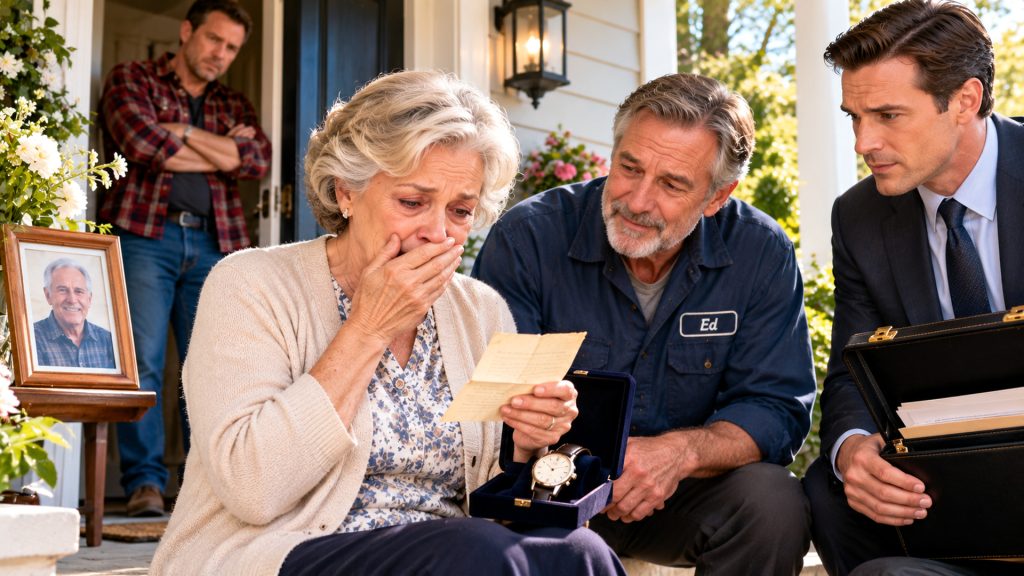
The tiny folded letter lay in her lap. Mr. Cole lowered his voice. “Yesterday morning, your brother submitted documents claiming that Margaret Brennan was no longer capable of managing her financial affairs.” My stomach dropped. “What?” Mom slowly raised her head.
Scott’s voice grew louder through the phone.
“Jenny, who are you talking to?”
I didn’t answer.
Mr. Cole continued.
“The filing requests an emergency appointment of someone to manage your mother’s property and finances.”
I felt the blood drain from my face.
“Someone?”
He hesitated.
“Scott.”
For a moment, the world seemed to become terribly quiet.
I stared at my mother.
Seventy-six years old.
Widowed only three months earlier.
Still capable of paying her bills, managing her home, remembering birthdays, and correcting me whenever I forgot the exact ingredients in Dad’s favorite meatloaf.
And my brother had apparently decided her grief was an opportunity.
“Jenny!” Scott shouted. “Answer me!”
I brought the phone closer.
“Scott, did you file paperwork claiming Mom can’t manage her own affairs?”
Silence.
Then he exhaled sharply.
“Don’t start.”
My hand began shaking.
“Did you?”
“I’m trying to protect her.”
I looked at Mom.
Her face had gone pale.
“Protect her from what?”
“From people taking advantage of her!”
I nearly laughed.
Not because anything was funny.
Because the cruelty of those words was almost impossible to comprehend.
“You stole Dad’s watch and sold it for forty dollars.”
Scott snapped, “It was an old watch!”
“An old watch you had no right to take.”
“You’ve always exaggerated everything.”
I closed my eyes.
Then asked the question that had been building inside me.
“Were you planning to take control of Mom’s money?”
His answer came too quickly.
“Someone has to make decisions.”
I felt something inside me turn cold.
“She’s perfectly capable of making her own decisions.”
Scott lowered his voice.
“Jenny, you don’t understand what you’re getting into.”
“Then explain it.”
He paused.
Then said, “Dad left things unfinished. There are assets nobody knows about.”
I stared at the lawyer.
Scott continued.
“And I’m not going to stand around while some stranger gets control of them.”
I took a slow breath.
“Who told you there were other assets?”
Another silence.
Then he said something that made my heart sink.
“I saw the watch.”
I looked toward the velvet box in Mom’s hands.
“What do you mean, you saw the watch?”
Scott sounded irritated.
“Before I sold it.”
My fingers tightened around the phone.
“You opened it?”
“No.”
“Then what did you see?”
He hesitated.
“Dad kept talking about Willow Lane near the end.”
I froze.
Mom looked up sharply.
I turned away from her.
“When?”
Scott sighed.
“A few weeks before he died. He was confused about some old house.”
I looked toward Mr. Cole.
His expression remained guarded.
Scott continued.
“I figured there might be something valuable connected to it.”
My chest tightened.
“So that’s why you took the watch.”
“I needed money.”
“You needed money, or you thought the watch might lead you to more?”
He didn’t answer.
Then he snapped, “Look, I don’t know what that lawyer told you, but Dad promised I’d be taken care of.”
I swallowed.
“Dad spent twenty years taking care of you.”
Scott’s voice hardened.
“Don’t do this, Jenny.”
“Do what?”
“Act like you’re better than me.”
I looked at the porch where Mom sat clutching fifty-one years of memories.
“This isn’t about being better than you.”
My voice trembled.
“It’s about what you did to our mother.”
He laughed bitterly.
“Mom doesn’t understand finances anymore.”
I stared at him.
“She understands that you sold her husband’s watch.”
Silence.
Then Scott whispered, “You don’t know the whole story.”
“Then tell me.”
He said nothing.
Finally, he muttered, “I’ll come over.”
“No.”
“Jenny—”
“Don’t come until Mom says she’s ready to see you.”
He began protesting.
I ended the call.
For several seconds, I stood motionless.
Then I turned toward my mother.
She had heard enough.
Her eyes were filled with tears.
“Scott wants to take my house?”
I knelt beside her.
“Mom, he filed something. That doesn’t mean he gets what he’s asking for.”
She nodded slowly.
Mr. Cole stepped forward.
“Mrs. Brennan, a filing is not the same as a court decision. You have rights, and you can contest it. Based on what I’ve seen today, there’s no reason to assume this request will succeed.”
Mom looked at him.
Then she whispered, “My own son thinks I’m helpless.”
The words broke my heart.
I took her hand.
“No, Mom.”
But I couldn’t finish.
Because I knew something worse.
Scott didn’t necessarily believe she was helpless.
He seemed to be hoping other people would.
We moved inside.
Ed placed the velvet box carefully on the dining table.
I made tea, though none of us drank much.
Mom kept the watch beside her.
Every few minutes, she reached out and touched it.
As though confirming it was really there.
Mr. Cole opened his briefcase again.
“Before we discuss your brother’s filing,” he said, “I need to explain exactly why I became involved.”
I sat across from him.
Mom folded her hands.
He removed several documents.
“Your husband contacted my firm shortly after his retirement. He wanted to review some property records and update his estate planning.”
Mom frowned.
“Harold never mentioned that.”
Mr. Cole nodded.
“He was concerned about discussing Willow Lane before he had resolved certain issues.”
“What issues?” I asked.
The lawyer glanced toward Mom.
“The property had been rented for many years. Harold wanted to make sure the tenant was protected. He also wanted to confirm that the title was clear and that any transfer to Margaret would be properly documented.”
Mom stared at the papers.
“He bought my childhood home?”
“Yes.”
“In 1981?”
“Yes.”
Her face crumpled.
I reached for her hand.
“Mom?”
She shook her head slowly.
“I don’t understand.”
Her voice trembled.
“Harold and I barely had enough money to buy groceries some weeks.”
Mr. Cole’s expression softened.
“He didn’t purchase the property outright with cash. The original records show that he used savings and financing, then paid it off over many years. There were repairs, insurance expenses, taxes, and rental income along the way.”
Mom pressed her fingers against her eyes.
“All that time?”
He nodded.
“All that time.”
I looked at the deed.
Willow Lane.
I knew that house.
At least, I knew the stories.
Mom had grown up there with her parents and younger sister.
There had been a pear tree in the backyard.
A narrow staircase.
And a kitchen window that looked directly toward the garden.
When her father became seriously ill, medical expenses overwhelmed the family.
They sold the house.
Mom was twenty-two.
She cried for months.
Not because the property was valuable.
But because it was where her mother taught her to bake bread.
Where her father read stories beside the fireplace.
Where the family had lived before illness changed everything.
Dad knew how much she missed it.
Apparently, he’d spent decades quietly protecting the place she’d lost.
I looked toward Mom.
Her lips were trembling.
“He never told me.”
Mr. Cole nodded.
“I believe he wanted it to be a surprise. Later, he worried that revealing it might create complications within the family.”
My throat tightened.
“Because of Scott?”
The lawyer didn’t answer immediately.
Then he said, “That concern appears in Harold’s written instructions.”
Mom closed her eyes.
And I realized that Dad had understood more about our family than I’d ever wanted to admit.
Ed shifted uncomfortably in his chair.
“I ought to explain something too.”
We turned toward him.
He looked down at his work-worn hands.
“When that young fellow brought the watch into my shop, I didn’t know whose it was.”
I nodded.
“He said it belonged to his father.”
Ed swallowed.
“He was in a hurry. Wanted cash right away.”
My jaw tightened.
“Forty dollars.”
Ed nodded.
“I offered him fifty, actually.”
I stared.
“He took forty?”
“He said forty was enough if I didn’t ask questions.”
A chill moved through me.
Ed continued.
“I didn’t think much of it at the time. People sell things for all kinds of reasons.”
He glanced toward Mom.
“But something about that watch bothered me.”
“What?”
“The wear.”
He took the watch from the box.
“The case was scratched, but the movement had been cared for. Somebody had spent years maintaining it.”
Mom smiled faintly.
“Harold took it to the same repairman every spring.”
Ed nodded.
“That explains it.”
He turned the watch over.
“When I started cleaning it, I noticed solder near the back.”
I leaned forward.
“It had been sealed?”
“Yes.”
He hesitated.
“I wasn’t comfortable forcing it open. So I took it to an old watchmaker I know. He helped me remove the back without damaging the movement.”
I looked at the tiny folded letter.
“And that’s when you found the note.”
Ed nodded.
“That’s when I realized it wasn’t just an old watch.”
His eyes filled.
“I’d bought fifty-one years of somebody’s life for forty dollars.”
Mom reached across the table.
“Ed.”
He looked at her.
She smiled through tears.
“You brought it home.”
His face crumpled.
“I couldn’t do anything else.”
He carefully placed the watch in her hands.
And for a moment, I felt more gratitude toward this stranger than I knew how to express.
My brother had looked at Dad’s watch and seen money for drinks.
Ed had looked at the same object and recognized a story worth protecting.
After Ed left, Mr. Cole asked whether he could speak with Mom privately.
I started to stand.
Mom reached for my arm.
“Jenny can stay.”
He nodded.
“Of course.”
Then he removed another envelope.
“This was prepared for you by Harold.”
Mom stared.
“Another letter?”
“Yes.”
He placed it on the table.
“Your husband asked that it be delivered when the property records were ready and when the appropriate legal arrangements had been completed.”
Mom looked confused.
“Then why are we hearing about it now?”
Mr. Cole took a breath.
“Because after Harold died, our firm began attempting to contact you about the estate matters we were handling. There were delays in locating some records and confirming instructions. When Mr. Ed called us about the watch, his discovery helped connect the handwritten note to the property file.”
I nodded slowly.
“So the watch wasn’t the only proof.”
“No. The property records exist independently. The note explains Harold’s intentions.”
I was relieved.
At least we weren’t relying on a tiny piece of paper that had been folded eight times and hidden behind a watch movement.
Mr. Cole gestured toward the envelope.
“Mrs. Brennan, would you like to read it?”
Mom nodded.
I passed it to her.
Her hands trembled as she opened it.
Dad’s familiar handwriting covered two pages.
She began reading aloud.
My Maggie,
At the sound of that name, Mom stopped.
Dad had called her Maggie for fifty-three years.
Even during arguments.
Even when he was tired.
Even in the hospital, when speaking required more strength than he had.
She pressed her lips together.
Then continued.
If you’re reading this, I probably didn’t get the chance to finish what I started.
I’ve spent most of my life trying to give you back something you lost long before we were married.
Mom began crying.
You always said Willow Lane was the happiest house you ever knew.
I remember the first time you took me past it. You pointed to the upstairs window and told me that was where you used to wait for your father to come home.
I closed my eyes.
I’d heard that story too.
You laughed when you told me about the pear tree.
But I saw you cry when we drove away.
Mom wiped her cheeks.
I couldn’t bear the thought that the place holding so much of your childhood had become another thing life had taken from you.
Her voice broke.
She handed the letter to me.
“Jenny, please.”
I took it carefully.
And continued.
So I made a plan.
It took longer than I expected.
There were years when I nearly gave up.
But every month, I put something aside.
When the opportunity came to buy the property, I took it.
Tears blurred my eyes.
I kept it rented because the woman living there reminded me of your mother.
She was alone.
She loved that little house.
I couldn’t take it away from her just to finish my surprise.
Mom covered her mouth.
I thought there would always be more time.
My voice trembled.
Time to repaint the kitchen.
Time to fix the porch.
Time to plant another pear tree.
Time to bring you there, hand you the keys, and watch you smile.
I stopped.
For several seconds, nobody spoke.
Then I continued.
But the older I get, the more I realize that time doesn’t wait for our plans.
If I can’t finish the surprise myself, I hope you will still accept it.
Not because a house can replace the people we’ve lost.
But because sometimes a place reminds us that the love we received didn’t disappear.
Mom began sobbing.
I swallowed.
There was one final paragraph.
And Maggie, if anyone ever makes you feel guilty for keeping what belongs to you, remember this:
You spent your life giving everything you could to our family.
It’s time somebody gave something back to you.
Always yours, Harold.
I lowered the letter.
Mom covered her face.
And I thought about the man who’d worn the same watch for fifty-one years.
The man who patched his work boots rather than buy new ones.
The man who carried a lunchbox to the steel mill and came home smelling of metal and machine oil.
All that time, he’d been quietly keeping a promise to a young woman who’d once cried over the loss of her childhood home.
We visited Willow Lane three days later.
Mr. Cole arranged for us to see the property, and Rebecca, a local real estate attorney he’d recommended, accompanied us to explain the title and estate documents.
The house stood at the end of a tree-lined street.
Its paint was faded.
The porch sagged slightly.
And the garden had grown wild.
But when Mom stepped out of my car, she gasped.
“Oh, Jenny.”
I looked at her.
She stood motionless, staring at the little white house.
Then she began walking.
Slowly.
As though afraid it might vanish if she approached too quickly.
She stopped beside the front steps.
“The railing used to be green.”
I smiled through tears.
“Really?”
She nodded.
“My father painted it every spring.”
She touched the worn wood.
Then looked toward the yard.
“The pear tree.”
I followed her gaze.
A tall, crooked tree stood near the fence.
Its branches were bare in the January cold.
Mom’s eyes filled.
“It’s still here.”
I looked toward Rebecca.
She smiled gently.
Mom walked closer to the tree.
Then placed her palm against the trunk.
“My father planted this the year I was born.”
Her voice broke.
“He said it would grow with me.”
I watched my mother stand beside that tree.
For months, grief had made her look smaller.
She moved slowly through the house she and Dad had shared.
She rarely laughed.
Sometimes she sat for hours staring at his reading glasses.
But standing in front of Willow Lane, something in her expression changed.
Not because she had stopped missing him.
But because she had found another piece of the life they’d shared.
We went inside.
The rooms smelled of old wood and dust.
Sunlight filtered through the windows.
Mom moved from room to room, touching the doorframes.
“The kitchen was yellow.”
She smiled faintly.
“My mother hated yellow, but Dad insisted it made breakfast cheerful.”
We laughed.
Then she walked toward the staircase.
I followed.
At the top, she stopped outside a small bedroom.
She pushed the door open.
And began crying.
I stepped beside her.
“What is it?”
She pointed toward the windowsill.
There was a tiny scratch in the paint.
A crooked letter M.
Mom covered her mouth.
“I carved that.”
I stared.
“When?”
“When I was twelve.”
Her voice trembled.
“My sister dared me.”
She laughed through tears.
“Dad was furious.”
I placed my arm around her.
And suddenly, I understood what my father had been trying to give her.
Not a house worth money.
A doorway back into the years before loss had taught her how fragile happiness could be.
As we prepared to leave, Rebecca asked whether Mom wanted to keep the property.
Mom looked surprised.
“Keep it?”
“Yes.”
She glanced around.
“I don’t know.”
I studied her.
“You don’t have to decide today.”
She nodded.
Then looked toward the kitchen.
“I always thought if I ever came back here, I’d feel like a little girl again.”
I smiled.
“And do you?”
She considered.
“No.”
Her eyes filled.
“I feel like an old woman remembering a little girl.”
I squeezed her hand.
“That’s not a bad thing.”
She smiled sadly.
“No.”
Then she looked toward the front door.
“I think I’d like to restore it.”
My heart lifted.
“Really?”
She nodded.
“Not because I need another house.”
She glanced toward the pear tree.
“But because your father wanted to bring this place back to life.”
Her voice softened.
“And maybe I can finish what he started.”
I smiled.
“Then we’ll do it together.”
Scott called that evening.
I answered reluctantly.
“What?”
His voice sounded strained.
“Jenny, we need to talk.”
I took a breath.
“About Mom?”
“Yes.”
“Then you need to stop trying to take control of her finances.”
He sighed sharply.
“It’s not that simple.”
“It is to me.”
He was quiet.
Then he said, “I know about Willow Lane.”
I closed my eyes.
“How?”
“Dad mentioned it before he died.”
I frowned.
“You said he was confused.”
Scott hesitated.
“He wasn’t always confused.”
My stomach tightened.
“What does that mean?”
Silence.
Then he whispered, “He told me there was property.”
I sat down.
“When?”
“A month before he died.”
“And what did you do?”
He exhaled.
“I asked him about it.”
I waited.
“He said it wasn’t mine.”
My heart sank.
Scott continued.
“He said it was for Mom.”
I closed my eyes.
Of course.
Dad had told him.
And Scott, rather than respecting that, had begun searching for ways to gain control.
“Scott,” I whispered, “you knew.”
He didn’t answer.
“You knew Dad wanted Mom to have it.”
He snapped, “I knew he was hiding money!”
I stared at the wall.
“He wasn’t hiding it from Mom to cheat her.”
Scott laughed bitterly.
“He was hiding it from me.”
I swallowed.
“Yes.”
The word hung between us.
Then Scott said something that shocked me.
“Do you know how that feels?”
I closed my eyes.
“No, Scott. I don’t.”
He sounded close to tears.
“Like Dad never trusted me.”
My throat tightened.
I thought about the six times Dad had paid off Scott’s debts.
The loans.
The promises.
The nights Mom cried because another creditor had called.
I took a breath.
“Scott, Dad loved you.”
He was silent.
“But he didn’t trust you with money.”
His breath caught.
“And you need to understand that those are two different things.”
Two weeks later, the court considered Scott’s request concerning Mom’s financial affairs.
I went with her.
She wore her favorite navy coat and carried a folder containing her bank statements, bills, and other records she’d prepared with her attorney.
She was nervous.
But she was also determined.
Before we entered, she took my hand.
“Jenny, what if they believe him?”
I squeezed her fingers.
“Then we’ll respond through the proper process.”
She nodded.
Then whispered, “I never thought I’d have to prove I can take care of myself.”
My heart ached.
“I know.”
The hearing was less dramatic than I’d feared.
Scott’s claims were reviewed.
Mom’s attorney presented information about her ability to manage her affairs.
And Mom answered questions clearly.
She knew her income.
Her expenses.
Her responsibilities.
And the details of the property matters under discussion.
When asked why she opposed Scott’s request, she spoke quietly.
“Because I’m grieving my husband, not losing my mind.”
The room fell silent.
She continued.
“My son believes that because I’m old and sad, I must need someone else to make decisions for me.”
Her voice trembled.
“But I have managed a household for more than fifty years.”
She looked toward Scott.
“And I would rather receive help when I ask for it than have my independence taken away because someone thinks I might own something valuable.”
I covered my mouth.
The request for emergency control was denied.
Further proceedings were not pursued after the parties addressed the remaining issues through counsel.
Mom walked out of the courthouse holding her head high.
She didn’t look triumphant.
She looked exhausted.
But there was something different in her eyes.
She had been heard.
And for the first time since Dad died, she wasn’t apologizing for wanting to make her own decisions.
Scott waited near the parking lot.
Mom stopped when she saw him.
For a moment, I thought she might walk past.
Instead, she approached.
“Scott.”
He looked down.
“Mom.”
She studied him.
“You took your father’s watch.”
He swallowed.
“I know.”
“You sold it.”
His eyes filled.
“Yes.”
“You told me I was imagining things.”
He looked away.
Mom’s voice broke.
“That was the part that hurt most.”
Scott covered his face.
“I didn’t know what to say.”
She nodded slowly.
“So you let me think I was losing my memory.”
He began crying.
“Mom, I’m sorry.”
She looked at him.
“I’ve heard you say sorry many times.”
He lowered his head.
“And I have forgiven you many times.”
Her voice trembled.
“But forgiveness hasn’t taught you to stop hurting people.”
Scott stared at her.
I felt tears rising.
Mom continued.
“I love you.”
His shoulders shook.
“But I won’t give you control of my finances.”
He nodded.
“And I won’t give you Willow Lane.”
He closed his eyes.
“Mom—”
“No.”
Her voice was gentle but firm.
“Your father worked too hard for me to surrender his final gift because you want another chance to solve your debts with someone else’s money.”
Scott began sobbing.
Mom stepped closer.
She touched his cheek.
“You can still be my son.”
His eyes filled.
“But you cannot keep treating my love as something you can sell.”
The words settled between them.
And for the first time, Scott didn’t argue.
After that, Mom began restoring Willow Lane.
Not quickly.
Not extravagantly.
She hired local contractors to inspect the house and make necessary repairs.
The wiring needed attention.
The porch required reinforcement.
Several windows had to be replaced.
But the structure was sound.
Mom visited every week.
Sometimes I drove her.
Sometimes Rebecca joined us to discuss practical matters.
And occasionally, Ed stopped by.
He had taken a personal interest in the project.
One afternoon, he arrived carrying an old toolbox.
“I thought you might need a hand.”
Mom smiled.
“Ed, you’ve already done more than enough.”
He shrugged.
“I like fixing things.”
I laughed.
“That makes two of you.”
He looked toward Dad’s photograph, which Mom had placed temporarily on the kitchen counter.
“Your husband must’ve been something.”
Mom smiled sadly.
“He was.”
Then she added, “Stubborn as a mule.”
Ed laughed.
“Those are usually the ones who build things that last.”
I watched Mom smile.
A real smile.
One I hadn’t seen often since October.
And I felt grateful all over again that Ed had looked inside an old watch instead of placing it in his shop window with a forty-dollar price tag.
Spring arrived.
The pear tree blossomed.
Mom insisted we spend an afternoon beneath it.
I brought sandwiches.
She brought lemonade.
We sat on a blanket in the grass.
The house was still being repaired, but the garden had begun to come alive.
Mom looked toward the branches.
“When I was little, my father used to tie a swing here.”
I smiled.
“Really?”
She nodded.
“I spent hours on it.”
She looked at me.
“Your grandfather would push me so high I thought I could touch the clouds.”
I laughed.
“That sounds terrifying.”
“It was wonderful.”
Her smile faded gently.
“I wish I’d told Harold more often how much that memory meant to me.”
I took her hand.
“He knew.”
She looked at me.
I smiled.
“He bought the whole house because he remembered you telling him.”
Tears filled her eyes.
Then she nodded slowly.
“Yes.”
She looked toward the porch.
“He knew.”
For a long time, we sat quietly.
Then Mom said, “Jenny, I’ve been thinking about what to do with this place.”
I looked up.
“What do you mean?”
She smiled.
“I don’t want to move here permanently.”
I nodded.
“Your home with Dad is still your home.”
“Yes.”
She looked toward the garden.
“But I don’t want Willow Lane sitting empty.”
I waited.
Then she said something that surprised me.
“I want it to become a place where people can gather.”
I frowned.
“What kind of gathering?”
She smiled.
“Widows. Widowers. People who’ve lost someone and don’t know what to do with all the quiet afterward.”
My throat tightened.
She continued.
“Maybe we could host afternoon tea.”
She laughed softly.
“Or a reading group.”
I smiled.
“And your terrible bridge games?”
Mom grinned.
“Especially those.”
We both laughed.
Then she looked toward the pear tree.
“Your father brought this house back to me.”
Her eyes filled.
“I think I’d like to use it to give something back.”
By summer, Willow Lane had become something beautiful.
The porch was repaired.
The walls were painted a soft cream.
The kitchen was restored with pale yellow cabinets, just as Mom remembered.
We kept the old staircase.
The scratched windowsill.
And the pear tree.
Mom insisted the crooked letter M remain untouched.
“That stays,” she told the painter.
He smiled.
“Yes, ma’am.”
In the living room, we placed comfortable chairs.
Bookshelves.
A long table for tea.
And photographs of Harold Brennan.
Not because we wanted to turn the house into a memorial.
But because the home existed through his quiet determination.
We named the space Harold’s House.
The first gathering was held on a warm Saturday afternoon.
Twelve people came.
Some were widowed.
Some lived alone.
Some had simply heard about a place where nobody would be expected to pretend grief had an expiration date.
Mom stood in the doorway greeting each visitor.
She wore a lavender dress and Dad’s old watch.
The repaired leather strap sat snugly around her wrist.
When the clock struck three, she raised her teacup.
“I’d like to say something.”
The room quieted.
Mom looked around.
“My husband spent years restoring something I thought was lost.”
Her voice trembled.
“He never got to see me standing here.”
She touched the watch.
“But I hope he’d be glad to know this house won’t be empty.”
People smiled gently.
Mom continued.
“Grief can make the world feel very small.”
She looked toward the windows.
“And sometimes the greatest kindness is simply giving someone a place to sit while they remember how to live.”
Her eyes filled.
“So welcome.”
She smiled.
“There’s tea in the kitchen, cake on the table, and nobody has to pretend they’re fine.”
I began crying.
Not from sorrow alone.
But because my mother, who had spent months sitting beside an empty space on her dresser, was now creating room for other people who understood that kind of emptiness.
Ed became a regular visitor.
He repaired little things around the house.
Fixed a stubborn door hinge.
Replaced a loose handle.
And occasionally brought old clocks he’d restored.
Mom teased him that he was turning her gathering place into a repair shop.
He laughed.
“Everything deserves a second chance.”
One afternoon, I found them sitting together on the porch.
Mom was telling him about Dad.
“He could fix almost anything,” she said.
Ed smiled.
“Sounds like my kind of man.”
Mom laughed.
“Except the dishwasher.”
Ed raised an eyebrow.
“What happened?”
“He tried to repair it himself and flooded the kitchen.”
Ed burst out laughing.
I smiled from the doorway.
For the first time, Mom was speaking about Dad without collapsing into tears.
She still missed him.
She always would.
But the memories had begun to bring warmth alongside the ache.
And I realized that the house wasn’t the only thing being restored.
Scott stayed away for several months.
At first, I was relieved.
His absence meant no arguments.
No demands.
No frantic calls asking for money.
But I also worried.
He was still my brother.
And despite everything, I remembered the boy who used to build forts with me beneath our parents’ dining table.
One evening, he called.
“Jenny?”
I hesitated.
“What is it?”
His voice sounded different.
Quieter.
“I wanted to tell you something.”
I waited.
“I started attending meetings.”
I frowned.
“What kind?”
“Support meetings.”
He took a breath.
“For drinking.”
My chest tightened.
Scott had always insisted his drinking wasn’t a problem.
He said he was simply unlucky.
That bills piled up.
That people exaggerated.
That everyone needed a few drinks sometimes.
Now, for the first time, he was naming what had been destroying his life.
I sat down.
“Scott, that’s important.”
He swallowed.
“I know.”
Then he said, “I’m seeing a counselor too.”
I closed my eyes.
“Good.”
He was quiet.
Then whispered, “I keep thinking about Dad’s watch.”
My throat tightened.
“What about it?”
“I sold it for forty dollars.”
His voice broke.
“And he wore it for fifty-one years.”
I closed my eyes.
“I know.”
He began crying.
“I don’t know what kind of person does that.”
I took a slow breath.
“Someone who needs to face the harm he’s caused.”
He was silent.
I continued.
“Scott, you can’t undo it.”
“I know.”
“But you can decide whether you’re going to keep living the same way.”
He sniffed.
“I’m trying.”
I looked toward the window.
“Then keep trying.”
Three weeks later, Scott asked to see Mom.
I told him it was her decision.
She considered for several days.
Then agreed to meet him at Willow Lane.
Not at her own home.
Not somewhere he could arrive unexpectedly.
At the house Dad had worked so hard to protect.
Scott arrived carrying a small paper bag.
He looked older.
His face was thinner.
His hands trembled slightly.
Mom stood on the porch.
For a moment, neither spoke.
Then Scott whispered, “Hi, Mom.”
She nodded.
“Hello, Scott.”
He looked around the property.
“It’s beautiful.”
Mom smiled faintly.
“Your father would have liked it.”
Scott’s eyes filled.
“I know.”
They sat in the living room.
I remained nearby, but Mom wanted to speak for herself.
Scott placed the paper bag on the table.
“I brought something.”
Mom looked at it.
“What?”
He removed a small wooden box.
Inside was a photograph.
Dad, Scott, and me standing beside our old station wagon.
Scott was about eight.
I was twelve.
Dad had one arm around each of us.
His watch was visible on his wrist.
Mom covered her mouth.
“Where did you find this?”
Scott swallowed.
“In my garage.”
He looked down.
“I’ve been going through old things.”
Tears filled his eyes.
“I found it behind some boxes.”
Mom touched the photograph.
Scott continued.
“I also brought forty dollars.”
My heart tightened.
He placed two twenty-dollar bills beside the box.
Mom stared.
He swallowed.
“I know it doesn’t make things right.”
She nodded.
“No.”
His eyes filled.
“But I wanted to give back what I took.”
Mom looked at him for a long moment.
Then she said quietly, “Scott, your father’s watch was never worth only forty dollars.”
He began crying.
“I know.”
She reached for his hand.
“Do you?”
He nodded through tears.
“I think I’m finally starting to.”
Mom squeezed his fingers.
“Then perhaps you’re beginning to understand what you really lost.”
Their relationship didn’t heal overnight.
Mom didn’t give Scott money.
She didn’t offer to put him in charge of anything.
She didn’t erase the court proceedings from her memory.
But she allowed him to visit occasionally.
At first, their conversations were short.
Awkward.
Careful.
Then, slowly, they began talking about ordinary things.
The weather.
The garden.
The old family photographs.
Scott continued attending support meetings and working with professionals on his finances.
He found steady employment at a local warehouse.
The work wasn’t glamorous.
It didn’t pay much.
But it was honest.
One afternoon, he arrived at Willow Lane with a bag of groceries.
Mom looked surprised.
“What is this?”
He smiled awkwardly.
“I brought ingredients for dinner.”
She raised an eyebrow.
“Are you cooking?”
He laughed.
“Trying.”
Mom smiled.
“Your father couldn’t cook either.”
Scott’s face softened.
“I know.”
He looked down.
“Maybe you can teach me.”
Mom studied him.
Then nodded.
“All right.”
I watched from the doorway as my mother and brother began preparing Dad’s favorite stew.
For the first time in years, Scott wasn’t asking for something.
He was offering his time.
And perhaps that was the beginning of the change we’d hoped for.
That autumn, we held a small celebration at Harold’s House.
It had been one year since Dad died.
I expected the anniversary to be unbearable.
But Mom insisted we mark it with something meaningful.
She invited the people who had become regular visitors.
Neighbors.
Old friends.
Widows and widowers.
Ed.
Rebecca.
And, after some thought, Scott.
We gathered beneath the pear tree.
The leaves had turned gold.
Mom stood beside a small wooden bench we’d installed in Dad’s memory.
It faced the garden.
A brass plaque read:
HAROLD BRENNAN
A LIFE BUILT WITH QUIET LOVE
Mom touched the plaque.
Then looked at everyone.
“My husband wasn’t a wealthy man.”
She smiled faintly.
“He worked in a steel mill.”
Her voice trembled.
“He came home tired. He worried about bills. He sometimes forgot anniversaries.”
A few people laughed.
“But he knew something important.”
She looked toward the house.
“Love isn’t only something you say.”
Her eyes filled.
“It’s something you build.”
I covered my mouth.
Mom continued.
“He spent decades protecting a place I thought I’d lost.”
She touched the watch on her wrist.
“And after he died, that gift taught me something I wasn’t expecting.”
The room grew quiet.
“That I still had a life to live.”
Her voice broke.
“And that I could honor him by filling it with kindness.”
She smiled through tears.
“So today, instead of only mourning what we’ve lost, I want us to remember what remains.”
She looked around.
“Friendship.”
“Memory.”
“Family.”
“And the chance to make someone else’s day a little less lonely.”
Tears filled my eyes.
Then Mom added softly, “Harold would’ve liked that.”
After the gathering, I found Scott standing alone beside the pear tree.
He was looking toward the bench.
I approached carefully.
“You okay?”
He nodded.
Then shook his head.
“I don’t know.”
I stood beside him.
For a while, neither of us spoke.
Then he whispered, “Dad knew.”
I looked at him.
“Knew what?”
“That I’d become someone he couldn’t trust.”
My throat tightened.
I considered.
“Scott, Dad knew you were struggling.”
He looked down.
“He kept helping me.”
“Yes.”
His eyes filled.
“And I kept letting him.”
I nodded.
Scott wiped his face.
“I thought he had endless chances to fix everything.”
My heart ached.
“Parents aren’t endless, Scott.”
He closed his eyes.
“I know.”
Then he whispered, “I wish I’d told him I was sorry.”
I looked toward the bench.
“You can’t tell him now.”
Scott began crying.
“But you can live differently.”
He looked at me.
I continued.
“That won’t erase what happened.”
He nodded.
“But it will mean the lessons he tried to teach you weren’t wasted.”
Scott stared toward the house.
Then whispered, “I’m trying.”
For the first time, I believed he understood that trying wasn’t something you announced once.
It was something you proved over time.
Winter came again.
The anniversary of the day Ed returned Dad’s watch approached.
Mom and I sat together at her kitchen table.
The watch rested on her wrist.
She wore it almost every day now.
Sometimes she forgot to wind it, and the hands stopped.
Then she’d laugh and ask me to help.
It wasn’t a perfect watch.
It had scratches.
A scarred glass face.
And a mechanism that required care.
But it still worked.
One afternoon, I asked, “Mom, do you ever wonder why Dad hid that first note inside it?”
She smiled thoughtfully.
“Sometimes.”
I looked at the watch.
“He could’ve told you about Willow Lane.”
She nodded.
“He could have.”
Then she looked toward the window.
“But Harold always liked surprises.”
I laughed.
“He was terrible at keeping them.”
Mom smiled.
“Usually.”
She touched the watch.
“Maybe he knew he’d need a way to leave me something if he couldn’t finish what he started.”
I nodded.
Then she whispered, “Or maybe he just wanted me to have one last mystery to solve.”
We laughed.
For a long moment, we sat quietly.
Then Mom said something that stayed with me.
“Jenny, I used to think the watch brought Harold back to me.”
I looked at her.
She shook her head gently.
“But it didn’t.”
Her eyes filled.
“What it did was remind me that he never really stopped loving me.”
I reached for her hand.
“And that was enough.”
As another year passed, Harold’s House grew.
What began as a small gathering place became a welcoming space for people experiencing loneliness and grief.
We hosted reading afternoons.
Simple craft sessions.
Tea gatherings.
And occasional talks from local professionals about managing practical issues after losing a spouse.
Mom insisted that nobody be pressured to speak about grief unless they wanted to.
Some visitors came simply to sit.
Some brought photographs.
Others talked for hours.
And some laughed more than they had in months.
Ed continued helping.
He became our unofficial clock repairman.
Whenever someone brought an old watch or clock with sentimental value, he offered to inspect it.
One afternoon, a widower brought a pocket watch that had belonged to his wife.
Ed repaired the winding mechanism.
The man began crying when he heard it ticking again.
Mom reached for his hand.
“I know,” she whispered.
And I realized that the story of Dad’s watch had quietly become something larger than our family.
It had taught us to look beyond an object’s price.
To recognize that ordinary belongings can carry extraordinary memories.
And to understand that sometimes the smallest things hold the stories people are most afraid of losing.
One spring afternoon, Mom asked me to drive her to the cemetery.
Dad’s grave stood beneath a maple tree.
The grass had grown green around the headstone.
We brought yellow flowers.
Mom placed them carefully beside the stone.
Then she sat on the nearby bench.
For a long time, she said nothing.
I waited.
Finally, she whispered, “Hello, Harold.”
My throat tightened.
She smiled through tears.
“I found the house.”
The wind moved gently through the trees.
“I found your note.”
She touched the watch.
“And I found your watch.”
Her voice broke.
“I wish you could’ve seen my face when I walked through that front door.”
Tears streamed down my cheeks.
Mom continued.
“You were always doing things quietly.”
She laughed softly.
“Fixing broken chairs. Helping neighbors. Making sure everyone else had enough.”
She looked toward his name.
“And now, somehow, you’ve done it again.”
I took her hand.
Mom squeezed it.
“Harold’s House is full of people.”
Her eyes filled.
“They come to laugh and cry and remember the people they’ve lost.”
She smiled.
“And sometimes they stay for cake.”
I laughed through tears.
“Your favorite.”
Mom nodded.
Then whispered, “I think you’d like what we’ve done.”
For a moment, she looked very peaceful.
Then she added, “And Harold?”
I looked toward her.
“I finally understand.”
Her voice trembled.
“The house was never the real gift.”
She touched the watch.
“You were.”
On the drive home, Mom told me she wanted to update her own estate documents.
I glanced toward her.
“Are you sure?”
She nodded.
“Very.”
I smiled.
“What are you thinking?”
She looked out the window.
“I want Harold’s House to continue after I’m gone.”
My throat tightened.
“Mom.”
She turned toward me.
“Not because I plan to leave anytime soon.”
I laughed through tears.
“Good.”
“But because I know how easily good intentions can disappear when nobody makes a plan.”
I nodded.
We met with Rebecca and discussed practical options.
Mom wanted the property used to support the community.
She wanted it maintained.
And she wanted the people who came there to know they belonged.
After reviewing the options, she created an estate plan designed to protect those wishes and provide for the property’s future.
She also made clear provisions for her remaining assets.
I didn’t ask what she intended to leave Scott.
That was her decision.
And after everything we’d experienced, I knew respecting her choices mattered more than any inheritance.
One afternoon, after signing the documents, Mom smiled.
“There.”
I laughed.
“Feel better?”
She nodded.
“Much.”
Then she looked at me.
“Jenny, do you know what your father taught me?”
I smiled.
“What?”
“That love without planning can leave a lot of work for the people who remain.”
I laughed.
“That sounds like Dad.”
Mom grinned.
“And he also taught me that planning doesn’t mean you stop living.”
She looked toward the garden.
“So now that the paperwork is done, I’d like to go buy more flowers.”
I laughed.
“Of course you would.”
The years that followed weren’t perfect.
Scott had setbacks.
There were difficult conversations.
Times when he struggled with temptation or felt ashamed of how slowly his life was improving.
But he continued seeking help.
He began keeping his promises more consistently.
And he learned to accept that rebuilding trust required patience.
Mom didn’t give him access to her accounts.
She didn’t lend him large sums of money.
She didn’t pretend the past had disappeared.
But she invited him for dinner.
She listened when he wanted to talk.
And she thanked him when he showed up to help without expecting anything in return.
One summer, Scott spent an entire weekend repairing the garden fence at Willow Lane.
I watched him work beneath the sun.
His shirt was soaked with sweat.
His hands were scratched.
And for the first time in years, he looked proud of something he’d accomplished without borrowing money or asking anyone to rescue him.
When he finished, Mom stepped outside.
She examined the fence carefully.
Then smiled.
“Your father would’ve approved.”
Scott’s eyes filled.
“Really?”
She nodded.
“He would’ve complained about your measurements first.”
We all laughed.
Then she added softly, “But yes.”
Scott looked down.
And I knew those words meant more to him than any money Dad could have left.
One evening, long after the guests had gone home from Harold’s House, I found Mom standing beside the mantel.
Dad’s photograph rested there.
Beside it lay the velvet box Ed had used to return the watch.
I smiled.
“Still keeping that box?”
Mom nodded.
“Of course.”
I laughed softly.
“Why?”
She looked at me.
“Because sometimes the people who save our most precious memories aren’t the ones we expect.”
My throat tightened.
She touched the velvet lining.
“A stranger could’ve sold this watch.”
I nodded.
“He could have.”
“But he chose to look more closely.”
She smiled.
“And because he did, I found something your father had been trying to give me for decades.”
I looked toward the photograph.
Mom continued.
“Scott saw forty dollars.”
Her voice trembled.
“Ed saw fifty-one years.”
I covered my mouth.
Then she looked at me.
“And Harold saw a promise.”
For a long moment, we stood quietly.
I understood exactly what she meant.
Three men had looked at the same watch.
One saw an easy way to buy drinks.
One recognized a precious family keepsake.
And one had carried it on his wrist for half a century while quietly building something that would outlive him.
The watch itself hadn’t changed.
Only the meaning people were willing to see.
I am older now than I was that January morning when Ed rang Mom’s doorbell.
And whenever I think about that day, I remember the smallest details.
The cold air.
The velvet box.
Mom’s trembling hands.
The yellowed paper folded eight times.
The way she sat down on the porch step when she read Dad’s first words.
And the terrible moment when we learned Scott was trying to take control of her finances.
At the time, I believed the story would end with anger.
I thought we’d spend years fighting over property.
That Mom would lose whatever peace she had left.
That Scott would never change.
And that Dad’s final gift would become another reason for our family to fall apart.
But life rarely unfolds exactly as we expect.
The truth hurt.
The consequences were real.
And not every wound healed completely.
Yet something beautiful emerged.
Mom found her childhood home.
She found the courage to protect her independence.
She found a new purpose in a life that had seemed unbearably empty after Dad died.
Scott began facing the problems he’d spent years avoiding.
And I learned that protecting someone you love doesn’t always mean doing everything for them.
Sometimes it means standing beside them while they make their own decisions.
Sometimes it means saying no.
And sometimes it means refusing to let another person’s mistakes define the rest of the family.
On the fifth anniversary of Dad’s death, we gathered beneath the pear tree.
Mom was eighty-one.
Her hair had turned almost completely white.
She walked more slowly now, but her mind was sharp and her laughter had returned.
Scott stood beside her.
Ed sat on the porch with a cup of tea.
And Harold’s House was filled with people who had become part of our extended family.
Mom raised her wrist.
Dad’s old watch gleamed softly in the afternoon sunlight.
I smiled.
“Still wearing it?”
She laughed.
“Of course.”
Then she looked toward the pear tree.
“Your father wore it for fifty-one years.”
Her voice trembled.
“I suppose I can keep it going a little longer.”
I took her hand.
“Mom, do you ever wish he’d just told you about the house?”
She considered.
Then smiled.
“Sometimes.”
I laughed.
“But?”
She looked toward the white porch.
“The surprise wasn’t what mattered.”
She squeezed my fingers.
“What mattered was knowing he’d spent all those years thinking about something that would make me happy.”
Her eyes filled.
“And after losing him, that knowledge helped me keep living.”
I leaned against her shoulder.
For a while, we watched the sunlight move through the pear tree.
Then Scott approached.
He carried a tray of lemonade.
“Anybody thirsty?”
Mom smiled.
“Thank you, sweetheart.”
He handed her a glass.
Then looked toward the house.
“Dad would’ve loved this.”
Mom nodded.
“Yes.”
Her voice broke.
“He would’ve.”
And for the first time, I saw my brother standing in the place Dad had protected, not as someone trying to claim it, but as someone willing to help care for it.
That was the kind of inheritance Dad had always wanted us to understand.
Not simply property.
Responsibility.
Memory.
And the quiet work of loving people well.
Later that afternoon, I walked through the house alone.
Sunlight filled the restored kitchen.
Laughter drifted from the porch.
The old staircase creaked beneath my feet.
I went upstairs to Mom’s childhood bedroom.
The little scratched M remained on the windowsill.
I touched it gently.
Then looked out toward the pear tree.
I thought about Dad.
The steel mill.
The lunchbox.
The long shifts.
The aching hands.
The watch he’d worn every day.
I thought about the sacrifices he’d made quietly, without expecting applause.
And I realized that the true beauty of his gift wasn’t its secrecy.
It was its purpose.
He hadn’t purchased Willow Lane to control Mom.
He hadn’t intended to impress strangers.
He hadn’t wanted his children to fight over it.
He had simply remembered something that mattered to the woman he loved.
And he’d spent decades trying to give it back.
I smiled through tears.
“Dad,” I whispered, “we found it.”
The house was filled with life.
The garden was blooming.
Mom was laughing downstairs.
And the watch he’d bought with his first paycheck was still ticking.
I closed my eyes.
For a moment, I imagined him standing beside me.
His work shirt rolled at the sleeves.
His hair streaked with gray.
That familiar half-smile on his face.
Then I opened my eyes.
The room was empty.
But the love he’d left behind was everywhere.
People often ask what became of the watch.
Some assume it must have contained a fortune.
A hidden bank account.
A rare jewel.
A secret inheritance worth millions.
But the truth is much more meaningful.
There was no treasure hidden inside the movement.
Only a tiny folded letter.
And behind that letter, a promise that had quietly shaped more than forty years of my parents’ marriage.
The watch had cost my father a small part of his first steel mill paycheck.
My brother sold it for forty dollars.
Ed returned it without demanding a profit.
And Mom wore it for years afterward because its value had never been measured in money.
It was the object that had followed Dad through nearly every important moment of his adult life.
His wedding.
The births of his children.
His retirement.
His final illness.
And, somehow, it became the thing that guided us toward a future none of us imagined.
A future where Mom had a purpose beyond mourning.
Where strangers found companionship in the home she once lost.
Where my brother began learning that love requires accountability.
And where I discovered that sometimes the most important things our parents leave us cannot be divided into equal shares.
One night, after everyone had gone home, Mom sat beside me on the porch.
The sky was filled with stars.
The pear tree moved gently in the breeze.
Dad’s watch ticked softly against her wrist.
She looked toward the garden.
“Jenny?”
“Yes, Mom?”
“Do you think your father knew how much this would mean to me?”
I smiled.
“I think he hoped.”
She nodded.
Then whispered, “I wish I’d thanked him.”
My throat tightened.
I took her hand.
“Mom, you thanked him every day you loved him.”
She looked at me.
Tears filled her eyes.
I continued.
“You built a life with him.”
“You raised us together.”
“You stayed beside him when he was sick.”
I smiled through tears.
“And you never stopped telling him you loved him.”
Mom lowered her head.
Then she laughed softly.
“He was a good man.”
I nodded.
“Yes.”
She looked toward the house.
“Not a perfect one.”
I smiled.
“No.”
She touched the watch.
“But a good one.”
For a long time, we sat quietly.
Then she whispered something I’ll never forget.
“Jenny, I think I’ve finally learned what home is.”
I looked at her.
“What?”
She smiled through tears.
“It isn’t the place where nothing bad ever happens.”
Her voice trembled.
“It isn’t the house we grew up in, or the one we share with someone we love.”
She looked toward the garden.
“It’s the place where the love we received teaches us how to love someone else.”
I squeezed her hand.
And for the first time, I understood why Dad’s gift had become so much larger than a deed.
The house had been lost once.
Recovered decades later.
And transformed into a place where other people’s broken hearts could find companionship.
Dad hadn’t simply given Mom back her childhood home.
He’d given her a way to keep creating love after his own life ended.
Today, whenever I hear someone say an old possession is worthless, I think about Dad’s watch.
A scratched steel case.
A scarred glass face.
A worn leather strap.
Forty dollars in a secondhand shop.
Fifty-one years on one man’s wrist.
And one small letter that changed the future of an entire family.
I think about how easy it is to overlook the things that matter most.
The old photographs.
The handwritten recipes.
The worn tools.
The little objects that accompany us through ordinary days.
Their value isn’t always visible.
Sometimes it’s hidden in the stories we haven’t asked about.
The memories we haven’t shared.
The sacrifices nobody noticed.
And the promises people kept quietly because they believed love was worth the effort.
Dad never became famous.
He never owned a grand estate.
He never wore an expensive watch.
But he spent his life building something that outlasted him.
A legacy of kindness.
Of responsibility.
Of remembering what mattered to the people he loved.
And when I think about the day Mom finally walked into Willow Lane, I know exactly what he’d wanted.
Not gratitude.
Not admiration.
Just the chance to see her smile.
The last time I visited Harold’s House, I found Mom sitting on the front porch, watching the pear tree.
Her hands rested peacefully in her lap.
The watch gleamed against her wrist.
“Mom,” I called.
She looked up.
Then smiled.
“Jenny.”
I approached.
“What are you doing?”
She looked toward the garden.
“Remembering.”
I sat beside her.
“Good memories?”
She nodded.
“The best.”
For a while, we watched the sunlight move through the leaves.
Then she looked at me.
“Do you know what your father would say if he saw this place?”
I smiled.
“What?”
She laughed softly.
“He’d complain that the porch needs painting again.”
I burst out laughing.
“So he would.”
Mom smiled.
Then touched the watch.
“And then he’d sit down and ask for cake.”
We laughed together.
And for one beautiful moment, grief felt less like an open wound and more like a thread connecting everything we’d loved.
I reached for Mom’s hand.
She squeezed mine.
The watch ticked softly.
The pear tree moved in the breeze.
And from inside the house came the sound of people laughing.
I looked toward Dad’s photograph in the living room.
Then whispered, “You did good, Dad.”
Because the greatest treasure he’d left behind wasn’t hidden in a watch.
It was the love that kept growing after he was gone.
Some things are worth only a few dollars to the world, yet priceless to the people who understand the love they carry.
And sometimes, the smallest object can hold the biggest promise of all.
The promise that even after goodbye, love can still find its way home.
THE END STORIES! THANK YOU FOR READING GOOD LUCK !❤️
Related Posts