Nine days after I buried my husband, my son walked into my living room with three animal cages and told me I would watch them while he and his wife went to the Bahamas. He didn’t ask if I had slept, eaten, or survived the grief. I smiled and said yes. By sunrise, I was on a cruise ship—and the legal folders on my table were waiting for him.

Part 1: The Cruise I Booked After the Funeral
By sunrise, when the cruise ship left Miami, my son and daughter-in-law would finally understand that I was not their unpaid servant. My husband, Edward, died on a cold Tuesday. I buried him in his favorite white linen shirt, with his rosary between his hands and a photo from our Key West vacation tucked inside his jacket pocket. I cried for seven days. On the eighth, I booked a cruise—not out of recklessness, but survival.
For forty years, I had been everyone’s wife, mother, cook, driver, babysitter, lender, housekeeper, and emotional support. When Edward became ill, I sold the earrings he had given me on our wedding day to help pay for his medicine. When our son, Daniel, lost his job, I used my savings to help him through it. When his wife, Vanessa, had their daughter, I slept on their uncomfortable sofa for three months, cooking, cleaning, and caring for the baby. I thought that was family. Then came Edward’s funeral.
Fresh cemetery dirt was still on my shoes when Daniel pulled me aside. “Mom, have you decided what you’re doing with the house?” I stared at him, unable to speak. My husband had just been buried, and my son was already thinking about property. Nine days later, Daniel arrived without warning. He wore a new shirt, expensive sunglasses, and the confident tone he had developed since Vanessa started calling him “the man of the family.”
“Mom, we’re going to the Bahamas for several days.” “That sounds nice,” I said. “You’ll watch the animals.” He did not ask. He informed me.
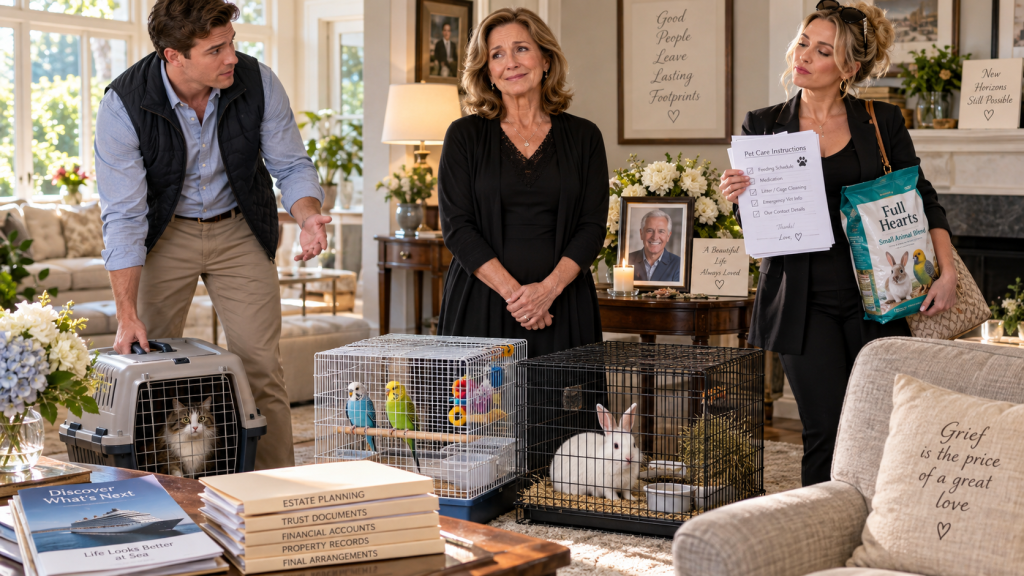
Vanessa carried in three cages: two noisy parakeets, a frightened white rabbit, and a nervous cat pressed against the back of an old carrier. They placed them in the center of my living room, beside Edward’s memorial photograph. They brought no flowers. They did not ask if I had slept. Vanessa only handed me pet food and instructions. “Vanessa,” I said quietly, “I buried my husband last week.” She sighed. “Mrs. Grace, everyone has problems.” Daniel added, “You’ll be alone anyway, Mom. This will give you something to do.”
Something inside me shifted. Not anger. Understanding. I looked at the cages. Then at my son. And smiled. “Of course, sweetheart. You may leave them here.”
PART 2 — THE HOUSE MY SON THOUGHT GRIEF HAD ALREADY GIVEN HIM
The moment Daniel and Vanessa drove away, the cat began crying.
Not me.
The cat.
A thin, frightened sound came from the plastic carrier beside Edward’s memorial photograph.
The rabbit pressed itself into the corner of its cage.
The parakeets screamed at each other as though they had also been informed of their vacation plans without consultation.
I stood in the center of the living room and looked at all of them.
Then I laughed.
Not because anything was funny.
Because nine days after burying my husband, my son had managed to leave me with four living creatures and no question about whether I was capable of taking care of myself.
That was almost impressive.
I knelt beside the cat carrier.
“Sweetheart.”
The cat hissed.
“Excellent.”
I sighed.
“At least one of us still has boundaries.”
I did not leave the animals alone.
I want that clear.
The cruise had already been booked.
My suitcase was packed upstairs.
My passport sat inside my handbag beside Edward’s death certificate and a packet from our attorney I had barely been able to look at.
Daniel did not know any of that.
He had assumed I would be sitting in the house because grief had made me stationary.
He was wrong.
But the animals had done nothing.
So I called the veterinary clinic Daniel and Vanessa used.
The number was written on the cat carrier.
Thank God.
A woman named Marisol answered.
I explained that my son had unexpectedly left several pets with me, but I had preexisting travel plans.
She did not ask for gossip.
Bless her.
She asked for names.
Vaccination status.
Medication.
Feeding instructions.
The cat was Pepper.
The rabbit was Snowball.
The parakeets were Mango and Kiwi.
Of course they were.
The clinic offered boarding for the cat and rabbit.
They did not board birds, but Marisol gave me the number of a licensed pet sitter they regularly recommended.
By nine that evening, every animal had somewhere safe to go.
I paid the deposits.
Then sent Daniel one message.
Your animals will be boarded while I’m away. Details and receipts are on my dining-room table.
He replied almost immediately.
Away where?
I did not answer.
At ten-thirty, the pet sitter collected Mango and Kiwi.
At eleven, a clinic employee picked up Pepper and Snowball.
By midnight, my living room was quiet again.
Too quiet.
Edward’s photograph sat beside the lamp.
He was smiling in it.
A picture taken on his sixty-eighth birthday.
Blue shirt.
Gray hair.
That look he always had when he suspected I was taking too many photographs.
I picked up the frame.
“You would have loved this.”
Silence.
I swallowed.
“Daniel brought me a rabbit.”
My voice broke.
That was when I cried.
Not at the funeral.
Not when the cemetery workers lowered Edward into the ground.
Not while signing the cremation paperwork for his old medical equipment and canceling the oxygen deliveries.
A rabbit did it.
Grief has terrible timing.
I cried until almost one in the morning.
Then I did something Edward would have approved of.
I made tea.
And opened the first legal folder.
Our attorney’s name was Miriam Feld.
She had handled our wills for twenty-two years.
The folder was labeled:
EDWARD AND GRACE MARTIN — ESTATE / SURVIVOR INSTRUCTIONS
I had avoided opening it because the word survivor made me feel like a person standing beside a shipwreck.
But inside there was no poetry.
Only structure.
A copy of the deed.
Trust documents.
Account lists.
Insurance information.
Beneficiary designations.
Instructions for what needed to happen next.
Edward and I had put the house into the Martin Family Revocable Trust four years earlier.
After Edward’s death, I remained trustee.
I retained the right to live in the house, sell it, refinance it, rent it, or move somewhere else if I chose.
Daniel had no present ownership.
None.
He was a contingent beneficiary of whatever remained after I died.
That was all.
Future possibility.
Not current property.
I sat at the dining-room table reading that sentence three times.
Then I remembered the cemetery.
Fresh dirt beneath my shoes.
Daniel pulling me aside while people were still walking toward their cars.
Mom, have you decided what you’re doing with the house?
At the time, grief had protected him.
I had been too shocked to become angry.
Now anger finally arrived.
Quietly.
The second folder was worse.
Label:
FAMILY ADVANCES — DANIEL MARTIN
I frowned.
I knew we had helped Daniel.
Of course we had.
Parents help children.
Or at least that is what Edward and I told ourselves every time money moved in one direction.
But I had never seen everything collected in one place.
Edward had.
Every loan.
Every transfer.
Every promise to repay.
Daniel’s layoff eight years earlier.
$14,000.
Down payment help on their first condominium.
$20,000.
Credit-card emergency.
$8,500.
Vehicle repair.
$4,200.
Legal fees after a business partnership collapsed.
$11,000.
Short-term “bridge” loan when Vanessa was pregnant.
$9,000.
Smaller amounts.
Five hundred.
One thousand.
Two.
Some repaid.
Most not.
Edward had kept a ledger.
At the bottom:
Outstanding documented advances: $47,360.
I stared at the number.
Forty-seven thousand dollars.
Then I found a note in Edward’s handwriting.
The letters had become shaky near the end.
Grace — these are not debts I want you chasing if you don’t need the money. But don’t let Daniel tell you we never helped.
I put my hand over my mouth.
That was Edward.
Not angry.
Not punitive.
Just unwilling to let generosity be rewritten as obligation.
There was another page.
A copy of a letter signed by both of us three years earlier.
I remembered it then.
Miriam had suggested it.
The letter stated that certain large transfers to Daniel would be treated as advances against any future inheritance unless we later changed our estate plan.
Not punishment.
Accounting.
Daniel had signed acknowledging receipt.
I had completely forgotten.
Grief and caregiving had erased entire filing cabinets from my mind.
Daniel had not forgotten.
His signature was there.
Bold.
Confident.
Then the third folder.
This one had my name only.
GRACE — DO NOT SIGN WITHOUT REVIEW
I stopped.
The folder was thin.
Inside was a handwritten note from Edward.
I knew immediately it had been written during the last year because his handwriting slanted differently after the tremor started.
Gracie,
Daniel has been asking too many questions about the house and whether you would want help managing things if I go first. I may be worrying over nothing. He loves you. But grief makes people tired, and tired people sign things because they want the conversation to end. Please let Miriam read anything anyone gives you. Even Daniel. Especially if he says it’s just paperwork.
I sat completely still.
My husband had been dying.
And while I was counting medication doses and pretending hospital food tasted acceptable, Edward had been worrying about what would happen to me afterward.
I pressed the page against my chest.
“You knew.”
The house answered with silence.
“You knew him better than I wanted to.”
My phone buzzed.
Daniel.
Mom, where are you going?
Then:
The pet place called Vanessa to confirm pickup. Why are you boarding them?
Then:
Mom. Answer me.
I turned the phone facedown.
For forty years, somebody always needed an immediate answer from me.
Edward.
The school.
Daniel.
Doctors.
Insurance.
Vanessa.
Grandchildren.
Neighbors.
Family.
That night, for the first time I could remember, my silence belonged to me.
At 3:40 in the morning, a car took me to Miami.
I carried one suitcase.
One handbag.
And Edward’s white linen handkerchief tucked into my coat pocket.
By 5:30, I was at the terminal.
By sunrise, I stood on the deck of a ship watching the coastline become smaller.
I had expected guilt.
Instead I felt something close to fear.
Not fear of the cruise.
Fear of freedom.
Edward and I had traveled together for decades.
Key West.
Savannah.
San Juan.
Italy once, badly.
We got lost in Florence because Edward refused to admit he had no idea where the hotel was.
This was the first trip I had taken without being someone’s wife.
I almost turned around.
Then the ship moved farther from shore.
Too late.
Good.
At 7:12 a.m., Daniel called.
I declined it.
At 7:13.
Again.
At 7:15.
Vanessa.
Then Daniel.
Then Vanessa.
Then a message:
WHERE ARE YOU?
I took a photograph of the ocean.
Sent it.
Nothing else.
Three dots appeared immediately.
Disappeared.
Appeared again.
Then:
Are you on a BOAT?
I smiled.
Technically, yes.
I sent:
Ship.
That was petty.
Edward would have loved it.
Daniel called again.
This time I answered.
“Mom.”
His voice sounded offended.
Not worried.
“Where are you?”
“On a cruise.”
“You booked a cruise?”
“Yes.”
“When?”
“Yesterday.”
That was not entirely true.
I had booked it the day before he dumped the animals on me.
He did not need the timeline yet.
“What about Pepper?”
“Boarded.”
“Snowball?”
“Boarded.”
“The birds?”
“With a licensed sitter.”
“How much did that cost?”
I looked out at the ocean.
“Interesting question.”
“What does that mean?”
“You did not ask what caring for four animals would cost me in time, food, cleaning, or sleep.”
“But now that someone charged money, suddenly the cost matters.”
Silence.
“Mom.”
“No.”
His tone softened artificially.
“I just wish you had told us.”
I laughed.
The sound surprised both of us.
“So do I.”
“What?”
“I wish you had told me before placing three cages in my living room and announcing I would rearrange my life for you.”
Another silence.
Then:
“You said yes.”
“I did.”
“You didn’t mention the cruise.”
“You didn’t ask whether I had plans.”
That ended that.
Vanessa came onto the line.
“Grace.”
Not Mom.
Never Mom when she was angry.
“We could have made other arrangements.”
“You still can.”
“This is incredibly irresponsible.”
I stared at the horizon.
“Irresponsible?”
“Those animals are stressed.”
“They are being professionally cared for.”
“That’s not the point.”
“What is?”
She stopped.
Because the point was not animal welfare.
The point was obedience.
They had told me what would happen.
I had changed the outcome without asking.
That was the offense.
Then Daniel said:
“How long are you gone?”
“Six nights.”
“Six?”
“Yes.”
“We need to talk about Dad’s estate.”
Of course.
The cemetery was nine days ago.
My husband was dead less than two weeks.
And apparently six nights was too long to postpone discussing what Daniel might receive from the remains of our life.
“What is so urgent?”
Daniel hesitated.
Then:
“I have paperwork.”
My heart became very calm.
Edward’s note flashed through my mind.
Especially if he says it’s just paperwork.
“What paperwork?”
“Nothing major.”
I almost closed my eyes.
Edward.
You stubborn old man.
You were right.
“What is it?”
Daniel sighed.
“The house.”
There it was.
“What about the house?”
“We need to simplify things.”
“For whom?”
“Mom.”
“For whom?”
He became irritated.
“For you.”
Of course.
He explained that now that Dad was gone, it might make sense to add Daniel to some documents.
So if I became ill.
If something happened.
If the house needed repairs.
If bills needed paying.
If I did not want to “deal with everything.”
A parade of hypothetical helplessness.
“I already have an estate plan.”
“I know.”
“Then what are you proposing?”
“A family property authorization.”
That phrase meant nothing to me.
Probably because it was not a formal universal term.
“What does Miriam say?”
Silence.
“Miriam?”
“Yes.”
“Our attorney.”
“I haven’t talked to her.”
“Then why would I sign anything?”
He exhaled dramatically.
“It’s not a big legal thing.”
Another Edward sentence.
Just paperwork.
Not a big legal thing.
“Email it to Miriam.”
“No.”
The answer came too quickly.
Interesting.
“Why not?”
“Because lawyers make everything complicated.”
I almost laughed.
Lawyers often do.
That is sometimes their purpose.
Complications can be where people hide rights.
“I won’t sign anything without her.”
“Mom, I’m not trying to take your house.”
I had not accused him of that.
Yet.
The defensive sentence hung between us.
I said:
“I’m glad.”
Then:
“Send her the papers.”
He hung up.
I spent the morning walking the ship.
Slowly.
For months, every room I entered had contained evidence of Edward’s illness.
Pill organizers.
Oxygen tubing.
Blankets.
Medical bills.
The chair where he slept when lying flat became too difficult.
On the ship, no room knew us.
No room remembered.
That anonymity hurt.
Then relieved me.
I ate breakfast outside.
Alone.
Scrambled eggs.
Fruit.
Coffee.
No one asked me to cut food.
No one needed medication.
No one said:
Grace, while you’re up—
I cried into my coffee.
Then ate anyway.
Survival can be embarrassingly ordinary.
At noon, Miriam called.
I answered immediately.
“Please tell me you’re somewhere warm.”
“I’m on a cruise.”
Silence.
Then she laughed.
A real laugh.
“Edward would be furious he missed this.”
“He would complain about the buffet.”
“Then eat enough for both of you.”
My eyes filled.
She let the silence sit.
Then:
“Daniel called me.”
Of course.
“What did he want?”
“A copy of the trust.”
My grip tightened around the phone.
“Why?”
“He said you asked him to help organize the house.”
“I did not.”
“I assumed.”
Relief.
Miriam knew us too well.
“What else?”
“He asked whether the trust allows a successor trustee to be appointed while you are living.”
My stomach tightened.
“What did you say?”
“That it does.”
I knew that.
“But only under the terms you and Edward established.”
“And you are current trustee.”
“Yes.”
“And unless you resign, become incapacitated under the trust’s actual procedure, or properly appoint someone where allowed, Daniel cannot simply declare himself in charge.”
Good.
I breathed again.
Then Miriam said:
“He asked another question.”
I waited.
“Whether selling the house would require probate.”
The ocean suddenly looked less beautiful.
“Why is he asking about selling my house?”
“I asked him the same thing.”
“What did he say?”
“That you were considering downsizing.”
I laughed.
Not because it was funny.
“I have never told him that.”
“I know.”
“Edward and I talked about it once.”
“Five years ago.”
“We decided not to.”
“I remember.”
Miriam became quiet.
Then:
“Grace, there is something you should know.”
There always is.
“Daniel contacted my office three days after Edward died.”
I stopped walking.
Three days.
Before the funeral.
“What did he ask?”
“For the estate documents.”
My throat tightened.
“He said he wanted to make things easier for you.”
“Did you give him anything?”
“No.”
“He was not my client.”
“He was not trustee.”
“He had no general authorization.”
Good.
“And?”
“He specifically asked whether the house would pass to him if you chose not to remain there.”
I closed my eyes.
“What did you say?”
“That the question was premature, and also not his decision.”
Miriam paused.
“He did not like that.”
I sat on an empty deck chair.
“Why didn’t you tell me?”
“Because your husband had just died.”
“And because Daniel asking questions, by itself, was not wrongdoing.”
That was fair.
Painful.
Fair.
Then:
“I planned to discuss it at our estate meeting.”
“When?”
“After you got back.”
I laughed weakly.
“You knew about the cruise?”
“Edward told me you always wanted to take one alone but were too afraid.”
I went completely still.
“When?”
“Last year.”
That man.
Dying and making plans inside plans.
Miriam continued.
“He said if he went first, I should remind you that being a widow was not the same thing as being finished.”
I covered my eyes.
People nearby walked past carrying towels and frozen drinks.
No one knew my dead husband had just reached across time and slapped me gently with common sense.
That afternoon, I opened the rest of the legal packet on my tablet.
Miriam had emailed secure copies.
The trust was straightforward.
Grace Martin remained trustee.
The house remained trust property.
Daniel was successor trustee only after a sequence of conditions if I could no longer serve or after my death, unless I changed the plan.
He had no immediate entitlement.
Even then, successor trustee did not mean personal owner.
That distinction mattered.
A trustee manages according to the trust.
A beneficiary may eventually receive something.
Neither role means:
Take Mom’s house because Dad died.
Then I saw Edward’s last amendment.
Signed eight months earlier.
I had been there.
I remembered now.
Miriam came to the house.
Edward was thin.
Tired.
He insisted on wearing a collared shirt for the meeting.
The amendment clarified Daniel’s outstanding advances.
Not as punishment.
If Daniel eventually received a distribution after my death, certain documented unpaid advances could be considered in equalization with other beneficiaries.
Our daughter, Rachel, had died years earlier in an accident, leaving one son—my grandson Caleb.
Caleb was also a beneficiary.
Daniel knew this.
Or should have.
The estate was not simply his.
The house was not a prize waiting for the surviving parent to move out.
My phone buzzed.
Vanessa.
A photograph.
Three sheets of paper spread across my dining-room table.
I recognized the room immediately.
My house.
Caption:
This is all Daniel wants you to sign. It’s not complicated.
I zoomed in.
Could not read everything.
But one heading was visible:
REAL PROPERTY MANAGEMENT AUTHORIZATION
Another:
CONSENT TO LISTING AND SALE SERVICES
My blood went cold.
Listing.
Sale.
I called Miriam.
She answered.
“Grace?”
“I’m sending you something.”
Thirty seconds later:
“Oh.”
That one syllable frightened me.
“What?”
“Do not sign these.”
“I wasn’t planning to.”
“The first appears to be a broad authorization allowing Daniel to communicate with contractors, insurers, and possibly property professionals.”
“And the second?”
“A consent related to listing property.”
I stared at the water.
“He told me it was to help with repairs.”
“Then why is there a listing consent?”
Exactly.
Miriam enlarged the photograph.
“The image is incomplete.”
“I need the full documents before giving you a conclusion.”
Facts.
Good.
“Tell Daniel to send them.”
“No.”
“Why?”
“Because I want to see what he does when I don’t make it easy.”
Miriam sighed.
“Grace.”
“I’m not setting a trap.”
“I’m simply not chasing him for papers he wants me to sign.”
Pause.
“Fair.”
Then:
“Do not sign anything electronically either.”
“I won’t.”
That evening, I went to dinner alone.
I wore one of the dresses Edward liked.
Dark green.
Nothing expensive.
He always said it made my eyes look younger.
I almost changed.
Then kept it on.
I ordered wine.
Edward hated wine.
Said every bottle tasted like expensive vinegar.
I lifted the glass toward the empty chair opposite me.
“To expensive vinegar.”
Then drank.
And cried.
Again.
Grief kept arriving between appetizers.
The next morning, there were nineteen missed calls.
Daniel.
Vanessa.
Daniel.
Daniel.
Then one from my neighbor, Mrs. Alvarez.
I called her first.
“Grace?”
“Yes?”
“Are you home?”
“No.”
“I didn’t think so.”
My stomach tightened.
“Why?”
“There’s a man walking around your house with Daniel.”
“What man?”
“I don’t know.”
“Nice suit.”
“Car says something about real estate.”
I closed my eyes.
Of course.
“Is Daniel inside?”
“Yes.”
“He has a key?”
“He used one.”
Daniel still had the emergency key Edward and I gave him years earlier.
For emergencies.
Not showings.
I felt anger rise.
Then forced myself to think.
He had access historically.
This was not a stranger breaking in.
But access did not mean authority to market the property.
“Can you take a picture from your property if you can do it without getting involved?”
Mrs. Alvarez snorted.
“Grace, I’m seventy-three.”
“I have been documenting neighborhood nonsense since before camera phones.”
Five minutes later, photographs arrived.
Daniel.
Vanessa.
And a woman holding a leather folder beside a car marked:
BELLAMY RESIDENTIAL GROUP
Real estate.
I called Miriam.
She was silent after seeing the photos.
Then:
“I’m going to contact the brokerage.”
“Can Daniel list the house?”
“Not validly as owner or trustee.”
“Could he talk to a realtor?”
“Anyone can talk.”
“Could he sign a listing?”
“Not on behalf of the trust unless he has actual authority.”
“Which he doesn’t.”
“Correct.”
Relief.
Then:
“But Grace, I want you to hear me.”
“Yes.”
“Do not assume the realtor knows that.”
Fair.
Daniel might have told her anything.
Widowed mother wants to downsize.
Son helping.
Documents coming.
Plausible.
Normal-sounding.
That was the danger of entitlement.
It often dresses itself as assistance.
Miriam contacted the brokerage’s managing broker.
Within an hour, the realtor called me.
Her name was Leah Bellamy.
She sounded horrified.
“Mrs. Martin, I am so sorry.”
“What did my son tell you?”
“That you were on a short vacation and wanted preliminary options before deciding whether to move.”
I closed my eyes.
“Did he say I authorized this?”
“He said the property was in a family trust and that he was helping with the estate.”
Technically designed not to be an outright lie.
Clever.
“Did he say he was trustee?”
Leah hesitated.
“He said he would be handling the property.”
Not the same.
Still misleading.
“Did you sign anything?”
“No.”
Thank God.
“We were only doing a preliminary walkthrough and discussing potential value.”
“Did he ask you to prepare a listing agreement?”
“Yes.”
My grip tightened.
“Has one been prepared?”
“A draft.”
“Not executed.”
“No.”
“Do not return to my property without my direct permission.”
“Absolutely.”
She apologized again.
I believed her.
Wrong assumptions.
Not conspiracy.
Then Leah said:
“There is something else you should know.”
Of course there was.
“Your son asked whether a buyer might be interested in purchasing quickly before probate was completed.”
I almost laughed.
“There is no probate issue with the house.”
“I understand that now.”
“What did you tell him?”
“That title would need to be confirmed and the authorized owner or trustee would need to sign.”
Good realtor.
Late context.
But good.
Then:
“He seemed frustrated.”
I could imagine.
I called Daniel.
For once, he answered immediately.
“Mom.”
“What are you doing in my house with a realtor?”
Silence.
Then anger.
“Mrs. Alvarez called you?”
“Answer me.”
“I was getting information.”
“About selling my house.”
“Our family house.”
“No.”
That word came easily now.
“My house is held in my trust.”
“You are not trustee.”
“You are not current owner.”
“And you do not have permission to arrange showings.”
“Mom, nobody was selling anything today.”
“Then why did you need a listing agreement?”
Silence.
Vanessa spoke in the background.
“Because you cannot stay there alone forever.”
I laughed.
Nine days after the funeral.
Apparently forever had arrived quickly.
Daniel said:
“You’re on a cruise less than two weeks after Dad died.”
There it was.
Judgment.
I felt the blow.
Then recognized it for what it was.
A weapon assembled from grief.
“So?”
“So maybe you are not thinking clearly.”
I went still.
“Be careful.”
“I’m just saying—”
“No.”
My voice changed.
Even he heard it.
“You do not get to use the fact that I am grieving to declare me incompetent because I made a decision you dislike.”
“Mom, nobody said incompetent.”
“You are suggesting I cannot decide where to travel.”
“While you are trying to prepare the sale of my house without permission.”
Silence.
Then he said:
“Dad wanted us to take care of you.”
My eyes filled.
Maybe he believed that.
Edward did want family to care for me.
That was not what this was.
“Taking care of me begins by asking what I need.”
“We are trying.”
“No.”
“You are arranging your solution before hearing my answer.”
Another silence.
Then I said:
“Put the emergency key on my dining-room table.”
“Mom.”
“Today.”
“That’s ridiculous.”
“Then Miriam will send the request in writing.”
He swore under his breath.
I heard Vanessa say:
“This is exactly why we should have handled it before she left.”
Before I left.
My blood went cold.
“What did she say?”
Nothing.
Then the call ended.
I stared at the phone.
Handled what?
The property authorization?
The listing?
Something else?
I called Miriam.
Her assistant said she was in a meeting.
So I went back to the cabin.
Sat on the balcony.
Watched the ocean.
Tried not to invent facts.
That is harder than it sounds.
Grief had already made me suspicious of every sentence.
I did not want Daniel’s selfishness to turn me into someone who saw conspiracy everywhere.
Maybe Vanessa simply meant the paperwork.
Maybe.
That was enough until evidence said otherwise.
Miriam called forty minutes later.
Her voice was sharp.
“Grace.”
“Yes?”
“I need you somewhere private.”
My stomach tightened.
“I am.”
“I spoke with the brokerage.”
“I know.”
“There is another issue.”
I closed my eyes.
“Tell me.”
“Daniel emailed them a document this morning.”
“What document?”
“A copy of something titled Trustee Transition Acknowledgment.”
My entire body went cold.
“I’ve never heard of that.”
“Neither have I.”
“What does it say?”
“It purports to state that because of Edward’s death, you intend to transition day-to-day property management authority to Daniel.”
I stood up.
“Did I sign it?”
Pause.
“No.”
Relief.
Then why did I still feel terrified?
“There is a signature line for you.”
“Blank?”
“Yes.”
“But Daniel signed beneath it as ‘incoming family representative.’”
That title meant nothing.
Sounded important.
Probably designed to.
“Is it legally effective?”
“Not without your authorization.”
“Then why am I worried?”
“Because of the email Daniel sent with it.”
“What did he say?”
Miriam read:
My mother is currently traveling and will execute the remaining signature pages upon return. Please begin preparing the listing materials so we do not lose time.
My breath stopped.
He had already promised my signature.
Not forged it.
Not yet.
But promised it.
Assumed it.
Budgeted around it.
Exactly what Edward warned me about.
Then Miriam said:
“That is not the part that concerns me most.”
I nearly laughed.
“What could possibly be more concerning?”
“Daniel attached a letter from Edward.”
The world stopped.
“My husband?”
“Yes.”
“What letter?”
“It appears to say Edward wanted Daniel to take over management of the house after his death.”
I sat down.
Hard.
“No.”
“You haven’t seen it?”
“No.”
“Did Edward ever tell you that?”
“No.”
“Do you recognize his signature?”
“I need to see it.”
Miriam forwarded the PDF.
I opened it.
My husband’s name sat at the bottom.
Edward Martin.
The signature looked real.
Painfully real.
Above it:
It is my wish that our son Daniel assist Grace with management and disposition of the residence when the time comes. Grace has carried enough responsibility during my illness. I trust Daniel to make the process easier for her.
I read it twice.
Then a third time.
My eyes filled.
Some of it sounded like Edward.
Some did not.
Disposition of the residence.
Edward never spoke like that outside Miriam’s office.
And there was no date.
No witness.
No context.
Just a signature.
“Could it be real?”
I whispered.
Miriam did not comfort me with certainty.
“I don’t know yet.”
Good lawyer.
Terrible moment.
“I need the original.”
“Daniel only sent a scan.”
“Where would he get it?”
“I asked him.”
“And?”
“He said Edward gave it to him several months ago.”
My chest tightened.
Why would Edward warn me in one folder about Daniel’s paperwork and privately give Daniel a letter encouraging him to take over?
Possible?
People contradict themselves.
Dying people especially.
But something felt wrong.
Then I remembered the white linen shirt.
The rosary.
The photo from Key West.
Edward’s hands.
His shaky signature near the end.
I zoomed in.
The signature on Daniel’s letter was not shaky.
It was clean.
Strong.
From years earlier.
I had seen it before.
Where?
My mind moved through decades of paper.
Tax returns.
Mortgage.
Birthday cards.
Insurance.
Then it hit me.
The house refinance.
Seven years ago.
Edward had signed a refinancing authorization with that exact long upward stroke in the E.
I could not prove it from memory.
But I knew.
Or thought I knew.
“Miriam.”
“Yes?”
“I think the signature image is old.”
Silence.
“What makes you say that?”
“Edward could barely sign his name cleanly during the last year.”
“This signature is not from the last year.”
“That does not prove the letter was created recently.”
“No.”
Again.
Facts.
“But can you compare it?”
“Yes.”
Miriam had old executed originals.
Lots of them.
She called me two hours later.
Her voice was different.
Controlled.
“Grace.”
“Yes?”
“We found a likely source.”
My stomach dropped.
“The signature on Daniel’s letter visually matches Edward’s signature from a seven-year-old home refinance authorization.”
“How closely?”
“Enough that I want a document examiner before saying more.”
Good.
Still careful.
Then:
“There are identical image characteristics.”
“Same spacing.”
“Same slight compression near the final letters.”
“A genuine handwritten signature does not normally reproduce with pixel-for-pixel artifacts.”
I closed my eyes.
“So someone copied it.”
“Likely.”
“Who?”
“I don’t know.”
Not yet.
Then came the message that changed everything.
From Daniel.
Mom, you need to stop letting Miriam turn this into something ugly. Dad wanted me to help. You know that.
I stared.
Then:
The letter is real in the only way that matters. It says what Dad wanted.
My skin went cold.
Not:
The signature is real.
Not:
Dad signed it.
Real in the only way that matters.
I screenshotted the message.
Sent it to Miriam.
She called instantly.
“Do not reply.”
“I wasn’t going to.”
“Good.”
Then another message arrived.
We were trying to make this easy before you got emotional about the house.
Before I got emotional.
My husband of forty years had been dead nine days.
Emotion apparently counted as a defect if it interfered with Daniel’s timeline.
Miriam spoke quietly.
“Grace, I need to ask you something.”
“What?”
“Do you want Daniel to remain successor trustee?”
I stared at the ocean.
The trust allowed amendment while I was competent.
I could change the successor.
Edward and I had chosen Daniel years earlier because he was our son.
Because families make plans based on who people were—or who they believed them to be.
I did not answer quickly.
Good.
“I don’t know.”
“That’s fine.”
“I don’t want to make estate changes just because I’m furious.”
“Also fine.”
“But I want everything reviewed.”
“Every beneficiary.”
“Every trustee provision.”
“Every power.”
“Good.”
“And I want someone independent involved.”
Miriam exhaled.
“Edward would approve.”
My throat tightened.
“Would he?”
“Yes.”
“How do you know?”
“Because he already asked me to prepare that option.”
I froze.
“What?”
She sent me one final document.
Draft only.
Never executed.
Prepared three months before Edward died.
Title:
Proposed Amendment — Independent Successor Trustee
Edward had asked Miriam to prepare an option replacing Daniel as immediate successor trustee with a professional fiduciary for the first two years after my death or incapacity, after which Daniel and Caleb could take roles under defined conditions.
Edward never signed it.
He became too ill.
So it was not effective.
Important.
But he had considered it.
Why?
Miriam had meeting notes.
Edward told her:
Daniel is too interested in the house before Grace has decided anything. I love him. That is why I want a buffer.
I cried.
There on a cruise balcony surrounded by strangers having cocktails.
My husband had loved our son enough to distrust him carefully.
That is a painful kind of wisdom.
I asked:
“Why didn’t Edward tell me?”
Miriam paused.
“He thought you had enough to carry.”
I laughed through tears.
“Everyone keeps deciding what I can carry.”
“Yes.”
She sounded sad.
“Edward was not perfect either.”
That mattered.
He had tried to protect me by keeping worry from me.
Kinder than Daniel.
Still a decision made without me.
I looked at the horizon.
Maybe that would be part of what I changed next.
No more protection that required silence.
The cruise lasted six nights.
I stayed.
That surprised Daniel most.
He expected me to fly home once the house issue began.
I did not.
Miriam handled the legal notices.
The brokerage closed its file.
Daniel returned the emergency key after receiving a written demand.
A locksmith changed the exterior locks after Miriam confirmed it would not violate anyone’s lawful occupancy rights because Daniel did not live there.
Mrs. Alvarez supervised from her porch like a retired intelligence officer.
The animals remained safely boarded.
I reimbursed nothing.
Daniel and Vanessa had chosen the vacation.
They could pay for their pets.
I slept badly.
Ate well.
Cried daily.
Watched the ocean.
Attended a terrible magic show.
Met a widow named Carol from Tennessee who had lost her husband three years earlier.
She said:
“The first year, everybody gives you advice because your life makes them uncomfortable.”
I liked her immediately.
We drank coffee together most mornings.
I told her almost nothing about Daniel.
I did not want my son to become the entire story of my first trip without Edward.
That belonged to me.
On the fifth day, I took Edward’s handkerchief to the deck.
I almost threw it into the ocean.
Then laughed.
He would have been furious about littering.
So I put it back in my pocket.
Healing is sometimes very inconvenient.
The night before we returned to Miami, Miriam called again.
“Grace.”
Her tone told me.
“What now?”
“We obtained the original digital file Daniel sent the realtor.”
“And?”
“The metadata does not prove authorship by itself.”
“Okay.”
“But the file was created three days after Edward’s death.”
I stopped breathing.
Three days.
Edward had been dead.
No ambiguity.
No older letter waiting in a drawer.
No deathbed instruction.
The digital file had been created after he died.
Miriam continued.
“The pasted signature image appears to have been imported from an older PDF.”
I closed my eyes.
Daniel had not merely exaggerated his father’s wishes.
Someone had created a letter after Edward’s death and placed Edward’s old signature beneath it.
“Did Daniel admit it?”
“No.”
“But he sent another message to the brokerage after they asked for clarification.”
“What did he say?”
Miriam read it.
Dad and I drafted the letter together before he passed. I only formatted the final copy afterward.
Possible explanation.
Barely.
“Could that be true?”
“It could.”
“There is no saved draft so far.”
“No email.”
“No note from Edward.”
“And the wording conflicts with what Edward told me privately.”
Not proof of criminal forgery by itself.
But enough to matter.
Then Miriam said:
“There is one more thing.”
Of course.
“Daniel brought another person to the house today.”
My stomach tightened.
“Who?”
“An appraiser.”
I stood.
“Why?”
“He told the appraiser you are considering selling or taking a reverse-mortgage alternative.”
I laughed.
“What?”
“The appraiser called the trust mailing address to confirm access.”
“Which routes to my email.”
Good system.
“What did Daniel say?”
“That he was helping prepare options before you returned.”
Again.
Before I returned.
Before I could say no.
Then Miriam’s voice became very quiet.
“Grace, he also emailed me a document he says you signed last month.”
Every part of me became still.
“I signed what?”
“A letter authorizing him to obtain property valuations on your behalf.”
“No.”
“You’re certain?”
“Yes.”
“Do you want me to send it?”
“Yes.”
The PDF arrived.
At the bottom was my signature.
Not typed.
Handwritten.
Beautifully familiar.
Mine.
Except I had never signed it.
I stared.
Then recognized the source almost instantly.
A Christmas card.
Last year.
Love, Mom.
I always made the M in Mom with the same long curve.
The authorization signature read:
Grace Martin
But the shape of Grace was identical to the signature on a birthday check I had written Daniel months earlier.
Maybe copied.
Maybe something else.
It needed examination.
I would not pretend certainty.
But I knew one thing.
I had never authorized him to value my house.
I whispered:
“Miriam.”
“Yes?”
“Preserve everything.”
“Already done.”
“I want no one entering the house except me, the pet services if necessary, and people you approve.”
“Understood.”
“And when I get back?”
“Yes?”
“I want Daniel to sit at my dining-room table.”
Miriam paused.
“With counsel?”
“Yes.”
“Good.”
“I want every document he says I signed.”
“Every letter he says Edward signed.”
“Every loan.”
“Every advance.”
“Every piece of paper.”
“Good.”
I looked toward the dark ocean.
“And I want him to explain why he was so certain I would give him control before he ever asked me.”
Miriam was silent.
Then:
“Grace.”
“What?”
“Do not expect the answer to hurt less just because you finally get it.”
I knew.
The next morning, as the ship approached Miami, my phone connected fully again.
Messages flooded in.
Daniel.
Vanessa.
The boarding clinic.
Mrs. Alvarez.
Miriam.
Then one from my home security system.
Motion detected.
Front porch.
I opened the camera.
Daniel stood outside my house.
Beside him was Vanessa.
And between them—
three animal cages.
Again.
Pepper.
Snowball.
Mango and Kiwi.
They had collected the pets before I returned.
Vanessa set the cages on my front porch.
Daniel held a thick manila envelope.
Then he looked directly into the camera.
He knew I was watching.
He raised the envelope.
And said:
“Mom, if you’re going to play this game, then you need to see what Dad really left me.”
My heart began pounding.
He slid the envelope beneath the door.
Then walked away.
By the time my ship docked, Miriam had already reached the house with a locksmith and retrieved it.
She called me from my own dining room.
“Grace.”
I closed my eyes.
“What is it?”
There was a long silence.
Then she said:
“Daniel has a document claiming Edward promised him half the house.”
I stopped walking.
Around me, passengers rolled suitcases toward the terminal.
Families hugged.
Phones rang.
Life moved.
I gripped the handle of my bag.
“Is it real?”
Miriam answered carefully.
“The signature may be.”
That chilled me more than if she had simply said no.
Then:
“But Grace…”
“What?”
“The date is six years old.”
Six years.
Before Edward got sick.
Before the trust was created.
Before several later estate plans.
Before the advances.
Before his warning to me.
I breathed again.
Older does not mean controlling.
Later documents can matter.
Context matters.
Miriam continued:
“And there is handwriting on the back.”
“Whose?”
“Edward’s.”
My chest tightened.
“What does it say?”
Miriam was silent for several seconds.
Then she read:
Daniel — I am giving you this only as a reminder of what I once hoped to do, not as a deed or promise. Too much has changed. Do not use this against your mother. The house is Grace’s security first. If she wants to sell, keep, burn, or paint it purple, that is her decision.
I closed my eyes.
Edward.
Of course.
Even from the grave, he had found a way to make himself unmistakably clear.
Then Miriam said:
“Daniel only sent me the front page.”
I opened my eyes.
“What?”
“The envelope contains the original.”
“He showed the realtor and me a scan of the front.”
“He did not include the handwritten back.”
My grief became something colder.
Daniel had not misunderstood the document.
He had selected which half of his father’s message he wanted people to see.
And when I looked toward the terminal doors, I realized the cruise had not been the beginning of a fight over inheritance.
It had exposed something much older.
My son had spent years treating every act of love from his parents as a promise that eventually everything would become his.
And now, for the first time in his life, I was going home to tell him that loving him and surrendering to him were no longer the same thing.
PART 3 — THE HOUSE WAS NEVER HIS TO INHERIT WHILE I WAS STILL LIVING
When I stepped off the ship in Miami, I did not go home.
That surprised me.
For six nights, I had imagined walking through my front door, laying Daniel’s envelope on the dining-room table, and finally saying every sentence I had swallowed for years.
Instead, I went straight to Miriam’s office.
My suitcase rolled behind me.
Edward’s handkerchief was still in my handbag.
My hair smelled faintly of salt and ship shampoo.
I probably looked ridiculous.
Miriam took one look at me and said:
“You ate?”
“Yes.”
“Today?”
I hesitated.
She pointed toward the conference room.
“Sandwich first.”
I almost laughed.
Everyone in my life had spent forty years telling me what to do.
Apparently my lawyer was allowed one exception.
The envelope sat in the center of the table.
Thick yellow paper.
Daniel’s handwriting on the front:
MOM — READ EVERYTHING BEFORE YOU LET MIRIAM TWIST IT.
That sentence alone told me he still believed the problem was interpretation.
Not conduct.
Miriam sat across from me.
She did not touch the envelope.
“It has been photographed and preserved.”
“Good.”
“I have not altered the order.”
“Good.”
“Do you want to open it?”
I looked at Edward’s handwriting visible through the clear evidence sleeve.
The house is Grace’s security first.
My throat tightened.
“Yes.”
The first page was the document Daniel claimed proved Edward had promised him half the house.
It was dated six years earlier.
Before the trust.
Before Edward’s cancer.
Before most of Daniel’s unpaid loans.
At the top:
FAMILY PROPERTY INTENTION MEMORANDUM
Not deed.
Not contract.
Not trust amendment.
Not transfer.
Intention.
The paper stated that Edward and I had “discussed the possibility” that one day Daniel might receive a fifty-percent interest in the residence, with the remainder eventually passing to our late daughter Rachel’s son, Caleb.
I remembered the conversation.
Barely.
Daniel had been struggling financially then.
Edward worried that property prices were rising so fast Daniel would never build equity.
We had discussed whether the house might eventually stay in the family.
Nothing more.
No transfer.
No guarantee.
No present ownership.
Then life changed.
Rachel died.
Caleb became a teenager without a mother.
Daniel borrowed money again.
Edward became ill.
We created the trust.
Updated our wills.
Reviewed everything with Miriam.
The six-year-old memorandum became exactly what Edward later wrote on its back:
Something we once considered.
Not a promise.
I turned the page over.
There was Edward.
Not a signature.
His actual handwriting.
Uneven.
Blunt.
Impossible to misunderstand.
Daniel — I am giving you this only as a reminder of what I once hoped to do, not as a deed or promise. Too much has changed. Do not use this against your mother. The house is Grace’s security first. If she wants to sell, keep, burn, or paint it purple, that is her decision.
I read it twice.
Then a third time.
My eyes filled.
Miriam handed me a tissue.
I ignored it.
“Did Daniel know this was on the back?”
“Yes.”
“How do you know?”
“He had the original.”
Of course.
I laughed once.
A tired sound.
“He scanned only the front.”
“Yes.”
“And sent that to the realtor.”
“Yes.”
“And to you.”
“Yes.”
“He looked at Dad’s handwriting telling him not to use this against me…”
My voice broke.
“…and used it against me.”
Miriam said nothing.
There are facts that do not need a lawyer to make them worse.
The next document was the supposed letter from Edward encouraging Daniel to “assist Grace with management and disposition of the residence.”
The one created digitally three days after Edward died.
Miriam had obtained the metadata.
The file had been created on Daniel’s laptop.
That did not prove every word came from him.
He could still claim he was typing up something Edward dictated before death.
So Miriam kept going.
They compared the language with Edward’s emails.
His estate notes.
His letters.
Then with Daniel’s emails.
A phrase in the letter caught the forensic reviewer’s attention:
streamline transition responsibilities.
Edward had never used that phrase in any preserved correspondence.
Daniel had.
Seven times.
Mostly in work emails.
Still not proof by itself.
But then came the signature.
The image matched an older refinance document closely enough that the examiner concluded it had likely been copied digitally rather than freshly signed.
There were identical compression artifacts.
Same edge pattern.
Same tiny pixel defect.
Edward had not physically signed the new letter.
Someone had placed an image of his old signature beneath new words.
I closed my eyes.
“Did Daniel admit it?”
“Not yet.”
“Has he been interviewed?”
“Not formally.”
Miriam folded her hands.
“Grace, we need to talk about what you want.”
I looked at her.
“What I want?”
“Yes.”
“Because several things are happening at once.”
She began counting.
“The trust and house.”
“The fake or altered documents.”
“The unauthorized property activity.”
“The old family loans.”
“Your estate plan.”
“And your relationship with Daniel.”
“Those are not one problem.”
That mattered.
Anger makes everything feel like one fire.
Law does not.
Life should not either.
I asked:
“Can I change the successor trustee?”
“Yes.”
“Today?”
“Yes, if you understand what you are doing and this is your decision.”
“I do.”
She did not immediately hand me papers.
Good.
Instead she asked:
“Why?”
Because lawyers apparently enjoy making people explain the obvious.
I looked down at Edward’s handwriting.
“Because I no longer trust Daniel to administer anything that requires him to put my wishes ahead of his own interests.”
Miriam nodded.
“Good.”
Not good that I felt it.
Good that I could state the reason clearly.
“And beneficiary provisions?”
she asked.
I hesitated.
That was harder.
“I don’t want to disinherit him because I’m angry.”
Miriam’s face softened.
“Then don’t.”
“I also don’t want him rewarded for assuming my death is his financial plan.”
“Those are separate issues.”
Again.
Separate.
Good.
Edward and I had already built some protection into the estate.
Documented advances could be considered when future distributions were calculated.
Caleb would not lose simply because Daniel had already received help while we were alive.
I decided to keep that structure.
Daniel remained a future beneficiary.
For now.
But I removed him as successor trustee.
A professional fiduciary would serve first if I became unable to manage the trust.
Miriam would be involved through the mechanism we selected.
Caleb could later serve in a defined role if appropriate.
Daniel could not step into control merely because I was sick, tired, or dead.
That felt less like punishment than housekeeping.
Long overdue housekeeping.
Then I changed my power of attorney.
Not because Daniel had one.
He did not.
But Edward’s warning stayed with me.
Tired people sign things because they want the conversation to end.
I named my niece Rachel’s daughter-in-law, Melissa, a woman I trusted deeply, as first agent for financial matters if I ever became unable to act.
Miriam insisted on safeguards.
Independent incapacity determination.
Accountings.
No self-dealing.
Clear authority.
I liked that.
Trust should not depend only on affection.
Affection is wonderful.
Records are better.
Then we discussed the fake documents.
I wanted everything preserved.
I wanted Daniel asked directly whether he created them.
I wanted the realtor and appraiser formally notified that Daniel had no authority.
I wanted my credit and property records monitored.
I wanted no lien, listing, loan, or deed connected to the house without my direct authorization.
All reasonable.
Then Miriam asked whether I wanted to make a police report regarding the apparent forged signatures.
I stared at her.
That was the moment motherhood became unbearable.
People like to imagine boundaries are easy once betrayal becomes obvious.
They are not.
This was my son.
The baby Edward held in one hand because he was terrified of dropping him.
The boy who broke his arm jumping off the garage roof.
The teenager who called me from college because he did not know whether chicken smelled “too chickeny.”
The man who brought me cages instead of condolences.
All of him.
One person.
“I need to hear him first.”
Miriam nodded.
“That is reasonable.”
“Does that hurt anything?”
“Not if we preserve the evidence and do not delay required notices.”
Good.
“Can we meet tomorrow?”
“Yes.”
“With his attorney?”
“If he retains one.”
“He should.”
Miriam gave me a look.
“I agree.”
I finally went home that afternoon.
Mrs. Alvarez stood on her porch waiting.
Of course she did.
When I got out of the car, she crossed the lawn without pretending otherwise.
“How was the cruise?”
“Educational.”
She nodded toward my house.
“I kept watch.”
“I noticed.”
“Your son has terrible timing.”
“That too.”
Then she handed me the emergency key.
Daniel had left it beneath the flowerpot despite my instruction to put it on the dining-room table.
A final tiny act of doing things his own way.
I looked at the key.
Then at Mrs. Alvarez.
“Thank you.”
She shrugged.
“I’m retired.”
“Suspicion is my cardio.”
I laughed.
It felt good.
The animals were still with Daniel and Vanessa.
Thank God.
No cages on my porch when I arrived.
Only three faint rectangular marks in the dust where they had placed them for the camera.
I unlocked the new locks.
Walked inside.
Nothing had changed.
Edward’s photograph.
His chair.
The indentation in the sofa cushion where he always sat.
For the first time since the cruise, grief hit before anger.
I put my suitcase down.
Then sat in Edward’s chair.
“Your son is an idiot.”
Silence.
“I know.”
I looked at his photograph.
“I was an idiot too.”
Maybe not.
But generous people often participate in their own exhaustion longer than they admit.
Edward and I helped Daniel because helping felt like love.
Sometimes it was.
Sometimes it became insulation.
Every emergency softened before it reached him.
Job loss?
We helped.
Debt?
We helped.
Baby?
I moved into their house for three months.
Car?
Edward paid half.
Loan?
We extended it.
Daniel learned something without any of us meaning to teach it:
His crisis would eventually become our responsibility.
Then Edward died.
And Daniel looked at the largest asset left standing.
The house.
Of course he thought the pattern continued.
That did not excuse him.
But it explained the soil where entitlement grew.
Parents plant things accidentally too.
Daniel arrived the next morning with a lawyer.
His name was Andrew Cole.
Vanessa did not come.
Good.
Miriam sat beside me.
Daniel looked exhausted.
Not cruise exhausted.
Consequences exhausted.
He stared at Edward’s photograph before sitting down.
Then at me.
“Mom.”
I did not answer.
Miriam began.
“This meeting is for information gathering.”
“Grace is not agreeing to transfer property, alter the trust for Daniel’s benefit, waive claims, or resolve any dispute today.”
Andrew nodded.
Daniel looked irritated by the formality.
That was his first mistake.
“This is family.”
he said.
Miriam looked at him.
“It became a legal matter when property documents were sent to third parties.”
Silence.
Good.
I placed Edward’s six-year-old memorandum on the table.
Front side up.
“Did Dad give this to you?”
Daniel looked at it.
“Yes.”
“When?”
“About eight months ago.”
“Before he died?”
“Yes.”
“Why?”
“He said he had once wanted me to have half the house.”
I turned it over.
Edward’s handwriting faced him.
Daniel looked away.
“You knew he wrote this.”
“Yes.”
“You read it.”
“Yes.”
“Then why did you scan only the front?”
His face tightened.
“Because the back was just Dad being emotional.”
I almost laughed.
“Emotional.”
“You know how he got near the end.”
I stared at him.
“No.”
“You do not get to use dying as a synonym for unreliable when the words are inconvenient.”
He looked down.
I pointed to the line.
Do not use this against your mother.
“What did you think that meant?”
Daniel rubbed his forehead.
“That he didn’t want us fighting.”
“And yet you showed the front to a realtor as evidence Dad wanted you involved.”
“I was trying to get information.”
“You were creating leverage.”
“No.”
“Yes.”
My voice remained calm.
That calm frightened him more than shouting ever had.
“You wanted the realtor to believe there was some family expectation that supported what you were doing.”
He said nothing.
That was close enough.
Then Miriam placed the second letter on the table.
The one created three days after Edward died.
“Did you create this file?”
Andrew leaned toward Daniel.
They whispered.
Then Daniel said:
“I formatted it.”
“What does that mean?”
“Dad talked about these things before he died.”
“That was not the question.”
Miriam stepped in.
“Daniel, did Edward physically sign this letter?”
Silence.
“No.”
My chest tightened even though I knew.
“Then why is his signature on it?”
Daniel’s eyes filled.
“I scanned it.”
There it was.
No forensic mystery needed anymore.
“From what?”
“The refinance document.”
I looked at him.
“Why?”
“Because Dad said all of that.”
“Did he?”
“Yes.”
“When?”
“Over months.”
“Exactly those words?”
“No.”
“So you wrote the letter.”
“I summarized.”
“And attached your dead father’s signature.”
He flinched.
“When you say it like that—”
I cut him off.
“There is no other honest way to say it.”
Daniel began crying.
I hated that.
Not because I wanted him cold.
Because his tears still reached the part of me that remembered bandaging his knees.
I held my hands together.
He said:
“I wasn’t trying to steal the house.”
“Then what were you trying to do?”
“Help.”
I closed my eyes.
That word.
Every controlling person eventually arrives there.
Help.
“Help whom?”
“You.”
“How?”
“You can’t stay in that house forever.”
“I can stay there today.”
“That isn’t the point.”
“It is exactly the point.”
I leaned forward.
“I was nine days into widowhood and you were already planning the next use of my home.”
Daniel’s face collapsed.
He admitted the rest slowly.
The Bahamas trip was already paid for mostly with points and a credit card.
The pets had nowhere else to go because their usual sitter was unavailable.
He assumed I would say yes.
That part hurt less than expected.
Of course he assumed.
For forty years, yes was my default.
The house was different.
Daniel and Vanessa were carrying debt.
More than I knew.
Not catastrophic.
Around $63,000 spread across credit cards, a personal loan, and a home-improvement balance.
They were not destitute.
They had income.
But Vanessa wanted to move into a larger house closer to her sister.
Daniel believed that if I sold my house eventually, I might distribute some money early.
Or loan them part.
Maybe enough for a down payment.
There it was.
Not a secret criminal empire.
A fantasy built on my future decision.
“You were counting on me selling.”
“Yes.”
“Did I ever say I would?”
“No.”
“You were counting on some of the money coming to you.”
Daniel cried.
“Yes.”
“Did Dad promise that?”
“He talked about helping us.”
“Years ago.”
“Yes.”
“Before you borrowed another forty-seven thousand dollars from us.”
His face changed.
“You’re counting that?”
“Your father did.”
He looked angry.
That surprised me.
“Dad said we didn’t have to repay all of it.”
“Correct.”
“He said family helps family.”
“Correct.”
“Then why is it suddenly being held against me?”
I stared at him.
“It is not being held against you.”
“It is being remembered.”
Silence.
“There is a difference.”
Miriam explained the advance accounting.
Again.
Slowly.
No one was suing Daniel for every dollar.
The ledger existed so future inheritance could be fair between him and Caleb.
Daniel said:
“Caleb isn’t Dad’s son.”
“No.”
I answered.
“He is Rachel’s son.”
My dead daughter’s child.
“Your father loved him too.”
“I didn’t mean—”
“Yes, you did.”
He looked ashamed.
Good.
Not because shame is useful forever.
Because sometimes it is the first sign entitlement has met another person’s humanity.
Then Miriam produced the property-valuation authorization bearing my copied signature.
“Did you create this?”
Daniel looked at his lawyer.
Another whisper.
Then:
“Yes.”
My throat tightened.
“How?”
“From a check.”
The birthday check.
I had known.
Still, hearing it hurt.
“Why?”
“The appraiser needed something showing I was allowed to arrange access.”
“So you gave him something false.”
“I thought you would approve.”
There.
The sentence that explained everything.
I thought you would approve.
Future permission.
Manufactured early.
I leaned back.
“Daniel, do you understand why that sentence does not help you?”
He cried.
“I do now.”
“No.”
“Tell me.”
He looked at me.
Then at Miriam.
Then his father’s photograph.
Finally:
“Because I decided your answer before you gave it.”
Yes.
“Again.”
He swallowed.
“I decided your answer before you gave it.”
My eyes filled.
That was the first useful thing he had said.
His attorney advised him not to discuss some specifics further.
Fair.
The meeting was not a confession booth.
So we moved to practical issues.
Daniel would provide every property-related document he had created or sent.
Every email to the realtor and appraiser.
Every altered or copied signature file in his possession.
He would cease representing that he had authority over the trust.
He would not enter my property without invitation.
He would pay the pet-boarding costs because they were his animals.
That last point almost made me laugh.
After everything else, we still had Mango and Kiwi’s invoice.
Life insists on comedy.
Then I told him about the successor trustee change.
His face went white.
“You removed me?”
“As successor trustee.”
“Why?”
I stared.
He heard himself.
Then looked down.
“Right.”
“You remain a beneficiary under the current plan.”
He looked up.
Surprised.
“Why?”
That question hurt more than anger would have.
“Because I am not redesigning my estate to punish you while I am furious.”
His eyes filled.
“Your father and I made a plan.”
“I am reviewing it carefully.”
“But you are my son.”
“That still matters.”
Then:
“It does not make you my manager.”
He nodded.
Daniel asked:
“Are you going to the police?”
There it was.
Fear.
I answered honestly.
“I haven’t decided every step.”
Andrew looked at Miriam.
They both understood.
The forged-looking documents had been sent to third parties in connection with property activity.
That was serious.
Whether prosecutors became involved was not entirely mine to control once reports existed.
The brokerage had its records.
The appraiser had his.
Miriam had preserved everything.
I would cooperate with any lawful inquiry.
I would not lie to protect Daniel.
That was the boundary.
Not revenge.
Truth.
In the end, the matter did become formal.
The brokerage reported the suspicious documentation through its compliance process.
The copied signatures and false Edward letter were reviewed.
Because no sale occurred, no loan funded, no deed recorded, and no money changed hands, the actual financial harm was limited.
But Daniel had created and used false documents.
He could not explain that away as family confusion.
He eventually accepted responsibility in a negotiated legal resolution involving document-related misconduct.
He received probation, financial penalties, community service, and an order to stay compliant with financial and legal conditions.
No dramatic prison sentence.
No handcuffs at Christmas.
Serious consequences.
Proportionate consequences.
He also paid my documented legal costs tied specifically to correcting the false property representations.
That hurt him.
Good.
Not because I wanted pain.
Because cost should finally remain with the person who created it.
Vanessa was interviewed too.
Her role was narrower.
She knew Daniel was trying to persuade me to sell.
She pushed for the bigger house.
She accompanied him to the realtor.
She knew I had not yet signed the listing documents.
But investigators found no evidence that she copied my signature or created Edward’s letter.
She had said:
We should have handled it before she left.
By “handled,” she meant getting me to sign before the cruise.
Manipulative.
Entitled.
Not the same as forgery.
That distinction mattered.
I refused to turn my anger into evidence that did not exist.
Vanessa apologized eventually.
Not beautifully.
Not quickly.
But honestly enough.
She said:
“I treated your house like Daniel’s future money.”
I answered:
“Yes.”
“I’m sorry.”
“Good.”
We were never close again.
Not hostile.
Just no longer confused about the relationship.
Daniel and Vanessa canceled their plan for the larger house.
They paid down debt.
Sold one car.
Cut travel.
Kept the animals.
I did not become their emergency fund again.
That was the harder boundary.
Because legal documents are easier than grandchildren asking:
“Grandma, why can’t Daddy borrow money?”
I said:
“Because grown-ups sometimes have to solve grown-up problems with the money they have.”
No insults.
No details.
Children do not need to carry adult accounts.
Daniel and I did not speak for three months beyond necessary legal communication.
That was my choice.
He sent letters.
I read them when I wanted.
Not immediately.
The first was defensive.
The second less so.
The fourth finally sounded like my son.
He wrote:
I think I learned that if I waited long enough, you and Dad would rescue me. I turned that into an expectation. When Dad died, I looked at the house and saw the last rescue. I am ashamed of that.
I cried.
Because that was true.
Then:
I also told myself I was protecting you from being alone in a house that was too big. The truth is that I wanted your decision to solve my problem.
Better.
And finally:
You were not failing to move on. I was trying to move you before you were ready because I wanted what came after.
That was the sentence I needed.
I invited him for coffee.
Not at my house.
A café.
Neutral ground.
He looked thinner.
Older.
Consequences do that.
He said:
“I’m sorry about Dad’s letter.”
I nodded.
“And your signature.”
Another nod.
“And the realtor.”
“Yes.”
“And the animals.”
That surprised me.
He smiled weakly.
“I figured I should cover everything.”
I almost laughed.
Then did.
For the first time in months.
Daniel cried.
So did I.
He asked:
“Do you still love me?”
That question nearly destroyed me.
“Of course.”
He lowered his head.
“Then why does everything feel different?”
Because love is not a reset button.
I took his hand.
“Because loving you and trusting you are not the same thing.”
He nodded.
“That hurts.”
“I know.”
“Will you trust me again?”
“I don’t know.”
He cried harder.
I let him.
Then:
“You can build evidence.”
He looked at me.
“What?”
“Trust is not rebuilt with promises.”
“It’s rebuilt with behavior.”
“Over time.”
He nodded.
That became our arrangement.
No dramatic forgiveness.
Evidence.
He started small.
When he wanted to visit, he asked.
When he needed something, he did not imply I owed it.
When I said no, he stopped arguing.
That last one mattered most.
A year later, my water heater failed.
Daniel offered to help arrange a plumber.
I said:
“No, I already have someone.”
He answered:
“Okay.”
Two letters.
I almost cried.
Progress can look very boring when you have spent a lifetime around entitlement.
Caleb remained part of my estate plan.
So did Daniel.
I eventually adjusted some distributions after another full review with Miriam.
Not to reward or punish.
To make the structure fair.
The documented advances remained relevant.
The trust would be administered professionally at first.
No beneficiary would control another beneficiary’s share.
My house, if I still owned it at death, would be handled according to clear instructions.
Not family assumptions.
I even added a memorandum in my own handwriting.
Miriam rolled her eyes when she read it.
I wrote:
If any relative waves an old piece of paper and claims I secretly promised them the house, please ask Miriam before anybody starts measuring curtains.
Edward would have laughed.
I did not sell the house.
Not then.
For two more years, I stayed.
I repainted the guest room.
Not purple.
Blue.
I changed Edward’s study into a reading room after I was ready.
His chair remained by the window.
Some things I kept.
Some I donated.
Some took months.
Nobody timed me.
That was the gift.
The first anniversary of Edward’s death was difficult.
Daniel asked:
“Do you want company?”
Not:
I’m coming over.
Do you want.
I said yes.
He brought dinner.
No cages.
No paperwork.
Vanessa came later with flowers.
Caleb joined us.
We ate Edward’s favorite lemon pie.
Daniel told a story about his father accidentally dropping an entire fishing tackle box into the Gulf.
We laughed until we cried.
No one mentioned inheritance.
That might have been the most respectful memorial Edward ever received.
Then I traveled again.
Another cruise.
This time to Alaska.
I told Daniel in advance because I wanted to.
Not because he had a right to approve.
He asked:
“Need me to watch the house?”
I looked at him.
He froze.
Then laughed.
“Bad wording.”
“Very.”
“Do you want me to check the house?”
“No.”
“Mrs. Alvarez?”
“Yes.”
“Honestly, probably safer.”
Correct.
Before leaving, I gave Mrs. Alvarez the key.
One key.
Clear instructions.
She saluted me.
I told Daniel nothing about the lock code.
He did not ask.
That mattered.
On the Alaska cruise, I stood on deck watching ice-blue mountains rise out of gray water.
Edward would have hated the cold.
I could almost hear him complaining.
For years, widowhood had sounded to me like the end of a sentence.
Then I realized it was punctuation.
A terrible mark.
Permanent.
But not necessarily a period.
I was still here.
That carried responsibilities too.
To live.
Not perform grief correctly.
Not preserve everything.
Live.
Three years after Edward died, I sold the house.
My decision.
That surprised Daniel.
Maybe everyone.
I had no crisis.
No debt.
No pressure.
I simply did not want four bedrooms anymore.
I found a smaller place near the water.
Single story.
Wide porch.
Enough room for guests.
Not enough room for anyone to assume they could move in without asking.
At closing, Miriam sat beside me.
Daniel did not.
Not because he was banned.
Because he had no role.
Exactly as it should be.
The sale proceeds went into the trust.
Not into Daniel’s checking account.
Not Vanessa’s down payment.
Not Caleb’s pocket.
Mine to manage.
Some invested.
Some kept liquid.
I gave modest gifts to both Daniel and Caleb that Christmas.
Equal.
Freely chosen.
Daniel stared at the check.
Then at me.
“Are you sure?”
That question was new.
I smiled.
“Yes.”
He hugged me.
No argument.
No assumption.
A gift feels different when it follows consent.
The animals aged too.
Pepper became fat and lazy.
Snowball lived longer than anyone expected.
Mango outlived Kiwi and became furious at the universe for several months afterward.
Funny.
Even birds grieve.
One summer Daniel asked whether I could watch Pepper for two nights while they attended a wedding.
Asked.
I looked at him.
“Two nights?”
“Yes.”
“Food included?”
“Yes.”
“Litter?”
“Yes.”
“Emergency vet number?”
“Yes.”
“Are you going somewhere with good weather?”
“Probably.”
I pretended to consider.
Then:
“Fine.”
His face softened.
“Thank you.”
Not entitlement.
Gratitude.
I watched Pepper because I wanted to.
That was the entire difference.
Years later, my granddaughter asked why her father always asked me three times before leaving anything at my house.
Daniel nearly choked on his coffee.
I smiled.
“Your father had to learn manners late.”
“Mom.”
I shrugged.
“Accurate.”
Everyone laughed.
Even him.
Some family stories can become jokes only after the harm has actually changed.
Before that, jokes are just camouflage.
Edward’s white handkerchief stayed in my travel bag.
I took it everywhere.
Not because I believed he traveled with me.
I do not know what I believe about that.
I kept it because once, on our first trip together, he spilled coffee down the front of his shirt and used that exact kind of handkerchief to make the stain worse.
Forty years later, I could still see his face.
Memory does not need property law.
It keeps what it wants.
The old house belongs to another family now.
A young couple with two children bought it.
I met them once.
The mother told me they loved the dining room.
I smiled.
That table had held birthday cakes.
Funeral casseroles.
Legal folders.
Animal food.
Forty years of marriage.
One disastrous conversation with my son.
Now someone else was doing homework there.
Good.
Houses are not loyalty tests.
They are buildings where lives happen until other lives happen afterward.
Edward understood that better than Daniel did.
Eventually Daniel learned too.
I still think about the morning after his funeral.
Daniel pulling me aside.
Mom, have you decided what you’re doing with the house?
At the time, I thought the cruelty was the timing.
It was.
But the deeper problem was the question underneath:
What happens to your life now that Dad is gone?
Daniel thought the answer might involve the house becoming available.
The family reorganizing around him.
Me becoming smaller.
More dependent.
More manageable.
He was wrong.
I was grieving.
Not gone.
That distinction saved me.
And I think about those cages.
Pepper pressed against the back.
Snowball terrified.
Two birds screaming.
Daniel announcing:
You’ll watch the animals.
I said yes.
People sometimes hear that part of the story and ask why.
Why didn’t I tell him no immediately?
Why smile?
Why accept?
Because transformation rarely arrives with a perfect speech.
Sometimes you spend forty years saying yes before you realize the next yes can mean something different.
My yes that night was not surrender.
It was time.
Time to think.
Time to arrange care.
Time to step onto a ship before anyone could reorganize my grief into a list of duties.
By sunrise, the animals were safe.
I was gone.
And the folders remained on the table.
Years later, Daniel admitted that walking into my house after the cruise and seeing those folders scared him more than if I had screamed.
“Why?”
I asked.
He said:
“Because Dad had kept records.”
I laughed.
“Your father kept receipts for light bulbs.”
“I know.”
Then Daniel became serious.
“I think I was counting on family history being fuzzy.”
That was perceptive.
People who take too much often depend on generosity becoming impossible to measure.
Edward measured.
Not because he wanted repayment.
Because he wanted truth to remain available.
There is dignity in records.
Especially inside families that prefer memory when memory is convenient.
Daniel never became the villain of my life.
I would not give him that power either.
He was my son.
A son who became entitled.
A son who crossed serious lines.
A son who copied signatures and tried to create authority because he believed my future answer was predictable.
He faced consequences.
Then changed.
Not perfectly.
Neither did I.
I learned to stop rescuing before being asked.
To stop offering money because silence made me uncomfortable.
To let grown children struggle without treating their discomfort as my emergency.
That was hard.
Maybe harder than saying no.
On my seventy-sixth birthday, Daniel gave me a small framed photograph.
Me on the first cruise.
Standing at the rail.
Ocean behind me.
I had sent him the photo without thinking.
Underneath, he placed a little engraved plate.
It read:
MOM’S FIRST TRIP AFTER DAD — THE YEAR SHE STOPPED ASKING PERMISSION TO LIVE
I cried.
Then hit him lightly with the frame.
“Dramatic.”
“Learned from you.”
“Absolutely not.”
Vanessa laughed.
My granddaughter took our picture.
Life continued.
Again.
That relentless miracle.
That night, after everyone left, I sat on my porch.
Edward’s handkerchief in my lap.
The new house quiet around me.
No cages.
No legal folders.
No son measuring rooms.
Just water moving in the distance.
I thought about what Edward wrote on that old paper.
The house is Grace’s security first.
For a long time, I thought he meant financial security.
He did.
But there was something more.
Security is also knowing your no will remain no after someone else becomes disappointed.
Knowing grief does not cancel adulthood.
Knowing love does not create a deed.
Knowing family can ask without assuming.
Knowing help is still help only when the person receiving it has room to refuse.
Edward had spent forty years loving me.
Daniel had spent too many years assuming that love would eventually become access.
It took loss, anger, lawyers, one ridiculous cruise, and four innocent animals for all of us to learn the difference.
I looked out toward the dark water.
Then smiled.
The first cruise had begun because everyone thought I would stay home and take care of whatever they left behind.
They were partly right.
I did take care of something.
Myself.
And once I finally understood that I was allowed to do that, I never again mistook being needed for being loved.
THE END STORIES! THANK YOU FOR READING GOOD LUCK !❤️
Related Posts