For several seconds, I couldn’t hear anything except the quiet breathing of four little girls in the back of my SUV. Margot Ashford had just told me she knew about Isla’s daughters. Not suspected. Not heard rumors. Knew. And she was telling me that my mother had been hiding evidence inside my grandfather’s private safe.
“Margot,” I said slowly, “what exactly is in that file?” Her breathing sounded uneven. “Graham, I don’t know everything.” “Then tell me what you do know.” A silence followed. Then she whispered, “Your mother kept copies of letters she claimed Isla sent you. But there are also letters you wrote that never reached her.” My hands tightened around the steering wheel.
I had written Isla dozens of letters. After she disappeared, I’d spent months trying to understand what had gone wrong. I wrote apologies for arguments we’d never finished. Questions I didn’t know how to ask. Promises that I would wait if she needed time. My mother told me Isla had refused every message. Then, one rainy afternoon, she placed a letter in front of me.
Graham, please stop contacting me. I don’t love you anymore. I’ve accepted a new opportunity overseas. You need to move on.
I remembered the sentence word for word.
For seven years, I’d believed Isla had written it.
Now Margot was telling me that the truth might be sitting inside a safe I’d passed a thousand times without opening.
“How do you know about the file?” I asked.
Margot drew a shaky breath.
“Your mother showed it to me.”
“When?”
“Three weeks ago.”
My stomach dropped.
Three weeks.
While I was choosing a diamond ring.
While our families were discussing caterers and champagne.
While a hundred and fifty guests were preparing to celebrate an engagement neither of us truly wanted.
My mother had known about Isla.
And she’d known about the children.
“Why would she show you?” I whispered.
Margot hesitated.
“Because I told her I wouldn’t marry you without knowing why you still seemed so unhappy.”
I closed my eyes.
She continued.
“Your mother said there was a woman from your past who might try to interfere with our engagement. She showed me photographs of Isla and the girls. She said she was arranging a settlement.”
I glanced at the rearview mirror.
Willa was helping Penny fasten her seat belt properly.
Tessa and Josie were whispering to one another.
Isla sat beside them, pale and motionless.
The girls were cold.
Tired.
Hungry.
They didn’t know that strangers had been discussing their futures in expensive offices.
They didn’t know their photographs had been passed around like inconvenient business documents.
I swallowed.
“Margot, did my mother tell you they might be mine?”
Another silence.
“Yes.”
A sharp pain moved through my chest.
“And you didn’t tell me?”
Her voice broke.
“I should have.”
I wanted to be furious.
Part of me was.
But I could hear something in Margot’s voice that I hadn’t heard during the six months we’d been together.
Shame.
Real shame.
Not embarrassment that a public event had collapsed.
The deeper kind that comes when a person realizes they’ve allowed someone else to use them.
“I was frightened,” she whispered. “Our families have been planning this merger for almost a year. My father kept saying the engagement would protect both companies. I convinced myself it wasn’t my business to interfere.”
I stared through the windshield.
Four little girls were sleeping in the back of my car because the people who controlled my family had decided appearances mattered more than truth.
“Margot,” I said quietly, “these are children.”
“I know.”
“They aren’t obstacles to a merger.”
“I know.”
Her voice dissolved into tears.
“I’m sorry, Graham.”
I took a breath.
“Where is the safe?”
“In your grandfather’s old library.”
“I know the room.”
“Your mother has the current combination. But the safe also has an emergency access procedure through the estate’s security provider.”
I frowned.
“Grandfather changed the access arrangements before he died.”
“Yes. Your mother apparently didn’t tell you that your name remained on the authorized access list.”
I closed my eyes.
My grandfather had died eighteen months earlier.
He’d been the only person in my family who occasionally challenged my mother.
And now, even after his death, he seemed to be reaching toward a truth she had buried.
“Thank you for telling me,” I said.
Margot sniffled.
“What happens to us?”
I looked at Isla.
She was staring through the window, holding Penny’s little hand.
I remembered the woman I’d loved seven years earlier.
The way she laughed with her entire face.
The way she insisted on paying for her own coffee even when I was carrying a wallet full of money.
The way she cried the first time I told her I loved her.
Then I thought about Margot.
She deserved something better than a husband who had never stopped grieving another woman.
“I’m not marrying you,” I said gently.
“I know.”
“But none of this means you’re worthless, Margot.”
She began crying harder.
I continued.
“You deserve to choose a life you actually want.”
For a long moment, she was silent.
Then she whispered, “So do you.”
When I ended the call, Isla turned toward me.
“She knew?”
I nodded.
“Apparently.”
Her eyes filled.
“All this time?”
“Not all seven years. But long enough.”
Isla looked toward the girls.
“Your family has been watching us.”
The words hurt because I couldn’t deny them.
I had no idea what my mother had been doing.
No idea how she’d obtained photographs of the children.
No idea how much she’d known about Isla’s struggles.
And that ignorance frightened me.
“Isla,” I said quietly, “I need you to understand something.”
She looked at me.
“I didn’t know where you were.”
Her expression tightened.
“I tried to find you.”
“I know that now.”
“No, Graham.”
Her voice trembled.
“I went to your building four times. I called your office. I sent letters. When I found out I was pregnant, I left messages everywhere I thought you might hear them.”
I felt sick.
She swallowed.
“Every door closed.”
For a moment, neither of us spoke.
Then Penny whispered from the back seat.
“Mommy, are we going somewhere warm?”
Isla immediately turned.
“Yes, sweetheart.”
I glanced at the little girl.
She looked at me with enormous green eyes.
“Will there be hot chocolate?”
My throat tightened.
“As much as your mom says is okay.”
Willa giggled.
“She only lets us have one cup.”
I smiled.
“Then one cup it is.”
And somehow, in the middle of the worst evening of my life, that tiny conversation reminded me what mattered first.
Four children needed warmth.
Food.
A safe place to sleep.
Everything else could wait until morning.
My SoHo apartment occupied the upper floors of an old brick building.
I’d purchased it five years earlier because I couldn’t tolerate living in my parents’ mansion any longer.
It had high ceilings, large windows, and more space than one person needed.
But I’d barely used it.
Most nights, I stayed in a hotel near my office.
I told myself it was convenient.
The truth was that the apartment felt empty.
I’d furnished it carefully.
Beautiful paintings.
Expensive chairs.
A kitchen designed by someone who probably never cooked.
But it had never felt like home.
That evening, when four little girls walked through the doorway wearing mismatched winter boots, something changed.
“Wow,” Josie whispered.
Tessa stared at the enormous windows.
“Mommy, look at the lights!”
Penny clutched Isla’s coat.
“Do we get to stay here?”
Isla looked at me uncertainly.
I nodded.
“For tonight, absolutely. And we’ll work out what happens afterward.”
My caretaker, Mrs. Elena Ruiz, had prepared the guest rooms.
She was sixty-three, originally from Puerto Rico, and had worked for me for almost a decade.
She took one look at Isla and the children and set down the towels she was carrying.
“Oh, goodness.”
Then she looked at me.
“Graham, these children need soup.”
I almost laughed.
“That was my thought too.”
She shook her head.
“No, you were probably thinking about lawyers and arguments. I am thinking about soup.”
Willa smiled.
“Do you make good soup?”
Elena placed a hand over her heart.
“Young lady, I make excellent soup.”
For the first time, Isla laughed.
Just a little.
But I heard it.
And my chest tightened with a memory of a younger woman laughing beside me in a bookstore seven years ago.
We found pajamas for the girls through a nearby shop that delivered quickly.
Elena made chicken soup and toasted bread.
The girls ate at the kitchen island, whispering and giggling as their exhaustion slowly gave way to curiosity.
Penny fell asleep before finishing her soup.
Josie insisted she wasn’t tired, then yawned so widely that Willa burst into laughter.
Tessa asked whether the guest rooms had nightlights.
Elena found four.
And Isla stood near the kitchen window, watching it all with an expression I couldn’t read.
When the girls were finally asleep, Elena quietly closed their bedroom doors.
Then she looked at me.
“Whatever trouble brought them here, Graham, don’t make those children pay for it.”
I nodded.
“I won’t.”
She studied me.
“Good.”
Then she left us alone.
Isla sat at the kitchen table.
I placed a mug of tea before her.
She wrapped both hands around it.
For a long time, neither of us spoke.
Then she whispered, “I never thought I’d see you again.”
I sat across from her.
“Neither did I.”
Her eyes filled.
“Do you know what the girls asked me on their fifth birthday?”
I shook my head.
“They asked whether their daddy knew it was their birthday.”
My throat closed.
I looked down.
Isla continued.
“I told them I didn’t know.”
A tear slipped down her cheek.
“Because that was the truth.”
I pressed my hands together.
“Isla, when did you find out you were pregnant?”
“Three weeks after your mother came to see me.”
I stared.
She continued.
“By then, your number had stopped working. I was living in a rented room in Queens because my old landlord had suddenly refused to renew my lease.”
My stomach tightened.
“Why?”
She gave a sad smile.
“I didn’t know at the time.”
Then she whispered:
“Your mother paid him.”
I felt the blood drain from my face.
“What?”
“Not directly. Through a property company. I found out months later when he admitted someone had offered to cover his losses if he ended my tenancy.”
I stared at her.
“My mother had you evicted?”
“She created enough trouble that I couldn’t stay.”
Isla looked down.
“I was twenty-five, pregnant, and frightened. I thought you’d chosen to abandon me. Then I lost my apartment.”
I closed my eyes.
“What did you do?”
She swallowed.
“I worked.”
Her voice was quiet.
“I cleaned hotel rooms. Waited tables. Took temporary office jobs. I saved every dollar I could.”
Then she smiled sadly.
“When the doctor told me there were four babies, I laughed.”
I looked up.
“You laughed?”
She nodded.
“I think I was too scared to do anything else.”
She wiped her cheeks.
“The doctors explained the risks. I had more appointments than I could count. I was hospitalized before the delivery. The girls were born early and spent weeks receiving care.”
My heart ached.
“Who helped you?”
“An older woman named Mrs. Alvarez. She owned the little building where I rented a room.”
Isla smiled through tears.
“She had three grown children and a heart the size of New York. She watched the girls when I worked. Taught me how to stretch groceries. Made me sit down when I was too exhausted to stand.”
I looked toward the bedroom where the girls were sleeping.
“Where is she now?”
Isla’s smile faded.
“She died last year.”
A terrible sadness washed over me.
I had been surrounded by wealth.
Assistants.
Drivers.
Lawyers.
An entire family office.
And Isla had been raising four premature daughters with the help of a kindly landlord while believing I didn’t want them.
“Why were you at the restaurant tonight?” I asked.
She looked down.
“I lost my apartment two weeks ago.”
My stomach tightened.
“What happened?”
“The building was sold. The new owner gave us notice. I tried to find somewhere else, but everything affordable was too small or too far from work.”
She swallowed.
“I was saving for a deposit. Then one of the girls got sick, and I missed several shifts.”
I nodded slowly.
“The restaurant manager said I could bring them in temporarily while I found childcare. Tonight he changed his mind.”
Her eyes filled.
“I was hoping we could stay in the employee storage room until morning.”
I stared.
Four little girls.
In navy-blue dresses.
Sleeping in a storage room.
While my family prepared a glittering engagement celebration overlooking Central Park.
I covered my mouth.
Then Isla whispered, “I didn’t want you to see me like that.”
I looked up sharply.
“Isla.”
She shook her head.
“I know what your family thinks of me.”
I leaned forward.
“Whatever my family thinks has no authority here.”
She stared at me.
Then asked the question I’d been dreading.
“Do you believe they’re yours?”
I looked toward the hallway.
Four sleeping children.
Four identical little faces.
Four girls with Isla’s eyes and my grandfather’s familiar dimple.
“I think they may be,” I said.
Her expression tightened.
“But we should establish it properly, with your agreement and appropriate testing.”
She nodded.
“I want that too.”
I swallowed.
“And if they are?”
She looked at me for a long moment.
“Then we figure out how you can be their father.”
I felt tears fill my eyes.
“Isla, I missed six years.”
Her voice softened.
“I know.”
“I missed their first steps.”
“Yes.”
“Their first words.”
“Yes.”
“I wasn’t there when they were born.”
She closed her eyes.
“No.”
I covered my face.
For several seconds, I couldn’t speak.
Then Isla whispered:
“Graham, you can’t go backward.”
I looked up.
Her eyes were shining.
“But you can decide what kind of person you’ll be tomorrow.”
That night, after Isla went to bed, I stood outside the girls’ room.
The door was slightly open.
A nightlight cast soft stars across the ceiling.
Willa slept with one arm stretched above her head.
Tessa and Josie had pushed their blankets aside.
Penny clutched a stuffed rabbit Elena had found in a storage closet.
I stared at them.
And for the first time in my adult life, the future frightened me for a reason that had nothing to do with business.
What if they were mine?
What if I disappointed them?
What if they’d already learned not to trust fathers?
Then I remembered what Isla had said.
You can decide what kind of person you’ll be tomorrow.
I stepped away from the doorway.
And made my first decision.
Before I confronted my mother, before I opened the safe, before I demanded answers from anyone, I would make sure Isla and the children had a secure place to stay that didn’t depend on pleasing me.
They were not going to exchange one powerful family’s control for another man’s generosity.
Not even mine.
The next morning, I called an attorney named Daniel Mercer.
Daniel had advised me on business matters for years, but he also had experience coordinating complex family and estate cases.
When I explained the situation, he was silent for a long time.
Then he said:
“Graham, I need you to take this slowly.”
I stared at my coffee.
“Slowly?”
“Yes. There are children involved, possible fraud, questions about your family’s conduct, and a woman who has spent years surviving without you.”
I closed my eyes.
“I know.”
“Then don’t make promises you can’t keep and don’t use your financial position to pressure Isla.”
I took a breath.
“I won’t.”
He continued.
“First, arrange independent legal advice for her if she wants it. Second, preserve relevant communications. Third, we can discuss parentage testing through a properly accredited process. And fourth, don’t confront your mother alone if you expect records may be concealed or destroyed.”
I nodded.
“Understood.”
Then I asked:
“Can you help me access my grandfather’s safe?”
Daniel hesitated.
“If you’re an authorized person under the estate and security records, we’ll verify that and follow the proper procedure.”
I looked toward the hallway.
“And the girls?”
His voice softened.
“We’ll make sure their welfare remains the priority.”
At ten, the apartment filled with the sound of children laughing.
I entered the kitchen to find Elena supervising an argument over pancakes.
“They’re all supposed to be the same size,” Josie announced.
Willa frowned.
“Mine’s smaller.”
Tessa leaned forward.
“That’s because you ate the edge.”
Penny giggled.
Elena looked toward me.
“Graham, you are just in time to settle a very serious dispute.”
I stared at the plates.
Then smiled.
“Perhaps we should measure them.”
Four little faces turned toward me.
Willa looked delighted.
“Do you have a ruler?”
I laughed.
“Actually, yes.”
Isla appeared in the doorway.
For a moment, she watched us.
Then she began laughing too.
And the sound made my heart ache.
Because seven years earlier, I’d imagined mornings exactly like this.
A kitchen.
Children.
Isla smiling.
Ordinary life.
I’d thought I’d lost it forever.
Now it was standing in front of me, arguing about pancakes.
By noon, Daniel had confirmed something extraordinary.
My name remained on the estate’s authorized access list for my grandfather’s private library and safe.
Not because my grandfather had forgotten to remove it.
Because he had specifically instructed that I retain access after his death.
The security provider confirmed the proper verification process, and Daniel arranged for the estate’s representative to attend.
I told Isla I was going to recover the letters.
She stood beside the window, watching the girls color.
“Be careful,” she said.
I looked at her.
“Of my mother?”
She nodded.
“She knows how to make people doubt themselves.”
I swallowed.
“She made me doubt you.”
Isla’s eyes filled.
“And she made me doubt you.”
For a moment, neither of us spoke.
Then I said:
“That ends today.”
My family’s mansion overlooked Central Park.
I’d grown up there among marble floors, oil paintings, and rooms so enormous that a child could feel lonely even when surrounded by servants.
The engagement decorations were still up when I arrived.
White roses filled the entry hall.
Crystal lanterns hung above the conservatory.
A towering arrangement of orchids stood beside a table covered in unused champagne glasses.
My mother had spent months preparing an evening that never happened.
She stood at the bottom of the staircase wearing a cream silk dress.
Her hair was perfectly styled.
Her expression was not.
“Graham.”
“Mother.”
She looked toward Daniel and the estate representative.
“Why have you brought lawyers into my home?”
I took a breath.
“Because I want the documents Grandfather kept in his safe.”
Her face changed.
Only for a second.
But I saw it.
“What documents?”
“The ones concerning Isla Brennan.”
She stiffened.
Then laughed.
“Oh, Graham. That girl is manipulating you again.”
I stared at her.
“Don’t.”
She frowned.
“Don’t what?”
“Call her that girl.”
My mother folded her arms.
“She’s a waitress who suddenly appeared with four children just as you were about to become engaged.”
I took a step forward.
“She didn’t appear suddenly. You’ve known where she was.”
Mother’s expression hardened.
“You don’t understand the situation.”
“Then explain it.”
She looked toward Daniel.
“This is a private family matter.”
Daniel answered calmly.
“We’re here only to carry out an authorized review of the late Mr. Ashford’s records.”
My mother turned toward me.
“You’re making a terrible mistake.”
I felt a familiar pressure in my chest.
All my life, that phrase had been enough to silence me.
A terrible mistake was choosing a university she hadn’t approved.
A terrible mistake was taking a job outside the family company.
A terrible mistake was falling in love with Isla.
Now, at thirty-four, I finally recognized the words for what they were.
Not a warning.
A leash.
We entered my grandfather’s library.
It smelled of cedar, old leather, and the faint tobacco scent that still lingered in his favorite chair.
Grandfather had been a difficult man.
Demanding.
Sometimes cold.
But he believed people deserved to be judged by their actions rather than the size of their bank accounts.
He had liked Isla.
I remembered introducing them at a charity dinner.
She had been nervous.
She wore a green dress and kept smoothing the fabric over her knees.
Grandfather asked what she did for work.
She told him she was studying early childhood education while working at a bookstore.
He smiled.
“Children need good teachers more than this city needs another investment banker.”
Isla laughed.
I remembered thinking that perhaps, finally, someone in my family understood why I loved her.
The safe stood behind a carved wooden panel.
A security representative verified the authorizations and opened it according to procedure.
Inside were estate documents, a small velvet box, and several carefully labeled folders.
One was marked with my name.
GRAHAM — PRIVATE CORRESPONDENCE.
My heart began pounding.
Daniel looked toward me.
“Would you like me to handle the documents?”
I nodded.
My hands were shaking.
He removed the folder and placed it on the desk.
Inside were dozens of envelopes.
Some addressed to Isla.
Some addressed to me.
And several carrying dates from seven years earlier.
I recognized my handwriting immediately.
The first letter began:
Isla, I don’t understand why you won’t answer me. Whatever happened, please let me speak to you.
I closed my eyes.
I remembered writing it in a hotel room after my mother told me Isla had left New York.
The next letter said:
If you need time, I’ll give it to you. But please don’t disappear believing I stopped loving you.
I swallowed.
I’d never received a reply.
Because the letters had never been delivered.
Then Daniel opened another envelope.
Inside was the letter supposedly written by Isla.
The one announcing she didn’t love me anymore.
Beneath it was a draft bearing corrections in my mother’s handwriting.
I stared.
There were phrases crossed out.
Sentences rewritten.
A note in the margin:
Make the separation final. No invitation to respond.
I felt physically sick.
My mother had not merely delivered a false message.
She had edited the words designed to break my heart.
I turned another page.
There were photographs of me outside a restaurant, kissing a woman I barely remembered.
I stared.
Then the memory returned.
It had been a charity event.
My mother had introduced me to a young woman named Natalie.
She’d leaned close while photographers gathered.
At one point, she’d kissed my cheek.
I’d stepped back, embarrassed.
But in the photograph, our faces were turned at an angle that made it appear we were kissing on the mouth.
The image had been cropped.
Isla had seen that photograph.
And believed I was cheating.
I pressed my hand against the desk.
For seven years, that single image had been part of the story that destroyed us.
Then Daniel found the document that changed everything.
It was a memorandum prepared for my mother’s private office.
Dated six years and ten months earlier.
Its subject line read:
Brennan Matter — Continuing Contact.
Beneath it was a summary of communications Isla had attempted to send.
Telephone messages.
Letters.
Requests to see me.
And one entry, underlined twice.
Ms. Brennan reports pregnancy and requests direct contact with Mr. Ashford.
I stared at it.
My breathing became shallow.
There was another note.
Four fetuses confirmed. Information not to be disclosed pending further instruction.
For several seconds, I couldn’t move.
Then I whispered:
“She knew.”
Daniel looked toward me.
I turned the document toward him.
“My mother knew Isla was pregnant.”
His expression became grave.
I swallowed.
“She knew there were four babies.”
I sat in my grandfather’s chair.
The room seemed to spin.
For seven years, I’d believed Isla had walked away because she no longer loved me.
I’d spent those years trying to become the son my mother wanted.
Working longer hours.
Attending endless family dinners.
Agreeing to introductions.
Then agreeing to an engagement I knew was wrong.
All because the woman I loved had supposedly chosen another life.
And my mother had known the truth.
She had known there might be four children.
My children.
She had let me grieve a family I didn’t know existed.
Daniel placed another page in front of me.
This one was signed by my grandfather.
It wasn’t addressed to Isla.
It was addressed to my mother.
Eleanor,
I have reviewed the correspondence concerning Isla Brennan. I am deeply troubled by the suggestion that Graham has been kept from receiving messages intended for him.
This must stop.
Whatever concerns you have about the relationship, Graham is entitled to make his own decisions.
Please arrange for the original correspondence to be delivered to him.
Father.
My eyes filled.
Grandfather had discovered something.
But had he known everything?
I turned the page.
There was a second note.
Dated two months later.
Eleanor, I asked you for confirmation that Graham received these letters. You have not provided it.
I will not permit the family office to be used to conceal personal correspondence.
I am retaining copies and instructing my legal advisers to examine what occurred.
I stared at the final sentence.
Grandfather had been trying to stop her.
Then he’d suffered a stroke.
His health declined.
And although he recovered enough to live several more years, he never returned to managing the family office as he once had.
I looked toward the safe.
He had preserved the evidence.
Perhaps hoping one day I’d find it.
There was one final envelope.
This one had been written in Grandfather’s familiar hand.
Graham,
If you are reading this, then I failed to put something right while I still had the strength.
Your mother has always believed she can protect this family by controlling every choice that might embarrass it.
I have tried to tell her that a reputation built on dishonesty deserves to collapse.
I cannot tell you what Isla Brennan would say if you found her. I cannot promise that the passage of time has left either of you unchanged.
But I can tell you this: never allow wealth to convince you that other people’s lives are yours to arrange.
Find the truth.
Then do what is right, even if doing so costs you the approval of everyone around you.
Grandfather.
I lowered the letter.
For a long time, I couldn’t speak.
Then I began crying.
Not quietly.
Not in the restrained way my mother had always taught me was acceptable for men in our family.
I cried for Isla.
For the four little girls I’d missed.
For the man I’d been seven years earlier, convinced he’d been abandoned.
And for a grandfather who had tried to stop the cruelty but hadn’t managed to bring the truth into daylight.
When I finally left the library, my mother was waiting in the corridor.
She looked at the folder in Daniel’s hands.
Then at me.
“Graham.”
I stopped.
She swallowed.
“What did you find?”
I stared at her.
“Everything.”
Her face went white.
For a moment, neither of us moved.
Then I asked:
“Did you know Isla was pregnant?”
My mother looked away.
“Your relationship had become unhealthy.”
I felt cold.
“Did you know?”
She pressed her lips together.
“Graham, you were young.”
I took a step closer.
“Mother.”
My voice broke.
“Did you know there were four babies?”
She closed her eyes.
Then whispered:
“Yes.”
Something inside me shattered.
I had expected her to deny it.
To insist the records were wrong.
To blame an assistant.
Instead, she stood in the hallway of our family’s mansion and admitted that she’d known I might have four children somewhere in the world.
“Why?” I whispered.
Her eyes filled.
“Because I knew what would happen if you found out.”
I stared at her.
“What would happen?”
“You would marry her.”
I swallowed.
“And?”
“You would throw away your future.”
I almost laughed.
My future.
Four little girls were sleeping in my apartment because their mother couldn’t afford a place to stay.
And my mother was speaking as though the tragedy had been the possibility of an unsuitable marriage.
“Do you understand what you’ve done?” I asked.
She straightened.
“I protected you.”
My voice rose.
“You stole seven years!”
“Graham—”
“You let me believe the woman I loved had abandoned me!”
Mother began crying.
“I thought she’d eventually move on.”
I stared.
“With four children?”
She covered her face.
“I arranged assistance.”
My stomach dropped.
“What assistance?”
“Money. Through intermediaries.”
I swallowed.
“Did Isla receive it?”
Mother hesitated.
“I was told arrangements had been made.”
I closed my eyes.
Isla had worked exhausting jobs.
Lost her home.
Raised four premature children with the help of a landlord.
And somewhere in the family office, my mother had been telling herself that money made everything acceptable.
“Who handled the payments?” I asked.
She looked toward Daniel.
“I don’t remember every detail.”
Daniel spoke calmly.
“We can review the records through the proper legal channels.”
Mother’s face tightened.
“This is family business.”
I shook my head.
“No.”
I looked straight at her.
“This is about Isla and four children who never consented to become part of your plans.”
She reached for my arm.
“Graham, please. Don’t destroy our family over this.”
I stepped back.
For a moment, I remembered being a boy.
The way she adjusted my collar before school.
The way she praised me when I won academic prizes.
The way she reminded me that an Ashford must never embarrass the family.
I had spent most of my life trying to deserve her approval.
Now I saw how expensive that approval had become.
“I didn’t destroy this family,” I said quietly.
I looked toward the folder.
“You made decisions that tore it apart.”
Then I said something I’d never said to her before.
“I’m stepping away from your control of my personal affairs. You’ll communicate with me through counsel about the records and any further investigation.”
She stared.
“Graham, I’m your mother.”
My throat tightened.
“I know.”
I swallowed.
“And that’s what makes this so painful.”
I turned and walked away.
When I returned to the apartment, Isla was sitting in the living room helping Penny draw a butterfly.
The other three girls were constructing an elaborate castle from sofa cushions.
The moment Isla saw me, she stood.
“Graham?”
I placed the folder on the table.
Her eyes moved toward it.
“Did you find something?”
I nodded.
She looked frightened.
“Was it bad?”
I took a breath.
“Yes.”
Then I added:
“But it means neither of us imagined what happened.”
We waited until the girls were occupied with Elena in the kitchen.
Then I showed Isla the letters.
She picked up one she’d written seven years earlier.
Her hands began shaking.
Graham, I don’t understand why you won’t answer. I need to tell you something important.
She stared at the words.
Then looked at me.
“I wrote this.”
I nodded.
“I never received it.”
She turned another page.
Her eyes filled.
Then she began crying.
“She kept them.”
I moved closer.
“Yes.”
“All those years.”
I nodded.
She pressed the letter against her chest.
“I thought you read them and didn’t care.”
My throat tightened.
“And I thought you didn’t want me anymore.”
For a moment, we sat across from each other like strangers who had stumbled upon the ruins of their former lives.
Then Isla whispered:
“Do you know how many nights I waited for you?”
I closed my eyes.
She continued.
“Every time my phone rang, I hoped it was you.”
Her voice broke.
“When the girls were born, I kept thinking maybe someone would tell you.”
I wiped my eyes.
“I would have come.”
She looked at me.
“I know that now.”
I swallowed.
“I would have been there.”
She reached for my hand.
For the first time in seven years, our fingers touched without anger between them.
And I understood that the deepest cruelty of what my mother had done wasn’t simply separating two people.
It was making each believe the other had chosen to leave.
That afternoon, Daniel arranged for Isla to speak with an independent attorney named Rachel Bennett.
Isla insisted on paying what she could toward the consultation.
I respected that.
I also offered financial support for the children’s immediate needs without asking her to make promises about our relationship.
Rachel helped us work out how to handle parentage testing, temporary support, the children’s housing, and the questions surrounding the intercepted correspondence.
We agreed that the girls should not become the center of a public scandal.
Their privacy mattered.
So did Isla’s.
I instructed my office not to release any information about them.
And when a society columnist called asking why I’d canceled my engagement, I gave a single statement:
“The engagement has ended by mutual decision. Please respect everyone’s privacy.”
Nothing more.
Margot called two days later.
I met her at a quiet café.
She arrived without the expensive jewelry she usually wore at family events.
Her eyes were red.
“Graham.”
“Margot.”
We sat across from each other.
For a moment, neither of us spoke.
Then she whispered:
“I told my father the engagement is over.”
I nodded.
“How did he react?”
She gave a sad laugh.
“He wanted to know what it meant for the merger.”
I looked down.
“I’m sorry.”
She shook her head.
“Don’t be. I finally told him my marriage isn’t a corporate asset.”
I looked up.
For the first time, she smiled.
Then her expression became serious.
“I should have told you about the children sooner.”
I nodded.
“Yes.”
She swallowed.
“I was afraid of losing everything.”
I studied her.
“Did you know what my mother had done to Isla?”
“Not all of it. But I knew enough to understand something was wrong.”
Her eyes filled.
“I kept telling myself someone else would fix it.”
I took a slow breath.
“Margot, I appreciate that you finally spoke.”
She nodded.
“But I can’t pretend your silence didn’t hurt people.”
“I know.”
She looked toward the window.
Then whispered:
“I met Isla once.”
I stared.
“When?”
“Last month. Briefly.”
My heart tightened.
“Where?”
“Outside the restaurant. Your mother had arranged for someone to deliver an envelope to her. I went because I wanted to see for myself what was happening.”
I swallowed.
“What happened?”
Margot’s eyes filled.
“Isla refused the envelope.”
I stared at her.
“She said she didn’t want money in exchange for disappearing.”
I closed my eyes.
Margot continued.
“One of the girls came out of the restaurant holding a broken hair clip. Isla knelt to fix it. And I remember thinking that your mother was talking about those children as though they were problems to be handled, while Isla was simply trying to be their mother.”
I looked down.
“Why didn’t you tell me then?”
She began crying.
“Because I was cowardly.”
I didn’t argue.
Sometimes the hardest thing a person can do is name their own failure without dressing it in excuses.
We sat quietly.
Then Margot reached into her handbag.
She placed an envelope on the table.
“These are copies of the messages your mother sent me about Isla.”
I looked at them.
“Your attorney should review anything relevant with Daniel.”
She nodded.
“I’ve already arranged that.”
Before leaving, she looked toward me.
“Graham, do you still love Isla?”
I hesitated.
Then answered honestly.
“I never stopped.”
Margot smiled sadly.
“I think I always knew.”
I looked at her.
“That doesn’t mean I know what happens next.”
She nodded.
“Of course.”
Then she stood.
“I hope the girls are happy.”
My eyes filled.
“Thank you.”
And for the first time, I saw Margot not as the woman I’d almost married, but as another person trying to find her way out of the life our families had designed.
The parentage results arrived eleven days later.
I had imagined that I would feel prepared.
After all, I had spent the previous week playing board games with the girls, answering their endless questions, and learning that four children who looked nearly identical could have completely different personalities.
Willa was fearless.
Tessa thought carefully before speaking.
Josie loved numbers and wanted to know how every machine worked.
Penny was gentle and observant, always noticing when someone was sad.
They were four different people.
And somehow, each had begun to occupy a separate place in my heart.
But when Daniel handed me the results, my hands shook.
“Are you ready?” he asked.
I looked toward Isla.
She nodded.
I opened the envelope.
And read.
The testing established that I was the biological father of all four girls.
For several seconds, I couldn’t speak.
Then the room blurred.
I covered my mouth.
Isla began crying beside me.
I looked at her.
“They’re mine.”
She nodded.
“They’re yours.”
My chest tightened.
I thought about the first Christmas I’d missed.
Their first birthdays.
The nights when they were sick.
The stories Isla read before bed.
The years I’d spent attending meaningless business dinners while my daughters were growing up without knowing me.
I pressed my hands against my face.
Then I began sobbing.
Isla moved beside me.
“Graham.”
I shook my head.
“I’m sorry.”
She took my hand.
“For what?”
“For everything I wasn’t there for.”
Her eyes filled.
“You didn’t know.”
I swallowed.
“But I know now.”
She nodded.
“Yes.”
I looked toward the hallway.
“Then I want to be there from now on.”
We told the girls that evening.
Not with dramatic speeches.
Not with photographers.
Not in front of my family.
Just the six of us sitting together in the living room.
Isla sat beside me.
The girls gathered on the rug, each holding a different stuffed animal.
Willa looked at us suspiciously.
“Are we in trouble?”
I smiled.
“No.”
Josie frowned.
“Then why does everybody look serious?”
Isla laughed softly.
“Because we have something important to tell you.”
Penny climbed into her mother’s lap.
“What?”
Isla took a breath.
“You remember when you asked Graham whether he might be your daddy?”
All four girls nodded.
Willa leaned forward.
“Yes!”
Isla looked toward me.
I felt tears fill my eyes.
Then I said:
“We found out that I am your dad.”
For a moment, there was absolute silence.
Then Willa shouted:
“I KNEW IT!”
Josie immediately asked, “How?”
Tessa stared at me.
Penny buried her face against Isla’s shoulder.
I laughed through tears.
We explained in simple, age-appropriate terms that adults sometimes need medical tests to answer questions about families.
We didn’t tell them they had been abandoned.
We didn’t ask them to understand seven years of betrayal.
Those were adult problems.
They deserved the truth about who I was without carrying the burden of how we’d been separated.
Tessa was the first to ask the question that mattered.
“Why weren’t you here before?”
My heart tightened.
I looked toward Isla.
She nodded gently.
I took a breath.
“Because your mom and I lost contact before you were born, and I didn’t know you existed.”
Tessa studied me.
“Did you want kids?”
My eyes filled.
“Very much.”
Josie tilted her head.
“All four?”
I laughed.
“All four.”
Penny finally looked up.
Then whispered:
“Are you going to leave?”
The question shattered me.
I moved closer, careful not to overwhelm her.
“I’m going to work very hard to be someone you can count on.”
She looked at Isla.
Then back at me.
“Even when we get noisy?”
I smiled.
“Especially then.”
Willa immediately climbed into my lap.
Josie asked whether she could see my apartment’s mechanical room.
Tessa wanted to know my favorite book.
And Penny quietly offered me her stuffed rabbit.
“You can hold him,” she whispered.
I took the little rabbit as though she were handing me something priceless.
“Thank you.”
She smiled.
And I knew that earning my daughters’ trust would be the most important work of my life.
The investigation into my mother’s conduct continued.
The correspondence and financial records were preserved and reviewed.
Some of the family-office staff who had participated in controlling communications were interviewed through appropriate legal channels.
The examination established that messages had been intercepted, misleading documents prepared, and efforts made to interfere with Isla’s housing and access to me.
There were serious questions about who had authorized each action and whether any civil or criminal laws had been violated.
Those matters proceeded separately.
I didn’t expect one dramatic confrontation to produce instant justice.
But I did insist that the truth be documented.
Financial records also showed that money supposedly intended to support Isla had largely been routed through intermediaries and administrative arrangements.
Isla had not received the assistance my mother claimed had been provided.
The discrepancy required further investigation.
My mother could no longer dismiss the entire matter as an unfortunate misunderstanding.
She had made deliberate choices.
And those choices had harmed real people.
I stepped back from the family company’s leadership while independent advisers reviewed potential conflicts of interest and the involvement of the family office.
That decision frightened me.
For years, I’d believed my identity depended on the Ashford name.
The business.
The fortune.
The expectations.
But when I sat beside my daughters helping them with puzzles, none of those things mattered.
They didn’t know the size of my bank accounts.
They didn’t care which directors attended our board meetings.
They wanted someone who could explain why the moon appeared during the daytime.
Someone who remembered which one liked strawberries and which one hated peas.
Someone who showed up.
My mother eventually requested a meeting.
I agreed to speak with her in the presence of legal counsel.
She looked older than I remembered.
The immaculate hair.
The expensive clothes.
The confident expression.
Everything was still there.
But something had disappeared from her eyes.
The certainty that she could arrange the world however she wished.
“Graham,” she whispered, “I miss you.”
My throat tightened.
“I know.”
She looked down.
“I made terrible mistakes.”
I studied her.
“Mother, you didn’t accidentally lose a letter.”
Her eyes filled.
“You knowingly kept Isla and me apart.”
She began crying.
“I thought I was protecting your future.”
I shook my head.
“You were controlling it.”
For a long moment, she said nothing.
Then she whispered:
“I know that now.”
I looked at her.
“Do you understand what those girls have lost?”
She covered her face.
“I know.”
“No,” I said gently. “You know what the records say. You don’t know what it felt like for Isla to give birth without me. You don’t know what it was like for those children to ask why their father wasn’t there.”
My voice broke.
“And you don’t know what it feels like to discover that your own mother decided you weren’t entitled to know your daughters existed.”
She began sobbing.
“I’m sorry.”
I closed my eyes.
I’d imagined hearing those words.
But an apology couldn’t return seven years.
It couldn’t erase the nights Isla spent frightened.
It couldn’t give my daughters back the birthdays I’d missed.
I took a breath.
“Mother, I hope you take responsibility for what you did.”
She looked up.
“But I won’t use the girls to help you feel forgiven.”
Her expression crumpled.
“They’re my granddaughters.”
I swallowed.
“Biologically, yes.”
Then I added:
“Any relationship with them will depend on their well-being, Isla’s and my decisions as parents, and whether trust can ever be established safely.”
She nodded through tears.
I stood.
For the first time in my life, I left my mother’s presence without feeling I needed her approval.
The months that followed were not a fairy tale.
Isla didn’t move directly from years of heartbreak into a perfect romance.
She had every reason to be cautious.
And I had a great deal to learn.
We worked with our attorneys to establish appropriate parenting and support arrangements.
I helped secure stable housing for Isla and the girls without requiring her to live with me.
She resumed the education courses she’d abandoned when the quadruplets were born.
The girls started attending a nearby school where they quickly made friends.
And I learned that fatherhood wasn’t an emotion that arrived with a DNA result.
It was a responsibility practiced every day.
I attended school meetings.
Learned to braid hair.
Packed lunches.
Took the girls to the park.
And discovered that helping four six-year-olds choose Halloween costumes required more negotiation skills than any corporate merger I’d ever handled.
Sometimes I made mistakes.
Once, I forgot that Tessa hated peanut butter and packed the wrong sandwich.
She looked at me as though I’d committed a grave offense.
I apologized.
She considered my apology carefully.
Then said, “Okay. But remember next time.”
I smiled.
“I will.”
And I did.
Slowly, Isla began trusting me again.
Not because I bought expensive gifts.
But because I showed up when I said I would.
When Willa was sick, I sat beside her bed reading stories.
When Penny had a nightmare, I stayed until she felt safe.
When Josie wanted help building a cardboard bridge for school, I spent an entire Sunday afternoon on the living-room floor.
And when Tessa asked whether I would attend her school performance, I arrived forty minutes early.
I sat in the front row.
And clapped until my hands hurt.
One evening, almost a year after the canceled engagement, Isla and I stood beside the river watching the city lights.
The girls were spending the evening with Elena, who had become one of their favorite people.
Isla leaned against the railing.
“Do you ever think about what would’ve happened if we’d found each other sooner?”
I looked toward the water.
“Every day.”
She nodded.
“I do too.”
I swallowed.
“We could have been married.”
“Maybe.”
“We could have raised the girls together.”
Her eyes filled.
“Yes.”
I turned toward her.
“Isla, I’m sorry for all the years we lost.”
She looked at me.
Then smiled sadly.
“We didn’t choose to lose them.”
I nodded.
She continued.
“But we get to choose what happens with the years ahead.”
I reached for her hand.
She let me take it.
For a long time, we stood quietly.
Then I whispered:
“I still love you.”
Her eyes filled.
“I know.”
I swallowed.
“I don’t expect you to say it back.”
She smiled.
“Good.”
For a moment, I thought I’d misunderstood.
Then she laughed softly.
“Because I’ve spent a year trying to work out how to trust my own heart again.”
I nodded.
She stepped closer.
“And I think I’m ready to try.”
We didn’t rush into marriage.
We didn’t announce anything to society columns.
We didn’t gather a hundred and fifty people beneath crystal chandeliers.
We began with dinners.
Walks.
Conversations that lasted long after the girls fell asleep.
We learned who we’d become during the years apart.
We talked about what frightened us.
What we needed.
And what kind of family we wanted our daughters to grow up believing was possible.
On the girls’ eighth birthday, we held a party in Central Park.
There were balloons.
A chocolate cake.
Four different birthday crowns.
And enough laughter to make every nearby family smile.
Willa wanted a bicycle.
Tessa asked for a collection of books.
Josie wanted a science kit.
And Penny asked whether she could have a little garden.
We gave them gifts chosen for who each girl was.
Not simply because they were quadruplets.
But because they were four extraordinary individuals.
Later that afternoon, Penny climbed into my lap.
“Daddy?”
I smiled.
“Yes, sweetheart?”
“Do you remember when we met?”
My throat tightened.
“Of course.”
She nodded.
“I was really cold.”
“I remember.”
“And Mommy was sad.”
I swallowed.
“Yes.”
Penny studied my face.
Then smiled.
“But you took us somewhere warm.”
I kissed her forehead.
“I’m glad I did.”
She leaned against me.
Then whispered:
“Now we’re all warm.”
I looked across the grass.
Isla was laughing as Willa and Josie argued over the rules of a game.
Tessa sat nearby reading the first page of her new book.
Elena was distributing slices of cake.
The sun shone through the trees.
And for the first time in years, I felt completely at home.
Seven years earlier, my mother had believed she could decide who belonged in my life.
She thought love was a weakness.
That money could erase inconvenient people.
And that protecting a family name mattered more than protecting the people who carried it.
But she had been wrong.
I nearly married a woman I didn’t love because everyone told me it was the sensible thing to do.
I nearly spent my entire life believing the woman I loved had abandoned me.
And I nearly missed the chance to know four little girls who had been waiting for a father they weren’t sure existed.
My name is Graham Ashford.
I’m a father.
A man who lost seven years to lies.
And a man who learned that the most valuable inheritance isn’t money, influence, or a powerful surname.
It is the chance to love someone freely and be loved in return.
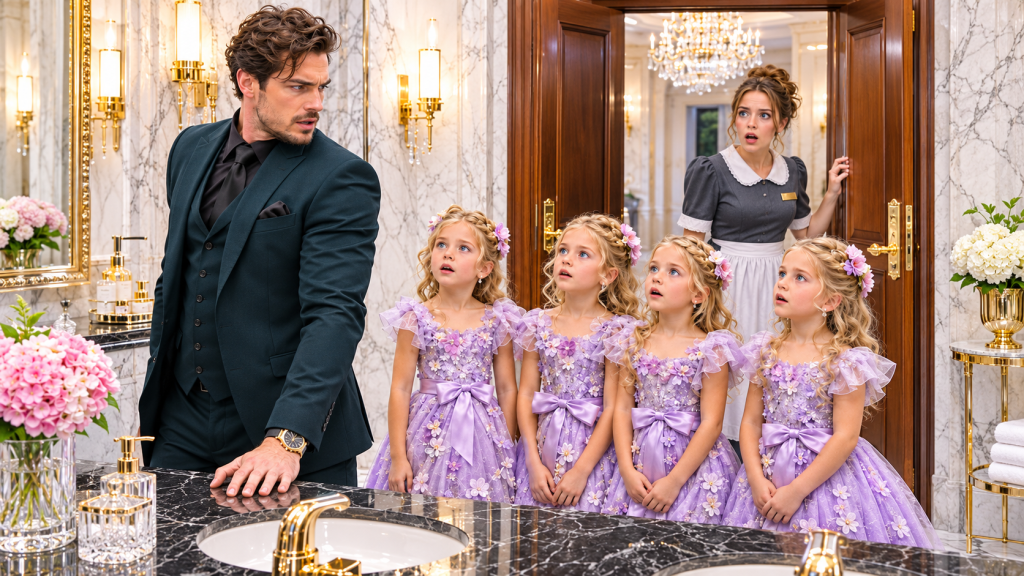
Sometimes I think about the moment I first saw the girls near the restaurant sinks.
Four little faces.
Four matching navy-blue dresses.
Four voices giggling over a hand dryer.
I had walked into that restaurant believing I was about to begin a future chosen for me.
Instead, I encountered the family I never knew I’d lost.
My mother thought she was protecting our family by keeping Isla away.
But the people she tried to erase became the people who taught me what family truly means.
And when my daughters ask me how we found one another, I always tell them the same thing.
“Sometimes life takes a long road to bring people together.”
Then Penny inevitably asks:
“But you found us, Daddy?”
And I smile.
“Yes, sweetheart.”
I hold her close.
“And this time, I’m staying.”
THE END STORIES! THANK YOU FOR READING GOOD LUCK !❤️
Related Posts