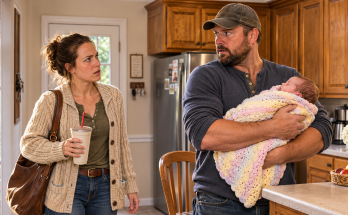
Bill stood in the driveway with one hand resting on the door of his truck, staring at the folder I held against my chest. For forty-one years, I had known that man’s face better than my own. I knew the way his left eyebrow lifted when he was telling a joke. I knew the little crease beside his mouth that appeared whenever he was worried about money. I knew how he rubbed his knee before a storm and how he hummed old country songs while watering the tomatoes.
But the expression he wore that afternoon was one I’d never seen before. He looked frightened of me. Not worried that I was hurt. Not ashamed that I’d discovered his affair. Frightened that I was holding papers he never intended me to see. “Earlene,” he said finally. “What are you doing here?”

I looked at him. Then at Christa, standing in the doorway with her arms folded tightly around herself. And finally at the rocking chair on the porch. The one Bill had purchased with the credit card we used for groceries. “I came to find out where our money was going,” I answered. Bill took two steps toward me.
“Give me that folder.”
I didn’t move.
“Why?”
“Because those are private documents.”
I looked down at the paper bearing my signature.
“Private enough that you signed my name without asking me?”
His face turned pale.
Christa whispered, “Bill?”
He turned on her.
“I told you not to show her anything.”
And there it was.
Not concern.
Not remorse.
Just anger that someone had interrupted his carefully arranged lies.
I held the folder closer.
“Don’t talk to her like that, Bill. She’s not the one who made promises to me forty-one years ago.”
He looked at me sharply.
“Earlene, you’re making a scene.”
I almost laughed.
We were standing on a quiet street in Evansville, beside a yellow house with mums on the porch.
A dog barked somewhere inside.
A neighbor’s lawn sprinkler clicked across a patch of dying grass.
And my husband was worried about appearances.
“Bill,” I said quietly, “if you wanted to avoid a scene, you shouldn’t have built a second life with our grocery money.”
Christa stepped onto the porch.
Her face was wet with tears.
“Bill, you told me she knew.”
He turned toward her.
“Christa, go inside.”
“No.”
The word surprised all three of us.
She straightened.
“You said your marriage was over. You said Earlene had agreed to sell the house.”
Bill clenched his jaw.
“She doesn’t understand the arrangements.”
I stared at him.
“Then explain them.”
He looked away.
“Not here.”
“Why not?”
“Earlene, for heaven’s sake—”
I interrupted him.
“Am I going into assisted living, Bill?”
The question struck him like a physical blow.
His mouth opened.
Then closed.
Christa began crying.
I continued.
“Because apparently you’ve been telling people that I’m leaving our house and moving into a facility.”
Bill rubbed his forehead.
“It’s complicated.”
I shook my head.
“No. A knee replacement is complicated. Forty-one years of marriage is complicated. Telling another woman that your wife is going into assisted living when she knows nothing about it is a lie.”
He looked toward the street.
“You’re seventy years old, Earlene.”
I felt my chest tighten.
“And?”
“You’re not getting younger.”
I stared.
For a moment, I wondered whether I’d misheard.
Then I said, very slowly, “Neither are you, Bill.”
He swallowed.
“That’s not what I meant.”
“Then tell me what you meant.”
He said nothing.
And in that silence, I finally understood that my husband had begun speaking about my future as though I wouldn’t be allowed to participate in it.
Christa moved toward me.
“Earlene, please. Come inside. I want to show you something.”
Bill reached for her arm.
“Don’t.”
She stepped away.
“You’ve lied to both of us.”
He gave a bitter laugh.
“Oh, now you’re innocent?”
Her face crumpled.
“No. I knew you were married when we started seeing each other. I knew what I was doing was wrong.”
She looked toward me.
“And I’m sorry.”
I swallowed.
Her apology couldn’t erase what she’d done.
But I appreciated that she wasn’t pretending she’d accidentally wandered into an affair.
Then Christa looked back at Bill.
“What I didn’t know was that you were using your wife’s name on financial documents.”
His expression hardened.
“You’re misunderstanding everything.”
“Then explain it to her.”
He said nothing.
I took one careful step backward.
“Bill, I’m leaving.”
His head snapped toward me.
“You’re not taking those papers.”
I felt my hands begin to tremble.
“These are copies, aren’t they, Christa?”
She nodded.
“Yes. He gave me copies. The originals aren’t here.”
I looked at Bill.
“Then you can explain to a lawyer why my name appears on documents I never signed.”
He took another step toward me.
“Earlene, don’t be foolish.”
I felt something cold settle inside my chest.
For forty-one years, whenever Bill wanted to end an argument, he called me foolish.
Foolish for worrying about money.
Foolish for questioning a bill.
Foolish for wondering why he stayed out so late.
He used the word as though it were a lid he could place over anything I wanted to say.
But not that day.
I looked him straight in the eyes.
“I’m not foolish, Bill.”
My voice shook.
“I’m just finished believing you.”
I turned toward my car.
Behind me, Christa called, “Earlene!”
I stopped.
She hurried down the steps carrying a small envelope.
“Please take this.”
I looked at it.
“What is it?”
“Copies of messages Bill sent me about the house. And the number of the realtor he told me was handling the sale.”
I hesitated.
Then accepted the envelope.
Christa’s eyes filled.
“I should have asked more questions.”
I looked at her for a long moment.
“Yes,” I said.
“You should have.”
Then I got into my car, locked the doors, and drove away.
I made it three blocks.
Then I pulled into an empty grocery store parking lot and began to cry.
Not the polite tears I’d shed when neighbors brought casseroles after my mother died.
Not the quiet tears I’d hidden when our daughter left for college.
I cried so hard I could barely breathe.
Forty-one years.
Four decades of washing his clothes, raising our child, planting gardens, attending church, and sitting beside him in hospital waiting rooms.
Forty-one anniversaries.
A thousand ordinary mornings.
The little tomato he’d always brought me in July.
And all the while, somewhere behind the familiar face of my husband, a stranger had been making plans.
Plans involving another woman.
Our money.
Our home.
And a future in which I was supposed to disappear quietly.
My phone rang.
It was my daughter, Melissa.
I answered.
“Mom?”
The moment I heard her voice, I started crying harder.
“Mom, what’s wrong?”
I tried to speak.
Nothing came out.
“Where are you?”
“Evansville.”
There was a pause.
“Mom, did you go to that house?”
I closed my eyes.
“Yes.”
“Oh, Mama.”
Her voice softened immediately.
“Are you safe?”
“Yes.”
“Are you alone?”
“Yes.”
“Okay. Tell me where you are.”
I gave her the name of the grocery store.
She took a breath.
“Listen to me. Don’t drive while you’re this upset.”
I nodded, although she couldn’t see me.
“I won’t.”
“I’m getting off my shift. I’ll come get you.”
“Melissa, you work at the hospital. You’re exhausted.”
“Mom.”
Her voice became firm.
“You spent twenty-six years making sure I never faced a frightening day alone.”
I covered my mouth.
“Let me return the favor.”
While I waited, I sat in the driver’s seat looking at the envelope Christa had given me.
I wanted to tear it apart.
Throw it into the trash.
Drive home and pretend I’d never seen anything.
Some part of me still wanted the world to be what it had been nine days earlier.
A husband going fishing.
A wife putting dinner in the oven.
An ordinary Saturday.
But I knew there was no going back.
The truth had entered my life.
And whether I liked it or not, it was staying.
Melissa arrived fifty minutes later.
She parked beside me, got out of her car, and opened my door.
I stood.
She wrapped her arms around me.
For a long time, we didn’t speak.
Then she whispered, “I’m here, Mom.”
I held on to her.
And for the first time that day, I felt the ground beneath my feet again.
We took my car back to St. Louis.
Melissa drove.
I sat in the passenger seat with the folder on my lap.
Every few miles, she glanced toward me.
Finally, she asked, “Did you see him?”
I nodded.
“And Christa?”
“Yes.”
Melissa took a slow breath.
“Did she know he was married?”
“Yes.”
My daughter gripped the steering wheel.
“Then she knew enough.”
I looked out the window.
“She knew about the affair. She says she didn’t know about the rest.”
Melissa nodded.
“And what is the rest?”
I handed her the folder when we stopped for gas.
She examined the papers under the station lights.
Her expression changed.
“Mom.”
I swallowed.
“Yes?”
“Did you sign any of this?”
“No.”
She turned a page.
“Did you authorize Dad to sell the house?”
“No.”
She looked up.
“Did you agree to move into assisted living?”
My eyes filled.
“No, honey.”
Melissa stared at the documents.
Then whispered, “Oh, my God.”
She placed the papers back into the folder.
“Mom, tomorrow morning we’re calling an attorney.”
I nodded.
“I know.”
“And you’re not confronting Dad alone again.”
I swallowed.
“I know.”
She reached across the console and squeezed my hand.
“Whatever this is, we’re going to sort it out.”
I looked toward the highway.
Then whispered, “Melissa, I don’t understand how he could do this.”
Her eyes filled.
“Neither do I.”
We drove the rest of the way in silence.
I did not go home that night.
Melissa insisted I stay with her.
She had a little guest room with blue curtains and a quilt I’d made when she got married.
I sat on the edge of the bed, looking at the familiar stitching.
I remembered working on that quilt during winter evenings while Bill watched baseball.
He used to bring me tea and complain that I was sewing crooked.
I would tell him perfection was overrated.
Then he’d kiss my forehead.
I had spent years believing those small moments were proof that our marriage was safe.
Now I didn’t know what they meant.
Perhaps some had been real.
Perhaps he had loved me once.
Perhaps he still thought he did, in some strange and selfish way.
But love wasn’t enough if it could be set aside whenever a more convenient life appeared.
At midnight, my phone buzzed.
Bill.
Earlene, please come home. We need to talk.
I stared at the message.
Then another appeared.
Christa is upset. She’s threatening to end things because you misunderstood the paperwork.
I almost laughed.
I had misunderstood.
Of course.
The same old explanation.
Then a third message arrived.
Don’t involve Melissa. This is between husband and wife.
That was the one that made me sit up straight.
I typed a single reply.
Any discussion about finances or property will go through my attorney. I am safe, and I will contact you when appropriate.
Then I turned off the phone.
The following morning, Melissa called a family-law attorney she’d met through a colleague at the hospital.
Her name was Margaret Ellis.
She was in her late fifties, with short silver hair, a warm voice, and the calm expression of a woman who had heard too many complicated stories to be easily surprised.
When I entered her office, I felt embarrassed.
I was seventy years old.
I had balanced our household budget for decades.
Raised a daughter.
Managed church fundraisers.
Cared for elderly relatives.
And yet I was sitting before a stranger, trying to explain how my husband had arranged to leave me without telling me.
Margaret listened patiently.
When I finished, she said, “Earlene, we need to distinguish what Bill intended from what he has actually done.”
I nodded.
“The affair is one matter.”
“Yes.”
“The attempted property arrangements are another.”
“Yes.”
“And whether any financial institution received false or unauthorized documents is a separate question that needs careful examination.”
My hands trembled.
“Can he sell our house without me?”
“That depends on how title is held, the applicable law, and what has been submitted. We need the recorded documents before reaching a conclusion.”
I nodded.
Margaret leaned forward.
“But I can tell you this: a letter bearing your name does not become valid simply because Bill says you signed it.”
Tears filled my eyes.
She reviewed the documents Christa had given me.
Then she stopped at one page.
“Where did you obtain this?”
“From Christa.”
Margaret studied it.
The page was headed Residential Transition Plan.
Beneath it were notes about our house, expected sale proceeds, and a proposed move into a senior living community.
A line identified me as the prospective resident.
Another identified Bill as my spouse and primary contact.
At the bottom was a signature that looked enough like mine to frighten me.
But it wasn’t mine.
Margaret turned the page over.
Then looked at me.
“Earlene, have you ever been evaluated for memory loss?”
I stared at her.
“No.”
“Has anyone told you that you need assisted living?”
“No.”
“Do you manage your own daily activities?”
“Of course.”
She nodded.
“Then we need to find out whether this was merely an inquiry or whether someone submitted inaccurate information about your health or wishes.”
I swallowed.
My husband had been telling another woman I was going away.
Now I discovered there were documents suggesting someone had begun arranging it.
Margaret called for a copy of the property records through the appropriate channels.
She also recommended that I contact our bank to review account access, recent transactions, and any unusual changes.
I agreed.
But then she asked something I hadn’t expected.
“Earlene, do you have independent funds available?”
I hesitated.
“We have joint accounts.”
“Anything in your name alone?”
I thought about the savings account my mother had left me.
A little inheritance I’d kept separate after her death.
It wasn’t enormous.
But enough to pay for an attorney and my immediate expenses.
“Yes,” I said.
Margaret smiled.
“Good. Keep those records available, and let us make any decisions about marital finances carefully. We don’t want either side hiding or improperly removing assets.”
I nodded.
I wasn’t interested in draining accounts or punishing Bill financially.
I wanted to know what was ours.
What had been spent.
What had been promised.
And what he had tried to do without my knowledge.
That afternoon, Melissa drove me to our bank.
The branch manager knew us.
For years, Bill and I had gone there together at Christmas to exchange money for crisp bills to put inside the grandchildren’s cards.
When he saw me, he smiled.
“Mrs. Turner, how can I help you?”
My married name suddenly felt strange.
I took a breath.
“I need to review recent activity on our accounts.”
He nodded.
“Certainly.”
We sat in a small office.
The manager printed statements and explained the procedures for obtaining additional records.
Some transfers were ordinary.
Utilities.
Insurance.
Groceries.
But others made my stomach tighten.
Furniture purchases.
Hotel charges.
Repeated payments to a property management company.
And several transfers to an account I didn’t recognize.
I pointed toward the unfamiliar name.
“What is that?”
The manager reviewed the entry.
“It’s a linked external account receiving scheduled transfers.”
I stared.
“Whose?”
He explained that he could provide information available to me as an account holder, while other identifying details would require appropriate authorization or process.
I nodded.
Then I looked at the amounts.
A few hundred dollars.
Then a thousand.
Then more.
Over several months, the total was substantial.
Money I thought was going toward retirement had been leaving our accounts.
Melissa leaned toward me.
“Mom, did you know about any of this?”
I shook my head.
“No.”
The manager looked concerned.
“Mrs. Turner, if you believe transactions may have been unauthorized, we can begin a review and explain the options available to you.”
I nodded.
“Please.”
He handed me the relevant information.
I took it carefully.
Then asked another question.
“Has anyone requested changes to the account access or mailing address?”
He examined the available records.
“There was a request to update contact information associated with one account.”
My heart began pounding.
“What address?”
He read it aloud.
A street on the north side of Evansville.
The yellow ranch house.
Christa’s address.
I stared at him.
For several moments, I couldn’t speak.
Then Melissa reached for my hand.
“Mom?”
I looked at her.
“He wasn’t just planning to leave.”
My voice broke.
“He was already moving our life over there.”
That night, I couldn’t sleep.
I sat at Melissa’s kitchen table with the statements spread before me.
Forty-one years of marriage.
Reduced to deposits, withdrawals, and transfers.
But somewhere between those numbers were all the things we’d sacrificed together.
The vacations we postponed.
The second car we didn’t buy.
The winters we kept the thermostat low.
The years I worked part-time while raising Melissa.
Every dollar represented choices we’d made because we believed we were building one future.
Now Bill had been spending that future on another woman.
I stared at the furniture receipt.
One queen bed.
One dresser.
One rocking chair.
The rocking chair hurt most.
I knew that sounded foolish.
But Bill had always promised that when we retired, we’d buy two rocking chairs for the porch.
We’d sit together in the evenings, watching the birds and complaining about the weather.
Now he’d purchased one.
For Christa.
And I wondered whether he had ever intended to share that peaceful old age with me.
The next surprise came on Thursday morning.
Christa called.
I almost didn’t answer.
But Margaret had advised me to preserve relevant communications and avoid making decisions based solely on anger.
So I picked up.
“Hello?”
“Earlene?”
Her voice sounded tired.
“Christa.”
A long pause.
Then she whispered, “Bill and I are finished.”
I stared at the wall.
“That is between you and Bill.”
“I know.”
She swallowed.
“But there’s something I need you to understand.”
I closed my eyes.
“Go ahead.”
“After you left, I asked him about the papers.”
I waited.
“He told me you were confused and that your daughter was encouraging you to make trouble.”
My jaw tightened.
“Of course he did.”
Christa continued.
“Then he said the assisted living arrangements were necessary because you’d become unpredictable.”
I felt sick.
I remembered the way Bill occasionally joked about my forgetfulness.
How he’d laugh when I misplaced my glasses.
How he’d tell friends I couldn’t remember where I put anything.
I’d dismissed it as ordinary teasing.
Now I wondered whether those jokes had been preparing other people to believe something untrue about me.
Christa took a breath.
“I told him I didn’t believe that.”
I looked down.
“He became furious.”
Her voice trembled.
“He said I’d ruined everything by showing you the folder.”
I swallowed.
Then she whispered something that made my skin turn cold.
“Earlene, he told me you’d never make it through the divorce without him.”
I closed my eyes.
“What does that mean?”
“I don’t know.”
She sounded frightened.
“But he said you’d be too embarrassed to fight.”
For a moment, I was silent.
Then I said quietly, “He doesn’t know me as well as he thinks.”
Christa began crying.
“I’m sorry.”
I took a breath.
“Christa, you made choices that hurt me.”
“I know.”
“You knew he was married.”
“Yes.”
“And you let me bring you a pound cake while you were seeing my husband.”
She sobbed.
“I know.”
I swallowed.
“I don’t know whether I’ll ever forgive that.”
“I understand.”
Then I added, “But if you have information about documents he submitted using my name, please provide it through your attorney or mine.”
She nodded through tears.
“I will.”
When the call ended, I sat quietly.
Christa had been part of the betrayal.
That didn’t make her responsible for every decision Bill made.
And Bill’s lies to her didn’t erase the fact that she’d knowingly pursued a married man.
The truth was messier than a story with one villain and one innocent bystander.
I was beginning to understand that accountability would require looking at each person’s choices separately.
Including mine.
Not because I caused Bill’s betrayal.
But because I had spent years avoiding questions when the answers frightened me.
That was something I intended to change.
The first time Bill came to Melissa’s house, I wasn’t there.
I had gone with Margaret to review the property records.
Melissa called while we were still in the attorney’s parking lot.
“Mom, Dad’s here.”
My stomach tightened.
“Is everything all right?”
“He’s standing on the porch asking to speak to you.”
I closed my eyes.
“Tell him I’m not available.”
“He says you’re making a mistake.”
I looked toward Margaret.
She nodded for me to stay calm.
“Melissa, you don’t have to argue with him. If he won’t leave when asked, get help.”
My daughter was quiet.
Then she said, “Mom?”
“Yes?”
“I’m proud of you.”
My eyes filled.
“For what?”
“For not running home just because he wants you to.”
When I returned, Melissa was waiting in the kitchen.
Bill had left.
But he’d placed a grocery bag on the porch.
Inside were two tomatoes, a jar of homemade pickles, and a note.
Earlene,
I know you’re upset.
We’ve been together too long to throw everything away over one mistake.
Come home. We’ll figure it out.
Love, Bill.
I read it twice.
One mistake.
Forty-one years.
As though an affair, months of secret spending, and documents bearing a signature I hadn’t written could all be folded into a single unfortunate afternoon.
I took the tomatoes out of the bag.
They were ripe.
Beautiful.
The first tomatoes from our garden had always been a tradition.
I remembered Bill carrying them into the kitchen each July, holding them carefully in his weathered hands.
“Only the best for my girl.”
For a moment, I could almost hear his younger voice.
Then I placed the tomatoes on the counter.
I wasn’t going to let a sentimental gift erase the facts.
The property records arrived two days later.
Margaret called me into her office.
She spread several documents across the table.
“Earlene, I have some good news.”
My heart lifted.
“What?”
“The house is jointly titled to you and Bill, as you believed. There is no completed sale.”
I exhaled.
“And the listing?”
“A real estate agent had prepared preliminary materials, but the agency has confirmed there is no valid listing agreement authorizing a sale on your behalf.”
I covered my mouth.
“So he couldn’t just sell it?”
“Not as though he alone owned it. Any sale or transfer would have to satisfy the applicable legal requirements. The disputed paperwork gives us additional matters to examine.”
I nodded.
For the first time in days, I felt a little of the ground return beneath my feet.
Then Margaret turned another page.
“However, there’s something concerning about the documents related to the proposed senior living arrangement.”
My stomach tightened.
“What?”
“The facility Bill contacted says it received an inquiry describing you as someone who needed help managing your affairs.”
I stared.
“What kind of help?”
“Assistance with finances, medication reminders, and daily decision-making.”
My mouth went dry.
“But I don’t need any of that.”
“I understand. An inquiry doesn’t mean the facility accepted the information as true or that you were admitted. We’re examining exactly what was submitted.”
I looked at the paper.
My name.
My birth date.
My home address.
Details about my marriage.
All arranged neatly beneath a heading about care needs.
It felt as though someone had written an entirely different life for me and expected me to step into it.
Margaret leaned forward.
“Earlene, have you ever given Bill a power of attorney?”
I thought carefully.
“Years ago, when I had surgery, we signed some papers so he could help with medical matters if necessary.”
“Do you have copies?”
“Not with me.”
“We should obtain them and check whether they’re still valid and what authority, if any, they grant.”
My hands began trembling.
“Could he use those papers to make decisions for me?”
“That depends on their terms and the law. We shouldn’t assume he has authority he doesn’t possess. But we need to review them.”
I swallowed.
“All right.”
Then I asked the question that had been haunting me since Christa opened her door.
“Margaret, was he trying to make people believe I couldn’t take care of myself?”
She considered.
“The documents raise that concern. We need to establish his intentions and what representations he actually made.”
I nodded.
But my heart already knew something about Bill’s character that no document could explain.
He had always hated being questioned.
And lately, I had begun asking questions.
The next week, I returned to our house for the first time since discovering the affair.
Margaret had advised me to coordinate the visit and avoid unnecessary confrontation.
Melissa accompanied me.
Bill had agreed in writing to be elsewhere while I collected personal belongings.
When I stepped through the front door, the familiar scent of furniture polish and old wood surrounded me.
My little porcelain rooster still sat on the kitchen windowsill.
Lilly’s childhood drawings were attached to the refrigerator.
A quilt I’d sewn twenty years earlier covered the sofa.
Everything looked ordinary.
That was what hurt.
A stranger might have entered and seen a happy home.
But I knew what had happened inside it.
I walked toward the bedroom.
Our wedding photograph hung above the dresser.
Bill wore a dark suit.
I wore a lace gown my mother had helped me choose.
We were twenty-nine and twenty-seven.
Neither of us had any idea what forty-one years would bring.
I stood before the photograph.
Then whispered, “What happened to us?”
Melissa appeared in the doorway.
“Mom?”
I wiped my eyes.
“I’m all right.”
She looked at the photograph.
Then came beside me.
“You don’t have to keep that if it hurts.”
I shook my head.
“I don’t know what I want to do with it.”
She nodded.
“Then don’t decide today.”
We packed clothes.
My jewelry.
Personal photographs.
Medical records.
And a wooden recipe box containing cards written in my mother’s handwriting.
Then Melissa opened the closet.
“Mom, what about the old cedar chest?”
I looked toward the foot of the bed.
Bill had built it during our first year of marriage.
Inside were Christmas decorations, family letters, and keepsakes.
I knelt beside it.
The hinges creaked when I opened the lid.
I lifted out a stack of photographs.
Beneath them lay a blue envelope.
I didn’t recognize it.
On the front, in Bill’s handwriting, were two words.
For Earlene.
I froze.
Melissa leaned closer.
“What is it?”
I shook my head.
“I don’t know.”
Inside was a letter dated almost three years earlier.
I unfolded it carefully.
And began reading.
Earlene,
I don’t know how to tell you this face-to-face.
Ever since the surgery, I feel like half the man I used to be.
I can’t work the way I used to. I can’t climb a ladder without worrying about my knee. I hate needing help.
You look after me so patiently, and somehow that makes me feel worse.
I keep thinking that you deserve someone stronger.
I don’t know what happens next.
I just know I’m ashamed of how frightened I’ve become.
Bill.
I sat back on my heels.
For a moment, the room seemed to hold its breath.
Bill had written that letter before Christa entered our lives.
Before the furniture purchases.
Before the airport kiss.
Before the lies.
He’d been frightened.
Ashamed.
Struggling to accept that his body had changed.
I remembered those months after his surgery.
How he snapped when I tried to help him stand.
How he refused to use the walker unless nobody else was watching.
How he’d lie awake staring at the ceiling.
I thought he was angry about the pain.
Perhaps he was.
But there had been more.
Melissa knelt beside me.
“Mom?”
I handed her the letter.
She read it.
Then looked up.
“Did he ever give this to you?”
I shook my head.
“No.”
Her eyes filled.
“Maybe he was trying to explain something.”
I nodded slowly.
“Maybe.”
Then I looked toward our wedding photograph.
For the first time, I felt an unexpected kind of sadness.
Not the sadness of betrayal.
The sadness of realizing that someone I’d loved had been suffering and hadn’t trusted me enough to tell the truth.
But as I folded the letter, I understood something important.
Bill’s fear might help explain how he became vulnerable to attention from someone new.
It might explain why Christa’s praise made him feel young again.
It might explain why he wanted to escape the life that reminded him of his limitations.
But it didn’t excuse what he’d done.
He could have talked to me.
Asked for counseling.
Admitted he was frightened.
Instead, he’d chosen secrecy.
And then he’d tried to arrange my future without asking me.
His pain had been real.
So was the harm he’d caused.
That evening, Melissa and I sat on her porch.
The air was cool.
Crickets sang beneath the bushes.
She handed me a cup of tea.
“Mom?”
“Yes?”
“Do you think you’ll forgive Dad?”
I looked toward the darkening sky.
“I don’t know.”
She nodded.
“Do you still love him?”
I thought about the question for a long time.
Then answered honestly.
“I love the man I married.”
My voice trembled.
“I love the father who carried you around the house when you were little. The husband who brought me tomatoes. The man who held my hand when my mother died.”
I swallowed.
“But I don’t know whether I can live with the man he’s become.”
Melissa slipped an arm around my shoulders.
“That makes sense.”
I looked at her.
“Does it?”
She smiled sadly.
“Mom, you’ve been married longer than I’ve been alive. You don’t have to make all your feelings simple just because the situation is terrible.”
I began crying.
Melissa held me.
And for the first time, I stopped trying to decide whether I was angry enough to leave or loving enough to stay.
I was allowed to feel both grief and anger.
I was allowed to remember good years without pretending the betrayal didn’t matter.
And I was allowed to make decisions about my future based on who I was now.
Not simply on who I’d promised to be forty-one years earlier.
The next important revelation came from Bill’s brother, Harold.
He called on a Sunday afternoon.
I’d always liked Harold.
He was quieter than Bill, less interested in telling stories, and more willing to listen.
He’d lived near Kentucky Lake for twenty years.
When his name appeared on my phone, I hesitated.
Then answered.
“Hello, Harold.”
“Earlene.”
He sounded troubled.
“Can we talk?”
I swallowed.
“Yes.”
A long silence followed.
Then he said, “Bill told me you two were having problems.”
I closed my eyes.
“That’s putting it mildly.”
Harold sighed.
“I know about Christa.”
My fingers tightened around the phone.
“You do?”
“Yes.”
I stared.
“How long?”
“Since last winter.”
I felt sick.
“Harold.”
His voice broke.
“I’m sorry.”
I sat down slowly.
“Did he bring her to the fishing camp?”
Harold was silent.
Then answered, “Once.”
My heart dropped.
“He told me she was a friend from therapy.”
I closed my eyes.
“Did you believe him?”
“No.”
I felt tears fill my eyes.
“Then why didn’t you tell me?”
Harold exhaled.
“Because he begged me not to.”
I covered my face.
“He said you two were already separating.”
My stomach tightened.
“Of course he did.”
Harold continued.
“I asked him whether you’d told Melissa. He said you wanted privacy.”
I shook my head.
“Harold, I was frying fish for him while he was telling you we were separated.”
His voice broke.
“I know that now.”
For several moments, neither of us spoke.
Then Harold said something that surprised me.
“Earlene, I should have called you anyway.”
I wiped my eyes.
“Yes.”
“I knew something wasn’t right. I chose to believe his version because it was easier.”
I closed my eyes.
He continued.
“I love my brother. But I was wrong to help him hide something that hurt you.”
His apology didn’t erase my pain.
But unlike Bill’s messages, it didn’t contain an excuse.
Then Harold said, “There’s something else you need to know.”
My heart tightened.
“What?”
“Bill came to the camp two months ago.”
I waited.
“He asked if I’d lend him money.”
I frowned.
“For what?”
“He said he had some investments that weren’t doing well.”
My stomach dropped.
“What investments?”
Harold sighed.
“That’s what I asked.”
“And?”
“He wouldn’t explain.”
I stared toward the kitchen.
Bill had always been cautious about money.
At least, I thought he had.
He checked grocery prices.
Complained about electric bills.
Refused to replace appliances until they broke.
Yet he had secretly purchased furniture and transferred thousands of dollars.
Now Harold was telling me he’d been borrowing money.
“Did you lend it to him?”
“No.”
I exhaled.
“He became angry.”
I nodded.
“That sounds like Bill lately.”
Harold hesitated.
“Earlene, he mentioned that he expected money from selling the house.”
My breath caught.
“When?”
“Two months ago.”
I closed my eyes.
Before I’d discovered the affair.
Before Christa showed me the folder.
Before Bill told her he’d be out of our house in two weeks.
He had been making plans around money that hadn’t yet become his.
I thanked Harold.
Before ending the call, he whispered, “Earlene?”
“Yes?”
“You’ve always been family to me.”
My throat tightened.
“I know.”
He swallowed.
“Whatever happens between you and Bill, I hope you’ll let me know if you need anything.”
I looked toward the garden.
“Thank you, Harold.”
For the first time in weeks, I felt that not everyone connected to my husband had chosen to remain silent.
Margaret began tracing the financial transactions through lawful disclosure procedures.
The records showed that Bill had withdrawn funds from our joint accounts and used them for expenses associated with Christa’s home.
Some payments were clear.
Furniture.
Hotels.
Travel.
Other transfers required additional explanations.
But the surprising part was that Bill hadn’t only been spending money on the affair.
He’d also borrowed against an investment account and used part of the proceeds to cover losses from a private business venture.
When Margaret explained this, I stared at her.
“Bill invested in a business?”
She nodded.
“According to the documents we’ve received, he put money into a small equipment rental partnership.”
I frowned.
“He never mentioned it.”
“Do you recognize the name of the other investor?”
She slid a paper toward me.
Derek Whitcomb.
I shook my head.
“No.”
Margaret continued.
“The venture lost money. There are outstanding obligations that need to be reviewed carefully.”
I felt my stomach twist.
“Was Christa involved?”
“Not according to the records we’ve seen.”
I nodded.
So the affair wasn’t the whole financial story.
Bill had been hiding losses as well.
And perhaps the fantasy of a new life had been his way of escaping not only an aging marriage but the consequences of decisions he was ashamed to admit.
Margaret folded her hands.
“Earlene, I want you to understand something.”
I looked up.
“Bill’s financial mistakes don’t automatically become yours in every respect. But marital debts and assets can be complicated, so we’ll need to analyze the legal obligations carefully.”
I nodded.
“And the house?”
“The house remains jointly owned. Any decision about it will be addressed through the appropriate legal process.”
I looked down.
For years, I’d trusted Bill to handle investments.
Not because I was incapable.
Because we’d divided responsibilities.
He managed the larger accounts.
I managed our household.
I thought that arrangement meant we were a team.
Now I understood that sharing responsibilities only worked when both people shared the truth.
One afternoon, Bill asked to meet with Margaret and me.
His attorney would attend.
I agreed.
Not because I wanted reconciliation.
Because I wanted answers.
The meeting took place in a quiet conference room.
Bill entered wearing the navy sweater I’d bought him the previous Christmas.
His hair looked thinner.
His shoulders were slumped.
And when he saw me, his eyes filled.
“Earlene.”
I nodded.
“Bill.”
He sat across from me.
For several moments, neither of us spoke.
Then he whispered, “I miss you.”
My throat tightened.
I looked at him.
“Do you miss me, Bill?”
He frowned.
“What?”
“Or do you miss the way things were when I didn’t know what you were doing?”
He looked down.
His attorney cleared his throat.
Margaret leaned slightly toward me.
I took a breath.
“I’m not here to argue about our marriage. I need to understand the documents.”
Bill nodded.
“All right.”
I placed a copy of the assisted living inquiry on the table.
“Why did you tell people I needed to move into a facility?”
His face changed.
He rubbed his forehead.
“I thought it might be easier.”
I stared.
“Easier for whom?”
He didn’t answer.
“Bill.”
He swallowed.
“For everyone.”
My hands began trembling.
“Everyone except me?”
His eyes filled.
“I didn’t know how to tell you I wanted to leave.”
For a moment, I couldn’t breathe.
Then I whispered, “So you planned to move me out instead?”
Bill covered his face.
“I wasn’t thinking clearly.”
I looked toward Margaret.
She remained calm.
Bill continued.
“Christa wanted us to start over. I was tired of fighting with myself. I thought if the house sold, we’d both have money, and you could live somewhere comfortable.”
I stared at him.
“Did you ever ask whether I wanted to sell?”
He shook his head.
“Did you ask whether I wanted assisted living?”
“No.”
“Then what part of that plan involved me making a decision about my own life?”
He began crying.
“I know.”
I leaned back.
For forty-one years, Bill had made decisions about where we lived, what car to buy, and when to retire.
We discussed most of them.
Sometimes we disagreed.
But I never imagined he’d reach a point where he thought he could simply make me disappear from our home.
“Bill,” I whispered, “I would have survived you telling me you no longer loved me.”
He looked up.
My voice broke.
“It would have hurt. It would have broken my heart. But I would have survived.”
Tears rolled down his cheeks.
“What I cannot understand is why you thought I deserved to be lied about.”
Bill stared at his hands.
Then whispered, “I was ashamed.”
I thought about the old letter I’d found in the cedar chest.
“Because of your knee?”
He looked surprised.
“How did you know?”
“I found the letter you wrote after surgery.”
He closed his eyes.
For a long time, he said nothing.
Then he whispered, “I felt useless.”
My throat tightened.
“You weren’t useless.”
“I couldn’t work like I used to. I couldn’t do half the things I’d done before.”
I swallowed.
“And Christa made you feel young again.”
He nodded slowly.
“Yes.”
I closed my eyes.
At last, he was saying something true.
Then I asked, “Did that make it all right to spend our savings?”
He shook his head.
“No.”
“Did it make it all right to sign my name?”
His face crumpled.
“No.”
“Did it make it all right to tell people I wasn’t capable of caring for myself?”
He began sobbing.
“No.”
I looked at him for a long moment.
Then said quietly, “That’s what I needed you to understand.”
His attorney asked for a moment.
We paused.
When the meeting resumed, Bill acknowledged that he had prepared or caused documents to be prepared bearing my name without my authorization.
His lawyer advised him to address questions about specific signatures and transactions through the appropriate legal procedures.
I didn’t demand a dramatic confession beyond what the evidence could support.
The documents would be examined.
The financial records would be reconciled.
And if misconduct had occurred, the relevant authorities and courts would decide how to address it.
What mattered most to me was that Bill could no longer pretend the papers were simply a misunderstanding.
At the end of the meeting, he looked toward me.
“Earlene, can you ever forgive me?”
I thought about the tomatoes.
The fishing hat.
Our wedding photograph.
The letter he’d never given me.
And the rocking chair on Christa’s porch.
Then I answered honestly.
“I don’t know.”
His eyes filled.
I continued.
“But forgiveness and staying married are not the same thing.”
He looked down.
I stood.
“For years, I believed being a good wife meant protecting you from embarrassment.”
My voice trembled.
“Now I know being a good woman means refusing to help you hide the truth.”
I walked out beside Margaret.
And this time, I didn’t look back.
The divorce took time.
There were documents to review, accounts to reconcile, property questions to settle, and difficult conversations about what forty-one years of marriage meant under the law.
The house was eventually sold through an agreed process, with the proceeds divided according to the settlement.
The disputed transactions were examined.
Some money was accounted for and addressed through the financial resolution.
Other questions concerning unauthorized documents were referred to the appropriate institutions for review.
There was no instant victory.
No miraculous check that restored every dollar.
No judge who could give me back the years I’d spent trusting a man who had begun living a second life.
But I received something I’d almost forgotten I possessed.
The right to decide what happened next.
I bought a small cottage outside St. Louis.
It had two bedrooms, a sunny kitchen, and a little porch overlooking a garden.
Nothing fancy.
But the first time I walked through the front door, I felt something I hadn’t experienced in months.
Peace.
I placed my mother’s recipe box on the kitchen counter.
Hung Lilly’s graduation photograph above the fireplace.
And put a pot of red geraniums beside the front steps.
Melissa helped me arrange the furniture.
Lilly came home from college during spring break and painted the guest bedroom pale yellow.
One afternoon, the three of us sat on the porch eating strawberries.
Lilly looked toward the garden.
“Grandma?”
“Yes, sweetheart?”
“Do you ever miss Grandpa?”
I thought about the question.
Then nodded.
“Sometimes.”
She looked down.
“Even after everything?”
I smiled sadly.
“Forty-one years don’t disappear simply because the ending was painful.”
She leaned against my shoulder.
I continued.
“I miss the good moments. But I don’t miss being lied to.”
Lilly nodded.
Then whispered, “I’m glad you’re happy again.”
My eyes filled.
“So am I, honey.”
I heard from Christa one final time.
She sent a short letter through Margaret’s office.
She had ended her relationship with Bill.
She had also provided relevant financial correspondence to the people reviewing the disputed transactions.
In her letter, she apologized again for the affair and acknowledged that she had knowingly participated in something that hurt another woman.
I read it quietly.
Then placed it inside the folder containing the other records.
I didn’t answer.
I didn’t wish her harm.
But I didn’t owe her friendship or reassurance.
Some chapters are best closed without another conversation.
Bill moved into a small apartment near his brother.
Harold told me he was attending counseling and trying to sort out his financial problems.
I hoped he meant it.
I hoped he learned to live without pretending that every painful truth was somebody else’s fault.
But I no longer felt responsible for helping him become a better man.
That work belonged to him.
One July morning, almost a year after I saw Bill kissing Christa at the airport, I was watering the tomatoes outside my cottage.
The sunlight was warm.
Birds sang in the trees.
And the first ripe tomato hung beneath a cluster of green leaves.
I reached for it.
Then stopped.
For forty-one years, Bill had always brought me the first tomato of the season.
It was one of our oldest traditions.
I stood there with my hand resting against the vine.
And for a moment, grief swept over me.
Not because I wanted him back.
Because I missed the life I had believed we shared.
I picked the tomato.
It was red and firm and warm from the sun.
I carried it into the kitchen, rinsed it beneath the tap, and sliced it onto a plate.
Then I sat at the table and took a bite.
It tasted like summer.
Like gardens.
Like ordinary mornings.
Like a life I was still allowed to enjoy.
And suddenly, I smiled.
That afternoon, Melissa came to visit.
She found me sitting on the porch with a glass of iced tea.
“Mom?”
“Hello, honey.”
She looked toward the garden.
“Those tomatoes look wonderful.”
I laughed.
“Best ones I’ve grown in years.”
She sat beside me.
Then asked, “How are you feeling?”
I considered.
“Good.”
She smiled.
“Really?”
I nodded.
“Really.”
For a moment, we listened to the birds.
Then I said, “You know, Melissa, I used to think getting older meant the important parts of life were behind me.”
She looked at me.
“And now?”
I smiled.
“Now I think some of the best parts are simply different from what I expected.”
She took my hand.
“I’m glad.”
I thought about the day I drove to Christa’s house.
The shaking legs.
The yellow ranch.
The rocking chair on the porch.
Bill’s truck pulling into the driveway.
And that terrible moment when I realized the man I’d trusted had been planning a future without me while secretly trying to arrange mine.
For a long time, I believed that day was the ending of my story.
But I was wrong.
It was the moment I stopped allowing someone else to write it.
My name is Earlene Turner.
I’m seventy years old.
A mother.
A grandmother.
A woman who loved one man for most of her adult life.
And a woman who learned that love cannot survive without honesty, respect, and the freedom to make your own choices.
I don’t regret the years I spent raising our daughter.
I don’t regret the gardens we planted.
The holidays we celebrated.
Or the kindness I gave when Bill was recovering from surgery.
Those things were real because my love was real.
His betrayal doesn’t make my devotion meaningless.
But my devotion doesn’t excuse his betrayal either.
I wish Bill had been honest when he became unhappy.
I wish he’d trusted me enough to speak about his fear of aging.
I wish he’d understood that a reconstructed knee didn’t make him less worthy of love.
And I wish he’d remembered that the woman who stood beside him for forty-one years deserved the truth.
But wishes cannot change the past.
They can only remind us what matters in the future.
That evening, I stood in my garden watching the sunset.
The tomatoes were ripening.
The grass smelled freshly cut.
And somewhere down the street, children were laughing as they rode their bicycles.
I held Diane’s old watering can—an unexpected gift from a neighbor with the same name as a dear friend—and smiled at the small coincidences life still offered.
Then I looked toward my cottage.
My little home.
My safe place.
My new beginning.
For forty-one years, I believed being a good wife meant standing beside my husband no matter what happened.
But sometimes, being a good woman means having the courage to walk away when the person beside you stops treating you with love.
The day I drove to Christa’s house, I thought I was going there to discover where my marriage had gone.
Instead, I discovered where my own life needed to begin again.
And for the first time in a very long time, the future belonged to me.
THE END STORIES! THANK YOU FOR READING GOOD LUCK !❤️
Related Posts