The envelope in Glenna’s hand was old enough that the paper had gone yellow around the edges. My grandmother had been dead for sixteen years, but I knew her handwriting better than I knew my own. She wrote with a heavy rightward slant, pressing so firmly that you could feel the letters on the other side of the page. Every birthday card, every grocery list, every note she’d left on the kitchen table carried those same strong, determined strokes.
And there, across the back of the envelope, were two words that made my stomach turn. TRUST NOBODY. I looked at Glenna. “Where did you get that?” She swallowed. “Your granny gave it to me.” I stared at her. “Why would Granny give you anything?” Glenna lowered her eyes.
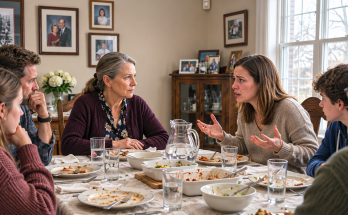
“Because she knew you loved my boy.” The baby began fussing in Hannah’s arms. Outside, a pickup truck rattled down the gravel road. Somewhere beyond the porch, a wind chime struck the same three notes again and again. For a moment, nobody moved. Then I held out my hand. “Give it to me.” Glenna hesitated.
“Rebecca, I think we should wait until Ford gets here.”
I looked straight at her.
“That is exactly what we’re not going to do.”
Hannah shifted the baby against her shoulder.
“Glenna, give her the envelope.”
My mother-in-law looked between us.
Then she handed it over.
I broke the seal carefully.
Inside were two folded sheets of paper and a faded photograph.
The photograph showed my granny standing in front of the farmhouse on our forty acres, wearing her old flowered housecoat and holding a black-and-white barn cat.
I was standing beside her, fifteen years old, grinning with a mouthful of braces.
On the back she’d written:
Rebecca and me. The place stays with the girl who knows how to love it.
My eyes filled immediately.
Granny had raised me for long stretches when my mama’s health was poor. She taught me how to make biscuits, how to pull a calf when the vet couldn’t arrive in time, and how to tell when a person was offering help because they loved you or because they wanted something.
I unfolded the first page.
Rebecca,
If somebody shows you this letter, I reckon something has gone wrong.
I left you that land because it belongs to your future, not to whichever man you marry. A good husband will respect that. A bad one will resent it.
You don’t owe anybody your inheritance just because you love them.
Granny.
I covered my mouth.
The next page was a copy of the recorded deed by which she’d transferred the land to me, along with notes about where the original papers had been kept.
There was nothing mysterious about the ownership.
Granny had wanted the property to remain mine.
And she had understood, long before I did, that love could make a woman dangerously willing to share what she’d worked so hard to protect.
I looked at Glenna.
“Why did she give you this?”
Glenna sat heavily in her recliner.
Her hands shook as she smoothed the sleeves of her bathrobe.
“Your granny came to see me not long after you and Ford got engaged.”
I stared.
“She told me she loved you like her own daughter. Said she hoped Ford would be a good husband.”
Glenna swallowed.
“Then she said if he ever started talking like your land was his, I was supposed to remind him whose name was on the deed.”
I could barely speak.
“And you kept the letter all these years?”
She nodded.
“She gave me a duplicate. Said you’d have your own records, but sometimes a woman needed somebody else to remember the truth.”
I looked down at the handwriting.
“Why didn’t you ever tell me?”
Glenna’s eyes filled.
“Because for a long time, I thought there was no reason.”
Then she whispered, “And when there was a reason, I was ashamed.”
Hannah sat on the sofa with Maisie asleep against her chest.
She looked younger than twenty-five now.
The Dollar General vest hung loosely from her shoulders. There was a little stain near the pocket, and her shoes were worn thin at the toes.
She stared at the papers on the coffee table.
“Ford told me he inherited that farm from his father.”
I looked up.
“What?”
She nodded miserably.
“He said he let his ex-wife stay there because she was raising his son.”
I felt something inside me go cold.
“And he told you I was divorced from him?”
“Yes.”
“How long have you been seeing him?”
Hannah looked toward the baby.
“Almost two years.”
I closed my eyes.
Two years.
Twenty-four months of Sunday dinners at Glenna’s.
Twenty-four months of Ford kissing me goodbye.
Twenty-four months of gas-receipt notes in my lunch.
And somewhere in those same months, he had been telling another woman that the house my grandmother left me belonged to him.
“How old is Maisie?” I asked.
“Three months.”
My throat tightened.
Three months.
While I was helping Colby shop for football cleats, Ford was becoming a father again.
While I was picking up extra pharmacy shifts to cover car insurance, he was buying diapers.
While I was telling coworkers that fourteen years of marriage taught you to stop worrying about every little thing, he was living a second life.
I looked toward Glenna.
“How long have you known?”
She covered her mouth.
I waited.
Finally, she whispered, “Since Hannah was pregnant.”
The room seemed to tilt.
“Since she was pregnant?”
Glenna nodded.
“Ford brought her here last spring.”
My eyes burned.
“And every Sunday, I sat at your table.”
She began crying.
“Rebecca—”
“Every Sunday, Glenna.”
My voice trembled.
“I brought you pot roast when your arthritis was bad. I filled your prescriptions. I drove you to the eye doctor.”
She lowered her head.
“And you smiled at me while you knew he had another woman carrying his baby.”
Glenna sobbed.
“I didn’t know how to tell you.”
I stared at her.
“You could have opened your mouth.”
Hannah looked away.
I continued.
“That’s all it would have taken.”
Glenna wiped her eyes.
“Ford kept saying he’d tell you himself.”
“And you believed him?”
She didn’t answer.
I looked at the yellow blanket wrapped around Maisie.
“You made her a blanket.”
Glenna began crying harder.
“She’s my grandbaby.”
I nodded slowly.
“Yes. She is.”
Then I lifted the blanket I’d brought from Colby’s closet.
“And so is the twelve-year-old boy who thinks this is the only one you ever made.”
Glenna stared at the two blankets.
Her expression crumpled.
For a long moment, I wanted to throw the envelope at her feet and walk away.
But then Maisie opened her eyes.
She blinked at the room with the soft, bewildered expression babies have when they wake in unfamiliar voices.
Her little fist curled against Hannah’s shirt.
She had done nothing wrong.
Neither had Colby.
Whatever happened next, those two children deserved adults who remembered that.
I took a slow breath.
“Hannah, may I photograph the paperwork?”
She nodded.
“Yes.”
I used my phone to take clear pictures of each page, including the document bearing the signature that resembled mine.
Then I asked whether I could have copies.
“Absolutely,” Hannah said.
She looked toward Glenna.
“I didn’t sign anything transferring Rebecca’s property. Ford told me I needed to review the trust papers before he filed them.”
I nodded.
“Good.”
I didn’t know whether the document was a forged deed, a draft trust transfer, or something that had never been submitted anywhere.
But I knew I hadn’t signed it.
And I wasn’t going to let anybody tell me that detail didn’t matter.
Hannah looked at me with tears in her eyes.
“Rebecca, I’m sorry.”
I met her gaze.
She swallowed.
“I knew he had a child. He said he and his ex-wife were raising Colby separately.”
I took a breath.
“Did you ever ask to meet Colby?”
“Yes. Ford said his ex didn’t want me around him.”
I almost laughed.
He had built two separate lives by using each woman as the reason the other couldn’t ask questions.
Hannah continued.
“I thought he was taking time to make things easier for his son.”
Her voice broke.
“I didn’t know he was sleeping in your bed every night.”
I looked toward the sleeping baby.
The anger I felt toward Ford was almost unbearable.
But Hannah’s face carried an awful realization of its own.
She had not known she was part of an affair.
And now she was discovering that the man she’d trusted had lied about his marriage, his home, and his intentions for their child.
I didn’t have enough strength to comfort her.
But I wasn’t going to blame her for secrets she’d been fed.
“Where do you live?” I asked.
She hesitated.
“In an apartment outside Sallisaw.”
“Does Ford help with rent?”
“Sometimes.”
I nodded.
“And does he visit Maisie?”
Her eyes filled.
“Two or three evenings a week. More when he says his route ends early.”
I felt my stomach twist.
Those were the nights he’d told me the propane company had him covering extra deliveries.
The nights I warmed up leftovers and told Colby his daddy was working hard.
I looked down.
Hannah whispered, “I thought we were building a family.”
I closed my eyes.
“So did I.”
Glenna leaned forward.
“Rebecca, please don’t let this tear the whole family apart.”
I looked at her.
I was so tired of that sentence.
People could hide things for months, sometimes years, and then act as though the person who discovered the truth was responsible for the damage.
I stood.
“Glenna, I didn’t bring another woman into my marriage.”
She lowered her eyes.
“I didn’t lie about owning somebody else’s land.”
She began crying.
“And I didn’t forge a signature.”
I picked up the envelope.
“If our family is coming apart, I’m not the one who cut through it.”
I left without waiting for Ford.
As I reached my car, Hannah followed me onto the porch.
“Rebecca?”
I turned.
She held Maisie against her shoulder.
For a moment, we looked at one another.
Two women who had believed the same man.
Two mothers who would be left carrying the consequences of his choices.
Hannah whispered, “I’m going to get a lawyer.”
I nodded.
“That’s a good idea.”
She hesitated.
“Can I call you if I find anything else?”
I thought about it.
Then said, “For information about the documents or the children, yes. But I can’t be the person you lean on about Ford.”
Her eyes filled.
“I understand.”
I looked at Maisie.
The baby yawned.
Then settled against her mother’s chest.
I swallowed.
“She’s beautiful.”
Hannah began crying.
“Thank you.”
I got into my car.
And this time, I called my sister.
“Beth?”
My voice broke on the first syllable.
She answered immediately.
“Rebecca? What’s wrong?”
I stared through the windshield.
“Can you come?”
She didn’t ask why.
Didn’t tell me to calm down.
Didn’t say she was busy.
She simply answered:
“Tell me where.”
I gave her Glenna’s address.
Then I began crying.
My sister said, “Stay in your car. Lock the doors. I’m on my way.”
And after forty years of insisting I could handle every trouble myself, I did something I should have done much sooner.
I let someone help me.
Beth arrived in forty minutes wearing jeans, a red sweatshirt, and the same old tennis shoes she’d worn to our family reunion.
She parked beside me and climbed into the passenger seat.
Then she looked at my face.
“Tell me.”
I handed her my phone.
She saw the picture of Ford holding Maisie.
Then the paperwork.
Then Granny’s letter.
Her jaw tightened.
“Lord have mercy.”
I nodded.
She looked at me.
“Have you talked to Ford?”
“Not yet.”
“Good.”
I wiped my eyes.
“I don’t know what to do.”
Beth took my hand.
“First, we make sure you and Colby are safe. Then we find a lawyer. Then we let Ford explain his own mess.”
I leaned against her shoulder.
“I thought I knew him.”
She kissed the top of my head.
“I know, baby.”
I began crying again.
And she held me until I could breathe.
On the drive back to Stilwell, I called the pharmacy.
I asked for another day off.
My supervisor, a woman named June who had worked with me for eleven years, sounded surprised.
“Rebecca, you never take time.”
“I know.”
She hesitated.
“Is everything all right?”
I looked toward Beth.
“No.”
June was quiet.
Then she said, “Take the time you need. We’ll cover your shifts.”
My eyes filled.
“Thank you.”
It was such a small kindness.
But that morning, nearly every familiar part of my life had turned uncertain.
Hearing someone say they’d help without asking for anything felt like being handed a railing on a dark staircase.
Beth drove me to my house.
Ford’s truck was gone.
Colby was still at school.
The kitchen looked exactly as I’d left it.
The Braum’s cup sat rinsed beside the sink.
A pot holder hung from the oven door.
On the refrigerator was Colby’s football schedule.
And beside the coffee maker lay a gas receipt with Ford’s handwriting.
Love you, Beck. Don’t work too hard.
I picked it up.
For fourteen years, those little notes had made me feel lucky.
Now I stared at the words and wondered how many he’d written after leaving Hannah’s apartment.
Beth touched my shoulder.
“Rebecca.”
I turned.
“Don’t make yourself solve the whole thing today.”
I nodded.
But my eyes moved toward the window.
Beyond the backyard lay forty acres of land my grandmother had loved.
Pasture.
A pond.
Two weathered barns.
Rows of pecan trees.
And the old fence Granny and I repaired one summer when I was sixteen.
Ford had tried to make plans for that land without me.
But the land wasn’t a promise between husband and wife.
It was a gift from a woman who had believed I deserved something that belonged to me.
I looked toward Beth.
“Whatever happens to my marriage, I am not letting him take Granny’s place.”
She nodded.
“Then that’s where we start.”
That afternoon, Beth helped me gather documents.
The recorded deed.
Property tax statements.
Insurance records.
Mortgage records showing the house and acreage were debt-free.
Bank statements.
Our marriage certificate.
And copies of everything I’d photographed at Glenna’s.
I found the original deed in a fireproof box beside Granny’s old Bible.
My name was printed clearly as the owner.
I sat at the kitchen table and traced the letters with my finger.
Rebecca Anne Turner.
No Ford.
No trust.
No vague promise of a transfer.
Just my grandmother’s decision, preserved in county records.
I felt my breathing settle.
One thing, at least, was certain.
Beth’s husband picked Colby up from school.
I didn’t want my son arriving home to find his mama crying over legal papers.
He was twelve.
Tall for his age.
Sensitive beneath all that football swagger.
He worried if I sneezed twice in a row.
I knew I couldn’t hide the truth forever.
But I also knew he didn’t need the entire weight of his father’s deception dropped on him in a single afternoon.
I called him.
“Hey, sweetheart.”
“Hey, Mama. Uncle Dan says I’m eating supper with them.”
“That’s right.”
“Are you okay?”
I swallowed.
“I’m having a hard day, honey. But I’m safe.”
He was quiet.
Then he asked, “Is Daddy okay?”
My chest tightened.
“Your daddy’s safe too.”
Another pause.
“Are y’all fighting?”
I closed my eyes.
“We have some grown-up things to work through.”
He didn’t speak.
Then he whispered, “Okay.”
I could hear how worried he was.
I wanted to tell him everything was fine.
But I had already spent too much of my life trusting comfortable lies.
So I said:
“Colby, nothing that happens between your daddy and me is your fault. And you don’t have to fix it.”
He swallowed.
“Love you, Mama.”
“I love you more than anything.”
Ford came home at six-thirty.
He walked through the back door carrying his lunch cooler, humming to himself.
Then he saw Beth.
He stopped.
“Well, hey, Beth.”
She looked at him.
“Ford.”
He glanced toward me.
“What’s going on?”
I sat at the kitchen table with my hands folded.
“I went to your mama’s house today.”
The color left his face.
His lunch cooler slipped from his fingers and landed on the floor.
For one moment, nobody moved.
Then Ford whispered:
“Rebecca.”
I looked at him.
“Maisie is a beautiful little girl.”
He closed his eyes.
And I knew, before he said another word, that he’d understood exactly what I’d discovered.
Ford stood by the kitchen door with his work boots planted on the linoleum, looking like a boy caught stealing from the church collection plate.
“Beck, let me explain.”
I studied him.
“Go ahead.”
He glanced at Beth.
“Can we talk alone?”
“No.”
“Rebecca, this is between us.”
I felt a bitter laugh rise in my throat.
“Apparently, our marriage hasn’t been between just us for nearly two years.”
His jaw tightened.
Beth folded her arms.
“She’s not asking you to leave yet, Ford. She’s asking you to tell the truth.”
He looked toward the table.
The documents were arranged in neat piles.
His eyes stopped on the photographs of the proposed trust papers.
Then on Granny’s letter.
“Where’d you get that?”
I didn’t answer immediately.
Instead, I asked:
“Did you sign my name?”
He swallowed.
“Beck—”
“Did you?”
He rubbed his forehead.
“They were just preliminary papers.”
I stared at him.
“That wasn’t my question.”
He looked toward the window.
Then whispered, “I was going to talk to you.”
I nodded slowly.
“Before or after somebody filed them?”
He said nothing.
I pulled out the chair opposite mine.
“Sit down, Ford.”
He hesitated.
Then sat.
I pushed the photograph of Maisie across the table.
“Is she your daughter?”
His face crumpled.
“Yes.”
I closed my eyes.
Somewhere inside me, a final little piece of hope broke.
Not because I’d truly doubted it.
Because hearing the truth spoken aloud made it impossible to pretend.
“How long have you known?”
“Since Hannah found out she was pregnant.”
“And you kept coming home to me?”
He lowered his head.
“Yes.”
“You kept sleeping beside me?”
His eyes filled.
“Rebecca, please.”
“And you kept sitting at your mama’s table every Sunday, letting me believe our family was whole?”
He began crying.
“I didn’t know how to tell you.”
I stared at him.
The sentence sounded so much like Glenna’s that I almost laughed.
It seemed nobody in that family knew how to tell me the truth.
But they all knew how to keep me from finding it.
“Why did you bring Maisie here yesterday?”
Ford wiped his face.
“Hannah had to work. Her sitter canceled.”
“Why didn’t you take her to Hannah’s apartment?”
“I needed to stop home for something.”
I waited.
He looked down.
Then whispered, “The papers.”
My stomach tightened.
“What papers?”
“The property documents.”
Beth leaned forward.
“Ford, be specific.”
He rubbed his hands together.
“I had some forms drawn up. Hannah was supposed to look them over.”
I stared.
“You brought your daughter into my kitchen while you collected documents designed to transfer my grandmother’s land?”
He covered his face.
“I wasn’t trying to steal anything.”
I pulled the copy toward me.
“Then why is my signature on this?”
He said nothing.
“Ford.”
His shoulders sagged.
“I copied it.”
The room went absolutely still.
Beth’s face hardened.
I stared at my husband.
“You copied my signature?”
He nodded.
My voice sounded strange to my own ears.
“From what?”
He whispered, “One of the insurance forms.”
I looked toward the refrigerator.
Fourteen years earlier, Ford had promised before God and our families to love me and honor me.
Now he sat at our kitchen table admitting he’d copied my name onto a property document.
I thought I would scream.
Instead, I asked:
“Did you submit it anywhere?”
He shook his head.
“Not to the county. I swear.”
“Did you show it to a bank?”
He hesitated.
Beth leaned forward.
“Ford.”
He swallowed.
“I talked to somebody about financing.”
My chest tightened.
“Financing what?”
“A business.”
I stared at him.
He rubbed his eyes.
“A small propane service operation. My own routes. My own truck.”
For a moment, I couldn’t make sense of it.
“You were going to borrow against my land?”
He looked miserable.
“I thought if we structured it right, we could set up a trust.”
“We?”
He looked away.
“Hannah and me.”
Beth stood so abruptly her chair scraped across the floor.
I lifted my hand.
She sat again.
I looked at Ford.
“Explain why Hannah needed to be involved in a trust concerning my property.”
He swallowed.
“She wanted security for Maisie.”
I nodded slowly.
“And you couldn’t provide that security from something you actually owned?”
He closed his eyes.
“I don’t have much in my name.”
I stared at him.
We had worked for years to keep our household debt low.
I paid taxes on the farm and carried much of the day-to-day expense.
Ford contributed to the household, but lately his spending had grown careless.
There were unexplained withdrawals.
Credit card balances.
Fuel charges he blamed on work reimbursements taking too long.
Now I saw those questions in a different light.
“You told Hannah the property belonged to you.”
He said nothing.
“You told her we were divorced.”
His face crumpled.
“Yes.”
“And when she started asking about her future, you decided to make your lies look true by using my land.”
Ford began crying.
“I didn’t think it would get this far.”
I leaned back.
“That’s funny.”
He looked up.
“Because it got all the way to your daughter being born.”
For a long moment, none of us spoke.
Then Ford whispered:
“I never meant to hurt you.”
I looked at him.
“Ford, you made the same choice over and over for nearly two years.”
He wiped his eyes.
“Rebecca—”
“You came home and kissed me.”
He lowered his head.
“You let me make your supper.”
Tears rolled down my cheeks.
“You stood beside me at church.”
My voice broke.
“And all that time, you were building another family.”
He covered his face.
I took a breath.
“You can’t call something an accident when you had to make a hundred decisions to keep it happening.”
Ford looked toward the hallway.
“Where’s Colby?”
“With Beth’s family.”
His face changed.
“Does he know?”
“Not yet.”
He began crying harder.
“Please don’t turn him against me.”
Something inside me steadied.
“Ford, I’m not going to ask Colby to hate you.”
He looked up.
“But I am not going to lie to protect you.”
He nodded miserably.
“And you’re going to help us tell him the truth in a way a twelve-year-old can understand. Without blaming Hannah. Without blaming me. Without making him responsible for comforting you.”
Ford stared at the table.
“Okay.”
Then I said the hardest words I’d ever spoken.
“You need to stay somewhere else tonight.”
He looked up sharply.
“Rebecca, this is my home.”
I felt my hands turn cold.
“No. This is where you’ve been living with me. The property belongs to me.”
His jaw tightened.
“I’ve lived here fourteen years.”
“I know. And we’ll handle any legal rights and responsibilities properly. But I’m asking you to stay with your brother or mother voluntarily while we sort this out.”
He stared at me.
For one frightening moment, I thought he might refuse.
Then he nodded.
“I’ll go to Mama’s.”
He stood and picked up his cooler.
At the doorway, he turned.
“Beck?”
I looked at him.
“Yes?”
“Do you still love me?”
The question almost knocked the breath out of me.
Because the terrible truth was that a part of me did.
I loved the man who taught Colby to fish.
The man who held me after my father’s funeral.
The man who knew I liked my toast nearly burned and my coffee with too much cream.
But I didn’t know who that man was anymore.
“I don’t know what to do with the love I still have,” I whispered.
Ford’s eyes filled.
Then I added:
“But it isn’t enough to make what you’ve done safe for me.”
He nodded.
And walked out.
When the truck disappeared down the gravel road, Beth moved beside me.
I leaned into her.
The house was quiet.
Too quiet.
For fourteen years, I’d listened for Ford’s boots at the back door.
I’d heard his truck coming before it reached the mailbox.
Now he was gone.
And even though I’d asked him to leave, I felt as though someone had torn the center out of my life.
Beth wrapped her arms around me.
“You’re going to get through this.”
I began crying.
“How?”
She held me tighter.
“One day at a time, baby. Sometimes one hour.”
The next morning, I met with a lawyer in Tahlequah.
Her name was Marianne Cole.
She was in her early sixties, with gray hair cut just below her ears and a voice that was soft until she needed it to be firm.
I brought Granny’s deed, the copies of the trust documents, the photographs, and every bank statement I could find.
Marianne studied them carefully.
Then looked at me.
“Rebecca, you did the right thing bringing the records.”
My hands trembled.
“Can Ford take my land?”
She folded her hands.
“The property being titled solely in your name and inherited from your grandmother is important. But we need to examine the entire situation under Oklahoma law, including any marital claims, improvements, debts, and the precise legal status of the documents.”
I nodded.
“The proposed transfer hasn’t been recorded in the county records we’ve checked.”
I released a breath.
“But that doesn’t mean we ignore it,” she continued. “We’ll take appropriate steps to protect your interests and investigate whether any bank or other party received a copy.”
I swallowed.
“And the signature?”
She looked at me.
“If you didn’t sign or authorize it, we need to preserve that evidence. A forged signature can have serious legal consequences.”
I stared down at my hands.
The hands that counted pills at Walmart.
The hands that washed Ford’s work clothes.
The hands that held Colby when he was little.
Someone had tried to use my name without my permission.
And for the first time, I understood that my signature was not merely ink.
It was my consent.
And Ford had treated it as something he could take.
Marianne helped me review financial records and discuss temporary arrangements.
She advised me not to move or conceal marital assets and not to assume a simple password change resolved every joint financial question.
We reviewed what accounts I owned, what Ford could legally access, and how to protect my finances through appropriate procedures.
I also asked about Colby.
That was the question that made my voice break.
“What happens to my boy?”
Marianne’s expression softened.
“Your son is going to need stability. Any custody and parenting arrangements should focus on his best interests.”
I swallowed.
“Ford loves him.”
“I understand.”
“He isn’t a bad father in every way.”
Marianne nodded.
“Then we’ll take that seriously while also addressing what has happened.”
I looked down.
It was painful to admit that someone could love his child and still make choices that harmed his family.
But it was true.
The next evening, Ford came to Beth’s house to help explain things to Colby.
We agreed beforehand that neither of us would turn the conversation into an argument.
Colby sat between us on the sofa.
He wore his football hoodie and held a worn baseball in his hands.
He looked from me to Ford.
“Am I in trouble?”
My heart broke.
“No, sweetheart.”
Ford shook his head.
“Not at all, buddy.”
Colby frowned.
“Then what’s going on?”
I took a slow breath.
“Your daddy and I are going to live separately for now.”
His face changed immediately.
“Why?”
Ford looked down.
I waited.
Then he said quietly:
“Because I’ve made some choices that hurt your mama.”
Colby stared at him.
“What choices?”
Ford swallowed.
“I haven’t been honest about another relationship.”
The room became very still.
Colby’s eyes filled.
“Like… another girlfriend?”
Ford nodded.
“Yes.”
My son looked toward me.
I wanted to gather him into my arms and somehow put the world back together.
But I couldn’t.
Then Colby whispered:
“Is that why there was a baby in the kitchen?”
Ford closed his eyes.
I felt tears spill down my cheeks.
“Yes, honey.”
Colby looked at his father.
“Is she your baby?”
Ford nodded.
“Yes.”
My son dropped the baseball.
It rolled beneath the coffee table.
For a moment, he didn’t move.
Then he whispered:
“So she’s my sister?”
I looked at him.
“She’s your half sister, yes.”
He covered his face.
Ford began crying.
“Buddy, I’m sorry.”
Colby pulled away.
“Why didn’t you tell me?”
Ford looked miserable.
“I didn’t know how.”
Colby stood.
“Everybody keeps saying that!”
His voice cracked.
“You didn’t know how to tell Mama. You didn’t know how to tell me. But you knew how to keep doing it!”
I closed my eyes.
Out of the mouths of children.
Sometimes the simplest truth is the one adults spend years trying to avoid.
Colby ran down the hallway.
I started after him, but Beth gently touched my arm.
“Give him a minute.”
I nodded.
Ford sat with his head in his hands.
For once, I didn’t comfort him.
Our son was hurting.
And Ford needed to understand that his guilt didn’t make him the center of the room.
A few minutes later, I knocked on the guest bedroom door.
“Colby?”
He was sitting on the bed, wiping his eyes with the sleeve of his hoodie.
I sat beside him.
For a long time, he didn’t speak.
Then he whispered:
“Does Daddy love her more than us?”
My chest tightened.
“Oh, honey.”
He looked at me.
I took his hand.
“Your daddy’s choices don’t mean you weren’t enough.”
Tears filled his eyes.
“Then why’d he do it?”
I swallowed.
“I don’t know all the reasons. But they belong to him, not to you.”
He leaned against my shoulder.
“Are you getting divorced?”
I closed my eyes.
“We haven’t finished making those decisions.”
He nodded.
Then whispered:
“Do I have to meet the baby?”
I shook my head.
“Not before you’re ready. She’s a little girl who didn’t do anything wrong, but you’re allowed to have your own feelings.”
He began crying again.
I held him.
And for the next hour, I didn’t look at my phone or think about property records.
I simply sat with my son.
Over the following weeks, life became something I barely recognized.
Ford stayed with Glenna.
Colby continued school.
I went back to work.
Every morning, I stood behind the pharmacy counter counting pills, checking labels, and answering questions from customers who had no idea my marriage was falling apart.
I learned that heartbreak doesn’t always look dramatic.
Sometimes it looks like a woman filling prescriptions while remembering that her husband once brought another woman’s child into her kitchen.
Sometimes it looks like setting two plates instead of three.
Sometimes it looks like hearing a truck pull into the parking lot and turning your head before remembering the person you’re waiting for no longer comes home.
Hannah and I exchanged a few messages about the property documents.
She retained her own attorney.
Ford’s paternity of Maisie was legally acknowledged, and Hannah began working through support arrangements for their daughter.
I didn’t interfere.
Maisie deserved support from her father.
But my grandmother’s property was not his to promise as a substitute for meeting his responsibilities.
Hannah eventually sent me a photograph of Maisie sitting in a little baby chair, smiling.
I stared at it for a long time.
Then showed it to Colby.
He looked quietly.
“She’s getting bigger.”
I nodded.
“Babies do that.”
He studied the picture.
Then said:
“She kinda looks like me.”
My throat tightened.
“Yes, sweetheart. She does.”
The legal review uncovered that Ford had consulted a financing broker about the proposed business loan.
The draft trust paperwork had been used in preliminary discussions, but no completed transfer of my land appeared in the county records, and no loan secured by my property had closed.
That was a relief.
But it wasn’t the end of the problem.
Marianne advised me on preserving the records and addressing the unauthorized signature through appropriate channels.
Ford, through his lawyer, acknowledged that I had not signed the document and agreed not to rely on it.
The remaining questions about his conduct were handled separately from our property and family proceedings.
There was no dramatic courtroom arrest.
No instant reversal that made the whole thing disappear.
There were uncomfortable meetings, written agreements, financial disclosures, and a great deal of patience.
For the first time in my life, I was grateful for boring paperwork.
Because boring paperwork was protecting something my grandmother had worked her whole life to give me.
Then came the hardest conversation.
It happened on a rainy Thursday afternoon, almost three months after I found Maisie in my kitchen.
Ford asked whether we could meet at the house.
I agreed, provided we kept the conversation calm.
He arrived without his work cooler.
Without his hat.
Without one of those little gas receipts carrying a love note.
He looked older.
His hair had more gray than I remembered.
His eyes were tired.
We sat across from each other at the kitchen table.
For a moment, neither of us spoke.
Then he whispered:
“I’ve started counseling.”
I nodded.
“That’s good.”
He looked down.
“I’m trying to understand why I did all this.”
I waited.
He took a breath.
“I liked feeling wanted.”
My chest tightened.
“Ford, I wanted you.”
His eyes filled.
“I know.”
“You had a wife who loved you. A son who adored you. A home.”
He nodded.
“I know.”
I looked toward the window.
“Then why wasn’t that enough?”
He sat silently for a long time.
Finally, he said:
“Because I wanted to be somebody who didn’t have to answer for the life he’d already built.”
I stared at him.
He swallowed.
“With Hannah, I got to pretend I was starting over. No bills. No old arguments. No responsibilities I hadn’t already failed at.”
I looked at him.
“But you still had responsibilities.”
He nodded.
“I know.”
I took a breath.
“And when she got pregnant?”
He covered his face.
“I panicked.”
“So you lied more.”
“Yes.”
“And when she wanted a home for Maisie, you promised her mine.”
He began crying.
“Yes.”
I looked down at my hands.
They were trembling.
“Ford, I would’ve survived you telling me you didn’t want to be married anymore.”
He looked up.
“It would’ve hurt worse than anything. But I could have made decisions based on the truth.”
My voice cracked.
“Instead, you decided the truth was yours to keep.”
He stared at me.
Then whispered:
“I’m sorry, Beck.”
I closed my eyes.
For fourteen years, I’d wanted those words whenever we argued.
Now they seemed very small.
Ford reached into his jacket.
He placed a folded piece of paper on the table.
I looked at it.
“What is that?”
“A letter.”
I hesitated.
He pushed it toward me.
“I wrote down everything I should’ve told you before.”
I unfolded it.
His handwriting was uneven.
Rebecca,
I lied because I was selfish and afraid of losing the life I had while trying to build another.
I knew the land was yours. I knew you hadn’t agreed to transfer it. I told Hannah what I wanted her to believe and then tried to make the paperwork match.
None of that was your fault.
I’m sorry for hurting you, for putting Colby through this, and for making Maisie’s beginning harder than it should’ve been.
Ford.
I read it twice.
Then folded it carefully.
“Thank you for telling the truth.”
His eyes filled.
“Is there any chance for us?”
I looked toward the refrigerator.
Colby’s school picture still hung beside the garden club card he’d given me on our anniversary.
Fourteen years.
A whole life.
I wanted, more than anything, to tell Ford we could go backward.
Back to the Sunday pot roasts.
The fishing trips.
The first tomatoes.
The little notes in my lunch.
But I knew we couldn’t.
And I didn’t want to build another marriage out of pretending.
“Ford,” I whispered, “I still care about you.”
He looked hopeful.
Then I continued.
“But I don’t trust you.”
His face fell.
“And I don’t know how to live beside someone while wondering whether every explanation is another lie.”
Tears rolled down his cheeks.
I swallowed.
“I’ve decided to move forward with the divorce.”
For a moment, he didn’t breathe.
Then he nodded.
I expected him to argue.
To blame Hannah.
To bring up Colby.
Instead, he whispered:
“I understand.”
And for the first time in months, I believed he meant it.
The divorce was finalized the following year.
It wasn’t quick, and it wasn’t painless.
Marianne helped me navigate the property questions, financial disclosures, and parenting arrangements. Ford had contributed to our household over the years, and the settlement had to account for more than simply whose name appeared on the deed.
But Granny’s land remained mine.
The forty acres.
The farmhouse.
The pond where Colby learned to fish.
The pecan trees.
The old barn where Granny used to store Christmas decorations in coffee cans because she didn’t trust cardboard boxes to keep the mice out.
I kept it all.
Not because I wanted to win something from Ford.
Because it had always been my inheritance, and I intended to pass it forward responsibly.
Ford remained involved in Colby’s life.
Their relationship wasn’t the same.
For months, my son refused to go fishing with him.
He wouldn’t sit beside him at football games.
Sometimes he answered Ford’s calls.
Sometimes he didn’t.
We arranged counseling for Colby so he could talk to someone who wasn’t caught in the middle.
Slowly, he found words for what he felt.
Anger.
Sadness.
Embarrassment.
And a fierce love for his baby sister that surprised all of us.
The first time Colby met Maisie, he was thirteen.
Hannah and I arranged the meeting at a quiet park with Ford present.
I hadn’t imagined my life would ever bring me to a picnic table beside the young woman my husband had lied to.
But there we were.
Two mothers trying to do something decent for two children.
Hannah held Maisie as Colby approached.
He stopped a few feet away.
“Can I see her?”
Hannah smiled gently.
“Of course.”
Maisie reached toward him with a little fist.
Colby laughed.
“She’s tiny.”
I smiled.
“You were once.”
He looked at me.
“No way.”
I laughed through tears.
“Ask your grandma. She’ll show you pictures.”
Then Colby reached out one finger.
Maisie wrapped her hand around it.
My son went very still.
For a moment, the park seemed to fall silent.
Then he whispered:
“Hey, little sis.”
And something inside my heart loosened.
Glenna and I had a harder road.
She called often.
At first, I didn’t answer.
When I finally agreed to meet, she brought a pie to my porch.
It was peach.
My favorite.
For fourteen years, that pie had been her way of making every disagreement disappear.
This time, I didn’t invite her inside immediately.
“Glenna,” I said, “you knew.”
Her eyes filled.
“I know.”
“You watched me sit at your table while Ford lied to me.”
She nodded.
“And you helped him hide it.”
Tears spilled down her cheeks.
“I did.”
I looked at her.
“Why?”
She took a shaking breath.
“Because I thought protecting my son meant keeping his mistakes from coming into the light.”
I swallowed.
“And now?”
She lowered her head.
“Now I know all I did was give him more room to hurt people.”
I stood quietly for a moment.
Then said:
“I don’t know when I’ll trust you again.”
She nodded.
“I understand.”
“But Colby loves you. And Maisie needs her grandmother too.”
Glenna began crying.
I continued.
“So if you’re going to be part of their lives, you need to stop hiding things just because telling the truth feels uncomfortable.”
She wiped her cheeks.
“I will.”
I couldn’t know whether she would keep that promise.
But I could decide what boundaries belonged around it.
I stepped aside.
“Come in. We can have a piece of pie.”
Two summers after the morning I found Maisie in my kitchen, I stood beside the garden wearing Granny’s old straw hat.
The tomatoes were ripe.
The chickens were raising a fuss near the barn.
And the sun was shining across the pasture.
Colby had grown several inches.
He was helping me repair a fence near the pond.
Every now and then, he’d stop to complain about the heat.
I would tell him Granny had made me do the same work when I was younger than he was.
He’d roll his eyes.
Then keep hammering.
That afternoon, Hannah brought Maisie by for a short visit.
Ford was scheduled to pick her up later.
The arrangement had taken patience and clear boundaries, but the children enjoyed seeing each other.
Maisie was walking now.
She toddled across the grass with her arms held out for balance.
Colby ran toward her.
“Maisie!”
She squealed.
Then fell straight onto her diaper.
Colby scooped her up, laughing.
I stood beside the garden gate watching them.
My son.
His little sister.
Two children whose lives had begun in the middle of a terrible secret.
Yet there they were, laughing beneath the Oklahoma sun.
And I understood that adults could make a terrible mess of things without deciding the whole future of the children who came after them.
Later, Hannah sat beside me on the porch.
For a while, we watched the children play.
Then she looked toward the yellow blanket folded over the back of the porch swing.
“Is that Colby’s?”
I nodded.
“Glenna’s first one.”
Hannah smiled sadly.
“Maisie’s is at home.”
I looked toward the yard.
“Funny how much trouble two blankets caused.”
She shook her head gently.
“The blankets didn’t cause it.”
I looked at her.
She continued.
“They just made the truth harder to hide.”
I smiled.
“You’re right.”
After Hannah left, Colby climbed onto the porch swing beside me.
He looked toward the pasture.
“Mama?”
“Yes, sweetheart?”
“Are you happy?”
The question surprised me.
I thought about the divorce.
The sleepless nights.
The lawyer’s office.
The first time I’d told my sister I needed help.
Then I looked at my son.
“Yes,” I said.
He studied me.
“Really?”
I smiled.
“Really.”
He leaned against my shoulder.
“Good.”
For a moment, we watched the sunset.
Then he whispered:
“I like it when you laugh again.”
My eyes filled.
I kissed the top of his head.
“Me too, honey.”
People sometimes ask whether I regret going to Glenna’s house that Friday morning.
I regret what I discovered.
I regret that Ford made choices that hurt so many people.
And I regret the months I spent trying to convince myself the little signs didn’t matter.
But I don’t regret learning the truth.
Because the truth gave me something I hadn’t realized I was losing.
The ability to decide how my own life would be lived.
I didn’t want to become a woman defined by betrayal.
I wanted to remain the woman Granny raised.
The one who could mend a fence.
Work an honest shift.
Raise a good son.
And find something worth laughing about even after a terrible season.
That evening, I opened Granny’s old Bible.
Her letter was tucked inside the front cover.
The words were faded, but I knew them by heart.
You don’t owe anybody your inheritance just because you love them.
I held the page gently.
Then whispered:
“Granny, I finally understand.”
Fourteen years of marriage had taught me many things.
But losing that marriage taught me something just as important.
Love without honesty can become a place where a person slowly disappears.
And protecting your peace isn’t selfish when the people demanding your silence are the ones who broke it.
The day I found that baby in my kitchen, I thought my world was ending.
I was wrong.
One part of my life was ending.
But another was beginning.
And now, when I stand on my porch looking over the forty acres Granny left me, I don’t see a broken marriage.
I see the home where my son is growing.
The place where two children can learn to love each other without inheriting their father’s lies.
And the land where I finally remembered who I was before I became somebody’s wife.
My name is Rebecca Turner.
I’m a mother.
A pharmacy technician.
A granddaughter who kept her grandmother’s promise.
And a woman who learned that the truth may break your heart, but living without it can cost you your entire life.
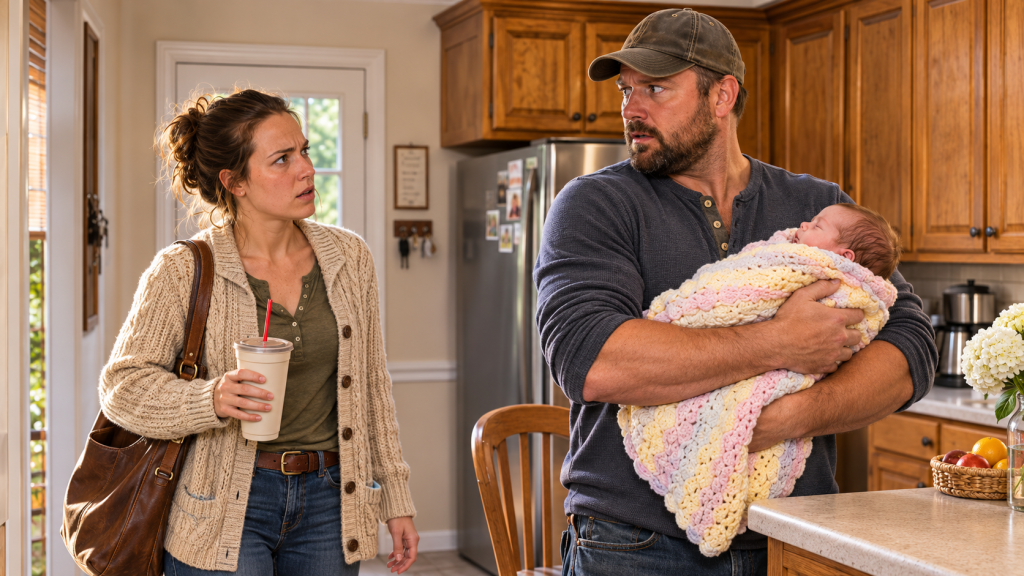
Sometimes, when the afternoon sun hits the kitchen window just right, I remember Ford sitting in my chair, rocking Maisie beneath that yellow blanket.
For a long time, the memory hurt.
Now it reminds me of the moment I stopped ignoring what my heart was trying to tell me.
I set my coffee down.
Step outside.
And breathe in the scent of the fields.
The land is still mine.
My son is growing strong.
And the life ahead of me is one I get to choose.
For the first time in years, that is more than enough.
THE END STORIES! THANK YOU FOR READING GOOD LUCK !❤️
Related Posts