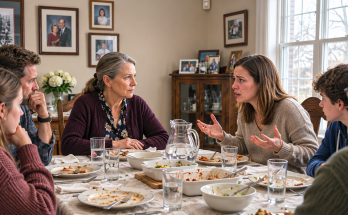
“Mommy, are we safe now?” Leo’s small voice rose from the enormous hotel bed, barely louder than the heating system humming beneath the window. I closed my laptop. On its screen, my father was still standing in the doorway of the Westchester house, holding the telephone against his ear as though calling me enough times could somehow change what had happened.
Beside him, my mother looked furious. Natalie stood near the staircase, staring at the papers David had placed on the table. And Terrence, who had spent Thanksgiving dinner describing his expensive vacations, had suddenly become very interested in leaving. But none of them mattered as much as the little boy reaching for me from beneath the white comforter.
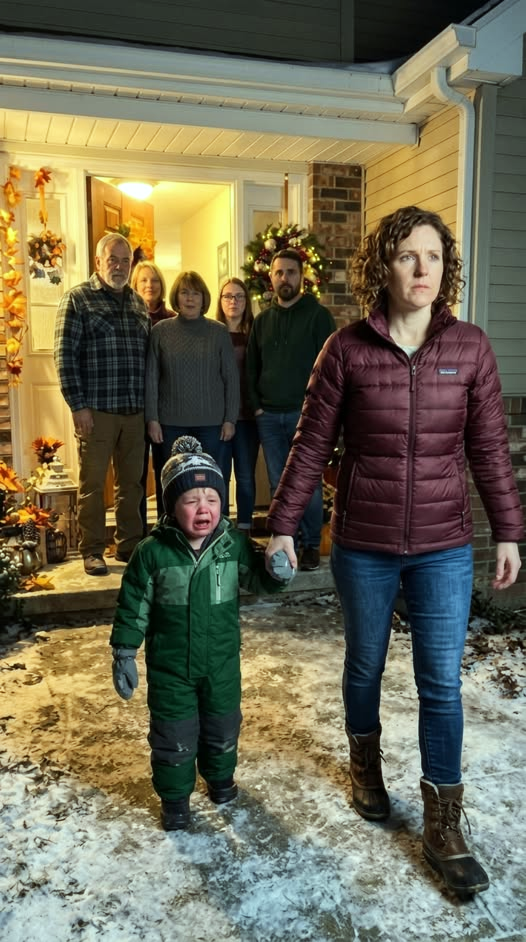
I climbed onto the bed beside him. “Yes, sweetheart,” I whispered. “We’re safe.” Leo studied my face. “Grandpa was really mad.” “I know.” “Was he mad because I spilled the juice?” My heart broke. I pulled him into my arms. “No, baby. You made an accident. Everybody spills things sometimes.”
He rubbed his eyes.
“But he said we can’t come back.”
I kissed his forehead.
“That’s something Grandpa said when he was angry. But you didn’t deserve to hear it.”
Leo was quiet for a moment.
Then he whispered, “Are we bad?”
I held him tighter.
“No, sweetheart. We are not bad.”
He looked up.
“Promise?”
I swallowed the lump in my throat.
“Promise.”
He tucked his little hand beneath my chin.
“Then can we have pancakes tomorrow?”
I laughed through tears.
“Absolutely.”
“Chocolate chips?”
“Extra chocolate chips.”
He smiled.
And in less than five minutes, he was asleep again.
I stayed awake until nearly four in the morning.
My phone rang seventeen times.
My father called eleven times.
My mother called four.
Natalie called twice.
Terrence sent a message that began, Nicole, I think we should handle this professionally.
I deleted nothing.
David had advised me long ago to preserve important communications, especially when emotions were running high.
So I silenced my phone, saved the messages, and opened the folder containing the records of the house.
Four years earlier, I’d purchased that property through an investment company I owned.
Not to humiliate my parents.
Not to control them.
Not because I expected anything in return.
I’d done it because my father had called me one night, his voice shaking, and admitted the bank was taking their home.
My parents had spent thirty-two years in that house.
It was where Natalie and I grew up.
Where my mother hung Christmas stockings beside the enormous fireplace.
Where my father taught me to ride a bicycle in the circular driveway.
Where I’d watched my grandmother bake apple pies every Thanksgiving until her hands became too unsteady to roll the dough.
I couldn’t bear the thought of them losing it.
So I stepped in.
Quietly.
Through a company.
With a lawyer.
And with one simple hope.
That giving my parents security might finally help them become the people I had spent my childhood wanting them to be.
I had been wrong about that last part.
At seven the next morning, David called.
“Nicole?”
“I’m here.”
“How’s Leo?”
I looked toward the sleeping boy.
“Still asleep.”
“Good.”
He paused.
“I wanted to clarify what happened last night before you speak with anyone in your family.”
I sat up.
“Okay.”
“The deputies were present to prevent a disturbance and document any safety concerns. They did not serve an eviction order or remove anyone.”
“I understand.”
“And the lease clause we discussed doesn’t automatically terminate their tenancy. Any formal action must follow New York law, including the notice requirements and whatever proceedings may be necessary.”
I closed my eyes.
“I don’t want them dragged into the snow.”
“I know.”
“I just don’t want to keep supporting people who think they can treat my child like garbage.”
David’s voice softened.
“Those are two different questions. We can address both responsibly.”
He explained that the company’s ownership had been documented through the appropriate records.
The original lease identified the company as landlord and included written terms regarding occupancy, payments, property care, and conduct.
The signed clause he had shown my father concerned serious harassment, intimidation, and interference with peaceful occupancy.
But David was careful.
One cruel Thanksgiving incident did not guarantee that a court would grant possession of the property.
And whatever authority I held as the owner, I couldn’t simply replace the locks or turn off the heat.
I didn’t want to.
What I wanted was to stop pretending that my generosity obligated me to endure humiliation.
David understood that.
“We’ll begin by reviewing the lease’s expiration date, renewal obligations, and any enforceable grounds for further action,” he said. “And we’ll make sure your parents receive everything they’re legally entitled to receive.”
I nodded.
“Thank you.”
Then he asked, “Do you still want them to know the whole story?”
I looked toward Leo.
“Yes.”
My voice trembled.
“They should know who kept that roof over their heads.”
After breakfast, I took Leo to a little bookstore near the hotel.
He chose a picture book about a penguin who was afraid of snow.
I bought it without thinking twice.
Then we walked through the city while flakes drifted between the buildings.
Leo held my hand.
He pointed at Christmas decorations.
Laughed at a tiny dog wearing a red sweater.
Asked whether penguins celebrated Thanksgiving.
And slowly, the terrible heaviness in my chest began to lift.
There is something extraordinary about small children.
They can be deeply wounded by a careless adult, yet still find joy in a funny dog or a chocolate chip pancake.
I knew Leo would remember what happened at my parents’ house.
I couldn’t erase that.
But I could make sure the experience didn’t become his definition of himself.
We returned to my apartment that afternoon.
Leo had his own bedroom, painted pale blue, with a bookshelf shaped like a little tree.
He ran inside carrying his new penguin book.
I put away our overnight bags.
Then I stood in the kitchen, looking at the family photograph beside the refrigerator.
It showed Leo at three years old.
He was sitting on my shoulders in Central Park, laughing so hard his cheeks were red.
I remembered how my parents had responded when I sent them that picture.
My mother wrote:
You should really think about finding him a proper father.
My father replied:
Children need discipline, not constant entertainment.
Neither had asked whether Leo was happy.
I stared at the photograph.
Then whispered:
“He has everything he needs to be loved.”
The first unexpected visitor arrived that afternoon.
It was my sister, Natalie.
She stood outside my apartment door wearing an expensive camel-colored coat.
Her makeup was perfect.
But her eyes were swollen.
I almost didn’t open the door.
Then I saw that she was alone.
“Nicole?”
I looked at her through the narrow opening.
“What do you want?”
She swallowed.
“Can we talk?”
I hesitated.
Then stepped into the hallway, closing the door behind me.
“Leo is here,” I said. “I don’t want him hearing another argument.”
Natalie nodded quickly.
“I understand.”
For a moment, she stared at the floor.
Then she whispered, “Did you really buy Mom and Dad’s house?”
“Yes.”
Her eyes filled.
“Four years ago?”
“Yes.”
She pressed one hand against her mouth.
“Why didn’t you tell us?”
I looked at her.
“Because I didn’t want them to feel embarrassed.”
Natalie closed her eyes.
Then began crying.
I stood very still.
My sister had always been the beautiful one.
The accomplished one.
The daughter who knew exactly which clothes to wear and which restaurants to visit.
Growing up, she’d been praised for everything.
Her grades.
Her appearance.
Her friends.
Her marriage.
I was the daughter who questioned things.
The one who preferred working on computers to attending country club dinners.
The one who became a single mother and refused to apologize for it.
We had lived in the same house for eighteen years without ever really learning how to be sisters.
Now Natalie stood in my hallway looking lost.
“Nicole,” she whispered, “I thought you were struggling.”
I stared.
“What?”
“Mom always said you could barely afford your apartment.”
I almost laughed.
“I own my apartment.”
Natalie’s head lifted.
“You do?”
“Yes.”
She stared.
“But Dad said you were renting.”
I folded my arms.
“Natalie, what else have they told you?”
She looked away.
“That your consulting business wasn’t doing well.”
I nodded slowly.
“And you believed them?”
She swallowed.
“I never really asked.”
That hurt more than I expected.
Not because I needed Natalie to admire my career.
Because she’d allowed our parents’ opinions to stand in for knowing me.
I took a breath.
“Natalie, I have worked very hard to build my business. I have clients in several states. I own my home. I take care of Leo.”
She began crying.
“I know that now.”
I looked at her.
“Do you?”
She nodded.
Then whispered something I wasn’t prepared to hear.
“Terrence has been helping Dad manage money.”
My stomach tightened.
“What money?”
She looked down.
“Their retirement accounts. Some investments.”
I frowned.
“Since when?”
“For almost two years.”
I stared at her.
My father had barely managed to keep the house four years earlier.
His investments had collapsed.
He’d accumulated debts he couldn’t pay.
And after my company purchased the property, I’d arranged a lease with payments far below the home’s market rental value.
I had assumed he’d learned something from that experience.
Apparently, I had assumed wrong.
“What kind of investments?” I asked.
Natalie hesitated.
“I don’t know.”
I studied her.
“Does Terrence?”
Her expression changed.
And suddenly I understood that my sister hadn’t simply come to apologize.
She was frightened.
“Natalie,” I said quietly, “what happened?”
She took a shaky breath.
“Dad told Terrence he needed money to buy the house back.”
My stomach dropped.
“Buy it back?”
She nodded.
“He didn’t want anyone at the country club finding out they’d lost ownership.”
I stared at her.
“And Terrence offered to help?”
“Yes.”
“How?”
She looked away.
“That’s what I need to find out.”
For several seconds, neither of us spoke.
Then Natalie whispered:
“Nicole, I think Dad has been borrowing money again.”
I felt the old familiar pressure building inside my chest.
The pressure to rescue.
To investigate.
To solve.
To pay.
For years, my family had called me whenever something went wrong.
A website that needed rebuilding.
A late bill.
A tax notice.
A financial emergency.
I would stop what I was doing, figure out the problem, and quietly handle it.
Then, at the next family dinner, my mother would announce that Natalie was the responsible daughter.
I had accepted that arrangement because I thought being useful would eventually make me loved.
Now, standing in my hallway, I realized how dangerous that belief had become.
“Natalie,” I said, “if Dad is borrowing money, he needs to address that with a qualified financial adviser and his own attorney.”
She looked frightened.
“But you’re good at this.”
“I know.”
“Couldn’t you just look at everything?”
I took a slow breath.
“I can tell you how to find professional help. But I’m not taking responsibility for financial decisions I didn’t make.”
Her face fell.
I continued gently.
“And I won’t use Leo’s future to rescue people who refuse to be honest with me.”
Natalie began crying.
“Do you hate us?”
I looked at her.
“No.”
She wiped her cheeks.
“Even after Thanksgiving?”
I closed my eyes.
I could still see my father’s hand gripping my coat.
My mother’s relieved expression.
The tiny red stain on Terrence’s loafers.
And Leo crying as snow drifted into the open doorway.
“I don’t hate you,” I said.
“But I’m not pretending it didn’t happen.”
Natalie nodded.
Then whispered:
“I should have stopped Dad.”
I looked at her.
“Yes.”
“I should have told Mom she was being cruel.”
“Yes.”
She covered her face.
“I just sat there.”
I swallowed.
“I know.”
For a long moment, we stood together in silence.
Then Natalie looked up.
“Can I apologize to Leo?”
I considered.
“Not today.”
She nodded immediately.
“Okay.”
“He needs time. And if you eventually speak with him, it has to be about what you did wrong—not about making you feel better.”
Her eyes filled.
“I understand.”
I wasn’t sure she did.
But for once, I wasn’t going to rush to make somebody else’s guilt disappear.
After she left, I sat at the kitchen table.
Leo was in his room building a tower from wooden blocks.
I could hear him humming.
I opened my laptop and pulled up the financial records connected with the property.
Four years of expenses.
Repairs.
Insurance.
Taxes.
Mortgage statements from the original transaction.
And the lease payments my parents had made.
They weren’t living there for free.
That was important.
They paid rent under an actual agreement.
But the rent was considerably below what similar properties commanded, and my company had absorbed significant ownership and maintenance costs.
I had accepted those expenses voluntarily.
Because I wanted them to stay in the home they loved.
Now I wondered whether my generosity had simply given them more money to spend on the appearances that nearly ruined them in the first place.
At six, David called again.
“Nicole, your father has retained counsel.”
I wasn’t surprised.
“What does he want?”
“He disputes the interpretation of the lease clause and wants clarification about renewal.”
I nodded.
“That’s his right.”
“Yes.”
David paused.
“He also asked whether the property could be purchased from your company.”
I stared at the wall.
“For how much?”
“He hasn’t made a formal offer.”
I almost laughed.
After throwing his daughter and grandson into the snow, my father wanted to negotiate for the house she’d secretly saved.
Then David said:
“Nicole, there’s another issue.”
My stomach tightened.
“What?”
“The title review we completed when you purchased the property shows an old private loan associated with your father’s financial collapse. It was satisfied during the foreclosure process, but someone has recently contacted the title company asking about the historical documents.”
I sat straighter.
“Who?”
“Terrence.”
My sister’s husband.
The man whose suede loafers had apparently been more important than my frightened child.
I looked toward the hallway.
“Why would Terrence want those records?”
“We don’t know. But we can document the inquiry and review whether it affects anything current.”
I nodded.
“Does it?”
“Nothing we’ve seen suggests it changes ownership. Your company acquired valid title. But if anyone is making claims or representations about the house, I want to know exactly what they’re saying.”
I closed my eyes.
Four years earlier, I’d paid a substantial amount to rescue that property from foreclosure.
Now my family was learning that the house belonged to me.
And suddenly everyone seemed interested in its legal history.
I thought about Terrence’s expensive shoes.
His carefully chosen cuff links.
His polished stories about investments.
Then I remembered something from Thanksgiving dinner.
He’d mentioned a new real estate opportunity.
A development fund.
He’d said the returns were extraordinary.
My father had smiled like a proud investor.
At the time, I hadn’t paid attention.
Now I wondered whether the dinner table argument had been about more than spilled cranberry juice.
The next morning, I called Ruth.
Not my sister.
My aunt Ruth, my late father’s younger sister, who had always been the only member of our family willing to tell uncomfortable truths.
She lived in Connecticut and had retired from teaching history.
When she answered, she sounded cheerful.
“Nicole, sweetheart!”
“Aunt Ruth.”
“Where’s that beautiful boy?”
“Eating cereal.”
She laughed.
“Then tell him I still owe him a dinosaur book.”
I smiled.
“I will.”
Then my voice changed.
“Aunt Ruth, I need to ask you something about Dad.”
She became quiet.
“Richard?”
“Yes.”
“What has he done?”
I closed my eyes.
It was such a simple question.
And somehow it told me she already suspected the answer wouldn’t be good.
I explained Thanksgiving.
The house.
David’s visit.
Natalie’s revelation.
And Terrence’s interest in the old property records.
Aunt Ruth listened without interrupting.
When I finished, she sighed deeply.
“Oh, Nicole.”
I swallowed.
“Did you know about the foreclosure?”
“Yes.”
I stared.
“You did?”
“Your father called me before he called you.”
My stomach tightened.
“What did he want?”
“Money.”
I closed my eyes.
“Of course.”
She continued.
“He asked me to lend him enough to stop the bank. I asked him to show me the actual numbers. He refused.”
I looked toward the window.
“Why?”
“Because Richard has always been more afraid of people seeing his mistakes than of making them.”
I sat silently.
Aunt Ruth’s voice softened.
“Sweetheart, you saved his home. But you couldn’t save him from himself.”
Then she told me something I’d never known.
Three months before the foreclosure, my father had tried to persuade her to invest in a private partnership.
He claimed it would restore his finances.
She’d asked for documentation.
He’d become offended.
They hadn’t spoken for nearly a year afterward.
“Was Terrence involved?” I asked.
“Not then.”
I nodded.
“But your father has a habit of trusting anyone who tells him he can recover what he’s lost without admitting how he lost it.”
I rubbed my forehead.
“And I keep trying to fix it.”
Aunt Ruth was quiet.
Then she said:
“Nicole, there’s a difference between helping someone and protecting them from the consequences of every decision.”
My eyes filled.
“I know.”
“Do you?”
I looked toward Leo’s room.
For a long time, I didn’t answer.
Then I whispered:
“I’m learning.”
Three days later, David invited me to his office.
He had uncovered something that, he said, I needed to see in person.
His office overlooked a narrow Manhattan street lined with bare trees. Outside, commuters hurried through the cold, carrying coffee and briefcases, unaware that the ordinary business of other people’s lives was unfolding behind the windows.
David placed two folders on his desk.
One was the Westchester property file.
The other contained documents he’d recently obtained through the title company’s records and information voluntarily supplied by a lender.
“Nicole, when your parents lost the house, they signed several acknowledgments as part of their move from ownership to tenancy.”
I nodded.
“I remember.”
“Your father acknowledged that the property had been acquired by an unrelated company and that his future occupancy would be governed by the lease.”
I frowned.
“That’s right.”
David slid a page toward me.
“Look at the signature.”
There it was.
Richard Bennett.
Beneath it, another line stated that he understood he retained no ownership interest in the property following the completed foreclosure and sale.
I stared.
My father had signed it.
Four years earlier.
He might not have known I was the person behind the company.
But he absolutely knew the house no longer belonged to him.
“Then why has he been telling Natalie and Terrence he owns it?” I whispered.
David opened the second folder.
“That’s what concerns me.”
Inside was a copy of a financial presentation Terrence had prepared.
It described a proposed real estate investment venture.
There were projections.
Estimated returns.
A list of potential assets.
And one familiar address.
My parents’ house.
I stared at the page.
“Why is my property listed here?”
David answered carefully.
“According to the documents, Terrence presented it as a property he expected to acquire through a family transaction.”
I looked up.
“Acquire from whom?”
“He appears to have represented that Richard could arrange the sale.”
My heart began pounding.
“But Dad doesn’t own it.”
“Correct.”
I swallowed.
“Does Terrence know that?”
“We haven’t established what he knew or when. His recent request for the historical title records suggests he was trying to clarify the situation. We shouldn’t assume more than the evidence shows.”
I nodded.
But the implications were terrible.
My parents had been living in a house I owned.
My sister’s husband had been using that house in conversations about an investment opportunity.
And everyone had behaved as though I was the least important person in the family.
“Did they borrow money against it?” I asked.
“Nothing we’ve found suggests your company granted a mortgage or other security interest. A person can’t simply create valid ownership rights by claiming property belongs to someone else.”
I exhaled.
“But there may be people who relied on those representations.”
David nodded.
“Yes. And that’s why we need to proceed carefully.”
He placed a second document in front of me.
It was a letter my father had signed several months earlier.
Addressed to a private lender.
The letter referred to an anticipated family purchase arrangement.
At the bottom was Richard’s signature.
I recognized it immediately.
The same heavy, impatient handwriting he’d used to sign my school permission slips.
I stared at the date.
Six weeks before Thanksgiving.
My father had been discussing my property as though he expected to control its future.
And then he’d stood at the front door on Thanksgiving night and told me to leave.
I leaned back.
For a moment, I imagined him deciding that if he could make me feel small enough, I might eventually surrender whatever he wanted.
He’d done versions of that throughout my childhood.
When I refused to attend the college he preferred, he said I was ungrateful.
When I started my consulting business, he said I was foolish.
When I chose to raise Leo, he called it an embarrassment.
Each time, I worked harder.
Earned more.
Became more independent.
And somehow continued hoping that one day he’d look at me and see someone worth being proud of.
Now I was looking at a document suggesting he was willing to treat the home I’d saved as a resource for someone else’s financial plans.
I pressed my hand against my mouth.
“David, do you think he ever appreciated what I did?”
My attorney’s expression softened.
“Nicole, I can’t tell you what your father feels.”
I nodded.
“But I can tell you that appreciation isn’t a condition of your ownership.”
Tears filled my eyes.
He continued.
“You don’t have to prove you deserve what you legally own.”
That afternoon, I called Natalie.
“Nicole?”
“I need to ask you something about Terrence.”
She sounded nervous.
“What?”
“Did he tell you he was arranging to purchase Mom and Dad’s house?”
Silence.
“Natalie?”
She swallowed.
“Yes.”
My heart sank.
“When?”
“About two months ago.”
“What did he say?”
“He said Dad had an opportunity to buy the house back and that Terrence was helping arrange financing.”
I closed my eyes.
“Did he tell you who owned it?”
“No.”
“And did you ask?”
She hesitated.
“I assumed Dad knew.”
There it was again.
The old family habit.
Nobody wanted to ask difficult questions because everyone preferred the comfort of believing the right people were in charge.
Natalie’s voice trembled.
“Nicole, Terrence is angry that I spoke with you.”
I sat straighter.
“Has he threatened you?”
“No.”
She paused.
“But he says I’ve betrayed him.”
I took a slow breath.
“Natalie, you should speak with an independent attorney if you’re concerned about your finances or anything you’ve signed.”
She was quiet.
Then whispered:
“I’ve already made an appointment.”
That surprised me.
“Good.”
She began crying.
“I think I’ve spent years believing that because Terrence handled the money, I didn’t need to understand it.”
I thought about my mother doing the same thing with Richard.
Then I thought about myself.
I’d handled money well.
But I had allowed love to keep me from recognizing how my family treated me.
We’d all surrendered something, hoping somebody else would take care of the difficult parts.
I swallowed.
“Ask questions, Natalie.”
She sniffled.
“Even if the answers are awful?”
“Especially then.”
The first snowstorm of December arrived the following weekend.
Leo and I spent the morning making paper snowflakes.
He taped them to every window in the apartment.
Then insisted we build a blanket fort in the living room.
I crawled inside beside him, holding two mugs of hot chocolate.
“Mommy?”
“Yes?”
“Are we going to Grandma’s for Christmas?”
I felt my heart tighten.
I had been dreading that question.
“I don’t think we’re going there this Christmas, sweetheart.”
He looked down.
“Because of the juice?”
I closed my eyes.
“No, baby.”
“Because Grandpa was mad?”
I took his little hand.
“Because some adults need time to learn how to treat one another kindly.”
He considered that.
Then asked:
“Can we have Christmas here?”
I smiled.
“Of course.”
“With Aunt Ruth?”
“If she can come.”
“And a big tree?”
“Absolutely.”
He grinned.
“And pancakes?”
I laughed.
“Leo, you could have pancakes on the moon if someone gave you a frying pan.”
He burst into giggles.
And I realized that the holiday I’d been afraid of losing was already taking shape inside a blanket fort on my living room floor.
My father didn’t contact me directly for another week.
When he finally did, it wasn’t a phone call.
It was a letter.
Handwritten.
Three pages.
For a moment, I felt a familiar rush of hope.
Perhaps he’d finally understood.
Perhaps he’d realized what he’d done to Leo.
Perhaps the discovery that I owned the house had forced him to see me differently.
I sat at the kitchen table and began reading.
The first paragraph said he was disappointed in how Thanksgiving had unfolded.
The second said he regretted raising his voice.
The third accused me of deliberately humiliating him in front of his family.
By the fourth, he was demanding to know why I’d concealed my identity as the property’s beneficial owner.
By the fifth, he wanted to discuss a purchase arrangement that would allow him to “restore the family legacy.”
I stared at the final page.
There was nothing about Leo.
Nothing about the snow.
Nothing about his tiny grandson crying as he was pushed toward the driveway.
Just pride.
Property.
And money.
I folded the letter.
Then placed it in a drawer.
For the first time, I didn’t feel an urgent need to answer.
Christmas Eve arrived with a quiet snowfall.
Aunt Ruth came from Connecticut carrying three enormous shopping bags and a tin of homemade cookies.
Leo ran into her arms.
“Aunt Ruth!”
She laughed.
“There’s my favorite little troublemaker!”
He looked offended.
“I’m not trouble!”
She winked.
“Then who’s been stealing all my cookies?”
Leo giggled.
We spent the afternoon decorating the tree.
Aunt Ruth told stories about my childhood.
The time I insisted on wearing rain boots to a wedding.
The summer I tried to organize the neighborhood children into a pretend business.
The day I asked my kindergarten teacher whether the school had a marketing plan.
I laughed until tears rolled down my face.
Then Ruth stopped beside the tree.
“Nicole?”
I looked up.
“Your mother called me.”
My smile faded.
“What did she want?”
“She wanted to know where you were spending Christmas.”
I nodded.
“And?”
“I told her that was something she should ask you herself, if you wanted to speak with her.”
I looked toward Leo.
“Did she mention him?”
Ruth’s expression softened.
“Yes.”
My heart tightened.
“She asked whether he was all right.”
For a moment, I couldn’t speak.
It was the first time since Thanksgiving that I’d heard of my mother asking about the child she’d watched being sent into the snow.
“Did she apologize?” I whispered.
“Not exactly.”
I nodded.
Ruth took my hand.
“But she sounded frightened.”
I looked at her.
“Because they might lose the house?”
“Perhaps.”
Ruth paused.
“Or perhaps she’s beginning to understand that she might lose something more important.”
I looked toward Leo.
He was kneeling beside the Christmas tree, carefully placing a plastic dinosaur among the presents.
I smiled sadly.
“Then she’ll have to show it.”
Ruth nodded.
“Yes.”
That night, after Leo fell asleep, I sat beside the tree.
The apartment was quiet.
White lights reflected against the windows.
I opened the drawer and took out my father’s letter.
Then I read it again.
This time, I didn’t search for hidden affection between the accusations.
I simply read what was there.
My father was angry.
He was embarrassed.
He wanted control of the house.
And he had not yet taken responsibility for what he’d done.
For years, I would have replied with explanations.
Why I bought the property.
Why I hid the truth.
Why I deserved respect.
That night, I wrote something different.
Dad,
I purchased the house four years ago because I didn’t want you and Mom to lose your home. I kept my involvement private because I wanted to preserve your dignity, not because I believed the property belonged to you.
What happened on Thanksgiving was unacceptable. Leo was frightened, and he continues to ask whether he did something wrong.
I will address the property through David and the appropriate legal process. I won’t make financial decisions in response to threats, guilt, or public embarrassment.
If you want a relationship with me and Leo, that will require an acknowledgment of what happened and consistent respectful behavior.
Nicole.
I read it once.
Then sent it.
And for the first time in my life, I didn’t spend the next hour wondering whether my father would approve.
Christmas morning was beautiful.
Leo woke me before six.
He ran into my room wearing dinosaur pajamas.
“Mommy! Santa came!”
I laughed.
“Did he?”
“He did!”
He dragged me into the living room.
Aunt Ruth was already awake, drinking coffee beside the tree.
We opened presents.
Aunt Ruth gave Leo an enormous box of building blocks.
I gave him a little bicycle with training wheels.
He gave me a painting he’d made at preschool.
It showed two stick figures standing beneath a bright yellow sun.
One was tall.
One was little.
Above them, he’d written, with help from his teacher:
MOMMY AND ME.
I stared at it.
Then began crying.
Leo looked worried.
“Mommy, don’t you like it?”
I pulled him into my arms.
“Oh, sweetheart. I love it.”
He smiled.
“That’s our house.”
I looked at the little painting again.
No enormous Westchester mansion.
No country club.
No expensive furniture.
Just two people beneath the sun.
I kissed his forehead.
“Yes, baby.”
I swallowed.
“That’s our home.”
The new year brought consequences nobody in my family could avoid.
Terrence’s proposed real estate venture came under scrutiny after questions arose about the property he had described to potential investors.
David confirmed that my company had never authorized its sale or use as collateral.
There was no valid transaction transferring an interest in the house.
Any claims Terrence had made were his responsibility to explain.
Natalie hired an independent attorney and began reviewing her own financial situation.
For the first time in years, she stopped allowing her husband to answer every question about money.
Their marriage became strained.
I didn’t celebrate that.
I understood how frightening it was to discover that someone you’d trusted might have been keeping important information from you.
But I also knew that Natalie had to decide what happened next.
I couldn’t make that decision for her.
My parents’ tenancy continued while David reviewed the lawful options.
The company honored its existing obligations.
The heat stayed on.
Necessary repairs were completed.
Rent was handled according to the lease.
There was no midnight lockout, no sudden removal, and no humiliating spectacle on their front lawn.
When the lease approached its end, David provided the required notices and explained the applicable procedures.
My parents retained their right to seek advice and contest anything they believed was improper.
Eventually, through their attorneys, we reached a written agreement for an orderly move.
They would relocate to a smaller rental home they could afford.
My company would not renew the old arrangement beyond the agreed terms.
And there would be no new financial promises made merely to keep the peace.
It wasn’t an exciting resolution.
But it was a lawful one.
And after years of emotional chaos, I had come to appreciate the quiet dignity of doing things properly.
My father struggled with the move.
For decades, he’d built his identity around that enormous house.
The circular driveway.
The grand staircase.
The expensive neighborhood.
The people who saw his address and assumed he was successful.
Losing ownership had wounded his pride.
Moving out forced him to acknowledge what had happened.
But the old house had never been the measure of his worth.
That was something I wished he understood.
My mother called one afternoon in early spring.
I nearly let the phone ring.
Then answered.
“Hello?”
“Nicole.”
Her voice sounded small.
“Hello, Mom.”
For a moment, neither of us spoke.
Then she whispered:
“How is Leo?”
I looked toward the living room.
He was building a train track across the rug.
“He’s doing well.”
She took a shaky breath.
“Does he remember Thanksgiving?”
My heart tightened.
“Yes.”
Silence.
Then she began crying.
“I never should have let your father speak to him like that.”
I closed my eyes.
“No, Mom. You shouldn’t have.”
She sobbed.
“I was angry with you.”
I swallowed.
“Why?”
“Because I thought you’d embarrassed us.”
I stared at the wall.
“With what?”
She hesitated.
“Your life. Being unmarried. Raising Leo alone. Refusing to do things the way we’d expected.”
I took a slow breath.
“And now?”
Her voice cracked.
“Now I realize you were the one keeping us from losing everything.”
For a moment, I felt the old temptation to make her feel better.
To tell her it was all right.
To say everyone made mistakes.
But I remembered Leo asking whether he was bad.
And I knew I couldn’t erase that.
“Mom,” I said quietly, “I didn’t deserve to be treated that way even if I hadn’t bought the house.”
She went silent.
I continued.
“Even if I rented a tiny apartment. Even if my business failed. Even if I had nothing to give you.”
Tears rolled down my cheeks.
“Leo and I deserved kindness before you knew I had money.”
My mother began crying harder.
“I know.”
I swallowed.
“That’s what I need you to remember.”
She asked whether she could see Leo.
I didn’t say yes immediately.
Instead, I told her that any contact would need to happen gradually, with his comfort at the center.
She agreed.
Several weeks later, after discussing it with Leo and making sure he felt safe, we met for a short visit at a public park.
My mother arrived carrying a small picture book.
She didn’t bring an expensive toy.
She didn’t try to buy his affection.
She sat on a bench while Leo played nearby.
Then, when he approached, she knelt.
“Leo,” she said softly, “Grandma wants to tell you something.”
He looked at her cautiously.
She swallowed.
“I was wrong on Thanksgiving. You shouldn’t have been sent outside. You didn’t do anything bad.”
Leo stared at her.
Then whispered:
“Even when I spilled the juice?”
My mother’s face crumpled.
“Even then, sweetheart.”
He looked toward me.
I nodded gently.
My mother continued.
“I’m sorry I didn’t help you when you were frightened.”
Leo considered that.
Then asked:
“Are you going to be mean again?”
She began crying.
“I’ll work very hard not to be.”
He looked at her for a long time.
Then handed her a small toy car.
“Want to play?”
My mother smiled through tears.
“Yes.”
It wasn’t forgiveness wrapped in a bow.
It was a beginning.
And sometimes a beginning is all anyone can honestly offer.
My father took longer.
He didn’t call on Leo’s birthday.
He didn’t send a card at Easter.
When he finally contacted me, it was through David.
He wanted to arrange a meeting about the house.
I agreed to discuss any outstanding property matters with counsel present.
But I made it clear that financial negotiations and family reconciliation were separate things.
I would not trade access to Leo for signatures.
And I would not exchange ownership concessions for an apology.
At the meeting, my father looked older.
His hair had gone almost completely white.
The expensive suit he wore seemed too large for his shoulders.
He sat across from me without speaking.
Then he said:
“I never knew it was you.”
I nodded.
“I know.”
“You purchased the house.”
“Yes.”
“And you let us believe we’d found an investor.”
“Yes.”
He stared at his hands.
“Why?”
I thought about that question.
Then answered:
“Because I loved you.”
His face changed.
I continued.
“Because I remembered being little and believing that house was the safest place in the world.”
My voice trembled.
“And because I thought if I saved it, maybe we could all be happy there again.”
He looked down.
For a long moment, neither of us spoke.
Then he whispered:
“I failed you.”
My throat tightened.
He continued.
“Not because I lost the house.”
He lifted his eyes.
“But because you saved it, and I still made you feel unwelcome.”
I stared at him.
It was the first time in my life I’d heard my father speak that way.
Not about money.
Not about his reputation.
About me.
Then his voice broke.
“And I frightened Leo.”
Tears filled my eyes.
“Yes.”
He covered his face.
“I don’t know how to make that right.”
I swallowed.
“You can’t undo Thanksgiving.”
He nodded.
“But you can decide what kind of grandfather you want to be from now on.”
He looked up.
I continued.
“If you want a relationship with Leo, it has to be built on patience. Respect. And the understanding that he’s a little boy, not a symbol of your disappointment in me.”
My father began crying.
“I understand.”
I wanted to believe him.
But I had learned not to confuse one emotional conversation with lasting change.
So I told him we’d begin slowly.
And that was all I promised.
A year after that terrible Thanksgiving, I drove past the old house.
The new tenants had placed pumpkins along the front steps.
A bicycle leaned against the garage.
Children’s laughter drifted from the yard.
The mansion no longer held the same power over me.
It was a beautiful building.
A place filled with memories.
A property my company owned and managed responsibly.
But it wasn’t the center of my family’s identity anymore.
And it wasn’t the place where I needed to prove my worth.
That Thanksgiving, Leo and I hosted dinner in our apartment.
Aunt Ruth came.
Natalie came with her children.
My mother joined us for part of the afternoon.
My father did not attend. He sent Leo a card and respected the fact that rebuilding trust would take time.
The meal was simple.
Roast turkey.
Mashed potatoes.
Green beans.
Cranberry sauce.
And a chocolate pie Leo insisted we decorate with candy dinosaurs.
At dinner, Natalie accidentally knocked over a glass of cranberry juice.
Red liquid spread across the table.
For one awful second, everyone froze.
Then Leo burst out laughing.
“Aunt Natalie!”
She stared at the spill.
Then looked toward me.
I picked up a napkin.
And smiled.
“Looks like we need a towel.”
Everyone laughed.
Not cruelly.
Not nervously.
Just the relieved laughter of people discovering that an accident could remain an accident.
Nobody shouted.
Nobody was sent outside.
Nobody was told they didn’t belong.
Later, after the dishes were finished, Leo climbed into my lap.
“Mommy?”
“Yes, sweetheart?”
“Is Thanksgiving supposed to be happy?”
I looked toward the table.
Aunt Ruth was telling a funny story.
Natalie was helping her children put on their coats.
My mother was quietly stacking plates in the kitchen.
I smiled.
“It’s supposed to be a time when we remember what we’re thankful for.”
Leo thought about that.
Then whispered:
“I’m thankful for you.”
My eyes filled.
I kissed his forehead.
“And I’m thankful for you.”
He snuggled against me.
Then asked:
“Even when I spill things?”
I laughed through tears.
“Especially then, baby.”
For years, I believed the only way to keep my family was to keep giving them whatever they needed.
Money.
Time.
Solutions.
Silence.
I thought that if I worked hard enough, became successful enough, and sacrificed enough, my parents would finally see me as someone worth loving.
But the truth was painfully simple.
I had been worthy of love long before I could afford to save their house.
Leo had been worthy of kindness before he ever learned how to hold a glass without spilling it.
And neither of us needed to earn our place in a family by pretending mistreatment didn’t hurt.
My parents lost the right to assume I would rescue them from every financial mistake.
They didn’t lose the opportunity to become better people.
Natalie lost the comfort of letting everyone else decide what was true.
But she gained the chance to know her sister.
And I lost the illusion that sacrificing myself could make everyone happy.
In its place, I found something much more valuable.
Peace.
Sometimes I remember that Thanksgiving night.
My father’s hand gripping my coat.
The snow blowing across the porch.
My mother’s relieved expression.
Leo’s frightened little voice.
For a long time, those memories made me angry.
Now they remind me why I made the choices I did.
Not to punish my parents.
Not to prove I had more money than they imagined.
But to protect the one person who should never have been made to feel unwanted.
My son.
That night, my parents told us never to return.
They believed they were closing a door on a daughter who had disappointed them.
They had no idea I was the person who had quietly kept their own door open for four years.
But the real lesson wasn’t that I could take away something they thought belonged to them.
It was that I finally understood I didn’t have to give away my dignity to remain their daughter.
My name is Nicole Bennett.
I’m a mother.
A businesswoman.
A daughter who once believed love had to be earned through sacrifice.
And a woman who learned that the most important inheritance we leave our children isn’t a house, a bank account, or a family name.
It’s the knowledge that they deserve to be treated with kindness.
Even when they make mistakes.
Even when they disappoint someone.
Even when the cranberry juice spills across the Thanksgiving table.
Tonight, when I tuck Leo into bed, he asks me to read his penguin book.
I sit beside him.
He rests his head against my shoulder.
Outside, snow drifts past the windows.
But inside, our home is warm.
He turns the final page.
Then looks up.
“Mommy?”
“Yes?”
“We’re not going anywhere, right?”
I smile and smooth his hair.
“Not unless we want to, sweetheart.”
He grins.
“Good.”
Then he closes his eyes.
And as I watch him fall asleep, I know something with a certainty no legal document could ever give me.
A real home isn’t the place where someone allows you to stay. It’s the place where you never have to question whether you belong.
THE END STORIES! THANK YOU FOR READING GOOD LUCK !❤️
Related Posts