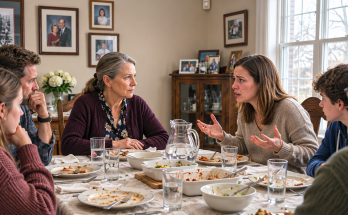
The moment I spoke those words, Gwendolyn’s face changed. For twenty years, I had known her as a woman who never apologized, never admitted defeat, and never allowed anyone else to control a conversation. But standing in her kitchen with a bouquet of white lilies abandoned on the table, I saw something I’d never witnessed before.
Fear. Not grief. Not guilt. Fear. She looked at the phone in my hand. “Wesley, hang up.” I stared at her. “Why?” “Because you don’t know what you’re doing.” I gave a bitter laugh. “For twenty years, I’ve apparently had no idea what was happening in my own life.” Grandma Opal sat beside the kitchen window, trembling.
Her eyes were filled with tears. “Gwendolyn,” she whispered, “enough.” My adoptive mother turned on her. “Mother, stay out of this.” “No.” The word was so quiet that I almost missed it. Then Opal straightened. “I stayed out of it when you told those boys their mother didn’t want them. I stayed quiet when you sent Clara’s letters back. I watched you turn two frightened children into strangers who believed they weren’t worth keeping.”
Her voice broke.
“And I won’t stay quiet another day.”
Gwendolyn gripped the kitchen counter.
“You have no idea what Clara was like.”
“Then tell me,” I said.
She turned toward me.
“What?”
“Tell me what was so terrible about our mother that you had to make us believe she abandoned us.”
Her lips parted.
Nothing came out.
I stepped closer.
“Was she cruel?”
Silence.
“Did she hurt us?”
Gwendolyn looked away.
“Did she refuse to feed us? Leave us alone? Put us in danger?”
My voice cracked.
“Or was she simply a young woman who needed help?”
Gwendolyn whispered, “You wouldn’t understand.”
I shook my head.
“Then I’m finally old enough for you to explain.”
But she said nothing.
And I realized that for the first time in my life, the woman who had demanded an explanation for every childhood mistake couldn’t provide one for her own.
Grant arrived forty minutes later.
I heard his truck pull into the driveway, followed by the familiar slam of a door.
Then he came into the kitchen.
He was still wearing his work clothes, a dark blue shirt with the sleeves rolled to his elbows.
He looked at me.
Then at Gwendolyn.
Then at Grandma Opal, who had been crying since I called him.
“What happened?”
I walked toward him.
“Sit down.”
He shook his head.
“Wesley, you sounded like somebody died.”
I swallowed.
“Somebody did.”
His expression changed.
I took a breath.
“Our biological mother died five years ago.”
Grant stared at me.
For a moment, his face showed nothing.
Then he whispered, “What?”
I nodded.
“And she didn’t abandon us the way Gwendolyn said.”
His eyes moved toward our adoptive mother.
“Gwen?”
She lifted her chin.
“Your brother is being dramatic.”
Grant’s jaw tightened.
“Did our mother try to find us?”
Gwendolyn looked away.
Grandma Opal answered.
“Yes, sweetheart.”
Grant turned toward her.
“For how long?”
Opal began crying.
“For years.”
He gripped the back of a chair.
“And you all knew?”
I looked down.
Opal covered her mouth.
Gwendolyn said nothing.
My brother’s expression slowly crumpled.
Then he asked a question I will never forget.
“Did she know we thought she didn’t want us?”
The kitchen went silent.
Grandma Opal nodded.
Grant sat down as though his legs had stopped working.
“Oh, God.”
He covered his face.
And the brother who had spent our childhood pretending nothing could hurt him began to sob.
When we were little, Grant always protected me.
He was four minutes older.
He reminded me of that constantly.
When Gwendolyn punished us for spilling milk, Grant would volunteer to clean the kitchen.
When she complained that we ate too much, he would quietly slide part of his dinner onto my plate.
When she told us we should be grateful anybody had taken us in, he would wait until she left and whisper, “We’re not a burden, Wes.”
But I knew he didn’t believe it any more than I did.
He just wanted one of us to feel safe.
Now I watched him cry over a mother whose voice he couldn’t remember.
And I felt something inside me break.
I sat beside him.
He grabbed my arm.
“Wesley, we could’ve found her.”
Tears filled my eyes.
“I know.”
“We could’ve called her.”
“I know.”
“We could’ve told her we were okay.”
My voice failed.
Grant bent forward, covering his face.
And for the first time since we were children, I had no words that could make things better.
Gwendolyn finally spoke.
“Your mother signed the adoption papers. That much is true.”
Grant lifted his head.
“Then why did you lie about everything else?”
She folded her arms.
“I didn’t lie. I simplified a complicated situation for two young children.”
I stared at her.
“You told us she walked away and never came back.”
Gwendolyn looked irritated.
“Well, she wasn’t raising you, was she?”
Grant stood.
“Because you wouldn’t let her see us!”
“Lower your voice.”
He laughed bitterly.
There it was again.
The command we’d heard every time we dared to express an emotion she didn’t approve of.
But Grant didn’t lower his voice.
“No. You don’t get to tell me how to feel about this.”
Gwendolyn stepped backward.
My brother’s eyes filled.
“You watched us grow up believing our own mother didn’t love us.”
She looked toward Opal.
“Mother, tell them what Clara was like.”
Opal shook her head.
“She was frightened, Gwen.”
“She was irresponsible.”
“She was twenty-one years old, raising twins without support.”
“She signed the papers!”
Opal’s voice rose.
“After you promised she could remain part of their lives!”
The room went still.
Gwendolyn stared at her mother.
And suddenly I understood that there was still more to the story.
I turned toward Opal.
“What promise?”
She wiped her face.
“Clara wasn’t able to care for you boys when Raymond and Gwendolyn first became involved.”
I waited.
“She had lost her job. She was living in a rented room. Your father wasn’t around, and she had very little family support nearby.”
Grant sat down again.
Opal continued.
“Raymond had heard about the situation through a church outreach program. He and Gwendolyn had been trying to become parents for years.”
My throat tightened.
“Did they know Clara?”
“Not well.”
She took a shaky breath.
“At first, the arrangement was supposed to provide temporary care while Clara found work and stable housing.”
I stared.
“Temporary?”
Opal nodded.
“The paperwork changed later. Clara agreed to the adoption after months of discussions. But Gwendolyn told her there would still be letters and occasional contact.”
I looked toward Gwendolyn.
“Was that promise written into the adoption?”
Opal shook her head sadly.
“Not in the documents I’ve seen.”
I swallowed.
So the legal adoption might have been valid.
Clara might truly have signed away her parental rights.
But the story Gwendolyn told us afterward was still a lie.
Our mother hadn’t simply abandoned us and forgotten we existed.
She had continued trying to reach us.
And the person responsible for receiving those messages had made sure we never saw them.
Grant looked toward Gwendolyn.
“Did Raymond know?”
For the first time, her face softened.
“Your father loved you boys.”
“That’s not what I asked.”
She hesitated.
“Raymond knew Clara wanted contact.”
My heart began pounding.
“Did he know you were hiding her letters?”
Gwendolyn looked away.
Opal whispered, “Not at first.”
I turned.
“What do you mean?”
Opal closed her eyes.
“Raymond found out she had written when you were seven.”
Grant and I stared at her.
“And?”
“He wanted Gwendolyn to give you the letters when you were old enough.”
I swallowed.
“Did he ever read them?”
“I believe he saw some.”
I remembered Raymond sitting beside our beds, reading stories and kissing our foreheads.
He’d always been gentle.
Always patient.
Always willing to tell us we were loved.
But now, for the first time, I wondered what else he’d known.
Opal took my hand.
“Your father wasn’t perfect, Wesley. But he tried to make sure you felt wanted.”
A tear slipped down my cheek.
“Then why didn’t he tell us?”
She looked toward the floor.
“I don’t know everything he intended to do.”
That uncertainty hurt.
But I was beginning to understand something important.
There were truths Opal knew.
Truths she only suspected.
And truths that had been lost when Raymond died.
I didn’t want another comforting story built out of guesses.
I wanted evidence.
I looked at Grandma Opal.
“You said you kept our mother’s letters.”
She nodded.
“Yes.”
“Where are they?”
“In my house.”
Grant immediately stood.
“Let’s go.”
Gwendolyn stepped forward.
“Mother, those are private family documents.”
Opal looked at her daughter.
For a long moment, they stared at one another.
Then the elderly woman spoke with a firmness I had never heard before.
“They are letters written to Wesley and Grant.”
She lifted her chin.
“And I’m finally going to give them to the people who should have received them.”
We left Gwendolyn standing in her kitchen.
I didn’t take the flowers.
I didn’t take the birthday gift.
I walked out carrying nothing except the terrible knowledge that my life had been built around a lie.
As I reached the porch, Gwendolyn called my name.
“Wesley.”
I stopped.
She stood inside the doorway.
For one brief moment, she looked like an ordinary sixty-year-old woman who was afraid of losing her family.
Then she said:
“After everything I did for you, this is how you repay me?”
I closed my eyes.
Twenty years.
The same sentence.
Different words.
Always the same meaning.
I turned toward her.
“You were supposed to love us without keeping a bill.”
Her mouth opened.
I continued.
“Raymond understood that.”
Then I walked away.
Grandma Opal lived in a small brick house fifteen minutes away.
It had a flower garden in front and a white porch swing that creaked whenever the wind blew.
When Grant and I were children, her house had been the one place where we felt welcome without having to earn it.
She baked cinnamon rolls.
Let us track mud across the kitchen.
And never complained when we ate too much.
I used to think she was simply a kind grandmother.
Now I wondered whether her tenderness had also been an attempt to make up for what she knew her daughter was doing.
We entered the living room.
Everything looked the same.
The crocheted blanket.
The old grandfather clock.
The family photographs arranged across the mantelpiece.
Opal walked toward the hallway.
“Wait here.”
Grant sat beside me.
Neither of us spoke.
Then Opal returned carrying a wooden sewing chest.
She placed it on the coffee table.
Her hands trembled as she opened it.
Inside were spools of thread, little silver scissors, yellowing patterns, and a bundle of letters tied with pale blue ribbon.
I felt my breath catch.
Opal lifted them carefully.
“These belong to you.”
The first envelope was dated seventeen years earlier.
Our names were written across the front.
To my beautiful boys, Wesley and Grant.
I stared at the handwriting.
My mother had written our names.
Not on a birth certificate.
Not in a court file.
On a letter.
A letter she’d held in her own hands.
Grant sat beside me, motionless.
I untied the ribbon.
Then opened the envelope.
My darling boys,
Today you are three years and eight months old.
I don’t know whether anyone will read this to you, but I want you to know that I think about you every morning when I wake up and every night before I fall asleep.
Wesley, you used to reach for my hair when you were tired.
Grant, you laughed whenever I sang too loudly.
I hope you are warm. I hope someone reads you stories. I hope you know you were loved before you could even say the word.
I am working hard to make a better life.
If I cannot see you today, perhaps one day you will understand that giving you a safe home was not the same as wanting to lose you.
Love always, Mama.
I couldn’t finish reading aloud.
My throat closed.
Grant took the letter.
His hands were shaking.
He read the final paragraph.
Then pressed the paper against his chest.
“She remembered us.”
I nodded.
“Yes.”
He began crying.
“She remembered everything.”
I looked at the envelope.
For twenty years, I’d pictured a woman walking away from two small boys without looking back.
Now I had a letter written by a mother who remembered the way I pulled her hair when I was sleepy.
And I understood how cruel it was to tell a child he’d been forgotten when someone had been remembering him every day.
We read another letter.
Then another.
They were written over several years.
Some were cheerful.
Clara described getting a job at a bakery.
She told us about learning to drive.
About renting a little apartment with yellow curtains.
About a stray cat that visited her fire escape.
Other letters were heartbreaking.
She wrote about birthdays she couldn’t celebrate with us.
Christmas gifts she’d bought but didn’t know where to send.
The way she sometimes saw little boys in grocery stores and had to leave because she couldn’t stop crying.
One letter said:
I don’t know whether you’re receiving these, but I’ll keep writing because a mother’s love shouldn’t disappear simply because the door is closed.
I covered my face.
Grant began sobbing beside me.
And Grandma Opal sat quietly across from us, watching the consequences of her silence finally take shape.
At the bottom of the chest, beneath the letters, was a small photograph album.
Its cover was blue velvet.
The corners had worn smooth with age.
Opal handed it to me.
“Clara left this with me when she realized Gwendolyn wasn’t passing her letters along.”
I opened the first page.
There was a photograph of a young woman sitting in a hospital bed.
She had long dark hair, tired eyes, and the most beautiful smile I’d ever seen.
Two newborn babies lay against her chest.
Grant leaned closer.
“Is that us?”
Opal nodded.
“Yes.”
I studied the photograph.
For most of my life, I’d had no idea what my biological mother looked like.
Now I was staring at a woman who had held me within hours of my birth.
She looked exhausted.
Frightened.
But happy.
I turned the page.
There we were again.
Two babies sleeping beneath a yellow blanket.
Then another photograph.
Grant and me on our first birthday, sitting beside a small cake.
One of us had frosting on his cheek.
The other was reaching for the candle.
Our mother knelt behind us, laughing.
I touched the photograph.
“She threw us birthday parties.”
Opal nodded.
“Of course she did.”
My voice broke.
“Gwendolyn told us she never celebrated our birthdays.”
Opal lowered her eyes.
“I know.”
Then Grant noticed something.
On the final page was a photograph of Clara standing beside a woman who looked remarkably like her.
The two women had their arms around each other.
On the back were three words.
Clara and Marianne.
Grant looked up.
“Who’s Marianne?”
Opal took the photograph.
“Your mother’s older sister.”
I stared.
“We have an aunt?”
“Yes.”
“Is she alive?”
Opal nodded.
“As far as I know.”
Grant leaned forward.
“Where?”
Opal opened a small address book.
“She lived in Asheville, North Carolina, when Clara died. I have an old telephone number and an address.”
I couldn’t speak.
An aunt.
Somewhere in the world was a woman who might know what our mother sounded like when she laughed.
Who might remember her favorite song.
Her favorite food.
The kind of person she became after losing us.
For twenty years, Grant and I had believed we had no biological family worth looking for.
Now we were discovering that our family had existed all along.
We simply hadn’t been allowed to know them.
“Why didn’t Marianne contact us?” Grant asked.
Opal sighed.
“She tried.”
I felt cold.
“When?”
“After Clara died.”
I stared at her.
“Gwendolyn received a letter from Marianne asking whether you boys could be told about your mother’s death.”
Grant covered his mouth.
“And?”
Opal began crying.
“She refused.”
The room went silent.
Then Grant stood.
He walked toward the window.
For a long time, he stared at the garden.
Finally, he whispered:
“Our mother died thinking we didn’t care.”
I swallowed.
“We don’t know that.”
He turned toward me.
“How could she know otherwise?”
I looked down at the letters.
There were things I couldn’t repair.
Words I couldn’t send backward through time.
Birthdays I couldn’t attend.
A funeral I couldn’t change.
But I refused to let another assumption become the foundation of our lives.
“We don’t know everything she believed,” I said quietly.
Grant’s eyes filled.
“Then we need to find somebody who does.”
We called Marianne that evening.
I dialed the number from Opal’s address book while Grant sat beside me.
It rang four times.
Then a woman’s voice answered.
“Hello?”
My heart hammered.
“Is this Marianne Brennan?”
“Speaking.”
I swallowed.
“My name is Wesley.”
A pause.
Then she asked, “Wesley who?”
I looked at Grant.
“Wesley. Clara’s son.”
The silence that followed was so complete that I wondered whether the call had disconnected.
Then I heard a sharp breath.
“Oh, my Lord.”
My eyes filled.
“Are you there?”
She began crying.
“Wesley?”
“Yes.”
Her voice broke.
“Clara’s Wesley?”
I covered my mouth.
For twenty years, I had been a burden in Gwendolyn’s version of our family.
Now a stranger was saying my name as though it were something precious.
“Is Grant with you?” Marianne asked.
Grant leaned toward the phone.
“I’m here.”
A sob escaped her.
“Oh, boys.”
She cried for several moments.
We waited.
Then she whispered:
“I’ve been hoping for this call for so long.”
My throat tightened.
“We just found the letters.”
Marianne went silent.
Then she asked:
“She never gave them to you?”
I swallowed.
“No.”
I heard her breathing change.
“That woman.”
There was anger in her voice.
But beneath it was something much deeper.
Grief.
Marianne took a moment to collect herself.
Then she said:
“Your mother loved you both more than anything in the world.”
Grant covered his face.
I closed my eyes.
“Can you tell us about her?”
“Oh, sweetheart.”
Her voice trembled.
“I could talk about Clara for a hundred years.”
We spoke for almost three hours.
Marianne told us Clara loved old movies and rainy afternoons.
She liked strawberry jam but hated strawberries in yogurt.
She sang badly and enthusiastically.
She had a habit of rescuing injured animals.
She once brought home a pigeon with a broken wing and kept it in the bathroom until it could fly again.
Grant laughed through tears.
“That sounds like something Wesley would do.”
I looked at him.
He smiled sadly.
Then Marianne told us that Clara had trained as a nursing assistant after the adoption.
She worked long shifts at a care facility.
Saved carefully.
And eventually rented a modest apartment where she kept two framed photographs of us beside her bed.
“She always hoped you’d come looking,” Marianne whispered.
My throat tightened.
“Did she think we hated her?”
A long silence followed.
Then Marianne answered:
“Sometimes she feared you did.”
I closed my eyes.
“But she never blamed you.”
Tears rolled down my cheeks.
“She said children can’t be expected to understand adult decisions they weren’t allowed to participate in.”
Then Marianne told us something unexpected.
“When Clara became ill, she wrote you both a letter.”
Grant leaned forward.
“Another letter?”
“Yes.”
“Did she send it to Gwendolyn?”
“No.”
Marianne’s voice softened.
“By then, Clara knew better.”
I swallowed.
“Where is it?”
“With me.”
I closed my eyes.
She continued.
“I’ve kept it all these years. Along with a box of her things.”
Grant reached for my arm.
I looked toward him.
He nodded.
Then I said:
“Marianne, would it be all right if we came to see you?”
She began crying again.
“Oh, boys.”
A pause.
“There’s nothing in this world I’d like more.”
Two days later, Grant and I drove to North Carolina.
I had barely slept.
Every time I closed my eyes, I saw Clara holding us in the hospital photograph.
I kept imagining meeting her.
Then remembering I couldn’t.
It was a peculiar kind of grief.
I was mourning someone I’d never known, while mourning the years I might have known her.
Grant was quiet during most of the drive.
He stared out the passenger window, his jaw tight.
Finally, somewhere near the Virginia border, he said:
“Wesley, do you think Raymond would’ve told us if he’d lived?”
I considered the question.
“I don’t know.”
Grant looked toward me.
“He loved us.”
“Yes.”
“He wouldn’t have wanted us hurting like this.”
“I believe that.”
My brother rubbed his eyes.
“But he knew Clara had been writing.”
I nodded.
“At least some of it.”
Grant leaned back.
“I don’t know how to feel about him anymore.”
My throat tightened.
Neither did I.
Raymond had been the warmest part of our childhood.
The father who carried us on his shoulders.
Who made pancakes shaped like animals.
Who taught us to ride bicycles.
But he’d also been an adult in a home where the truth about our mother was being controlled.
Maybe he hadn’t understood the extent of it.
Maybe he’d intended to tell us when we were older.
Maybe his death had interrupted plans he’d never put into action.
We couldn’t know.
And that uncertainty hurt.
“I think,” I said carefully, “we’re allowed to love him and still have questions about what he should’ve done.”
Grant looked at me.
Then nodded.
“Yeah.”
He stared through the windshield.
“That sounds right.”
Marianne lived in a small white house outside Asheville.
There were flowerpots on the porch and wind chimes hanging beside the door.
When we pulled into the driveway, a woman was already standing outside.
She had silver hair, kind eyes, and Clara’s smile.
The moment she saw us, she covered her mouth.
I got out of the car.
Grant followed.
For several seconds, nobody moved.
Then Marianne began crying.
“Oh, my goodness.”
She came down the porch steps.
She looked at Grant.
Then at me.
Then back again.
“You look so much like her.”
My throat closed.
She reached toward us.
“May I hug you?”
Grant nodded immediately.
And suddenly we were standing in the driveway with our mother’s sister holding us both.
She smelled of lavender soap and fresh bread.
Her arms were warm.
And she kept whispering:
“My boys. Clara’s beautiful boys.”
Inside, Marianne had prepared lunch.
There was chicken soup, homemade bread, and apple pie.
I couldn’t eat much.
I was too overwhelmed.
But Grant had three bowls of soup, which made Marianne laugh.
“Your mother could eat like that when she was nervous.”
He looked up.
“Really?”
“Oh, yes. She’d insist she wasn’t hungry, then finish everything on the table.”
Grant smiled.
For the first time since Gwendolyn’s birthday, his face looked almost peaceful.
After lunch, Marianne brought out a large cardboard box.
She set it on the dining table.
“These belonged to Clara.”
Inside were photographs.
A worn blue sweater.
A little silver necklace.
A collection of postcards.
And two tiny knitted hats.
One had a green ribbon.
The other had a blue one.
Marianne lifted them carefully.
“Your mother made these before you were born.”
I stared.
Grant touched the green hat.
“She knitted?”
Marianne laughed through tears.
“Not very well.”
She pointed toward the uneven stitches.
“See? She always pulled the yarn too tight.”
I smiled.
Then I began crying.
Because those crooked little stitches were more precious than anything I’d ever owned.
They were proof that before I had a name, before I could speak, before anyone could tell me I was unwanted, someone had sat quietly making something for me.
Then Marianne gave us Clara’s final letter.
The envelope was addressed to both of us.
Her handwriting had become unsteady.
I opened it carefully.
Grant moved his chair beside mine.
And together we read the last words our mother had written for us.
My dear Wesley and Grant,
If this letter finds you, it may mean I didn’t live long enough to see you again.
There are so many things I wish I could explain.
I was young when I had you. I loved you immediately, but love alone did not give me money, housing, or the stability two little boys needed.
When Raymond and Gwendolyn offered to adopt you, I believed you would have a safer life than I could provide at that moment.
I was told I could write and that one day, when you were old enough, we might meet.
Perhaps I was foolish to trust that promise. But please don’t let my mistakes become a burden you carry.
You were never mistakes.
You were the best thing that ever happened to me.
I hope you’ve grown into kind men. I hope someone has loved you well. I hope you laugh often and have people who make you feel safe.
And if you’ve ever wondered why I didn’t come for you, please know I tried to find a way to reach you without frightening you or disrupting your lives.
I never stopped thinking about you.
Not one day.
Love, Mama.
Grant’s hand found mine beneath the table.
We sat together, crying over the letter.
I had spent twenty years believing I was unwanted.
Now I held proof that my mother had loved me until the end of her life.
It didn’t return those lost years.
It didn’t erase the damage Gwendolyn had done.
But it changed the voice inside my head.
The one that whispered I wasn’t worth keeping.
For the first time, I had something stronger than that voice.
My mother’s words.
You were never mistakes.
That afternoon, Marianne took us to Clara’s grave.
It was in a small cemetery on a hillside beneath tall oak trees.
The grass was soft beneath our shoes.
A gentle wind moved through the branches.
Marianne stopped beside a simple headstone.
I read the name.
Clara Brennan.
Below it were the dates of her birth and death.
And beneath those, a short inscription.
Beloved Sister. Loving Mother. Always Remembered.
I knelt.
For a long moment, I couldn’t speak.
Then I placed my hand against the cool stone.
“Hi, Mom.”
My voice broke immediately.
Grant knelt beside me.
He whispered:
“It’s us.”
Tears ran down his face.
“Wesley and Grant.”
I closed my eyes.
“We’re sorry we didn’t find you.”
The wind moved softly through the trees.
I swallowed.
“We didn’t know.”
My brother covered his face.
And together, we grieved a mother we’d spent our lives being taught not to miss.
We stayed in Asheville for three days.
Marianne showed us the bakery where Clara once worked.
The park where she liked to walk.
The little library where she borrowed novels every Saturday.
We met one of her closest friends, a woman named Denise, who remembered Clara talking about us.
“She used to show me your baby pictures,” Denise said.
My eyes filled.
“Even years later?”
Denise smiled sadly.
“Especially years later.”
She reached for my hand.
“She was proud of the men she hoped you’d become, even when she didn’t know where life had taken you.”
I looked toward Grant.
For the first time, we were learning about ourselves through the eyes of someone who had loved us before we could remember.
On our final evening, Marianne handed me a small envelope.
Inside was a photograph of Clara standing beneath a flowering tree.
She was smiling.
On the back, she’d written:
One day, I hope my boys know that love can survive distance.
I held the photograph carefully.
Then I asked Marianne something I’d been afraid to ask.
“Did Mom ever stop hoping?”
Marianne thought for a moment.
Then shook her head.
“No.”
I swallowed.
“Even when she was sick?”
Her eyes filled.
“Especially then.”
I looked down.
She continued.
“She said she didn’t need you to forgive her. She only wanted you to know you were loved.”
And suddenly I understood that I didn’t have to make our mother’s life into a perfect story.
She had been young.
Frightened.
Financially unstable.
She had made a painful decision.
Perhaps she had trusted promises that should have been written into enforceable arrangements.
But none of those things meant she hadn’t loved us.
Her life had been complicated.
Her love had not.
When we returned home, Gwendolyn had left twelve messages on my phone.
The first was angry.
The second accused Grandma Opal of meddling.
The third reminded me how expensive it had been to raise two children.
By the seventh, she was crying.
By the ninth, she was insisting that everything she’d done had been for our own good.
The final message was different.
“Wesley,” she whispered, “please call me. I think there’s something you should know about Raymond.”
I stared at the screen.
Then called Grant.
He answered immediately.
“What’s wrong?”
“Gwendolyn says there’s something about Dad.”
He was silent.
Then said, “Do you believe her?”
I looked at Clara’s photograph on my desk.
“I don’t know.”
Grant sighed.
“That’s the problem, isn’t it?”
I understood exactly what he meant.
For twenty years, we’d believed what Gwendolyn told us because she was our mother.
Now every claim required a question.
Every memory had acquired a shadow.
And even the truth, when it came from her mouth, felt dangerous to trust.
We agreed to meet Gwendolyn with Grandma Opal present.
Not because we wanted another argument.
Because we wanted to hear whatever she knew without allowing her to control the story.
The meeting took place at Opal’s house on a Sunday afternoon.
When Gwendolyn arrived, she looked exhausted.
There were dark circles beneath her eyes.
Her hair, normally arranged perfectly, hung loosely around her face.
She sat across from us at the kitchen table.
For a moment, nobody spoke.
Then she looked at Grant.
“You’ve been to North Carolina.”
He nodded.
“Yes.”
“Did you meet Marianne?”
“Yes.”
Gwendolyn swallowed.
“And?”
Grant stared at her.
“And she told us about our mother.”
Her face tightened.
“I suppose she blamed me for everything.”
I took a slow breath.
“Gwendolyn, we’re not here to discuss whether Marianne likes you.”
She looked toward me.
“Then why are we here?”
“Because you said you had something to tell us about Raymond.”
Gwendolyn looked down at her hands.
For a long time, she didn’t speak.
Then she whispered:
“Your father wanted to adopt you before I did.”
I frowned.
“What?”
She wiped her eyes.
“He met you through the outreach program. You were living with Clara at the time.”
Grant leaned forward.
“He knew us before the adoption?”
She nodded.
“Raymond volunteered at the church’s family support center. Sometimes he helped deliver groceries. He met Clara there.”
My heart tightened.
Gwendolyn continued.
“She was exhausted. She was trying so hard. And Raymond became attached to you boys.”
I remembered my father holding us in photographs.
The way he laughed when we ran toward him.
The way he used to say we’d made his life complete.
“He came home talking about you,” Gwendolyn whispered.
“Every day.”
She gave a sad laugh.
“He said there were two little boys who needed a family.”
I waited.
Gwendolyn wiped her eyes.
“We had tried to have children for years.”
I knew that part.
She had mentioned it often when we were growing up.
Usually when she wanted us to feel guilty.
She would say we’d never understand how much she’d sacrificed to become our mother.
Now she spoke more quietly.
“I thought when you arrived, everything would finally be right.”
Her voice trembled.
“But you cried for Clara.”
My throat tightened.
Gwendolyn looked down.
“You asked for her every night.”
I stared at her.
We had been three years old.
Of course we’d cried for our mother.
But Gwendolyn had apparently heard those cries as rejection.
“I tried to comfort you,” she whispered.
“Sometimes it worked. Sometimes it didn’t.”
Then she said something that seemed to cost her every ounce of pride she had left.
“I became jealous of a woman who wasn’t even there.”
Nobody spoke.
Gwendolyn continued.
“Raymond kept telling me that loving children didn’t mean making them forget the people who came before us.”
My eyes filled.
“He said that?”
She nodded.
“He wanted you to know Clara had loved you.”
Grant stared at her.
“Then why didn’t we?”
Gwendolyn covered her face.
“Because I couldn’t stand the thought that you’d grow up and choose her over me.”
The confession settled over the room.
It was ugly.
Small.
Painfully human.
For twenty years, she’d made us believe we weren’t wanted because she was terrified of not being wanted herself.
I looked at her.
“Gwendolyn, we were children.”
She nodded.
“We weren’t choosing between mothers.”
“I know.”
“We were trying to understand why the person we remembered had disappeared.”
She began crying.
“And you turned that grief into shame.”
Her shoulders shook.
I swallowed.
“Every time we asked about Clara, you told us she didn’t want us. Every time we were difficult, you reminded us that we should be grateful you kept us.”
Gwendolyn whispered, “I’m sorry.”
I looked down.
Those were words I’d wanted for years.
But hearing them didn’t automatically make my childhood easier to remember.
Grant leaned forward.
“What happened with Raymond?”
Gwendolyn wiped her eyes.
“He discovered a bundle of letters when you were seven.”
I nodded.
“Opal told us.”
“He was furious.”
Her voice broke.
“He said I had no right to hide them.”
My throat tightened.
“What did he do?”
“He contacted Clara.”
Grant and I stared at her.
“What?”
Gwendolyn nodded.
“He wrote to her. Told her he wanted to arrange a meeting when you were a little older.”
My heart began pounding.
“And did she answer?”
“Yes.”
I gripped the edge of the table.
“What did she say?”
Gwendolyn swallowed.
“That she would wait. That she didn’t want to upset you. That she only wanted you to know she loved you.”
Tears filled my eyes.
Then Gwendolyn whispered:
“Raymond kept the correspondence in his desk.”
I stared.
“Where is it?”
Her face crumpled.
“I don’t know.”
For a moment, I felt anger rising again.
Another missing letter.
Another secret.
Another story I was supposed to believe without proof.
But before I could speak, Grandma Opal stood.
“Wait.”
We all turned.
She walked into the hallway.
A few moments later, she returned carrying a small metal box.
I recognized it immediately.
It had belonged to Raymond.
He used to keep his pocket watches and old coins inside.
Opal placed it on the table.
“Raymond gave me this after his first hospital stay,” she said.
Gwendolyn looked startled.
“Mother?”
Opal ignored her.
“He told me if something happened to him, I should keep it safe until the boys were old enough.”
I stared at the box.
“Why didn’t you give it to us?”
Opal’s eyes filled.
“Because after he died, Gwendolyn told me she was too overwhelmed for another argument. Then years passed, and I kept making excuses for my own silence.”
She looked at us.
“I’m sorry.”
Inside the box were several letters, a pocket watch, and a photograph of Raymond holding Grant and me on a fishing dock.
Beneath the photograph was a folded sheet of paper.
It was addressed to us.
My hands shook as I opened it.
Wesley and Grant,
If this reaches you after I’m gone, there is something I want you to understand.
You were never required to forget Clara in order to love us.
She gave you life. Gwendolyn and I were given the privilege of raising you.
Those are different kinds of love, but one does not erase the other.
Your mother has made decisions about Clara’s letters that I believe were wrong. I have asked her to correct them. I hope we can do that together, with care for everyone involved.
If I am not here to help, please know that your beginnings were not shameful.
You were loved before you came into our house.
And I loved you from the day I met you.
Dad.
Grant started crying before I reached the final line.
I read it again.
Then again.
Raymond had known something was wrong.
He’d tried to correct it.
He had not managed to tell us before he died.
That failure still hurt.
But the letter gave us a clearer picture of the man we’d loved.
He hadn’t believed our mother abandoned us.
He hadn’t believed knowing her would make us love him less.
He’d believed our hearts were capable of holding more than one family.
I looked at Gwendolyn.
For a long moment, neither of us spoke.
Then I said:
“Raymond was right.”
She nodded.
Tears rolled down her face.
“I know.”
I took a breath.
“And you let us believe he agreed with you.”
She covered her face.
“I’m sorry.”
Grant stood.
He walked toward the window.
Then turned back.
“Gwendolyn, I don’t know if I can forgive you.”
She looked up.
His eyes were filled with tears.
“But I need you to understand that knowing Clara loved us doesn’t mean Raymond wasn’t our father.”
Gwendolyn began sobbing.
Grant continued.
“We were always capable of loving both of them.”
His voice broke.
“You were the one who decided love had to be a competition.”
For a long time, the only sound was Gwendolyn crying.
Then I stood.
I looked toward the photographs on Opal’s mantelpiece.
Raymond smiling.
Grant and me on bicycles.
A family portrait from when we were eight.
And I understood that the truth hadn’t erased every good memory.
Raymond’s love was still real.
Grandma Opal’s kindness was still real.
Even some of the things Gwendolyn had done for us had been real.
But so was the harm.
I didn’t have to choose between remembering the good and acknowledging the bad.
Both belonged to our story.
“Gwendolyn,” I said, “I need distance.”
She looked frightened.
“For how long?”
“I don’t know.”
Her eyes filled.
I continued.
“I need time to understand what happened. I need to grieve Clara. I need to build relationships with the family we were kept from.”
She began crying again.
“And I need you to stop telling us we owe you gratitude for being adopted.”
She nodded.
“All right.”
Grant looked at her.
“If you want a relationship with us, it can’t depend on pretending the past was different.”
Gwendolyn whispered, “I understand.”
I wanted to believe her.
But trust had been damaged too deeply for one apology to repair it.
So I didn’t promise forgiveness.
I didn’t offer a hug.
I simply took Raymond’s letter, placed it carefully in the box, and walked outside with my brother.
The following months were difficult.
There were days when I felt relieved.
Days when I felt furious.
And days when I missed the version of my childhood that had existed before I learned the truth.
Grant struggled too.
He had spent years keeping everyone at a distance.
Now he was learning that distance had protected him from pain but also made it harder to accept love.
We both began seeing counselors experienced in adoption and family trauma.
Not because anything was wrong with us.
Because twenty years of believing we had been unwanted had shaped the way we saw ourselves.
Sometimes healing meant learning a new story.
And sometimes it meant recognizing that a story we’d repeated for years had never belonged to us in the first place.
Marianne became part of our lives.
We called every Sunday.
Sometimes she told us stories about Clara.
Sometimes she simply asked how our week had been.
At first, those ordinary questions felt strange.
I was accustomed to phone calls that came with demands.
Requests.
Criticism.
Reminders of what I supposedly owed.
Marianne just wanted to know whether I’d eaten dinner and whether Grant’s engineering project was going well.
It took time to believe that affection could be so uncomplicated.
One evening, Grant came to my apartment carrying a small photograph frame.
Inside was the hospital picture of Clara holding us.
He placed it beside Raymond’s photograph on my bookshelf.
I stared at the two images.
Our biological mother.
Our adoptive father.
Two people who had loved us in different ways.
Grant stepped back.
“There.”
I looked at him.
“What?”
He smiled sadly.
“Now they can both be here.”
My eyes filled.
I put an arm around his shoulders.
For a long time, we stood together looking at the photographs.
Almost a year after Gwendolyn’s birthday, Grant and I returned to Asheville.
This time, we didn’t arrive as frightened men searching for answers.
We came to celebrate Clara’s birthday.
Marianne invited several people who had known her.
Denise brought photographs from the care facility where Clara had worked.
An elderly neighbor brought a jar of strawberry jam made from Clara’s recipe.
A former coworker told us how Clara once stayed three hours after her shift ended to sit with a patient who had no family nearby.
I listened to every story.
Each one gave me another piece of a woman I wished I’d known.
And slowly, my mother became more than a tragedy.
She became a person.
Funny.
Stubborn.
Generous.
Sometimes impatient.
Often exhausted.
And deeply loving.
That afternoon, we visited her grave.
Grant brought flowers.
I carried the little photograph of Clara beneath the flowering tree.
We sat beside the headstone for a long time.
Then my brother spoke.
“Mom, I got promoted.”
I looked toward him.
He smiled through tears.
“Lead engineer.”
A gentle wind moved through the grass.
He continued.
“I wish I could’ve told you in person.”
I swallowed.
Then I said:
“I opened my own design studio.”
My voice trembled.
“It’s small, but it’s mine.”
We sat quietly.
Then Grant laughed.
“Look at us, Wes.”
I looked at him.
“What?”
“We spent our whole lives trying to prove we were worth keeping.”
His eyes filled.
“And she would’ve been proud of us without any of that.”
I looked toward the stone.
Then nodded.
“Yes.”
That evening, Marianne showed us a folder containing some of Clara’s unfinished writing.
She had kept notebooks.
Little reflections about life.
Memories of childhood.
Lists of books she wanted to read.
On one page, written in blue ink, was a sentence that made me stop.
If my boys ever find me, I hope they don’t spend their lives regretting the years we lost. I hope they spend their days loving the people who are still here.
I stared at those words.
For months, I’d been thinking about everything that had been taken from us.
The birthdays.
The holidays.
The afternoons at the park.
The ordinary conversations.
All the chances to say “I love you” that never happened.
And those losses were real.
But Clara hadn’t wanted grief to become our entire inheritance.
She wanted us to live.
To love.
To become men who knew they belonged.
I read the sentence again.
Then closed the notebook.
For the first time, I felt that honoring my mother might mean something more than mourning her.
Back home, Grant and I made a decision.
We established a small scholarship in Clara’s memory through a local community organization.
It wasn’t a grand foundation.
There were no elaborate galas or wealthy donors.
We contributed money each year to help young parents complete vocational training while raising their children.
We weren’t trying to rewrite Clara’s life.
We were trying to honor what she’d struggled so hard to achieve.
And perhaps help another young mother find stability without facing impossible choices alone.
When Grandma Opal heard about the scholarship, she cried.
“Clara would have loved that,” she whispered.
I looked at her.
“Would she?”
Opal nodded.
“She always wanted to help people who felt they had nowhere to turn.”
For a moment, I thought about the woman I’d never met as an adult.
Then smiled.
“Then I think we’re doing something good.”
Gwendolyn’s place in our lives remained uncertain.
She began counseling, and occasionally she sent letters.
Some were defensive.
Others showed a growing willingness to acknowledge what she’d done.
Grant and I didn’t respond to every one.
We met her occasionally, with clear boundaries.
She was no longer allowed to use adoption as a debt we owed her.
She was no longer allowed to speak of Clara as someone who had never loved us.
And we didn’t pretend that twenty years of dishonesty could be repaired in a few conversations.
Whether we would ever become close remained an open question.
I was learning that forgiveness was not a deadline.
And reconciliation was not something anybody could demand.
One Sunday afternoon, I visited Grandma Opal.
She was sitting on her porch swing, knitting a blue scarf.
I sat beside her.
For a while, we listened to birds singing in the garden.
Then she whispered:
“Wesley, do you hate me for not telling you sooner?”
I considered.
I had been angry with her.
Very angry.
She had known enough to help us find the truth years earlier.
And she had remained silent.
But unlike Gwendolyn, she wasn’t asking me to pretend her choices hadn’t mattered.
“No, Grandma,” I said.
Her eyes filled.
“But I wish you’d been braver.”
She nodded.
“So do I.”
I took her hand.
“Please don’t ever hide something important from us again just because you’re afraid it’ll hurt.”
She squeezed my fingers.
“I won’t.”
We sat quietly.
Then she said:
“Your mother had your eyes.”
I smiled.
“I know.”
She looked toward me.
“And Raymond always said you had his stubbornness.”
I laughed.
“That too.”
Years ago, Gwendolyn told us we should be grateful anyone had taken us in.
For a long time, I carried those words like a warning.
I tried to be useful.
Successful.
Easy to love.
I believed that if I disappointed someone, they might decide I wasn’t worth keeping.
But love isn’t supposed to be a reward for perfect behavior.
And a child should never have to spend his life paying for the privilege of being raised.
My name is Wesley.
I’m a designer.
A brother.
An adopted son.
And the biological son of a woman named Clara Brennan, who loved two little boys even when she couldn’t be with them.
I was raised by a man named Raymond who taught me what kindness looked like.
I was hurt by a woman named Gwendolyn who let fear become cruelty.
And I found my way back to a family I’d been told didn’t exist.
All those things are true.
None cancels out the others.
Sometimes, when I’m working late, I look at the photographs on my bookshelf.
Clara holding us as newborns.
Raymond teaching us to ride bicycles.
Grant laughing beside me at our college graduation.
Marianne standing between us beneath the flowering trees in Asheville.
And I think about how close I came to never knowing the truth.
If I hadn’t gone to Gwendolyn’s birthday carrying those white lilies, I might have spent another twenty years believing my mother had abandoned us.
But I did go.
I heard the words I was never supposed to hear.
And in that painful moment, something opened.
Not just a secret.
A door.
The greatest thing Clara gave us wasn’t the letters, the photographs, or even the final message she wrote before she died.
It was the knowledge that we had been loved before we could remember being loved.
And the greatest lesson Raymond left us was that family doesn’t become smaller when more love enters it.
It becomes richer.
One evening, Grant and I sat on my balcony watching the sun go down.
He looked toward the two photographs beside the window.
Then smiled.
“You know something, Wes?”
“What?”
“For years, I thought finding our mother would mean losing the family we already had.”
I nodded.
“And now?”
He took a slow breath.
“Now I realize we were never supposed to choose.”
I smiled.
“No.”
He leaned back.
“We were just supposed to know the truth.”
I thought about Clara’s final wish.
That we wouldn’t spend our lives regretting every year we’d lost.
That we’d find the courage to love the people who were still here.
I couldn’t go backward.
I couldn’t meet my mother at the door of her little apartment or ask her to tell me a bedtime story.
I couldn’t place my graduation photograph in her hands.
But I could carry her love into the years ahead.
I could be kinder.
Braver.
More honest.
And I could make sure that nobody I loved ever had to wonder whether their place in my life depended on being perfect.
I looked toward my brother.
For twenty years, we thought we were two unwanted boys who had been fortunate enough to find a home.
Now we knew something different.
We had been wanted.
We had been remembered.
And even in the years when we felt most alone, our mother had never stopped loving us.
The truth couldn’t give us back our childhood.
But it finally gave us permission to stop living as though we had never deserved one.
And for the first time in my life, I no longer looked at my beginnings with shame.
I looked at them with love.
THE END STORIES! THANK YOU FOR READING GOOD LUCK !❤️
Related Posts