My husband h!t me because I refused to move into his mother’s house. The next morning, he tossed a makeup bag onto the bed and sneered, “Mom’s coming for lunch. Cover those bruises and act like everything’s fine.”

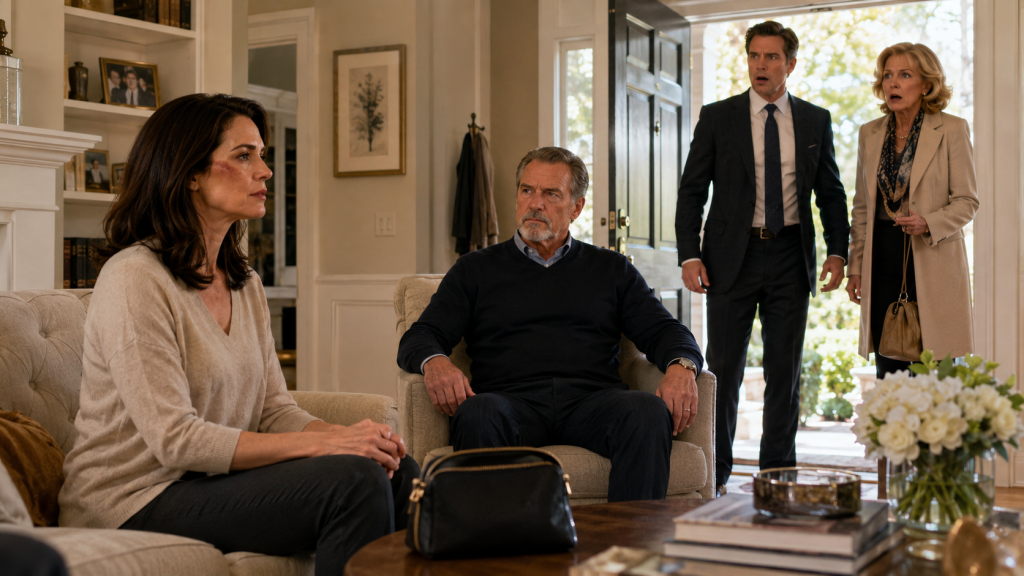
At noon, they walked in together, laughing—until they stopped dead. The makeup was untouched, my suitcase had vanished, and sitting calmly in the living room was the last person he ever expected to face…
The makeup bag landed beside my swollen cheek before the blood on my lip had fully dried. “Mom’s coming for lunch,” Julian hissed. “Cover the bruises and smile.”
He stood over me in our bedroom, already dressed for work, cuff links shining, his expression calm enough to make what happened the night before feel completely unreal. But the ache in my ribs was real. So was the dark fingerprint beneath my jaw.
All because I had said no.
His mother, Eleanor, had decided we should sell my townhouse and move into her oversized colonial house “to save money.” In reality, she wanted my salary paying her mortgage, my hands cleaning her rooms, and my silence protecting her son.
“I’m not living under your mother’s roof,” I had told Julian.
He slapped me first. When I still refused, he shoved me against the dresser and kicked me after I fell.
Now he pointed at the makeup bag. “Use the green concealer. It hides purple.”
Something inside me went cold. Not broken. Cold.
Julian mistook my silence for surrender. He always did.
He leaned close enough for me to smell his coffee. “At noon, you’ll serve lunch. You’ll tell Mom you tripped in the bathroom. Then we’ll discuss listing this place.”
“This place is mine,” I whispered.
His smile vanished. “Not for long.”
The front door slammed behind him at 7:42 a.m.
At 7:43, I reached beneath the mattress and took out the second phone Julian did not know existed.
I had bought it three months earlier, after his first shove. I was a senior forensic accountant for a federal contractor, trained to document fraud, preserve evidence, and follow money people thought was invisible. Fear had delayed me. Training had not disappeared.
I photographed every bruise beside that morning’s newspaper. I saved the bedroom audio from the cloud-connected security system Julian believed he had disabled. Then I opened the encrypted folder labeled TAX RECEIPTS.
Inside were copies of his threats, recordings of Eleanor pressuring me to transfer the deed, bank statements showing Julian had secretly borrowed against my identity, and messages between them discussing how to make me “look unstable” if I resisted.
For months, I had quietly copied every forged form Julian brought home, every suspicious transfer, and every late-night conversation with Eleanor. I had not known when I would be brave enough to use them. That morning, bravery finally felt less frightening than staying.
I called a number I had not used in five years. A man answered on the second ring.
“Audrey?”
My throat tightened. “Dad, I need you.”
There was a pause, then the voice Julian feared more than any judge.
“Tell me where you are.”
PART 2 — THE MAN SITTING IN MY LIVING ROOM
“Tell me where you are.”
My father’s voice was so steady that I almost lost the little strength I had left.
For five years, I had imagined calling him.
Sometimes in anger.
Sometimes in shame.
Sometimes at two in the morning when Julian was asleep beside me and I lay staring at the ceiling, remembering the last thing Dad had said before I cut him out of my life.
If that man ever makes you afraid in your own home, call me. I don’t care how many years have passed.
At the time, I had been furious.
I thought he was judging my marriage.
I thought he disliked Julian because they were too similar—two stubborn men who could fill a room without raising their voices.
I had chosen my husband.
My father had stepped back.
And now, five years later, I was standing in the bathroom with dried blood at the corner of my mouth, asking the man I abandoned to come save me from the man I defended.
“Dad…”
My voice cracked.
“I’m at home.”
He did not ask whether Julian had hurt me.
Maybe he heard the answer already.
“Is he there?”
“No.”
“When is he coming back?”
“Noon. With his mother.”
A pause.
Then:
“Lock the doors.”
“He has a key.”
“Then don’t worry about the doors.”
I frowned.
“What does that mean?”
“I’m coming.”
“Dad, wait—”
“Audrey.”
The way he said my name silenced me.
“Are you bleeding?”
My throat closed.
“A little.”
His breathing changed.
It was the smallest sound.
But I heard the fury underneath it.
“Did Julian do that?”
“Yes.”
The word was almost inaudible.
Dad was silent.
For one terrible second, I thought the call had dropped.
Then he said:
“Take photographs.”
“I already did.”
“Good.”
“Dad…”
“Yes?”
“I have evidence.”
“What kind?”
I looked toward the bedroom.
“Enough that this isn’t only about last night.”
His voice became sharper.
“What else has he done?”
I closed my eyes.
“He used my identity to borrow money.”
Silence.
“And Eleanor helped him pressure me to transfer the townhouse.”
Another silence.
“I have messages.”
“How long?”
“Months.”
“How long has he been hitting you?”
That question hurt differently.
I sat on the edge of the bathtub.
“He didn’t…”
I stopped.
The lie would not come anymore.
Not even automatically.
“He shoved me three months ago.”
Dad said nothing.
“He grabbed my arm once before that.”
Still nothing.
“Last night was the first time he…”
I touched my ribs.
“The first time it was this bad.”
When Dad finally spoke, his voice was almost frighteningly calm.
“Listen carefully.”
I straightened.
“Pack only what matters. Identification. Medication. Documents. Work equipment. Anything sentimental you cannot replace.”
My eyes filled.
“What about the house?”
“The house can wait.”
“It’s mine.”
“I know.”
“He said he was going to take it.”
“He won’t.”
“You don’t know that.”
“Yes.”
For the first time, steel entered his voice.
“I do.”
I wiped my cheek.
“Why?”
“Because he picked the wrong morning to find out what you kept from him.”
My breath caught.
“What did I keep from him?”
“Me.”
At 8:11 a.m., I packed one suitcase.
Not the large cream one Julian bought for our honeymoon.
That felt like his.
I took the old navy suitcase from the guest-room closet.
The one I owned before marriage.
I filled it with work clothes, jeans, underwear, toiletries, and the small wooden box containing my grandmother’s earrings.
Then I stopped.
There were photographs everywhere.
Julian and me in Santorini.
Julian kissing my cheek at a company Christmas party.
Our wedding portrait.
I stood in front of that one for almost a minute.
My white dress.
His black tuxedo.
My father three feet away, looking at Julian with an expression I had once called disapproval.
Now I wondered whether it had been fear.
Not fear of Julian.
Fear for me.
I took the wedding photograph off the wall.
For one wild second, I wanted to smash it.
Instead, I placed it face down on the dresser.
Breaking glass would not change what happened.
Leaving would.
I found my passport.
Birth certificate.
Social Security card.
The original deed showing I purchased the townhouse eighteen months before marrying Julian.
I placed everything inside a document envelope.
Then I removed the encrypted backup drive from beneath my desk.
Fourteen months of financial records.
Six months of messages.
Three audio files.
Copies of the loan applications Julian had submitted using my income.
The forged electronic signature on a home-equity document I had never approved.
A message from Eleanor:
Once Audrey signs the townhouse over, she’ll have nowhere else to go. Then she’ll stop threatening Julian with divorce.
Another from Julian:
She thinks because she bought it before the wedding, it’s untouchable. Mom says we just need her signature.
And the one that had frightened me enough to buy the second phone:
If she starts acting crazy, we document everything. Dad always said women lose when they look emotional.
I had stared at that message for days.
Not because Julian called me crazy.
Because he was preparing to prove it.
A story.
A paper trail.
A version of me that could be handed to lawyers.
Audrey drinks too much.
Audrey has mood swings.
Audrey is paranoid about money.
Audrey is unstable.
If I resisted, he wanted my resistance to become evidence against me.
That morning, I copied everything one final time.
Then I sent the encrypted archive to three places.
My attorney.
My private cloud account.
And my father.
At 8:46 a.m., the doorbell rang.
I froze.
Too early.
Julian?
Eleanor?
My heartbeat slammed against my ribs.
Then the second phone buzzed.
Dad: Outside.
I almost collapsed.
I unlocked the door.
My father stood on the porch.
Thomas Avery had aged.
That was my first thought.
Five years had silvered more of his hair.
There were lines beside his mouth I did not remember.
He wore a charcoal overcoat over a dark suit, though I knew he had been retired for nearly three years.
Behind him stood another man.
And beside the curb sat a black sedan.
Dad looked at my face.
Everything stopped.
He did not hug me.
Not immediately.
He just stared.
At my lip.
My cheek.
The bruise beneath my jaw.
His hands curled once at his sides.
“Where is he?”
“At work.”
“And the mother?”
“Coming with him at noon.”
Dad nodded.
Then his eyes came back to me.
“May I touch you?”
That question destroyed me.
Not the sight of him.
Not the five lost years.
That.
A man asking permission to hug his own daughter because the man I married had taught my body that hands were dangerous.
I nodded.
Dad pulled me carefully against his chest.
I broke.
There was no graceful way to do it.
I cried into his coat like I was eight years old.
My whole body shook.
“I’m sorry.”
He tightened his arms.
“No.”
“I should have called you.”
“No.”
“I chose him.”
“Audrey.”
“I told you you were controlling.”
“You were angry.”
“I said I never wanted to see you again.”
“And I stayed away because you asked me to.”
My tears came harder.
“I wasted five years.”
Dad pulled back.
He placed both hands gently on my shoulders, careful not to touch the bruises.
“Look at me.”
I did.
“You called today.”
I swallowed.
“That’s the only part of the last five years that matters right now.”
Behind him, the other man turned away politely.
Dad noticed.
“This is Michael Chen.”
The man stepped forward.
Early fifties.
Gray scarf.
Leather briefcase.
He offered me his business card instead of his hand.
Michael Chen, Attorney at Law.
I looked at Dad.
“You brought a lawyer?”
“I brought the lawyer.”
Michael almost smiled.
“Your father has always enjoyed making introductions sound threatening.”
I stared at the card.
“Why do I need you?”
Michael’s expression became serious.
“Because your father forwarded me the files you sent.”
My stomach tightened.
“You already looked?”
“Enough to know you should not be alone when your husband comes home.”
I wrapped my arms around myself.
“What did you see?”
“The loan documents.”
“He forged them?”
“We need formal review before I make that statement as fact.”
I appreciated the precision.
“But the signatures deserve immediate scrutiny.”
He glanced toward my cheek.
“And that is separate from what happened to you physically.”
Dad’s voice hardened.
“Police?”
I hesitated.
Even after everything.
That hesitation was there.
Julian getting arrested.
His career.
His family.
His reputation.
All those thoughts came before my own bruises.
I hated that.
“I don’t know.”
Dad did not pressure me.
Michael didn’t either.
He simply said:
“You do not have to decide everything at once.”
I nodded.
“You do need medical documentation.”
“I took pictures.”
“A doctor should examine your ribs.”
“I’m fine.”
Dad closed his eyes.
Only for a second.
When he opened them again, grief had replaced anger.
“Please never say that to me while looking like this.”
My throat tightened.
I looked away.
“I’ll go.”
“Good.”
“But not yet.”
Dad frowned.
“Why?”
“Because Julian told me to be here at noon.”
Dad’s expression changed.
“You want to stay?”
“I want him to come home.”
“Audrey—”
“I spent three months being afraid of what would happen if I left.”
I looked toward the living room.
“I don’t want to disappear and spend the rest of my life wondering what version he told everyone.”
Michael studied me.
“What do you want to happen?”
I took a breath.
“I want him to walk through that door thinking I covered the bruises.”
My voice steadied.
“I want him to believe my suitcase is still upstairs.”
Dad watched me carefully.
“And then?”
I looked at him.
“I want him to see that I am not alone.”
At 9:30, my suitcase left the house.
Michael’s driver carried it to the sedan.
My important documents went with it.
So did my backup drive.
I kept my second phone.
The original phone stayed on the kitchen counter exactly where Julian expected it.
Then we documented the house.
Every room.
Every valuable.
Every account statement I could safely access.
Michael photographed the makeup bag sitting untouched on the bed.
Dad stared at it.
The green concealer had rolled halfway out.
“He bought this?”
“Last night.”
“For the bruises?”
“Yes.”
Dad turned away.
For several seconds, he stood facing the window.
His shoulders rose and fell once.
When he spoke, his voice was quiet.
“If I see him and lose my temper…”
“You won’t.”
Dad looked at me.
I almost smiled.
“You spent thirty-one years on the bench.”
Twenty-seven of them as a judge.
Four as chief judge of the county superior court.
Julian hated him for it.
Not because Dad had ever threatened him.
Because Julian could charm rooms.
Dad was one of the few men who had never appeared impressed.
During our engagement, Julian used to mock him.
Your father thinks he’s God because people stand when he enters a courtroom.
I defended Julian.
Dad never answered.
Now my retired father stood in the bedroom where my husband had ordered me to hide the evidence of violence.
He looked suddenly tired.
“I sent men to prison for doing less than this.”
My stomach tightened.
“I know.”
“And somehow I missed my own daughter.”
“You didn’t miss me.”
His eyes met mine.
“I stopped letting you see me.”
That hurt both of us.
Dad nodded slowly.
“I should have tried harder.”
“No.”
“Audrey—”
“No.”
I stepped closer.
“We can argue about five years later.”
A small, sad smile touched his mouth.
“You always did schedule arguments.”
“I’m an accountant.”
“You’re impossible.”
“You raised me.”
For the first time that morning, Dad laughed.
It lasted perhaps two seconds.
But it reminded me of who we had been before Julian.
At 10:17, Michael found something I had missed.
He was sitting at the dining table reviewing copies of the loan paperwork.
“Audrey?”
I walked over.
“What?”
“This company.”
He pointed to the lender.
Hawthorne Residential Capital.
“What about it?”
“Do you recognize the name?”
“No.”
Michael looked at Dad.
Dad leaned over.
His expression hardened.
“Eleanor’s maiden name is Hawthorne.”
My skin turned cold.
I pulled up the state corporate registry.
Hawthorne Residential Capital LLC.
Registered eighteen months earlier.
The organizer was a corporate filing service.
But the mailing address—
I knew it.
Eleanor’s accountant.
“Oh my God.”
Michael kept reading.
“These may not be legitimate third-party loans.”
“What does that mean?”
“It may mean someone created an entity to make debt appear connected to your property.”
I sat down.
“Why?”
“We need more records.”
I shook my head.
“No. Think about it.”
The pieces began arranging themselves.
Eleanor had repeatedly said selling my townhouse would “simplify things.”
Julian complained that maintaining two sets of family assets made no sense.
Then fake debts appeared.
Debts supposedly secured against my income.
Pressure to move.
Pressure to sign over the property.
Pressure to let Eleanor “handle the sale.”
I felt sick.
“They weren’t trying to save money.”
Michael looked at me.
“No.”
“They were trying to get the house.”
Dad’s jaw tightened.
“Why?”
I stared at the financial statements.
Then I remembered something Eleanor said at Christmas.
If Audrey sold her place, we could finally solve that little issue with the second mortgage.
I had assumed she meant her house.
“What if Eleanor is in trouble?”
Michael said, “Financially?”
“Yes.”
I opened the files again.
Mortgage records.
Public liens.
Property tax records.
There.
A lien against Eleanor’s home.
Then another.
And another.
I looked up.
“She’s drowning.”
The elegant colonial house Eleanor bragged about at every dinner was buried beneath debt.
Dad leaned closer.
“How much?”
“Public records show more than four hundred thousand.”
Michael frowned.
“That would explain motive.”
My stomach turned.
They wanted my townhouse.
Not so we could live together.
Not to save money.
Not because Eleanor was lonely.
They needed my equity.
My home was nearly paid off.
The same home my mother left me enough money for the down payment on before she died.
Julian had not only wanted me under Eleanor’s roof.
He wanted the one place I could escape to converted into cash.
That realization hurt more than the bruise on my face.
“He wasn’t trying to move me.”
Dad looked at me.
“He was trying to remove your exit.”
I closed my eyes.
Exactly.
At 10:52, another message arrived from Julian.
Don’t embarrass me today.
A second:
Mom is already upset that you’ve delayed the realtor.
Then:
Wear the blue dress. Long sleeves.
I showed Michael.
He photographed the messages.
Dad read them.
His face remained expressionless.
That frightened me more than anger.
At 11:06, Eleanor texted.
Sweetheart, please make that chicken salad Julian likes. We all need to put last night’s unpleasantness behind us.
Unpleasantness.
My husband hit me.
His mother called it unpleasantness.
Then another message came.
A good wife knows when not to provoke her husband.
Something inside me settled.
For months I had wondered whether Eleanor knew.
Now she had answered.
I took a screenshot.
Then I typed nothing.
At 11:30, Dad sat in the living room.
Exactly where Julian would see him the moment he entered.
He removed his overcoat.
Dark suit.
White shirt.
No tie.
He looked like the judge Julian remembered.
Michael sat at the dining table with a legal pad.
I stayed upstairs until 11:55.
Then I changed.
Not into the blue dress.
Not into long sleeves.
I wore a simple sleeveless black blouse.
My bruises remained visible.
Every one.
The mark on my jaw.
Purple blooming across my upper arm.
The split lip.
I looked in the mirror.
For years, I had believed dignity meant making pain invisible.
That morning, dignity meant refusing to hide it.
I carried the makeup bag downstairs.
Placed it unopened on the coffee table.
Dad looked at me.
His eyes filled.
He said nothing.
Michael quietly stood.
“You’re sure?”
“Yes.”
“Once they come inside, you do not owe them a conversation.”
“I know.”
“You can ask them to leave at any point.”
“I know.”
“And if Julian becomes aggressive—”
“He won’t.”
Dad looked at me sharply.
I swallowed.
“Not with you here.”
My father’s expression became unbearably sad.
“That sentence tells me everything.”
At exactly 12:03, I heard Julian’s car.
My stomach dropped.
My body reacted before my mind did.
Hands cold.
Breathing shallow.
Heart racing.
I hated it.
Dad noticed.
“Audrey.”
I looked at him.
“You don’t have to prove anything.”
“I know.”
“Then breathe.”
I did.
Once.
Twice.
A car door slammed.
Then Eleanor’s laugh floated up the walkway.
They were happy.
That was the detail I would remember forever.
Laughing.
After what Julian had done.
After Eleanor knew.
They were walking toward my house discussing lunch as though violence were simply another domestic inconvenience to be powdered over.
The lock turned.
Julian opened the door.
“Babe?”
I said nothing.
He stepped inside.
Eleanor followed wearing a camel-colored coat and carrying a bottle of white wine.
Julian was saying:
“I told her she’d better have—”
He stopped.
Eleanor nearly walked into him.
For one long second, nobody moved.
Julian’s eyes landed on me first.
My bare arms.
My uncovered face.
The bruises.
Then the makeup bag.
Untouched.
Then the empty place beside the staircase where my suitcase had been earlier.
Finally, his eyes moved toward the living room.
Dad rose.
Slowly.
Thomas Avery did not need a courtroom robe.
Julian knew exactly who he was.
The blood drained from my husband’s face.
“Judge Avery.”
Dad’s voice was quiet.
“Julian.”
Eleanor’s wine bottle lowered.
“What is this?”
I almost laughed.
After everything, she still sounded offended.
Like we had rearranged lunch without consulting her.
Julian looked at me.
“What is he doing here?”
“My father?”
“You know what I mean.”
“No.”
I tilted my head.
“I don’t think I do.”
His eyes narrowed.
“Audrey, can we speak privately?”
“No.”
“Audrey.”
“No.”
His gaze moved toward Dad.
“Stay out of our marriage.”
Dad did not answer.
Julian turned to me.
“Upstairs.”
One word.
An order.
My body remembered obeying.
My legs almost moved.
Then I looked at the bruises on my arm.
“No.”
His jaw tightened.
“We need to talk.”
“We are talking.”
Eleanor stepped forward.
“This is completely unnecessary.”
Dad looked at her.
“Which part?”
She froze.
He gestured toward my face.
“The bruises?”
Silence.
“The forged financial documents?”
Her eyes flickered.
“The attempt to obtain her property?”
Eleanor went pale.
Julian looked at me.
“What did you tell him?”
Everything in his voice revealed him.
Not concern.
Not denial.
Not horror that someone thought him capable of these things.
Only one question.
What did you tell him?
I smiled faintly.
“Enough.”
He moved toward me.
Dad stepped between us.
It happened so naturally that Julian stopped.
His face reddened.
“Get out of my house.”
My voice came before Dad’s.
“Your house?”
Julian turned.
I walked toward the table.
I picked up the deed.
“This townhouse was mine before I married you.”
“That doesn’t mean—”
“Your name is not on the deed.”
“We’re married.”
“You are not on the mortgage.”
“Audrey—”
“And as of this morning, your access to my individual accounts has been revoked.”
His face changed.
Eleanor spoke sharply.
“You can’t do that.”
I looked at her.
“Why not?”
“We’ve made plans.”
There it was.
We.
I picked up another document.
“Plans involving Hawthorne Residential Capital?”
Eleanor’s mouth fell open.
Julian went completely still.
Dad looked at both of them.
For the first time, neither seemed to know what to say.
I continued.
“I found the company registration.”
Eleanor recovered first.
“That has nothing to do with you.”
“It appears in documents using my signature.”
Julian’s voice sharpened.
“You signed those.”
“No.”
“Yes, you did.”
“I didn’t.”
“You forget things when you’re stressed.”
The sentence was delivered so quickly, so smoothly, that I almost admired the preparation.
Michael spoke for the first time.
“Mr. Mercer, I recommend you stop.”
Julian turned.
“And who are you?”
“Michael Chen.”
Julian scoffed.
“Another family friend?”
“My attorney,” I said.
Silence.
The words changed the room.
Julian stared at me.
“You hired a lawyer?”
“Yes.”
“When?”
“Today.”
His laugh came out wrong.
“You’re insane.”
Michael calmly wrote something on his legal pad.
Julian noticed.
“What are you writing?”
“Please continue.”
That terrified him.
More than Dad.
More than the documents.
The idea that his words were being preserved.
Julian pointed at me.
“She does this.”
Nobody spoke.
“She creates drama.”
Michael kept writing.
“She’s paranoid.”
Another note.
“She thinks everyone is stealing from her.”
Another.
Eleanor jumped in.
“Audrey has been extremely emotional lately.”
I looked at her.
“Is that why you told me a good wife knows not to provoke her husband?”
She froze.
Julian turned toward her.
“What?”
I raised my second phone.
“Would you like me to read the message?”
Eleanor’s lips parted.
No sound came.
Julian looked at me.
“What phone is that?”
I almost smiled.
The question was perfect.
“You don’t recognize it?”
His expression shifted.
“No.”
“Good.”
He understood.
Not everything.
Enough.
“You’ve been recording us.”
“I’ve been preserving evidence.”
“That’s illegal.”
Michael looked up.
“Be very careful giving legal advice today.”
Julian snapped:
“Shut up.”
Dad finally spoke.
“Julian.”
My husband looked at him.
“Sit down.”
“I don’t take orders from you.”
“No.”
Dad’s voice remained almost gentle.
“You only give them to women you believe are afraid of you.”
Julian’s face twisted.
“You don’t know anything about our marriage.”
Dad’s eyes went to my bruises.
“I know enough about last night.”
Julian looked at me.
“You told him I hit you?”
I stared.
“What would you call it?”
“You fell.”
Dad’s eyes closed.
Eleanor immediately said:
“Yes. Exactly. Audrey fell.”
I turned toward her.
“Interesting.”
She froze.
“Because you weren’t here.”
Silence.
Julian’s face changed.
He knew before I said it.
“The bedroom system captured audio.”
His mouth opened.
Nothing came.
“You said you disabled it.”
I continued.
“You disabled the visible microphone setting.”
A breath.
“You did not disable the cloud backup.”
Eleanor slowly sat down.
Julian looked like someone had removed the floor beneath him.
“What exactly did it record?”
I said nothing.
He stepped closer.
“What did it record?”
Dad moved again.
Julian snapped:
“Stop getting between me and my wife.”
I finally said the sentence I had been afraid to say for three months.
“I’m not your wife anymore.”
Everything went silent.
Julian stared.
I continued.
“Legally, yes. For the moment.”
I swallowed.
“But this marriage ended when you hit me and expected makeup to repair it.”
His face hardened.
“You’ll regret this.”
Maybe he meant it as a threat.
Maybe habit took over.
Either way, Michael’s pen stopped.
Dad looked toward the hallway.
And then came the knock.
Three firm knocks.
Julian turned.
I did not.
Because I already knew.
Michael had made the call while I was upstairs.
I had agreed.
At 11:40.
Police.
Two officers stood outside.
One woman.
One man.
The female officer looked at me first.
“Ms. Avery?”
“Yes.”
“We’re here regarding a domestic assault report.”
Julian’s head snapped toward me.
“You called the police?”
I looked at him.
“Yes.”
“You said you weren’t going to ruin my life.”
“I never said that.”
His face became red.
“You know what this will do to me?”
Something almost broke inside me.
Not from fear.
From disbelief.
Even now.
His career.
His reputation.
His life.
Still the center.
I touched the bruise beneath my jaw.
“Do you know what you did to me?”
For once, Julian had no answer.
The officers entered.
They separated us.
One spoke to Dad.
One spoke to Michael.
The female officer asked me questions.
Did I feel safe?
Did Julian strike me?
Did he prevent me from leaving?
Were weapons in the house?
Had this happened before?
My answers came slowly.
But they came.
Yes.
Yes.
No.
No.
Not like this.
She photographed my injuries.
Julian watched from across the room.
His face shifted through disbelief, rage, and finally fear.
Eleanor stood near the kitchen.
Silent.
Then the officer asked Julian to turn around.
His eyes widened.
“What?”
“Sir, place your hands behind your back.”
“This is ridiculous.”
“Sir.”
“My wife fell.”
The officer’s expression did not change.
“We can discuss that.”
“I’m not going anywhere.”
Dad did not move.
Neither did I.
Julian looked at me.
“Audrey.”
There was something new in his voice.
Pleading.
I had never heard it before.
“Audrey, tell them this is a misunderstanding.”
My heart hurt.
Because some old part of me wanted to.
The trained part.
The obedient part.
The wife who had spent years smoothing the tablecloth after somebody else shattered the plates.
Then I looked at the makeup bag.
Green concealer.
For purple bruises.
“No.”
One word.
That was all.
The cuffs closed.
Eleanor gasped.
Julian shouted my name.
The officers led him outside.
He twisted once toward me.
“You’re destroying everything!”
I stood in the doorway.
My ribs hurt.
My mouth hurt.
My hands trembled.
But I did not hide.
“No, Julian.”
My voice carried across the porch.
“I just stopped helping you hide what you destroyed.”
The patrol car door closed.
Silence returned.
Eleanor lasted another thirty seconds.
Then she turned toward me.
“You vindictive little bitch.”
Dad stepped forward.
I lifted my hand.
“No.”
This one was mine.
Eleanor stared at me.
“You have no idea what you’ve done.”
“That sentence seems popular in your family.”
“My son could lose his career.”
“He should have thought about that before hitting me.”
“You provoked him.”
Dad’s jaw tightened.
I stayed calm.
“How?”
“You humiliated him.”
“By refusing to give you my house?”
Her face changed.
“You’re twisting everything.”
“Then explain Hawthorne Residential Capital.”
She looked toward Michael.
“I don’t discuss private finances in front of strangers.”
Michael almost smiled.
“Then I suspect you’ll enjoy speaking with investigators instead.”
Her expression collapsed.
“What investigators?”
I took out one printed statement.
Her LLC.
The false lien document.
My alleged signature.
“Julian used my identity.”
“That’s absurd.”
“You benefited.”
“I didn’t know.”
For the first time, Eleanor looked afraid.
Not angry.
Afraid.
And something inside me understood the difference.
She had known about the pressure.
Known about the bruises.
Known Julian wanted my property.
But perhaps she did not know everything he had done financially.
Or perhaps she simply realized denial was now safer.
Either way, I was finished determining which lie belonged to which person.
Michael stood.
“Mrs. Mercer, my client is asking you to leave.”
Eleanor looked at me.
“This is family business.”
“No.”
I opened the front door.
“It isn’t anymore.”
Her face twisted.
“You think your father can protect you forever?”
I looked at Dad.
Then back at her.
“No.”
My voice softened.
“That’s the point.”
She frowned.
“I’m going to protect myself.”
Eleanor stared for another second.
Then she walked outside.
I closed the door behind her.
Locked it.
And leaned against the wood.
For almost ten seconds, nobody spoke.
Then my legs gave out.
Dad caught me before I hit the floor.
I started sobbing.
Not elegantly.
Not quietly.
My whole body folded against him.
“Did I do the right thing?”
The question embarrassed me the moment it escaped.
Dad held me tighter.
“You told the truth.”
“But what if—”
“No.”
He pulled back.
“Do not spend tonight arguing his defense in your own head.”
I wiped my face.
“I loved him.”
“I know.”
“I still…”
I could not finish.
Dad understood anyway.
“You can love someone and still leave the place where they hurt you.”
I looked toward the window.
The patrol car was gone.
“I thought I’d feel stronger.”
Dad brushed my hair from my face with the same gentleness he used when I was a child.
“Who told you strength feels good?”
I laughed through tears.
Nobody.
Movies, perhaps.
Books.
People who tell stories after healing is complete.
Nobody talks enough about the moment itself.
How courage can feel exactly like terror while you are doing it.
We left for the hospital twenty minutes later.
Before I walked out, I returned to the bedroom one last time.
The makeup bag still sat on the bed.
I picked it up.
For a second, I considered throwing it away.
Then I placed it inside a clear evidence bag Michael had given me.
“Keeping it?” Dad asked from the doorway.
“Yes.”
“Why?”
I looked at the little green tube.
“Because someday he’s going to say it never happened.”
Dad nodded.
“And I want to remember that I stopped covering for him before the bruises even faded.”
My father looked at me for a long moment.
Then he said:
“That sounds like my daughter.”
The words should have comforted me.
Instead, they made me cry again.
Because for five years, I thought becoming Julian’s wife required becoming less of Thomas Avery’s daughter.
Now I understood.
The part of me Julian feared most had never belonged to Dad.
Dad had simply been the first person to recognize it.
At the hospital, the doctor documented two bruised ribs.
A split lip.
Soft-tissue injuries.
Nothing life-threatening.
Everything real.
When the nurse asked whether I had somewhere safe to stay, I looked at Dad.
“Yes.”
He drove me to his house that evening.
The same brick house where I grew up.
The same porch.
The same oak tree.
Inside, my old bedroom had become a reading room.
I laughed when I saw it.
“You got rid of my bed?”
“You were thirty-two.”
“Cruel.”
“I kept your books.”
He had.
Every one.
College textbooks.
Old novels.
Even the terrible poetry collection I wrote at sixteen.
I touched the spine.
“You kept this?”
“Evidence.”
I smiled.
The word felt different now.
Dad made soup.
I managed three bites.
Then my attorney called.
Not Michael.
My divorce attorney.
A woman Michael had already contacted.
Her name was Rebecca Sloan.
She had reviewed the material.
She spoke calmly.
Protective order.
Property preservation.
Financial disclosures.
Account safeguards.
Forensic review.
Words that frightened me.
Words that also sounded like doors locking between Julian and the rest of my life.
Then she said:
“There is one issue you should know about tonight.”
My stomach tightened.
“What?”
“We reviewed the documents connected to Hawthorne Residential Capital.”
“And?”
“The company is in serious financial trouble.”
I looked at Dad.
“How serious?”
“Serious enough that its existence may explain the pressure to transfer your townhouse.”
I closed my eyes.
I knew that part.
Then Rebecca continued.
“But there’s something worse.”
My skin prickled.
“What?”
“One of the loan applications contains a notarized acknowledgment.”
“So?”
“The notary claims you appeared personally and signed in front of him.”
“I didn’t.”
“I believe you.”
“Who notarized it?”
A pause.
Then Rebecca answered.
“Julian.”
I stood.
“What?”
“Your husband holds an active notary commission through his employer.”
My hand tightened around the phone.
“He notarized my forged signature?”
“That appears to be what the document says.”
I could barely breathe.
“But that’s not the worst part.”
My stomach dropped.
“What is?”
Rebecca’s voice became quieter.
“The application lists the loan proceeds as being used to satisfy an existing private debt.”
“What debt?”
“To Eleanor.”
I stared at Dad.
He could hear only my side of the conversation, but his expression changed.
“How much?”
“Two hundred eighty thousand dollars.”
My knees weakened.
“Julian owed his mother almost three hundred thousand?”
“That’s how the document presents it.”
“Why?”
“We don’t know yet.”
My mind raced.
Then Rebecca said:
“But there is another name in the transaction history.”
I gripped the phone.
“Whose?”
She told me.
And for a moment, I thought I had misheard.
Because the name belonged to someone I knew.
Someone who had been inside my house.
Someone Julian repeatedly told me was the only person he trusted with our finances.
His business partner.
Nathan Cole.
The man who had sat across from me at our anniversary dinner six months earlier and raised a glass to “trust, loyalty, and family.”
Rebecca continued.
“There are transfers among Eleanor, Julian, Nathan, and the Hawthorne entity totaling more than nine hundred thousand dollars.”
I closed my eyes.
“How much of it came through accounts connected to me?”
“We’re still calculating.”
“How bad?”
“Audrey…”
“Tell me.”
“At least four hundred thousand dollars appears to have moved using either your identity, your income, or your property as justification.”
My stomach turned.
The physical violence had begun when I refused to move into Eleanor’s house.
But now I understood why.
I had not simply rejected a family arrangement.
I had interrupted a financial scheme.
My townhouse was supposed to solve a problem I had never been told existed.
And when I refused to hand it over willingly, Julian had become violent.
I looked at Dad.
“He wasn’t angry because I said no.”
Dad frowned.
“What?”
I lowered the phone.
“He was scared.”
Rebecca heard me.
“That is possible.”
I stared into the dark window.
“Because they needed the house.”
Nobody spoke.
Then another thought arrived.
Cold.
Awful.
“What happens if I had signed?”
Rebecca paused.
“The townhouse likely would have been transferred or leveraged, depending on which document they ultimately used.”
“And then?”
“You would have had significantly less control over it.”
I swallowed.
“And if I had moved into Eleanor’s house?”
Dad understood before I said it.
“You would have had nowhere that was yours.”
Exactly.
My marriage had suddenly rearranged itself.
Every argument.
Every push.
Every threat.
Every comment Eleanor made about how married women should stop thinking in terms of “mine.”
They had been trying to isolate me financially before I realized I needed to leave physically.
I pressed my hand against my mouth.
“Rebecca.”
“Yes?”
“I have another recording.”
“What kind?”
“Julian and Eleanor talking in our kitchen about making me look unstable.”
Silence.
“Send it tonight.”
“I will.”
“And Audrey?”
“Yes?”
“Do not underestimate the importance of what you preserved.”
I looked at my bruised arm.
I had spent months calling myself a coward for gathering evidence without leaving.
Now, for the first time, I saw it differently.
Maybe I had not been ready to run.
But some part of me had been preparing a road.
At 11:18 that night, I lay in the guest bedroom at Dad’s house.
I could not sleep.
Every time I closed my eyes, I heard Julian.
Cover those bruises.
Smile.
Serve lunch.
Act like everything’s fine.
My phone vibrated.
A voicemail notification.
Julian.
The protective instructions said not to communicate.
But I was allowed to preserve messages.
I played it.
His voice sounded different.
Smaller.
“Audrey.”
A pause.
“I’m sorry things got out of control.”
My heart went cold.
Things.
Not I.
Not me.
Things.
“I didn’t mean to hurt you.”
Another pause.
“You know how you get when you’re stubborn.”
There it was.
The hook.
I almost laughed.
“I love you.”
My eyes filled anyway.
Damn him.
“You’re my wife.”
I covered my mouth.
“We can fix this.”
For years, those four words had been enough.
We can fix this.
After shouting.
After broken promises.
After humiliation.
Always we.
Never him.
“I need you to call your father and tell him he misunderstood.”
My tears stopped.
“And you need to drop whatever you told the police.”
There it was.
Not apology.
Strategy.
“Mom is devastated.”
Of course Eleanor was.
“She thinks your father manipulated you.”
I closed my eyes.
Then Julian said:
“And Audrey, whatever you found about the loans, you need to be very careful.”
My skin prickled.
“There are things you don’t understand.”
The voicemail paused.
Then his voice lowered.
“If you push too hard, people other than me are going to get hurt.”
I sat upright.
The message ended.
I replayed the final sentence.
Once.
Twice.
People other than me are going to get hurt.
I walked downstairs.
Dad sat at the kitchen table reading.
He looked up immediately.
“What happened?”
I handed him the phone.
He listened.
His expression changed.
Not fear.
Recognition.
“What?”
He replayed the last line.
Then looked at me.
“That’s not an apology.”
“I know.”
“It sounds like a warning.”
“I know.”
Dad stood.
“Send it to Michael.”
I did.
Thirty seconds later, Michael called.
“I heard it.”
“What does he mean?”
“We don’t know.”
“Could Nathan be involved?”
“Possibly.”
“And Eleanor?”
“Clearly financially connected.”
I rubbed my forehead.
“What if there are other people?”
Michael became quiet.
Then he said:
“Audrey, there is something I didn’t tell you this afternoon.”
My stomach dropped.
“What?”
“I recognized Nathan Cole’s name.”
I stared at Dad.
“From where?”
“An old case.”
My pulse quickened.
“What kind?”
Michael hesitated.
“A financial fraud investigation.”
I stopped breathing.
“Was he charged?”
“No.”
“Why?”
“The investigation collapsed after a key witness withdrew.”
I stared into the darkness beyond the kitchen window.
“When?”
“Six years ago.”
One year before I married Julian.
My hands became cold.
“Who was the witness?”
Michael did not answer immediately.
“Michael.”
Finally:
“Eleanor Mercer.”
Everything inside me went still.
Julian’s mother.
The woman who told me a good wife knew not to provoke her husband.
The woman whose collapsing finances were connected to a company using my identity.
The woman who had been laughing when she walked into my home at noon.
She had not simply stumbled into Julian’s fraud.
She had a history with Nathan.
A history she had never mentioned.
I looked at Dad.
He had heard enough to understand.
My voice came out as a whisper.
“What happened six years ago?”
Michael exhaled.
“We need the original file before I say more.”
“But you think this started before me.”
Silence.
That silence answered.
I sat slowly.
For months I believed Julian wanted my townhouse because Eleanor was controlling.
Then I believed they needed my equity because she was in debt.
Now I understood something worse.
The townhouse might not have been the beginning.
I might have been selected because I had one.
A woman with a high salary.
Excellent credit.
A valuable property in her own name.
And enough emotional distance from her father that nobody powerful would look too closely.
Until this morning.
I looked across the table at Thomas Avery.
The man Julian had spent five years convincing me was arrogant.
Controlling.
Judgmental.
Dangerous to our marriage.
Suddenly I wondered whether Julian had worked so hard to separate us for exactly the reason I once mocked.
Because my father knew what men like him looked like when the courtroom doors finally closed.
Dad reached across the table.
He did not take my hand.
He placed his palm beside it and waited.
I turned mine over.
Then held on.
“What happens now?” I whispered.
His fingers tightened gently.
“Now?”
He looked toward the second phone, the financial files, and the voicemail that Julian thought would frighten me back into silence.
“Now we find out why your husband was so desperate to make sure you never spoke to me again.”
I stared into the quiet kitchen.
That morning, I had believed the worst thing Julian had done was hit me.
By midnight, I understood the bruises were only the first visible crack in something much larger.
The forged loans.
My townhouse.
Eleanor’s debt.
Nathan Cole.
A six-year-old fraud investigation.
And a husband who had just warned me that other people could get hurt if I kept asking questions.
I touched the bruise beneath my jaw.
Julian had ordered me to cover it because he believed hiding the evidence would restore his control.
Instead, leaving it visible had exposed the first lie.
And somewhere beneath that lie was the reason he married me in the first place.
PART 3 — THE WOMAN THEY THOUGHT WOULD STAY QUIET
I did not sleep that night.
Every time I closed my eyes, I heard Julian’s voice.
People other than me are going to get hurt.
It was not an apology.
It was not panic.
It was a warning dressed in the language of concern.
By three in the morning, I stopped pretending rest was possible.
I sat at my father’s kitchen table wearing one of his old college sweatshirts while the bruises beneath my jaw darkened from red to purple.
Dad made coffee.
Neither of us drank much.
The house was quiet except for the hum of the refrigerator and the soft ticking of the clock above the stove.
Five years earlier, I had walked out of this house furious because Dad told me he did not trust Julian.
Now I was sitting at the same table asking myself whether Julian had spent our entire marriage ensuring I would never come back.
At 6:12 a.m., Michael Chen called.
“I found the old file.”
I straightened.
Dad immediately looked at me.
“What was the case?” I asked.
Michael exhaled.
“Investment fraud.”
My stomach tightened.
“Nathan?”
“Yes.”
“How much?”
“Just under three million dollars disappeared through a private real-estate investment operation.”
I closed my eyes.
“And Eleanor?”
“She was supposed to be the prosecution’s strongest witness.”
“Why?”
“Because she handled some of the accounts.”
My skin turned cold.
“Handled them how?”
Michael paused.
“She was Nathan Cole’s bookkeeper.”
Dad stopped moving.
I stared across the table.
“What?”
“Before Julian introduced Nathan as his business partner, Nathan and Eleanor had already worked together for years.”
I remembered dinner parties.
Nathan laughing beside Eleanor.
The two of them calling each other old family friends.
Julian once told me Nathan had known his mother “through church.”
Church.
Another lie.
“What happened to the case?”
Michael continued.
“Eleanor gave investigators documents implicating Nathan.”
“And then?”
“Three weeks before trial, she withdrew key portions of her statement.”
“Why?”
“She claimed memory problems.”
I almost laughed.
Of course.
Emotional women.
Confused women.
Unstable women.
Apparently Julian had inherited more than his mother’s eyes.
“Without her testimony,” Michael said, “the case weakened. Several investors accepted civil settlements. Nathan was never convicted.”
Dad’s expression hardened.
“And Eleanor?”
“Walked away.”
I rubbed my temple.
“So she protected him.”
“Possibly.”
“No.”
I looked at Dad.
“She did.”
Then another thought came.
“Why?”
Michael was quiet.
“We found something else.”
Those words had become poisonous.
“What?”
“Nathan wasn’t merely Eleanor’s employer.”
I waited.
“They were business partners.”
My mouth went dry.
Michael continued.
“There are incorporation records going back almost fifteen years.”
I felt something inside me rearrange.
Eleanor had not been a mother drowning under bad decisions.
She had been part of the machinery.
Maybe not every piece.
Maybe not every lie.
But enough.
“What does that have to do with Julian?”
“That’s what we’re trying to establish.”
I looked toward the dark window.
“No.”
I whispered it.
“What?”
“I know.”
Dad leaned forward.
“What do you know?”
I thought back to the year before Julian proposed.
He had been charming.
Attentive.
Almost strangely interested in my townhouse.
He asked what I paid.
Whether I had refinanced.
Whether my name alone was on the deed.
At the time, I thought he was impressed.
Responsible.
Thinking about our future.
Then I remembered the first Christmas I spent with Eleanor.
She stood in my kitchen admiring the crown molding.
“You own this by yourself?”
“Yes.”
“No family trust?”
“No.”
“No co-owner?”
“No.”
She had smiled.
“How impressive.”
Back then, it felt like praise.
Now it sounded like inventory.
I put both hands flat against the table.
“They knew about the townhouse before Julian proposed.”
Dad stared at me.
“Audrey…”
“He asked questions.”
My voice became hollow.
“Too many questions.”
Michael heard me through the phone.
“What kind?”
I told him.
The deed.
The mortgage.
The equity.
My credit.
My job.
My retirement account.
There was silence on the line.
Then Michael said carefully:
“Write down everything you remember.”
My throat tightened.
“You think he married me for money.”
Dad’s face broke.
Michael did not answer immediately.
“We don’t know that yet.”
I looked at my bruises.
But I knew.
Maybe Julian had loved parts of me.
Maybe attraction had been real.
Maybe some mornings had been genuine.
Human beings are rarely simple enough to be entirely false.
But love and exploitation can live in the same house.
And suddenly I could not tell where one ended and the other began.
By nine, Rebecca Sloan had obtained an emergency protective order.
Julian was barred from contacting me directly.
He could not return to the townhouse without a supervised arrangement.
He could not move money from certain joint accounts.
He could not dispose of shared property.
For the first time in our marriage, rules existed that he had not written.
That mattered.
At 10:30, two financial investigators arrived at Dad’s house.
One worked with the district attorney’s economic-crimes unit.
The other was from the state financial-regulation office.
They asked for everything.
Every loan document.
Every email.
Every message.
Every recording.
I handed over the encrypted drive.
My hands shook while I did it.
Not because I was unsure.
Because that tiny drive contained the ugliest pieces of my marriage.
Words I had saved at two in the morning.
Screenshots taken while Julian showered.
Audio files I had listened to alone, wondering whether I was paranoid.
Now strangers were cataloging them as evidence.
One investigator, a woman named Carla Mendes, noticed my bruises.
She looked at me gently.
“Did he know you were collecting this?”
“No.”
“Good.”
The word surprised me.
Then she looked at the folder.
“You may have protected more than your property.”
The first major break came that afternoon.
Nathan Cole had tried to close two business accounts.
The bank froze them.
Then investigators found something hidden inside one of the account records.
Monthly payments.
From Hawthorne Residential Capital.
To Julian.
Not salary.
Not reimbursement.
Acquisition fees.
I stared at the phrase.
“What does that mean?”
Carla turned the spreadsheet toward me.
“That’s what we’re determining.”
“How much?”
“Eighty thousand over eighteen months.”
“For what?”
She pointed to coded descriptions.
A-17.
A-22.
A-31.
Then one marked:
A-34 — pending property conversion.
My mouth went dry.
“What’s A-34?”
Carla looked at me.
“We believe it may be you.”
I stopped breathing.
“No.”
She showed me another document.
A private spreadsheet recovered from Nathan’s cloud account.
The rows contained names.
Ages.
Professions.
Credit scores.
Property values.
Marital status.
I scanned them.
Then I saw:
A-34 — A. Avery/Mercer. Forensic accountant. Townhouse equity estimated $610K. Strong credit. Limited immediate family contact.
The room disappeared.
Limited immediate family contact.
They knew.
My separation from Dad was not merely convenient.
It was a column.
A risk factor.
A weakness.
I felt sick.
Dad read over my shoulder.
His face went white.
“They profiled her.”
Carla nodded.
“That appears possible.”
I kept reading.
Beside my name:
J.M. relationship established. High compliance. Transfer resistance increasing.
High compliance.
I stared at those two words until tears blurred them.
That was me.
Not Audrey.
Not wife.
Not daughter.
Not woman.
Compliance.
The measure of how easily I could be moved.
“How many names?”
Carla did not answer immediately.
“Twenty-three.”
My stomach twisted.
“Women?”
“Mostly.”
“Married to people connected to Nathan?”
“Some. Dating others. Several appear to have been approached through business or social connections.”
I closed my eyes.
“So this was bigger than my house.”
“Yes.”
Dad stepped away from the table.
I had rarely seen him look helpless.
He had spent decades inside courtrooms where every disaster eventually became a case number and every case followed a procedure.
But this was his daughter reduced to a spreadsheet.
He turned toward the window.
I reached for him.
“Dad.”
He shook his head.
“I’m all right.”
“No, you’re not.”
He laughed once.
Neither was I.
I stood beside him.
“They knew we weren’t speaking.”
His eyes filled.
“I’m sorry.”
“Stop.”
“I should never have let five years pass.”
“You respected what I asked.”
“I should have been annoying.”
Despite everything, I laughed.
“You were always excellent at that.”
He looked at me.
Then his face crumpled.
Just slightly.
“I thought staying away was loving you.”
I took his hand.
“And I thought choosing Julian was proving I was independent.”
We stood there in silence.
Two people who had both mistaken distance for principle.
Then I said:
“They used the distance.”
Dad nodded.
“Yes.”
My throat tightened.
“But they didn’t create it.”
He looked at me.
“We did.”
That mattered.
Because taking responsibility is not the same as accepting blame for somebody else’s cruelty.
Julian exploited a fracture.
He did not invent my free will.
I had made mistakes.
Dad had made mistakes.
But exploitation still belonged to the people who chose to exploit.
Nathan was arrested two days later.
Not for me.
Not yet.
For financial offenses tied to falsified lending documents and illegal transfers.
Eleanor was questioned that same afternoon.
She hired an attorney before sunset.
Julian remained temporarily free while the domestic-assault case moved forward.
His attorney released a statement calling the financial accusations a “marital misunderstanding.”
I read that phrase twice.
Marital misunderstanding.
As if forged signatures were forgotten anniversaries.
As if bruised ribs were communication problems.
As if my property had simply wandered into somebody else’s business plan.
Rebecca told me not to respond publicly.
I didn’t.
I had spent enough of my marriage explaining myself to people committed to misunderstanding me.
A week later, Carla called.
“We found the source of Eleanor’s debt.”
I sat down.
“What?”
“The liens against her house were not ordinary household debt.”
I waited.
“They were connected to investor settlements from the old Nathan Cole matter.”
My stomach dropped.
“So she owed money because of that fraud?”
“Yes.”
“How much?”
“Originally close to seven hundred thousand.”
I stared at the wall.
“And she needed my townhouse.”
“It would have covered a substantial portion.”
I laughed bitterly.
All those lunches.
All those comments.
Family should live together.
Why pay two mortgages?
This townhouse is too much house for one couple.
You’ll inherit my place someday anyway.
Every sentence had been wrapped in maternal concern.
Underneath was arithmetic.
Then Carla said:
“There’s more.”
My grip tightened.
“A message thread between Eleanor and Nathan.”
My skin prickled.
“What does it say?”
Carla hesitated.
Then read:
“If Audrey signs before the lien review, we’re clear.”
My stomach turned.
Another message.
“Julian says she’s getting suspicious.”
Then Eleanor:
“Push the family angle. She hates conflict.”
I closed my eyes.
Another.
Nathan:
“And the father?”
Eleanor:
“She hasn’t spoken to him in years. Keep it that way.”
I stopped breathing.
There it was.
Not paranoia.
Not hindsight.
Proof.
I pressed my palm over my eyes.
“They knew.”
“Yes.”
“They talked about Dad.”
“Yes.”
A tear slid down my cheek.
“What else?”
Carla’s voice softened.
“You don’t need to hear all of it today.”
“Yes.”
I needed it.
Not because pain was useful.
Because for years Julian made me question my own memory.
I wanted the truth unedited.
Carla continued.
One message from Julian:
“She almost called him after our fight. I handled it.”
I froze.
“When?”
“The date is eighteen months ago.”
I remembered.
The fight over Christmas.
Julian screamed because I told Eleanor we would spend Christmas Eve alone.
He apologized later.
Then cried.
Then told me my father had always wanted our marriage to fail.
I had stood in the bathroom holding my phone.
Dad’s number on the screen.
I never pressed call.
Julian had “handled it.”
God.
How many times had he been managing me while I thought we were resolving things?
The criminal cases took months.
Real life does not move at the speed of revenge stories.
There were hearings.
Continuances.
Motions.
Interviews.
Financial audits.
Some days nothing happened.
Other days three terrible things arrived before lunch.
Julian eventually lost his job.
Not because I demanded it.
Because his employer investigated the notarized documents and suspended his commission.
He was later charged in connection with falsified financial instruments, identity misuse, and the assault.
Eleanor faced fraud-related charges tied to the Hawthorne entity.
Nathan’s case became the largest.
Investigators linked his operation to multiple victims.
Some had lost retirement savings.
Some had nearly lost homes.
One woman had refinanced property after a boyfriend connected to Nathan convinced her it was “for their future.”
I was not the first.
That hurt.
Then it comforted me.
Not because anyone else suffered.
Because the shame stopped feeling uniquely mine.
Predators survive by making each victim believe she was individually foolish.
Patterns destroy that lie.
The divorce hearing came eleven months after the morning Julian threw the makeup bag onto our bed.
I wore navy.
Sleeveless.
Not intentionally at first.
Then I realized what I had chosen.
No bruises remained.
Only skin.
Julian sat across the courtroom.
He looked thinner.
His hair was shorter.
The arrogance had not disappeared completely, but it no longer filled the room.
His lawyer did most of the talking.
The financial evidence made the property division simpler than Julian expected.
The townhouse remained mine.
Completely.
The fraudulent claims against it were removed.
Certain debts attributed to me were challenged and invalidated.
Julian’s share of marital assets was reduced by findings connected to misuse and concealment.
I listened calmly.
There was no satisfaction.
Only relief.
Then, during a break, Julian asked through counsel whether he could speak to me privately.
Rebecca looked at me.
“You do not owe him that.”
“I know.”
“Do you want to?”
I thought for a long moment.
“Yes.”
We spoke in a conference room.
Door open.
Rebecca nearby.
Julian sat across from me.
For a few seconds, neither of us spoke.
Then he said:
“You look good.”
I almost laughed.
Eleven months earlier, he had given me makeup to hide what he did.
Now he was complimenting the face that had healed without him.
“Why did you want to talk?”
He looked down.
“I’m sorry.”
I waited.
“For what?”
His eyes lifted.
“Everything.”
“No.”
His face tightened.
“What do you mean?”
“I spent years accepting broad apologies.”
I folded my hands.
“Be specific.”
He looked away.
“I shouldn’t have hit you.”
“No.”
His jaw tightened.
“I shouldn’t have used your information on those documents.”
“No.”
“I shouldn’t have let Mom pressure you.”
“You didn’t let her.”
He frowned.
“You participated.”
Silence.
“You accepted money from Nathan for keeping me compliant.”
His face changed.
So he knew I knew.
“That wasn’t what it looked like.”
“Then what was it?”
“I was supposed to manage the transaction.”
“The transaction was my home.”
“I never thought you’d lose it.”
I stared.
That sentence told me more than any confession.
“You only thought I’d lose control of it.”
He said nothing.
“Did you marry me because of the townhouse?”
His face tightened.
“No.”
I searched him.
“Did Nathan know about me before we met?”
Silence.
My stomach dropped.
“Julian.”
He whispered:
“Yes.”
Even after everything, that hurt.
“How?”
“A networking dinner.”
My memory flashed.
The first night I met Julian.
A professional association fundraiser.
Nathan had introduced us.
I had forgotten that part.
Of course I had.
It seemed meaningless then.
“What did he tell you?”
“That you were successful.”
I waited.
“That you owned property.”
Another pause.
“That you were single.”
My throat tightened.
“And?”
Julian looked ashamed.
“That your father wasn’t in your life.”
I leaned back.
The beginning of my love story had been a briefing.
God.
He rushed to speak.
“But then I actually loved you.”
I laughed softly.
Tears filled my eyes.
“Maybe you did.”
He looked hopeful.
I hated that.
“But you loved me inside a plan.”
His face fell.
“You knew why Nathan introduced us.”
“Yes.”
“And you stayed.”
“Yes.”
“You took money.”
“Yes.”
I breathed slowly.
“Then every good memory now has something standing behind it.”
He looked at me.
“I can’t undo that.”
“No.”
“I wish I could.”
“So do I.”
For the first time, my voice broke.
Because there had been good memories.
Sunday mornings.
Road trips.
The night he danced with me barefoot in the kitchen.
The week I had pneumonia and he slept on the floor beside the couch.
The human heart does not become stupid simply because the person it loved became cruel.
I wiped my cheek.
Julian whispered:
“I never thought I’d become this.”
I looked at him.
“I don’t think people become this in one night.”
He flinched.
“The first shove mattered.”
Silence.
“The first forged form mattered.”
His eyes dropped.
“The first lie you told yourself to make the next lie easier mattered.”
I stood.
He looked up.
“Audrey.”
I stopped.
“Can you ever forgive me?”
I thought about the question.
Not because he deserved an answer.
Because I deserved to know mine.
“Maybe.”
His face changed.
“But forgiveness will never mean access.”
I walked out.
That was the last private conversation we ever had.
Eleanor pleaded guilty to several financial charges rather than go to trial.
Nathan fought everything.
He lost.
The evidence was too broad.
Too many victims.
Too many spreadsheets.
Too many accounts.
Too many messages.
The old fraud case, the one Eleanor had helped collapse years earlier, returned as context for the newer investigation.
Several former investors received additional restitution.
Some money was never recovered.
That part mattered too.
Justice does not restore every year.
Every dollar.
Every night of fear.
Sometimes justice is simply the world finally refusing to cooperate with the lie.
Julian’s assault case ended with a plea agreement that required accountability, counseling, restrictions, and legal consequences I once thought would destroy me to witness.
It didn’t.
I did not celebrate.
But I did not rescue him either.
That was my freedom.
A year and a half after leaving, I sold the townhouse.
Dad nearly choked when I told him.
“You fought so hard to keep it.”
“I fought so they couldn’t take it.”
He stared at me.
“That’s different?”
“Completely.”
I smiled.
“It was mine to keep.”
Then I handed him the real-estate contract.
“And it’s mine to sell.”
He laughed.
“Fair enough.”
The townhouse had been my fortress.
Then my trap.
Then evidence.
I wanted it to become something ordinary again.
Property.
Nothing more.
I bought a smaller home fifteen minutes from Dad.
Not next door.
I had boundaries.
He complained dramatically.
I told him fifteen minutes was already generous.
We were learning each other again.
Slowly.
Not trying to recover five missing years.
You cannot recover time.
You can only stop wasting the time still available.
Sunday dinner became our thing.
Dad cooked badly.
I criticized professionally.
He kept the terrible poetry book from my teenage years and occasionally threatened to read it aloud when I became difficult.
I threatened litigation.
We were good.
Not repaired.
Real.
I returned to therapy too.
That was harder than court.
In court, facts sit in folders.
Therapy asks where those facts live in your body.
For months I still flinched when someone moved too quickly near me.
I hated unexpected knocks.
I checked locks twice.
Sometimes I woke at 7:42 a.m. with the memory of the front door slamming.
My therapist never called those reactions weakness.
She called them memory.
Bodies remember what minds are trying to file away.
Eventually, the memories became quieter.
Not gone.
Just no longer in charge.
Two years after Julian’s arrest, Michael invited Dad and me to a small event honoring people who had assisted in exposing the financial scheme.
I nearly refused.
Then Carla told me several victims would be there.
I went.
One woman hugged me.
Her name was Lena.
She had been A-22.
I recognized the code.
She owned a duplex.
A man connected to Nathan had convinced her to refinance it.
She lost nearly eighty thousand dollars before discovering the fraud.
“You’re A-34,” she said.
I felt strange hearing it.
“Yes.”
She smiled sadly.
“I thought I was the only idiot.”
My chest tightened.
“So did I.”
We both laughed.
Then cried.
That night, looking around the room, I understood what documentation had done.
My screenshots had not only protected me.
They had helped show a pattern.
Patterns are powerful because they turn shame into evidence.
They take twenty-three isolated women and reveal one system.
I still have the makeup bag.
Not on display.
Not somewhere I see every day.
It sits inside a sealed box in the back of my closet.
The green concealer is still inside.
Unused.
Sometimes I think about throwing it away.
Maybe someday I will.
But for now, I keep it because it marks a boundary between two versions of my life.
Before that morning, I thought survival meant covering damage well enough to keep functioning.
After that morning, survival meant refusing.
Refusing the concealer.
Refusing lunch.
Refusing the move.
Refusing the story that Julian’s future mattered more than my safety.
Refusing to let Eleanor call violence an unpleasantness.
Refusing to believe distance from my father meant I had nobody.
Refusing to confuse love with permission.
The bruises faded within weeks.
The financial cases took years.
The emotional damage took longer.
But the decision happened in less than one minute.
7:42 a.m.
The door slammed.
7:43.
I reached beneath the mattress.
And called my father.
Sometimes people imagine escaping abuse as a dramatic burst of strength.
It wasn’t like that for me.
I was terrified.
I was ashamed.
I was still half-convinced I was overreacting.
Courage did not arrive like fire.
It arrived like a phone in my shaking hand.
Three years later, Dad and I had lunch on the anniversary of that day.
At noon.
Exactly noon.
He noticed the time.
“Intentional?”
“Very.”
We were sitting on my new back patio.
Sunlight.
Sandwiches.
No makeup bag.
No Julian.
No Eleanor.
No fear of a key turning in the front door.
Dad poured iced tea.
“You know,” he said, “I spent years thinking the worst phone call I could receive was you telling me Julian hurt you.”
I looked at him.
“And?”
He smiled sadly.
“The worst would have been never receiving the call.”
My eyes filled.
I reached across the table.
Held his hand.
“I almost didn’t make it.”
“I know.”
“I was embarrassed.”
“I know.”
“I thought you’d say I told you so.”
Dad looked offended.
“I would never.”
I raised an eyebrow.
He sighed.
“Fine. I would have thought it extremely loudly.”
I laughed.
The sound surprised me with its ease.
Then Dad became serious.
“You know what I’m proudest of?”
“What?”
“Not the evidence.”
I waited.
“Not the accounts.”
His fingers tightened around mine.
“Not even that you left.”
He looked at me.
“That you stopped believing you had to look fine when you weren’t.”
My throat tightened.
That was it.
The deepest part.
Julian’s command had not merely been about makeup.
Cover the bruises.
Smile.
Serve lunch.
Protect the appearance.
For years, I had done some version of that everywhere.
At work.
With friends.
With Dad.
With myself.
Everything’s fine.
Everything’s fine.
Everything’s fine.
Until my body could no longer carry the lie.
I looked down at my arms.
Bare.
Unmarked.
Mine.
At noon on the worst morning of my marriage, Julian walked into the living room expecting a wife wearing concealer.
He found my father instead.
For years, I thought Thomas Avery was the person Julian feared most.
I was wrong.
Dad frightened him because Dad could recognize a case.
Michael frightened him because Michael could preserve a case.
Investigators frightened him because they could prosecute a case.
But the person Julian truly feared was the woman sitting bruised upstairs who finally decided she no longer needed his permission to tell the truth.
Me.
That was why he isolated me.
Why he called me unstable.
Why he wanted the townhouse.
Why he needed me dependent.
Why he gave me green concealer and told me purple could disappear.
Because men like Julian are not most afraid of powerful fathers.
They are afraid of women who stop covering what happened.
I spent years believing the evidence of my worst day was written across my face.
It wasn’t.
The real evidence was the life that came after.
My own home.
My restored career.
Sunday dinners with Dad.
A bank account nobody else controlled.
A front door whose key belonged only to people I chose.
A body that no longer flinched every time a man raised his voice.
A mirror I could stand in front of without wondering which version of myself would keep the peace.
And every year, when that anniversary returns, I make lunch at noon.
Nothing elaborate.
Sometimes soup.
Sometimes sandwiches.
Once, embarrassingly, frozen pizza.
Dad usually comes.
We never call it a celebration.
That would feel wrong.
It is more like a reminder.
Of the morning Julian ordered me to hide the truth.
Of the afternoon I stopped.
Last year, Dad arrived carrying a small gift bag.
I opened it.
Inside was a makeup bag.
For one second, I could not breathe.
Then I looked at him.
He was smiling.
I unzipped it.
No concealer.
Inside was a spare house key.
A tiny flashlight.
A phone charger.
Emergency cash.
And a folded note.
I opened it.
Dad had written:
For whatever life you choose next.
I cried.
Of course I did.
Then I laughed.
Because objects do not get to keep the meanings cruel people give them.
Neither do houses.
Neither do marriages.
Neither do scars.
And neither do women.
Julian once threw a makeup bag onto our bed and ordered me to erase what he had done.
Three years later, my father gave me another one.
This time, there was nothing inside meant to hide me.
Only things meant to help me leave any place I no longer chose to stay.
I keep that bag beside my front door.
Not because I am afraid.
Because I am free.
And now I know the difference.
THE END STORIES! THANK YOU FOR READING GOOD LUCK !❤️
Related Posts