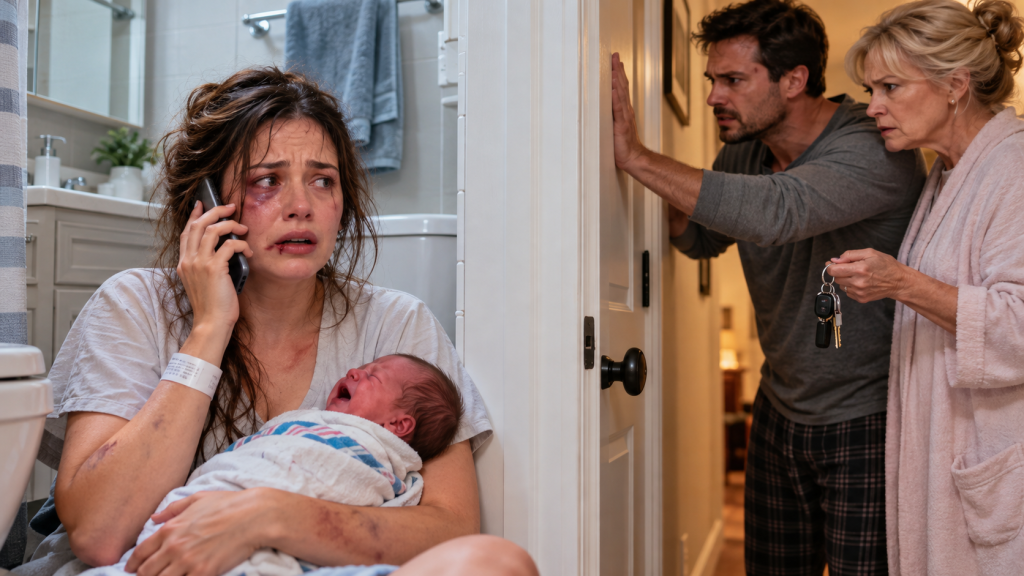
I was still on the toilet when my husband grabbed my hair, dragged me into the hallway with my clothes half down, and slammed my shoulder into the doorframe because our newborn had kept him awake again. By the time I hit the floor,

I barely looked like the woman who’d come home from the hospital three days earlier—my hair was stuck to my sweaty face, one cheek was swelling, my lip had split, and dark bruises covered my arms above the hospital wristband. His mother threw my crying baby onto a pile of blankets. I crawled to my son first, smashed the bathroom stool into my husband’s shin, shoved her away, and locked us inside. Then he screamed that life had been better before I gave birth.
The bathroom fan rattled above us while the tile burned cold against my knees. My son was screaming so hard his tiny face had gone red, and every movement sent a hot pulse through the shoulder that had hit the doorframe.
I checked his face. I checked his chest. I checked his tiny fists. He was terrified, but he was breathing, moving, crying.
That was enough.
My husband hit the bathroom door with his palm.
“Open it.”
I pulled my son against my hospital T-shirt and backed into the tub. My phone was still on the sink where I’d brought it in while timing his feeding, less than three feet away.
He knocked again. He called my name softly. He told me I was upsetting the baby.
The change in his voice scared me almost more than the yelling had.
His mother joined him outside the door. “You attacked him with that stool,” she said.
“After he dragged me down the hall.”
“You need to calm down.”
“No.”
My hospital wristband scraped the edge of the sink as I reached for my phone. Three days earlier, that band had meant nurses checking our names before placing my son in my arms. Now it was still wrapped around bruised skin while two people stood outside telling me the problem was my reaction.
I unlocked the phone and called for help.
Quietly.
I gave the dispatcher the address first. Then I said I had a three-day-old baby with me, that I had just given birth, and that my husband had dragged me from the bathroom and slammed me into a doorframe.
Outside, he stopped talking.
Then his voice came through the door, low and controlled. “Tell them you hit me.”
His mother immediately added, “She did hit you. I saw it.”
I stared at the stool beside the toilet and understood what they were doing. They weren’t checking whether the baby was hurt. They weren’t asking whether my shoulder needed help. They were already building a version of the morning where everything started with the one thing I had done to get back to my son.
The dispatcher kept me talking.
Then I heard my husband ask, “Where are her keys?”
His mother answered without hesitation. “I took them when she went into the bathroom.”
My grip tightened around the phone.
That meant even before I locked this door, she had already made sure I couldn’t simply pick up my baby and drive away.
A second later, metal jingled in the hallway.
Then his mother slipped my car keys into his hand.
PART 2 — THE DOOR THEY COULDN’T TALK THEIR WAY THROUGH
The keys jingled once outside the bathroom door.
Then everything went quiet.
That sound frightened me more than his fist against the wood.
My husband, Evan, had my car keys.
His mother, Lorraine, had taken them before I even understood I needed to escape.
And suddenly the morning looked different.
Not spontaneous.
Not one exhausted new father losing his temper.
Prepared.
The dispatcher’s voice remained steady in my ear.
“Are you still locked in the bathroom?”
“Yes.”
“Is the baby with you?”
“Yes.”
“Is he breathing normally?”
I looked down at Theo.
My three-day-old son was pressed against my chest, wrapped badly inside the first towel I had been able to reach.
His crying had softened into small, broken sounds.
His entire body seemed impossibly tiny.
“Yes.”
I swallowed.
“I think so.”
“Stay where you are.”
Outside the door, Evan finally spoke.
“Mara.”
I shut my eyes.
There it was again.
The calm voice.
The reasonable husband.
The voice he used in front of other people.
“Open the door so we can talk.”
I said nothing.
“Mara.”
The doorknob moved gently.
“You’re scaring Theo.”
I looked at my son.
Three days earlier, Evan had stood beside my hospital bed and cried when the nurse placed Theo in his arms.
He had kissed the top of our baby’s head.
He had taken pictures.
He had texted everyone:
Mom and baby are perfect.
Perfect.
I almost laughed.
My lip hurt too much.
Lorraine spoke from the hallway.
“She’s always been dramatic.”
The dispatcher heard that.
“Who is that?”
“His mother.”
“Does she live there?”
“No.”
“She’s staying to help with the baby.”
That sentence tasted strange now.
Help.
Lorraine had arrived the morning after we came home from the hospital carrying casseroles, clean towels, and opinions.
Theo was feeding too often.
I was holding him too much.
I needed to stop “using childbirth as an excuse” to stay in pajamas.
Her son needed sleep because he had work.
I needed to be grateful Evan had not complained more.
Every criticism had arrived disguised as advice.
Every cruelty wrapped in the language of family.
The dispatcher asked, “Has either of them hurt the baby?”
My throat tightened.
“His mother threw him.”
Outside, Lorraine shouted immediately.
“I did not throw that baby!”
The dispatcher heard that too.
I stared at the door.
“You threw him onto blankets.”
“I put him down!”
“You let go of him.”
“He landed on something soft.”
I felt something violent rise through my chest.
“You threw my newborn.”
Evan struck the door.
“Stop lying!”
Theo startled.
His tiny arms jerked outward.
I rocked him immediately.
“I’m sorry.”
I whispered it to him.
Not because I had done anything wrong.
Because mothers apologize to babies for storms they did not create.
The dispatcher said, “Mara, listen to me. Officers are almost there.”
“How long?”
“Very soon.”
Evan must have heard.
His voice changed.
“Mom.”
One word.
Then footsteps.
Fast.
Moving away from the bathroom.
The dispatcher asked, “What is happening?”
“I don’t know.”
I pressed my ear toward the door.
A drawer opened somewhere.
Then another.
Lorraine whispered something.
I could not make out the words.
Then Evan said clearly:
“Put that away.”
My stomach dropped.
“What?”
the dispatcher asked.
“He’s hiding something.”
“What do you think it is?”
“I don’t know.”
I heard footsteps again.
Then the sound of our kitchen trash can opening.
I thought of the morning.
What had been in the kitchen?
Bottles.
Formula samples.
My discharge papers.
Pain medication.
Evan’s beer from the night before.
My heart began pounding.
Lorraine hissed:
“Clean your leg.”
I stared at the stool.
Evan’s shin.
The place where I had hit him to reach Theo.
They were not simply hiding something.
They were preparing.
The dispatcher told me not to unlock the door under any circumstances unless police identified themselves.
I held Theo tighter.
Then I heard Evan say:
“She needs to be evaluated.”
Lorraine answered, “Exactly.”
My entire body went cold.
Evaluated.
For what?
I leaned closer to the door.
Evan continued.
“She hasn’t slept.”
“No new mother sleeps,” Lorraine said.
“She’s emotional.”
“She attacked you.”
“With a stool.”
“She could have hit the baby next.”
My blood ran cold.
That was what they were building.
Not simply self-defense.
Dangerous mother.
Unstable postpartum woman.
The narrative assembled itself in real time outside the door.
Exhausted.
Emotional.
Violent.
Holding a newborn behind a locked bathroom door.
I looked at the phone.
“The dispatcher?”
“I’m here.”
“They’re going to say I’m mentally unstable.”
There was a pause.
Then her voice became firmer.
“You stay focused on the facts.”
Facts.
My shoulder hurt.
My lip was bleeding.
My keys were in Evan’s possession.
Theo had been thrown onto blankets.
I had called for help.
Facts.
“They’re saying I attacked him.”
“You’ve already told me what happened.”
“I hit his shin.”
“After what?”
“After he dragged me out of the bathroom and his mother had my baby.”
“Good. Keep answering exactly like that.”
Good.
The word almost made me cry.
Not because she approved of hitting him.
Because for the first time that morning, someone was keeping the order of events intact.
Abuse often depends on rearranging time.
Remove the first ten minutes, and survival starts to look like aggression.
Then came the sound I had been waiting for.
Sirens.
Faint.
Then closer.
Evan stopped speaking.
Lorraine whispered, “Let me handle this.”
Of course she would.
Lorraine could make a funeral sound like a misunderstanding.
The doorbell rang.
Then pounding.
“Police!”
My whole body shook.
Evan answered almost immediately.
“Thank God.”
His performance had begun.
I could hear him from the bathroom.
“My wife just had a baby three days ago. She’s having some kind of breakdown.”
I closed my eyes.
Not:
My wife is hurt.
Not:
Please check the baby.
A breakdown.
One of the officers said something I couldn’t hear.
Lorraine began talking over Evan.
“She hasn’t been herself since the delivery.”
My hand tightened around the phone.
The dispatcher said, “Do not respond to them through the door yet.”
Then I heard the officer.
“Where is she?”
Evan answered.
“Locked in the bathroom with our newborn.”
“Does she have a weapon?”
A pause.
My heart stopped.
Then Evan said:
“She hit me with a stool.”
Not technically false.
That was the brilliance of it.
The most dangerous lies often contain one perfectly accurate sentence surrounded by missing truth.
The officer asked again.
“Does she have a weapon now?”
“I don’t know.”
I looked at the stool.
I pushed it farther away with my foot.
The officer’s voice came louder.
“Ma’am?”
I froze.
“Mara?”
“Yes?”
“This is Officer Daniels with the police department.”
The dispatcher confirmed they were at the house.
“You can answer him.”
I swallowed.
“Yes.”
“Are you inside the bathroom?”
“Yes.”
“Is the baby with you?”
“Yes.”
“Is anyone else inside?”
“No.”
“Are you holding anything that could hurt someone?”
“No.”
“Can you place your phone on speaker and move away from the door?”
I did.
My knees almost failed when I stood.
Pain shot through my shoulder.
I leaned against the tub.
Theo began crying again.
Officer Daniels continued.
“We’re going to open the door once we know the hallway is clear.”
“Is Evan there?”
“He’s been moved into another room.”
“His mother?”
“Separated.”
Separated.
The word felt beautiful.
I heard another officer instruct Evan to remain in the living room.
He protested.
“That’s my son in there.”
Then Lorraine:
“She should not be alone with that child.”
I looked down at Theo.
My son had one fist curled against my collarbone.
His face was damp.
I whispered:
“You’re okay.”
Maybe I was speaking to both of us.
A minute later, Officer Daniels said:
“Mara, unlock the door.”
My hand hovered over the latch.
For three days, I had been home from the hospital.
For three days, my world had become smaller and smaller.
Bedroom.
Nursery.
Kitchen.
Bathroom.
Evan.
Lorraine.
A crying baby.
Pain.
Fatigue.
Orders.
The latch suddenly felt like the heaviest thing I had ever touched.
I turned it.
The door opened slowly.
Officer Daniels stood on the other side.
He was perhaps forty.
Gray beginning at his temples.
Behind him stood a female officer and a paramedic.
Nobody rushed toward me.
Nobody grabbed Theo.
Officer Daniels simply looked.
First at my face.
Then my shoulder.
Then the bruises around my arms.
Then the hospital wristband.
His expression changed.
The female officer’s did too.
“My name is Officer Reyes.”
Her voice was quiet.
“Can I come closer?”
That question nearly broke me.
Permission.
“Yes.”
She approached slowly.
“What’s the baby’s name?”
“Theo.”
“How old?”
“Three days.”
Her eyes moved to the towel.
Then to his face.
“We’re going to have the paramedic look at both of you.”
I looked toward the hall.
“Where is my husband?”
“Separated.”
“Can he come in here?”
“No.”
“His mother?”
“No.”
I started crying.
Officer Reyes must have misunderstood.
“You’re safe in here.”
“I know.”
That was why I was crying.
Relief can hurt almost as much as fear when your body has forgotten what it feels like.
The paramedic checked Theo first.
His pupils.
Breathing.
Heart rate.
Arms.
Legs.
Every small movement made me hold my breath.
Finally he said:
“He looks responsive. That’s good.”
“Is he hurt?”
“We need a pediatric exam to be certain.”
“I want him checked.”
“We’re going to.”
Then he looked at me.
“Now you.”
“I’m fine.”
The phrase came automatically.
Officer Reyes looked at my face.
“No.”
She did not say it cruelly.
Just factually.
“No, you’re not.”
I lowered my eyes.
The paramedic touched my shoulder gently.
Pain exploded.
I gasped.
“We need imaging.”
“I just had a baby.”
“I know.”
“I don’t want to leave Theo.”
“He goes with you.”
That settled it.
Outside the bathroom, Evan raised his voice.
“You’re taking my son?”
Officer Daniels answered.
“The baby is being medically evaluated.”
“I’m his father.”
“You’ll stay here until we finish speaking with you.”
“I want to go to the hospital.”
“No.”
“This is unbelievable.”
Lorraine joined in.
“She is manipulating all of you.”
Officer Reyes looked at me.
“Did they take your keys?”
“Yes.”
“Who?”
“Lorraine.”
“Before or after the argument?”
“I don’t know exactly.”
I thought.
“She took them when I went into the bathroom before Evan dragged me out.”
Officer Reyes’s eyes sharpened.
“Before he put his hands on you?”
“Yes.”
“Why?”
“I don’t know.”
“Where are the keys now?”
“Evan has them.”
She wrote something.
“Did you try to leave earlier?”
“No.”
“Did you tell anyone you planned to?”
“No.”
That seemed to matter.
She stepped into the hallway.
Seconds later I heard:
“Mr. Hale, do you have your wife’s car keys?”
Evan hesitated.
“No.”
My heart stopped.
Then Lorraine said:
“I have them.”
A second lie.
Officer Reyes looked back at me.
I whispered:
“She gave them to him.”
The dispatcher had heard.
Thank God.
The 911 call.
The entire conversation.
The metal jingling.
Their voices.
Evidence already existed before they knew police were listening.
I had never understood how precious chronology could be.
The officers searched.
The keys were found in Evan’s sweatshirt pocket.
His story changed.
Lorraine had handed them to him because she was afraid I might “drive irrationally with a newborn.”
Officer Reyes wrote that down too.
The more they explained, the quieter the officers became.
That scared Evan.
He grew louder.
“She hit me.”
Officer Daniels said, “We see your leg.”
“She could’ve broken it.”
“Did you drag her from the bathroom?”
“No.”
I looked toward Reyes.
She heard the answer.
Lorraine jumped in.
“He was trying to help her stand.”
I almost laughed.
Help me stand.
My clothes had been half down.
My hair in his fist.
My shoulder against the doorframe.
Help.
Officer Daniels asked:
“Why was she on the floor?”
“She was hysterical.”
“Before or after you touched her?”
“I didn’t touch her like that.”
“What does that mean?”
Silence.
I could almost see Evan realizing every attempt to qualify the truth created another question.
Then Officer Daniels asked Lorraine:
“Did you pick up the infant?”
“Yes.”
“Did you place the baby onto blankets?”
“Yes.”
“Did you throw him?”
“Absolutely not.”
I held Theo tighter.
“She let go of him.”
Officer Reyes said quietly, “We’ll document everyone’s statements.”
Not:
We believe you.
Not yet.
But nobody was ordering me to reconcile the stories.
Nobody was asking me to be reasonable for Evan’s sake.
That was enough.
They placed me onto a stretcher.
I hated it.
Not because of pain.
Because the last time I had been wheeled through that front door, Evan had been beside me carrying Theo’s empty car seat.
We had been coming home.
Neighbors had waved.
Lorraine had taken pictures.
Three days later, I left the same house with bruises under my hospital bracelet while police stood in my living room.
Across the room, Evan stared at me.
His face looked furious.
Then he noticed Officer Daniels watching.
Instantly, the anger softened into concern.
“Mara.”
I turned my head away.
“Please.”
His voice cracked perfectly.
“You know I love you.”
I looked back.
For years, that sentence had solved things.
Arguments.
Disappointments.
Broken promises.
Love used like a receipt proving nothing else counted.
That morning, it sounded empty.
Maybe love existed somewhere inside him.
But whatever he called love had dragged me half-dressed down a hallway because his newborn interrupted his sleep.
“I want my keys.”
He blinked.
“What?”
Officer Reyes took them from an evidence bag.
“We’ll return them when appropriate.”
Evan’s face hardened again.
Only for half a second.
Then the front door closed between us.
The emergency department looked different when I returned as a patient who had already been discharged with a baby.
Three days earlier, the nurses had clapped softly when we left maternity.
Now one of those same nurses saw me coming through the hall.
Her smile disappeared.
“Mara?”
I had forgotten her name.
Then she moved closer.
“Rachel.”
I remembered.
She had helped me latch Theo at two in the morning.
She had taught Evan how to swaddle him.
She had hugged me before discharge.
“What happened?”
I could not answer.
Officer Reyes did.
“We need separate medical evaluations for mother and infant.”
Rachel looked at my bruises.
Her eyes filled with anger so quickly she had to blink.
“Of course.”
Theo was taken for a pediatric exam.
I went with him.
Nobody separated us unnecessarily.
Every time someone needed to hold him, they asked.
Every time they touched me, they explained first.
After what had happened at home, those small courtesies felt almost unbearably tender.
Theo was examined carefully.
No fractures.
No obvious head injury.
No immediate signs of serious trauma.
The doctor still wanted observation because he was three days old and had been dropped or thrown from someone’s arms.
I cried when she said the word observation.
“Is he going to be okay?”
“He looks good right now.”
Right now.
I learned to live inside those words.
My own shoulder was badly bruised but not broken.
My lip needed no stitches.
The swelling in my cheek looked worse than it was.
But my blood pressure concerned them.
So did my bleeding.
Giving birth had already left my body depleted.
Fear had done the rest.
The obstetrician examined me.
Then said something I had not known I needed to hear.
“You should have been resting.”
I laughed bitterly.
“Tell my husband.”
She looked at me.
“No.”
I stopped.
“I’m telling you.”
Her voice softened.
“You just gave birth. You are healing from a major physical event.”
I started crying.
Three days at home with Evan and Lorraine had somehow convinced me that recovery was laziness.
I had apologized for sleeping.
Apologized for needing pads changed frequently.
Apologized for feeding Theo at night.
Apologized for bleeding on a towel.
Apologized when crying hurt my stitches.
No one at the hospital had asked me to apologize for any of it.
A social worker arrived around noon.
Her name was Celeste Martin.
She sat beside the bed.
Officer Reyes remained nearby but gave us space.
Celeste asked:
“Do you want your husband here?”
“No.”
“His mother?”
“No.”
“Do you want either of them to receive information about your room or the baby?”
“No.”
She nodded.
No judgment.
No demand for explanation.
“Do you have somewhere safe to go after discharge?”
I opened my mouth.
Then stopped.
My mother lived four hours away.
We had not been close since I married Evan.
My closest friend, Jenna, had a one-bedroom apartment and two cats.
My sister lived across the country.
I looked down at Theo.
“I don’t know.”
Celeste wrote nothing for several seconds.
Then said:
“That’s okay.”
It did not feel okay.
“I have nowhere.”
“You have options.”
The sentence sounded almost foreign.
Options.
She explained emergency housing.
Protection orders.
Advocacy services.
Safe transportation.
Assistance retrieving belongings.
The police report.
None of it sounded like my life.
Domestic violence advocate.
Protective order.
Safety plan.
Those terms belonged to other women in pamphlets.
Not me.
I was a thirty-two-year-old graphic designer with framed wedding photographs and matching Christmas pajamas.
Evan brought me coffee in bed on Sundays.
He cried at our wedding.
He kissed my belly when Theo kicked.
He had also dragged me by my hair while I was using the toilet.
Both things were true.
That was the part nobody prepares you for.
People imagine abusive relationships as one long stretch of darkness.
Often there are lights.
That is why you stay long enough to become confused.
Celeste asked:
“Was this the first time he hurt you?”
“Yes.”
I answered too quickly.
She waited.
I stared at the blanket.
“Physically.”
There.
The missing word.
She nodded.
“What happened before?”
I told her about doors slammed beside my head.
A drinking glass thrown into the sink hard enough to shatter.
Evan punching a wall when I said I wanted my mother to visit after the baby came.
Him taking my phone during arguments.
Calling me lazy when pregnancy made me sick.
Once driving away from a gas station and leaving me there for forty minutes because I “embarrassed” him by disagreeing in front of his friend.
Lorraine always had explanations.
He’s stressed.
He’s excited about the baby.
Men feel pushed aside during pregnancy.
You know Evan has a temper.
Don’t provoke him when he’s tired.
I looked at Celeste.
“I thought abuse meant…”
I stopped.
“What?”
“He had never hit me before.”
She nodded slowly.
“That line keeps a lot of people confused.”
I looked away.
Then she asked:
“Did his behavior change during pregnancy?”
“Yes.”
“How?”
“He got angry about the baby.”
“When?”
“Toward the end.”
“Specific examples?”
I remembered.
The nursery furniture.
He complained about the cost even though his parents had bought most of it.
The birthing classes.
He attended one, then stopped.
The night I asked him to install the car seat and he said:
“You’re the one who wanted this so badly.”
My heart stopped.
Celeste saw my face.
“What?”
“I forgot he said that.”
“What did you think he meant?”
“I thought he was tired.”
But now another memory arrived.
The positive pregnancy test.
Evan had smiled.
Hugged me.
Then later that night, while I was brushing my teeth, I heard him tell Lorraine on the phone:
“This wasn’t the timing we agreed on.”
I assumed he meant work.
Money.
Now I wondered.
“What did Lorraine think about the pregnancy?”
Celeste asked.
“She acted happy.”
“Acted?”
I noticed the word only after saying it.
“She threw a baby shower.”
“That doesn’t answer the question.”
No.
It didn’t.
“She kept saying Evan wasn’t ready.”
“Ready for what?”
“To be second place.”
My throat tightened.
Lorraine said that often.
A baby changes marriage.
Don’t become one of those women who forgets her husband exists.
A man will look elsewhere if home becomes nothing but diapers.
I thought she was old-fashioned.
Now it sounded like a warning.
Officer Reyes returned an hour later.
She looked serious.
“We arrested Evan.”
I stopped breathing.
“What?”
“Based on the totality of the evidence available at this point.”
My hands shook.
“For what?”
She named several alleged offenses related to the assault.
I barely heard them.
“His mother?”
“Not arrested at this time.”
Disappointment hit me.
Then shame for feeling disappointed.
Reyes continued.
“Her conduct involving the baby is still being investigated.”
I nodded.
“Did she leave?”
“She was told not to come here.”
“What if she does?”
“She will not have access to you.”
I looked at Theo.
Then asked the question that had been sitting inside me since the house.
“Do they believe I attacked him?”
Officer Reyes pulled out a chair.
“Mara, we document what everyone says.”
My heart sank.
Then she continued.
“But the 911 recording is important.”
I looked up.
“It captured him telling you to say you hit him.”
“Yes.”
“It also captured his mother acknowledging she took your keys.”
My eyes filled.
“And you reported the sequence before officers arrived.”
Sequence.
Again.
Chronology protecting me.
“There’s more.”
My stomach tightened.
“What?”
Officer Reyes held up her phone.
“Do you have a baby monitor?”
“Yes.”
“Camera?”
“Yes.”
My heart stopped.
The nursery.
A camera sat above Theo’s bassinet.
I had installed it during pregnancy.
Evan complained it was unnecessary.
“You’re going to be ten feet away.”
But I wanted one that stored motion events because I was terrified of sleeping through his crying.
“Does it record?”
“Cloud clips.”
“Do you know the password?”
“Yes.”
Officer Reyes looked at Celeste.
Then at me.
“We obtained your consent through the form you signed earlier to review digital evidence you voluntarily provide. We found recordings from this morning.”
My skin prickled.
“But we weren’t in the nursery.”
“No.”
She looked grim.
“Not during the main assault.”
“Then what?”
“The camera microphone reaches part of the hallway.”
I stopped breathing.
Audio.
I remembered.
The nursery door had been open.
The bathroom was down the hall.
“You can hear him?”
“Yes.”
“What does it capture?”
Reyes did not make me listen.
She summarized.
My baby crying.
Evan shouting.
My voice from the bathroom telling him to give me a minute.
Lorraine saying:
“Go make her get up.”
Then movement.
Me screaming.
A crash.
Theo crying louder.
Then my husband’s voice.
Life was easier before this baby.
I shut my eyes.
The sentence from the hallway.
Not screamed in a moment I had invented.
Recorded.
Then another line.
Officer Reyes hesitated.
“What?”
She looked at me carefully.
“He told his mother to take Theo.”
My stomach twisted.
“For what?”
Reyes glanced at her notes.
“The audio is partially unclear.”
“Tell me.”
She exhaled.
“He says something that sounds like, ‘Take him downstairs. I’ll deal with her.’”
My entire body went cold.
Deal with her.
I pulled Theo closer.
Officer Reyes continued.
“Then we hear your mother-in-law say something about your keys.”
“Before she took them?”
“It appears so.”
“What exactly?”
Reyes looked at me.
“She says, ‘I already have them.’”
I stared.
Already.
Not reaction.
Preparation.
“How long before he dragged me?”
“Approximately forty seconds.”
My hands began shaking.
Lorraine had taken my keys before Evan touched me.
Why?
Unless she expected something.
Unless they had already discussed keeping me from leaving.
“Why would she do that?”
Officer Reyes did not speculate.
That was what made me trust her.
“I don’t know.”
Then she added:
“But officers found something else in the house.”
Of course.
By then, I had learned that terrible mornings rarely contained only one terrible truth.
“What?”
“Documents.”
My stomach dropped.
“What kind?”
“Some legal paperwork.”
“About what?”
She paused.
“Your baby.”
I stopped breathing.
“Theo?”
“Yes.”
“What paperwork?”
“A draft petition.”
“For what?”
“Emergency temporary custody.”
I stared at her.
“That makes no sense.”
“The documents were not filed.”
“Who drafted them?”
“A family-law office.”
My chest tightened.
“Whose name is on them?”
“Your husband.”
The room blurred.
Theo moved against me.
I looked down.
His face was peaceful now.
Sleeping.
Three days old.
And his father already had custody papers.
“Why?”
Celeste moved closer.
“Mara, breathe.”
I did.
Barely.
“What do the papers say?”
Reyes hesitated.
Then answered carefully.
“They allege concern that you may become unable to care safely for Theo due to postpartum mental instability.”
I laughed.
A horrible sound.
Of course.
The narrative outside the bathroom had not been invented that morning.
It had been rehearsed on paper.
“How old are the documents?”
“Draft date was yesterday.”
Yesterday.
The second day we had been home.
Yesterday, Lorraine washed dishes while I fed Theo.
Evan complained because I asked him to hold the baby while I showered.
Yesterday, apparently, he also contacted a lawyer.
“Did the attorney know he was hurting me?”
“We don’t know.”
“What did he tell them?”
“We’re investigating.”
I felt sick.
Then something occurred to me.
“My keys.”
Reyes nodded slightly.
“Yes.”
“He wanted me unable to leave.”
“That is one possibility investigators will examine.”
“And if I reacted…”
I could barely say it.
“He could say I was unstable.”
Nobody answered.
Because now the idea no longer sounded paranoid.
It sounded documented.
I started crying.
Not from fear.
From recognition.
For months I had thought Evan’s anger was about stress.
About work.
About sex during pregnancy.
About money.
But perhaps my son’s birth had created something else.
A conflict over control.
The second Theo existed outside my body, Evan had started talking about what I did wrong.
How I held him.
When I fed him.
Whether I slept.
Whether I showered too long.
Whether I let Lorraine soothe him.
Who knew better.
Who decided.
Maybe the baby had not simply kept him awake.
Maybe the baby had made it impossible for me to keep centering Evan.
And that was what he could not tolerate.
Officer Reyes said:
“There’s another document you need to know about.”
I almost told her I couldn’t.
Then I remembered the bathroom.
The door.
The stool.
Theo’s red face.
I could.
“What?”
“An email printout.”
“From who?”
“Your mother-in-law.”
“To the lawyer?”
“Yes.”
My heart stopped.
“What did she say?”
Reyes looked down.
Then back at me.
“She describes herself as the person who would provide primary daytime care if your husband were granted temporary custody.”
I stared.
Lorraine.
Primary caregiver.
Not Evan.
Lorraine.
Suddenly the last three days rearranged themselves.
Her insisting on taking Theo from me.
Her criticizing breastfeeding.
Her saying formula would let “other people bond properly.”
Her telling Evan I was making the baby too dependent.
Her entering our bedroom without knocking and lifting Theo from the bassinet.
Her saying:
“He settles better for me.”
I had laughed.
Uncomfortably.
Maybe she had not been trying to help me mother.
Maybe she had been auditioning to replace me.
“She wanted my baby.”
Celeste said softly:
“We don’t know exactly what she wanted.”
“I do.”
My voice sounded strange.
I looked at Theo.
“She wanted control.”
That part I understood.
The same thing Evan wanted.
Maybe that was what Lorraine had taught him.
Love meant access.
Care meant authority.
If someone resisted your version of care, they were ungrateful.
Difficult.
Unstable.
Officer Reyes said:
“The attorney may have simply been preparing documents based on what they were told. A draft is not proof of a complete plan.”
I nodded.
Facts.
Stay with facts.
“But it proves he was thinking about custody before today.”
“Yes.”
“And the keys?”
“Are evidence.”
“The 911 call?”
“Evidence.”
“The camera?”
“Evidence.”
I closed my eyes.
For the first time, the word did not frighten me.
Evidence meant I did not have to be eloquent.
I did not have to persuade.
I only had to tell the truth and let facts remain where they belonged.
I stayed in the hospital overnight.
Theo too.
My mother arrived at seven that evening.
I had not called her.
Celeste had.
Apparently somewhere on one of my intake forms, my mother was still listed as emergency contact after Evan.
Her name was Evelyn.
When she walked into the room, I almost did not recognize her.
Not because she looked different.
Because I had spent the previous year convincing myself I did not need her.
Evan hated the way she questioned him.
Lorraine said my mother “interfered.”
Eventually I stopped inviting her.
Phone calls became shorter.
Visits rarer.
Mom kept trying.
Then stopped pushing.
Now she stood at the door and looked at my face.
Her hand flew to her mouth.
“Oh, Mara.”
I started crying.
Not graceful tears.
Child tears.
“Mom.”
She crossed the room.
Then stopped before touching me.
“Can I hug you?”
Permission again.
“Yes.”
She wrapped both arms around me.
Careful of my shoulder.
Careful of Theo.
Careful of everything.
“I’m sorry.”
I buried my face against her.
“I should’ve listened.”
“No.”
“I pushed you away.”
“We’ll talk about that later.”
“I defended him.”
“Later.”
“I thought you hated him.”
“I did.”
I pulled back.
That surprised me.
Mom wiped her face.
“Not at first.”
“What changed?”
She sat down.
“When you got pregnant.”
My stomach tightened.
“What happened?”
“You changed.”
“I was pregnant.”
“No.”
She shook her head.
“You became afraid of disappointing him.”
I looked down.
“He started answering your phone.”
I remembered.
“He started canceling plans for you.”
I remembered.
“You stopped making jokes about him.”
That one hurt.
Mom continued.
“Then Lorraine started telling me you needed less stress and that my visits upset the household.”
“She said that?”
“Yes.”
My hands tightened.
“Why didn’t you tell me?”
“I tried.”
“When?”
“Christmas.”
I remembered the fight.
Mom told me Evan was controlling.
I accused her of never liking him.
I hung up.
“I wasn’t ready to hear it.”
She touched my hand.
“I know.”
Then she looked at Theo.
“Can I hold him?”
I almost answered immediately.
Then my body resisted.
Not because I distrusted her.
Because Lorraine had made every request to hold my baby feel like an attempted theft.
Mom saw it.
Her face softened.
“You don’t have to.”
I looked at her.
And that was why I handed Theo over.
She did not believe loving him entitled her to take him.
She simply held him because I chose yes.
Watching my mother cradle my son, I understood something painful.
I had spent years confusing people who respected boundaries with people who loved me less.
Evan always pushed.
Lorraine always insisted.
Mom stepped back.
Somehow I had interpreted insistence as devotion.
I would never make that mistake again.
The protection order hearing happened quickly.
Temporary first.
Longer-term decisions later.
I barely spoke.
My attorney did most of it.
The 911 recording mattered.
The photos mattered.
The hospital records mattered.
The baby monitor clips mattered.
The keys mattered.
The draft custody petition mattered.
Chronology mattered.
Evan’s attorney argued that the stool strike showed mutual violence.
My attorney answered with the sequence.
Dragged.
Baby taken.
Mother attempting to reach child.
Single defensive strike.
Retreat.
Locked door.
No pursuit.
No continuing assault.
Order restored.
That was the pattern.
Evan tried to turn one moment of resistance into proof we were equal participants.
The facts refused.
Lorraine attempted to contact me through relatives.
I blocked them.
Then she sent an email.
I did not read it.
My attorney did.
Apparently it said:
I hope when your hormones stabilize, you understand how badly you have hurt this family.
Hormones.
Three days postpartum.
Bruised.
Dragged.
Baby thrown onto blankets.
And somehow the injury to the family was mine.
I asked my attorney to save the email.
Evidence.
I was learning.
A week after the assault, police returned with me to the house so I could collect necessities.
I did not go alone.
My mother came.
An advocate came.
An officer stood nearby.
The house smelled the same.
Laundry detergent.
Coffee.
The lavender candle Lorraine had lit constantly because she said newborn homes smelled sour.
I stood in the hallway.
The doorframe still had a faint mark where my shoulder struck.
I touched it.
Then pulled my hand away.
My mother whispered:
“You don’t have to stay.”
“I know.”
That was precisely why I could.
I went into the nursery.
Theo’s bassinet waited beside the chair.
Tiny socks inside a basket.
A half-used package of diapers.
The blanket I had folded before labor.
Objects from a life that existed only one week earlier.
A lifetime ago.
I packed his clothes.
Medical papers.
My laptop.
A hard drive.
Then I entered our bedroom.
My wedding photograph sat on the dresser.
Evan smiling.
Me leaning against him.
I picked it up.
Mom watched.
“You want it?”
I thought about smashing it.
Instead, I set it facedown.
“No.”
The photograph was not dangerous.
The version of him I had believed in could no longer harm me.
Before leaving, the officer asked whether I wanted anything from the bathroom.
I almost said no.
Then I remembered my hospital wristband.
I had removed it at the hospital after the second admission.
It sat inside my purse.
I carried it back into that bathroom.
The stool was gone.
Probably evidence.
I stood beside the sink.
The fan rattled overhead.
For one second, my body remembered everything.
Cold tile.
Theo screaming.
The door shaking.
Metal keys.
I put one hand on the sink.
Breathed.
Then I looked at myself in the mirror.
Bruises turning yellow.
Lip healing.
Hair brushed.
Still tired.
Still frightened.
But standing.
Three days after giving birth, I had believed locking that door meant I had nowhere left to go.
Now I understood.
It was the first boundary Evan could not talk me into opening.
I walked out.
The investigation into Lorraine took longer.
Eventually, authorities determined that she had participated in taking my keys and had made false or misleading statements surrounding the incident.
The exact legal consequences were less dramatic than I once imagined they should be.
Real life is like that.
Not everyone who does harm receives a sentence proportional to the wound.
But the custody documents ended any possibility of her quietly stepping into Theo’s life as though nothing had happened.
She did not become his caretaker.
She did not receive unsupervised access.
She did not get to transform “grandmother” into ownership.
That mattered more to me.
Evan’s criminal case moved slowly.
I hated that.
Then eventually, I understood slow did not mean nothing was happening.
Statements.
Hearings.
Evidence.
Negotiations.
Evaluations.
Consequences arrived in paperwork before they arrived in courtrooms.
By then, my life had already started changing without waiting for a verdict.
I moved in with Mom temporarily.
Then rented a small apartment near her.
Two bedrooms.
Nothing fancy.
The kitchen had terrible cabinets.
The neighbor upstairs vacuumed at midnight.
The heating made a clicking noise.
I loved it.
Because the keys were mine.
Only mine.
At night, I slept with Theo beside me in his bassinet.
At first, every sound woke me.
Then silence woke me.
I expected footsteps.
A door opening.
Evan complaining.
Lorraine taking the baby because I was “spoiling him.”
Instead, there was only Theo breathing.
Sometimes crying.
Sometimes making tiny squeaking noises that sounded like a toy.
One night at three in the morning, he would not settle.
I had fed him.
Changed him.
Rocked him.
Nothing worked.
Exhaustion pressed behind my eyes.
For a terrifying second, Evan’s voice returned to me.
Life was easier before this baby.
I looked down at Theo.
Then something broke inside me.
I started crying.
Not because I resented my son.
Because I finally understood how enormous the difference was.
I was exhausted too.
I had stitches.
Bruises.
Court dates.
Fear.
Yet Theo’s crying did not make me want to punish him.
It made me want to understand him.
Exhaustion can explain irritability.
It does not explain cruelty.
Sleep deprivation does not create the pleasure of control.
That belonged to Evan.
Not the baby.
Not me.
I kissed Theo’s forehead.
“Cry if you need to.”
His face scrunched.
I almost laughed.
“I’m serious.”
“You don’t have to make yourself smaller because somebody else is tired.”
I hope he learns that earlier than I did.
Months later, Evan asked through attorneys for supervised contact with Theo.
My first instinct was no.
Never.
Then I struggled with something more complicated.
Evan was my son’s father.
Biology did not erase danger.
Danger did not erase biology.
The court made decisions based on evaluations I could not control completely.
So I focused on the part I could.
Safety.
Supervision.
Documentation.
No Lorraine.
No unsupervised exchanges.
No direct contact with me outside approved channels.
No using Theo to carry messages.
Boundaries so clear they sounded almost cold.
They were not cold.
They were love with structure.
Evan attended required programs.
Whether he changed, I did not know.
I stopped measuring my safety by his character.
That was another freedom.
I did not need him to become good before I could build a good life.
I did not need him to understand me.
I did not need Lorraine to admit what she had done.
I did not need every relative to pick my side.
I needed a locked door that belonged to me.
My own keys.
A phone nobody took.
Doctors who knew the history.
People I could call.
A son growing up without believing love and fear were synonyms.
That was enough.
Theo turned one on a cold March morning.
Mom made a cake he could barely eat.
My best friend Jenna brought balloons.
I invited three people.
Not thirty.
Not everyone who claimed family.
Only safe people.
Theo smashed frosting into his hair.
Everyone laughed.
I took pictures.
Then Mom handed me a small box.
“What’s this?”
“Open it later if you want.”
Of course I opened it immediately.
Inside was my old hospital wristband.
I stared.
“I thought I had it.”
“You left it at my house after moving.”
She had mounted it inside a small frame.
Beneath it was a sentence.
THE DAY YOU CAME HOME WAS NOT THE DAY YOU BECAME SAFE. THE DAY YOU CHOSE YOURSELF WAS.
I began crying.
Mom immediately looked worried.
“Too much?”
“No.”
I laughed through tears.
“It’s awful.”
“I can return it.”
“I love it.”
She hugged me.
Across the room, Theo squealed because Jenna had put a party hat on herself.
I looked at him.
One year old.
Alive.
Loved.
Safe.
The bruises from that morning were long gone.
The shoulder healed.
My lip healed.
But some injuries do not disappear in the order people expect.
I still checked bathroom locks.
Still flinched when someone raised a voice behind a closed door.
Still hated hearing keys jingle unexpectedly.
Healing was not forgetting.
It was noticing the memory without obeying it.
Years later, when Theo was old enough to ask why his father and I did not live together, I did not tell him everything.
Children deserve truth in portions they can carry.
I said:
“Your father hurt me, and it wasn’t safe for us to live together.”
Theo looked sad.
“Did he hurt me?”
I thought about blankets on the floor.
Lorraine’s hands.
The baby monitor recording.
“You were very little.”
“That’s not an answer.”
He was seven.
Already too clever.
So I told him carefully:
“Some adults made unsafe choices around you.”
“Did you save me?”
The question stopped me.
I thought of crawling.
My shoulder burning.
The bathroom stool.
The door.
My phone.
Then I shook my head.
“We saved each other.”
He frowned.
“I was a baby.”
“I know.”
“Babies can’t save people.”
I smiled.
“Maybe not in the way you mean.”
I touched his chest.
“But loving you reminded me I had to move.”
That was the truth.
Before Theo, I had tolerated things from Evan I should not have.
Not because I was weak.
Because I kept hoping the kind version of my husband was the real one and the frightening version was temporary.
But when Lorraine dropped my newborn and Evan stood between me and my child, something became simple.
I would still betray myself for love.
I would not betray Theo.
So I crawled.
Sometimes motherhood does not make women softer.
Sometimes it introduces them to the boundary they should have had all along.
I used to replay Evan’s sentence obsessively.
Life was better before you gave birth.
For years, I heard it as rejection.
Of Theo.
Of me.
Of our new life.
Now I hear something else inside it.
Confession.
Life had been better for Evan before Theo because before Theo, control was easier.
I still slept when Evan wanted.
Went where he wanted.
Explained his moods.
Adjusted myself around them.
Motherhood rearranged my priorities.
Suddenly someone else needed me more than Evan needed obedience.
He felt the center moving.
And rather than becoming a partner, he tried to force it back.
That was what he could never forgive.
Not the crying.
Not the sleeplessness.
My attention no longer belonged to him first.
Theo did not destroy our marriage.
He revealed it.
That distinction changed everything.
The bathroom did not become the place my life ended.
It became the place the truth finally became too loud to explain away.
I remember the cold tile.
My bruised knees.
My son’s red face.
Evan’s voice through the door.
Lorraine telling me to calm down.
The stolen keys moving from one hand to another.
For a long time, that was the image that haunted me most.
The keys.
Because they symbolized everything.
Someone else deciding whether I could leave.
Now I keep my keys in a blue ceramic bowl beside my front door.
Nothing special.
Apartment key.
Car key.
Mailbox.
A ridiculous little keychain Theo made at school.
Every morning, I pick them up.
Every evening, I put them down.
Such an ordinary ritual.
But sometimes ordinary things become sacred after someone tried to take the choice they represented.
Theo once asked why I always smile when I grab my keys.
I told him:
“Because I know exactly where they are.”
He laughed.
He thought I was joking.
Maybe someday I will explain.
Or maybe he will never need to understand.
That would be even better.
Because the greatest ending I can imagine is not my son growing up knowing exactly how I escaped.
It is my son growing up unable to understand why any person would ever take someone’s keys just to make sure they could not leave.
That is the kind of man I want to raise.
Not a man terrified of becoming his father.
A man who simply learns that love never requires captivity.
A man who knows tiredness does not excuse cruelty.
A man who hears a baby cry and understands the crying is not disrespect.
A man who knows a woman’s body belongs to her even when she is married, recovering, exhausted, bleeding, frightened, or angry.
A man who knows that when somebody says no, the conversation changes.
Not the punishment.
Not the volume.
The conversation.
For years, I believed leaving Evan was the bravest thing I ever did.
I was wrong.
The bravest thing happened earlier.
On a bathroom floor.
Before police.
Before lawyers.
Before doctors.
Before I knew anyone would believe me.
I crawled toward my baby.
That was all.
One movement.
Then another.
I reached him.
I fought for enough space to close a door.
I called for help.
People like Evan depend on the belief that freedom must arrive dramatically.
A grand rescue.
A perfect plan.
Money.
A hidden suitcase.
A person waiting outside.
Mine began with none of those things.
It began with a cheap bathroom stool.
A phone beside the sink.
A lock.
And one exhausted woman deciding that the story outside the door would no longer be the only version anyone heard.
Lorraine said I attacked him.
Evan said I was unstable.
They had paperwork.
Excuses.
A plan.
I had bruises.
A crying newborn.
A 911 recording.
And the truth in the correct order.
In the end, that was enough to open the first door.
I opened all the others myself.
PART 3 — THE LIFE BEYOND THE LOCKED DOOR
For a long time, I believed the story ended with the bathroom door.
The lock.
The phone call.
The police.
The hospital.
The keys returned to my hand.
It would have been a neat ending.
A woman in danger calls for help.
People arrive.
The dangerous man is removed.
The baby is safe.
The woman begins again.
But real endings are rarely that clean.
A locked door can stop someone from reaching you for one morning.
It cannot answer every question waiting on the other side.
And there was one question I could not silence.
Why had Evan contacted a custody attorney the day before he dragged me through the hallway?
At first, everyone told me not to obsess over it.
My mother said I had enough to survive without trying to understand every ugly thought inside my husband’s head.
Celeste, the hospital social worker, put it differently.
“Understanding can help,” she told me.
“But be careful not to turn understanding into a requirement for moving forward.”
I knew what she meant.
Some people wait years for an explanation that never arrives.
Why did you hurt me?
Why did you lie?
Why wasn’t I enough?
Why did you think you were allowed?
Questions can become another room you trap yourself inside.
Still, the custody papers mattered.
Not only emotionally.
Legally.
So my attorney kept digging.
And three weeks after Theo and I left the hospital, she called me.
Her voice was careful.
“Mara, we received the family-law firm’s intake records.”
I was standing in my mother’s kitchen with Theo asleep against my chest.
My body still hurt sometimes when I moved too fast.
The bruises were fading.
The fear wasn’t.
“What did he tell them?”
I asked.
There was a pause.
“That you were emotionally unstable during pregnancy.”
I almost laughed.
Of course.
“He claimed your behavior had become unpredictable.”
“What behavior?”
“Crying.”
I looked down at Theo.
“Pregnant women cry.”
“I know.”
“What else?”
“Insomnia.”
“I was thirty-eight weeks pregnant.”
“I know.”
“Anything else?”
My attorney exhaled.
“He claimed you had become excessively attached to the baby before birth.”
For a moment, I could not understand the sentence.
“Attached?”
“He described you as obsessive.”
I sat down.
My mother looked over from the sink.
I turned away.
“What did that mean?”
“He told the attorney you refused to let anyone make decisions about the baby.”
I laughed then.
A sharp, broken sound.
“You mean I wanted to make decisions about my own child.”
“Yes.”
“What decisions?”
“Feeding.”
I closed my eyes.
Lorraine.
The formula arguments.
“She wanted me to stop breastfeeding.”
“That appears in the notes.”
I froze.
“What?”
My attorney continued.
“Evan specifically told the lawyer that his mother had extensive newborn experience and would be available to provide full-time care.”
I held Theo tighter.
“Full-time?”
“Yes.”
“Why?”
“The intake notes say Evan expected to return to work almost immediately.”
I felt cold.
“So if he got custody…”
“His mother would have provided most of the daytime care.”
The plan was no longer theoretical.
It had shape.
I saw it.
Theo at Lorraine’s house.
Lorraine choosing bottles.
Lorraine controlling visits.
Evan appearing in court as the stable father with a helpful mother.
Me reduced to supervised contact with the baby I had carried.
All because grief, exhaustion, and postpartum recovery could be rearranged into something frightening enough on paper.
“What else did he say?”
I asked.
My attorney hesitated again.
“Are you sure?”
“No.”
I swallowed.
“But tell me.”
“He said you were unlikely to cooperate voluntarily with a separation.”
That sentence hurt differently.
“Separation?”
“Yes.”
I stared at the wall.
There had been no separation.
No conversation.
No warning.
Three days earlier, Evan had introduced us to the maternity nurse as:
“My beautiful wife and my perfect son.”
I whispered:
“He was planning to leave me.”
“It appears he was considering it.”
“How long?”
“The first attorney contact was six weeks before Theo was born.”
I stopped breathing.
Six weeks.
I remembered that time.
My feet swollen.
Hospital bag packed.
Evan becoming more distant.
Lorraine visiting almost every day.
The two of them speaking quietly in the kitchen when they thought I was asleep.
I assumed they were planning something for the baby.
They were.
Just not a nursery.
“Why didn’t he ask for a divorce?”
My attorney answered carefully.
“The intake notes suggest he was concerned about housing.”
“Our house?”
“Yes.”
I frowned.
The house had been mine before we married.
My grandmother left me the down payment.
The deed was in both our names after refinancing, but my contribution had been much larger.
“He wanted the house.”
“He wanted continued access to it.”
I felt sick.
“And Theo.”
“Yes.”
“Why?”
There was silence.
Then my attorney said:
“The answer may be in the financial records.”
That was the first time money entered the story.
Not grocery money.
Not mortgage payments.
Something larger.
Before Theo was born, I had barely thought about money beyond monthly bills.
I worked freelance.
Evan earned more.
We were comfortable.
Not wealthy.
At least I thought so.
Then the forensic accountant found the accounts.
Three credit cards I had never seen.
A personal loan.
Two business debts.
And nearly sixty thousand dollars missing from a joint line of credit.
My attorney called again.
“Did you authorize these withdrawals?”
“No.”
“Did you sign any business guarantees?”
“No.”
“Did you know Evan was investing in something called Hale Property Ventures?”
“No.”
She became quiet.
“What?”
“The company is partly owned by Lorraine.”
My stomach dropped.
Of course it was.
They had created a small property company two years earlier.
Bought one rental.
Then another.
The second had become a disaster.
Repairs.
Vacancy.
Debt.
The company was drowning.
Evan had been moving household money into it.
Little by little.
Then larger amounts.
He had told me our savings were lower because of medical expenses.
I believed him.
Pregnancy is expensive.
I had no reason not to.
Apparently, trust had been the cheapest asset he possessed.
“What does that have to do with Theo?”
I asked.
My attorney sighed.
“Maybe nothing directly.”
“But?”
“The house is the most valuable thing you two jointly control.”
My hand moved around Theo’s back.
“And if he separated from me…”
“The property would become part of negotiations.”
“Custody too.”
“Yes.”
“And if he convinced a court I was unstable…”
“It could affect leverage.”
I felt physically ill.
Theo stirred.
I rocked him.
My attorney said:
“Mara, listen carefully.”
I closed my eyes.
“This is not proof that he assaulted you because of property.”
“I know.”
“It does show that several legal and financial conflicts existed before the assault.”
“I know.”
“Do not let speculation become more important than evidence.”
Facts.
Again.
Everyone good in my life kept teaching me the same lesson.
Truth was strong enough.
It did not need decoration.
So I stayed with what could be proved.
Evan was in financial trouble.
Evan had contacted a custody attorney before Theo was born.
Evan had described me as unstable.
Lorraine had offered herself as primary caregiver.
My keys were taken before the physical attack.
Their comments after the attack matched language from the custody preparation.
That was enough.
I did not need to invent the rest.
Then Lorraine made a mistake.
Four weeks after the assault, she called my mother.
Mom almost did not answer.
When she saw Lorraine’s name, she came into the living room where I was feeding Theo.
“What do I do?”
“Don’t answer.”
The phone stopped.
Then rang again.
And again.
Finally, a voicemail appeared.
Mom looked at me.
“Should we listen?”
I hesitated.
Then nodded.
Lorraine’s voice filled the room.
Calm.
Controlled.
Exactly like Evan’s.
“Evelyn, I know you think you’re helping Mara, but you have no idea how unstable she has been for months.”
I felt my body tense.
Mom reached for my hand.
The voicemail continued.
“She cannot care for a newborn alone. Evan is trying to protect his son.”
Then Lorraine said something neither of us expected.
“And you know as well as I do that Mara’s father had problems.”
I looked at Mom.
Her face changed.
My father had died when I was nineteen.
Heart attack.
Kind man.
Quiet.
Worked too much.
Loved terrible jokes.
“What is she talking about?”
I whispered.
Mom shook her head.
Lorraine continued.
“Mental-health problems run in families. It would be irresponsible to ignore that.”
Mom stopped the recording.
She looked furious.
Not frightened.
Furious.
“What?”
I asked.
“Your father had depression.”
I stared.
“What?”
“After his brother died.”
I had been eight.
I barely remembered the year.
“He saw a psychiatrist for six months.”
“You never told me.”
“Because it was his private medical history.”
Her voice sharpened.
“And because being depressed after losing his brother did not make him dangerous.”
I felt something cold move through me.
“How did Lorraine know?”
Mom went still.
That was the question.
I did not know.
Neither did she.
Then I remembered.
Months earlier, Lorraine had helped me clean out boxes in our garage.
Old family paperwork.
Insurance forms.
A folder from Dad’s estate.
Had she found something?
Had she read it?
The idea made my skin crawl.
Mom replayed the voicemail.
This time we listened to the ending.
“I am asking you to stop encouraging her paranoia. If this becomes a custody matter, all of this will come out anyway.”
All of this.
Lorraine sounded confident.
As though my dead father’s grief could be inherited like eye color and presented as evidence that his daughter should lose a newborn.
Mom saved the voicemail.
Then called my attorney.
Another piece.
Another record.
Evidence.
Lorraine had spent years weaponizing private information.
No wonder Evan knew how.
The first time I saw Evan after the assault was through a courtroom.
Not directly.
A screen.
He wore a dark suit.
He had shaved.
His shin had healed.
If you did not know what happened, he looked like any tired new father.
That was unsettling.
I had expected the man who dragged me through the hall to somehow look different afterward.
Cruelty should leave a visible stain.
It doesn’t.
He looked like the man I had married.
That was part of the grief.
The judge reviewed conditions.
No direct contact.
Supervised interaction with Theo only after separate review.
No access to my residence.
No communication through Lorraine.
Evan’s attorney said he wanted reconciliation counseling.
My attorney refused on my behalf.
The judge did not order it.
Evan looked at the camera.
At me.
For one second, I saw something familiar.
That expression he used after arguments.
The one that said:
You’re taking this too far.
Then he looked away.
Afterward, I cried in the parking lot.
My mother sat beside me.
“Do you miss him?”
I almost denied it.
Then I said:
“Yes.”
She nodded.
No shock.
No judgment.
“I hate that.”
“I know.”
“How can I miss him?”
“Because you married more than one version of him.”
I looked at her.
She continued.
“The man who hurt you was real.”
“But so was the man who made you laugh.”
“So was the man who brought soup when you were sick.”
“So was the man who held your hand during labor.”
Tears filled my eyes.
“Then which one was real?”
“All of them.”
That answer was harder than calling him a monster.
But truer.
People sometimes stay because they think the loving version will defeat the cruel one.
Maybe that is the wrong question.
A person can be tender sometimes and still be unsafe overall.
Good memories are not contracts requiring you to return.
I learned that slowly.
Painfully.
Evan eventually accepted a plea arrangement.
There was no dramatic confession.
No courtroom speech.
No moment when he looked at me and admitted every emotional truth I wanted acknowledged.
Legal outcomes are rarely written like endings in stories.
He accepted responsibility for specific acts.
There were conditions.
Programs.
Supervision.
Probation.
Restrictions.
The details mattered legally.
But emotionally, something else mattered more.
He stopped being the person who controlled what happened next.
That power transferred to courts.
Attorneys.
Evaluators.
And, finally, me.
Months later, he wrote a letter.
It came through my attorney.
She asked whether I wanted to read it.
I said no.
Then changed my mind the next day.
It was five pages.
The first two were terrible.
Explanations.
Stress.
Sleep deprivation.
Financial fear.
Lorraine’s influence.
My “emotional distance” late in pregnancy.
Every paragraph had an invisible word inside it.
Because.
I did this because.
I said this because.
I felt this because.
Then somewhere on page three, the tone changed.
Perhaps his therapist had challenged him.
Perhaps he finally heard himself.
He wrote:
None of those things explain why I believed my discomfort gave me the right to frighten you.
I stopped.
Read it again.
Then continued.
I keep wanting to tell you I was not myself that morning. The truth is worse. I was myself. I was a version of myself I had spent years excusing because I had not crossed a physical line before.
My hands shook.
I thought if I never struck you, then slamming doors, taking your phone, frightening you in arguments, leaving you places, and making you doubt yourself did not count as abuse.
I cried.
Not because the letter fixed anything.
Because someone had finally named the years before the bathroom.
Evan continued.
When Theo was born, I felt angry that everything revolved around him and you. I was ashamed of that anger, so I turned the shame toward you instead.
My throat tightened.
I told myself you were controlling. In reality, I was losing control over you. Those are not the same thing.
That sentence stayed with me.
He had been losing control over me.
Pregnancy had made me more protective of my time.
Motherhood had made me less willing to organize every hour around him.
Theo had not taken Evan’s place.
He had revealed that Evan believed he was entitled to one.
The letter continued.
Then came the part about Lorraine.
My mother encouraged me to think custody was a way to protect myself if the marriage ended. She told me that if you had primary custody, I would lose the house, money, and my son. I wanted to believe her because it made me feel less ashamed of planning behind your back.
I paused.
There it was.
Not innocence.
Influence.
Different things.
She did not make me call the lawyer.
She did not make me lie.
She did not make me hurt you.
I did those things.
I cried harder.
Then the final paragraph.
I do not expect you to forgive me. I hope someday Theo knows that the worst thing I ever did did not become the only thing I ever did afterward. I am trying to become someone he can safely know.
I folded the letter.
I did not answer.
Not then.
But I kept it.
Not because I wanted Theo to read it.
Maybe someday.
Maybe never.
I kept it because accountability had finally arrived without asking me to carry it for him.
That mattered.
Lorraine never apologized properly.
Not once.
She wrote.
Called through people.
Sent birthday gifts.
Claimed her intentions had been misunderstood.
Said she panicked.
Said she was protecting her son.
Said she had grown up in a generation where families handled things privately.
Said the police had made everything worse.
Said I had destroyed Theo’s relationship with his grandmother.
For years, that sentence angered me.
Then one day it stopped.
Because I understood something.
A relationship with a child is not a prize adults are entitled to because of biology.
Access is built through safety.
She had not lost access because I was vindictive.
She had lost it because when Theo was three days old, she used her hands carelessly with him and used mine as evidence against me.
Eventually, after professional evaluation and years of demonstrated change, tightly structured contact became possible.
Supervised.
Limited.
Never automatic.
Some people called that harsh.
I called it accurate.
Family titles describe relationships.
They do not excuse conduct.
Theo grew.
That sounds ordinary.
It was not.
Every milestone felt like a reclamation.
Six months.
Sitting.
Eight months.
Crawling.
One year.
Cake.
Fourteen months.
First steps.
Two years.
His first clear sentence:
“Mommy, keys.”
He loved keys.
Of course he did.
Plastic toy keys.
My car keys.
Mom’s house keys.
Any jangling object.
At first, the sound still made my body tense.
Then Theo would grin.
“Keys!”
And suddenly the same sound meant something else.
Not captivity.
Curiosity.
Childhood.
I realized then that healing sometimes works by giving old sounds new memories.
Bathroom fans.
Keys.
Doors closing.
Babies crying.
None of them belonged to Evan forever.
I reclaimed them one by one.
When Theo was four, he discovered the scar near my shoulder.
It was small.
Barely noticeable.
He traced it with one finger.
“What happened?”
I froze.
Then remembered what I had promised myself.
Truth in portions children can carry.
“I got hurt.”
“Did you fall?”
“No.”
He looked at me.
“Did somebody hurt you?”
Children surprise you.
“Yes.”
“Who?”
I took a breath.
“Your dad.”
His face changed.
I hated that.
“Why?”
“He made a very bad choice when you were a baby.”
Theo thought carefully.
“Did he say sorry?”
“Yes.”
“Then okay?”
The simplicity nearly broke my heart.
“No, sweetheart.”
He frowned.
“Why?”
“Because saying sorry matters.”
I touched his hand.
“But sorry doesn’t always make something safe right away.”
He considered that.
Then nodded.
“Like when I throw toys.”
I almost laughed.
“Yes.”
“You say I’m sorry.”
“Yes.”
“And then I still lose the toy.”
“Exactly.”
Apparently kindergarten discipline had prepared him for accountability better than many adults.
He leaned against me.
“Does Dad still hurt people?”
“I don’t believe he does.”
“Good.”
That was all.
Children do not always need the giant speeches adults prepare.
Sometimes they need one honest answer.
Then permission to return to dinosaurs.
By the time Theo was six, Evan had become a consistent part of his life under carefully expanded arrangements.
Slowly.
Evaluated.
Structured.
Nothing automatic.
Their relationship did not look like the one Evan once imagined controlling through court papers.
It became something humbler.
Saturday pancakes.
Soccer practice.
Homework.
Video calls.
Evan showed up.
And when he could not, he said why.
He never asked Theo to keep secrets from me.
That was one of my strictest boundaries.
“No secrets between homes.”
Surprises were okay.
Birthday presents.
Father’s Day crafts.
But no:
Don’t tell Mom.
Never.
Evan agreed.
I did too.
That rule became sacred.
When Theo was eight, he asked the question I had always feared.
“Why did Dad hurt you?”
We were driving home from school.
Rain moved across the windshield.
I could have delayed.
Changed the subject.
Told him he was too young.
Instead, I asked:
“What made you wonder?”
He stared out the window.
“Dad said he used to be angry a lot.”
I nodded.
“He did.”
“Was he angry because I cried?”
My hands tightened around the steering wheel.
There it was.
The sentence I had spent years hoping Theo never inherited.
Responsibility.
The baby’s cry.
The father’s anger.
“No.”
I said it so quickly he looked at me.
“No, Theo.”
“But babies cry a lot.”
“Yes.”
“And he didn’t sleep.”
“No.”
I pulled into a parking lot.
Stopped the car.
Turned toward him.
“Listen to me.”
His eyes widened.
“You were a newborn.”
“You had one job.”
“What?”
“To need things.”
He looked confused.
“That was your job.”
“To cry when something was wrong.”
“To wake up hungry.”
“To need holding.”
“To need changing.”
“To need people.”
I touched his cheek.
“Adults are responsible for what they do with their frustration.”
His eyes filled slightly.
“So it wasn’t me?”
“No.”
“Not even a little?”
“Not even one percent.”
He nodded.
I had to look away for a second because tears blurred everything.
Then he asked:
“Was it you?”
I almost smiled.
“No.”
“Then whose fault was it?”
“Your dad’s.”
He was quiet.
“That sounds mean.”
“It can sound mean and still be true.”
I continued carefully.
“Your dad had feelings.”
“Stress.”
“Fear.”
“Anger.”
“But those feelings did not force his choices.”
“He is responsible for what he did.”
Theo stared at the dashboard.
Then whispered:
“He’s nicer now.”
“Yes.”
“Can both be true?”
My breath caught.
I looked at him.
“Yes.”
“Someone can do something terrible and later become safer.”
“Then do you forgive him?”
Children really are ruthless.
I smiled sadly.
“In some ways.”
“What does that mean?”
“It means I don’t spend every day angry anymore.”
“Are you going to marry him again?”
I laughed.
“No.”
“Why?”
“Because forgiveness doesn’t always mean going back.”
He nodded slowly.
That answer became important later.
Not only for him.
For me.
I remarried when Theo was eleven.
His name was Daniel.
Not because I had been searching.
For years, I avoided dating.
Not out of fear exactly.
I simply liked my life.
Work.
Theo.
Mom.
Friends.
My apartment became a house.
A small one.
Yellow kitchen.
Terrible backyard.
My keys still went into the blue bowl by the door.
Then Daniel entered quietly.
He did not rescue me.
That mattered.
I no longer wanted rescue.
He asked.
Listened.
Waited.
The first time he slept over, I woke at two in the morning because he closed the bathroom door too loudly.
My body went rigid.
Daniel came back and saw my face.
He did not say:
What’s wrong with you?
He said:
“Do you need space?”
That question changed something.
“Yes.”
He slept on the couch without acting wounded.
The next morning, we talked.
Not dramatically.
Simply.
I told him about the doorframe.
The keys.
The bathroom.
He did not promise:
I would never do that.
Instead, he said:
“Tell me what helps you feel safe now.”
Better question.
Much better.
When he eventually proposed, I said yes because I wanted to.
Not because I needed somewhere to go.
That difference made marriage feel entirely new.
Theo carried the rings.
Evan attended.
That surprises people.
But by then, our lives had become larger than the worst morning connecting us.
He sat toward the back.
Not family.
Not enemy.
Theo’s father.
A man I once loved.
A man who hurt me.
A man who later changed enough to safely occupy a limited, honest place in our son’s life.
All of those identities could exist.
We do not always need people reduced to one word before we can heal.
Lorraine died years later.
Before she did, she asked to see me.
I almost refused.
Then agreed.
Not for her.
For myself.
She looked very small in the hospital bed.
Smaller than I remembered.
Age had taken the authority from her voice.
She still had the same eyes.
“Mara.”
“Lorraine.”
She started crying almost immediately.
“I ruined everything.”
I said nothing.
“I thought I was helping my son.”
“I know.”
“No.”
She shook her head.
“I used that sentence too long.”
That surprised me.
She looked toward the window.
“I wanted Theo.”
My chest tightened.
There.
Finally.
Not legally.
Not literally.
Something more complicated.
“I wanted to be needed.”
She continued.
“Evan was pulling away from me after he married you.”
“Then the baby came.”
“And suddenly I had a way back into his life.”
I watched her.
“I told myself you were overwhelmed.”
“I told myself I was better with babies.”
“I told myself you didn’t appreciate help.”
Her eyes filled.
“But really…”
She swallowed.
“…I hated that you were his family first.”
For years, I imagined Lorraine as coldly strategic.
Maybe she was.
But beneath control often lives fear.
Again, not an excuse.
Just anatomy.
“I am sorry I took your keys.”
My throat tightened.
“Why did you?”
She closed her eyes.
“Evan told me you might leave with Theo if you got upset.”
“So you stopped me.”
“Yes.”
“Before anything happened.”
“Yes.”
There it was.
The question I had carried for years.
Solved quietly inside a hospital room.
“You expected an argument.”
“Yes.”
“Did you expect him to hurt me?”
She cried.
“No.”
I believed her.
Strangely.
Then I asked:
“When he did?”
Her face collapsed.
“I chose him.”
The simplest answer.
The ugliest.
“I saw your face.”
“I saw you crawling.”
“I saw you trying to get to the baby.”
“And I still chose the version of events that protected my son.”
She cried harder.
“I have had years to understand what that says about me.”
I sat there.
Then said:
“Thank you for telling me the truth.”
She looked up hopefully.
I knew the next question before she asked.
“Do you forgive me?”
I thought about the keys.
The blankets.
The hallway.
Her email about hormones.
Years of boundaries.
Theo growing.
My life changing.
Then I answered honestly.
“I don’t hate you anymore.”
Her mouth trembled.
“That isn’t forgiveness.”
“Maybe not.”
I stood.
“But it’s what I have.”
She nodded.
No demand.
No anger.
For once, she accepted the boundary.
That was the last time I saw her.
Years after all of this, Theo became a father.
That is the part of the story that still makes me cry.
He was twenty-nine.
His wife, Maya, delivered a little girl after a long labor.
I sat in the waiting room.
Not the delivery room.
Because Maya wanted her own mother there.
A younger version of me might have felt hurt.
The woman I became understood immediately.
Her birth.
Her body.
Her choice.
So I waited.
Theo came out three hours later.
His face was wet with tears.
“Mom.”
I stood.
“Everything okay?”
He nodded rapidly.
“She’s perfect.”
I hugged him.
Then his expression changed.
“Mom.”
“What?”
“I understand something now.”
I looked at him.
He wiped his face.
“I haven’t slept in two days.”
“And?”
“I’m scared.”
“I don’t know what I’m doing.”
“And when she cried…”
His voice broke.
“…I just wanted to help her.”
My eyes filled.
Theo looked at me.
“I don’t understand how he could have looked at me and been angry.”
There was no need to ask who he meant.
I touched his face.
“You don’t have to understand.”
He nodded.
“I used to think maybe becoming a dad would help me understand him.”
“And?”
“It made me understand you.”
That sentence dismantled me.
I hugged my son.
The newborn he once was existed inside the man holding me.
A child who survived a morning he could not remember.
A man determined not to repeat it.
That was the real ending.
Not court.
Not punishment.
Not even escape.
A different inheritance.
Theo had inherited Evan’s eyes.
His height.
His laugh.
But he had not inherited his choices.
That is the mercy of being human.
Blood passes things down.
So does teaching.
So does accountability.
So does love.
And sometimes a family ends one pattern simply because one person finally says:
This stops here.
The blue key bowl still sits beside my front door.
The house has changed.
Daniel repainted the hallway.
Theo moved out years ago.
My mother passed peacefully in her sleep at eighty-one.
There are photographs everywhere.
Theo graduating.
Theo’s wedding.
My granddaughter asleep against my chest.
A picture of me and Daniel laughing so hard neither of us is looking at the camera.
And tucked inside a drawer in my office is one old hospital wristband.
Mine.
The plastic is yellowing now.
My name barely readable.
I used to keep it framed.
Eventually, I took it down.
Not because I wanted to forget.
Because I no longer needed the worst day of my life displayed to prove I survived it.
Survival became visible elsewhere.
In the keys I carry.
In the son I raised.
In the boundaries I kept.
In the life I chose.
People occasionally ask me why I stayed with Evan until Theo was born.
The question used to make me angry.
Now I understand what they are really asking.
How do smart people get trapped?
How do loving people stay?
How can someone not know?
The answer is usually less dramatic than people expect.
One small boundary moves.
Then another.
A phone taken during an argument.
A friend criticized.
A visit canceled.
A door slammed.
A cruel joke explained away.
An apology.
Flowers.
A good week.
Then another small boundary.
You do not wake up one morning and decide captivity feels romantic.
You simply keep adjusting to one degree warmer until someone finally asks why you are standing inside a fire.
For me, the answer arrived on cold bathroom tile.
Theo screaming.
My shoulder burning.
My clothes half down.
My car keys in someone else’s hand.
I had no perfect plan.
No hidden money.
No suitcase packed.
No dramatic speech.
I had a phone.
A lock.
A bathroom stool.
And a reason stronger than the fear that had kept me adjusting.
My son.
For a long time, I thought I saved Theo that morning.
Then I believed he saved me.
Now, after all these years, I think the truth is quieter.
The moment I crawled toward him, I remembered myself.
Not wife.
Not daughter-in-law.
Not exhausted postpartum woman.
Not person everyone else was describing.
Me.
A human being entitled to dignity.
A mother allowed to protect her child.
A woman allowed to leave a room, a house, a marriage, or a life that became unsafe.
That was the person Evan had slowly convinced me not to trust.
That morning, she came back.
Bruised.
Bleeding.
Terrified.
But back.
And once I heard her voice again, no one ever got to take my keys away from me.
Not literally.
Not emotionally.
Not ever.
THE END STORIES! THANK YOU FOR READING GOOD LUCK !❤️
Related Posts