My son’s fiancée asked me not to wear blue to their wedding — then I saw what her mother was wearing. My son Grant has always been the calm one.
He avoids arguments, rarely raises his voice, and would rather compromise than turn something into a fight.
Vanessa was much more outspoken.
I actually thought that was why they worked so well together.
She pushed him out of his comfort zone. He seemed to soften her rough edges.
A week before their wedding, Vanessa called me.
“Joan, could you please not wear blue to the wedding?”
I was confused.
I’d already bought a navy dress.
“Why? Is something wrong with it?”
“No, no. It’s beautiful. Blue is just part of the wedding palette, and I don’t want it to look strange in the photos.”
I didn’t want to make a big deal out of a dress, so I bought another one.
Then I arrived at the wedding.
And the moment I walked in, I stopped dead.
Vanessa’s mother was wearing blue.
For a second, I honestly thought I was seeing things.
I’d spent money on a whole new dress because Vanessa specifically asked me not to wear that color.
And now her own mother was standing there in a gorgeous floor-length blue gown like it was the most normal thing in the world.
What the hell?
I was already annoyed.
Then I looked around.
Even two of her aunts were wearing blue.
They all had matching little corsages too.
I found Vanessa before the ceremony.
“You told me no one was supposed to wear blue.”
She shifted uncomfortably.
“Not exactly.”
“Then why did you tell me not to?”
Before she could answer, her mother stepped closer.
“Blue is for family.”
I stared at her.
“I’m the groom’s mother.”
She gave me a tight little smile.
I turned to my son.
“Grant?”
He wouldn’t meet my eyes.
“Mom. Please. Not now.”
Fine. I wasn’t going to start a fight on my son’s wedding day.
But I started noticing things I hadn’t before.
When Grant suggested taking one photo with just the two of us, Vanessa immediately shook her head.
“We don’t have time for that.”
Grant glanced at me.
“Maybe just one—”
“Grant. We have a schedule.”
He went quiet.
At dinner, Grant started telling his uncle about their honeymoon.
Vanessa interrupted him.
“No, honey. That’s not what we’re doing anymore. Remember?”
A few people laughed.
Grant laughed too.
But I saw his face turn red.
Later, I pulled him aside.
“What is going on?”
“Nothing.”
“Forget the blue dress. I’m talking about you.”
“Mom—”
“I’ve watched her shut you down all day, and you haven’t said a word.”
“She’s stressed. It’s our wedding day.”
“Grant, look at me.”
He finally did.
“Are you actually happy?”
For a second, he looked like he wanted to tell me something.
Then Vanessa appeared.
“There you are! Grant, seriously? I’ve been looking everywhere. We have a schedule.”
Then she looked at me and laughed.
“And Joan, could you please stop stealing my groom?”
A couple of people nearby laughed.
Grant didn’t.
Instead, he followed Vanessa back inside without another word.
I stood there for a moment, furious.
Part of me wanted to grab my son, take him outside, and ask him one more time what the hell was going on.
But this was his wedding.
So I went back to my table and kept my mouth shut.
For the next twenty minutes, I watched Vanessa laugh with her family like nothing had happened.
Grant barely said a word.
Then suddenly, I heard the sharp clink of a spoon against a champagne glass.
I looked up.
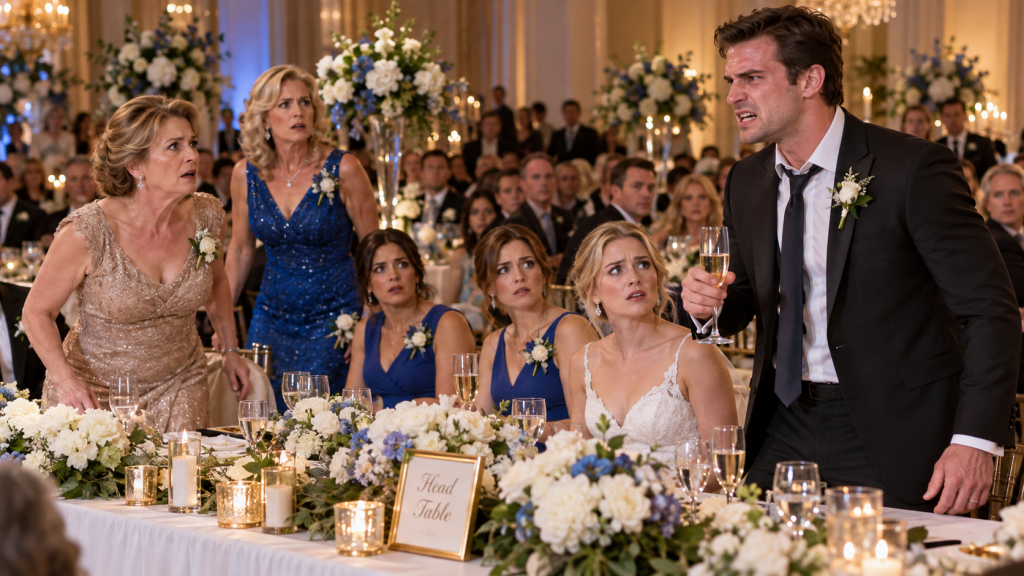
Grant was standing.
My heart skipped a beat.
Vanessa looked up at him, clearly surprised.
“I’d like to make a toast,” Grant said.
Then he looked directly at me.
And that’s when I saw it.
Grant was furious.
His tie was loosened, his face was red, and he was gripping that champagne glass so tightly I thought it might crack.
I’d never seen my calm, quiet son look like that.
And suddenly, I knew exactly what was about to happen.
I shot to my feet.
PART 2 — THE TOAST GRANT WAS NEVER SUPPOSED TO MAKE
I stood so quickly that my chair scraped backward across the ballroom floor.
The sound disappeared beneath conversation and music.
Grant was twenty feet away.
Champagne glass in one hand.
Microphone in the other.
His tie hung slightly loose at his neck.
His cheeks were red.
And although his voice was calm when he began, I knew my son well enough to understand what that calm meant.
Grant became quieter when he was furious.
Always had.
At six, he whispered before throwing up.
At sixteen, he went completely silent before telling a football coach he would rather quit than watch another player be humiliated.
At twenty-nine, standing at his own wedding reception, he looked the same way.
Contained.
Barely.
Vanessa smiled up at him from the sweetheart table.
It was the polished smile she had worn all afternoon.
Beautiful.
Controlled.
Expectant.
She thought Grant was about to thank everyone.
He wasn’t.
“I wasn’t planning to make a toast.”
he said.
The room quieted.
A few relatives laughed.
Grant did not.
“I know that probably sounds strange because apparently grooms are supposed to have prepared remarks.”
He glanced at the champagne glass.
“But I’ve spent most of today saying whatever would keep everyone comfortable.”
Vanessa’s smile faded slightly.
I stopped moving.
Grant looked directly at me.
“And I owe my mother an apology.”
Every head in the ballroom turned.
Toward me.
Wonderful.
There are few experiences more uncomfortable than being publicly identified in a room containing one hundred eighty people when you have spent the previous hour trying desperately not to become a story.
“Grant.”
Vanessa said softly.
He ignored her.
“Mom.”
His voice cracked.
“I knew Vanessa had asked you not to wear blue.”
My chest tightened.
The room became silent.
Behind Vanessa, her mother sat completely still in a royal-blue gown.
So did the two blue-clad aunts beside her.
Matching corsages.
Matching expressions.
Grant swallowed.
“What I didn’t know until today was why.”
Vanessa stood.
“Grant, this is not appropriate.”
He looked at her.
“No.”
One word.
Quiet.
“But neither was what happened.”
I felt my pulse in my throat.
Vanessa’s mother—Cynthia Hale—rose halfway from her chair.
“Maybe we should discuss this privately.”
Grant laughed once.
There was no humor in it.
“That’s what everyone keeps saying.”
Cynthia froze.
Grant continued.
“Every time something happens, it needs to be private.”
“Every time I’m uncomfortable, it needs to wait.”
“Every time my mother asks a question, it’s bad timing.”
He looked around the ballroom.
“And apparently every time Vanessa makes a decision for both of us, I’m supposed to smile because disagreeing would embarrass her.”
Vanessa reached for his arm.
“Give me the microphone.”
Grant stepped backward.
She stared at him.
I had never seen him do that before.
Not from her.
“Please.”
she whispered.
“You’re upset.”
“I am.”
“Then don’t do this while you’re emotional.”
A few people looked down at their plates.
I watched Grant’s face.
That sentence had been used before.
I knew it immediately.
Not necessarily those exact words.
The familiarity was in the way his shoulders changed.
The tiny retreat.
The instinct to wonder whether he was allowed to continue.
For half a second, I thought he might hand her the microphone.
Then his fingers tightened around it.
“No.”
Again.
Louder.
“I’m allowed to be upset and still speak.”
Something inside me shifted.
Not pride.
Not yet.
Relief.
Because for most of Grant’s life, his kindness had carried one dangerous weakness.
He could understand everyone’s side so well that sometimes he lost his own.
Vanessa’s face hardened.
“What exactly are you trying to accomplish?”
Grant looked at her.
“I’m trying to stop lying.”
That sentence changed the room.
Cynthia sat down.
I did too.
Slowly.
Nobody was leaving now.
Not because Grant was holding us hostage.
Because everyone suddenly understood this was not about a dress.
Grant turned toward me.
“Mom, Vanessa told me yesterday that she had asked you to change your dress.”
I stared at him.
“Yesterday?”
He nodded.
“She said the navy one photographed too close to the wedding colors.”
Exactly what she had told me.
“I asked why her mother was wearing blue.”
Vanessa interrupted.
“I told you that.”
Grant looked at her.
“No.”
“You told me your mom’s dress had already been purchased and couldn’t be changed.”
Cynthia shifted.
One of Vanessa’s aunts looked down.
Grant continued.
“And I let it go.”
His eyes returned to mine.
“Because it was the night before the wedding.”
There it was.
The disease of timing.
Tomorrow.
Later.
After the wedding.
After dinner.
When everyone calms down.
Peace delayed until the person causing the conflict has already received what they wanted.
“I should have called you.”
Grant said.
“I’m sorry.”
My throat tightened.
I wanted to tell him it was only a dress.
But it wasn’t.
Not anymore.
So I nodded.
Once.
And let him finish.
Then Grant said:
“Twenty minutes ago, Vanessa told me the truth.”
Vanessa went pale.
My stomach tightened.
“What truth?”
I asked.
Grant looked at her.
She shook her head almost imperceptibly.
Do not.
He continued anyway.
“There’s a family group chat.”
Cynthia closed her eyes.
“And?”
I asked.
Grant took out his phone.
Vanessa moved toward him.
“Seriously?”
He stepped away again.
“There’s a message from Cynthia from three months ago.”
Cynthia said sharply:
“Do not drag me into your marital disagreement.”
Grant stared at her.
“You created the group.”
That ended that.
He looked at the phone.
Then read.
“Blue photographs as family. Vanessa, your side should all coordinate shades. Make sure Joan doesn’t accidentally show up matching us.”
A murmur moved through the room.
My face burned.
Not because I cared about matching.
Because people had planned my exclusion months before anyone pretended it was about photography.
Grant continued.
Another message.
From Vanessa.
“Don’t worry. If she buys blue, I’ll have her change.”
My hands became cold.
I looked at Vanessa.
She did not look back.
Then Cynthia:
“Good. We don’t need her attaching herself to every family picture just because she’s Grant’s mother.”
That one hurt.
More than I expected.
I had never tried to dominate their wedding.
Never asked to walk Grant down the aisle.
Never demanded a mother-son dance longer than the schedule allowed.
I had given them money toward the rehearsal dinner and then told them to choose whatever they liked.
I had spent months asking Vanessa:
What would make things easier?
Apparently disappearing from photographs would have been useful.
One of Vanessa’s cousins whispered:
“Oh my God.”
Cynthia turned toward her.
“Enough.”
Grant kept reading.
Vanessa:
“She’ll make it about being excluded.”
Cynthia:
“Then tell her it’s a bride decision. She won’t argue because Grant never backs her publicly.”
The words landed like something physical.
I looked at my son.
His face crumpled.
There.
The real wound.
Not that they disliked me.
That they had counted on his silence.
They had built their plan around it.
Grant lowered the phone.
“I found those messages twenty minutes ago.”
“How?”
Vanessa asked.
Her voice was trembling now.
Grant looked at her.
“You left your phone on the table when you went to fix your makeup.”
“You went through my phone?”
“No.”
“A message appeared on the lock screen.”
He swallowed.
“It said, ‘Joan bought the beige dress after all. Perfect.’”
I felt ill.
Grant continued.
“I asked you what it meant.”
Vanessa stared at him.
“And you told me to stop ruining the wedding.”
No denial.
Cynthia stood again.
“This is ridiculous.”
“No.”
Grant said.
“It’s not.”
“You are humiliating my daughter.”
The irony was almost too large to hold.
Grant looked at her.
“I’m talking about something she did.”
“In front of everyone.”
“Yes.”
“Exactly.”
Cynthia gestured around the room.
“Why?”
Grant’s voice became quieter.
“Because every private conversation ends with me apologizing for bringing something up.”
That silenced even her.
Vanessa started crying.
Real tears.
I believed they were real.
That did not tell me what they meant.
People can cry because they are hurt.
Ashamed.
Angry.
Exposed.
Afraid.
Tears identify emotion.
Not innocence.
“Grant.”
she whispered.
“You promised you wouldn’t let your mother interfere with us.”
His face changed.
I stopped breathing.
“What?”
I asked.
He looked at me.
Then Vanessa.
“I never promised that.”
“Yes, you did.”
“No.”
“You said after we got married, she wouldn’t be involved in our decisions anymore.”
Grant stared.
“I said our marriage would be between us.”
“Exactly.”
“That is not the same as cutting off my mother.”
Vanessa laughed through tears.
“No one said cut off.”
Cynthia looked toward the ceiling.
Something in that reaction told me otherwise.
Grant saw it too.
“What?”
he asked.
Cynthia said nothing.
“What aren’t you saying?”
Vanessa wiped her face.
“Nothing.”
Grant’s eyes narrowed.
Then he looked down at her phone lying on the sweetheart table.
The lock screen lit again.
Another message.
From the family chat.
Cynthia’s name visible.
Do not let him start discussing the honeymoon. Shut this down now.
Grant read it.
I watched the last bit of patience leave his face.
“Honeymoon?”
Vanessa reached for the phone.
Too late.
“What about the honeymoon?”
“It’s nothing.”
“You changed it.”
Vanessa froze.
Grant laughed once.
“I knew it.”
“Grant—”
“You changed it.”
“It was supposed to be a surprise.”
That word.
Surprise.
The polite costume people put over decisions they know someone would reject if asked.
Grant looked toward me.
Then around the room.
“We were supposed to fly to Madeira Monday.”
A few relatives nodded.
Apparently several knew.
“We planned it for nine months.”
Vanessa said:
“We’re still traveling.”
“Where?”
No answer.
“Vanessa.”
She finally whispered:
“Cancún.”
Grant blinked.
“Cancún.”
“Yes.”
He looked honestly confused.
“Why?”
Cynthia answered.
“Because the family has a villa there.”
I closed my eyes.
Of course.
Not honeymoon.
Family vacation.
Grant stared at Vanessa.
“Who is going?”
She said nothing.
Cynthia did.
“We thought it would be nice for everyone to spend some time together.”
Everyone.
Grant’s face drained of color.
“Who?”
Vanessa whispered:
“My parents.”
He waited.
“My sisters.”
Waited.
“Uncle David and Aunt Marlene.”
The blue aunts.
Of course.
Grant stared.
“You canceled our honeymoon and booked a family trip?”
“It’s still romantic.”
Someone at a nearby table made a sound that might have been choking.
Vanessa turned.
“Can everyone stop acting like this is insane?”
Nobody answered.
That was probably answer enough.
Grant put the champagne glass down.
Carefully.
“When?”
“I changed the flights three weeks ago.”
Three weeks.
Not stress.
Not wedding-day confusion.
A decision.
“Why didn’t you tell me?”
“I was going to surprise you tonight.”
“No.”
Grant shook his head.
“You knew I wouldn’t agree.”
“That’s not true.”
“Would I have agreed?”
Vanessa opened her mouth.
Closed it.
There.
Cynthia stepped forward.
“Grant, our family paid for the villa.”
He looked at her.
“I didn’t ask you to.”
“It’s a gift.”
“A gift is something the recipient wants.”
Cynthia stared.
Then:
“You’re being incredibly ungrateful.”
I almost stood again.
Grant beat me to it.
“No.”
His voice became steady.
“I’m done being called ungrateful because I don’t want the thing you decided I should want.”
That sentence silenced the room more effectively than shouting ever could.
Then he looked at Vanessa.
“What else changed?”
She frowned.
“What do you mean?”
“The honeymoon.”
“The photos.”
“You canceled the mother-son photo.”
“You changed the seating chart yesterday.”
Vanessa’s eyes widened.
I had not known that one.
Grant continued.
“You moved Uncle Peter from our table because he ‘talks too much.’”
“He does.”
“That isn’t the point.”
His voice rose for the first time.
“What else have you changed without asking me?”
Vanessa whispered:
“Can we please go somewhere private?”
Grant looked exhausted.
Then at me.
Then at the hundred people watching.
I could see embarrassment finally catching up with him.
He had made his point.
More than his point.
Whatever came next did belong somewhere private.
So I stood.
Not charging toward Vanessa.
Not dramatic.
I walked to my son.
“Enough for now.”
I said softly.
He looked at me.
Angry.
Hurt.
Twenty-nine and somehow eight again.
“Mom.”
“You said what needed saying.”
I glanced toward Vanessa.
“Now the rest is between the two of you.”
For a second, I thought he might disagree.
Then he nodded.
Vanessa’s cousin took the microphone and announced dessert.
Heroic woman.
People love cake because it allows them to pretend not to have heard a family collapse.
The band started playing quietly again.
Conversation returned in terrified little pockets.
Grant walked toward a small conference room near the ballroom.
Vanessa followed.
Cynthia tried to go too.
Grant turned.
“No.”
Her face froze.
“I’m her mother.”
“I know.”
“She shouldn’t be alone right now.”
Grant looked at Vanessa.
“Do you want your mother in our conversation?”
Vanessa hesitated.
That mattered.
Then:
“No.”
Cynthia looked as if Vanessa had slapped her.
Interesting.
Grant opened the door.
They went inside.
Closed it.
For once, both mothers stayed outside.
That was probably the healthiest thing anyone had done all day.
I did not stand at the door.
I wanted to.
God, I wanted to.
Instead, I returned to my table.
Grant was an adult.
If I responded to Vanessa’s control by trying to control him in the opposite direction, I would only prove the wrong lesson.
So I sat.
My brother Peter poured me water.
“You okay?”
“No.”
“Good wedding.”
I stared at him.
He smiled weakly.
“Too soon?”
“Very.”
He drank his own water.
Across the ballroom, Cynthia was furious.
Not crying.
Furious.
She spoke in tight whispers to her husband, Richard Hale.
I had barely heard Richard say ten words all day.
He had the posture of a man who had spent thirty-five years discovering silence was cheaper.
Interesting.
Maybe Grant and Vanessa were not opposites after all.
Maybe they had both inherited different versions of the same family survival strategy.
One person pushes.
Another yields.
Eventually everyone forgets yielding is still a choice until the person doing it can no longer breathe.
Twenty minutes passed.
Then thirty.
Dinner plates disappeared.
Dessert arrived.
I ate nothing.
Finally the conference-room door opened.
Vanessa walked out first.
Her face was blotchy.
Grant followed.
He looked devastated.
Not relieved.
That scared me.
He came straight to me.
“We’re leaving.”
“We?”
“Me.”
Then:
“I don’t know about her.”
Vanessa stood several feet away.
Cynthia rushed toward her.
I stayed focused on Grant.
“Where are you going?”
“Hotel.”
“Want me to come?”
He almost said yes.
I saw it.
Then shook his head.
“No.”
Good.
Painful.
Good.
“What happened?”
I asked.
He glanced toward Vanessa.
“I asked to see our joint accounts.”
My stomach tightened.
“Why?”
“Because I realized I haven’t looked at them in months.”
That did not sound like Grant.
He was not obsessive with money.
But he was careful.
Or had been.
He continued.
“Vanessa handles most wedding payments.”
Reasonable.
Maybe.
“Then she started handling more.”
He looked ashamed.
“Utilities.”
“Travel.”
“Credit cards.”
“I transferred my paycheck into the joint account after we moved in together.”
My chest tightened.
“Grant.”
“I know.”
I softened.
“No.”
“You trusted your fiancée.”
“That isn’t stupidity.”
His eyes filled.
“Maybe not.”
Then:
“But I stopped looking because every time I asked questions, she said I was making her feel like I didn’t trust her.”
There it was.
Another route closed by emotion.
“How much is missing?”
I asked.
“I don’t know that anything is missing.”
Good.
Facts.
He continued.
“But there are transfers I don’t recognize.”
“Large?”
“Some.”
“How large?”
He swallowed.
“Twenty-six thousand dollars since January.”
I went cold.
“Where?”
“An account in Vanessa’s name.”
Not automatically theft.
Couples transfer money.
Wedding expenses.
Savings.
Family payments.
Could be explainable.
I forced myself not to leap.
“Did you ask?”
“Yes.”
“What did she say?”
“That it was wedding money her mother was holding.”
I looked toward Cynthia.
Of course.
Cynthia had paid several vendor deposits.
Vanessa said she had transferred funds back to reimburse her.
Possible.
Grant asked for statements.
Vanessa became angry.
Then eventually showed him part of the account.
Some transfers did correspond to wedding expenses.
Not all.
Several went to a company called Hale Event Consulting LLC.
Owned by Cynthia.
The company had provided no vendor services Grant knew about.
“What does Vanessa say?”
“That her mother coordinated things.”
I stared.
“Did you agree to pay her?”
“No.”
“Did you know she was charging?”
“No.”
Again.
Not automatically fraud.
Could be misunderstood family reimbursement.
But enough for Grant to stop pretending everything was fine.
Then came another issue.
Wedding gifts.
Some guests had used an online cash registry.
Grant thought the funds were going into their joint honeymoon account.
They weren’t.
They had been redirected two months earlier to Vanessa’s personal account.
“Can she do that?”
I asked.
“The registry was in both our names.”
His mouth tightened.
“She had the login.”
I exhaled.
“How much?”
“About seventeen thousand so far.”
The ballroom seemed suddenly too bright.
“Did she explain?”
“She said it was simpler because she was paying for the wedding.”
Again.
Maybe not illegal.
Maybe deeply inappropriate.
Definitely something Grant should have known.
I looked at him.
“What are you doing now?”
He stared at the carpet.
“I don’t know.”
“Okay.”
He looked up.
“You’re not going to tell me to leave her?”
Every motherly instinct in me screamed.
Instead:
“No.”
His eyes widened.
“I’m going to tell you not to make a permanent decision tonight while you’re exhausted and furious.”
“Then tomorrow?”
“Tomorrow you make the decision that belongs to you.”
His face crumpled.
He hugged me.
Hard.
I held him.
Then I whispered:
“But tonight, protect your accounts.”
He laughed through tears.
“Very maternal.”
“I contain multitudes.”
Grant left the reception.
So did Vanessa eventually.
Separately.
The guests stayed another hour because weddings are strange machinery.
Once catering has been paid and a DJ has been booked, social inertia can survive almost anything.
I watched people dance while the bride and groom were gone.
Surreal.
Cynthia remained.
She spent much of that hour explaining to relatives that Grant had experienced “cold feet after the ceremony.”
I heard her say it twice.
The third time, I walked over.
“Cynthia.”
She stopped.
“Joan, not now.”
“No.”
My voice was quiet.
“You do not get to rewrite what happened before they have even decided what it means.”
She stared.
“I’m protecting my daughter.”
“Then comfort her.”
“Don’t narrate my son.”
And I walked away.
That felt better than yelling.
At eleven that night, Grant called.
He was in a hotel ten miles away.
Alone.
Vanessa had gone to her parents’ house.
“Did you freeze anything?”
I asked.
He laughed tiredly.
“You make me sound kidnapped.”
“No.”
“I make you sound like someone who discovered financial activity he didn’t recognize.”
“Yes.”
He had changed his banking passwords.
Contacted the registry platform and asked them to freeze further withdrawals until ownership of the wedding funds was clarified.
He had not emptied the joint account.
Good.
One angry spouse draining everything would only create another problem.
He transferred his next paycheck to an individual account he already had.
Documented current balances.
Saved statements.
Then stopped.
Good.
“Are you married?”
I asked.
Silence.
Odd question after a wedding.
“I mean legally.”
“I think so.”
Apparently their officiant had signed the marriage license after the ceremony.
Whether it had already been returned to the county or not would not erase the ceremony itself where local law recognized it.
This was not a television drama where ripping up a paper magically unmarried people.
If Grant ended the marriage, there would be legal process.
Divorce.
Potential annulment only if actual legal grounds existed.
Not because the reception went badly.
I hated that reality for him.
Still reality.
“Don’t make legal assumptions.”
I said.
“I know.”
“I’m calling Rachel Kim tomorrow.”
“Our family lawyer?”
“Yes.”
“For yourself.”
He went quiet.
“That feels extreme.”
“You got married today.”
“And discovered money you don’t understand today.”
“Information is not divorce.”
He exhaled.
“Okay.”
Then he whispered:
“Mom?”
“Yeah?”
“I knew she could be controlling.”
My throat tightened.
“Did you?”
“I thought it was confidence.”
Silence.
“She always knew where we were eating.”
“What we were doing.”
“When we should leave.”
“What hotel we should book.”
“What color tie I should wear.”
He laughed miserably.
“I liked it at first.”
“Why?”
“Because I didn’t have to decide.”
There.
He was honest enough to make the story harder.
Vanessa had not simply seized control from a helpless man.
Grant had surrendered pieces because it was comfortable.
Until surrender stopped feeling voluntary.
“She’d say, ‘Trust me, I’ll handle it.’”
he continued.
“And usually she handled it well.”
“Reservations got made.”
“Bills got paid.”
“Trips got planned.”
“Then at some point, if I disagreed, she acted like disagreement itself was the problem.”
I listened.
“What did you do?”
“I stopped disagreeing.”
He started crying.
“That part is on me.”
“Yes.”
I said softly.
He went quiet.
Then I added:
“Not everything that happened after.”
Important distinction.
His silence had made control easier.
It did not give someone unlimited permission.
The next morning, Grant met with an attorney.
So did Vanessa.
Not the same attorney.
Good.
They agreed through counsel to preserve financial records and not move disputed joint funds while they sorted out what belonged to whom.
The honeymoon was canceled.
Both versions.
Madeira and Cancún.
Airline credits remained.
Ironically.
Then the photographs arrived.
The photographer had no idea the marriage might already be in trouble.
She sent the preview gallery.
I nearly deleted the email.
Then I opened it.
There I was in beige.
Cynthia in blue.
Vanessa’s family in coordinated blue around her.
And in several large family photographs—
I was absent.
Not accidentally.
There were shots labeled:
BRIDE FAMILY
Fine.
Normal.
Then:
IMMEDIATE FAMILY
Cynthia.
Richard.
Vanessa’s sisters.
Their spouses.
Grant.
No me.
No Grant’s uncle.
No one from his side.
I stared at it.
Then found one photograph taken candidly during cocktail hour.
Grant and me laughing beside a window.
Not posed.
Not scheduled.
No matching colors.
It became my favorite picture.
Because no one had authorized it.
Grant called two days later.
“I found something.”
His voice sounded strange.
“What?”
“Vanessa gave me access to the wedding folder.”
“And?”
“She said if I’m going to accuse her of hiding things, I should look at everything.”
That was either confidence or a mistake.
Maybe both.
Inside the folder were invoices.
Contracts.
Guest spreadsheets.
Vendor emails.
The blue-family photo plan.
And a document titled:
POST-WEDDING FAMILY PLAN
I almost laughed.
“What is that?”
“You’re not going to like it.”
Apparently it was a spreadsheet Vanessa and Cynthia had built together.
No legal force.
Just plans.
But plans say things too.
Holidays:
Thanksgiving — Hales.
Christmas Eve — Hales.
Christmas Day — “flexible, possibly Joan lunch if needed.”
If needed.
I sat down.
Grant’s birthday:
Dinner with Hales.
Summer:
Hale family lake week.
My birthday:
Blank.
Again.
Not a crime.
Not even extraordinary in isolation.
But Grant had never seen the document.
His next year had been scheduled without him.
Then came a tab marked:
BOUNDARIES
That word again.
Often beautiful.
Sometimes weaponized.
The entries:
Joan — no unannounced visits.
Reasonable.
I never made unannounced visits.
Joan — no spare key.
Also reasonable.
I had never asked for one.
Joan — one holiday annually.
Interesting.
Joan — no future childcare more than one day weekly.
Grant and Vanessa did not have children.
Their hypothetical children already had maternal access limits assigned.
Then:
Joan — discourage “my baby” language if pregnancy happens.
I stared.
I had never called Grant “my baby” since he was perhaps four.
This was not a response to behavior.
It was pre-written suspicion.
Grant whispered:
“I think she decided what kind of mother-in-law you were before you became one.”
My chest hurt.
“Maybe.”
“I’m sorry.”
“Stop apologizing for her spreadsheet.”
“I should have noticed.”
“Grant.”
I softened.
“You were getting married to someone you loved.”
“Of course you were inclined to interpret her generously.”
He went quiet.
Then:
“You don’t like her.”
I thought.
“I don’t like what I’m seeing.”
“That’s not the same thing.”
He laughed weakly.
“Everyone is becoming a lawyer.”
“Good influence.”
But there was another tab.
GRANT
This one hurt him more.
Social:
Reduce weekly game night after marriage.
Encourage networking with Hale family business circle.
Fitness:
Return to trainer.
Wardrobe:
Replace older suits.
Finances:
Move all household payments under Vanessa after wedding.
Personal:
Encourage therapy for conflict avoidance.
That one was not inherently bad.
Grant actually laughed.
“She’s not wrong.”
Then:
Family:
“Limit Joan emotional dependence.”
His laugh stopped.
I closed my eyes.
Again, there were versions of this that could have reflected legitimate concerns.
Parents can be intrusive.
Adult children can be enmeshed.
But Grant and I spoke once or twice a week.
Saw each other every couple of weeks.
I did not have a key.
Did not manage his appointments.
Did not know his salary.
Whatever emotional dependence Vanessa had been planning to reduce existed more vividly in her spreadsheet than in our actual relationship.
“What do you want?”
I asked.
“I want to know why she was making a plan for me instead of with me.”
That was the right question.
They met with a couples counselor four days later.
Not to save the marriage automatically.
Not to end it.
To speak somewhere neither mother could enter.
I respected that.
Cynthia did not.
She called Grant repeatedly.
He did not answer.
Then she called me.
That surprised me.
I nearly ignored it.
Then answered.
“Joan.”
“Cynthia.”
“Tell Grant he needs to speak to his wife.”
I stared at my kitchen wall.
“No.”
Silence.
“What?”
“I am not relaying instructions.”
“You’re his mother.”
“Yes.”
“Exactly.”
“No.”
I almost smiled.
“He’s twenty-nine.”
“If Vanessa needs to communicate, she can use the channel they agreed on.”
Cynthia’s voice hardened.
“You’re enjoying this.”
“No.”
And I meant it.
“I would have preferred wearing beige to a happy wedding and never learning any of this.”
She went quiet.
That sentence seemed to reach her.
For three seconds.
Then:
“You’ve always wanted him back.”
There it was.
Back.
As if marriage had been an abduction.
“I never lost him.”
I said.
“And that may be the difference between us.”
Then I ended the call.
Grant and Vanessa’s counseling was painful.
I learned only what Grant chose to tell me.
Good.
Vanessa admitted she believed Grant’s conflict avoidance meant she had to “take charge” or nothing would happen.
Some truth there.
She had asked him what he wanted and often received:
“Whatever you think.”
“That’s fine.”
“I don’t care.”
Over years, she stopped asking.
Efficiency became habit.
Habit became authority.
Then authority became entitlement.
She also admitted Cynthia reinforced it.
Her mother had always said:
“If Grant can’t make decisions, someone has to.”
Grant heard that and finally understood something.
Not every passive answer was neutral.
When he refused to choose, someone else had to.
He owned that.
But Vanessa had turned his passivity into permanent permission.
She had to own that too.
The blue dress was harder.
Vanessa cried when explaining it.
Not because the truth improved.
Because it became uglier when spoken aloud.
Cynthia had never liked me.
She thought I was “too independent.”
Too informal.
Not deferential enough.
At an engagement dinner, I had disagreed with her about whether Grant and Vanessa should buy a house before the wedding.
Politely.
Cynthia interpreted that as competition.
Then began talking about keeping the wedding visually centered on “Vanessa’s family.”
Blue became the marker.
Vanessa agreed.
“Why?”
Grant asked.
She eventually answered:
“Because Mom said your mother would insert herself if we didn’t set limits.”
“What had Mom done?”
Vanessa could not answer.
That mattered.
Grant asked one more question in counseling.
“Why didn’t you tell me blue was for your family?”
Vanessa whispered:
“Because you would have said your mother is family too.”
Grant looked at her.
“She is.”
Exactly.
That was the whole ridiculous wound in one sentence.
For a brief period, I thought perhaps they might repair things.
People can change.
Control can be confronted.
Conflict-avoidant people can learn to speak.
Marriage does not have to end because one wedding reveals ugly family dynamics.
Then Grant found the document.
Not a spreadsheet.
Not an invoice.
A real financial form.
That changed everything again.
It was buried in a folder of mortgage-preapproval papers.
Grant and Vanessa had been considering buying a larger home after the wedding.
They had spoken to a lender.
Nothing had closed.
No house under contract.
Grant knew his credit had been checked.
Normal.
What he did not know was that Vanessa had submitted a preapproval package using information from both of them.
Also potentially normal if both had authorized it.
Then he opened a document titled:
Gift Funds / Family Contribution Acknowledgment
Cynthia and Richard Hale were listed as providing $150,000 toward a future down payment.
Generous.
Then came conditions in a separate family agreement.
Not lender conditions.
Private.
The proposed $150,000 would be documented as a loan unless Grant and Vanessa remained married for ten years.
Strange.
Maybe enforceable.
Maybe not.
Needed legal review.
Then another provision:
If the marriage ended earlier, repayment would be allocated to Grant and Vanessa jointly.
Grant had never agreed to that.
His attorney reviewed it.
Said the family agreement did not automatically bind Grant merely because his name appeared.
Execution mattered.
Consent mattered.
Then they reached the signature page.
Grant called me immediately.
“Mom.”
I knew from his voice.
“What happened?”
“There’s a signature.”
My stomach tightened.
“Whose?”
“Mine.”
Silence.
“Did you sign it?”
“No.”
I sat down.
Not because forgery was already proven.
Because the pattern of control had crossed into a different category.
“Are you sure?”
“Yes.”
“How?”
“The signature isn’t even how I sign legal documents.”
He exhaled.
“It looks like the signature I use on birthday cards.”
That detail chilled me.
Vanessa had access to cards.
Of course.
So did Cynthia.
Again, access was not proof.
His attorney asked for the original electronic file and transmission history.
No accusations yet.
Good.
They traced the PDF.
It had been emailed to the mortgage broker from Vanessa’s account six weeks before the wedding.
The broker had replied:
Please have Grant confirm he understands the family repayment provision.
Vanessa answered:
He does. He hates paperwork and asked me to handle it.
My chest tightened.
Same mechanism.
His avoidance turned into her explanation for his absence.
Grant had never seen the email.
Never spoken to the broker about the family agreement.
His attorney requested metadata.
The signature image appeared to have been inserted digitally into the PDF.
Still needed forensic review.
Then Vanessa’s attorney produced a text exchange.
Vanessa had messaged Cynthia before submitting it.
Grant says he doesn’t want strings attached to your money.
Cynthia replied:
Then don’t call them strings. He’ll never read the whole thing.
I felt physically sick.
Vanessa:
I’m not comfortable signing for him.
Important.
Cynthia:
You’re not signing. You’re attaching what he already signed on the preliminary worksheet. Same thing.
Not the same thing.
Not remotely.
Then Vanessa:
He’ll be furious if he finds out.
Cynthia:
He won’t. And once you have the house, he’ll understand why it was necessary.
There.
Not impulse.
Not misunderstanding.
They knew he would object.
They proceeded because they believed the outcome would justify bypassing him.
The last message came from Vanessa.
Fine. Send me the scan.
Grant read that exchange in his attorney’s office.
Then sat silently for ten full minutes.
The lawyer asked whether he wanted water.
He said no.
Then:
“I need to know where the scan came from.”
Good question.
The answer arrived two days later.
A birthday card.
One Grant had signed for Cynthia the previous year.
She had apparently photographed the signature.
Not unusual by itself.
Maybe she liked the card.
But that image matched the signature pasted into the family repayment agreement.
At least visually.
A document examiner would need to establish more formally what happened.
Still, Vanessa’s text:
Send me the scan
was difficult to explain away.
Grant called her.
With attorneys aware.
He asked one question.
“Did you put my signature on that agreement?”
Vanessa cried.
Then said:
“I thought you had agreed in principle.”
He repeated:
“Did you put my signature on it?”
Silence.
Then:
“Yes.”
The word landed harder than any wedding toast.
Grant closed his eyes.
“Why?”
“Because my parents wouldn’t give us the down payment otherwise.”
“We didn’t need their money.”
“We needed it for the house I wanted.”
There.
Not we.
I.
Grant heard it too.
Vanessa continued.
“You kept saying we’d wait another year.”
“Yes.”
“We didn’t need to.”
“I wanted to.”
“That’s what I mean.”
Her voice rose.
“You always delay everything.”
“You won’t make decisions.”
“So I made one.”
Grant went very quiet.
“And my signature?”
She cried.
“I knew you’d come around.”
There it was.
The sentence that finally ended his uncertainty.
Not because people cannot recover from terrible choices.
Because Vanessa still described consent as a temporary obstacle to the decision she believed was correct.
She had not yet understood the problem.
Grant did not scream.
Of course.
He said:
“We need to stop talking directly for now.”
Vanessa panicked.
“Are you divorcing me?”
“I don’t know.”
“Grant.”
“I said I don’t know.”
“You can’t do this because of one document.”
He laughed once.
“One document?”
Then:
“No, Vanessa.”
“It’s not the paper.”
“It’s that you knew I would say no.”
“And you decided my no was something to solve.”
Silence.
Then he ended the call.
His attorney notified the lender that Grant disputed the family agreement and had not authorized the pasted signature.
No mortgage had closed.
No loan funded.
The questionable agreement had not yet created the financial catastrophe Cynthia apparently imagined would never occur.
That mattered.
There would still be professional review.
Potential civil consequences depending on how the agreement had been used.
Possibly other legal issues if someone knowingly submitted a false signature in a financial transaction.
No one announced criminal charges in a counseling session.
Good.
Process.
Evidence.
Again.
But for Grant, the legal category mattered less than the personal one.
Three weeks after the wedding, he came to my house.
No suit.
No champagne glass.
Jeans.
Sweatshirt.
He sat at my kitchen table and said:
“I think my marriage is over.”
I did not say:
Thank God.
I did not say:
I told you so.
I did not say anything.
I got up.
Made tea.
Sat beside him.
Then:
“Do you want it to be?”
He cried.
“That’s the problem.”
“What?”
“I still love her.”
Of course.
People always want betrayal to make love disappear because clean feelings produce clean decisions.
They rarely do.
“She can be funny.”
he said.
“Generous.”
“She stayed with me every night when I had pneumonia.”
“She helped me apply for the promotion I was afraid to ask for.”
“She remembers everyone’s birthdays.”
He cried harder.
“She isn’t only this.”
“I know.”
He looked at me.
“You do?”
“Yes.”
Because if Vanessa had been cruel every second, Grant would never have wanted to marry her.
That was not an insult to him.
It was reality.
Good people can behave badly.
Loving people can become controlling.
People can be wonderful in some rooms and unsafe in others.
The task is not to decide whether someone is entirely good or bad.
It is to decide what behavior you can build a life beside.
Grant wiped his face.
“What would you do?”
There it was.
The question every mother thinks she wants.
Then fears.
I looked at my son.
“I won’t decide this for you.”
He laughed miserably.
“Apparently everyone has learned that lesson this month.”
“Expensive wedding.”
“Very.”
Then I added:
“But if you stay, stay because she understands what she did and changes.”
“Not because everyone is tired of conflict.”
He nodded.
“And if you leave?”
“Leave because you decide you cannot trust the marriage.”
“Not because you think I need revenge for a blue dress.”
That made him laugh.
Small.
Needed.
Then he said:
“I keep thinking about the toast.”
“What part?”
“Cynthia’s message.”
His eyes filled again.
“She said you wouldn’t argue because I never back you publicly.”
I said nothing.
“I made that true.”
My throat tightened.
“Sometimes.”
He looked down.
“I thought staying neutral meant I wasn’t taking sides.”
I reached across the table.
“Grant.”
He looked at me.
“Neutrality can become a side when only one person is being asked to swallow something.”
He closed his eyes.
That was not about me alone anymore.
It was about him too.
He had spent years swallowing.
Calling it calm.
Calling it compromise.
Calling it love.
Until one wedding day, there was nothing left in him willing to go down quietly.
A week later, Vanessa’s attorney sent Grant the complete wedding-finance archive.
One item was still missing.
The original image file of Grant’s signature.
Where had Cynthia gotten it?
They assumed the birthday card.
Then the forensic examiner called.
The image was not from the birthday card.
The resolution differed.
The scan was cleaner.
It came from a document.
Grant’s signature on a prior financial form.
Which one?
That took another week.
Then they found it.
Two years earlier, Grant and Vanessa had applied together for an apartment.
Standard paperwork.
Both signed.
Cynthia had never been part of that application.
So how had she obtained Grant’s signature?
Vanessa did not know.
Or claimed not to.
Then the apartment-management company found an email.
Nine months earlier.
A request for an archived copy of the application.
Sent from an email address using Grant’s full name.
The message said:
Need previous signed application for mortgage verification. Please send to updated address below.
The updated address was not Grant’s.
It forwarded to an account controlled by—
Vanessa.
Grant stared at the record.
“That wasn’t me.”
His attorney nodded.
“I know.”
Then another detail appeared.
The request had been made before they were engaged.
Nine months before the wedding.
Before the blue dresses.
Before the honeymoon change.
Before I knew there was anything wrong.
Grant went completely still.
Because whatever had been happening in his relationship had not started with wedding stress.
Someone had been collecting his signed documents long before anyone needed a down payment.
And when his attorney asked Vanessa why she had created an email address in Grant’s name to obtain an old signed application, she refused to answer without counsel.
That was when Grant finally understood the question was no longer:
What did Vanessa change during the wedding?
It was:
How long had she been making decisions in his name before he noticed he was no longer the one making them?
And for the first time since he raised that champagne glass, even I was afraid of what the answer might be.
PART 3 — THE COLOR NOBODY GOT TO OWN
The answer to how long Vanessa had been making decisions in Grant’s name turned out to be both worse and smaller than I feared.
Worse, because it had begun before the wedding.
Smaller, because there was no hidden second mortgage, no secret company, no enormous account drained behind Grant’s back.
There was no need to invent a larger crime.
What Vanessa had actually done was serious enough.
The false email account had been created nine months before the wedding.
It used Grant’s full name.
A slight variation of his usual address.
His birthday as part of the password recovery questions.
Vanessa’s phone number for recovery.
The first message sent from it was the request for their old apartment application.
The one containing Grant’s signature.
When her attorney finally provided the account history, there were only seven outgoing messages.
Seven.
I remember that number because Grant stared at it for a long time.
Not seventy.
Not seven hundred.
Seven times someone had put his name above words he had not written.
Sometimes seven is plenty.
The first message obtained the apartment application.
The second sent a copy of Grant’s income statement to a mortgage broker.
The third confirmed that “Grant” was comfortable with Vanessa handling communications.
The fourth requested preliminary loan figures.
The fifth said he was “fine with Vanessa making the final selection.”
The sixth was the one tied to the family down-payment arrangement.
And the seventh told the broker:
Please communicate through Vanessa going forward. I travel often and hate dealing with paperwork.
Grant read that sentence twice.
Then put the pages down.
“I don’t travel often.”
His attorney looked at him.
“I know.”
“I work fifteen minutes from home.”
“I know.”
Grant laughed.
A dry, exhausted sound.
“She created a personality for me.”
That sentence hurt.
Because she had.
Not a completely invented man.
That would have been easier to reject.
She had taken pieces of the real Grant—
quiet.
dislikes paperwork.
trusting.
slow to argue.
—and stretched them until they became authorization.
When Vanessa finally gave a full statement through her attorney, she admitted creating the email address.
Her explanation was painfully ordinary.
She had wanted the old apartment application because it contained financial information and signatures they might need for future mortgage paperwork.
Grant had been busy.
She knew he would say they could simply request fresh documents later.
Vanessa did not want later.
So she made an email address in his name and requested the file herself.
That was the first line.
Not theft for money.
Not a secret plan to ruin him.
Convenience.
Then convenience became permission.
Grant asked her, during one mediated conversation:
“Why didn’t you just ask me?”
Vanessa looked down.
“Because you would have said no.”
That answer ended all ambiguity.
Not:
Because you were unreachable.
Not:
Because I misunderstood.
Because you would have said no.
Grant leaned back in his chair.
There it was again.
The same answer beneath the honeymoon.
The wedding colors.
The down-payment agreement.
The family schedule.
He would have said no.
So she removed the question.
Vanessa cried.
“I thought you’d thank me later.”
Grant closed his eyes.
“For what?”
“For getting things moving.”
He stared at her.
“We weren’t stuck.”
“We were.”
“No.”
“You were impatient.”
Her face changed.
That was the first time I heard later that he had said something so cleanly.
No softening.
No apology wrapped around it.
Not:
I understand why you felt—
Not:
Maybe I could have—
Just:
You were impatient.
Vanessa had spent years treating Grant’s reluctance as dysfunction.
For the first time, he treated his own pace as legitimate.
That mattered.
The financial review took another six weeks.
Grant hired an independent accountant.
Not because he believed every transaction was suspicious.
Because he needed to know where the ground actually was.
The answer was messy but not catastrophic.
The twenty-six thousand dollars transferred into Vanessa’s account had mostly gone toward wedding expenses.
Venue upgrades.
Flowers.
Transportation.
Photography.
A last-minute catering increase.
Several reimbursements to Cynthia.
Those reimbursements totaled just over nine thousand dollars.
Of that amount, about six thousand corresponded to documented expenses Cynthia had actually paid.
Three thousand did not.
Hale Event Consulting had invoiced Vanessa for “coordination and family logistics.”
Grant had never agreed to hire Cynthia.
Vanessa had.
Without telling him.
Cynthia called it compensation for months of planning work.
Maybe she had done work.
She had.
Too much, arguably.
But charging the couple secretly was another matter.
After lawyers became involved, Cynthia returned the disputed three thousand dollars rather than fight over it.
No courtroom.
No prosecution.
A check.
Sometimes accountability arrives looking annoyingly small compared with the argument that produced it.
The wedding registry money was also accounted for.
Vanessa had redirected the cash gifts into her personal account because she had been using that account to pay wedding vendors.
Poor choice.
Not necessarily theft.
After documented expenses were reconciled, roughly eleven thousand dollars remained.
That money was preserved until Grant and Vanessa agreed through their lawyers how to divide or return it.
They eventually decided to return several large gifts from immediate family and divide the remainder as marital property under advice of counsel.
Again.
No dramatic pile of stolen cash.
Just a relationship where one person had increasingly stopped distinguishing:
I can manage this
from
I can decide this.
The mortgage preapproval was withdrawn.
No house purchased.
No loan funded.
No one lost one hundred fifty thousand dollars.
The lender documented Grant’s dispute regarding the pasted signature and removed the application from active consideration.
The false family agreement was preserved.
Attorneys reviewed whether any criminal referral or civil claim was appropriate.
I did not pretend to understand every statute involved.
What mattered to Grant was simpler.
His signature had been put on a financial document without his authorization.
That was no longer a relationship disagreement.
It was a boundary with legal edges.
Cynthia’s role was clearer too.
She had not created the false email account.
Vanessa had.
She had not redirected wedding gifts.
Vanessa had.
She had not altered the honeymoon reservation herself.
Again, Vanessa.
But Cynthia had obtained Grant’s signature scan.
Had told Vanessa he would “never read the whole thing.”
Had encouraged her to attach it to the family loan agreement.
And had repeatedly treated Grant’s likely refusal as something Vanessa should work around.
Her influence mattered.
But it did not turn her daughter into a puppet.
Vanessa was thirty.
She made choices.
That distinction eventually became important to Vanessa herself.
At first, she blamed Cynthia.
A lot.
“My mother has controlled everything my entire life.”
Maybe true.
“She taught me that if people hesitate, you help them decide.”
Probably true.
“She told me Grant needed someone stronger.”
True, according to texts.
Then her therapist apparently asked:
“And when did you become responsible for what you do with what you were taught?”
Vanessa hated that question.
Good question.
Grant did not reconcile with her.
Not romantically.
For two months, he remained unsure.
That surprised some relatives.
They thought the forged signature should have made the answer instantaneous.
Human beings do not always work that way.
Grant loved her.
Had loved her for years.
He remembered road trips.
Inside jokes.
Sick days.
The morning she sat beside him before a job interview and repeated:
“You belong in that room.”
He remembered the good version of being pushed out of his comfort zone.
Vanessa had sometimes believed in him before he believed in himself.
That was real.
So was everything else.
For a while, he kept asking whether the good could be separated from the control.
Eventually, the answer he reached was:
Not enough to stay married.
They had been legally married.
The license had been filed.
There was no dramatic tearing up of paper.
No officiant declaring the ceremony canceled retroactively.
Grant filed for divorce.
Because that was what ending a valid marriage required.
The marriage had lasted only weeks.
The legal process lasted longer than the relationship had after the wedding.
There is a particular sadness in that.
Wedding photos arrived before the divorce papers were final.
Flowers were still drying when attorneys were exchanging financial disclosures.
Grant’s suit came back from the cleaners while he was looking for a new apartment.
Life has terrible comedic timing.
Vanessa moved back in with her parents temporarily.
That arrangement did not last long.
Something had changed between her and Cynthia.
Perhaps exposure does that.
For the first time, Vanessa began telling her mother no.
No, you are not joining my therapy session.
No, you are not calling Grant.
No, you are not speaking to his attorney for me.
No, you are not telling relatives he was “brainwashed by Joan.”
That final one started a fight loud enough that Vanessa spent a week with her sister.
I learned about it only later.
Good.
I did not need live updates from the other side of the divorce.
Cynthia called me once.
Three months after the wedding.
I almost did not answer.
Then did.
“Joan.”
“Cynthia.”
Long silence.
“I owe you an apology.”
I sat down.
There had been enough surprises.
“Go ahead.”
She inhaled.
“The blue dresses were cruel.”
Direct.
Good beginning.
“I told myself they were about photographs.”
“They weren’t.”
“No.”
“They were about making clear whose family mattered.”
“Yes.”
Her voice cracked.
“And I treated Grant as though marrying Vanessa meant joining us instead of the two of them creating something separate.”
There it was.
I said nothing.
Cynthia continued.
“I thought if Vanessa gave him enough structure, he would become more decisive.”
“And when he disagreed?”
She went quiet.
“I called that indecision.”
Exactly.
Then she said:
“I should never have told Vanessa to use his signature.”
“No.”
“I thought he had already agreed to taking the money.”
“He had not agreed to the conditions.”
“I know.”
“And you knew he might object.”
Another pause.
“Yes.”
That was the sentence I needed.
Not because I wanted to punish her.
Because apologies become useless when they remove the part the person knew at the time.
Cynthia started crying.
“I was trying to protect my daughter.”
I almost laughed.
Not cruelly.
Sadly.
“From what?”
She had no answer.
A slower house purchase?
A honeymoon Grant actually wanted?
A mother-in-law wearing navy?
Disagreement?
Sometimes control becomes so habitual that the person cannot identify the danger they believe they are preventing.
Cynthia finally whispered:
“From uncertainty.”
That was honest.
Vanessa had inherited a mother who hated uncertainty.
Grant had grown into a man who tolerated too much of it rather than conflict.
They fit beautifully until they didn’t.
I did not forgive Cynthia that day.
Not completely.
But I believed she understood more.
That was enough for a phone call.
Before hanging up, she said:
“I am sorry for what I said about you not being family.”
My throat tightened.
“Thank you.”
Then:
“For what it’s worth, I never thought you weren’t Grant’s family.”
She gave a sad laugh.
“I think I was afraid Vanessa wouldn’t be first unless everyone else became less.”
There.
Scarcity.
Love turned into ranking.
One mother had tried to make room for her daughter by shrinking another mother’s place.
It had never been necessary.
Grant came to stay with me briefly after filing for divorce.
Three weeks.
Then I made him leave.
Lovingly.
He was thirty.
He could afford his own apartment.
And after everything that happened, the last lesson he needed was:
When one woman controls you too much, return to your mother.
No.
He found a one-bedroom apartment ten minutes from work.
Ugly carpet.
Tiny kitchen.
No wedding registry towels because Vanessa kept those.
I gave him two old pans.
He objected.
“You’re trying to control my kitchen.”
“Correct.”
He laughed.
Good.
Then bought his own pans.
Better.
Therapy helped him.
Not instantly.
He discovered that “calm” had become part personality and part survival strategy.
As a child, conflict made him uncomfortable.
His father—my late husband, David—had been louder than Grant.
Not cruel.
Just expressive.
I was decisive too.
Grant learned early that if he waited long enough, someone else would choose.
Restaurant.
Vacation.
College visit.
Paint color.
Small things.
We thought he was easygoing.
He was.
We also reinforced it.
That was uncomfortable for me.
One session, Grant asked me to join.
His therapist asked:
“When Grant said, ‘I don’t care,’ what did you usually do?”
“Choose.”
“Did you ever make him choose?”
I thought.
“Not often.”
Grant looked at me.
“That’s where I learned it worked.”
Ouch.
He smiled slightly.
“I’m not blaming you.”
“I’m still offended.”
The therapist almost laughed.
Then Grant said:
“I liked people deciding until I met someone who never stopped.”
That was the shape of it.
Vanessa had not created his passivity.
She exploited and reinforced a habit already there.
Grant had work too.
Different work.
His responsibility was not what Vanessa did with his signature.
His responsibility was learning to stop abandoning his own decisions before someone else collected them.
He started with ridiculous things.
Dinner.
A couch.
Weekend plans.
When I asked what he wanted for his birthday, he said:
“Thai.”
I almost cried.
He stared.
“Mom.”
“You picked something.”
“Please get a hobby.”
Fair.
He also became less pleasant.
I mean that as praise.
Not rude.
Less automatically agreeable.
He declined Easter brunch one year because he already had plans.
I said:
“But everyone will be there.”
Then caught myself.
He looked at me.
I looked at him.
“Go.”
He smiled.
“Growth.”
“Don’t enjoy this.”
Too late.
Vanessa changed too, from what I heard later.
We did not become friends.
That would have been unrealistic.
But nearly a year after the divorce finalized, she wrote Grant a letter.
He showed me only because he wanted to.
It began:
I spent a long time telling myself I became controlling because you would not decide.
Then:
The truth is that your hesitation made me anxious, and instead of learning to tolerate that anxiety, I turned it into authority.
Grant read that line several times.
Another:
When you said no, I heard delay. When you said maybe, I heard permission to keep pushing. When you said nothing, I treated silence as yes. None of those translations belonged to me.
That was good.
Painful.
Good.
Then:
The signature was the clearest version of what I had been doing emotionally for years. I put your name beneath a decision because I believed you would eventually become the person I had already decided you should be.
Grant cried.
So did I.
Not because they were getting back together.
They weren’t.
Because understanding arrived.
Late.
Still valuable.
Vanessa apologized for the honeymoon.
The money.
The fake email.
The blue dress plan.
Then something I did not expect.
She apologized for the photograph.
“What photograph?”
I asked.
Grant showed me.
It was the formal immediate-family photograph from the wedding.
Everyone in blue around Vanessa.
Grant in the middle.
Me absent.
Vanessa wrote:
I thought excluding Joan from that photograph would establish a boundary. Looking at it now, I see that I was not setting a boundary around our marriage. I was staging a picture where your family only counted if it came through me.
That was exactly right.
Grant did not respond for several weeks.
Then sent:
I appreciate the apology. I hope you keep doing the work.
Nothing romantic.
No reopening.
No cruelty.
Closure.
The questionable financial agreement did produce consequences.
The lender documented the false signature submission and declined future business connected to that application.
The attorneys resolved the matter without a funded loan or financial loss to Grant.
Cynthia and Vanessa cooperated with the review.
There were professional and legal discussions about the knowingly false submission.
The final resolution was far less dramatic than the wedding itself—financial penalties, formal withdrawal of the document, and legal costs that neither woman found amusing.
I did not track every detail.
Grant did.
Then stopped.
There is a moment when evidence has served its purpose.
After that, continuing to stare at it becomes another way of staying married to what happened.
Cynthia and Richard stayed together.
Richard surprised me.
After the wedding, I had assumed his silence meant agreement.
Not entirely.
He had known Cynthia was too involved.
He had not known about the signature.
When he learned, he was furious.
Then had to confront something uncomfortable.
For years, he had avoided challenging Cynthia because, like Grant, he preferred peace.
Different generation.
Same mistake.
He eventually told her:
“I kept letting you run everything because resisting you was exhausting.”
Cynthia apparently answered:
“Then why did you never say that?”
Richard said:
“Because you made saying it exhausting too.”
Not elegant.
Effective.
They went to counseling.
I did not request progress reports.
Thank God.
The blue photograph was not deleted.
Grant kept a copy.
That surprised me.
“Why?”
I asked.
He shrugged.
“Because it happened.”
Good answer.
We do not have to destroy every painful photograph to move forward.
Sometimes the picture is simply evidence of who people were then.
Not who they must remain.
My beige dress stayed in my closet for two years.
I hated it.
Not because it was ugly.
It was actually nicer than the navy one.
But every time I saw it, I remembered standing in that ballroom while Cynthia told me:
Blue is for family.
Eventually I donated it.
No ceremony.
No scissors.
No dramatic bonfire.
Someone else probably wore it to a pleasant dinner and never knew it had once been purchased under protest.
Good.
Objects deserve release too.
The navy dress remained.
The original one.
The one Vanessa asked me not to wear.
I had almost returned it before the wedding.
Forgot.
It stayed at the back of my closet.
Three years later, Grant invited me to an awards dinner for his company.
“Dressy?”
I asked.
“Yes.”
“What color?”
He groaned.
“Whatever you want.”
I smiled.
Then wore the navy dress.
Not to make a point.
At least that is what I told myself.
Maybe a small point.
Grant saw me in the lobby.
Stopped.
Then laughed.
“Oh, no.”
“What?”
“You kept it.”
“It was expensive.”
“Of course.”
Then he hugged me.
No photographers organizing family colors.
No corsages.
No one deciding who belonged.
Just blue.
A color.
Finally.
Grant dated eventually.
Not quickly.
His first few relationships were awkward because he had become almost aggressively decisive.
One woman asked where he wanted dinner and he sent her a three-paragraph ranking of restaurants.
Progress can overcorrect.
He learned.
Years later he met Mara Bennett, an architect who had two qualities I noticed immediately.
She asked questions.
And she tolerated answers she did not like.
That sounds like a small qualification for love.
It is enormous.
The first Christmas Grant brought Mara to my house, I asked whether they wanted to stay for breakfast the next morning.
Grant said:
“No, we’re heading to her brother’s.”
Old me might have looked disappointed.
Maybe even said:
“But you always have Christmas breakfast here.”
I did not.
“Okay.”
Simple.
Mara looked almost surprised.
Later Grant whispered:
“Thank you.”
I understood.
Not because I had done something heroic.
Because families change through tiny moments where people decide not to repeat themselves.
Grant married Mara four years later.
Small wedding.
Seventy people.
No color rules.
At least none involving me.
Two months before the ceremony, Mara called.
“Joan, weird question.”
My heart almost stopped.
“What color are you wearing?”
Silence.
Then I started laughing.
Mara had no idea why.
“Did I say something?”
“No.”
I wiped my eyes.
“Why?”
“Because my mom bought navy and I thought it might be nice if you two coordinated a little for family photos.”
I laughed harder.
Grant apparently heard from across the room.
“Oh God.”
he shouted.
“Do not ask my mother about blue.”
Mara said:
“What?”
I could barely speak.
“Blue is fine.”
“Are you sure?”
“Yes.”
“Actually, wear whatever you like.”
She paused.
“Okay?”
“Perfect.”
That was the conversation.
No test.
No category.
No hidden rule.
Blue could belong to whoever wanted it.
At the wedding, Mara’s mother wore navy.
So did I.
Different shades.
Nobody died.
In one photograph, Grant stood between us.
Both mothers.
Both families.
Mara beside him.
Nobody arranged us according to ownership.
Cynthia was not there.
Vanessa was not there.
Not because they were enemies forever.
Because this was not their wedding.
That was all.
Years later, I ran into Vanessa.
Grocery store.
Of course.
Life loves mundane locations for complicated people.
She was standing in front of the coffee.
I almost turned away.
Then she saw me.
“Joan.”
“Vanessa.”
She looked older.
So did I.
No tragedy.
Time.
She asked about Grant.
I kept it general.
“He’s well.”
“I heard he married.”
“Yes.”
She smiled sadly.
“I’m glad.”
I believed her.
Then she looked at my coat.
Blue.
Of course.
She laughed.
Not cruelly.
“Apparently I don’t own that color anymore.”
I smiled.
“You never did.”
She nodded.
“No.”
There was no apology needed beyond that moment.
We stood in aisle six like two women who had once nearly become family and then did not.
That was sad.
Also peaceful.
Before we parted, Vanessa said:
“I used to think if Grant disagreed with me, it meant he didn’t trust me.”
I looked at her.
“And now?”
“Now I think trust is being allowed to hear no without turning it into a threat.”
That was a good sentence.
I hoped she kept it.
We said goodbye.
No hug.
No exchange of numbers.
Not every healed wound needs a renewed relationship.
Grant never became loud.
That pleased me.
The goal was never to transform my calm son into someone who won every argument.
He remained gentle.
Compromising.
Thoughtful.
He still said:
“I don’t care.”
Sometimes.
But now, when he did care, he spoke before resentment had to borrow a microphone.
That was the difference.
Once, years after both weddings, he asked:
“Do you think I should have made that toast?”
I knew exactly which one.
“The first wedding?”
“Yes.”
I thought.
“No.”
His eyebrows rose.
“Really?”
“I think you needed to say those things.”
“But maybe not to one hundred eighty people.”
He smiled.
“Fair.”
“Do you regret it?”
He thought longer.
“I regret that I waited until public anger was the only voice I had left.”
That was a much wiser answer.
Then:
“But if I hadn’t stood up…”
I finished for him.
“You might have kept sitting.”
He nodded.
Sometimes people do not leave unhealthy patterns elegantly.
Sometimes the door appears only after they kick something open.
The goal afterward is learning to use handles.
I thought about my own role too.
The moment Grant stood with the champagne glass, I shot to my feet.
I thought I knew exactly what he was about to do.
For one heartbeat, I wanted to stop him.
Then part of me wanted him to destroy Vanessa publicly.
Neither instinct was particularly wise.
I was his mother.
Not his judge.
Not his rescue team.
Not his replacement decision-maker.
The most useful thing I did that entire night came later, when I told him:
The rest belongs between the two of you.
That lesson took effort for me too.
Parenting an adult child means loving someone whose decisions no longer require your approval.
Sometimes that is harder than changing diapers.
Cynthia once said blue was for family.
For years, that sentence stayed sharp inside me.
Then time made it almost funny.
Because color was never the real issue.
Access was.
Who counted.
Who decided.
Who got photographed.
Who got consulted.
Who had permission to speak for whom.
Vanessa and Cynthia had tried to make belonging visible by controlling a color.
But healthy family does not need uniforms.
It needs room.
Room for a son to disagree with his mother.
Room for a husband to disagree with his wife.
Room for a daughter to stop obeying her own mother.
Room for two families to exist without one swallowing the other.
And most of all—
room for no.
At Grant and Mara’s wedding, the photographer eventually called:
“Immediate family, please.”
For one second, something old moved through me.
Then Mara took my hand.
Her mother stood on the other side.
Grant walked over.
Mara’s brother.
A few others.
No one checked colors.
No one asked which family outranked which.
The photographer said:
“Closer.”
We shuffled inward.
Grant looked at me.
I was wearing blue.
So was Mara’s mother.
So was one of Grant’s cousins.
Even the photographer had a blue scarf.
I started laughing.
“Mom.”
Grant whispered.
“What?”
“You’re doing the thing.”
“What thing?”
“The weird private joke face.”
I smiled.
“Long story.”
He knew exactly which story.
The camera flashed.
That photograph hangs in my hallway now.
Not because Grant’s second marriage erased the first.
It did not.
Vanessa was part of his life.
She mattered.
She hurt him.
He loved her.
He left.
All of those things remain true.
The photograph matters because no one in it had to become smaller for anyone else to belong.
That was something we all learned late.
When I think back to that first wedding, I no longer remember the beige dress first.
I remember Grant’s hand around the champagne glass.
How tightly he held it.
A calm man reaching the limit of how much quiet he could survive.
For years, he believed compromise meant keeping everyone from becoming uncomfortable.
Vanessa learned that if she pushed long enough, his discomfort would retreat before hers did.
Cynthia learned the same thing.
So did I, sometimes.
People build patterns together.
Then act surprised when one person finally refuses to perform his part.
That afternoon, Grant stopped.
Messily.
Publicly.
Too late.
Still stopped.
And that became the beginning of something better.
Not the end of Vanessa.
Not revenge against Cynthia.
Not Grant “winning.”
The beginning of a man learning that kindness without boundaries eventually becomes self-erasure.
He learned he could say:
I want Madeira.
I don’t want your parents on my honeymoon.
I want a photo with my mother.
I want to read the agreement.
Do not sign for me.
No.
Simple sentences.
None cruel.
All his.
Vanessa learned something too, I think.
Love cannot be made efficient by removing another person’s choices.
A partner is not a project.
A quiet person is not an empty space waiting for a stronger personality.
And consent is not an obstacle between you and the future you have already planned.
If someone would say no, that is not proof you should avoid asking.
It is proof the question matters.
As for me, I eventually stopped thinking of the navy dress as the dress Vanessa forbade.
It became the dress I wore to an awards dinner.
Then another wedding.
Then a retirement party.
Then, finally, I spilled red wine on it at sixty-eight and ruined it beyond rescue.
Grant was there.
He looked at the stain.
Then at me.
“Well.”
I sighed.
“This feels symbolic.”
He laughed.
“Please don’t make the dry cleaner hear the whole story.”
I donated what could not be saved and bought another dress.
Green.
Because sometimes a color should simply be a color.
All those years earlier, Cynthia looked at me and said:
Blue is for family.
She meant exclusion.
What she never understood was that family cannot be created by controlling who matches in a photograph.
Family is not a color.
Not a seating chart.
Not a holiday spreadsheet.
Not a honeymoon villa.
Not a bank account.
Not a signature pasted beneath a decision someone never made.
Family is relationship without ownership.
Closeness without erasure.
Love strong enough to survive another person choosing differently.
And if it cannot survive that—
then it was never peace.
It was obedience wearing better clothes.
Grant knows the difference now.
So do I.
And somewhere in a hallway photograph, both mothers are wearing blue.
No one had to ask permission.
THE END STORIES! THANK YOU FOR READING GOOD LUCK !❤️
Related Posts