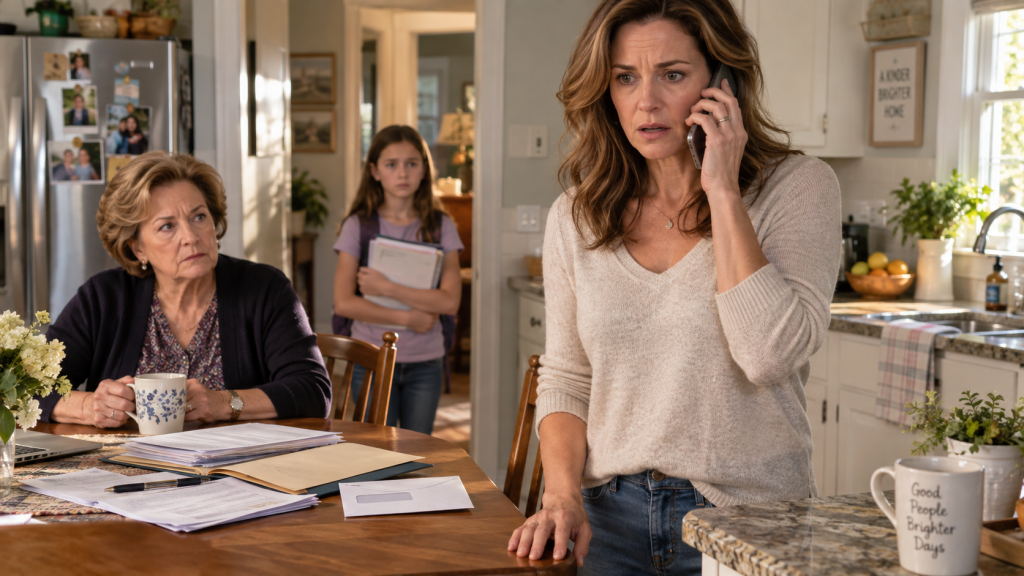
My mother told me at her kitchen table that my brother is moving his family in, so I need to leave by the first. I nodded and washed my cup. Then the title company called about the deed,

and the clerk stopped typing when I told her which one of us has been paying the mortgage on this house for nine years.
“Your brother has three kids,” my mother said. “You have one. It’s what your father would have wanted.”
“Where would you like me to go?”
“You’ll land on your feet. You always do.”
My name is Michelle. I am 44. I have lived in this house with my mother and my daughter since my divorce, and I have never once called it mine.
I endured “your brother needs it more.”
I endured the guest room, at 44, with my daughter on a trundle bed.
I endured my brother’s wife walking through my closet on Thanksgiving “to see if the space would work.”
I endured $1,412 leaving my account on the fifth of every month, for nine years, for a mortgage with my mother’s name on the statements.
I endured my mother telling her church that “Shane helps with the house.”
Shane has never helped with anything but eating.Nine years ago my mother lost her house. I had just gotten my divorce money. Forty-eight thousand dollars.
“Put it down on a place for us,” she said. “We’ll put it in my name for your credit, honey. After the divorce, you know.”
I signed where the man pointed. There were a lot of pages. I was crying that year. I did not read them.
Wednesday night my brother called me.
“Mom says you’re being difficult.”
“I asked where I should go.”
“You’ve lived there free for nine years, Michelle. You’ve been taking from Mom this whole time. Everybody knows it.”
“Taking what?”
“Her house. Her money. Misty says you’ve got her card.”
“I’ve got my card.”
“Sunday we’re all coming over and we’re going to sit down and go through it. All of it. Mom wants it in writing what you owe her.”
“Sunday,” I said. “Fine.”
He hung up first. He always does.My daughter was in the doorway with her homework.
“Is Uncle Shane taking our room?”
“Nobody is taking anything,” I said. “Do your math.”
Thursday morning my daughter texted me from school. “Grandma’s card got declined at the gas station. She says it’s you.”
I have never touched my mother’s card. Somebody has.
Thursday at 10:15 my phone rang at work. A title company. A woman named Ms. Farrow.
“Ms. Dunn? I’m calling about a quitclaim application on the property on Larkin Street. Your brother submitted it Monday. Your mother is transferring the deed to him.”
“That sounds right.”
“It doesn’t, ma’am. That’s why I’m calling. The application lists your mother as the sole owner. I pulled the recorded deed from the closing nine years ago, and I need to ask you something before I go any further.”
“Ask.”
“Who has been paying the mortgage on this house?”
“I have. Every fifth. Out of my account.”
The typing stopped.”Ms. Dunn, do you know what you signed at that closing?”
“My mother said it was for my credit.”
“Ma’am, I’m looking at the deed.”
I stood up from my desk and walked into the hallway.
“Is there a problem with the transfer?”
“There are two names on this deed,” she said. “Neither one is on your brother’s application. And neither one is your mother’s.”
“Two.”
“Two. Grantees. Joint.”
“Whose?”
“Before I tell you, you need to understand what it means. If it’s who I think it is, your brother’s application isn’t just wrong. It’s a false statement on a recorded document, and your mother signed under it. And if the second name is who I think it is, Ms. Dunn, then the person your mother is moving in on the first has known about this deed for nine years. Sunday, when they sit you down, they are not going to be the ones asking what you owe.”
“Read it to me.”
“I’d rather you come in and see it.”
“Read it.”
She cleared her throat. I could hear the paper.
“Grantees, fee simple, joint, recorded the fourteenth of September nine years ago. The first name is.
PART 2 — THE NAME BESIDE MINE
“The first name is Michelle Dunn.”
I stopped breathing.
Ms. Farrow paused.
Then she read the second.
“Shane Dunn.”
For a second, I thought I had misheard her.
The hallway outside my office felt too bright.
Too clean.
People moved past carrying folders and coffee.
Somebody laughed near the copy room.
And there I was, standing against a beige wall, listening to a title clerk tell me that for nine years I had been paying a mortgage on a house my mother repeatedly called hers—
and my name was on the deed.
So was my brother’s.
Not hers.
Mine.
And Shane’s.
“Read that again.”
I said it softly.
Ms. Farrow did.
“Grantees: Michelle Dunn and Shane Dunn.”
I closed my eyes.
“No.”
“It’s what I’m looking at.”
“That doesn’t make sense.”
“Do you remember signing the deed?”
“I remember signing a lot of papers.”
“Did your brother attend the closing?”
My stomach tightened.
“No.”
Then I corrected myself.
“Not the main closing.”
“What does that mean?”
“He came later.”
I had forgotten that until she asked.
Nine years is enough time for memory to sand down details.
That year, everything had felt blurry.
Divorce papers.
My daughter crying at night.
Boxes.
My father already sick.
My mother panicking about losing her old house.
I remembered Shane walking into the title office after I had already been sitting there for almost an hour.
He said he was only there because Dad wanted him to “sign some family thing.”
I never asked what.
I was tired.
That had become the explanation for too many mistakes.
Ms. Farrow said:
“I need you to come in.”
I looked at the clock.
10:23.
“I’m at work.”
“This is worth leaving work for.”
That sentence changed something.
“How serious?”
She paused.
Then:
“Serious enough that I am not processing your brother’s transfer request until ownership is clarified.”
“Can he transfer his half?”
“Potentially, depending on the exact form of title and any restrictions.”
“But not your half.”
I swallowed.
“Mom signed as sole owner.”
“Yes.”
“She isn’t.”
“Not according to this deed.”
I leaned my forehead against the wall.
“So what happens now?”
“We slow everything down.”
Good.
I had never loved a sentence more.
I left work at eleven.
My manager did not argue after I said the words:
“Title problem.”
People understand house problems in the same tone they understand hospital problems.
I drove to the title company with both hands locked on the steering wheel.
At every red light, a memory came back.
My mother saying:
Your brother needs the house more.
Shane saying:
You’ve lived there free for nine years.
Misty opening my closet.
The mortgage deduction.
$1,412.
Every fifth.
One hundred eight payments.
I did the multiplication in my head.
Then stopped.
I already knew the number would hurt.
Ms. Farrow met me in a conference room.
Mid-fifties.
Silver glasses.
Calm voice.
The kind of woman who looked as though she had spent thirty years watching families discover that memories and recorded documents are not the same thing.
She put the deed in front of me.
There it was.
My name.
MICHELLE DUNN
Beside:
SHANE DUNN
The language was technical.
I did not pretend to understand all of it.
Ms. Farrow pointed.
“You and your brother took title together.”
My hands trembled.
“What about my mother?”
“She is not a grantee.”
“Can she still have some kind of right?”
“Possibly through another agreement.”
“Occupancy.”
“Lease.”
“Life estate recorded separately.”
“Something else.”
“But not in this deed.”
Facts.
Good.
I needed them.
“Why would the mortgage be in her name?”
Ms. Farrow looked at the loan file summary.
“Your mother appears to have been the primary borrower.”
“Your father was involved too.”
“My father?”
“Yes.”
My chest tightened.
Dad had died seven years ago.
Two years after we bought the house.
“He wasn’t on the deed?”
“Not as an owner.”
“But he signed financing-related documents.”
I stared.
“Then who put Shane and me on title?”
She gave me the only answer she could.
“The recorded deed says the seller conveyed to both of you.”
“Why was I told it was in Mom’s name?”
“That I can’t answer.”
Of course.
Then she showed me the brother’s application.
Proposed transferor: Margaret Dunn, sole owner.
Proposed transferee: Shane Dunn.
My mother’s signature sat beneath a statement affirming the information was accurate to the best of her knowledge.
I looked at it.
“She signed this Monday?”
“Yes.”
“And Shane submitted it.”
“Yes.”
“Did he attach the deed?”
“No.”
“He attached a property-tax statement showing your mother’s mailing address.”
I almost laughed.
Mailing address.
Not ownership.
Two entirely different things.
Yet if no one checked, maybe the paperwork would have moved farther than it should.
Not completed.
Not yet.
That mattered.
“Why did you check?”
I asked.
Ms. Farrow smiled slightly.
“Because the legal description on his application did not match the county index format.”
“Small thing.”
“Yes.”
“Small things save people.”
She nodded.
Sometimes.
Then she pulled another document.
“Your brother also checked a box saying there were no other known ownership interests.”
I stared.
My stomach turned.
“If his name is already on the deed…”
“Yes.”
“Then he knew.”
“Likely.”
Careful.
Not certainty.
Maybe he had forgotten.
Maybe he genuinely believed the deed had later changed.
Maybe.
But Shane had spent years telling me I lived free in “Mom’s house.”
And now he was trying to receive that house from a woman who did not own it.
The excuses were getting expensive.
I asked:
“Can I get copies?”
“Yes.”
“All of them.”
She slid a release form toward me.
I read every line.
That was new.
Then signed.
On the drive home, I did not call Mom.
Did not call Shane.
Did not call Misty.
I called a real-estate attorney.
Her name was Claire Bennett.
Recommended by a coworker after a boundary dispute.
I said:
“I think my mother is trying to transfer a house she doesn’t own to my brother, who already partly owns it, while I’ve been paying the mortgage.”
Silence.
Then Claire said:
“That is several problems in one sentence.”
“Can you see me today?”
“Yes.”
Bless women who understand emergencies without making them theatrical.
Before the appointment, I stopped at my bank.
I requested nine years of mortgage-payment records.
Not because bank statements magically gave me extra ownership.
Claire would explain that later.
But because if this became an accounting dispute, contributions mattered.
Down payment too.
I found the original cashier’s check in an old digital file.
$48,000.
From my divorce settlement.
Payable into the closing.
My money.
Every dollar.
I sat in my car staring at the image.
For nine years, my mother had told people Shane “helped with the house.”
Maybe he helped by owning half while I financed most of the experience.
Efficient.
Claire’s office smelled like coffee and paper.
She reviewed the deed first.
Then the closing statement.
Then the mortgage records I had brought.
She asked:
“Has your mother been contributing to the mortgage?”
“Not regularly.”
“Taxes?”
“Escrowed.”
“Insurance?”
“Escrowed.”
“Repairs?”
“Some.”
“Who pays most major repairs?”
“I do.”
“Utilities?”
“Split.”
“Your mother pays some.”
“Yes.”
“Your brother?”
I laughed.
Claire wrote something.
“I’ll put that down as no.”
Then she said:
“The first important thing is that deed ownership and financial contribution are related but not identical.”
“I figured.”
“You and Shane are on title.”
“Absent some later transfer I haven’t seen, that means you both have ownership interests.”
“How divided?”
She examined the wording carefully.
“We need the exact jurisdictional effect and any other recorded instruments.”
“I’m not going to guess from one page.”
Good.
I trusted her immediately.
“Second, your mother may have occupancy rights or other interests that aren’t obvious yet.”
“So I can’t kick her out.”
Claire stared.
“Is that what you want?”
“No.”
“Good.”
“She’s my mother.”
“I just don’t want her transferring my house.”
“Also good.”
Then:
“Third, do not stop the mortgage impulsively.”
I nodded.
“Fourth, do not sign anything from Shane.”
“I won’t.”
“Fifth, preserve every text.”
“I have them.”
“Especially where he says you lived free.”
I almost smiled.
“I have that too.”
Claire leaned back.
“Excellent.”
Apparently my brother’s arrogance had become documentation.
I asked the question I had been avoiding.
“Can Mom make me leave?”
Claire answered carefully.
“Not merely because she says so.”
Relief went through me.
Then:
“But we still need to understand occupancy, possession, and the co-ownership structure before anyone makes declarations.”
Fine.
Not revenge.
Information.
I could live with that.
Then my phone buzzed.
Mom.
I let it ring.
She texted:
Gas card declined again. What did you do?
I stared.
Claire noticed.
“Related?”
“Maybe.”
I explained.
My mother believed I had somehow caused her gas card to decline.
She had apparently been telling family that I had access to her finances.
I did not.
Claire frowned.
“Is there a power of attorney?”
“No.”
“Joint bank account?”
“No.”
“Authorized user?”
“No.”
“Then unless you actually touched the account, don’t argue about it.”
“What do I do?”
“Tell her to call the bank.”
Simple.
I texted:
I have not used or changed your card. Call the number on the back.
Mom replied immediately:
You always know how to make me feel stupid.
I stared.
No answer was possible that would not become a new argument.
So I put the phone down.
That evening, my daughter Kayla sat at the kitchen counter doing homework.
Sixteen.
Too observant.
Always.
“Are we moving?”
I looked at her.
“I don’t know yet.”
Her pencil stopped.
“You said nobody was taking anything.”
“I said that because I wanted you to feel safe.”
“Was it true?”
Good question.
“No.”
Her eyes filled.
I hated myself.
“Then don’t do that.”
I sat beside her.
“Okay.”
“What’s actually happening?”
I told her the age-appropriate version.
I may own part of the house.
Uncle Shane may own part.
Grandma apparently does not own it the way we were told.
A lawyer was checking.
We were not moving by the first just because Grandma said so.
Kayla listened.
Then:
“Why does Uncle Shane own part if you paid for it?”
There it was.
The question everyone should have asked nine years earlier.
“I don’t know.”
She nodded.
“Okay.”
No dramatics.
Then:
“Can I finish geometry?”
Teenagers are useful that way.
Mom came home at eight.
She had been at church.
She placed her purse on the table.
Then looked at me.
“You embarrassed me at the gas station.”
I stared.
“I wasn’t there.”
“You know what I mean.”
“No.”
“I actually don’t.”
She sighed.
“The card was declined because there was a hold.”
“Why?”
“They said too many charges.”
My stomach tightened.
“What charges?”
“Groceries.”
“Gas.”
“Things.”
“What things?”
Her face changed.
“Why are you interrogating me?”
“I’m not.”
Then I stopped.
This was not mine to investigate unless she wanted help.
“Did the bank identify charges you don’t recognize?”
Mom looked away.
There.
“Yes?”
“A few.”
“What kind?”
“Restaurants.”
“Online purchases.”
I thought of Shane.
Then immediately stopped myself.
Suspicion is not proof.
“Call the fraud department.”
“I did.”
“And?”
“They’re sending a replacement card.”
Good.
“Then it’s being handled.”
Mom crossed her arms.
“You really didn’t touch it?”
“No.”
She believed me then.
I could see it.
She did not apologize.
Also familiar.
I almost told her about the deed.
Instead, I asked:
“Mom, Sunday is still happening?”
She looked surprised.
“Yes.”
“Shane and Misty are coming.”
“Yes.”
“Good.”
Then I washed the dinner plate in the sink.
Same as I had washed my coffee cup when she told me to leave.
Maybe I was becoming predictable too.
Friday morning, Claire called.
“I pulled additional records.”
My stomach tightened.
“Anything?”
“Yes.”
“Your father signed an affidavit at closing.”
I sat down at my desk.
“What kind?”
“A family-contribution acknowledgment.”
That did not sound standard.
“It isn’t.”
Claire continued.
“Looks like the closing attorney prepared it because the funding and title structure were unusual.”
My pulse changed.
“What does it say?”
“That your forty-eight-thousand-dollar contribution funded the down payment.”
I closed my eyes.
Proof.
Not just memory.
“And?”
“That your father intended ownership to be placed jointly in you and Shane.”
My throat tightened.
“Why?”
“The document says he wanted both children to have an equal long-term interest while the home served as residence for Margaret.”
I stared.
So Dad had done it.
Not Mom.
Not accidentally.
My father.
“Did I know?”
Claire asked.
“There’s a signature from you acknowledging the contribution amount and title structure.”
My stomach dropped.
I had signed it.
Of course.
Crying.
Divorce.
Pages.
I signed.
“That means I agreed?”
“It means you signed a document that disclosed the structure.”
Claire’s voice stayed calm.
“Whether you understood every consequence is another matter.”
I rubbed my forehead.
“And Shane?”
“Also signed.”
There.
My brother knew.
Not probably.
Knew.
Nine years.
“What exactly did Shane acknowledge?”
Claire paused.
Then read:
I, Shane Dunn, acknowledge that Michelle Dunn has contributed $48,000 toward acquisition of the property and that such contribution exceeds any funds contributed by me at closing.
I laughed.
He had contributed zero.
Apparently lawyers prefer “exceeds.”
“What else?”
Claire continued.
I further acknowledge that occupancy by Margaret Dunn does not constitute sole ownership by Margaret Dunn and that any future sale or transfer requires consideration of all recorded ownership interests.
I closed my eyes.
Shane had signed a document saying Mom was not sole owner.
Nine years later, he submitted an application saying she was.
Facts.
Now I had them.
My hands began to shake.
“He knew.”
“Yes.”
“He told me I lived here free.”
“Yes.”
“He knew my name was on title.”
“Yes.”
“He’s known the whole time.”
“Yes.”
That hurt differently than Mom.
Mom could have misunderstood.
Forgotten.
Simplified.
Maybe even convinced herself the house was hers because she lived there.
Shane had signed.
He knew.
Then spent years allowing the family story to become:
Michelle takes.
Shane helps.
“Is there anything else?”
I asked.
Claire became quiet.
“Yes.”
Of course.
“There is another paragraph.”
“What?”
“Your father included a reimbursement provision.”
I stopped breathing.
“What does that mean?”
“It means he anticipated a future sale.”
Claire read:
In the event the property is sold during the joint ownership of Michelle Dunn and Shane Dunn, Michelle Dunn shall first be reimbursed from net proceeds for her documented initial contribution of $48,000, subject to any later written amendment agreed by both owners. Remaining net proceeds shall then be distributed according to ownership interests and applicable law.
I stared at the wall.
Dad.
He knew.
He knew exactly what might happen someday.
Not this.
Maybe something like it.
He had protected the money I put in before anyone divided the rest.
I started crying.
At work.
Quietly.
Not because of forty-eight thousand dollars.
Because my father had seen me.
That year, I had felt like wreckage.
Divorced.
Humiliated.
Back under my parents’ roof emotionally even before we bought the new house.
Mom needed somewhere to live.
Shane had a young family starting.
Everyone needed something.
I wrote the check.
Dad had apparently looked at the whole arrangement and thought:
Michelle should not disappear inside this.
Nine years later, his signature was still trying to keep that from happening.
Claire waited.
Then said:
“There’s more context.”
I laughed through tears.
“Is there ever not?”
“Your father wrote a handwritten note in the file.”
My breath caught.
Not legal magic.
Not a deed.
Just a note.
Claire read:
Michelle is putting in what she has so Margaret has a home. Shane cannot later say this was a gift from Michelle to everyone. Make that clear.
I covered my mouth.
Dad had been dead seven years.
For one moment, he felt closer than my mother sitting in the next room every night.
“Can I get a copy?”
“I already scanned it.”
“Thank you.”
Then Claire said:
“Michelle.”
“Yes?”
“Do not go into Sunday trying to win.”
I almost laughed.
“Why not?”
“Because you already have the documents.”
“Sunday is for information.”
“Ask what they believe.”
“Ask what your mother remembers.”
“Ask why Shane filed what he filed.”
“Let them answer before you show everything.”
That sounded terrifying.
Also smart.
Saturday, Kayla came into my room holding Grandma’s replacement credit-card envelope.
“It was in the mailbox.”
I took it.
“Give it to Grandma.”
“She’s at church.”
“Put it on her bed.”
Kayla hesitated.
“What?”
She held up a printed transaction list.
It had apparently come in the same bank envelope.
I did not want to look.
Then I saw one merchant name.
MISTY’S MARKETPLACE
Misty ran an online resale shop.
My sister-in-law.
I stared.
“Why is Aunt Misty on Grandma’s card?”
I took the paper.
Several charges.
$312.
$198.
$547.
Repeated over months.
Merchant descriptors tied to Misty’s small online business.
Could be legitimate purchases.
Could be reimbursement.
Could be anything.
Do not assume.
Then another line:
SHANE DUNN AUTO PAY
$684.
I sat down.
Interesting.
When Mom came home, I handed her the statement.
“Do you recognize these?”
She frowned.
Then went pale.
“Where did you get this?”
“Bank mailed it.”
“Kayla opened my mail?”
“No.”
“The envelope was open when she handed me the enclosed pages.”
That was true.
Mom stared at the Shane line.
Then at Misty’s business name.
“I gave Shane my card once.”
“For what?”
“Groceries.”
“When?”
“Christmas.”
“Last Christmas?”
She nodded.
“Did you authorize monthly charges?”
“No.”
There.
Not proof of theft yet.
Enough to call the bank.
I gave her the phone.
She called.
This time, I sat beside her.
Not taking over.
Just there.
The bank identified Shane as having used the card information for an autopay tied to an account in his name.
Misty’s merchant charges had been processed through her business storefront.
Mom started crying.
“I thought it was you.”
I said nothing.
Then she whispered:
“I accused you.”
“Yes.”
“I’m sorry.”
It was the first apology she had given me in a long time.
I wanted to say:
It’s okay.
Habit.
I stopped.
“It hurt.”
Mom nodded.
“I know.”
Better.
The bank opened disputes for charges Mom said she had not authorized.
Not all would necessarily be refunded.
There would be review.
Shane would have an opportunity to explain.
Misty too.
Again.
Process.
I was beginning to love process.
It gave truth somewhere to stand while emotions ran in circles.
Sunday came.
At three, Shane arrived with Misty.
And all three children.
Of course.
He brought an accordion folder.
Misty carried a notebook.
Mom had set out coffee.
It looked almost civilized.
Kayla stayed upstairs by choice.
Good.
This was adult business.
Shane sat across from me at the kitchen table.
The same place where Mom told me to leave by the first.
He opened his folder.
“Okay.”
He sounded managerial.
“We need to get this sorted.”
I nodded.
“Agreed.”
Misty smiled tightly.
“Mom wants everything written down.”
“Good.”
Shane pulled out a typed sheet.
“First, we calculated fair-market rent for the nine years you’ve been living here.”
I stared at him.
Mom looked uncomfortable.
“How much?”
He named a number so absurd I almost admired it.
Over one hundred thousand dollars.
Then:
“Minus what you claim you paid on the mortgage.”
Claim.
Interesting.
“And household expenses.”
“Then we can figure out what you owe Mom before you move.”
I folded my hands.
“Anything else?”
Shane looked surprised by my calm.
“Yes.”
“Misty and I will take over the mortgage once we move in.”
“Whose mortgage?”
He frowned.
“Mom’s.”
I nodded.
“Okay.”
Then I asked:
“Shane, who owns the house?”
His face did not change.
“Mom.”
“Are you sure?”
“Yes.”
Misty answered too.
“Yes.”
Mom stared at her coffee.
There.
That mattered.
I looked at Mom.
“Do you believe you own the house?”
She swallowed.
“I thought I did.”
Thought.
Past tense.
Shane looked at her sharply.
“Mom.”
She did not look at him.
Good.
I reached into my folder.
Not the whole thing.
One page.
The deed.
I placed it in the center of the table.
Shane did not touch it.
Misty leaned forward.
“What’s that?”
I looked at my brother.
“You tell her.”
His face had changed.
Finally.
“Shane.”
Misty turned.
“What is it?”
He said:
“An old deed.”
I almost smiled.
“Old?”
“Nine years.”
“Still recorded.”
Silence.
Misty picked it up.
Read.
Then looked at Shane.
“Why is your name on here?”
He rubbed his jaw.
“It was temporary.”
I looked at him.
“Was mine temporary too?”
He glared.
“Michelle.”
“No.”
“Answer.”
He exhaled.
“Dad set it up weird.”
There.
Not denial.
Misty looked at me.
“You own this house?”
“Part of it.”
Then I looked at Shane.
“And so does he.”
Mom whispered:
“What?”
I turned toward her.
She genuinely looked stunned.
That changed something.
“Mom.”
“You didn’t know?”
“I thought Dad put it in my name.”
Maybe true.
Maybe memory.
We would sort that later.
Shane said:
“Dad explained it.”
Mom stared at him.
“To you?”
Silence.
There.
Then I placed the acknowledgment in front of him.
His signature.
Nine years younger.
Still his.
Mom read over his shoulder.
Her face changed line by line.
Margaret Dunn does not constitute sole ownership.
Shane closed his eyes.
Misty whispered:
“You knew?”
He snapped:
“It wasn’t like that.”
I leaned back.
“Tell us what it was like.”
He stared.
No answer.
Misty turned.
“You told me Mom owned it.”
“I thought she basically did.”
“Basically?”
“She lives here.”
I almost laughed.
“Occupation is not title.”
He glared at me.
“Don’t start acting like a lawyer.”
“I hired one.”
That stopped him.
Good.
Then Mom said something I did not expect.
“Why did you have me sign the transfer?”
Shane looked at her.
“Because you wanted us to move in.”
“I wanted you to move in.”
“Yes.”
“I didn’t know I was transferring something I didn’t own.”
His face tightened.
“You knew Dad wanted the house to stay in the family.”
“It is in the family.”
My mother’s voice rose.
“Michelle is family.”
Silence.
That was new.
I looked down before emotion could get me.
Then Misty said:
“Wait.”
She held up the acknowledgment.
“Michelle put forty-eight thousand down?”
Shane said nothing.
I answered.
“Yes.”
Misty stared at him.
“You told me Mom did.”
Another lie exposed.
Not by me.
By paper.
Shane became angry.
“Can everyone stop pretending Michelle is a saint?”
I looked at him.
“Who said saint?”
“You think paying the mortgage means the whole house is yours?”
“No.”
Important.
“I think being on the deed means I’m an owner.”
“And I think paying the mortgage matters in any accounting.”
“But I am not claiming your interest disappears.”
He stared.
Maybe he had prepared for fury.
Reason gave him nowhere to stand.
Then Mom pushed the credit-card statement across the table.
“Explain this.”
Shane froze.
Different problem.
Separate.
Good.
He looked at the autopay.
Then Misty’s merchant charges.
Misty went pale.
“What?”
Mom asked.
“Why is your store charging my card?”
Misty stared at Shane.
Then:
“I didn’t know that was your card.”
There.
Possible.
Shane said:
“I used it for family expenses.”
Mom’s voice sharpened.
“Without asking?”
“You gave me the card.”
“For Christmas groceries.”
“I thought you said I could use it when needed.”
“I did not.”
There was no written permission.
The bank would sort disputed transactions.
I did not need to prosecute the kitchen.
But I watched Mom’s face.
Something fundamental was breaking.
Not because of money.
Because she had believed the wrong child was taking from her.
Shane pointed at me.
“This is what you wanted.”
I stared.
“What?”
“To turn Mom against me.”
“No.”
“You’ve always been jealous.”
I almost laughed.
“Of what?”
He had no answer.
Then he said the ugliest thing possible.
“Dad always felt sorry for you.”
The kitchen went still.
I looked at him.
“He felt sorry for me?”
“Yes.”
“After the divorce.”
“That’s why he put you on the deed.”
Maybe he believed that.
Then I pulled out the handwritten note.
Dad’s handwriting.
Shane read it.
His face drained.
Michelle is putting in what she has so Margaret has a home. Shane cannot later say this was a gift from Michelle to everyone. Make that clear.
No pity.
Recognition.
Shane pushed his chair back.
“This is insane.”
“No.”
I said.
“It’s documented.”
He stood.
Misty did not.
Interesting.
“Sunday’s over.”
Mom said:
“Sit down.”
Shane stared at her.
“Mom.”
“Sit.”
He did.
I had not heard that voice from her since we were teenagers.
Then I placed one final document on the table.
The reimbursement provision.
Misty read first.
Her eyes widened.
“Michelle gets her forty-eight thousand back before proceeds are divided?”
“Under that agreement, subject to the final legal interpretation and any later documents.”
I said it carefully.
Claire had trained me.
Shane rubbed both hands over his face.
Mom whispered:
“Your father did that?”
“Yes.”
She started crying.
Quietly.
“I didn’t know.”
Maybe that was the tragedy beneath everything.
Dad had built safeguards.
Then died.
The rest of us lived inside assumptions.
And Shane, the one person who definitely knew, had let the assumptions benefit him.
I thought Sunday would end there.
It did not.
Because Misty looked at Shane and asked:
“Why were you trying to transfer the whole house if you already owned part?”
He did not answer.
She asked again.
“Why?”
He looked trapped.
Then said:
“Because the lender wanted clean title.”
The room changed.
I sat straighter.
“What lender?”
Shane closed his eyes.
Mom stopped crying.
Misty stared.
“What lender?”
He said nothing.
I felt something cold settle inside me.
“Shane.”
“What lender?”
Finally:
“We were trying to refinance.”
I stared.
“This house?”
“Yes.”
“How much?”
Silence.
Misty whispered:
“Shane.”
“How much?”
He looked at her.
Not me.
“About two hundred thousand.”
Mom gasped.
I did not move.
“For what?”
He said:
“Debt.”
Of course.
Misty looked like she had been struck.
“What debt?”
He turned toward her.
“Not here.”
Her laugh was sharp.
“Where?”
“You brought me to a table to calculate what Michelle supposedly owes your mother.”
“So yes.”
“Here.”
Shane looked away.
And suddenly the transfer application made sense.
Not simply move his family in.
Not simply claim Mom’s house.
He wanted title concentrated.
Clean enough to borrow against.
The house was not shelter.
It was collateral.
I asked:
“Did you already apply for financing?”
He did not answer.
That was enough to worry me.
I looked at the title-company documents.
Then at Claire’s folder.
“Was the quitclaim transfer part of a loan application?”
Shane stared.
Finally:
“Yes.”
My mother whispered:
“You were going to mortgage the house?”
“Refinance.”
He corrected automatically.
Mom’s face hardened.
“On a house you don’t pay for.”
Silence.
Misty asked:
“What debt?”
Again.
Shane snapped:
“Business debt.”
“You don’t own a business.”
He said nothing.
Misty stood.
Her chair scraped the floor.
“What did you do?”
I almost felt sorry for her.
Almost.
Then my phone rang.
Claire.
I answered immediately.
“Hi.”
Her voice was controlled.
“Are you with your family?”
“Yes.”
“Put me on speaker if you’re comfortable.”
I did.
Claire said:
“I just received the complete closing archive from the original title company.”
My heart tightened.
“I thought we had everything.”
“We had the main documents.”
“There was a separate side agreement.”
Shane went completely still.
I saw it.
Claire continued.
“Signed by your father.”
“By Michelle.”
“And by Shane.”
Misty turned toward him.
“What side agreement?”
Claire said:
“It addresses what happens if one co-owner stops contributing to the property but later seeks to force a sale or transfer.”
My pulse increased.
Shane closed his eyes.
He knew this one too.
Claire continued:
“It says Michelle’s documented mortgage payments after closing are to be credited in an eventual owner accounting to the extent permitted by law and not treated as rent unless all owners later agree in writing.”
The room disappeared.
Not rent.
Nine years.
Not free.
Not debt to Mom.
Recorded contribution evidence.
Exactly the opposite of the story Shane had brought to the table.
Then Claire said:
“And there is one more provision.”
My brother whispered:
“Stop.”
Everyone looked at him.
Claire had heard.
“Shane?”
Silence.
She continued anyway.
“The agreement states that before any voluntary transfer of Shane’s interest or any attempt to use the property as collateral, Michelle must receive written notice and an opportunity to object or resolve the ownership issue.”
I stared at him.
He had not forgotten.
He had tried to go around me.
Again.
Then Claire said:
“I also received an attachment to your brother’s recent loan inquiry.”
My stomach tightened.
“What attachment?”
“A copy of this side agreement.”
The room went silent.
Meaning the lender had it.
Meaning Shane had supplied it.
Meaning he had not merely known about the deed nine years ago.
He had used the old file recently.
Read it recently.
Possessed it recently.
And still sat at my mother’s kitchen table telling me I lived there free.
Claire’s voice became very careful.
“There’s a handwritten notation on the copy submitted with the loan package.”
I swallowed.
“What notation?”
“It says:”
She paused.
Then read:
Michelle won’t fight this. Mom has already told her she has to leave. Once she’s out, we can clean up title.
Nobody moved.
I looked at my brother.
He looked back.
And for the first time in my life, Shane did not hang up first.
There was nowhere left to hang up from.
PART 3 — THE HOUSE I FINALLY CALLED MINE
For several seconds after Claire read the handwritten notation from Shane’s loan package, nobody at my mother’s kitchen table moved.
Michelle won’t fight this. Mom has already told her she has to leave. Once she’s out, we can clean up title.
My brother had written that.
Not nine years ago.
Recently.
After reading the same ownership agreement he had spent years pretending did not exist.
After seeing my name beside his.
After seeing Dad’s instructions about my forty-eight-thousand-dollar down payment.
After seeing the paragraph saying my mortgage payments were not rent.
He knew.
And his plan depended on one thing.
Me doing what I had always done.
Leaving quietly when someone said Shane needed the space more.
I looked at him.
“What does ‘clean up title’ mean?”
Shane rubbed both hands over his face.
“Michelle.”
“No.”
My voice stayed calm.
“You brought a folder to this table to calculate what I supposedly owe Mom.”
“You wanted everything in writing.”
“Now we have it.”
I tapped the loan note.
“Explain yours.”
Misty stared at her husband.
“What lender?”
Shane looked at her.
“Mist—”
“What lender?”
Mom sat beside me with one hand pressed against her chest.
A few hours earlier, she had believed Sunday dinner would end with me agreeing to move out before the first.
Now she was learning that the son she intended to move in had been preparing to borrow against the home before his boxes ever crossed the doorway.
Shane exhaled.
“It was a private lender.”
“For what?”
Misty asked.
“I already told you.”
“No.”
“You said business debt.”
She leaned forward.
“You don’t have a business.”
Shane’s jaw tightened.
“I had an investment.”
Misty stared at him.
“What investment?”
The answer took too long.
Two years earlier, Shane and a friend named Colin Mercer had started buying distressed properties.
Not mansions.
Not some secret empire.
Cheap houses.
Tax sales.
Foreclosures.
Places they believed they could renovate quickly and resell.
Shane never formed the business properly.
Never told Mom.
Never told me.
And, judging by Misty’s expression, had told his own wife almost nothing.
He borrowed.
Credit cards first.
Then an unsecured line.
Then personal loans.
Then money from Colin.
One house sold for less than expected.
Another developed foundation problems.
A third sat half-renovated while interest accumulated.
By Sunday afternoon, the total debt associated with Shane’s “investment” and other borrowing was a little under one hundred eighty thousand dollars.
The proposed refinance was for two hundred thousand.
Pay the debt.
Cover fees.
Leave a little cash.
“Breathing room,” he called it.
That phrase sounded familiar.
People like Shane were always one large transfer away from finally being able to breathe.
Usually with somebody else’s lungs.
Misty stood.
Her chair scraped hard across the floor.
“You told me you lost twenty thousand.”
Shane looked at her.
“I didn’t want you to worry.”
She laughed.
One sharp sound.
“You owe almost two hundred thousand dollars and didn’t want me to worry?”
“The houses still have value.”
“Then sell them.”
“One is already under lien.”
“What about the others?”
“Colin controls one.”
“And the third?”
Shane said nothing.
Misty closed her eyes.
“There is no third house anymore, is there?”
No answer.
She turned away.
Sometimes silence is the clearest financial statement available.
Mom whispered:
“You were going to borrow against this house.”
Shane looked at her.
“I wasn’t taking it from you.”
That sentence did something to me.
I had spent nine years paying for a house everyone called my mother’s.
Shane had spent nine years contributing nothing.
Yet he still believed the primary victim in the room was Mom because, in his mind, I barely existed inside the property at all.
Mom said:
“It isn’t mine.”
Her voice broke.
Shane frowned.
“Mom.”
“It isn’t.”
She looked at the deed again.
Then at me.
“It’s theirs.”
“Partly.”
I said.
“We still need Claire to explain the exact ownership and accounting.”
I did not claim more than I knew.
That mattered now.
Truth had already suffered enough from this family.
Claire’s voice came through the speaker.
“Shane, I’m going to strongly recommend that you stop discussing the proposed loan until you have your own attorney.”
He scoffed.
“So Michelle gets a lawyer and suddenly everybody talks to me like I’m a criminal.”
Claire did not react.
“I did not call you a criminal.”
“The loan is not closing.”
That got his attention.
“What?”
“The title company has already declined to process the transfer as submitted because Margaret is not the recorded owner.”
“The lender has also been notified of the ownership discrepancy.”
Shane’s face changed.
“You called them?”
“The title company did its job.”
Claire’s voice remained level.
“Your financing request depends on title and consent issues that are unresolved.”
“So, no.”
“You are not borrowing two hundred thousand dollars against this property next week.”
For the first time all day, Shane looked genuinely frightened.
Not angry.
Frightened.
He turned toward me.
“You did this.”
“No.”
I pointed at his own loan package.
“You did.”
“You could have just signed.”
“I was never asked.”
“You would have said no.”
“Yes.”
His eyes widened, as though my honesty were unfair.
I continued.
“That is why consent matters.”
“You don’t get to decide my answer is inconvenient and write around it.”
Mom looked down at her hands.
Then she asked:
“Were you planning to move me?”
Shane stared.
“What?”
“After the refinance.”
“No.”
“Where would I sleep?”
“With us.”
“Where?”
He looked confused.
“This house.”
Misty turned around.
“With five people?”
“We would make it work.”
Mom looked toward the hallway.
The house had three bedrooms.
Her room.
The room Kayla and I had shared for years.
And a third room Mom had insisted remain ready for Shane’s children when they visited.
Kayla had slept on a trundle beside my bed while an entire bedroom sat empty most nights because:
Your brother has three kids.
I had endured that too.
Never even listed it among the things that hurt.
Some unfairness becomes furniture after long enough.
Mom whispered:
“And Michelle?”
Shane looked toward me.
“She’d move.”
The simplicity of it.
No hesitation.
Like a chair being removed before a larger table arrived.
Something inside Mom changed.
I saw it.
Her shoulders lowered.
Not defeat.
Recognition.
She finally heard the plan without the soft family language around it.
Not:
Shane needs more room.
Not:
His children deserve stability.
Not:
Michelle always lands on her feet.
The plan was:
Michelle goes.
Her money stays in the walls.
Shane moves in.
Then borrows against the property.
Mom stood.
“You need to leave.”
Shane stared.
“What?”
“Not forever.”
She was shaking.
“But today.”
“Mom.”
“I said leave.”
His face reddened.
“This is Michelle turning you against me.”
Mom’s voice rose.
“No.”
Everyone stopped.
She had not raised her voice at Shane in years.
“Michelle did not use my credit card.”
“You did.”
“You had me sign papers for a house that isn’t mine.”
“You told me you were moving your family here because you needed room.”
“You did not tell me you were trying to borrow two hundred thousand dollars.”
Shane stood too.
“I was going to pay it back.”
Mom laughed bitterly.
“With what?”
He had no answer.
Then she said the sentence I never expected to hear.
“Your sister has been paying for the roof over my head for nine years.”
Shane’s face changed.
Mom continued.
“And I let people think you were helping.”
There it was.
I looked at her.
So did Misty.
Shane stared.
“What?”
Mom turned toward me.
Tears filled her eyes.
“I told people Shane helped because I was embarrassed.”
My throat tightened.
“Embarrassed about what?”
“That my daughter was paying the mortgage.”
The room went quiet.
Mom sat again.
“I was supposed to be the mother.”
She whispered.
“Your father died.”
“You were divorced.”
“You had Kayla.”
“And every month, the payment came from you.”
She wiped her face.
“At church, women would ask how I was managing.”
“I didn’t want to say my daughter was carrying me.”
“So I said both my children helped.”
I stared.
“And when Shane didn’t?”
She looked down.
“I kept saying it.”
“Long enough that maybe I started needing to believe it.”
That hurt.
But not the way I expected.
Not because she had praised Shane.
Because she had turned my support into something shameful enough to hide.
I said:
“You could have just said I helped you.”
Mom nodded.
“I know.”
“Why was that embarrassing?”
She started crying harder.
“Because you had already been through so much.”
I laughed once.
“Mom, I was not ashamed of helping you.”
“You were.”
“No.”
“I was tired.”
“That is not the same thing.”
Shane grabbed his folder.
“This is pointless.”
Misty did not move.
He looked at her.
“Let’s go.”
“No.”
He froze.
She folded her arms.
“I’m staying.”
“Misty.”
“You lied to me too.”
His face hardened.
“We’ll talk at home.”
“We are talking now.”
Their children were in the backyard.
Thank God.
Some adult failures should not be presented as family entertainment.
Misty pointed toward the credit-card statement.
“Did you use Margaret’s card for charges through my store?”
Shane said nothing.
Her expression changed.
“You told me those were your corporate cards.”
“I reimbursed things.”
“With her money?”
“I was going to settle everything once the refinance closed.”
There it was again.
Future money used to justify present behavior.
Misty looked at Mom.
“I didn’t know those charges were yours.”
Mom’s face remained guarded.
“I believe you didn’t know all of it.”
Not absolution.
Fair.
Misty nodded.
“I’ll give the bank whatever records they ask for.”
Good.
Then she looked at Shane.
“You go.”
He stared at all of us.
One by one.
Nobody rescued him.
So he left.
And for once, he did not hang up first.
He had to walk out.
The weeks afterward were less satisfying than Sunday.
That is the part revenge stories skip.
Paperwork.
Statements.
Attorneys.
Appraisals.
Account histories.
Bank fraud forms.
Mortgage records.
There was no morning where I woke up and suddenly owned everything because my brother lied.
Shane remained an owner.
So did I.
Mom remained the borrower on the mortgage and occupant of the home.
The lender had rights.
The side agreements mattered.
My contributions mattered.
Shane’s lack of contributions mattered.
The exact legal accounting required professionals.
It took months.
Good.
I no longer wanted quick answers.
Quick answers were how I signed things while crying nine years earlier.
The title company formally rejected Shane’s attempted transfer from Mom because she had no ownership interest to convey.
Nothing had been recorded.
No deed changed.
No loan funded.
No lien from Shane’s proposed refinance attached to the house.
Those details mattered more to me than any fantasy about catching him at the last second.
We had caught it before damage became harder to undo.
That was enough.
The bank investigated Mom’s disputed card charges.
Some were clearly tied to Shane’s accounts.
Some to purchases processed through Misty’s business.
Misty provided records.
The picture became more boring and more believable than the conspiracy I had feared.
Shane had used Mom’s card number for expenses he called “temporary family borrowing.”
Groceries sometimes.
Gas.
A car payment.
Shipping costs.
A few purchases through Misty’s storefront to generate inventory and cash flow.
Misty had known money was moving.
She had not known Margaret’s card was the source for every transaction.
That did not make her spotless.
She had benefited.
But she had not secretly stolen the card herself.
The bank credited some disputed charges after its review.
Others became part of a repayment agreement between Mom and Shane.
Mom did not ask me whether she should forgive him.
Good.
I would not have known what to say.
The house accounting was harder.
Claire hired a real-estate accounting specialist.
We gathered everything.
My forty-eight-thousand-dollar down payment.
Nine years of mortgage payments.
Not treated as nine years of pure equity, because mortgage payments include interest, taxes, insurance, and other components.
I learned more about amortization than any sane woman should.
We documented principal reduction.
Repairs.
A new water heater.
Roof work.
Plumbing.
The year the air conditioner died during July and I put six thousand dollars on a card because Mom was recovering from pneumonia.
We documented Mom’s contributions too.
Utilities.
Some repairs.
Household expenses.
And Shane’s.
Almost nothing connected directly to the house.
A few hundred dollars for paint one summer.
A pressure washer he took home afterward.
Claire declined to count that as a gift to civilization.
The house was appraised.
$426,000.
The mortgage balance was a little over $118,000.
For the first time, I understood what nine years of payments had built.
Not simply shelter.
Equity.
Slow.
Unexciting.
Real.
Shane saw the appraisal and suddenly became interested in fairness.
Of course.
His attorney argued that he held an equal ownership interest under the deed.
Claire did not deny that the deed gave him a real interest.
Good.
We were not rewriting documents just because he had behaved badly.
But the side agreements required my initial contribution to be addressed first and provided for an accounting of my later documented payments.
The lawyers disagreed over exactly how much credit should apply.
So we mediated.
One long day.
Bad coffee.
Four separate rooms.
Nobody dramatic enough to smash a table.
Thank God.
Shane wanted cash.
He had creditors.
Misty had filed for separation by then.
Not because I told her to.
Because financial secrets have a way of making spouses reevaluate other promises too.
She took the kids to her sister’s for several months.
Shane’s property venture collapsed.
Colin sold one remaining asset.
There was not enough to clear everything.
The two hundred thousand against our house had been his hoped-for rescue.
It never arrived.
During mediation, Shane said:
“Michelle gets everything.”
I almost laughed.
I was sitting in the next room, but Claire carried the message.
“What does he think I get?”
“The house.”
I looked around the mediation office.
“I get a mortgage.”
Claire smiled.
“Yes.”
“I get to buy him out.”
“Yes.”
“I get to continue supporting Mom.”
“Yes.”
“And refinance closing costs.”
“Yes.”
“What does he think ‘everything’ means?”
“Possibly walls.”
Fair.
By late afternoon, we had an agreement.
Not perfect.
Real.
The forty-eight thousand would be credited according to Dad’s written agreement.
My documented mortgage and capital contributions would be accounted for at the negotiated amount our lawyers and mediator reached.
Shane would receive a buyout reflecting his recognized ownership interest after those agreed credits, the mortgage, and closing adjustments.
He got less than he had imagined when he first decided the whole house could somehow become his.
He got more than the angry part of me wanted him to have.
That is how I knew the number was probably fair.
I refinanced.
In my name.
My credit, nine years after the divorce everyone once claimed made my name unsuitable.
Turns out nine years of steady employment and actual payment history do interesting things to credit scores.
The mortgage became mine.
The deed became mine.
Solely.
Not because I stole Shane’s half.
Because I bought it.
Properly.
Signed.
Recorded.
Reviewed by my lawyer.
Every page.
Twice.
When Ms. Farrow at the title company called after recording, she said:
“Congratulations, Ms. Dunn.”
I laughed.
“For what?”
“You now hold title individually.”
I sat at my desk.
The same workplace hallway where she had first told me my name was already on the deed.
I thought I would feel triumphant.
Instead, I felt tired.
Then peaceful.
“Thank you.”
Before hanging up, she said:
“And for the record, you read every page this time.”
“I annoyed everyone.”
“Excellent.”
That was enough celebration.
Mom remained in the house.
That surprised Shane.
Maybe some relatives too.
People assumed once I “won,” I would put her out.
Why?
Because that was what she had tried to do to me?
I did not want revenge organized around imitation.
We created a written occupancy agreement.
Simple.
Clear.
Mom could remain as long as she wanted, subject to ordinary household responsibilities we agreed on.
No secret ownership.
No future promise to Shane.
No “everybody knows.”
Just paper.
Mom read every page.
So did I.
Then we signed.
The night after the refinance closed, Mom came into my room.
My room.
Still the guest room.
Still shared with Kayla’s trundle.
She stood in the doorway.
“You know this is ridiculous.”
I looked up from a book.
“What?”
“You sleeping in here.”
I almost smiled.
“It has been ridiculous for nine years.”
She winced.
Fair.
Then:
“Kayla should take the third bedroom.”
I closed the book.
“The one you kept ready for Shane’s kids?”
Mom looked ashamed.
“Yes.”
I waited.
She continued.
“And you should take mine.”
“No.”
She looked surprised.
“Why?”
“Because it’s your room.”
“But this is your house.”
There it was.
The phrase I had never said.
Your house.
I felt something shift.
“We can figure out rooms without punishing anyone.”
I said.
The third bedroom became Kayla’s.
Finally.
Sixteen years old and her first bedroom in that house that did not roll underneath someone else’s bed during the day.
She painted one wall green.
A terrible green.
I said nothing.
The freedom to choose ugly paint is one of the purest forms of homeownership.
I moved a desk into the small den and eventually converted part of it into a bedroom space for myself while we planned a modest addition the following year.
No one was displaced.
No grand renovation.
We made the house fit the people actually living in it.
Novel concept.
The first night Kayla slept in her own room, she stood in the doorway.
“Is Uncle Shane mad?”
“Probably.”
“Is Grandma mad?”
“No.”
“Are you?”
“At whom?”
“Everybody.”
I thought.
“Less than I was.”
She nodded.
Then asked:
“Are we staying?”
“Yes.”
“For real?”
“Yes.”
Her shoulders dropped.
Only then did I understand how frightened she had been.
Teenagers can continue geometry while wondering where they will sleep next month.
Children are efficient like that.
Too efficient.
Mom and I had our real conversation weeks later.
Not during the crisis.
After.
Saturday morning.
Coffee.
Same kitchen table.
Of course.
Families apparently only tell the truth near appliances.
She said:
“I favored Shane.”
No introduction.
I looked at her.
“Yes.”
She winced.
“I thought you might argue.”
“What would be the point?”
She stared into her coffee.
“I always told myself he needed more.”
“He did sometimes.”
“Three children.”
“Unstable work.”
“Misty stayed home for a while.”
“And you…”
She paused.
“Always managed.”
I laughed quietly.
“There it is.”
She looked up.
“You’ll land on your feet.”
I said.
Mom began crying.
That was the sentence she had used when asking me to leave.
I continued.
“Do you know what it feels like to be the child everyone believes will land on her feet?”
She shook her head.
“It means nobody catches you.”
Her face collapsed.
“It means when there is one bedroom left, it goes to Shane’s children because Michelle will understand.”
“When there is one person who can make the mortgage, Michelle will manage.”
“When Shane has debt, Michelle can move.”
“When something goes missing on your card, Michelle must have done it because she’s the one nearby.”
My voice shook.
“I kept landing because you kept pushing.”
Mom covered her mouth.
I let myself cry too.
For once, I did not clean up the sentence to make it easier for her.
“I’m sorry.”
she whispered.
I nodded.
Not enough.
Still necessary.
She continued.
“Your father used to tell me I did that.”
My chest tightened.
“What?”
“He said I confused competence with not needing care.”
Of course Dad had seen that too.
“He said Shane learned very young that if he needed enough, someone would rearrange the room for him.”
I almost laughed.
“That sounds like Dad.”
Mom smiled through tears.
“Yes.”
“Why didn’t anything change?”
Her answer was honest.
“Because I liked being needed.”
That surprised me.
She stared at her hands.
“Shane needed money.”
“Help.”
“Food.”
“Advice.”
“You rarely asked.”
“And I told myself that meant you didn’t need me.”
There.
The tragedy.
I had become self-sufficient enough to disappear emotionally inside my own family.
“I needed a mother.”
I said.
“I just didn’t need one to pay my bills.”
Mom cried harder.
“I know.”
“No.”
I shook my head.
“You know now.”
The same distinction I had used with Shane.
Truth has timing.
We cannot pretend late knowledge lived inside us all along.
Mom nodded.
“Now.”
Good.
Our relationship changed after that.
Not magically.
She still defended Shane sometimes.
Then caught herself.
I still became defensive whenever she said:
“Your brother…”
Then tried to listen before reacting.
We learned new habits badly.
That is still learning.
Mom stopped telling church that Shane helped with the house.
One Sunday she introduced me to a woman from her Bible study.
“This is my daughter Michelle.”
The woman smiled.
“Oh, you’re the one who saved the house years ago.”
I looked at Mom.
She looked embarrassed.
Then said:
“She did more than that.”
Not perfect.
Enough.
Shane and I did not become close.
People asked.
Especially Mom.
For the first year, our communication was limited to practical things.
Repayment.
Documents.
Family emergencies.
He entered a debt-management arrangement.
Sold what he could.
Went back to steady employment.
Misty eventually divorced him.
I was sad for their children.
Not surprised.
The credit-card issue was resolved through repayment and the bank’s process.
No dramatic prison.
No brother in handcuffs at Thanksgiving.
Just debt.
Consequences.
A marriage ending.
Trust gone.
Sometimes that is more than enough.
Two years later, Shane apologized.
Not at Mom’s birthday.
Not in front of everyone.
He called first.
Asked if he could come by.
I said yes.
We sat on the porch.
He looked older.
Humility ages some people.
He said:
“I knew about the deed.”
“I know.”
“I knew about the forty-eight thousand.”
“I know.”
“I knew you were paying the mortgage.”
“I know.”
Each sentence stripped away another excuse.
Then:
“I let Mom think you were living there because she allowed it.”
My eyes filled.
“Yes.”
“Why?”
He stared at the yard.
“Because if I admitted you were an owner, I had to admit I was benefiting from something you paid for.”
Honest.
Continue.
“I kept thinking Dad meant for both of us to have half, so the payments didn’t matter.”
I said:
“Dad literally wrote that they mattered.”
“I know.”
“Now.”
Shane almost smiled.
Fair.
Then he said:
“When the debt got bad, I started seeing the house as the only thing that could save me.”
There it was.
Not home.
Asset.
Rescue.
“I thought if Mom got you out, you’d eventually sign whatever needed signing because you hate conflict.”
I looked at him.
“You were right about who I used to be.”
He nodded.
“That’s the worst part.”
“I’m sorry.”
He said it plainly.
No:
But I was desperate.
No:
You have more.
No:
Three kids.
Just:
“I’m sorry I treated being your brother like it entitled me to whatever you could survive losing.”
That sentence reached me.
I did not hug him.
I did not say we were fine.
I said:
“Thank you.”
That was enough for that year.
Dad’s handwritten note lives in my desk now.
Not framed.
I considered framing it.
Then decided against it.
My father would have hated becoming decor.
But sometimes I take it out.
Michelle is putting in what she has so Margaret has a home. Shane cannot later say this was a gift from Michelle to everyone. Make that clear.
He had.
We were the ones who spent nine years making it unclear.
The paper waited.
Patient.
Truth can be like that.
Quiet until someone finally reads it.
Kayla left for college two years after I refinanced.
The night before she moved into her dorm, she stood in her green bedroom surrounded by boxes.
“Should I repaint?”
I frowned.
“Why?”
“So you can use the room.”
“It’s your room.”
“I’m leaving.”
“For college.”
“You’re allowed to come back.”
She smiled.
“Grandma says people who leave need to make space for the people who stay.”
I stared.
Then Kayla laughed.
“I’m joking.”
“Not funny.”
“A little.”
I threw a pillow at her.
She ducked.
Normal.
Beautifully normal.
After she left, I did not turn her room into an office.
Mom asked once.
I said:
“Not yet.”
She nodded.
No argument.
Sometimes growth is simply not repeating the sentence.
Three years after Sunday, Mom’s health began to change.
Nothing catastrophic.
Arthritis.
A minor heart issue.
Driving became harder at night.
One afternoon, she sat at the kitchen table and said:
“I think I need more help.”
My old instincts activated.
I can do it.
I’ll handle it.
I’ll rearrange work.
I’ll land on my feet.
Then I stopped.
“What kind of help?”
Mom thought.
“I don’t know.”
So we figured it out together.
Not automatically me.
A home-health aide twice a week.
Grocery delivery.
Rosa from church drove her to some appointments.
Shane took Thursday afternoons when his work schedule allowed.
He actually showed up.
Consistently.
Interesting what people can learn when rescue stops being automatic.
One evening, after Shane left, Mom said:
“He helps now.”
I smiled.
“Yes.”
Then she added:
“And so do you.”
No hierarchy.
No correction.
Two children.
Different contributions.
That may have been the sentence she should have said nine years earlier.
We got it eventually.
The house changed too.
We replaced the old porch railing.
Painted the kitchen.
Fixed the cracked tile Mom had covered with a rug for years.
Nothing extravagant.
I paid attention to every receipt.
Not because I expected another fight.
Because clarity became a form of peace.
When the mortgage balance dropped below fifty thousand, I took a screenshot.
Sent it to Kayla.
She replied:
nerd
I saved that too.
Then, nine years and eight months after Ms. Farrow first called me, I made the last mortgage payment.
I was fifty-four.
Mom was sitting at the kitchen table.
Of course.
Kayla was home for the weekend.
I clicked submit.
The screen displayed:
Payment received.
I stared.
Mom said:
“That’s it?”
“That’s it.”
She started crying.
Kayla groaned.
“Why is everybody crying about banking?”
I laughed.
“You’ll understand someday.”
“I hope not.”
Fair.
A month later, the lender mailed the final satisfaction paperwork.
I read everything.
Twice.
Then filed it with the deed.
My deed.
That still felt strange.
Not selfish.
Not guilty.
Mine.
For years, I had refused to call the house mine because I thought doing so would somehow take something from Mom.
Then I learned ownership and love were not opposites.
I could own the walls and still share the home.
I could let Mom stay without pretending she owned what she did not.
I could give without disappearing from the gift.
That may have been the biggest thing Dad tried to protect in those old closing papers.
Not money.
Me.
One Sunday, Shane came with his children.
Misty brought them later for cake.
Yes, Misty too.
Divorce had not turned every holiday into a battlefield.
Another miracle.
We ate at the kitchen table.
The same one.
Always the same one.
One of Shane’s sons asked:
“Grandma, is this your house?”
Everyone became quiet.
Mom looked at me.
Years earlier, she would have said yes automatically.
Instead she smiled.
“No.”
Then she pointed toward me.
“It’s Aunt Michelle’s house.”
The boy shrugged.
“Okay.”
Children are wonderfully unimpressed by property law.
Then Mom added:
“But she lets me live here.”
I smiled.
“No.”
Mom looked confused.
I corrected her gently.
“You live here because we agreed you do.”
Not:
I let you.
Important.
Mom understood.
She smiled.
“Right.”
Then asked who wanted pie.
That was all.
No ceremony.
The sentence had finally found its proper size.
That night, after everyone left, I washed my coffee cup.
The exact same ordinary motion I had made years earlier when Mom told me I needed to leave by the first.
She was sitting at the table.
Older now.
Softer.
She said:
“Do you remember that day?”
“Yes.”
“I told you that you’d land on your feet.”
I dried the cup.
“Yes.”
She looked ashamed.
“I hate that sentence.”
I thought about it.
“I don’t.”
She looked surprised.
“Why?”
“Because I did.”
Then I set the cup down.
“But now nobody gets to use that as a reason to push me.”
Mom’s eyes filled.
She nodded.
“That’s fair.”
I walked through the house before bed.
Kayla’s room.
Empty tonight.
Mom’s door half open.
The hall light glowing.
The mortgage paid.
No boxes waiting.
No sister-in-law measuring closets.
No brother planning loans against walls he did not maintain.
Just a house.
My house.
I finally allowed myself to think the words without immediately apologizing to someone in my head.
My house.
Not because nobody else belonged there.
Because I did.
That was the part I had forgotten for nine years.
I belonged inside the things I built too.
Dad had tried to write that lesson into a closing file when I was too broken to read it.
It took me nearly a decade to understand.
Helping family does not require erasing your name from the help.
Being dependable does not mean being disposable.
Being the child who survives does not make you the child who should always surrender.
And love is not proven by how much of yourself you can lose before finally saying no.
I had paid the mortgage every fifth of the month for nine years while everyone called it Mom’s house.
Then my brother tried to make it his.
The title company called.
The paper spoke.
And eventually, so did I.
This time, nobody told me where I should go.
Because I had finally understood something my father knew before I did:
I had already paid dearly for the right to have a place in that home.
And I was done being the only person expected to leave it.
THE END STORIES! THANK YOU FOR READING GOOD LUCK !❤️
Related Posts