When I told my wealthy son that I was $3,200 short for an urgent medical procedure, he had just completed a $12 million deal—but he lowered his voice and said, “I can’t help you, Dad.” That evening, my daughter came to the house with $2,000,

nearly every dollar she had managed to save, and told me softly, “We’ll figure out the rest together.” I thanked her, made one private phone call, and signed a document neither of my children knew existed. Four days later, my son rushed into my hospital room demanding that I undo what I had done—but the man sitting beside my bed opened an old folder, and my son stopped before finishing his sentence…
The $3,200 balance had been circled twice on the estimate from the medical center near the Grand Parkway. I was fifty-eight years old, still working six days each week at a distribution warehouse, and most of the money I had saved was already gone because of tests, prescriptions, and the mortgage.
The billing coordinator explained that the procedure could be scheduled, but I first needed to arrange the remaining deposit.
She spoke kindly.
Somehow, that made the amount feel even heavier.
I drove home, placed the estimate on the kitchen island beside an overdue utility bill, and called my son Richard.
He answered from a steakhouse. I could hear glasses clinking behind him, followed by laughter and people congratulating him.
“Dad, can we talk tomorrow? We just closed the biggest deal of my career.”
“I only need one minute.”
I explained the medical procedure, the deadline, and the amount I still needed.
Richard listened without interrupting.
For a moment, I actually thought he might be opening his banking app.
Then his tone shifted.
“I can’t do this, Dad.”
“It’s thirty-two hundred dollars.”
“I heard you.”
“You just told your mother about a twelve-million-dollar deal.”
“That money is connected to my future. Ask the hospital if they can work out another payment option.”
The noise from the restaurant filled the phone again.
Then the call ended.
My wife Caroline had been standing near the refrigerator the whole time.
Earlier that evening, she had proudly told three relatives and someone from church how much Richard’s deal was worth.
When I asked her to speak to him, she crossed her arms.
“Please don’t turn his celebration into another family issue.”
“I’m trying to arrange a medical procedure.”
“Melissa has a steady job. Ask her.”
Melissa was twenty-six and worked as a fourth-grade teacher. Her salary paid for a small apartment, student loans, groceries, and an old Civic that seemed to need another repair every few months.
Richard drove a new Audi and lived downtown in a building with its own private garage.
Even so, Caroline pushed the estimate toward me as though our daughter were the logical person to ask.
I never called Melissa.
She arrived forty minutes later carrying a foil pan of chicken and rice.
She noticed that my coffee hadn’t been touched, then saw the medical estimate beneath my hand.
“Why didn’t you tell me?”
“Because this isn’t your problem to fix.”
She read the page silently.
Then she sat down across from me, opened her worn canvas purse, and placed a soft white envelope on the table.
“There’s two thousand dollars in there.”
I pushed it toward her.
“No.”
She slid it back.
“It’s almost everything I’ve saved, but my rent is already covered.”
“You need this money more than I do.”
“No, Dad. I need you more than I need the money.”
The entire kitchen fell silent.
Even Caroline turned her eyes away.
Melissa reached across the table and wrapped her hand around mine.
“We’ll find the rest together.”
The next morning, she went to a used-car dealership near the school where she taught.
When she came back, the Civic was gone.
She placed the final payment receipt beside my medical estimate and tucked a city bus schedule into her purse.
“Cars can be replaced,” she said. “You can’t.”
I kept hearing that sentence long after she left.
For ten years, my family had blamed me for sixty acres of property outside Rosenberg that became unusable after an environmental problem was discovered on neighboring land.
My financing vanished.
My business collapsed.
I started working shifts at the warehouse simply to keep the bills paid.
Five years earlier, Richard had encouraged Caroline to separate her finances from mine.
She kept the house, her retirement account, and everything associated with both.
I accepted the land, the taxes, and every responsibility tied to it.
Richard had described the agreement as “smart protection.”
I continued paying the property taxes anyway.
That night, after Melissa had gone home, I noticed a certified envelope buried beneath the rest of the mail on the kitchen counter.
Inside was the notice I had been waiting almost ten years to receive.
The restrictions placed on the property had officially been lifted.
There was another letter from Cornerstone Golf Development.
A newly built highway interchange had changed the value of the entire surrounding area, and the company wanted to purchase my sixty acres for a large private development.
Their preliminary offer was printed on the first page.
$15 million.
I read the number three times.
Then my eyes shifted to the bus schedule Melissa had left beside the receipt from the hospital.
Richard had millions connected to his latest business deal and protected every dollar.
Melissa had only two thousand dollars and had given me almost all of it.
I stepped onto the front porch and called Larry Foster, the property attorney who had kept copies of my old documents.
“Larry, I need you to find the agreement Caroline signed five years ago.”
I heard him typing.
“Is this about the Rosenberg land?”
“Yes.”
“Did something happen?”
“Everything changed.”
Larry called me again twenty minutes later.
“Boris, do Richard and Caroline know about the development offer?”
“No.”
“Don’t tell them anything yet. There’s wording in the old agreement we need to examine very carefully.”
The following morning, Larry met me in a quiet consultation room near the hospital lobby.
He carried a leather folder containing the original agreement, several ownership documents, and one new document he had prepared during the night.
He pointed to a paragraph Richard himself had insisted on adding five years before.
“This sentence could determine everything,” he said.
Then he turned to the new document.
I read every page.
I wrote Melissa’s name wherever Larry instructed.
Then I signed.
A notary completed the last section before Larry placed all of the papers back inside the folder and sealed it.
“Once this is officially recorded, changing it back would require more than simply changing your mind,” he said.
“That’s exactly how I want it.”
Melissa remained beside me through the procedure.
Caroline’s chair stayed empty.
Richard sent a short message asking if I had “worked out the payment issue,” but he never once asked how I was doing.
When I woke later, late-afternoon sunlight was coming through the blinds.
The doctor told me the procedure had gone exactly as planned.
Larry was sitting near the window with the leather folder resting on his knees.
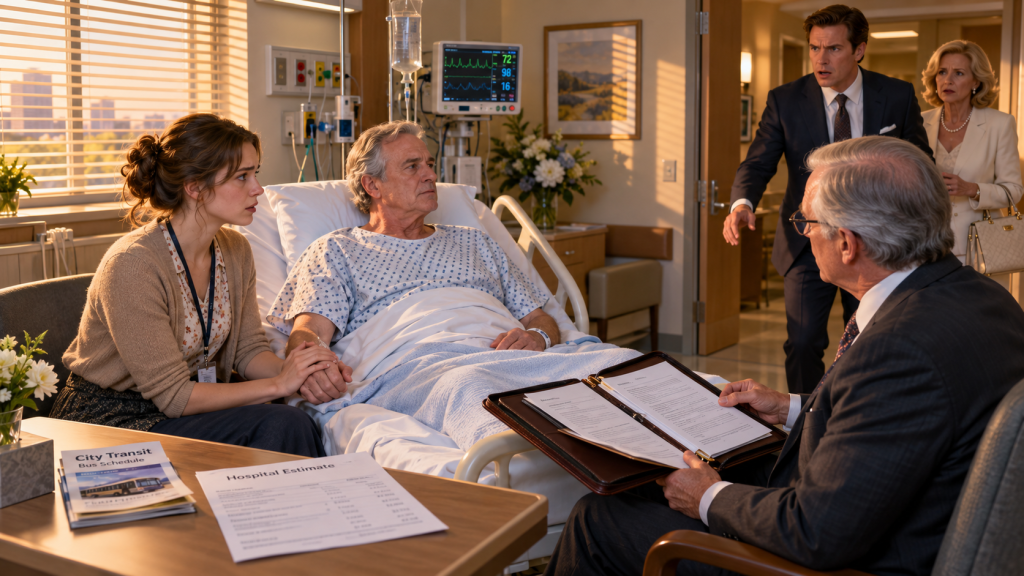
Four days after my first call to Richard, the hospital-room door suddenly opened.
Richard walked in quickly, with Caroline directly behind him.
His phone was already in his hand, displaying a property notice that one of his business contacts had forwarded to him.
“You transferred the land,” he said. “Tell me you haven’t finalized anything.”
Neither of them asked about my procedure.
Neither one even looked at Melissa, who was sitting beside me.
Caroline stepped closer.
“That property affects the entire family. Whatever you signed needs to be reconsidered.”
Richard nodded.
“We can have the documents reviewed before anything goes any further.”
“You had the chance to help this family four days ago,” I said.
“This is different.”
“You’re right. Melissa had two thousand dollars. You had access to much more than that. Only one of you asked what I needed.”
His gaze dropped toward the city bus schedule lying on my bedside table, then quickly returned to my face.
“That doesn’t determine who has rights to the property.
PART 2 — THE CLAUSE RICHARD FORGOT HE WROTE
“That doesn’t determine who has rights to the property,” Richard said.
He spoke quickly.
Confidently.
The way he spoke in conference rooms when he believed the room already belonged to him.
I looked at my son from the hospital bed.
Four days earlier, I had asked him for $3,200 to help cover a medical procedure.
He had refused.
Not because he was unable.
Because he had decided his future mattered more than my immediate need.
Now, somehow, my future had become valuable.
And suddenly he had found the time to show up.
Caroline stood beside him with her handbag still hanging from one shoulder.
Neither of them had asked whether the procedure had worked.
Neither had asked how much pain I was in.
Richard’s first question had been about land.
Caroline’s first concern had been whether papers could be undone.
Melissa sat quietly in the chair beside my bed.
Her old Civic was gone.
The bus schedule remained folded on the table.
Larry Foster slowly opened the leather folder on his lap.
“I think this is the part where everyone should sit down.”
Richard looked at him.
“And you are?”
“Larry Foster.”
“I know who you are.”
Richard’s jaw tightened.
“You handled Dad’s property agreement.”
“I did.”
“Then you know this land was part of the family assets.”
Larry adjusted his glasses.
“No.”
Just one word.
Calm.
Almost gentle.
But the entire room changed.
Caroline frowned.
“What do you mean, no?”
Larry removed a yellowing document from the folder.
“The Rosenberg property was originally acquired solely by Boris before your financial separation agreement.”
“Yes,” Richard said impatiently. “But it was still part of the marital estate.”
“It could have been.”
Larry looked directly at him.
“But it wasn’t.”
Richard’s expression changed.
Only slightly.
He was beginning to remember something.
Larry continued.
“Five years ago, when the environmental restrictions made the land nearly impossible to finance or sell, you were concerned that any liability connected to it might affect your mother.”
“That was reasonable.”
“It was.”
Larry nodded.
“You insisted the agreement be revised to create a complete separation between Caroline and the property.”
Caroline looked at Richard.
He looked at the floor.
Larry turned one page.
“You specifically requested language stating that Boris would retain all title, liabilities, taxes, assessments, environmental obligations, future legal costs, and—”
He paused.
“Any increase or decrease in value.”
Silence.
I watched recognition arrive on Richard’s face.
Not all at once.
Slowly.
Like a man watching an old door close from the wrong side.
Larry slid the document across the small hospital table.
“There.”
His finger rested beneath a paragraph.
Richard did not pick it up.
Caroline did.
Her eyes moved across the page.
Once.
Then again.
“This says I waived…”
Her voice faded.
Larry completed the sentence.
“Any present or future interest in appreciation, sale proceeds, redevelopment rights, mineral rights, leasing revenue, condemnation awards, or other financial benefits arising from the property.”
Caroline looked at me.
“You let me sign that?”
I almost laughed.
The question hurt too much to become humor.
“Caroline.”
My voice was quiet.
“You asked me to.”
“No.”
“Yes.”
I remembered the day perfectly.
Richard had been sitting at our kitchen table with three spreadsheets and a legal pad.
The environmental issue had just become public.
Banks had frozen financing.
My small development company was collapsing.
I had spent twenty-six years building it.
Three months were enough to break it.
Richard was thirty at the time.
Already successful.
Already certain.
“Dad,” he had said, “you need to isolate the toxic asset.”
Toxic asset.
Not land.
Not the sixty acres where I had once planned a small commercial center.
Not the property I had borrowed against.
Not the thing I had spent years paying taxes on.
A toxic asset.
Caroline had been frightened.
I understood that.
The house was nearly paid off.
Her retirement account was healthy.
Richard convinced her that one bad judgment from a neighboring environmental claim could swallow everything.
So I signed.
I gave Caroline the house.
Her retirement funds.
Savings.
Most of the liquid investments that remained.
I kept the land.
The debts.
The taxes.
The lawsuits.
And the shame.
At the time, Richard called it smart protection.
He told me repeatedly:
“You can rebuild later.”
Apparently, later had arrived.
Caroline lowered the paper.
“That agreement was based on the property being worthless.”
Larry shook his head.
“No.”
“It was based on the property being risky.”
“That is not the same thing.”
Richard stepped forward.
“Fine.”
His voice had lost some confidence.
“Mom may have waived her interest.”
“But that still doesn’t explain the transfer.”
Larry reached for the next document.
“No.”
“It doesn’t.”
Melissa shifted slightly beside me.
Richard finally looked at her.
Not kindly.
“What did you get Dad to sign?”
Melissa’s face changed.
I sat straighter despite the pain pulling beneath my ribs.
“She didn’t get me to sign anything.”
“Dad.”
“Do not speak about your sister like that.”
“She showed up with money, and suddenly four days later you transfer fifteen million dollars in land to her?”
Melissa stood.
“I didn’t know the land had value.”
Richard laughed.
“You expect me to believe that?”
“Yes.”
Her answer was simple.
“I didn’t even know Dad still owned it.”
That stopped him.
Because he knew it was probably true.
Melissa had never cared about the property.
When the land became a family embarrassment, she had been finishing college.
She remembered the stress.
The arguments.
The moving boxes.
She did not remember parcel numbers or environmental restrictions.
She had never asked.
That was one of the things I loved about her.
Not because ignorance was a virtue.
Because she had never measured me by whatever I owned.
Richard looked at me.
“What exactly did you sign?”
Larry removed the new document.
“A transfer into the Miller Family Land Trust.”
Caroline blinked.
“Family trust?”
Richard immediately said, “Good. Then we can still—”
“No.”
Larry’s voice remained calm.
“The trust is irrevocable.”
Richard went still.
Melissa looked at me.
She had not known that part.
I had told her only that I was changing some estate planning.
Nothing more.
Larry continued.
“Boris transferred the Rosenberg property into the trust prior to accepting any final purchase agreement.”
“Why?”
Richard demanded.
“Because he wanted the land separated from his personal estate before negotiations concluded.”
“And who controls the trust?”
Larry looked at Melissa.
“Melissa is the sole beneficiary.”
The room became absolutely silent.
Melissa stared at me.
“What?”
Her voice barely came out.
I looked at her.
She shook her head.
“No.”
“Dad.”
“Not now.”
“You didn’t tell me.”
“I know.”
Richard turned sharply.
“So you did give her everything.”
“No.”
Larry corrected him.
“He gave the trust the property.”
“That is functionally the same thing.”
“Not entirely.”
Richard looked ready to explode.
Larry opened another page.
“Boris retained no right to reclaim the principal asset.”
“He did retain a limited right to use a defined portion of proceeds for his own medical care and living expenses if necessary.”
Melissa’s eyes filled.
“Dad…”
I held up my hand.
Larry continued.
“The remainder is held for Melissa under terms Boris approved.”
Richard laughed bitterly.
“Of course.”
Then he looked at his sister.
“Congratulations.”
Melissa stared back at him.
“What is wrong with you?”
“What’s wrong with me?”
He stepped closer.
“You sell a ten-year-old Honda and suddenly you get fifteen million dollars.”
“It was seventeen years old.”
Richard actually blinked.
She continued.
“And I did not know this was happening.”
“Convenient.”
Melissa’s eyes hardened.
“You think I sold my car because I expected land?”
“I think people do strange things when they know an inheritance is possible.”
She went pale.
That was when I understood how far Richard had come from the boy I raised.
Not because he cared about money.
Money matters.
I had spent enough years without it to know that pretending otherwise is foolish.
But somewhere along the way, Richard had begun believing every act of kindness contained a calculation.
Every sacrifice was leverage.
Every relationship a negotiation.
Maybe because that was how he lived.
Maybe because success had taught him to evaluate everything by return.
I looked at him.
“Do you know what Melissa said when she handed me the money?”
He remained silent.
“She said, ‘I need you more than I need the money.’”
His jaw tightened.
I continued.
“She didn’t ask what I owned.”
“She didn’t ask what I would leave her.”
“She didn’t ask whether I could pay her back.”
“She didn’t ask whether helping me was financially efficient.”
I looked at Caroline too.
“She saw her father needed a medical procedure.”
“And she helped.”
Richard crossed his arms.
“So I’m being punished because I said no?”
“No.”
I answered immediately.
“That is what you keep getting wrong.”
“No one is punishing you.”
“Fifteen million dollars went to Melissa.”
“Yes.”
“After I refused you thirty-two hundred.”
“Yes.”
“And you want me to believe those things aren’t connected?”
“They are connected.”
He looked almost relieved.
Then I finished.
“But not in the way you think.”
I adjusted myself against the hospital pillows.
Pain tugged through my side.
Melissa immediately reached to help.
I nodded.
“Thank you.”
Richard watched.
I wondered whether he noticed the difference.
I did not have to ask her.
She had already seen.
“That land spent ten years teaching me something,” I said.
“What?”
Richard asked.
“That worth can disappear on paper long before it disappears in reality.”
He frowned.
“For ten years, everyone called those sixty acres worthless.”
“Banks.”
“Developers.”
“Your mother.”
“You.”
“Sometimes me.”
I looked toward the window.
“But every year I paid the taxes.”
“Every year I kept the records.”
“Every year I drove out there twice.”
“Do you know why?”
Neither child answered.
“Because it was still mine.”
“That didn’t mean it would ever become valuable.”
Richard said.
“No.”
I nodded.
“It didn’t.”
“That’s exactly the point.”
I looked at him.
“I took care of something when there was no guarantee it would ever reward me.”
Then I turned toward Melissa.
“That’s what she did too.”
Melissa’s face crumpled.
“Dad.”
“No.”
I smiled at her.
“You need to hear this.”
She began crying quietly.
“You gave me everything you had available when there was nothing in it for you.”
“You did not know the land had changed.”
“You thought I was still the same warehouse worker with a mortgage and medical bills.”
“You chose me anyway.”
Richard looked away.
I continued.
“That is why the trust is hers.”
Caroline finally spoke.
“You have two children.”
Her voice was low.
Accusing.
“I know.”
“How can you leave everything to one?”
“I didn’t say I was leaving everything.”
“The land is everything now.”
“No.”
I looked at her.
“The land is money.”
“There’s a difference.”
Caroline’s face hardened.
“You can say that because you suddenly have fifteen million dollars.”
I smiled sadly.
“No.”
“I say that because for ten years I had almost nothing.”
The room went quiet again.
“I worked Saturdays.”
“Then Sundays during peak season.”
“I wore the same work boots until the soles separated.”
“I delayed dental work.”
“I ignored pain in my body longer than I should have.”
I looked at Richard.
“And every Christmas, you gave me expensive bottles of whiskey I never asked for because it looked better than asking whether I needed help with the property taxes.”
He flinched.
That one landed.
Caroline whispered, “Boris…”
I looked at her.
“And you.”
Her face tightened.
“You kept the house.”
“I agreed.”
“You kept your retirement.”
“I agreed.”
“You separated your finances because you were afraid my failure would become yours.”
“I understood that too.”
“What I did not understand was how quickly everyone would start acting as if I had failed because I was a failure.”
Caroline’s eyes lowered.
That had been the deeper wound.
Not losing the business.
Not working in the warehouse.
Not even watching friends avoid discussing money around me.
It was becoming smaller inside my own family.
Richard stopped asking for advice.
Caroline stopped introducing me as someone who had once built a company.
At family gatherings, she described me as “working in distribution now.”
Now.
As though my life before that had been corrected.
Only Melissa remained unchanged.
When she was twenty-one, she brought me sandwiches during overnight warehouse inventory.
At twenty-three, she helped me organize tax records without asking why the land had become a disaster.
At twenty-six, she sold her car.
Not because I was successful.
Because I was her father.
Larry closed one folder.
Richard did not look at him.
Instead, he stared at me.
“What happens if the deal closes?”
“The money goes into the trust.”
“And Melissa receives fifteen million dollars?”
Larry answered.
“Not immediately.”
Richard turned.
“Why not?”
“Because Boris did not design the trust to turn a schoolteacher into a reckless lottery winner.”
Melissa actually laughed through her tears.
I smiled.
Larry continued.
“A portion will clear Boris’s remaining medical expenses and certain obligations.”
“A modest distribution will be available to Melissa.”
“The bulk will remain invested.”
“Why?”
Melissa asked.
This time, I answered.
“Because I don’t want money changing your character.”
She stared at me.
“You sold your car.”
“I don’t want you waking up six months from now believing a fifteen-million-dollar account means you no longer need to think carefully.”
“Dad.”
“I mean it.”
I smiled.
“You are getting a reliable car.”
She laughed.
“You are not taking the bus for the next twenty years as some monument to sacrifice.”
Her eyes filled again.
“Okay.”
“And you’ll pay your student loans.”
“Okay.”
“And you will keep teaching if you still love teaching.”
Melissa nodded.
“I do.”
“Good.”
“Money should make your life larger.”
“It should not become your life.”
Richard made a sound under his breath.
I turned.
“You disagree?”
“No.”
His expression was bitter.
“I just find the speech interesting.”
“Why?”
“Because you called me for money immediately after finding out you needed surgery.”
“I found out about the land afterward.”
“That’s convenient.”
Melissa stood abruptly.
“Richard, stop.”
He looked at her.
“No.”
“You stop acting like Dad staged all of this to test us.”
“Didn’t he?”
“No.”
I answered.
Richard looked at me.
“I would never fake illness to measure my children.”
“Then what was the call?”
“A father asking his son for help.”
He stared.
“Nothing more.”
That seemed to hurt him.
Maybe he would have preferred a test.
A test could be called manipulative.
A test could be criticized.
But if it had truly been only a request, then his answer belonged entirely to him.
He had not failed because I set a trap.
He had simply revealed what he valued.
Richard paced toward the window.
The late-afternoon sun hit the glass behind him.
He looked exhausted now.
Not angry.
Not exactly.
Cornered.
“What am I supposed to do with this?”
he asked.
I thought about the question.
“Nothing.”
He turned.
“What?”
“You do not have to do anything.”
“You transferred fifteen million dollars away from your son.”
“No.”
I shook my head.
“I transferred property I owned.”
“That was family land.”
“No.”
“It became family land in your head once it became valuable.”
His face reddened.
“That is not fair.”
“Where was that concern when it was contaminated?”
He looked away.
“Where was the family meeting when the tax bill came?”
Nothing.
“Where were the questions when the county required another environmental assessment?”
Silence.
“Where were you when I worked two months of overtime because one of the annual payments came due at the same time the furnace broke?”
Richard looked at me.
“I didn’t know.”
“Exactly.”
The word was not angry.
That made it heavier.
“You didn’t know because you didn’t ask.”
He sat down.
For the first time since entering the room.
Melissa watched him carefully.
Caroline remained near the bed rail.
Her shoulders had softened.
Maybe the fight was leaving her too.
Larry quietly placed the old agreement back inside the folder.
Richard said, “You could have told me.”
“About what?”
“That things were that bad.”
I stared.
“I called you four days ago.”
“That’s not what I mean.”
“I know.”
I leaned back.
“You want me to say I should have explained more.”
“Fine.”
“Maybe.”
“But there is a difference between not knowing every struggle your father has and not asking whether he survived a medical procedure.”
Richard flinched.
I let the silence sit.
That was the part he could not negotiate away.
He had entered my hospital room and talked about land for almost twenty minutes.
Not once had he asked.
He looked at the dressing beneath my hospital gown.
Then finally:
“How did it go?”
I nearly laughed.
Not because it was funny.
Because the question had arrived too late to sound natural.
“The procedure went well.”
Richard nodded.
“Good.”
Caroline closed her eyes.
For one second, she looked ashamed.
Then she moved toward the chair opposite Melissa.
“Boris.”
“What?”
“I should have come.”
I looked at her.
She did not defend herself.
That was unusual.
“I told myself hospitals make me anxious.”
“They do.”
“And Richard said you’d probably be discharged quickly.”
I waited.
“But that isn’t why I stayed away.”
Her eyes filled.
“Why?”
“Because I was angry.”
I did not expect that.
“At me?”
“Yes.”
“For needing surgery?”
“No.”
She shook her head.
“For making everything feel poor again.”
The sentence entered the room slowly.
Melissa stared at her mother.
Richard looked confused.
Caroline wiped at one eye.
“When you put that estimate on the counter, I was back ten years ago.”
“The creditors.”
“The letters.”
“The business collapsing.”
“Watching every dollar.”
“I hated that life.”
“So you hated me for reminding you of it.”
Caroline whispered:
“Yes.”
That answer hurt.
But it was honest.
I preferred pain that told the truth.
She continued.
“When Richard succeeded, I felt safe.”
“I started talking about his deals.”
“His building.”
“His car.”
“As if his success proved that all those bad years were behind us.”
Melissa’s voice was quiet.
“And what did Dad prove?”
Caroline looked at her.
“I think…”
She struggled.
“I think I treated your father like the reminder of everything I wanted to forget.”
My throat tightened.
Ten years.
That was the first time she had said anything close to it.
“I’m sorry.”
I looked out the window.
There are apologies you imagine for so long that when they finally arrive, they do not feel satisfying.
They feel late.
Still valuable.
Still late.
“I believe you.”
Caroline cried.
“Is that all?”
“What else do you want?”
“I don’t know.”
I nodded.
“That’s the problem.”
For years, Caroline had known exactly what she wanted from me.
Pay this.
Sign that.
Take the liability.
Do not risk the house.
Work more.
Complain less.
Now she wanted something emotional.
And for once, I did not know how to provide it.
“I need time.”
She nodded.
“All right.”
Richard stood again.
“So that’s it?”
His anger had returned.
Not as strong.
But enough.
“Mom apologizes and Melissa gets the fortune.”
Melissa snapped.
“Stop calling it a fortune like Dad died.”
The room froze.
Richard looked at her.
She pointed toward me.
“He is sitting right there.”
Her voice shook.
“He almost had a serious procedure without enough money because all of us got used to Dad being the one who absorbs everything quietly.”
“That isn’t fair.”
“You keep saying that.”
Melissa laughed through tears.
“What exactly is unfair?”
“That you don’t get half of property you wanted nothing to do with?”
“That Dad noticed which child treated him like a human being?”
Richard stared at her.
“You think you’re better than me now?”
“No.”
Melissa shook her head.
“I think I behaved better than you four days ago.”
That landed differently.
Not identity.
Behavior.
No permanent label.
Just a choice.
Richard looked at the floor.
Melissa continued.
“I don’t think you’re evil.”
“You’re my brother.”
“I love you.”
“But you did something selfish.”
“And the worst part is you still care more about losing money than about what that choice says about you.”
Richard sat down again.
This time slowly.
Nobody spoke.
Finally he whispered:
“I thought Dad was asking because he didn’t want to use credit.”
I stared at him.
“What?”
He looked embarrassed.
“You always hated carrying debt.”
“That’s true.”
“And I thought…”
He rubbed his face.
“I thought if I gave you the money, this would become another thing.”
“What thing?”
“Another family obligation.”
I almost smiled.
“You make nearly seven figures a year.”
“That doesn’t mean I don’t have commitments.”
“I know.”
“Investments.”
“I know.”
“Taxes.”
“I know.”
“I’m trying to build something.”
“I know.”
My voice softened.
“Richard, I never asked you for a house.”
“I asked for $3,200.”
He closed his eyes.
“I know.”
“You spent more than that on the watch you wore to dinner that night.”
His hand moved instinctively toward his wrist.
He was wearing it now.
That seemed to embarrass him more than anything Larry had said.
“I know.”
The room became quiet.
Then Richard whispered:
“I messed up.”
It was not an apology.
Not yet.
But it was the first honest sentence he had spoken since arriving.
I nodded.
“Yes.”
Two days later, I was discharged.
Melissa drove me home.
Not in a new car.
Larry had offered.
I refused.
We borrowed my neighbor’s old SUV.
Melissa laughed when she saw it.
“This thing smells like fishing bait.”
“Character.”
“It smells like death.”
“Gratitude, Melissa.”
“You are impossible.”
I smiled.
“I raised you.”
She drove slowly.
Every pothole felt like someone punching me.
When we reached the house, Caroline was there.
She had made soup.
I nearly asked whether Richard had told her to.
Then stopped myself.
If I turned every good act into suspicion, the money would have changed me before I ever received it.
So I said:
“Thank you.”
She nodded.
“I can stay tonight.”
“You don’t have to.”
“I know.”
That mattered.
I let her stay.
Not because everything was repaired.
Because relationships do not always heal through one dramatic conversation.
Sometimes repair is soup.
Fresh sheets.
Someone helping you stand without turning it into leverage.
Caroline slept in the guest room.
Our marriage remained complicated.
There were still wounds from years before the land changed value.
The money had not created those wounds.
It had simply removed the excuse to ignore them.
The following morning, Melissa arrived by bus.
I was furious.
“You could have called a ride.”
“It was fine.”
“You changed buses twice.”
“It was forty minutes.”
“You sold your car for me.”
She placed a grocery bag on the counter.
“Are we going to have this conversation every morning?”
“Yes.”
She rolled her eyes.
“Excellent.”
I pointed at the chair.
“Sit.”
She obeyed.
I reached into the kitchen drawer and removed an envelope.
Inside was a check.
She stared at the amount.
“No.”
“Yes.”
“Dad.”
“It is exactly what you spent helping me.”
“I don’t want it.”
“That’s unfortunate.”
“I gave it to you.”
“And I accepted it.”
She frowned.
“Then what is this?”
“The second half of the lesson.”
“What lesson?”
“Helping someone should not require destroying your own safety.”
She stared at me.
“You sold your car.”
“You emptied your savings.”
“You did something beautiful.”
I smiled.
“And slightly ridiculous.”
Her eyes filled.
“I thought you needed it.”
“I did.”
“That’s why it mattered.”
I pushed the check closer.
“But sacrifice should not become a lifestyle.”
“I don’t want you learning that love means you must always empty yourself.”
Melissa looked down.
“That sounds specific.”
“It is.”
I thought of my marriage.
The business.
The land.
The years of quietly accepting whatever burden everyone decided made the most sense for me to carry.
“I learned that too late.”
Melissa touched the check.
“Is the land deal final?”
“Not yet.”
“What if it falls through?”
“Then I will still pay you back.”
She smiled weakly.
“You don’t even have that kind of money lying around.”
“I’ll sell Larry.”
She laughed.
“I don’t think that’s legal.”
“We’ll ask him.”
She finally took the check.
Then looked at me.
“Dad?”
“Yes?”
“Why me?”
I knew what she meant.
Not the repayment.
The trust.
I took a long breath.
“Because I trust you with the difference between having money and being money.”
She frowned.
“That sounds like something you practiced.”
“I had a lot of time in the hospital.”
“Seriously.”
I looked at her.
“Because when I was worth nothing financially, you did not change the way you loved me.”
Her face crumpled.
“Dad.”
“That matters.”
I reached for her hand.
“More than you understand.”
She squeezed mine.
Then:
“I don’t want Richard to think I stole something from him.”
“He will probably think whatever hurts least for a while.”
“What does that mean?”
“It is easier to believe you manipulated me than to accept that his own choices mattered.”
Melissa went quiet.
“Do you think he’ll hate me?”
“No.”
“Eventually?”
“No.”
I hoped I was right.
The purchase offer became formal two weeks later.
Cornerstone increased it.
Fifteen million became sixteen-point-eight after surveys confirmed additional commercial access near the interchange.
When Larry told me, I laughed.
“What?”
he asked.
“For ten years nobody wanted it.”
“That’s real estate.”
“Now everyone wants it.”
“That is also real estate.”
The sale took months.
Not days.
Life is rarely as convenient as dramatic stories make it.
There were inspections.
Title reviews.
Environmental confirmations.
Tax planning.
Arguments about easements.
By the time closing arrived, I was back at the warehouse on restricted duty.
My supervisor, Dean, stared at me when I gave notice.
“You’re quitting?”
“Yes.”
“Did the procedure change your priorities?”
“Something like that.”
“What are you going to do?”
I smiled.
“Sleep past five-thirty once.”
He laughed.
“I mean afterward.”
“I don’t know.”
That answer felt wonderful.
At fifty-eight, I had spent my entire life knowing what came next because something always needed paying.
Mortgage.
College tuition.
Business loan.
Property tax.
Medical bill.
For once, uncertainty felt like room.
Not danger.
At the final closing, Melissa wore the same canvas purse she had carried into my kitchen the night she gave me two thousand dollars.
I noticed.
“You could afford something nicer now.”
She looked horrified.
“This purse is twelve years old.”
“Exactly.”
“It survived student teaching.”
“Impressive.”
“It has emotional value.”
“That is a polite way of saying the zipper barely works.”
She hugged it protectively.
“Mind your business.”
Larry laughed.
Then the final papers came across the table.
The sale closed at $16.4 million after adjustments.
Taxes and costs would take their share.
So would medical expenses.
The trust would still hold more money than anyone in my immediate family had ever possessed.
Melissa stared at the wire confirmation.
Then at me.
“I feel sick.”
“That’s healthy.”
“Why?”
“Because people who feel nothing when sixteen million dollars appears are the people I worry about.”
Larry nodded.
“Your father is accidentally wise today.”
“Accidentally?”
I said.
Melissa laughed.
I looked at her.
“Nothing changes today.”
“What do you mean?”
“You go to work Monday.”
“I know.”
“You do not buy a mansion.”
“I know.”
“You do not lend money to cousins.”
“I know.”
“You do not tell half the family.”
“I know.”
“You buy a car with airbags.”
She laughed.
“Yes.”
“Preferably one manufactured during the current century.”
“Yes, Dad.”
Larry slid another paper toward her.
“This authorizes your first personal distribution.”
Melissa looked at the number.
It was enough to eliminate her student loans.
Replace the car.
Build an emergency fund.
And still leave most of the trust untouched.
She started crying.
“I can pay off school.”
“Yes.”
“I’ve been paying those loans since I was twenty-two.”
“I know.”
“I thought I’d still have them at forty.”
“Not anymore.”
She covered her mouth.
That moment meant more to me than the land sale.
Not because debt is the greatest tragedy in life.
Because I knew how many nights she had graded papers at the kitchen table while calculating whether she could afford a repair.
How many summer-school sessions she had taught for extra income.
How many times she had said no to trips because money mattered.
She had never complained.
I wanted the land to give her something I had failed to give myself for too many years.
Breathing room.
Richard did not speak to me for nearly a month.
He spoke to Melissa even less.
Then one Sunday, he arrived at my house.
Alone.
No Audi.
He had parked around the corner for some reason and walked.
I opened the door.
“Hi.”
“Can I come in?”
I stepped aside.
He entered.
The kitchen looked almost the same as the night everything changed.
Same island.
Same chairs.
Different people.
Richard noticed the bus schedule still pinned beneath a magnet on the refrigerator.
Melissa had told me to throw it away.
I refused.
Not because I wanted to shame Richard.
Because some objects become witnesses.
He sat.
I poured coffee.
Neither of us spoke for a while.
Then he said:
“I sold the watch.”
I stared.
“What?”
“The watch you mentioned.”
“Why?”
He shrugged.
“I couldn’t wear it anymore.”
“That seems dramatic.”
He smiled weakly.
“Probably.”
“How much?”
“Enough.”
“For what?”
He looked at me.
“I started a medical emergency fund at the church.”
That surprised me.
Richard had never been particularly religious.
“They helped Mom years ago when Grandma got sick.”
I remembered.
“Anonymous?”
“I wanted it to be.”
“But?”
“Pastor Bennett has a big mouth.”
I laughed.
“So do you feel redeemed?”
Richard looked down.
“No.”
Good answer.
“I feel embarrassed.”
“That will fade.”
“I don’t want it to.”
“Why?”
“Because I think I need to remember how quickly I explained you away.”
My chest tightened.
He continued.
“When you called, I had just closed the deal.”
“I was high on it.”
“Everyone was congratulating me.”
“The partners were there.”
“The restaurant was expensive.”
“And when you said you needed money…”
He stopped.
I waited.
“I didn’t hear Dad needs surgery.”
“What did you hear?”
“Another financial problem.”
The honesty hurt.
“I put you in a category.”
He whispered.
“Before you finished asking.”
I looked at him.
“Poor Dad.”
“Failed business.”
“Bad land.”
“Always one bill away from another problem.”
His eyes filled.
“I stopped seeing you.”
That was it.
The real wound.
Not $3,200.
Not $16 million.
Being unseen.
I nodded slowly.
“Yes.”
Richard cried.
I did not rush around the table.
I did not tell him it was fine.
It wasn’t.
But I stayed.
That mattered too.
After a minute he said:
“I thought because I had become successful, that meant I had learned something you hadn’t.”
I smiled sadly.
“I know.”
“And then the land changed.”
“The land did not change much.”
He frowned.
“What?”
“The highway changed.”
“The restrictions changed.”
“The market changed.”
“The dirt mostly stayed exactly where it was.”
Richard stared.
I continued.
“That is why money is a dangerous judge.”
“One year a person looks brilliant.”
“Another year he looks foolish.”
“Sometimes nothing about the person changed.”
“Only the price someone else was willing to pay.”
He looked down.
“I thought your land proved you failed.”
“And now?”
“I think maybe it proved timing can humiliate anybody.”
I laughed.
“That is closer.”
He smiled.
Then he became serious.
“Are you ever changing the trust?”
“No.”
His face tightened.
I let him feel it.
“Okay.”
That answer surprised me.
“You’re not going to argue?”
“I already did.”
He breathed out.
“You were right about something.”
“What?”
“If I only show up when the asset becomes valuable, I don’t get to act shocked when I’m not treated like I carried it.”
My throat tightened.
He looked at me.
“I’m not going to lie and say I don’t care about the money.”
“I do.”
“Sixteen million dollars is a lot of money.”
“Yes.”
“I am jealous.”
“Okay.”
“I’m angry.”
“Okay.”
“I think part of me will always believe I should have gotten something.”
“Maybe.”
He looked surprised.
“You’re not mad?”
“No.”
“Feelings are cheap.”
I smiled.
“Behavior is what sends invoices.”
That made him laugh.
Then he leaned back.
“I owe Melissa an apology.”
“Yes.”
“I don’t know if she’ll accept it.”
“That is her business.”
He nodded.
Then:
“I owe you one too.”
“You already apologized.”
“No.”
He shook his head.
“I said I messed up.”
“That isn’t the same.”
He took a breath.
“I’m sorry I reduced you to the part of your life that failed.”
The words hit hard.
Richard continued.
“I’m sorry I treated the money I had as proof that I was smarter than you.”
“I’m sorry you called me scared about a medical procedure and I cared more about keeping my evening uncomplicated.”
Tears filled his eyes.
“And I am sorry I walked into your hospital room asking about land before I asked whether you were okay.”
I swallowed.
“Thank you.”
He waited.
Maybe for forgiveness.
I did not make him ask.
“I forgive you.”
Richard closed his eyes.
His shoulders dropped.
Then I added:
“That does not change the trust.”
His eyes opened.
For one second, the old Richard appeared.
Then he laughed.
“Of course it doesn’t.”
I smiled.
“Good.”
His apology to Melissa took longer.
She made him work for it.
I approved.
Not cruelly.
But she did not accept a steak dinner and pretend everything was repaired.
When he offered to buy her a new car, she said:
“That would defeat almost every lesson available here.”
I laughed for ten minutes when she told me.
Eventually, they sat down.
No parents.
No lawyers.
Just brother and sister.
I never asked exactly what they said.
Some repairs should belong to the people making them.
But two weeks later, Melissa sent me a photo.
Richard was standing beside her new car.
A sensible blue Honda.
Used.
Three years old.
He held a ridiculous red bow.
Caption:
He did not pay for it. He was allowed to hold the bow.
I wrote:
Growth.
She replied:
Barely.
But they were smiling.
That was enough.
Caroline and I had the hardest road.
Money had exposed something that existed long before the property collapsed.
She had loved me.
I believed that.
But somewhere in our marriage, she had begun loving security more.
When my business failed, she lost faith in me.
When Richard succeeded, she transferred that faith to him.
It was not an affair.
No dramatic betrayal.
Something quieter.
She had stopped believing I was someone worth standing beside during uncertainty.
That hurt differently.
One night, months after the sale, we sat on the back patio.
She said:
“Do you want a divorce?”
I looked at her.
“Do you?”
She cried.
“I don’t know.”
“At least that’s honest.”
She wiped her face.
“I thought once the money was settled, everything would feel fixed.”
“It didn’t?”
“No.”
“Why?”
“Because now I know if the land had stayed worthless, I might never have realized how badly I treated you.”
That was an ugly truth.
Important truths often are.
She continued.
“I don’t know whether I’m apologizing because I changed or because circumstances embarrassed me into seeing myself.”
I stared at her.
“That is the most honest thing you’ve said in years.”
She nodded.
“I started seeing someone.”
My stomach tightened.
“A man?”
Her eyes widened.
“A therapist.”
I laughed.
She slapped my arm.
“You’re terrible.”
“I just had a heart attack emotionally.”
“You did not have a heart attack.”
“Close enough.”
She laughed too.
It was the first time we had laughed together in months.
Maybe years.
We did not divorce then.
We did not magically heal either.
We started over in the least romantic way possible.
Counseling.
Separate accounts still.
Clear expectations.
No pretending.
Some weeks felt hopeful.
Some felt pointless.
But for the first time in years, Caroline stopped treating my survival as proof I did not need care.
She came to my follow-up visits.
She asked before making plans involving my time.
Once, when I complained about pain, she did not say:
“You always overdo it.”
She simply said:
“Sit down. I’ll finish.”
I almost cried over a basket of laundry.
Healing can be humiliatingly ordinary.
A year after the surgery, I returned to the medical center for my final major follow-up.
The doctor smiled.
“Everything looks good.”
“Define good.”
“You’re difficult.”
“I was told that before.”
“You can keep being difficult for a long time.”
“That’s encouraging.”
He shook my hand.
When I walked into the lobby, Melissa was waiting.
So was Richard.
I stopped.
“What are you two doing here?”
Melissa shrugged.
“Thought you might need a ride.”
Richard held up a coffee.
“And she said I wasn’t allowed to bring a car.”
“Correct.”
Melissa said.
I laughed.
“You both have jobs.”
Richard checked his watch.
“I moved a meeting.”
I looked at him.
Once, that would have been impossible.
His schedule had been sacred.
Now he shrugged.
“It’s a meeting.”
Not nothing.
Not everything.
Perspective.
We walked outside.
Richard had driven.
Melissa sat in the back.
At the first light, Richard said:
“Dad?”
“Yes?”
“I’m considering a deal.”
“Oh no.”
Melissa laughed.
“Here we go.”
Richard ignored her.
“It’s risky.”
“What kind?”
He explained.
For the first time in almost a decade, my son asked for my business opinion.
Not because I owned sixteen million dollars.
The trust did.
Not because he wanted anything from me.
He asked because somewhere along the way, he had remembered I once built things too.
I listened.
Asked questions.
Pointed out two problems.
He argued.
Good.
By the time we reached my house, we were both irritated.
It felt wonderful.
Before leaving, he said:
“You think I should walk away?”
“No.”
“What?”
“I think you should understand the downside before you convince yourself the upside makes you brilliant.”
He stared.
Then smiled.
“Is that about the land?”
“Everything is about the land now.”
Melissa groaned.
“I’m never escaping this property.”
“No.”
I said.
“It paid off your student loans. Show some respect.”
She laughed.
And for a moment, we were not the father with money.
The rich son.
The generous daughter.
The wife who failed him.
We were simply a family.
Damaged.
Changed.
Still here.
Two years after the land sale, Melissa used part of her annual trust distribution to create something I had never expected.
A small emergency fund for teachers in her school district.
Car repairs.
Medical copays.
Temporary rent help.
The kind of expenses that do not look catastrophic until you are the person with forty-three dollars until payday.
She named it the Bridge Fund.
I found out by accident.
“You didn’t tell me.”
She shrugged.
“It wasn’t your money.”
I smiled.
“Technically—”
She pointed at me.
“Do not become Richard.”
I shut my mouth.
Richard later contributed anonymously.
Not from the land.
From his own money.
Melissa figured it out anyway.
She did not thank him directly.
She sent him a text:
Your secrecy skills are terrible.
He replied:
Inherited from Dad.
I showed Larry.
He said we were all exhausting.
He was right.
People occasionally asked why I had left so much to Melissa.
When word of the sale eventually spread, family members who had ignored the contaminated land for a decade became experts on inheritance fairness.
I stopped explaining.
Fair does not always mean equal.
That sentence makes people uncomfortable.
It should.
Equality is simple arithmetic.
Fairness requires history.
I did not give Melissa the land because she was worth more than Richard.
I loved both my children.
That never changed.
I gave her the land because she had shown me what she would do when she believed there was nothing to receive in return.
That mattered to me.
Richard had already built enormous financial security.
He did not need my property to have a future.
Melissa had nearly emptied herself to preserve mine.
And I wanted the most uncertain asset I had ever carried to become security for the person who once gave away her own security for me.
That was not revenge.
Revenge would have required me to enjoy Richard’s loss.
I didn’t.
For a while, I wished I could give him part of the land without betraying the reason I had changed everything.
Then I understood something.
Love does not always prove itself by reversing consequences.
Sometimes loving your adult child means letting one painful outcome remain.
Not because you want them hurt.
Because removing every consequence teaches them the wrong lesson.
Richard lost no home.
No career.
No future.
He lost an inheritance he had assumed would exist only after it became valuable.
And from that loss, he found something I had not been able to give him through lectures.
Humility.
Not perfect humility.
He was still Richard.
He still ordered wine by region and looked physically ill when I bought store-brand coffee.
But he called.
He showed up.
He asked questions before offering solutions.
And on the anniversary of my procedure, he sent one message.
Not money.
Not flowers.
Just:
Glad you’re still here, Dad.
I stared at it for a long time.
Then answered:
Me too.
Sometimes that is what reconciliation looks like.
Not restoring everything.
Becoming people who finally know what matters.
Three years after the hospital room confrontation, we gathered at Melissa’s house for my sixtieth birthday.
She had purchased a modest place outside Katy.
Nothing extravagant.
Big backyard.
Books everywhere.
A dining table scarred by classroom craft projects because she had bought it secondhand from another teacher.
Richard arrived late.
Of course.
He carried a cake.
Caroline brought too much food.
Larry came because at some point the man had become family whether he wanted to admit it or not.
At dinner, Melissa raised her glass.
I groaned.
“No speeches.”
“It’s my house.”
“That is not how parental authority works.”
“You have no authority here.”
“I gave you—”
She narrowed her eyes.
I stopped.
Everyone laughed.
Then she said:
“To Dad.”
Richard smiled.
Caroline reached for my hand beneath the table.
Melissa continued.
“Who spent ten years holding onto land everyone thought was worthless.”
I looked at Richard.
He laughed.
“She’s going to do it.”
Melissa ignored him.
“And who somehow used that land to teach all of us things none of us wanted to learn.”
“Some of us needed fewer lessons than others.”
Richard said.
Melissa pointed at him.
“You are the main student.”
We laughed again.
Then her expression softened.
“But mostly…”
She looked at me.
“To Dad, who taught me that being generous doesn’t mean being empty.”
My throat tightened.
“And that family shouldn’t have to become poor to prove they love each other.”
I looked down.
That one got me.
Richard raised his glass too.
“And to Dad.”
I looked up.
He swallowed.
“Who taught me that being able to pay for something and being willing to show up are two different kinds of wealth.”
The table went quiet.
Then Larry muttered:
“Great. Now everyone is philosophical.”
That saved us.
We laughed.
Caroline leaned over and kissed my cheek.
For once, nobody mentioned the fifteen million.
Or sixteen.
Or whatever number the story had become after taxes and investment growth.
It no longer mattered.
The greatest thing the land bought was not a car.
Not a house.
Not retirement.
It bought visibility.
It forced all of us to see who we had become.
And then decide whether we wanted to remain those people.
That was more valuable than the property itself.
Later that evening, after everyone left, I stood on Melissa’s back porch.
She came outside carrying two cups of coffee.
“Decaf.”
I looked offended.
“I’m sixty, not dead.”
“Doctor’s orders.”
“Traitor.”
She handed me one.
For a while, we watched the backyard.
Then she said:
“Do you ever wish you had split it evenly?”
I knew she had been carrying that question.
“Yes.”
She looked surprised.
“Really?”
“Sometimes.”
“Why?”
“Because easy decisions are comforting.”
I sipped the coffee.
“Half to you.”
“Half to Richard.”
“No arguments.”
“No guilt.”
“No cousins with opinions.”
“Sounds peaceful.”
“Very.”
“Then why didn’t you?”
I looked at her.
“Because peace and truth are not always the same thing.”
She stayed quiet.
“I did not choose you because you were the better child.”
“You are both too old for that nonsense.”
“You were simply the child who showed me something at the exact moment I needed to see it.”
“What?”
“That I was still worth helping when there was no profit in me.”
Melissa’s eyes filled.
“Dad.”
I continued.
“When the land became worthless, I think part of me believed I became worthless with it.”
“You didn’t.”
“I know that now.”
She looked toward the yard.
“So the trust was because I gave you two thousand dollars?”
“No.”
I smiled.
“The trust was because the two thousand dollars told me who you had been all along.”
She began crying.
I pretended not to notice for approximately five seconds.
Then I pulled her into a hug.
She laughed against my shoulder.
“You’re ruining my makeup.”
“You’re sixty thousand dollars richer every time you complain.”
“That is not how trusts work.”
“Larry says many things.”
We stayed there for a while.
Then she whispered:
“I would have given you the money even if the land stayed worthless.”
“I know.”
That was the whole story.
Not the development offer.
Not the forgotten clause.
Not Richard storming into my hospital room.
That sentence.
I would have given it even if nothing came back.
That is what love sounds like when it is not negotiating.
For ten years, I thought the Rosenberg property was the worst financial decision of my life.
Then a highway moved.
A restriction lifted.
A developer called.
Suddenly people described me as lucky.
Smart.
Patient.
Visionary.
I laughed every time.
I was not a visionary.
I was a man who kept paying taxes on land he could not sell because abandoning it would have created an even bigger mess.
That is the danger of judging people by outcomes.
Failure can look like stupidity right before circumstances change.
Success can look like genius right before they change again.
Money does not reveal character because rich people are bad or poor people are good.
That is childish.
Money reveals character because it gives our priorities somewhere visible to stand.
When I needed $3,200, Richard had the ability to help and chose not to.
Melissa barely had the ability and chose to help anyway.
One decision did not make him a monster.
One sacrifice did not make her a saint.
But both decisions told me something.
Then what happened afterward told me even more.
Melissa learned not to empty herself for love.
Richard learned that protecting his future did not require treating everyone else’s needs as interruptions.
Caroline learned that security bought at the cost of loyalty can leave a marriage poor even when the accounts are full.
And I learned that resentment is a terrible estate plan.
I did not want the land to become a weapon.
I wanted it to become a mirror.
Eventually, it did.
Years later, the bus schedule Melissa had left beside my hospital estimate still sat in my desk drawer.
The paper had softened at the folds.
The route numbers were outdated.
The times were useless.
I kept it anyway.
Not as proof that Richard failed.
Not as proof that Melissa deserved millions.
As a reminder of one quiet evening when my daughter believed her father had almost nothing left and chose to stand beside him anyway.
That was the richest moment of my life.
It happened before the development offer.
Before the trust.
Before the sale.
Before anyone knew what those sixty acres were worth.
And maybe that is why I understood something I had missed for most of my life.
The people who deserve to stand beside you when the harvest comes are often the ones who were willing to stand in the field when everyone else thought nothing would ever grow there.
Richard eventually learned that.
So did Caroline.
So did I.
And Melissa?
She seemed to know it already.
Maybe that was why, when the land finally became worth millions, I never felt as though I had made her rich.
The money only caught up to something she already possessed.
A generous heart.
A steady conscience.
And the ability to look at a man everyone else had begun measuring by what he had lost and still simply call him Dad.
PART 3 — WHAT THE LAND WAS REALLY WORTH
For a long time after the sale closed, everyone assumed the money was the ending.
It wasn’t.
Money rarely ends anything.
It reveals.
It magnifies.
It removes excuses.
And sometimes, when people have spent years blaming circumstance for who they became, money is cruel enough to give them no circumstance left to hide behind.
That was what happened to us.
The land had sold.
The trust had been established.
Melissa had paid off her student loans, replaced the car she had sacrificed for me, and gone right back to teaching fourth grade.
Richard had returned to his deals.
Caroline and I had begun counseling.
On paper, everything looked cleaner.
Safer.
More comfortable.
But families do not heal because numbers in an account change.
They heal when people begin doing things differently on days when nobody is watching.
That part took years.
The first surprise came from Melissa.
Six months after the sale, she called me on a Wednesday afternoon.
“Dad?”
“Yes?”
“I think I made a mistake.”
My stomach tightened.
“What kind?”
“Don’t panic.”
“That sentence has never prevented panic.”
She sighed.
“I lent someone money.”
“How much?”
Silence.
“Melissa.”
“Thirty thousand.”
I sat down.
“Thirty?”
“I know.”
“Who?”
“One of the teachers at school.”
“Why?”
“Her husband left.”
“She has two kids.”
“She was behind on rent.”
“She needed a car.”
“And somehow that became thirty thousand dollars?”
“I kept helping.”
There it was.
Not greed.
Not recklessness.
Something I recognized more intimately.
Overgiving.
I closed my eyes.
“Does she have a repayment plan?”
Another silence.
“Melissa.”
“She said she would pay me back when things stabilize.”
“That means no.”
“She’s struggling.”
“That does not make you a bank.”
Her voice changed.
“I thought you’d understand.”
“I do.”
“That’s why I’m worried.”
“What does that mean?”
“It means I recognize what you’re doing.”
She went quiet.
I softened.
“You are trying to rescue someone because you can.”
“Isn’t that good?”
“Sometimes.”
I leaned back.
“But helping people and carrying people are not the same thing.”
She sounded irritated.
“She has children.”
“I know.”
“She needed help.”
“I know.”
“I have money.”
“I know.”
Her frustration rose.
“Then what is the problem?”
“The problem is that you are becoming proud of being the person who always says yes.”
Silence.
I could practically hear her pulling away from the phone.
“That is not what I’m doing.”
“Maybe not yet.”
“Dad—”
“I am not scolding you.”
“Yes, you are.”
“Fine.”
I smiled slightly.
“I’m scolding you lovingly.”
She did not laugh.
So I kept going.
“Remember the hospital?”
Her voice softened.
“Yes.”
“You gave me nearly everything you had.”
“I know.”
“I was grateful.”
“I know.”
“But I never want that moment to become your identity.”
“What do you mean?”
“I do not want you spending the rest of your life proving that you are the one who gives more.”
Melissa was quiet.
I continued.
“Your generosity was beautiful because it came from love.”
“But if generosity becomes the only way you know you are good, people will eventually use it.”
My throat tightened.
“And worse, you’ll help them.”
That landed.
She whispered:
“Because that’s what you did.”
“Yes.”
Not only with Caroline.
Not only with the children.
With business partners.
Employees.
Relatives.
Anyone who needed something.
I had built an entire identity around being dependable.
Then I had become shocked when everyone depended on me without considering what it cost.
“I thought saying yes made me kind.”
I said.
“Sometimes it made me afraid.”
“Afraid of what?”
“That people would stop loving me if I became inconvenient.”
Melissa’s voice broke.
“Dad.”
“I don’t want that for you.”
For a while, neither of us spoke.
Then she said:
“What do I do about the teacher?”
“Nothing cruel.”
“You honor whatever you already promised.”
“You stop adding to it.”
“And next time, you help in a way that does not make someone else’s entire future your private responsibility.”
She sighed.
“That sounds less noble.”
“It is.”
I smiled.
“Healthy behavior often has terrible branding.”
That finally made her laugh.
Good.
Richard’s change was harder to see.
That was because Richard had always been good at dramatic gestures.
He could buy expensive gifts.
Make large donations.
Move meetings.
Send flowers.
But character does not live in gestures.
It lives in repetition.
For the first year after our hospital confrontation, he called me every Sunday.
Same time.
7:30 p.m.
At first, the calls felt forced.
“Hey, Dad.”
“Hello.”
“How are you feeling?”
“Old.”
“Very funny.”
Then silence.
We had forgotten how to speak to each other without discussing business.
That realization hurt.
So I started asking about things that had nothing to do with money.
“What did you eat today?”
“What?”
“You heard me.”
“Why?”
“I’m conducting research.”
“On?”
“Whether wealthy people still eat sandwiches.”
He laughed.
Then told me about a terrible airport wrap.
Another week, he asked how the Astros were doing.
He had not cared about baseball since high school.
We argued anyway.
Slowly, the calls stopped feeling scheduled.
Sometimes they lasted ten minutes.
Sometimes an hour.
One Sunday, Richard missed the call.
I noticed.
I did not call him.
That was new for me too.
Old Boris would have wondered whether I had done something wrong.
Whether the reconciliation was slipping.
Whether I should make the first move.
At 11:42 that night, my phone rang.
“Dad?”
“Yes?”
“I forgot.”
“I know.”
“I’m sorry.”
“It’s fine.”
“No.”
He sounded frustrated with himself.
“I don’t want to become the guy who only remembers people when something forces him to.”
I sat quietly.
That sentence mattered more than any donation.
“I was at dinner.”
“With clients?”
“Yes.”
“How’d it go?”
“We closed.”
“Congratulations.”
He hesitated.
“Can I call you tomorrow?”
“Of course.”
He paused again.
Then said:
“Glad you’re here.”
I smiled.
“Me too.”
And that was it.
No money.
No apology.
No grand promise.
Just a man remembering that relationships need maintenance even when they have no financial return.
Caroline and I nearly separated anyway.
That surprised everyone.
Especially Caroline.
The land was sold.
Medical debt was gone.
The house was safe.
The years of financial fear that had hollowed out our marriage were over.
And still, we sat across from each other at counseling and discovered the money had never been the real problem.
The real problem was contempt.
Not dramatic contempt.
The quieter kind.
The kind that forms when two people begin narrating each other instead of listening.
Caroline had turned me into the man who failed.
I had turned Caroline into the woman who abandoned me.
Both descriptions contained truth.
Neither contained the whole person.
One evening, our counselor asked:
“What do you miss about each other?”
Caroline answered first.
“I miss laughing.”
I stared at her.
She looked embarrassed.
“We used to laugh all the time.”
That was true.
Before debt.
Before the land.
Before every dinner conversation became arithmetic.
Then the counselor looked at me.
“What do you miss?”
I almost said trust.
Too obvious.
Then I thought about it.
“I miss being interesting to her.”
Caroline’s eyes lifted.
“What?”
I swallowed.
“When we first got married, you asked me what I thought about things.”
“Politics.”
“Books.”
“Work.”
“People.”
“Everything.”
I looked at her.
“Later, you only asked me whether bills were paid.”
Her eyes filled.
I continued.
“I stopped feeling like your husband.”
“I felt like the financial condition you were living with.”
Caroline looked down.
“That is fair.”
I almost laughed.
Twenty years earlier, I would have defended.
Five years earlier, she would have.
Now we simply sat with it.
She whispered:
“I miss who I was before I became afraid of losing everything.”
That sentence changed the room.
Fear had lived with us so long we had begun confusing it with personality.
Fear made Caroline controlling.
Fear made me silent.
Fear made Richard worship financial security.
Fear made Melissa overgive because she wanted nobody she loved to feel abandoned.
The land had not created our dysfunction.
It had only provided the stage.
Our counselor asked:
“Do you want to remain married?”
Caroline looked at me.
I looked at her.
Neither answered immediately.
Then I said:
“I want to know whether we can become honest enough that staying means something.”
Caroline nodded.
“So do I.”
That was less romantic than a promise.
It was more useful.
A year later, Caroline moved back into the bedroom we had once shared.
Not because counseling was complete.
Not because everything was forgiven.
Because one night I had the flu.
Nothing serious.
Just enough to make me miserable.
She brought soup.
I complained it was too salty.
She told me I was ungrateful.
I told her she was a bad cook.
She laughed.
Then sat beside me while I slept.
When I woke at two in the morning, she was still there, reading.
“You’re still here?”
She looked over the top of her glasses.
“Unfortunately.”
“Your neck is going to hurt in that chair.”
“Then stop being sick.”
I smiled.
She closed the book.
“Do you want me to stay?”
That question.
Simple.
Not assumed.
Not owed.
Asked.
“Yes.”
She stayed.
Sometimes marriages survive not because people return to who they were.
But because they finally become people who know how to ask.
The second year after the sale, I stopped visiting the old land.
There was nothing left to visit.
Cornerstone had begun construction.
Roads cut through the property.
Survey markers gave way to graded earth.
Trees disappeared.
Machines arrived.
One day, Larry called.
“They’re opening the first section next month.”
I laughed.
“What am I supposed to do, cut a ribbon?”
“They invited you.”
“Why?”
“Because you’re the former owner.”
“That sounds like a category for old men.”
“You are sixty.”
“Watch yourself.”
I went.
Melissa came.
Richard came.
Caroline came.
We stood beside a temporary stage while local officials gave speeches about economic growth.
Nobody mentioned contaminated land.
Nobody mentioned ten years of failure.
History becomes very clean once success arrives.
A developer shook my hand.
“You must have had incredible foresight holding onto this.”
I smiled.
“No.”
He laughed, assuming modesty.
“I mean it.”
I looked across the property.
“I held onto it because nobody would buy it.”
He blinked.
Then laughed again.
I did too.
Because sometimes the truth is too ordinary for people who need success to have a heroic origin story.
After the speeches, Richard and I stood alone near the edge of the site.
He said:
“Do you miss it?”
“The dirt?”
“The idea of it.”
I knew what he meant.
That land had once represented my comeback.
Then my humiliation.
Then my unexpected fortune.
Now it was becoming someone else’s project.
“No.”
I said.
Richard looked surprised.
“I thought you would.”
“I spent too long asking that property to explain who I was.”
He considered that.
Then nodded.
“I did too.”
We stood quietly.
Then Richard said:
“I turned down a deal last month.”
I looked at him.
“Why?”
“Didn’t like the downside.”
“That has never stopped you.”
“Exactly.”
I smiled.
“Are you becoming cautious?”
“God, I hope not.”
We both laughed.
Then he added:
“I kept hearing something you said.”
“What?”
“That upside doesn’t make you brilliant.”
I looked at him.
“That sounds wise.”
“You said it.”
“I say many wise things.”
“Most are repetitive.”
I shoved his shoulder.
For a moment, he was fifteen again.
And I was not the failed father.
Or the father with the land.
Just Dad.
I had missed that.
Melissa’s life changed more quietly.
She stayed in the classroom for three more years.
Then she became an instructional coach.
Not because the trust required ambition.
Because she wanted to help new teachers.
She used a small portion of her annual distributions to expand the Bridge Fund.
But now she created rules.
Applications.
Limits.
An independent committee.
No loans she approved personally.
No private rescue arrangements.
When she showed me the policy document, I laughed.
“What?”
“You turned generosity into bureaucracy.”
“Exactly.”
“I’m proud of you.”
“That is the meanest thing you’ve ever said.”
“Boundaries are administrative.”
She rolled her eyes.
Then she grew serious.
“I understand what you meant now.”
“About?”
“Helping without becoming necessary.”
That was good.
“People should be able to survive your kindness.”
I said.
She nodded.
“And I should be able to survive giving it.”
“Exactly.”
She smiled.
“Look at us.”
“What?”
“Emotionally healthy.”
“Don’t get carried away.”
We laughed.
Then, three years after my procedure, Richard made a mistake.
A large one.
Not criminal.
Not catastrophic.
But expensive.
One of his investments collapsed.
He lost several million dollars.
News spread quickly enough that a business journal wrote about it.
He called me before I could call him.
“Dad.”
His voice sounded strange.
Flat.
“I lost the deal.”
“I heard.”
“How?”
“You are not as important as you think you are.”
He laughed weakly.
Then went quiet.
“I messed up.”
“Yes.”
“I ignored two warnings.”
“I know.”
“You read the article?”
“I did.”
“They made me sound stupid.”
“They were probably excited.”
“Helpful.”
Silence.
Then he said:
“I finally understand something.”
“What?”
“How you felt.”
I knew immediately.
Not the money.
The shrinkage.
The way people’s eyes change.
The way every past success suddenly becomes invisible beneath one failure.
Richard continued.
“Two investors stopped returning my calls.”
“One partner blamed me publicly.”
“People who were congratulating me six months ago are pretending they always thought the deal was bad.”
I closed my eyes.
“Yes.”
“How did you survive ten years of that?”
I thought about it.
“Badly at first.”
He laughed.
“No, really.”
“I worked.”
“That’s it?”
“Mostly.”
“I kept paying whatever needed paying.”
“I came home.”
“I woke up.”
“I tried again.”
Richard’s voice softened.
“Did you hate me?”
That surprised me.
“When?”
“When I was telling Mom to separate the finances.”
I thought back.
“No.”
“You should have.”
“I was hurt.”
“That isn’t the same.”
“Did you think I thought you were stupid?”
“Yes.”
He inhaled sharply.
“I did.”
Silence.
“But I was wrong.”
I smiled sadly.
“You were young.”
“I was thirty.”
“People are young as long as they are confidently wrong.”
He laughed.
Then his voice broke.
“Dad.”
“Yes?”
“I’m scared.”
There it was.
Not performance.
Not confidence.
My wealthy son.
My successful son.
The boy who had once told me risk should be isolated.
Afraid.
“What are you scared of?”
“That this is who I am now.”
I understood exactly.
One bad asset.
One failed deal.
One mistake becoming identity.
“No.”
I said.
He went quiet.
“No?”
“No.”
I leaned forward.
“Your failure is something that happened.”
“It is not your name.”
His breathing changed.
I continued.
“And if anyone around you only knows how to love success, losing them will hurt.”
“But it will also save you time.”
Richard laughed through tears.
“That sounds like you’re enjoying this.”
“I am enjoying being wiser than you.”
“That’s fair.”
Then I asked:
“How much trouble are you actually in?”
He explained.
It was serious.
But survivable.
He would have to sell an investment property.
Cut expenses.
Restructure.
Maybe leave one partnership.
He hated that.
Of course.
Then he said something I had not expected.
“I am not asking you for money.”
I smiled.
“I know.”
“I mean it.”
“I know.”
“I don’t want you thinking I called because of the trust.”
“I don’t.”
There was a pause.
Then:
“I called because I needed my dad.”
That sentence undid me.
I turned away from Caroline, who was sitting across the room.
My eyes filled.
“Well.”
I cleared my throat.
“You have him.”
Richard cried.
So did I.
Later, after the call, Caroline said:
“That was what you wanted, wasn’t it?”
“What?”
“For him to need you without money being involved.”
I thought about it.
“No.”
I smiled.
“I wanted him to remember he could.”
That was different.
Six months after Richard’s loss, he came to Sunday dinner driving a five-year-old Lexus.
Melissa nearly fell out of her chair laughing.
“What happened to the Audi?”
“Sold it.”
“Are you okay?”
“It was a car.”
“You used to discuss the leather.”
“I was insufferable.”
“You still are.”
He smiled.
Then he handed me a small box.
“What is this?”
“Open it.”
Inside was a watch.
Not the old luxury one.
A simple mechanical watch.
Brown leather band.
Nothing flashy.
I frowned.
“What’s this for?”
“Your birthday.”
“My birthday is next month.”
“I know.”
“Are you dying?”
“Hopefully not.”
He sat.
“I sold the old watch after the hospital.”
“I know.”
“I kept thinking I should replace it when things were better.”
“Why?”
“Because I liked watches.”
“That is allowed.”
He nodded.
“But then I realized I kept connecting expensive things to proof I was doing well.”
I looked at the watch.
“This one belonged to Grandpa.”
My throat tightened.
My father’s watch.
I had not seen it in years.
“Where did you get this?”
“Mom had it stored.”
Caroline smiled.
“He had it cleaned.”
Richard looked embarrassed.
“I thought maybe…”
He shrugged.
“It should be worn.”
I turned the watch over.
My father’s initials were scratched faintly into the back.
The same watch he wore when I was a boy.
Worth very little financially.
Worth everything else.
I put it on.
Richard watched.
“Fits?”
“Barely.”
“Your wrists got fat.”
“Leave.”
Everyone laughed.
Then Melissa raised her glass.
“To the cheap watch.”
Richard pointed at her.
“Vintage.”
“Cheap.”
“Vintage.”
I looked at both of them.
And I thought:
There it is.
The family I almost lost while trying to keep everything paid.
Five years after the hospital procedure, I retired completely.
Not semi-retired.
Not consulting.
Not “helping” at the warehouse.
Retired.
It terrified me.
For forty years, I had measured my value partly by whether somebody needed me to work.
The first Monday morning, I woke at 5:10 automatically.
I stared at the ceiling.
Then remembered.
Nowhere to go.
No shift.
No invoice.
No business emergency.
No tax deadline.
Nothing.
For one terrible moment, I felt useless.
Then Caroline rolled over.
“Why are you awake?”
“Habit.”
“Go back to sleep.”
“I can’t.”
She opened one eye.
“Then make coffee.”
I laughed.
Retirement saved.
I made coffee.
At seven, we sat on the porch.
No alarms.
No urgent bills.
No medical estimate on the island.
Just morning.
Caroline looked at me.
“What are you going to do today?”
“I have no idea.”
She smiled.
“Good.”
For most of my life, not knowing had frightened me.
Now it felt like wealth.
Real wealth.
Not fifteen million.
Time that was not already promised.
That afternoon, I opened the desk drawer where I kept the old bus schedule.
It was still there.
Folded into quarters.
Faded.
Beside it was the original medical estimate.
$3,200 short.
Circled twice.
I had kept that too.
Two pieces of paper.
One represented what I lacked.
The other represented what Melissa was willing to give up.
Between them sat everything that happened afterward.
The trust.
The land sale.
Richard’s apology.
Caroline’s return.
Melissa’s boundaries.
The Bridge Fund.
Years of trying again.
I took both papers outside.
Caroline watched me.
“What are those?”
“You know.”
She did.
“Still keeping them?”
I sat beside her.
“For a while.”
“Why?”
I thought about it.
“Because people keep telling the story wrong.”
“What story?”
“The land.”
“The inheritance.”
“The money.”
I looked at the estimate.
“They think this changed us because the land became valuable.”
“It didn’t?”
“No.”
I shook my head.
“The change started before I knew about the offer.”
Caroline looked at me.
“When Melissa brought the envelope.”
“Yes.”
That was the moment.
Before the certified letter.
Before Larry.
Before fifteen million dollars.
Before the forgotten clause.
A kitchen table.
Two thousand dollars.
A daughter with almost nothing saying:
We’ll figure out the rest together.
That was the beginning.
Everything after only made the lesson visible.
At sixty-five, I needed another procedure.
Nothing as frightening as the first.
Still, when the doctor told me, I felt the old fear.
Medical language has a way of turning even strong men back into children.
The estimated out-of-pocket cost came to $4,700.
I laughed when I saw it.
The billing coordinator looked confused.
“Is something wrong?”
“No.”
“Do you need a payment plan?”
I smiled.
“No.”
“I’m fine.”
This time, I could have paid it a thousand times.
That was not why I laughed.
When I got home, I placed the estimate on the kitchen island.
Same place.
Caroline saw it.
Her face changed.
“What’s that?”
“Minor procedure.”
“Minor according to whom?”
“The doctor.”
“When?”
“Next month.”
She immediately opened her calendar.
“I’ll drive you.”
I did not ask.
An hour later, Richard called.
“Mom told me.”
“That woman cannot keep a secret.”
“Do you need anything?”
I smiled.
“No.”
“Are you sure?”
“Yes.”
“Do you want me there?”
I stopped.
Not do you need money.
Not what is the bill.
Do you want me there?
“Yes.”
“Then I’ll be there.”
Twenty minutes later, Melissa called.
“Mom told me.”
“Apparently privacy is dead.”
“I’m coming too.”
“You have school.”
“I have personal days.”
“You don’t need to—”
“Dad.”
I stopped.
“I am coming.”
I smiled.
“All right.”
On the morning of the procedure, the waiting room had four people in it for me.
Caroline.
Melissa.
Richard.
Larry.
I stared at him.
“Why are you here?”
He held up a newspaper.
“I heard there was free coffee.”
“You are not family.”
He looked offended.
“After your legal bills?”
I laughed.
The nurse came to call my name.
I stood.
Richard stood too.
“You okay?”
“Yes.”
Melissa hugged me.
Caroline kissed my cheek.
Larry said:
“Try not to sign anything while sedated.”
I pointed at him.
“That is the best advice anyone has given me.”
We laughed.
Then I walked through the doors.
Alone.
But not unsupported.
There is a difference.
When I woke, all three of them were there.
Caroline closest to the bed.
Melissa asleep in a chair.
Richard standing near the window.
For one strange second, I remembered the first hospital room.
The empty chair.
The land notice.
Richard arriving angry.
Caroline asking about documents.
Melissa beside me.
Larry with the folder.
Same pieces.
Different arrangement.
Richard noticed my eyes open.
“Hey.”
“Did I die?”
“No.”
“Disappointing.”
“Very.”
Melissa woke.
“Dad?”
“I’m fine.”
Caroline touched my hand.
The doctor came later and told us everything had gone perfectly.
Richard asked three medical questions.
Melissa asked five.
Caroline wrote everything down.
I watched them.
And I realized this was the inheritance I had wanted all along.
Not money.
Presence.
Not obedience.
Care.
Not one child winning.
A family learning that showing up matters before there is anything valuable to divide.
That evening, Richard and Melissa argued in the hospital cafeteria over who would stay overnight.
“I can.”
Richard said.
“You have work.”
Melissa replied.
“So do you.”
“I’m a teacher. They have substitutes.”
“I own part of the firm.”
“Congratulations.”
“You cannot just—”
I interrupted.
“Neither of you is staying.”
They both looked at me.
“I’m sixty-five, not six.”
“You just had surgery.”
Melissa said.
“The nurses are here.”
Richard crossed his arms.
“What if you need something?”
“I push a button.”
He looked unhappy.
I smiled.
“Go home.”
Neither moved.
“Children.”
Melissa groaned.
“We’re almost forty.”
“Then this is embarrassing for you.”
Richard laughed.
Finally, they agreed.
Before leaving, Melissa kissed my forehead.
Richard squeezed my shoulder.
At the door, he stopped.
“Dad?”
“Yes?”
“Call if you need anything.”
“I will.”
He stared at me.
“You mean it?”
I understood the question beneath the question.
Would I still hide need?
Would I still decide protecting my children meant never letting them carry anything?
“Yes.”
I said.
“I mean it.”
Richard nodded.
Then left.
That was one of the hardest lessons I had learned.
Receiving is part of love too.
People who always give can become controlling in their own way.
If nobody is allowed to help you, nobody is allowed to fully love you either.
I had spent decades thinking strength meant carrying everything.
At sixty-five, I finally understood strength sometimes meant handing someone one corner.
Years passed.
Larry retired before I did.
Badly.
He called me twice a week complaining about golf.
Melissa eventually became a principal.
She pretended she hated the title.
Loved the work.
Richard rebuilt after his failed deal.
More slowly.
He became less flashy.
Better.
Caroline and I renewed our vows at our fortieth anniversary.
Nothing elaborate.
Backyard.
Immediate family.
When the officiant asked whether we had written our own vows, I said no.
Caroline said yes.
She had not told me.
She unfolded a piece of paper.
I groaned.
She ignored me.
“Boris.”
Her voice shook.
“For too many years, I thought safety meant making sure nothing could be taken from me.”
“The house.”
“Retirement.”
Savings.”
“Control.”
She looked at me.
“I did not understand that while I was protecting those things, I was sometimes failing to protect the person beside me.”
My eyes filled.
She continued.
“You lost money.”
“I lost faith.”
“Those are not the same kind of loss.”
The yard became very quiet.
“I cannot undo the years I made you feel as though your financial failure had changed your worth.”
“But I can spend whatever years we have left making sure you never have to wonder where I stand.”
I laughed through tears.
“That seems expensive.”
Everyone laughed.
Caroline smiled.
“Very.”
Then it was my turn.
I had no paper.
Of course.
I looked at her.
“I spent years believing loving my family meant taking every heavy thing out of everyone else’s hands.”
“I thought that was strength.”
“It wasn’t.”
“Sometimes it was pride.”
Caroline’s eyes widened slightly.
I continued.
“I didn’t tell you when I was afraid.”
“I didn’t ask for help until I was desperate.”
“I carried resentment quietly and then acted surprised nobody could see it.”
I squeezed her hands.
“So my promise is simple.”
“I’ll tell you when something is heavy.”
“And I’ll trust you enough to let you carry some of it.”
Caroline cried.
Melissa cried.
Richard cried.
Larry pretended dust had entered his eye.
Everything comes around eventually.
Even men who think they are too practical for emotion.
The trust continued.
I never changed it.
That mattered.
Not because Richard needed punishment.
He didn’t.
By then, his relationship with Melissa was stronger than it had ever been.
He had rebuilt his wealth.
He did not need the land.
But the trust had become a symbol of one moment in time.
Changing it later would have turned growth into a retroactive negotiation.
I did not want that.
Instead, I updated the rest of my estate plan.
Carefully.
Transparently.
Both children sat at the table.
No surprises.
No tests.
No secret clauses.
Richard received other assets.
Melissa retained the trust.
Charitable gifts were outlined.
Medical directives were clear.
Caroline’s protection was explicit.
When we finished, Richard leaned back.
“So this is what healthy estate planning looks like?”
Larry, who had come out of retirement solely to insult us, said:
“Yes.”
“No hospital confrontations.”
“No hidden land transfers.”
“No crying?”
Larry looked at our family.
“Let’s not become unrealistic.”
We laughed.
Then Richard looked at Melissa.
“You know I’m fine with the trust now.”
She smiled.
“I know.”
“I wasn’t for a long time.”
“I definitely know.”
He nodded.
“I’m glad Dad did it.”
That surprised me.
“Why?”
Richard looked at me.
“Because if you had split it evenly after everything that happened, I might have learned the wrong lesson.”
My throat tightened.
“What lesson?”
“That apologies restore every outcome.”
He paused.
“They don’t.”
“That is annoyingly mature.”
Melissa said.
“I contain multitudes.”
“You contain meetings.”
“Jealous.”
They started bickering.
I leaned back and watched.
This was enough.
More than enough.
At seventy, I took Melissa and Richard out to the old development site.
By then, almost nothing remained recognizable.
Hotels.
Retail.
A medical complex.
Restaurants.
Office buildings.
The land that had once nearly ruined me had become an entire little district.
We parked near a walking trail.
Richard looked around.
“This was all yours?”
“Once.”
Melissa laughed.
“That sounds fake.”
“It felt fake while I owned it too.”
We walked slowly.
My knees were worse.
My heart was fine.
Caroline had stayed home because she said walking around a former toxic asset sounded like a terrible anniversary activity.
She had a point.
At the edge of the development stood one old oak tree.
I recognized it.
Somehow, it had survived construction.
I stopped.
“That tree was here.”
Melissa looked at it.
“When?”
“When I bought the land.”
Richard touched the trunk.
“You remember one tree from decades ago?”
“I spent a lot of time here.”
They both grew quiet.
I had.
In the worst years, I drove out there alone.
Sometimes after work.
Sometimes before.
I would sit in my truck and stare at land nobody wanted.
Not because I expected the value to return.
Because I needed somewhere to put my failure.
That place had held it.
Now people jogged past pushing strollers.
A teenager rode a bicycle.
Someone carried coffee.
Life had completely covered the old story.
That comforted me.
Richard asked:
“If you could go back, would you sell earlier?”
“No one would buy it.”
“You know what I mean.”
Would I avoid the pain?
The business collapse?
The warehouse?
The humiliation?
The hospital estimate?
I thought about it for a long time.
Then said:
“I would change some things.”
Melissa waited.
“I would ask for help sooner.”
“I would tell your mother I was scared instead of acting like silence made me strong.”
“I would not let either of you think money determined whether a person had wisdom.”
I looked around.
“But I would not erase the whole thing.”
Richard frowned.
“Why?”
“Because I like who we became.”
Melissa slipped her arm through mine.
Richard looked down.
I continued.
“That does not mean the pain was good.”
“It means we did something good after it.”
There is a difference.
I had learned to respect that difference.
Pain does not deserve credit for growth.
People do.
We sat beneath the oak tree.
Three adults.
My children no longer young.
Me no longer pretending I was.
Melissa pulled something from her purse.
A folded piece of paper.
I recognized it immediately.
The bus schedule.
I stared.
“How did you get that?”
“You gave it to me years ago.”
“No, I kept one.”
“You had a copy.”
I laughed.
Apparently symbolism can have duplicates.
Richard took it.
“What is this?”
Melissa looked at him.
“The route schedule I used after selling my car.”
His face changed.
He had seen mine in the hospital.
But this was hers.
The actual one she carried.
The folds were worn almost white.
Richard ran his thumb across it.
“You kept this?”
“Yes.”
“Why?”
Melissa thought.
Then smiled.
“Because I wanted to remember who I was before the money.”
That answer silenced us.
She continued.
“Not poor.”
“Not struggling.”
“Before I knew I would ever have more.”
She looked at me.
“I wanted to remember that I could still be generous when generosity actually cost me something.”
Richard nodded slowly.
Then he reached into his wallet.
He removed a folded receipt.
“What is that?”
I asked.
He laughed.
“You two are not the only sentimental idiots.”
He handed it to me.
A restaurant receipt.
The steakhouse.
The night I called.
My heart tightened.
“How do you still have this?”
“I asked the restaurant for a copy a few weeks after everything happened.”
Melissa stared.
“Why?”
Richard looked embarrassed.
“Because I needed to remember too.”
The total was more than $3,200.
Much more.
Champagne.
Steaks.
Private room.
Wine.
Desserts.
My son had spent more celebrating a deal than I had needed for surgery.
At the time, that fact would have enraged me.
Now it only made me sad.
Richard looked at the receipt.
“I used to keep it because I hated myself.”
I waited.
“Now I keep it because I don’t.”
That surprised me.
He continued.
“I look at it and remember I can be selfish.”
“I can be arrogant.”
“I can get so focused on what I’m building that I stop seeing people.”
He folded it again.
“But if I hated myself forever, I’d just make the story about me again.”
I smiled.
There it was.
Real growth.
Not shame.
Awareness.
Melissa nudged him.
“That was almost insightful.”
“Thank you.”
“Almost.”
He rolled his eyes.
Then looked at me.
“Do you still have the hospital estimate?”
“Yes.”
“Of course you do.”
“I am your father.”
“You’re a hoarder.”
“Historian.”
Melissa laughed.
And sitting beneath that tree, I realized our family had become a collection of old papers.
A medical estimate.
A bus schedule.
A dinner receipt.
A property agreement.
Documents that once measured completely different things.
Need.
Sacrifice.
Blindness.
Ownership.
None of them were valuable on their own.
But together, they told the story more accurately than the money ever could.
A few years later, Caroline died.
Not suddenly.
Cancer.
Ten months from diagnosis to the end.
There are stories where a death resolves everything.
Ours did not need resolving.
Thank God.
We had already said what mattered.
That was one of the greatest gifts of the years after the land sale.
No deathbed apology.
No last-minute revelation.
No desperate attempt to compress decades into ten minutes because pride had wasted all the earlier opportunities.
On her final good day, Caroline lay in our bedroom while rain touched the windows.
I sat beside her.
She looked smaller.
Still sharp.
“You look terrible.”
I told her.
She smiled.
“Marriage vows.”
“I didn’t promise honesty.”
“You should have.”
We held hands.
After a while, she whispered:
“Do you think we made it?”
The question surprised me.
“Made what?”
“The marriage.”
I thought about forty-six years.
The good ones.
The bad ones.
The years we nearly became strangers.
The ones after.
“Yes.”
I said.
“But not because we stayed.”
She looked at me.
“Why?”
“Because eventually we stopped lying about what staying required.”
Her eyes filled.
“That sounds like something expensive counseling taught you.”
“Very expensive.”
She laughed weakly.
Then asked:
“Were you happy?”
I kissed her hand.
“Not always.”
She smiled.
“Good.”
“What?”
“I would hate to die thinking you became stupid.”
I laughed and cried at the same time.
Then I told her:
“I was loved.”
Her face changed.
That was enough.
She died two days later.
Melissa held one hand.
Richard held the other.
I sat beside them.
No one discussed property.
No one discussed inheritance.
No one wondered who would get what.
We had learned better.
Grief was allowed to be grief.
After Caroline died, I thought loneliness would feel like financial ruin.
A sudden subtraction.
Instead, it felt like walking through a house where every object still knew someone I could no longer call.
Her coffee mug.
Her reading glasses.
The blanket she always complained I folded incorrectly.
For months, I reached toward her side of the bed at night.
Nothing.
No amount of money helps with that.
This comforted me strangely.
There are things wealth cannot bribe.
Love remains one of them.
So does death.
So does memory.
Richard called more often.
Melissa visited too much.
I told her that.
She ignored me.
One Sunday, both arrived without planning it.
They argued over dinner.
Richard said he was ordering.
Melissa said takeout was lazy.
I sat at the table and listened.
Then suddenly laughed.
They stopped.
“What?”
Melissa asked.
“Nothing.”
I looked at them.
“You sound like your mother.”
Both went quiet.
Then Richard smiled.
“That bad?”
“Worse.”
We ate Chinese food.
Melissa complained.
Richard gloated.
I felt Caroline everywhere.
Not haunting.
Present.
There is a difference.
By my mid-seventies, I no longer cared much about what the trust was worth.
Larry’s successor sent reports.
Numbers went up.
Sometimes down.
Melissa’s distributions remained reasonable.
Richard remained successful.
The Bridge Fund expanded into a regional foundation.
Richard joined its board.
I told him that was funny.
He agreed.
One afternoon, the two of them came to the house carrying a folder.
I looked at it suspiciously.
“I have trauma around folders.”
Melissa laughed.
“This one is good.”
“What do you want?”
Richard sat.
“We want to show you something.”
Inside were plans for a small nonprofit medical assistance program.
Not flashy.
Direct grants for working families who fell just short of procedure deposits, medication costs, or post-discharge expenses.
I stared at the proposal.
“How much?”
Richard answered.
“We’re both funding it.”
“From?”
“My money.”
“The trust,” Melissa said.
I frowned.
“What does it have to do with me?”
They looked at each other.
Then Melissa slid the final page toward me.
At the top:
THE $3,200 FUND.
I stared.
“No.”
Richard laughed.
“We knew you’d hate it.”
“I hate it.”
“Good.”
Melissa smiled.
“Then it stays.”
My eyes filled despite myself.
“You cannot name a charity after a number.”
“We did.”
“It sounds like tax fraud.”
Richard said:
“That might improve donations.”
I looked at both of them.
“Why?”
Melissa’s smile faded.
“Because families fall through gaps.”
She touched the page.
“Too much income for some assistance.”
“Not enough savings for an emergency.”
Richard continued.
“And because needing a few thousand dollars should not become a test of who loves you.”
That sentence broke me.
I looked down.
My vision blurred.
The amount that once made me feel ashamed had become help for strangers.
Not because my children wanted to memorialize suffering.
Because they finally understood the indignity of being one ordinary bill away from fear.
I cleared my throat.
“One condition.”
Richard smiled.
“Here we go.”
“No publicity about me.”
“Fine.”
“No story about the land.”
“Fine.”
“No photograph where I look inspirational.”
Melissa laughed.
“Impossible.”
“I mean it.”
“Fine.”
“And one more.”
They waited.
“If someone receives help, nobody asks them to prove they deserve compassion.”
Richard’s eyes softened.
“We already wrote that part.”
Of course they had.
The fund helped its first family three months later.
I never met them.
That was intentional.
A warehouse worker.
Two children.
Needed $2,800 for a cardiac procedure deposit.
The resemblance to my old life was so obvious that Richard almost withdrew the case because he thought I would become emotional.
Melissa told him to stop being ridiculous.
She was right.
The grant was approved.
That evening, I sat alone on the porch.
I imagined some man looking at an estimate.
Maybe ashamed.
Maybe calculating bills.
Maybe wondering who he could ask.
And I thought:
Pay it.
Let him breathe.
No test.
No inheritance lesson.
No family betrayal required.
Just help.
That was perhaps the best thing the land ever bought.
Not because charity made us good.
Because it turned one family’s painful education into someone else’s easier afternoon.
That is enough.
We should never romanticize suffering.
If pain teaches you something useful, the kindest thing you can do is make sure the next person has to learn it more gently.
I am eighty-one now.
Richard is fifty-three.
Melissa is forty-nine.
They both have gray in their hair.
I mention this often.
They hate it.
Good.
My health is decent.
My knees are terrible.
My memory sometimes puts things in the wrong drawer.
But I remember that hospital room perfectly.
Richard coming through the door.
Caroline behind him.
Melissa beside me.
Larry holding the old folder.
“You transferred the land.”
Not:
How are you?
Not:
Did the procedure work?
The land.
For years, I thought that was the most painful part of the story.
It isn’t anymore.
Now, when I think about that room, I remember what came after.
Richard eventually learning to call before he needed anything.
Melissa learning that love did not require emptying herself.
Caroline learning that safety without tenderness was not safety at all.
Me learning that being needed and being loved were not the same thing.
That was worth more than the land.
I mean that literally.
Because money has a number.
Those things do not.
Last Christmas, all of us gathered at Melissa’s house.
Her children were there.
Richard’s children too.
Grandchildren everywhere.
Noise.
Shoes in the hallway.
Someone spilled cider.
A dog stole ham.
Perfect.
After dinner, my oldest grandson asked me a question.
“Grandpa?”
“Yes?”
“Mom says you used to own the land where the hotel is.”
“I did.”
“Why did you sell it?”
“Because someone offered too much money.”
Everyone laughed.
Then he asked:
“Were you rich?”
I looked at the family around me.
Richard pouring coffee for Melissa without being asked.
Melissa packing leftovers for a neighbor whose husband was sick.
My grandchildren arguing over cards.
Photographs of Caroline on the wall.
I smiled.
“Eventually.”
He frowned.
“What does that mean?”
Richard looked at me.
He knew what was coming.
Melissa groaned.
“Dad, don’t give him the speech.”
“What speech?”
my grandson asked.
“Too late.”
I leaned closer.
“Being rich is complicated.”
“That sounds boring.”
“It usually is.”
He laughed.
I pointed toward Richard.
“Your uncle once had more money than I did.”
Richard corrected:
“I still do.”
“Quiet.”
Everyone laughed.
I continued.
“And your mother once had almost nothing.”
Melissa looked at me.
“But when I needed help, she gave me nearly everything she had.”
My grandson looked impressed.
“How much?”
“Two thousand dollars.”
He frowned.
“That doesn’t sound like nearly everything.”
“It was to her.”
That stopped him.
“See, amounts lie sometimes.”
He stared.
“If someone has a million dollars and gives you ten, ten dollars isn’t much.”
“If someone has twenty dollars and shares ten…”
“That’s half.”
“Exactly.”
He thought.
“So Mom was richer?”
Melissa’s eyes filled.
Richard smiled.
I shook my head.
“No.”
“She was more generous in that moment.”
“That is different.”
He nodded seriously.
I was glad he understood the distinction.
I had spent years learning not to turn one act into an entire identity.
Richard was not selfish forever.
Melissa was not required to be endlessly selfless.
People are larger than their best decision.
And larger than their worst.
That may be the final thing age taught me.
We need accountability because choices matter.
We need mercy because people keep making new ones.
After everyone went home that night, Melissa drove me back to my house.
At the front door, she carried my bag.
“I can carry that.”
“I know.”
“Then give it to me.”
“No.”
I stared at her.
“You are still annoying.”
“Genetic.”
We went inside.
She placed the bag beside the stairs.
Then she noticed something on the desk.
The old estimate.
Still there.
Framed now.
She groaned.
“You framed it?”
“Yes.”
“That is deeply weird.”
“History.”
“You need hobbies.”
“I have you.”
“That explains everything.”
Beside the estimate sat the bus schedule.
And Richard’s old steakhouse receipt.
Three documents.
I had finally placed them together.
Melissa stood looking at them.
Then she smiled.
“You really kept all three.”
“Yes.”
“Why?”
I thought about it.
“Because they are the real inheritance.”
She looked at me.
“Paper?”
“No.”
“Perspective.”
I pointed to the estimate.
“That one says people can need help.”
The bus schedule.
“That one says love can sacrifice.”
The receipt.
“And that one says success can make a person forget what matters.”
Melissa looked at me.
“And what does the land agreement say?”
I smiled.
“That lawyers are dangerous.”
She laughed.
Then hugged me.
I held her.
Not the twenty-six-year-old teacher who sold her car.
Not the beneficiary of a trust.
My daughter.
That was all.
Before leaving, she stood at the door.
“Dad?”
“Yes?”
“Richard and I talked.”
“That sounds expensive.”
“About the trust.”
I waited.
“When you’re gone…”
She swallowed.
“We want to move a large part of what remains into the medical fund.”
I stared at her.
“Both of you?”
“Yes.”
“Richard too?”
“He said the land already gave us enough.”
My throat tightened.
“And the rest?”
“Some for the kids.”
“Some for education.”
“Some for the Bridge Fund.”
She smiled.
“And some for us.”
“Good.”
She laughed.
“You thought I was going to give it all away.”
“Yes.”
“I learned boundaries.”
“I am proud.”
She touched the door handle.
Then paused.
“Are you okay with it?”
I looked toward the framed papers.
The land had once been mine.
Then the trust’s.
Then Melissa’s future.
Eventually, none of it would belong to me.
That was right.
Money should move.
Otherwise it becomes a shrine.
“Yes.”
I said.
“I’m okay with it.”
She smiled.
Then:
“Dad?”
“Yes?”
“Thank you.”
“For what?”
She looked around the modest house.
At the worn floor.
The old photographs.
The framed estimate.
“For not making the money the point.”
I felt my eyes sting.
“I almost did.”
“When?”
“Every time I got angry at Richard.”
She waited.
“Every time I wanted the trust to hurt him.”
I smiled sadly.
“Resentment is persuasive.”
“What stopped you?”
I thought.
“You.”
She frowned.
“How?”
“Because you did not give me that two thousand dollars to hurt anybody.”
“You gave it because you loved me.”
“And if I had turned your kindness into a weapon, I would have cheapened it.”
Melissa’s eyes filled.
She hugged me again.
Then whispered:
“I’d still give it to you.”
I laughed into her hair.
“You’d better not.”
“Why?”
“You have children.”
“So?”
“So use the trust.”
She laughed.
And that was our ending.
Not dramatic.
No courtroom.
No secret clause.
No son storming into a hospital.
Just an old man standing in a doorway with his daughter, arguing about money neither of us needed to be afraid of anymore.
People still tell the story as if it began with fifteen million dollars.
It didn’t.
It began with $3,200.
That is important.
Because large numbers impress people.
Small numbers reveal them.
Fifteen million dollars changed what my family could afford.
Three thousand two hundred dollars changed what we could see.
It showed me the son who had become so busy protecting his future that he had forgotten his father existed inside the present.
It showed me the daughter who had almost nothing and still believed love meant making room.
It showed Caroline how deeply fear had distorted her loyalty.
And it showed me the part of myself that had spent decades waiting until I was desperate before admitting I needed help.
The land was never the real fortune.
It was the interruption.
The thing that forced us to stop long enough to ask:
Who are we when there is nothing to gain?
And later:
Who do we become once we know the answer?
Richard became better.
Not perfect.
Better.
Melissa became wiser.
Not less generous.
Wiser.
Caroline became softer.
Not weak.
Softer.
And I became less proud.
That may have been the hardest change of all.
I learned to say:
I need help.
I learned to say:
No.
I learned to say:
I forgive you.
And still mean:
The consequence remains.
I learned that love does not always divide everything equally.
But it should always tell the truth.
And I learned something else too.
Something I wish I had known when I was fifty-eight and staring at an estimate I could not afford.
A person’s worth does not rise when their property rises.
It does not fall when a business fails.
It does not shrink because they need help.
It does not expand because they close a twelve-million-dollar deal.
Value is not a market.
Human beings are not assets.
And families become dangerous when they start treating each other as investments.
The best people in your life are not always the ones who can give the most.
Sometimes they are simply the ones who look at what little they have and say:
We’ll figure out the rest together.
That sentence bought me more than a medical procedure.
It returned something I had lost years before.
The belief that being loved did not require being successful.
The belief that my children could still surprise me.
The belief that a family can fail each other terribly and still choose, over time, to become something kinder.
So yes.
The land sold for millions.
Melissa inherited it.
Richard did not.
Caroline and I found our way back to each other before we ran out of time.
And one old medical estimate eventually helped strangers who would never know my name.
Those things happened.
But when I close my eyes now, none of them is the moment I remember first.
I remember my kitchen.
Evening.
A foil pan of chicken and rice cooling on the counter.
An overdue utility bill.
A medical estimate beneath my hand.
My daughter opening a worn canvas purse.
A white envelope.
Two thousand dollars.
Almost everything she had.
Me trying to push it back.
And Melissa looking at me with tears in her eyes and saying:
“No, Dad. I need you more than I need the money.”
Everything valuable came after that.
The land.
The trust.
The reconciliation.
The lessons.
The years.
But that was the moment I became rich.
I simply did not know it yet.
THE END STORIES! THANK YOU FOR READING GOOD LUCK !❤️
Related Posts