PART 3 — THE CHILD WHO TAUGHT ME WHAT SAFETY MEANT
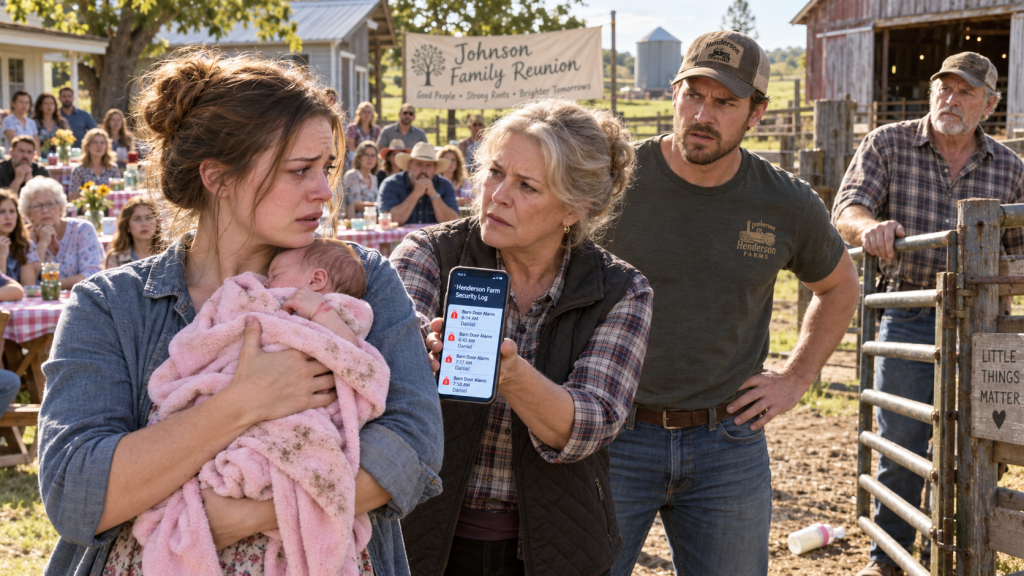
Adam’s mother held the phone out to me again.
“There’s another video.”
For one second, I did not take it.
My daughter was still pressed against my chest.
Her cheek rested beneath my collarbone.
Her crying had softened into those tiny, wounded newborn breaths that somehow sounded worse than screaming.
In.
Pause.
Out.
A little shudder.
Then again.
I could feel every one.
Behind Adam, the reunion had gone completely silent.
No forks against plates.
No cousins laughing.
No music from the speaker near the porch.
Just wind moving through the trees and my baby trying to settle against the only body she trusted completely.
Adam took one step toward his mother.
“Mom.”
His father tightened his grip around Adam’s arm.
“Don’t.”
Adam looked at him.
“Let go of me.”
“No.”
“I said let go.”
My father-in-law’s voice dropped.
“You’ve said enough today.”
Adam’s mother walked closer to me.
Her hand trembled.
“I found this because the camera app stores clips when the motion sensor trips.”
My stomach turned.
“When?”
She swallowed.
“Last Sunday.”
Seven days earlier.
We had been at the farm last Sunday.
Only for an hour.
Adam had said he needed to pick up a tool from his father.
I had been exhausted.
Our daughter had barely slept the night before.
Adam told me to stay in the truck because it was cold.
He said he would take the baby inside for a minute so I could close my eyes.
I had thanked him.
Actually thanked him.
My hands began shaking.
“What happened last Sunday?”
Adam’s mother looked at him.
Then back at me.
“Watch.”
I shifted my daughter carefully and pressed play.
The angle was different.
Not the pen.
The side of the equipment barn.
The timestamp read 11:18 a.m.
There was Adam.
Our daughter bundled in a pale gray blanket.
One week younger.
Two weeks old.
He walked toward the barn.
Opened a narrow side door.
Disappeared inside.
No one else entered.
The clip ended.
Another began six minutes later.
Adam walked out alone.
He pulled the door shut behind him.
Then crossed the yard toward the farmhouse.
I stopped breathing.
“No.”
His mother touched my arm.
“There’s more.”
I did not want more.
I watched anyway.
Twelve minutes.
No one.
Seventeen.
No one.
At nineteen minutes, Adam came back.
He opened the door.
Bent down.
Then emerged with our daughter in his arms.
Even through the camera microphone, I could hear her crying.
Not fussing.
Crying.
High.
Hoarse.
Desperate.
My vision blurred.
“What is in that room?”
Adam’s father answered.
“Feed storage.”
His voice sounded sick.
“No animals.”
“Concrete floor.”
“Gets cold.”
I looked at Adam.
He was no longer angry.
He was scared.
Finally.
“You put her in there?”
He shook his head.
“It wasn’t like today.”
“What was it like?”
“She was in her car seat.”
I stared.
As though that helped.
“I left the carrier on the floor.”
“You left our two-week-old daughter alone in a barn?”
“For twenty minutes.”
His voice sharpened slightly, defensive again.
“You were sleeping.”
My mind flashed back to the truck.
Eyes closed.
Seat reclined.
I remembered waking when Adam tapped the window.
He had placed the baby seat beside me.
I asked if she had been okay.
He said:
“Perfect.”
Perfect.
I looked at the security clip again.
Our child screaming as he carried her out.
“You told me she slept the whole time.”
Adam rubbed his face.
“She was fine.”
“No.”
“She was.”
“No.”
I heard my own voice rise for the first time.
“You do not get to use that word.”
Our daughter startled against my chest.
I immediately lowered my voice.
I kissed the top of her head.
“Sorry, baby.”
That instinct.
Immediate.
She startled.
I responded.
Not because she was spoiled.
Because she was three weeks old.
Because babies cry before they know language.
Because need is not manipulation when a person cannot hold up her own head.
I looked at Adam again.
“Why?”
He stared toward the ground.
“Because she wouldn’t stop crying.”
“And?”
“I needed a break.”
My mouth fell open.
“So you put her in a feed room?”
“I knew where she was.”
“That is not supervision.”
“She was strapped in.”
“You left her alone.”
“I was twenty yards away.”
“Nineteen minutes.”
His eyes flashed.
“You’ve left her in the crib.”
“In our house.”
“I don’t stand over her every second.”
“Neither do I.”
My voice shook.
“But I do not carry her into an outside storage building because I don’t want to hear her.”
Adam looked toward the relatives.
Again.
Always the audience.
“I was overwhelmed.”
For the first time, something in that sentence reached me.
Not enough to excuse him.
Enough to make me listen.
“Then why didn’t you tell me?”
He said nothing.
“Why didn’t you hand her back to me?”
Nothing.
“Why didn’t you call your mother?”
His mother began crying.
“You were fifty feet from people who would have helped.”
I swallowed.
“You chose to hide her.”
That was the part I could not move around.
Not exhaustion.
Not panic.
Hiding.
He did not place her safely in a crib and step outside for five minutes.
He put her where no one would see.
That choice had intention inside it.
Maybe not an intention to injure.
But an intention to make her disappear.
My daughter made a small sound against me.
I tightened my arms.
Adam said:
“Give her to me.”
“No.”
“I’m her father.”
“I know.”
“You can’t keep her from me.”
“I’m not discussing custody in a driveway.”
His face changed.
“Custody?”
I looked at him.
“What did you think was happening?”
Silence.
“You left our newborn alone in a barn last week.”
I pointed toward the pen.
“And today you had her put behind a gate because she was embarrassing you.”
“That is not what happened.”
“Then tell me what happened.”
He opened his mouth.
Nothing came.
Because sometimes facts become stronger than explanation.
—
I took the phone.
Not stole it.
Adam’s mother handed it to me.
“Keep it.”
Adam stepped forward.
His father blocked him again.
“Mom, that’s my privacy.”
His mother stared at him as if she had never seen him before.
“That is my granddaughter.”
Those five words changed the yard.
Adam looked wounded.
As though his mother had chosen a side.
She had.
The side of a three-week-old baby who had no vote.
“I’m going home,” I said.
Adam snapped:
“Our home?”
“No.”
His face hardened.
“Where?”
“My sister’s.”
“I’m coming.”
“No.”
“You’re not taking my child somewhere and refusing to tell me.”
“I just told you where.”
“You know what I mean.”
“Yes.”
I did.
Control.
He wanted the shape of the next scene.
The next conversation.
The next chance to tell me I was overreacting before I had time to understand how badly I had underreacted before.
I opened the back door of my car.
Then stopped.
My daughter’s wrist.
The red mark.
The barn.
The pen.
I looked at Adam’s mother.
“Where’s the nearest emergency department?”
Adam groaned.
“Oh my God.”
I turned.
“What?”
“You’re taking her to the ER for a little red line?”
“Yes.”
“You’re making this into evidence.”
The word fell between us.
Evidence.
He knew.
Maybe before I did.
His father closed his eyes.
His mother whispered:
“Go.”
I secured my daughter in the car seat.
My hands shook so hard it took me three tries to fasten the chest clip correctly.
I forced myself to slow down.
Safety first.
Always.
When I stood again, Adam was beside my door.
“Move.”
“We need to talk.”
“Not now.”
“You’re my wife.”
“And she is my daughter.”
“Ours.”
“Yes.”
I looked straight at him.
“Which is why I cannot understand why I had to protect her from you.”
His face collapsed.
Just briefly.
Then anger returned.
“Don’t say that.”
“I wish I didn’t have to.”
I got inside.
Locked the doors.
Adam stood in front of the car for several seconds.
His father finally pulled him aside.
I drove away.
In the rearview mirror, the reunion remained frozen.
Tables full of untouched food.
People standing.
The farm shrinking behind me.
And for the first time since my daughter was born, I did not wonder whether I was being too emotional.
I wondered why I had spent so much of my marriage trying not to be.
—
At the emergency department, the nurse asked what happened.
I opened my mouth.
Nothing came.
How do you explain that your husband put your newborn in an animal pen because she was crying?
The nurse waited.
Patient.
I tried again.
“My daughter was left in an outdoor livestock pen.”
Her expression changed.
“By who?”
I swallowed.
“Her father.”
She stopped typing.
Not dramatically.
Just stopped.
“How old is she?”
“Three weeks.”
The nurse looked at the baby.
Then at me.
“Was she dropped?”
“No.”
“Bitten?”
“No.”
“Any animals in the enclosure at the time?”
“No.”
“Any loss of consciousness?”
“No.”
“She has a mark on her wrist.”
I showed her.
“And there was an earlier incident.”
The nurse’s eyes lifted.
I told her.
Feed room.
Nineteen minutes.
Car seat on concrete.
Alone.
When I finished, my hands were numb.
The nurse said:
“I’m going to get the pediatric clinician.”
Then, gently:
“We may need to involve a social worker.”
I nodded.
I expected fear.
Instead, relief moved through me.
Someone else was going to write this down.
Not my mother-in-law.
Not me.
Not an angry wife.
A professional.
Facts.
My daughter was examined thoroughly.
No fracture.
No serious injury.
The wrist mark was a superficial abrasion.
Temperature normal.
Breathing normal.
Neurologic exam reassuring.
She fed well.
Every normal finding felt like oxygen.
I cried when the doctor said:
“She looks okay.”
Then he added:
“But that does not make the situation okay.”
I stopped crying long enough to look at him.
He sat on the rolling stool.
“She is too young to be intentionally left to cry in an unsafe or isolated environment.”
I nodded.
“He says she needs to learn to self-soothe.”
The doctor’s expression tightened.
“At three weeks, her job is to signal need.”
My throat closed.
“Exactly.”
“Your job is to respond.”
Tears came again.
“I know.”
He glanced toward the door.
“And if a caregiver feels overwhelmed, the safe choice is to place the baby on her back in a safe sleep space and step away briefly if needed, while getting support.”
Not a barn.
Not a pen.
Not a punishment.
Support.
The social worker arrived twenty minutes later.
Her name was Janine.
She asked me almost everything twice.
Dates.
Times.
Locations.
Who was present.
Whether Adam had ever hit me.
No.
Threatened me.
Not physically.
Controlled money.
Somewhat.
Called me names.
Sometimes.
Handled the baby roughly before.
I hesitated.
That hesitation frightened me.
“Tell me what you’re thinking.”
Janine said.
I looked at my daughter sleeping in the clear hospital bassinet.
“He gets irritated when she cries.”
“How?”
“He says she does it for attention.”
Janine looked at me.
“She’s three weeks old.”
“I know.”
“He complains I pick her up too fast.”
“What happens if he holds her?”
“He bounces her harder than I do.”
“Hard enough to concern you?”
I thought.
“Yes.”
That word hurt.
Because I had known.
Not known enough.
But known something.
“He never shook her.”
“I’ve never seen that.”
“Any marks before today?”
“No.”
“Any yelling?”
“At me.”
“At her?”
“He says things.”
“What things?”
I felt ashamed saying them aloud.
“Stop it.”
“You’re fine.”
“This is ridiculous.”
“Give it a rest.”
Janine wrote.
Each sentence looked worse on paper than it had in our living room.
That was another lesson.
People normalize what they hear repeatedly.
Writing restores edges.
—
My sister Rebecca came to the hospital.
She did not ask questions first.
She hugged me.
Then held the baby while I went to the bathroom and threw up.
Stress.
Fear.
No food.
Everything.
When I returned, Rebecca sat in the chair beside the bassinet.
My daughter’s tiny fingers wrapped around her pinky.
Rebecca looked at me.
“You’re coming home with me.”
I nodded.
No debate.
“Good.”
Then:
“Adam texted me.”
My stomach dropped.
“What did he say?”
“That you’re having some kind of postpartum breakdown.”
I stared.
Rebecca’s face hardened.
“He said you’re misinterpreting everything because you haven’t been sleeping.”
Of course.
Suddenly, my exhaustion was useful to him.
Not when I was waking every ninety minutes.
Not when I was bleeding postpartum and still washing bottles.
Now.
Now my lack of sleep mattered because it could explain why I was unreasonable.
“What did you say?”
“I told him not to contact me again tonight.”
I looked at her.
“And?”
“He called me a bitch.”
That sounded more like him.
Rebecca smiled without humor.
“I survived.”
I almost laughed.
Then Janine returned.
“We made a mandated report.”
My body stiffened.
Rebecca took my hand.
Janine continued.
“That does not mean anyone is automatically arrested or that your child is being taken from you.”
I nodded.
“Given the age of your daughter and the two incidents described, the report will be reviewed.”
“What do I do?”
“Do you feel safe going home with the father there?”
“No.”
The answer came immediately.
That frightened me too.
Janine nodded.
“Then don’t.”
Simple.
Permission from a stranger for something my body already knew.
Don’t.
—
Adam called seventy-one times that night.
I know because my phone logged them.
I did not answer.
His messages changed by the hour.
At first:
You are humiliating me.
Then:
My family thinks I’m some kind of monster.
Then:
Dad is lying about what I said.
Then:
You know I love her.
Then:
You’re going to destroy our marriage over two mistakes.
Then:
Call me before you do something stupid.
Then:
Please.
At 1:13 a.m.:
I’m sorry.
I stared at that one longest.
Two words.
The words I had been waiting for.
They did not fix anything.
Because apology without understanding is only panic wearing softer clothes.
I turned off the phone.
My daughter slept in a portable bassinet beside Rebecca’s guest bed.
I sat on the floor and watched her breathe.
Rebecca found me at three.
“What are you doing?”
“Checking.”
“She’s breathing.”
“I know.”
“You need sleep.”
“I know.”
She sat beside me.
For a long time, neither of us spoke.
Then I whispered:
“What if I missed something?”
Rebecca looked at me.
“You found her.”
“What if there were other times?”
“You didn’t know.”
“What kind of mother doesn’t know?”
“The kind married to someone who hides things.”
I started crying.
“I left her with him.”
“You left her with her father.”
“That’s supposed to be safe.”
“Yes.”
Rebecca’s voice softened.
“That is supposed to be safe.”
I cried harder.
She wrapped one arm around me.
No advice.
No forgiveness speech.
Just arm.
Presence.
That was what I needed.
—
The next morning, Adam’s mother called.
I almost did not answer.
Then I did.
“Hello?”
She was crying.
“I’m sorry.”
My chest tightened.
“For what?”
“For not telling you sooner.”
I sat up.
“What do you mean?”
She went silent.
A bad silence.
“What did you know?”
“Not the barn.”
She said quickly.
“Not that.”
“What then?”
She inhaled.
“When you were pregnant, Adam said he wasn’t sure he wanted a baby anymore.”
My hand went cold.
“What?”
“He was scared.”
“So was I.”
“I know.”
“He said he thought once you got pregnant everything became about the baby.”
I closed my eyes.
“He said he felt replaced.”
My stomach turned.
Our daughter was not even born.
“And after she came?”
“He called me twice.”
“When?”
“First week.”
“What did he say?”
“That the crying was making him crazy.”
My pulse rose.
“What did you tell him?”
“That newborns cry.”
She started crying harder.
“I told him to give her to you or call me if he was overwhelmed.”
“Did he?”
“No.”
“What else?”
She hesitated.
That was the answer.
“What else?”
“He said sometimes he understood why people walk away.”
My throat tightened.
“Walk away from what?”
She whispered:
“Babies.”
The room tilted.
I grabbed the edge of the mattress.
“Did you tell anyone?”
“His father.”
“And?”
“We thought he was venting.”
Maybe he was.
Maybe that was all.
But now every sentence rearranged itself around the two videos.
“I should have told you.”
“Yes.”
The word came out before I could soften it.
She cried.
“Yes.”
I did not rescue her.
Not yet.
“You should have.”
“I was afraid you’d think I was turning you against my son.”
I almost laughed.
“Instead you protected him from consequences.”
She went quiet.
“I know.”
That mattered.
Then she said:
“There’s something else.”
I closed my eyes.
“Please stop saying that.”
“I’m sorry.”
“What?”
“The camera system stores thirty days.”
My breath stopped.
“We’re checking everything.”
—
They found four incidents.
Not twenty.
Not some hidden campaign of cruelty.
Four.
Enough.
The barn.
The pen.
One clip showed Adam placing the baby carrier on the covered back porch while she cried, then going inside for nine minutes.
Another showed him setting the carrier in the detached garage while he spoke on the phone near the driveway.
Six minutes.
Every time, the same pattern.
Distance.
Noise removed.
Baby out of sight.
He was not striking her.
Not shaking her.
Not throwing her.
In some ways, that made the truth harder to explain to people who wanted one dramatic word.
He was making her disappear whenever her needs overwhelmed him.
That was the pattern.
And because newborns cannot protect themselves from being inconvenient, it was enough.
Adam’s father sent every clip directly to the investigator.
Not to Adam.
That choice fractured their relationship.
For months.
Maybe permanently.
When Adam discovered it, he called his father a traitor.
His father later told me:
“I’d rather betray my son’s secret than my granddaughter’s safety.”
I never forgot that sentence.
—
A child-protection investigator came to Rebecca’s house two days later.
So did a police detective.
Not because every bad parenting decision becomes criminal.
Because the age of the baby, the repeated isolation, the circumstances, and the wrist abrasion required review.
I told the story again.
Every detail.
By the third telling, I sounded numb.
That frightened me.
The detective said:
“You’re doing fine.”
I almost laughed.
That phrase again.
But from him it meant:
Keep going.
Not:
Stop feeling.
Difference.
Adam was interviewed separately.
He admitted moving her.
He insisted he never intended harm.
I believed that part.
I still do.
Intent became one of the hardest things I had to hold.
He did not wake up planning to injure our daughter.
He wanted quiet.
He wanted control.
He wanted the reunion untouched by crying.
He wanted himself not to feel overwhelmed.
And he treated a helpless child as the object that needed removing.
Harm does not always require hatred.
Sometimes selfishness is enough.
—
My attorney’s name was Lauren Bell.
Rebecca found her.
Family law.
Sharp voice.
Soft eyes.
She listened.
Then said:
“You need temporary orders.”
I looked at my daughter asleep in my arms.
“What kind?”
“Custody.”
“Contact.”
“Possibly supervised parenting time until there is a safety assessment.”
The words felt enormous.
“He’s her father.”
“Yes.”
“I don’t want to erase him.”
Lauren nodded.
“Then don’t.”
I looked up.
“Protection is not erasure.”
That sentence became my anchor.
We filed.
Adam filed too.
His attorney claimed I was reacting from postpartum anxiety.
That hurt.
Not because postpartum anxiety is shameful.
Because he was using a real vulnerability women experience as a way to make the evidence disappear.
Lauren asked:
“Have you been evaluated?”
“No.”
“Would you be willing?”
“Yes.”
I met with my obstetrician.
Then a therapist.
I was exhausted.
Anxious.
Traumatized.
But oriented.
Clear.
Protective.
No psychosis.
No delusion.
No loss of reality.
The irony was almost cruel.
I had spent three weeks doubting myself.
The moment I finally trusted what I saw, my husband called that doubt illness.
My therapist said:
“Anxiety can distort risk.”
I nodded.
“Evidence can also establish it.”
That mattered.
Both.
—
The temporary court hearing happened when my daughter was seven weeks old.
I hated every minute.
Adam sat fifteen feet away in a suit.
He looked like the man I married.
Same jaw.
Same hands.
Same blue tie from our anniversary dinner two years earlier.
I wanted to walk across the room and ask:
What happened to us?
Instead, our lawyers spoke.
The videos were discussed.
The hospital examination.
The investigator.
Adam’s statements.
The court did not call him a monster.
Neither did I.
That mattered.
Orders were made for supervised contact pending a fuller evaluation and parenting education.
No overnight visits.
No unsupervised care for the time being.
Adam cried.
I did too.
There was no victory.
Only a structure designed to make sure our daughter stayed safe while adults figured out whether her father could become safe enough to care for her properly.
Outside court, Adam approached me.
Lauren stepped closer.
He stopped at a respectful distance.
At least that.
“She smiled yesterday.”
I froze.
The supervisor must have told him.
“Yes.”
“I missed the first one.”
My eyes filled.
“Yes.”
His face crumpled.
“You’re taking everything.”
I almost let guilt move me.
Then I looked at him.
“No.”
My voice softened.
“Your choices took things.”
He cried.
“I love her.”
“I believe you.”
That surprised him.
“I do.”
I continued.
“But loving her is not enough if you respond to her needs by making her disappear.”
He closed his eyes.
“I know.”
Not yet.
But maybe beginning.
—
Adam entered a parenting program.
Therapy too.
At first, because the court expected it.
Later, I think, for himself.
His therapist specialized in paternal postpartum depression, anger, and adjustment to parenthood.
That became another complicated truth.
Men can experience postpartum depression.
Fear.
Detachment.
Irritability.
Even resentment.
Adam eventually received a diagnosis involving depression and adjustment difficulties.
When I heard, part of me softened.
Another part became furious.
Why hadn’t he asked for help?
Then my therapist said:
“You can understand an illness without accepting unsafe behavior.”
Again.
Both.
Adam had been struggling.
Our daughter still needed protection.
Neither truth canceled the other.
—
His parents changed too.
His mother carried guilt like a second purse.
Always with her.
She called too often at first.
“I should have known.”
“I should have told you.”
“I should have—”
Eventually, I said:
“I cannot keep comforting you about what happened to my baby.”
Silence.
Then:
“You’re right.”
That was the beginning of a healthier relationship.
She started therapy too.
Not because I asked.
She said she needed to understand why protecting her adult son’s image had felt more important than speaking plainly.
His father handled guilt differently.
He repaired things.
The pen gate disappeared.
Literally.
One month later, I drove past the farm.
The old animal enclosure was gone.
Fence posts pulled.
Ground flattened.
I stopped the car.
Cried.
Then got angry.
Removing the pen did not remove what happened.
But later, I understood.
He could not stand looking at it.
Sometimes grief becomes physical labor.
He planted grass.
By spring, you could barely tell where the pen had been.
I could.
I always could.
—
Adam and I separated permanently.
That decision took six months.
Not because I wanted to punish him.
Because even as he changed as a father, I could not find my way back into being his wife.
That distinction mattered.
He apologized.
Really apologized.
Not:
I’m sorry you got upset.
Not:
I made a mistake.
He said:
“I resented a baby for needing what babies need.”
He said:
“I treated crying like disrespect because I felt powerless.”
He said:
“I cared more about not looking overwhelmed than admitting I was.”
He said:
“I lied because I knew you would stop leaving her alone with me.”
That one nearly broke me.
We were sitting in a counseling office when he said it.
I stared.
“You knew?”
“Yes.”
“You knew I would think it was unsafe?”
“Yes.”
“Then why did you do it?”
He cried.
“Because in the moment I cared more about getting away from the sound.”
That was the most honest thing he ever gave me.
And the reason I knew our marriage was over.
Not because people cannot recover.
Because trust inside me had changed shape.
I could eventually trust him to follow rules.
To attend therapy.
To show up supervised.
Maybe someday to parent independently.
But marriage requires a different kind of surrender.
Sleeping beside someone.
Leaving your child in their arms without calculating risk.
Believing the person next to you will tell the truth before consequences force it out.
I no longer had that.
Counseling could not manufacture it.
I told him:
“I want you to become a good father.”
He cried.
“I hope you do.”
Then:
“But I do not want to be married to you while you learn.”
His face collapsed.
That sentence hurt me too.
Still true.
—
Our divorce was quieter than the family expected.
No screaming.
No hidden accounts.
No revenge.
We divided what we had.
Sold the house.
That part surprised people.
They assumed I would keep it.
I did not want it.
Too many nights standing in the nursery doorway listening for how Adam responded to crying.
Too much doubt.
Rebecca said:
“Don’t let him take your home.”
I told her:
“I’m not.”
I sold a building.
I kept myself.
Different.
I rented a two-bedroom apartment near a park.
Small balcony.
Too many stairs.
Cheap kitchen cabinets.
Perfect.
The nursery window faced a maple tree.
My daughter slept beside me in a bassinet for months anyway.
Then crib.
Then eventually her own room.
The first night she slept four hours straight, I woke panicked because she was quiet.
I ran to the crib.
Breathing.
Fine.
I sat on the floor and cried.
Safety takes a while to feel safe after fear becomes a habit.
—
Adam’s supervised visits continued for five months.
Then professionally monitored transitions.
Then short unsupervised daytime visits after evaluations and consistent progress.
I fought that step emotionally.
Hard.
Lauren asked:
“What does the evidence say now?”
I hated the question.
Evidence had saved me.
Now evidence was asking me not to freeze Adam forever in his worst month.
His therapist supported gradual contact.
The parenting evaluator did too.
No further unsafe incidents.
He had learned infant development.
Crying.
Safe sleep.
Overstimulation.
How to place a baby safely in the crib and call someone if he felt overwhelmed.
Most importantly, he had built a support plan.
His mother.
His father.
His sister.
Therapist.
A friend.
People he would call.
Not barns.
Not garages.
People.
I still cried the first time our daughter left with him for two hours.
Rebecca sat with me.
“What if—”
She stopped me.
“What?”
I stared at the door.
“What if I’m wrong?”
Rebecca took my hand.
“You were not wrong then.”
That was not my question.
She understood.
“And if professionals who know the full history think this step is safe now, letting change count is not betrayal.”
I hated how wise my sister had become.
“I preferred you judgmental.”
“I contain multitudes.”
I laughed.
Barely.
Two hours later, Adam returned our daughter exactly on time.
She was asleep in the carrier.
He handed me a written note.
Fed 3 oz.
Diaper at 2:20.
Slept 25 min.
Cried in car.
Pulled over.
Soothing worked.
I stared at the note.
“Pulled over?”
“Yes.”
“She was crying.”
“I didn’t want to keep driving while distracted.”
My eyes filled.
That was such a normal parenting decision.
It felt enormous.
He noticed.
“I know.”
No grand speech.
Just:
“I know.”
—
Our daughter’s name is Lily.
I had avoided saying it for months in my own mind when thinking about the case.
Baby.
Infant.
Child.
Words from reports.
But she was Lily.
She grew.
That itself felt miraculous.
Three months.
Six.
Nine.
First tooth.
First laugh.
First fever.
First time she rolled off the play mat and looked offended at gravity.
Adam attended what he could within the custody arrangement.
Not everything.
That was reality.
At her first birthday, I invited him.
So did his parents.
We held it at a public park.
Not the farm.
I was not ready.
Pink balloons.
Cupcakes.
No dramatic speeches.
Lily smashed frosting into her hair.
Adam laughed.
Then cried.
He sat on the grass six feet from me.
At one point, his mother took Lily to change her.
Adam looked over.
“I’m glad you left.”
I stared.
“What?”
He rubbed his hands together.
“That day.”
At the reunion.
“If you’d stayed…”
He looked toward the playground.
“I think everyone would have minimized it by dinner.”
My throat tightened.
“My dad would’ve told me not to do it again.”
“Mom would’ve hovered.”
“I would’ve apologized.”
He swallowed.
“And then maybe in two weeks, when she cried enough…”
He did not finish.
He did not need to.
I felt cold.
“I hate admitting that.”
He whispered.
“But I think it’s true.”
I looked at him.
“You changed because you had to face it.”
“Yes.”
Then:
“And because I wanted to.”
That distinction mattered too.
Consequences can open a door.
A person still has to walk through.
—
His parents eventually invited me back to the farm.
I said no the first three times.
No one pressured me.
Good.
When Lily was two, I said yes.
We arrived on a spring afternoon.
The farm looked ordinary.
That offended me.
Again.
Places do not carry visible morality.
Sunlight on the barn.
Chickens near the fence.
Windmill turning.
No pen.
Grass where it had been.
I held Lily’s hand.
She toddled beside me.
Adam’s father came out from the barn.
He had aged.
Or guilt made him look that way.
He stopped several feet away.
“Hi.”
“Hi.”
Lily recognized him.
“Papa!”
She ran.
I let her.
That moment mattered.
He crouched.
Held her.
Cried immediately.
I looked away.
Not because I wanted to deny him tenderness.
Because some emotions deserve privacy.
Later, he walked me toward the old pen area.
“You don’t have to.”
I said.
“I know.”
He stopped.
“I need to tell you something.”
I waited.
“That day, I should’ve refused.”
“Yes.”
He nodded.
No defense.
“I knew it was wrong.”
My throat tightened.
“Then why?”
“He was my son.”
I stared.
“That is not an answer.”
“No.”
He looked at the grass.
“It’s the excuse I used.”
Good.
“I thought helping him meant doing what he asked, then correcting him later.”
He swallowed.
“I forgot she was the one who needed help.”
He looked at Lily running after a butterfly.
“I am sorry.”
I believed him.
“Thank you.”
Then:
“I’m not asking you to make me feel better.”
That sentence was important.
“I know.”
We stood there.
No forgiveness ceremony.
No hug.
The land between us held enough.
—
Adam’s mother apologized differently.
She gave me a folder.
Inside were printed screenshots of every security clip.
Copies.
Dates.
Notes.
Not hidden.
Not erased.
“I want Lily to have the truth someday if she asks.”
I stared.
“You want her to see this?”
“When she’s old enough.”
“If you think she should.”
She looked at me.
“But I don’t want our family to become one of those families where everyone knows something happened and nobody says what.”
My eyes filled.
That was generational change.
Not pretending.
Not turning trauma into a family ghost.
Truth with age-appropriate care.
I kept the folder.
Locked away.
Years later, I would decide what to do with it.
—
Lily was four when she first asked why Daddy did not live with us.
I knew the question would come.
Still, I froze.
She sat on the bathroom counter while I brushed her hair.
“Because Daddy and Mommy decided we’re better in different houses.”
“Did Daddy be bad?”
Children hear everything.
Even what adults think they hid.
I put down the brush.
“Daddy made some unsafe choices when you were a tiny baby.”
Her eyes widened.
“Like running with scissors?”
I almost laughed.
“Kind of.”
“Did you yell?”
“Probably.”
She smiled.
“Good.”
I pulled her into my arms.
“Daddy learned better.”
“Is he safe now?”
The question took my breath.
“Yes.”
At that point, based on years of behavior, I believed it.
“Yes.”
She nodded.
That was enough for four.
Truth does not have to arrive all at once.
—
At seven, she asked more.
Why Grandma cried whenever the farm reunion story came up.
Why there was no old animal pen anymore.
Why Dad always said:
“If you need me, tell me.”
Over and over.
We told her more.
Together.
That mattered.
Adam sat with me.
Neutral room.
No blame language.
We told her when she was a newborn, Dad got overwhelmed by crying and made unsafe choices about where to leave her.
She looked at him.
“You put me outside?”
His face broke.
“Yes.”
“Why?”
He cried.
“Because I was not handling being a new dad well.”
She frowned.
“That was dumb.”
I almost choked.
Adam laughed through tears.
“Yes.”
“It was.”
“Did Mom get me?”
“Yes.”
Lily looked at me.
“Were you scared?”
“Yes.”
She took my hand.
Then looked back at Adam.
“Did you say sorry?”
“A lot.”
“Did you learn?”
“Yes.”
She thought for a moment.
Then:
“Okay.”
Children sometimes understand accountability more cleanly than adults.
Unsafe.
Sorry.
Learn.
Do better.
No need for mythology.
—
At twelve, Lily asked to see the videos.
I said no.
Not yet.
She was angry.
“You said you wouldn’t hide it.”
“I’m not hiding.”
“Then show me.”
“There is a difference between truth and giving you an image you cannot unsee before you’re ready.”
She rolled her eyes.
Adolescence had arrived.
Adam supported me.
That mattered.
He said:
“Your mother is right.”
She glared at him.
“You always say that when it’s about the videos.”
He smiled sadly.
“Because she was right when it mattered most.”
That shut the room up.
At sixteen, she asked again.
This time, we showed her.
Not every clip.
The barn.
The pen.
Together.
Adam was present.
So was Lily’s therapist, at her request.
The moment she saw herself as a tiny bundle inside that enclosure, her face changed.
Not dramatically.
Just still.
Like mine had.
She watched her father walk away.
Then the clip ended.
No one spoke.
Finally, Lily said:
“You left me crying.”
Adam’s eyes filled.
“Yes.”
“For people?”
“What?”
“For the reunion?”
His face collapsed.
“Yes.”
She looked at him.
“Did you love me?”
The question nearly broke all of us.
Adam answered immediately.
“Yes.”
“Then how?”
There it was.
The question adults fear.
How can someone love you and still hurt you?
Adam did not defend himself.
“I loved you badly in those moments.”
Lily started crying.
“I thought love meant you’d never do that.”
I reached for her.
She leaned into me.
Adam stayed where he was.
Did not demand comfort.
Good.
He said:
“Love does not make every choice safe.”
His voice shook.
“That is why apologies are not enough by themselves.”
Lily looked at him.
“What is enough?”
“Changing.”
He swallowed.
“And accepting that the person you hurt gets to decide what trust looks like afterward.”
I looked at him.
Years.
That answer had taken years.
Lily cried.
Then asked to leave.
I took her home.
She did not see Adam for three weeks.
He allowed it.
No guilt.
No:
I’m your father.
He texted once:
I love you. No need to answer.
That was all.
Eventually, she did.
Trust had to become hers now.
Not mine to manage.
—
When Lily was seventeen, she wrote an essay for school about safety.
She did not tell me the topic.
I found out when she asked me to read it.
The first sentence:
My first lesson about love happened before I could remember it.
I sat down.
She wrote about the story carefully.
Not sensationally.
No names.
No graphic detail.
She wrote:
People in my family spent years arguing about whether my father loved me when he left me somewhere unsafe as a newborn. I think that was the wrong question. The more important question was whether love without safe behavior should be trusted automatically.
I cried.
Then:
My mother taught me that protecting someone is not the same as hating the person who frightened them. My father taught me, later, that accepting consequences is part of becoming trustworthy again.
I had to stop reading.
Lily watched me.
“You okay?”
“No.”
She smiled.
“Good no or bad no?”
“Proud no.”
“That’s not a thing.”
“It is now.”
I finished.
Her final line:
Safety is not the absence of love. Sometimes safety is the structure that lets love become honest.
I looked at her.
“Where did you get this?”
“Therapy.”
I laughed.
“Worth every copay.”
She rolled her eyes.
—
Adam never remarried.
Not because he waited for me.
I asked once.
He said:
“I had enough work learning to live with myself.”
Too dramatic.
But Adam had always had some drama in him.
I did date.
Eventually.
Years later.
A man named Marcus.
Teacher.
Divorced.
Two sons.
The first time Lily had a fever while Marcus was at my apartment, he asked:
“What do you need?”
Not:
What should I do?
Not:
She’s fine.
What do you need?
I said:
“Can you make tea?”
He did.
That was all.
Sometimes green flags are painfully ordinary.
Marcus and I never rushed.
I had learned that being lonely is not a medical emergency.
A person can wait.
Observe.
Ask.
Leave if needed.
Stay if earned.
We eventually married when Lily was thirteen.
Adam attended.
Yes.
People thought that was strange.
Maybe.
He stood near the back with his parents.
After the ceremony, he shook Marcus’s hand.
Then hugged Lily.
Then told me:
“You look happy.”
“I am.”
He nodded.
“Good.”
That was it.
Maturity is sometimes knowing when the story is no longer about you.
—
Adam became a good father.
I say that carefully.
Not to rewrite.
Not to erase.
He became.
The verb matters.
He learned.
He built routines.
He never missed therapy during the early years.
He taught parenting classes later through a fathers’ support organization.
The irony embarrassed him.
Good.
Humility fit him better than certainty ever had.
He spoke openly about paternal depression, frustration, and the danger of interpreting infant crying as intentional defiance.
He never used Lily’s name.
Never made himself a hero.
He said:
“I made unsafe choices because I refused to admit I was overwhelmed.”
Then:
“Getting help before you lose control is part of protecting your child.”
I heard him speak once.
From the back of a community center.
He did not know I was there.
When he finished, one young father approached him.
Said:
“Sometimes I put headphones on because the crying makes me furious.”
Adam did not shame him.
He said:
“Put the baby safely in the crib first.”
“Then step away.”
“Call someone.”
“You are not bad because you need help.”
“But you are responsible for what you do when overwhelmed.”
I cried in the parking lot afterward.
Not because I forgave something new.
Because change was visible.
Again.
—
His parents stayed married.
The farm changed.
No more reunions with babies treated as inconveniences.
That sounds obvious.
Apparently it needed saying.
At family events, there was a quiet room inside the farmhouse.
Rocking chair.
Bassinet when needed.
Bottles.
Diapers.
A sign his mother embroidered:
BABIES BELONG WITH US.
The first time I saw it, I almost broke.
She noticed.
“I know it’s corny.”
“No.”
I touched the stitched letters.
“It’s good.”
She smiled.
Then:
“I made two.”
“Why?”
“One for church nursery.”
Of course.
Pain travels.
Sometimes so does repair.
—
Adam’s father died when Lily was nineteen.
Heart attack.
Sudden.
At the funeral, Lily spoke.
She talked about learning to drive the tractor with him.
Picking peaches.
His terrible jokes.
Then she said:
“My grandfather taught me that adults can admit when protecting someone they love means confronting someone else they love.”
I saw Adam close his eyes.
His mother cried.
So did I.
After the service, Adam’s father’s old workshop was opened for family.
On one wall hung the farm security control panel.
Newer system now.
Different screen.
I stood in front of it.
For a second, I saw the old name.
ADAM.
Access log.
Timestamp.
The evidence that cracked my life open.
Lily came beside me.
“You okay?”
“Yes.”
She looked at the panel.
“This is where you saw it?”
“Similar one.”
She nodded.
Then:
“I’m glad it showed his name.”
So was I.
That sentence carried no joy.
Only gratitude that truth had left a footprint.
Because if the alarm had not logged the code, Adam might have denied it.
His father might have protected him.
I might have doubted myself.
Evidence matters when love makes facts emotionally inconvenient.
—
The farmhouse was sold after Adam’s mother became too old to manage it.
Before closing, she invited all of us one last time.
I walked behind the barn.
The grass where the old pen had stood was thick.
Nothing marked it.
No plaque.
No memorial.
Good.
Lily stood there with me.
Twenty-three.
Adult.
She bent down and picked a clover.
“This spot?”
“Yes.”
She looked around.
“It looks so normal.”
“I know.”
She tucked the clover into her pocket.
Then:
“Do you hate it?”
“The place?”
“Yes.”
I thought.
“No.”
“Why not?”
“It didn’t make the decision.”
She smiled.
“Therapy answer.”
“Expensive therapy.”
She laughed.
Then grew serious.
“Do you hate Dad for it?”
I looked toward the house.
Adam was helping his mother pack dishes.
Older.
Gray at the temples.
Patient.
“No.”
“Did you?”
“Yes.”
She looked at me.
“For how long?”
“I don’t know.”
I considered.
“Maybe I hated what he had done more than I hated him.”
She nodded.
“Do you forgive him?”
“Yes.”
“Completely?”
I smiled.
“Forgiveness is not a measuring cup.”
She groaned.
“Mom.”
“I don’t know how to answer that.”
Then I tried.
“I don’t want him punished forever.”
“I don’t want to hurt him.”
“I believe he changed.”
“I can be in a room with him and remember good things.”
I looked at her.
“But I would never go back and leave baby you with him before he changed.”
Her eyes filled.
“That part stays true.”
She nodded.
“Good.”
“Why good?”
“Because sometimes people act like forgiveness means deciding it wasn’t that bad.”
I hugged her.
“No.”
“It was that bad.”
“And he became better.”
Both.
She leaned into me.
The clover crushed between us.
—
I kept the security videos until Lily was twenty-five.
Then I asked what she wanted.
“Keep.”
“Delete.”
“Give to you.”
She thought.
Then:
“Do we need them legally?”
“No.”
“Does Dad need them?”
“No.”
“Do you?”
I looked at the folder.
“No.”
She nodded.
“Then delete them.”
We did.
Together.
Not because the past became false.
Because evidence had finished its work.
I kept the medical record.
Court orders.
Necessary family documents.
The videos themselves disappeared.
I expected relief.
Instead, ordinary sadness.
Digital files erased in seconds.
Memory remains analog.
Messier.
Harder to delete.
Maybe that is fine.
—
Adam died at sixty-seven.
Cancer.
Life has a cruel sense of symmetry.
By then, Lily was thirty-one.
Married.
Pregnant with her first child.
Adam knew he was going to be a grandfather.
That mattered enormously to him.
Near the end, Lily visited almost every day.
I visited once.
Marcus understood.
Adam was in hospice.
Thin.
Quiet.
Nothing like the angry young father in the reunion video.
He smiled when I entered.
“Hi.”
“Hi.”
We sat.
No audience.
No lawyers.
No supervisors.
No court.
Just two old people who once loved each other badly enough to hurt and later carefully enough to stop.
After a while, he said:
“Do you think she’ll be scared?”
“Who?”
“Lily.”
“When the baby cries.”
My eyes filled.
“Everyone gets scared.”
He nodded.
“I mean because of me.”
I understood.
“She’ll have feelings.”
“Yes.”
“She also has support.”
He smiled.
“She chose better.”
I gave him a look.
“Careful.”
He laughed weakly.
“Sorry.”
Then:
“I spent years wondering what would have happened if the alarm hadn’t shown my code.”
So had I.
“What do you think?”
“I think I would’ve lied.”
My chest tightened.
“That’s honest.”
“Late.”
“Still.”
He looked toward the window.
“I hated Dad for telling you.”
“I know.”
“Then I hated myself for needing him to.”
Silence.
“I’m glad he did.”
“So am I.”
He looked at me.
“Thank you for not turning Lily against me.”
I shook my head.
“That was never mine to do.”
“You could have.”
“Yes.”
“I wanted her to know what happened and also have space to know who you became.”
His eyes filled.
“I didn’t deserve that.”
I frowned.
“Stop turning accountability into self-hatred.”
He almost smiled.
“You always hated drama.”
“That is completely false.”
We both laughed.
Then he coughed.
When he settled, he said:
“I was a terrible father for those weeks.”
“Yes.”
He closed his eyes.
Then:
“I became a good one.”
My throat tightened.
“Yes.”
He looked at me.
“Thank you.”
I did not ask why.
Maybe for saying both.
Adam died eight days later.
Lily held his hand.
His mother was already gone by then.
His sister stood beside her.
I sent flowers.
My own name on the card.
No complicated message.
Thank you for loving her better.
That was enough.
—
Lily gave birth four months later.
A girl.
Sophie.
The first time Sophie cried in the hospital, I watched Lily’s face.
Not because I expected danger.
Because history makes the body watch.
Lily lifted her daughter immediately.
“Hey.”
Soft.
“Hey, baby.”
Sophie calmed.
Then cried again.
Lily laughed through tears.
“I know.”
She looked at me.
“She’s loud.”
“Very.”
“Dad would’ve panicked.”
The sentence hurt.
Then she smiled sadly.
“Old Dad.”
“Yes.”
“Later Dad would’ve brought earplugs and a parenting pamphlet.”
I laughed.
That was true.
Sophie cried again.
Lily kissed her forehead.
“You’re allowed.”
I stopped breathing.
“What?”
Lily looked at me.
“I was talking to her.”
I knew.
Still.
You’re allowed.
Allowed to cry.
Allowed to need.
Allowed to interrupt dinner.
Allowed to be inconvenient.
Allowed to exist loudly.
Something inside me that had been tight for thirty-one years finally loosened.
I cried.
Lily noticed.
“Mom.”
“I’m fine.”
She raised an eyebrow.
“No, you’re not.”
“Fine enough.”
She smiled.
Then handed Sophie to me.
“Hold your granddaughter.”
I did.
Tiny.
Warm.
Helpless.
Perfect.
Not because she was quiet.
Because she existed.
—
When Sophie was three weeks old, exactly the age Lily had been at the reunion, I went to their house.
I did not plan the date.
Realized when I saw the calendar.
My stomach turned.
Lily saw.
“What?”
“She’s three weeks.”
Her face softened.
“Oh.”
We both looked at Sophie.
Sleeping in a bassinet.
Safe.
Inside.
Near us.
Lily sat beside me.
“Does it feel weird?”
“Yes.”
“Do you want to talk?”
“No.”
She smiled.
“Good boundary.”
I laughed.
Then Sophie started crying.
Lily stood.
Picked her up.
No rush of fear in the room.
No irritation.
No need to remove the sound.
Just response.
Her husband came in from the kitchen.
“Want me to take her?”
Lily considered.
“Yes.”
He took Sophie.
Walked slowly.
Bounced gently.
“She’s fed?”
“Yes.”
“Diaper?”
“Clean.”
“Probably tired.”
He kept walking.
Sophie cried.
Nobody panicked.
Nobody blamed.
Nobody disappeared.
I sat on the sofa and watched.
This.
This was the future I had been fighting for without knowing it.
Not a life without crying.
A life where crying did not cost a child belonging.
—
I am sixty-two now.
Lily is thirty-three.
Sophie is two.
Marcus is making pancakes in the kitchen as I write this.
Badly.
He claims shape is irrelevant.
He is wrong.
There is a framed photograph on my desk.
Lily at seven.
Missing front tooth.
Adam beside her.
Both covered in paint after building a birdhouse.
Another.
Lily’s wedding.
Adam crying.
Another.
Sophie in my arms.
No photos of the pen.
No need.
The past exists without decorating the walls.
—
People who hear the beginning always ask the same question.
“How could a father do that?”
I understand why.
I asked it too.
For years.
The answer became less dramatic over time.
He was overwhelmed.
Immature.
Resentful.
Depressed.
Ashamed to admit weakness.
Obsessed with controlling noise because he could not control himself.
He made unsafe choices.
Then lied.
None of those explanations excuse him.
Together, they make him human.
That matters because monsters are easy.
Humans are harder.
If Adam had been a monster, I would have left once and never looked back.
Instead, he was a man who loved his daughter and harmed her through selfish, unsafe behavior.
Then spent decades becoming someone who would never do it again.
Real accountability has to be built for humans.
Not cartoons.
Otherwise, nobody learns anything.
—
People also ask:
“Why didn’t you see it sooner?”
That question used to make me angry.
Now I answer honestly.
Because I was postpartum.
Exhausted.
In love.
I trusted my husband.
I thought irritation meant adjustment.
I thought his complaints were normal new-parent stress.
I thought a father who held the baby badly could learn.
I thought if something truly dangerous happened, he would tell me.
I was wrong about the last one.
Trust is not foolish.
But trust without verification becomes dangerous once evidence appears.
When evidence appeared, I acted.
That is the part I hold.
Not the days before.
The moment I knew.
I moved.
—
The security alarm did not save Lily.
People did.
Technology revealed.
Then people had to choose.
Adam’s father could have lied.
He told the truth.
Adam’s mother could have deleted the footage.
She handed me the phone.
I could have let Adam explain it away.
I drove to the hospital.
The doctor could have said the mark was minor and sent us home.
He told me the situation mattered.
The social worker could have treated me like a hysterical mother.
She listened.
The court could have made protection sound like punishment.
Instead, structure created space for assessment and change.
Adam could have spent his life insisting everyone misunderstood him.
Eventually, he stopped.
Safety is rarely one heroic act.
It is a chain of people refusing to look away.
—
For a long time, I thought motherhood meant preventing every bad thing.
Impossible.
Now I think motherhood is partly this:
When bad things happen, believe what you see.
Do not make your child carry your need for the family to look normal.
That lesson cost me a marriage.
Worth it.
Not because divorce is victory.
Because safety is.
—
I never regretted leaving the reunion.
Not once.
I regretted that I had to.
Different.
Sometimes the healthiest thing you can do for a family is interrupt the gathering.
Stop the meal.
Make people uncomfortable.
Take the baby.
Go.
Families often call the person who breaks silence dramatic because silence was working for everyone except the vulnerable person.
I learned that too.
—
Adam once asked me, years after the divorce:
“When did you know you were done with me?”
I expected my answer to be the pen.
Or the video.
Or court.
It wasn’t.
“The driveway.”
“What part?”
“When you said I was seriously leaving the reunion over this.”
He looked down.
“Why that?”
“Because our daughter was crying against me.”
I remembered.
Dirty blanket.
Red wrist.
Bottle outside the gate.
“And you were worried about the reunion.”
His eyes filled.
“That was the moment I understood our priorities were not temporarily different.”
I looked at him.
“They were morally different.”
He nodded.
“I’m sorry.”
“I know.”
That was one of the last times we discussed it.
Some wounds do not need constant retelling to remain acknowledged.
—
If I could stand beside myself in that yard now, I would touch her shoulder.
She was terrified.
Not that she showed it.
She thought calm meant strength.
I would tell her:
You do not have to be calm.
But stay clear.
Take the baby.
Take the phone.
Go to the hospital.
Let professionals write things down.
Do not argue in circles.
Do not accept “I love her” as a response to “you endangered her.”
Love is relevant.
Behavior is evidence.
You are not destroying a family by protecting the smallest person in it.
If the family cannot survive that truth, it was already broken in ways you had not seen.
Then I would tell her something she would not believe yet.
Adam will change.
Not enough to save the marriage.
Enough to save his relationship with Lily.
You do not have to choose between accountability and hope.
You can require one and still leave room for the other.
His parents will change too.
Your daughter will grow up knowing the truth without being defined by it.
One day, she will hold her own crying baby and say:
You’re allowed.
And you will understand that the line ended.
Not the family.
The line.
The belief that babies should become quieter for adult comfort.
The belief that fathers cannot admit overwhelm.
The belief that mothers must keep peace even when peace is unsafe.
All of it.
Ended.
—
That is what I remember most now.
Not the alarm screen.
Not Adam’s name.
Not the pen.
Not even the dirty blanket.
I remember Lily’s first real laugh.
Four months old.
She was lying on my bed.
I sneezed.
She startled.
Then laughed.
A whole-body baby laugh.
I sneezed again on purpose.
Another laugh.
Again.
Soon I was fake-sneezing like an idiot while she kicked her feet.
For months, crying had felt dangerous because of what happened.
That afternoon, sound became joy again.
Her sound.
Her voice.
Her right to fill a room.
I cried while she laughed.
She laughed harder because I looked ridiculous.
Good.
Let children be loud.
Let them cry.
Let them laugh.
Let them interrupt reunions.
Let adults rearrange themselves around the vulnerable rather than moving the vulnerable out of sight.
That was the lesson.
Simple.
Hard-earned.
Permanent.
—
The pink blanket survived.
I almost threw it away.
Could not.
Washed it three times.
The dirt came out.
The memory didn’t.
For years, it stayed in a box.
When Lily became pregnant, I found it.
Held it.
Then asked:
“Do you want this?”
She knew immediately.
“The blanket?”
“Yes.”
She thought.
“No.”
I nodded.
“Okay.”
Then:
“Do you?”
I looked at the faded pink fabric.
“No.”
So we donated it.
Clean.
No story attached.
Some other baby used it, maybe.
That felt right.
Objects do not need to inherit trauma either.
—
The security code that displayed Adam’s name is gone.
The system replaced.
The farm sold.
The pen removed.
Adam dead.
His father dead.
His mother gone.
Time does not ask permission before it changes the scenery.
But Lily is here.
Sophie is here.
I am here.
And the story did not end where fear began.
That is enough for me.
More than enough.
—
Last Sunday, our family gathered at Lily’s house.
Birthday.
Sophie turned two.
There were twenty people in the yard.
Music.
Food.
Children running everywhere.
At one point, Sophie became overwhelmed.
Too many faces.
Too much noise.
She started crying.
Loudly.
One relative joked:
“Somebody put that kid somewhere quiet.”
The words were innocent.
They had no idea.
The whole world did not know our history.
But Lily froze.
So did I.
Marcus looked at me.
Then Sophie’s father walked over.
He picked up his daughter.
“Nope.”
He smiled.
“She gets to be here.”
Lily’s eyes filled.
Mine too.
The relative looked confused.
“No offense.”
“None taken.”
He carried Sophie inside.
Not away as punishment.
Inside with him.
Quiet room.
Safe arms.
Choice.
Ten minutes later, Sophie came back outside.
Happy.
Cake on her face.
She ran toward me.
“Grandma!”
I lifted her.
Heavy now.
Strong legs.
Warm cheeks.
She pointed toward the balloons.
“Pink!”
“Yes.”
“Mine!”
“Apparently everything is yours today.”
Lily laughed from across the yard.
I looked at her.
She looked at me.
No words.
We both knew.
Difficult babies do not belong away from guests.
There are no difficult babies.
There are babies.
And there are adults responsible for making enough room for what babies need.
Adam learned that too late for our marriage.
But not too late for his daughter.
His parents learned it.
I learned to defend it.
Lily inherited it.
Sophie will probably never know why everyone in our family takes crying so seriously.
Good.
That may be the greatest success of all.
When a cycle truly ends, the next child experiences the absence of harm as ordinary life.
No explanation needed.
—
So yes.
I once heard my newborn crying from an unused animal pen.
Her blanket was dirty.
Her bottle was outside the gate.
Her wrist was red.
The alarm showed my husband’s name.
Then his mother showed me another video.
And another.
That was the day my marriage ended, though the paperwork came later.
It was also the day something else began.
A family stopped protecting the wrong person.
A father was forced to confront what he had become.
A mother learned that leaving was not overreaction.
A baby grew up knowing she had never been the problem.
And years later, that baby held her own daughter and gave her the sentence every child deserves before they understand words:
You are allowed to need us.
You are allowed to cry.
You are allowed to take up space.
You never have to become convenient to deserve love.
That is how our story ended.
Not with the gate.
With it open.
THE END STORIES! THANK YOU FOR READING GOOD LUCK !❤️
Related Posts