➡️ PART 3 ENDING PART➡️
Daniel stared at the envelope as though his mother had just reached through eight years of silence and placed a hand around his wrist.
Theresa’s handwriting was unmistakable.
She had always written names carefully.
Even on grocery lists, each letter looked deliberate, as if somebody might someday need to understand exactly what she meant.
Daniel did not reach for it.
Lucy did.
Only halfway.
Then she seemed to realize what she was doing and pulled her hand back.
“What is that?” she asked.
I kept my eyes on my son.
“A letter.”
Daniel’s jaw tightened.
“I can see that.”
“Your mother wrote it.”
“When?”
“Before she died.”
The color drained slowly from his face.
Robert Hughes sat at the far end of my dining table, one hand resting on the black binder.
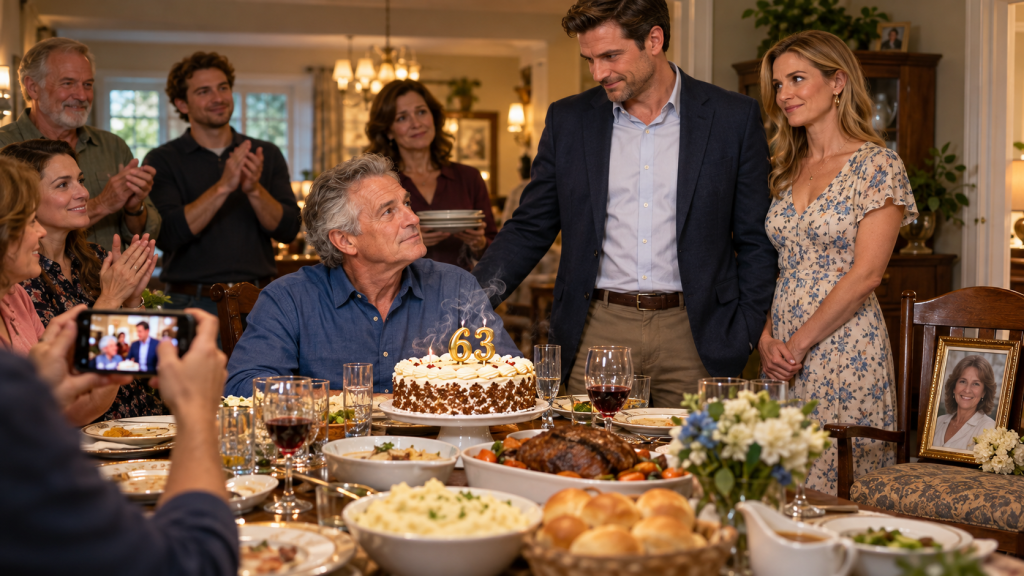
The same dining table where, less than twenty-four hours earlier, Daniel had wished that my sixty-third birthday candle would be my last.
The cake plate was gone.
The crumbs had been wiped away.
But I could still see Theresa’s empty chair.
Some absences never become ordinary.
They simply learn how to sit quietly beside you.
Daniel finally reached for the envelope.
His fingers stopped just before touching it.
“Why would Mom write something for me and leave it with Robert?”
I answered truthfully.
“Because she knew me.”
Daniel frowned.
“What does that mean?”
“She knew I might need years before I was ready to stop protecting you from yourself.”
His face hardened.
“There it is.”
“What?”
“You’ve already decided I’m some kind of monster.”
“No.”
I shook my head.
“If I thought you were a monster, this would be easier.”
That silenced him.
I pushed the envelope a little closer.
“You’re my son.”
“That is exactly why it took me this long.”
Lucy crossed her arms.
“Daniel made a bad joke.”
I turned toward her.
“No.”
“Ernest—”
“I am not discussing a joke.”
I pointed toward the napkin still lying on the table.
House. Shop. Insurance. Investment account. Pending signature.
“I’m discussing a plan.”
Lucy looked at the list.
For the first time, she did not have a quick answer.
Daniel did.
“That doesn’t prove anything.”
“You brought me documents last month.”
“Estate documents.”
“You called them routine.”
“They were.”
Robert spoke for the first time.
“No, they were not.”
Daniel looked at him.
Robert opened the binder.
“The documents you presented to Ernest would have created a holding company controlled by you, transferred ownership of the residence into that entity, assigned most voting rights in Sullivan Auto to the same structure, and expanded your authority under a durable power of attorney.”
Daniel laughed.
Nervously.
“That makes it sound sinister.”
Robert did not blink.
“I am reading what they did.”
“They were for succession planning.”
“Succession usually begins with informed consent.”
“Dad knew.”
I looked at him.
“No.”
Daniel turned toward me.
“You did.”
“You explained that putting the house and shop ‘in the family name’ would make things easier.”
“Yes.”
“You did not explain that once the house entered that company, I would no longer have sole authority to sell it, refinance it, or remove it without dealing with you.”
“That’s how family entities work.”
“You did not explain that your proposed operating agreement gave you the deciding vote if I became ‘unable or unwilling to manage day-to-day matters.’”
“You’re sixty-three, Dad.”
The sentence left his mouth before he could stop it.
I smiled.
Not because it was funny.
Because sometimes people open the exact door you need.
“And?”
He looked away.
Lucy stepped in.
“Sixty-three isn’t ancient, Ernest. That isn’t what he meant.”
I nodded.
“I know exactly what he meant.”
Then I looked at Daniel again.
“What happens when I turn seventy?”
He said nothing.
“Seventy-five?”
Silence.
“When do I become old enough that you stop asking and start deciding?”
His mouth tightened.
“You’re twisting this.”
Robert slid a document across the table.
“Perhaps this will help.”
Daniel looked down.
It was a copy of the proposed power of attorney.
Three paragraphs had been highlighted.
Robert said:
“This language would have given you authority to manage Ernest’s bank accounts, insurance interests, business shares, and real property once the instrument was activated.”
“It was for emergencies.”
“Then why did your draft permit gifts to yourself?”
Daniel froze.
Lucy turned toward him.
“What?”
Robert continued.
“There is a clause authorizing the agent to make transfers to descendants, including himself, for tax, estate-planning, or family-support purposes.”
Daniel looked furious.
“That’s standard.”
“No.”
Robert’s voice remained calm.
“It can appear in powers of attorney.”
“That does not make it appropriate in this situation.”
I stared at my son.
“How much?”
Daniel frowned.
“What?”
“How much were you planning to move?”
“Nothing.”
I pointed toward Lucy’s napkin.
“Then what does pending signature mean?”
Lucy’s eyes widened.
She looked at Daniel.
He looked at her.
There.
Something passed between them.
Not guilt exactly.
Recognition.
I sat back.
“You two were expecting me to sign something.”
Neither answered.
Robert closed the binder.
“That silence is probably wise.”
Daniel shoved his chair backward.
“This is unbelievable.”
“No.”
I said quietly.
“What’s unbelievable is that your first reaction is still anger that I noticed.”
My grandchildren were in the living room.
I could hear cartoons playing softly.
My youngest grandson, Mason, was eight.
The night before, he had wrapped both arms around me and said:
“Happy birthday, Grandpa.”
No calculation.
No mention of the shop.
No question about insurance.
Just a hug.
I lowered my voice.
“Sit down.”
Daniel stared at me.
“You don’t order me around.”
“Then stand.”
I was too tired to care.
Something in my voice must have reached whatever part of him still remembered being twelve years old at this table.
He sat.
Lucy did too.
I pushed Theresa’s envelope toward him.
“Read it.”
Daniel picked it up.
His thumb traced his mother’s handwriting.
For one moment, the greed disappeared.
He was not a forty-year-old man with debt and plans.
He was my boy.
Theresa’s boy.
The child who cried in the hospital parking lot eight years earlier and said:
“What are we supposed to do without her?”
My anger weakened.
Love is cruel that way.
It keeps showing you the child inside the adult even when the adult has done everything possible to make you forget.
Daniel opened the envelope.
Inside were six handwritten pages.
And a smaller folded sheet bearing instructions in Theresa’s handwriting.
Daniel unfolded the first page.
He read silently.
His expression changed almost immediately.
“What does it say?” Lucy asked.
He ignored her.
I knew the beginning.
Robert had shown me a copy that morning.
Theresa had written:
Daniel,
If Robert is giving you this letter, then either your father has finally become braver than his habit of protecting you, or you have pushed him so far that he has no other choice.
Daniel stopped reading.
His eyes filled.
He looked at me.
“Mom wrote this?”
“Yes.”
“When?”
“Seven months before she died.”
He looked back down.
Theresa’s words continued.
I hope you never read this.
I mean that sincerely.
Because if you never read it, then perhaps the thing I am afraid of will never happen.
You have always been frightened of insecurity. I saw it when you were little. If another child had a bigger bicycle, you wanted to know why. If your friend’s parents bought him a car, you wanted to know when you would get one. Wanting things does not make you bad. But as you grew older, I began seeing you measure love by what people were willing to give you.
Daniel’s mouth tightened.
Lucy watched him.
I stared at Theresa’s empty chair.
In my mind, I could hear her voice.
Soft.
Firm.
Never cruel.
She had been better at truth than I was.
Daniel kept reading.
Your father has one weakness where you are concerned.
He would rather pay for your mistakes than watch you suffer from them.
My throat tightened.
That line hurt more the second time.
He calls that helping.
Sometimes it is.
Sometimes it teaches you that the people who love you are responsible for protecting you from every consequence.
Daniel’s eyes lifted toward me.
I looked back.
No defense.
Theresa was right.
When Daniel wrecked his first car at nineteen because he was driving too fast, I bought him another.
Not new.
But another.
When his first attempt at a detailing business failed, I paid the suppliers.
When he and Lucy bought more house than they could comfortably afford, I gave them money for the down payment.
When Daniel borrowed from me to cover credit-card debt, I let him repay half and quietly forgot the rest.
Every rescue had been small enough to explain.
Together, they had become an education.
Not the education I intended.
Theresa’s letter continued.
Daniel, I love you more than I can write on paper.
That is why I need you to understand this: you do not inherit your parents while they are still alive.
Daniel covered his mouth.
Lucy whispered his name.
He continued reading.
The house is not yours because you grew up in it.
The shop is not yours because your father taught you how to change oil there.
Our savings are not a reward waiting at the end of our lives.
Anything you receive is a gift.
A gift is not late simply because the giver is still breathing.
The room became completely silent.
Even the cartoon in the living room seemed too loud.
Daniel reached the second page.
I have watched you ask questions about our insurance more often since I got sick.
His face collapsed.
I remembered.
Theresa had noticed.
I had not wanted to.
During chemotherapy, Daniel asked about the life-insurance policy.
Perfectly reasonable question, I had told myself.
He asked whether my name alone was on the shop.
Another reasonable question.
He asked Robert once whether probate would take long if Theresa died first.
That one had bothered me.
I had still defended him.
“He’s scared,” I told Theresa.
Maybe he had been.
Fear and greed can share a room.
Theresa wrote:
I know illness makes everyone think about death.
I am not angry that you have questions.
I am worried by how often your questions begin with what happens to property after someone is gone instead of how that person is doing while they are here.
Daniel lowered the letter.
His hands shook.
“I was scared, Dad.”
“I know.”
“I didn’t want her to die.”
“I know.”
Tears ran down his face.
“Then why would she write this?”
I looked at him.
“Because love doesn’t require blindness.”
He closed his eyes.
Lucy sat beside him, suddenly very quiet.
Daniel resumed.
The final page was shorter.
If you are reading this because you have begun pressuring your father to transfer the shop, the house, or control of his finances, stop.
Not because I am threatening you from the grave.
Because I am asking you, as your mother, to remember that your father is a person before he is an estate.
My eyes filled.
Daniel started sobbing.
Not loudly.
That made it worse.
Then Theresa’s last lines:
If Ernest chooses to give you everything someday, receive it with gratitude.
If he chooses differently, love him anyway.
And if you ever catch yourself waiting for his death because you believe your life cannot begin until his ends, then you have already inherited the worst thing money can give a person.
Entitlement.
Do not pass it to your children.
Love,
Mom
Daniel folded the letter.
Carefully.
Too carefully.
For almost a minute, nobody spoke.
Then he whispered:
“She thought that about me?”
I answered:
“She was afraid of what you might become.”
“That’s different.”
He looked at me.
“Is it?”
I thought.
“Yes.”
“Because she also believed you could choose differently.”
His eyes filled again.
Lucy looked toward the living room.
Then back to me.
“What were her instructions?”
I had almost forgotten the smaller sheet.
Daniel unfolded it.
Theresa had written that Robert should keep the letter sealed unless two conditions occurred:
Daniel attempted to pressure me into transferring significant assets during my lifetime.
Or I specifically asked Robert to release it.
Not legally binding.
Not a curse.
A mother’s contingency plan.
At the bottom, she had added:
Robert, if Ernest is still making excuses for him, make Ernest read my copy first. He is stubborn.
Despite everything, I laughed.
Robert did too.
Daniel stared at the page.
Then, to my surprise, a small laugh broke through his tears.
“Sounds like Mom.”
“Yes.”
God, yes.
For ten seconds, we were a family remembering Theresa.
Then Daniel placed the letter on the table.
And reality returned.
“So what now?”
he asked.
I answered:
“Now you live with the changes I made this morning.”
His face hardened again.
That quickly.
Grief had touched him.
It had not transformed him.
Not yet.
“What exactly did you do?”
Robert opened the binder.
I stopped him.
“No.”
Robert looked at me.
I said:
“I’ll tell him.”
Because this was not a legal seminar.
This was my life.
I looked at Daniel.
“The house is now in a living trust.”
“You control it?”
“Yes.”
“And after you die?”
“There are instructions.”
“What instructions?”
“You don’t need them today.”
His mouth opened.
I raised a hand.
“See?”
“What?”
“You’re doing it again.”
His jaw tightened.
I continued.
“I still live here.”
“I am healthy.”
“My doctor thinks I have many years left.”
“And within thirty seconds, you moved to after I die.”
Daniel looked away.
I continued.
“The trust has an independent successor trustee if I become genuinely incapacitated.”
“Not you.”
His eyes snapped back.
“Who?”
“A professional fiduciary.”
“You trust a stranger more than your son?”
“I trust a structure more than temptation.”
That hurt him.
I saw it.
Still true.
“The investment accounts are being moved under independent advisory management.”
“Beneficiary designations have been changed.”
“To who?”
“Again.”
I sighed.
“You are proving the point.”
Lucy whispered:
“Are the children still included?”
I looked at her.
“Yes.”
Her shoulders dropped.
That told me something.
Not everything about Lucy was greed.
A mother had surfaced.
“The grandchildren will have trusts for education, health needs, and later distributions.”
Daniel looked at me.
“And me?”
“You are not the direct beneficiary of those trusts.”
His face turned red.
“So you cut me out.”
“No.”
“You just said—”
“I said your children are protected independently.”
“What about the shop?”
That was the question he had been waiting to ask.
I leaned back.
“The controlling interest is being transferred into an employee ownership structure.”
Daniel stared.
“What?”
“The mechanics will take time.”
“Valuations.”
“Filings.”
“Tax work.”
“But the documents I signed this morning begin the transition.”
He laughed.
At first I thought he had misunderstood.
Then he stood.
“You gave my company to mechanics?”
I stood too.
“Your company?”
His face changed.
I pointed toward the window.
“My shop is twelve miles from here.”
“I signed the first lease.”
“I bought the first lift used.”
“I spent thirty years with grease under my fingernails.”
“Your mother handled invoices at the kitchen table when we couldn’t afford a bookkeeper.”
“You worked there.”
“You were paid.”
“You received bonuses.”
“You were treated well.”
“But you do not get to erase the people who built it before you arrived because you assumed my death would promote you.”
Daniel’s chest rose and fell.
“I’ve worked there fifteen years.”
“Yes.”
“I run half that place.”
“Then you understand why experienced employees deserve a stake.”
“So I get nothing?”
“You get the salary you earn.”
He stared.
I continued.
“The independent board will decide whether you remain in management.”
His face changed completely.
“What board?”
“The one being established as part of the transition.”
“You’re firing me?”
“No.”
“I am removing the idea that being my son guarantees control.”
Lucy stood.
“Ernest, you can’t humiliate him at his own workplace.”
I looked at her.
“Lucy, yesterday he wished me dead at my own birthday.”
She went silent.
I lowered my voice.
“I’m done arranging my life so Daniel never experiences embarrassment.”
Daniel left twenty minutes later.
Not calmly.
The children heard enough to know something was wrong.
That was the part I regretted most.
Mason ran toward me before Lucy got him out the door.
“Grandpa, are you mad at Dad?”
I crouched.
My knees complained.
I did not care.
“I’m upset about some grown-up things.”
“Did Dad do something bad?”
I looked toward Daniel.
He was standing by the front door.
Listening.
I could have punished him through his son.
Tempting.
Easy.
Wrong.
“Your dad made some choices he needs to fix.”
Mason looked worried.
“Do you still love him?”
My throat tightened.
I looked directly at Daniel.
“Yes.”
I said.
“I do.”
Daniel’s face changed.
Then he looked away.
Mason hugged me.
Real.
No paperwork.
No inheritance.
Just arms around my neck.
“Okay.”
He ran back to Lucy.
The front door closed.
Robert and I were alone.
He poured himself more coffee.
Then looked at me.
“How do you feel?”
I sat.
“Terrible.”
He nodded.
“Good.”
I glared.
He smiled faintly.
“If you felt good about this, I’d worry.”
I looked toward Theresa’s chair.
“Did she really think it would get this bad?”
Robert was quiet.
“No.”
I turned.
“She hoped it wouldn’t.”
“That’s not what I asked.”
He sighed.
“Theresa thought Daniel had begun equating money with safety.”
“She worried that after she died, you would overcompensate.”
“For him?”
“For everyone.”
I laughed bitterly.
“She was right.”
“Yes.”
Robert had been Theresa’s friend first.
That meant he had the annoying habit of telling me truths in her voice.
I rubbed my hands over my face.
“What happens now?”
“Legally?”
“Everything.”
Robert smiled sadly.
“I only bill for the first category.”
The audit of Sullivan Auto began the following Monday.
I almost canceled it.
Almost.
That word describes too many mistakes in families.
I almost asked.
Almost noticed.
Almost said no.
This time, I did not stop.
Our accountant, Helen Morris, reviewed five years of company records.
Not because I assumed Daniel had stolen.
Because after finding those transfer documents, I no longer wanted assumptions in either direction.
Facts.
That became my rule.
Daniel did not come to work for three days.
On Thursday, he arrived.
Walked into my office.
Closed the door.
“You’re auditing me.”
“I’m auditing the company.”
“Same thing.”
“No.”
“It isn’t.”
He laughed.
“You really like that phrase now.”
“I’ve had reason to use it.”
Daniel tossed his keys onto my desk.
“If you don’t trust me, fire me.”
I looked at the keys.
Then at him.
“I am not making another emotional decision because you demand one.”
He stared.
“Helen will finish her review.”
“The new governance committee will look at it.”
“Then decisions get made.”
“My father would never have done this to me.”
I almost smiled.
“I am your father.”
“You know what I mean.”
“No.”
“I don’t.”
His eyes filled with anger.
“You’re treating me like an employee.”
“At work, you are one.”
That sentence hurt him.
It also needed to exist.
Helen found problems.
Not millions.
No secret offshore accounts.
Real life is usually less cinematic.
But enough.
Over four years, company cards had paid for personal expenses that were difficult to justify.
Restaurants.
A family vacation coded as a vendor conference.
Furniture delivered to Daniel’s house and listed as “office fixtures.”
Repairs to Lucy’s SUV.
Club dues.
Several cash advances.
Total questionable amount:
$61,430.
Daniel called them compensation.
Helen asked where the approvals were.
There were none.
He said I had always let him use the company card.
That was partly true.
For legitimate business.
Sometimes for dinner when he worked late.
Not for patio furniture.
Then Helen found something worse.
Daniel had contacted our bank months earlier about future financing.
He asked what borrowing capacity the shop might have after an anticipated ownership transition.
He had not taken a loan.
He had not forged anything.
But he had been planning around ownership he did not possess.
The bank officer’s notes included a line:
Client states father expected to transfer controlling interest this year.
I stared at those words.
This year.
I had never said that.
Not once.
Daniel had simply repeated his hope until it became fact in other people’s paperwork.
When I confronted him, he looked exhausted.
“I thought you were going to.”
“Why?”
“You kept saying you wanted to slow down.”
“That is not the same as giving you everything.”
“You said the shop should stay in the family.”
“Years ago.”
“And?”
“I changed my mind.”
His face hardened.
“Because of one joke.”
“No.”
I shook my head.
“The joke made me stop pretending I hadn’t seen everything else.”
There is a difference.
A final straw does not create the weight beneath it.
It only proves how much was already there.
The new board terminated Daniel as general manager.
I abstained from the vote.
That surprised him.
He called me afterward.
“You’re hiding behind them.”
“No.”
“I created a system where one angry father could not fire his son and one entitled son could not inherit a company.”
“That’s called governance.”
He laughed bitterly.
“You sound like Robert.”
“Terrifying.”
He did not laugh.
The board offered Daniel continued employment in a non-management role while the financial issues were reviewed.
He refused.
“I’m not turning wrenches for people who used to report to me.”
I said:
“Then don’t.”
He quit.
For real.
No severance beyond what his contract required.
No special check from Dad.
That was one of the hardest things I had ever done.
Not the paperwork.
Watching him leave.
Daniel had started at the shop at fourteen sweeping floors.
Theresa brought him sandwiches on Saturdays.
I taught him brake systems.
Diagnostics.
Customer estimates.
He was good.
Very good.
But somewhere along the way, being good at the work became, in his mind, ownership of the reward.
I stood at the office window while his truck left the lot.
Miguel Alvarez, my foreman of twenty-two years, came into the office.
“You okay, boss?”
“No.”
He nodded.
Then:
“Want me to lie?”
I smiled.
“Please.”
“He’ll be back tomorrow.”
“Terrible lie.”
“Best I got.”
I laughed.
That helped.
Daniel told the family I had lost my mind.
That did not surprise me.
My cousin Frank called.
“Ernie, what’s this I hear about you giving your business to strangers?”
I said:
“Employees.”
“Same difference.”
“No.”
“It isn’t.”
Apparently that phrase had become my late-life hobby.
Frank continued.
“Daniel’s your only son.”
“Correct.”
“Who else should get it?”
“People who earn it.”
He sighed.
“Blood is blood.”
I looked around the shop.
Miguel had missed only four days of work in twenty-two years.
Helen had kept us from collapsing during the 2008 recession.
Our service manager, Anita, had spent nineteen years dealing with customers who believed yelling changed labor rates.
Blood matters.
So does showing up.
I said:
“If Daniel wants a relationship with me, blood gives him one.”
“It doesn’t give him my building.”
Frank called me stubborn.
Theresa would have agreed.
Then came the word dementia.
That one hurt.
Daniel did not file anything in court.
He was not that reckless.
But he told family members I was “declining.”
He said Robert was manipulating me.
He suggested Theresa’s death had left me depressed and vulnerable.
He told Lucy’s brother that I had become obsessed with money.
Eventually one of my nephews called and gently asked whether I had seen a doctor recently.
I understood.
Daniel was creating doubt.
Maybe not consciously as a grand strategy.
Maybe because he needed an explanation where he was not the problem.
Still dangerous.
So I saw my doctor.
Not because Daniel demanded it.
Because I wanted facts.
Physical.
Cognitive screening.
Medication review.
Nothing concerning.
My doctor asked why.
I told him.
He removed his glasses.
“Family?”
“Yes.”
He nodded as though that explained more illnesses than any textbook.
Robert placed the medical documentation with my estate file.
Not to humiliate Daniel.
To make future lies harder.
I hated needing it.
I was grateful it existed.
Lucy came to see me alone in November.
That surprised me.
She sat at the same dining table.
No perfume strong enough to enter the room before she did.
No smile.
She looked tired.
“Daniel doesn’t know I’m here.”
“I’m not comfortable keeping secrets from him.”
“It’s not a secret.”
She exhaled.
“Fine.”
“I’ll tell him.”
I waited.
Then she pulled the napkin from her purse.
The one I thought I had thrown away.
House.
Shop.
Insurance.
Investment account.
Pending signature.
“I wrote this.”
“I know.”
“I need to tell you why.”
I crossed my arms.
“Go ahead.”
“Daniel told me you had already agreed to transfer everything.”
My expression did not change.
Inside, something shifted.
Lucy continued.
“He said the documents were basically done.”
“That the house would go into a family trust or company, the shop would become his, and you wanted us to help with estate planning.”
I stared.
“That’s not what he told me.”
“I know.”
“How?”
“After your birthday.”
She looked ashamed.
“I found copies of the papers.”
“I read them.”
I thought about the broad power of attorney.
The family holding company.
“What did you think they said before?”
“That you were giving him the business while you stayed semi-retired.”
“And the house?”
“That eventually we’d manage it for you.”
Eventually.
That word.
Always politely waiting for my absence.
Lucy continued.
“I was excited.”
“I won’t lie.”
“I wanted to remodel this kitchen.”
My eyebrows lifted.
She almost smiled.
“I know.”
“I said it out loud like an idiot.”
“Yes.”
“Thank you.”
“You’re welcome.”
Her eyes filled.
“But I did not know he had made himself able to control things while you were alive.”
I believed part of that.
Not all.
“You wrote insurance.”
“I did.”
“Why?”
“Daniel said there was a policy meant to help us pay estate taxes.”
“There isn’t.”
She looked surprised.
“He said—”
“I know.”
We sat in silence.
Then she whispered:
“We’re in trouble.”
I almost laughed.
Financially, apparently.
“What kind?”
She handed me a folder.
Credit cards.
Home-equity loan.
Private-school tuition.
Two car notes.
A second mortgage.
Daniel had been carrying nearly $390,000 in consumer and home-related debt beyond their primary mortgage.
My stomach dropped.
“How?”
“Lifestyle.”
She said it before I could.
Then cried.
“I kept thinking the shop would be ours.”
There.
At least honest.
“We both did.”
I leaned back.
“So my death was your debt-management plan.”
Lucy flinched.
“No.”
“Then what was?”
“Your transfer.”
“Same money.”
“Different timing.”
She covered her face.
“That sounds terrible.”
“It is terrible.”
She cried quietly.
I let her.
Then she asked:
“Are you going to help us?”
There it was.
The old Ernest knew how to answer.
Of course.
How much?
Where do I sign?
The new Ernest took a breath.
“No.”
Lucy stared.
Not angry.
Destroyed.
“No?”
“I will make sure my grandchildren have food, medical care, and education.”
“Directly.”
“I will not pay off your house.”
“I will not clear the cards.”
“I will not replace Daniel’s income.”
Her tears fell.
“We might have to sell.”
“Then sell.”
“You say that like it’s nothing.”
“No.”
I shook my head.
“I say it like a house is not worth turning someone else’s life into a financial expectation.”
She looked down.
After several seconds, she nodded.
That surprised me.
“Okay.”
Just that.
Okay.
She stood.
At the door, I said:
“Lucy.”
She turned.
“I don’t think you caused all of this.”
Her face changed.
“But you participated.”
She nodded.
“I know.”
“Figure out which part is yours.”
“I’m trying.”
That was the first honest conversation we ever had.
Daniel did not speak to me for four months.
Mason did.
So did the older grandchildren.
Lucy made sure of that.
I respected her for it.
She could have used access to them as punishment.
She didn’t.
I saw them every other Sunday.
Sometimes at my house.
Sometimes breakfast.
No estate conversations.
No comments about their parents.
That boundary became sacred.
One afternoon, Mason wandered into my bedroom while I was putting laundry away.
He saw the safe.
“Is that where all your money is?”
I laughed.
“No.”
“Dad said you have a safe full of important stuff.”
“That part is true.”
“What’s in it?”
“Papers.”
“Boring.”
“Extremely.”
He thought.
Then:
“Dad says you took his shop away.”
There it was.
I sat on the bed.
“Do you know what ownership means?”
“Kind of.”
“It means who legally controls something.”
Mason nodded.
“The shop belonged to me.”
“Dad worked there.”
“Yes.”
“He worked very hard.”
“Yes.”
“Then why didn’t he get it?”
Good question.
Because children strip adult stories down to their bones.
“Because working somewhere does not automatically mean you own it.”
He frowned.
“But you’re his dad.”
“Yes.”
I smiled.
“And because I’m his dad, I want him to learn he can build a life that doesn’t depend on me dying.”
Mason stared.
“That’s weird.”
“What?”
“Dad dying would make me sad.”
My chest tightened.
“It should.”
He looked at me.
“Does Dad want you dead?”
I hated Daniel for making that question possible.
“No.”
I answered carefully.
“I think your dad said something cruel because he was angry and thinking too much about money.”
“That doesn’t mean he doesn’t love me.”
Mason considered.
“Can people love someone and still be mean?”
“Yes.”
“Adults too?”
“Especially adults.”
He nodded.
Then:
“Can I have a soda?”
Children.
Bless them.
“Yes.”
He ran downstairs.
The world continued.
Sullivan Auto changed.
Slowly.
The employee ownership plan took more than a year to implement properly.
Lawyers.
Valuations.
Financing.
Tax advice.
Nothing magical.
In the end, employees acquired a significant ownership stake through a structured plan.
I retained enough interest to provide retirement income and a voice during the transition.
A professional board governed major decisions.
My remaining interest would eventually be purchased under the agreement.
No automatic inheritance.
No dynasty.
The first time the new sign went up, it read:
SULLIVAN AUTO SERVICE
Below it, smaller:
EMPLOYEE OWNED
I stood in the parking lot and stared.
Miguel joined me.
“Theresa would like that.”
I smiled.
“She’d ask how much the sign cost.”
He laughed.
“Then tell you we overpaid.”
“Definitely.”
The wind moved across the lot.
For the first time, the shop felt like something I could leave someday without feeling that I had abandoned it.
That mattered.
Daniel found work at another repair company.
Not management.
Service adviser.
He hated it.
I heard through the grandchildren.
Then six months later, he moved to a smaller independent shop.
Better pay.
More responsibility.
No last name on the sign.
That was probably good for him.
Lucy went back to work full-time in medical billing.
They sold their large house.
Moved into a smaller one.
The children changed schools.
That hurt them.
I paid directly for Mason’s therapy when he struggled with the transition.
Daniel tried to return the money.
I said:
“It’s for him.”
He accepted.
That was our first conversation in months.
Thirty-seven seconds.
Progress.
My sixty-fourth birthday came quietly.
No gold candles.
No camera.
Robert took me to breakfast.
My grandchildren came in the afternoon.
Lucy brought a grocery-store cake.
Daniel did not come.
He sent a card.
I opened it after everyone left.
Inside:
Happy birthday, Dad.
Nothing else.
I sat at the table.
Theresa’s chair across from me.
And cried.
Not because the card was cold.
Because it was the first thing Daniel had given me in years without asking for something in the same week.
Sometimes absence is progress too.
Then, almost a year later, Daniel appeared at the shop.
I was in the office two days a week by then.
He knocked.
Actually knocked.
At a door he used to walk through without thinking.
“Come in.”
He entered.
Older.
Tired.
He held a check.
I looked.
$5,000.
“What’s that?”
“For the company card stuff.”
I stared.
“The settlement agreement already requires repayment.”
“I know.”
“Then give it to the administrator.”
“I did.”
“This is the first installment.”
I nodded.
“Okay.”
He remained standing.
“Can I sit?”
That question hurt more than it should have.
“Yes.”
He sat.
For a while, neither spoke.
Then Daniel said:
“I was angry at you for ruining my life.”
I said nothing.
“I told everybody you were senile.”
“I know.”
“I knew you weren’t.”
That hurt.
He looked ashamed.
“I needed you to be wrong.”
“Why?”
“Because if you were right…”
He swallowed.
“…then Mom was right too.”
I looked toward the window.
He continued.
“I read her letter about fifty times.”
My throat tightened.
“So did I.”
Daniel almost smiled.
Then:
“I kept getting stuck on one line.”
“Which?”
“Your father would rather pay for your mistakes than watch you suffer from them.”
I said nothing.
“I thought that was love.”
“It was.”
I looked at him.
“It just wasn’t always wise.”
His eyes filled.
“I thought every time you rescued me meant I deserved rescuing.”
There.
I breathed slowly.
He continued.
“When you stopped, I thought you stopped loving me.”
My chest hurt.
“You really believed that?”
“Yes.”
He laughed bitterly.
“Sounds pathetic.”
“No.”
“It sounds learned.”
He looked at me.
“I learned it from you.”
That could have made me defensive.
Instead, I let it land.
“Yes.”
His face changed.
He had expected denial.
I continued.
“I taught you some of it.”
“I’m sorry.”
Daniel cried.
Not dramatically.
Quietly.
“Then I taught myself the rest.”
he whispered.
“That part is mine.”
Good.
He understood.
Then:
“I’m not asking for the shop back.”
I almost laughed.
“Excellent start.”
He smiled through tears.
“I’m not asking you to change the will.”
“Better.”
“I’m not asking for money.”
“Now I’m suspicious.”
He laughed.
A real laugh.
For a second, he was twenty again.
Then:
“I want my dad back.”
My throat closed.
I looked at him.
“You never lost me.”
Daniel’s face broke.
“You stopped speaking to me.”
“You stopped calling.”
Fair.
He wiped his face.
“I didn’t know how.”
“Neither did I.”
Silence.
Then I said:
“Daniel, if we rebuild anything, I need you to understand something.”
He nodded.
“Forgiveness will not restore your old access.”
His expression stayed steady.
Good.
“You will never have power of attorney over me.”
“Okay.”
“You will not control the trust.”
“Okay.”
“The shop will remain employee owned.”
He swallowed.
“Okay.”
“The grandchildren’s trusts stay independent.”
“Yes.”
“And I will not discuss what you get when I die every time we have dinner.”
He looked down.
“I deserve that.”
“No.”
I corrected him.
“This isn’t about deserving.”
“It’s about making sure our relationship exists while I’m alive.”
He looked up.
Tears again.
“I want that.”
“So do I.”
I stood.
Daniel did too.
For one awkward second, neither knew what came next.
Then my son hugged me.
Not the way Mason did.
Adults carry history into embraces.
Still, it was real.
I held him.
And somewhere in my head, Theresa said:
About time, both of you.
Reconciliation did not happen in one hug.
Important.
Daniel still became defensive.
I still became suspicious too quickly.
He once offered to help me organize tax documents and I stared at him so long he finally said:
“Right. Bad choice of activity.”
We laughed.
Another time, he complained that the employee-owned shop was “going downhill.”
I nearly threw him out.
Then realized he was criticizing a scheduling system, not asking for control.
Trauma makes ordinary conversations loud.
We learned.
Slowly.
Lucy apologized a year later.
Not at my house.
Neutral diner.
She said:
“I used to walk through your kitchen and imagine what I’d change.”
“I noticed.”
She laughed nervously.
“I know.”
Then:
“I think wanting the house made it easier not to think about what had to happen before it could become ours.”
That was honest.
“I never wanted you dead.”
“I believe you.”
“But I wanted the result that came after.”
She looked ashamed.
“That is close enough that it scares me.”
I appreciated that sentence.
She continued.
“I’m sorry.”
“Thank you.”
We never became close.
We became decent.
Sometimes that is the healthier miracle.
Daniel and Lucy nearly divorced.
They did not.
Counseling.
Debt repayment.
Smaller house.
Humility.
Apparently those things are stressful.
They stayed together, but differently.
Lucy later told me:
“For years we planned around money we didn’t have.”
“That’s called being American.”
She laughed.
Then:
“No.”
“I mean your money.”
“I know.”
“Once it disappeared from our plan, we had to find out whether our actual life worked.”
“And?”
She smiled.
“Mostly.”
Good enough.
Mason grew.
So did the others.
The grandchildren’s trusts paid tuition directly when the time came.
No giant checks at eighteen.
No sports cars.
No “Grandpa’s dead, congratulations.”
I hated that idea.
Robert structured the trusts so education, medical care, first-home assistance, and later distributions came with professional oversight and age.
Daniel was not trustee.
He eventually said:
“Good.”
That mattered.
When Mason was seventeen, he asked me:
“Why didn’t Dad get to manage our money?”
I said:
“Because he’s your father.”
Mason frowned.
“That makes no sense.”
“It will someday.”
“Try me.”
Fair.
I explained:
“If your father is deciding whether to tell you no as a parent while also deciding whether to release your money as trustee, those roles can get mixed.”
Mason thought.
“Did Dad used to mix money and love?”
Children become adults and start seeing what was once hidden.
“Yes.”
“Do you?”
My throat tightened.
“Sometimes.”
He smiled.
“At least you know.”
Smart kid.
Robert died before me.
That was rude.
He had always seemed too organized to die first.
Heart attack at seventy-one.
Sudden.
I sat at his funeral and realized how many bridges to Theresa were disappearing.
Afterward, Robert’s daughter gave me an envelope.
“Dad said you’d know what this is.”
Inside was Theresa’s original instruction sheet.
The one he had kept.
At the bottom, beneath the paragraph I already knew, she had written something Robert never showed me before.
If Ernest finally sets a boundary, do not let him turn the boundary into another punishment.
I read it twice.
Then laughed through tears.
Of course.
Theresa had predicted both of us.
Daniel’s entitlement.
My tendency to swing too far once hurt.
The next line:
He will be tempted to leave Daniel nothing just to prove he can. Remind him that freedom means choosing calmly, not choosing the opposite out of anger.
I sat in my car after the funeral and stared at that sentence.
My estate plan at that time left Daniel very little directly.
Not nothing.
But close.
Was that what I truly wanted?
Or was part of me still arguing with the birthday candle?
Good question.
Annoying woman.
Dead eight years, still winning arguments.
I revisited the plan.
Not secretly.
I told Daniel.
“We’re meeting with the new attorney next month.”
His face tensed.
“Do I need to know?”
“No.”
“Then why tell me?”
“Because I don’t want secrecy to become another weapon.”
He nodded.
“What are you changing?”
“I’m not telling you numbers.”
He smiled faintly.
“Fair.”
I added a modest trust for Daniel.
Not the shop.
Not control.
Enough to acknowledge he was my son without turning my death into his retirement strategy.
The bulk of my remaining financial estate still flowed to grandchildren’s trusts, the trades scholarship I had created, and several charities Theresa cared about.
The house would eventually be sold unless circumstances changed.
No child automatically received the keys.
I left Daniel my tools.
Not all.
The good ones.
That was almost more valuable emotionally.
And Theresa’s letters.
I told the attorney:
“Make sure he gets those.”
She smiled.
“Those may be the most dangerous assets.”
“You have no idea.”
The Ernest and Theresa Sullivan Trades Scholarship began almost accidentally.
Miguel’s grandson wanted to attend a technical program.
Couldn’t afford tools.
I paid.
Then thought:
Why one kid?
The shop’s new employee trust contributed.
I contributed.
A local supplier joined.
Soon we had a small scholarship fund for young people entering auto repair, welding, HVAC, electrical work, and other trades.
At the first award dinner, a nineteen-year-old named Javier shook my hand.
“My dad says college is the only way to make something of yourself.”
I smiled.
“Your dad is wrong about one word.”
“What?”
“Only.”
He laughed.
Theresa would have loved him.
That scholarship became more important to me than leaving a building to one person.
A shop can create income.
A trade can create independence.
Big difference.
My seventieth birthday arrived seven years after Daniel’s remark.
This time, I did not want a party.
Naturally, everyone ignored me.
Family came.
Employees.
Former employees.
Grandchildren.
Lucy brought food.
Daniel brought the cake.
I noticed.
One cake.
Seven candles.
“Why seven?” I asked.
“Too lazy for seventy.”
“Respectable.”
He smiled.
The dining room was loud again.
But different.
Nobody talked about remodeling my kitchen.
Nobody mentioned insurance.
Nobody asked who got what.
Maybe they wondered.
Human.
They kept it in their heads.
Progress.
When the cake came out, Mason—now a teenager—started singing badly.
Everyone joined.
Daniel stood across from me.
For a second, the memory came back so clearly I could smell extinguished wax from seven years earlier.
His drink.
His low voice.
I hope this is the last candle you blow out.
My chest tightened.
Daniel saw it.
His smile disappeared.
He stepped closer.
Quietly, so only I could hear:
“I’m sorry.”
I looked at him.
“I know.”
“No.”
His eyes filled.
“Every birthday.”
He swallowed.
“I remember.”
“So do I.”
“I wish I could take it back.”
“You can’t.”
He nodded.
“I know.”
Then Mason shouted:
“Grandpa, make a wish!”
Everyone laughed.
I looked around.
Theresa’s chair was still empty.
But the room no longer felt like a waiting room for my death.
That was the wish.
Already true.
I blew out the candles.
Everyone clapped.
Daniel too.
This time, the sound did not hurt.
Later, after people left, Daniel stayed to help clean.
He scraped plates into the trash.
Loaded the dishwasher badly.
His mother would have corrected him.
I watched.
Then said:
“You know what my wish was?”
He froze.
“Do I want to?”
“Yes.”
He turned.
“I wished for nothing.”
He frowned.
“That’s depressing.”
“No.”
I smiled.
“I didn’t need anything.”
His eyes filled.
We stood quietly in the kitchen.
Then Daniel said:
“I used to think your death was when my life would get easier.”
There it was.
More direct than ever.
I waited.
He continued.
“I hate saying it.”
“Say it anyway.”
“I thought the shop would solve everything.”
“The house would mean we’d never worry.”
“Insurance.”
“Investments.”
“I didn’t think of it as you dying.”
“I thought of it as…”
He searched.
“Eventually.”
That word again.
“Eventually is a polite word for somebody else’s ending.”
He nodded.
“I know.”
Then:
“When you changed everything, I thought you ruined my future.”
“What do you think now?”
Daniel leaned against the counter.
“I didn’t have a future.”
“I had an inheritance plan.”
My eyes filled.
Good.
He finally understood the difference.
Daniel eventually started his own small business.
Mobile diagnostics.
One van.
Then two.
No money from me.
He asked for advice once.
Advice.
Not capital.
I gave too much.
Father.
Eventually he said:
“Dad.”
“What?”
“I asked one question.”
“Right.”
His business did well.
Not spectacular.
Well enough.
He hired a young technician.
Then another.
One afternoon he came to the employee-owned Sullivan Auto to buy an old diagnostic unit we were replacing.
The transaction went through normal channels.
He paid market price.
Miguel called me afterward.
“You’d be proud.”
“I am.”
“Tell him.”
“I do.”
Miguel laughed.
“Not enough.”
Theresa again.
Everyone conspiring.
I called Daniel.
“Good job.”
He was quiet.
Then:
“Thanks, Dad.”
That was all.
Enough.
I retired fully at seventy-two.
Real retirement.
Not dying.
Different concept.
On my last official day at the shop, employees gathered in the service bay.
They gave me a plaque.
I hate plaques.
This one said:
ERNEST SULLIVAN
FOUNDER
HE BUILT A SHOP. THEN HE BUILT A WAY FOR IT TO OUTLIVE HIM.
I cried.
Embarrassing.
Miguel hugged me.
Anita cried harder.
Then Daniel appeared.
I had not known they invited him.
He stood near the back.
Afterward, he approached.
“Can I show you something?”
We walked outside.
His mobile-service van sat in the lot.
On the side:
SULLIVAN MOBILE DIAGNOSTICS
I stared.
Daniel said quickly:
“If you don’t want me using the name—”
I looked at him.
“Whose name is it?”
He swallowed.
“Ours.”
That word.
Not mine.
Not his.
Ours.
I touched the van.
“Looks good.”
Daniel cried.
I pretended not to notice.
Then I noticed openly.
We were past pretending.
Theresa’s grave became easier to visit over the years.
At first, I went there to complain.
Mostly about Daniel.
“I blame you.”
I would say.
“You spoiled him.”
Unfair.
Then:
“You should’ve told me.”
She had.
In every way except screaming.
Eventually I visited to tell her ordinary things.
Mason graduated.
Lucy got promoted.
Daniel’s business added a third van.
The shop’s employee plan paid its first full distribution.
My knees hurt.
Robert died.
The scholarship had twelve students.
I would sit beside the stone and talk like a fool.
Maybe that is what marriage becomes after death.
One person continuing both sides badly.
When I was seventy-five, Daniel came with me.
First time since her funeral.
We stood at Theresa’s grave.
He placed flowers.
Red.
Her favorite.
Then said:
“I’m sorry, Mom.”
I looked away.
That belonged to them.
After a while, he sat on the grass.
“Dad.”
“Yes?”
“Do you think she knew I’d turn into that?”
“No.”
He looked up.
“She wrote the letter.”
“She knew you could.”
“That’s worse.”
“No.”
I sat beside him carefully.
“She knew all of us can become worse versions of ourselves if nobody stops us.”
Daniel stared at the stone.
“Did you hate me?”
I thought.
“Sometimes.”
His face tightened.
“I loved you at the same time.”
“That sounds impossible.”
“It isn’t.”
I smiled sadly.
“Parenthood is mostly impossible things coexisting.”
He laughed softly.
Then:
“Do you trust me now?”
I looked at him.
“With what?”
He frowned.
“Me.”
“That’s not how trust works.”
I picked up a blade of grass.
“I trust you to take Mason home safely.”
“I trust you not to steal from the shop.”
“I trust you when you tell me you’re paying your debts.”
“I trust you with some things more than others.”
Daniel nodded.
“Will you ever trust me with everything?”
“No.”
Honest.
He looked hurt.
Then accepted it.
“I understand.”
That mattered more than pretending the answer had changed.
Mason grew into a young man who wanted nothing to do with auto repair.
Naturally.
He studied nursing.
Daniel complained jokingly that three generations of Sullivan grease ended with him.
I said:
“Good.”
He frowned.
“Why good?”
“Means the kid chose.”
Daniel smiled.
“Yeah.”
Choice.
That became a family word.
Mason’s older sister went into accounting.
That terrified Daniel.
“She’s going to audit me.”
“Probably.”
“Genetics are cruel.”
“Your mother would love it.”
She would.
Years after the birthday, one of my nephews asked:
“Do you regret not leaving the shop to Daniel?”
We were at a barbecue.
I looked toward my son.
He was helping Mason’s little boy fix a toy truck.
Grandfather now.
Different softness.
“No.”
“Even now?”
“Especially now.”
My nephew frowned.
“Why?”
“Because losing the shop forced him to build something that belonged to him.”
I watched Daniel laugh with the child.
“If I had given him everything, he might have spent his whole life believing his father’s death was his greatest business opportunity.”
My nephew went quiet.
Then:
“That’s dark.”
“Yes.”
“So was the birthday.”
Fair.
Daniel repaid every dollar identified in the company audit.
It took six years.
Interest too.
The day the final payment cleared, Helen—still our accountant because apparently accountants do not retire out of spite—called me.
“He’s done.”
I sat quietly.
“Send him the confirmation.”
“I already did.”
“Good.”
Then Helen said:
“Ernest?”
“Yes?”
“You know you could’ve forgiven the debt.”
“I know.”
“Why didn’t you?”
I thought.
“Because sometimes making restitution is part of becoming the person who deserves forgiveness.”
Helen was quiet.
Then:
“Therapy?”
“Dead wife.”
“Cheaper?”
“No.”
We laughed.
Lucy changed too.
More than I expected.
She stopped talking about things as markers.
Bigger house.
Better kitchen.
New car.
Maybe financial pain teaches people what objects actually cost.
At my seventy-eighth birthday, she brought homemade soup instead of a gift.
“I know you hate stuff.”
“I hate bad stuff.”
She rolled her eyes.
Then handed me an envelope.
Inside was a photograph of Theresa with Daniel as a baby.
I had never seen it.
“Where did you get this?”
“Found it in one of Daniel’s old boxes.”
Theresa was twenty-seven.
Tired.
Beautiful.
Holding a sleeping baby.
On the back, she had written:
He trusts us with everything. What a terrifying privilege.
I had to sit down.
Lucy touched my shoulder.
“You okay?”
“No.”
She nodded.
“Good picture?”
“The best.”
I framed it.
That photograph eventually sat on my bedside table beside Theresa’s final letter.
Beginning and warning.
Both love.
Age softened me.
Not completely.
I was still stubborn.
Ask anyone.
But by eighty, I no longer thought of the safe as protection from Daniel.
The safe held documents.
That was all.
My safety came from something else.
Clear structures.
Independent people.
Written wishes.
And relationships that no longer depended on guessing what I meant.
I had learned too late that family peace built on unspoken assumptions is not peace.
It is deferred conflict.
Theresa knew.
Annoying woman.
When my health finally began to fail, Daniel noticed before I admitted it.
Shortness of breath.
Fatigue.
Nothing dramatic.
Age.
One afternoon he sat at my kitchen table.
“Dad.”
The word still had the power to make me twenty years younger.
“What?”
“You need help.”
My body stiffened.
He saw it.
Immediately.
Then raised both hands.
“Not money.”
I laughed.
He smiled.
“I mean help at home.”
“I’m fine.”
“You almost fell yesterday.”
“I tripped.”
“On air.”
“Dangerous substance.”
He sighed.
Then said something beautiful.
“What do you want?”
I stared.
Not:
Here is what we’re doing.
Not:
Sign this.
What do you want?
I thought.
“To stay here.”
“Okay.”
“For now.”
“Okay.”
“With help coming in.”
“Okay.”
I looked at him.
“You’re agreeing too easily.”
He smiled.
“I’m learning.”
We arranged home care.
Through professionals.
Daniel did not manage my accounts.
He attended medical appointments only when I invited him.
He never once asked whether the house would be his afterward.
That was when I knew the lesson had become real.
Not when he apologized.
When he stopped asking.
One evening, he found me sitting beside the safe.
Open.
Documents on the bed.
For one second, the past returned to both of us.
Daniel stopped in the doorway.
“Bad time?”
“No.”
“Need help?”
I almost said yes.
Then thought.
“Read me the date on this insurance statement.”
He stepped closer.
Stopped again.
“Are you sure?”
That question almost made me cry.
“Yes.”
He read it.
Nothing more.
No reaching for beneficiary pages.
No scanning balances.
Just the date.
I smiled.
“What?”
“Nothing.”
“Dad.”
“You finally learned how to stand beside an open safe without trying to inherit it.”
His face changed.
Then he laughed.
“Low bar.”
“Took you long enough.”
He sat beside me.
“Fair.”
I gave Daniel Theresa’s original letter before I died.
Not in the will.
While I could still watch him receive it.
He held the pages.
“These belong to you too.”
“They’re hers.”
“And yours.”
He looked at me.
“I don’t want to lose them.”
“Then make copies.”
He laughed.
“Practical to the end.”
“That was your mother.”
Then I handed him the photograph of Theresa holding him as a baby.
He stared at the words on the back.
He trusts us with everything. What a terrifying privilege.
Daniel started crying.
“I failed that.”
“Yes.”
I said.
No lies.
Then:
“And then you learned.”
His shoulders shook.
“Does that count?”
“It’s the only part you can still change.”
He nodded.
My final will did not contain surprises.
That was intentional.
Nobody needed another birthday-table reveal.
The house would be sold.
A portion of the proceeds went to the grandchildren’s trusts.
A portion to the trades scholarship.
A portion to hospice care in Theresa’s name.
Daniel received his modest trust and my personal tools.
Mason received my old watch.
Lucy received Theresa’s recipe box because, strangely, Theresa had once told me Lucy was the only person in the family who respected ingredient measurements.
Daniel was offended.
Good.
The shop remained employee owned.
It was never coming back into the estate.
Best decision I ever made.
But I am getting ahead of myself.
Because the story did not end with my death.
The important ending happened while I was still sitting at the table.
Still blowing out candles.
Still drinking coffee.
Still watching my son become someone I could love without protecting myself from him every second.
That is the ending I care about.
Not what everyone received afterward.
At eighty-one, I celebrated another birthday.
Smaller.
Family only.
Daniel brought the cake.
Again.
This time there was one candle.
“Cheap.”
I told him.
“Inflation.”
He replied.
Mason had children of his own by then.
They crowded around the table.
One little boy asked:
“Great-Grandpa, what do you wish for?”
I looked around.
Daniel.
Lucy.
Grandchildren.
Great-grandchildren.
Theresa’s photograph on the shelf behind them.
My life.
Imperfect.
Still mine.
Daniel caught my eye.
For just a second, I saw shame cross his face.
The old birthday.
I shook my head slightly.
Not tonight.
He understood.
I blew out the candle.
Applause.
Real.
Then I said:
“My wish already came true.”
Daniel froze.
The room laughed because nobody knew the old sentence.
He did.
His eyes filled.
This time he asked:
“What was it?”
I smiled.
“That I’d live long enough to see you stop waiting for my life to end before yours could begin.”
The room went quiet.
Not uncomfortable.
Tender.
Daniel stood.
Walked around the table.
Then hugged me.
“I’m sorry.”
I whispered:
“I know.”
Then:
“And I’m proud of you.”
He cried into my shoulder.
That sentence had taken eighteen years to become true again.
Worth waiting for.
People think boundaries destroy families.
Sometimes they do.
Sometimes a family was already being destroyed by the absence of them.
The morning after my sixty-third birthday, I believed I was protecting myself from Daniel.
That was true.
But I was also doing something I did not understand yet.
I was protecting him from an inheritance large enough to let him remain the worst version of himself.
If I had signed those papers, Daniel might have gotten the house.
The shop.
Authority.
Money.
And he would have learned that wishing an old man out of the way works if you wait long enough.
Instead, he got consequences.
A smaller house.
A regular job.
Debt repayment.
Humility.
His own business.
His own mistakes.
His own success.
His father.
Eventually.
That turned out to be worth more.
I still think about the sentence he whispered over my birthday cake.
I hope this is the last candle you blow out.
For years, Daniel hated himself for it.
I stopped hating him much sooner.
Not because words do not matter.
They do.
But because one terrible sentence became the door through which years of hidden resentment finally entered the light.
Without it, I might have signed.
That is the part that frightens me most.
I might have signed the house away while believing I was simplifying paperwork.
I might have given Daniel control over the shop because I was tired of arguing.
I might have expanded the power of attorney because “family handles family.”
Then one day, I might have discovered that I was still alive but no longer in charge of the life I had built.
The cruel sentence saved me from the polite documents.
Strange.
Sometimes the ugly truth is safer than a beautiful lie.
The napkin Lucy left on the table disappeared long ago.
House.
Shop.
Insurance.
Investment account.
Pending signature.
I kept it for several years.
Then one afternoon I took it from the safe.
Daniel happened to be visiting.
“What’s that?”
I handed it to him.
He read.
Winced.
“I forgot about this.”
“I didn’t.”
He gave it back.
I looked at the list.
Then tore it in half.
Daniel stared.
“Why now?”
“Because everything on it has been decided.”
He frowned.
“House?”
“Mine while I’m alive.”
“Shop?”
“Employees.”
“Insurance?”
“Handled.”
“Investments?”
“Handled.”
“Pending signature?”
I smiled.
“Nothing pending.”
I tore the napkin again.
Dropped it in the trash.
Then looked at my son.
“The only thing I care about now is whether you come for dinner when there’s nothing to sign.”
Daniel’s eyes filled.
“I’m here.”
“Yes.”
He was.
That was the inheritance I had wanted all along.
Not someone waiting at the edge of my life.
Someone willing to sit inside it.
Theresa had once told me that love becomes dangerous when it turns into an excuse to avoid truth.
I thought she was talking about marriage.
She was talking about everything.
Parenthood.
Money.
Forgiveness.
Family.
You can love a child and say no.
You can forgive a son and never restore his power of attorney.
You can leave someone less money than they expected without loving them less.
You can give strangers—employees, students, hospice nurses—part of what you built because they helped make your life meaningful too.
Blood is not a deed.
Love is not a beneficiary form.
And an inheritance is not proof that a parent approved of the person you became.
Sometimes the greatest thing a parent can leave a child is the chance to build something that does not depend on the parent leaving at all.
Daniel eventually did.
So did I.
If Theresa had lived, none of this would have happened exactly this way.
She would have caught Daniel sooner.
Probably caught me sooner too.
She would have stood in the kitchen with her hands on her hips and said:
“Ernest, stop paying for everybody’s bad decisions.”
I would have argued.
She would have won.
Marriage.
Instead, she left six pages in an envelope.
Six pages that sat quietly in Robert’s office for years waiting for a day I prayed would never come.
When that day came, I thought the letter was a weapon.
It wasn’t.
It was a mirror.
Daniel saw entitlement.
I saw enabling.
Lucy saw expectation.
All of us saw something we had spent years calling by nicer names.
That is what truth does when it is written by someone who loved you enough not to flatter you.
My shop still carries my name.
Sullivan Auto Service.
Employee Owned.
Daniel’s company carries it too.
Sullivan Mobile Diagnostics.
For a while, that would have bothered me.
Two Sullivan signs.
No guaranteed inheritance between them.
Now I like it.
A name can be shared without control being shared.
A legacy can be influence instead of ownership.
That was something I had to grow old to understand.
On the wall of the shop, near the front desk, there is a photograph of Theresa.
Not me.
Her.
She is standing beside the first lift we ever bought.
Hair tied back.
Holding an invoice.
Looking irritated because I had apparently bought the wrong part.
Below the photograph is a small brass plaque.
I did not order it.
The employees did.
It reads:
THERESA SULLIVAN
SHE KEPT THE BOOKS, KEPT ERNEST HONEST, AND KEPT THIS PLACE ALIVE.
The first time Daniel saw it, he stood there a long time.
Then said:
“She should’ve owned half.”
Miguel laughed.
“She did in everything except paperwork.”
I looked at Daniel.
“Exactly.”
Maybe that was why I cared so much about changing how ownership worked.
Theresa had taught me that contributions should not disappear just because one name sits on the deed.
Daniel learned it too.
Late.
Still.
I do not know how many candles I have left.
Nobody does.
That is why Daniel’s birthday remark was so cruel.
He spoke as though my remaining years were an administrative delay.
I am not angry anymore.
But I remember.
Not to punish him.
To remember what happens when people begin treating someone else’s life like the waiting period before money moves.
A person is not probate.
A father is not a future distribution.
An old man sitting in a house he paid for is still living a life, not occupying somebody else’s inheritance.
That is what I wish I had understood earlier.
That is what Daniel finally did.
And if tomorrow really is the last candle I ever blow out?
Fine.
I have lived.
I built a shop.
Loved Theresa.
Raised a son imperfectly.
Spoiled him too much.
Corrected course too late.
Still corrected it.
Watched grandchildren grow.
Turned employees into owners.
Helped young people learn trades.
Forgave without surrendering judgment.
Learned to say no without apologizing for the existence of the word.
And watched my son walk into my house for dinner with empty hands.
No documents.
No insurance questions.
No plans.
Just himself.
That was my wish.
Not that Daniel receive nothing.
Not that he suffer.
Not that he regret one stupid sentence forever.
I wanted him to understand something simple before either of us ran out of time:
My death was never supposed to be the beginning of his life.
And his life was never supposed to depend on what I left behind.
By the time he finally understood that, I no longer cared what anyone called inheritance.
Because the thing I had been trying to preserve all along was never the house.
Never the shop.
Never the investments locked inside my safe.
It was the chance for my son to sit across from me while I was still alive and call me Dad without asking what came next.
In the end,
he did.
And that was enough.
More than enough.
THE END STORIES! THANK YOU FOR READING GOOD LUCK !❤️
Related Posts