➡️ PART 3 ENDING PART➡️
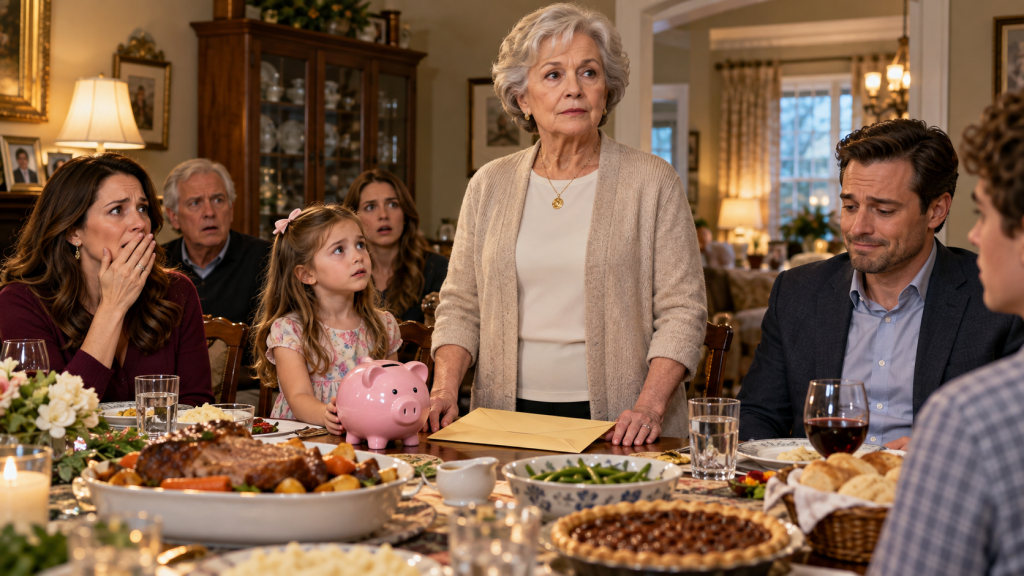
“Daddy, is that why Grandma Jean signs Nana’s papers when Mommy’s at work?”
Nobody at the table moved.
Not my daughter.
Not my son-in-law.
Not even me.
The refrigerator clicked off in the kitchen, and in the sudden quiet I could hear the little second hand on the wall clock moving forward as though time had decided our family deserved to hear every second of what came next.
My granddaughter stood beside the table with both hands resting on her pink piggy bank.
She was six years old.
Her hair was falling out of one braid.
There was still a streak of purple marker along the side of her thumb from coloring before dinner.
She had no idea she had just opened a door three adults had spent years keeping closed.
I looked at her.
“Sweetheart.”
She looked up.
“Yes, Nana?”
“Take your piggy bank back to the living room for me.”
Her father spoke before she could move.
“What did you mean about Grandma Jean?”
His voice was too sharp.
My granddaughter immediately shrank.
I stood.
“Mark.”
He looked at me.
“You do not question her.”
“I’m asking what she meant.”
“No.”
I placed one hand gently on the pink pig.
“She is six.”
“I’m not interrogating her.”
“You will not use a child to solve an adult lie.”
My daughter Rachel looked at her husband.
“Mark.”
He ignored her.
“Emma, when did Grandma Jean—”
“Enough.”
I had taught third graders for thirty years.
I did not need to shout to make a room listen.
Mark stopped.
Emma stared between us, frightened now.
That angered me more than the receipts.
I knelt carefully beside her.
My knees complained.
They always did.
“Baby, you haven’t done anything wrong.”
Her lip trembled.
“Am I in trouble?”
“No.”
“Daddy sounds mad.”
I looked directly at Mark.
“He is not mad at you.”
Mark’s face tightened.
I waited.
He understood.
Finally he said:
“No, sweetheart.”
Emma looked uncertain.
Then she picked up her piggy bank.
“Can I watch Bluey?”
“Yes.”
Her mother whispered it.
Emma walked into the living room.
A cartoon started thirty seconds later.
Bright music.
Tiny dogs.
Ordinary childhood.
I waited until I heard her laugh at the television.
Then I turned back to the adults.
“Now.”
I said.
“Who is Grandma Jean signing my name for?”
Mark folded his arms.
Rachel stared at him.
“Answer her.”
He looked at his wife.
“You already know.”
“No.”
Rachel’s voice cracked.
“You told me this stopped.”
“Rachel—”
“You told me it stopped two years ago.”
He rubbed his forehead.
“It did.”
I held up the stack of receipts.
“Apparently my handwriting continued without me.”
Mark looked toward the living room.
Then lowered his voice.
“Mom helped with some forms.”
My stomach turned.
“Your mother.”
He said nothing.
Grandma Jean.
Jean Fletcher.
Mark’s mother.
The woman who brought deviled eggs to Thanksgiving.
The woman who called me “the other grandma” with a smile that always made it sound slightly competitive.
The woman who sat beside me at Emma’s preschool graduation.
The woman who had once told me:
“You’re lucky Rachel lets you keep her so much. I barely get weekdays.”
I had thought she was jealous of time.
Apparently she had been signing my name.
I sat down.
Slowly.
“Call her.”
Mark stared.
“What?”
“Call your mother.”
“Tonight?”
I looked at the receipts.
“My name has been working overtime for four years.”
“Yes.”
“Tonight.”
Jean answered on the second ring.
Mark put her on speaker.
“Hi, honey.”
Then she heard the room.
Something in a mother’s instinct changed her tone.
“What happened?”
Rachel spoke first.
“Mom knows.”
Silence.
Not confusion.
Not:
Knows what?
Silence.
That was answer enough.
Jean whispered:
“Oh.”
I closed my eyes.
She knew.
Maybe not everything.
Enough.
Mark started:
“Mom, Emma said—”
I interrupted.
“Jean.”
She went quiet.
“It’s Martha.”
A long breath.
“Martha.”
“I have forty-eight childcare receipts on my kitchen table.”
No one moved.
“Twenty-four have one imitation of my signature.”
“Twenty-four have another.”
Rachel looked up sharply.
Twenty-four.
I had counted more carefully that afternoon after copying every page.
Two years in one hand.
Two in another.
I continued.
“Rachel says the first hand is hers.”
My daughter flinched.
I did not protect her from the sentence.
“Is the second yours?”
Jean said nothing for so long that I almost thought the call had disconnected.
Then:
“Yes.”
Rachel covered her mouth.
Mark closed his eyes.
I looked at him.
There it was.
The whole room changed.
Not because I had found the second person.
Because my daughter finally understood that while she had stopped one lie, her husband had simply found another hand to keep it alive.
Rachel whispered:
“You said you canceled everything.”
Mark leaned forward.
“Rachel, we needed—”
“You said it was over.”
“I was trying to fix the debt.”
“With my employer’s benefit?”
“With money available to us.”
“It wasn’t available!”
“It was a benefit you qualified for!”
Rachel stood.
“So you asked your mother to forge my mother’s name?”
Mark’s face went red.
Jean’s voice came through the speaker.
“Rachel, that isn’t exactly what happened.”
I almost laughed.
There is no sentence in human history more dangerous than:
That isn’t exactly what happened.
I said:
“Then explain exactly.”
Jean inhaled.
“Mark told me you knew about it.”
I looked at him.
He stared at the table.
Jean continued.
“He said Martha was providing the care.”
“I am.”
I said.
“He said the company reimbursed some of the childcare cost.”
“It reimburses childcare you actually pay for.”
Silence.
Jean said:
“I thought it was a family benefit.”
“Did you think I was being paid nine hundred eighty dollars a month?”
Another silence.
There.
The receipt amount.
$980.
Every month.
Four years.
The company benefit did not reimburse the entire stated expense.
It reimbursed a capped amount.
Two hundred forty-five dollars each month.
Twelve months.
Four years.
$11,760 deposited back into Rachel’s household through her employer.
But every receipt certified something else:
That Rachel and Mark had supposedly paid me $980 for childcare services.
Money that had never touched my hands.
Jean whispered:
“Mark said the number had to reflect the value of the care.”
“The value.”
I repeated.
“Yes.”
“Who decided my care was worth $980?”
Jean did not answer.
I looked at Mark.
He did.
“It was based on market rates.”
I stared at him.
Market rates.
For five years I had arrived at 7:15.
Packed lunches.
Washed tiny underwear after accidents.
Sat through fevers.
Learned sight words.
Built blanket forts.
Changed the baby’s diapers after he came along.
Canceled dental appointments when pickup ran late.
Scheduled my own life around the phrase:
Can you keep them just one more hour?
And somewhere behind my back, Mark had researched market rates.
Not to pay me.
To price the labor he was receiving for free so he could claim a benefit.
I felt something inside my chest crack cleanly.
“That is remarkable.”
I whispered.
Mark frowned.
“What?”
“You found out exactly what my work was worth.”
Nobody spoke.
“And still never paid me a dollar.”
Rachel started crying.
“Mom.”
I raised one hand.
“Not yet.”
She closed her mouth.
I turned toward the phone.
“Jean, why did you sign my name?”
Her voice trembled.
“Mark said you had approved the arrangement before.”
I looked at my son-in-law.
He would not meet my eyes.
Jean continued.
“He said Rachel got nervous about paperwork and didn’t want to keep signing.”
Rachel laughed once.
A broken sound.
“Nervous?”
I looked at her.
She wiped tears.
“I told him it was wrong.”
“When?”
“Two years ago.”
“How long had you been doing it?”
“Almost two years.”
The first hand.
My daughter’s.
I felt disappointment settle somewhere deeper than anger.
“Why did you start?”
Rachel sat.
Her shoulders collapsed.
“We were struggling.”
“With what?”
“Daycare.”
I looked around my own kitchen.
“You didn’t have daycare.”
“Before you started keeping Emma every day.”
I remembered.
Emma had been eleven months old when their daycare raised rates.
Rachel called crying.
Could I help for a few weeks?
I said yes.
Five years later, the few weeks still had a toothbrush in my downstairs bathroom.
Rachel continued.
“Mark found the dependent-care reimbursement through work.”
“Your work.”
“Yes.”
“He said since we were paying daycare before and then you started providing the care, we could still claim the benefit.”
“Did you ask anyone?”
“No.”
“Did you read the rules?”
She closed her eyes.
“Yes.”
There it was.
“So you knew.”
“Yes.”
“Did the rules say you had to actually incur the expense?”
“Yes.”
“Did you?”
“No.”
Her voice broke.
“No.”
I sat very still.
“Then why?”
Rachel cried.
“Because it was two hundred forty-five dollars a month.”
I almost laughed from pain.
That small.
That much.
Both.
“Your father and I raised you to forge signatures for two hundred forty-five dollars?”
“No.”
“Then help me understand.”
“We were drowning.”
She said.
“Not in the beginning.”
“But everything felt expensive.”
“Emma was little.”
“We had student loans.”
“Rent.”
“Then the car.”
“And Mark said the company already set the money aside.”
“That if we didn’t claim it, it just stayed with the company.”
I looked at Mark.
He said nothing.
Rachel continued.
“And you really were doing the care.”
I nodded.
“Yes.”
“For free.”
She cried harder.
“I know.”
“No.”
I said.
“I don’t think you did.”
For years, I had told myself that because I volunteered, the work did not count as sacrifice.
That is one of the lies women my age were trained to find noble.
If you cook because you love them, the cooking does not count.
If you miss your appointment for a grandchild, the appointment was not important.
If your back hurts from lifting a toddler, that is simply grandmotherhood.
If your daughter says money is tight, you buy diapers.
If her husband says they could never afford childcare without you, you smile.
You do not put a price on family.
Mark had said it so many times that I heard his voice even when he was not in the room.
You can’t put a price on family, Ma.
Except he had.
$980 per month.
In ink.
Under my name.
Then he had taken the reimbursement and called me a saint.
I looked at him.
“Where did the money go?”
He rubbed his palms together.
“Household expenses.”
“Which ones?”
“Groceries.”
“Utilities.”
“Emma.”
“That is not specific.”
He looked at Rachel.
She spoke.
“In the first two years, it went into our checking account.”
“And?”
“We used it.”
“For everything.”
I nodded.
“And the second two?”
Rachel turned toward him.
“Yes.”
Mark’s jaw tightened.
“It went into the same household.”
Rachel stared.
“No.”
“What?”
“No, it didn’t.”
He froze.
I looked at my daughter.
Her face had changed.
She knew something.
“What do you mean?”
I asked.
Rachel looked at Mark.
“Our company changed benefit administrators eighteen months ago.”
“So?”
“The reimbursement stopped appearing in checking.”
Mark looked away.
Rachel’s face went white.
“I asked you.”
She whispered.
“You told me the plan had changed and we weren’t getting reimbursed anymore.”
“I said the deposit changed.”
“No.”
“You said it ended.”
“Rachel—”
“Where did the money go?”
No answer.
She stood.
“Where?”
Mark rubbed his face.
“I opened a separate account.”
The room went silent again.
Even Jean whispered:
“Mark.”
Apparently that part was new to her too.
Rachel stared at her husband.
“A separate account?”
“Yes.”
“Why?”
“I was paying down the card.”
“What card?”
He did not answer.
Rachel laughed in disbelief.
“What card?”
“The Visa.”
“You told me it was paid off.”
“I was trying.”
“You lied.”
“Yes.”
The word came out angry now.
As if admitting it should end the discussion.
Rachel sat down hard.
“How much?”
“About nine thousand at the worst point.”
“And the Nana money went there?”
He flinched at the phrase.
Good.
“Yes.”
Not all of it.
But enough.
I leaned back.
The fraud had layers now.
My daughter had participated at first.
Then stopped.
Her husband continued.
His mother helped.
The reimbursement went from joint household money to a secret account.
And my granddaughter had been the only person using the phrase honest enough to explain the entire thing.
Nana money.
Money that existed because Nana worked.
Money Nana never received.
I picked up the pink piggy bank Emma had left beside the living-room doorway.
She had forgotten to take it with her.
I carried it back to the table.
The coins rattled softly.
“Do you know why she brought this?”
Nobody answered.
“She thinks I am free because nobody pays me.”
Rachel covered her face.
I continued.
“She is six years old.”
“She has learned that sitters cost nine dollars an hour.”
“Little Sprouts costs more.”
“And Nana is cheaper.”
Mark whispered:
“We never said that to her.”
I looked at him.
“You said it somewhere she could hear.”
“That is saying it to her.”
He looked down.
I turned toward Rachel.
“When she grows up, what do you want her to learn from me?”
Rachel’s eyes filled.
“What?”
“That women prove love by being useful for free?”
“Mom.”
“That if family needs something, you hand over your time, your body, your money, your name?”
“No.”
“Then why have all of you been teaching her exactly that?”
No answer.
From the living room, Emma laughed at the television.
The sound broke me.
I lowered my voice.
“She will not be part of this conversation again.”
Rachel nodded quickly.
“Yes.”
“None of you will ask what else she heard.”
“Yes.”
“None of you will tell her she caused trouble.”
“Yes.”
I looked at Mark.
He did not respond.
“Mark.”
His jaw tightened.
“Fine.”
“No.”
I said.
“Not fine.”
“I need you to understand.”
He looked at me.
“If that little girl ever believes telling the truth is dangerous because adults punish her for what the truth reveals, you will teach her to hide things from you.”
Something in his face changed.
I continued.
“Do not do that to her.”
He looked away.
Then nodded.
“I won’t.”
It was the first useful thing he said all evening.
Jean was still on the phone.
I had almost forgotten.
“Martha.”
she said.
“Yes?”
“I want to apologize.”
“Tonight is crowded.”
She stopped.
That was harsher than I intended.
I sighed.
“Tomorrow.”
“Can I come over?”
“Yes.”
“Alone?”
I looked at Mark.
“Yes.”
Jean agreed.
Then asked:
“What are you going to do?”
I looked at the receipts.
“Tell the truth.”
Mark stood.
“What does that mean?”
“It means tomorrow morning I am calling the benefits office.”
Rachel closed her eyes.
“Mom.”
“I am telling them my signature was forged.”
Her face turned pale.
“I could lose my job.”
There it was.
The fear I knew would come.
And because she was my daughter, my heart immediately tried to protect her.
I hated that heart for one second.
Then forgave it.
It had spent forty-three years loving Rachel.
Instinct does not disappear because disappointment arrives.
I said:
“I will tell them exactly what I know.”
“That includes the fact that you told Mark to stop two years ago.”
Rachel cried.
“And the fact that before that, you knowingly signed my name.”
Her face crumpled.
“Yes.”
“I won’t make you worse.”
“I won’t make you better.”
“I will tell the truth.”
She nodded.
Then Mark said:
“That could destroy us.”
I looked at him.
“No.”
“You built something that could destroy you.”
“I found it.”
There is a difference.
Dinner ended without coffee.
Without pie.
The pot roast sat cold.
Emma asked why everyone was quiet.
I said the grown-ups had money problems.
That was enough.
Her baby brother had fallen asleep in his high chair.
Rachel gathered his diaper bag.
Mark avoided looking at me.
At the door, Emma hugged my waist.
“Can I come tomorrow?”
My chest tightened.
I looked at Rachel.
She looked terrified of my answer.
“Not tomorrow, sweetheart.”
Emma’s face fell.
“Why?”
“Because Nana has some grown-up errands.”
“What about Tuesday?”
I almost said yes automatically.
The word was already climbing my throat.
Then I stopped.
“I don’t know yet.”
Emma stared as though she had never heard those words from me.
Perhaps she hadn’t.
I kissed her hair.
“I’ll call Mommy.”
She nodded.
Then whispered:
“Did you like my piggy bank?”
I had forgotten.
I knelt.
“I loved that you wanted to give it to me.”
“Can you keep the money?”
“No.”
She frowned.
“Why?”
“Because your money is yours.”
The answer came so quickly it startled me.
Her money is yours.
Mine should have been too.
“And my hugs?”
she asked.
I smiled.
“I’ll take all of those you want to give.”
She hugged me again.
Then left.
I closed the door.
Locked it.
And for the first time in five years, I looked at Monday’s calendar knowing no one was coming at 7:15.
The silence frightened me.
It also felt like oxygen.
I did not sleep much.
At 2:03 in the morning, I sat at the kitchen table with the receipts arranged by date.
Forty-eight months.
$980 allegedly paid to me each month.
$47,040 worth of fictional payments.
$11,760 actually reimbursed to Rachel through the employer plan.
Not stolen from my checking account.
That distinction mattered legally.
Emotionally, another number mattered more.
The hours.
I did the arithmetic because retired teachers cannot resist arithmetic when feelings become unmanageable.
Ten hours and fifteen minutes most weekdays.
Five days a week.
Roughly fifty hours.
Some holidays.
Some evenings.
Sick days.
Teacher conference days.
Summer weeks.
Five years.
Thousands of hours.
I stopped calculating.
The number became grotesque.
Not because my daughter owed me wages for every hug.
She did not.
Because I had built an arrangement so large that nobody could distinguish grandmother from unpaid employee anymore.
Not even me.
I had told myself:
You do not invoice your own heart.
True.
But perhaps you also do not hand your heart a timecard and then pretend the hours cost nothing.
At 8:30 the next morning, I called the benefits office.
Not my old student’s friend privately.
Officially.
Her name was Teresa Cole.
She had known me as Mrs. Vance in fifth grade.
Now she was forty-two and spoke in the careful tone adults use when their childhood teacher becomes a problem at work.
“I’m sorry, Mrs. Vance.”
“Martha.”
“I don’t think I can call you Martha.”
“Then we’ll both suffer.”
She laughed nervously.
Then became serious.
“I need to transfer you to compliance.”
The word made my stomach hurt.
A woman named Dana came on.
I explained.
My name.
My childcare.
No payment received.
No authorization to sign.
My daughter’s admission.
My son-in-law’s continuation.
Jean’s signatures.
The receipts.
Dana asked:
“Did you ever tell your daughter she could claim that she paid you?”
“No.”
“Did you ever receive any of the claimed $980 monthly payments?”
“No.”
“Did you receive the $245 benefit reimbursements?”
“No.”
“Were you aware claims were being submitted?”
“Not until last week.”
Dana paused.
“Do you have copies?”
“Yes.”
“Please preserve the originals exactly as received.”
“I have scans.”
“Good.”
Then came the question.
“Do you believe your daughter knowingly submitted any of the false receipts?”
I closed my eyes.
This was the moment.
Mother or witness.
I wanted a third option.
There wasn’t one.
“Yes.”
“How long?”
“Approximately two years.”
My voice shook.
“She says she stopped after that and told her husband to stop.”
“Do you believe her?”
That was not fair.
Not because Dana was wrong to ask.
Because love had never been a reliable evidentiary standard.
“I believe she is telling the truth about that.”
I said carefully.
“I also have not independently verified it.”
Silence.
Then Dana said:
“Thank you.”
I nearly cried.
Not from relief.
From exhaustion.
Truth should not feel like betrayal.
But sometimes it does.
Rachel called fifteen minutes later.
“HR contacted me.”
I gripped the phone.
“Already?”
“Benefits flagged my account.”
Her voice shook.
“They scheduled a meeting at eleven.”
“I’m sorry.”
The words escaped before I could stop them.
Rachel went quiet.
“Why are you apologizing?”
Good question.
I stared at the window.
“I don’t know.”
She started crying.
“Mom.”
“Yes?”
“I am scared.”
I closed my eyes.
Every motherly instinct returned.
Tell her it will be fine.
Offer money.
Call somebody.
Fix.
Instead:
“I know.”
“What if they fire me?”
“I don’t know.”
“What are we going to do?”
Another reflex.
We.
For years, every one of their crises became ours.
Martha, can you?
Mom, can you?
Nana, we need—
I breathed.
“You and Mark will figure out your next steps.”
Silence.
Then:
“You’re really done helping us.”
Pain.
There it was.
I answered carefully.
“No.”
She cried harder.
“I’m done being the first solution.”
Rachel did not speak.
I continued.
“If you are hungry, I will not let you starve.”
“If the children need medicine, call me.”
“If you need someone to sit beside you while you cry, I am your mother.”
“But I will not make consequences disappear so quickly that you never have to meet them.”
Long silence.
Then she whispered:
“I understand.”
I was not sure she did.
Neither was I.
But we had both heard the sentence.
That was a beginning.
Jean arrived at ten.
She brought muffins.
Of course.
Women over sixty have been trained to bring baked goods to moral disasters.
I let her in.
She placed the container on my counter.
“I didn’t know what else to do.”
“Coffee?”
“Yes.”
We sat.
Jean looked older than she had the day before.
She had always been carefully put together.
Hair sprayed.
Lipstick.
Gold earrings.
Today she wore no makeup.
“Martha, I am sorry.”
I nodded.
Then waited.
She clasped her hands.
“Mark told me the reimbursement was legitimate because you were providing the care.”
“Did he tell you I was paid?”
“He said it was an accounting requirement.”
“That was not my question.”
Jean looked down.
“No.”
“So you knew I wasn’t getting $980.”
“Yes.”
“And you signed receipts saying I was.”
“Yes.”
There.
No excuses yet.
Good.
“Why?”
Jean stared at the coffee.
“Because Mark asked.”
I almost laughed.
“Our children are in their thirties.”
“I know.”
“You forged another grandmother’s signature because your son asked?”
Her eyes filled.
“When you say it like that—”
“How else would you like it said?”
She nodded.
“Fair.”
Then:
“I also resented you.”
That surprised me.
“Why?”
“Because Emma preferred you.”
I stared.
“She is six.”
“I know how childish it sounds.”
Jean’s voice cracked.
“But you had her every day.”
“You knew the teachers.”
“The routines.”
“What she liked for lunch.”
“She called your house home sometimes.”
“I got weekends if they weren’t busy.”
She wiped her eyes.
“When Mark asked me to help with the forms, I think part of me liked being included in something you weren’t.”
The honesty made me ache.
Jean continued.
“He said Rachel had become nervous because the company changed administrators.”
“He said you knew they were using the benefit.”
“I wanted to believe him.”
“Did you?”
She shook her head.
“Not completely.”
That mattered.
“Why didn’t you ask me?”
“Because I knew you would probably say no.”
There it was.
Consent bypassed by prediction.
The logic of every person who decides asking is inconvenient.
Jean whispered:
“I signed twenty-four.”
“Yes.”
“I used a sample from one of the old receipts.”
My skin crawled.
“My daughter’s imitation.”
“Yes.”
“But yours looks different.”
“I couldn’t copy it exactly.”
I looked at her.
“My handwriting saved me.”
She almost smiled.
“You were always particular about penmanship.”
“I had no idea it would become forensic evidence in retirement.”
We both laughed once.
Then stopped.
Jean’s eyes filled again.
“What happens to me?”
I sat back.
“I don’t know.”
“Are you reporting my name?”
“Yes.”
She closed her eyes.
I continued.
“I am not exaggerating your role.”
“I’m not minimizing it.”
“I will say you signed because Mark asked and because you say you believed some version of authorization existed.”
Jean nodded.
“Thank you.”
“That is not protection.”
“I know.”
I believed her.
Then Jean said something that changed the rest of the story.
“There’s more.”
I stared.
Of course there was.
“What?”
“Mark paid me.”
My stomach turned.
“How much?”
“Not much.”
“Jean.”
“One hundred dollars some months.”
“For what?”
She looked ashamed.
“For helping with forms.”
I felt physically sick.
“You took part of the Nana money.”
She flinched at the phrase.
“Yes.”
“Did Rachel know?”
“No.”
“Why did Mark pay you?”
“He said he knew I was taking a risk.”
The room went quiet.
A risk.
That meant Mark knew exactly what it was.
Not a harmless benefit technicality.
Not a misunderstanding.
A risk worth compensating.
Jean covered her face.
“I should have stopped.”
“Yes.”
“I should have called you.”
“Yes.”
“I was stupid.”
“No.”
She looked up.
I shook my head.
“Do not use stupidity to escape responsibility.”
She stared.
Then nodded slowly.
“You’re right.”
“Say what it was.”
Jean cried.
“I knew enough to know I should not sign.”
There.
That was the sentence.
Truth without disguise.
Rachel’s meeting lasted two hours.
She called afterward from her car.
“They suspended me.”
My heart dropped.
“For how long?”
“Pending review.”
“Paid?”
“No.”
I closed my eyes.
She continued quickly.
“I told them everything.”
“Everything?”
“The first two years.”
“Mark.”
“Mom Jean.”
“The separate account.”
I heard traffic in the background.
She was breathing too fast.
“Good.”
I said.
She laughed bitterly.
“Good?”
“Not the suspension.”
“The truth.”
She cried.
“I might lose my job.”
“I know.”
“What do I tell Emma?”
“The truth appropriate for six.”
“What does that even mean?”
I thought.
“Tell her Mommy made a dishonest money decision and is fixing it.”
“She’ll think I’m a criminal.”
“She is six.”
“She thinks adults who say ‘I’m sorry’ are immediately repaired.”
Rachel laughed through tears.
Then:
“Mom.”
“Yes?”
“I told HR you didn’t know.”
“Thank you.”
“And I told them Mark kept doing it after I stopped.”
“Thank you.”
“And I told them I signed your name.”
My throat tightened.
“That was hard.”
“Yes.”
“I’m proud of you for telling the truth.”
Silence.
Then Rachel sobbed.
I almost took it back.
Not because she didn’t deserve praise for honesty.
Because parents rarely learn how to say:
I am proud of the way you admitted what I wish you had never done.
Life does not give us scripts for that.
Mark did not call me for three days.
On the fourth, he arrived unannounced.
I did not open the door immediately.
He stood on the porch with his hands in his coat pockets.
“I want to talk.”
“Rachel with you?”
“No.”
“Then we can talk outside.”
He looked offended.
Good.
I stepped onto the porch and closed the door behind me.
He stared.
“You think I’m dangerous?”
“I think I am allowed to choose who comes inside my house.”
His jaw tightened.
Then relaxed.
“Fair.”
Progress, perhaps.
He handed me an envelope.
I did not take it.
“What is it?”
“Money.”
Of course.
“How much?”
“Two thousand.”
“Why?”
“Some of what we got.”
I looked at him.
“Not all.”
“No.”
“Not even half.”
“No.”
“Then why two thousand?”
“It’s what I can give right now.”
I crossed my arms.
“I’m not accepting cash from you on the porch.”
“It’s a cashier’s check.”
“That changes nothing.”
His frustration rose.
“What do you want from me?”
There it was.
The question people ask when they think apology is a vending machine.
Insert remorse.
Select outcome.
I answered honestly.
“I don’t know yet.”
He looked stunned.
“You reported us.”
“Yes.”
“You stopped childcare.”
“Yes.”
“Rachel could lose her job.”
“Yes.”
“My mother is terrified.”
“Yes.”
“And you don’t know what you want?”
I stared.
“What I wanted was for none of you to forge my name.”
He went silent.
I continued.
“That option is gone.”
“So now I am deciding what I need next.”
He looked away.
Then said:
“I did it for my family.”
I closed my eyes.
He heard himself.
Maybe.
I said:
“So did I.”
He looked back.
“I watched your children fifty hours a week for free.”
“I gave up appointments.”
“Trips.”
“Sleep.”
“My own money.”
“I did it for family.”
“And somehow, my version of family required sacrifice while yours required permission to take.”
His face fell.
“I never thought of it like that.”
“I know.”
That was the problem.
Mark sat on the porch step.
I remained standing.
He stared at the street.
“When Rachel got pregnant with Emma, I promised myself my kid would have everything.”
I said nothing.
“My dad left when I was nine.”
I knew that.
Jean raised him mostly alone.
“He never paid child support regularly.”
“Mom worked two jobs.”
“I hated being the kid who couldn’t go on field trips.”
“The kid with the old shoes.”
“The kid whose mother pretended she already ate so there was enough food.”
His voice cracked.
“And when I learned Rachel’s company had a childcare benefit, it felt stupid not to take it.”
I leaned against the railing.
“At first I thought we’d pay you.”
That surprised me.
“What?”
“We talked about it.”
“Rachel said you wouldn’t accept.”
“She was probably right.”
“So we said we’d claim the benefit and maybe use it to buy you things.”
“Did you?”
He looked ashamed.
“No.”
“Why?”
“Because every month there was something else.”
Debt.
Car.
Groceries.
Life.
Greed is rarely a dragon guarding gold.
Sometimes it is simply a hand that gets used to reaching.
Mark continued.
“When Rachel stopped, I was angry.”
“Why?”
“Because I thought she was throwing away free money.”
“It wasn’t free.”
“I know that now.”
“No.”
I said.
“You knew then.”
He looked at me.
“You paid your mother because you knew she was taking a risk.”
His face went pale.
Jean had not told him she confessed that part.
Good.
He closed his eyes.
“Yes.”
At least no lie.
I sat in the porch chair.
“Why the separate account?”
He hesitated.
“Because I was ashamed of the card debt.”
“So you hid another thing.”
“Yes.”
“From Rachel.”
“Yes.”
“And used her benefit account.”
“Yes.”
“And my name.”
“Yes.”
“And Jean’s hand.”
“Yes.”
I nodded.
“Then stop saying family.”
He looked at me.
“Call it what it was.”
His eyes filled.
“I was stealing.”
The word hung between us.
Technically the money came from the employer benefit plan.
Not my bank account.
But morally, he knew what I meant.
He had stolen consent.
Name.
Labor.
Trust.
He whispered:
“I’m sorry.”
I believed he was sorry.
That did not make everything soft.
“Thank you.”
His face crumpled.
“Is that all?”
“For today.”
He nodded.
Then stood.
He left the cashier’s check on the porch railing.
I called after him.
“Take it.”
He turned.
“Why?”
“Because repayment will happen through whatever process the benefits office requires.”
“I don’t want private payments muddying it.”
He stared.
“You really thought this through.”
“No.”
I said.
“I learned not to let you manage the paperwork.”
He flinched.
Then took the check.
Rachel kept her job.
Barely.
The company investigation took six weeks.
She had a clean record.
She self-reported before being formally accused.
She cooperated.
She admitted the first two years of false claims.
The employer required full repayment of the $11,760 benefit.
Not by me.
By Rachel.
Her access to the dependent-care reimbursement program was permanently revoked.
She received a final disciplinary warning and an unpaid suspension.
I did not ask Teresa for special treatment.
She did not offer any.
Good.
Rachel cried when she told me she was not fired.
Then cried harder when she realized the repayment schedule would take nearly two years.
I did not offer money.
That was harder than any confrontation.
Jean repaid what Mark had given her.
A little over $1,900 across two years.
She insisted on paying it toward the employer restitution through Rachel.
Rachel resisted.
I said nothing.
Eventually they worked it out.
Their mess.
Their repair.
I was learning.
The legal consequences for forging my signatures were complicated.
I spoke with a lawyer.
Not because I wanted prison.
Because my name had been used on financial documents for four years, and I needed to protect myself from whatever else might exist.
Her name was Lydia Shaw.
She was sixty-three and wore red glasses that made every question feel more serious.
Her first instruction:
“Check your credit.”
I did.
No loans in my name.
Thank God.
No credit cards.
No hidden debts.
The receipts had been used only for the employer benefit claims.
That mattered.
Lydia helped me prepare a sworn statement documenting that I had never received the claimed childcare payments and had never authorized anyone to sign on my behalf.
That document became important when the company corrected its records.
No one was going to decide later that I had secretly earned $47,040 and forgotten to mention it.
I slept better after that.
“Do you want to press this farther?”
Lydia asked.
“What does farther mean?”
“There are possible avenues for reporting forgery and identity misuse.”
I looked down.
“My daughter signed too.”
“Yes.”
“My son-in-law.”
“Yes.”
“Jean.”
“Yes.”
Lydia waited.
I thought about jail.
Court.
Emma.
The baby.
Then I thought about all the years I had avoided consequences because I confused them with cruelty.
“What would you do?”
“I do not make personal decisions for clients.”
Annoying woman.
“Then tell me what protecting myself requires.”
“Documentation.”
“You have it.”
“Correcting the employer record.”
“In progress.”
“Changing passwords.”
“Done.”
“Locking down financial access.”
“Done.”
“Formal written notice that nobody may use your name.”
“We can do that.”
“And criminal reporting?”
“Not necessary to protect your account at this stage.”
I breathed.
“Then I don’t want it.”
Lydia nodded.
“Why?”
“I want accountability.”
“I don’t need maximum destruction to prove I was hurt.”
She studied me.
“That is a clear answer.”
It was.
That surprised me.
I ended weekday childcare completely.
Not forever with Emma.
Not love.
The job.
There was a difference I had failed to define.
Rachel and Mark enrolled the baby in a licensed daycare.
Emma went to before- and after-school care three days a week.
The remaining two days, Mark adjusted his work hours and Rachel worked remotely part of the afternoon.
It cost them far more than Nana.
Of course.
For the first month, Rachel called me almost every day with some version of:
“This is impossible.”
I listened.
Sometimes I said:
“I know.”
Never:
I can take them.
That sentence stayed behind my teeth until it learned to stop climbing.
One afternoon, Rachel came over alone.
She looked exhausted.
Hair pulled back.
No makeup.
She sat at my kitchen table.
“You were doing three jobs.”
I frowned.
“What?”
She laughed bitterly.
“Daycare called because the baby had a fever.”
“After-school care charged a late pickup fee because traffic was bad.”
“Emma forgot her lunch.”
“I had to leave work.”
“Then the daycare still charges for the day even when he’s sick.”
She stared at me.
“You were doing three jobs.”
“Childcare.”
“Transportation.”
“Emergency coverage.”
I smiled faintly.
“And sandwiches.”
She cried.
“I didn’t know.”
That sentence hurt.
“How could you not know?”
“I knew you did things.”
“That is not the same as understanding the cost.”
“No.”
She wiped her face.
“I only noticed the cost when I had to start paying for pieces of it.”
There.
That was perhaps the first time she saw me clearly.
Not because money makes care more real.
Because prices forced her to notice how much she had been consuming without measuring.
She whispered:
“I’m sorry.”
I said nothing.
She continued.
“I’m sorry I signed your name.”
“I’m sorry I let Mark convince me it wasn’t really fraud because the company had a benefit.”
“I’m sorry I told myself we deserved money because you were helping.”
“I’m sorry I stopped asking whether you wanted to do all of it.”
My eyes filled.
That one.
That was the wound.
Not the $11,760.
Not even the signature.
Choice.
“I wanted some of it.”
I said.
Rachel looked up.
“I loved having Emma.”
“I loved the baby.”
“I loved the mornings.”
“Not every one.”
“But many.”
“Then why didn’t you tell me it was too much?”
I laughed.
“Because you are my daughter.”
“That’s not an answer.”
“It was mine.”
For years.
I looked toward the window.
“After your father died, the house was so quiet.”
Rachel’s face softened.
I rarely spoke about Bill anymore.
My husband had been gone seven years.
“I retired.”
“Then he died eighteen months later.”
“All at once, nobody needed me at 7:30.”
“No classroom.”
“No husband.”
“No papers to grade.”
“No dinner to share.”
She started crying.
“When you asked me to watch Emma for a few weeks…”
I smiled.
“I felt useful again.”
There.
My part.
Not fraud.
Not forgery.
But participation in the arrangement that made overuse easy.
“I said yes because I loved her.”
“And because I was lonely.”
“Then when the few weeks became months, I was afraid if I complained you would find someone else.”
Rachel stared.
“You thought I’d keep Emma from you?”
“No.”
“Not consciously.”
“I thought if I stopped being useful, I might become optional.”
My daughter covered her mouth.
I cried now too.
That fear had lived inside me without a name.
Useful.
Needed.
Loved.
Three different words I had blurred until I could not tell where one ended.
Rachel reached for my hand.
“Mom.”
I let her take it.
“You were never optional.”
“I know that now.”
“Do you?”
I thought.
“More than I did.”
Good enough.
Emma had a harder adjustment than anyone expected.
She did not like after-school care.
Too loud.
Different snacks.
No tomato garden.
No Nana.
She complained for weeks.
One Thursday Rachel called.
“She says you don’t love her anymore.”
My heart broke so fast I had to sit down.
“What did you say?”
“That Nana loves her and Nana is not her daycare.”
Good.
“And?”
“She said that doesn’t make sense.”
I almost laughed.
“It barely makes sense to adults.”
Rachel sighed.
“What do we do?”
Old instinct:
Bring her here tomorrow.
Instead:
“Can she come Saturday?”
Pause.
“For grandma time.”
“Not because you need childcare.”
Rachel understood.
“Yes.”
Emma came Saturday.
At ten.
Not 7:15.
No diaper bag.
No lunch schedule.
Just a backpack with coloring books and one stuffed rabbit.
When she walked in, she hesitated.
“Are you babysitting me?”
I knelt.
“No.”
Her face fell.
“Then why am I here?”
I smiled.
“Because I asked if you wanted to spend the day with me.”
She stared.
“For free?”
There it was again.
I took a breath.
“Listen to me, baby.”
She did.
“When I spend time with you because I choose to, nobody owes me money.”
“What about babysitters?”
“Babysitters are doing a job.”
“Aren’t you doing a job?”
“Sometimes I was.”
“Did Mommy pay you?”
“No.”
“Was that bad?”
Six-year-olds will walk directly into philosophical territory adults spend forty years avoiding.
I sat on the floor.
“It wasn’t bad that I helped.”
“It became a problem because everybody forgot to ask whether I still wanted to do so much.”
Emma considered.
“So you got tired.”
“Yes.”
“Why didn’t you say?”
A child.
Same question as her mother.
I smiled sadly.
“I’m learning.”
She nodded.
Then handed me her rabbit.
“You can hold Mr. Pickles while you learn.”
I did.
That Saturday was different.
We made cookies because we wanted cookies.
Not because she needed an afternoon activity while her parents worked.
We watered tomatoes.
Colored.
Watched a movie.
At four, Rachel arrived on time.
Four.
Not 5:40 promised and 6:30 delivered.
Emma groaned.
“No.”
Rachel laughed.
“Nana has plans.”
Emma looked at me.
“Do you?”
I did.
Gloria from my retired-teachers group and I were going to a community theater show.
For years, I would have canceled.
“I do.”
I said.
Emma nodded.
“Okay.”
That little okay felt like a new family language.
Jean and I rebuilt more slowly.
For almost a year, I could barely look at her without seeing my name in her handwriting.
Then one afternoon she asked me to lunch.
I almost said no.
Then decided I wanted soup.
Healing is sometimes less noble than appetite.
We met at a diner.
Jean said:
“I’ve been thinking about what you said.”
“Which part?”
“The part about predicting you would say no.”
I waited.
She stirred her coffee.
“I did that to my own mother.”
I frowned.
“She lived with us before she died.”
“I used her Social Security money for household expenses.”
“She knew.”
“At least I think she did.”
Jean looked ashamed.
“I never asked clearly.”
“I just told myself the money was part of the household because she lived there.”
My anger softened into something sadder.
Patterns.
Older than us.
She continued.
“I think I learned that women’s resources become family resources automatically.”
“Money.”
“Time.”
“Labor.”
“If a mother or grandmother has it, someone else can need it more.”
I stared at her.
“That’s exactly what I believed too.”
Jean looked surprised.
“You didn’t steal.”
“No.”
“But I gave until I resented people for taking what I kept handing them.”
She nodded slowly.
Two grandmothers.
Different sins.
Same old rule underneath.
A woman’s generosity should have no visible edge.
We talked for two hours.
Not forgiveness all at once.
Understanding.
Different.
Useful.
Mark and Rachel separated for four months.
I did not cause it.
Important.
The forged receipts exposed cracks already there.
The secret credit card.
The separate account.
The lies after Rachel told him to stop.
She moved with the children into a small apartment closer to work.
Mark stayed in their house.
They attended counseling.
I did not ask for details.
Another new skill.
Rachel used to tell me every argument.
I used to become emotional backup in their marriage.
No more.
When she tried:
“Mark said—”
I interrupted gently.
“Is this something you need your mother for or something you need your therapist for?”
She stared.
Then laughed.
“Therapist.”
“Good.”
We both improved.
They eventually reconciled.
I know some people would call that foolish.
I did not.
It was not my marriage.
Rachel set conditions.
Transparent accounts.
No secret credit.
Shared passwords by mutual agreement, not surveillance.
Individual counseling.
No financial decisions in my name or involving me unless I was present.
Mark sold his expensive truck.
They used the proceeds to reduce debt.
He took on extra project work.
The reimbursement repayment came from their budget.
Not mine.
Not Jean’s beyond her portion.
I watched.
I did not celebrate early.
Change deserves time before applause.
Mark apologized to me again a year later.
Not on a porch.
Not because he was scared.
He came to my house after dropping Emma off for a planned Saturday visit.
He stood in the kitchen.
“I need to say something.”
I waited.
“I used to joke that you were free childcare.”
My chest tightened.
He looked ashamed.
“I said it at work.”
“To friends.”
“Sometimes in front of Emma.”
There was the origin.
“Mommy says you’re way cheaper than Little Sprouts.”
Not one comment.
A family joke.
He continued.
“I thought I was praising you.”
“Like saying we were lucky.”
I stared.
“You were praising yourself.”
He looked up.
“What?”
“For having access to something valuable without paying for it.”
The sentence landed.
He nodded slowly.
“You’re right.”
I continued.
“People brag about getting a deal.”
“You made me the deal.”
His eyes filled.
“I’m sorry.”
This time I believed he understood the shape of the apology.
“Thank you.”
Then he said:
“I also want you to know the Nana money is fully repaid.”
I smiled sadly.
“There was never Nana money.”
He understood.
“Yes.”
“That phrase should die.”
He nodded.
“It has.”
Good.
I started teaching again.
Not full-time.
God forbid.
On Tuesdays, the public library asked me to run a handwriting and letter-writing club for children.
Apparently cursive had become exotic.
The first week, eight children came.
The second week, fourteen.
We practiced capital letters.
Loops.
Spacing.
How to make an M that belongs to you.
I laughed the first time I said that aloud.
One little girl asked:
“What’s funny?”
“Nothing, sweetheart.”
But it was not nothing.
My handwriting had protected me.
Thirty years teaching children to form letters had taught my eyes to see the difference between a hand and an imitation.
Now I taught that knowledge again without anger.
There was something beautiful in that.
I also took a trip.
My first one alone since Bill died.
Three nights in Door County with Gloria.
Rachel panicked.
“Who will water the tomatoes?”
“Your father did not die so I could spend retirement enslaved by tomatoes.”
She laughed.
I hired the teenager next door.
Nine dollars an hour?
No.
Twenty-five dollars for the week.
We negotiated.
Very healthy.
The first time Rachel asked me to babysit after everything, she looked terrified.
It was six months after their childcare arrangement changed.
“Mom.”
“Yes?”
“I have a question.”
“That sounds ominous.”
“Mark’s office Christmas dinner is Friday.”
I waited.
“We have a sitter.”
“Good.”
“She canceled.”
Ah.
Rachel took a breath.
“Would you be willing to keep the kids from six to ten?”
I stared at her.
She rushed:
“You can say no.”
The sentence moved me more than the request.
“Six to ten?”
“Yes.”
“Pickup at ten?”
“Ten.”
“Not ten-thirty.”
“Ten.”
“Are you paying me?”
She froze.
We looked at each other.
Then I laughed.
Rachel did too.
“I don’t know.”
she said.
“That’s why I’m asking.”
I thought.
“No.”
Her face fell.
Then I continued:
“I don’t want money for one Friday with my grandchildren.”
“I do want you here at ten.”
“Yes.”
“And if it becomes regular, we discuss it again.”
“Yes.”
“Then okay.”
Rachel smiled.
“Thank you.”
No saint.
No:
You can’t put a price on family.
Just thank you.
It felt completely different.
They came back at 9:52.
I checked.
Of course I did.
Mark noticed the clock.
“Eight minutes early.”
“Miracles continue.”
He smiled.
Then handed me a bakery box.
“What’s this?”
“Cake.”
“Payment?”
“No.”
His eyes widened.
“Gift.”
Good answer.
I accepted.
Emma eventually learned the full story in pieces.
Not at six.
At six, she needed to know only that adults made a money mistake and nobody was angry at her.
At twelve, she found the piggy bank.
The same pink one.
She had outgrown it years before.
I had kept it on a shelf.
She laughed.
“Oh my God.”
“What?”
“I remember this.”
My stomach tightened.
“How much?”
She shook it.
“Giving it to you.”
I sat.
“What else do you remember?”
“Everybody looked weird.”
Accurate.
“Daddy tried to take it.”
“Yes.”
“And you got mad.”
“I got firm.”
She rolled her eyes.
“Teacher word.”
I smiled.
Then she asked:
“Was that when the Nana money thing happened?”
Children remember phrases even when they forget meaning.
“Yes.”
“What was Nana money?”
I took a breath.
“You’re old enough for a clearer answer.”
So I told her.
Not every legal detail.
Enough.
Her parents had submitted false childcare receipts.
My name had been signed without permission.
Money had been reimbursed.
Her mother confessed.
Her father continued longer than her mother knew.
Grandma Jean helped.
Emma stared.
“Because you watched me?”
“Yes.”
“For free?”
“Yes.”
“That’s messed up.”
Twelve-year-olds are efficient moral philosophers.
“Yes.”
She frowned.
“Did I cause everybody to find out?”
There it was.
Six years later.
Still hiding underneath.
“No.”
“You told the truth without knowing it was important.”
“But if I hadn’t said Grandma Jean—”
“I already knew there were two signatures.”
She relaxed slightly.
“I would have found out.”
I took her hand.
“And even if your sentence had revealed everything, the responsibility belonged to the adults who did it.”
“Not the child who said it.”
She nodded.
Then:
“Were you mad at Mom?”
“Yes.”
“Dad?”
“Yes.”
“Grandma Jean?”
“Yes.”
“Did you hate them?”
“No.”
She thought.
“Can you be really mad at somebody and still love them?”
I smiled.
“That might be the main thing families are for.”
At sixteen, Emma got her first babysitting job.
Nine dollars an hour had become fifteen.
Inflation.
She came to my condo after her first Saturday.
Exhausted.
“That child never stops asking questions.”
I smiled.
“Karma.”
She dropped onto my sofa.
“They paid me sixty dollars.”
“Good.”
“Do you know what I realized?”
“What?”
“You watched me all day every day.”
“Basically.”
“That’s insane.”
“I was younger.”
“Still.”
She stared at her sixty dollars.
“Did you really never get paid?”
“No.”
Emma looked horrified.
“Grandma.”
“I chose it at first.”
“That doesn’t make it less work.”
There it was.
The sentence I had taken years to learn.
Coming from the child whose care had taught it to me.
“No.”
I said.
“It doesn’t.”
She handed me a ten-dollar bill.
I laughed.
“What is this?”
“Back pay.”
I pushed it toward her.
“No.”
She pushed it back.
“You’re cheap.”
I stared.
Then we both burst out laughing.
The old phrase had lost its teeth.
I took the ten.
Then slipped it into her coat pocket before she left.
Grandmothers are allowed some crimes.
My relationship with Rachel became stronger after it became smaller.
That sounds backward.
Before, she was in my house every day.
Called constantly.
Needed something always.
We were deeply involved and strangely distant.
After boundaries, we spoke less.
More honestly.
Sometimes she called just to ask:
“How are you?”
The first few times, I answered:
“Why?”
She would laugh.
“No reason.”
It took practice to believe that.
Mark changed too.
Not into a saint.
Thankfully.
He still talked too much.
Still bought gadgets he did not need.
Still thought grilling was a personality.
But he learned to hear no without treating it as rejection.
One Christmas, he asked whether I could host twenty people.
“No.”
He blinked.
“Okay.”
That was it.
I almost hugged him.
Growth can be boring.
That is how you know it is real.
Jean and I eventually became friends.
Not because betrayal creates friendship.
Because we both survived the truth about ourselves.
We started walking at the mall on Wednesday mornings.
Slowly.
Two grandmothers circling a food court before stores opened.
One day she said:
“Do you ever think about those signatures?”
“Yes.”
“Me too.”
“I’m still ashamed.”
I looked at her.
“Good.”
She stared.
Then I smiled.
“Some shame is a guardrail.”
“Just don’t build a house there.”
Jean laughed.
“Still a teacher.”
“Unfortunately.”
She took my arm.
“I’m glad you caught us.”
I thought.
“I’m glad I caught myself.”
She looked confused.
So I explained.
“I caught the part of me that thought being loved meant never making anyone inconvenient.”
Jean nodded.
We kept walking.
My blue notebook stayed in the kitchen drawer.
I stopped using it for favors.
No more:
$45 sneakers.
$28 medicine.
$130 school trip.
Those had been gifts.
Recording them turned generosity into silent debt nobody knew they owed.
I started using the notebook for something else.
Things I chose.
Tuesday — Library handwriting club.
Thursday — lunch with Gloria.
Saturday — Emma, by invitation.
Monday — nothing.
That last one became my favorite.
Nothing.
An empty day.
Mine.
Years after the receipts were corrected, I received a letter from Rachel’s employer.
Routine archive cleanup.
They were closing the old case file.
No action needed.
I held the paper for a long time.
Then shredded it.
Not dramatically.
The shredder worked perfectly, which was almost disappointing.
The original photocopy from Emma’s school folder remained.
I considered keeping it.
Then decided not to.
I had spent too much of my life preserving evidence after I no longer needed protection.
I tore it in half.
Then quarters.
Then dropped it into recycling.
My name disappeared into pieces.
Good.
It belonged to me again.
Bill’s old desk sat in the corner of my spare room.
One afternoon, I found a birthday card he had written me twenty years earlier.
His handwriting was awful.
Always had been.
Martha,
You make everybody’s life easier. I hope somebody remembers to make yours easier too.
I sat on the floor.
Cried for an hour.
The man had known me.
Maybe better than I knew myself.
I had spent decades making life easier.
Students.
Parents.
Rachel.
Bill.
Emma.
Mark.
Anyone.
Then felt guilty the moment ease came back toward me.
I placed the card inside the blue notebook.
Not as proof.
As permission.
When I turned seventy, my family threw me a birthday dinner.
Small.
My request.
Rachel asked beforehand:
“What do you want?”
“No gifts.”
Mark groaned.
“That’s not helpful.”
“I want everyone here at five.”
“Five?”
“Yes.”
“Not five-thirty.”
He laughed.
“Okay.”
At 4:54, the doorbell rang.
All of them.
Early.
I nearly cried.
Emma carried a box.
“Open mine first.”
Inside was a new piggy bank.
Not pink.
Blue ceramic.
Across the side, in her teenage handwriting:
NANA’S TIME — NOT FOR SALE
I stared.
Then beneath, smaller:
HUGS STILL FREE
The room blurred.
“Oh, you ridiculous child.”
She hugged me.
Rachel cried.
Jean cried.
Mark pretended not to.
The baby—no longer a baby at all—asked why everybody was emotional.
Nobody explained.
Some family stories deserve their own timing.
I kept that bank.
No money inside.
Just folded slips of paper.
Things people gave that could not be reimbursed.
Emma:
One garden day.
Rachel:
Lunch, no favors attached.
Mark:
I will fix the loose cabinet door without calling it payment for anything.
Jean:
Coffee. My treat. No forged signatures.
I laughed every time I opened it.
Humor did not erase what happened.
It made memory breathable.
Then came the hardest question years later.
Rachel asked:
“Do you forgive me?”
We were sitting on my balcony.
Emma away at college.
The little baby from those years was in middle school.
So much time had passed.
I looked at my daughter.
“Yes.”
She cried.
I continued.
“But I want you to understand what I mean.”
She nodded.
“I forgive the woman who did it.”
“I do not believe what she did became acceptable.”
“I do not need you to keep suffering to prove you understand.”
“I do not need you to mention it every Christmas.”
“I do need the boundaries we built afterward to stay real.”
Rachel wiped her face.
“They will.”
I believed her.
Then she asked:
“Did you ever forgive yourself?”
I stared.
“For what?”
“For letting us use you.”
The answer surprised me.
“No.”
Not fully.
Rachel took my hand.
“Maybe you should.”
So I did something mothers are terrible at.
I listened to my daughter.
Forgiving myself took longer than forgiving her.
Because I had a story about myself too.
I was the generous mother.
The devoted grandmother.
The woman who never needed much.
Changing that story felt selfish.
Then I realized the story had always been incomplete.
Generous people have limits.
Devoted grandmothers have appointments.
Strong women need medication.
Loving mothers can say no.
Retired teachers can sleep past seven.
A heart can be open without leaving the front door unlocked.
Those sentences became easier.
Eventually, true.
At seventy-eight, arthritis made handwriting difficult.
Irony.
I stopped teaching the library class.
The children threw me a little retirement party from my second retirement.
One girl handed me a card.
Her cursive was terrible.
Beautiful.
It said:
Mrs. Vance taught me my name should look like mine.
I cried.
Of course.
That sentence traveled all the way back to a forged M on a receipt.
My name should look like mine.
My life should too.
Emma became an elementary school teacher.
Nobody in the family was surprised except her.
On her first day, she called me.
“Nana.”
“Yes?”
“I have twenty-seven children.”
“My condolences.”
“How did you do this for thirty years?”
“Coffee and controlled disappointment.”
She laughed.
Then became serious.
“I think I understand you more now.”
“Dangerous.”
“When kids need you all day, it feels good.”
“Yes.”
“And exhausting.”
“Yes.”
“And when they hug you, you forget you were tired.”
“Yes.”
She went quiet.
“I get why you kept saying yes.”
My eyes filled.
“Do you?”
“I think so.”
Then:
“But I also get why you stopped.”
That mattered more.
Rachel eventually became a grandmother herself.
Life has humor.
Emma had a daughter.
One Tuesday, Rachel called me.
I was eighty-three.
“Mom.”
“Yes?”
“I’m exhausted.”
I smiled immediately.
“Baby?”
“Yes.”
“Emma asked me to keep her three days this week.”
“And?”
“I said yes.”
“Do you want to?”
Silence.
Then laughter.
“I hate you.”
“Answer.”
“I want two days.”
“Then say two.”
“She’ll be disappointed.”
“Yes.”
Rachel sighed.
“I know what you’re doing.”
“Good.”
Later she told me she called Emma back.
“I can do Tuesday and Thursday.”
Emma said:
“Perfect.”
No guilt.
No drama.
No family collapse.
Rachel called me afterward.
“That was annoyingly easy.”
I smiled.
“Usually.”
Patterns break quietly when somebody practices a different sentence.
The next Sunday, four generations sat at Rachel’s table.
Me.
Rachel.
Emma.
Emma’s little girl.
The child was coloring.
Of course.
Children apparently spend history with crayons.
She looked up at Rachel.
“Grandma, how much do you cost?”
Every adult at the table froze.
Then Emma burst out laughing.
Rachel covered her face.
I nearly fell out of my chair.
The little girl looked confused.
“What?”
Emma wiped tears.
“Nothing, baby.”
Rachel looked at me.
Years disappeared.
The pink piggy bank.
Pie.
Receipts.
A six-year-old trying to understand adult economics.
My daughter smiled.
Then answered:
“Grandma’s time belongs to Grandma.”
The child frowned.
Not satisfied.
Rachel continued.
“And when Grandma chooses to spend some with you, that’s a gift.”
The little girl considered.
“What does a gift cost?”
“Nothing.”
“Then Grandma is free.”
We all laughed.
Rachel shook her head.
“No.”
“Grandma is priceless.”
I groaned.
“Too sentimental.”
Emma smiled.
“Runs in the family.”
Maybe.
I used to think the story was about $11,760.
It wasn’t.
That was simply the number on the sticky note.
The amount large enough to make a retired teacher sit at her kitchen table and finally count all the ways a family had turned gratitude into entitlement.
Money was the clue.
Not the wound.
The wound was being transformed into a service while everyone kept calling it love.
The wound was learning that people had discussed the market value of my care without ever asking whether I was tired.
The wound was seeing my signature beneath work I had done freely and realizing somebody else had converted generosity into a transaction behind my back.
The wound was my granddaughter believing grandmothers came in cheap and expensive versions.
But even that was not the whole story.
Because the receipts exposed something in me too.
I had wanted to be indispensable.
I had confused usefulness with security.
Some part of me believed that if Rachel needed me enough, I could never become one of those widowed mothers who received a Sunday call and a Christmas visit.
So I kept proving my value.
Every sandwich.
Every late pickup.
Every fever.
Every yes.
And the cruel thing about proving your value through usefulness is that eventually people begin to believe usefulness is what you are for.
Nobody in my family invented that belief alone.
We built it together.
Then we had to dismantle it together.
Mark once asked me, years later:
“If you had found out sooner, do you think you would have stopped watching Emma?”
I thought.
“No.”
He looked surprised.
“I would have stopped the fraud.”
“I would have changed the schedule.”
“I would have required you to ask.”
“But I loved caring for her.”
“That part was real.”
He nodded.
Then:
“So you don’t regret it?”
I smiled sadly.
“I regret every yes I gave when I wanted to say no.”
“That is different from regretting the yeses I meant.”
He stared.
“That’s a good line.”
“Thirty years teaching.”
“We collect them.”
Jean died before I did.
Cancer.
Fast.
Her final months were difficult.
Mark asked whether I would visit.
I did.
Jean lay in a hospice bed.
Smaller.
No lipstick.
No gold earrings.
She looked at me.
“I still think about your signature.”
I sat beside her.
“I don’t.”
She smiled weakly.
“Liar.”
“Sometimes.”
She reached for my hand.
“I was jealous of you.”
“I know.”
“I thought being the less-needed grandmother meant I was the less-loved one.”
My heart softened.
“It didn’t.”
“I know now.”
We sat quietly.
Then Jean whispered:
“You know what’s funny?”
“What?”
“In the end, nobody can forge the part that matters.”
I frowned.
“What part?”
“Whether they showed up.”
Tears filled my eyes.
Jean squeezed my hand.
“You did.”
“So did you.”
Not always well.
But yes.
She did.
I attended her funeral.
Rachel sat beside me.
Mark hugged me afterward.
Families survive strange things.
Not all.
Ours did.
Changed enough.
Mark and Rachel stayed married.
Not because fraud improved their relationship.
Because once the lies were exposed, they decided to build something less impressive and more honest.
Their finances remained boring.
They celebrated boring.
No secret cards.
No hidden accounts.
No “free” benefits that required pretending somebody else had been paid.
When Mark received a promotion years later, he called me.
“Guess what.”
“What?”
“We can finally afford full-price daycare.”
“Your children are teenagers.”
“I know.”
“Terrible timing.”
We laughed.
That was forgiveness too.
The ability to joke about an old wound without reopening it.
My husband Bill used to say families are like old houses.
Everybody wants the charm.
Nobody wants to discuss the wiring.
I finally understood.
Our wiring had been wrong.
Love connected to guilt.
Help connected to entitlement.
Money connected to silence.
Being needed connected to worth.
The receipts did not burn the house down.
They showed us where the sparks were.
We rewired slowly.
Messily.
Professionals involved.
Some walls opened.
Some repairs expensive.
Then life continued.
When I turned eighty-six, Emma brought me the original pink piggy bank.
I stared.
“Where did you find this?”
“Mom had it.”
“I thought it was gone.”
“Nope.”
The rubber stopper was cracked.
Pink paint faded.
She set it beside the blue one she had given me years before.
Old and new.
“Open it.”
I did.
Inside were pennies.
Lots of them.
And one folded piece of paper.
I unfolded it.
Child handwriting.
Probably written when Emma was six or seven.
FOR NANA BECAUSE SHE HELPS US.
I cried.
Emma sat beside me.
“I found it in my old room.”
“I think I put it in there after that dinner.”
I touched the crooked letters.
“You were trying to pay me.”
“I guess.”
“Out of guilt?”
“No.”
She thought.
“Love.”
I smiled.
“Those were always easy to confuse in our family.”
She laughed softly.
Then asked:
“Do you want to keep it?”
“Yes.”
That surprised me.
The piggy bank no longer represented humiliation.
It represented a child trying to repair an adult world with coins.
That deserved tenderness.
I placed it beside the blue one.
One said:
I think Nana needs payment because adults said she was cheap.
The other said:
Nana’s time belongs to Nana.
A family education in ceramic form.
I am old enough now that most of the people in the original Sunday-dinner room have gray hair.
Some are gone.
Some grandchildren have children.
Money changed.
Jobs changed.
Houses sold.
The $11,760 that once felt enormous became, over decades, simply a number attached to a painful lesson.
But I remember exactly how that sticky note looked when Teresa slid it across the desk.
11,760.
My first thought was:
They owe me.
Years later, I understood the deeper thought beneath it:
They saw value in what I did.
They just forgot to see value in me.
That was what had hurt.
And that was what eventually changed.
Rachel started asking whether I was tired.
Mark learned no was not rejection.
Jean learned jealousy could turn into complicity if left unnamed.
Emma learned that telling the truth was safe.
And I learned that generosity without choice is not generosity for long.
It becomes expectation.
Then obligation.
Then resentment.
Sometimes, if nobody intervenes, exploitation.
The most important sentence in the entire story was not:
“The first signatures were mine.”
Not:
“Grandma Jean signs Nana’s papers.”
Not even:
“Eleven thousand seven hundred and sixty dollars.”
It was a sentence I did not learn until much later.
Do you want to?
Rachel began asking it.
Mark too.
Do you want to keep the kids Friday?
Do you want us to come for dinner?
Do you want help with the garden?
Do you want company at the appointment?
Do you want to spend Christmas here or at your house?
Such an ordinary question.
I had spent five years being loved without being asked it enough.
Once the question returned, choice returned.
And once choice returned, generosity felt beautiful again.
My granddaughter was six when she asked me how much I cost.
I told her:
“A hug.”
It was a sweet answer.
But it was not quite right.
People do not cost.
Time costs.
Labor costs.
Childcare costs.
Opportunity costs.
Gas costs.
Food costs.
Care has material weight even when love is wrapped around it.
But people?
No.
You do not put a price on a person.
That was what all of us had gotten wrong in different ways.
Rachel and Mark put a price on my labor and then kept the money.
Jean treated inclusion as something she could buy with complicity.
I treated usefulness as the price I had to pay to remain central in my family.
Even Emma tried to make love measurable with pennies.
It took years for us to learn the better equation.
Care can be given.
Work can be paid.
Help can be requested.
Love cannot be invoiced.
And no human being should have to stay useful to remain loved.
If I could return to that Sunday dinner, I would still put the envelope beside the piggy bank.
I would still ask:
“Who signed my name?”
I would still report the receipts.
I would still stop daily childcare.
I would still tell the benefits office the truth.
But I would whisper one thing to the woman standing at the table before she opened that envelope.
Do not let the forged signature become the only betrayal you investigate.
Look at your own signature too.
The invisible one.
The one you placed beneath every unspoken agreement:
Martha will handle it.
Martha does not mind.
Martha always says yes.
I had signed that one myself.
Not in ink.
In habit.
And unlike the receipts, nobody else could cancel it for me.
I had to do that.
So I did.
Slowly.
One honest no at a time.
The funny thing is, once I stopped being free childcare, I became a better grandmother.
I was less tired.
Less secretly resentful.
When Emma visited, I wanted her there.
When I baked cookies, I chose cookies.
When I attended school events, I was Nana in the audience, not the person mentally calculating pickup logistics.
I began having stories that did not involve the children.
Trips.
Library students.
Gloria.
Jean.
My tomatoes.
My own life.
Emma liked hearing them.
Imagine that.
Children can love grandparents who exist outside service.
Maybe they even learn something from it.
When Emma had her own daughter, she once said:
“I want her to know you.”
I smiled.
“She will.”
“But you’re not keeping her five days a week.”
I laughed.
“Absolutely not.”
“Good.”
“Why good?”
Emma looked at me.
“Because I want her to know Great-Nana as a person.”
That sentence made the entire journey worth something.
Not the fraud.
Never the fraud.
But the work we did after.
Great-Nana as a person.
Not service.
Not wallet.
Not emergency contact.
Not signature.
Person.
And that is how the Nana money finally disappeared.
Not when the employer closed the case.
Not when the last repayment cleared.
Not when the forged receipts were shredded.
It disappeared when nobody in the family expected my love to be measurable in what I provided.
When Emma stopped asking whether I was free.
When Rachel stopped saying:
“We can’t afford it unless Mom helps.”
When Mark stopped joking about cheap childcare.
When Jean apologized without asking to be excused.
When I stopped keeping a ledger of favors.
The money vanished.
The relationship remained.
That was the miracle.
I still have the two piggy banks.
The pink one.
The blue one.
Neither contains money now.
Inside the pink one is Emma’s crooked note:
FOR NANA BECAUSE SHE HELPS US.
Inside the blue one is another note, written years later in an adult hand:
FOR NANA BECAUSE SHE IS NANA.
No amount.
No receipt.
No signature.
No reimbursement.
Just a sentence.
That one is mine.
And after everything, it is finally enough.
THE END STORIES! THANK YOU FOR READING GOOD LUCK !❤️
Related Posts



