For several seconds, nobody moved. Brenda stood in the aisle as if Richard Hale’s words had physically struck her. The two officers looked at each other. The younger flight attendant stared at the floor.
And I remained frozen in seat 3A, one hand still resting on my unfastened seat belt. Five minutes earlier, I had been preparing myself to walk past an entire plane full of strangers like a criminal. Now the chairman of the airline was telling me to stay seated.
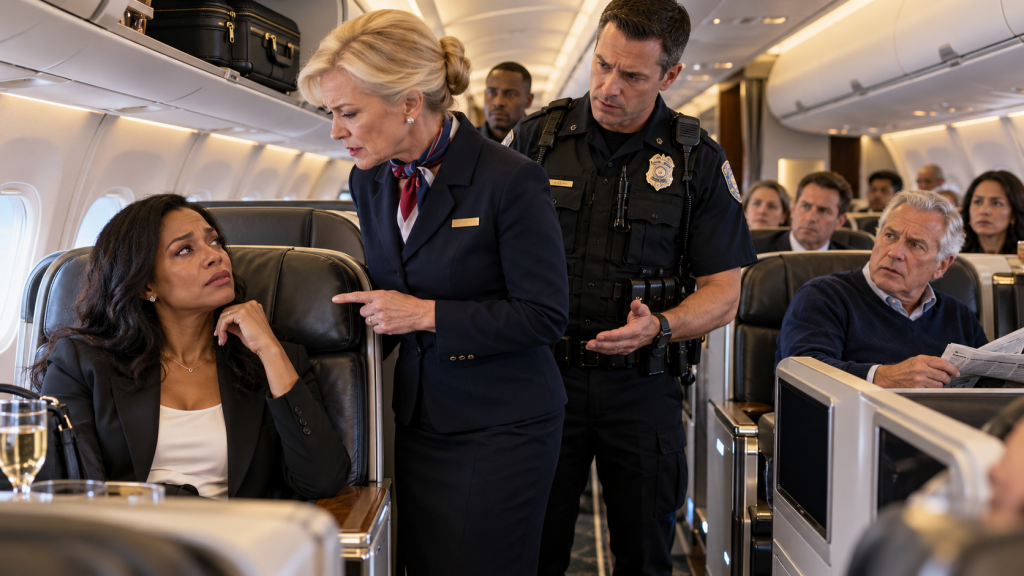
But strangely, I didn’t feel victorious. I felt exhausted. Richard turned toward the senior officer. “I understand you were responding to information given by the crew.” The officer nodded cautiously. “Yes, sir.” “I don’t blame you for coming aboard.”
Richard gestured toward me.
“But I witnessed the interaction from the moment Ms. Brooks entered the cabin. She was calm. She did not threaten anyone. Several passengers witnessed the same thing.”
The woman in row four immediately spoke.
“I did.”
Another man raised his hand.
“Same here.”
The businessman whose bag had started the argument looked miserable.
“So did I.”
Brenda turned toward him.
“Sir, you don’t need to involve yourself.”
He stared at her.
“You involved me when you tried to take her space for my bag.”
That silenced her.
The officer looked at me.
“Ma’am, do you still have the recording?”
“Yes.”
“Keep it.”
His expression softened.
“Do not delete or edit it.”
“I won’t.”
Then he looked toward Brenda.
“Are you still requesting this passenger be removed?”
Brenda’s lips parted.
Richard answered.
“No.”
Brenda snapped toward him.
“With respect, Mr. Hale, you may not have heard what happened before—”
“I heard enough.”
“But she’s been argumentative since boarding.”
My anger returned.
“Argumentative?”
Richard raised one hand.
“Ms. Brooks.”
I looked at him.
“You don’t have to defend yourself right now.”
That sentence almost made me cry.
Not because I needed a stranger to rescue me.
Because for the previous thirty minutes, every calm explanation I offered had been treated as evidence against me.
I sat back.
Richard looked at Brenda.
“You will gather your personal belongings and leave the aircraft.”
Her face went white.
“You’re removing me?”
“For this flight.”
“Mr. Hale, I have twenty-seven years with this airline.”
“And that is exactly why I expect you to understand how serious this is.”
“You can’t do this in front of passengers.”
His expression hardened.
“You had no difficulty trying to remove Ms. Brooks in front of passengers.”
Brenda stared.
The entire cabin had gone silent.
Richard continued.
“You will be paid according to policy while this incident is reviewed. You will have an opportunity to give your account.”
That mattered.
Even then.
He wasn’t firing her in the aisle.
He wasn’t holding a public trial.
He was stopping the immediate situation and ordering an investigation.
Brenda looked around.
Then at me.
Something ugly flickered across her face.
“This is unbelievable.”
Richard said quietly:
“Yes.”
She swallowed.
“I’ve dealt with disruptive passengers for almost three decades.”
“Then you should know the difference between disruption and disagreement.”
Her eyes filled.
For one strange second, I felt sorry for her.
Then I remembered the hand moving toward the officer’s handcuffs.
The satisfied smile.
The word hostile.
My sympathy stopped at the edge of accountability.
Brenda walked toward the galley.
The younger flight attendant followed.
A few minutes later, Brenda stepped off the aircraft carrying a small black bag.
She never looked at me.
The officers followed.
Before leaving, the senior officer paused beside my seat.
“Ms. Brooks.”
I looked up.
“I’m sorry this escalated the way it did.”
I appreciated that he didn’t pretend the escalation had been imaginary.
“Thank you.”
He nodded.
Then left.
The cabin door finally closed.
I thought everyone would return to their phones.
Instead, nobody seemed to know what to do.
The businessman with the oversized bag approached me.
His face was red.
“Ms. Brooks?”
“Yes?”
“I owe you an apology.”
“You didn’t do anything.”
“I should’ve said something sooner.”
“You did tell her you could move your bag.”
“Not strongly enough.”
I studied him.
He seemed genuinely ashamed.
“I watched her keep pushing you over something I never asked for.”
He shook his head.
“I should’ve ended it immediately.”
I said:
“You aren’t responsible for what she chose to do.”
“Maybe not.”
He looked toward the overhead bin.
“But I could’ve made it harder for her to do it.”
That was fair.
He held out his hand.
“Thomas Reed.”
I shook it.
“Maya Brooks.”
He smiled faintly.
“I know.”
Of course he did.
The whole plane knew my name now.
He returned to his seat.
Richard remained standing in the aisle.
Then he looked at me.
“May I sit?”
The absurdity of the chairman asking permission after his employee had spent half an hour ordering me around almost made me laugh.
“Sure.”
He sat in 3B.
For a moment, neither of us spoke.
Then he said:
“I owe you an apology too.”
“You didn’t do it.”
“My company did.”
I looked at him.
“That’s not exactly the same thing.”
“No.”
He nodded.
“But leadership doesn’t get to take credit for good service and call bad service an individual problem before investigating why it happened.”
That sentence stayed with me.
He continued.
“I need to ask you something.”
“What?”
“Did you feel Brenda treated you differently because you’re Black?”
There it was.
Direct.
No euphemism.
No awkward dance.
I looked out the window.
“I can’t know what’s inside her head.”
“I understand.”
“But I know what happened.”
He waited.
“She stopped me at boarding and assumed I was in the wrong cabin.”
I counted with my fingers.
“She demanded my boarding pass after letting the man ahead of me pass.”
“She took my phone out of my hand.”
“She questioned my carry-on.”
“Then she tried to give my bin space to a man who arrived later with a larger bag.”
“And when I asked why, she called me hostile.”
My voice began shaking.
“I didn’t shout.”
“I know.”
“I didn’t swear.”
“I know.”
“I didn’t threaten her.”
“I know.”
“I stayed seated.”
“I saw.”
My eyes burned.
“And somehow I became the security concern.”
Richard said nothing.
That was good.
I didn’t need him to explain my own experience.
I whispered:
“So yes.”
I looked at him.
“I believe race mattered.”
He nodded slowly.
“Thank you for saying it clearly.”
“Are you going to?”
His eyebrows lifted.
“Am I going to what?”
“Say it clearly.”
He understood.
“If the investigation supports discriminatory treatment, yes.”
I studied him.
“Not ‘service inconsistency’?”
“No.”
“Not ‘communication breakdown’?”
“No.”
“Not ‘unfortunate misunderstanding’?”
His mouth tightened.
“No.”
“Good.”
I leaned back.
Then remembered what he had said.
“When we land, there’s something in her personnel file I deserve to know.”
Richard looked toward the front.
“Yes.”
“What?”
“I shouldn’t have said that publicly.”
I almost laughed.
“That’s convenient.”
“You’re right.”
He nodded.
“I was angry.”
“At her?”
“At what I was watching.”
“What is in the file?”
He hesitated.
“I can tell you generally. I cannot disclose confidential personnel details that don’t directly concern your complaint.”
Fair.
“There have been previous passenger complaints involving similar allegations.”
My stomach dropped.
“How similar?”
“Passengers reporting that Brenda treated them as though they did not belong in premium cabins.”
I stared.
“Black passengers?”
He paused.
“Several complaints involved passengers of color.”
“Several?”
“Yes.”
“How many?”
“I can’t give you an exact number without reviewing the records.”
I looked at him.
“Then how did she keep working first class?”
His face changed.
That question bothered him.
“It appears the complaints were handled individually.”
“What does that mean?”
“Different supervisors. Different flights. Different stations.”
“And nobody put them together?”
“That’s what I intend to find out.”
I laughed bitterly.
“So everyone saw one tree and nobody noticed the forest.”
Richard nodded.
“That may be what happened.”
“Or nobody wanted to.”
“That is also something we need to determine.”
The captain’s voice came over the intercom.
We were finally preparing for departure.
Richard stood.
“We should take our seats.”
He returned to 1A.
The younger flight attendant came through the cabin.
Her name tag read Lena.
She stopped beside me.
“Ms. Brooks?”
“Yes?”
“Can I get you anything?”
“No.”
She nodded.
Then hesitated.
“I should have said more.”
I looked at her.
“When?”
“Before security came.”
Her eyes filled.
“I knew what Brenda was doing wasn’t right.”
“You apologized.”
“Quietly.”
“Yes.”
She swallowed.
“Quietly wasn’t enough.”
I didn’t know what to say.
She continued.
“I was afraid she’d retaliate.”
“Against you?”
“She was the lead attendant.”
That explained some of it.
Not all.
Lena whispered:
“She had already written up another junior attendant last month after they disagreed with her.”
I felt a chill.
“About what?”
She stopped.
“I probably shouldn’t discuss it.”
“Then don’t.”
She looked surprised.
I smiled sadly.
“You don’t owe me confidential information because you feel guilty.”
She nodded.
“Thank you.”
Then she said:
“But I will tell the truth in the investigation.”
“That’s enough.”
She walked away.
The plane pushed back.
As the aircraft accelerated down the runway, I looked at San Francisco shrinking beneath us.
I should have felt relieved.
Instead, my hands were trembling.
My body had not received the message that the danger was over.
I closed my eyes.
Then I heard my mother’s voice in my memory.
You don’t have to be strong every second just because people expect you to be.
So I stopped trying.
I cried.
Quietly.
Not dramatic.
Not loud.
Just tears sliding down my face while the plane climbed through clouds.
Lena brought me tissues without saying anything.
I appreciated that.
About forty minutes into the flight, the woman from row four approached.
“Can I sit for a second?”
I nodded.
She took the empty seat beside me.
“My name is Denise.”
“Maya.”
“I know.”
Again.
The plane knew.
She smiled apologetically.
“I wanted to make sure you’re okay.”
“I will be.”
She nodded.
Then said:
“I recorded some of it too.”
My head turned.
“What?”
“When Brenda came back after the man moved his bag.”
She held up her phone.
“I started recording because I didn’t like the way she was talking to you.”
My chest tightened.
“Would you be willing to send it to me?”
“Absolutely.”
That mattered.
My recording captured my perspective.
Hers captured the aisle.
Brenda’s posture.
My posture.
The businessman leaving.
My voice.
Her voice.
Context.
Denise sent the video.
Then another passenger offered one.
Then another.
By the time we were over Nevada, I had four witness contacts.
Thomas Reed gave me his business card.
The man across the aisle gave me his email.
Lena quietly wrote down the flight number and the proper customer-relations department to contact.
Evidence.
Not because I planned to sue.
I didn’t know what I planned.
But I had spent my professional life designing buildings.
And architects learn one thing quickly:
If something matters, document it.
At 35,000 feet, I created a folder.
Flight Incident.
I saved everything.
My recording.
Witness videos.
Boarding pass.
Ticket receipt.
Photos of my carry-on.
A screenshot showing seat 3A.
Time stamps.
Then I wrote down everything I remembered while it was fresh.
When Brenda stopped me.
Her exact words.
My responses.
The officer’s statements.
Richard’s intervention.
I worked for almost an hour.
Then I stopped.
Because something else bothered me.
The museum.
My firm’s biggest project.
I had won it less than twenty-four hours earlier.
If someone had filmed only the moment the police approached me, that video could already be online.
I searched.
Nothing.
Again.
Nothing.
Then I found it.
A fourteen-second video.
Posted by someone farther back in the cabin.
Caption:
Woman refuses to leave first class after argument with crew. Police called.
My stomach dropped.
The video ended before Richard spoke.
Of course it did.
No context.
Exactly what I had feared.
Views:
18,000.
Then 22,000.
Then 27,000.
I felt sick.
Comments were already dividing into predictable camps.
Some assumed I had done something.
Others asked for context.
A few made comments I won’t repeat.
I closed the app.
My phone rang.
My boss.
Martin.
I stared at his name.
Then answered.
“Hi.”
“Maya.”
His voice was tense.
“Are you on a plane?”
“Yes.”
“Are you okay?”
I almost cried again.
“You saw it.”
“I saw a video.”
“It isn’t what it looks like.”
“I assumed that.”
That surprised me.
“Why?”
“Because I’ve worked with you for eleven years.”
My eyes filled.
“Thank you.”
“What happened?”
I told him.
Not every detail.
Enough.
He listened.
Then said:
“Do you have documentation?”
“Yes.”
“Good.”
Of course that was his first practical question.
Architects.
“Do not post anything publicly while you’re in the air.”
“I wasn’t planning to.”
“Our communications team is already aware.”
My heart sank.
“The museum client?”
“Not yet.”
“Martin.”
“Listen.”
His voice softened.
“You did nothing wrong based on what you’ve told me.”
“Based on what I’ve told you.”
“Yes.”
“And we’ll verify before making statements because that’s what responsible people do.”
I breathed.
“Okay.”
“Come home.”
“I am.”
“Get some sleep.”
“I’ll try.”
“And Maya?”
“Yes?”
“Congratulations again.”
I laughed through tears.
“What?”
“You won the museum yesterday.”
“I remember.”
“Don’t let today erase yesterday.”
That sentence saved part of me.
I looked out the window.
Clouds.
Sunlight.
An ordinary sky.
“Thank you.”
After the call, Richard approached again.
He didn’t sit this time.
“Everything okay?”
“There’s a video online.”
His expression tightened.
“I expected that.”
“It’s cut before you intervene.”
“Also expected.”
“Twenty-seven thousand views.”
He sighed.
“Our communications team will address the incident after we verify facts.”
I looked at him.
“Please don’t use me as marketing.”
He blinked.
“What?”
“Don’t turn this into a heroic-chairman story.”
His face changed.
I continued.
“I don’t want a commercial about how your chairman saved a passenger.”
He nodded slowly.
“That’s fair.”
“Because the story isn’t that the system worked.”
“No.”
“The story is that it almost didn’t.”
His eyes dropped.
“And if you hadn’t been sitting there?”
He looked at me.
I already knew the answer.
I would have been removed.
Maybe handcuffed.
Maybe rebooked.
Maybe banned pending review.
Maybe publicly humiliated.
All because one person used a powerful word.
Hostile.
Richard said quietly:
“That’s the question keeping me awake too.”
I believed him.
When we landed in Chicago, the atmosphere changed again.
Phones came alive.
Notifications exploded.
The video had crossed 400,000 views.
But another video had appeared.
Denise’s.
Fuller context.
It showed Brenda demanding my bag be removed.
Thomas saying he could store his bag elsewhere.
Me remaining seated.
Brenda calling me hostile.
Then security arriving.
The caption:
I was there. This woman did NOT behave the way the viral clip makes it look.
Views were climbing faster.
Then a third video appeared.
It captured Richard standing.
People online had identified him.
The narrative shifted.
But I hated that too.
Because suddenly strangers were debating whether I deserved dignity based on which clip they had seen.
I wanted to scream:
I deserved it before the second video.
I deserved it before the chairman stood.
I deserved it even if nobody important had witnessed anything.
At the gate, several airline executives were waiting.
So was a representative from airport operations.
And, to my horror, two reporters.
“How did they get here already?”
Richard muttered something under his breath.
One executive approached.
“Mr. Hale.”
Richard raised a hand.
“Not here.”
Then he turned to me.
“Ms. Brooks, we have a private conference room available if you’d like to speak.”
I looked toward the reporters.
“No.”
He seemed surprised.
“I want to go home.”
“Of course.”
“I’ve been traveling all day.”
“Absolutely.”
“And I don’t want to sit in a room with five executives while I’m exhausted and emotional.”
He nodded.
“Understood.”
“Send me whatever you need in writing.”
“We will.”
Then he said:
“Transportation home?”
“No.”
“Please.”
“No.”
He smiled faintly.
“I’m learning.”
I almost smiled too.
“My sister is picking me up.”
“All right.”
Then his expression became serious.
“I meant what I said. We will investigate.”
I nodded.
“I hope you investigate what would’ve happened if seat 1A had been empty.”
He held my gaze.
“So do I.”
I walked through the terminal.
People stared.
Maybe they recognized me.
Maybe I imagined it.
My sister, Tasha, was waiting outside baggage claim.
She ran toward me.
“Maya!”
I barely had time to drop my carry-on before she wrapped both arms around me.
That was when I finally broke.
Not on the plane.
Not when police boarded.
Not when the handcuffs moved.
In my sister’s arms.
“I didn’t do anything.”
“I know.”
“I didn’t do anything.”
“I know.”
“He was going to handcuff me.”
“I know.”
“I was sitting down.”
“I know.”
She held me.
People walked around us.
I didn’t care.
For once, I didn’t care who watched me cry.
At home, my mother was waiting.
So was my father.
Apparently Tasha had called them.
Mom held my face.
“Look at me.”
I did.
“You are home.”
I nodded.
“You are safe.”
I cried harder.
Dad took my carry-on.
The same carry-on.
He looked at it.
“This?”
“What?”
“This is the dangerous suitcase?”
I laughed.
Actually laughed.
“Yes.”
He lifted it.
“Terrifying.”
“Dad.”
“I’m calling Homeland Security.”
Mom hit his arm.
“Leave her alone.”
But I needed the joke.
I desperately needed something ordinary.
That night, I barely slept.
At 3:14 a.m., I woke convinced someone was knocking on my bedroom door.
Nobody was.
At 4:02, I checked the videos.
Bad idea.
Millions of views.
My name trending locally.
My employer named.
My profession named.
Someone found the museum announcement.
I turned off my phone.
At 7:30, Martin called.
“The client knows.”
I sat up.
“What did they say?”
“They asked whether you’re okay.”
I closed my eyes.
“That’s it?”
“Then they asked whether we intended to remove you from the project.”
My stomach dropped.
“What did you say?”
“I asked why we would remove the lead architect who won the project.”
I cried.
“Martin.”
“They said good.”
I covered my face.
He continued.
“Maya, listen to me. There may be noise. There may be press. But we are not punishing you because somebody else mistreated you.”
I couldn’t speak.
“Take today off.”
“I have drawings—”
“Take the day.”
“I don’t need—”
“Maya.”
“Yes?”
“That’s an instruction you can safely follow.”
I laughed.
“Fine.”
By noon, the airline sent me a formal email.
Not a generic apology.
A detailed acknowledgment.
They confirmed Brenda had been placed on administrative leave pending investigation.
They confirmed the incident report describing me as “hostile and noncompliant” had been flagged for review.
That word.
Hostile.
There it was in writing.
They requested my recordings.
I contacted an attorney first.
Not because I wanted money.
Because I no longer trusted anyone else to define what had happened.
Her name was Simone Ellis.
She listened to everything.
Then said:
“First, don’t sign a settlement.”
“They haven’t offered one.”
“They will.”
“How do you know?”
“Because you’re a professional woman with multiple recordings, several witnesses, a viral incident, and the chairman as an eyewitness.”
I sighed.
“This sounds disgusting.”
“What?”
“Like my humiliation has market value.”
Simone’s expression softened.
“Legal compensation isn’t a price tag on suffering.”
“Then what is it?”
“Sometimes accountability has financial consequences because apologies alone are cheap.”
I thought about that.
Then she said:
“But you don’t have to decide what you want today.”
Good.
Everyone kept asking what I wanted.
I still didn’t know.
Three days later, Richard called.
I answered.
“Ms. Brooks.”
“Mr. Hale.”
“Richard, please.”
“Maya.”
He exhaled.
“We found more.”
My stomach tightened.
“What?”
“Complaints.”
“How many?”
“Eleven over seven years that bear enough similarity to require review.”
I closed my eyes.
Eleven.
“How many involved Black passengers?”
“I need to be careful about characterizing people based on records, but at least seven complainants identified themselves as Black.”
My chest tightened.
“Seven.”
“Yes.”
“And nothing happened?”
“Some complaints resulted in coaching.”
“Coaching.”
“Yes.”
“Others were closed because there was insufficient evidence.”
“Were there witnesses?”
“In some cases.”
“Recordings?”
“One.”
I stood.
“Then why was she still working?”
Richard was silent.
I said:
“You told me different supervisors handled things.”
“Yes.”
“That isn’t an answer anymore.”
“No.”
His voice sounded tired.
“It isn’t.”
“What happened?”
“We had a fragmented complaint system.”
“Meaning?”
“Passenger complaints were categorized by flight, station, crew issue, customer-service issue, and other factors. There wasn’t an effective mechanism for identifying patterns involving a specific employee unless someone manually reviewed the history.”
I laughed bitterly.
“You run an airline.”
“Yes.”
“You can track my bag across three airports.”
“Yes.”
“But you couldn’t track eleven complaints about one employee?”
Silence.
Then:
“That is exactly the question I’ve asked internally.”
I sat.
“Was Brenda warned?”
“More than once.”
“About discrimination?”
“I cannot disclose disciplinary specifics.”
“Then why call me?”
“To tell you the scope of our review has expanded beyond your flight.”
I looked out my apartment window.
Chicago traffic below.
People moving.
Ordinary life.
“What happens now?”
“An external firm is reviewing the complaints.”
“External?”
“Yes.”
“Not your HR department?”
“No.”
“Good.”
He continued.
“We’re also reviewing supervisory decisions.”
That interested me.
“Meaning the people who ignored it?”
“Meaning the people responsible for responding to earlier complaints.”
I nodded.
Then asked:
“Why were you on my flight?”
He paused.
“What?”
“You said this wasn’t the first complaint you’d heard about.”
“Yes.”
“Were you there because of Brenda?”
“No.”
The answer came immediately.
“I was returning from a board meeting.”
“So coincidence.”
“Yes.”
I laughed softly.
“That’s terrifying.”
“I know.”
Because if he had been one flight later?
One day earlier?
Different seat?
My life could have changed.
The investigation lasted six weeks.
I returned to work.
That helped.
Buildings don’t care about viral videos.
Steel loads remain steel loads.
Measurements remain measurements.
A column doesn’t become hostile because someone says it is.
The museum project consumed me.
I loved that.
My team treated me normally.
Mostly.
One young intern approached my desk.
“Ms. Brooks?”
“Yes?”
“I just wanted to say you’re really brave.”
I looked at her.
“I sat in a chair.”
She smiled awkwardly.
“You know what I mean.”
“I do.”
Then I said:
“But don’t make bravery the requirement for being treated fairly.”
Her expression changed.
“Okay.”
“People shouldn’t need to perform courage to deserve dignity.”
She nodded.
I returned to my drawings.
That became something I repeated often.
Not publicly.
Privately.
Because the internet wanted heroes and villains.
I wanted systems that didn’t require heroes.
Brenda became a villain online.
People found her social media.
Her family.
Her home town.
Someone posted what they claimed was her address.
I immediately told Simone.
“This needs to stop.”
“You can’t control the internet.”
“I know.”
I released one short statement through my attorney.
Not about the investigation.
About harassment.
I said I wanted accountability for what happened to me, not threats against Brenda or her family.
Some people accused me of protecting her.
Others praised me.
I stopped reading comments.
Brenda had frightened and humiliated me.
That did not give strangers permission to terrorize her.
Accountability and cruelty are not synonyms.
Six weeks after the flight, the airline announced the results.
They did not publish every personnel detail.
They confirmed the external review found that prior complaints involving Brenda had not been adequately connected or escalated.
They confirmed failures in complaint tracking and supervisory review.
They announced new centralized pattern monitoring.
Mandatory bias and de-escalation training.
Revised procedures for requesting law-enforcement removal before departure.
A requirement that, absent an immediate safety threat, a second senior crew member or captain review passenger-removal requests.
And an independent appeals process for employees who raised concerns about senior crew.
Lena’s situation mattered too.
She had feared retaliation.
That wasn’t incidental.
A culture where junior employees fear speaking can protect bad decisions.
Then I read the final paragraph.
Brenda was no longer employed by the airline.
I stared at it.
No celebration.
No satisfaction.
Just weight.
Twenty-seven years.
Ended.
My mother called.
“You okay?”
“I don’t know.”
“You don’t have to feel happy.”
“I thought I would.”
“No.”
Mom’s voice softened.
“You wanted what happened to matter.”
“Yes.”
“It did.”
That was enough.
Then Simone called.
“They want to settle.”
I sighed.
“Of course.”
The first offer was substantial.
More money than I expected.
But it came with confidentiality provisions I disliked.
“They want me silent.”
“They want settlement terms confidential.”
“Difference?”
“Legally, potentially significant.”
“Emotionally?”
“Less.”
I rejected it.
The second offer changed the language.
I could discuss my experience.
I couldn’t disclose certain settlement negotiations or confidential personnel materials.
There was also compensation.
A formal written apology.
Reimbursement for legal expenses.
A commitment to policy changes already underway.
And something unexpected.
An invitation to serve, temporarily and paid, on an external passenger-experience advisory panel.
I laughed when I read it.
“What?”
Simone asked.
“They want the angry passenger on a committee.”
“You aren’t angry.”
“I am absolutely angry.”
“Fair.”
I considered it.
Then said:
“I’ll do the panel if it includes frontline employees.”
Simone smiled.
“I’ll tell them.”
“And disability advocates.”
“Okay.”
“And people who actually understand racial bias in travel.”
“Yes.”
“And don’t call it the Maya Brooks Initiative.”
She laughed.
“I don’t think they planned to.”
“Good.”
I accepted the revised agreement.
Not because it made everything right.
It didn’t.
But because I could continue talking.
And because the changes were measurable.
Months passed.
The internet moved on.
It always does.
Another outrage.
Another video.
Another person briefly turned into a symbol.
I became an architect again in the public imagination.
Thank God.
The museum broke ground eleven months later.
At the ceremony, I wore a yellow hard hat and stood beside the mayor, museum director, engineers, donors, and my team.
Martin whispered:
“Remember San Francisco?”
“I try not to.”
“You almost didn’t get home.”
“Martin.”
“What?”
“Today.”
He nodded.
“Today.”
I looked at the site.
Steel would eventually rise there.
Glass.
Stone.
Light.
A building designed to make people feel welcome before they even entered.
That had always been part of my concept.
Now it meant more.
The main entrance had no grand staircase separating people from the street.
Instead, the plaza flowed gently upward.
Multiple paths.
Clear sight lines.
Wide doors.
A lobby visible from outside.
Architecture can communicate.
Come in.
You belong here.
I hadn’t designed it because of the flight.
But after the flight, I understood the design differently.
Two years later, the museum opened.
My parents came.
Tasha came.
Martin cried and denied it.
I stood in the central atrium looking up at light spilling through the roof.
My mother took my hand.
“You did this.”
“My team did.”
“You always say that.”
“Because it’s true.”
Dad looked around.
“Where’s the dangerous suitcase?”
I laughed.
“Dad.”
“What? It deserves recognition.”
That carry-on had become a family joke.
I still used it.
Partly because I refused to let Brenda ruin a perfectly good suitcase.
At the opening reception, someone touched my elbow.
I turned.
Richard Hale.
“Mr. Hale.”
“Maya.”
We hadn’t seen each other in almost two years.
He looked older.
Or maybe I simply remembered him frozen in seat 1A.
“Congratulations.”
“Thank you.”
He looked around.
“This is extraordinary.”
“I appreciate that.”
Then he smiled.
“I flew here.”
“Bold.”
“No incidents.”
“Excellent.”
We laughed.
Then he became serious.
“I wanted to tell you something.”
“What?”
“Passenger removals involving non-safety disputes are down significantly.”
I raised an eyebrow.
“Is that because your crews became nicer or because they’re terrified of viral videos?”
“Probably both.”
I smiled.
He continued.
“But internal reports from junior crew are up.”
“Meaning?”
“More employees are challenging questionable escalation before it reaches law enforcement.”
That mattered more.
“Good.”
“Lena helped design part of the training.”
I stared.
“Lena?”
“Yes.”
“She stayed?”
“She did.”
I smiled.
“Good for her.”
“She was promoted last month.”
That made me genuinely happy.
Richard looked toward the atrium.
“You told me something on the flight.”
“What?”
“You said not to turn the incident into a story about the chairman saving a passenger.”
“I remember.”
“You were right.”
I looked at him.
“The changes that lasted came mostly from employees telling us where the system failed.”
“That’s usually how it works.”
He nodded.
Then he said:
“I still think about what would’ve happened if I hadn’t been there.”
“So do I.”
“I don’t have a comforting answer.”
“Neither do I.”
“But I can tell you what should happen now.”
I waited.
“If another passenger is calmly questioning a non-safety instruction, the system is supposed to slow down before anyone calls police.”
Supposed to.
Not guaranteed.
Systems are built by people.
People fail.
But better procedures matter.
“Good.”
Richard shook my hand.
Then left.
I thought that was the final chapter.
It wasn’t.
Three months later, I received a letter.
Actual paper.
No return name I recognized.
I opened it at my kitchen table.
Ms. Brooks,
You probably do not want to hear from me.
I knew immediately.
Brenda.
My stomach tightened.
I almost stopped reading.
Then continued.
I have rewritten this letter more times than I can count. Every version sounded like an excuse. Maybe this one will too.
I sat down.
I am sorry for what I did to you.
Direct.
No “if.”
No “you felt.”
No “misunderstanding.”
I saw you board and made an assumption about where you belonged. I wish I could tell you otherwise, but after months of counseling and after being forced to look at complaints I had dismissed, I no longer believe that would be honest.
My throat tightened.
She admitted it.
When you challenged me about the bag, I became angry because I felt my authority was being questioned. Instead of asking whether my instruction was reasonable, I treated your disagreement as disrespect.
I kept reading.
Calling you hostile was wrong. Calling security was worse.
My hands shook.
The part I am most ashamed of is the moment the officer approached you. You looked frightened. I saw it. And I still felt justified.
I stopped.
That was the smile.
The one I remembered.
I have asked myself what would have happened if Mr. Hale had not been there. I know the answer. You would have been removed because of what I said.
Tears filled my eyes.
I cannot undo that.
No.
She couldn’t.
I lost my job. For several months, I blamed you. Then I read the earlier complaints. Some I remembered. Some I had forgotten. In almost every one, I had an explanation for myself. The passenger was rude. The cabin was busy. I was tired. They misunderstood. I had twenty-seven years of explanations.
I leaned back.
Eventually I had to ask why the same kind of misunderstanding kept happening around me.
That sentence stayed with me.
I am not asking you to forgive me. I am not asking you to respond. I only wanted to say that you were not hostile. You were calm. I was wrong.
I cried.
Not for her.
Not exactly.
For the version of myself sitting in 3A wondering whether calmness could protect me.
It couldn’t.
But truth eventually returned.
The letter ended:
I hope the museum is beautiful. I saw an article about it.
Brenda Lawson
I placed the letter on the table.
Then called my mother.
“She wrote to me.”
“Who?”
“Brenda.”
Silence.
“What did she say?”
I read parts.
Mom listened.
Then asked:
“Are you going to answer?”
“I don’t know.”
“You don’t have to.”
“I know.”
That was important.
Forgiveness, response, reconciliation.
None were obligations.
I waited three weeks.
Then I wrote back.
Briefly.
I told her I received the letter.
I told her I appreciated that she had named what she did without asking me to comfort her.
I told her the museum was beautiful.
And I told her I hoped whatever she did next, she remembered how much power a uniform and a word could carry.
I didn’t tell her I forgave her.
At that point, I didn’t know whether I had.
Maybe forgiveness isn’t always a moment.
Sometimes it’s simply the day you realize remembering something no longer controls your breathing.
Years passed.
I traveled constantly for work.
Yes.
I kept flying.
The first flight after the incident was awful.
I stood at the gate sweating.
When first-class boarding was called, I almost waited.
Then stopped myself.
No.
I had a ticket.
I boarded.
The attendant smiled.
“Welcome aboard.”
I almost cried.
That poor woman probably wondered why a greeting affected me so deeply.
I found my seat.
Placed the dangerous suitcase overhead.
Sat.
Nothing happened.
That was healing too.
Ordinary things becoming ordinary again.
I learned to stop scanning every flight attendant’s face for suspicion.
Slowly.
Not completely.
Some experiences leave a small alarm behind.
But alarms can become quieter.
My career grew.
The museum won awards.
I became a partner at the firm.
Then managing partner.
At fifty-two, I gave a lecture to architecture students about public space.
A student asked:
“What makes a space welcoming?”
I could have answered with design theory.
Proportion.
Transparency.
Accessibility.
Lighting.
Circulation.
Instead, I said:
“A welcoming space communicates that you do not need to prove you belong before entering.”
The room went quiet.
Then I explained the architecture.
But that first sentence came from seat 3A.
I never became an activist in the way strangers expected.
I didn’t spend my life talking about one flight.
I had buildings to design.
Parents to love.
A career.
Friends.
Bad dates.
Good dinners.
A life bigger than my worst afternoon.
That mattered.
People who experience public humiliation are sometimes turned permanently into the thing that happened to them.
I refused.
I was not “the woman from the plane.”
I was Maya Brooks.
Architect.
Daughter.
Sister.
Boss.
Friend.
Woman who occasionally spent too much on shoes.
Woman who still hated turbulence.
Woman who designed a museum.
Woman who once refused to move a legal carry-on because there was no good reason she should.
The incident became part of me.
Not all of me.
Years later, my father died.
Suddenly.
Heart attack.
He was seventy-four.
Grief rearranged everything.
After the funeral, Tasha and I sat in my parents’ house going through his things.
In a desk drawer, I found a newspaper clipping.
The museum opening.
Another.
My promotion.
Then, folded beneath them, an old printout of an article about the flight.
Across the top, Dad had written:
She kept her seat.
I started sobbing.
Tasha read it.
Then laughed through tears.
“That’s Dad.”
I nodded.
Not:
Chairman saves daughter.
Not:
Airline apologizes.
She kept her seat.
That was how he saw it.
I had stayed seated until authority threatened force.
I had explained.
Documented.
Survived.
And later, I had refused to let anyone else own the meaning of what happened.
I framed that note.
It hangs in my office now.
People think it refers to leadership.
I let them.
In a way, it does.
At sixty, I retired from full-time practice.
Not completely.
Architects never retire.
We simply become people who criticize buildings recreationally.
Tasha says I’m unbearable.
She’s correct.
The museum still stands.
Children run through the plaza.
People enter wearing suits.
Jeans.
Uniforms.
Wheelchairs.
School backpacks.
Expensive coats.
Cheap sneakers.
Nobody at the door asks whether they look like they belong.
Sometimes I sit in the atrium anonymously.
I watch.
A building has a life after the architect leaves.
That is one of the beautiful things about the profession.
You design something.
Then people make it theirs.
One afternoon, I noticed a woman struggling with a rolling suitcase near the entrance.
I laughed.
Of course.
I helped her lift it over a temporary cable cover.
“Thank you,” she said.
“Dangerous things, suitcases.”
She looked confused.
“Sorry?”
“Nothing.”
I smiled.
She walked away.
I sat beneath the skylight.
And remembered Brenda.
Not with rage.
Not anymore.
I remembered Richard.
Lena.
Denise.
Thomas.
The officer.
The people who spoke.
The people who stayed silent.
The millions who watched fragments.
And the woman I had been.
Thirty-five.
Exhausted.
Thrilled about a museum contract.
Wanting nothing more extravagant than a peaceful first-class flight home.
I wish I could tell her something.
Not that everything would be fine.
Because for a while, it wouldn’t.
I would tell her:
Keep the recording.
Take the witness names.
Call your sister.
Cry when you get home.
Don’t read the comments.
Let professionals help.
Don’t let strangers turn your pain into entertainment.
Don’t let supporters turn you into a symbol you never asked to become.
Don’t confuse accountability with revenge.
And most importantly:
Do not spend one second wondering whether you caused this by refusing to surrender something you had every right to keep.
Your bag wasn’t the problem.
Your tone wasn’t the problem.
Your presence wasn’t the problem.
The problem was that someone decided your calm refusal was more threatening than her unreasonable demand.
Years after the incident, Lena visited the museum.
She emailed me first.
We met for coffee.
She was now a training supervisor.
“You?”
I laughed.
“What?”
“You train people?”
“I know.”
She smiled.
“Terrifying.”
She told me she used the incident in training.
Anonymized.
No names.
“What do you teach?”
I asked.
She thought.
“That authority doesn’t make every instruction reasonable.”
I nodded.
“And that once you label someone disruptive, every behavior afterward can get interpreted through that label.”
That was exactly what had happened.
“I sat quietly.”
“Yes.”
“Which became refusal.”
“Yes.”
“I recorded.”
“Which became aggression.”
“Yes.”
“I asked questions.”
“Which became hostility.”
I stared into my coffee.
Lena continued.
“So we teach people to separate behavior from interpretation.”
Good.
She smiled.
“And we teach junior crew how to challenge a lead respectfully.”
“Does it work?”
“Sometimes.”
I laughed.
“Most honest answer.”
She laughed too.
Before leaving, Lena said:
“I’ve wanted to tell you something for years.”
“What?”
“You changed my career.”
I immediately shook my head.
“No.”
“You did.”
“I was sitting in a chair.”
She smiled.
“I used to think being professional meant staying quiet when someone senior was wrong.”
Her expression became serious.
“That day taught me silence can be a decision too.”
I thought of her whispered apology.
I’m so sorry.
She had known.
But she had been afraid.
“Don’t punish your younger self forever.”
Her eyes filled.
“I’m trying not to.”
“Good.”
We hugged.
Another piece of the story settled.
A few months later, Richard retired.
He sent me a note.
Maya,
My career included thousands of flights. I remember yours more clearly than almost any other. Not because I intervened, but because it showed me how easily leaders can mistake the absence of visible failure for evidence that a system is working.
I read that twice.
Thank you for refusing to let us turn what happened into a public-relations victory.
I smiled.
He remembered.
The work became better because you insisted the story remain uncomfortable.
Good.
Some stories should.
At the bottom, handwritten:
P.S. I finally visited the museum without a meeting attached. Your atrium is magnificent.
I kept that note too.
Not framed.
Dad’s note kept the wall.
As I grew older, people occasionally asked whether I ever saw Brenda again.
No.
I didn’t.
I heard through a mutual connection that she eventually worked in hospitality training at a small company.
The irony didn’t bother me.
Maybe it was appropriate.
People should be allowed to become more than their worst decision if they actually do the work.
Accountability is not a demand that someone remain frozen forever at their lowest point.
I hoped she changed.
From a distance.
Distance can coexist with goodwill.
I never needed her back in my life.
That is another thing people misunderstand about forgiveness.
You can stop wanting someone punished without wanting them close.
You can wish them growth without volunteering to witness it.
You can accept an apology without reopening a door.
My life was full enough.
One summer, I took my niece, Ava, to San Francisco.
She was twenty-two.
Architecture student.
Clearly influenced by her brilliant aunt.
Or so I told everyone.
We flew first class because I had miles.
At boarding, Ava teased:
“Any rules?”
“Yes.”
“What?”
“Don’t bring an oversized bag.”
She groaned.
“Aunt Maya.”
“What?”
“That’s dark.”
“That’s healing.”
We boarded.
Seat 3A.
I stopped.
Of all seats.
3A.
Ava looked at me.
“You okay?”
I stared.
Then smiled.
“Yes.”
“Want to switch?”
That question mattered.
Want to.
Choice.
I shook my head.
“No.”
I sat in 3A.
Put my carry-on overhead.
The flight attendant walked by.
“Would you like something to drink?”
“Sparkling water, please.”
“Of course.”
And that was it.
No confrontation.
No boarding-pass interrogation.
No police.
No chairman.
No viral video.
Just a woman sitting in a seat she had paid for.
I looked out the window.
Then laughed.
Ava frowned.
“What?”
“Nothing.”
“That’s creepy.”
“I’m having a moment.”
“Can you have it quietly?”
I laughed harder.
As the plane took off, I realized something.
For years, I had thought the best ending to the story would be Brenda being fired.
Then I thought it was the airline changing policies.
Then the museum opening.
Then her apology.
But none of those were the ending.
This was.
Seat 3A.
An ordinary flight.
No one questioning whether I belonged.
No one important needing to stand up for me.
No dramatic rescue.
Just normalcy.
That was what I had wanted from the beginning.
A wide seat.
A hot meal.
A few hours of peace.
Sometimes justice is dramatic.
Sometimes it’s an investigation.
A settlement.
A policy.
An apology.
But sometimes justice is the day something that once terrified you becomes boring again.
I sat back.
Closed my eyes.
And slept almost the entire flight.
When we landed in San Francisco, Ava shook me.
“We’re here.”
I opened my eyes.
Passengers stood.
Bins opened.
Suitcases came down.
Mine too.
I pulled it out.
Same bag.
Older now.
Scuffed.
Still legal carry-on size.
Ava stared.
“You seriously still use that?”
“Absolutely.”
“Why?”
“It’s a good suitcase.”
She narrowed her eyes.
“That’s not the real reason.”
I smiled.
“No.”
We walked off the aircraft.
The crew thanked us.
I thanked them.
Then I stepped onto the jet bridge.
No officers.
No reporters.
No fear.
Just my niece complaining that I walked too slowly.
At baggage claim, she asked:
“Do you ever wish that man hadn’t been sitting there?”
“Richard?”
“Yes.”
I stopped.
“What do you mean?”
“If he hadn’t been there, maybe the whole thing would’ve become even worse.”
“Yes.”
“But maybe then you would’ve sued and won even more money.”
I laughed.
“You are definitely too young.”
“I’m serious.”
I thought.
“No.”
I looked at her.
“I am grateful he was there.”
“Even though you hate the rescue version?”
“I don’t hate that he helped me.”
That distinction mattered.
“I hate the idea that his importance made me deserving of help.”
Ava nodded slowly.
“He was useful because he was a witness with power.”
“Yes.”
“But you were right before he spoke.”
“Yes.”
She smiled.
“I get it.”
Good.
That was the lesson.
Richard didn’t make me right.
He made it harder for everyone else to ignore that I was.
Years after that trip, when Ava became an architect, she sent me a photograph.
Her first major public project.
A community library.
Glass entrance.
Wide plaza.
No intimidating staircase.
I texted:
Looks welcoming.
She replied:
That’s the point.
I cried.
Architecture is inheritance too.
Not buildings.
Values.
At seventy-one, I returned to my museum for an anniversary event.
The director asked me to speak.
I stood in the atrium.
Hundreds of people.
My hair silver now.
My knees less enthusiastic about stairs.
I looked around at the building.
Then I told the audience:
“When we designed this place, we wanted the entrance to communicate something simple: you are already welcome before anyone decides whether you look like you belong.”
Some people knew the reference.
Most didn’t.
That was fine.
I continued.
“Buildings teach us things.”
“They tell us where to go.”
“Where to wait.”
“Which doors are important.”
“Which spaces are public.”
“Which are private.”
“And sometimes, unintentionally, who is expected.”
I paused.
“Our job is to notice those messages.”
I thought of Brenda.
The airplane aisle.
The first-class curtain.
“Because belonging should not be a reward given only after someone proves themselves.”
Applause.
I didn’t tell the plane story.
I didn’t need to.
The lesson had grown beyond it.
Afterward, a young Black architecture student approached.
“Ms. Brooks?”
“Yes?”
“I know what happened to you on that flight.”
I smiled.
“That was a long time ago.”
“I watched the videos in a class about public bias.”
That made me feel ancient.
“Wonderful.”
She laughed.
“I just wanted to say seeing you have this career afterward mattered to me.”
That surprised me.
“Why?”
“Because most stories online end at the bad thing.”
My chest tightened.
She continued.
“We see the humiliation.”
“The arrest.”
“The firing.”
“The scandal.”
“But we don’t see the person five years later.”
“Or twenty.”
I nodded.
She was right.
The internet freezes people at impact.
Real life keeps moving.
I smiled.
“Then remember this part.”
“What?”
“The flight lasted a few hours.”
I gestured toward the museum.
“This took years.”
Her eyes filled.
“Don’t let the shortest chapter become the title of your life.”
She wrote that down.
I laughed.
“You architecture students write down everything.”
“Only good things.”
She left.
I stood beneath the skylight.
Sunlight moved across the stone floor.
Children ran past.
A security guard politely told them not to run.
Their mother apologized.
Nobody called police.
I laughed to myself.
Life has a sense of humor.
I sat on a bench.
Closed my eyes.
And for one moment, I could hear the aircraft again.
Brenda’s voice.
“You have made your choice.”
Yes.
I had.
I chose not to surrender my bag without a reason.
Then I chose to document.
To speak.
To accept help.
To demand better.
To reject revenge.
To continue flying.
To continue designing.
To let the incident become a lesson without allowing it to become my identity.
Those choices mattered more than hers.
That is what I know now.
People can mistreat you.
Mislabel you.
Humiliate you.
Even put authority behind a false story about you.
Sometimes someone powerful will speak up.
Sometimes they won’t.
Sometimes witnesses will help.
Sometimes you’ll stand alone.
But another person’s certainty about who you are does not become truth simply because they say it in a uniform.
I was never hostile.
I was tired.
I was never dangerous.
I was frightened.
I was never somewhere I didn’t belong.
I was sitting in the seat I had paid for.
And Richard Hale did not give me the right to remain there.
He simply refused to participate when someone tried to take that right away.
That distinction followed me for the rest of my life.
On the final evening of the museum anniversary, I left through the main entrance.
The plaza glowed under soft lights.
A taxi waited.
The driver stepped out.
“Ms. Brooks?”
“Yes.”
He opened the trunk.
I placed my old carry-on inside.
Still traveling.
Still carrying too much.
Still mine.
As we pulled away, I looked back at the building.
My building.
Not literally.
Thousands of people had made it possible.
Engineers.
Contractors.
Artists.
Donors.
Workers.
My team.
But part of me lived in those lines.
The doors.
The openness.
The invitation.
The driver asked:
“Airport?”
I smiled.
“Yes.”
“Business or vacation?”
“Vacation.”
“First class?”
I laughed.
He looked confused.
“Sorry.”
“Yes.”
I looked out the window.
“First class.”
And this time, when I boarded, nobody asked me to prove I belonged there.
THE END STORIES! THANK YOU FOR READING GOOD LUCK! ❤️
Related Posts



