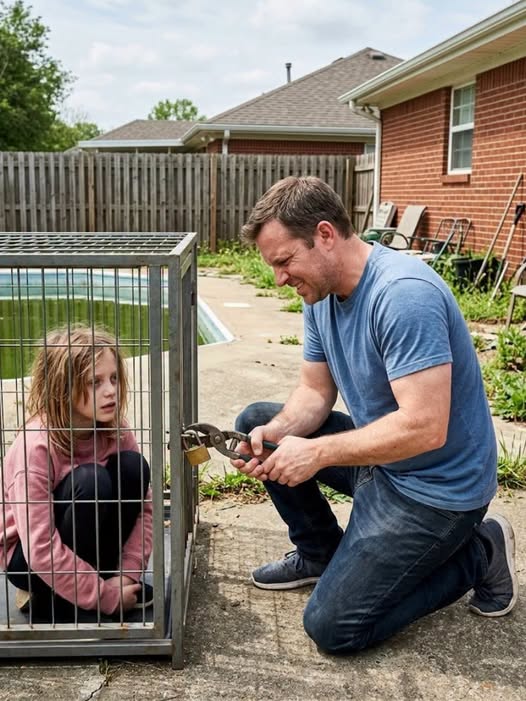
➡️ PART 3 ENDING PART ➡️
For a moment, I couldn’t understand what my daughter had said.
Not because the words were complicated.
Because they were too simple.
“Mommy was still alive when Julian locked me in the cage.”
Still alive.
The phrase struck me harder than anything I had seen in that backyard.
I dropped to my knees beside Emily.
The paramedic had wrapped a gray blanket around her shoulders. Her face looked impossibly small above it.
“Sweetheart, where did Mommy go?”
Emily looked toward the house.
“Downstairs.”
Detective Mara Bennett crouched beside us.
Unlike me, she did not immediately fire another question.
She looked at Emily and said quietly, “You’re safe right now.”
Emily’s fingers tightened around mine.
Then Mara asked, “When you say downstairs, do you mean the basement?”
Emily nodded.
“Is there a basement door inside the house?”
Another nod.
“Do you know if your mother is still there?”
Emily’s lower lip trembled.
“I don’t know.”
That was enough.
Detective Bennett stood immediately.
She signaled to two officers.
Julian, still handcuffed near the patio, began shouting.
“You can’t go in there!”
Every head turned.
He seemed to realize too late what he had done.
An officer moved him farther from the house.
“You need a warrant!”
Detective Bennett didn’t argue with him.
There was a missing woman.
A child had just reported that she had last seen her mother alive inside the residence before being unlawfully confined outside.
Whatever legal questions remained would be handled by people who knew how to handle them.
I had only one job.
Emily.
“Daddy.”
“I’m here.”
She stared at the officers entering the house.
“I didn’t tell him.”
“Tell him what?”
Her hand disappeared beneath the blanket.
When it came back out, she was holding something tiny.
A brass key.
I stared at it.
“Where did you get that?”
“Mommy.”
My heart started pounding.
“When?”
“The night he took her downstairs.”
Detective Bennett stopped halfway toward the house.
She returned.
“What does it open?”
Emily looked at her.
“I don’t know.”
Then she whispered:
“Mommy said if Daddy comes, give it to him. If Daddy doesn’t come, give it to a police lady.”
My vision blurred.
Elena had expected something to happen.
Maybe not exactly what happened.
But enough.
She had thought about me.
About the police.
About Emily.
I held out my palm.
Emily placed the key in it.
It was cold.
Small.
Ordinary.
And somehow heavier than anything I had ever held.
Detective Bennett photographed it before taking possession.
“Did your mother say anything else?”
Emily nodded.
“She said, ‘Don’t let Julian know you have it.’”
“Where did you hide it?”
Emily looked almost embarrassed.
“In my shoe.”
I swallowed.
For three days, my ten-year-old daughter had sat inside a metal cage with a key hidden in her shoe.
I wanted to scream.
Instead I kissed her forehead.
“You did exactly what Mommy asked.”
Emily began crying.
“Did I wait too long?”
“No.”
The answer came so quickly it almost hurt my throat.
“No, baby.”
“But I didn’t get out.”
“That was not your job.”
“I could’ve—”
“No.”
I took her face gently between my hands.
“Listen to me. Getting out was not your job. Fighting Julian was not your job. Finding Mommy was not your job.”
Her eyes filled.
“You stayed alive.”
My voice broke.
“That was your job.”
She leaned against me.
I held her.
Behind us, firefighters continued examining the pool.
The first black bag had been removed.
Then the second.
Then the third.
I refused to look.
Emily had told me not to.
This time, I listened.
A few minutes later, Detective Bennett received a radio call.
Her expression changed.
She ran toward the house.
Two paramedics followed.
I stood automatically.
“What happened?”
Nobody answered immediately.
Then an officer came through the back door.
“Female located in basement.”
My knees nearly gave out.
“Alive?”
He looked at me.
“Alive.”
Emily heard him.
She made a sound I will remember until the day I die.
Not a scream.
Not quite a sob.
A tiny gasp of hope from a child who had been holding her breath for three days.
“Mommy?”
I pulled her against me.
“They found her.”
“Is she okay?”
“I don’t know yet.”
“Can I see her?”
“We’ll ask.”
Minutes stretched.
Julian had stopped shouting.
He sat in the back of a patrol car now.
For the first time since I entered the yard, I looked directly at him.
He stared back.
There are moments when rage feels physical.
Hot.
Immediate.
It tells you that if you could only get close enough to the person who hurt your child, something inside you would finally become quiet.
It is a lie.
Violence would not have returned three stolen days to Emily.
It would not have carried Elena out of the basement.
It would only have given my daughter one more frightening thing to remember about her father.
So I looked away.
That was the first useful thing I did with my anger.
I saved it for later.
Elena came out on a stretcher.
Emily tried to run toward her.
A paramedic stopped her gently.
I held her shoulders.
Elena looked pale.
Weak.
There was an oxygen mask over her face.
But her eyes were open.
They moved across the yard.
Then found Emily.
Her hand lifted.
Barely.
Emily sobbed.
“Mommy!”
Elena started crying beneath the mask.
I don’t know whether she could hear us clearly.
I hope she could.
Because Emily kept saying:
“I’m okay, Mommy. Daddy came. I’m okay.”
Daddy came.
Those words almost destroyed me.
I had come.
Three days late.
I would spend years forgiving myself for those three days.
At the time, I didn’t know that yet.
All I knew was that Elena was alive.
Emily was alive.
And Julian was in handcuffs.
The ambulance took Elena first.
Another took Emily.
I rode with my daughter.
At the hospital, the world became fluorescent lights and questions.
Doctors examined Emily.
Dehydration.
Exhaustion.
Bruising.
Malnutrition that appeared to have developed over more than three days.
That last part made me feel sick.
The cage was not the beginning.
It was simply the first thing I had seen.
A social worker named Naomi Patel sat with me outside Emily’s room.
She spoke gently.
“Has Emily ever reported physical abuse to you?”
“No.”
“Fear?”
“Yes.”
That answer hurt.
“What kind?”
“She asked to stay with me longer.”
“How often?”
“Several times.”
“Did she say why?”
“No. She said she was fine.”
Naomi waited.
I knew what she was waiting for.
The rest.
“And I let myself believe her.”
Naomi did not tell me it wasn’t my fault.
I was grateful.
Because I didn’t need absolution from someone who had known me for seven minutes.
She said something better.
“You’re here now.”
I nodded.
“Was that enough?”
“For what?”
“To make up for not understanding sooner.”
“No.”
The honesty surprised me.
Then she continued.
“But parenting isn’t a system where one correct action cancels one missed warning. What matters now is what you do with what you know.”
That sentence stayed with me.
What you do with what you know.
I had known Emily was uncomfortable.
I had not known she was unsafe.
Now I knew.
Everything after that would have to change.
A doctor came out.
“She’s asking for you.”
I went in.
Emily looked tiny in the hospital bed.
There was an IV in her arm.
Her hair had been gently combed back.
Someone had given her clean pajamas with little stars on them.
I sat beside her.
“Where’s Mommy?”
“She’s being treated.”
“Is she going to die?”
My heart clenched.
“I don’t know everything yet.”
Her eyes filled.
“But the doctors are helping her.”
“You promise?”
“I promise they’re helping.”
Not:
She’ll be fine.
Not:
Nothing bad will happen.
I had learned in one afternoon that children deserve reassurance, but they also deserve truth.
Emily closed her eyes.
Then opened them again.
“What was in the pool?”
I froze.
“I don’t know.”
That was true.
“Were they people?”
“No.”
I didn’t know how I knew.
Maybe because no one had treated the pool like a recovery scene after opening the bags.
Maybe because Detective Bennett had not come to tell me something worse.
Still, I corrected myself.
“I don’t think so.”
Emily nodded.
“Julian said they were Mommy’s mistakes.”
“What does that mean?”
“I don’t know.”
A nurse came in before I could ask more.
Good.
Emily had already answered enough questions for one lifetime.
Detective Bennett arrived almost an hour later.
She asked to speak privately.
I stepped into the hallway.
“Elena is stable.”
I closed my eyes.
My hand went against the wall.
“Thank God.”
“She appears to have been confined in a locked basement storage room.”
My anger returned.
“What did he do to her?”
“I’m not going to speculate before the medical evaluation and interview are complete.”
I nodded.
That was fair.
“What was in the pool?”
“Documents.”
I stared at her.
“What?”
“Mostly financial records. Some electronics. Clothing. Personal items.”
“In trash bags?”
“Yes.”
“Why throw them in water?”
“Likely destruction.”
“Whose records?”
“We’re still sorting that out.”
Then she held up an evidence bag.
Inside was the little brass key.
“We found what this opens.”
“What?”
“A fire-resistant document box hidden behind a removable panel in the laundry room.”
My heart began pounding.
“What was inside?”
“Records.”
“What records?”
She looked toward Emily’s room.
“Some appear to belong to Elena.”
“And?”
“Some appear to concern Julian.”
“What kind?”
“Financial.”
I thought of the black bags.
“Was he stealing from her?”
“We don’t know yet.”
“Detective.”
She looked at me.
“Please.”
Her expression softened slightly.
“We found bank statements, copies of loan applications, property records, insurance documents, and a handwritten log Elena appears to have kept.”
“A log of what?”
“Dates. Incidents. Amounts of money. Threats.”
I felt sick.
“How long?”
“About eight months.”
Eight months.
Eight months of Elena documenting something.
Eight months while I exchanged polite texts about pickup times.
Eight months while Emily moved between our homes.
“Why didn’t Elena tell me?”
“I can’t answer that.”
I could.
Or thought I could.
Divorce does strange things to trust.
Elena and I had not ended well.
We had fought about money.
Parenting.
My work hours.
Her resentment.
My defensiveness.
By the end, every conversation felt like a negotiation between two people who remembered the same marriage differently.
We had eventually become civil.
But not close.
If Julian had begun controlling her, maybe she had been ashamed.
Maybe she thought I would say:
I told you so.
God.
Had I ever given her reason to think that?
Probably.
Not recently.
But once might have been enough.
Detective Bennett continued.
“The key Emily carried appears to have been the only key Elena had managed to keep hidden.”
“What was Julian trying to destroy?”
“We’ll know more when the records are processed.”
“And the cage?”
Her face changed.
“That is part of the criminal investigation.”
“Did he put Emily in it?”
“Based on what we currently know, yes.”
“Why?”
“We’re not going to interview Emily in detail tonight.”
Good.
“She said she saw something?”
“Possibly.”
“What?”
“We’ll let a trained child interviewer handle that.”
I hated not knowing.
But this was not about satisfying my fear.
It was about protecting my daughter.
“Okay.”
Detective Bennett looked at me.
“Mr. Carter—”
“Daniel.”
“Daniel. Do not question Emily about what happened.”
“I won’t.”
“Even gently.”
“I won’t.”
“Children often try to tell parents what they think the parent needs to hear.”
I thought about every time Emily had told me she was fine.
“I understand.”
I didn’t.
Not fully.
But I would.
Julian was arrested that night.
The initial charges were serious.
More came later.
I will not turn them into entertainment.
The legal process lasted years.
What matters is that there was evidence.
Physical evidence.
Medical evidence.
Neighbor statements.
Security records.
Financial records.
Elena’s notes.
And eventually, when professionals determined she was ready, Emily’s own account.
Not extracted at the kitchen table.
Not demanded by me.
Given once, carefully, in a child advocacy center with trained people who understood that a ten-year-old should not have to repeatedly relive frightening events because adults are curious.
I watched none of that interview.
I didn’t need to.
I was her father.
Not her investigator.
The next morning, Elena asked to see me.
She was in a hospital bed.
Her face looked older than it had four days earlier.
Maybe mine did too.
For a few seconds, neither of us spoke.
Then she said:
“Emily?”
“With a pediatric team.”
“Is she okay?”
“She will need time.”
Elena started crying.
I stood awkwardly beside the bed.
There had been a time when seeing Elena cry would have made me reach for her automatically.
Marriage creates muscle memory.
Divorce doesn’t erase it overnight.
But she wasn’t my wife anymore.
So I asked:
“Do you want me to sit?”
She nodded.
I sat.
“I’m sorry.”
she whispered.
I did not say:
It’s okay.
It wasn’t.
“For what?”
“For not calling you.”
“Why didn’t you?”
Her eyes closed.
“I thought I could fix it.”
That sentence.
How many disasters begin there?
I thought I could fix it.
“When did you know Julian was dangerous?”
She flinched.
“I don’t know.”
“Yes, you do.”
She looked at me.
“Daniel.”
“I am not asking to punish you.”
My voice softened.
“I need to understand what Emily was living with.”
Elena cried.
“Six months ago, maybe.”
“Six months?”
“He wasn’t like that at first.”
I said nothing.
She heard herself.
“I know how that sounds.”
“Tell me.”
“He started controlling money.”
“How?”
“He said I was bad with it.”
“Were you?”
“No.”
Then:
“Not really.”
I almost smiled at the familiar Elena qualification.
She had always been honest eventually.
“He wanted all our accounts combined. Then he started moving money.”
“Where?”
“I didn’t know.”
“That was the log?”
She looked surprised.
“You found it?”
“Police did.”
She began crying harder.
“I thought he destroyed everything.”
“The key opened the box.”
Her hand went to her mouth.
“Emily kept it?”
“Yes.”
“Oh God.”
“She hid it in her shoe.”
Elena turned her face away and sobbed.
I waited.
Eventually she whispered:
“I should never have given that to her.”
I understood the guilt.
But I also understood the situation.
“You were trapped.”
“I made her responsible.”
“You gave her a key.”
“I told her to give it to you.”
“And she did.”
“After three days in a cage.”
Her voice cracked.
“I put my baby in the middle.”
“No.”
I said it firmly.
“Julian put her in the middle.”
Elena looked at me.
“You made a decision while you were afraid.”
I swallowed.
“That decision wasn’t perfect. But don’t take responsibility for what he chose to do afterward.”
Her eyes closed.
“Did she ask for me?”
“Every ten minutes.”
Elena cried again.
I did too.
There was no dignity left to protect between us.
Only our daughter.
“What happened Tuesday?”
I asked.
Elena looked toward the door.
“Have police told you not to ask me?”
“No.”
“They’ll want my statement.”
“You don’t have to tell me.”
“I want to.”
So I listened.
Julian had been moving money from a joint business account.
Elena discovered loans opened using information connected to her small design company.
Some documents appeared to carry her electronic authorization.
She said she had not approved them.
She confronted him.
He denied it.
Then became angry.
She started documenting everything.
Quietly.
Copies.
Screenshots.
Statements.
She bought the fire-resistant box.
Hid it behind a panel.
The black bags contained records Julian believed were the only copies.
He had forced her to gather them.
Then dumped them in the pool.
But he didn’t know about the box.
“What did Emily see?”
Elena’s face collapsed.
“She came downstairs.”
My heart stopped.
“She heard us arguing.”
“What happened?”
“Julian was holding my phone.”
Elena swallowed.
“I told Emily to go back upstairs.”
“She didn’t?”
“No.”
A sad smile touched her face.
“She has your stubbornness.”
“Poor kid.”
For half a second, we were just parents again.
Then the smile disappeared.
“Julian told her I was sick.”
“Sick?”
“That I wasn’t thinking clearly. That I needed to stay downstairs until I calmed down.”
My hands clenched.
“He locked you in?”
“Yes.”
“And Emily?”
“She started screaming.”
Elena closed her eyes.
“He took her outside.”
I stood.
I couldn’t sit anymore.
“Daniel.”
“I know.”
“No, I need a minute.”
I walked to the window.
Cars moved through the hospital parking lot.
People carried coffee.
A man helped an elderly woman into a wheelchair.
The ordinary world continued.
I hated it for a moment.
Then Elena said:
“I heard her crying.”
I turned.
“I heard her asking for you.”
That destroyed me.
I sat again.
“Why didn’t anyone call?”
“Julian took my phone. Emily’s too.”
“Mrs. Harris heard arguments.”
“She probably saved our lives.”
“Yes.”
Then Elena said:
“So did you.”
I shook my head.
“I waited three days.”
“You didn’t know.”
“I knew something was wrong.”
“You knew she wasn’t answering.”
“She had asked me before not to go back.”
Elena became quiet.
“I thought it was because you were stricter.”
I stared at her.
“What?”
“She used to ask me to stay with you longer too.”
That landed strangely.
“When?”
“Last year.”
“Why didn’t you tell me?”
“I thought she was playing us against each other.”
I closed my eyes.
Of course.
Two divorced parents.
Each interpreting the child’s requests through the divorce.
Emily had asked both of us for more time away from the other house at different points.
Maybe at first it was ordinary.
Maybe later it wasn’t.
We had been so determined not to be manipulated that we had failed to ask whether she was simply struggling.
“We missed her.”
I whispered.
Elena nodded.
“We did.”
No accusation.
No defense.
Just grief.
“We don’t miss her again.”
I said.
Elena looked at me.
“No.”
That became our first agreement in the new version of our family.
We don’t miss her again.
Not meaning we would understand every silence.
Parents cannot.
Not meaning we would become suspicious of every mood.
Children need privacy too.
It meant when Emily changed, we would notice.
When she became afraid, we would ask.
When she said she didn’t want to go somewhere, we would not immediately reduce it to inconvenience, manipulation, or divorce drama.
We would listen before explaining.
Emily stayed in the hospital for two nights.
Elena stayed longer.
I slept in a chair beside my daughter.
At 2:13 the first night, Emily woke screaming.
I was beside her before I was fully awake.
“No cage.”
she gasped.
“No cage.”
I held her.
“No cage.”
“Door.”
“The door is open.”
“Don’t close it.”
“I won’t.”
For almost a year, Emily slept with her bedroom door open.
Then halfway open.
Then eventually closed.
Recovery has strange milestones.
People expect big ones.
First day back at school.
First birthday after.
First time testifying.
But some of the most important victories were tiny.
The first time she locked a bathroom door herself.
The first time she went swimming again.
The first night she slept without checking whether I was still in the house.
The first time she saw a dog crate at a pet store and didn’t freeze.
Those were our milestones.
The black bags were processed.
The pool water had damaged much of what Julian tried to destroy.
Not enough.
Investigators recovered information from electronic devices.
The hidden box contained duplicates.
Elena had emailed some records to an account Julian didn’t know existed.
He had destroyed copies.
Not truth.
That difference mattered.
The financial investigation revealed that Julian had accumulated substantial debts.
Some from failed business ventures.
Some from personal spending.
Some from investments he had concealed from Elena.
He had used deception to obtain access to money.
The exact legal details took months to untangle.
I stopped trying to understand every number.
My concern was Emily.
Elena filed for divorce.
That sentence almost made me laugh the first time she said it.
Two divorces connected by one child.
Except this time, I was not her opponent.
I drove her to her attorney’s office once because she still wasn’t medically cleared to drive.
On the way there, she said:
“This is weird.”
“What?”
“You helping me divorce someone.”
“I have experience.”
She laughed.
Then immediately started crying.
I pulled over.
She covered her face.
“I feel so stupid.”
“No.”
“I married him.”
“Yes.”
“I brought him into Emily’s life.”
“Yes.”
She looked at me, wounded.
“You’re supposed to say none of this was my fault.”
“No.”
She stared.
“I don’t think that’s useful.”
I chose my words carefully.
“You chose to marry him.”
She cried.
“You missed things. So did I.”
She looked down.
“But you did not choose for him to hurt you.”
Silence.
“You did not choose for him to lock Emily outside.”
Her shoulders shook.
“You are responsible for what you knew and what you did with it.”
I thought of Naomi’s words.
“What you do with what you know.”
I continued.
“He is responsible for what he did.”
Elena cried quietly.
“I stayed too long.”
“Yes.”
I hated saying it.
But she had asked for truth.
Then:
“And you started collecting evidence. You hid copies. You gave Emily the key. You were trying to get out.”
She nodded.
“You should have called me sooner.”
“I know.”
“I’m angry about that.”
“I know.”
“I may be angry for a long time.”
“I understand.”
“But I’m still driving you to your lawyer.”
She laughed through tears.
“Why?”
“Because Emily needs both of us to get healthier.”
That became the foundation.
Not forgiveness.
Not friendship.
Parenting.
Elena moved into an apartment after leaving the hospital.
Emily did not immediately live with her.
That was difficult.
For everyone.
Temporary orders gave me primary custody while professionals evaluated what environment would best support Emily.
Elena agreed.
That mattered.
She could have fought out of shame.
Instead she said:
“Emily needs stability more than I need to prove I’m still her mother.”
I respected her for that.
She saw Emily several times a week.
At first in therapy.
Then at my house.
Then outings.
Eventually overnights.
Slowly.
Emily set much of the pace.
One afternoon, about four months after the rescue, Elena came to my house for dinner.
Emily had made spaghetti.
Technically, I made spaghetti.
Emily stirred the sauce twice and declared herself head chef.
We sat at the table.
Halfway through dinner, Emily dropped her fork.
The metal hit the plate.
She froze.
Elena froze too.
I watched them.
“What?”
Emily looked at her mother.
“Are you going back to Julian?”
Elena’s face crumpled.
“No.”
“Ever?”
“No.”
“What if he says sorry?”
“No.”
“What if he gets better?”
Elena took a breath.
“I hope he becomes better someday.”
Emily looked confused.
“But I will not be married to him again.”
“Why?”
“Because someone becoming better doesn’t mean I have to give them the same access to my life.”
I looked at Elena.
That was a good answer.
Emily considered it.
“Do I have to forgive him?”
“No.”
Elena answered.
“Do I?”
“No.”
“What if I do later?”
“Then you do.”
Emily nodded.
Then picked up her fork.
“Okay.”
And went back to spaghetti.
Children sometimes ask life-changing questions between bites of pasta.
Julian’s case moved through the courts.
I will not describe every hearing.
Emily did not spend her childhood in court.
Professionals worked hard to prevent that.
Eventually, Julian accepted responsibility for multiple offenses as part of the legal process.
He received a significant sentence.
There were restrictions concerning contact with Emily.
Financial consequences followed too.
People sometimes ask whether I felt satisfied.
No.
I felt relieved.
Satisfaction would imply there was an outcome capable of making what happened worth it.
There wasn’t.
No sentence could turn the cage back into ordinary metal.
No conviction could give Emily those three days back.
Accountability mattered.
It just wasn’t healing.
Healing happened elsewhere.
In therapy rooms.
At breakfast.
In the car.
At school.
In swimming lessons.
Yes.
Swimming lessons.
That surprised me too.
For almost two years, Emily would not go near a pool.
Then at twelve, she came home from school and said:
“I want to learn diving.”
I stared at her.
“What?”
“Diving.”
“Into water?”
She rolled her eyes.
“No, Dad. Off buildings.”
There she was.
Sarcasm.
My favorite sign of recovery.
“Are you sure?”
“Yes.”
“Why?”
She shrugged.
“I don’t want that pool to own all pools.”
I nearly cried.
I didn’t.
She hated when I cried at everything.
“Okay.”
We found an instructor who understood trauma.
The first lesson, Emily sat on the edge with her feet in the water for twenty minutes.
Nobody rushed her.
Second lesson, she got in.
Third, she swam.
Months later, she jumped from the lowest diving board.
When she surfaced, she was laughing.
I turned away.
Her instructor smiled.
“You can cry.”
“She’ll make fun of me.”
“She probably will.”
I cried anyway.
Emily did make fun of me.
Healing.
Elena healed differently.
She went to therapy.
Returned to work.
Rebuilt her finances.
For a while, she apologized constantly.
To Emily.
To me.
To Mrs. Harris.
To teachers.
To doctors.
Eventually her therapist apparently told her apologies could become another way of asking other people to relieve your guilt.
She stopped saying:
“I’m sorry”
every ten minutes.
Started saying:
“What do you need?”
That was better.
Mrs. Harris became part of our lives.
Every Christmas, Emily brought her cookies.
The first year, Mrs. Harris cried.
“You saved me.”
Emily told her.
Mrs. Harris shook her head.
“No, sweetheart. Your dad saved you.”
Emily frowned.
“Daddy came because you told him.”
Mrs. Harris looked at me.
I looked at her.
There was no reason to argue over credit.
Rescue had been a chain.
Emily survived.
Mrs. Harris noticed.
I came.
Police responded.
Doctors treated.
Elena had hidden evidence.
Investigators worked.
Therapists helped.
No one person owned the rescue.
That became important to Emily later.
She did not owe her life to any single adult.
She belonged to herself.
When Emily was fourteen, she asked to see the cage.
It had been evidence for years.
Eventually, I was told it would be disposed of.
“Why?”
I asked.
“Why do you want to see it?”
“I don’t know.”
That was not enough for me.
So we discussed it with her therapist.
Weeks later, Emily said:
“I want to know if it was really as small as I remember.”
My heart broke.
Trauma distorts scale.
Rooms become smaller.
Voices become louder.
Minutes become hours.
We did not take her to an evidence warehouse.
Instead, with professional guidance, she was given accurate dimensions.
She drew it.
Then sat staring at the drawing.
“It was small.”
“Yes.”
“I thought maybe I remembered wrong.”
“No.”
She looked at me.
“Dad?”
“Yes?”
“Thank you for breaking it.”
I had no answer.
I hugged her.
Years later, she would tell me that moment mattered because for a long time she thought recovery required discovering the cage hadn’t been as bad as she remembered.
Instead, she learned something else.
It had been bad.
She had still survived.
Healing does not require minimizing what happened.
Sometimes it requires finally naming it accurately.
Emily returned to regular school.
At first, kids knew something had happened.
News travels.
Adults gossip.
Children overhear.
One boy asked whether she had “lived in a dog cage.”
Emily punched him.
Not ideal.
I was called to school.
The principal looked exhausted.
Emily sat with her arms crossed.
“Did you hit him?”
“Yes.”
“Why?”
“He asked a stupid question.”
I looked at the principal.
“Can I have a minute with her?”
We stepped into the hallway.
“I’m not going to tell you he deserved it.”
“He did.”
“Maybe.”
She looked surprised.
“But you still can’t punch people.”
“Why?”
“Because we have laws.”
She almost smiled.
Then her eyes filled.
“He laughed.”
I crouched.
“I know.”
“I hate everyone knowing.”
“I know.”
“Can we move?”
That question was serious.
“Do you want to?”
She thought.
“No.”
“Then we won’t.”
“What do I say?”
“You can say, ‘I’m not talking about that.’”
“What if they keep asking?”
“Tell a teacher.”
“That’s lame.”
“Very.”
She laughed.
We practiced.
I’m not talking about that.
It became powerful.
A boundary small enough for a fourteen-year-old to carry.
Eventually, the questions stopped.
Teenagers found new gossip.
Life moved.
At sixteen, Emily got her driver’s license.
I aged approximately thirty years in one afternoon.
Elena bought her a used Honda.
I paid half.
We argued about whether that counted as an extravagant gift.
It felt wonderfully normal.
At seventeen, Emily brought home a boy named Noah.
I disliked him instantly.
Not because he did anything wrong.
Because he existed near my daughter.
Elena found this hilarious.
“You’re ridiculous.”
“I know.”
“He’s polite.”
“Suspicious.”
“He gets good grades.”
“Cover.”
“He volunteers at an animal shelter.”
“Long con.”
Emily walked into the kitchen.
“You two know I can hear you?”
Elena and I looked at each other.
“Who are you?”
I asked.
Emily threw a napkin at me.
There are people who believe a family damaged by trauma must remain solemn to prove the trauma mattered.
They are wrong.
Laughter does not disrespect pain.
Sometimes laughter is evidence that pain no longer owns every room.
Emily graduated high school.
Elena sat on one side of me.
Mrs. Harris on the other.
When Emily crossed the stage, all three of us stood.
She saw us.
I know she did.
Her smile changed.
Later, in the parking lot, she said:
“You embarrassed me.”
“You’re welcome.”
“Mrs. Harris screamed my full name.”
“She earned the right.”
Emily hugged her.
We took photographs.
One with me.
One with Elena.
One with both of us.
One with Mrs. Harris.
Then Emily insisted on one where everyone stood together.
It was awkward.
Beautiful.
Real.
Elena and I never remarried each other.
People occasionally assumed we would.
Trauma had brought us closer.
But closeness is not always romance.
We became something better suited to who we were.
Partners in loving Emily.
Friends, eventually.
Real friends.
The kind who could say:
“You’re being an idiot.”
and know it wasn’t reopening the divorce.
Elena remarried when Emily was twenty-two.
His name was Marcus.
He was a librarian.
Quiet.
Patient.
The first time Elena told me about him, I asked too many questions.
She laughed.
“You know you’re my ex-husband, right?”
“Unfortunately.”
“You don’t get to approve my dates.”
“No.”
Then:
“What’s his last name?”
“Daniel.”
“No.”
She laughed.
Marcus understood why trust came slowly.
He never demanded access to Emily.
Never insisted she call him anything.
Never acted offended when she preferred staying with me during early visits.
He let relationships grow at their own speed.
That was how he eventually became family.
I remarried too.
Her name was Sophie.
She met Emily when Emily was nineteen.
I waited.
Probably longer than necessary.
Fear can disguise itself as caution.
Emily finally said:
“Dad, I’m in college. You don’t need permission to date.”
“I know.”
“You’re acting weird.”
“I am always weird.”
“More.”
Eventually I introduced them.
Sophie did something brilliant.
Nothing.
She didn’t try to mother Emily.
Didn’t buy an extravagant gift.
Didn’t force closeness.
She said:
“Your dad talks about you constantly.”
Emily groaned.
“I’m sorry.”
Sophie smiled.
“I figured.”
That was the beginning.
Emily studied environmental science.
For a while, I thought she might become a therapist because everyone expects survivors to turn survival into a career.
She didn’t.
Good.
She loved rivers.
Wetlands.
Water-quality restoration.
The first time she told me she wanted to work around water, I looked at her.
She knew exactly what I was thinking.
“Dad.”
“I didn’t say anything.”
“Your eyebrows did.”
“Water?”
“Yes.”
“You’re sure?”
She smiled.
“Pools don’t own water either.”
There it was again.
She built a career restoring damaged waterways.
I could not have invented a more beautiful metaphor if I tried.
But Emily would hate me calling it a metaphor.
“It is a job, Dad.”
she would say.
So:
It was a job.
She was good at it.
She married Noah.
Yes.
The animal-shelter long con succeeded.
He became a veterinarian.
I eventually admitted he was acceptable.
At their wedding, I walked Emily down the aisle.
Halfway there, she whispered:
“Don’t cry.”
“I’m not.”
“You are.”
“Allergies.”
“Inside?”
“Severe.”
She laughed.
When I handed her hand to Noah, I did not say:
Take care of her.
I hated that phrase.
Emily did not belong to one man until another man took responsibility.
Instead, I hugged her and whispered:
“Choose each other every day.”
She kissed my cheek.
“I will.”
Then she looked at Noah.
“And if he ever buys a metal cage, I’m leaving.”
Noah nearly choked.
I stared at her.
She smiled.
Dark humor had become one of the ways she owned the memory instead of letting it own her.
Later, during my toast, I did not mention Julian.
I did not mention the backyard.
I did not tell a room full of guests that my daughter was strong because she survived something terrible.
I said:
“Emily has spent her whole life teaching me that strength is not the same as never needing help.”
She looked at me.
“And love is not proving you can rescue someone.”
My voice shook.
“Love is listening when they tell you what they need, believing them when something is wrong, and standing close enough that they don’t have to shout forever.”
Emily cried.
So did I.
Allergies.
Obviously.
She had two children.
My grandchildren.
The first time her daughter, Ava, turned ten, I had a difficult week.
I hadn’t expected it.
Ten.
The age of the cage.
The age of the phone calls.
The age of the whisper beside the pool.
Emily noticed.
“You’re doing math.”
“What?”
“Trauma math.”
I stared at her.
“Is that a scientific term?”
“I invented it.”
She sat beside me.
“Ava isn’t me.”
“I know.”
“She is safe.”
“I know.”
“I’m safe.”
“I know.”
“You’re allowed to stop checking.”
That one hurt.
Because I still checked.
Doors.
Windows.
Messages.
Silences.
For years, if Emily didn’t answer my call, my body returned to that Sunday.
Three days.
No answer.
Driveway.
Fence.
Tarp.
Metal.
I had gotten better.
Not completely.
Emily put her hand on mine.
“Dad, you came.”
“Eventually.”
“No.”
She squeezed my hand.
“You came when you understood I needed you.”
“I should have understood sooner.”
“Maybe.”
That surprised me.
She did not rescue me from guilt.
Good.
“Maybe you should’ve.”
She continued.
“But I spent years watching you punish yourself for three days.”
My eyes filled.
“Did that help me?”
I knew the answer.
“No.”
“Did it protect me?”
“No.”
“Then maybe stop making it your penance.”
I looked away.
“I don’t know how.”
“Yes, you do.”
“How?”
“Same way you taught me.”
She smiled.
“Name what happened accurately.”
I waited.
“You missed warning signs.”
“Yes.”
“You didn’t know I was in a cage.”
“No.”
“When you found out something was wrong, you came.”
“Yes.”
“You called police.”
“Yes.”
“You got me out.”
“Yes.”
“You listened afterward.”
I cried.
“Most of the time.”
“Dad.”
“Okay.”
She leaned against me.
“That’s the whole story.”
Not:
Perfect father saves daughter.
Not:
Negligent father ignores child.
The whole story.
I missed things.
Then I showed up.
Both were true.
Elena had her own version.
She stayed too long.
She also tried to leave.
She failed to protect Emily from everything.
She also hid the evidence that helped stop Julian.
She was harmed.
She made mistakes.
She healed.
Both.
People wanted simple stories.
We stopped giving them one.
Mrs. Harris lived to ninety-four.
Emily visited her regularly.
Near the end, Mrs. Harris moved into assisted living.
Emily brought Ava to meet her.
Mrs. Harris looked at my granddaughter and said:
“You look exactly like your mother.”
Ava said:
“Grandpa says I have his ears.”
Mrs. Harris looked at me.
“Your grandfather says a lot of things.”
Still sharp at ninety-four.
Before Emily left that day, Mrs. Harris took her hand.
“I almost didn’t tell your father.”
Emily became still.
“What?”
“The day he came.”
Mrs. Harris’s eyes filled.
“I thought maybe it wasn’t my business.”
That sentence stayed in the room.
“I had heard arguments. Seen things. I told myself families have problems.”
Emily squeezed her hand.
“But you did tell him.”
“Yes.”
“Why?”
Mrs. Harris looked at Ava.
“Because I realized protecting someone’s privacy is not the same as ignoring someone’s fear.”
Emily cried.
“So I told him.”
A week later, Mrs. Harris died in her sleep.
At her funeral, Emily spoke.
She did not tell the cage story.
She said:
“Mrs. Harris taught me that being a good neighbor sometimes means noticing.”
That was enough.
Elena died before I did.
Cancer.
She was seventy-three.
Marcus sat beside her.
Emily on the other side.
I visited near the end.
Elena smiled weakly.
“Look at us.”
“What?”
“You, me, Emily, Marcus.”
She looked toward the hallway where Sophie was getting coffee.
“And your wife.”
“Very modern.”
She laughed.
Then winced.
“Don’t make me laugh.”
“You started it.”
Later, when we were alone, Elena said:
“Do you still blame me?”
I knew what she meant.
I sat beside her.
“Sometimes.”
Her eyes filled.
“Still?”
“Yes.”
I had learned not to lie at deathbeds.
“But not the way I used to.”
She nodded.
“I blame myself too.”
“I know.”
“I wish I’d called you.”
“I wish you had.”
“I wish I’d left earlier.”
“I know.”
“I wish—”
“Elena.”
She stopped.
“We can wish until you run out of time.”
She cried.
I took her hand.
“You made mistakes.”
“Yes.”
“So did I.”
“You didn’t marry him.”
“No.”
“That was mine.”
“Yes.”
She flinched.
I squeezed her hand.
“But what he did was his.”
She cried harder.
“Do you really believe that?”
“Yes.”
Finally.
After decades.
Yes.
“You don’t have to die carrying his choices as proof that you failed.”
She closed her eyes.
“I love her so much.”
“I know.”
“Did she know?”
“Yes.”
Elena opened her eyes.
“Are you sure?”
“Absolutely.”
That seemed to give her peace.
She died two days later.
Emily was devastated.
Grief does not obey the moral accounting of the past.
Elena had failed her in some ways.
Loved her enormously in others.
Emily mourned the whole mother.
Not the defendant.
Not the victim.
Not the woman in the basement.
Her mother.
At the funeral, Emily placed the little brass key inside Elena’s casket.
I was surprised.
“You kept it?”
“Police returned it years ago.”
“I didn’t know.”
“I did.”
“Why put it with her?”
Emily looked at the casket.
“Because she doesn’t need to hide anything anymore.”
I cried.
Of course.
Years later, Emily asked me whether I remembered the black bags.
“Every one.”
“I used to think Mommy was in them.”
I looked at her.
“You told me she wasn’t.”
“I knew she wasn’t.”
“How?”
“I heard her banging on the basement door after Julian threw the bags in.”
My chest tightened.
She had never told me that.
Or maybe she had told investigators.
Not me.
“Why didn’t you tell me?”
“You told me I didn’t have to explain everything.”
I nodded.
“Right.”
“I liked that.”
I smiled sadly.
“Good.”
Then she said:
“Do you know why I told you not to look?”
I had wondered for forty years.
“No.”
“I thought the bags were full of body parts.”
I closed my eyes.
Ten years old.
Of course.
“What did Julian tell you?”
“That they were pieces of what happens to people who don’t listen.”
I felt old rage rise.
Even after all those years.
Emily touched my arm.
“Dad.”
“I’m okay.”
“No, you’re not.”
“No.”
She smiled.
“Neither was I.”
“What changed?”
“I learned what was actually in them.”
“Documents.”
“Documents.”
She laughed softly.
“For years, I was afraid of garbage bags.”
“I remember.”
“Then one day I put leaves in one.”
I looked at her.
“That was it?”
“Pretty much.”
“No dramatic music?”
“No.”
“Therapy is disappointing.”
“Very.”
She leaned back.
“Fear hates accurate information.”
I smiled.
“That’s annoyingly wise.”
“I’m old now.”
“You’re my child.”
“I have grandchildren.”
“Temporary condition.”
She laughed.
I loved that laugh.
When I was eighty-two, I moved out of the house I had lived in after the divorce.
Emily helped.
In a closet, we found the gardening pliers.
The ones I had used on the padlock.
I had kept them.
I didn’t remember deciding to.
Emily held them.
“These?”
“Yes.”
She turned them over in her hands.
Rusty now.
Ordinary.
“Do you want them?”
I asked.
“No.”
“Me neither.”
We put them in a donation pile.
Then both stopped.
Emily looked at me.
“Somebody is going to buy these for three dollars and have no idea.”
“Good.”
She smiled.
“Good.”
That felt right.
Objects do not have to remain sacred because they touched terrible moments.
Sometimes pliers should become pliers again.
A pool should become water again.
A backyard should become grass.
A child should become a woman.
A father should become more than the man who broke a lock.
I lived long enough to see all of that.
Julian did not become part of our lives again.
I learned pieces about him through legal notices over the years.
I did not follow closely.
His future was not my responsibility.
Whether he changed internally, regretted what he did, or spent his life blaming others was not something I needed to know.
Accountability had occurred.
Safety had been established.
We moved forward.
That was enough.
Not every story needs reconciliation.
Some doors should stay closed.
That is not bitterness.
Sometimes it is wisdom.
When Emily was in her sixties, she asked:
“Do you think you would’ve forgiven Julian if he really changed?”
“No.”
She looked surprised.
“Never?”
“I don’t know.”
I thought.
“Maybe I could forgive him in the sense of not carrying hatred.”
“And let him back?”
“No.”
“Why not?”
“Because forgiveness and access are different.”
She nodded.
“Mom used to say that.”
“She learned it the hard way.”
“So did we.”
Yes.
We did.
The final years of my life were quieter.
Sophie and I traveled until our knees complained.
Emily visited.
Ava brought children of her own.
My house filled with photographs.
None from that backyard.
That mattered.
Trauma has a strange hunger for visual space.
Police photographs.
Evidence.
News images.
Court documents.
We kept what the lawyers required.
Then, when legally permitted and emotionally ready, we let much of it go.
I did not frame the broken padlock.
I framed Emily graduating.
Emily diving.
Emily beside a restored wetland.
Emily marrying Noah.
Emily holding Ava.
Emily laughing beside Elena.
Emily standing with Mrs. Harris.
Those were also evidence.
Evidence of life afterward.
Maybe the most important kind.
Near the end, Ava asked me to tell her what happened.
She knew the family version.
Not every detail.
I told her enough.
When I finished, she asked:
“Were you scared when you saw Mom in the cage?”
“Yes.”
“Did you know what to do?”
“No.”
“But you broke it.”
“Yes.”
She thought.
“That’s brave.”
I smiled.
“No.”
She frowned.
“Why?”
“Brave would be too simple.”
“What was it?”
“I was her father.”
She waited.
“That doesn’t mean fathers always know what to do.”
I continued.
“It means in that moment, I knew the next thing.”
“What?”
“Open the door.”
She nodded.
That was how I came to understand courage.
Not a personality.
Not fearlessness.
Sometimes it is simply knowing the next right thing.
Call.
Drive.
Climb the fence.
Break the lock.
Hold your child.
Call police.
Tell the truth.
Listen.
Then the next thing.
And the next.
You do not need to see the whole road.
You need to stop pretending the warning sign is nothing.
That was the part I had failed before the backyard.
I had wanted explanations that made me comfortable.
She’s adjusting to divorce.
She doesn’t like her stepfather.
Kids test boundaries.
Her phone died.
She’ll call tomorrow.
Some of those explanations were reasonable.
That is what makes warning signs difficult.
Danger rarely arrives carrying a sign that says:
THIS IS DANGER.
Sometimes it looks like a child becoming quieter.
A request for one extra night.
Shoulders tightening at a name.
A phone that stops answering.
The lesson was not to panic at every silence.
It was to remain curious.
To ask again.
To make it safe for the answer to be inconvenient.
I learned that too late for some things.
In time for others.
And Emily learned something even more important.
Her fear deserved language.
When something felt wrong, she did not need perfect evidence before asking for help.
That became something she taught her own children.
“If you’re scared, tell me.”
Not:
Prove why.
Not:
Are you sure?
Tell me.
We’ll figure out why together.
One evening near my eighty-eighth birthday, Emily and I sat on my porch.
She had gray hair.
I hated it.
Children should remain thirty forever.
She held two cups of coffee.
“Dad?”
“Hmm?”
“Do you remember what I said when you opened the cage?”
I knew.
“Daddy, please don’t look.”
“Yes.”
“I’ve thought about that a lot.”
“So have I.”
“You know what I wish I’d said?”
“What?”
She smiled.
“Daddy, look at me.”
My eyes filled.
She continued.
“Because that’s what I actually needed.”
I took her hand.
“I did.”
“I know.”
“No.”
I squeezed her fingers.
“I mean I kept looking.”
She cried.
“So did Mom.”
“Yes.”
“Eventually.”
“Yes.”
“So did I.”
I smiled.
“That was the important one.”
She looked toward the sunset.
For a while, neither of us spoke.
Then she said:
“I’m okay, Dad.”
I believed her.
Not because she never had nightmares.
Not because she forgot.
Not because the past became harmless.
She was okay because okay had stopped meaning untouched.
Okay meant whole.
Scarred in places.
Joyful in others.
Capable of grief.
Capable of trust.
Able to remember without returning.
Able to swim.
Able to love.
Able to close doors.
Able to open them.
Able to say no.
Able to ask for help.
Whole.
I had spent years thinking my job was to erase what happened to her.
Impossible.
Then I thought my job was to protect her from ever being hurt again.
Also impossible.
Eventually, I understood.
My job was to help build a life in which pain did not have the final authority.
Emily did the rest.
That is what I remember when I think about that backyard.
Not Julian.
Not the cage.
Not even the black bags under the water.
I remember the lock falling into the grass.
A small sound.
Metal against earth.
Then the door opening.
That sound became the dividing line in my memory.
Before.
After.
Before, Emily was alone inside something she could not open.
After, she wasn’t.
Everything wasn’t fixed when that door opened.
In many ways, the hardest work had not even begun.
But she was no longer alone.
Sometimes that is where rescue actually starts.
Not when the danger disappears.
When someone enters it with you and says:
I’m here.
Years later, after I had become old enough to forget where I put my glasses while they were sitting on my face, I could still remember exactly how Emily felt when I pulled her out.
Too light.
Shaking.
Alive.
I remember her fingers grabbing my shirt.
I remember saying:
“I’ve got you.”
At the time, I thought those words meant:
I will carry you.
They didn’t.
No parent carries a child through an entire life.
Eventually they walk.
Then run.
Then leave.
Then build lives you only visit.
“I’ve got you” came to mean something different.
I will believe you.
I will listen.
I will come when I know you need me.
I will admit when I missed something.
I will not make you carry my guilt.
I will not demand that your healing make me feel like a good father.
I will love you when you’re frightened.
I will love you when you’re angry.
I will love you when you no longer need rescuing.
That was the promise.
Not perfection.
Presence.
Elena learned it too.
Before she died, she wrote Emily a letter.
Emily showed me years later.
One paragraph stayed with me.
Elena had written:
“I spent too much of my life believing love meant enduring things long enough for them to become better. I was wrong. Love without safety is not a test you pass by staying. Sometimes the most loving thing you can do for yourself and your child is leave before you have every answer.”
Emily kept that letter.
Not the key.
The key went with Elena.
Good.
The lesson stayed.
The object didn’t need to.
When my own time became short, Emily sat beside my bed.
No cage.
No locked door.
No hidden key.
Just my daughter holding my hand.
I was tired.
She knew.
“Dad?”
“Yes?”
“You can go.”
I smiled weakly.
“Bossy.”
“Genetic.”
“From your mother.”
“Liar.”
I laughed.
It hurt.
Worth it.
Then she leaned closer.
“You came for me.”
My eyes filled.
“Always.”
“No.”
She smiled.
“Not always.”
Even then, honest.
“Eventually.”
I corrected.
“Yes.”
“I’m sorry.”
“I know.”
“I should’ve—”
“Dad.”
She squeezed my hand.
“We did this already.”
I smiled.
“We did.”
“You missed things.”
“Yes.”
“Then you learned.”
“Yes.”
“You listened.”
“I tried.”
“You stayed.”
“Yes.”
She kissed my forehead.
“That was enough.”
I closed my eyes.
Maybe that was what I had needed to hear for fifty years.
Not:
You were perfect.
I wasn’t.
Not:
You couldn’t have known.
I could have known more.
Not:
None of it was your fault.
Fault was never the only useful question.
That was enough.
Human enough.
Father enough.
Love does not become real because it never fails.
Sometimes love becomes visible in what it does after failure.
Does it deny?
Defend?
Blame?
Disappear?
Or does it learn?
Apologize?
Change?
Stay?
We stayed.
All of us who could.
And the people who could not safely remain in our lives did not get access merely because forgiveness sounded noble.
That was part of love too.
Years earlier, I had thought the most terrifying thing in that backyard was under the pool water.
It wasn’t.
The black bags contained paper, electronics, pieces of evidence someone wanted erased.
Terrifying, yes.
But not the worst thing.
The worst thing was a little girl who had learned to sit perfectly still inside a cage because she believed movement might make an adult angrier.
That was the thing we spent years undoing.
We taught her movement was safe again.
Running.
Swimming.
Diving.
Driving.
Traveling.
Walking down an aisle.
Wading through wetlands.
Dancing badly at family weddings.
Chasing her children.
Living.
Movement became hers again.
And maybe that is the image I would choose if I could replace the one people always imagine when they hear our story.
Not Emily inside the cage.
Emily at thirty-seven, standing knee-deep in a restored river, laughing because she had slipped in the mud.
Her hair wet.
Her clothes ruined.
Water moving around her.
No fear.
No one telling her to be still.
That was my daughter.
That was the ending.
Not survival alone.
Freedom.
If you had told me that Sunday afternoon, while I was breaking a padlock with shaking hands, that one day I would remember the story without feeling only rage, I would not have believed you.
But time does not always erase.
Sometimes it rearranges.
Julian became smaller.
The cage became smaller.
The pool became smaller.
Emily’s life became larger.
That is healing.
Not shrinking the truth.
Growing a life around it until the truth is no longer the biggest thing in the room.
So when people asked me what happened that day, I eventually stopped beginning with the cage.
I began with Emily.
My daughter was ten.
She loved strawberry ice cream.
Hated multiplication worksheets.
Collected smooth rocks from hiking trails.
Sang too loudly in the car.
Wanted to be a marine biologist for exactly eleven days.
She was funny.
Stubborn.
Tenderhearted.
Observant.
And one terrible week, adults failed her.
Then some adults listened.
She survived.
She healed.
She grew.
That is the order that matters.
Person first.
What happened second.
Never the other way around.
Because Emily was never “the girl in the cage.”
She was my daughter.
Elena’s daughter.
A friend.
A student.
A scientist.
A wife.
A mother.
Eventually a grandmother.
A woman who loved rivers.
A woman who could swim through deep water without mistaking every shadow beneath her for something waiting to hurt her.
And I was lucky enough to see almost all of it.
On my final clear afternoon, she opened the curtains beside my bed.
Sunlight came in.
“Too bright?”
she asked.
“No.”
Outside, rain from the previous night had left drops shining on the trees.
I looked at her.
For one impossible second, she was ten again.
Then sixty-eight.
Both.
My child and the woman she had become.
“Emily.”
“Yeah, Dad?”
“Look at me.”
She did.
I smiled.
There was nothing left to rescue.
Nothing left to prove.
Just love.
“I see you.”
Her face crumpled.
She took my hand.
“I know.”
And after all those years, that was enough.
Because the story had never truly been about what was hidden beneath the water.
It was about what had been hidden in plain sight.
A child’s fear.
A mother’s danger.
A father’s missed warnings.
A neighbor’s suspicion.
A locked door.
A key in a shoe.
Truth waiting for someone to notice.
And once we finally did, the lesson was painfully simple:
When a child becomes quieter, listen.
When fear changes the way someone moves through a room, notice.
When someone you love says, “I’m fine,” but everything in them looks frightened, make space for a different answer.
Do not demand perfect words from scared people.
Do not make children provide courtroom evidence before their fear becomes worthy of attention.
And when you discover you missed something important, do not waste the rest of your life trying to rewrite yourself as someone who never could have known.
Learn.
Change.
Show up differently.
That is what we did.
Not perfectly.
But enough.
The black bags eventually disappeared into evidence storage.
The pool was drained.
The cage was taken away.
The house was sold years later.
The grass grew over the place where the lock had fallen.
Time moved.
Emily moved with it.
And the little brass key that had once represented terror eventually rested beside Elena, where no one needed it anymore.
But the door it opened stayed open for the rest of our lives.
The door to truth.
The door to listening.
The door to a family that stopped confusing silence with safety.
And on the other side of that door was not a perfect life.
It was something better.
A real one.
A life where Emily could speak.
A life where Elena learned she was allowed to leave.
A life where I learned that protecting my daughter did not mean pretending I had never failed to notice her fear.
A life where accountability mattered more than revenge.
A life where healing did not require forgetting.
A life where a pool could become water again.
Where pliers could become tools again.
Where a closed door could simply mean someone wanted privacy.
Where a black trash bag could hold autumn leaves.
Where a child who had once been ordered not to move could spend the rest of her life going wherever she chose.
That was what we fought for.
Not a better ending to those three terrible days.
There was no better ending to them.
We fought for all the days afterward.
And we got them.
Thousands of them.
Ordinary ones.
Beautiful ones.
Painful ones.
Ridiculous ones.
Days when nobody was afraid.
Days when someone was afraid and knew how to say it.
Days when phones went unanswered because Emily was busy living.
Eventually, I learned not to panic every time.
That may sound small.
It wasn’t.
One afternoon, many years after everything happened, I called Emily.
No answer.
I waited.
Ten minutes.
Twenty.
My old fear stirred.
Then I looked out the window.
Breathed.
And did not call again.
An hour later, my phone rang.
“Hey, Dad.”
“Hey.”
“Sorry, I was swimming.”
I smiled.
“That’s okay.”
“You good?”
“Yes.”
And I was.
She had been underwater.
And I had not been afraid.
That was when I knew we had finally made it home.
THE END STORIES! THANK YOU FOR READING GOOD LUCK !❤️
Related Posts