I stared at the final page of Liam’s black notebook until the words blurred. Original deed? Mom’s forged signatures? Beneath that was the storage-unit receipt. Unit 214. Cape Fear Storage. Rented in David’s name.
Renewed six days earlier. I lifted my eyes. “How did you get this?” Liam looked toward the blinds before answering. “Dad dropped it.” “When?” “Two weeks ago.” “You saw him?” “He came to the restaurant.”
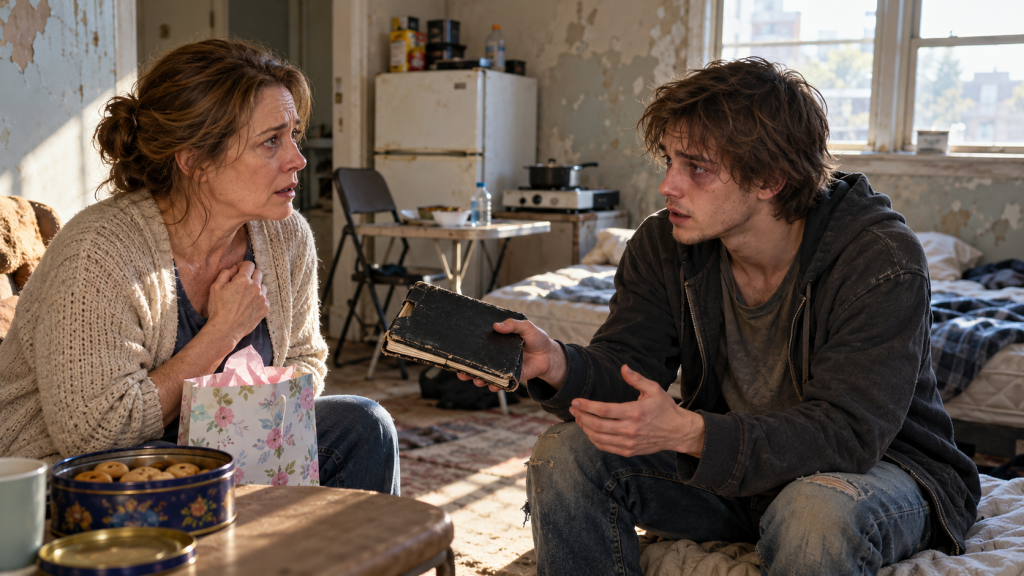
My stomach tightened. “What did he want?” “To know what I’d told you.” “You hadn’t told me anything.” “I know.” “That didn’t matter to him.” Liam rubbed both hands over his face. “He sat in a booth for almost an hour waiting for my shift to end.”
“What did he say?”
“At first, he acted normal.”
“Asked about school.”
“Asked if I was eating.”
“Then he said I needed to stop digging into the house.”
I felt something cold move through me.
“He knew about the notebook?”
“Not this one.”
Liam tapped the cover.
“I kept notes on my laptop first.”
“Then someone logged into it remotely.”
“How do you know?”
“The cursor moved while I was using it.”
I stared.
“What?”
“I thought I was imagining it.”
“Then files started opening by themselves.”
“County records.”
“Screenshots.”
“My notes.”
“So I disconnected the laptop from Wi-Fi.”
“And?”
“The next day, Dad showed up.”
I could barely breathe.
“Did he admit it?”
“No.”
“He just said, ‘You’re making this harder than it needs to be.’”
Liam looked down.
“That’s when I started writing everything by hand.”
I pulled the notebook closer.
Page after page.
Dates.
Names.
Photographs taped in.
Times.
A black SUV.
The same plate appearing outside his apartment, campus library, and restaurant.
A list of county filings.
A notary name.
A company.
Tidewater Holdings LLC.
Marcus Vane.
David.
Richard.
Then one name appeared repeatedly in the margins.
Elaine Porter.
“Who is Elaine?”
Liam went still.
“I don’t know exactly.”
“She notarized the deed.”
I turned the page.
There was a photograph of the filed quitclaim deed.
My supposed signature.
A notary seal.
Elaine M. Porter.
My throat tightened.
“Have you contacted her?”
“No.”
“Good.”
Liam looked up.
“You sound scared.”
“I am.”
That seemed to surprise him.
Maybe because mothers are not supposed to admit that.
I reached across the folding table and took his hand.
“But being scared does not mean we’re helpless.”
He nodded.
Then glanced at the door.
“Mom.”
“What?”
“The SUV was outside when you pulled in.”
My whole body tightened.
“You saw it?”
“Yes.”
“Still there?”
“I don’t know.”
I stood.
“Stay here.”
“No.”
“Liam.”
“I’m not letting you walk outside alone.”
For half a second, I almost smiled.
He was eighteen.
Terrified.
Too thin.
Living on a mattress in a rundown apartment because his father had convinced him that protecting me required disappearing.
And he still thought his job was to protect me.
“No one is going outside.”
I took out my phone.
“Who are you calling?”
“My attorney.”
“You have one?”
“After divorcing your father?”
I looked at him.
“I have three.”
That got the smallest laugh.
Good.
I called Rebecca Sloan.
She had handled two property transactions for me after my divorce and had once described David as “a man who treats paperwork like a suggestion.”
I had liked her immediately.
She answered on the second ring.
“Sarah?”
“Are you in Wilmington?”
“No.”
“Can you be?”
A pause.
“What happened?”
“I need you to listen first.”
Ten minutes later, she was no longer speaking casually.
“Do not go to the storage unit.”
she said.
“That was my plan.”
“Change it.”
“Why?”
“Because if the deed is fraudulent, there may be other crimes tied to it.”
“The storage unit could contain evidence.”
“If David rented it, you do not have lawful access simply because you have the receipt.”
I hated reasonable people.
“What do I do?”
“Photograph every page of Liam’s notebook.”
“Email copies to me.”
“Back them up somewhere David cannot access.”
“Do not use any shared cloud account from your marriage.”
“We’ve been divorced six years.”
“Do you know whether he still knows any of your passwords?”
I stopped.
“He shouldn’t.”
“That is not what I asked.”
No.
I could not say for certain.
Rebecca continued.
“I’m contacting a local real-estate litigator and a forensic document examiner.”
“And police?”
“Possibly.”
“Possibly?”
“Sarah, deed fraud is serious, but we need to establish exactly what happened.”
“County recording offices generally record documents; they do not authenticate every signature.”
“If a forged instrument was filed, we need certified copies, title history, notary information, and whatever evidence Liam has.”
“I have my original closing documents.”
“Where?”
My stomach dropped.
“In the beach house.”
Silence.
“Sarah.”
“I kept them in a fireproof box in the study.”
“Who knew?”
“David.”
Another silence.
Of course he knew.
He had helped Liam move in.
He knew where I stored everything.
Rebecca said:
“Do not confront anyone tonight.”
I stared toward the window.
The blinds were closed.
“I already confronted Chloe.”
“That’s different.”
“She knows I’m here.”
“Then assume David does too.”
My skin prickled.
“What about Liam?”
“Can you move him?”
“Yes.”
“Hotel?”
“No.”
I looked around the apartment.
“I’m taking him somewhere they won’t know.”
“Where?”
“Not telling you over the phone.”
“Good.”
That was when I realized how serious this had become.
Rebecca did not argue.
I packed Liam’s life in twelve minutes.
It fit into two duffel bags.
That hurt more than I expected.
Eight months earlier, he had moved into a furnished beach house with a bedroom facing the ocean.
Now everything he owned fit into the trunk of my rental car.
I picked up the black notebook last.
Liam stopped me.
“Wait.”
He took it from my hand.
Then removed the cardboard cover.
Inside, taped between layers, was a tiny memory card.
I stared.
“What is that?”
“Backup.”
I almost laughed.
“You’re your mother’s son.”
“No.”
He looked at me.
“I’m the son of two paranoid people.”
Fair.
“What’s on it?”
“Photos.”
“Screen recordings.”
“Voicemails.”
“One conversation with Dad.”
My heart pounded.
“You recorded him?”
“In North Carolina, one person in a conversation can generally record it.”
He had researched that too.
“Good.”
“He said something weird.”
“What?”
Liam swallowed.
“He said the house was never supposed to stay yours.”
I froze.
“What exactly did he say?”
“I saved it.”
We did not listen there.
Not yet.
We left through the back stairwell.
No black SUV.
At least none we saw.
I drove in silence.
“Where are we going?”
Liam asked.
“My friend Marisol’s.”
“Who?”
“You met her once.”
“When I was ten.”
“She owns a veterinary clinic outside town.”
“Why would Dad not know?”
“Because your father never cared enough about my friends to remember their names.”
That was suddenly useful.
Marisol answered the door at ten-thirty wearing pajama pants covered in cartoon dachshunds.
She took one look at Liam.
Then at me.
Then stepped aside.
“No questions until food.”
That was why we had been friends for twenty-seven years.
She made grilled cheese.
Liam ate three.
I pretended not to notice how hungry he was.
Afterward, we sat at her kitchen table.
I put my phone in airplane mode.
So did Liam.
Then we listened to the recording.
David’s voice came first.
Calm.
Tired.
Familiar.
“You need to stop doing this.”
Liam:
“Doing what?”
“Looking into the property.”
“It’s Mom’s property.”
“No.”
A pause.
Then Liam:
“The deed says she transferred it.”
“She didn’t.”
David exhaled.
“Liam, you’re eighteen.”
“You think you understand paperwork because you found some county website.”
“You don’t.”
“So explain it.”
Silence.
Then David said:
“The beach house was never supposed to stay in your mother’s name.”
My pulse jumped.
“Why not?”
Liam asked.
“Because that was temporary.”
“Temporary how?”
“Your mother bought it for you.”
“Then she should have transferred it.”
“She planned to after graduation.”
“That’s not good enough.”
“For who?”
Another pause.
Then:
“For people who put money into making this family function.”
My blood went cold.
Liam’s voice sharpened.
“Dad, you didn’t pay for that house.”
“Not directly.”
“What does that mean?”
“It means marriages are complicated.”
“You’ve been divorced six years.”
“Exactly.”
Silence.
Then David lowered his voice.
“Your mother walked away with more than she understands.”
I felt physically ill.
The divorce.
The settlement.
We had split marital property.
Not perfectly.
But through lawyers.
The inheritance I later used to buy Liam’s house came from my mother.
Separate property.
David had never touched it.
Liam said:
“The house came from Grandma’s inheritance.”
David replied:
“You don’t know everything.”
“What don’t I know?”
“Enough.”
Then came the line that changed everything.
“If Sarah had transferred the house when she was supposed to, none of this would have been necessary.”
The recording ended there.
I looked at Liam.
“When were you supposed to get the house?”
“After graduation.”
“Yes.”
“So what was he talking about?”
“I don’t know.”
But I had an idea.
David had not forged the deed simply to give Chloe somewhere to stay.
He wanted control before Liam legally received it.
Why?
The answer came the next morning.
Rebecca called at 7:12.
“I pulled the chain of title.”
I sat upright on Marisol’s sofa.
“What did you find?”
“The quitclaim deed is real in the sense that it was actually recorded.”
“Not real because I didn’t sign it.”
“I know.”
“Listen.”
“The deed transferred title from you to Tidewater Holdings for ten dollars and ‘other valuable consideration.’”
“I received nothing.”
“That is one issue.”
“Three weeks later, Tidewater executed a deed of trust.”
I stopped breathing.
“What?”
“There is a loan against the property.”
“How much?”
“Two hundred and seventy-five thousand.”
My hands went cold.
“Who loaned it?”
“A private lender.”
“Cape Atlantic Capital.”
“Who signed?”
“Marcus Vane on behalf of Tidewater.”
I stood.
“They borrowed against my house.”
“Yes.”
“How much is owed?”
“I’m finding out.”
“Where did the money go?”
“Also finding out.”
I looked toward Liam.
He was awake now.
Watching me.
Rebecca continued.
“There’s more.”
Of course.
“The loan went delinquent last month.”
My stomach dropped.
“What happens?”
“The lender initiated preliminary foreclosure steps.”
I closed my eyes.
That explained Liam’s sudden panic.
The house had not merely been stolen on paper.
It had been turned into cash.
“Does Chloe know?”
“No idea.”
“Does David?”
“Almost certainly.”
“Who is Marcus?”
“Registered agent and managing member of Tidewater.”
“I found three dissolved LLCs connected to him.”
“Real-estate flips.”
“Short-term lending.”
“One civil judgment.”
“One bankruptcy involving another entity.”
“Do you recognize the name?”
“No.”
“Any friend of David’s?”
“Not that I know.”
“Let me check something else.”
She paused.
Keyboard clicking.
Then:
“Oh.”
I hated that sound.
“What?”
“Marcus Vane worked with David.”
“When?”
“Seven years ago.”
“At what?”
“A development company called Harborline Properties.”
I remembered Harborline.
David had called it a consulting job.
Temporary.
He said he hated the people.
“What happened to it?”
“Collapsed.”
“Several lawsuits.”
“Investors claimed misrepresentation.”
“David was not named as a defendant.”
“Marcus was.”
My mouth went dry.
“So this goes back years.”
“Maybe.”
Rebecca said carefully.
“Do not jump farther than the evidence.”
I almost laughed.
“You really are a lawyer.”
“Yes.”
“And right now that is useful.”
It was.
By noon, Rebecca had a Wilmington attorney named Aaron Cho in the room with us by video.
Aaron specialized in title disputes and real-estate fraud.
He was forty-something, precise, and completely unimpressed by drama.
I liked him immediately.
He reviewed the documents.
Then said:
“We need to move fast.”
“How fast?”
“Today.”
“Why?”
“Because if foreclosure advances, unwinding things becomes more complicated.”
“But the lender has a forged deed.”
“Yes.”
“Which can invalidate the chain, but the lender may claim it relied on public record and notarization.”
“Either way, we stop further transfer.”
“What do we file?”
“Lis pendens if litigation is filed.”
“Temporary restraining order if necessary.”
“Complaint to quiet title.”
“Potential fraud claims.”
“Notary complaint.”
“Criminal referral.”
My head spun.
Liam said:
“What happens to Chloe?”
Aaron glanced at him.
“If she has a lease from an entity whose title is invalid, her occupancy rights may also be affected.”
“She has kids.”
Liam said quietly.
I looked at him.
After everything, that was his concern.
“She threw you out.”
“I know.”
“But they’re kids.”
My heart hurt.
Aaron said:
“No one needs to make an immediate decision about removing them today unless there is a safety issue.”
Good.
We could separate justice from cruelty.
That mattered.
Then Aaron asked:
“Sarah, is there any chance you signed a blank deed or power of attorney at any point?”
“No.”
“Any electronic signature authorization?”
“No.”
“Any document package David might have retained from your divorce?”
My stomach tightened.
“There were closing documents from another property we sold during the divorce.”
“What kind?”
“Deed.”
“Settlement statement.”
“Notarized signatures.”
Aaron leaned closer.
“Who kept copies?”
“Both attorneys.”
“And David?”
“Probably.”
There it was.
A source for my signature.
Maybe more.
Aaron asked:
“Do you have the signature page from the fraudulent deed?”
Rebecca shared it.
He stared.
“This is not hand-signed.”
“How can you tell?”
“It looks like a high-quality reproduction inserted into a scanned document.”
“We’ll confirm with an examiner.”
“The notary acknowledgment is more interesting.”
I leaned forward.
“Why?”
“It states you personally appeared before Elaine Porter.”
“I never met her.”
“Then either the acknowledgment is false or someone impersonated you.”
Liam’s face tightened.
“Someone pretended to be Mom?”
“Possibly.”
I felt sick.
That possibility was worse than simple copying.
A woman sitting across from a notary.
Using my name.
My identification.
My property.
Aaron continued.
“We need the notary journal.”
“North Carolina notaries do not always maintain journals as uniformly as some states, but Elaine may have records.”
“Do not contact her yourselves.”
He looked at Liam.
“Especially you.”
Liam nodded.
“Did you already?”
“No.”
“Good.”
The black SUV appeared again that afternoon.
Marisol noticed it first.
Parked half a block from her clinic.
Same plate Liam had written down.
She called me from the front desk.
“There’s a man sitting in it.”
My stomach tightened.
“Can you see him?”
“Baseball cap.”
“Middle-aged.”
“Phone.”
Liam went pale.
“That’s the car.”
I called Detective Andrea Ruiz.
Aaron had arranged the introduction after we filed a report with the Wilmington Police Department’s financial-crimes unit.
She told us not to approach.
An officer arrived.
The SUV left before he reached it.
But Marisol’s exterior cameras captured the plate.
Registered owner:
Coastal Investigative Solutions.
A private investigation company.
The owner was a licensed investigator named Kevin Marsh.
My anger exploded.
“David hired a private investigator to follow our son?”
Detective Ruiz held up a hand.
“We do not know who hired him yet.”
“Then find out.”
“We will.”
“Can’t you ask him?”
“Yes.”
“And he may have lawful confidentiality obligations to his client.”
I stared.
“He’s following an eighteen-year-old boy.”
“Following someone in public is not automatically illegal.”
“What about intimidation?”
“If there was threatening conduct, that matters.”
Liam said:
“He never spoke to me.”
“Just stayed close enough that I noticed.”
Ruiz looked at him.
“That can still be relevant.”
She took copies of the notebook.
The memory card.
The storage receipt.
Then she asked the question I had been dreading.
“Liam, why did you leave the house?”
He looked at me.
I nodded.
His voice became quiet.
“Dad came over.”
“When?”
“Twenty-four days ago.”
“Who else was there?”
“Chloe.”
“Grandpa Richard.”
“Grandma Helen came later.”
“What happened?”
Liam stared at the table.
“Dad said Chloe needed the house for the summer.”
“I said no.”
“What did he say?”
“That it wasn’t mine.”
“Did he show you the deed?”
“Yes.”
“Did you know about it before?”
“No.”
“What did you do?”
“I called Mom.”
I looked at him.
“You never told me.”
“You didn’t answer.”
I remembered.
A missed call at 11:40 one morning.
I had been at a dentist appointment.
He had texted:
Nothing urgent. Call me later.
I called that evening.
He said everything was fine.
My stomach twisted.
Ruiz asked:
“What happened after your mother didn’t answer?”
“Dad said if I made a scene, he’d call police and have me removed.”
“Did he?”
“No.”
“He said it would be embarrassing for Mom when police learned she’d committed fraud.”
“Then Grandpa said I should stop acting like a spoiled brat because Mom had given me a free house anyway.”
My jaw clenched.
Liam continued.
“Chloe started moving things in two days later.”
“Did anyone physically force you out?”
“No.”
“I packed.”
“Why?”
“Because Dad said the lender could come after Mom.”
“He said if I cooperated, he could fix it without her finding out.”
Ruiz’s expression sharpened.
“Fix what?”
“He said paperwork had gotten complicated.”
“And what did he want from you?”
Liam’s hands tightened.
“Sign something.”
I froze.
“What?”
“He said it was a statement that Mom intended to transfer the house to me.”
Ruiz leaned forward.
“Did you sign?”
“No.”
My breath escaped.
“Why not?”
“Because it said I had authorized Dad to manage it for me.”
I stared.
“You never told me.”
“I was scared.”
His voice cracked.
“I thought if I told you, Dad might actually get you arrested.”
I closed my eyes.
Again.
He had used my safety to control our son.
That was becoming a pattern.
Ruiz asked:
“Do you still have the document?”
Liam nodded.
“Photo.”
Another page in the notebook.
He had photographed the agreement before refusing.
Aaron read it later and almost swore.
It would have allowed David to claim Liam ratified the transfer arrangement.
Not enough to cure the forged deed.
But useful in creating confusion.
That seemed to be David’s whole strategy.
Not perfect legality.
Noise.
Enough overlapping paperwork that a normal person would become exhausted before finding the truth.
The first major break came from Elaine Porter.
She contacted police herself.
Not because conscience suddenly awakened.
Because Aaron’s lawsuit named her.
Her attorney called Rebecca.
Elaine wanted to cooperate.
We met in a conference room two days later.
She was sixty-one.
Gray-blonde hair.
Nervous hands.
She looked nothing like a criminal mastermind.
That did not make me trust her.
She sat across from me.
“I’m sorry.”
I said nothing.
Her attorney touched her arm.
Elaine continued.
“I did notarize that deed.”
“I know.”
“But you were not there.”
“I know.”
She looked at me.
“I thought you were.”
That made me sit forward.
“What?”
“A woman came in.”
My stomach turned.
“With David?”
“No.”
“With Marcus Vane.”
The room went quiet.
Elaine swallowed.
“She had identification.”
“In my name?”
“Yes.”
“Driver’s license?”
“Yes.”
“Did it look real?”
“Yes.”
“Photo?”
Elaine closed her eyes.
“It looked like her.”
She pointed at me.
“Close enough.”
My skin crawled.
“How old?”
“Maybe late forties.”
“I’m fifty-six.”
“She looked younger.”
Of course she did.
“How did you not know?”
Elaine’s attorney intervened.
“My client has acknowledged failures in her identification procedures.”
I stared at him.
“Failures?”
Elaine whispered:
“The license scanned.”
“What does that mean?”
“The barcode returned matching information.”
Ruiz spoke.
“Fake IDs can encode valid data.”
Elaine nodded miserably.
“I knew Marcus professionally.”
“That was part of why I didn’t scrutinize it enough.”
“How professionally?”
“He brought documents to me.”
“For his companies.”
“Did you know David?”
Her eyes flickered.
“Yes.”
My stomach dropped.
“How?”
“Through Marcus.”
“How well?”
“I met him several times.”
“Was he there when my deed was discussed?”
“Yes.”
There it was.
Elaine began crying.
“I should have stopped it.”
“Yes.”
I said.
She nodded.
“I know.”
“Who was the woman?”
“I don’t know.”
“Try.”
Elaine closed her eyes.
“Dark hair.”
“Your height.”
“Glasses.”
“She barely spoke.”
“Marcus did most of the talking.”
“Did she sign in front of you?”
“Yes.”
I froze.
“So someone actually forged my signature by hand.”
“Yes.”
That complicated everything.
A deliberate impersonation.
Not a pasted image.
“What did David do?”
“He gave Marcus the paperwork before.”
“How do you know?”
“Marcus told me.”
I looked at Ruiz.
She was writing.
Elaine continued.
“After I notarized it, I felt uncomfortable.”
“Why?”
“The woman’s hands were shaking.”
“She asked where the restroom was.”
“Marcus answered for her.”
“That bothered me.”
“Did you stop them?”
“No.”
“Did you call anyone?”
“No.”
“Did you write anything down?”
“Yes.”
That got everyone’s attention.
Elaine opened her bag.
Her attorney took out a photocopy.
A handwritten note.
5/12 – Tidewater deed. Woman nervous. M.V. directing conversation. ID verified electronically. D.R. called earlier re urgency.
D.R.
David Reynolds.
My ex-husband.
My hands went numb.
“You wrote his initials.”
“Yes.”
“Why?”
“Because he called that morning.”
“What did he say?”
“That his former wife was transferring a property into a family investment company.”
“He said there had been conflict and he wanted everything done quickly before you changed your mind.”
I laughed.
Cold.
“He told you that.”
“Yes.”
“And you never spoke to me.”
“No.”
“But you notarized a deed taking my house.”
She lowered her eyes.
“Yes.”
I wanted to scream at her.
Instead, I said:
“Thank you for writing the note.”
She looked up, surprised.
“It doesn’t excuse what you did.”
Her face fell.
“But it may help prove what they did.”
That was enough.
The impersonator took longer.
Three weeks.
Then Liam found her.
Not intentionally.
Through the notebook.
He had written down every person connected to Tidewater.
One name appeared on a corporate filing as a temporary office manager:
Nicole Harris.
No photograph.
No obvious connection.
Then Rebecca found an old social-media photo from Harborline Properties.
Office Christmas party.
David.
Marcus.
Elaine.
And a woman standing near the edge.
Dark hair.
Glasses.
My height.
Nicole.
Ruiz compared the image with security footage from the notary’s office.
Same woman.
The quality was poor.
Not definitive.
But enough for investigators to pursue.
Nicole was living in South Carolina.
She denied everything.
Then police showed her a copy of the fake driver’s license photograph recovered from Elaine’s ID scan.
Nicole started crying.
She asked for a lawyer.
Within a month, she began cooperating.
The story she told made me sit in silence for hours afterward.
Marcus recruited her.
Five thousand dollars.
He said it was a “family transfer” and that I knew about it but did not want to appear in person because of a contentious divorce history.
Nicole knew something was wrong.
She also needed money.
That became her explanation.
She wore glasses similar to mine.
Darkened her hair.
Used the fake license.
Practiced my signature from copies Marcus gave her.
Copies of my divorce documents.
Copies David had provided.
She signed my name.
Elaine notarized it.
Marcus filed the deed electronically.
Tidewater became owner of record.
Then came the loan.
Two hundred seventy-five thousand dollars.
Where did it go?
The answer changed the story again.
Not to Chloe.
Not primarily.
Not even to David.
Bank records showed the loan proceeds entered Tidewater’s account.
Within forty-eight hours:
$90,000 went to Cape Fear Development Partners.
$72,000 went to a company controlled by Marcus.
$48,000 went toward taxes and liens connected to Richard’s business.
$35,000 went to David.
The remainder paid loan fees, legal costs, and Tidewater expenses.
I stared at the breakdown.
“Richard?”
My former father-in-law.
The man who had stood in my house with an iced drink and told me not to make Liam’s disappearance into a crisis.
Aaron nodded.
“Looks like his construction company had payroll-tax problems.”
I felt sick.
“So they stole my house to rescue his business.”
“Partly.”
“Chloe?”
“Her lease gave her occupancy, but no substantial money flowed directly to her.”
“Did she know?”
“Still unclear.”
That question haunted me.
Chloe had lied at the door.
Liam invited us.
No, David permitted us.
She knew something was wrong.
But how much?
Richard knew more.
That became obvious when investigators recovered emails.
He had written David:
If the deed gets through, we can cover the tax issue and buy time. Sarah won’t find out until Liam graduates.
David replied:
She wasn’t supposed to come early.
That sentence burned through me.
I read it over and over.
I had flown two days early to surprise my son.
That was all.
A small change.
A gift bag.
Cookies.
A mother wanting to see her child’s face.
Had I arrived when expected, what would I have found?
Would they have moved out temporarily?
Restored Liam to the house for the visit?
Staged everything?
The emails suggested exactly that.
Chloe wrote David:
What do we do when Sarah comes in August?
David responded:
We’ll be gone by then. Liam can move back in once refinancing closes.
There it was.
Liam was never supposed to lose the house permanently.
At least not in David’s mind.
He was supposed to be displaced long enough for them to borrow against it.
Then, somehow, they planned to “fix” title before I noticed.
Except the loan defaulted.
The scheme became unstable.
Liam started investigating.
And I arrived early.
The black SUV was another surprise.
Kevin Marsh, the private investigator, eventually disclosed his client after being subpoenaed in civil litigation.
Not David.
Marcus.
Marcus hired him to monitor Liam because he feared Liam had discovered the deed fraud.
David knew.
That mattered.
Texts between them:
Marcus: Kid is pulling county docs.
David: Keep him away from Sarah.
Marcus: I can’t control who he calls.
David: Then scare him enough that he doesn’t.
My stomach turned.
Marcus replied:
I’m not threatening an eighteen-year-old. Surveillance only.
Ironically, the private investigator had more boundaries than my ex-husband.
David then sent Liam the message about mortgage fraud.
The threat.
The lie.
The thing that kept him quiet.
I confronted David only once before court.
Not in person.
Through a recorded call arranged after my attorney approved.
He answered immediately.
“Sarah.”
“Did you forge my deed?”
Silence.
Then:
“No.”
“Did you arrange it?”
Another silence.
“You’re making this too simple.”
I almost laughed.
“There is a fake deed with my name.”
“There is a fake ID.”
“There is a woman who says Marcus paid her to impersonate me.”
“Your father received forty-eight thousand dollars from the loan.”
“You received thirty-five.”
“Tell me which part is complicated.”
“Marcus went too far.”
There it was.
The oldest cowardice in the world.
Blame the accomplice.
I said:
“Did you give him copies of my signature?”
David exhaled.
“Sarah.”
“Yes or no?”
“I gave him old closing documents.”
“Did you know why?”
“He said he could structure the transfer.”
“Did you tell him I agreed?”
“I told him you intended the house for Liam.”
“That is not the same thing.”
“I know.”
“Did you know someone would sign my name?”
Silence.
My heart pounded.
“David.”
“I knew paperwork would be handled.”
I closed my eyes.
“That is not an answer.”
“It’s the answer I have.”
“No.”
“It’s the answer your lawyer told you to give.”
He snapped:
“You think I wanted this?”
“I think you wanted money.”
“I wanted to keep my father from losing everything.”
“What did that have to do with my house?”
“He was going to lose his company.”
“Then he should have lost his company.”
David went quiet.
I continued.
“You decided my property was an emergency fund for your family.”
“It wasn’t supposed to hurt you.”
I laughed.
Actually laughed.
“You stole a four-hundred-thousand-dollar house.”
“We borrowed against it.”
“You forged ownership first.”
“I did not sign your name.”
“You handed them the paper.”
“You knew.”
“We were going to reverse the transfer.”
“When?”
“After the development deal closed.”
“There was a development deal?”
“Cape Fear.”
I remembered the $90,000 transfer.
“What was that?”
“A land acquisition.”
“Marcus had investors.”
“We only needed bridge money.”
“And when it failed?”
“It didn’t fail.”
“The lender is foreclosing.”
Silence.
Then:
“It stalled.”
I almost admired the vocabulary.
People who cannot admit failure become poets.
“Where is Liam supposed to live while you ‘stall’?”
“He wasn’t supposed to leave.”
“He was told the house wasn’t his.”
“It isn’t his.”
That sentence exposed something deeper.
“No.”
I said.
“It’s mine.”
Silence.
Then David:
“You bought it for him.”
“Yes.”
“So why keep it in your name?”
“Because he is eighteen.”
“Exactly.”
There was bitterness in his voice.
“He’s an adult.”
“An adult you threatened with his mother’s arrest.”
David exhaled.
“I was trying to keep him out of it.”
“You made him central to it.”
“I was going to protect him.”
“By moving your sister and parents into his house?”
“Chloe needed somewhere.”
I closed my eyes.
“There.”
“What?”
“That is the whole problem.”
“Every time someone in your family needs something, you decide it matters more than the person who actually owns it.”
“That’s not fair.”
“Neither was stealing my house.”
He went silent.
I lowered my voice.
“Did you ever once plan to tell me?”
“Yes.”
“When?”
“When everything was fixed.”
I almost whispered:
“So never.”
The line went quiet.
Then David said:
“I’m sorry Liam got scared.”
Not:
I’m sorry I scared him.
I noticed.
“Do not contact him.”
“He’s my son.”
“He’s eighteen.”
“He can decide.”
“Sarah—”
“He already did.”
I hung up.
The civil case moved faster than the criminal one.
Aaron obtained a temporary order preventing any sale or further encumbrance.
The lender paused foreclosure once confronted with the alleged forged deed.
Cape Atlantic Capital was not happy.
But their attorneys quickly recognized the risk.
Their title insurance carrier became involved.
So did mine from the original purchase.
There were depositions.
Experts.
Document examination.
Nicole’s cooperation.
Elaine’s admission.
Corporate records.
Bank transfers.
Emails.
The deed was eventually declared void.
Title restored to me.
On paper, that sentence looked simple.
Title restored to Sarah Reynolds.
In reality, it took months.
Thousands of pages.
More money in legal fees than I want to remember.
The lender’s mortgage fell with the invalid title, though insurance and claims against Tidewater absorbed much of the financial fight.
The beach house came back to me.
But by then, it did not feel like a gift anymore.
It felt contaminated.
Not physically.
Emotionally.
Every room held a version of betrayal.
The kitchen where Chloe’s family ate breakfast.
The study where my original closing documents disappeared.
The bedroom Liam abandoned.
The front door slammed in my face.
When the court order finally confirmed possession, Aaron asked:
“What do you want to do about the occupants?”
I looked at him.
“Who is still there?”
“Chloe and the boys.”
“Richard and Helen left after the lawsuit.”
Of course they did.
“Does Chloe have anywhere to go?”
“She says no.”
“Do you believe her?”
Aaron shrugged.
“Not relevant legally.”
“Relevant to me.”
I called Chloe.
First time since the door.
She answered with:
“Sarah, please.”
Not hello.
Please.
“Did you know?”
Silence.
“Know what?”
“Do not.”
My voice sharpened.
“Did you know the deed was forged?”
“No.”
“Did you know David had moved the house into a company?”
“Yes.”
“Did you know I had not approved it?”
“I thought you had.”
“Why?”
“David said you were trying to put it in Liam’s name indirectly.”
“That makes no sense.”
“I know that now.”
“What did you think when Liam refused to leave?”
“He was angry.”
“What did you think when your brother told him he didn’t own the house?”
“I thought it was family paperwork.”
I almost laughed.
“Family paperwork.”
“I know how it sounds.”
“Do you?”
“Yes.”
Her voice cracked.
“My divorce was final.”
“I had nowhere to take the boys for the summer.”
“David said the house was empty.”
“It was not empty.”
“I know.”
“My son lived there.”
“I know.”
“You watched him pack.”
Silence.
That silence answered enough.
“Why didn’t you stop him?”
Chloe began crying.
“Because I needed the house.”
There it was.
Not forged deeds.
Not corporate entities.
Need.
The same excuse.
“I’m sorry.”
she whispered.
“I was desperate.”
“Desperate people still make choices.”
“I know.”
“Did you know someone was following Liam?”
“No.”
“Did you know David threatened him?”
“No.”
“Did you know your father received money from the loan?”
Another silence.
“Chloe.”
“Yes.”
“How much did you know?”
“I knew Dad needed money.”
“How much?”
“I didn’t know the amount.”
“Did you know it came from the house?”
“I suspected.”
I closed my eyes.
Suspected.
Enough to stay.
Not enough to ask.
“I’m giving you thirty days.”
She started sobbing.
“Sarah.”
“Thirty.”
“The boys start school—”
“I will pay the deposit and first month on a rental.”
Silence.
“What?”
“You heard me.”
“Why?”
“Because your sons did not forge my deed.”
She cried harder.
“But after thirty days, you leave.”
“Yes.”
“And you never tell anyone I threw children onto the street.”
“I wouldn’t.”
“Good.”
I paid the deposit.
Not for Chloe.
For two boys who still argued about sunscreen.
Some people thought that was weak.
I didn’t.
Boundaries are not cruelty.
Neither is compassion surrender.
Both can occupy the same sentence.
Richard had a much harder time.
His construction company collapsed.
The tax obligations were real.
The $48,000 taken from the house did not save it.
It merely delayed failure.
He had known the property was mine.
Emails proved that.
He had pressured David for help.
He had written:
Sarah has more than she needs. Liam will inherit eventually.
That sentence stayed with me.
More than she needs.
As if ownership expires once someone else decides you are comfortable enough.
Richard eventually entered a plea to financial offenses tied to the scheme.
Marcus faced the most serious charges.
Forgery conspiracy.
Fraud.
Identity-related offenses.
Loan fraud.
Corporate misrepresentations.
Nicole received a reduced sentence for cooperation.
Elaine lost her notary commission and faced professional penalties; she also cooperated and avoided the harsher outcome prosecutors originally considered.
David’s case took longer.
He denied knowing the full extent.
Then more messages surfaced.
One from Marcus:
Need Sarah signature exemplar and current DL data.
David replied:
I have old closing set. DOB/address same. Use what you need.
Another:
Do not involve Liam until title is done. He’ll call her.
And then:
If he fights, remind him about Sarah’s exposure. He’ll fold.
I stopped reading after that.
There are moments when proof stops being useful emotionally.
You already know.
Another page does not make betrayal more true.
David eventually pleaded guilty to conspiracy and fraud-related charges.
Not every count prosecutors initially filed.
Real cases rarely preserve the dramatic shape people expect.
His attorney emphasized that he had not personally impersonated me, had no prior felony record, cooperated after indictment, and that title was restored.
The prosecution emphasized planning, use of my identity, exploitation of family access, the loan, and coercion toward Liam.
He served prison time.
Less than Marcus.
More than Richard.
At sentencing, I gave a victim-impact statement.
I did not want revenge.
I wanted accuracy.
I stood at the podium.
David sat beside his attorney.
The same man I had once married.
The man who held Liam when he was born.
The man who taught him to ride a bike.
The man who forged a path into my property because he thought family need outranked my no.
I said:
“David did not steal a house from a stranger.”
“He used everything he knew about us to make the theft possible.”
“He knew where I kept documents.”
“He knew what my signature looked like.”
“He knew I bought the home for our son.”
“He knew Liam would protect me if frightened enough.”
My voice broke.
“That last part is the hardest.”
David looked down.
“I can repair title.”
“I can replace locks.”
“I can sell a house.”
“But my son learned that his father would use his love for his mother as leverage.”
“That damage does not have a deed we can correct.”
The courtroom was silent.
I continued.
“I do not want the longest possible punishment.”
“I want the court to understand the kind of harm that happens when someone turns family intimacy into access.”
“He did not break into a stranger’s filing cabinet.”
“He walked through doors that were open because we once trusted him.”
I stepped away.
David asked to speak.
He looked older.
Much older.
“I kept telling myself I was borrowing.”
he said.
“From whom?”
The judge asked.
David looked at me.
“That’s the problem.”
His voice cracked.
“I stopped asking.”
He swallowed.
“I thought the house was eventually Liam’s.”
“I thought Sarah had money.”
“I thought my father’s company could be saved.”
“I thought if the development closed, I could put everything back before anyone knew.”
He looked toward Liam, who sat beside me.
“I told myself no one would lose.”
Liam’s jaw tightened.
David continued.
“Then Liam found out.”
“And instead of stopping, I scared him.”
His voice broke.
“That is the part I cannot explain away.”
Good.
“At first, I thought I was keeping Sarah out of a mess.”
“Then I was keeping myself out of consequences.”
He wiped his face.
“I am sorry.”
I believed he was sorry.
That did not erase the sentence.
The judge sentenced him.
Liam did not cry until we reached the parking lot.
Then he folded against me.
Not like an eighteen-year-old.
Like a child.
“I hate him.”
he sobbed.
“I know.”
“I still love him.”
“I know.”
“I hate that too.”
I held him.
“You don’t have to choose one.”
He cried harder.
That became our next year.
Not property.
Not court.
Contradiction.
Liam returned to college.
Not the beach house.
He refused.
“I don’t want to sleep there.”
I understood.
We rented him a small apartment closer to campus.
A clean one.
Two bedrooms.
Good locks.
No rusted stairs.
He insisted on paying part of the rent from his restaurant job.
I argued.
He won.
Sometimes children need to contribute because dependence has been weaponized against them.
I learned to distinguish pride from healing.
The black notebook stayed in his desk.
For months.
Then one day, he handed it to me.
“I don’t want it anymore.”
“What should I do with it?”
“Keep it.”
“Why?”
“Because if I keep it, I check it.”
That sentence hurt.
Every license plate.
Every name.
Every timestamp.
He had been living in investigation mode.
Hypervigilance disguised as responsibility.
I took the notebook.
“Okay.”
He hesitated.
“Don’t throw it away.”
“I won’t.”
“Just…”
“I know.”
Evidence can become a cage after the danger ends.
I put it in a locked file box.
Not hidden.
Stored.
There is a difference.
Liam began therapy.
At first, he hated it.
“Everyone keeps asking how I feel.”
“What did you expect?”
“Solutions.”
I laughed.
“Wrong building.”
He worked with a therapist named Jonah Ellis.
Three months in, Liam came home for dinner and said:
“Jonah thinks Dad trained me.”
I stopped chopping vegetables.
“What does that mean?”
“To manage everyone’s emotions.”
I looked at him.
He continued.
“Dad used to tell me not to upset you.”
“Not to upset Grandma.”
“Not to challenge Grandpa.”
“Not to embarrass Chloe.”
“He always made me responsible for how adults reacted.”
My chest tightened.
“I didn’t see that.”
“Neither did I.”
He looked toward the floor.
“So when he said you’d get arrested if I told you, it fit.”
I set the knife down.
“I’m sorry.”
“Why?”
“For missing it.”
He shook his head.
“You don’t have to apologize for everything Dad did.”
“No.”
“But I can apologize for what I failed to notice.”
He considered that.
“Okay.”
Then:
“Thanks.”
Small words.
Big work.
The beach house sat empty after Chloe left.
I visited once.
Walked through every room.
The place was beautiful.
Ocean beyond the windows.
White walls.
Sunlight.
A deck Liam had loved.
I stood in his old bedroom.
One mark remained on the wall where he had measured his height as a joke the first week.
18 years, 6’1″, still growing?
I touched it.
Then heard a car outside.
My body went rigid.
For one awful second, I expected the black SUV.
It was Liam.
He walked in holding two coffees.
“You followed me.”
“Technically.”
I almost laughed.
He looked around.
“Weird.”
“Yes.”
“Feels smaller.”
“It does.”
He entered the kitchen.
“Are you selling?”
“I think so.”
He stared.
“You bought it for me.”
“I bought it because I wanted you to have security.”
“That worked out.”
Dark humor.
Progress.
I smiled.
“What do you want?”
He looked toward the ocean.
“Honestly?”
“Yes.”
“I don’t want it.”
I nodded.
“I thought you might say that.”
“Does that hurt?”
“A little.”
He looked guilty.
I stopped him.
“No.”
“My feelings are not your assignment.”
He stared.
Then smiled faintly.
“Jonah would approve.”
“Jonah sounds expensive.”
“He is.”
“Good.”
We walked onto the deck.
Wind off the ocean.
Gulls.
Liam said:
“I loved it here.”
“I know.”
“I hate that they ruined it.”
“They didn’t ruin the ocean.”
He looked at me.
“Just the paperwork?”
“No.”
I smiled sadly.
“They ruined some memories.”
“That’s real.”
“But places are allowed to stop being ours.”
He nodded.
We sold the house.
For $468,000.
More than I paid.
I expected to feel victorious.
I felt relieved.
That was better.
From the proceeds, I paid my legal costs.
Set aside money for taxes.
Then created something Liam did not expect.
A trust.
Not for real estate.
Education.
Housing.
Emergency support.
But structured.
Independent trustee.
Clear limits.
No parent control.
No family company.
No signatures from David.
When I told Liam, he groaned.
“Mom.”
“What?”
“You made a trust because Dad committed fraud?”
“I made a trust because systems should survive people.”
“That sounds like Rebecca.”
“It does.”
He smiled.
“Can I reject it?”
“When you’re thirty.”
“That’s rude.”
“Excellent.”
The remaining sale proceeds funded something else.
A small program through a local legal-aid organization helping elderly and low-income homeowners challenge deed fraud and predatory title transfers.
I did not name it after myself.
I did not name it after Liam.
No plaque.
No speech.
Just funding.
Because once you learn how easy it can be to weaponize paperwork against someone who does not notice quickly, you stop thinking property fraud is an abstract crime.
It is displacement.
It is fear.
It is someone standing in a doorway telling you that your home no longer belongs to you because a database says so.
Years passed.
Liam graduated.
On time.
Despite everything.
I sat in the auditorium beside Marisol.
Chloe came too.
That surprised me.
She sat several rows behind us with her sons.
Richard did not.
Helen did.
She had separated from Richard after the case.
Not because of the conviction alone.
She later told me:
“I realized I had spent forty years calling silence loyalty.”
That sentence stayed with me.
At graduation, Liam crossed the stage.
I stood.
Cheered too loudly.
He found us afterward.
Hugged me.
Then Marisol.
Then Helen.
He hesitated when Chloe approached.
She stopped several feet away.
“Congratulations.”
“Thanks.”
“I’m proud of you.”
Liam nodded.
No hug.
That was his choice.
Chloe accepted it.
Good.
Her sons ran up next.
Liam hugged both.
Children should not inherit every adult fracture.
Chloe began crying.
“I’m sorry.”
Liam looked at her.
“For what?”
She knew this mattered.
“For taking the house.”
“For believing David because believing him was convenient.”
“For watching you leave and telling myself you were choosing independence.”
“For not asking whether you were safe.”
Liam’s expression changed.
“That last one.”
“What?”
“That’s the one.”
Chloe nodded.
“I know.”
He did not forgive her that day.
He also did not walk away.
Healing often lives in that middle distance.
David was released while Liam was twenty-three.
He wrote first.
Not to me.
To Liam.
The letter arrived through his therapist.
Liam did not open it for three weeks.
Then brought it to my house.
“Want to read it?”
“No.”
He looked surprised.
“Why?”
“It’s yours.”
“What if he says something manipulative?”
“Then you can decide whether to show me.”
He stared.
“You’re very healthy now.”
“Annoying, isn’t it?”
“Extremely.”
He opened it.
Read silently.
Then handed it to me.
Only because he chose to.
David wrote:
Liam,
I spent a long time saying I was trying to save the family. That is not accurate. I was trying to save myself from admitting I could not fix my father’s business, could not make the development work, and could not replace the money once I helped take it.
When you began asking questions, I saw you as a threat instead of my son.
That sentence is difficult to write because it is true.
Liam stopped me.
“That part hurt.”
“I know.”
I continued.
I used your fear for your mother because I knew it would work. I knew you loved her enough to sacrifice your own safety and comfort. Instead of being proud of that love, I exploited it.
My eyes filled.
I do not expect contact.
I do not expect forgiveness.
I am writing because if you never speak to me again, I still want the last lie I told you corrected.
Your mother did not commit fraud.
You did not cause what happened.
You were right to question me.
You were right to leave.
You were right to tell her.
Dad.
Liam stared at the table.
“What do you think?”
I looked at him.
“What do you think?”
He laughed softly.
“That’s irritating.”
“Learned from therapy.”
He folded the letter.
“I believe him.”
“Okay.”
“I’m still angry.”
“Okay.”
“I might answer.”
“Okay.”
“Would that bother you?”
“No.”
He studied my face.
“Really?”
“Yes.”
“Why?”
“Because I spent too much time around people who decided what others were allowed to do because they thought they knew best.”
He nodded.
Then said:
“I’m not ready.”
“That is also allowed.”
Liam eventually wrote back.
One page.
No sentimental ending.
He asked David one question:
When did you first decide Mom’s house was available to solve your problem?
David answered two weeks later.
The moment I learned she paid cash.
That honesty stunned us both.
Not when Richard’s company collapsed.
Not when the loan became urgent.
Earlier.
The house had become a resource in David’s mind simply because I owned it without debt.
I read the line several times.
Then said:
“That may be the whole story.”
Liam nodded.
“Yeah.”
Entitlement often begins quietly.
Not with:
I will steal this.
With:
This exists.
I need something.
Therefore, maybe it is available.
The rest becomes paperwork.
David rebuilt his relationship with Liam slowly.
Very slowly.
Supervised by boundaries rather than courts.
Coffee.
Occasional calls.
No financial advice.
No access to accounts.
No keys.
No emergency contact authority.
At first, David found that humiliating.
Then he stopped complaining.
That mattered.
I saw him once, years after his release, at Helen’s funeral.
We stood near the back of the church.
He approached.
“Sarah.”
“David.”
“You look well.”
“You look older.”
He laughed.
“Fair.”
We stood in awkward silence.
Then he said:
“I owe you an apology that isn’t part of a sentencing statement.”
I looked at him.
“Okay.”
He swallowed.
“I stole from you.”
“Yes.”
“I used Liam.”
“Yes.”
“I let my father convince me that your property was somehow family property because we used to be married.”
“Yes.”
“I knew that wasn’t true.”
That one mattered.
“I gave Marcus your old documents.”
“I knew he was creating a transfer you hadn’t approved.”
“I avoided asking exactly how because I wanted deniability.”
I nodded.
“That’s accurate.”
His eyes filled.
“I was angry at you too.”
That surprised me.
“For what?”
“For doing well.”
I stared.
“After the divorce.”
“You inherited money.”
“You bought Liam a house.”
“You traveled.”
“You looked…”
He stopped.
“What?”
“Unbothered.”
I almost laughed.
“You thought I was unbothered?”
“I know now that was stupid.”
“You had no idea.”
“I know.”
He looked down.
“I told myself you had more than enough.”
“So taking from you was less wrong.”
“Yes.”
There it was.
The sentence beneath everything.
I said:
“Do you understand how dangerous that idea is?”
“Yes.”
“No one else gets to decide when I have enough.”
“I know.”
“No one gets to convert my comfort into their permission.”
“I know.”
We stood there.
The church bells rang once.
Then David said:
“I’m sorry.”
“I believe you.”
He looked up.
“That doesn’t mean—”
“No.”
I stopped him.
“It doesn’t.”
We did not reconcile.
There was nothing to reconcile romantically.
That marriage had ended years before the deed fraud.
But we became capable of being in the same room.
Eventually.
That was enough.
Liam became an urban planner.
Of all things.
He laughed when people said property was boring.
“It isn’t.”
he would say.
“Trust me.”
He specialized in housing access and neighborhood redevelopment.
Not because of what happened.
At least that was what he claimed.
I never argued.
At twenty-eight, he bought his first house.
He invited me to closing.
I declined.
“What?”
“I’ll come afterward.”
“Why?”
“This one should be yours.”
He smiled.
“You’re sure?”
“Yes.”
“I might forge your name.”
“Then I’ll haunt you.”
He laughed.
He signed every page himself.
Then sent me a photograph from the front porch.
No caption.
Just keys in his hand.
I cried.
Obviously.
A year later, he married a woman named Elena.
On their wedding day, David attended.
So did Chloe.
So did I.
Families are strange.
They do not always split cleanly along the lines of wrongdoing.
Sometimes people return in different roles.
Smaller ones.
Healthier ones.
No one pretends the past did not happen.
Liam asked me to give a toast.
I said:
“When Liam was eighteen, I thought buying him a house was the greatest security I could give him.”
He smiled from the head table.
“I was wrong.”
Guests laughed softly.
“What mattered more was teaching him that if something feels wrong, he is allowed to question the people he loves.”
My voice tightened.
“He taught me the same thing.”
I looked at Elena.
“May your home never be defined only by whose name is on paper.”
“May it be defined by who can speak honestly inside it.”
People applauded.
Liam wiped his eyes.
Afterward, David found me near the bar.
“That was good.”
“I know.”
He laughed.
“You still do that.”
“What?”
“Say things that make compliments useless.”
“Efficient.”
He smiled.
Then looked toward Liam.
“He turned out okay.”
“No.”
I said.
“He turned out himself.”
David nodded.
“Better.”
Years later, the black notebook resurfaced.
I had almost forgotten where I kept it.
Liam’s daughter—my granddaughter Ava—was sixteen and helping me clean out old storage boxes.
She pulled it from the locked file box.
“What’s this?”
My heart stopped.
“Something that belonged to your father.”
“Can I read it?”
“No.”
She stared.
“Why?”
“Because it contains things he wrote when he was scared.”
“That sounds interesting.”
“It is.”
“Still no.”
She rolled her eyes.
Teenagers survive history by believing boundaries are personal attacks.
That evening, I called Liam.
“Ava found the notebook.”
Silence.
Then:
“Wow.”
“Do you want it?”
He thought.
“No.”
“Should I destroy it?”
Another pause.
“Not yet.”
“What do you want me to do?”
“Give it to me next time.”
I did.
He sat at my kitchen table turning pages.
Older now.
Steady.
He reached the page with the black SUV.
Then the storage receipt.
Then the final note.
Original deed? Mom’s forged signatures?
He smiled sadly.
“I was intense.”
“You were being followed.”
“Fair.”
He closed it.
“I think I’m ready.”
“For what?”
“To get rid of it.”
We went outside.
Not dramatic.
No bonfire.
No symbolic ocean.
He put the notebook through a document shredder.
Page by page.
I watched.
“You sure?”
“Yes.”
“What about history?”
“We have court records.”
“What about evidence?”
“Cases are over.”
He fed another page.
“What about memory?”
He looked at me.
“I remember enough.”
That was the answer.
Evidence had saved us once.
Keeping every piece forever would not save us again.
The storage-unit mystery eventually became almost funny.
Police searched Unit 214 with a warrant during the investigation.
Liam had been right.
Original documents were inside.
But not my original deed.
County records already preserved title.
What mattered were David’s copies of my divorce closing papers.
My signature samples.
Photocopies of my old driver’s license.
Corporate formation documents.
A folder labeled:
SARAH – TRANSFER
I hated that folder.
Inside was a timeline.
My travel schedule.
Liam’s class schedule.
Projected dates Chloe would occupy the house.
A note in Marcus’s handwriting:
Need 60–90 days before S notices.
They had expected me not to notice my own house disappearing for three months.
The worst part?
They were probably right.
I lived in another state.
Taxes were on autopay.
No mortgage statement.
Liam was supposed to be there.
I might not have checked county records for years.
Fraud often succeeds not because victims are careless.
Because ordinary life does not require us to verify every thing we already know is ours.
My son should have been living safely in the house.
I should not have needed to confirm the deed every morning.
Trust is supposed to reduce vigilance.
That is why betrayal can operate so efficiently inside families.
They know exactly where you are not looking.
I learned from it.
But I refused to become suspicious of everything.
That would have been another thing David stole.
I changed passwords.
Froze credit files.
Set property alerts.
Used independent trustees.
Kept records.
Then I lived.
That part matters.
Fear can become its own kind of tenancy.
I was not giving it lifetime rights.
At sixty-eight, I moved closer to Liam.
Not into his house.
Absolutely not.
Three streets away.
He complained.
“You said closer.”
“This is closer.”
“You can walk here.”
“Exactly.”
“That feels threatening.”
“Good.”
Ava came over constantly.
So did her younger brother Mason.
My house became the place with cookies.
Life has a sense of humor.
The story began with cookies in a rental car.
Years later, they were still involved.
One summer afternoon, Ava asked:
“Grandma, why didn’t Dad call you sooner?”
I looked toward Liam.
He had told her some of the story by then.
His choice.
I answered carefully.
“Because he was afraid I would get hurt.”
“But you got hurt anyway.”
“Yes.”
“Then why keep it secret?”
“Because fear makes bad math.”
She frowned.
“What?”
“When people are scared, they sometimes calculate that silence will reduce harm.”
“Usually they forget silence has a cost too.”
Ava considered that.
“Dad says Grandpa David lied to him.”
“Yes.”
“Do you hate Grandpa David?”
“No.”
“Did you?”
“Yes.”
She looked surprised by my honesty.
“Really?”
“For a while.”
“What changed?”
I watched Liam in the kitchen helping Mason with something.
“Time.”
“Truth.”
“Boundaries.”
“His actions afterward.”
“Not one thing.”
Ava said:
“Dad says forgiveness doesn’t mean giving someone the keys again.”
I smiled.
“That sounds like your father.”
“Is it true?”
“Yes.”
That became the family lesson.
Not because we put it on a wall.
Because we practiced it.
David came to birthdays.
He did not manage money.
He attended holidays.
He did not stay in my house.
He spoke with Liam.
He did not pressure him.
When he needed help later in life after surgery, Liam helped arrange care.
He did not move him in.
Love.
Without surrender.
A skill none of us had at the beginning.
Richard never fully accepted responsibility.
Even in old age, he described the scheme as:
“a desperate business decision.”
Not fraud.
Not theft.
Business.
Liam stopped arguing.
“There are people who use vocabulary as a bunker.”
he told me once.
“Grandpa lives in one.”
That sounded like therapy too.
Richard died without ever giving me a direct apology.
I thought that would bother me more.
It did not.
Closure is often sold as something another person hands you.
Sometimes they never do.
You close your own door.
Chloe changed more.
She rebuilt her life after the case.
Worked.
Rented.
Eventually bought a modest condo.
The first Christmas after she closed, she sent me a photograph of her own keys.
Caption:
Mine. Legally. I checked twice.
I laughed.
Then cried.
We were never close again.
But we became honest.
That was better than fake closeness.
Marcus served the longest sentence.
After release, I never saw him.
I did not need to.
Nicole wrote me once.
A letter.
She apologized for impersonating me.
Not only signing.
Becoming me for twenty minutes.
She wrote:
I told myself it was paperwork. I did not think about you walking up to a house you owned and being told you did not belong there.
That line mattered.
Because crime is often made possible by abstraction.
A signature.
A parcel number.
A transfer.
A loan.
Then one day, a real woman is standing on a porch holding cookies while someone shuts her own door in her face.
I wrote Nicole back.
One sentence.
I accept that you understand the harm; I am not ready to offer anything beyond that.
I never heard from her again.
That was enough.
On my seventy-fifth birthday, Liam gave me a black notebook.
I stared at it.
He grinned.
“Open it.”
“I swear to God.”
“Open it.”
Inside, every page was blank.
On the first page he had written:
For things worth remembering, not things you’re afraid to forget.
I cried.
He groaned.
“Of course.”
I filled that notebook slowly.
Ava’s graduation.
Mason’s first job.
Elena’s terrible lasagna.
Marisol retiring from the veterinary clinic.
Liam turning forty.
My first solo trip to Portugal.
A sunset.
A joke.
A recipe.
Nothing about license plates.
Nothing about deeds.
Nothing about people watching from parked cars.
Different notebook.
Different life.
Years later, I asked Liam whether he regretted leaving the beach house.
He thought for a long time.
“No.”
“Even though you were forced?”
“I regret why.”
“Not leaving.”
“Why?”
He looked at me.
“Because that apartment taught me something.”
“What?”
“That having less is not the same as being powerless.”
I smiled.
He continued.
“I had a mattress.”
“A hot plate.”
“No beach.”
“No furniture.”
“But for the first time in weeks, Dad did not have a key.”
That sentence stayed with me.
Security is not always expensive.
Sometimes it is simply a door someone else cannot open.
When I became eighty, Liam surprised me with a trip to Wilmington.
I resisted.
“I have been to Wilmington.”
“I know.”
“Something important happened there.”
“I am aware.”
“Come.”
We went.
Not to the old beach house.
He had looked up the new owners once, then stopped.
Instead, he drove me to the neighborhood where his rundown apartment had been.
The building was gone.
Redeveloped.
In its place stood a small mixed-income housing complex.
Liam smiled.
“I worked on the zoning plan.”
I stared.
“You never told me.”
“I wanted to show you.”
There was a courtyard.
Trees.
Bike racks.
Affordable units mixed with market-rate apartments.
No peeling paint.
No rusted stairs.
He pointed toward the corner.
“Your apartment was there?”
“Roughly.”
I laughed.
“That’s almost too neat.”
“I know.”
“Did you plan this because of what happened?”
“No.”
He paused.
“Maybe.”
We sat on a bench.
He handed me coffee.
Same way he had years earlier at the beach house.
“Mom.”
“Yes?”
“Thank you.”
“For what?”
“Coming early.”
My throat tightened.
Two days early.
That tiny change.
“If you had come when planned…”
“I know.”
“No.”
He looked at me.
“I think about it sometimes.”
“Dad said they’d be gone before your visit.”
“They would’ve moved me back.”
“Reset the rooms.”
“You might have never known.”
I looked toward the apartments.
“But I did.”
“Because you surprised me.”
“Yes.”
He smiled.
“You always overdo birthdays.”
“Excellent parenting.”
We sat quietly.
Then he said:
“I used to think finding the notebook saved everything.”
“What do you think now?”
“You showing up did.”
I shook my head.
“No.”
“You told me.”
“Eventually.”
“That mattered.”
He looked down.
“Do you know what the hardest part was?”
“What?”
“I thought if I told you the truth, I would destroy the family.”
My eyes filled.
“And?”
“The family was already being destroyed by the lie.”
There it was.
The lesson that took us decades to name.
Truth did not break the family.
It revealed where the breaks already were.
Some relationships survived.
Some changed.
Some ended.
But at least we were no longer living inside paperwork written by people who benefited from our confusion.
Before we left Wilmington, Liam drove me to the ocean.
Not the old house.
A public beach.
We walked slowly.
I was eighty.
He was forty.
Different people from the frightened mother and exhausted eighteen-year-old who once sat in a converted apartment with a black notebook between them.
He picked up a shell.
Handed it to me.
“For your notebook.”
“That makes no sense.”
“I know.”
I kept it.
Of course.
That evening, in the hotel, I opened the second black notebook.
The one with good things.
I wrote:
Today Liam took me back to the place where fear once made him disappear.
Then:
He is not missing anymore.
I stared at that line.
Because that was the real ending.
Not the deed.
Not the court.
Not David’s sentence.
Not the sale of the house.
My son had been missing long before I knew his address.
Not physically.
Emotionally.
He had been shrinking his life to contain a threat.
Short phone calls.
No video.
No complaints.
No help.
Working nights.
Sleeping on a mattress.
Tracking cars.
Protecting me.
That was what terrified me most when I finally understood.
He had been trying to disappear safely.
It took years for him to stop.
Years to believe he could call without causing disaster.
Years to stop scanning parking lots.
Years to stop feeling guilty when people helped him.
Years to separate independence from isolation.
And he did.
Slowly.
Beautifully.
Not because one court order fixed him.
Because healing is repetitive.
Safe call after safe call.
Honest conversation after honest conversation.
Boundary after boundary.
Until the body learns what the mind already knows.
The danger ended.
The house was never the most important thing I bought for Liam.
The best thing I gave him was not property.
It was the right to tell me something terrible without being responsible for what happened next.
And the best thing he gave me was that black notebook.
Not because it contained evidence.
Because it contained the moment he stopped carrying the truth alone.
I had flown to Wilmington thinking I was surprising my son.
Instead, I found my former family living in my house.
My name forged.
My property mortgaged.
My son gone.
And a lie large enough to make all of us question what belonged to whom.
But property turned out to be the easiest thing to recover.
The court could restore title.
A judge could void a deed.
Insurance could absorb losses.
Money could be repaid.
A house could be sold.
Trust took longer.
So did safety.
So did the part of Liam that had learned to be quiet when frightened.
But those came back too.
Not exactly as before.
Better in some ways.
More deliberate.
Less innocent.
More real.
Years after everything, Liam asked me one final question.
“Mom, if you could go back to that day, would you still buy me the house?”
I thought about it.
Then smiled.
“Yes.”
He stared.
“Seriously?”
“Yes.”
“After all that?”
“The house was not the mistake.”
“What was?”
“Believing ownership on paper was enough protection.”
He nodded.
“And trusting Dad?”
“No.”
That surprised him.
“Trusting someone you loved was not a moral failure.”
“His betrayal was his.”
“I would not teach you to regret having trusted your father.”
Liam became quiet.
Then:
“What would you change?”
“I would make sure you knew sooner that you never had to protect me from the truth.”
His eyes filled.
Mine too.
He smiled.
“Fair.”
Then he hugged me.
No fear.
No whispering.
No black SUV outside.
No hidden deed.
No notebook between us.
Just my son.
Home in the only sense that finally mattered.
THE END STORIES! THANK YOU FOR READING GOOD LUCK! ❤️
Related Posts