Professor Sterling stopped at the edge of the stage with the second envelope in his hand. My father saw his name first. Then Mom’s. His expression changed instantly. “What’s that?” he called.
Dean Caldwell glanced toward him. The microphone was still live. Every sound carried. Professor Sterling looked at me. Not Dad. Me. That mattered. “Chloe?” I took a breath. “After the ceremony.”
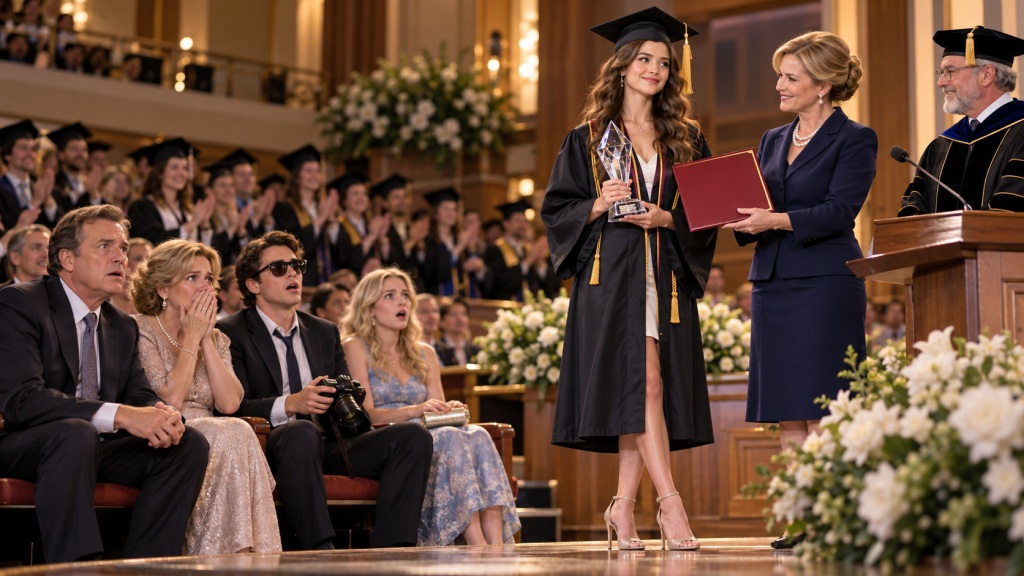
Dad stood halfway from his chair. “What is it?” I looked directly at him. “Something you should probably read somewhere private.” The auditorium had already given my family one shock. I was not going to turn graduation into a public trial.
That day belonged to hundreds of students.
Not just us.
Professor Sterling nodded and tucked the envelope beneath his folder.
Then Dr. Vance stepped closer.
“Congratulations, Chloe.”
“Thank you.”
She squeezed my hand.
Quietly, so the microphone would not catch it, she said:
“Breathe.”
I almost laughed.
“I’m trying.”
“You’ve been trying for four years.”
“Today you’re allowed to enjoy something.”
That nearly made me cry.
Not Stanford.
Not the scholarship.
Permission.
I had spent so many years turning joy into something that needed to be defended that I had forgotten it could simply be felt.
I walked back toward my seat.
The applause followed me.
My family stared.
Julian had finally retrieved his camera.
He held it against his chest instead of taking pictures.
Lily looked at me as though I had become a stranger.
Mom’s eyes were full of tears.
Dad looked furious.
Not proud.
Furious.
That told me more than the applause ever could.
I sat.
The student beside me whispered:
“You’re going to Stanford Medical School?”
I nodded.
“Apparently.”
She laughed.
“Apparently?”
“It still doesn’t sound real.”
Behind me, Dad hissed:
“Six months?”
I looked forward.
“Not now.”
“You hid this for six months?”
“Dad.”
My voice stayed calm.
“I’m graduating.”
He leaned back.
I could practically feel his anger burning through the back of my gown.
Ten minutes earlier, he had believed he was finishing his obligation to a disappointing daughter.
Now he had discovered that while he was calling me a failure, people he considered important had been calling me exceptional.
That difference mattered to him.
It mattered far too much.
The ceremony continued.
Names.
Applause.
Degrees.
Families shouting from the balcony.
When Julian had graduated from college six years earlier, Dad had stood and yelled so loudly security asked him to sit down.
When my name was called for my actual degree, my father clapped.
Too hard.
Too loudly.
As though volume could rewrite the first half of the afternoon.
Mom cried.
Lily screamed my name.
Julian took twelve photographs.
I smiled for none of them.
Afterward, the lobby became a river of black gowns and flowers.
People hugged me.
Professor Sterling hugged me.
My lab partners squeezed me so hard the crystal award nearly slipped from my hands.
Mrs. Hernandez from the café had come.
I hadn’t known.
She pushed through the crowd wearing the red blouse she saved for church.
“Oh, mi niña.”
She grabbed my face with both hands.
“You did it.”
I burst into tears.
That embarrassed me more than anything.
I had stayed dry-eyed through Stanford.
Through the award.
Through my father’s face.
Then the woman who had slipped free sandwiches into my backpack when she realized I was skipping dinner said she was proud of me, and I fell apart.
Mrs. Hernandez kissed my forehead.
“Cry.”
“I’m ruining your makeup.”
“I don’t care.”
“You don’t wear makeup.”
“Exactly.”
I laughed through tears.
Behind her, my family stood watching.
That was the picture I remember most.
Not my father beneath the chandelier.
Not Julian dropping his camera.
My mother watching another woman hold me like a daughter.
Something in her face changed.
Maybe she understood, for the first time, that all the care she assumed I did not need had not disappeared.
Other people had simply provided it.
Professor Sterling approached.
The envelope was still in his hand.
My stomach tightened.
Dad noticed.
“Now.”
he said.
Professor Sterling’s eyebrows lifted.
Dad corrected himself.
“Please.”
I wiped my eyes.
“Not here.”
Mom glanced around nervously.
“Chloe, people are staring.”
I almost laughed.
For twenty-two years, appearing respectable had been more urgent in our family than being kind.
“Then let’s go outside.”
We crossed the courtyard.
Graduates posed beside fountains.
Parents carried bouquets.
The June sunlight was too bright.
I led everyone toward a quiet garden behind the science building.
Dr. Vance came too.
Not because she belonged in the family discussion.
Because I had asked her to.
Six months earlier.
When I told her everything.
I wanted one person there who knew the full story before my family began rewriting it.
Professor Sterling handed the envelope to Dad.
Dad looked at me.
“What is this?”
“Open it.”
Mom stood beside him.
Julian hovered slightly behind.
Lily looked frightened.
Dad tore the envelope.
Inside were fourteen pages.
The first was a letter from Margaret Ellison.
Attorney.
Trust administrator.
My father’s face went pale.
Mom whispered:
“No.”
Julian frowned.
“What?”
Dad read silently.
Then looked at me.
“Where did you get this?”
I laughed softly.
“That’s your first question?”
“Chloe.”
“The trust administrator contacted me.”
Mom grabbed the papers.
“She wasn’t supposed to—”
She stopped.
Too late.
I stared.
“Wasn’t supposed to what?”
Mom’s mouth opened.
Closed.
Julian stepped closer.
“What trust?”
I looked at him.
“Grandma Evelyn’s.”
He frowned.
“What about it?”
Professor Sterling quietly stepped away.
Dr. Vance remained.
Dad’s eyes narrowed.
“This has nothing to do with graduation.”
“No.”
I agreed.
“It has to do with every time you told me you were wasting money on my education.”
Mom looked around.
“Can we please do this at home?”
“I don’t live at home.”
“You know what I mean.”
“No.”
I looked at Dad.
“Read page three.”
He did not move.
So I said it.
“Grandma Evelyn established education accounts for all three of us.”
Lily’s head snapped up.
“All three?”
“Yes.”
Julian frowned.
“I knew about mine.”
Of course he did.
I looked at Lily.
“Did you?”
She slowly shook her head.
Dad said:
“Those accounts were ours to manage.”
“No.”
I said.
“They were Grandma’s money to be used for our education.”
“That is managing.”
Dr. Vance’s voice entered calmly.
“Misrepresentation is not management.”
Dad turned.
“This is a family matter.”
Dr. Vance nodded.
“It is.”
Then she looked at me.
“That means Chloe decides whether I remain.”
I said:
“Stay.”
Dad hated that.
Good.
Mom clutched the letter.
“What exactly have you told these people?”
There it was.
Not:
What happened?
What did we do?
What do you know?
What have you told these people?
I answered:
“The truth.”
Mom looked wounded.
As though truth were a betrayal.
I continued.
“When Grandma died, she left education funds.”
“Julian received distributions from his.”
“I was supposed to receive distributions from mine.”
Dad snapped:
“You did.”
“Freshman year.”
“Yes.”
“Part of sophomore year.”
“Yes.”
“And then you told me the account was empty.”
Dad said nothing.
Julian looked between us.
“It wasn’t?”
I shook my head.
“No.”
I turned to Dad.
“How much was left when you told me there was nothing?”
He looked away.
I answered for him.
“Forty-six thousand eight hundred dollars.”
Lily gasped.
Julian whispered:
“What?”
Dad’s voice hardened.
“It was family money.”
“No.”
“It was held for education.”
“Yes.”
“Family education.”
I stared at him.
“That is not what Grandma’s documents say.”
Mom stepped in.
“You were already receiving scholarships.”
“Small ones.”
“You had grants.”
“Some.”
“You were working.”
“Thirty-two hours a week.”
“You managed.”
There it was.
The defense.
You survived what we did.
Therefore what we did was acceptable.
I asked:
“Where did the $46,800 go?”
Silence.
Julian looked at Dad.
“Where did it go?”
Dad’s jaw tightened.
“Expenses.”
“What expenses?”
I asked.
Mom began crying.
That was when I knew Julian did not know all of it.
I almost felt sorry for him.
Almost.
Dad finally said:
“Your brother needed help.”
Julian went still.
“No.”
Dad looked at him.
“Julian—”
“What did you use it for?”
No answer.
“Dad.”
Julian’s voice changed.
“What did you use Chloe’s education money for?”
Dad snapped:
“It wasn’t Chloe’s money.”
Dr. Vance said nothing.
She did not need to.
I pulled another sheet from my graduation folder.
I had brought my own copy.
“Page seven.”
Dad’s name.
Mom’s.
Dates.
Transfers.
$12,400 toward Julian’s living expenses during law school.
$9,800 toward the BMW down payment.
Julian went white.
Another $6,300 for bar-preparation courses he never completed because he had withdrawn before finishing his second year.
Then $4,900 toward credit-card debt.
The rest had been moved into a general family account and spent over time.
Julian stared at the paper.
“My car?”
Dad said:
“You needed transportation.”
“You told me that was my graduation gift.”
“It was.”
“With her money?”
“With family money.”
Julian looked at me.
For once, he had no joke.
No sunglasses.
No smirk.
Just shame.
“I didn’t know.”
I believed him.
That was another painful thing.
It would have been easier if he had known.
Mom whispered:
“Chloe, you have to understand.”
I turned.
“Then help me.”
She wiped her face.
“Julian had gotten into Stanford Law.”
“He had a clear path.”
I felt something inside me go quiet.
There it was.
Not financial necessity.
Value judgment.
Mom continued.
“Your father thought investing in him made sense.”
“And me?”
“You kept changing what you wanted.”
“I changed from biochemistry to molecular biology.”
“You talked about research.”
“Yes.”
“You talked about medical school.”
“Yes.”
“None of it was guaranteed.”
I laughed softly.
“Neither was law school.”
Nobody looked at Julian.
That silence said enough.
Dad finally spoke.
“I thought you would burn out.”
I stared at him.
“Why?”
“You were working constantly.”
“Because you stopped paying.”
He flinched.
“You were exhausted.”
“Because you stopped paying.”
“You were always anxious.”
“Because you stopped paying.”
Mom cried harder.
Dad’s face flushed.
“You don’t get to reduce everything to money.”
I almost laughed.
“You whispered that you were done wasting money on me fifteen minutes before I was announced as a Stanford medical student.”
His face changed.
He had not realized I heard.
Mom looked at him.
“You said that?”
Julian looked down.
Lily whispered:
“Dad.”
Dad’s confidence cracked.
“I was frustrated.”
“With what?”
He looked at the ground.
“With you.”
“Why?”
“You never told us anything.”
I stared at him.
“You stopped asking.”
“That is not the same.”
“No.”
I agreed.
“It isn’t.”
I held the crystal award against my gown.
“You want to know why I stopped telling you things?”
“Because when I got a ninety-eight on my organic chemistry final, you asked why it wasn’t one hundred.”
“When I got my first lab position, Mom asked whether it paid.”
“When my professor invited me onto the protein-folding project, Julian laughed and asked whether I was folding laundry.”
Julian closed his eyes.
“I remember.”
“When I told you I was considering medical school, Dad said I was chasing another expensive fantasy.”
Dad looked away.
“So I stopped handing you things you could crush.”
Nobody spoke.
I pointed toward the letter.
“That envelope isn’t revenge.”
“I did not arrange for Stanford to stand on stage so I could humiliate you.”
“I asked Professor Sterling to hold that because I knew the minute you heard ‘Stanford,’ you would suddenly want to turn today into proof that you had supported me.”
Dad snapped:
“We did support you.”
“Yes.”
I said.
“Until supporting me became inconvenient.”
Mom whispered:
“That isn’t fair.”
“Neither was using Grandma’s money for Julian’s BMW.”
Julian flinched.
“Stop.”
We all looked at him.
He turned to Dad.
“Stop calling it family money.”
Dad stared.
Julian’s voice shook.
“You told me you had saved for the car.”
“I thought you had.”
Dad said:
“I did what I thought was best.”
“For me.”
“Yes.”
Julian looked at me.
“Not for her.”
Dad’s face hardened.
“You benefited from it.”
“I didn’t know.”
“You enjoyed the car.”
“That is not the point.”
It was the first time in my life Julian had defended me against Dad.
I hated how badly I had wanted it.
I hated that getting it hurt.
Dad shoved the pages back into the envelope.
“So what?”
he asked.
“What do you want?”
The question was almost angry.
As though every truth needed an invoice.
“I don’t know.”
“You hired an attorney.”
“The trust administrator has an attorney.”
“What do you want from us?”
“I want you to stop lying.”
His face went rigid.
“I have never lied about loving you.”
That sentence surprised me.
I looked at him.
“I didn’t accuse you of not loving me.”
“Then what are we doing?”
“We are talking about what your love looked like.”
That silenced him.
Because love had become my family’s favorite defense.
We did it because we love you.
We worried because we love you.
We pushed Julian because we love him.
We expected more because we love you.
Love became a word that arrived after every injury carrying a mop.
I shook my head.
“You can love someone and still treat them badly.”
Dr. Vance glanced at me.
I had heard her say that six months earlier.
Now the words belonged to me.
Professor Sterling returned quietly.
“Chloe.”
I looked at him.
“The reception starts in ten minutes.”
I almost laughed.
Of course.
Cupcakes and champagne while my family discovered financial misconduct.
Graduation had impeccable timing.
I handed Dad the envelope.
“Margaret Ellison’s contact information is inside.”
“What happens now?”
I looked at him.
“You explain the transfers.”
“To her?”
“Yes.”
“And then?”
“If the trust requires repayment, you repay it.”
Mom gasped.
“With what money?”
I stared at her.
The question came out before I could soften it.
“The same way I paid tuition.”
Silence.
Mom covered her mouth.
I regretted the sharpness immediately.
Not the truth.
The pleasure I had taken in delivering it.
That scared me.
I did not want their cruelty to become my personality.
I took a breath.
“I’m not trying to destroy you.”
Mom cried.
“It feels like it.”
“I know.”
I looked at the envelope.
“But consequences feel different when you’re used to somebody else carrying them.”
Nobody answered.
I turned toward Lily.
She was still staring at the papers.
“You okay?”
“No.”
Fair.
She whispered:
“Do I have one?”
“One what?”
“A trust.”
I looked at Mom and Dad.
Neither answered.
That was answer enough.
Lily’s face changed.
“How much?”
Dad sighed.
“We’ll discuss it at home.”
“No.”
Lily’s voice suddenly became firm.
“How much?”
Mom whispered:
“About fifty-one thousand.”
Lily stared.
“Were you going to tell me?”
“You’re nineteen.”
“So?”
“We were waiting.”
“For what?”
Dad snapped:
“Lily.”
She stepped backward.
“No.”
Her eyes filled.
“You told me I couldn’t study architecture because it would put me in too much debt.”
Dad looked away.
“You told me to go to community college.”
“There is nothing wrong with community college.”
“I know.”
Lily shouted.
“That isn’t the point.”
Her whole body shook.
“You knew there was money.”
Mom reached for her.
Lily pulled away.
That was when I understood the betrayal was not over.
I had simply reached the part of the story where the pattern became visible to the next daughter.
Julian muttered:
“Dad, what the hell?”
Dad exploded.
“Enough!”
People across the courtyard turned.
Dad lowered his voice.
“I made decisions.”
“Yes.”
I said.
“You did.”
“I was trying to keep this family stable.”
“No.”
Julian said.
“You were trying to decide which kid was worth betting on.”
That landed harder than anything I could have said.
Dad stared at his son.
The masterpiece.
The favorite.
The child he had financed at everyone else’s expense.
Julian took off his sunglasses.
For the first time all day, he looked twenty-eight.
Not glamorous.
Not privileged.
Tired.
“I dropped out.”
Dad flinched.
Julian laughed bitterly.
“Say it.”
Mom whispered:
“Julian.”
“No.”
He turned toward Chloe—toward me.
“I dropped out of law school after second year.”
“I know.”
His head snapped toward me.
“You know?”
“I saw your LinkedIn disappear.”
That almost made him laugh.
“You never asked.”
“You never told me.”
“Fair.”
He looked at Dad.
“But he kept telling everybody I was ‘taking time to find the right specialization.’”
Dad snapped:
“I was protecting you.”
“There it is.”
I whispered.
Everyone looked at me.
The same word.
Protecting.
Protecting Julian from embarrassment.
Protecting Mom from money shame.
Protecting Dad from admitting the business was struggling.
Protecting the family image.
Meanwhile I had been protected from nothing.
Maybe because they believed I could survive it.
Maybe because they simply believed I mattered less.
The distinction no longer changed the result.
I looked at Dr. Vance.
“I want to leave.”
She nodded.
Mom panicked.
“Chloe, we haven’t taken pictures.”
That nearly broke me.
Pictures.
Of course.
I looked at her.
“You wanted the ceremony done before four.”
Her face collapsed.
“I didn’t know.”
Exactly.
I smiled sadly.
“I did.”
Then I walked away.
Lily followed.
Julian hesitated.
Then followed too.
That surprised everyone.
We went to the reception.
Just the three of us at first.
My siblings.
For years, Dad had arranged us like a ranking.
Julian first.
Lily somewhere in the middle because she was agreeable.
Me last.
Standing there with cheap champagne in plastic cups, none of us looked like the roles anymore.
Julian held out his cup.
“To Stanford.”
I looked at him.
“You don’t have to.”
“I know.”
“That’s why I’m doing it.”
Lily raised hers.
“To Chloe.”
I swallowed.
“No.”
They frowned.
I lifted my glass.
“To nobody being the family investment strategy anymore.”
Julian laughed.
Lily cried.
Then we drank.
Professor Sterling brought me cake.
Mrs. Hernandez took photographs.
Dr. Vance talked with my lab partners.
My parents did not enter the reception.
Later I learned Dad sat in the car for forty minutes.
Mom cried in the passenger seat.
I did not go after them.
That was new.
Six months earlier, I would have.
I would have felt their distress from across campus and abandoned my own celebration to regulate theirs.
Not that day.
That day I stayed.
I ate cake.
I laughed.
I took photographs.
I held the crystal award until my wrist hurt.
And for two hours, I let my life be mine.
The trust issue became uglier before it became cleaner.
Margaret Ellison had administered Grandma Evelyn’s education trust for sixteen years.
She was seventy-one, terrifyingly organized, and completely unimpressed by my father.
At our first meeting she placed three binders on the table.
One for Julian.
One for me.
One for Lily.
She turned mine around.
“Your grandmother was very specific.”
I read the language.
Education.
Tuition.
Books.
Required fees.
Housing directly related to education.
Reasonable living expenses while enrolled.
No preference among grandchildren.
No use for parental obligations unrelated to the beneficiary.
I closed my eyes.
“Julian’s car?”
“Not allowable under your subaccount.”
“And bar prep?”
“Not from yours.”
“What happened?”
Margaret’s jaw tightened.
“Your father submitted reimbursement requests using your tuition statements.”
I stared.
“He claimed he paid them?”
“Yes.”
“But I paid them.”
“In several instances, yes.”
My stomach turned.
“How did nobody catch that?”
“Because the trust reimbursed the parent who certified payment.”
“You were legally an adult, but your father had historically managed the paperwork.”
“And I trusted certifications I should have verified more aggressively.”
She did not hide behind procedure.
I respected that.
“Why did you contact me?”
“When you turned twenty-one, annual statements were required to be sent directly to you.”
“They went to my parents’ address.”
“They were returned.”
“Then I searched for updated contact information.”
She found my university email.
The first message had landed in spam.
The second did not.
That was how I learned the account existed.
Six months before graduation.
Three days after Stanford accepted me.
Two secrets arriving in the same week.
One opened a future.
One rewrote the past.
I asked:
“Can my parents go to jail?”
Margaret studied me.
“That depends on facts, intent, referrals, and decisions beyond my authority.”
“I’m not asking you for a promise.”
“Good.”
“What happens financially?”
“Restitution to the trust.”
“How much?”
“Preliminary amount: $46,800, plus some lost growth.”
I laughed without humor.
“Of course there’s lost growth.”
“There is always lost growth.”
I liked Margaret.
She made betrayal sound like accounting.
Sometimes that helps.
Dad hired a lawyer.
So did the trust.
For months, my parents accused nobody publicly.
That was probably their attorney’s advice.
Privately, Mom called me twice.
I answered once.
She said:
“We may have to sell Dad’s boat.”
I almost laughed.
I had forgotten Dad owned a boat.
Of course he did.
I had worked café doubles while my father owned a boat.
Mom heard my silence.
“Chloe.”
“What do you want me to say?”
“I want you to understand this is affecting us.”
I stared at the wall.
“Mom.”
“Yes?”
“I understand perfectly.”
She cried.
“I don’t think you do.”
“No.”
My voice stayed calm.
“You don’t think consequences count unless they happen to you.”
She hung up.
We did not speak for three months.
The trust matter settled without a criminal case.
My parents agreed to repay $52,300 including an agreed amount for lost growth and administrative costs.
Dad sold the boat.
Mom sold jewelry she rarely wore.
They refinanced part of their home equity.
Julian voluntarily paid $11,000 toward the restitution.
I told him he did not have to.
He said:
“I know.”
That was why I let him.
He sold the BMW.
The photograph of him standing beside it had been Dad’s phone wallpaper for years.
When Dad changed the wallpaper, Julian laughed.
“What is it now?”
I asked.
“His dog.”
“Probably healthier.”
He laughed.
Our relationship became strange.
Then better.
Julian eventually told me something I never knew.
Dad had used me against him too.
Not financially.
Emotionally.
Whenever Julian struggled at Stanford, Dad said:
“Your sister would kill for an opportunity like this.”
When Julian failed a class:
“Chloe never needs reminding to study.”
When he dropped out:
“Do you know how humiliating it is that the child I invested in is quitting while your sister works three jobs?”
I stared at him.
“He said that?”
Julian nodded.
“You were the failure when he talked to you.”
“I was the failure when he talked to me.”
That hurt in a completely different direction.
“He still funded you.”
“I know.”
“I’m not saying it was equal.”
“Good.”
“It wasn’t.”
He looked down.
“But Dad needed us competing.”
“Why?”
“I don’t know.”
We sat in silence.
Then I said:
“Maybe if one of us was winning, he didn’t have to ask whether he was parenting well.”
Julian looked at me.
“That sounded like therapy.”
“It was expensive.”
Stanford required a different kind of strength than undergrad.
During my first month of medical school, I discovered something humiliating.
Being admitted did not cure me.
I still heard Dad’s voice.
Failure.
Waste.
Too much.
Not enough.
Every time I scored below the class average, I panicked.
Every time another student answered faster, I imagined the admissions committee calling to say they had made a clerical error.
I slept four hours a night.
Then five.
Then sometimes not at all.
Dr. Vance noticed.
Of course she did.
One evening she found me in a study room surrounded by notes.
“You look terrible.”
“Thank you.”
“I mean it clinically.”
“Even better.”
She sat across from me.
“When did you sleep?”
“Recently.”
“Chloe.”
“Five hours yesterday.”
“And before that?”
I said nothing.
She closed my textbook.
I reached for it.
She put her hand on top.
“No.”
“I have an exam.”
“You also have a nervous system.”
“I’m aware.”
“You study one.”
I glared.
She smiled.
Then asked:
“Who are you trying to beat?”
I looked away.
“Nobody.”
“That’s a lie.”
I hated mentors.
She continued.
“Your classmates?”
“No.”
“Your brother?”
“No.”
“Your father?”
Silence.
There it was.
I whispered:
“I don’t ever want them to be right.”
Dr. Vance leaned back.
“About what?”
“That I’m a failure.”
She looked almost sad.
“Chloe.”
“What?”
“You got into medical school and somehow converted that into a new opportunity to prove you belong.”
I stared at the table.
She continued.
“That game has no finish line.”
“I know.”
“No.”
“You understand the sentence.”
“You don’t believe it yet.”
That was true.
Healing was annoyingly repetitive.
I started therapy.
Not because Stanford broke me.
Because Stanford removed the fantasy that achievement would fix everything.
It hadn’t.
I could stand inside one of the best medical schools in the country and still become sixteen when Dad sounded disappointed.
That was not ambition.
That was injury wearing a white coat.
Therapy taught me something I resisted for almost a year:
I had built an identity around being the child who needed nothing.
No money.
No praise.
No rescue.
No attention.
That had saved me.
Then it trapped me.
People who never ask for help eventually become surrounded by people who believe they do not need any.
I started asking.
Classmates shared notes.
A friend brought soup when I had the flu.
I called Julian once after a brutal exam and said:
“I think I failed.”
He said:
“Want me to tell you about actual academic failure?”
I laughed until I cried.
I passed.
Barely.
He mailed me a card.
WELCOME TO MEDIOCRITY. WE HAVE SNACKS.
I kept it.
Lily changed too.
After graduation, she demanded access to her trust statements.
Dad resisted for exactly two days.
Then Margaret intervened.
Lily’s account remained mostly intact.
$51,200.
She used part of it for architecture school.
Not because I told her to.
Because she chose it after comparing programs, costs and scholarships.
Dad hated the tuition.
He did not control it.
That distinction became the beginning of their new relationship.
Mom called me during my second year of medical school.
We had spoken only occasionally.
Birthday texts.
Christmas.
Nothing deep.
She said:
“I’m in Palo Alto.”
I stood in the hospital hallway.
“What?”
“I came to see you.”
My stomach tightened.
“Why didn’t you ask?”
“I thought you’d say no.”
“I might have.”
Silence.
Then:
“I know.”
That answer surprised me.
I told her to meet me at a café near campus.
Public.
Neutral.
The family had taught me the usefulness of neutral tables.
Mom looked older.
Not dramatically.
Just enough.
She wore a cardigan I remembered from high school.
No jewelry.
She stirred her coffee for almost a minute.
Then said:
“I owe you an apology.”
I waited.
Specific apologies.
I had learned that lesson from another life.
She began.
“I treated your independence like evidence you needed less love.”
My throat tightened.
“I told myself Julian needed us more.”
“He did.”
“In some ways.”
“Yes.”
“But I turned that into an excuse.”
She looked down.
“When you did well, I thought you were fine.”
“When you struggled, I thought you were proving your father right.”
“I never gave you a safe answer.”
That was true.
If I succeeded, I did not need them.
If I failed, I disappointed them.
No path led to care.
Mom continued.
“I knew some of the trust money went to Julian.”
My chest hardened.
“How much did you know?”
“Not all the details.”
“How much?”
She swallowed.
“I knew about the car.”
I looked out the window.
That hurt more than when I first learned it.
Dad’s choices were predictable.
Mom had always presented herself as helpless beside him.
Apparently she had not been helpless.
She had simply agreed.
“Why?”
“He was so depressed after leaving law school.”
“He hadn’t left yet when you bought the car.”
She flinched.
“You’re right.”
“Why?”
Tears filled her eyes.
“Because your father said Julian needed confidence.”
“And I didn’t?”
Mom cried.
“I thought you already had it.”
I almost laughed.
That was the tragedy.
They mistook functioning for confidence.
Silence for strength.
Distance for immunity.
I whispered:
“I was terrified all the time.”
“I know that now.”
“No.”
I shook my head.
“You know the sentence now.”
“You didn’t know me then.”
Mom accepted that.
“I want to.”
I looked at her.
“What?”
“Know you now.”
That was harder than an apology.
Because it required a future.
I did not forgive everything at that table.
I did agree to another coffee.
Then another.
She visited again three months later.
With permission.
Progress.
Dad took longer.
Three years.
He sent birthday cards.
I responded with thank-you texts.
He called.
Sometimes I answered.
Most calls lasted under four minutes.
He never apologized properly.
He said things like:
“I wish everything hadn’t become so complicated.”
Or:
“We all made mistakes.”
I hated that one.
We all made mistakes is often what the person who made the largest mistake says when fractions become inconvenient.
Then, during my final year of medical school, Dad mailed a letter.
Actual paper.
Three pages.
The first line:
You were right that I only learned how impressive you were when important people told me.
I stopped reading.
Then started again.
That is an ugly thing for a father to admit.
Yes.
I thought Julian’s path made sense because I understood it. Law. Prestige. Salary.
I did not understand laboratories, research, or why anybody would spend twelve hours studying proteins.
I laughed weakly.
Instead of admitting I did not understand your dream, I called it unrealistic.
That line mattered.
When you kept succeeding without my approval, I felt less important in your life.
I stared.
Finally.
Truth.
I reacted by criticizing you more.
That was not discipline.
It was insecurity.
I sat on the floor.
Dad had never used that word about himself.
Ever.
The day of your graduation, I said we were done wasting money on you.
My eyes filled.
I knew you heard me when you looked toward us after receiving the award.
He had known.
I have replayed your face for three years.
I am sorry.
No explanation after.
No “but.”
I kept reading.
I also stole from the future your grandmother tried to give you.
There it was.
No family money.
No management language.
I used money intended for your education because I decided Julian’s future was more valuable at that moment.
That was wrong.
My chest hurt.
I do not expect Stanford, your medical degree, or anything else you accomplish to make me feel better about what I did.
Your success does not retroactively make my treatment of you worse or better.
I stared at that sentence.
He had learned something.
Even if you had failed every class, I would still have owed you respect.
That broke me.
Because beneath every triumph story is a dangerous temptation.
To think the mistreated person earns justice by becoming extraordinary.
No.
If I had become a cashier forever, Dad would still have been wrong.
If I had never published research, Dad would still have been wrong.
If Stanford had rejected me, Dad would still have been wrong.
My worth was not the plot twist.
His failure to see it was.
The final paragraph said:
If you ever want to try again, I would like to know my daughter without requiring her to impress me first.
I cried.
Then I called him.
He answered on the second ring.
“Chloe?”
“Yes.”
Silence.
“I got your letter.”
“Okay.”
“You actually wrote a good apology.”
He laughed once.
“I had professional help.”
“Mom?”
“Therapist.”
I smiled.
“Even better.”
Then he asked:
“Are you graduating?”
“In three months.”
“I know.”
Of course he did.
“Are we invited?”
I closed my eyes.
There it was.
A choice.
Mine.
“Yes.”
His breath caught.
“But.”
“Okay.”
“No speeches.”
“No surprise parties.”
“No social-media posts about how you always knew I could do it.”
He laughed softly.
“Fair.”
“And Dad?”
“Yes?”
“If you come, you come as my father.”
“Not as the man who produced a doctor.”
Silence.
Then:
“I understand.”
He did.
This time.
Medical-school graduation felt completely different from college.
No secret Stanford folder.
No trapdoor.
No envelope.
My family knew.
Mom arrived early.
Dad carried flowers.
Normal flowers.
Not an enormous arrangement designed to compete with everyone else.
Lily came from architecture school.
Julian came wearing a suit that actually fit and no sunglasses.
He had returned to school eventually.
Not Stanford Law.
He finished a master’s degree in nonprofit management.
Dad struggled with that at first.
Then learned to shut up.
A useful late-life skill.
When my name was called, Dad stood.
He clapped.
Not loudly enough to make himself part of the ceremony.
Just enough.
Afterward, he hugged me.
“Congratulations, Doctor.”
I stiffened.
He felt it.
Then corrected himself.
“Congratulations, Chloe.”
That was better.
I hugged him back.
Not because everything was healed.
Because enough had changed for contact to stop hurting.
My residency was brutal.
Neurology.
Long hours.
Hard cases.
Families begging for answers medicine could not always provide.
The protein-folding research that began in college followed me.
Not as destiny.
As curiosity.
Eventually I entered a physician-scientist track focused on neurodegenerative disease.
The first time my name appeared on a major paper, Mom called.
“I read it.”
I laughed.
“No, you didn’t.”
“I read the title.”
“That’s more believable.”
She tried the abstract.
Gave up after three sentences.
We laughed.
That laugh meant more to me than the crystal award.
Dad never fully understood the science.
Eventually he stopped pretending.
He would call and say:
“Tell me what you’re working on like I’m twelve.”
I did.
Sometimes he actually understood.
Sometimes he said:
“That sounds terrible.”
Also fair.
Julian and I became close.
Not inseparable.
Real.
He once admitted:
“I used to like being the favorite.”
I looked at him.
“Obviously.”
“No.”
He smiled sadly.
“I mean I knew you were getting less.”
“I didn’t know the money stuff.”
“But I knew Dad laughed more at my jokes.”
“I knew Mom rearranged dinner for me.”
“I knew you got blamed.”
“And I liked that it wasn’t me.”
I appreciated the honesty.
“Why tell me?”
“Because apologizing only for the part I didn’t know feels convenient.”
That was one of the most mature things anyone in my family had ever said.
I hugged him.
Then stole his fries.
Balance.
Lily became an architect.
A good one.
Not famous.
Not supposed to be.
She designed schools, libraries and affordable housing.
Dad once told a relative:
“She could make more in commercial development.”
Mom kicked him under the table.
He corrected himself.
“She likes the work.”
We all stared.
He shrugged.
“I’m learning.”
He was.
Slowly.
At thirty-eight, I received another award.
Bigger than the crystal one.
There was a ceremony.
Dr. Vance attended.
Professor Sterling watched online.
My parents came.
So did Julian and Lily.
Before my name was announced, Dad leaned toward Mom.
I saw him whisper something.
For one absurd second, my body went back sixteen years.
Wrinkled graduation gown.
Pinching heels.
We’re finally done wasting money on this failure.
Then Mom smiled.
Later I asked what he had said.
Dad looked embarrassed.
“Nothing important.”
Mom answered for him.
“He said, ‘She did all this and we almost convinced her she couldn’t.’”
Dad looked down.
I did not know what to say.
So I said the truth.
“You didn’t almost convince me.”
He looked up.
“You did convince me.”
His face fell.
“For a while.”
I touched his hand.
“But I learned different.”
That mattered.
Not:
You failed to hurt me.
They had hurt me.
Deeply.
Pretending otherwise would turn resilience into another performance.
The victory was not that their cruelty bounced off.
It didn’t.
The victory was that damage was not destiny.
Dad died when I was forty-three.
Heart attack.
Unexpected.
Mom called at 5:12 in the morning.
For the rest of my life, that time would have weight.
I flew home.
At the funeral, people told me my father had been proud of me.
I believed them.
That was complicated.
He had eventually become proud.
Real pride.
Quieter.
Less possessive.
I was grateful.
But when one man said:
“Your dad always knew you’d become a doctor,”
I corrected him.
Gently.
“No.”
He looked startled.
“He didn’t.”
Mom heard.
I expected her to intervene.
Instead she said:
“He learned.”
That was perfect.
Not sainthood after death.
Truth.
Dad had learned.
Late.
Imperfectly.
Enough to change the final years.
Not enough to rewrite the first ones.
After the funeral, Mom gave me a small box from Dad’s desk.
Inside was the crystal award from my college graduation.
I stared.
“I thought this was in my storage unit.”
Mom smiled.
“You gave it to him.”
I had forgotten.
Years earlier, after his apology.
He kept it on his desk.
Underneath it was a folded index card.
Dad’s handwriting.
This is not proof Chloe became worthy.
My throat closed.
Next line:
It is proof she already was, and I was late to notice.
I sat down.
Cried.
Mom sat beside me.
Neither of us spoke.
Some apologies arrive while people are alive.
Some leave an echo.
Years later, when students came into my lab terrified they were not good enough, I never told them my entire family story.
That would have been unbearable.
But I told them one thing.
“Do not confuse being underestimated with being incapable.”
Sometimes I added:
“And do not build your entire life around proving somebody wrong.”
That second part was harder.
Revenge can get you through exams.
It cannot build a peaceful life.
I learned that slowly.
My proudest moment was not Stanford.
Not medical school.
Not publication.
Not the award.
It happened when a first-generation college student named Maya sat in my office and said:
“I think I have to drop out.”
Money.
Family.
Work.
Same old ghosts wearing new names.
I asked:
“What do you need?”
Not:
Why didn’t you plan better?
Not:
Are you sure you belong here?
Not:
Maybe this path isn’t realistic.
What do you need?
We found emergency funding.
Adjusted her research schedule.
Connected her with counseling.
She stayed.
Years later, she became a physician.
At her graduation, she mailed me a photograph.
On the back:
Thank you for not making me earn the right to be helped.
I cried harder over that sentence than any award I ever received.
Because finally I understood what I had wanted all along.
Not applause.
Not Stanford.
Not the cardinal-red folder.
Not for my father to watch a dean announce I mattered.
I wanted someone in my family to believe I was worth helping before there was evidence it would pay off.
That was the wound.
And that was why success alone could never heal it.
Success had exposed the lie.
Healing required something quieter.
Boundaries.
Honesty.
Apologies without excuses.
Time.
People changing repeatedly instead of dramatically.
Me learning to receive love without presenting credentials first.
The cardinal-red folder stayed in my desk for years.
Eventually the color faded slightly at the edges.
The crystal award gathered dust.
The paper from Grandma Evelyn’s trust stayed in a legal file until the matter was closed.
None of them became sacred.
Objects are witnesses.
They are not the life itself.
When I turned fifty, I found the Stanford acceptance letter while cleaning.
My daughter—yes, I eventually had one—picked it up.
“What’s this?”
“The letter that scared your grandparents half to death.”
She laughed.
“Why?”
“Long story.”
“Tell me.”
So I did.
Not the dramatic version.
The true one.
Grandpa favored Uncle Julian.
Grandma went along with things she should not have.
Money meant for me was misused.
I worked too much.
I hid Stanford because I was scared happiness would be mocked.
People apologized.
Some relationships healed.
Some never returned to what they had been.
My daughter listened.
Then asked:
“Were you a failure?”
I laughed.
“Frequently.”
She frowned.
“That’s not what I meant.”
“I know.”
I sat beside her.
“Yes.”
“I failed exams.”
“I failed experiments.”
“I failed to communicate.”
“I failed at relationships.”
“I failed to rest.”
“I once contaminated three weeks of cell cultures because I was distracted.”
She looked horrified.
“Was that bad?”
“Very.”
“But were you a failure?”
I smiled.
“No.”
“That’s different.”
She considered.
“Grandpa didn’t know the difference?”
“Not for a long time.”
She looked at the letter.
“Did you forgive him?”
“Yes.”
“Because he was sorry?”
“Partly.”
“Because he changed.”
“Mostly.”
Then she asked:
“Would you have forgiven him if you didn’t get into Stanford?”
That question stopped me.
I thought about twenty-two-year-old me.
The wrinkled gown.
The pinching heels.
The practiced smile.
The girl who believed the perfect announcement would finally reverse the family ranking.
“No.”
I said slowly.
“Back then, I don’t think I could have.”
“Why?”
“Because I still thought success was my evidence.”
“Evidence of what?”
“That I deserved better.”
My daughter frowned.
“But you already did.”
Exactly.
I kissed her forehead.
“You figured it out faster than I did.”
The last time I saw Dr. Vance before she retired, we had coffee on campus.
She was older.
Still terrifying.
Still dressed perfectly.
She asked:
“Do you remember graduation?”
“How could I forget?”
“You looked like you were going to faint.”
“I nearly did.”
She smiled.
“Your father looked worse.”
“He deserved it.”
She raised an eyebrow.
I laughed.
“Mostly.”
Then she asked:
“Do you regret not telling them about Stanford earlier?”
I thought.
“No.”
“Why?”
“Because secrecy protected something fragile.”
“For a while.”
She nodded.
“And now?”
“Now I wish I had learned earlier that joy shouldn’t need protection from family.”
Dr. Vance smiled.
“That sounds expensive.”
“Years of therapy.”
“Good investment.”
The best.
When I look back now, people sometimes want the satisfying version.
The version where my father whispered that I was a failure and thirty seconds later Stanford humiliated him in public.
That is a good story.
Clean.
Sharp.
Shareable.
But it is not the part that mattered most.
The important part came afterward.
When the applause stopped.
When nobody was holding a crystal award.
When Dad had to decide whether he could admit he had been wrong without demanding instant forgiveness.
When Mom had to decide whether protecting family peace was worth continuing to hide ugly truth.
When Julian had to examine the privilege he enjoyed without pretending he created it.
When Lily had to choose her own future without waiting for permission.
When I had to learn that becoming impressive was not the same thing as becoming free.
That took years.
There was no microphone.
No dean.
No dramatic folder.
Just ordinary conversations.
Some good.
Some awful.
Some unfinished.
That was where our family actually changed.
The day of my graduation, Dad thought a diploma would be the end of my story.
He believed he was finally done spending money on a daughter who had disappointed him.
He had no idea I was already carrying a future he had not funded, approved or even imagined.
Stanford shocked him.
The trust documents frightened him.
But neither was the lesson.
The lesson came much later.
I did not become worthy when Dr. Vance opened the cardinal-red folder.
I did not become worthy when the auditorium applauded.
I did not become worthy when my research was published.
I did not become worthy when patients began calling me Doctor.
I had been worthy at the dining table where nobody asked about molecular biology.
I had been worthy behind the café counter at five in the morning.
I had been worthy while crying in a stairwell after interviews.
I had been worthy when my parents decided my brother was the safer investment.
And if Stanford had rejected me, I still would have been worthy.
That is what my father finally learned.
That is what I finally learned.
And in the end, that mattered far more than making him drop his jaw in an auditorium.
THE END STORIES! THANK YOU FOR READING GOOD LUCK! ❤️
Related Posts