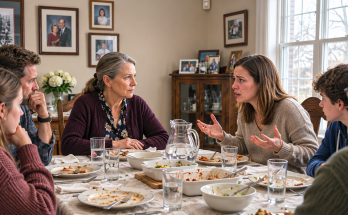
Julian stared at the envelope as if it contained something alive. “You found the invoices?” His voice was barely above a whisper. That question told me more than a denial ever could. I leaned back in my chair.
“So you knew they existed.” Chloe turned toward him so quickly her chair scraped the floor. “Julian.” He didn’t look at her. “Mom, please.” I had heard those two words from my son so many times that they had lost whatever power they once held.

Mom, please. Please lend us money. Please don’t make a big deal out of it. Please understand. Please forgive. Please wait. Please keep carrying what we should have learned to carry ourselves. I folded my hands on top of the notebook.
“No, Julian.”
My voice remained quiet.
“That phrase has financed enough of your life.”
Nobody at the table moved.
Marcus stood several feet away, his posture still professional, but his expression had changed.
He was not looking at me anymore.
He was looking at my son.
Not with anger.
With disappointment.
Somehow that was worse.
Marcus had known Julian since college.
He had given him summer work at the restaurant when money was tight.
He had once written Julian a recommendation letter.
He had toasted at his wedding.
And now Marcus was staring at him like he was trying to understand how the boy he remembered had become the man sitting at that table.
Chloe recovered first.
She always did.
“That company is legitimate.”
I turned toward her.
“Then explain the invoices.”
“They’re marketing materials.”
“Marketing materials bearing The Golden Vine’s legal business name?”
She hesitated.
Marcus answered before she could.
“And our tax identification number.”
The entire table went silent.
I looked at him.
“What?”
Marcus placed another page beside me.
“I had our bookkeeper pull everything after you called me last week.”
Chloe stared at me.
“You called him?”
“Yes.”
“How long have you been investigating us?”
I smiled faintly.
“Long enough to stop calling it curiosity.”
Marcus continued.
“The invoices use our logo, address, tax ID, and an electronic version of my signature.”
His jaw tightened.
“I never signed them.”
Chloe’s mother, Brenda, shifted in her seat.
“What exactly were the invoices for?”
Marcus looked at me.
I nodded.
He answered.
“Corporate dinners.”
“Private wine events.”
“Executive retreats.”
“Catering deposits.”
“Venue buyouts.”
He placed a stack of copies on the table.
“None of them happened here.”
Amanda picked up one page.
Her face changed.
“This says a sixty-person pharmaceutical dinner.”
Marcus nodded.
“No such dinner occurred.”
Another cousin grabbed another invoice.
“Twenty-eight thousand dollars?”
“Also false.”
Chloe reached across the table.
“Stop touching those.”
That was the wrong thing to say.
Every head turned toward her.
I watched her realize it.
Too late.
I asked:
“How much altogether?”
Marcus answered.
“From the copies we’ve found so far, just under one hundred eighty-six thousand dollars.”
Brenda gasped.
Julian closed his eyes.
Chloe’s father, who had been silent until then, finally spoke.
“Julian.”
My son looked at him.
“What the hell did you do?”
Chloe snapped,
“Don’t talk to him like that.”
Her father stared.
“Then you explain.”
She crossed her arms.
“It wasn’t theft.”
Marcus said quietly,
“I didn’t call it theft.”
That made her face go pale.
People reveal themselves when they start defending against accusations nobody has yet made.
I opened the navy notebook.
“Julian.”
He looked at me.
“What did Vance Event Holdings actually do?”
He rubbed both hands over his face.
“Corporate event coordination.”
“Whose events?”
“My employer’s clients.”
I knew Julian worked in business development for a medical software company.
He arranged executive meetings.
Client dinners.
Conferences.
I asked:
“And why did you create an outside company to handle expenses your employer already reimbursed?”
His eyes dropped.
Nobody breathed.
I continued.
“Because that is what these bank records suggest.”
Brenda looked confused.
“What records?”
I slid copies across the table.
I had spent nearly forty years auditing companies.
People imagine accounting as numbers.
It isn’t.
Numbers are only the footprints.
Accounting is learning who walked where.
Vance Event Holdings received deposits from Julian’s employer.
Then money moved out.
Some to real restaurants.
Some to hotels.
Some to legitimate vendors.
And some—
to Chloe.
To Julian.
To credit cards.
To luxury purchases.
And, most interestingly, back into the same checking account from which I had sent them emergency loans.
Chloe said,
“You had no right to look at our banking.”
I met her eyes.
“You sent me statements when you asked for money.”
Her face changed.
Of course she had forgotten.
People often forget the evidence they voluntarily provide when they assume the person helping them will never examine it.
I continued.
“I did not access anything illegally.”
“I reviewed records you gave me, transfers involving my money, and public business filings.”
Then I looked at Julian.
“And when I saw reimbursements from your employer marked against fake Golden Vine invoices, I called Marcus.”
Julian whispered,
“Mom.”
There it was again.
Smaller this time.
I asked:
“How much?”
He looked at Chloe.
She looked away.
“How much did you claim from your employer using false restaurant invoices?”
He did not answer.
I opened the notebook.
“One hundred twenty-seven thousand, six hundred dollars that I can document.”
Brenda’s glass slipped from her hand.
It did not break.
It rolled across the linen and spilled water into a plate.
Nobody moved to stop it.
Julian whispered,
“It wasn’t supposed to be that much.”
My chest tightened.
Not because I was surprised.
Because there are moments when a mother still waits for her child to become innocent.
Even when the evidence is already in front of her.
I asked:
“What was it supposed to be?”
He stared at the table.
“A temporary thing.”
I laughed softly.
“Fraud is often temporary right up until the first payment clears.”
His face reddened.
“I was going to pay it back.”
“With what?”
Silence.
Chloe stepped in.
“He did not steal one hundred twenty-seven thousand dollars.”
I looked at her.
“Then tell me the correct number.”
Her mouth opened.
Closed.
Marcus remained standing beside us.
I could feel the employees at the edge of the room pretending not to look.
This was no longer the humiliation dinner Chloe had planned.
The stage had turned.
I did not enjoy that as much as I thought I would.
There was satisfaction, yes.
I am not going to lie.
But beneath it was grief.
Because the person being exposed was still my son.
Julian finally spoke.
“It started with client dinners.”
I said nothing.
He continued.
“My company gave managers a budget.”
“We could book restaurants and submit receipts.”
“One night, a client canceled after the deadline.”
“We lost the deposit.”
“My boss told me it would come out of my quarterly incentive unless I found another account code.”
Chloe interrupted.
“You don’t have to explain this here.”
Julian looked at her.
“Yes.”
He did.
For the first time, I saw something between them that was not partnership.
Fear.
He continued.
“I created Vance Event Holdings because I thought it would make reimbursements easier.”
I asked,
“Why not use the real vendor?”
“Because the company procurement system had restrictions.”
“Which you wanted to bypass.”
“Yes.”
“And then?”
He swallowed.
“The first fake invoice was four thousand eight hundred.”
“What did you do with the reimbursement?”
“Paid the actual restaurant charge.”
“That sounds almost legitimate.”
“It wasn’t.”
At least he understood.
“Then?”
He looked at Chloe.
“She said we were doing all the work anyway.”
Chloe’s face hardened.
Julian continued.
“She said if my employer already budgeted fifteen thousand for an event and I could do it for ten, the difference was basically ours.”
Brenda whispered,
“Oh, Chloe.”
Her daughter snapped,
“Don’t.”
Julian kept talking.
At first, they pocketed small amounts.
Eight hundred.
Twelve hundred.
Two thousand.
Then Chloe designed invoice templates.
Used Golden Vine’s branding because Julian had legitimate receipts from previous dinners there.
Marcus closed his eyes.
That hurt him.
Julian continued.
“They looked authentic.”
Marcus opened his eyes.
“They were authentic enough because you stole the information from my invoices.”
Julian lowered his head.
“Yes.”
I asked:
“How did my money become involved?”
Chloe finally answered.
“Cash flow.”
I turned toward her.
She looked angry now.
Maybe anger felt safer than shame.
“The company reimbursed slowly.”
“Sometimes thirty days.”
“Sometimes sixty.”
“We needed money to pay the real vendors first.”
“So you borrowed from me.”
“Yes.”
“You told me it was rent.”
“Sometimes it was.”
“You told me it was car repairs.”
“We had car repairs.”
“You told me Julian needed twelve thousand dollars for a professional certification.”
She looked away.
I finished:
“That certification never existed.”
Silence.
“What was the twelve thousand actually for?”
Julian answered.
“A conference deposit.”
“Which your employer later reimbursed?”
“Yes.”
“Did you repay me?”
“No.”
That single word hurt more than all the others.
Not because twelve thousand dollars would change my life.
Because he had watched me tighten my own budget while keeping money he knew was mine.
I asked:
“Where did the reimbursement go?”
Chloe whispered,
“Debt.”
“What debt?”
She said nothing.
Brenda looked at her daughter.
“What debt?”
Chloe’s eyes filled.
For the first time that evening, she looked less arrogant than frightened.
“Cards.”
“How much?”
Her father asked.
She stared at him.
“How much, Chloe?”
“About ninety thousand.”
Brenda covered her mouth.
Amanda whispered,
“Jesus.”
Chloe snapped,
“It wasn’t all shopping.”
I almost smiled.
No one had accused her of that either.
She continued defensively.
“Julian had travel.”
“We had the wedding.”
“Furniture.”
“Medical bills.”
“My business.”
I frowned.
“What business?”
Julian looked at her.
“Chloe.”
She stopped.
There it was.
Another secret.
I stared at both of them.
“What business?”
Chloe folded her arms.
“It doesn’t matter.”
I looked at Marcus.
He knew.
I could tell.
“What do you know?”
He hesitated.
Then:
“Mrs. Margaret, I believe some of the forged invoices were also used in an application for financing.”
The room changed again.
I closed my eyes.
Of course.
There is always a second use for a forged document.
I asked:
“What financing?”
Marcus slid another page toward me.
“A business line.”
The lender had contacted The Golden Vine two weeks earlier to verify several invoices supposedly issued to Vance Event Holdings.
That was how Marcus discovered something was wrong.
He had called me because my name appeared as a reference.
I stared at the application.
Requested credit line: $250,000.
My hand went cold.
Then I saw the guarantor section.
My name.
Margaret Vance.
I looked at Julian.
He looked sick.
“Did you sign my name?”
“No.”
Too fast.
I turned to Chloe.
She looked at the floor.
My heart stopped.
“Chloe.”
Nothing.
I whispered,
“Did you forge my signature?”
Her mother said,
“Chloe, answer her.”
Chloe began crying.
“I thought you would agree.”
That sentence split the room open.
I sat very still.
“You thought I would agree.”
“Yes.”
“So you signed first?”
“I was going to tell you.”
“When?”
“When the line was approved.”
My voice turned quiet.
“How much of it funded?”
Marcus answered.
“None.”
I looked at him.
“Why?”
“The lender contacted us because the invoices looked unusual.”
“He paused the application.”
I breathed again.
Barely.
Chloe said:
“So no money was taken.”
I looked at her.
“That is your defense?”
“You didn’t lose anything.”
I felt something inside me become very calm.
“Chloe.”
She looked at me.
“You signed my name on a quarter-million-dollar credit application.”
“But—”
“No.”
I held up one hand.
“Do not tell me the crime failed as if that makes the attempt generous.”
Julian whispered,
“I didn’t know she used your name.”
I believed him.
That did not save him.
I looked at him.
“You knew about the fake invoices.”
He nodded.
“You knew you were submitting false documents to your employer.”
“Yes.”
“You knew my emergency loans were being used as working capital.”
“Yes.”
“You knew reimbursements came in.”
“Yes.”
“You did not repay me.”
“No.”
“Then do not reach for the one fraud you didn’t know about as proof that you were innocent.”
His face collapsed.
Good.
Accountability should be precise.
So should innocence.
The restaurant manager approached.
Not Marcus.
His assistant.
He whispered something.
Marcus nodded.
Then looked at me.
“Mrs. Margaret, there is another matter.”
Chloe laughed through tears.
“Of course there is.”
I almost agreed.
Marcus said:
“The declined card for tonight’s dinner.”
“What about it?”
“It wasn’t merely declined.”
He looked at Julian.
“The issuing bank marked it closed for suspected fraud.”
Julian stared.
“What?”
Marcus continued.
“The restaurant received a callback request.”
“The card was linked to a corporate account.”
My son’s face went white.
“Corporate?”
“Yes.”
He looked at Chloe.
She shook her head.
“I used the Vance Event card.”
Julian stood.
“No.”
Everyone turned.
He looked genuinely terrified.
“That card is not supposed to exist anymore.”
I frowned.
“What do you mean?”
“My employer froze all event cards last month.”
Silence.
Marcus said:
“This card bears your company’s name.”
Julian stared at Chloe.
“Where did you get it?”
She began crying harder.
“Julian.”
“Where?”
“I had a replacement sent.”
His mouth fell open.
“You what?”
“You said payroll was delayed.”
“That card was closed.”
“I knew the number.”
“You requested a company card without authorization?”
“I needed money.”
Julian stepped backward from her.
For the first time that night, I saw him looking at his wife the way I had looked at him.
As someone suddenly realizing the person beside him had secrets of their own.
He whispered,
“What else did you do?”
Chloe wiped her face.
“Don’t.”
“What else?”
Her father stood.
“Chloe.”
She snapped,
“Everybody stop saying my name!”
Silence.
Then she screamed:
“We were drowning!”
Her voice cracked.
“You all sit there acting like we were living some glamorous life.”
“We were drowning.”
“The wedding cost more than we expected.”
“The condo lost value.”
“Julian’s bonuses dropped.”
“My online store failed.”
“Every month there was another bill.”
“And every time I tried to fix something, it got worse.”
I stared at her.
For the first time, I saw the panic beneath the cruelty.
That did not excuse anything.
But it explained why the fraud kept escalating.
She continued.
“We had to keep looking successful.”
I almost whispered:
“For whom?”
But she answered without being asked.
“For everyone.”
There it was.
The true creditor.
Appearance.
Not a bank.
Not a lender.
Not me.
Image.
They had built a life that required applause to remain solvent.
Designer clothes.
Restaurants.
Trips.
A condo beyond their means.
Business ventures.
Photographs.
Anniversary dinners.
And beneath all of it:
Debt.
Fraud.
My money.
Corporate reimbursements.
A quarter-million-dollar application with my forged name.
I closed the notebook.
“That is enough.”
Chloe stared at me.
“What are you going to do?”
There was fear in her voice now.
Real fear.
Not fear of me refusing a dinner bill.
Fear of consequences.
I looked at Marcus.
“First, separate the check.”
Chloe blinked.
“What?”
“This dinner.”
I looked at the nine people around the table.
“Everyone pays for what they ordered.”
Brenda looked embarrassed.
“That’s fair.”
Her husband nodded.
Amanda immediately reached for her purse.
The cousins did the same.
Nobody complained.
Except Chloe.
“You can’t be serious.”
“I have rarely been more serious.”
Marcus signaled the server.
The $3,400 bill was divided.
Some guests paid quickly.
Some awkwardly.
One cousin complained about a bottle of wine until his wife reminded him he had ordered it.
Ordinary consequences.
Small compared to what was coming.
Then I looked at Marcus.
“Second, preserve every invoice.”
“Already done.”
“Do not delete anything.”
“I won’t.”
“Your attorney?”
“Contacted.”
Good.
Then I turned to Julian.
“Third, you need your own lawyer.”
His eyes widened.
“Mom.”
“I mean it.”
“Not Chloe’s lawyer.”
“Not your employer’s lawyer.”
“Your own.”
He looked toward his wife.
She stared back at him.
Something between them had broken.
Maybe not the marriage.
Not yet.
But the shared illusion that they could always protect each other from reality.
I continued.
“Fourth, I am freezing any further financial help.”
Chloe laughed bitterly.
“Of course.”
I looked at her.
“Not punishment.”
“Protection.”
“For me.”
That shut her up.
Then I pulled one final page from the notebook.
A total.
Over three years, I had given or loaned them $42,180.
Of that, only $5,000 had ever been repaid.
Not because I had demanded repayment.
Because I had believed their emergencies.
The car.
The certification.
Medical expenses.
Rent.
Business problems.
I had not required receipts because they were family.
That was my mistake.
Not theirs.
Mine.
I had confused trust with the absence of questions.
I looked at Julian.
“You owe me thirty-seven thousand one hundred eighty dollars.”
He swallowed.
“I can’t pay that now.”
“I know.”
“Then why say it?”
“Because numbers do not disappear just because they embarrass us.”
I slid the page toward him.
“We will put it in writing.”
“No interest.”
“No threats.”
“No using it to control you.”
“But no more pretending it never existed.”
He stared at the number.
Then nodded.
“Okay.”
That mattered.
Small.
But real.
We left the restaurant separately.
I drove home alone.
No victory music.
No triumphant phone call.
Just silence.
At a red light, I started crying.
Not over the money.
Not the forged invoices.
Not even the humiliation.
I cried because my son had sat at that table while his wife mocked me.
He had known I was invited late.
He had let it happen.
That was the wound my calculator could not quantify.
The next morning, Julian called.
I did not answer.
He called again.
Then texted:
I need to tell you everything.
I stared at the message for almost an hour.
Then replied:
Tomorrow. Noon. My accountant’s office. Bring records.
No kitchen-table confessions.
No emotional fog.
Documents.
I had spent forty years learning that people remember money very differently when crying.
The next day, Julian arrived carrying two boxes.
He looked ten years older.
My accountant, Helen Park, sat with us.
So did my attorney.
Julian’s lawyer joined.
That changed the conversation.
No screaming.
No accusations.
Facts.
Julian admitted the false reimbursement scheme.
Not every detail.
His attorney stopped him from discussing potential criminal exposure too freely before reviewing everything.
That was appropriate.
I was his mother.
Not the prosecutor.
But financially, we reconstructed what we could.
Vance Event Holdings had received roughly $184,000 over two years.
About $56,000 went to real event expenses.
Another $31,000 had paid household debt.
Roughly $47,000 moved directly to Julian and Chloe.
The rest went through cards, vendor accounts, and expenses that needed further review.
The $127,600 number I had calculated was close to the portion associated with questionable reimbursements.
Julian’s employer discovered irregularities within a week.
He was suspended.
Then terminated.
Not immediately arrested.
Real life is slower.
Internal audit.
Lawyers.
Interviews.
Digital records.
The company referred the matter to authorities.
Julian cooperated through counsel.
Chloe’s forged loan application created a separate issue.
The lender provided records.
The signature was not mine.
The application had never funded.
That mattered.
So did the attempt.
Chloe hired a lawyer.
Then something unexpected happened.
She called me.
I almost ignored her.
Then answered.
“What?”
Her voice was small.
“Can I come see you?”
“No.”
Silence.
I continued.
“Not yet.”
She began crying.
“I need to apologize.”
“You can write it.”
“That feels cold.”
“So did inviting me at 8:30 to pay for a dinner that began at six.”
Silence.
Then:
“You’re right.”
Good.
Two days later, a letter arrived.
No perfume.
No expensive stationery.
Plain white paper.
Chloe wrote:
Margaret, I wanted to humiliate you because I resented how much Julian depended on you.
That surprised me.
Not:
You misunderstood.
Not:
I was stressed.
She continued.
Every time he called you for money, I felt like our marriage was failing. Instead of asking why we kept needing help, I started hating the person who helped.
I sat very still.
I told myself you used money to make Julian loyal to you. The truth is you rarely asked for anything back. That made me feel worse.
Interesting.
The dinner was my idea. I told everyone you had offered to pay. That was a lie.
Good.
Specific.
The 8:30 invitation was deliberate.
I already knew.
Still, seeing it written mattered.
I wanted you to arrive too late to be part of the celebration but early enough to cover it.
Cruel.
Clear.
No excuse.
Then:
I forged your signature on the credit application. Julian did not know.
My hand tightened.
I am ashamed. I understand if you never trust me again.
That was the first apology from Chloe I believed.
Not because it healed anything.
Because it named the behavior without asking me to soften it.
I gave the letter to my attorney.
Then stored it.
Not as ammunition.
As record.
The criminal investigations lasted almost two years.
Julian ultimately pleaded guilty to offenses related to falsified business reimbursements.
Because he cooperated early, repaid part of the loss, had no prior record, and provided evidence showing how the scheme worked, his sentence was serious but not the dramatic decades people online imagine.
There was restitution.
Probationary supervision after a limited custodial period.
Professional consequences.
His career in corporate business development ended.
Chloe faced separate charges involving attempted financial fraud and unauthorized use of corporate credit.
Her case resolved differently.
No giant prison term.
Restitution.
Probation.
Community service.
Financial restrictions.
Again:
Real justice is usually less cinematic than revenge.
And more useful.
The employer recovered significant funds through insurance and restitution.
The restaurant was cleared completely.
Marcus had to spend months proving The Golden Vine had not issued the false invoices.
I apologized.
He looked at me.
“For what?”
“My family dragged your business into this.”
He shook his head.
“You didn’t.”
“Julian did.”
“That distinction matters.”
He was right.
I had spent too many years taking responsibility for everyone related to me.
Motherhood had turned guilt into muscle memory.
Marcus refused repayment for his legal costs from me.
The restaurant’s insurers handled most of it.
He did, however, make me sit through a meeting about invoice verification controls.
I complained.
He said:
“You’re the accountant.”
Fair.
The Golden Vine added QR verification to large event invoices and direct confirmation procedures for institutional clients.
Not dramatic.
Useful.
That is what consequences should create when possible.
Better systems.
Julian and Chloe separated six months after the restaurant dinner.
Not because I told them to.
I did not.
Their marriage had survived on a shared story:
We are successful.
We are smarter than everyone.
We are almost at the breakthrough.
When the money disappeared, so did the ability to maintain the performance.
Julian told me later:
“We loved each other.”
I believed him.
“That doesn’t mean we were good for each other.”
I nodded.
“That sounds more accurate.”
They divorced.
No children.
That simplified the legal process.
Their condo sold.
At a loss.
They paid debt.
Chloe’s parents helped her once.
Then stopped.
Apparently humiliation teaches families boundaries in every direction.
Brenda called me after the divorce.
“I owe you an apology too.”
“For what?”
“I sat at that dinner knowing Chloe told you 8:30.”
My chest tightened.
“You knew?”
“Yes.”
“I thought it was childish.”
“But I didn’t stop it.”
She sighed.
“I enjoyed watching her win.”
That honesty surprised me.
“Win what?”
“Approval.”
She paused.
“Chloe always felt like Julian cared more about your opinion than hers.”
There it was again.
Women turned into competitors by a man who should have learned how to set boundaries between wife and mother.
I asked:
“Did Julian encourage that?”
“Not deliberately.”
That sounded right.
Julian’s favorite conflict strategy had always been silence.
Silence does not prevent triangles.
It creates them.
Brenda continued.
“I should have said something.”
“Yes.”
“I’m sorry.”
“Thank you.”
We never became friends.
We became polite.
Sometimes that is the correct size for a relationship.
The hardest part was Julian.
When he finished his custodial sentence, I picked him up.
I debated it for weeks.
My therapist asked:
“Why do you want to go?”
I answered:
“Because he’s my son.”
She asked:
“Is that enough?”
I said:
“No.”
Then thought.
“I want him to know consequence does not mean exile.”
That was better.
So I went.
Julian came out carrying one small bag.
He looked thinner.
Older.
When he saw me, he stopped.
“Mom.”
I nodded.
“Get in.”
He did.
We drove twenty minutes before speaking.
Then he said:
“I thought you wouldn’t come.”
“I almost didn’t.”
He looked out the window.
“I would have understood.”
I glanced at him.
“That is progress.”
He laughed once.
Then cried.
I kept driving.
Eventually, he whispered:
“Why did you?”
I thought about it.
“Because I love you.”
He closed his eyes.
Then I continued:
“And because I finally learned loving you does not require rescuing you from what you did.”
He nodded.
That distinction changed our relationship.
He did not move in with me.
He wanted to.
At least at first.
I said no.
He rented a room from an old college friend.
Worked warehouse shifts.
Then bookkeeping.
Lower pay.
No fancy title.
He hated it.
Good.
Humility should not be humiliation.
But sometimes it begins as losing the status you used as identity.
He started repaying me.
Two hundred dollars a month.
Then three hundred.
Some months nothing.
When he had a medical bill, I did not demand payment.
When he had extra, he sent more.
We kept a spreadsheet.
Of course.
One day he called.
“Mom.”
“Yes?”
“I hate that spreadsheet.”
“I love it.”
“I know.”
We laughed.
Five years later, he paid the last dollar.
Thirty-seven thousand one hundred eighty.
No interest.
I printed the final line.
BALANCE: $0.
Then I drove to his apartment.
He opened the door.
I handed him the paper.
He stared at it.
Then started crying.
“You kept every payment.”
“Of course.”
He hugged me.
I let him.
Then he whispered:
“I’m sorry it took this long.”
I pulled back.
“No.”
“What?”
“You paid it.”
“Do not turn completion into another opportunity to shame yourself.”
He smiled.
“That sounds like therapy.”
“It is expensive. I reuse material.”
He laughed.
Good.
Chloe rebuilt too.
Not with Julian.
Separate.
She worked for a small events company.
Ironically.
This time as an employee.
No LLC.
No fake invoices.
Years later, she mailed me a check for $12,000.
I stared at it.
That was the amount Julian had claimed was for his nonexistent certification.
A note was attached.
I know Julian repaid you. This is not repayment. It is my share of remembering what I helped take. Donate it if you don’t want it.
I called her.
“Why?”
“Because I’m tired of the old version of me being the last person in our story to touch your money.”
That line stopped me.
I deposited the check.
Then donated the same amount to a financial literacy nonprofit helping women leaving abusive or financially exploitative relationships.
Not because Chloe had abused me.
Because I liked turning dishonest money stories into better ones.
I told her.
She cried.
Then said:
“Thank you.”
We never became close.
But when she remarried years later, she sent me a wedding announcement.
No request.
No obligation.
I mailed a card.
That was enough.
Marcus remained manager at The Golden Vine until he bought out another small stake and became operating partner.
My 18% stayed mine.
I never hid it again.
That was my own lesson.
For years, I had avoided talking about assets because I did not want Julian thinking he could depend on them.
Ironically, silence did not create independence.
It created fantasy.
After everything, I updated my estate plan.
Julian knew exactly what he would receive.
Exactly what he would not.
No surprises.
No secret tests.
No financial riddles after death.
I had learned something from watching families destroy themselves around money.
A will should distribute property.
It should not become a final parenting ambush.
Julian would receive part of my estate.
Not everything.
A portion went to charity.
A portion of my Golden Vine interest would be offered back to the partnership under a buy-sell agreement.
I told him.
He nodded.
No arguments.
Then asked:
“Why tell me now?”
“Because secrecy is not the same as privacy.”
He smiled.
“Another therapy line?”
“No.”
“That one is accounting.”
At seventy-four, I stepped back from active restaurant oversight.
I still ate there.
Marcus still kept my side lounge table.
I never asked for it.
He insisted.
One evening, Julian joined me.
Just the two of us.
First dinner there together since the anniversary disaster.
We arrived at six.
Exactly.
I looked at him.
“Good time?”
He groaned.
“Mom.”
“Just checking.”
We sat.
Ordered simply.
No lobster.
No vintage champagne.
Julian had water.
I had one glass of wine.
At the end, the server brought the check.
Julian reached for it.
I raised an eyebrow.
“What are you doing?”
“Paying.”
“You invited me?”
“Yes.”
“What time did you tell me?”
“Six.”
“Did I arrive at six?”
“Five fifty-eight.”
I nodded.
“Then proceed.”
He laughed.
Then paid.
No performance.
No humiliation.
No lesson.
Just dinner.
That ordinary moment meant more than the night I exposed him.
Because accountability that never becomes ordinary responsibility is only theater.
Julian eventually rebuilt a career.
Not at his old level.
He did compliance work for a logistics company.
The irony was so severe I almost considered it divine intervention.
His first week, he called.
“Mom.”
“Yes?”
“My job is literally stopping people from submitting fake reimbursement documents.”
I laughed for nearly a minute.
He said:
“I knew you’d enjoy this too much.”
“Correct.”
Over time, he became good at it.
People can use the knowledge of how they failed without glorifying the failure.
That mattered.
He also started speaking to young employees about financial pressure.
Not confessing every detail.
But enough.
How lifestyle inflation becomes panic.
How small dishonesty grows.
How one fake receipt creates a second fake receipt.
How shame makes people hide instead of ask for help.
I attended one talk.
He did not know I was there until afterward.
He said:
“You were spying.”
“I prefer auditing.”
He smiled.
Then asked:
“Was it okay?”
I thought.
“Yes.”
His face relaxed.
I continued:
“But you spoke too fast.”
He groaned.
Mothers remain mothers.
Years passed.
The navy notebook filled.
Then I stopped writing in it.
Not because memories stopped.
Because I realized I had been using it for three years before the restaurant dinner as proof that I was being mistreated.
Loan.
Lie.
Promise.
Humiliation.
I had not known how to set a boundary, so I collected evidence instead.
That was my part.
I had turned accounting into emotional avoidance.
If the number became large enough, perhaps I would finally feel entitled to say no.
Ridiculous.
I was allowed to say no at the first disrespect.
No spreadsheet required.
One rainy afternoon, I opened the notebook.
Read every page.
Then added one final entry.
Balance settled. Lesson retained.
I closed it.
Did not throw it away.
Accountants have limits.
I put it in a drawer.
A year later, Julian asked:
“Do you still have the notebook?”
“Yes.”
“Can I see it?”
I looked at him.
“Why?”
“I want to remember.”
I handed it over.
He read quietly.
Some pages made him cry.
Some embarrassed him.
One entry said:
Julian borrowed $600. Promised Friday. Forgot.
He looked up.
“I did that?”
“Frequently.”
He continued.
At the back, he found the final line.
He stared.
Then handed the notebook back.
“Thank you.”
“For what?”
“For stopping.”
That surprised me.
“Stopping what?”
“Helping me in the way I was using you.”
I looked at my son.
That was exactly it.
Generosity becomes harmful when it protects someone from every consequence.
My love had not caused his fraud.
Let’s be precise.
He caused that.
Chloe caused her part.
But my endless willingness to cover shortfalls had helped them believe there would always be another floor beneath the one they were breaking.
The restaurant dinner removed the floor.
Painfully.
Publicly.
Maybe more publicly than necessary.
I admit that now.
I could have confronted them privately.
Part of me liked that Chloe’s humiliation plan turned against her.
That part of me was human.
Not noble.
Years later, I told Julian:
“I’m sorry I exposed some of it at the table.”
He looked stunned.
“Why are you apologizing?”
“Because your wrongdoing did not automatically make every response of mine wise.”
He sat with that.
Then said:
“Thank you.”
“Would you have listened privately?”
He thought.
“No.”
I laughed.
“That does not erase the apology.”
“I know.”
Good.
That was maturity.
Not deciding who was entirely right.
Learning to own the exact portion that was yours.
On my eightieth birthday, my family gathered at The Golden Vine.
A real invitation.
Six o’clock.
I checked twice.
Marcus was semi-retired by then.
His daughter managed operations.
Julian came early.
He carried flowers.
No one asked me to pay.
In fact, when I tried to contribute, Marcus threatened to remove me from my own restaurant.
I said:
“You cannot.”
He said:
“Watch me.”
I sat.
We ate.
Laughed.
No one mentioned the infamous anniversary dinner until dessert.
Then Marcus’s daughter brought out a small cake.
Written across it:
8:30? NEVER AGAIN.
I stared at Julian.
He raised both hands.
“Marcus did it.”
Marcus looked innocent.
Terrible liar.
Everyone laughed.
Even me.
Especially me.
That was when I knew the memory no longer owned us.
It had become a story.
Not harmless.
Not forgotten.
But no longer sharp enough to cut every time it was touched.
After dinner, Julian walked me to my car.
He said:
“Mom.”
“Yes?”
“I still think about that night.”
“So do I.”
“I hated you for about twenty minutes.”
“I know.”
“Then I hated myself for five years.”
I stopped.
“That was too long.”
“I know.”
He looked toward the restaurant windows.
“I thought losing everything was the punishment.”
“What was?”
“Seeing that I had become someone who could laugh while my own mother was being humiliated.”
That was the real wound.
I touched his cheek.
“You are not that man anymore.”
He started crying.
I continued:
“But do not forget him completely.”
“Why?”
“Because memory is cheaper than repeating the lesson.”
He laughed.
Then hugged me.
When I got home, I opened the navy notebook one last time.
On the page with the $3,400 restaurant bill, I wrote:
Paid by the people who ordered it.
Then beneath that:
The rest took longer.
Because that was the truth.
The dinner bill was never the real account.
The real account was trust.
My trust in Julian.
His trust in himself.
Chloe’s belief that image could replace stability.
My habit of financing peace.
Their habit of confusing help with entitlement.
Those debts took years to settle.
Some never returned to zero.
Not every relationship should.
But the balance became honest.
And that was enough.
The night Chloe invited me for 8:30 to a dinner that began at six, she thought I was walking into a room where my only role was to pay.
For too many years, I had taught everyone the same thing.
Margaret helps.
Margaret covers it.
Margaret understands.
Margaret won’t make a scene.
That woman existed.
She was generous.
She was loving.
She was also tired.
At sixty-eight, sitting beneath the gold lights of The Golden Vine while nine people waited for me to take out my credit card, I finally learned that family should not require one person to become the emergency fund, the apology department, and the quietest chair at the table.
So I called the manager.
Opened the notebook.
And refused the bill.
Not just the $3,400 one.
All of it.
That refusal did not destroy my family.
The lies almost did.
The refusal gave us a chance to rebuild something that did not require me to disappear in order to belong.
THE END STORIES! THANK YOU FOR READING GOOD LUCK! ❤️
Related Posts