Robert’s voice filled the conference room. Older. Weaker. But unmistakably his. “Tere, if you’re hearing this, our children have betrayed you once.” I stopped breathing. “What they don’t know is that Thaddeus left proof of what they did to me.”
Moses did not move. Rain tapped softly against the glass walls behind him. I stared at the recorder as though Robert might somehow climb out of it and explain forty-six years of secrets with one sentence. His voice continued. “I’m sorry I had to hide part of this from you.”
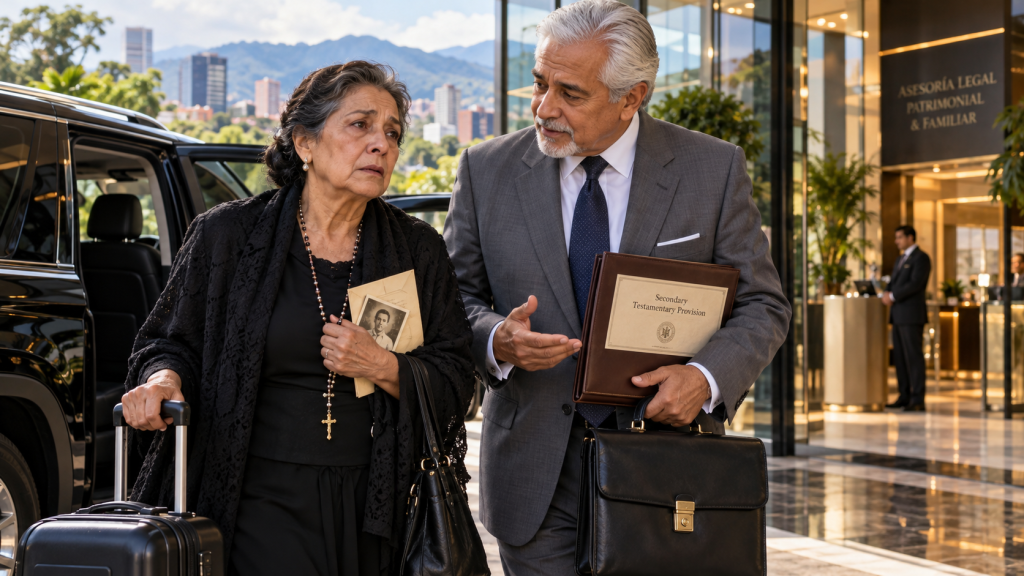
My eyes filled immediately. “Had to?” I whispered. But the recording went on. “You would have confronted them.” I almost laughed through tears. He was right. “And I needed time.” A pause. A breath. Robert sounded tired. So tired. “I needed documents before emotion destroyed the truth.”
I pressed my fingers against my mouth.
Moses lowered his eyes.
Robert continued.
“Rebecca and Diego began taking money from the accounts they managed for me three years before I died.”
My heart stopped.
No.
Not my children.
Not again.
I looked at Moses.
He did not interrupt the recording.
“They called it reimbursement.”
Robert’s voice weakened.
“For travel.”
“Medical appointments.”
“Property management.”
“Emergency expenses.”
“But some of those expenses never existed.”
I felt the room tilt.
Rebecca had handled Robert’s online banking during the final years because I was busy physically caring for him.
Diego helped with insurance.
Elvira organized bills.
That had been their contribution.
Or so I thought.
Robert continued.
“At first, I believed I was forgetting things.”
My throat tightened.
His illness had affected him.
Pain medications.
Fatigue.
Confusion after procedures.
How many times had he asked:
“Tere, did we pay that bill already?”
How many times had I answered impatiently:
“Yes, Robert. Rest.”
I covered my face.
“They let me believe I was losing my mind faster than I was.”
Moses finally looked at me.
I could not look back.
Robert’s voice trembled.
“Thaddeus’s trust office noticed the withdrawals because some transfers passed through accounts connected to my international holdings.”
I lowered my hands.
“International holdings?”
Moses whispered,
“Keep listening.”
The recording continued.
“I never told Rebecca or Diego how much Thaddeus left behind.”
“I told them enough to see what they would do.”
My heart tightened.
Robert had tested them.
That thought made me angry.
Even dead, he was still arranging people like pieces on a board.
“They did exactly what I feared.”
He coughed.
Then:
“They asked me to move everything into structures they could manage after my death.”
“I refused.”
A pause.
“Then someone submitted papers claiming you were incapable of understanding estate matters.”
My blood ran cold.
The attempted trust inquiries.
Rebecca’s email.
Diego’s attorney.
Robert had known.
“He did not tell you,” Moses said quietly, “because the filing never succeeded.”
I turned toward him.
“Never tell me that like it makes it smaller.”
He nodded.
“You’re right.”
Robert’s voice resumed.
“They were preparing to remove you from control before I was even dead.”
I closed my eyes.
Rebecca.
My daughter.
The girl I rocked through fevers.
Diego.
My son.
The boy who used to wait by the door for Robert to come home.
They had looked at me and seen an obstacle.
Not a mother.
Not a wife.
An obstacle.
“Tere,” Robert continued, “I need you to understand something before Moses shows you the rest.”
His voice softened.
“I did not leave them empty-handed.”
I thought about the will reading.
Apartments.
Cars.
Land.
Accounts.
A fortune.
“They received more than enough to live well.”
“But I also left them responsibility for what they had already taken.”
I frowned.
Moses reached for another folder.
Robert said,
“The American estate includes companies and property they asked to control.”
“They wanted ownership.”
“So I gave them ownership.”
A chill moved through me.
Moses opened the folder.
Inside were corporate charts.
Loan documents.
Tax schedules.
Robert’s voice continued.
“But ownership is not only profit.”
“Ownership is debt.”
“Taxes.”
“Contracts.”
“Guarantees.”
“Maintenance.”
“Obligations.”
My heart began to understand before my mind fully did.
Rebecca and Diego had heard apartment.
Estate.
Land.
Cars.
They had not heard the liabilities attached.
Robert had not trapped them with fake debt.
The obligations were real.
They simply never asked.
Because they were too busy celebrating.
Robert continued.
“They spent years asking me to transfer those structures to them because they thought I was too old to manage them.”
“So I did.”
Moses looked at me.
“The holdings they inherited are valuable.”
“How valuable?”
“Roughly twenty-four million gross.”
I swallowed.
“And the debts?”
“Approximately sixteen million, depending on tax treatment and pending obligations.”
I stared.
“So they still inherited money.”
“Yes.”
“Just not what they thought.”
“Correct.”
I laughed once.
Dryly.
Robert had not left them nothing.
He had left them exactly what they demanded.
Control.
With control came the bills.
The recording went on.
“What they do not know is that I kept evidence of every transfer they made from my personal accounts.”
“I signed some.”
“Others were signed while I was too medicated to understand.”
“And some were not signed by me at all.”
I gripped the arms of the chair.
Moses slid another file toward me.
Bank records.
Wire transfers.
Checks.
Electronic authorizations.
“Total?” I whispered.
Moses answered.
“Just under eleven million dollars.”
My mouth went dry.
“Eleven million?”
“Over three years.”
I almost stood.
Then could not.
My children had taken almost eleven million dollars from their father while I was changing his sheets and crushing pills into applesauce.
Moses continued.
“Not all of it was theft.”
That word still hit me.
“Some transactions were gifts Robert knowingly approved.”
“How much?”
“Approximately three million.”
I swallowed.
“And the rest?”
“Disputed.”
“About seven-point-eight million.”
My eyes burned.
“Where did it go?”
“Rebecca’s real-estate projects.”
“Diego’s business debt.”
“Vehicles.”
“Tuition for grandchildren.”
“Mortgage paydowns.”
“Personal spending.”
I looked at the floor.
Tuition.
Cars.
Apartments.
All those things they called their own success.
How much of it had come from the man they visited only when documents needed signing?
Robert’s voice became softer.
“Tere, don’t let anger decide everything.”
I looked at the recorder.
Even now.
Even after death.
He was telling me not to burn the world down.
“I was angry too.”
A long pause.
“Then I remembered they were still our children.”
My throat closed.
“They did something ugly.”
“That does not mean every part of them is ugly.”
Tears rolled down my face.
I hated him a little for still being wise when I wanted permission to hate.
“But love does not mean protecting them from consequences.”
There.
The sentence I needed.
Robert continued.
“So I made the records available.”
“If they challenge your capacity.”
“If they challenge the trust.”
“If they attempt to take the Costa Rican assets.”
“If they attempt to remove you from the home or force you into care without your consent…”
His voice hardened.
“…then Moses has instructions to release everything.”
I turned toward Moses.
“Everything?”
He nodded.
“Everything.”
The recording clicked.
Then Robert’s voice came back one final time.
“Tere.”
He sounded so tired that my heart broke all over again.
“The ticket was not an exile.”
I covered my mouth.
“It was the only gift I knew they would laugh at.”
I began crying.
Moses looked away.
“They always ignored what they considered small.”
“You never did.”
I thought of the envelope.
The cheap paper.
The one-way ticket.
Rebecca ripping it open before I could.
Diego laughing.
Costa Rica is peaceful.
Perfect for someone your age.
Robert continued.
“That is why I knew the ticket would reach you.”
My whole body shook.
“And if you came…”
A long breath.
“…it would mean there was still enough of us inside you to trust one last mystery.”
Then the recording ended.
No music.
No goodbye.
Just silence.
I cried so hard I could not sit upright.
For eight years, I had watched Robert disappear slowly.
I had thought death was the final abandonment.
Then the will reading made me believe even his memory had left me empty-handed.
Now I understood.
He had built a door nobody else would bother opening.
Because they thought it led nowhere.
Moses waited until I could breathe.
Then he said,
“There is something else Robert asked me to show you.”
I laughed through tears.
“Of course there is.”
He almost smiled.
Then he stood.
“Come with me.”
The glass conference building connected to an underground parking garage.
We drove out of San José.
Past concrete.
Traffic.
Then farther.
Green took over.
Mountains rose through mist.
Coffee fields climbed hillsides in long dark rows.
I stared through the window.
“This belongs to the trust?”
“Part of it.”
“How much land?”
“About three thousand hectares across several parcels.”
I turned.
“Three thousand?”
“Not all coffee.”
“There is protected forest.”
“Watershed land.”
“Some leased agricultural acreage.”
My head spun.
Robert had lived in Miami.
Complained about cable bills.
Wore the same brown loafers for twelve years.
Meanwhile, there was a mountain.
Moses noticed my expression.
“Robert did not live extravagantly from these assets.”
“I can see that.”
“He reinvested most income.”
“Why?”
“Because Thaddeus asked him to.”
The name.
The mystery brother.
“Tell me about him.”
Moses looked at the road.
“Robert’s father had a relationship in Costa Rica before returning permanently to the United States.”
“Thaddeus was born here.”
“Robert learned about him as a young man.”
“Their father wanted nothing to do with either family understanding the other.”
I stared at the old photograph in my lap.
“Then how did they meet?”
“Robert came here in 1978.”
The picture.
He was twenty-five.
I had not met him yet.
“They became close?”
“For a time.”
“What happened?”
“Pride.”
Moses sighed.
“Family history.”
“Money.”
“The usual things.”
I almost laughed.
Apparently families have been ruining themselves over money in every generation.
“Thaddeus built the coffee business?”
“Expanded it.”
“The original land was smaller.”
“He had no children.”
“No spouse?”
“A long-term partner died years before him.”
“And he left everything to Robert?”
“Most controlling interests.”
“Why?”
“Because by the end, Robert was his closest living relative.”
I shook my head.
“And Robert never told me.”
“Not entirely.”
I looked at Moses.
“What does that mean?”
“He told you once.”
I frowned.
“No.”
“According to him, he mentioned having a brother when you were dating.”
I searched memory.
Forty-six years.
Young Robert.
A tiny apartment.
Cheap wine.
Long conversations.
Then it came.
A sentence.
Barely anything.
“My father left another family somewhere south.”
I had thought he meant metaphorically.
A rumor.
A shame.
Not a brother.
“You call that telling me?”
Moses laughed.
“I believe Robert eventually agreed it was inadequate.”
I smiled despite myself.
That was also Robert.
Technically truthful.
Emotionally impossible.
We drove another hour.
Then the road narrowed.
The SUV turned through stone gates.
Beyond them stood the wooden house from the photograph.
Renovated.
Larger.
But unmistakable.
My heart stopped.
Robert had stood here forty-eight years earlier.
Beside Thaddeus.
Before me.
Before Rebecca.
Before Diego.
Before illness.
Before secrets.
A woman waited on the porch.
Maybe fifty.
Dark hair.
Work boots.
Simple white blouse.
Moses introduced her.
“Mrs. Morales, this is Ana Monteverde.”
My heart jumped.
“Monteverde?”
She smiled gently.
“My father was Thaddeus’s cousin.”
I nodded.
Not daughter.
Moses had said no children.
Ana extended her hand.
“I’m the estate manager.”
I took it.
“You knew Robert?”
“Yes.”
“How well?”
“Enough to know he hated papaya.”
I laughed unexpectedly.
“He did.”
“Wouldn’t touch it.”
“He claimed it tasted like perfume.”
Ana smiled.
“That’s what he said here too.”
And suddenly Robert felt close.
Not the sick man in bed.
Not the dead man in a casket.
Robert.
Complaining about fruit in another country decades before I knew he had ever visited.
Ana led me inside.
The house smelled like wood and coffee.
On one wall were photographs.
Thaddeus.
Robert.
Workers.
Harvests.
Families.
Then I saw one from twelve years earlier.
Robert.
Older.
Standing in front of the same house.
I froze.
“He came back?”
Ana nodded.
“Several times.”
“He told me those were business trips to Atlanta.”
My anger returned.
Moses spoke carefully.
“Robert had reasons for secrecy.”
“I’m beginning to dislike that sentence.”
He nodded.
“Fair.”
I turned toward Ana.
“Did he bring Rebecca or Diego?”
Her expression changed.
“Diego came once.”
My stomach tightened.
“When?”
“About five years ago.”
I stared.
“Why?”
“Robert was considering involving him in one of the export companies.”
Of course.
Even after everything, Robert had tried to include him.
“What happened?”
Ana looked toward Moses.
He nodded.
She answered.
“Diego copied internal financial files.”
My stomach dropped.
“What?”
“He told one of our administrators Robert had authorized him.”
“He had not.”
“What was he looking for?”
“The value of the trust.”
There it was.
“He knew?”
“Not everything.”
Ana shook her head.
“But he knew enough to suspect the Costa Rican assets were significant.”
I thought about the inquiry from Diego’s attorney.
Mental incapacity.
Trust information.
They had not discovered it after Robert died.
Diego had been looking for years.
“Did Robert confront him?”
“Yes.”
“And?”
“Diego said he was just trying to help with estate planning.”
I laughed bitterly.
That phrase seemed to cover every theft in our family.
Ana continued.
“Robert sent him home.”
“He never returned.”
I walked outside.
The air felt wet and cool.
Coffee plants stretched down the slope.
I needed distance from walls.
From files.
From dead men’s plans.
Moses followed slowly.
I turned.
“I’m angry with Robert.”
“I know.”
“No.”
I looked at him.
“Everyone keeps telling me he protected me.”
“He did.”
“He also lied to me for decades.”
“Yes.”
That answer surprised me.
Moses did not defend him.
Good.
“He let me believe we had less than we had.”
“Yes.”
“He let me sew late at night while there was a sixty-three-million-dollar trust.”
Moses winced.
“That part bothered me too.”
My eyes filled.
“I counted coins for medication.”
“I know.”
“I skipped my own dental work.”
“I know.”
“Why?”
Moses looked toward the mountains.
“Because Robert was afraid that once the money became visible, your children would reorganize the entire family around it.”
“He believed ordinary life protected you.”
I stared.
“Ordinary poverty?”
“No.”
Moses shook his head.
“You were never poor.”
“We felt poor.”
“Yes.”
He accepted that.
“Robert went too far.”
That sentence calmed something.
Not because it erased anything.
Because finally someone allowed me to love Robert and still be angry.
“He should have told you more.”
Moses continued.
“He knew that near the end.”
“Then why didn’t he?”
“He was ashamed.”
I laughed once.
Everyone in this family had been silenced by shame.
Robert.
My children.
Me.
Money had done what grief could not.
Turned everyone into secret-keepers.
Moses reached into his briefcase and handed me another envelope.
Robert’s handwriting.
This one said only:
For Tere after she has cursed me properly.
I started laughing.
Then crying.
“He knew.”
“Very well.”
I opened it.
The letter was four pages.
Tere,
If you are reading this, Moses has probably failed to defend me, which means I chose the right lawyer.
I laughed aloud.
Then kept reading.
I owe you an apology before I owe you an explanation.
My eyes filled.
I hid too much.
There.
No excuse first.
I told myself secrecy protected you from greed. Sometimes it did. Sometimes it simply denied you the dignity of knowing your own life.
I stopped.
Read it again.
Denied you the dignity of knowing your own life.
That was exactly the wound.
Robert continued.
When Thaddeus died, I suddenly had more wealth than I knew how to carry.
I watched people change around numbers.
Friends became advisers.
Relatives became investors.
Everyone had a reason why their emergency was now mine.
I thought of Steven in another life.
Different story.
Same human hunger.
I did not want that for us.
So I kept most of it separate.
Then Rebecca and Diego grew older.
My chest tightened.
I made another mistake.
I tested them instead of teaching them.
I closed my eyes.
Yes.
I let them manage small pieces of money to see whether they would respect boundaries.
When they failed, I became suspicious instead of honest.
That was Robert too.
Proud.
Quiet.
He collected evidence instead of having conversations.
You would have told me to sit them down and speak plainly.
I whispered,
“Yes.”
I did not.
That is on me.
Tears blurred the page.
But what they did after that belongs to them.
Again.
Two truths.
Robert made mistakes.
Children made choices.
One did not erase the other.
I am most sorry about the final eight years.
My breathing changed.
You worked too hard caring for me.
I should have used more of the trust to hire help.
I cried harder.
I told myself you would refuse strangers.
I told myself I needed you.
I told myself spending less kept things simple.
Those were excuses.
My hands shook.
The truth is I liked being cared for by you.
I covered my mouth.
And I let your love become labor I did not sufficiently relieve.
There.
The man I loved.
Accountable at last.
I cannot repay those years.
The trust is not payment.
The land is not payment.
Money cannot convert sacrifice into fairness after the fact.
I pressed the page to my chest.
What I can do is make sure your old age belongs to you.
I cried silently.
Not the children.
Not a nursing home they choose.
Not a daughter-in-law laughing.
Mine.
Travel if you want.
Stay home if you want.
Sell everything.
Keep it.
Give money away.
Waste some.
But choose.
That word.
Choose.
Do not let Rebecca or Diego turn your love into authority over you.
And do not let my guilt become authority either.
My throat closed.
Even his final gift came with an instruction not to obey him.
That mattered.
The letter ended:
I loved you badly in some ways and completely in others.
I sobbed.
I hope the complete part is what remains after the anger softens.
Robert
I sat on the porch for a long time.
Ana brought coffee.
No one spoke.
I looked across the land.
Sixty-three million dollars.
Coffee.
Forest.
Investments.
Water rights.
Leases.
And none of it felt as heavy as four handwritten pages.
The next morning, Moses took me to the trust office.
There were no golden vaults.
No dramatic doors.
Just accountants.
Binders.
Screens.
Spreadsheets.
Of course.
We reviewed everything.
I asked questions.
For once, no one said:
“You don’t need to worry about this.”
They explained.
Every holding.
Every debt.
Every distribution.
Every restriction.
The trust paid me an income.
I could authorize larger distributions with safeguards.
I could replace advisers.
I could sell some assets.
Not protected conservation land without special review.
Good.
I liked that.
Thaddeus had preserved thousands of acres from development.
I had no desire to turn his mountains into condominiums.
Then Moses showed me the file on Rebecca and Diego.
Not revenge.
Evidence.
Bank records showed they had used Robert’s weakened state to obtain signatures on several transfers.
Some valid.
Some questionable.
Two electronic authorizations came from Diego’s device while Robert was hospitalized.
One property transfer request used Rebecca’s login.
There were recordings too.
Not hidden cameras.
Voicemails.
Robert had saved them.
One from Rebecca:
“Dad, Mom doesn’t understand how much care costs. If you put the apartment in my name now, I can make sure she doesn’t waste everything after you’re gone.”
My body went cold.
Another from Diego:
“If you leave Mom control, she’ll give it all away or get scammed. We need to protect the estate from her.”
Protect the estate from me.
The woman bathing their father.
Counting his breaths.
Sleeping in a chair.
Apparently my greatest risk was being alive after him.
I turned off the recording.
“I don’t want more today.”
Moses nodded.
Good.
For the first time in days, I made a decision not to know everything immediately.
That felt powerful.
I stayed in Costa Rica for three weeks.
Not because Robert ordered me to.
Because I wanted to.
I slept in a guest cottage near the old house.
Rain woke me.
Birds I did not know screamed at sunrise.
I walked slowly.
My knees hated hills.
Ana laughed at me once.
“You don’t have to climb every path.”
“I’m proving something.”
“To who?”
I stopped.
Good question.
Nobody.
So I turned around.
That became my first lesson after Robert.
I did not have to suffer to prove I deserved what was mine.
I had done enough of that.
Moses asked on the fourth day,
“What do you want to do about Rebecca and Diego?”
I stared at the valley.
“I don’t know.”
“Good.”
I looked at him.
“Good?”
“Yes.”
“You have been reacting for weeks.”
“Not knowing is allowed.”
I smiled.
Lawyers were apparently useful for more than documents.
I called Rebecca first.
She answered immediately.
“Mom.”
Her voice sounded bright.
Too bright.
“You made it?”
I sat on the porch.
“Yes.”
“How is Costa Rica?”
“Beautiful.”
A pause.
Then casually:
“So what was the ticket about?”
There.
Not:
Are you okay?
Not:
Did you find Dad’s friend?
What was the ticket about?
I said,
“Robert left me something.”
Silence.
“How much?”
I closed my eyes.
“Rebecca.”
“What?”
“Your father left me something.”
“That is all you need to know.”
Her voice sharpened.
“We’re his children.”
“Yes.”
“We have a right to understand the estate.”
“You already received your inheritance.”
“We received American property.”
I froze.
American.
She knew.
“You knew there was something outside the United States.”
Silence.
My heart hardened.
“Rebecca.”
She exhaled.
“Diego mentioned Dad had business interests.”
“How?”
“I don’t know.”
“You used your email to request information about the Costa Rica trust.”
Another silence.
Then:
“That was just estate planning.”
I almost laughed.
The same phrase.
“Why did the request say I was mentally incapable?”
She did not answer.
“Rebecca.”
“You were exhausted.”
“After caring for your father for eight years.”
“That is not incapacity.”
“I was worried.”
“No.”
I surprised myself with the firmness.
“You were preparing.”
She started crying.
“Mom.”
I remained quiet.
“I didn’t know Dad was going to cut you out.”
“He didn’t.”
The words came before I could stop them.
Silence.
Then Rebecca’s breathing changed.
“What does that mean?”
There it was.
I could feel the question sharpening into money.
I said,
“It means I am safe.”
“How safe?”
I almost laughed.
“Safe enough.”
She became angry.
“Why are you doing this?”
“Doing what?”
“Talking in riddles.”
I stared across the mountains.
Because for forty-six years, Robert had done the same.
I did not want to become him.
So I answered plainly.
“Rebecca, your father left me a private trust in Costa Rica.”
Silence.
“How much?”
“No.”
“What?”
“You do not need the number.”
“I’m your daughter.”
“Yes.”
“Family doesn’t hide money.”
The sentence nearly made me choke.
I breathed.
Then said,
“Your father kept records of the transfers you and Diego made from his accounts.”
No sound.
Then:
“What records?”
“All of them.”
Her voice changed.
“Mom, Dad gave us money.”
“Some.”
“He wanted us to have it.”
“Some.”
“You don’t know what you’re talking about.”
There it was.
The old assumption.
Seventy-two.
Widow.
Caregiver.
Probably confused.
Except I was sitting beside the lawyer who had every document.
I said,
“Moses does.”
Silence.
Then Rebecca hung up.
Not goodbye.
Just click.
I stared at the phone.
My daughter.
I expected pain.
Instead, I felt clarity.
Diego called eleven minutes later.
Of course.
“Mom, what did you tell Rebecca?”
I laughed.
“You two still move quickly.”
“Dad’s records are complicated.”
“So are your withdrawals.”
Silence.
“Mom.”
“I need you to listen.”
“I am listening.”
“No.”
His voice softened artificially.
“I mean really listen.”
That tone.
The one used on old people.
I hated it.
“You’ve had an emotional shock.”
I closed my eyes.
There.
Exactly what Robert predicted.
“You’re grieving.”
“Yes.”
“You’re in another country.”
“Yes.”
“With people you barely know.”
“Yes.”
“And they’re telling you things about your children.”
I almost admired the strategy.
Almost.
“Diego.”
“Yes?”
“Did you authorize transfers from your father’s accounts while he was hospitalized?”
Silence.
He sighed.
“He asked me to handle things.”
“Did he ask you to send money to your business?”
“He had invested in it.”
“Did he sign those transfers?”
Silence again.
“Some.”
There.
Finally.
“Did you ask your attorney to tell the Costa Rican trust that I was mentally incapable?”
He exhaled.
“I was protecting Dad’s estate.”
“No.”
“You were protecting your access.”
“That’s unfair.”
“Maybe.”
I looked at the trust papers.
“Then explain it through lawyers.”
He froze.
“What?”
“Moses will send you formal notice.”
“Mom, please don’t turn this into a legal war.”
I laughed sadly.
“You already did.”
Then I hung up.
My hands shook afterward.
Strength does not mean the body stays calm.
Sometimes your voice is steady while your entire nervous system trembles.
Ana brought me tea.
I hated tea.
Drank it anyway.
“What happens now?”
I asked Moses later.
“That depends on what you want.”
I thought.
“I don’t want them arrested just because I’m angry.”
“Good.”
“But I don’t want what they did erased.”
“Also good.”
“What options?”
He explained.
Civil accounting.
Recovery of unauthorized transfers.
Negotiated restitution.
Potential referral to law enforcement where forgery or fraud was supported.
Trust safeguards.
Probate challenges.
Capacity protections.
No revenge switch.
No magic.
Process.
I chose process.
That became the pattern of the next eighteen months.
Rebecca and Diego hired attorneys.
Their first position:
Robert had gifted everything voluntarily.
Then documents showed otherwise.
Their second:
I was being manipulated in Costa Rica.
Then independent capacity evaluations showed I was fully competent.
Their third:
The withdrawals were advances against inheritance.
Then Robert’s estate ledger showed which advances were recognized and which were not.
Their fourth:
They had merely been reimbursing themselves for caregiving and management.
That one nearly made me scream.
Caregiving?
I had changed their father’s diapers.
They had invoiced “management.”
Moses told me:
“Do not attend every argument.”
I listened.
Mostly.
The American estate’s final accounting became painful.
The visible assets Rebecca and Diego inherited were real.
So were the liabilities.
Once debt service, taxes, and prior advances were accounted for, their net inheritances were far smaller than they celebrated at the will reading.
Still substantial.
Enough to live comfortably.
Not enough to make consequences disappear.
Rebecca eventually sold one apartment.
Diego sold two cars and his interest in a land parcel.
Elvira stopped smirking.
That part should not have pleased me.
It did a little.
I am human.
The bigger reckoning involved the disputed seven-point-eight million dollars.
Investigators ultimately concluded some transfers were authorized but poorly documented.
Others were not.
Two signatures were determined likely not to have been executed by Robert personally.
One electronic authorization was traceable to Diego’s device while Robert was under heavy sedation.
That crossed a line even I could not explain away.
Diego faced criminal exposure.
Rebecca too, though differently.
I cried when Moses told me.
Not because they were innocent.
Because motherhood does not switch off when evidence becomes ugly.
I still remembered Diego at six.
Missing front teeth.
Running into my bed during thunderstorms.
I remembered Rebecca at ten.
Cutting her own bangs and lying about it while scissors were still in her hand.
Children grow.
Love does not erase memory.
Neither does accountability.
The prosecutors offered plea arrangements.
Not enormous prison sentences.
Not cinematic destruction.
Financial crimes involving family elders are messy.
Evidence gets complicated by gifts.
Authority.
Prior consent.
Health.
The final outcomes included restitution, probationary conditions, professional restrictions, and for Diego a short custodial sentence tied to the strongest fraudulent authorization.
Rebecca avoided incarceration but accepted a plea involving improper financial conduct and repayment obligations.
I did not celebrate.
I went to Mass.
Sat in the back.
Cried.
Then went home.
That was all.
At sentencing, the judge asked if I wanted to speak.
I had written six pages.
I used one.
I looked at my children.
Not enemies.
Not babies.
Adults.
I said,
“I loved you before there was money.”
Rebecca started crying.
Diego looked down.
“I will love you after the money is gone.”
My voice shook.
“But love does not require me to pretend you did not hurt your father.”
Silence.
“Or me.”
I breathed.
“You believed age made us easier to manage.”
“You believed caregiving made me financially naïve.”
“You believed illness made your father’s signatures available.”
Rebecca covered her face.
I continued.
“The punishment is not mine to decide.”
“The relationship is.”
That sentence surprised even me.
I looked at both of them.
“I will not decide today what our family becomes next.”
“But it will not become what it was.”
Then I sat down.
That was enough.
Elvira confronted me outside.
“How could you do this to Diego?”
I stared at her.
Years earlier, I would have defended myself.
Explained evidence.
Explained law.
Explained Robert.
Not anymore.
I said,
“I didn’t sign his name.”
Then I walked away.
Costa Rica became part of my life.
Not all of it.
I kept my home in Florida for several years.
But I returned to San José often.
At first, every visit felt like trespassing into Robert’s secret life.
Then slowly, it became mine.
I learned enough Spanish legal vocabulary to terrify bank managers.
Ana taught me coffee grading.
I was terrible.
Everything smelled like coffee.
Apparently professionals detect fruit, chocolate, flowers, acidity, altitude.
I detected coffee.
Ana said I lacked imagination.
I told her I was seventy-three and had earned the right not to pretend blueberries were inside espresso.
We became friends.
I met workers whose families had been connected to the estate for generations.
I reviewed wages.
Benefits.
Housing.
One thing bothered me.
Some seasonal workers had poor access to healthcare.
I remembered eight years of Robert’s medication schedules.
Then I used trust income to build a small clinic partnership.
Not named after me.
Not after Robert.
After Thaddeus.
Clínica Monteverde.
Moses objected to the first budget.
“You’re spending too much.”
I stared at him.
“Whose money?”
He smiled.
“Yours.”
“Then why are you arguing?”
“Because you pay me to.”
Fair.
The clinic opened two years later.
No ribbon-cutting spectacle.
Just doctors.
Nurses.
Vaccines.
Diabetes care.
Prenatal visits.
The first time I watched an elderly farm worker get his blood pressure checked, I thought of Robert.
Then I cried in the bathroom.
Grief keeps finding new rooms.
I also changed one rule in the trust.
Within the limits Thaddeus allowed, I created a transparent family education policy.
Not secret gifts.
Not envelopes.
Not children calling for emergency money.
Any future family support would be documented.
Equal criteria.
Independent review above a certain amount.
I had learned.
Money without rules becomes a language people rewrite to suit themselves.
I wanted my grandchildren to know where generosity ended and entitlement began.
Rebecca and I did not speak for almost a year.
Then she wrote.
Not email.
A handwritten letter.
Three pages.
The first sentence:
Mom, I keep wanting to explain what I did because explanation feels less ugly than admitting I wanted control.
I sat down.
Read slowly.
Dad was sick.
You were exhausted.
I told myself somebody needed to be practical.
My eyes filled.
Practical became the word I used when I wanted something you might say no to.
Good.
Painful.
Good.
I did take money Dad had not clearly authorized.
I told myself he would have given it to me anyway.
I closed my eyes.
That logic.
The entitlement of anticipated inheritance.
I also supported the capacity inquiry about you.
My hand trembled.
I am ashamed of that.
You were not confused.
You were grieving.
I treated grief like evidence against you.
Tears ran down my face.
There.
The deepest wound.
She continued.
I do not ask you to restore what we had.
I am beginning to understand that what we had included you doing too much emotional work for all of us.
I stopped.
Read that line again.
Maybe therapy had reached her.
Maybe consequences had.
Probably both.
If you ever want contact, I will accept your rules.
No demand.
No grandchildren as leverage.
No “I am still your daughter.”
Just a door.
I waited two months.
Then called.
She answered on the first ring.
“Mom?”
Her voice cracked.
“Hello, Rebecca.”
She started crying.
I did too.
We did not solve anything.
We spoke for fourteen minutes.
Weather.
Her children.
My knee.
Coffee.
Then she said,
“I’m sorry.”
I answered,
“I know.”
Not forgiveness.
Acknowledgment.
It was enough for that day.
Diego took longer.
Prison changed him.
Not magically.
Not immediately.
His first letters blamed Robert.
Then lawyers.
Then Rebecca.
Then me.
I stopped reading.
Moses screened them.
Three years later, one arrived that he said was different.
I opened it.
Mom, Dad did not humiliate me in the will.
I kept reading.
He gave me exactly what I kept demanding while he was alive: responsibility.
My throat tightened.
I wanted the buildings.
I did not want the debt.
I wanted the accounts.
I did not want the taxes.
I wanted his signature.
I stopped.
My heart pounded.
I did not want his judgment.
Tears filled my eyes.
And when his judgment blocked me, I treated his illness like permission to go around him.
I cried.
Not because he was redeemed.
Because he finally named it.
I am sorry.
I do not expect you to answer.
If Dad left any recording for me, I do not deserve it yet.
That sentence mattered.
Because there was a recording.
Robert had left one for each child.
Moses told me.
I had authority to release them when I believed the time was right.
At first, that angered me.
Another decision Robert left in my lap.
Then I remembered his letter.
Do not let my guilt become authority.
So I treated the recordings as mine to decide.
Not his command.
Rebecca received hers after four years.
Diego after six.
I never listened first.
Those messages belonged to them.
They told me only what they wanted afterward.
Rebecca said Robert apologized for being emotionally distant and for confusing financial discipline with parenting.
He also told her:
You are not owed my money because you are my daughter. You are owed my love. I gave you less of the second than I should have.
That destroyed her.
In a useful way, I think.
Diego’s message said:
I made you think competence was the only way to earn my respect. Then when you failed, you hid failure instead of asking for help. I helped build that. But you still chose dishonesty. Both things belong in the same room.
When Diego told me that, I cried.
Robert finally learned something too.
Too late.
Still real.
My relationship with my children rebuilt slowly.
Not back to what it was.
Forward into something else.
Rebecca visited Costa Rica first.
She paid for her own ticket.
That detail made me smile.
At the estate, Ana gave her no special treatment.
Good.
Rebecca saw the clinic.
The forest.
The coffee fields.
The old photograph of Robert and Thaddeus.
She stood beneath it for a long time.
“Dad looks happy.”
“He was young.”
“No.”
She shook her head.
“Happy.”
I looked.
Maybe.
There was freedom in his face I had not seen during the final years.
Rebecca whispered,
“I wish I had known him before money became the only language we spoke.”
My throat tightened.
“Then stop making it the only language now.”
She nodded.
We walked outside.
No hug.
Not then.
Later.
Diego visited two years after that.
Supervised by nobody.
But with boundaries.
He had completed his sentence.
Worked steadily.
Paid restitution.
No longer managed family money.
He arrived thinner.
Quieter.
Moses met him.
They shook hands.
Diego said,
“I used to hate you.”
Moses smiled.
“I billed by the hour, so that was fine.”
I laughed.
Diego actually laughed too.
Good.
Humor returned before intimacy did.
At dinner, Diego asked,
“Mom, how much is the trust worth now?”
The entire table froze.
Then he smiled.
“I’m joking.”
I stared.
He raised both hands.
“Bad joke.”
Ana nearly choked laughing.
So did I.
The fact that we could joke about the number meant the number had stopped controlling the room.
That was progress.
I never moved permanently to Costa Rica.
I divided my time.
Miami.
San José.
Eventually a smaller home near the estate.
I traveled.
Robert had told me to.
More importantly, I wanted to.
Spain.
Portugal.
Mexico.
Italy.
At seventy-six, I went to Paris alone.
Rebecca worried.
“Mom, maybe take someone.”
“I am taking someone.”
“Who?”
“Me.”
She sighed.
I smiled.
I visited museums until my feet rebelled.
Ate pastries Robert would have called overpriced.
Bought a red coat.
He hated red coats.
Said they made people look like traffic signals.
I wore it constantly.
Freedom sometimes looks ridiculous.
I also wasted money deliberately.
Not irresponsibly.
Symbolically.
Robert told me to.
I bought first-class plane tickets once.
Hated the price.
Loved the seat.
Bought an absurdly expensive mattress.
Worth every dollar.
Bought handmade dishes that chipped within a year.
Not worth every dollar.
But mine to choose.
That mattered.
The Costa Rican trust grew.
Markets rise.
Coffee changes.
Land appreciates.
But I stopped asking Moses the total every quarter.
Numbers had already done enough damage in my family.
I cared more about income sustainability.
Worker wages.
Conservation.
Clinic funding.
Education grants.
My own needs.
I also changed my American will.
Rebecca and Diego would inherit.
Yes.
That surprised everyone.
But not equally.
Not automatically.
And not without structures.
My grandchildren received education trusts.
The clinic received a permanent endowment.
Conservation remained protected.
I also created a caregiver fund in Robert’s name.
That decision took years.
At first, I refused.
Why name anything after the man who let me carry too much alone?
Then I reread his letter.
I let your love become labor I did not sufficiently relieve.
He had named his failure.
So the fund would name the lesson.
The Robert and Teresa Morales Caregiver Relief Fund.
Not Robert alone.
Not me alone.
It provided respite care for spouses caring for ill partners.
Paid home aides.
Transportation.
Temporary nursing support.
Sleep.
Simple things.
The first recipient was a sixty-nine-year-old man caring for his wife with Parkinson’s.
He had not slept a full night in months.
The fund paid for overnight care twice a week.
He wrote:
I forgot what it felt like to be her husband instead of only her nurse.
I cried for an hour.
That sentence healed something in me.
I had spent years as Robert’s nurse.
Cook.
Cleaner.
Medication manager.
I loved him.
But somewhere along the way, husband and wife became patient and caregiver.
Nobody warned me grief can begin before death.
The fund acknowledged that.
Not with poetry.
With paid help.
Sometimes money is useful when it stops pretending to be love and simply buys relief.
Elvira eventually apologized too.
Not quickly.
Her first attempts were excuses.
She had “only followed Diego’s lead.”
She “didn’t understand the estate.”
She “never meant the smile that way.”
I ignored those.
Years later, she sent a message.
Teresa, I smiled at the will reading because I believed wealth proved worth. I saw your ticket and assumed you had lost. That says something ugly about me, not about you.
I read it twice.
Better.
I am sorry I helped make your grief humiliating.
That mattered.
I answered:
Thank you for saying it clearly.
Nothing else.
We became civil.
Not close.
That was enough.
Moses became family in the oddest way.
Not legally.
Emotionally.
He retired at seventy-four.
I told him retirement was a scam.
He told me widowhood had made me argumentative.
I said widowhood had removed the audience that used to stop me.
He laughed.
At his retirement dinner, he gave me the original plane-ticket envelope.
I stared.
“I thought the notary had it.”
“Robert instructed them to send it to me after probate.”
“Why?”
Moses smiled.
“He thought you might throw it away once you learned what it meant.”
I opened it.
Inside, beneath where the ticket had been, was a sentence written so faintly I had never noticed.
Robert’s handwriting.
If they laugh, go.
I started crying.
Four words.
That was all.
If they laugh, go.
Robert had known.
Not exactly what would happen.
But enough.
He knew our children’s arrogance would become the signal.
Their mockery would push me toward the one thing they considered worthless.
I hated the manipulation.
Loved the precision.
Robert was complicated.
So was I.
So were they.
That became the truth I preferred over heroes and villains.
Years passed.
I turned eighty.
My knees became negotiators.
Coffee estates became less romantic when stairs were involved.
Ana ordered golf carts.
I protested.
She ignored me.
Good.
Rebecca came for my birthday.
Diego too.
Elvira.
Grandchildren.
Moses.
His wife.
Workers.
Friends.
We ate under a long covered terrace while afternoon rain moved across the mountains.
At one point, my granddaughter Sofia asked,
“Abuela, is it true Grandpa only left you a plane ticket?”
Everyone went quiet.
Rebecca looked down.
Diego looked at me.
I smiled.
“Yes.”
“That’s mean.”
I laughed.
“It looked mean.”
“What did it really mean?”
I thought.
Then said,
“It meant I had to go somewhere before I understood what was mine.”
She frowned.
“Why didn’t he just tell you?”
Every adult at the table started laughing.
Sofia looked offended.
I said,
“That is an excellent question.”
Rebecca raised her glass.
“To Grandpa’s inability to communicate normally.”
Diego added,
“Finally, a family consensus.”
We laughed.
I looked around the table.
Years earlier, this same family had sat in a notary office and measured love in property.
Now the wealth was still there.
But it no longer decided who could speak.
That mattered more.
After dinner, I walked with Rebecca.
Slowly.
She offered her arm.
I accepted.
Not because I was weak.
Because my knee hurt.
Learning to accept help without hearing control in it took time.
We stopped near the edge of the coffee field.
She whispered,
“Mom.”
“Yes?”
“I still think about the will reading.”
“So do I.”
“I’m ashamed.”
“I know.”
“I wish I could take back the way I looked at you.”
I breathed.
“You can’t.”
She nodded.
Tears filled her eyes.
“But you have looked at me differently since.”
She turned.
“What do you mean?”
“You asked before helping me walk.”
Her face crumpled.
Such a small thing.
Choice.
Again.
We hugged.
Not because everything was repaired.
Because enough had been.
Diego came later.
He stood beside me.
“I used to think Costa Rica was the prize.”
I smiled.
“And now?”
“It was the mirror.”
I looked at him.
He continued.
“Dad knew if we couldn’t see value in the ticket, we weren’t ready to see value in anything else.”
I laughed softly.
“Don’t make him too wise.”
Diego smiled.
“He’d hate that.”
“Yes.”
We stood quietly.
Then he said,
“I’m sorry, Mom.”
“I know.”
“No.”
He shook his head.
“I don’t mean for the money.”
I waited.
“I’m sorry I tried to make you small enough to manage.”
My throat tightened.
That was it.
The capacity inquiry.
The whispers.
Perfect for a woman your age.
The assumption that widowhood made me less competent.
I looked at him.
“Thank you.”
He cried.
So did I.
Then I said,
“You still don’t get the trust.”
He laughed through tears.
“Fair.”
At eighty-two, I sold my Miami house.
My choice.
Rebecca immediately asked whether I was sure.
I stared at her.
She stopped.
Then corrected herself.
“Do you want help with the move?”
I smiled.
“Yes.”
That was growth.
Not never making mistakes.
Catching them.
I moved into a smaller condominium near one of my grandchildren.
Kept a place in Costa Rica.
No giant house.
No live-in nurse.
Not yet.
I hired help before I desperately needed it.
Another lesson from Robert.
I refused to make eighty-two-year-old Teresa prove love by exhaustion.
When I needed someone to drive at night, I hired someone.
When stairs became difficult, I used elevators.
When I forgot an appointment, I wrote it down.
No shame.
Age is not incapacity.
But pretending age changes nothing is another kind of pride.
The difference is choice.
Help that follows your request feels different from help that removes your authority.
That became something I spoke about often.
The clinic eventually added elder legal-services days.
Moses’s idea.
Older farmers came with deeds.
Pension questions.
Family disputes.
One woman said her son wanted her to sign over land “for convenience.”
I laughed.
She looked startled.
“Sorry.”
I told her,
“I have opinions about convenience.”
She kept the land.
Maybe her son was perfectly kind.
Maybe not.
The point was she understood before signing.
That was enough.
Robert’s original recorder stayed with me.
I listened only twice more.
Once when I turned seventy-five.
Once when I turned eighty-five.
The second time, his voice sounded younger than I remembered.
That frightened me.
Memory ages people with us.
Recordings don’t.
I heard him say:
“The ticket was not an exile.”
And smiled.
By then, the plane ticket itself was framed.
Not in a grand museum display.
Just a little frame on my desk.
Underneath, Robert’s faded words:
If they laugh, go.
People sometimes asked what it meant.
I said,
“It means don’t assume the smallest gift has the smallest value.”
That was true.
But incomplete.
It also meant humiliation can sometimes be a doorway if you refuse to let the people humiliating you define what comes next.
My children thought I had been discarded.
For a few hours, I believed them.
That was the painful part.
Not their laughter.
My belief.
I thought forty-six years had ended in a plane ticket because I still measured Robert’s love in what the will publicly gave me.
A house.
Money.
A letter.
Something visible.
Robert knew better.
And worse.
Better because he understood hidden value.
Worse because he hid too much.
I no longer romanticize the secrecy.
If I could speak to him, I would say:
“You should have told me.”
Then I would hug him.
Then probably hit his shoulder.
Then tell him the clinic is doing well.
Then complain about Moses.
Then show him the red coat.
Love can survive criticism.
That was another lesson I learned too late.
At eighty-six, I wrote my own letters to Rebecca and Diego.
Not because I expected to die immediately.
Because I had learned not to leave emotional work until the end.
Rebecca’s began:
You are not the worst thing you did to me.
Diego’s:
Consequences did not make you less my son. They made our relationship honest enough to continue.
My grandchildren received letters too.
Each one different.
No riddles.
No secret countries.
No mysterious envelopes.
I had learned from Robert’s mistakes as much as his wisdom.
My will was transparent.
Everyone knew the broad structure.
Not exact amounts.
Enough.
Nobody would sit in a cold notary office smirking because they thought another person lost.
That game ended with us.
I also added a clause requiring every primary beneficiary to attend one financial-education session before receiving discretionary control.
Rebecca laughed when she heard.
“Mom.”
“What?”
“You’re assigning homework from the grave?”
“Yes.”
“Dad would be proud.”
“Then I may remove it.”
We laughed.
Family patterns can become jokes once they stop being weapons.
That is how I know we healed.
Not perfectly.
But genuinely.
The last time all of us visited the old wooden house together, the photograph of Robert and Thaddeus still hung on the wall.
Diego stood beneath it.
Rebecca beside him.
I joined them.
For a long moment, nobody spoke.
Then Rebecca said,
“Imagine if Grandpa had just told everybody he had two families.”
I laughed.
“Your grandfather?”
“Robert’s father.”
“Oh.”
Even at eighty-six, family trees could confuse me.
Diego said,
“Maybe secrecy runs in the blood.”
I looked at him.
“No.”
He frowned.
I continued.
“Patterns run until someone chooses differently.”
He nodded.
That became the sentence I kept.
Not blood.
Not destiny.
Choice.
Robert chose secrecy.
Sometimes wisely.
Sometimes wrongly.
My children chose entitlement.
Then later chose accountability.
I chose not to confuse love with immediate forgiveness.
Then later chose relationship with boundaries.
Thaddeus chose conservation.
Moses chose loyalty to a dead friend’s instructions.
Ana chose to tell me when I was being stubborn.
Very often.
And every one of those choices mattered more than inheritance.
People still ask about the sixty-three million dollars.
How much is left?
Did it grow?
Who gets it?
I smile.
That is exactly the kind of question that started the problem.
The answer is:
Enough.
Enough for me.
Enough for the clinic.
Enough for workers.
Enough for conservation.
Enough for grandchildren to receive help without believing life owes them rescue.
Enough to matter.
Not enough to become the meaning of us.
The most valuable thing Robert left me was not land.
Not coffee.
Not investments.
Not even the ticket.
It was the moment my children laughed.
That sounds strange.
But their laughter revealed the truth before any lawyer did.
They thought value was obvious.
A building.
A car.
An account.
A large number read aloud in an office.
Anything small must be worthless.
A folded envelope.
An old woman.
A one-way ticket.
A secret brother.
A dying father’s last sentence.
They were wrong.
So was I, briefly.
Now, when someone hands me something small, I look twice.
When someone treats a person as though age makes them less important, I listen carefully.
When family uses love to justify access, I ask who actually chose.
And when life closes a door loudly enough that everyone else thinks I have been thrown out, I remember San José.
The humid air.
The gray suit.
Moses saying my full name.
Mrs. Teresa Morales Navarro?
I had thought I was arriving in exile.
I was actually arriving at the first place in years where nobody had already decided what I was supposed to do next.
That was the real inheritance.
Choice.
Robert tried to give it to me awkwardly.
Secretly.
Imperfectly.
But he gave it.
And I finally learned how to keep it.
THE END STORIES! THANK YOU FOR READING GOOD LUCK !❤️
Related Posts