For several seconds, I could only stare at my own name. It was written in blue ink beneath a paragraph accepting a forty-thousand-dollar cash deposit from a buyer I had never met.
The signature looked like mine. Almost. The first letter leaned too far to the right. The last stroke curled upward in a way I never wrote it. But if Arthur had not shown me the original trust documents first, I might have believed I had forgotten signing it.
That realization frightened me more than the forgery itself. My mother had copied me well enough to make me doubt my own hand. Arthur watched my face. “Bridget?” I looked up.
“She signed my name.”
“Yes.”
“To sell a house she doesn’t own.”
“Yes.”
“And took forty thousand dollars.”
“Yes.”
My voice broke.
“What happens now?”
Arthur folded his hands.
“Now we stop the sale.”
“Can you?”
“We can seek an emergency injunction.”
“What about the buyer?”
“That depends on what the buyer knew.”
“What does Mom tell them?”
“We’ll find out.”
Then he leaned toward me.
“But first, I need you to understand something.”
I waited.
“You do not go home and confront her alone.”
I almost laughed.
“She’s my mother.”
“That is not legal protection.”
“She’s not dangerous.”
Arthur did not answer.
He simply turned the forged contract back toward me.
Right.
Danger did not always carry a weapon.
Sometimes danger wore your mother’s handwriting.
I swallowed.
“What should I do?”
“Stay somewhere else tonight.”
“I don’t have anywhere else.”
Arthur’s eyes softened.
“Yes, you do.”
I frowned.
He stood, walked to a cabinet, and removed another file.
“Nana Evelyn anticipated that.”
Of course she did.
By then, I was starting to believe my grandmother had anticipated weather patterns.
Arthur opened the folder.
A small cottage sat on eight acres behind the eastern ridge of the farmhouse property.
I knew the place.
Or I thought I did.
As a child, I called it the old smokehouse because everyone said it belonged to a neighboring farmer.
It had been renovated.
Recently.
New roof.
Heat.
Water.
One bedroom.
Tiny kitchen.
The title sat inside the same trust.
My mouth fell open.
“Nana owned that too?”
“Your grandmother owned considerably more than your mother ever explained to you.”
My pulse quickened.
“How much more?”
Arthur smiled faintly.
“We should probably discuss that after you breathe.”
I almost cried again.
Then he opened the trust schedule.
The farmhouse.
The eight-acre cottage parcel.
Seventeen acres of timber.
A leased hayfield.
A workshop building behind the north pasture.
Mineral rights on a tract Nana never sold.
And a modest investment account.
Not millions.
Not some magical inheritance.
But enough.
Enough that my life had been built around a false story.
Mom always told me Nana died land-rich and cash-poor.
That the farmhouse was “basically all that remained.”
That Presley and I should be grateful she had been allowed to keep it.
Arthur pointed to the figures.
“The trust’s net assets are currently valued around seven hundred eighty thousand dollars, depending on the land appraisal.”
I stared.
“The house is only listed for three eighty-five.”
“That’s because your mother’s agent listed only the residence and immediate acreage.”
“What about everything else?”
“Some of it appears to be what she borrowed against.”
My stomach tightened.
The debt.
Two hundred fourteen thousand dollars.
Arthur continued.
“Several liens were attempted against nonresidential trust assets.”
“Attempted?”
“The trust structure prevented some.”
“Some?”
He slid another page toward me.
“One lender accepted a personal guarantee from your mother and Presley secured by equipment she did not own.”
Another.
“One accepted assignment of timber proceeds that were not hers to assign.”
Another.
“And one private lender believed your mother had authority to sell the north parcel.”
I felt dizzy.
“Why would she do this?”
Arthur paused.
“We need documents before motives.”
I hated lawyers for sentences like that.
They were always right.
By 5:30 that evening, Arthur had filed emergency notices with the title company, the listing broker, the county recorder, and counsel for the buyer.
The sale could not quietly move forward anymore.
The buyer’s attorney responded within an hour.
That was the first good sign.
They claimed the buyer had been told my mother had full authority as family trustee.
She did not.
They had been shown a document naming Mom as trustee.
Forged.
Not my signature this time.
Nana’s.
I sat in Arthur’s conference room staring at the scan.
“Mom forged Grandma too?”
Arthur shook his head.
“Possibly.”
“Possibly?”
“The signature looks mechanically reproduced.”
“Meaning?”
“It may have been copied from another document.”
The fake amendment supposedly replaced the trust’s restrictions and allowed Mom to sell the farmhouse at her discretion.
It was dated six months after Nana’s death.
I looked at Arthur.
“She was dead.”
“Yes.”
“And she supposedly signed this?”
“Yes.”
“That seems like a problem.”
He almost smiled.
“A substantial one.”
The document carried a witness signature.
Presley’s.
My half-sister.
Twenty-seven years old.
Born long after the original trust.
The witness date showed she had supposedly been present seven years ago.
I did the math.
She would have been twenty.
Old enough.
“Did Presley know?”
Arthur said:
“That is one of the questions her attorney may need to answer.”
Her attorney.
The phrase made everything real.
My sister had filmed my humiliation at breakfast.
Now she might need a lawyer.
That night, I drove to the cottage.
I had no idea what to expect.
The brass key Nana left me opened the front door.
That nearly broke me.
The place smelled like cedar and dust.
There was a couch.
A quilt.
A tiny table.
Old photographs stacked in a cabinet.
And on the kitchen counter sat a sealed envelope.
My name.
Nana’s handwriting.
I sat down before opening it.
My hands shook.
Bridget,
If Arthur gave you this key, then your mother has probably made you feel like a guest in the only place that ever belonged to you.
I pressed my lips together.
She knew.
Years before she died.
She knew.
Do not hate her too quickly. Your mother has always been frightened of scarcity. Frightened people sometimes reach for control because control feels like safety.
Then:
That does not make dishonesty harmless.
Good.
Nana never confused explanation with permission.
I kept reading.
The farmhouse is yours because you loved it before you knew what it was worth. Presley loved what could be bought from it. Your mother loved what owning it made her feel. None of those are crimes. But only one of you ever listened when the roof leaked.
I laughed through tears.
That was Nana.
Practical until the end.
I do not want you to keep the property if keeping it becomes a prison. Sell it if you choose. Rent it. Farm it. Leave it empty. I am not giving you instructions from the grave. I am giving you options the living may try to take.
I stopped.
Options.
That word stayed with me.
Then the final line:
A home is not where someone lets you remain. A home is where your presence does not require permission.
I cried until I could not see.
At 8:12 p.m., my phone started vibrating.
Mom.
Again.
Again.
Again.
Then Presley.
Then Mom.
I did not answer.
Arthur told me not to.
The voicemails came anyway.
Mom’s first message was angry.
“Bridget, what did you do?”
Second:
“The realtor says there is a title problem.”
Third:
“You need to call me right now.”
Fourth:
“This is going to ruin everything.”
Everything.
Not our relationship.
Not the family.
Everything.
Whatever she had planned.
Presley’s message was different.
“You’re psychotic.”
Then:
“You’ve been living there basically for free.”
I laughed out loud.
For free.
I had paid Mom seven hundred dollars a month since I was nineteen.
Started at four hundred.
Then five.
Then seven.
She called it rent.
I also covered electricity twice when she fell behind.
Bought the replacement water heater.
Paid the property insurance one year.
Fixed the porch.
Repainted the upstairs bedrooms.
But in Presley’s version, I was free-loading.
The next morning, Arthur called.
“Your mother retained counsel.”
I rubbed my forehead.
“Fast.”
“People move quickly when forty thousand dollars may need to be returned.”
“Does she have it?”
Silence.
My stomach sank.
“She spent it?”
“We don’t know.”
I hated that answer.
Arthur continued.
“The buyer is demanding escrow proof.”
“What does that mean?”
“They want to know whether the deposit is still available.”
“Is it?”
“Apparently not.”
I closed my eyes.
Forty thousand dollars gone.
“Where?”
“We’re tracing.”
By afternoon, we knew.
Twenty-five thousand had gone toward Presley’s credit cards and auto loan.
Ten thousand toward a deposit on a luxury condo reservation outside Asheville.
Five thousand cash.
My mother had already started building her new life with money from a house she did not own.
Presley posted that same week.
A video.
I watched it once.
She stood in a showroom kitchen.
White cabinets.
Gold fixtures.
Music playing.
Caption:
Manifesting the soft life we deserve.
I almost threw my phone.
Then stopped.
That was exactly it.
Deserve.
Mom thought she deserved a luxury new-build after “forty years sacrificing.”
Presley thought she deserved a lifestyle because struggle was ugly.
And I had been assigned the role of person who could be sacrificed because I always figured things out.
I was the one who could sleep on a couch.
Work another shift.
Take fewer classes.
Delay replacing my car.
Be reasonable.
People rarely steal from the strong because they think strength means you can survive it.
That does not make the theft smaller.
Three days later, Mom agreed to meet.
Neutral location.
Arthur’s office.
Her lawyer present.
Presley came too.
Designer sunglasses.
No apology.
Mom looked older than she had at breakfast.
She stared at me across the conference table.
“How could you do this?”
I actually looked behind me.
Arthur did too.
Mom’s lawyer closed his eyes.
I whispered:
“How could I do what?”
“Freeze the sale.”
“You cannot sell it.”
“This has been my home for thirty years.”
“Yes.”
“I raised you there.”
“Yes.”
“I maintained it.”
I almost laughed.
“Nana maintained it.”
“She’s dead.”
The room went silent.
Mom flinched at her own words.
Then she continued.
“I took care of her.”
“That doesn’t make the trust yours.”
Her lawyer touched her arm.
She pulled away.
Presley leaned forward.
“You’re seriously going to kick Mom out?”
I stared at her.
“No one said that.”
“You terminated her life rights.”
“No.”
Arthur finally spoke.
“Ms. Summers did not terminate anything.”
He looked toward Mom.
“Your mother triggered the termination clause when she executed a listing agreement and represented that she had authority to convey trust property.”
Presley rolled her eyes.
“Legal technicality.”
Arthur looked at her.
“Ownership is often quite technical.”
I almost smiled.
Mom’s face crumpled.
“I was trying to take care of us.”
There it was.
Us.
I asked:
“Who is us?”
She looked confused.
“Family.”
“Does that include me?”
“Of course.”
“Where was I going to live?”
She stared at the table.
Presley answered:
“You’re thirty-two.”
I turned toward her.
“So?”
“So grow up.”
I laughed.
“You’re twenty-seven.”
Her face changed.
I continued.
“Mom pays your phone, car insurance, groceries, and rent.”
Presley snapped:
“That’s different.”
“How?”
“I’m building a business.”
“Which business?”
She went quiet.
The influencer business had not generated meaningful income in two years.
Mom said:
“Stop attacking your sister.”
“I’m asking.”
“You’ve always been jealous.”
There it was.
The old family word.
Jealous.
Any time I noticed unfairness.
Jealous.
When Presley got a car at sixteen and I bought mine at twenty-three.
Jealous.
When Mom paid for Presley’s private college while I worked graveyard shifts at the diner.
Jealous.
When Presley came home after dropping out and got the larger bedroom because she “needed space for content.”
Jealous.
For years, that word trained me to distrust my own accounting.
I looked at Mom.
“No.”
She stared.
“I’m not jealous.”
Then I looked at Presley.
“I’m tired of being called jealous whenever numbers exist.”
Presley folded her arms.
Mom started crying.
Real tears.
That made everything harder.
“I wanted one nice thing.”
I swallowed.
“The Asheville house?”
“Yes.”
“I’m sixty-two.”
“I wanted a new kitchen.”
“A pool.”
“A place where something wasn’t always breaking.”
For a moment, I saw her.
Not the woman who forged papers.
My mother.
Tired.
Aging.
Afraid.
Then she whispered:
“Your grandmother left everything complicated.”
The sympathy disappeared.
“Nana left everything protected.”
Mom looked at me.
“From me?”
“Yes.”
She recoiled.
I almost wished I could take it back.
Almost.
But truth should not always be softened into uselessness.
Arthur slid the life-occupancy clause across the table.
“Nana gave you the right to live in the farmhouse for your lifetime.”
Mom stared at him.
“So it was mine.”
“No.”
He spoke gently.
“It was security.”
“Not ownership.”
She looked at me.
“I was never going to have anything.”
My chest tightened.
There.
The real wound.
Mom had lived in that house for three decades.
Raised children.
Cared for Nana.
Hosted holidays.
Paid some bills.
But she never owned the ground beneath her.
Nana had known exactly what she was doing.
Maybe too well.
I asked:
“Why didn’t you tell me?”
Mom stared.
“Tell you what?”
“That Nana left it to me.”
Her face hardened.
“You were twenty-four when she died.”
“You were irresponsible.”
“I worked two jobs.”
“You changed majors twice.”
“I was twenty-four.”
“You would’ve sold it.”
“Nana didn’t think so.”
Mom’s eyes filled.
“Your grandmother always trusted you more.”
That sentence landed differently.
Not greed.
Resentment.
Old.
Deep.
Presley looked at Mom.
“You told me Grandma left the house to you.”
Mom closed her eyes.
There it was.
Even Presley had been lied to.
Not about everything.
But enough.
Presley whispered:
“You said Bridget had no claim.”
Mom did not answer.
My sister slowly lowered her sunglasses.
For the first time, she looked afraid.
“Mom.”
Silence.
Presley turned toward Arthur.
“What did Grandma leave me?”
Arthur paused.
“Your grandmother left you a separate education trust.”
Presley froze.
“What?”
Mom’s face went white.
I looked at her.
“What education trust?”
Arthur pulled another document.
“Fifty thousand dollars.”
My mouth opened.
Presley stared.
“Where is it?”
Arthur’s expression changed.
“That is one of the issues we are currently investigating.”
Presley turned slowly toward Mom.
The room became electric.
“What does that mean?”
Mom started crying harder.
Presley whispered:
“Mom.”
Arthur spoke carefully.
“The account was exhausted over several years.”
“For what?”
“That is being traced.”
Presley stood.
Her chair scraped backward.
“Was my college paid from that?”
Mom whispered:
“Some.”
“How much?”
No answer.
“How much?”
“Eleven thousand.”
Presley stared.
“What happened to the rest?”
Mom covered her face.
“I needed help.”
I felt sick.
This was bigger.
Mom had not only hidden my inheritance.
She had spent Presley’s.
My sister turned toward me.
For once, her face held no smugness.
No camera.
No performance.
Just a daughter realizing the person she defended had also used her.
Mom whispered:
“I was keeping the house running.”
Arthur asked:
“Using trust money?”
“I paid taxes.”
“Utilities.”
“Repairs.”
“Presley’s expenses.”
Presley laughed.
A sharp, wounded sound.
“My expenses?”
“You needed things.”
“You told me Grandma didn’t leave me anything.”
Mom cried.
“I didn’t want money changing you.”
Presley stared at her.
Then said:
“You paid my bills with my money and called it yours.”
Nobody spoke.
That sentence cracked the family story cleanly in half.
Presley had spent years believing Mom favored her.
Maybe Mom did.
But some of the generosity had been funded by Presley’s own inheritance.
I had spent years believing Mom gave me less because I was worth less.
In reality, she had withheld what was mine too.
Different methods.
Same control.
Arthur continued.
“The education trust gave your mother discretionary access for tuition, housing, and educational expenses.”
Presley’s face tightened.
“Did she break the law?”
Arthur did not answer casually.
“Some withdrawals may have exceeded the trust’s intended purpose.”
Mom’s attorney finally spoke.
“We should stop.”
Mom looked at him.
“No.”
“Jean—”
“No.”
She wiped her face.
Then looked at both of us.
“I used some.”
“How much?”
Presley asked.
Mom whispered:
“About twenty-seven thousand outside school.”
Presley sat down slowly.
“For what?”
“House repairs.”
“Debts.”
“Your father.”
My breath stopped.
Presley’s father.
Not mine.
My mother had married him after my dad disappeared from our lives.
His name was Robert Nash.
Charming.
Unreliable.
Gone by the time Presley was fourteen.
I had always been told he left with debt.
Apparently some of the debt stayed behind.
Mom said:
“He gambled.”
Presley went pale.
“What?”
“He borrowed against everything.”
“I was trying to keep us afloat.”
“Grandma knew.”
I looked at Arthur.
He nodded slightly.
That explained the trust.
Nana had not built it only because she distrusted Mom.
She distrusted Robert.
Maybe both.
Mom continued.
“Your grandmother treated me like I was stupid.”
Arthur said nothing.
Mom looked at me.
“She gave you the house because she thought you were more like her.”
Then to Presley.
“She put your money in a trust because she thought I would lose it.”
Presley whispered:
“And you did.”
Mom’s face crumpled.
“Yes.”
The room went silent.
For years, I imagined a confrontation where Mom admitted she loved Presley more.
Instead, we discovered something sadder.
She loved us both through fear.
She controlled me because she thought I was strong enough to lose.
She indulged Presley because she thought Presley was fragile enough to keep dependent.
Neither was healthy love.
Arthur broke the silence.
“We need to resolve the sale deposit.”
Mom nodded weakly.
The forty thousand had to be returned.
She did not have it.
I did not pay it for her.
That was difficult.
Every old reflex told me to fix things.
Take extra shifts.
Use savings.
Protect her.
Arthur stopped me.
“Bridget, if you rescue her from the exact consequence that exposed the problem, nothing changes.”
I hated that.
Again, he was right.
Mom sold jewelry.
Presley returned the newer SUV Mom had helped finance and used the remaining equity.
Mom emptied a savings account.
Together, they repaid the buyer.
The buyer withdrew without further legal action once funds were returned and title fraud became clear.
That was one mercy.
The forged signature issue remained.
So did the fake trust amendment.
A criminal referral was possible.
I did not control that entirely.
The title company reported it.
The lender reports followed.
Investigators interviewed Mom.
Presley too.
Presley admitted signing some documents without reading them.
At least one.
The fake amendment witness page.
She claimed Mom told her it was an updated insurance form.
Sound familiar?
Control thrives on people who sign without asking.
I did not believe Presley was entirely innocent of everything.
She knew Mom was trying to sell.
She celebrated me being displaced.
She co-signed loans.
But evidence showed she had not drafted the fraudulent documents.
She had mostly trusted Mom and enjoyed the benefits.
That was morally ugly.
Legally different.
Mom’s case became more serious.
Investigators found scanned signature files.
Drafts.
Emails to a document preparer.
Not some criminal mastermind.
Just escalating shortcuts.
The fake trust amendment.
My forged purchase consent.
Misrepresentations to lenders.
She eventually accepted a plea on fraud-related and forgery-related charges.
No dramatic prison sentence.
She was sixty-three.
No prior record.
She cooperated.
Repaid what she could.
Lost access to trust management permanently.
Received probation, financial penalties, restitution obligations, and a suspended sentence contingent on compliance.
Some people in our extended family said she “got off easy.”
Others said I had “sent my mother to court.”
Neither was accurate.
She created documents.
Systems responded.
I stopped intervening.
That was all.
The farmhouse became mine in practice as well as on paper after Mom’s occupancy rights terminated.
And suddenly, I faced the question Nana had warned me about.
What now?
I could evict Mom.
Legally.
I could move back into the farmhouse and tell Presley to leave.
Part of me wanted to.
The angry part.
The teenager inside me who had slept in the smallest room while Presley got a vanity and walk-in closet.
The twenty-two-year-old who worked twelve-hour shifts while Mom paid for Presley’s spring break.
The woman who had been told:
“You have sixty days.”
That part of me wanted to walk into the kitchen, slide an eviction notice across the counter, and say:
“Good luck, loser.”
But revenge is often just pain borrowing someone else’s voice.
So I waited.
I stayed in Nana’s cottage.
For three months.
Long enough to hear my own thoughts without Mom or Presley narrating them.
Presley moved out first.
Not because I forced her.
Because the humiliation finally broke something.
She rented a room with a friend in Raleigh.
Got a real job.
Social media coordinator for a dental company.
She hated it.
Which made me laugh.
She called me one night.
“Do you know people expect you to answer emails at eight-thirty?”
“Yes.”
“That’s abusive.”
“No.”
“Bridget.”
“Welcome to employment.”
She hung up.
Then called back five minutes later.
“Also, I’m sorry.”
I went quiet.
“For what?”
“All of it.”
That was broad.
“Be specific.”
She groaned.
“Fine.”
She paused.
“For filming you.”
“For laughing.”
“For saying you were a loser.”
“For acting like Mom giving me things meant I was better.”
She swallowed.
“And for knowing you were struggling and deciding it was funny because if I admitted it was unfair, I’d have to admit I benefited.”
That was the first real thing she had ever said to me.
I sat on the cottage porch.
Night insects buzzing.
Nana’s quilt over my legs.
“Thank you.”
Presley cried.
“I thought she loved me more.”
My throat tightened.
“I thought that too.”
“Turns out she just controlled us differently.”
“Yes.”
Presley laughed through tears.
“That’s bleak.”
“It is.”
We did not become best friends.
Not instantly.
There was too much history.
But we stopped being enemies.
That was enough.
Mom stayed in the farmhouse while the legal process continued.
I could have ended it sooner.
Instead, I offered her something.
A written lease.
One year.
Modest rent.
Clear maintenance responsibilities.
No borrowing.
No representations of ownership.
No access to trust accounts.
She stared at me when Arthur gave it to her.
“You’re making me your tenant?”
I answered:
“I’m making the arrangement honest.”
Her face crumpled.
“This was my home.”
“It can still be your home for now.”
She looked at me.
“But not mine.”
“No.”
That was the wound.
I saw it.
Did not deny it.
Mom signed.
Not because she liked it.
Because she had nowhere else ready.
For the first time in my life, paperwork protected me from her.
And also protected her from uncertainty.
Boundaries can feel cruel to people accustomed to ambiguity.
They are not.
One year later, Mom chose to leave.
She found a small townhouse outside Asheville.
Not luxury.
Not a pool.
Two bedrooms.
Little patio.
Enough.
She invited me after moving in.
I almost said no.
Then went.
She had arranged Nana’s old china in a glass cabinet.
That surprised me.
“I thought you sold those.”
Mom smiled faintly.
“Almost.”
We sat outside.
She looked older.
Softer.
“Do you like the farmhouse?”
I nodded.
“I do.”
“Are you staying?”
“I think so.”
She stared toward the trees.
Then said:
“I hated your grandmother for leaving it to you.”
I said nothing.
“She told me once.”
“What?”
“That she was going to.”
My breath stopped.
“When?”
“Before Presley was born.”
I stared.
Mom continued.
“She said, ‘Bridget sees the farm as a place. You see it as security.’”
I frowned.
“That sounds cruel.”
“It was.”
She laughed sadly.
“But she was right.”
Then:
“I spent my whole life terrified someone could take my home.”
She looked at me.
“So I became the person trying to take yours.”
That sentence stayed with me.
I asked:
“Why didn’t you ever tell me Dad left?”
“My dad?”
“No. Mine.”
She closed her eyes.
My biological father had always been a blank page.
Mom said he “wasn’t ready for family.”
That was all.
She took a long breath.
“He wanted money from Evelyn.”
Of course.
“He thought the farm would eventually come to me.”
“When Nana told him it wouldn’t, he left.”
My chest hurt.
“So you blamed the property?”
“I blamed her.”
Mom looked ashamed.
“And then Robert did the same thing in a different way.”
Two men.
Two financial disasters.
A mother who spent her life trying to turn security into control because trust had always cost her.
I could understand.
Not excuse.
Understand.
That distinction changed everything.
Mom entered financial counseling as part of probation.
Then therapy.
She hated therapy.
Called it “expensive talking.”
Kept going anyway.
Good.
Years passed.
The farmhouse changed slowly.
I did not turn it into a museum for Nana.
She would have hated that.
I replaced the upstairs carpet.
Fixed the barn roof.
Rented the hayfield to a local farmer.
Placed the timber acreage under a sustainable management plan.
Sold one old tractor.
Kept another because Nana once threatened to haunt anyone who sold it for less than five thousand.
Arthur said ghosts were not enforceable trust beneficiaries.
I told him not to test her.
The investment account grew modestly.
Nothing glamorous.
Enough to pay taxes and repairs.
I kept working.
At first, at the diner.
Then I finished my degree.
It took me thirteen years from the first community college class to graduation.
Thirteen.
I thought I would feel ashamed walking across that stage at thirty-five.
Instead, Presley screamed so loudly from the audience that security looked at her.
Mom cried.
Arthur came too.
He wore a tie Nana once gave him.
Afterward, Mom hugged me.
“I should’ve helped you more.”
I whispered:
“Yes.”
She froze.
Then nodded.
“I know.”
We were learning that apologies do not require the other person to minimize the damage.
She could say sorry.
I could say it hurt.
Both could remain in the room.
Presley changed too.
Not perfectly.
She still loved expensive things.
Still took eighty photographs of brunch.
Still occasionally called normal shoes “depressing.”
But she paid her own bills.
That mattered.
Her influencer account eventually became profitable in a boring, legitimate way.
She built content for small businesses.
Taxed income.
Contracts.
Deadlines.
She once called me excited because she paid quarterly estimated taxes correctly.
Growth comes in strange forms.
Three years after everything happened, she handed me a check.
Five thousand dollars.
“What’s this?”
“Restitution.”
“For what?”
“The farm equipment loan.”
“That’s Mom’s issue.”
“I co-signed.”
“Legally?”
“Morally.”
I stared.
“You don’t owe me five thousand.”
She shrugged.
“Fine.”
“Then call it rent for all the years I stole your sweaters.”
I laughed.
Took the check.
Deposited it into the farm repair account.
Not because I needed it.
Because accountability should be allowed to land.
Mom repaid smaller amounts over time too.
She would never restore everything taken from Presley’s education trust.
Some money was gone.
Arthur structured a settlement.
Mom redirected part of her retirement income.
Not enough to recreate fifty thousand dollars plus growth.
Enough to acknowledge debt.
Presley surprised us.
After receiving several years of payments, she asked to stop.
Mom cried.
“I still owe you.”
Presley nodded.
“Yes.”
Mom looked confused.
Presley continued.
“But I don’t want the rest of our relationship to become a payment plan.”
That was her choice.
Not forced forgiveness.
Not financial amnesia.
Choice.
Mom still acknowledged the debt in writing.
Presley simply chose not to collect the remaining balance.
Arthur looked uncomfortable.
“Emotionally generous.”
Then:
“Financially questionable.”
Classic Arthur.
He retired at seventy-four.
Before he did, he gave me Nana’s original file.
Every document.
Every note.
The brass key.
I asked:
“What should I do with this?”
“Keep what matters.”
“Destroy duplicates.”
“Update the trust.”
“Don’t worship paper.”
I smiled.
“You’ve spent your life worshipping paper.”
“Exactly.”
He pointed at me.
“Learn from my decline.”
The last thing he handed me was one unopened letter.
Nana’s handwriting.
For Bridget after she stops being angry.
I stared at him.
“How did she know?”
“She knew you.”
I waited a week.
Then opened it.
Bridget,
If you are reading this calmly, then either I was wrong about your temper or enough time has passed.
I laughed.
Your mother is not evil. She is frightened. Do not confuse those two things. But also do not let fear wear the costume of motherhood and call itself permission.
My eyes filled.
Jean believes security is something another person can grant or withdraw. I tried to teach her otherwise and failed. Maybe life will finish the lesson.
Then:
Do not make the farm a trophy proving you won.
I stopped.
Because part of me had.
Not publicly.
But privately.
Mine.
Nana chose me.
Mom lost.
Presley moved out.
Mine.
Nana knew.
If you stay, stay because you love the mornings. If you leave, leave because you choose another life. Property is a poor substitute for dignity.
I cried.
She had protected the farm.
Then protected me from becoming trapped by the victory.
The final paragraph read:
One day, someone may ask you who this place belongs to. If you answer only with your own name, remember the dirt was here before all of us. Take care of it while it is yours. That is enough.
I folded the letter.
Walked outside.
The pasture was green.
The barn needed paint.
A fence post leaned.
Ordinary.
Beautiful.
Mine temporarily.
Not possession.
Responsibility.
That changed how I lived there.
I created a small farm scholarship in Nana’s name.
Nothing huge.
Five hundred dollars at first.
For local students working while attending community college.
The first recipient was a nineteen-year-old woman who worked nights at a grocery store.
I cried reading her application.
Not because she reminded me of myself.
Because she deserved help without needing to prove suffering beautifully.
Presley helped design the website.
For free.
Mostly.
She charged me dinner.
Mom attended the first award night.
She sat in the back.
Afterward, she whispered:
“Your grandmother would’ve loved this.”
I smiled.
“She would’ve complained about the cookies.”
Mom laughed.
“Yes.”
That was healing too.
Shared memory no longer weaponized.
Six years after the sale attempt, Mom called me one morning.
Her voice shook.
“I’m sick.”
Breast cancer.
Early stage.
Treatable.
She needed surgery.
Then radiation.
Presley wanted her to move in.
Mom refused.
I offered the cottage.
She stared at me.
“Your cottage?”
“Nana’s cottage.”
“She left it to you.”
“Yes.”
“So why would you let me stay?”
I looked at her.
“Because I’m offering.”
She started crying.
That distinction mattered more than the roof.
Not entitlement.
Invitation.
Mom stayed four months.
Some mornings, I brought coffee.
Some days, she wanted silence.
Presley came on weekends.
We argued about medication schedules.
Mom complained we treated her like an infant.
Normal family irritation.
No one owned anyone.
One afternoon, Mom sat on the cottage porch wrapped in Nana’s quilt.
She said:
“I used to think if you owned the house, I disappeared.”
I sat beside her.
“You didn’t.”
“I know that now.”
She looked toward the farmhouse.
“I wish I had known earlier.”
“So do I.”
No false comfort.
Then she asked:
“Do you forgive me?”
I thought for a long time.
“For which part?”
She laughed.
Fair.
“I don’t know.”
I smiled sadly.
“Some parts.”
Her eyes filled.
“Not all?”
“No.”
She nodded.
“Okay.”
That was one of the most peaceful conversations we ever had.
Forgiveness stopped being a door with only open or closed.
It became rooms.
Some I entered.
Some remained locked.
Mom recovered.
Lived another twelve years.
Her relationship with Presley became healthier.
Her relationship with me became quieter.
No daily calls.
No financial entanglement.
No surprise decisions.
Better.
Before she died, she gave me a small box.
Inside were Nana’s earrings.
And one note.
I spent my life trying to make sure I had somewhere to stay. You taught me that staying because someone wants you there feels different.
I cried for days.
Mom died in her townhouse.
Not the farmhouse.
Not displaced.
Not abandoned.
In a place she chose.
That mattered.
After the funeral, Presley and I went back to the farm.
We sat at the kitchen counter.
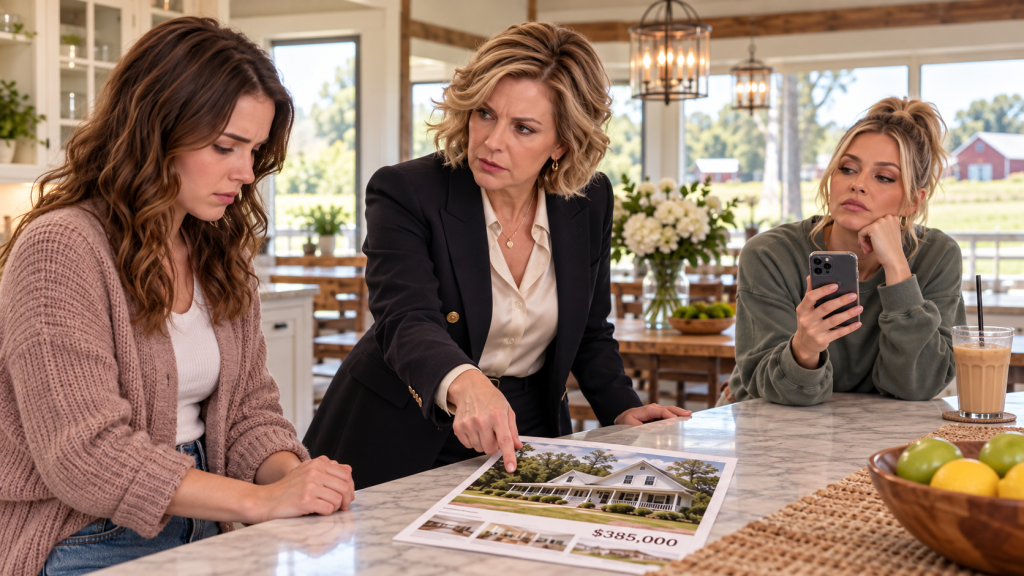
Same counter where Mom had slid the real-estate listing toward me years earlier.
Presley put her phone down.
Screen facing the table.
No recording.
“I was awful.”
I smiled.
“Yes.”
She laughed.
“You’re supposed to say we were young.”
“You were twenty-seven.”
“Still young.”
“Ancient.”
She threw a napkin at me.
Then looked around.
“Do you remember the listing?”
“I still have it.”
Her eyes widened.
“Why?”
“Evidence.”
“Of trauma?”
“Of bad pricing.”
She laughed.
“Three eighty-five was low.”
“Criminally.”
We checked.
The property would have been worth far more by then.
But I had stopped measuring Nana’s gift only in dollars.
Presley asked:
“Would you ever sell?”
I thought.
“Maybe.”
She looked surprised.
“Really?”
“Yes.”
“Doesn’t that feel like betraying Grandma?”
“No.”
“Nana said I could.”
Presley nodded.
Then:
“If you do, don’t give me anything.”
I smiled.
“Wasn’t planning to.”
“Rude.”
Some things healed enough to become jokes.
I never married.
Not because I distrusted love.
Life simply went another direction.
I had relationships.
One long one with a teacher named David.
We loved each other.
Then wanted different futures.
Ended kindly.
No property war.
No villain.
That was almost shockingly healthy.
Years later, I became aunt to Presley’s daughter.
A little girl named Evelyn.
Of course.
When Presley told me the name, I cried.
“She would hate being memorialized by an influencer.”
Presley smiled.
“Perfect.”
Little Evelyn grew up running through the same farmhouse halls Presley and I once fought in.
One summer, when she was eight, she asked:
“Aunt Bridget, is this your house?”
I opened my mouth.
Then remembered Nana’s last letter.
I looked out toward the pasture.
“For now.”
Evelyn frowned.
“What does that mean?”
“It means I take care of it while it belongs to me.”
She thought.
“Then who gets it after?”
I smiled.
“We’ll see.”
She ran away.
Children do not care about estate philosophy for long.
Years later, I revised the trust.
Not to recreate Nana’s control.
To create options.
The farm could be held.
Sold.
Leased.
Protected.
No one beneficiary could be evicted from their whole life without notice.
No one could borrow against shared assets secretly.
Independent review.
Clear records.
No invisible inheritance.
No weaponized uncertainty.
Presley read the documents.
“All this because Mom tried to sell one farmhouse.”
I stared at her.
“One farmhouse?”
She smiled.
“Fine.”
“One emotionally significant agricultural empire.”
I laughed.
The brass key remained in my desk.
It no longer opened the cottage after we changed the locks.
I kept it anyway.
Not because metal has magic.
Because it represented the moment Nana had given me something more important than property.
Access to the truth.
For most of my life, Mom controlled information.
Who owned what.
Who owed what.
What Nana intended.
What Presley received.
What I deserved.
Once I had the records, that power changed.
That is why secrets around money can become so destructive.
Money itself was not the deepest wound.
It was being told I had nothing while standing on something legally mine.
It was watching Presley receive support funded partly by money Mom pretended did not exist.
It was being called jealous when the numbers were actually unequal.
It was nearly being removed from my home through a story repeated so often I had begun to believe it.
The day Arthur locked his office door, I thought he was about to tell me I was rich.
He did not.
Seven hundred eighty thousand dollars of land and accounts is significant.
Life-changing, in some ways.
But what changed me most was one line in a trust.
My mother did not have authority to erase me from the place Nana intended me to inherit.
That sentence rearranged my spine.
Years later, when Arthur died, his daughter sent me a box.
Inside was his old desk nameplate.
And a note he had apparently written for several long-term clients.
Mine said:
You were never rescued by the trust. You were rescued by learning to read what had already been true.
Classic lawyer.
Even death did not stop him from billing emotionally.
I placed the note beside Nana’s.
The farmhouse eventually became more than a family home.
I converted the old workshop into two small rental studios.
Affordable.
Especially for women returning to school or leaving unstable housing.
Not charity.
Real leases.
Clear rules.
One tenant stayed eighteen months while finishing nursing school.
When she moved out, she cried.
“This place saved me.”
I shook my head.
“No.”
She looked confused.
“You did.”
I had learned that sentence from Dr. Morris in another life I had once imagined somebody else living.
People deserve credit for their own survival.
Buildings help.
Trusts help.
Lawyers help.
But people still have to walk through the door.
I did.
Presley did, eventually.
Even Mom did, in her own way.
The older I got, the less interested I became in deciding who was the villain.
Mom did illegal things.
That remained true.
She also loved us.
That remained true.
Presley treated me cruelly.
Then changed.
Both true.
Nana protected me.
And also used documents to shape a family after death.
Both true.
No one became simple just because the story finally had records.
That was okay.
Truth does not require simplicity.
It requires enough honesty to stop repeating the lie.
The lie in our family had been this:
Bridget has nothing.
Presley needs everything.
Mom decides.
That lie ended.
In its place came something less dramatic.
Bridget owns some things.
Presley owns some things.
Mom owes some things.
Everyone gets to ask.
Everyone gets to see the paperwork.
Nobody signs in secret.
Boring.
Beautiful.
The last time I found the old real-estate listing, I was cleaning the desk.
Glossy paper.
Professional photographs.
Front porch.
Kitchen.
Pasture.
Charming family farmhouse, priced to sell.
I smiled.
Then noticed Mom had written something on the back.
I had never seen it.
A list.
Asheville deposit
Presley debt
moving company
furniture
Bridget—2 months
Two months.
That was all she had budgeted for me.
Not money.
Time.
Two months to disappear from a home I had been promised before I knew promises mattered.
I expected anger.
Instead, I felt sad.
For her.
For the woman who believed security required making someone else temporary.
I folded the listing.
Walked outside.
The sun was setting behind the barn.
Presley’s daughter was chasing fireflies.
The old tractor still ran badly.
The fence still leaned in one place no matter how many times I fixed it.
Home.
Not because a deed said so.
The deed mattered.
Believe me.
But paper alone does not make belonging.
Choice does.
Truth does.
The absence of fear does.
No one in that house could slide a listing toward me and make my existence disappear anymore.
That was the inheritance.
Not the seven hundred eighty thousand dollars.
Not the farmhouse.
Not the timber.
Not the cottage.
The inheritance was permanence without captivity.
A place I could leave because nobody could force me out.
That difference changed everything.
And whenever someone asks me why Nana did not simply tell everyone the truth while she was alive, I think about that faded quilted pouch.
The brass key.
Arthur’s business card.
Her letter.
Maybe she should have told us more.
Maybe she believed documents could protect what conversations could not.
Maybe she was wrong in some ways.
But she gave me one thing perfectly.
A choice waiting for the moment I finally needed it.
Mom once told me:
“We’re selling. You have sixty days.”
For a few terrible minutes, I believed her.
Then I opened Nana’s envelope.
And learned something I should have known much earlier.
I was never the person they were allowing to stay.
I was the person they had forgotten could read the deed.
THE END STORIES! THANK YOU FOR READING GOOD LUCK !❤️
Related Posts