David did not speak for several seconds after James finished reading the forged document. The field hospital around him kept moving. A monitor beeped. Someone called for plasma in the next bay. Boots crossed the plywood floor.
A helicopter thudded somewhere beyond the canvas walls. War continued because war has no respect for the moment a man’s private life splits in half. James spoke first. “David.” He still said nothing. “Did you hear me?” “Yes.” His voice barely sounded human. James lowered his own.
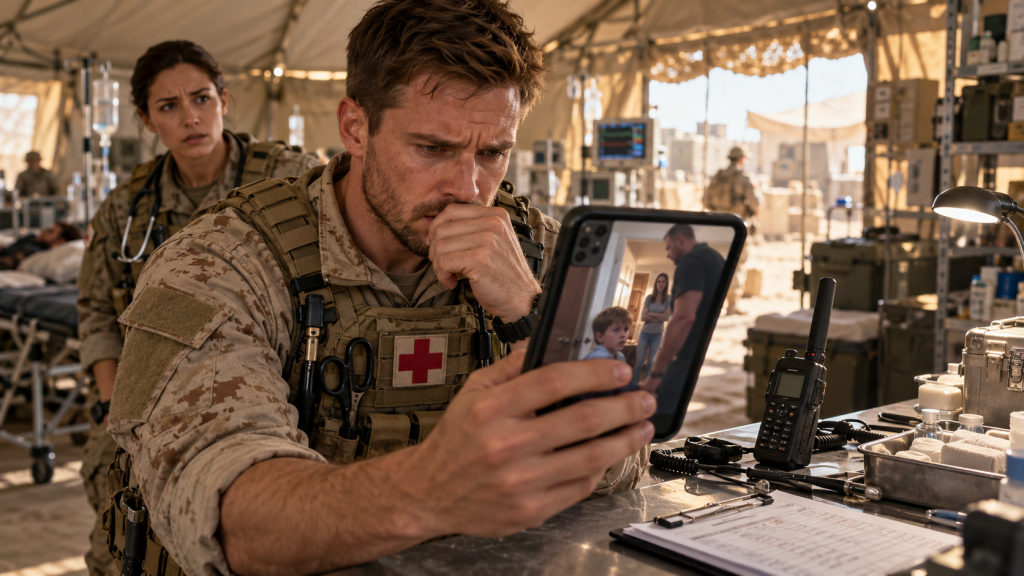
“The document says you granted Brian Lawson temporary authority over Matthew during your deployment.” “I didn’t.” “I know.” “It says indefinitely?” “Until revoked in writing or until a court modifies it.” David looked down at his hands. Hands that had held pressure on arterial wounds.
Hands that had restarted hearts.
Hands that had carried men twice his size toward helicopters.
They suddenly felt useless.
“Where did they get my signature?”
“We don’t know yet.”
“Who notarized it?”
“There’s a stamp.”
“Name?”
James paused.
“Dana Lawson.”
David’s head came up.
“Lawson?”
“Yes.”
Brian’s older sister.
A notary.
And according to the document, the person who supposedly witnessed David sign the paper in Dallas forty-one days after his deployment began.
David was in the Middle East that day.
There were duty logs.
Flight records.
Military payroll records.
Medical shift records.
Hundreds of witnesses.
The lie was not clever.
It had simply depended on nobody looking too closely.
David whispered,
“They thought I’d be gone long enough.”
James answered:
“Yes.”
“And by the time you returned, they expected the custody story to already exist.”
David closed his eyes.
Matthew’s passport.
The emergency petition.
The forged authorization.
Tomorrow’s filing date.
The violence.
Marissa watching.
Pieces that had seemed disconnected were beginning to form one structure.
His son had not merely been living with a violent man.
Someone had been preparing paperwork to make the violence harder to escape.
“Where is Matthew now?”
“County children’s hospital.”
“Condition?”
“Scalp injury.”
“Bruising.”
“Possible rib fracture, but imaging is still being reviewed.”
David gripped the edge of the table.
“Head CT?”
“Ordered.”
“Neuro status?”
“Alert.”
“Nausea?”
“Some.”
“Loss of consciousness?”
“Not according to the first medic.”
David was a father.
But he was also a medic.
He hated himself for how quickly his mind translated his child into assessment categories.
Airway.
Breathing.
Circulation.
Neurologic status.
Pain scale.
Evidence.
The language of survival.
James seemed to understand.
“He asked whether you were coming.”
David’s composure broke.
Not loudly.
He bent forward until his forehead almost touched the metal table.
“Tell him yes.”
“I did.”
“No.”
David looked up.
“Tell him exactly this.”
James waited.
“Tell him Dad is already on the way.”
It was not technically true.
Not yet.
David still needed release.
Transport.
Command approval.
Connections.
Flights.
But for the first time in years, he did not care about precision.
His son needed certainty.
“Tell him,” David repeated.
James said:
“I will.”
Then:
“David, there’s something else.”
Of course there was.
David’s entire body went still again.
“What?”
“The neighbor’s original message said 911 wasn’t coming because Brian was a cop.”
“Yes.”
“That may not have been paranoia.”
David stared.
James continued.
“State investigators are pulling dispatch logs.”
“Mr. Miller called three times.”
“First call classified as a domestic disturbance.”
“Second was downgraded.”
“Third was closed after someone noted that a supervising officer had made contact and determined no action was needed.”
David’s jaw clenched.
“Who was the supervising officer?”
James exhaled.
“Brian Lawson.”
The room seemed to tilt.
Brian had apparently responded to the complaint about himself.
Not physically.
Administratively.
His credentials appeared in the system.
His name on the resolution.
His authority converting a neighbor’s fear into an official nothing.
David said:
“He buried his own call.”
“That’s what investigators are checking.”
“Checking?”
James’s voice hardened.
“David, listen to me.”
“I know what you want to do.”
“You do not touch this.”
“You do not call Brian.”
“You do not call Marissa.”
“You do not call his department.”
“You get on that aircraft.”
“You land.”
“You go to your son.”
“And you let the evidence live.”
David hated him for saying it.
Which meant James was right.
“I’m not asking you to forgive anything.”
James continued.
“I’m telling you revenge is the easiest gift you could give Brian right now.”
“If you threaten him, he becomes scared.”
“If you strike him, he becomes injured.”
“If you give him any reason to say this is about an unstable deployed father instead of what he did to a child, you help him.”
David breathed slowly.
Once.
Twice.
Then:
“I want him prosecuted.”
“Good.”
“I want everyone who helped him investigated.”
“Good.”
“I want my son out of that house.”
“He already is.”
That sentence was the first mercy of the night.
Matthew was out.
The house remained.
The danger remained.
The marriage remained.
The lies remained.
But Matthew was out.
For now.
David said:
“Get me home.”
Fourteen hours later, he was over the Atlantic.
Not asleep.
Not even close.
He had spent the first leg of the flight reviewing updates through secure channels.
Matthew’s CT was clear.
No intracranial bleeding.
The rib injury was a severe contusion, not a fracture.
There were older bruises on his upper arms and back.
One appeared several days old.
Another older.
His scalp had a torn patch where hair had been pulled out near the root.
He had small abrasions on his knees.
The pediatrician documented everything.
Then came the sentence David reread until the words stopped looking like English:
Child reports this was not the first incident.
He turned the screen off.
Ten minutes later, turned it back on.
The protective-services interviewer had not completed a full forensic interview yet.
They were waiting until Matthew had rested.
Good.
David knew enough medicine to understand that exhausted children should not be interrogated because adults are impatient.
He wanted answers.
He wanted them now.
He also wanted his son protected from being turned into evidence before he could be a child.
That balance would define the next several years of his life.
At 3:11 a.m. Central Time, James sent another message.
Marissa detained for interview. Not under arrest yet.
David stared.
Then another.
Brian placed on administrative leave by department pending state investigation. State investigators have physical custody of service weapon and patrol bag.
Then:
Emergency protective order sought. Matthew remains hospital-protected.
David did not feel relief.
He felt hunger.
Not for violence.
For certainty.
He wanted a world in which no uniform could make a call disappear.
No marriage could turn a child’s scream into “discipline.”
No forged signature could convert absence into abandonment.
That world did not exist.
So he would have to work inside the one that did.
When David landed, James was waiting outside the secure military arrival area.
He looked older than David remembered.
Same square shoulders.
More gray hair.
No uniform.
He did not hug David.
He simply said:
“Matthew’s awake.”
David nodded.
Then:
“Take me.”
James drove.
For twenty minutes, neither spoke.
Dallas passed outside the window in pieces.
Billboards.
Gas stations.
Traffic lights.
Ordinary people moving through an ordinary morning.
David had imagined coming home for months.
Matthew running through an airport.
Marissa crying.
A duffel bag dropped beside the couch.
Pizza.
A shower.
His own bed.
Instead, he was wearing desert boots and going to a children’s hospital because a man had dragged his son by the hair while his wife watched.
Life does not ask whether an ending matches the beginning.
At the hospital entrance, James stopped him.
“David.”
He turned.
“Before you go in, one thing.”
“What?”
“Matthew has been asking whether he is in trouble.”
David’s throat closed.
“Why?”
“He thinks this happened because he disobeyed Brian.”
David looked away.
James continued.
“The therapist said not to overwhelm him with promises.”
“Don’t tell him you’ll never leave again unless you know exactly what that means.”
“Don’t tell him Brian can never come near him unless counsel confirms the order.”
“Give him what is true.”
David nodded.
James put one hand on his shoulder.
“Your son doesn’t need a sergeant.”
“He needs Dad.”
That was harder.
Sergeant Sullivan knew how to function.
Dad had failed to see that his family had been collapsing thousands of miles away.
He went inside anyway.
Matthew was smaller than he remembered.
That was David’s first thought.
Not because the boy had changed.
Because memory had protected him.
In David’s mind, Matthew was always moving.
Running toward the camera during video calls.
Showing missing teeth.
Holding Lego spaceships.
Now he sat in a hospital bed wearing a pale blue gown.
Bandage near his hairline.
Bruising visible on one cheek.
One arm around a stuffed dinosaur someone from the hospital had given him.
David stopped in the doorway.
Matthew stared.
For one second, neither moved.
Then:
“Dad?”
David crossed the room.
He did not grab him.
Did not scoop him up.
Did not assume touch was welcome.
He sat beside the bed.
“I’m here.”
Matthew’s lip trembled.
“You came fast.”
David smiled through tears.
“Not fast enough.”
Matthew reached for him.
That was permission.
David pulled his son carefully against his chest.
The boy started crying.
No words.
Just the deep exhausted crying of a child who has spent too many hours trying to understand why adults did not stop something.
David held him.
He could feel every breath.
Counted them instinctively.
One.
Two.
Three.
Alive.
That was enough for that minute.
After a while, Matthew whispered:
“Are you mad?”
David closed his eyes.
“At you?”
Matthew nodded.
“No.”
“Brian said I make Mom crazy.”
David kept his voice steady.
“You did not make anybody hurt you.”
“I kicked him.”
“While he was pulling your hair?”
“Yes.”
“That was your body trying to protect you.”
Matthew stared at him.
“Am I bad?”
“No.”
The answer came so quickly it startled them both.
“No.”
David repeated it.
“You are not bad.”
Matthew looked down.
“Mom said I should listen because Brian knows the law.”
David felt something sharp move through him.
“Did she say that?”
“Yes.”
“When?”
“A lot.”
A lot.
Two words.
A whole history.
David wanted to ask everything.
Instead:
“Okay.”
Matthew looked confused.
“That’s all?”
“For now.”
“But don’t you want to know?”
“I want to know everything.”
David touched the blanket.
“But you don’t have to tell me everything today.”
Matthew leaned into him.
That was the beginning of David learning that urgency is not the same thing as care.
The full forensic interview happened the following afternoon.
David did not watch.
He could have been permitted to observe remotely under certain arrangements, but the child specialist advised against it.
Matthew should speak without worrying whether his father’s face changed.
So David sat in a hallway with coffee he never drank.
James joined him.
The door remained closed for forty-seven minutes.
David counted every one.
When the interviewer emerged, she did not give him every detail.
She gave what he needed immediately.
Matthew described multiple incidents.
Hair pulling.
Being pushed against walls.
Being forced to stand facing a corner for long periods.
Food being withheld as punishment on at least two occasions.
Brian squeezing the back of his neck hard enough to leave marks.
One incident involving a belt.
David stood.
James immediately moved closer.
Not touching him.
Just present.
The interviewer said:
“Mr. Sullivan.”
David looked at her.
“I know this is difficult.”
Difficult.
He almost laughed.
She continued.
“Your son also described being told that if he complained, you could lose your job and go to jail because soldiers who abandon their families are criminals.”
David sat down again.
Brian had not simply hurt Matthew.
He had used David’s service as a threat.
Absence weaponized.
The interviewer continued.
“He said his mother sometimes tried to calm Brian afterward.”
David looked up.
“Afterward?”
“Yes.”
“Did she intervene during?”
The woman’s expression changed slightly.
“Sometimes.”
“Meaning?”
“There are incidents where Matthew described her telling Brian to stop.”
“Others where she told Matthew to obey.”
“And at least one where she left the room.”
David closed his eyes.
Marissa.
He needed her to be one thing.
Monster.
Victim.
Complicit.
Terrified.
Something simple.
Evidence refused.
The first interview with Marissa complicated everything.
She admitted the affair.
It had begun seven months after David deployed.
Brian first came into her life through a neighborhood security meeting after a series of burglaries.
He was charismatic.
Helpful.
Available.
Everything David was not from six thousand miles away.
At first, she told herself it was companionship.
Then emotional.
Then physical.
That betrayal hurt.
But even David knew immediately it was no longer the central wound.
The abuse was.
Marissa said Brian became controlling after three months.
Checked her phone.
Commented on her clothes.
Criticized Matthew.
Insisted David’s deployments proved he valued the military more than his family.
She said Brian told her police would believe him if conflict ever arose.
David’s attorney later asked:
“Do you believe she was afraid of him?”
David answered:
“Yes.”
Then:
“Do you believe fear explains everything she did?”
“No.”
That distinction stayed.
Fear explained some silence.
Not all complicity.
Marissa had signed the emergency custody petition.
Voluntarily.
She had participated in collecting records portraying David as absent.
She had given Brian copies of deployment documents.
She had allowed him to use Matthew’s passport.
She had seen bruises and failed to seek medical care.
At one point, she photographed Matthew’s arm.
Not to report abuse.
To send Brian a message saying:
You need to be more careful.
That text destroyed any illusion that she had not understood.
She knew.
Maybe not every time.
Maybe not every degree.
But she knew enough.
Brian, meanwhile, had built a paper trail.
Not only the forged authorization.
There were draft affidavits.
Screenshots.
Printouts of missed calls from David that were framed as “inconsistent contact.”
School tardiness blamed on “instability due to father’s prolonged absence.”
A note from Brian claiming Matthew showed “aggressive conduct after communications with deployed parent.”
No licensed clinician had diagnosed that.
Brian had written it himself.
There were photographs of David holding a rifle overseas pulled from an official family newsletter.
Under one, Brian had typed:
High-risk military exposure / possible reintegration concerns.
David stared at that line.
Then laughed.
His attorney, Laura McKenna, looked at him.
“What?”
“He was building a story where being a medic made me dangerous.”
Laura nodded.
“Yes.”
“While he was hitting my kid.”
“Yes.”
David looked down.
That was the whole architecture.
Brian did not need a perfect lie.
He needed enough paper to make the truth expensive.
Enough delay.
Enough doubt.
Enough official language to make a judge hesitate.
The forged signature came from a family-care document David had completed before deployment.
Marissa had access to a scanned copy.
The signature image matched almost exactly.
The false authorization had been assembled digitally.
Dana Lawson’s notary log became critical.
She initially insisted David had appeared remotely.
That created another problem.
At the time she claimed to have notarized the document, remote notarization required a process she could not prove she had followed.
No video.
No journal entry consistent with the session.
No identification record.
And David had been on a documented twelve-hour field rotation with no personal video access.
Eventually, Dana admitted Brian asked her to “help with family paperwork.”
She claimed she believed Marissa had authority.
That explanation did not save her commission.
Nor did it prevent legal consequences.
But like everything else, responsibility came in degrees.
Dana had not abused Matthew.
She had helped legitimize a lie.
Brian’s police department became its own investigation.
Not every officer protected him.
That mattered.
The truth was less satisfying than a conspiracy.
More believable.
Two dispatchers had followed normal procedure.
One patrol officer drove past after the first complaint but did not make contact because Brian, a commander, electronically noted that he was handling the situation personally.
A second officer later admitted he saw Brian’s name and assumed the matter was “domestic and handled.”
A lieutenant approved closure without reviewing the neighbor’s video because no video had yet been entered into the record.
Negligence.
Deference.
Institutional habit.
Maybe favoritism.
State investigators found no evidence that the entire department had knowingly conspired to cover child abuse.
They found something almost as dangerous.
People saw rank and stopped asking questions.
The chief resigned months later.
Not solely because of Brian.
Because the external review showed serious failures in complaint handling, supervisor overrides, and conflict-of-interest safeguards.
New policies followed.
Independent review when an officer was personally named in a complaint.
Automatic escalation for child-welfare allegations involving department personnel.
Audit trails that could not be closed by the subject of the complaint.
David did not celebrate.
Policies written after your son bleeds are difficult to applaud.
Still, they mattered.
Mr. Miller became an unexpected hero in local news.
He hated that description.
“I just used my phone.”
David visited him after Matthew was discharged.
The old man opened the door and immediately started crying.
David did too.
Neither pretended otherwise.
Mr. Miller said:
“I should’ve gone over there.”
“No.”
“I heard him.”
“No.”
“I could’ve—”
David shook his head.
“Brian had a gun.”
Mr. Miller looked down.
“I felt like a coward.”
David sat across from him.
“You documented.”
“You called.”
“You kept calling.”
“You got the message to me.”
“That is what helped Matthew.”
The old man nodded.
Then:
“Those men James sent…”
David’s expression tightened.
“They were there to secure Matthew.”
“They moved fast.”
“They heard him screaming.”
“They entered because a child was in immediate danger.”
Mr. Miller studied him.
“They could’ve hurt Brian.”
“Yes.”
“But they didn’t.”
“No.”
“Why?”
David thought about James’s words.
Don’t ask me for revenge.
Then:
“Because rescuing my son was more important than punishing a man.”
That sentence became another dividing line in David’s life.
The “team” was investigated too.
Of course they were.
A retired federal agent.
Two former military medics.
A private investigator.
They had gone to the house with body cameras.
They had no general search warrant.
But they had neighbor video, an active report of child abuse, audible screaming when they arrived, and a child in apparent immediate danger.
Their entry was scrutinized.
So was every second of the footage.
Lawyers argued.
Review boards reviewed.
No one simply declared them heroes and walked away.
In the end, prosecutors concluded the emergency entry was supported by the circumstances and did not pursue charges against them.
James received an internal reprimand from one organization for using unofficial contacts without authorization.
He accepted it.
David apologized.
James shrugged.
“Paperwork heals.”
David almost laughed.
“No, it doesn’t.”
“No.”
James looked at him.
“But sometimes it keeps the next person from improvising.”
Fair.
The custody case came faster than the criminal case.
Emergency orders temporarily placed Matthew with David once medical staff cleared him and military command approved David’s compassionate leave.
Marissa received supervised contact.
Brian received no contact.
Not because David demanded it.
Because the evidence was overwhelming enough for the court to act.
The first night Matthew came home with David, they did not go to the old house.
David refused.
The house was evidence.
And emotionally, it belonged to danger.
They stayed in a furnished apartment arranged through military family support.
Two bedrooms.
Ugly couch.
Coffee table with one leg shorter than the others.
Matthew loved it.
“Can we stay here forever?”
David looked around.
“At this place?”
“Yes.”
“The microwave sounds like it’s dying.”
Matthew smiled.
“I like it.”
David understood.
No Brian.
No Marissa.
No memories in the walls yet.
Temporary can feel safer than familiar when familiar betrayed you.
The first night, Matthew refused to sleep alone.
David sat on the floor beside the bed.
No lights off.
Door open.
At 2:10, Matthew whispered:
“Dad?”
“I’m here.”
“If you go back to war, do I have to stay with Mom?”
David’s chest tightened.
He had promised James he would not lie.
“I don’t know exactly what the court will decide yet.”
Matthew began crying.
David continued quickly.
“But I know this.”
“What?”
“I am not leaving you without a safe plan.”
“Ever?”
David paused.
“Ever.”
That he could promise.
Not that he would never deploy again.
Not that nothing bad would happen.
Safety planning.
Not magical protection.
Matthew stared at him.
“Can I come with you?”
“To war?”
“Yes.”
Despite everything, David almost laughed.
“No.”
“Why?”
“Because your homework is dangerous enough.”
Matthew smiled faintly.
Then fell asleep.
David stayed on the floor until morning.
The criminal investigation uncovered the deeper motive behind the custody papers.
At first, David thought Brian wanted Marissa and wanted him gone.
True.
But incomplete.
Brian also had a personal reason to formalize control over Matthew.
Financial.
Military survivor benefits and family allowances had been discussed in messages between Brian and Marissa.
Not because David was expected to die.
Not explicitly.
But Brian repeatedly complained that David’s income “still controls the household.”
He encouraged Marissa to move direct deposits.
To redirect certain dependent-related payments.
To change beneficiaries where possible.
Most changes failed because military and insurance systems required direct authentication David had not provided.
One small joint account, however, had been drained.
$41,700.
Emergency savings.
David had built it over six years.
Marissa transferred most of it to a new account.
From there, approximately $18,000 went toward household expenses.
Some paid legal consultations related to custody.
Some paid a down payment on a truck Brian purchased.
David stared at the statement.
“A truck?”
Laura nodded.
“It’s titled to Brian.”
Using money from David’s deployment savings.
The betrayal was almost too ordinary.
No secret island.
No offshore account.
A truck.
People imagine life-changing theft should buy something grand enough to justify itself.
Often it buys a vehicle that depreciates in a parking lot.
More disturbing were messages about David’s future assignment.
Brian had researched the military academy in Virginia.
School districts near it.
Travel distance.
Jurisdiction.
One message said:
If we get the emergency order before he lands, Virginia won’t matter. He’ll be the one trying to undo status quo.
Status quo.
Matthew being dragged by his hair was part of the status quo Brian wanted to establish.
Another message from Marissa said:
I don’t want to take Matthew from David forever.
Brian replied:
You don’t need forever. You need first.
David read that line until his lawyer took the page away.
That explained the filing date.
Tomorrow.
They expected temporary advantage to become leverage.
The emergency petition accused David of abandonment due to repeated voluntary deployments.
False.
His deployment orders documented service obligations.
It claimed he had been “emotionally absent.”
Subjective.
It claimed Matthew feared him.
False, according to multiple communications and later professional evaluation.
It alleged David had discussed “combat violence” with the child.
Technically, David had once told Matthew why he treated injured soldiers.
Brian turned fatherly explanation into instability.
Paper does not have to lie completely to mislead.
It only has to arrange truth dishonestly.
Marissa’s role became the hardest part for Matthew.
When supervised visits began, he wanted to see her.
David hated that instinctively.
Then hated himself for hating it.
Dr. Evelyn Parks, Matthew’s therapist, told him:
“Your son is not betraying you by loving his mother.”
David nodded.
Then did not behave as if he understood.
The first visit left Matthew crying.
Marissa had apologized.
Too much.
“She said she’s sorry over and over.”
David asked:
“Did she ask you to forgive her?”
Matthew shook his head.
“No.”
“Did she blame Brian?”
“Some.”
David clenched his jaw.
“What did she say?”
“That she was scared of him.”
That was probably true.
Then:
“She said she should’ve protected me.”
Also true.
Matthew looked at his hands.
“I asked why she didn’t.”
David waited.
“What did she say?”
“She cried.”
He looked up.
“That’s not an answer.”
Seven years old.
Already understanding what adults twice his age avoid.
“No,” David said.
“It isn’t.”
Marissa eventually gave a full statement as part of a negotiated resolution.
She admitted she knew Brian’s discipline was physically abusive.
She admitted signing false statements.
She admitted helping him collect documents.
She admitted the forged signature was Brian’s idea and that she provided the source image.
She insisted she did not know his sister would notarize it falsely.
Investigators found that plausible.
She admitted moving money.
She denied knowing Brian had used his police access to close complaint calls.
That also appeared plausible.
The state did not charge her as if she were Brian.
Different acts.
Different culpability.
She faced child-endangerment-related charges, falsification-related offenses, and financial consequences.
She entered a plea.
Probationary supervision.
Mandatory treatment.
Parenting restrictions.
Restitution.
No immediate unsupervised custody.
No fairy-tale reunion.
David filed for divorce.
Marissa did not fight the dissolution itself.
She fought for a path back to parenting.
That mattered.
The marriage was over.
Motherhood was not automatically erased.
The family court required therapeutic supervision.
Parenting classes.
Individual therapy.
Compliance.
No contact with Brian.
No discussion of litigation with Matthew.
No introducing romantic partners without notice and later court modification.
Slow.
Deliberate.
The kind of process people online call “too lenient” when they do not have to live inside a child’s heart.
Matthew missed her.
That was the truth.
He also feared disappointing David by saying so.
Dr. Parks caught it first.
She told David privately:
“He is protecting you.”
David closed his eyes.
“No.”
“Yes.”
“From what?”
“From knowing he loves her.”
That sentence broke him.
David went home and sat beside Matthew on the floor.
They were assembling a model helicopter.
Matthew was terrible at instructions.
David said:
“Hey.”
“What?”
“You never have to protect me from loving Mom.”
Matthew froze.
David continued.
“I’m angry at her.”
“I’m hurt.”
“We are getting divorced.”
“All true.”
“But she is your mother.”
“You can love her.”
Matthew looked at him.
“You won’t be mad?”
“No.”
“What if I forgive her?”
David swallowed.
“That is yours.”
“What if you don’t?”
“That is mine.”
Matthew thought.
Then:
“What if I forgive her and then get mad again?”
David smiled.
“Sounds normal.”
Matthew nodded.
Then glued the helicopter blade backward.
Progress.
Brian’s case took almost two years.
The department terminated him before the criminal case concluded.
The state’s review found serious violations.
Improper access to complaint systems.
False administrative entries.
Misuse of official authority.
Possession of documents connected to the custody fraud.
Evidence that he had used police databases for personal searches related to David’s travel and service status.
No proof he had ordered other officers to ignore abuse.
No evidence of a grand department-wide conspiracy.
Just one man with authority exploiting gaps other people had been too deferential to challenge.
Brian’s defense attacked the rescue team.
The neighbor.
David.
Marissa.
Everyone.
They argued Matthew was difficult.
That physical control had been misinterpreted.
That the hair pulling was exaggerated by camera angle.
Then prosecutors played Mr. Miller’s video.
No argument survives a child’s knees hitting grass very gracefully.
They played the body-camera footage from the rescue.
Brian saying:
“He needs discipline.”
They showed medical photographs.
Dispatch logs.
The forged paperwork.
Dana’s notary irregularities.
Messages discussing “status quo.”
The truck purchase.
Not every ugly thing became a separate conviction.
Law does not work that way.
Some conduct overlapped.
Some supported broader counts.
Some became evidence of intent.
Brian ultimately faced convictions and pleas related to injury to a child, tampering and falsification, abuse of official access, and related misconduct.
The sentence was substantial.
Not life.
Not death.
Years.
Enough to remove him from policing.
Enough that Matthew would become a teenager before any realistic possibility of contact mattered.
There was also a no-contact order.
Brian never saw Matthew again.
That fact gave David less satisfaction than he expected.
Justice did not feel like victory.
It felt like a door with locks checked twice.
Dana lost her notary commission and faced penalties.
She claimed until the end she had believed she was helping her brother with a legitimate family emergency.
Maybe.
But she signed her authority onto a lie.
Intent mattered.
So did responsibility.
The police department settled civil claims related to supervisory failures and system misuse.
David did not become wealthy.
After attorney fees, treatment costs, relocation, and structured portions allocated for Matthew’s care, the settlement became security more than fortune.
Therapy.
Education trust.
Medical follow-up.
A college fund.
David liked that.
Money built from failure turned into future care.
He did not buy a truck.
James teased him once.
“Missed opportunity.”
David nearly threw coffee at him.
The military offered David choices.
Return to deployment after compassionate leave.
Transfer earlier.
Medical reassignment.
He spent weeks agonizing.
He had built his identity around service.
Twelve years.
Medals in drawers.
Friends buried.
Friends saved.
He had planned the Virginia instructor role because it would bring him home more.
Now even that felt like a compromise.
One night he asked Matthew:
“Would you be okay moving to Virginia?”
Matthew looked worried.
“Without Mom?”
“At first.”
“Is there war there?”
“No.”
“Then okay.”
David laughed.
Fair.
He accepted the instructor position.
No more combat rotation.
Not because he became afraid of war.
Because his definition of duty changed.
That sentence took him years to say without guilt.
At the military academy, he trained medics.
Trauma care.
Evacuation.
Decision-making under pressure.
He was excellent.
But the lesson he repeated most often was not technical.
“Your first job is to see what is actually in front of you.”
Not what rank says.
Not what expectation says.
Not what someone more powerful wants you to call it.
See the patient.
See the evidence.
See the danger.
He never told the class why that mattered so much.
Matthew knew.
They bought a small house outside Richmond.
White siding.
Backyard.
No dinosaur stickers on the front door at first.
Matthew said he was too old.
Two weeks later, David found one tiny dinosaur sticker beside the garage.
He said nothing.
The first year was difficult.
Matthew had nightmares.
Not every night.
Enough.
He hated having his hair brushed.
David learned to ask first.
He flinched when adult men raised their voices.
He became angry over small rules.
Dr. Parks, who continued remotely before transferring care, explained:
“Control can feel dangerous after coercion.”
David asked:
“So what do I do?”
“Offer predictable choices where choices are possible.”
So instead of:
Take a shower now.
He said:
“Shower before dinner or after?”
Instead of:
Go to bed.
“Ten minutes reading or fifteen?”
Not unlimited freedom.
Choice inside safety.
It worked slowly.
David had to learn that command presence, useful in emergencies, could frighten his son.
One evening Matthew spilled milk.
David said sharply:
“Hey!”
Matthew dropped to the floor.
Hands over his head.
David froze.
Every cell in his body stopped.
“I’m sorry.”
Matthew stayed curled.
David knelt several feet away.
“I’m not going to hit you.”
No movement.
“I raised my voice.”
“I shouldn’t have.”
“I’m staying right here.”
Minutes passed.
Finally Matthew looked up.
“Brian yelled before he hit.”
David’s eyes filled.
“I know.”
“Are you mad about the milk?”
“No.”
“But you yelled.”
“Yes.”
“I was startled.”
“That is not your fault.”
Matthew stared.
Then:
“Can I clean it?”
“If you want.”
“I spilled it.”
“Then we clean it together.”
They did.
Neither pretended it was just milk.
Years later, David would remember that night more clearly than Brian’s sentencing.
Because healing is not built from a judge’s words.
It is built from moments when a child expects history to repeat and it doesn’t.
Marissa followed her treatment plan.
Slowly.
Painfully.
She did not regain overnight custody.
Her first unsupervised afternoon with Matthew came nearly two years after the abuse was discovered.
By then, David had spent countless hours angry about the possibility.
Then the day arrived.
He packed Matthew’s backpack like a medic preparing a field kit.
Water.
Snack.
Phone.
Emergency contacts.
Inhaler even though Matthew barely needed it anymore.
Matthew rolled his eyes.
“Dad.”
“What?”
“I’m going to lunch.”
“Lunch can become anything.”
“Dr. Parks says that’s catastrophizing.”
David stared.
“Dr. Parks talks too much.”
Matthew smiled.
At the door, he hesitated.
“Will you be here when I get back?”
David understood immediately.
“Yes.”
“Promise?”
“Yes.”
Matthew went.
David spent three hours pretending to clean the garage.
When Marissa returned him, she remained at the end of the driveway.
Good.
Matthew walked inside carrying a milkshake.
“How was it?”
“Okay.”
“Just okay?”
“Weird.”
David nodded.
“Good weird or bad weird?”
Matthew frowned.
“Stop stealing therapist questions.”
Fair.
Then:
“Mom cried.”
David said nothing.
“She said she was sorry.”
“Okay.”
“I told her I know.”
David waited.
Matthew looked at him.
“That’s all.”
Sometimes that is all.
Years passed.
Marissa did not become the woman David had married again.
That person existed only in memory anyway.
She became a mother Matthew saw regularly under gradually less restrictive arrangements.
She never regained equal parenting time.
Not because David opposed it forever.
Because the court, therapists, and eventually Matthew’s preferences supported a different structure.
As a teenager, Matthew spent one weekend a month with her, plus dinners.
Some months more.
Some less.
Marissa accepted that without litigation.
That was part of her accountability.
She never dated another police officer.
David privately thought that was beside the point.
Her future choices were hers.
What mattered was whether she stopped outsourcing judgment to whoever sounded most certain.
By the time Matthew was fourteen, he asked her directly:
“Why didn’t you stop him?”
They were in family therapy.
David was not present.
Matthew told him later.
“What did she say?” David asked.
“She said because every time she waited, the next time became easier to excuse.”
David went quiet.
Matthew continued.
“She said she was scared.”
“Do you believe her?”
“Yeah.”
“Does that make it okay?”
“No.”
David nodded.
Good.
Matthew had learned nuance without surrendering reality.
At fifteen, he saw the original neighbor video.
Not because anyone showed him recklessly.
Because he asked.
His therapist prepared him.
David sat nearby.
Matthew watched once.
Then turned it off.
He stared at the black screen.
“That’s me.”
“Yes.”
“I look little.”
“You were.”
He swallowed.
Then:
“Why didn’t Mom move?”
David had no answer that belonged to him.
“Ask her.”
Matthew did.
Months later.
He never told David the full response.
That was okay.
Children become entitled to private relationships with their parents as they age.
David had learned not to own every truth.
James remained part of their lives.
Uncle James, despite being no relation.
He visited Virginia twice a year.
Taught Matthew to fish badly.
Told inappropriate military stories until David stopped him.
One evening, when Matthew was sixteen, he asked:
“Were you really going to send hitters to my house?”
James nearly choked on his drink.
David closed his eyes.
“Who told you that phrase?”
“Dad’s old messages.”
James looked at David.
“You let him read those?”
“He found a backup.”
Teenagers.
James leaned back.
“No.”
Matthew looked disappointed.
“No?”
“I sent people who knew how to respond to a dangerous situation.”
“That sounds less cool.”
“It was supposed to.”
Matthew laughed.
James continued.
“Your dad was angry enough that I was very careful about what I offered.”
Matthew looked at David.
“You wanted them to hurt Brian?”
David answered honestly.
“For about ten seconds?”
“Yes.”
Matthew went quiet.
Then David continued.
“But wanting something and choosing it are different.”
“Why didn’t you?”
“Because getting you out mattered more.”
James nodded.
“And because revenge would’ve made your dad easier to discredit.”
Matthew thought.
Then:
“So you were strategic.”
James smiled.
“Now that sounds cool.”
David threw a napkin at him.
That conversation mattered.
David did not want his son learning that masculinity meant violence answered violence.
He wanted him to know rage is information.
Not instruction.
At seventeen, Matthew had his first serious girlfriend.
A girl named Nia.
The first time she met David, she said:
“Matthew says you can fix bullet wounds.”
David replied:
“I prefer preventing them.”
Good answer.
Matthew groaned.
“Dad.”
Normal embarrassment.
Beautiful.
At eighteen, Matthew graduated high school.
Marissa attended.
James too.
Mr. Miller flew in with his daughter.
David had stayed in touch with the old neighbor all those years.
When Matthew saw him, he crossed the room and hugged him.
Mr. Miller cried instantly.
“I didn’t do anything.”
Matthew smiled.
“You sent the video.”
“Yes.”
“That was something.”
David looked away.
Because eighteen-year-old Matthew was speaking to the man who had refused to look away when a whole system briefly did.
After graduation, they went to dinner.
At 8:43, Matthew raised his glass of soda.
“To old people with phones.”
Mr. Miller laughed.
“To kids who survive being teenagers.”
Fair.
Marissa sat at the other end of the table.
Not beside David.
Not excluded.
Just part of a family no longer pretending to be what it was.
That took years.
Matthew chose nursing.
Not military.
Not law enforcement.
Not trauma surgery.
Pediatric nursing.
David almost objected.
Then caught himself.
His son’s future was not a symbolic sequel to his own.
Matthew said:
“I like kids.”
“That’s your whole reason?”
“Pretty much.”
Good.
Children should be allowed ordinary reasons.
He went to college in North Carolina.
The first month, David called too much.
Matthew finally said:
“Dad.”
“What?”
“I survived Brian.”
“I can survive dining hall pasta.”
David replied:
“Those are separate threats.”
Matthew hung up.
Progress.
David dated eventually.
Not for years.
Then he met Erin.
A physical therapist.
Divorced.
Two teenagers.
The first time she stayed for dinner, Matthew was twenty-one and home from college.
He watched her carefully.
David noticed.
After she left, he asked:
“What do you think?”
Matthew shrugged.
“She seems normal.”
“High praise.”
“Don’t marry anybody weird.”
“I’ll put that in my criteria.”
Erin and David married three years later.
Small ceremony.
Matthew stood beside him.
Marissa was not invited.
Not out of revenge.
She had no place at David’s wedding.
Matthew attended both as son and best man.
During the toast, he said:
“My dad taught me how to make tourniquets, change tires, and overpack for a three-hour drive.”
Everyone laughed.
Then:
“He also taught me something he had to learn late.”
David looked up.
Matthew continued.
“Being strong is not the same as making every decision alone.”
David’s eyes filled.
James shouted:
“Finally!”
More laughter.
Good.
Brian came up for parole review years later.
Matthew was an adult.
No one asked David to decide how he should feel.
Matthew wrote a victim-impact statement.
He let David read it only after submission.
It said, in part:
You used your authority to make me believe adults would not help me. The most important thing I learned afterward is that you were wrong.
David stopped reading for a moment.
Then continued.
My neighbor helped. Strangers helped. Doctors helped. Investigators helped. My father came home. My mother eventually told the truth. You were not the whole world, even when you made yourself feel like it.
David cried.
No threat.
No revenge.
No wish for suffering.
A boundary written by the child Brian once dragged through grass.
The parole board considered many factors.
Matthew’s statement was one.
Brian remained incarcerated longer.
Eventually, years later, he was released under supervision.
No contact.
No police work.
No place in Matthew’s life.
Matthew did not track him.
David tried not to either.
The day Brian was released, David found himself checking the locks twice.
Erin noticed.
“You okay?”
“Yes.”
She waited.
He sighed.
“No.”
She stood beside him.
Not solving.
Just there.
He said:
“I hate that he still changes what my hands do.”
Erin looked at the lock.
“Then check it once.”
“What?”
“Check it once because that is reasonable.”
“Then stop.”
David stared at her.
Annoyingly sensible.
He checked once.
Walked away.
That became its own victory.
Marissa’s later life was quieter.
She worked.
Completed every court requirement.
Paid restitution.
Rebuilt a modest relationship with Matthew.
She never asked David to forgive her.
That helped.
At Matthew’s college graduation, she approached David.
They had not spoken privately in years.
“David.”
“Marissa.”
She looked older.
So did he.
“I owe you an apology.”
He almost laughed.
“You’ve apologized.”
“Not for this.”
He waited.
“I used your deployment as an excuse to make my loneliness more important than your trust.”
David said nothing.
She continued.
“Then I used fear of Brian to avoid admitting when I had already made choices.”
Her eyes filled.
“I was afraid of him.”
“I believe you.”
“But I also protected him.”
“Yes.”
“And I failed Matthew.”
David looked toward their son across the lawn.
Twenty-three.
Laughing with classmates.
Cap crooked.
Alive.
Marissa whispered:
“I don’t expect forgiveness.”
David thought.
Then:
“I stopped organizing my life around whether I forgive you.”
She nodded.
That hurt her.
He could see it.
Still true.
Then he added:
“But I’m glad you became safer for him.”
She cried.
“Thank you.”
That was all.
No hug.
No reconciliation.
No restored marriage.
Some relationships end without needing hatred to keep them ended.
Mr. Miller died when Matthew was twenty-five.
Stroke.
David and Matthew flew to Dallas for the funeral.
The old neighborhood looked smaller.
David’s former house had been sold years earlier.
Another family lived there.
Different paint.
No dinosaur stickers.
Matthew stood across the street.
“That’s it?”
David nodded.
“I remember it bigger.”
“You were seven.”
They walked past Mr. Miller’s house.
His daughter gave Matthew a small envelope.
Inside was a printed photograph.
A still frame from a different video.
Not the abuse.
A backyard clip Mr. Miller had apparently taken months before.
David pushing Matthew on a swing during predeployment leave.
Matthew laughing.
Marissa in the background carrying lemonade.
A family before everything.
On the back, Mr. Miller had written:
Don’t let the worst video become the only one you remember.
Matthew cried.
So did David.
They framed that picture.
Not the rescue.
Not the evidence.
The swing.
That choice mattered.
Years later, Matthew had a son.
He named him Owen.
David held the baby in a hospital room and experienced terror so immediate he almost handed him back.
Tiny head.
Tiny hands.
Entire future.
Matthew saw his face.
“You okay?”
David laughed.
“No.”
“Helpful.”
“I forgot babies are this small.”
“You held me.”
“Apparently I survived.”
Matthew smiled.
Then became serious.
“Dad?”
“Yes?”
“I’m scared I’m going to be too protective.”
David looked at his son.
Then the newborn.
“You probably will be sometimes.”
“Great.”
“You’ll apologize.”
Matthew laughed.
“That’s your advice?”
“No.”
David adjusted the blanket.
“My advice is: don’t confuse fear with wisdom.”
Matthew went quiet.
David continued.
“You can know bad things happen without treating him like danger is everywhere.”
“Let him have a childhood bigger than what happened to you.”
Matthew’s eyes filled.
“Okay.”
David handed Owen back.
Grandfather.
That word felt impossible.
The first time Owen ran across a yard, David felt his body react.
For one flash, he saw hair in Brian’s fist.
Grass.
Knees.
Then Matthew scooped Owen up.
Laughing.
Safe.
David breathed.
Memory was not prophecy.
At sixty, David retired from teaching.
The academy gave him a plaque.
He hated plaques.
James attended.
Older.
Cane now.
Still sarcastic.
During the retirement dinner, James said:
“Sullivan spent his career teaching people to run toward emergencies.”
David rolled his eyes.
Then James added:
“Eventually he learned staying afterward is a skill too.”
That quieted the room.
David looked at Matthew.
His son understood.
Rescue takes minutes.
Parenting after rescue takes years.
That was the real story.
Not the eight-minute arrival.
Not the body cameras.
Not the arrest.
Not the forged paperwork.
The years after.
The haircuts Matthew hated because someone had once pulled his hair.
The nights he checked doors.
The first safe visit with his mother.
The first spilled milk that ended in a towel instead of violence.
The first time he said he loved Marissa without watching David’s face.
The first day in college.
The first patient he comforted.
The first baby he held.
The first home he built where nobody’s badge mattered more than a child’s voice.
David kept the forged document for decades.
Not physically.
His attorney retained certified copies.
David kept one scan.
The page saying he had granted Brian authority over Matthew.
His own stolen signature beneath words he never approved.
For years, he could not delete it.
Then one afternoon, Owen was six.
Same age Matthew had been when some of the abuse began.
Owen was at David’s house building a cardboard fort.
He grabbed David’s old tablet.
“What’s this?”
David looked.
The document.
His chest tightened.
He took the tablet gently.
“Old paperwork.”
“Boring?”
“Yes.”
“Delete it.”
David almost laughed.
“Why?”
“It’s boring.”
Children can be wise accidentally.
That night, after Owen went home, David opened the file.
He read it once.
Temporary authority.
Parental absence.
Best interests.
David Sullivan.
His forged name.
He selected delete.
The tablet asked:
Are you sure?
David stared.
Then pressed:
Yes.
No ceremony.
No speech.
The legal archives remained.
Truth did not depend on his personal copy anymore.
He slept well.
Matthew called the next morning.
“Dad.”
“Yeah?”
“Owen says you deleted something important because he told you it was boring.”
David smiled.
“Correct.”
“What?”
“A lie.”
Silence.
Then Matthew understood.
“That document?”
“Yes.”
“You okay?”
David looked out the window.
Morning light on grass.
No sirens.
No uniforms.
No boy screaming.
“Yes.”
This time he meant it.
People later told the story in simplified ways.
Combat medic sees video.
Cop boyfriend hurts son.
Military friends arrive.
Bad guy arrested.
Father comes home.
Justice.
Clean.
Fast.
Almost satisfying.
That was never the whole story.
David had learned that rescue is the easy part to narrate because rescue has motion.
Doors open.
People run.
Sirens arrive.
Someone is carried out.
Healing is quieter.
A child deciding he can sleep with the door closed.
A mother admitting fear does not erase complicity.
A father learning not to turn vigilance into another cage.
A police department admitting rank should never silence a complaint.
A neighbor understanding that calling again is courage.
A soldier choosing not to confuse revenge with protection.
A family becoming smaller and safer rather than larger and false.
Years after the first video, David returned to Dallas with Matthew.
They stood outside Mr. Miller’s old house.
Matthew was forty.
David almost seventy.
Owen, now a teenager, was with them.
The three generations stood beneath the crepe myrtle that had once appeared in the background of the worst video David ever watched.
Owen asked:
“Is this where it happened?”
Matthew nodded.
“Yes.”
Owen looked toward the house across the street.
“Do you hate it?”
Matthew thought.
“No.”
“Why not?”
“Because houses don’t choose.”
David smiled.
His son had become wiser than him.
Owen looked at David.
“Grandpa, is it true you sent commandos?”
David groaned.
“Your father has exaggerated this story for thirty years.”
Matthew laughed.
“You literally called Captain Archer.”
“Former Captain Archer.”
“He sent four tactical dudes.”
“Medical and investigative personnel.”
Owen grinned.
“So yes.”
David sighed.
“Fine.”
Then he became serious.
“But they were not there to punish anyone.”
Owen waited.
“They were there to get your dad out.”
Matthew looked at him.
Even after decades, that distinction still mattered.
David continued.
“The hardest thing I ever did after that was understand that protecting someone does not mean controlling everything around them.”
Owen frowned.
“That sounds like something Dad says.”
“Because he steals my material.”
Matthew rolled his eyes.
Then David looked at his son.
“Your dad survived because a lot of people did one thing right at the right time.”
“Mr. Miller recorded.”
“James called people.”
“Those people entered when they heard him scream.”
“Doctors documented.”
“Investigators checked.”
“Lawyers challenged forged papers.”
“Therapists listened.”
“Your dad told the truth.”
“And eventually, so did his mother.”
Matthew looked down.
David added:
“No one person saved him.”
Matthew smiled slightly.
“Not even you?”
David thought about the flight.
The hospital.
The years.
Then:
“Especially not me.”
Matthew looked up.
David continued.
“I came home.”
“That mattered.”
“But coming home once is not the same as staying.”
Matthew’s eyes filled.
“You stayed.”
“Yes.”
That was the only answer that mattered anymore.
Owen wandered toward the sidewalk.
Teenager.
Bored by ancestral trauma.
Good.
David and Matthew stood beneath the tree.
Matthew said:
“Do you ever think about what would’ve happened if Mr. Miller hadn’t sent the video?”
David had asked himself that question thousands of times.
Now he answered differently.
“No.”
Matthew looked surprised.
“Really?”
“I used to.”
“Then?”
“I realized imaginary tragedies can eat the life you actually got.”
Matthew nodded.
They stood quietly.
Then Owen shouted:
“Can we get food?”
Matthew laughed.
David said:
“Apparently history is over.”
They walked away.
No dramatic music.
No police cruiser.
No enemy waiting.
Just three people arguing about tacos.
And that, more than anything, was what David had wanted when he first stared at that terrible video thousands of miles away.
Not revenge.
Not fear.
Not Brian’s destruction.
A future ordinary enough for his son to complain about dinner.
The first time David saw Matthew being dragged through the grass, he believed the worst thing in the world was distance.
Six thousand miles.
A twelve-hour flight.
A father who could not reach his son.
Years later, he understood the greater danger had been something else.
Silence reinforced by authority.
A neighbor told not to trust his own eyes.
A wife telling herself abuse was discipline.
Officers assuming rank meant truth.
A child believing adults would not come.
That was what almost trapped Matthew.
So David spent the rest of his life teaching the opposite.
Look.
Listen.
Document.
Ask again.
Believe evidence over status.
Protect without possessing.
And when someone smaller says something is wrong, do not make them prove pain perfectly before you move.
Matthew grew up knowing that lesson better than anyone.
Not because of what Brian taught him.
Because of what came afterward.
When Owen was seven, he once came home from school angry because a teacher had grabbed his wrist too hard during a chaotic dismissal.
Matthew listened.
Asked what happened.
Did not explode.
Did not accuse.
Did not dismiss.
He documented the mark.
Called the school.
Requested a meeting.
Brought another adult.
Asked questions.
The teacher apologized.
Administration reviewed what happened.
No cover-up.
No war.
No inherited rage.
Just accountability proportional to reality.
David heard about it later.
He asked:
“You okay?”
Matthew laughed.
“Yeah.”
“You didn’t threaten anybody?”
“Dad.”
“Just checking.”
Matthew went quiet.
Then:
“I kept thinking about Mr. Miller.”
“How?”
“He saw something wrong.”
“He didn’t tell himself it was none of his business.”
David smiled.
“Good.”
Matthew continued.
“And I kept thinking about you.”
“That sounds dangerous.”
“You always say anger is information, not instruction.”
David stopped.
He had forgotten saying it.
Matthew had not.
That was inheritance.
Not blood.
Not property.
Not rank.
Words carried forward because they helped someone choose differently.
Near the end of David’s life, when illness finally slowed him, Matthew sat beside his hospital bed.
Roles reversed.
The medic becoming patient.
The boy becoming nurse.
David hated it.
“This blood pressure cuff is wrong.”
Matthew stared.
“You trained medics for thirty years and somehow learned nothing about being annoying.”
“It’s too tight.”
“It’s supposed to be.”
“Oxygen saturation?”
“Ninety-seven.”
“Heart rate?”
“Dad.”
“What?”
“Stop treating yourself.”
David smiled.
Then grew quiet.
Matthew adjusted the blanket.
After a while, David said:
“I’m sorry I was gone.”
Matthew looked at him.
“For deployment?”
“Yes.”
“I know why you went.”
“That doesn’t mean it didn’t affect you.”
“No.”
David swallowed.
“I spent years thinking if I had been home, none of it would’ve happened.”
Matthew leaned back.
“Maybe.”
David looked at him.
Matthew continued.
“Or maybe something else would’ve.”
“That’s not comforting.”
“It’s not supposed to be.”
David smiled faintly.
Then Matthew said:
“You came back.”
“I should’ve been there before.”
“You came back.”
David looked away.
Matthew continued.
“And then you stayed when staying was harder than flying home.”
David’s eyes filled.
There.
The sentence James had understood decades earlier.
The team arrived in minutes.
David took hours.
Healing took years.
Staying was the longest mission.
Matthew reached for his hand.
“Dad?”
“Yes?”
“You can stop standing watch.”
David laughed softly.
“Bossy.”
“Genetics.”
“You got that from your mother.”
Matthew smiled.
“Probably.”
No anger.
Not anymore.
Marissa had died several years earlier from cancer.
Matthew had been with her.
David had sent flowers.
Nothing more.
Nothing less.
A life once divided by betrayal had become history no longer demanding daily judgment.
David squeezed his son’s hand.
“Matthew.”
“Yeah?”
“The dinosaur stickers.”
“What about them?”
“I hated those things.”
Matthew laughed.
“You loved them.”
“They ruined the door.”
“You kept one.”
David looked guilty.
Matthew stared.
“You kept one?”
“Toolbox.”
“Seriously?”
“Maybe.”
Matthew shook his head.
Then cried.
So did David.
Not because everything had been fixed.
Nothing ever is.
Because life had become large enough to contain the worst day without being defined by it.
When David finally closed his eyes to rest, Matthew stayed beside him.
Not out of fear.
Not because someone ordered him.
Because he wanted to.
The boy who once believed powerful adults could make help disappear had grown into a man who knew better.
People came.
People stayed.
People failed.
People changed.
Systems broke.
Systems could be repaired.
Uniforms could protect.
Uniforms could also conceal.
Authority deserved scrutiny.
Love deserved truth.
And a child’s cry deserved an answer no matter whose badge stood in the doorway.
That was the legacy Brian never intended to leave.
He tried to teach Matthew that power meant nobody would come.
Instead, Matthew learned the opposite.
One neighbor came.
Then four strangers.
Then medics.
Then investigators.
Then lawyers.
Then therapists.
Then his father.
Again.
And again.
And again.
Until one day nobody needed to come at all.
Because the house was safe.
The doors were ordinary.
The phone was just a phone.
And a boy’s life had finally become bigger than the video that once made his father stop breathing.
THE END STORIES! THANK YOU FOR READING GOOD LUCK !❤️
Related Posts