I drove back to the hospital with Lucy’s envelope on the passenger seat and the photograph of Valerie and David folded inside my jacket. By the time I reached the maternity floor, I had convinced myself of three different things. First, the birthmark meant nothing.
Second, Valerie’s note meant everything. Third, if I saw David standing beside that baby, I might do something that would ruin the rest of my life. Only one of those thoughts survived the elevator ride. The nurse at the desk stopped me before I reached Valerie’s room. “Mr. Mendez?” “Yes.” “I’m sorry, but Ms. Towers has asked that you not be permitted back into her room.”
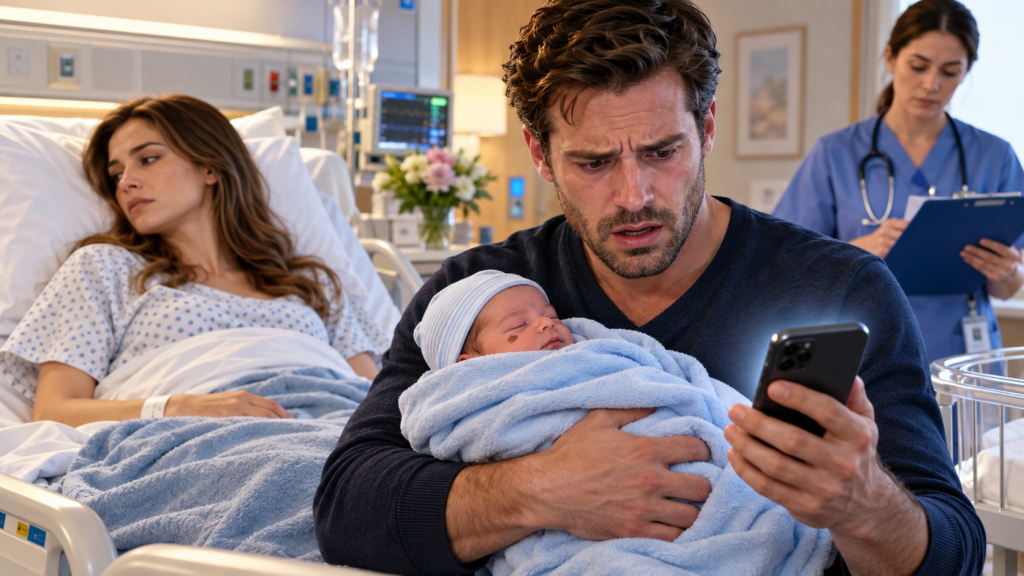
I stared at her. “She just gave birth.” “Yes.” “I was with her for ten hours.” “I understand.” “My name is on the admission paperwork.” “That does not override her request.” The words landed with humiliating precision. I had spent months acting as though money could purchase a place in somebody’s life.
The condo.
The driver.
The appointments.
The nursery.
And now a nurse had reduced the truth to one sentence.
It did not override her request.
I lowered my voice.
“The baby. Is he okay?”
“He is stable and with his mother.”
“Did she leave?”
“No. She was transferred to a private recovery room.”
Relief and anger collided so violently inside me that I had to grip the counter.
I had imagined Valerie vanishing with the child. Instead, she had simply vanished from me.
That was different.
And legally, emotionally, morally, she had every right to refuse to see me.
Even after lying.
Even after taking my money.
Even after letting me believe another man’s child was mine.
A lie does not erase another person’s boundaries.
I asked for nothing else.
I walked down the hall until I found a row of empty chairs beside a darkened vending machine.
Then I called Lucy.
She did not answer.
I called again.
Still nothing.
My third call went directly to voicemail.
I deserved that.
I stared at her positive pregnancy test on my phone until the image blurred.
A child.
My child?
Maybe.
The laboratory records said my fertility was normal. Lucy’s records said the same. But a positive pregnancy test was not proof of paternity, and I had already learned what happened when a man built a life on the evidence he preferred.
I typed one message.
I am not coming to your house. I am not asking you to forgive me. I need to know you are safe. When you are ready, I will answer every question and accept whatever you decide.
Then I added another line.
And I will take a paternity test whenever you want.
I almost deleted that sentence because it sounded suspicious.
Then I left it.
Truth deserved verification now.
My phone rang less than five minutes later.
It was not Lucy.
It was my father.
“Raymond.”
His voice was weak but unmistakably furious.
“Where are you?”
“At the hospital.”
“With that woman?”
“Dad—”
“Your wife came to see me.”
My heart stopped.
“When?”
“Yesterday.”
“What did she tell you?”
“That my son has been behaving like a coward.”
I closed my eyes.
My father, Ernesto Mendez, had survived the heart attack that I had used for months as my excuse not to tell him the truth.
I said I was protecting his heart.
What I really protected was my reputation.
He continued.
“She asked whether I knew a man named David had referred you to a fertility clinic.”
I sat straighter.
“What did you say?”
“The truth. I told her David recommended that doctor to me years ago after your mother died.”
“What?”
The hospital corridor suddenly felt colder.
“Why would David recommend a fertility doctor to you?”
“Not for fertility. The physician’s family owns a medical investment group. David was trying to get me to put money into it.”
My mouth went dry.
“Did you?”
“No.”
“Why?”
“Because I am old, not stupid.”
Under any other circumstance, I might have laughed.
Instead I asked:
“Dad, do you remember the company name?”
He gave it to me.
I wrote it on the back of an old parking receipt.
My father lowered his voice.
“What have you done, Raymond?”
There was no point lying anymore.
“Everything you would be ashamed of.”
He was quiet.
Then:
“That is not an answer.”
So I told him.
Not every ugly detail.
Enough.
The affair.
The pregnancy.
The condo.
The child who looked like David.
The envelope.
The normal fertility results.
The payment from one of David’s companies to the doctor.
When I finished, my father breathed slowly into the phone.
I waited for him to shout.
Instead he said:
“You blamed Lucy.”
“Yes.”
“For not giving you a child.”
“Yes.”
“And now she is pregnant.”
“Yes.”
He was silent for so long I thought the call had dropped.
Then:
“Do not go to her tonight.”
“I wasn’t going to.”
“Good.”
“Do not arrive at her door with flowers.”
“I won’t.”
“Do not tell her God has given you another chance.”
My throat tightened.
“I won’t.”
“Because God is not your public-relations department.”
I covered my eyes.
Even now, even while my life collapsed, my father could find the exact sentence that hurt most.
He said:
“Your first job is not getting your wife back.”
“I know.”
“Do you?”
“I think I’m beginning to.”
“No. Your first job is becoming someone who can hear the word no without turning it into a negotiation.”
I did not answer.
He was right.
Then his tone changed.
“Second, protect the company.”
I looked up.
“What?”
“David did not spend two years positioning that clinic, that woman, and your marriage for entertainment.”
The words hit me.
“What do you know?”
“Not enough. Come see me tomorrow morning. Bring every company file you can access without deleting or altering anything.”
“You think this is bigger than the buyout?”
“I think you have finally noticed the bill, son.”
He hung up.
That night I did not go home.
Home meant Lucy’s kitchen and my clothes and the bed where I had spent eight years beside a woman I betrayed.
I checked into a hotel near the hospital.
Not the kind Valerie liked.
No marble lobby.
No rooftop pool.
Just a clean room with a desk and curtains that did not quite close.
I did not sleep.
At 2:11 a.m., a message arrived from an unknown number.
You should check the condo deed before you accuse me of stealing everything.
I knew immediately it was Valerie.
I replied only:
Are you and the baby safe?
Three dots appeared.
Disappeared.
Returned.
Yes.
Then:
I never said the baby was yours in writing.
My hands went cold.
I stared at the sentence.
For months she had called him “our son.”
Sent me ultrasound photos.
Asked me to choose names.
Let me pay every expense.
Let me build a nursery.
But she was right about one technical point.
I could not remember a text where she had explicitly written, You are the biological father.
She had built a lie with implication.
I typed:
Whose child is he?
Her answer came nearly a minute later.
Ask David.
Then another.
And ask him why he needed you distracted before the September valuation.
That was the first moment fear overtook heartbreak.
Our company, Mendez Serrano Arquitectura, had been founded fourteen years earlier by David Serrano and me in Guadalajara.
We started with two desks, one secondhand printer, and a borrowed conference room.
By the year before Valerie appeared, we employed one hundred twenty people across Guadalajara, Monterrey, and Miami and managed commercial projects worth hundreds of millions of pesos.
David handled business development and investor relationships.
I controlled design, operations, and major project approvals.
We each owned forty-two percent.
The remaining sixteen percent belonged to senior employees and an early investor.
We had fought for years about growth.
David wanted outside capital.
I wanted control.
Then, twelve months before Valerie announced her pregnancy, I discovered that several project-development companies tied to David were billing our firm unusual consulting fees.
I confronted him.
He called them legitimate intermediaries.
I demanded an independent valuation because our partnership agreement allowed either founder to trigger a buy-sell process under certain conditions.
If I bought him out, David would lose operational influence over the company he had built beside me.
If he bought me out, I would lose mine.
Valerie met me four months later.
At an architecture convention David had insisted I attend.
I sat on the hotel bed and felt sick.
Had he introduced us?
I searched my old messages.
There.
Eight months earlier.
David:
You look miserable. Come to the Miami reception tonight. There’s someone you should meet. She works with hospitality developers. Could be useful.
I had never paid attention to the last sentence.
Could be useful.
I whispered:
“God.”
Then I remembered Lucy’s words.
Sometimes God doesn’t punish quickly, Ray. He punishes perfectly.
No.
This was not God.
That thought mattered.
God had not forced me into Valerie’s hotel room.
David had not held my wedding vows hostage.
The clinic lie may have made me vulnerable.
Valerie may have manipulated me.
David may have engineered the meeting.
But I had cheated.
Me.
If I turned conspiracy into absolution, I would simply find a new version of the same cowardice.
At six in the morning, I showered, changed, and drove to my father’s house.
Lucy was there.
Her car sat in the driveway.
I stopped so suddenly the driver behind me honked.
For a full minute I remained inside my car.
Then the front door opened.
Lucy stepped outside.
She wore jeans, a cream sweater, and no makeup.
She looked tired.
Beautiful.
Unreachable.
I got out slowly.
Neither of us moved toward the other.
I had imagined this moment all night.
In every version, I begged.
Now I remembered my father’s warning.
Hear no without turning it into negotiation.
“Hi,” I said.
Lucy crossed her arms.
“Did you read everything?”
“Yes.”
“Do you believe me now?”
“Yes.”
A shadow moved across her face.
“I wish you had believed me before.”
“So do I.”
She looked at me carefully, almost suspicious of the fact that I had not defended myself.
I asked:
“Are you okay?”
“I’m pregnant, not dying.”
“I know.”
“No, Ray. You don’t know anything yet.”
Fair.
I nodded.
“Then tell me what you want me to know.”
She glanced toward the house.
“Your father wants both of us inside.”
“Do you?”
She seemed surprised by the question.
After a few seconds she said:
“For this conversation. Yes.”
We entered separately.
My father sat at the dining table wearing a cardigan over his pajamas.
A folder lay in front of him.
Three cups of coffee had been poured.
Mine was black.
Lucy’s had milk.
He remembered.
I almost broke at that small detail.
Ernesto pointed at the chairs.
“Sit.”
We did.
He looked at me first.
“Lucy has more to show you.”
I turned toward her.
She opened a folder.
Inside were copies of bank statements, fertility records, corporate invoices, and a timeline written in her neat handwriting.
I stared.
“How long have you been investigating this?”
Her expression hardened.
“Do not flatter yourself by calling it an investigation.”
“What was it?”
“Trying to figure out whether I was losing my mind.”
That silenced me.
She continued.
“Two years ago, after the clinic told us natural conception was almost impossible, I asked for complete copies of our lab records.”
“You never told me.”
“I tried.”
My stomach tightened.
“When?”
“The night of your birthday dinner.”
I remembered.
She had brought an envelope to the restaurant.
I arrived forty-five minutes late after drinks with David.
I had been irritated.
She tried to talk in the car.
I said:
Can we not make everything about babies tonight?
I closed my eyes.
Lucy saw the memory on my face.
“Yes,” she said quietly.
“That night.”
“I’m sorry.”
“I know you are sorry now.”
No comfort.
Good.
She continued.
“The lab values did not match what Dr. Barreto told us. I thought maybe I misunderstood them, so I took the records to another specialist.”
“And?”
“He said there was no basis for telling us we were essentially infertile. There were some timing and age factors, but nothing close to impossible.”
“Why didn’t you confront the clinic?”
“I did.”
My head snapped up.
“They said the physician had used broader clinical context.”
“Then?”
“I requested a second opinion in writing. That was when one of the clinic administrators called me privately.”
She slid an email across the table.
The sender’s name was Ana Beltrán.
“She told me Dr. Barreto had a financial relationship with one of David’s investment vehicles.”
I read the email.
It did not accuse anyone of falsifying lab results.
It said there were concerns about conflicts, undocumented consultations, and unusual access to patient scheduling information.
My father said:
“Lucy brought that to me because she recognized one of the company names.”
I looked at him.
“The medical investment group.”
“Yes.”
Lucy continued.
“I began looking at publicly available corporate records. David’s holding company had paid Barreto’s consulting entity about one hundred forty thousand dollars over three years.”
My hands tightened.
“Why would he care whether we thought we were infertile?”
“I didn’t know.”
“But you suspected him.”
“Yes.”
“Why not tell me?”
She gave a hollow laugh.
“I did tell you David made me uncomfortable.”
I remembered dismissing that too.
Jealousy.
Bitterness.
A wife threatened by her husband’s successful friend.
All the convenient explanations.
Lucy looked at the table.
“Then Valerie appeared.”
She pushed another page toward me.
It was a photograph from the Miami architecture reception.
Valerie in a silver dress.
David beside her.
Not simply standing together.
His arm around her waist.
The date stamp was from six months before the night I claimed to have met her for the first time.
I felt cold all over.
“How did you get this?”
“Conference photographer’s public gallery.”
I stared at Valerie’s smile.
David’s hand.
Six months.
They had known each other at least six months before she walked up to me and said:
You’re Raymond Mendez, right? I love your hotel work.
I had thought fate was flirting with me.
It had been casting.
Lucy said:
“I confronted you about Valerie before I knew she was pregnant.”
“I lied.”
“Yes.”
“I told you she was a client contact.”
“Yes.”
“I’m sorry.”
She looked tired.
“Ray, if you apologize after every sentence, we will be here until the baby is born.”
My heart jumped at the word baby.
Lucy noticed.
Her expression closed.
I forced myself not to ask the question screaming inside me.
Mine?
Instead I said:
“Okay.”
My father pushed his coffee aside.
“Now the company.”
Lucy handed me invoices.
Three vendors.
Lago Advisory.
Sierra Procurement.
Meridian Hospitality Solutions.
All had billed Mendez Serrano millions of pesos over several years for consulting, permitting, sourcing, and market-entry services.
I knew the names.
I had approved some invoices.
David had assured me they were standard.
Lucy had highlighted bank recipients.
All three companies eventually routed money through entities linked to David.
Not directly enough to prove theft.
Enough to ask questions.
“How did you get internal invoices?”
I asked.
She looked at me.
“You left copies in our home office.”
Of course.
While I spent evenings with Valerie, my wife sat in the house I abandoned reading paperwork I could not be bothered to examine.
My father said:
“Your September valuation would have exposed the vendor relationships.”
“Unless I became distracted.”
Lucy said nothing.
The pregnancy announcement came exactly three weeks before the valuation process began.
Valerie needed a condo.
Doctors.
Money.
My secret life exploded privately.
I postponed document production.
I asked the valuation firm for sixty extra days.
David had encouraged it.
Take your time, Ray. Family first.
I whispered:
“That bastard.”
Lucy’s eyes flashed.
“No.”
I looked at her.
“Do not do that.”
“Do what?”
“Make David the only bastard in this story.”
The sentence hit cleanly.
I nodded.
“You’re right.”
My father leaned back.
“Good. We are making progress.”
Lucy took a breath.
“Ray, I believe David and Valerie manipulated you.”
I stared at her.
“But manipulation only works because there is something to manipulate.”
I lowered my eyes.
“Your need to be admired.”
“Your resentment toward me.”
“Your obsession with having a son.”
“Your belief that fertility was proof of manhood.”
Each sentence stripped something from me.
Not dignity.
Illusion.
“You were angry at me for a medical problem neither of us actually had.”
“I know.”
“You punished me for it.”
“I know.”
“You slept with someone else because she made you feel chosen.”
I whispered:
“Yes.”
“And then when she became pregnant, you did not ask for a paternity test.”
“No.”
“Why?”
I looked at her.
The answer was humiliating.
“Because I wanted it to be mine.”
Lucy’s eyes filled.
Finally.
Not with softness.
With grief.
“That is the first honest thing you’ve said about this.”
I nodded.
My father stood slowly.
“I’m going to the patio.”
Neither of us stopped him.
He left us alone.
Lucy placed both hands around her coffee.
I said:
“I won’t ask you to take me back.”
“Good.”
“I want to be involved with the baby if the baby is mine.”
She flinched slightly.
I corrected myself.
“Our baby. If I am the father.”
“You are.”
My breath stopped.
She looked directly at me.
“I already did the dating calculation with my doctor.”
I could not speak.
“The last time we slept together was five weeks ago.”
I remembered.
My father’s discharge dinner.
Lucy and I had come home late.
For one night, we behaved like the couple we used to be.
The next morning, I went to meet Valerie.
Shame burned through me.
Lucy continued.
“I have not been with anyone else.”
My eyes filled.
“So I’m—”
“Biologically, yes.”
The room blurred.
I covered my face.
A sound escaped me that I did not recognize.
Not joy.
Not exactly.
Grief.
Relief.
Terror.
All of it.
Lucy waited.
When I finally looked up, she said:
“Do not mistake this pregnancy for reconciliation.”
“I won’t.”
“You are not moving back in.”
“I understand.”
“I am filing for divorce.”
The words still hurt.
Even though I expected them.
I nodded.
“I understand.”
“You will have the opportunity to be this child’s father if you behave like one.”
Tears ran down my face.
“What does that mean to you?”
Her expression softened for the first time.
Barely.
“It means consistency.”
“Truth.”
“Respect.”
“Showing up without turning every moment into a plea for me to love you again.”
I nodded.
“I can do that.”
She looked at me for a long time.
“Then do it.”
Not promise.
Do.
That became the first honest instruction of my second life.
The next forty-eight hours changed the shape of every problem I thought I had.
I retained a family lawyer for the divorce.
A separate lawyer for the paternity issues surrounding Valerie’s baby.
And, at my father’s insistence, independent corporate counsel who had never represented David, me, or Mendez Serrano before.
Her name was Mariana Ortega.
She was fifty-eight, spoke quietly, wore no jewelry except a steel watch, and had the unnerving habit of letting people finish lying before she asked the next question.
I showed her Lucy’s folder.
The clinic records.
The photograph.
The vendor invoices.
Valerie’s messages.
The note from the hospital.
Mariana read everything once.
Then again.
Finally she said:
“You are going to have to tolerate not knowing which problem is criminal, which is civil, which is marital, which is corporate, and which is simply moral.”
“I understand.”
“No, you don’t.”
She looked at me.
“You want one villain and one case.”
I said nothing.
“You probably want David arrested by Friday, Valerie exposed by Saturday, your company returned by Monday, and your wife impressed by Tuesday.”
My father, sitting beside me, coughed into his hand to hide a laugh.
I glared at him.
Mariana continued.
“That is not how this works.”
“What do we do?”
“Preserve records. Stop informal confrontation. Notify the board under the partnership agreement. Commission a forensic review. Do not alter files. Do not access accounts you are not authorized to access. And do not send David emotional messages you will later have to explain in court.”
I put my phone face down.
She noticed.
“Have you already?”
“No.”
“Good.”
My father said:
“A miracle.”
Mariana ignored him.
“What about the baby?”
I asked.
“That is not my field. Let your family counsel handle it. A physical resemblance is not evidence of paternity.”
“I know.”
“Do you?”
I nodded.
This time, I meant it.
Within a week, the hospital’s social worker and Valerie’s attorney arranged for communication about parentage.
Valerie denied that I was the biological father.
That sentence should have relieved me.
Instead, I grieved.
It made no sense.
I had held that child for less than five minutes.
I had been deceived about him for months.
Yet I had painted his room.
Chosen a crib.
Argued over names.
Talked to Valerie’s stomach while she laughed at me.
Hope does not disappear simply because the invoice was fraudulent.
My lawyer explained that I should not sign an acknowledgment of paternity while the issue was disputed.
A DNA test was arranged through the proper process once medically appropriate.
I waited.
There was nothing heroic about waiting.
I checked my phone forty times a day.
Then fifty.
Meanwhile, David acted as though nothing had happened.
He emailed me Monday morning.
Ray,
Hope the delivery went well. We need to discuss the valuation timetable and the Monterrey hospitality proposal. Call when you can.
I read it three times.
Hope the delivery went well.
As though he did not know.
As though he had not slept with Valerie.
As though the child might not carry his face.
Mariana told me not to answer beyond operational necessity.
So I wrote:
I will participate in company matters through counsel and scheduled governance channels for the time being. Please preserve all records relating to company vendors, related-party transactions, and the pending valuation.
His response came eleven minutes later.
What the hell is this?
I forwarded it to Mariana.
She replied:
Nothing. Do not answer.
It was astonishing how powerful silence became once it was not being used as fear.
The board convened an emergency meeting three days later.
David arrived in person.
I had not seen him since the baby was born.
He looked exactly the same.
That enraged me more than if he had arrived disheveled.
Navy suit.
Brown shoes.
Silver cuff links.
The same easy smile he used when clients were nervous.
He sat across from me.
“Ray.”
“David.”
His eyes moved briefly toward Mariana.
Then back to me.
“I hear congratulations are in order.”
Every muscle in my body tightened.
Mariana put one finger on the table.
Do not.
I heard her without words.
I answered:
“There is a paternity process underway.”
David leaned back.
“Paternity?”
A perfect performance.
If I had not seen the photograph, I might have admired it.
He looked concerned.
“Is Valerie saying something?”
I held his gaze.
“You can ask her attorney.”
A flicker.
Tiny.
There.
Then gone.
The meeting began.
Our independent director, Teresa Maldonado, chaired it.
Mariana presented enough information to justify an outside forensic accounting review without turning the meeting into a criminal accusation.
Related-party vendors.
Undisclosed connections.
Potential conflicts.
Questions about the valuation delay.
The board voted four to one to retain an external forensic firm.
David was the one.
He said the review was unnecessary and damaging.
Then he made his first mistake.
He knew which vendors would be examined before Mariana named all of them.
“Sierra and Lago are legitimate contractors.”
Teresa Maldonado looked up.
“No one said Sierra or Lago.”
Silence.
David smiled too quickly.
“They were in the materials.”
They were not.
Mariana did not react.
She simply made a note.
That was the moment I realized intelligence does not protect people from panic.
Sometimes it makes them more creative while they are drowning.
After the meeting, David followed me into the hallway.
“Ray.”
I kept walking.
“Ray, stop.”
I did.
Mariana stopped too.
David looked at her.
“Can I speak to my partner alone?”
“No,” I said.
He gave me a wounded smile.
“Fourteen years, and now I need permission?”
“Fourteen years, and apparently I needed a forensic accountant.”
His jaw tightened.
“Valerie is poisoning you.”
I almost laughed.
“Interesting choice of metaphor.”
He frowned.
I continued.
“Did you know her before the Miami convention?”
“No.”
A clean lie.
I looked at Mariana.
She said nothing.
David’s face changed.
He understood.
“What did she tell you?”
I did not answer.
He moved closer.
“Ray, whatever she said, she’s unstable.”
There it was.
The oldest coward’s trick.
When a woman becomes inconvenient, diagnose her character.
I had done versions of it to Lucy.
Bitter.
Jealous.
Insecure.
I knew the technique because I had used it.
“Do not contact me outside counsel about personal matters.”
David stared at me.
“You’re making a mistake.”
I said:
“I made mine months ago.”
Then walked away.
The DNA result arrived twelve days after the birth.
I was not the father.
Probability of paternity: excluded.
The language was clinical.
Almost gentle in its certainty.
I sat alone in my car outside the laboratory collection center and cried.
Not for a son I had lost.
For a son who had never been mine.
There is a difference.
But grief does not respect it.
I called Lucy afterward.
She answered on the fourth ring.
“Hello?”
“The result came back.”
She was quiet.
“I’m not his father.”
“I’m sorry.”
That surprised me.
“Why?”
“Because you loved the idea of him.”
I closed my eyes.
Lucy understood me even after I had given her every reason not to.
“I feel ridiculous.”
“Don’t.”
“I held him for five minutes.”
“You waited for him for months.”
That sentence broke me.
I leaned my forehead against the steering wheel.
Lucy did not say anything for a while.
Then:
“Ray?”
“Yes?”
“Do not use this grief to come running toward my pregnancy.”
I opened my eyes.
“I won’t.”
“I mean it.”
“I know.”
“Our child is not a replacement.”
“No.”
“Good.”
Then she said:
“I have my first obstetric appointment Thursday.”
My heart stopped.
“Okay.”
“If you want to come, you can.”
I could barely breathe.
“Are you sure?”
“Yes.”
“Thank you.”
“Do not make me regret it.”
“I won’t.”
Thursday arrived with more terror than any board meeting.
I reached the clinic twenty minutes early.
Lucy arrived exactly on time.
I did not touch her.
I did not ask if she had missed me.
I carried the folder she handed me.
Sat where she told me.
Answered when spoken to.
The pregnancy was still early.
The doctor explained dates, blood work, next steps.
There was no dramatic movie ultrasound where a fully formed baby waved at us.
There was uncertainty.
Monitoring.
Normal caution.
I found that strangely healing.
Reality was not required to perform for me anymore.
In the parking lot, Lucy said:
“You did well.”
I almost smiled.
“I sat in a chair.”
“For you, currently, that is progress.”
I laughed.
She did too.
Only once.
Then her face closed again.
The laugh had surprised both of us.
I went home alone.
Not our home.
A furnished apartment near my office.
The house remained with Lucy during the divorce process.
I had offered to leave.
She accepted.
The five-million-dollar Brickell condo became another problem.
I had purchased it in Valerie’s name eight weeks before the birth.
At the time, I called it security for “our family.”
Now my lawyer asked a humiliating question.
“Was there any written agreement that she would return the property if the child was not yours?”
“No.”
“Any deed restriction?”
“No.”
“Any loan document?”
“No.”
“Any written representation from Valerie stating you were the biological father?”
I remembered her message.
I never said the baby was yours in writing.
“No.”
My lawyer sighed.
“Then do not assume you can simply take the condo back.”
My anger flared.
“She conned me.”
“Possibly.”
“Possibly?”
“You knowingly bought an unmarried partner a condominium while cheating on your wife.”
That sentence belonged on my tombstone.
He continued.
“Fraud requires proof. Your assumptions are not contracts.”
So we gathered proof.
Valerie’s cooperation became central.
Her attorney contacted mine.
She wanted to negotiate.
Not over the baby.
Over evidence.
We met in a law office in Miami six weeks after the birth.
Valerie entered carrying a breast pump bag and looking more exhausted than glamorous.
No heels.
No heavy perfume.
No silver dress.
Just a new mother with shadows under her eyes.
For several seconds, neither of us spoke.
Then she said:
“You look terrible.”
I almost laughed.
“So do you.”
“Having a newborn will do that.”
The sentence hurt.
She saw it.
“I’m sorry.”
“Which part?”
Her mouth tightened.
“Most of it.”
Our lawyers stopped us before the conversation became useless.
Valerie gave a recorded statement with counsel present.
She had known David for almost two years.
Not romantically at first.
She did marketing work for a developer that used Mendez Serrano.
David began sleeping with her about eleven months before she met me.
He complained constantly about our partnership.
Said I was blocking growth.
Said I was arrogant.
Said my marriage was “dead.”
All partially true in ways that made the lies easier to carry.
Then he told her I was vulnerable.
Childless.
Frustrated.
Desperate to prove myself.
I asked:
“He said that?”
Valerie looked at me.
“Yes.”
I felt shame crawl up my neck.
“What was the plan?”
“At first? Get close to you.”
“Why?”
“To know what you were doing about the buyout.”
“Corporate spying?”
She looked down.
“That sounds dramatic.”
“It sounds accurate.”
“Yes.”
She admitted she asked about valuation firms, my conversations with investors, and whether I planned to force David out.
I had told her everything.
In bed.
Over wine.
In the condo I later bought her.
I had considered those conversations intimacy.
To her, they were reporting.
David paid her.
Not the $180,000 all at once for the pregnancy.
The payment Lucy found was part of a larger arrangement covering consulting work, travel, and what Valerie called “keeping me engaged.”
I felt physically ill.
“Then you got pregnant.”
She nodded.
“Was that planned?”
Her face hardened.
“No.”
I believed her.
Not because I trusted her.
Because the answer cost her something.
She continued.
“When I found out, I told David first.”
“Before me.”
“Yes.”
“What did he say?”
Her eyes filled.
“He told me to terminate.”
I looked down.
She touched the table with both hands.
“I refused.”
“Then?”
“He panicked.”
“About being the father?”
“About you finding out we already knew each other.”
I stared at her.
“So he told you to say it was mine.”
“He told me you wanted a baby so badly you would never ask enough questions.”
The cruelty of that sentence was not that it was false.
It was that he had known me well enough to be right.
Valerie wiped her eyes.
“I said I wouldn’t lie directly.”
I laughed once.
“No. You just let me build the lie for you.”
“Yes.”
Her answer stopped me.
No defense.
Good.
She continued.
“David said if you believed the baby was yours, you would delay the valuation, transfer assets, and maybe restructure your company shares for estate planning.”
My stomach turned.
“Estate planning?”
“He wanted you to move some shares into a vehicle that could eventually be leveraged or sold.”
“I never did.”
“No.”
“Why?”
“You kept saying you wanted to wait until after the birth.”
For once, my caution had helped me.
A little.
Then I remembered the condo.
Not enough.
I asked:
“Why take the apartment?”
Valerie looked directly at me.
“Because I wanted it.”
That answer was almost refreshing.
“And because David told me you could afford it.”
“Did you love me?”
She did not answer immediately.
“No.”
I nodded.
“Did you ever?”
“No.”
Another clean wound.
“Did you love David?”
Her face changed.
“I thought I did.”
“And now?”
She laughed without humor.
“Now I have a DNA test, a newborn, and a man who has not visited his son.”
I stared.
“David knows?”
“Yes.”
“Has he acknowledged paternity?”
“Not voluntarily.”
Her lawyer interrupted.
“That matter is proceeding separately.”
I leaned back.
The baby had become a legal problem between the two people who created him while I had spent months preparing to be his father.
No one in the room seemed proud.
Valerie slid a flash drive across the table.
My lawyer stopped me from touching it.
“What’s on it?”
“Messages. Voice notes. Copies of vendor instructions David sent me. Photos from before Miami. Records of the consulting payments.”
“Why give it up?”
She looked at me.
“Because David told me last week that if investigators asked, I manipulated both of you.”
Of course.
The same man who called her unstable in the hallway.
The same man who planned to make her responsible if the scheme collapsed.
Fear has a way of turning accomplices into archivists.
Valerie continued.
“And because I have a son now.”
For the first time, her face softened completely.
“I do not want him growing up thinking this is what adults do.”
I almost said:
Then why did you?
But I stopped.
Not out of kindness.
Because our lawyers had already asked the useful questions.
I did not need cruelty for decoration.
The forensic review took four months.
Its findings were worse than I expected and narrower than my imagination.
David had not stolen the entire company.
He had not forged my name on a secret sale.
He had not planned to murder me.
Reality rarely arranges itself for maximum drama.
What he had done was substantial enough.
Over roughly three years, related vendors had received the equivalent of about 48 million Mexican pesos in payments under contracts that were either inflated, poorly supported, or conflicted.
A portion of those payments—roughly the equivalent of 2.3 million U.S. dollars at the relevant rates—could be traced through entities in which David or close associates had undisclosed interests.
Not every peso was proven stolen.
Some vendors had provided real services.
Some invoices were legitimate.
Some relationships violated disclosure rules without necessarily being criminal.
But enough was wrong that the board placed David on administrative leave and referred findings to outside authorities and regulators.
He sued.
Of course.
Claimed I engineered the investigation to force him out cheaply.
The timing looked terrible for me.
I had discovered his affair with Valerie.
I was furious.
I stood to benefit if his shares lost value.
That was why the independent review mattered.
Evidence had to survive my anger.
Mariana reminded me every time I wanted to turn a fact into a conclusion.
“Let the documents be boring.”
“What does that mean?”
“Boring documents win cases.”
I learned to love boring documents.
Bank records.
Board minutes.
Conflict disclosures.
Contracts.
Emails.
No dramatic monologue.
Just dates that refused to change their story.
Then the clinic matter broke open.
Dr. Javier Barreto denied falsifying laboratory results.
Technically, the original lab sheets were authentic.
That mattered.
What became the central allegation was that he had intentionally misrepresented our prognosis during consultations and documented unsupported conclusions in summary notes while maintaining undisclosed financial relationships with David-linked entities.
He insisted his judgment had been clinical.
An independent medical review disagreed with parts of his interpretation.
Professional regulators began investigating.
The clinic itself eventually settled Lucy’s civil claims without admitting every allegation.
I did not celebrate.
No settlement could give us back the years when I called my wife defective.
That bill belonged to me even if Barreto had helped print it.
One evening, six months after the baby’s birth, Lucy and I sat across from each other in mediation for our divorce.
Assets.
Accounts.
The house.
Retirement.
Company interests.
My five-million-dollar mistake in Miami.
I expected her to demand everything she could.
She did not.
That hurt too.
Lucy wanted a fair division under the law.
The Guadalajara home.
Her share of marital investments.
Security for the coming child.
No ownership in my company beyond whatever value the marital property analysis required.
She did not want revenge.
I almost wished she did.
Anger would have made me feel central.
Instead she was building a future.
Our mediator asked whether reconciliation remained possible.
Lucy answered first.
“No.”
One syllable.
No tremble.
I looked down.
The mediator turned to me.
“I accept her answer.”
Lucy glanced at me.
Something moved in her face.
Not forgiveness.
Respect, perhaps.
The first grain of it.
Outside the mediation room, she said:
“You really mean that?”
“What?”
“You’re not going to keep trying to talk me out of the divorce?”
I looked at her growing stomach.
Then at her face.
“I spent too much of our marriage treating what I wanted as more important than what you said.”
She went still.
“I’m trying not to do that anymore.”
Her eyes filled.
“That would have saved us, Ray.”
“I know.”
“No.”
She touched her stomach.
“You know now.”
Then she walked away.
The divorce became final three months before our daughter was born.
Daughter.
I had spent years begging life for a son.
Then destroyed my marriage partly because I thought another woman had finally given me one.
When the ultrasound later showed that Lucy was carrying a girl, I cried so hard the technician left the room for a minute.
Lucy watched me cautiously.
“Are you disappointed?”
The question nearly destroyed me.
“No.”
“Ray.”
“No.”
I put both hands over my face.
“I’m ashamed you even had to ask.”
She said nothing.
I looked at the screen.
Tiny profile.
Small moving hand.
“I wanted a child.”
“That was always the truth.”
“The son part was pride.”
Lucy’s eyes softened.
For one second, her hand moved toward mine.
Then stopped.
I saw it.
I pretended not to.
Some mercies should not be grabbed.
They disappear when you reach too quickly.
Our daughter was born on a rainy Tuesday morning in Guadalajara.
Lucy called me at 2:14 a.m.
Not because she wanted me beside her as husband.
Because we had agreed I would be present as the child’s father if the medical team allowed it and if I respected every boundary she set.
I arrived at the hospital before three.
Her sister, Elena, met me in the hallway.
She had disliked me openly since the affair came to light.
I respected her for the efficiency of it.
“Lucy wants you in the room,” she said.
“Okay.”
“Do not make this about redemption.”
“I won’t.”
“Do not ask her anything about getting back together.”
“I won’t.”
“Do not cry louder than she does.”
Despite everything, I smiled.
“That one I can’t guarantee.”
Elena almost smiled back.
Almost.
Inside, Lucy was exhausted and irritated with everybody.
That was reassuringly familiar.
She looked at me.
“You came.”
“You called.”
“Good answer.”
Hours passed.
Labor was difficult but medically ordinary.
No miracle.
No catastrophe.
No punishment from heaven.
Just pain, nurses, breathing, water, monitors, and time.
When our daughter finally cried, I stopped existing for a second.
The doctor placed her against Lucy.
I did not reach.
That mattered.
I stood beside the bed with tears running down my face and waited until Lucy looked at me.
Then she whispered:
“Come here.”
I stepped closer.
Our daughter had dark hair plastered against her tiny head.
Her face was red and furious.
No cinematic beauty.
She looked like an outraged walnut.
I loved her instantly.
Lucy laughed weakly when I said that.
“What are we naming her?” the nurse eventually asked.
We had discussed names for months.
Lucy looked at me.
“You tell her.”
My throat tightened.
“Isabel.”
“Isabel Lucía Mendez Morales.”
Lucy had chosen to give her both family names.
Not as a reward to me.
As a statement that our daughter came from both of us even though the marriage no longer existed.
When the nurse asked whether I wanted to hold her, I looked at Lucy first.
She nodded.
I lifted Isabel carefully.
The first baby I had ever held had been David’s son.
I had looked at his face and seen punishment.
Now I looked at my daughter and understood how wrong that instinct had been.
Children are not bills.
They are not verdicts.
They are not evidence that God approves of one adult and condemns another.
They arrive innocent into stories they did not write.
I kissed Isabel’s forehead.
Then cried so hard Elena handed me a tissue and muttered:
“You are definitely crying louder.”
Lucy laughed.
I held our daughter for twelve minutes.
Then gave her back without being asked.
That tiny act became important to me.
I was learning that love was not proved by holding on longest.
Sometimes it was proved by knowing when to release.
Paternity testing after birth confirmed what Lucy had already told me.
I was Isabel’s father.
I kept the report.
Not because I distrusted Lucy.
Because I had promised myself I would never again confuse certainty with insult.
Facts were not betrayal.
Sometimes they were peace.
Our parenting agreement was detailed.
Scheduled time.
Medical decisions.
Travel permissions.
Financial support.
Emergency procedures.
At first, I hated seeing fatherhood translated into pages.
Then I realized structure protected everyone.
Lucy did not have to trust a mood.
I did not have to guess.
Isabel did not have to become a messenger.
I rented an apartment ten minutes from Lucy’s house and turned the second bedroom into a nursery.
Nothing extravagant.
A crib.
A dresser.
A rocking chair.
One shelf of books.
The five-million-dollar nursery in Miami had contained imported furniture, custom wallpaper, and a ceiling painted like stars.
This room cost less than one light fixture in that condo.
It was the most precious room I had ever built.
The first night Isabel stayed with me for several hours while Lucy slept, I sat in the rocking chair terrified.
Every sound seemed dangerous.
Every silence worse.
I texted Lucy twice.
Is this breathing normal?
Then:
Never mind. She sighed.
Lucy replied:
Raymond, babies make noises.
Then five minutes later:
You’re doing fine.
I stared at those words for a long time.
Not:
I forgive you.
Not:
Come home.
You’re doing fine.
Enough.
My father met Isabel when she was three days old.
He held her against his chest and immediately started crying.
I had seen Ernesto cry twice in my life.
At my mother’s funeral.
And when doctors told him he would survive his heart attack.
Now a third.
He looked at me over the baby’s head.
“You nearly lost this.”
I nodded.
“Yes.”
He shook his head.
“No.”
“You nearly lost the right to be near it.”
That was more accurate.
He kissed Isabel’s forehead.
“Do better.”
“I will.”
My father frowned.
“Wrong.”
I smiled despite myself.
“I’ll try.”
“Better.”
The company case moved forward while I learned diapers.
That contrast kept me sane.
One morning I sat through a three-hour meeting about vendor recovery claims.
That afternoon, Isabel vomited down the front of my shirt.
One problem involved millions.
The other required a towel.
The towel problem felt more urgent.
David’s paternity case concerning Valerie’s son concluded with a DNA test confirming he was the biological father.
The boy’s name was Gabriel Towers.
Valerie had not given him David’s surname.
When I heard, I felt something loosen inside me.
For months I had called him Mateo in my imagination.
That was the name I had chosen.
Valerie had smiled and said she liked it.
After the birth, she chose Gabriel instead.
At first, that hurt.
Later, I was grateful.
He deserved a name untouched by my fantasy.
David initially contested financial responsibility.
Then the DNA result arrived.
He could contest many things.
Biology was not one of them.
A court established support and related obligations according to the applicable process.
I stayed out of it.
That child was not my leverage against David.
He was not proof that David deserved suffering.
He was a baby.
I wanted nothing from him.
Valerie eventually sent me one photograph through our attorneys.
Not because I asked.
She wrote:
You spent months preparing to love him. I thought you should know he is healthy.
I stared at Gabriel’s face.
The brown mark beneath his left eye remained.
The small dimple.
David’s eyebrow.
I did not cry.
I whispered:
“Good.”
Then deleted the photograph from my phone after saving it once to an encrypted folder I never opened again.
Some losses do not need daily memorials.
The condo dispute ended through settlement.
The evidence of Valerie’s arrangement with David, her false implications about paternity, and the financial communications gave my attorneys substantial civil claims.
But I had also made a voluntary transfer while committing adultery.
Nothing about that fact disappeared.
Litigation could have lasted years.
Instead, the condo was sold.
After mortgage costs, taxes, legal expenses, and negotiated allocations, I recovered a substantial portion of what I had put into it, but not all.
Valerie retained enough to secure housing for herself and Gabriel after settling related claims.
I did not like every term.
That was probably evidence the settlement was real.
I had once thought justice meant getting back every peso I regretted spending.
It did not.
Some losses were the price of my own choices.
The company matter was slower.
David’s suspension became permanent after the board concluded he had failed to disclose conflicts and breached partnership duties.
His ownership did not simply vanish.
Shares are not moral stickers that fall off bad people.
The buy-sell dispute became a war of valuations, contractual rights, pending claims, and offsets.
Independent accountants calculated potential damages.
Insurers became involved.
Outside authorities investigated vendor relationships.
Several vendors cooperated.
One executive admitted that David had required parts of legitimate contracts to be routed through intermediary companies connected to associates.
Another denied wrongdoing entirely.
The evidence was mixed.
Messy.
Real.
Eventually, prosecutors in Mexico brought financial and corporate charges based on a subset of transactions they believed they could prove.
Separate civil litigation addressed broader losses.
David did not collapse in one spectacular afternoon.
He spent nearly three years fighting.
During that time, he called me once.
Not directly.
Through a mediation session.
By then Isabel was two.
David looked older on the video screen.
The silver cuff links were gone.
His lawyer beside him.
Mariana beside me.
The mediator asked whether we wished to speak privately as former partners.
Mariana objected.
I surprised her.
“I’ll speak with counsel present.”
David looked at me.
“Ray.”
“David.”
He laughed bitterly.
“Remember when our biggest problem was finding someone to lend us a printer?”
“Yes.”
“We built something incredible.”
“Yes.”
“And you’re destroying it because of a woman.”
I stared at him.
Even after everything.
“A woman?”
“Valerie.”
“No.”
“You know what I mean.”
“I don’t think you do.”
He leaned toward the camera.
“You think you’re innocent now because you confessed to Lucy?”
“No.”
“You think acting humble turns you into a saint?”
“No.”
His anger increased because I would not fight the argument he had prepared.
He said:
“You slept with Valerie willingly.”
“Yes.”
“You bought her that condo willingly.”
“Yes.”
“You delayed the valuation.”
“Yes.”
“You told her confidential company information.”
“Yes.”
David stopped.
I continued.
“Those are my failures.”
Then I leaned closer.
“The undisclosed vendor interests are yours.”
“The money routed through related entities is yours to explain.”
“Your relationship with Valerie before she met me is yours.”
“Your role with Barreto is yours.”
“And Gabriel is your son, not a weapon you get to use against me.”
David’s face changed.
For a second, shame appeared.
Then anger covered it.
“You always thought you were better than me.”
I shook my head.
“No.”
“That was the problem.”
“I thought being better at design meant I didn’t have to look closely at the business.”
“I let you carry too much.”
“I let you become the person who knew every contract while I enjoyed being the creative genius.”
“That was arrogance.”
Mariana glanced at me.
She had not expected that answer.
Neither had David.
I continued.
“I helped create the conditions where you had too much unchecked power.”
“That does not excuse what you did.”
“But I am done pretending the company became vulnerable only because you were dishonest.”
For the first time, he had nothing to say.
The mediation did not settle that day.
But six months later, it did.
David agreed to sell most of his remaining shares under a negotiated valuation adjusted for civil claims and disputed amounts.
A portion of proceeds was held to resolve pending liabilities.
He retained no management role.
The senior employee group increased its ownership.
An outside investor acquired a minority position under governance protections.
I no longer controlled the company alone.
That was deliberate.
We created stronger approval thresholds.
Related-party transaction rules.
Independent audit oversight.
No founder exceptions.
Especially no founder exceptions.
Mendez Serrano Arquitectura kept David’s surname for two more years because contracts, branding, and employee interests mattered more than my anger.
Eventually, after a company-wide process, it became Mendez Atelier Group.
I did not name it after myself.
The employees voted.
I tried to argue.
They ignored me.
Appropriate.
The criminal case against David eventually ended in a negotiated plea involving financial misconduct and false disclosures tied to specific transactions.
He received a custodial sentence significantly shorter than the dramatic decades people imagine in stories like ours, followed by restrictions and restitution-related orders.
The professional consequences lasted longer.
He lost board positions.
Licenses associated with certain financial activities were affected.
His reputation collapsed in the business circles he had spent twenty years cultivating.
I felt almost nothing when sentencing happened.
That surprised me.
For years I had imagined seeing him punished would close something inside me.
Instead, I was home with Isabel, teaching her to stack wooden blocks.
My phone buzzed with Mariana’s message.
Sentence entered. Call when convenient.
I looked at my daughter.
She put one red block on top of another.
Then knocked both down.
Again.
Again.
Again.
She laughed every time.
I put the phone aside.
That was the moment I understood my life had moved beyond David.
Not healed completely.
Moved.
There is a difference.
Dr. Barreto’s case ended differently.
The professional board disciplined him for conflict-disclosure failures, documentation issues, and aspects of clinical conduct established through review.
The civil settlement with the clinic included compensation to Lucy for expenses and emotional harm claims without requiring her to endure a public trial.
There was no courtroom confession where he admitted ruining our marriage.
Good.
Because he had not ruined our marriage.
He had distorted information.
He had behaved unethically.
He may have helped David create conditions favorable to manipulation.
But I had ruined the marriage.
Lucy never let me outsource that.
Neither did I.
I began therapy six months after Isabel’s birth.
I should have begun earlier.
My therapist was named Dr. Arturo Salcedo.
The first session, I spent forty minutes explaining David’s scheme.
He listened.
Then asked:
“Why did you cheat?”
I stared at him.
“Did you hear anything I just said?”
“Yes.”
“He manipulated the situation.”
“Yes.”
“The clinic lied to us.”
“Possibly.”
“Valerie was working with him.”
“Yes.”
“And you ask why I cheated?”
“Yes.”
I almost did not return.
I returned.
The second session, I said:
“Because I wanted to feel powerful.”
He nodded.
That annoyed me.
“Is that it?”
“No.”
I thought longer.
“Because I was angry at Lucy.”
“For what?”
“For not giving me a child.”
“Did she choose that?”
“No.”
“Was she actually infertile?”
“No.”
“Then what were you angry at?”
I hated him.
For at least twenty minutes.
Then I said:
“At myself.”
There.
A small door.
I had built an identity around success.
Young architect from a middle-class family.
Partner.
Awards.
Projects.
Money.
Marriage.
The one thing I could not command was fatherhood.
Every negative test felt like evidence that I was not fully in control.
Instead of grieving beside Lucy, I turned her into the reason.
She became the failed component in a life I believed should work.
Valerie made me feel chosen by biology.
Pregnant.
Proof.
A son.
Victory.
I had not loved her.
I had loved what her pregnancy allowed me to believe about myself.
Dr. Salcedo said:
“That is cruel.”
“Yes.”
“To both women.”
“Yes.”
“And to you.”
I frowned.
“I’m not interested in feeling sorry for myself.”
“That is not what I said.”
He leaned forward.
“Self-contempt is sometimes another form of self-obsession, Raymond.”
That sentence followed me for years.
I had begun using shame as another way to make every room about me.
Look how terrible I am.
Look how guilty I feel.
Look how much I suffer.
Meanwhile Lucy needed diapers delivered on time.
Isabel needed vaccinations.
Employees needed payroll.
My father needed cardiology appointments.
Responsibility was less dramatic than shame.
That was why it worked.
Lucy returned to work when Isabel was seven months old.
She had been a lighting designer before reducing her hours during our fertility years and my increasingly demanding travel schedule.
I had once treated her work like a hobby compared with mine.
After the divorce, she rebuilt her client list.
Within three years she opened a small studio.
The first time I saw her company website, I stared at it for an hour.
LUCÍA MORALES LIGHTING
Her name.
Her work.
Her photographs.
Her projects.
No Mendez.
No mention of me.
I felt proud.
And grief-stricken.
Both were allowed.
I sent one message.
The site looks beautiful. Congratulations.
She replied:
Thank you.
Nothing else.
That was enough.
Our co-parenting improved because I stopped trying to use Isabel as a bridge back to Lucy.
I never sent messages through our daughter.
Never asked Isabel what her mother did on weekends.
Never scheduled “family” events without asking.
When Lucy dated someone for the first time after our divorce, I learned because Isabel mentioned a man named Tomás who made pancakes shaped like bears.
I nearly had a heart attack.
That evening, I typed three messages to Lucy.
Deleted all three.
Then called Dr. Salcedo.
“My ex-wife is dating.”
He said:
“Yes.”
“That’s all?”
“What did you expect?”
“I don’t know.”
“Do you have a parenting concern?”
“No.”
“Then you have an emotion.”
“I hate you.”
“Excellent. Same time next week?”
Tomás lasted eight months.
Then disappeared from Isabel’s stories.
I never asked why.
That restraint felt like bench-pressing a car.
Later, Lucy told me:
“Thank you for not making it difficult.”
I shrugged.
She narrowed her eyes.
“Do not pretend it was easy.”
“It was not easy.”
She smiled.
“Better.”
Our relationship became strange and steady.
Not friends exactly.
Not enemies.
Two people who had once known each other’s bodies and now discussed pediatric dentists.
At Isabel’s third birthday, we stood beside the cake while she blew spit across half the frosting.
Lucy laughed so hard she leaned against my shoulder by accident.
We both froze.
Then stepped apart.
No music.
No sudden realization.
Just a brief memory of what our bodies once considered normal.
That night I cried in my apartment.
Then got up the next morning and continued.
My father died when Isabel was four.
Another heart attack.
This one final.
He had spent his last years adoring her.
Every Sunday, she climbed into his chair and stole pieces of mango from his plate.
He pretended to complain.
At the hospital, I arrived twenty minutes before he died.
Lucy brought Isabel but kept her outside with Elena because she was too young for the room.
My father looked small beneath the blankets.
I held his hand.
He opened his eyes.
“Raymond.”
“I’m here.”
“Did you fix it?”
I knew what he meant.
I could have lied.
Instead:
“Some of it.”
He smiled.
“Good.”
“I’m still trying.”
“Better.”
Even dying, he corrected me.
I laughed through tears.
He whispered:
“Lucy?”
“Outside.”
“Still divorced?”
“Yes, Dad.”
He looked disappointed.
Not because he wanted the marriage restored at any cost.
Because he had loved her too.
“She happy?”
“I think so.”
“Good.”
Then:
“You?”
I thought about the question.
“Sometimes.”
He nodded.
“That’s plenty.”
Those were nearly his last words.
Minutes later, his breathing changed.
Then stopped.
At the funeral, Lucy sat beside me.
Not as wife.
As family.
When everyone left, she stayed while I stood at the grave.
I said:
“He knew about some of David’s connections before I did.”
“He knew pieces.”
“He blamed himself.”
“So do you.”
I looked at her.
She continued.
“Your father was not responsible for what you did.”
“No.”
“Neither was I.”
“I know.”
“Neither was infertility.”
“I know.”
“Neither was Valerie.”
“I know.”
She looked toward the grave.
“Then maybe stop needing every death to become another trial.”
I swallowed.
“Was I doing that?”
“Yes.”
“Sorry.”
Lucy smiled sadly.
“Your father loved you, Ray.”
“I know.”
“He died knowing you were trying.”
I nodded.
Then she added:
“And he was right about one thing.”
“What?”
“Sometimes is plenty.”
She took my hand.
Just for a moment.
Then let go.
I did not chase the hand.
That may sound like nothing.
For the man I had been, it was everything.
Years passed, which is the least dramatic and most important sentence in this story.
Isabel grew.
She learned to walk between my sofa and the coffee table.
She learned to say mamá before papá and seemed delighted by how offended I pretended to be.
She started preschool.
Lost her first tooth.
Became obsessed with planets.
Then horses.
Then drawing buildings, which Lucy blamed on me until Isabel announced that architecture was boring and she wanted to design roller coasters.
At every stage, I waited for fatherhood to feel like the reward I had once imagined.
It never did.
It felt like responsibility.
Joyful, exhausting, ordinary responsibility.
That was better.
A reward can make you believe you earned the person who gave it to you.
A responsibility reminds you they belong to themselves.
When Isabel was six, she asked why her mother and I lived in different houses.
Lucy and I had prepared for that question.
We sat with her together.
I said:
“I hurt your mother when we were married, and we decided we could be better parents from separate homes.”
Isabel frowned.
“Did you hit her?”
“No.”
“Did you yell?”
“Sometimes.”
Lucy said gently:
“Your dad broke important promises.”
Isabel looked at me.
“Why?”
There are questions children ask before adults are ready to answer them.
I said:
“Because I was selfish.”
She considered this with the severe face of a six-year-old judge.
“Are you still selfish?”
Lucy looked away, hiding a smile.
I answered:
“Sometimes.”
“Mom says everybody is sometimes.”
“Your mother is very wise.”
Lucy raised an eyebrow.
“Now you discover this?”
Isabel laughed.
So did I.
That was family now.
Not repaired marriage.
Not erased betrayal.
A room where the truth could exist without crushing the child sitting between us.
When Isabel was nine, Lucy remarried.
His name was Andrés Vega, a pediatric physical therapist with an irritatingly calm voice and excellent posture.
I wanted to dislike him.
I tried.
He made it difficult.
Before proposing to Lucy, he asked if I would meet him for coffee.
I almost refused.
Then curiosity won.
He sat across from me and said:
“I’m not asking permission.”
“Good.”
“I’m telling you because Isabel matters.”
“Also good.”
“I will never ask her to call me Dad.”
Something in my chest loosened.
“She already has a father.”
“I know.”
Then he added:
“She can have more than one adult who loves her without replacing anyone.”
I stared at him.
That sentence defeated every childish territorial instinct I had carried into the café.
I said:
“Take care of them.”
Andrés shook his head.
“I will love them. Taking care of each other is everybody’s job.”
I disliked him slightly again.
Too wise.
Lucy married him in a small garden ceremony.
I was not invited.
That was appropriate.
Isabel was.
She wore a yellow dress and called me afterward to tell me every detail.
I listened.
When she said:
“Mom looked beautiful,”
I answered:
“I’m sure she did.”
Then I went into my kitchen, poured one glass of wine, and let myself grieve the life that could no longer be mine.
Not because Lucy owed it to me.
Because consequences can remain sad even when they are fair.
I never remarried.
Not because I spent my life waiting for Lucy.
I dated.
Loved once, perhaps twice.
Learned to tell women the truth about my past before intimacy made disclosure feel like a trap.
Some walked away.
I respected them.
One relationship lasted four years.
We ended kindly.
By then I understood that not every ending required a villain.
Valerie contacted me when Gabriel was eight.
One email.
She wrote that he had begun asking about his father’s past and would eventually discover public information about the company case.
She wanted to tell him an age-appropriate version without turning David into either a monster or a victim.
She asked whether I had any objection to her saying that, for a period before Gabriel’s birth, I had believed I was his father.
I sat with the email for days.
Then replied:
Tell him only if it helps him understand his own story. Do not make him responsible for mine.
She wrote back:
Thank you.
Years later, when Gabriel was seventeen, I received a letter.
Not from Valerie.
From him.
Mr. Mendez,
My mother told me you once expected me to be your son. I know what happened between the adults was terrible. I am not writing because I want money or a relationship. I just wanted to say I am sorry you were hurt by the circumstances around my birth, even though none of it was my fault.
I read that last sentence twice.
Even though none of it was my fault.
Good.
He knew.
I wrote back:
Gabriel,
You never need to apologize for being born. You were the only completely innocent person in that hospital room. I am glad you are alive, and I hope your life is large enough that our mistakes become only a footnote in it.
That was all.
We never became family.
We did not need to.
Sometimes closure is two strangers refusing to hand each other inherited guilt.
David wrote to me after his release.
A long letter.
Seven pages.
He apologized for the vendors.
For Valerie.
For Barreto.
For using my obsession with fatherhood against me.
He wrote:
I knew you would betray Lucy if the right person made you feel admired. I hate admitting that I knew you that well.
I sat with that sentence for a long time.
Then he wrote:
I spent years blaming you for making me feel secondary in the firm. I told myself you got the awards while I did the ugly business work. Instead of confronting you or leaving, I decided I was entitled to take what I believed you overlooked.
That sounded true.
He continued:
Gabriel is the one person in this story I am trying not to fail again.
I hoped he meant it.
I did not reply.
Forgiveness is not always correspondence.
By the time I turned sixty, Mendez Atelier Group no longer needed me every day.
That was difficult.
I had once built my identity around being indispensable.
As husband.
As founder.
As future father.
Indispensability is seductive because it looks like love while feeding ego.
I stepped down from chief executive responsibilities and became design chair for three years.
Then advisory partner.
Younger architects made decisions I disliked.
The company survived.
That was healthy and deeply annoying.
At my retirement dinner, one of our youngest partners gave a speech.
She said:
“Raymond taught us that a building should be strong enough to carry weight without pretending the weight is not there.”
I almost laughed.
She had meant architecture.
I heard my life.
Lucy attended with Andrés and Isabel, who was nineteen and studying industrial design.
After dinner, she handed me a small box.
Inside was the fountain pen I had used to sign the company’s original partnership papers with David.
I stared at it.
“Where did you find this?”
“Grandpa Ernesto’s things.”
My throat tightened.
Isabel said:
“Mom had it restored.”
I looked at Lucy.
She shrugged.
“It leaked.”
“That seems symbolic.”
She smiled.
“Don’t ruin the moment.”
I held the pen.
Once, I had believed legacy meant leaving a company, a fortune, a son carrying my name.
At sixty, my legacy looked different.
Employees whose mortgages depended on honest governance.
A daughter who knew I had failed and loved me without being asked to excuse it.
An ex-wife whose life became larger after leaving me.
A company strong enough to continue when its founders became history.
That was enough.
On Isabel’s twenty-first birthday, she asked me for the whole story.
Not the child’s version.
Everything.
We sat on my balcony in Guadalajara after dinner.
City lights spread below us.
She had Lucy’s eyes.
My hands.
And an expression entirely her own.
“Mom says I should ask you.”
“She’s right.”
“She said there are parts that are yours to tell.”
So I told her.
The infertility years.
My resentment.
Valerie.
The false prognosis.
David.
The pregnancy.
The condo.
The hospital.
Gabriel.
The company.
The divorce.
I did not make myself noble.
I did not make David supernatural.
I did not make Valerie a temptress.
I did not turn Lucy into a saint whose goodness existed only to highlight my failure.
They were people.
So was I.
When I finished, Isabel was crying.
“Did Mom know you were telling me tonight?”
“Yes.”
“Did Andrés?”
“I assume your mother tells Andrés everything important.”
She smiled through tears.
Then:
“Were you excited when you thought Gabriel was yours?”
“Yes.”
“Did you love him?”
I thought carefully.
“I loved the future I imagined with him.”
“Is that the same?”
“No.”
She nodded.
Then asked the question I had feared for twenty-one years.
“If Mom hadn’t gotten pregnant with me, would you have tried harder to get her back?”
I felt the old instinct rise.
Say the comforting thing.
Tell her she saved us.
Tell her she brought me home.
Make the child the hero.
I refused.
“No.”
She looked surprised.
“I hope I would have learned the same lessons eventually. But you were not born to repair anything.”
Her eyes filled again.
“You didn’t save our marriage.”
“There was no marriage left to save.”
“You also didn’t save me.”
“My responsibility was to change whether you existed or not.”
Isabel wiped her face.
“Good answer.”
“I have had twenty-one years to prepare.”
She laughed.
Then leaned her head on my shoulder.
I closed my eyes.
The gesture lasted perhaps a minute.
I did not need longer.
Lucy and Andrés moved to Mérida after retirement.
I visited occasionally for Isabel-related holidays.
By then there was no tension in sharing a table.
Andrés grilled fish.
Lucy complained he overcooked it.
I washed dishes.
Sometimes the three of us laughed about parenting Isabel through adolescence.
Those evenings would have been impossible if I had spent decades interpreting Lucy’s boundaries as temporary obstacles.
Acceptance had not destroyed love.
It transformed it into something that could exist without possession.
When Lucy turned sixty-five, Isabel organized a large birthday dinner.
At the end, Lucy pulled me aside.
“I want to tell you something.”
I smiled.
“At our age, that opening is dangerous.”
She laughed.
Then became serious.
“I forgave you years ago.”
I stopped breathing for a second.
She continued before I could speak.
“Do not misunderstand me.”
There was the Lucy I knew.
“I am not saying the divorce was a mistake.”
“I know.”
“I am not saying what happened no longer matters.”
“I know.”
“I am saying I do not carry anger toward you anymore.”
My eyes filled.
“Thank you.”
She touched my arm.
“You stopped asking for forgiveness.”
I thought about that.
Maybe that was why she could finally give it.
I whispered:
“I forgave you too.”
Her eyebrows rose.
“For what exactly?”
I laughed.
She punched my shoulder.
Some things deserved no solemnity.
We returned to the party.
Andrés handed me cake.
Life continued.
I am seventy-four now.
Old enough that people assume every story I tell will end with wisdom.
Most do not.
Some end with confusion.
Some with regret.
Some with the discovery that you were the problem in rooms where you spent years feeling like the victim.
I still think about that hospital.
The blue blanket.
Gabriel’s face.
The birthmark beneath his eye.
Valerie turning away.
The nurse asking for a signature.
Lucy’s text appearing at the exact moment I believed God had punished me.
For years, I described that moment as the day I received the bill.
I was wrong about that too.
Gabriel was not the bill.
Isabel was not the refund.
Lucy’s pregnancy was not divine compensation.
Children should never be forced into the moral accounting of adults.
The bill was truth.
The bill was looking at eight years of marriage and admitting I had turned shared grief into an accusation.
The bill was accepting that a conspiracy against me did not erase the betrayal I chose against Lucy.
The bill was paying lawyers, yes.
Losing money.
Losing part of my company.
Losing a marriage.
But the largest bill was learning that remorse does not purchase restoration.
You can become better and still not receive back what you destroyed.
That lesson hurt.
It also saved me.
If change guarantees reward, it is just another transaction.
Real accountability asks:
Who are you willing to become even if nobody gives you the prize you wanted?
Lucy never came back.
She did not need to.
I became Isabel’s father.
Not because biology redeemed me.
Because day after day, year after year, I showed up.
I missed one school performance when a flight was canceled and felt terrible.
I attended hundreds of ordinary moments nobody photographed.
Dentist appointments.
Homework.
Bad colds.
Broken friendships.
College applications.
A disastrous driving lesson where she nearly removed my side mirror.
Fatherhood was not the delivery room revelation I had chased.
It was repetition.
And repetition, I learned, is where love becomes visible.
There is one photograph on my desk now.
Not the Miami convention.
Not the first company office.
Not even my wedding photograph with Lucy, though I still keep that album.
The picture was taken when Isabel was twelve.
She stands between Lucy and me after a school exhibition.
Andrés is beside Lucy.
My father is gone by then.
We are not one traditional family.
We are something more honest.
Four adults and one child who never had to choose whose version of the past she was allowed to love.
On the back, Isabel wrote years later:
Nobody here belongs to anybody. That’s why we could stay.
I cried when I read it.
Because at thirty-eight, I thought love meant possession.
My wife.
My son.
My company.
My legacy.
At seventy-four, I understand that the word my should describe relationship, not ownership.
Lucy was my wife.
She never belonged to me.
Isabel is my daughter.
She belongs to herself.
The company was my work.
It belonged to everyone who built it.
Even grief was not mine alone.
Valerie had hers.
Gabriel had questions.
David had consequences.
Lucy had years she could never recover.
Nobody left the story untouched.
Nobody left it entirely guilty or entirely clean except the children.
That matters.
When people hear what David and Valerie did, they sometimes say:
“So you were set up.”
I answer:
“Yes.”
Then they say:
“So the affair wasn’t really your fault.”
I answer:
“No.”
Those statements can exist together.
I was manipulated.
I was also responsible.
David exploited a weakness.
I supplied it.
Valerie lied.
I wanted the lie.
Barreto distorted information.
I chose what to do with the pain that information created.
Lucy warned me.
I punished her for disturbing the story I preferred.
Responsibility became easier when I stopped treating it as humiliation.
It was simply ownership of my part.
Nothing more.
Nothing less.
Last year, Isabel called to tell me she was engaged.
His name is Mateo.
Yes.
Mateo.
When she said it, I went silent.
“Dad?”
“I’m here.”
“You hate the name?”
“No.”
“Then what?”
“Old memory.”
She waited.
I told her there had once been a baby I expected to call Mateo.
She already knew the story, but not that detail.
“Oh.”
Then:
“Is this weird?”
I laughed.
“No.”
“Names do not belong to ghosts.”
She married him six months later.
At the wedding, I walked beside her for half the aisle.
Then stopped.
She walked the rest alone.
Her idea.
When I asked why, she said:
“Because you got me here. I take it from here.”
I had to look away.
Lucy, seated beside Andrés, was already crying.
At the reception, she raised her glass toward me.
No words.
None needed.
Later, Isabel danced with me.
She put her arms around my shoulders.
“Do you ever wish you could go back?”
“To before all of it?”
“Yes.”
I looked across the room.
Lucy laughing with Andrés.
Mateo talking to his mother.
My daughter in front of me.
I thought about the answer.
“I wish I had been kinder sooner.”
“That’s not what I asked.”
“I know.”
She smiled.
“So?”
“No.”
She looked surprised.
“Why not?”
“Because wanting to go back usually means imagining I could keep everything good while deleting only the consequences.”
“I don’t get that privilege.”
I kissed her forehead.
“I would change what I did if I could.”
“But I cannot ask life to return the marriage I broke just because I eventually learned from breaking it.”
Isabel rested her head against me.
“You make everything complicated.”
“Architect.”
She laughed.
Then the song ended.
I let go.
That has become the image I trust most.
Not holding.
Letting go at the right time.
The nurse placed Gabriel in my arms decades ago, and I thought his face was a punishment.
Today, I would tell that frightened younger man something different.
Put the baby down gently.
Do not punish him for the adults around him.
Do not run to Lucy expecting pregnancy to erase betrayal.
Do not attack David.
Do not turn Valerie into the only liar because you need to remain the hero.
Open the records.
Take the test.
Protect the company.
Sign what is true.
Accept what is over.
Then spend the rest of your life proving that one terrible season does not have to become permission for another.
That is all redemption ever was for me.
Not getting Lucy back.
Not winning the company case.
Not watching David fall.
Not recovering money from the condo.
It was becoming a man who no longer needed another person’s loss to prove he had changed.
I once believed God had handed me a bill.
Maybe life did.
But the bill did not say PAYBACK.
It said ACCOUNTABILITY.
There is a difference.
Payback wants someone else to hurt enough that your suffering feels balanced.
Accountability asks you to stop passing the damage forward.
That was the debt worth paying.
And unlike the condo, the legal fees, the settlements, or the millions that moved through company accounts, there was no single payment large enough to clear it.
I paid it in ordinary installments.
One truthful conversation.
One boundary respected.
One child-support payment made before it was due.
One board disclosure.
One apology without a request attached.
One school pickup.
One silence where I once would have argued.
One goodbye I did not turn into a chase.
Year after year.
Until eventually the debt stopped feeling like punishment.
It became character.
And if there is any grace in my story, it is not that I was secretly innocent.
I was not.
It is that guilt did not have to be the final identity either.
A man can be responsible for terrible choices without making those choices the only truth he ever lives.
But he must name them first.
No euphemisms.
No convenient villains.
No miracles used as excuses.
I cheated on my wife.
I blamed her for pain that belonged to both of us.
I believed another woman because her lie made me feel powerful.
I ignored warnings.
I betrayed trust.
Then I discovered that I had been betrayed too.
For a while, I thought that made us even.
It did not.
Pain is not arithmetic.
Eventually, I learned to stop counting.
Lucy built a beautiful life.
Gabriel grew up knowing he had no reason to apologize for his beginning.
Valerie faced what she had done and, from what little I know, became a devoted mother.
David lived with consequences that belonged to him.
Mendez Atelier outgrew both founders.
Isabel became an adult who could hear the truth without carrying my shame.
And I became an old man who finally understands why Lucy looked at me all those years ago and said God punishes perfectly.
She was wrong about one thing.
It was not God’s punishment.
It was truth arriving on time.
Not quickly.
Not gently.
But before I had spent the rest of my life becoming the man my worst choices were trying to make me.
That was enough.
More than enough.
Sometimes I still wake before dawn and remember that hospital room, the blue blanket, the terror, the certainty that my life had ended. Then sunlight reaches the window, and I remember what followed: not rescue, not revenge, but years of choosing differently. That is the part no photograph captured. A life can survive the moment exposing it, provided a person inside stops hiding from himself.
THE END STORIES! THANK YOU FOR READING GOOD LUCK !❤️
Related Posts