I stared at my brother. For a moment, the only sound was the ticking of the old International’s cooling engine and the distant bawling of cattle beyond our barn. “Dad left something under the seat?” Phil nodded. “He wrote that you were supposed to find it after he died.”
I looked toward the truck. The faded paint. The dented mixer box. The windshield streaked with twenty-nine years of Nebraska weather. And the worn leather gloves resting exactly where Dad had left them. For four months, I’d climbed into that truck every morning. I’d driven it across rented pastures.
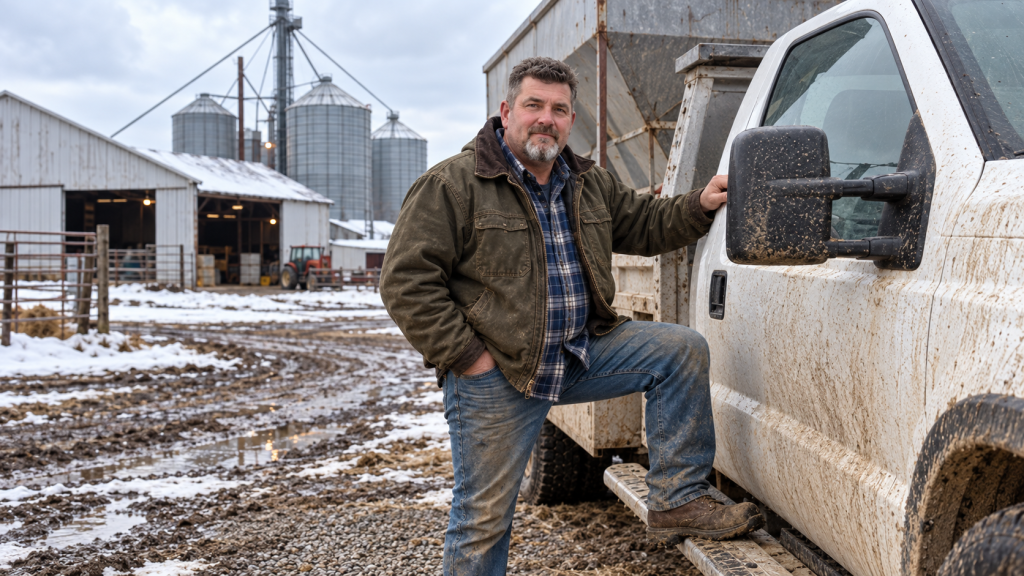
Hauled feed. Checked the cattle. Sometimes talked to my father as if he were still sitting beside me. Yet apparently, something he’d left behind had been inches away from me the entire time. “Why didn’t he tell me?” I whispered. Phil lowered his eyes. “I don’t know, Wade.” I took a breath. “Then let’s find out.”
We walked toward the International.
My boots crunched across the gravel.
Phil followed a few steps behind, carrying the folder he’d brought from Dad’s workshop.
The driver’s door groaned when I opened it.
That familiar smell reached me immediately.
Diesel.
Old vinyl.
Ground feed.
And the faint, unmistakable scent of the peppermint candies Dad kept in the glove compartment.
I climbed inside.
For a second, I looked at the empty passenger seat.
I could almost hear him.
“Don’t slam the door, Wade. She’s older than you think.”
My throat tightened.
Then I reached beneath the driver’s seat.
Nothing.
I felt along the metal frame.
My fingers found dust, a loose bolt, and a collection of sunflower seed shells Dad had apparently dropped over the years.
“There’s nothing here,” I said.
Phil leaned through the doorway.
“Maybe he meant the storage box beneath the seat.”
I frowned.
“What storage box?”
Phil pointed toward the lower frame.
“There. Behind that panel.”
I looked closer.
An old rectangular metal cover had been secured with two screws.
I’d never noticed it.
Or maybe I’d noticed it a thousand times without thinking anything of it.
I grabbed a screwdriver from the toolbox.
Removed the screws.
Pulled the cover free.
And reached inside.
My fingers touched something wrapped in oilcloth.
I stopped breathing.
“Wade?” Phil whispered.
I carefully pulled it out.
A flat brown packet.
Sealed with two strips of black electrical tape.
Across the front, in my father’s unmistakable handwriting, were five words.
WADE. OPEN THIS WHEN READY.
I stared at them.
My hands began shaking.
Phil stood quietly beside the truck.
Neither of us spoke.
Then I noticed the date written beneath my name.
January 17.
The night before Dad died.
My father had suffered a heart attack early the following morning.
The doctor later told us it had probably happened quickly.
I’d been the one who found him.
He was sitting in his favorite chair beside the farmhouse window, wearing his work shirt and holding an old newspaper.
His coffee was untouched.
For weeks afterward, I’d tortured myself wondering whether I could have saved him if I’d arrived earlier.
And now I was holding something he’d prepared only hours before his death.
I sat behind the wheel.
Phil climbed into the passenger seat.
For a moment, we looked at each other.
Two grown men.
Fifty-one and fifty-six.
Both suddenly feeling like boys.
Then I carefully peeled away the tape.
Inside were three things.
A handwritten letter.
A small brass key.
And a thick envelope containing bank statements, copies of loan agreements, and a notebook page covered with columns of numbers.
I looked at the letter first.
Across the top, Dad had written:
Wade, this is the truth I was too much of a coward to tell you while I could still look you in the eye.
My chest tightened.
I unfolded the page.
And began reading.
Son,
If you’re reading this, then I’m gone, and you’ve probably already heard what I did with the farm.
I imagine you’re angry.
You should be.
My eyes burned.
Dad had never spoken like that.
Albert Kucera didn’t admit he was wrong.
He would argue with a broken thermometer before accepting that he’d misread the temperature.
But there it was.
In his handwriting.
You should be.
I swallowed and kept reading.
For twenty-two years, you worked beside me.
You gave up better-paying jobs, weekends, vacations, and more than one opportunity to build something of your own.
I told myself that keeping you close was good for the farm.
What I didn’t ask often enough was whether it was good for you.
A tear fell onto the paper.
I wiped it away with my sleeve.
I owe you more than I ever said.
More money.
More thanks.
And a better explanation than the one you’re about to receive from Don.
I heard Phil take a shaky breath.
Then I continued.
The farm has debts you don’t know about.
Some came from bad harvests and equipment repairs.
Some came from decisions I made when your mother was sick.
And some came from trying to fix trouble I should never have hidden from either of you.
My stomach tightened.
I looked toward the bank statements.
Then back at the letter.
I have spent too long pretending that hard work alone can solve every problem.
Sometimes it can’t.
Sometimes an old man makes a mess and leaves his sons to discover it.
I pressed my lips together.
Dad.
Stubborn, proud Dad.
Who’d spent his life telling us that excuses were worth less than the paper they were written on.
I left the farm to Phil because I convinced myself he could sell it if necessary.
You never would.
I knew you’d put your last dollar, your last healthy day, and probably your marriage into saving those acres.
I thought I was protecting you from that.
I stopped.
My chest burned.
He’d left the land I’d spent twenty-two years working to my brother because he believed I’d love it too much to let it go.
But I know that doesn’t make what I did fair.
I should have spoken to you.
I should have let you decide.
Instead, I made one more decision for everybody and called it fatherhood.
My vision blurred.
I heard Phil whisper my name.
I shook my head.
I wasn’t finished.
The old truck is yours because I wanted you to have something that belonged to the work you did, not just to the estate.
There are records in this packet you need to examine with Don.
The key opens the locked drawer beneath my workshop bench.
I’ve kept a full account of what happened there.
I looked at the little brass key in my palm.
Then returned to the letter.
There’s one more thing you need to know.
Phil wasn’t told the whole truth either.
Don’t decide what kind of brother he is until you’ve both seen the papers.
Phil turned toward me.
His face had gone pale.
“What does that mean?”
I shook my head.
“I don’t know.”
Then I read the final paragraph.
Wade, I was never good at saying I loved you.
I thought getting up before sunrise and working beside you was enough.
It wasn’t.
I was proud of you.
Every single day.
Not because you kept the farm alive, but because of the kind of man you became.
I hope you find a way to forgive me someday.
But even if you don’t, I hope you finally live a life that belongs to you.
Dad.
I lowered the letter.
And cried.
I hadn’t cried when the attorney read the will.
Hadn’t cried when I moved my cattle.
Hadn’t cried when I accepted the fertilizer-hauling job.
I’d been too angry.
Too proud.
Too busy trying to convince myself that none of it mattered.
But now I sat in Dad’s old truck, holding an apology he’d been unable to say aloud.
And the grief came through me like a storm.
Phil looked toward the windshield.
His eyes filled.
For a long time, he said nothing.
Then he whispered:
“He knew.”
I wiped my face.
“Knew what?”
Phil’s voice broke.
“That he’d hurt you.”
I stared at the letter.
“Yes.”
He looked down.
“And he did it anyway.”
Those words might have made me furious four months earlier.
Now they simply hurt.
Because my father hadn’t been a villain.
He’d been a good farmer.
A stubborn father.
A man who loved his sons and sometimes confused loving them with making their decisions.
And he’d made a terrible mistake.
I folded the letter carefully.
Then picked up the financial statements.
There were payments to the farm’s lender.
Equipment invoices.
Insurance records.
And one old loan guarantee bearing a name I recognized.
PHILIP KUCERA.
I froze.
I looked at my brother.
“Phil.”
He turned.
“What?”
I held out the document.
“Did Dad guarantee a business loan for you?”
His face drained of color.
For a moment, he couldn’t speak.
Then he whispered:
“Fifteen years ago.”
My stomach tightened.
“How much?”
Phil stared at the paper.
“Eighty thousand dollars.”
I looked down.
The document showed a much larger balance.
Accrued interest.
Additional advances.
And a refinancing agreement that appeared to have drawn security from the farm.
My hands began trembling.
“Phil, this says two hundred and forty thousand.”
He closed his eyes.
I stared at him.
“What happened?”
My brother looked toward Dad’s gloves.
Then whispered:
“Wade, I thought I paid him back.”
I sat motionless.
Phil reached for the statement.
His hands shook.
“After my insurance partnership failed, Dad helped me with a loan.”
I looked at him.
“He told me he’d used savings.”
Phil nodded miserably.
“I sent payments for years. He said everything was settled.”
I pointed to the refinancing papers.
“Then why is the farm securing this debt?”
Phil shook his head.
“I don’t know.”
I studied the account numbers.
Something was wrong.
The payments Phil said he’d made weren’t visible where I expected them to be.
But the records were incomplete.
I couldn’t conclude anything from a handful of statements.
Still, a horrible possibility had begun forming in my mind.
Dad had borrowed against the farm.
Phil believed he’d repaid him.
And somehow, the debt had continued growing.
I looked toward the farmhouse in the distance.
Then back at my brother.
“Phil, we need to open that drawer.”
He swallowed.
“Yes.”
I put Dad’s letter back inside the packet.
Then climbed down from the cab.
The sun was sinking behind the pasture.
Our cattle moved quietly near the fence.
Theresa stood on the porch watching us.
She’d seen my face.
Even from that distance, she knew something had happened.
“Wade?” she called.
I looked toward her.
For a moment, I couldn’t answer.
Then I raised the packet.
“Dad left us something.”
Her expression changed.
“What?”
I swallowed.
“The truth.”
Phil and I drove to the family farm in Dad’s old pickup.
For the first time in four months, I rode beside my brother without feeling as though the space between us was impossible to cross.
Neither of us said much.
The road curved between cornfields.
Familiar windbreaks passed outside.
The sun turned the tops of the cottonwoods gold.
As we approached the farmhouse, Phil spoke.
“Wade?”
“Yeah?”
He swallowed.
“I should’ve called you before planting.”
I looked ahead.
“Yes.”
He nodded.
“I was ashamed.”
I said nothing.
“Everybody in town knew Dad left me the farm.”
His voice broke.
“And everybody knew you were the one who could actually run it.”
I looked toward him.
He kept his eyes on the road.
“I thought if I called you, I’d be admitting I didn’t deserve what he gave me.”
I swallowed.
“And instead, you hired people who didn’t know the land.”
Phil nodded.
“Yes.”
I looked toward the struggling corn.
The uneven rows.
The yellow patches.
The silent irrigation pivot.
“Phil, asking for help doesn’t make you a failure.”
He gave a bitter laugh.
“It feels like it.”
I thought about Dad.
How many years he’d spent refusing to ask for help.
How many bills he’d hidden.
How many decisions he’d made in silence.
Then I whispered:
“That’s probably where we learned it.”
Phil looked at me.
For a moment, neither of us spoke.
Then he nodded.
We pulled into the farmyard.
The workshop stood beside the machinery shed.
Its green door was faded.
The old windmill behind it creaked in the evening breeze.
I climbed out.
For twenty-two years, I’d opened that workshop every morning.
Greased machinery.
Sharpened blades.
Replaced bearings.
Argued with Dad about tools he insisted weren’t missing.
Now I stood in front of it holding a key he’d hidden for me.
Phil opened the door.
The smell of grease and old lumber greeted us.
Nothing had changed.
Dad’s coffee tin sat on the bench.
His wrench set hung on the wall.
The calendar still showed January.
I walked toward the workbench.
Knelt.
And found the narrow drawer beneath it.
A brass lock was set into the wood.
I inserted the key.
Turned it.
The lock clicked.
Inside was a blue ledger.
Several envelopes.
A folded map.
And a small recorder.
I stared at the contents.
Then lifted the ledger.
Across the cover, Dad had written:
THE FARM. WHAT I OWE MY BOYS.
Phil’s breathing changed.
I opened the first page.
The numbers began in 1998.
Feed costs.
Seed purchases.
Loan payments.
Machinery repairs.
There were also handwritten entries beside my name.
Wade repaired combine. Saved estimated service charge.
Wade covered cattle feed from personal account.
Wade worked through harvest after injury.
Page after page.
Year after year.
Dad had recorded things he’d never mentioned.
Not every hour.
Not an official payroll register.
But enough to show he’d noticed.
My eyes filled.
Then I reached the final pages.
The handwriting had become shakier.
There were several entries involving Phil’s payments.
And alongside them, a name that made my stomach tighten.
Martin Kessler.
I recognized it immediately.
Kessler Agricultural Finance.
The private lending company that had approached Dad several years earlier about refinancing the farm.
I looked at Phil.
“Do you know Kessler?”
He frowned.
“The lender?”
I nodded.
Phil’s expression changed.
“He’s the man who’s been calling me about the farm.”
My stomach tightened.
“What does he want?”
Phil looked away.
“He says the balloon payment comes due in September.”
I stared.
“How much?”
His voice was barely audible.
“Four hundred and eighty thousand dollars.”
I felt cold.
The farm had a mortgage balance large enough to threaten its future.
The crop was failing.
The irrigation system was broken.
And September was less than three months away.
I looked back at the ledger.
Then turned to a page marked with a red line.
At the bottom, Dad had written:
Kessler says the only way out is to sell. I don’t believe him anymore.
My heart began pounding.
I looked toward Phil.
He stared at the page.
Then I picked up the small recorder.
Its battery cover was loose.
A piece of tape held it shut.
There was a label on the back.
Again, Dad’s handwriting.
PLAY THIS WITH BOTH BOYS PRESENT.
For a moment, neither of us moved.
Then Phil whispered:
“Wade, maybe we should wait.”
I looked at him.
“For what?”
His eyes filled.
“I don’t know.”
I stared at the recorder.
Then took a breath.
“Dad made us wait long enough.”
I pressed the button.
There was a soft hiss.
A faint click.
Then a voice filled the workshop.
My father’s voice.
“Wade? Phil?”
Both of us froze.
There was a long pause.
Then Dad cleared his throat.
“Well, I suppose if you’re hearing this, I finally ran out of chances to avoid a difficult conversation.”
My knees weakened.
Phil gripped the workbench.
And Dad continued.
“There’s something about the farm loan that both of you need to know.”
The recorder crackled.
For a moment, neither Phil nor I moved.
I’d spent four months wishing I could hear Dad’s voice again.
Now it filled the workshop, rough and familiar, with the same stubborn Nebraska accent he’d carried all his life.
And he was about to tell us something he’d apparently been unable to say while he was alive.
“Boys, I don’t know how much you’ve already figured out.”
Dad coughed.
“Knowing Wade, probably more than I ever gave him credit for.”
A weak smile crossed my face.
Then his voice grew serious.
“First thing, Phil, I need you to know that you paid back the money I loaned you when your insurance partnership failed.”
Phil gripped the workbench.
I turned toward him.
His eyes had filled with tears.
Dad continued.
“You sent the payments exactly as we agreed. Every last one.”
Phil covered his mouth.
For fifteen years, he’d apparently believed that debt was behind him.
Now he was hearing our father confirm it.
“But here’s where I went wrong,” Dad said.
“I didn’t use all those payments to reduce the farm borrowing.”
My stomach tightened.
“I needed money when your mother got sick. There were medical bills, equipment payments, and a bad harvest. I used some of what Phil sent to cover those expenses.”
The recording hissed.
Dad took a breath.
“Then I refinanced. Borrowed more than I should have. Told myself the next harvest would fix it.”
I lowered my head.
I remembered those years.
Mom’s treatments.
The medical appointments.
Dad arriving home from the hospital looking as though he’d aged ten years.
The corn prices falling.
The old combine breaking down during harvest.
I knew we’d been struggling.
But I hadn’t known just how badly.
Dad continued.
“Kessler came along when the local bank wouldn’t extend the operating line on the terms I wanted.”
His voice sounded bitter.
“He offered quick money. I signed papers I should’ve taken more time to understand.”
I looked toward the ledger.
The name Martin Kessler appeared again and again.
“Now he’s got a balloon payment scheduled for September. He’s also been asking whether I’d consider selling the farm to one of his investment partners.”
Phil slowly sat on a wooden stool.
Dad coughed again.
Then said:
“I don’t know that Kessler’s done anything illegal. But I know he’s been pushing me toward a sale, and I don’t trust advice that comes from a man who might profit from me having no other choice.”
I swallowed.
“That’s why I’ve kept copies of the loan documents, every payment, and the correspondence.”
The recorder clicked softly.
“I need you boys to have somebody independent examine all of it.”
For a moment, the recording fell silent.
Then Dad’s voice returned.
Quieter.
“And Wade…”
My heart tightened.
“I know you’ve spent years keeping this farm running while I pretended everything was under control.”
I looked down.
“You’ve paid for repairs from your own pocket.”
I nodded slowly.
“You’ve worked through sickness.”
My throat closed.
“You’ve missed birthdays and anniversaries because I convinced you the cattle couldn’t wait.”
I thought of Theresa.
The vacation she’d planned for our twentieth anniversary.
The reservations she’d made.
The way I’d canceled three days beforehand because Dad said the combine needed repairing.
I remembered her expression when I told her.
She’d smiled.
Said she understood.
But I’d seen the disappointment.
And done nothing about it.
Dad continued.
“I wrote down what I could remember of what you’ve contributed.”
His voice broke.
“It’s not enough.”
I closed my eyes.
“I know it isn’t enough.”
There was a long pause.
Then Dad spoke again.
“I left the farm to Phil because I thought he’d be willing to sell if the debt couldn’t be managed.”
I tightened my grip on the recorder.
“I thought Wade would destroy himself trying to save it.”
Phil looked at me.
Neither of us spoke.
Dad’s next words were almost a whisper.
“But the truth is, I was too afraid to let either of you make that choice yourselves.”
I began crying.
“I kept telling myself I was protecting my boys.”
Dad coughed.
“Maybe I was just protecting myself from having to admit I’d failed.”
The workshop became impossibly quiet.
Then Dad continued.
“Phil, don’t let anybody tell you you’re less of my son because you chose a different life.”
Phil covered his face.
“And Wade, don’t let anybody tell you you’re worth less because I left you an old truck.”
Tears ran down my cheeks.
“Both of you deserved better than this.”
I sat on the edge of the workbench.
“If the farm can be saved, I hope you save it together.”
His voice trembled.
“If it can’t, I hope you have the sense to let the land go before it takes your lives with it.”
A long silence followed.
Then Dad laughed softly.
“And for heaven’s sake, fix that irrigation pivot. The north tower’s gearbox has been making a noise since October.”
Phil let out a broken laugh.
I covered my eyes.
Even dying, Dad had managed to leave us a maintenance instruction.
Then his voice became quiet again.
“I love you boys.”
A pause.
“I should’ve said it more.”
The recorder clicked.
And stopped.
For a long time, neither of us moved.
The wind rattled the workshop window.
A meadowlark called somewhere beyond the grain bins.
And I sat beside my brother, feeling as though Dad had died all over again.
Phil began crying first.
Not quietly.
Not the way men in our family were taught to cry.
He bent forward, covered his face, and sobbed.
“I didn’t know,” he whispered.
I looked toward him.
“Wade, I swear I didn’t know.”
I believed him.
For the first time in months, I understood that Phil hadn’t been standing on top of some enormous fortune laughing at my loss.
He’d been handed a farm with debts he didn’t understand.
A business he didn’t know how to operate.
And the impossible expectation that he could somehow become our father.
Neither of us had received what we needed.
Phil had received property without preparation.
I’d received experience without ownership.
And Dad had left us an apology without giving us the chance to ask him why.
I looked down at the recorder.
Then whispered:
“Dad, you stubborn old fool.”
Phil laughed through tears.
“That’s exactly what he was.”
For a moment, we both smiled.
Then the laughter faded.
I took a breath.
“Phil, we still have a problem.”
He nodded.
“The crop.”
“The debt.”
“The pivot.”
He lowered his eyes.
“And a farm I don’t know how to run.”
I looked toward the workshop door.
Outside, the evening light stretched across the machinery yard.
For twenty-two years, I’d known what to do next on that farm.
Repair this.
Feed that.
Plant here.
Check the weather.
Now, for the first time, I wasn’t sure.
Because saving the crop meant going back to the land that had broken my heart.
And helping Phil meant trusting a brother I’d barely spoken to since Dad’s funeral.
I took a slow breath.
“Let’s go see the pivot.”
Phil looked up.
“What?”
“I said let’s go look at it.”
Hope flashed across his face.
“Wade, does that mean—”
“Don’t get ahead of yourself.”
I stood.
“We haven’t agreed on anything.”
He nodded quickly.
“I know.”
“But Dad was right about one thing.”
Phil waited.
“That gearbox did sound bad last October.”
For the first time that evening, my brother smiled.
A genuine smile.
And together, we stepped out into the cooling Nebraska night.
The center-pivot irrigation system stood motionless against the darkening sky.
Its long metal spans stretched across the field like the skeleton of some enormous sleeping animal.
One tire was flat.
The grass around the control panel had grown tall.
And the soil beneath the north tower was rutted and hardened.
I walked slowly around the machinery.
Phil followed.
“Has anybody tested the power?” I asked.
He looked embarrassed.
“I hired someone.”
“That wasn’t what I asked.”
He sighed.
“I don’t know.”
I nodded.
“Then we’ll start there.”
We didn’t attempt repairs in the dark.
Instead, I inspected what I could see safely and made a list.
The electrical system needed qualified testing.
The damaged tire required attention.
The gearbox needed inspection.
The alignment and drive components had to be checked.
And the irrigation schedule couldn’t begin until we knew the whole system was operating safely.
Phil watched me write.
“You remember all this?”
I looked at him.
“Twenty-two years, Phil.”
He nodded sadly.
“Right.”
We stood beside the pivot for a moment.
Then he asked quietly:
“How bad is the corn?”
I stared across the field.
Some plants were healthy.
Others were yellow and stunted.
There were gaps where seed had failed.
And the weeds had been allowed to grow too long.
“Bad,” I answered.
Phil closed his eyes.
“Is it hopeless?”
I considered.
“No.”
His eyes opened.
“But we need to stop pretending we’ll harvest a perfect crop.”
He nodded.
“Some areas may recover enough to justify further investment. Some won’t.”
I pointed toward the field.
“We need soil and tissue tests, a realistic yield assessment, and a plan that doesn’t throw good money after bad.”
Phil swallowed.
“Can you help me make one?”
I looked at him.
For a moment, I saw the older brother who used to help me climb into haylofts.
The boy who defended me when the older kids at school made fun of my stutter.
The teenager who once gave me his favorite baseball glove because mine had torn.
Then I saw the man who’d inherited our father’s entire farm while I’d been left with a rusty truck.
Both memories were true.
I took a breath.
“Yes.”
Phil’s eyes filled.
“But we do it properly.”
He nodded.
“No more assumptions.”
“No more decisions made for me.”
“Agreed.”
“And if I’m going to work on this farm, I need a written arrangement.”
Phil didn’t hesitate.
“Whatever you think is fair.”
I shook my head.
“No, Phil.”
He frowned.
“We’re not doing it that way anymore.”
I looked across the field.
“We get independent advice.”
“We look at the numbers.”
“And we agree on terms that protect both of us.”
Phil was quiet for a moment.
Then he nodded.
“Okay.”
I extended my hand.
He looked at it.
Then took it.
His grip was firm.
Familiar.
For a moment, I felt like we were standing beside Dad again.
Two boys being told to shake hands after arguing over a borrowed tool.
But this time, nobody forced us.
We made the choice ourselves.
The next morning, I told Theresa everything.
We sat at our kitchen table before sunrise.
The coffee was hot.
The house was quiet.
Dad’s letter lay between us.
Theresa read it slowly.
When she finished, she wiped her eyes.
“Oh, Wade.”
I looked down.
“He knew he hurt me.”
She nodded.
“He did.”
I swallowed.
“And he thought he was protecting me.”
Theresa looked toward the window.
“Maybe he was trying.”
She paused.
“But that doesn’t mean it was fair.”
I looked at her.
“I know.”
She took my hand.
“Wade, I loved your father.”
My throat tightened.
“But I watched you give twenty-two years of your life to that farm.”
I nodded.
“And I watched you come home too exhausted to enjoy the life we were building here.”
For a moment, I couldn’t speak.
Theresa’s eyes filled.
“I never wanted you to abandon your father.”
Her voice broke.
“I just wanted there to be room for us too.”
The words struck harder than anything in Dad’s letter.
Because I’d spent months thinking about what my father owed me.
I hadn’t spent enough time thinking about what I owed my wife.
I reached for her hands.
“Theresa, I’m sorry.”
She looked surprised.
I swallowed.
“For the canceled vacations.”
Tears filled her eyes.
“For the dinners I missed.”
“For all the times you needed me and I said the farm couldn’t wait.”
She began crying.
I held her hands tighter.
“I don’t want to make the same mistake again.”
She leaned toward me.
“Then don’t.”
I nodded.
“If we help Phil, we do it together.”
Her expression softened.
“And we protect our own farm dreams, not just your father’s.”
I smiled sadly.
“Yes.”
Then she said something that changed the way I looked at the entire problem.
“Wade, perhaps the question isn’t whether you should go back.”
I frowned.
“What do you mean?”
She squeezed my fingers.
“Perhaps the question is whether you can finally go forward.”
I stared at her.
For twenty-two years, I’d believed the farm was my life.
Now, sitting beside the woman who’d loved me through all those years, I began wondering whether my future could include the land without being consumed by it.
Then my telephone rang.
Phil.
I answered.
“Morning.”
His voice sounded strained.
“Wade, I’m sorry to call so early.”
My stomach tightened.
“What happened?”
He hesitated.
“Martin Kessler just called.”
I looked toward Theresa.
“What did he want?”
Phil swallowed.
“He says he’s coming to the farm tomorrow with an offer.”
I frowned.
“What kind of offer?”
There was a pause.
Then my brother whispered:
“He says if I sell before the end of the month, he’ll make the September debt disappear.”
I went cold.
The farm was worth far more than the debt.
And somebody was offering to make nearly half a million dollars vanish in exchange for the land Dad had spent his life working.
I looked toward the financial packet.
Then toward Theresa.
And suddenly, I understood why Dad had written one sentence in red ink.
Kessler says the only way out is to sell.
I don’t believe him anymore.
I didn’t sleep much that night.
Every time I closed my eyes, I saw Dad’s handwriting.
Kessler says the only way out is to sell.
I don’t believe him anymore.
I’d spent twenty-two years operating a farm that belonged to my father.
I’d watched him negotiate seed prices, compare machinery loans, and argue with suppliers over bills that were only a few dollars too high.
Dad could squeeze ten cents out of a corn buyer and then drive twenty miles to save twelve dollars on a replacement bearing.
He was careful.
Sometimes painfully careful.
Yet he’d signed a complicated private loan arrangement without fully understanding how it might affect the land.
That frightened me.
Because if a man like Albert Kucera could find himself trapped by bad financial decisions, what chance did Phil and I have if we started signing papers out of desperation?
At seven the next morning, I called Don Jensen.
The attorney who’d read Dad’s will answered on the third ring.
“Don Jensen.”
“Don, it’s Wade Kucera.”
There was a pause.
“Wade. How are you holding up?”
I looked toward Dad’s old truck outside the kitchen window.
“That’s a complicated question.”
Don sighed gently.
“I imagine.”
I explained the hidden packet.
The ledger.
The loan documents.
Dad’s recording.
And Martin Kessler’s offer.
Don listened without interrupting.
When I finished, he asked:
“Have you and Phil signed anything concerning the new sale proposal?”
“No.”
“Good.”
I swallowed.
“Don, can Phil sell the farm while there’s still a mortgage?”
“He may be able to sell, but the liens and other title matters must be addressed through the closing. You need the exact loan terms, payoff information, and title records before agreeing to anything.”
I nodded.
“Can you help us?”
Don paused.
“I can explain the estate documents and my prior work for your father. But because you and Phil may have different interests now, I recommend independent legal advice before either of you makes new financial commitments.”
I stared at the table.
That made sense.
“So we need separate lawyers?”
“Potentially, yes. At minimum, each of you should understand whose interests any professional is representing.”
I glanced toward Theresa.
She was listening from the kitchen doorway.
“Don, there’s another thing.”
“Yes?”
“Dad kept records of work I did and money I spent on the farm.”
A pause.
“He wrote that he owed me more than he’d ever paid.”
Don’s voice softened.
“That’s important evidence of your father’s intentions and concerns. Whether it establishes a legally enforceable obligation depends on the records and applicable law. We shouldn’t promise more than the documents support.”
I closed my eyes.
I hadn’t called because I wanted someone to tell me I suddenly owned half the farm.
But a part of me still wanted Dad’s ledger to turn twenty-two years of sacrifice into something nobody could take away.
Don continued.
“Wade, your father’s will and his private letter may tell different parts of the story.”
I swallowed.
“The letter can help you understand him.”
He paused.
“But it doesn’t automatically rewrite the will.”
I nodded slowly.
“I know.”
Then Don said something I needed to hear.
“Whatever you and Phil decide now should be your choice. Not a way of continuing an argument with Albert after he’s gone.”
I looked toward Dad’s gloves.
For a moment, I couldn’t speak.
Then I whispered:
“Thank you, Don.”
When I ended the call, Theresa sat beside me.
“You all right?”
I considered.
“No.”
She smiled sadly.
“But I’m thinking more clearly than I was yesterday.”
I looked toward her.
“That counts for something.”
She squeezed my hand.
“It counts for a lot.”
That afternoon, Phil and I met at the farm with an agricultural lender from a different institution, a farm-management consultant, and an attorney Phil had retained.
I brought Theresa.
Not because I needed her permission to make every decision.
Because she deserved to understand what could affect our future.
For the first time, we put every number on the table.
The current mortgage balance.
The September balloon payment.
The operating expenses.
The damaged crop.
The cost of repairing the irrigation system.
The equipment maintenance that had been postponed.
The value of the cattle Phil didn’t own.
And the financial records Dad had kept.
There were no easy answers.
The farm had substantial value.
But value wasn’t the same as cash.
Land couldn’t make a loan payment by itself.
And a poor harvest didn’t become profitable because everyone wanted it to.
The consultant, Laura McBride, studied the crop reports.
She was a practical woman in her late forties with a weathered face and the patience of somebody who’d spent years explaining unpleasant facts to farmers.
“Wade,” she said, “the planting damage is significant.”
I nodded.
“Some areas may produce a worthwhile crop. Others could lose enough yield that additional spending won’t be justified.”
Phil looked down.
Laura continued.
“We need a field-by-field plan. And we need to separate saving this year’s crop from deciding how the farm should operate for the next twenty years.”
I looked toward Phil.
He was staring at his hands.
“Phil,” I said quietly.
He looked up.
“You can’t undo the planting.”
His eyes filled.
“I know.”
“Then we stop spending time punishing ourselves for it.”
He stared.
“And we work with what we’ve got.”
For a moment, he couldn’t speak.
Then he nodded.
“Okay.”
I turned back toward Laura.
“What needs doing first?”
She pointed toward the irrigation report.
“The pivot.”
I nodded.
“And the weeds.”
“Yes.”
“And a realistic cash-flow forecast.”
“Exactly.”
For the first time since Dad died, I felt the familiar focus that used to settle over me when a difficult mechanical problem appeared.
Not blind optimism.
Not pride.
Just a list of things that needed doing.
The next day, Martin Kessler arrived.
He drove a spotless black pickup with chrome wheels that looked as though they’d never touched mud.
He wore polished boots.
A pressed shirt.
And sunglasses that probably cost more than my weekly wages at the co-op.
He climbed out of the truck and smiled broadly.
“Philip!”
Phil nodded.
“Martin.”
Then Kessler noticed me.
His smile changed.
“Wade Kucera.”
I took off my gloves.
“Morning.”
He extended his hand.
“I’ve heard a lot about you.”
I shook it briefly.
“Can’t imagine why.”
He laughed.
“Your father spoke very highly of your work.”
I felt a sharp pang.
Then Kessler looked toward the field.
“Shame what’s happened to the crop.”
Phil swallowed.
“We’re working on it.”
Kessler nodded sympathetically.
“Of course. But I think we should be realistic.”
He opened a leather folder.
“My investment partner is prepared to make a clean offer for the property.”
I stood beside Phil.
“How much?”
Kessler looked at me.
“Philip and I have been discussing the numbers.”
I nodded.
“Then he can tell me.”
Phil took a breath.
“One million two hundred thousand.”
I stared.
Four hundred acres.
A farmhouse.
A machinery shed.
Irrigation infrastructure.
And farm buildings.
The exact market value would depend on many factors.
But I knew enough about recent local land sales to recognize the offer deserved serious scrutiny.
I looked toward Kessler.
“Has the property been independently appraised?”
He smiled.
“Wade, the crop’s in bad shape, and the debt comes due soon.”
“That wasn’t my question.”
His smile tightened.
“We’re offering certainty.”
I nodded.
“Then the offer can withstand an appraisal.”
Phil looked toward me.
Kessler closed his folder slightly.
“Gentlemen, I’m trying to spare your family from a difficult situation.”
I looked directly at him.
“Then give us a written payoff statement and let us get independent advice.”
His expression hardened.
“Your father knew the terms.”
I felt anger rise.
“My father is dead.”
For a moment, nobody spoke.
I took a breath.
“And we’re not going to make decisions by guessing what he might have done.”
Kessler looked toward Phil.
“Philip, I thought we had an understanding.”
My brother swallowed.
“We discussed an offer.”
“Yes.”
“But I haven’t signed anything.”
Kessler’s expression changed.
I watched Phil.
For months, he’d been ashamed to call me.
Ashamed to admit he didn’t know how to operate the farm.
Now he stood beside the man who was offering him an easy escape.
And for the first time, he didn’t look away.
“I want a proper evaluation,” Phil said.
Kessler stared.
“Philip, you’re running out of time.”
Phil took a breath.
“Then I’d better stop wasting it.”
I almost smiled.
Kessler looked toward me.
“So that’s how it is.”
I said nothing.
He continued.
“You’re going to take advice from the brother who doesn’t own the land?”
The words struck like a hammer.
For a second, I felt the old humiliation return.
The reading of the will.
The rusty truck.
The twenty-two years.
But before I could answer, Phil spoke.
“Yes.”
I turned toward him.
My brother stood straighter.
“I’m going to listen to the man who knows the farm.”
Kessler’s jaw tightened.
“And I’m going to listen to independent advisers about the loan.”
For several seconds, nobody moved.
Then Kessler gave a thin smile.
“Well, gentlemen, don’t say I didn’t warn you.”
He returned to his pickup.
As he drove away, dust rose behind the tires.
Phil watched until the truck disappeared.
Then he looked at me.
“Wade?”
“Yeah?”
“Did I just make a terrible mistake?”
I considered.
“I don’t know.”
His face fell.
Then I added:
“But at least it was your decision.”
Phil gave a weak laugh.
I put a hand on his shoulder.
“Now let’s find out what options we really have.”
The following week was the hardest I’d worked since Dad’s final harvest.
But it was different.
This time, I wasn’t simply doing whatever the farm demanded.
I was working under an agreed, documented arrangement.
Phil and I signed a short-term consulting and farm-operations agreement with clear compensation, defined responsibilities, reimbursement terms, and decision-making procedures.
Theresa read every page.
Phil’s attorney reviewed it.
My own adviser checked the parts affecting me.
Nobody laughed at that.
Nobody said we should simply trust one another because we were brothers.
We’d seen what happened when important family arrangements remained unspoken.
We weren’t going to repeat it.
The co-op approved a temporary schedule that allowed me to assist during certain hours without abandoning my job.
Jeff, my manager, grinned when I explained.
“So the Kucera boys are finally talking?”
I nodded.
“Trying to.”
He laughed.
“Your father would be pleased.”
I considered.
“Maybe.”
Then I smiled.
“But he’d probably complain that we’re taking too long.”
Jeff burst out laughing.
We brought in a qualified irrigation technician.
The damaged gearbox was replaced.
The wheel and tire issues were addressed.
The electrical system was tested.
And the pivot was inspected before being returned to service.
When the machine finally began moving, Phil stood beside me.
The long metal spans rolled slowly across the field.
Sprinklers began releasing water in silver arcs.
My brother stared.
“It’s working.”
I nodded.
“For now.”
He laughed.
“You always have to say that.”
I smiled.
“Farm equipment doesn’t appreciate optimism.”
Then he turned toward me.
His eyes filled.
“Dad would’ve loved seeing this.”
I looked toward the moving pivot.
“Yes.”
For a moment, my throat tightened.
“He would.”
But I also remembered something Dad hadn’t known how to say.
Don’t let the farm take your life.
I looked toward my watch.
It was nearly six.
Theresa and I had dinner plans.
For twenty-two years, I’d have stayed until dark.
Checked every sprinkler.
Walked every row.
Found one more thing that needed fixing.
But this time, I put my notebook away.
“Phil, I’m heading home.”
He looked surprised.
“Already?”
I smiled.
“Theresa’s waiting.”
For a moment, he stared.
Then he nodded.
“Go.”
I looked at him.
He grinned.
“I’ve got this for tonight.”
I hesitated.
“Call if there’s an emergency.”
He nodded.
“But not because I can’t find the wrench.”
I laughed.
And drove home.
That evening, Theresa and I sat on our back porch.
The sun was sinking beyond our rented pasture.
Our cattle grazed quietly near the fence.
She handed me a glass of lemonade.
“Long day?”
I nodded.
“Very.”
She smiled.
“But you’re home.”
I looked at her.
For a moment, I couldn’t speak.
Then I reached for her hand.
“Yes.”
I swallowed.
“I’m home.”
She leaned against my shoulder.
And we sat together while the last light faded.
The next morning, Phil called.
His voice sounded strange.
“Wade?”
I sat up.
“What happened?”
He took a breath.
“The independent appraisal came in.”
My heart tightened.
“And?”
There was a long pause.
Then my brother whispered:
“The farm is worth more than twice what Kessler offered.”
I stared toward the window.
Then Phil continued.
“And Wade, the attorney found something in the refinancing agreement that we need to discuss immediately.”
Phil was waiting at the farmhouse when I arrived.
He stood beside the kitchen table, staring at a stack of documents.
For a moment, he looked so much like Dad that I nearly stopped in the doorway.
The same broad shoulders.
The same deep crease between his eyebrows.
The same habit of pressing one hand flat against a piece of paper when he was worried.
“Morning,” I said.
Phil looked up.
“Wade.”
I removed my cap.
“Tell me what the attorney found.”
He took a breath.
“First, the appraisal.”
He turned a page toward me.
The independent appraiser had assessed the property at approximately two million eight hundred thousand dollars, subject to the report’s assumptions and the conditions affecting the land.
I stared at the number.
Kessler’s offer had been one million two hundred thousand.
The difference was enormous.
I looked toward Phil.
“That’s not a small discount for a quick sale.”
He shook his head.
“No.”
I swallowed.
“What about the loan?”
Phil sat down.
“The attorney found that the investment group offering to buy the farm has a business connection to an entity affiliated with Kessler.”
My stomach tightened.
“What kind of connection?”
“Shared investors and a previous financing arrangement.”
I looked at the documents.
It didn’t automatically prove wrongdoing.
Business relationships could be perfectly lawful.
But Kessler had presented the proposed sale as though it were simply a favor to a struggling family.
He hadn’t clearly explained that the buyer’s interests might be connected to his own.
I felt anger rise.
“Did the lawyer say what it means?”
Phil nodded.
“He said the relationship needs closer review, along with the loan terms and communications. He also said we shouldn’t assume Kessler has the right to force a sale just because he wants one.”
I stared.
For weeks, Phil had been listening to warnings.
The debt.
The deadline.
The failing crop.
The risk of losing everything.
And while the debt was real, the claim that selling immediately was the only possible solution was beginning to look much less convincing.
I took a breath.
“Did the attorney find a way to refinance?”
Phil hesitated.
“Not yet.”
My shoulders sagged.
“But a local agricultural lender is willing to review a complete proposal if we can demonstrate a viable operating plan.”
I nodded slowly.
“That’s something.”
Phil looked toward me.
“Wade, I’m sorry.”
I frowned.
“For what?”
“For almost signing that offer.”
I studied my brother.
He looked exhausted.
Older than he’d looked at Dad’s funeral.
I took a breath.
“Phil, you inherited a problem you didn’t understand.”
He looked down.
“And you were trying to get out from under it.”
He nodded.
“But next time, we get advice before fear makes the decision.”
He looked up.
“Agreed.”
For a moment, we sat quietly.
Then Phil slid another sheet across the table.
“There’s something else.”
My stomach tightened.
“What now?”
He gave a tired smile.
“Nothing bad, I hope.”
I picked it up.
It was a handwritten outline.
At the top were two words.
FARM PARTNERSHIP.
I looked at him.
Phil swallowed.
“I stayed up half the night thinking.”
I raised an eyebrow.
“Dangerous hobby.”
He laughed weakly.
Then his expression turned serious.
“Wade, Dad gave me four hundred acres.”
I nodded.
“But he didn’t give me twenty-two years of your experience.”
My throat tightened.
“And I can’t pretend owning a farm makes me the man who kept it running.”
I looked down.
Phil continued.
“I don’t want to sell it out from under you.”
He swallowed.
“And I don’t want you working for me your entire life either.”
For a moment, I couldn’t speak.
Then he said:
“I want us to find a way to own and operate it together.”
I stared.
“What do you mean?”
Phil pointed toward the outline.
“A proper partnership. Or maybe a separate operating business and an agreement to transfer some acreage over time. Whatever makes sense after we get advice.”
I shook my head.
“Phil, that’s a complicated decision.”
“I know.”
“It could affect the loan.”
“I know.”
“And Theresa and I can’t risk everything we’ve saved just because we want the farm.”
He nodded.
“Then we don’t ask you to.”
I looked up.
He continued.
“We hire people who know how to structure it.”
I felt something move in my chest.
For twenty-two years, Dad had decided what the farm needed.
Now Phil was asking what I needed.
That difference mattered more than he realized.
I took a breath.
“Let’s get through this harvest first.”
He nodded.
“Then we make a long-term decision with actual numbers.”
Phil smiled.
“Deal.”
But saving the harvest was going to be harder than either of us had imagined.
The weather turned hot.
A dry wind swept across the fields.
The damaged corn struggled.
Some stalks never developed properly.
Other areas improved after careful nutrient management and irrigation.
The crop consultant visited regularly.
We tracked costs.
Compared likely yields.
And avoided spending money in areas unlikely to respond.
Nothing about it was glamorous.
There were no miraculous overnight recoveries.
No secret fertilizer that turned ruined corn into a record harvest.
There was only work.
Careful judgment.
And the humility to accept that some of the damage couldn’t be repaired.
One afternoon, I stood beside Phil at the edge of the worst field.
Rows of stunted corn stretched before us.
He removed his hat.
“Dad would’ve hated seeing this.”
I nodded.
“Yes.”
Phil swallowed.
“I feel like I failed him.”
For a moment, I stared at the field.
Then I asked:
“Phil, do you remember when Dad planted the south forty too early in 2007?”
He frowned.
“No.”
I laughed softly.
“Of course you don’t. You were selling insurance in Omaha.”
Phil smiled weakly.
“Fair point.”
I looked toward the corn.
“He got impatient because the forecast showed rain.”
I shook my head.
“The ground was still cold, and we had a terrible stand.”
Phil raised an eyebrow.
“Dad?”
“Yep.”
“The same man who lectured everybody about soil temperature?”
“The very same.”
Phil laughed.
“What happened?”
I smiled sadly.
“We replanted part of it.”
Then I looked at him.
“And he complained about the seed bill for five years.”
Phil began laughing harder.
For a moment, we stood beside the damaged crop, laughing like brothers again.
Then his expression softened.
“I guess he wasn’t perfect.”
I looked toward the field.
“No.”
I swallowed.
“He wasn’t.”
That had become the hardest truth for me to accept.
Dad had been the center of the farm for as long as I could remember.
I knew his habits.
His routines.
His rules.
I knew he checked the soil temperature before planting.
Knew he believed in repairing a machine twice before buying a replacement.
Knew he hated wasting feed.
But somewhere along the way, I’d begun treating his judgment as though it couldn’t be questioned.
Even when his decisions were hurting me.
Even when he refused to explain things.
Even when I should have spoken honestly.
I looked toward Phil.
“Maybe saving Dad’s farm doesn’t mean doing everything Dad would’ve done.”
He considered.
Then nodded.
“Maybe it means fixing what he couldn’t.”
I smiled.
“Exactly.”
The first serious crisis came in July.
A thunderstorm crossed the county.
High winds pushed through the fields.
Power went out across several farms.
Late that night, Phil called.
“Wade, the irrigation pivot stopped.”
I glanced at the clock.
Eleven forty-two.
I looked toward Theresa.
She was reading beside me.
“Is there damage?”
“I don’t know. The power’s out, and the system shut down.”
I took a breath.
“Don’t touch the electrical equipment.”
Phil was silent.
I continued.
“We’ll check it when conditions are safe. I’ll call the technician in the morning.”
He swallowed.
“You’re not coming?”
For a moment, I felt the old guilt rise.
Dad would’ve gone.
He would’ve grabbed his coat, climbed into the pickup, and driven through the storm to look at something he couldn’t safely repair in the dark.
And for twenty-two years, I’d followed him.
But Theresa was watching me.
And I remembered the promise I’d made.
“Phil, is anybody hurt?”
“No.”
“Are the cattle safe?”
“As far as I can tell.”
“Then there’s nothing useful I can do in that storm.”
He hesitated.
“Right.”
“We’ll handle it in the morning.”
A long silence followed.
Then Phil said quietly:
“Dad would’ve gone anyway.”
I looked toward the rain against our bedroom window.
“Yes.”
I swallowed.
“He probably would have.”
Phil sighed.
Then said:
“Maybe that’s one thing we don’t need to inherit.”
I smiled.
“Good night, Phil.”
“Good night, Wade.”
I set down the phone.
Theresa looked at me.
“Everything all right?”
I nodded.
“The power’s out at the farm.”
She closed her book.
“Are you going?”
I shook my head.
“Not tonight.”
For a moment, she stared.
Then a small smile appeared.
“Good.”
I reached for her hand.
And we turned off the lamp.
The next morning, the power company restored service.
The irrigation technician checked the system.
A protective component had done its job during the outage.
After appropriate checks, the pivot returned to service without major additional damage.
Phil called afterward.
“You were right.”
I smiled.
“Don’t sound so surprised.”
He laughed.
Then said quietly:
“I think Dad taught us how to work.”
I looked toward the pasture.
“But maybe not always when to stop.”
I nodded.
“No.”
There was a pause.
Then Phil whispered:
“Let’s learn.”
By August, we had enough information to make a serious refinancing proposal.
The independent lender reviewed the land valuation, crop projections, operating costs, and proposed management arrangements.
Phil’s attorney examined the existing debt.
My adviser examined the possibility of a long-term lease and ownership arrangement that wouldn’t endanger Theresa’s and my finances.
Nothing happened quickly.
There were forms.
Appraisals.
Financial statements.
Requests for additional information.
And more questions than I’d ever seen Dad ask about a loan.
But that was the point.
For the first time in years, nobody was telling us to sign something because it would all work out.
We were making decisions with our eyes open.
Then, three weeks before the balloon payment was due, Kessler sent a letter.
It arrived at the farmhouse by certified mail.
Phil called me immediately.
“Wade, you need to see this.”
I drove over after my shift.
He handed me the envelope.
The letter stated that the loan remained due under its terms and requested confirmation of our repayment or refinancing plan.
It also repeated Kessler’s willingness to discuss a sale.
I read it twice.
There was nothing surprising about a lender expecting repayment.
But after months of pressure, every sentence felt like a warning.
Phil looked at me.
“What if the new lender says no?”
I folded the letter.
“Then we look at the next lawful option.”
He swallowed.
“And if we have to sell?”
I looked toward the window.
The farmyard stretched beyond the glass.
The grain bins.
The workshop.
Dad’s old pickup.
I took a breath.
“Then we sell carefully, for a fair price, before we let fear give it away.”
Phil stared.
For a moment, I saw relief in his face.
He’d been afraid I’d demand we hold onto the land no matter what it cost.
But Dad’s recording had changed something in me.
I didn’t want to spend the rest of my life proving my loyalty to a man who was no longer alive.
I wanted a future.
And I wanted my brother to have one too.
The next afternoon, the agricultural lender called.
Phil put the phone on speaker.
I sat beside him at the kitchen table.
Theresa stood near the counter.
The loan officer spoke carefully.
“We’ve completed our initial underwriting review.”
My heart pounded.
Phil swallowed.
“And?”
There was a pause.
Then the officer said:
“We believe a refinancing arrangement may be possible, but it will require changes in how the farm operates and how ownership responsibilities are documented.”
Phil closed his eyes.
I gripped the edge of the table.
The door wasn’t closed.
But it wasn’t open all the way either.
Then the officer added something that made us both go still.
“We’ve also reviewed the existing loan payoff information, and there are questions about certain fees that your attorneys should resolve before closing.”
I looked toward Phil.
Kessler’s loan.
Again.
For a moment, Dad’s voice returned to me.
I signed papers I should’ve taken more time to understand.
I took a slow breath.
Then said:
“Tell us what we need to do.”
The loan officer sent us a list of conditions that afternoon.
I printed it.
Phil read it twice.
Theresa made coffee.
Then the three of us sat at the kitchen table and started working.
The refinancing would require verified financial statements.
A complete operating budget.
A repayment plan supported by realistic farm income.
Evidence that the management structure was workable.
And resolution of the disputed charges on the existing loan.
I stared at the pages.
Twenty-two years ago, I would’ve handed them to Dad.
He would’ve grumbled.
Called somebody.
And told me not to worry.
Now there was nobody to hand them to.
We had to understand them ourselves.
Phil looked toward me.
“Think we can do it?”
I considered.
“Not by pretending the crop is better than it is.”
He nodded.
“And not by pretending the farm doesn’t need changes.”
“Agreed.”
I picked up a pencil.
“Then let’s start with the numbers.”
For the next several days, we worked with our advisers.
The accounting review identified several disputed charges in the old loan’s payoff calculation.
Some related to fees assessed during earlier extensions.
Others involved the application of payments that required reconciliation.
Our attorney communicated with Kessler’s representatives.
Nobody stormed into anybody’s office.
Nobody threatened to destroy a business.
The disagreement was documented.
Supporting records were exchanged.
And after further discussions, the parties reached a written payoff resolution.
The revised amount was still substantial.
But lower than the figure Phil had originally been given.
I remember staring at the final statement.
“That’s real money,” I whispered.
Phil nodded.
“Money Dad was afraid we couldn’t find.”
For a moment, neither of us spoke.
Then I looked toward the workshop.
“He kept telling himself he’d solve everything before we found out.”
Phil sighed.
“Yeah.”
I swallowed.
“And nearly ran out of time.”
My brother lowered his head.
“We almost did too.”
He was right.
If we’d accepted Kessler’s proposed sale without independent review, we might have surrendered valuable land for far less than a carefully marketed sale could have produced.
If we’d waited until the final day to explore financing, the available options might have narrowed considerably.
And if we’d kept refusing to speak to one another, neither of us would have understood the entire situation.
I looked toward Phil.
“Funny, isn’t it?”
He frowned.
“What?”
“Dad spent his whole life teaching us to fix things.”
I smiled sadly.
“But the one thing he didn’t teach us was how to admit we needed help.”
Phil stared at the table.
Then nodded.
“Guess we’re learning late.”
I laughed softly.
“Better late than never.”
The refinancing finally closed after the lender completed its review and the required documents were signed.
It was not an easy approval.
The poor crop mattered.
So did the farm’s operating history, collateral value, management arrangements, and the repayment plan we’d developed.
The new terms spread the debt over a more manageable period.
They also forced us to make difficult commitments about expenses, recordkeeping, and future borrowing.
The farm wasn’t suddenly debt-free.
But the September balloon payment was resolved.
We had a real plan.
And for the first time since Dad died, I could drive past those fields without imagining a foreclosure notice nailed to the farmhouse door.
The evening the refinancing was confirmed, Phil came to my place.
This time, he didn’t arrive looking defeated.
He stepped out of Dad’s blue pickup carrying a cardboard box.
I met him beside the barn.
“What have you got?”
He smiled.
“Something I found.”
I raised an eyebrow.
“Another secret compartment?”
Phil laughed.
“No. Nothing like that.”
He opened the box.
Inside were photographs.
Old ones.
Faded around the edges.
I picked up the first.
Dad standing beside the feed truck on the day he bought it.
He looked younger.
Stronger.
His hair still dark beneath his cap.
The second photograph showed Phil and me sitting on a fence.
I couldn’t have been more than nine.
Phil was fourteen.
We were both holding fishing poles.
I smiled.
“Remember that day?”
Phil nodded.
“You dropped your bait bucket in the creek.”
I laughed.
“And you blamed the dog.”
He grinned.
“Worked, didn’t it?”
I shook my head.
“Dad knew.”
Phil looked toward the photograph.
“Yeah.”
For a moment, his smile faded.
Then he removed another picture.
This one showed Mom standing in front of the farmhouse.
She wore a yellow dress.
Her hair was blowing across her face.
Dad stood beside her.
One arm around her shoulders.
My throat tightened.
“She loved that dress.”
Phil nodded.
“Remember how Dad complained it was too bright?”
I smiled sadly.
“And then bought her a matching scarf.”
Phil laughed.
We stood quietly.
Then he said:
“Wade, do you ever think about how many things we misunderstood when we were young?”
I considered.
“All the time lately.”
He looked toward Dad’s old truck.
“I spent thirty years thinking Dad was disappointed because I didn’t become a farmer.”
I turned toward him.
“He never said that.”
Phil laughed bitterly.
“He didn’t have to.”
For a moment, I couldn’t speak.
He continued.
“Every time I came home, he’d ask whether business was good.”
I nodded.
“And if I said yes, he’d say farming was honest work.”
I remembered.
Dad had said that plenty of times.
Phil looked down.
“I always thought he meant mine wasn’t.”
My throat tightened.
“I didn’t know.”
He nodded.
“I didn’t tell you.”
For a moment, we stood silently.
Then I said:
“Phil, Dad was proud when you opened your agency.”
He looked up.
“What?”
I smiled sadly.
“He told Butch you were the first Kucera to build a business without a tractor.”
Phil stared.
“He said that?”
I nodded.
“He was proud.”
My brother’s eyes filled.
“Why didn’t he tell me?”
I looked toward the sky.
“Because he was Dad.”
Phil laughed through tears.
“Yeah.”
I put a hand on his shoulder.
“He wasn’t very good at making pride sound like love.”
My brother nodded.
“No.”
Then he whispered:
“But I guess he felt it.”
I smiled sadly.
“I think he did.”
Harvest arrived slowly.
The damaged fields produced less than they should have.
Some areas were disappointing.
Others performed better than we’d feared.
There was no miracle.
We didn’t break records.
Didn’t make the front page of the agricultural newspaper.
Didn’t suddenly recover every dollar lost during planting.
But we brought in a crop.
And that mattered.
One cold October morning, I climbed into the combine.
Phil sat beside me.
The engine rumbled.
The header moved into the first rows.
Dry corn rattled against the machinery.
For a moment, I forgot to breathe.
It was the first harvest since Dad’s death.
The first time I’d worked those fields knowing he would never come around the corner in his pickup.
Never complain that I was driving too fast.
Never ask whether I’d checked the moisture.
I felt tears rise.
Phil noticed.
“You all right?”
I nodded.
“Just thinking.”
He looked toward the field.
“About Dad?”
I swallowed.
“Yeah.”
For a while, we rode in silence.
Then Phil said:
“Remember how he used to come out here with coffee in that old thermos?”
I laughed softly.
“He’d spend twenty minutes telling me not to spill it.”
Phil grinned.
“Then spill half of it himself.”
I began laughing.
And for a moment, the combine cab felt less empty.
Not because Dad had returned.
But because we were finally able to remember him together.
By the end of harvest, we knew the financial truth.
The crop had been poor.
Some losses were unavoidable.
But we’d prevented additional damage, controlled later expenses, and generated enough income to support the revised operating plan alongside our other resources and financing arrangements.
The farm still needed improvement.
The machinery would require careful maintenance.
And the coming seasons would need to be managed differently.
But we had a foundation.
We weren’t standing on a promise that the next harvest would magically fix everything.
We were standing on a plan that acknowledged what could go wrong.
That winter, Phil and I returned to Don Jensen’s office.
The same office where I’d heard Dad’s will read nearly a year earlier.
I remembered that terrible February morning.
The cold wind.
The attorney’s voice.
The moment I realized I’d inherited only an old feed truck.
This time, Theresa came with me.
Phil brought his own attorney.
An independent farm-ownership adviser joined us.
We weren’t there to fight over Dad’s will.
We were there to decide what the future could look like.
Over several meetings, we reviewed the possibilities.
A long-term operating lease.
A farm partnership.
A buyout.
A purchase of a defined portion of the acreage.
Each option involved legal, tax, financial, and family consequences.
We took our time.
And eventually, we chose a structure that fit our circumstances.
Phil would retain ownership interests in the farm while we established a properly documented operating arrangement.
I would hold a meaningful ownership interest in the farm-operating business, earned through agreed contributions and terms rather than vague promises.
We also negotiated a staged purchase arrangement giving Theresa and me a clear path toward acquiring the western portion of the land, subject to the necessary financing, lender approvals, surveys, and closing requirements.
Nothing transferred by magic.
We signed documents.
Obtained advice.
Reviewed values.
Understood the obligations.
And we made sure both households could live with the arrangement.
When the initial agreements were finalized, Phil looked at me across the conference table.
“You happy?”
I considered.
Then smiled.
“Ask me after planting season.”
He burst out laughing.
The lawyer looked confused.
Theresa rolled her eyes.
“Farmers,” she muttered.
We all laughed.
But later, as we walked toward our vehicles, Phil stopped me.
“Wade?”
I turned.
“Yeah?”
He looked nervous.
“I want you to know something.”
I waited.
“I would’ve given you half the land if you’d asked.”
I studied him.
For a moment, I remembered those first terrible weeks after the will.
The cattle trailers.
The rented pasture.
The job at the co-op.
Then I took a breath.
“Maybe.”
Phil looked surprised.
I continued.
“But I didn’t want you to give me something because you felt guilty.”
He nodded slowly.
“I wanted us to decide what was fair with our eyes open.”
Phil stared.
Then he smiled.
“Dad would’ve hated all those lawyers.”
I laughed.
“He would’ve complained about the bill.”
Phil grinned.
“Every single page.”
I looked toward the courthouse square.
“Probably.”
Then I added quietly:
“But I think he would’ve been relieved we finally learned to talk.”
Phil’s eyes filled.
“Yeah.”
He swallowed.
“Me too.”
The following spring, Theresa and I took a vacation.
A real vacation.
Seven days.
In the Black Hills.
I didn’t cancel.
Didn’t return early.
Didn’t spend every evening calling the farm.
Phil had the operating schedule.
Our employees and contractors understood their responsibilities.
And I was available for genuine emergencies without being the answer to every routine question.
On the second morning, Theresa and I sat outside a little cabin overlooking the pine-covered hills.
She held a cup of coffee.
I held mine.
For a long time, we watched the sunlight move across the trees.
Then she whispered:
“Wade?”
I turned.
“Yes?”
“Do you remember our twentieth anniversary?”
My heart tightened.
I nodded.
“The vacation I canceled.”
She looked toward the hills.
“I was so disappointed.”
I took her hand.
“I know.”
She smiled sadly.
“I thought maybe the farm would always come first.”
My throat tightened.
I looked at her.
“Theresa, I’m sorry it took me so long.”
She squeezed my fingers.
Then leaned against me.
“You’re here now.”
For a moment, neither of us spoke.
Then she laughed softly.
“And you haven’t checked the weather in Nebraska since breakfast.”
I grinned.
“Personal record.”
She burst out laughing.
I kissed her forehead.
And for the first time in years, I didn’t feel guilty about being happy somewhere other than the farm.
Two years later, our family gathered at the farmhouse for Thanksgiving.
Phil had become far more involved in the operation.
He didn’t suddenly transform into an expert farmer.
He still needed help understanding equipment.
Still asked questions that sometimes made me stare at him.
But he was good with budgets.
Insurance.
Contracts.
Risk management.
Skills I’d once dismissed because they didn’t involve mud or machinery.
Now they were helping keep the farm financially stable.
And he had learned enough about the fields to know when to ask questions before making expensive decisions.
I remained responsible for much of the agricultural operation.
But we had employees.
Clear schedules.
Written procedures.
And a system that didn’t depend on one man working until he could barely stand.
Our separate ownership arrangement had progressed according to plan.
Theresa and I had begun building equity in the western acreage through the documented purchase structure.
We still owed money.
Still had obligations.
But those obligations were understood.
And the farm no longer felt like something I had to sacrifice my whole life to deserve.
That Thanksgiving afternoon, Phil and I stood outside beside Dad’s old International.
The truck was still running.
I’d repainted the door.
Replaced several worn components.
And installed a new seat cover.
But I’d kept the old dashboard.
And Dad’s gloves still rested there.
Phil smiled.
“Can’t believe that thing is still going.”
I laughed.
“She’ll outlive both of us just to prove a point.”
My brother grinned.
Then he looked toward the farmhouse.
“Dad would’ve liked this.”
I nodded.
“I think so.”
For a moment, we stood quietly.
Then Phil asked:
“Do you ever wish he could see what we’ve done?”
My throat tightened.
“Every day.”
He looked down.
I continued.
“Sometimes I still get mad at him.”
Phil nodded.
“Me too.”
I swallowed.
“Sometimes I wish he’d left the farm differently.”
“Me too.”
“And sometimes I just wish I could ask him how to fix something.”
Phil smiled sadly.
“Yeah.”
I looked toward Dad’s gloves.
Then whispered:
“But I don’t think he’d want us spending the rest of our lives arguing with his ghost.”
My brother laughed softly.
“Probably not.”
For a moment, we watched the sun disappear beyond the fields.
Then Phil stepped closer.
“Wade?”
“Yeah?”
He swallowed.
“I’m glad you helped me.”
I looked toward him.
He continued.
“Not just with the farm.”
His voice broke.
“With being your brother again.”
My eyes filled.
I reached for his shoulder.
“I’m glad you came to ask.”
He smiled through tears.
Then we embraced.
Two men who’d spent four months pretending they didn’t need each other.
Two sons who’d loved the same stubborn father.
And two brothers who’d finally understood that inheritance didn’t have to be the last chapter of their relationship.
Inside, Theresa called us for dinner.
“Wade! Phil! Are you two coming?”
Phil laughed.
“We’d better go.”
I looked toward the truck.
Then toward the farmhouse.
Warm light shone through the kitchen window.
Mom’s old yellow curtains were still there.
But the house no longer felt trapped in the past.
There were fresh flowers on the table.
New photographs on the walls.
And voices inside.
Living voices.
People who still had time to say what mattered.
I placed a hand on the International’s hood.
For a moment, I remembered the day Don Jensen read the will.
Four hundred acres for Phil.
One rusty feed truck for me.
I’d walked out of that office believing Dad had measured twenty-two years of my life and decided they were worth less than a piece of worn-out machinery.
I had been wrong about one thing.
The truck wasn’t proof of what I was worth.
It was proof of what Dad had failed to tell me.
But it was also the thing that carried us toward the truth.
Under its seat had been a letter.
A ledger.
A key.
And a father’s final attempt to say the words he’d avoided his entire life.
Those words didn’t erase the hurt.
They didn’t make his will fair.
They didn’t give me back the anniversaries, weekends, or years I’d missed.
But they helped me understand him.
And once I understood, I could finally decide what to do next.
Not because Dad would’ve ordered it.
Not because Phil needed rescuing.
And not because four hundred acres were the only thing that could make my life meaningful.
I chose to help because I loved the land.
Because I loved my brother.
And because I had finally learned that love shouldn’t require a man to surrender himself.
I took Dad’s gloves from the dashboard.
For a moment, I held them.
The leather was old.
Soft from years of use.
The fingers curled permanently into the shape of his hands.
Then I placed them back where they’d always been.
“Evening, Dad,” I whispered.
The wind moved gently through the yard.
For a moment, I almost imagined his answer.
Evening, boy. You get that truck greased?
I laughed softly.
Then I looked toward the house.
Theresa stood in the doorway.
Smiling.
Waiting.
For once, there was no field that needed me more than she did.
I turned away from the truck.
Walked toward my wife.
And went inside.
Because after twenty-two years of believing my place in the world had to be earned through work, I finally understood something my father had spent his entire life trying to learn.
A farm can be inherited.
Money can be borrowed.
Land can be bought, sold, divided, or lost.
But time?
Time never comes back.
And the people who love you shouldn’t have to spend their lives waiting for you to notice.
My father left me an old truck.
My brother inherited four hundred acres.
But in the end, the most valuable thing either of us received wasn’t written in the will.
It was the chance to become brothers again.
And the courage to build lives our father could be proud of without repeating every mistake he made.
I closed the farmhouse door behind me.
The table was crowded.
The food was warm.
Theresa reached for my hand.
Phil pulled out a chair.
And for the first time in a very long time, there was nothing I wanted more than to sit down and stay.
THE END STORIES! THANK YOU FOR READING GOOD LUCK !❤️
Related Posts