➡️ PART 3 ENDING PART ➡️
I read Ingrid’s message three times.
Has Evelyn signed the new beneficiary papers yet? We need everything finished before Sophia gives birth.
The shower was still running upstairs.
Water hissed through the pipes as if this were an ordinary Tuesday evening.
As if my husband were not standing twenty feet away while his mother discussed my signature and another woman prepared to give birth to his child.
I did not touch Lukas’s phone.
I did not reply.
I did not open anything else.
Instead, I took my own phone from my pocket and photographed the screen exactly as I had found it.
Then I put his phone back on the counter.
My hands were shaking so badly that I had to grip the edge of the kitchen island.
Beneficiary papers.
My mind immediately began sorting through possibilities.
Life insurance.
Retirement accounts.
Investment accounts.
Our mortgage.
The small brokerage account I had opened before marrying Lukas.
The employer-sponsored policy through my company.
The supplemental policy we had purchased after our fifth anniversary.
I worked in finance.
I knew what beneficiary meant.
I also knew that legitimate beneficiary changes required legitimate authorization.
And Sophia had just told me Lukas possessed documents containing copies of my signature.
Suddenly this was no longer simply about adultery.
It wasn’t even only about the $5,000.
Something had been moving beneath my marriage while I was busy trying to save it.
And for the first time, I stopped asking myself whether I was overreacting.
I had spent too many years doing that.
The shower stopped.
I straightened.
A few minutes later, Lukas walked downstairs wearing sweatpants and an old Northwestern T-shirt.
The shirt I had bought him.
He kissed the top of my head.
“Something smells good.”
“Chicken.”
He opened the refrigerator.
“Did you make the lemon sauce?”
“Yes.”
“My favorite.”
I watched him take out a beer.
Ten years.
There is something uniquely terrible about discovering betrayal inside familiarity.
If Lukas had suddenly become cruel, perhaps leaving would have been simpler.
But he still knew I hated cilantro.
Still bought my preferred coffee.
Still put gas in my car when he noticed the tank was low.
Still reached for my hand while watching television.
Still remembered which side of the bed I slept on.
Human beings want betrayal to announce itself by turning the betrayer into a monster.
Often it doesn’t.
Sometimes the person lying to you still remembers your coffee order.
That makes the truth harder.
Not less true.
Lukas twisted the cap from his beer.
“How was work?”
“Fine.”
“You took the day off, didn’t you?”
My heart stopped for half a second.
Then I remembered.
Shared calendar.
“Yes.”
“You okay?”
“Headache.”
He frowned.
“You should’ve told me.”
Why?
So you could worry?
So you could call Sophia?
So your mother could ask whether I had signed something while my head hurt?
“I slept most of it off.”
He walked over and touched my forehead.
His palm was warm.
“You don’t have a fever.”
“No.”
He smiled.
“Good.”
I wanted to ask him whether Sophia was having a boy or a girl.
I wanted to ask whether he had held her after doctor’s appointments.
Whether he had listened to a heartbeat.
Whether he had cried.
Whether the first time he saw an ultrasound, he thought about the two embryos we had transferred and lost.
I wanted to ask whether he had ever looked at my body after our failed treatments and blamed me.
Instead, I said:
“Dinner’s ready.”
We ate.
He told me about work.
I listened.
He complained about a client.
I nodded.
He asked whether I wanted to watch a movie.
I said I was tired.
Then I went upstairs and locked the bathroom door.
Only then did I cry.
Quietly.
Not because I was afraid he would hear.
Because I was beginning to understand how long I had trained myself to make grief convenient.
During infertility treatment, I cried quietly.
After the first failed IVF cycle, I went back to work two days later.
After the second, I hosted Thanksgiving because Ingrid said canceling would “make everything awkward.”
When people asked whether we wanted children, I smiled and said:
“We’ll see.”
When they gave advice, I thanked them.
When Ingrid told me maybe stress was the reason I couldn’t conceive, I swallowed my anger.
When Lukas said we needed to stop making our marriage “all about babies,” I agreed.
I had been swallowing pain for years.
That night, I decided I was finished swallowing.
But I would not spit it out blindly.
I needed facts.
The next morning, I went to work early.
At 7:15, I called an attorney.
Not a family friend.
Not anyone Lukas knew.
Her name was Natalie Chen.
A colleague had once recommended her during a messy divorce involving hidden business assets.
I told the receptionist it was urgent.
Natalie called me back at 8:03.
I gave her the shortest version.
“My husband has another woman pregnant. His family knows. I have reason to believe he may be attempting to alter financial or beneficiary documents using my signature.”
She became very quiet.
“Do you have evidence?”
“Some.”
“Do you have access to your accounts?”
“Yes.”
“Joint?”
“Yes.”
“Individual?”
“Yes.”
“Do not empty joint accounts.”
“I wasn’t planning to.”
“Good.”
She continued.
“Do not alter or destroy anything. Do not access accounts you are not legally authorized to access. Preserve what you already have. Change passwords on your personal accounts and personal email. Enable multifactor authentication. Download statements from accounts you legitimately control.”
I wrote everything down.
“Should I confront him?”
“No.”
The answer came immediately.
“Why?”
“Because right now you don’t know whether you’re dealing with a cheating husband who has been financially dishonest, document fraud, or a misunderstanding involving paperwork that looks worse than it is.”
“A misunderstanding?”
“I don’t think that’s the most likely explanation from what you’ve told me.”
I appreciated her precision.
“But my job is not to tell you the most emotionally satisfying story. My job is to establish facts.”
That was exactly what I needed.
Facts.
Not revenge.
Not imagination.
Facts.
I made an appointment for that afternoon.
Then I called Sophia.
She answered on the first ring.
“Did you find something?”
“Yes.”
“What?”
I hesitated.
Then told her about Ingrid’s message.
Sophia went silent.
“Beneficiary papers?”
“Yes.”
“I don’t know anything about that.”
“I believe you.”
“Why?”
“Because if you knew, I don’t think you would’ve called me yesterday.”
She started crying.
“I feel so stupid.”
The phrase made something twist inside me.
I had said the same thing to myself at three in the morning.
“Don’t.”
“He told me you knew.”
“I know.”
“He said you wanted this.”
“I know.”
“I slept with your husband.”
“Yes.”
Silence.
I did not rescue her from that fact.
She did not need cruelty.
She also did not need me to pretend nothing had happened.
“I am sorry.”
she whispered.
I looked through my office window at Chicago waking beneath a gray sky.
“I believe you’re sorry.”
“That doesn’t make it better.”
“No.”
Another silence.
Then she said:
“I have the photographs.”
My posture changed.
“What photographs?”
“The papers.”
“You photographed them?”
“All of them.”
“Don’t send them to me yet.”
“Why?”
“I’ve spoken to a lawyer. I want to preserve everything correctly.”
Sophia exhaled.
“Okay.”
“Where are the originals?”
“Lukas’s apartment.”
I frowned.
“What apartment?”
There was a pause.
“The one on Halsted.”
My stomach dropped.
“Lukas doesn’t have an apartment.”
Sophia went silent.
Then:
“He told me you knew about that too.”
Of course he did.
“What did he say it was for?”
“Work. He said sometimes he stayed there when meetings ran late because your house was too far from downtown.”
Our house was twenty-five minutes away without traffic.
Forty-five with it.
Apparently far enough to require a second home.
“How long has he had it?”
“Over a year.”
I closed my eyes.
Five unexplained business trips.
Maybe there had never been trips.
Maybe there had simply been Halsted Street.
“Sophia, don’t go back there.”
“My things are there.”
“Then speak to your own attorney before collecting them.”
“My own attorney?”
“Yes.”
She sounded frightened.
“Do you think I’m in trouble?”
“I think Lukas has told both of us different versions of reality. You are pregnant. You need someone whose only job is protecting your interests and your child’s.”
She began crying again.
“Evelyn, I don’t know what to do.”
Neither did I.
That was the strange thing.
People think betrayed wives instantly become strategic queens.
They imagine us applying lipstick in mirrors while planning elegant revenge.
I was sitting behind a desk trying not to vomit.
“I don’t know either.”
I admitted.
“But we’re going to stop letting Lukas be the person who tells us what reality is.”
That became our first agreement.
Natalie’s office was on the thirty-second floor of a building overlooking the river.
I brought printed bank statements.
Screenshots.
My notes from Sunday dinner.
Dates of Lukas’s trips.
The photograph of Ingrid’s message.
Sophia did not attend.
Natalie wanted separate representation.
Again, good.
She reviewed everything.
Then she asked:
“Do you speak German fluently?”
“Not fluently.”
“How well?”
“Well enough.”
“Could you accurately understand the dinner conversation?”
“Yes.”
“Could you translate every sentence word for word?”
“Most.”
“Some?”
“I wrote everything down the next morning.”
“Good.”
She read my notes.
When she reached Ingrid’s statement about making me raise Sophia’s baby, her expression tightened.
But she did not editorialize.
She simply said:
“This is relevant to your marital situation. It may or may not be legally relevant depending on what develops.”
Then she reviewed the accounts.
The $5,000 transfer was real.
There were three more.
Smaller.
$1,200.
$2,800.
$3,500.
All described vaguely.
Consulting.
Travel.
Investment.
I stared.
“How did I miss these?”
Natalie looked at me.
“You weren’t auditing your marriage.”
That sentence hurt.
No.
I had not been.
Marriage was not supposed to require forensic accounting.
Still, trust had become the camouflage.
Natalie arranged for a forensic accountant.
His name was Marcus Bell.
Within forty-eight hours, Marcus found an account I had never seen before.
Not hidden exactly.
Lukas had opened it individually.
That was legal.
The problem was that money from our joint account had repeatedly moved through it.
Over eighteen months, the total exceeded $46,000.
Some went toward the Halsted apartment.
Some toward Sophia’s expenses.
Some remained unexplained.
I felt strangely calm when Marcus showed me.
Numbers did that.
Numbers did not flirt.
They did not tell me I was imagining things.
They did not kiss my forehead and ask whether I had a fever.
They simply sat there.
$46,000.
A measurable amount of deception.
Then came the documents.
Sophia hired an attorney named Rebecca Ortiz.
With Rebecca’s guidance, Sophia turned over copies of what she had photographed.
Natalie called me into her office.
She laid the first page down.
A beneficiary-change form.
My name.
My policy.
My signature.
Except I had never signed it.
My stomach turned.
“Is that your signature?”
“It looks like it.”
“Did you sign this?”
“No.”
“Could you have signed something electronically and forgotten?”
“No.”
“Are you certain?”
“Yes.”
Natalie placed another document down.
A retirement account authorization.
Again, my name.
Again, a signature resembling mine.
The proposed changes were incomplete.
Not processed.
Drafts.
But they existed.
“What was he trying to do?”
I whispered.
“We don’t know yet.”
“Who was the beneficiary?”
“The form isn’t complete.”
“Then why copy my signature?”
“We don’t know.”
The phrase frustrated me.
But Natalie would not speculate.
Good lawyers are infuriating when you’re desperate for a villain’s complete plan.
They prefer evidence.
The third document was different.
A draft loan application using information from our jointly owned home.
My income appeared.
So did Lukas’s.
My signature line was blank.
But attached to the packet was a photocopy of a page from an older mortgage document containing my real signature.
My skin went cold.
“He was practicing.”
I whispered.
Natalie did not agree.
She did not disagree.
“We need an expert before drawing that conclusion.”
The signature expert later found that at least two draft signatures appeared to have been traced or copied from authentic samples.
That changed the legal situation.
Natalie contacted the appropriate institutions.
Accounts were flagged.
No unauthorized beneficiary change had actually been completed.
That mattered.
No money had been taken through the draft loan.
That mattered too.
Intent would be investigated separately.
Facts first.
Always facts.
I filed for divorce six days after Sunday dinner.
Lukas learned when he was served at work.
He called me seventeen times.
I did not answer.
Then Ingrid called.
I answered that one.
“Evelyn!”
Her voice was furious.
“What are you doing?”
“Hello, Ingrid.”
“Do not ‘hello’ me. Lukas just called. You’ve filed for divorce?”
“Yes.”
“Because Sophia is pregnant?”
“Among other things.”
She went silent.
Then:
“You know?”
I switched to German.
“I know quite a lot, Ingrid.”
Silence.
Beautiful, absolute silence.
For the first time in ten years, my mother-in-law had nothing to say.
So I continued in German.
“I know Sophia is almost five months pregnant. I know Lukas gave her money from our joint account. I know about the apartment on Halsted. I know about the beneficiary papers.”
Nothing.
Then Ingrid whispered:
“You speak German?”
“Enough.”
“How long?”
“Nearly two years.”
Her breathing changed.
I could almost see every family dinner replaying inside her head.
Every joke.
Every insult.
Every conversation conducted six feet from me because they believed language had made me furniture.
“Oh my God.”
she whispered.
“Yes.”
“Evelyn, you misunderstood some things.”
I almost laughed.
“Which things?”
“We were joking.”
“About making me raise Sophia’s baby?”
Silence.
“That was a joke?”
“Families say things.”
“Yes.”
I said.
“They do.”
Then I asked:
“What beneficiary papers?”
Her voice became careful.
“I don’t know.”
“You texted Lukas about them.”
“What?”
I read her message back to her in German.
Word for word.
Another silence.
“That wasn’t what you think.”
“What do I think?”
She hesitated.
Exactly.
She did not know how much I knew.
And I was not going to help her.
“Evelyn, listen to me.”
“No.”
“Please.”
“I listened to you for ten years.”
My voice remained calm.
“Sometimes you just didn’t know I was listening.”
Then I ended the call.
Lukas came to the house that evening.
Natalie had advised me not to meet him alone if I felt unsafe.
I did not believe Lukas would physically hurt me.
But I no longer trusted my ability to predict what he would do.
So my friend Maya sat in the living room.
Lukas arrived carrying flowers.
Flowers.
White lilies.
The same flowers he had brought after our second failed IVF cycle.
I stared at them.
“Take those away.”
“Evelyn.”
“Take them away.”
He left them on the porch.
Then came inside.
He looked terrible.
For one weak second, I wanted to hold him.
Ten years does not vanish because a process server delivers papers.
The body remembers before dignity catches up.
“Can we talk?”
“Yes.”
Maya stood.
“I’ll be upstairs.”
Lukas looked at her.
“Do we need an audience?”
“She is here because I asked her to be.”
He nodded.
Then sat.
I remained standing.
“You speak German.”
“Yes.”
“How long?”
“Does that matter?”
He covered his face.
“You heard everything Sunday?”
“Yes.”
“Oh God.”
“That’s what your mother said.”
He looked up.
“Evelyn, I can explain.”
“Good.”
I sat across from him.
“Start with Sophia.”
He cried.
Not immediately.
His face tightened first.
Then tears appeared.
“I made a terrible mistake.”
“A five-month pregnancy is not a single mistake.”
“I know.”
“How long?”
He looked down.
“Eight months.”
Eight.
“So it began before our anniversary.”
“Yes.”
“Before our second IVF consultation this year?”
His face crumpled.
“Yes.”
I felt something break.
“Did you sleep with her while we were still trying?”
“Yes.”
I turned my face away.
There are betrayals that hurt because of sex.
This wasn’t one.
It was time.
While I was injecting hormones into my stomach, he was seeing her.
While I was tracking cycles, he was lying.
While I sat in a fertility clinic beside him discussing whether we could afford another attempt, he already had another woman in his life.
“Did Sophia know?”
“No.”
“She says you told her I agreed to some kind of arrangement.”
“I panicked.”
“You lied.”
“Yes.”
“You told her I wanted her to have your baby.”
“Not exactly.”
I stared at him.
He corrected himself.
“Yes.”
“Why?”
“I didn’t know what to do after she became pregnant.”
“So you decided to deceive both women until the baby arrived?”
“I thought I could fix it.”
There it was.
The favorite sentence of people who create disasters while avoiding consequences.
“I thought you might eventually accept the baby.”
I stared.
“You thought I would raise your affair child?”
His face twisted.
“I knew how badly you wanted to be a mother.”
The cruelty of that sentence was so precise I almost stopped breathing.
Not because he meant it cruelly.
That made it worse.
He genuinely believed my longing for motherhood could be used as a bridge across his betrayal.
“You thought my infertility made me desperate enough to accept anything.”
“No.”
“Yes.”
“I thought once you saw the baby—”
“Stop.”
He stopped.
I was crying now.
“You sat beside me while I grieved children we never had.”
He cried too.
“You held me.”
“I know.”
“You told me we were enough.”
“I meant it.”
“No.”
I shook my head.
“Maybe you wanted to mean it.”
That was different.
“Did you love Sophia?”
“I don’t know.”
“Did you love me?”
“Yes.”
The answer came immediately.
I believed him.
That was painful too.
People can love you and still betray you.
Love is not always enough to govern behavior.
“Then why?”
He looked at his hands.
“I was angry.”
“At me?”
“At everything.”
He wiped his face.
“The treatments. The schedules. Sex becoming appointments. Watching you disappear every time another cycle failed.”
“I disappeared?”
“You stopped talking.”
“So did you.”
“I know.”
He looked at me.
“Sophia contacted me after her father died. We had coffee.”
“And then?”
“I felt like myself with her.”
That old excuse.
Not false.
Not sufficient.
“She didn’t know about the treatments?”
“No.”
“She didn’t know about our grief.”
“No.”
“So she got the version of you who wasn’t grieving.”
He nodded.
“And you got to pretend you weren’t either.”
He started crying harder.
“Yes.”
For the first time, I saw the shape of it.
Not justification.
Shape.
Our infertility had hurt both of us.
I had turned inward.
Lukas had run outward.
I dealt with pain by controlling everything I could.
He dealt with it by finding a room where the pain did not exist.
Neither was healthy.
Only one involved deceiving a spouse and another woman.
Understanding did not equal absolution.
“What about the money?”
“I helped Sophia with medical expenses.”
“With our money.”
“Yes.”
“Without telling me.”
“Yes.”
“The apartment?”
“I rented it.”
“With joint funds.”
“Partly.”
“Why?”
He looked away.
“For privacy.”
There was no elegant word for that.
An affair apartment.
“What about the documents?”
His face changed.
That was when I knew the conversation was about to become worse.
“Evelyn—”
“What beneficiary papers?”
“My mother misunderstood.”
“She asked whether I had gotten your signature.”
“I know.”
“What signature?”
He stood.
I immediately stood too.
Maya appeared at the top of the stairs.
“I’m okay.”
I told her.
She remained there.
Good friend.
Lukas paced.
“I was looking at options.”
“What options?”
“For the baby.”
“What does that mean?”
“If something happened to me, I wanted the child provided for.”
“Reasonable.”
He looked surprised.
“It is reasonable.”
I said.
“What isn’t reasonable is using my signature.”
“I didn’t submit anything.”
“That is not the question.”
“I was trying to see how the forms worked.”
“With traced copies of my signature?”
His face collapsed.
“I wasn’t going to use them.”
“Then why make them?”
“I don’t know.”
“Try again.”
He rubbed both hands over his face.
“My mother kept telling me that if the baby was going to be part of our family, everything needed to be arranged before the birth.”
“Our family.”
“I know how that sounds.”
“It sounds exactly like what you were discussing.”
“She thought you’d stay.”
“And you?”
He didn’t answer.
“Did you think I would stay?”
“Yes.”
The honesty hurt.
“Why?”
“Because we’ve survived everything.”
“No.”
I whispered.
“We survived things that happened to us.”
He looked at me.
“This is something you did to us.”
He sat down again.
That distinction landed.
Cancer.
Infertility.
Job loss.
Death.
Those are storms that strike a marriage from outside.
Betrayal is different.
Someone inside the house opens the window.
“What did Ingrid want changed?”
I asked.
“Some beneficiary percentages.”
“Whose?”
“Mine.”
“Then why did you need my signature?”
“Some accounts are jointly controlled.”
“What did she want?”
He swallowed.
“She wanted money protected for the baby.”
“How much?”
“I don’t know.”
“Lukas.”
“Twenty percent.”
I stared at him.
“Of what?”
“Certain investments.”
“Joint investments?”
“Yes.”
The room became very quiet.
“You were considering giving twenty percent of jointly held assets to a child I didn’t know existed.”
He cried.
“I didn’t do it.”
“You created documents.”
“I didn’t file them.”
“You copied my signature.”
“I was never going to submit it without talking to you.”
“Then why copy it?”
He had no answer that survived daylight.
That became the moment I knew the marriage was over.
Not Sophia.
Not the German dinner.
Not even the pregnancy.
The signature.
Because adultery can come from weakness.
Lies can grow out of fear.
Even financial secrecy can begin with cowardice.
But sitting somewhere and practicing my name on a document meant he had crossed into imagining a world where my consent could be manufactured.
I could forgive many things.
I could not remain married where my “yes” had become something another person believed he could reproduce with a pen.
I looked at him.
“I will communicate through my attorney about the divorce.”
He started crying.
“Please don’t do this.”
“I didn’t.”
“Evelyn.”
“You did.”
He stood.
“Ten years.”
“Yes.”
“You’re throwing away ten years.”
“No.”
My voice shook.
“I am refusing to throw away the rest of my life because I already gave you ten.”
He covered his mouth.
I cried too.
There was no triumph.
No music.
No satisfaction.
Just two people in a living room finally standing inside the ruins of something they had once built together.
“I love you.”
he whispered.
“I love you too.”
His face changed.
Hope.
Terrible, immediate hope.
So I continued.
“And I’m still leaving.”
He broke.
That was one of the hardest sentences I ever said.
Because love and leaving are not opposites.
Sometimes leaving is what becomes necessary after love has been asked to survive too much dishonesty.
Lukas left.
Maya came downstairs.
I sat on the floor.
She sat beside me.
Neither of us spoke for almost an hour.
Eventually she said:
“Do you want tea?”
I laughed through tears.
“Tea?”
“I don’t know what people do in situations like this.”
“Neither do I.”
“So tea?”
“Yes.”
She made tea.
That was the beginning of my divorce.
Not revenge.
Tea.
The investigation into the documents took months.
No fraudulent beneficiary change had actually been processed.
No loan had been obtained with my forged signature.
That mattered legally.
The draft documents and copied signatures were nevertheless relevant to the financial proceedings and broader review of what Lukas had been doing.
My attorneys handled it.
I stopped trying to turn every fact into a criminal mystery.
That wasn’t my job.
My job was to protect myself.
Sophia’s job was to protect herself and her baby.
Lukas’s job was to answer for his decisions.
Ingrid’s job, apparently, was to call everyone and complain.
She called me four times during the first month.
I answered once.
“You are destroying this family.”
she said.
I replied in German.
“No, Ingrid. I’m leaving a situation your family created.”
“You are being dramatic.”
“Am I?”
“Lukas made a mistake.”
“A long one.”
“The child is innocent.”
That stopped me.
“Yes.”
She seemed surprised.
“The baby is innocent.”
I repeated.
“I have never said otherwise.”
“Then why won’t you help?”
There it was.
The entitlement was so complete that for a moment I couldn’t speak.
“Help how?”
“Lukas is overwhelmed. Sophia is emotional. You always know how to handle things.”
I laughed.
Not because it was funny.
Because I finally understood.
For years, my competence had been treated as a family utility.
Need taxes organized?
Evelyn.
Insurance problem?
Evelyn.
Birthday reservation?
Evelyn.
Medical paperwork?
Evelyn.
Lukas forgot something?
Evelyn would fix it.
And now he had created a child with another woman and somehow the family had already begun imagining my competence wrapping itself around the consequences.
“I am not your emergency department.”
I said.
Ingrid became silent.
“Evelyn—”
“No.”
“You wanted a child.”
My eyes filled.
“Yes.”
“You could love this one.”
The sentence was almost identical to Lukas’s.
That was when I understood where the idea had come from.
“Do you hear yourself?”
“The baby needs stability.”
“Then give the baby stability.”
“You’re his wife.”
“Not for much longer.”
“Marriage means family.”
“Yes.”
I whispered.
“It does.”
Then I said:
“That is why what Lukas did matters.”
I ended the call.
I blocked her number.
For six months.
That was one of the healthiest things I had ever done.
Sophia gave birth in November.
A boy.
His name was Noah.
I learned through Rebecca.
Not Lukas.
Not Ingrid.
Sophia sent me a message two days after the birth.
A photograph was attached.
I stared at it for a long time before opening it.
He was tiny.
Red-faced.
Wrapped in a blue blanket.
His eyes closed.
One fist near his cheek.
I cried so hard I had to sit down.
Not because I wanted him.
Not because I hated him.
Because babies had become complicated symbols in my life.
Hope.
Failure.
Needles.
Blood tests.
Pregnancy announcements I smiled through.
Baby showers I attended while bleeding after treatment.
A nursery I never decorated.
Names Lukas and I once whispered in bed.
And now there was Noah.
A child who had done nothing wrong.
Born into an adult disaster.
Sophia’s message read:
I don’t expect you to answer. I just wanted you to know he is healthy. I am sorry for the pain surrounding his existence. I will never tell him that he was a mistake. He wasn’t. The adults made mistakes. He didn’t.
I read that twice.
Then replied:
He is beautiful. I hope both of you are safe and healthy.
Nothing more.
Nothing less.
That became the nature of my relationship with Sophia.
We did not become best friends.
Life is not always improved by forcing women harmed by the same man into sisterhood.
We respected each other.
Occasionally exchanged information during legal proceedings.
Eventually, years later, exchanged Christmas cards.
That was enough.
She ended her romantic relationship with Lukas before Noah was born.
They established a parenting arrangement through lawyers.
Lukas became a father.
A real one.
Not always a perfect one.
But from what I later learned, a present one.
That mattered.
I was glad.
Not for him.
For Noah.
Ingrid adored her grandson.
Of course she did.
For a while, she continued telling relatives that I had abandoned Lukas “when he needed me most.”
Then Elisa called me.
His sister.
The same woman who had giggled at Sunday dinner.
“I owe you an apology.”
she said.
I almost hung up.
Instead:
“Go ahead.”
She was silent.
“I laughed.”
“Yes.”
“I knew it was wrong.”
“Yes.”
“I told myself it wasn’t my marriage.”
“Yes.”
“I thought you didn’t understand.”
I waited.
She started crying.
“That’s worse, isn’t it?”
“What?”
“That we thought cruelty was acceptable because you couldn’t hear it.”
There it was.
Finally.
“Yes.”
She cried.
“I am sorry.”
I believed her.
“Thank you.”
“Do you forgive me?”
I hated that question.
Not because forgiveness was impossible.
Because apologies sometimes become invoices.
I apologized.
Now give me forgiveness.
So I said:
“I don’t know yet.”
She became quiet.
“Okay.”
That answer made me respect her more.
She did not push.
Months later, she called again.
Not to ask for forgiveness.
To tell me she had corrected Ingrid at a family gathering after Ingrid blamed me for the divorce.
“What did you say?”
“I said Lukas cheated, lied to both women, moved marital money, and created documents using your signature.”
I smiled.
“How did that go?”
“Mom threw a bread roll.”
I laughed.
Really laughed.
For the first time in months.
“What kind?”
“What?”
“The bread.”
“Rye.”
“Very German.”
Elisa laughed too.
Healing sometimes arrives disguised as a stupid joke.
Our divorce was finalized fourteen months after I filed.
I kept the house.
Not because I wanted it.
Because financially, it made sense.
Then I sold it six months later.
I could not sleep there anymore.
Every room had become an archive.
The kitchen where his phone lit up.
The bathroom where I cried.
The bedroom where I studied German while he slept.
The hallway where we once measured an imaginary child’s height against the wall before we even had one.
I moved into a condominium overlooking Lake Michigan.
Smaller.
Bright.
Mine.
On the first night, I sat on the floor eating Thai food from the carton because my dining table had not arrived.
I expected loneliness.
Instead, I felt quiet.
There is a difference.
Loneliness is absence.
Quiet can be space.
For the first time in years, nobody was lying to me in my own home.
That was worth something.
Therapy helped.
I had resisted it for years because I considered myself self-aware.
A dangerous assumption.
My therapist, Dr. Miriam Cole, asked me during our third session:
“What are you grieving?”
“My marriage.”
“What else?”
“Trust.”
“What else?”
I cried.
“The baby.”
She waited.
“Which baby?”
That question broke something open.
“All of them.”
The embryos.
The imagined children.
Noah, in a strange way—not because he should have been mine, but because his existence forced me to face how desperately I had wanted motherhood.
The version of myself who thought persistence guaranteed reward.
The future I had organized my life around.
I grieved all of it.
Then Miriam asked:
“Do you still want to be a mother?”
I stared at her.
“I don’t know.”
For years, the answer had been yes.
So loud it drowned out everything else.
Now I genuinely did not know.
That frightened me.
“Am I giving up?”
“On what?”
“Motherhood.”
“Is motherhood an exam?”
“No.”
“Then why would choosing differently mean failing?”
I thought about that for months.
I did not immediately adopt.
I did not rush into another fertility treatment.
I did not decide the universe had removed Lukas so I could receive some better child later.
Pain does not need a prize to justify surviving it.
I simply lived.
I traveled to Lisbon with Maya.
I took German literature classes because I refused to let the language become contaminated by Lukas’s family.
That mattered to me.
German had not betrayed me.
People had.
I read Rilke badly.
Then better.
I learned to make bread.
Not well.
Elisa sent me a recipe.
I replied:
If anyone throws this at me, I’m blaming you.
She sent six laughing emojis.
Two years passed.
Then three.
I was thirty-nine when my doctor told me something unexpected.
A final review of my old fertility records suggested that one factor in our infertility had likely been male-factor related as well.
Not solely me.
I sat in my car afterward and laughed.
Then cried.
For years, I had carried infertility in my body as if I had personally failed at womanhood.
Lukas had never explicitly blamed me.
But the family language had.
Your treatments.
Your stress.
Your body.
Your problem.
The truth had always been more complicated.
It usually is.
I did not call Lukas.
There was nothing to gain.
I took the information to therapy.
Then let it become information.
Not a weapon.
At forty, I began dating again.
Terribly.
Dating apps were an anthropological experience.
One man spent forty minutes explaining cryptocurrency.
Another asked whether my divorce had made me “less traditional.”
A third lied about being married while sitting across from a woman whose previous marriage had ended because of lying.
Almost impressive.
Then I met Daniel Brooks.
At a bookstore.
Not dramatically.
He reached for the same copy of a novel I wanted.
He apologized.
I said:
“You can have it.”
He said:
“I’ve already read it.”
“Then why are you taking it?”
“My sister’s birthday.”
I narrowed my eyes.
“Good answer.”
He laughed.
Daniel was a high-school history teacher.
Divorced.
One daughter in college.
Kind without performing kindness.
He did not ask me for my “divorce story” on our first date.
Or second.
On the fourth, I told him.
Not everything.
Enough.
He listened.
Then said:
“That sounds painful.”
That was all.
No:
What an idiot.
No:
I would never do that.
No:
You’re so strong.
Just:
That sounds painful.
I loved him a little for that.
We dated slowly.
At forty-two, he asked whether I wanted to marry again.
I said:
“I don’t know.”
He smiled.
“Good.”
I frowned.
“Good?”
“I’d rather marry someone who decides yes than someone who thinks she has to.”
Six months later, I said yes.
We married at city hall.
Maya came.
Daniel’s daughter, Claire, came.
Elisa came too.
That surprised everyone.
Especially Ingrid, I suspect.
I did not invite Ingrid.
Boundaries are not revenge.
Daniel and I never had biological children.
We discussed adoption.
Fostering.
Fertility treatment.
Then one afternoon Claire called me from college because she had failed an exam and was terrified to tell her father.
She said:
“Evelyn, can you help me?”
And something inside me softened.
I never replaced her mother.
I did not try.
Claire already had a mother.
A good one.
But over time, I became another adult who loved her.
When she married at twenty-nine, she asked me to help fasten her grandmother’s necklace.
While I stood behind her, she looked at me through the mirror.
“You know you’re one of my moms, right?”
I stopped breathing.
She laughed.
“Don’t cry. My makeup.”
Too late.
I cried.
Not because the universe had finally compensated me.
Claire was not compensation.
She was herself.
A person who entered my life through a path I had never planned.
That distinction mattered.
Motherhood, I learned, was larger than the narrow door I had spent six years trying to force open.
But I also learned something else.
My life would have been complete even if Claire had never called me one of her moms.
Women do not need motherhood to validate survival.
That took me years to understand.
Lukas and I saw each other occasionally.
Chicago is enormous until you share history.
Then it becomes a village.
The first time was at a charity dinner five years after our divorce.
He had changed.
Gray at the temples.
Thinner.
He was alone.
Daniel was beside me.
Lukas approached carefully.
“Evelyn.”
“Lukas.”
He looked at Daniel.
I introduced them.
No drama.
No masculine confrontation.
Thank God.
We were adults.
“How are you?”
Lukas asked.
“Good.”
“You look happy.”
“I am.”
He smiled sadly.
“I’m glad.”
Then he looked at Daniel.
“Take care of her.”
I almost rolled my eyes.
Before Daniel could respond, I said:
“I take care of myself.”
Lukas laughed.
A real laugh.
“You do.”
Then Daniel said:
“And sometimes we take care of each other.”
I looked at him.
That was better.
Lukas nodded.
“Yes.”
He walked away.
Later, I asked Daniel:
“Was that weird?”
“Extremely.”
“Sorry.”
“Don’t be.”
Then he stole my dessert.
Marriage.
Years later, I met Noah.
I was forty-eight.
He was eight.
Sophia had invited me to a fundraising event for a nonprofit she supported.
I almost declined.
Then went.
Noah was running around with a paper airplane.
He had Lukas’s eyes.
That hurt for approximately one second.
Then he crashed the airplane into a flower arrangement and shouted:
“Sorry!”
He was just a child.
Not a symbol.
Not evidence.
Not an affair.
A child.
Sophia introduced us.
“Noah, this is Evelyn.”
He looked at me.
“Dad’s old wife?”
Sophia nearly died.
I laughed so hard I had to hold the table.
“Yes.”
I said.
“Dad’s old wife.”
“You don’t look old.”
“Thank you.”
Sophia covered her face.
“I am so sorry.”
“It is fine.”
Noah whispered loudly:
“Mom said not to ask questions.”
“That usually makes people want to ask more.”
He nodded seriously.
“Why did you divorce Dad?”
Sophia closed her eyes.
I crouched to his height.
“That’s a grown-up story.”
“Was he bad?”
“No.”
I thought carefully.
“He made some choices that hurt people.”
“Does he still?”
“Everybody still makes bad choices sometimes.”
“Do you hate him?”
“No.”
That was true by then.
Noah considered this.
“Okay.”
Then he ran away.
Sophia stared at me.
“Thank you.”
“For what?”
“For not making him carry it.”
I watched Noah retrieve his airplane.
“He wasn’t there.”
That became one of the things I was proudest of.
Not exposing Lukas.
Not winning financially.
Not learning German.
Not leaving.
Refusing to hand adult shame to a child who had done nothing to earn it.
Noah deserved a father he could understand on his own terms.
Lukas would have to build that relationship himself.
I would not poison it.
Nor would I rewrite history to protect him.
Both could be true.
When Noah was twelve, Lukas told him an age-appropriate version.
I know because Lukas wrote me afterward.
I told him I hurt you and his mother. I did not blame either of you. I thought you should know.
I replied:
Thank you.
That was all.
Sometimes healing is boring.
Good.
I had enough drama.
Ingrid and I did not speak for nearly nine years.
Then Elisa called.
“Mom’s in the hospital.”
I paused.
“Is she dying?”
“Not today.”
Very Elisa.
“What happened?”
“Stroke. Mild, they think.”
I visited.
Not because she deserved it.
Not because I had forgotten.
Because I wanted to know whether seeing her still had power over me.
She looked small in the hospital bed.
Age had taken some of the sharpness from her.
When she saw me, she cried.
“Evelyn.”
I answered in German.
“Hello, Ingrid.”
She laughed weakly.
“You still speak it.”
“Better now.”
“Of course.”
I sat.
For several minutes, neither of us spoke.
Then she said:
“I was cruel to you.”
No excuses.
Interesting.
“Yes.”
“I thought I was protecting my son.”
“You were protecting him from consequences.”
She nodded.
“Yes.”
“I thought family loyalty meant taking his side.”
“And now?”
She looked toward the window.
“Now I think maybe loyalty should have meant telling him he was wrong before he destroyed his marriage.”
That was something.
“Why did you want me to raise Noah?”
She closed her eyes.
“I was afraid.”
“Of what?”
“Scandal.”
I almost laughed.
Of course.
“What would people think?”
she continued.
“Lukas married ten years. Mistress pregnant. Divorce.”
She shook her head.
“I thought if you accepted the baby, then somehow it would become a complicated family story instead of adultery.”
I stared.
“You wanted me to absorb the shame.”
Tears appeared in her eyes.
“Yes.”
There it was.
The truth.
“And because I wanted a child, you thought I would.”
“Yes.”
“That was cruel.”
“I know.”
I waited.
Then she said:
“I knew you were stronger than Sophia.”
I frowned.
“What does that mean?”
“I thought you could carry it.”
I felt the old anger rise.
Then settle.
“Strong people still feel weight, Ingrid.”
She cried.
“I know now.”
That sentence touched an old wound.
Not enough to erase it.
Enough to acknowledge it.
“What about the beneficiary documents?”
Her face tightened.
“I pushed Lukas.”
“How far?”
“I told him he needed to protect Noah financially before you found out.”
“With our money.”
“Yes.”
“Did you tell him to copy my signature?”
“No.”
I watched her.
“I swear.”
I believed her.
“Did you know he had?”
“No.”
She cried.
“When I asked whether you signed, I thought he was going to persuade you.”
“Persuade me without telling me about the baby?”
She looked ashamed.
“He said he would find a way.”
There it was.
Cowardice layered on cowardice.
“I am sorry.”
Ingrid whispered.
I nodded.
“I believe you.”
Her eyes lifted.
“Do you forgive me?”
I thought of Elisa.
The question again.
But this time I had an answer.
“Yes.”
Ingrid cried.
I continued.
“That does not make what happened acceptable.”
“I know.”
“It does not mean we become close.”
“I know.”
“It means I don’t want to carry anger toward you anymore.”
She nodded.
“That’s more than I deserve.”
I shook my head.
“Forgiveness isn’t a salary.”
She looked confused.
“You don’t earn it from me.”
I said.
“I choose whether carrying anger still serves my life.”
She closed her eyes.
“Does it?”
“No.”
That was forgiveness.
Not forgetting.
Not restoration.
Release.
Ingrid lived another seven years.
We exchanged Christmas cards.
Nothing more.
Enough.
Lukas became a decent father.
I say that because it matters.
People sometimes wanted me to hate hearing it.
I didn’t.
A man can fail catastrophically as a husband and become better in another role.
His growth did not invalidate my leaving.
My leaving may even have forced some of it.
But I don’t claim credit.
He did the work.
When Noah was sixteen, Lukas called me.
Rare by then.
“Can I ask you something?”
“Yes.”
“Do you think people really change?”
I smiled.
“What happened?”
“Noah told me he’s afraid he’ll grow up to be like me.”
That hurt.
“What did you say?”
“That I hope he becomes better.”
“Good.”
“But I don’t know how to explain that he isn’t responsible for what I did.”
“Then tell him exactly that.”
“I have.”
“Tell him again.”
Silence.
Then:
“Did you ever think I would change?”
“Yes.”
He sounded surprised.
“You did?”
“Yes.”
“Then why did you leave?”
I smiled sadly.
“Because your potential wasn’t a marriage.”
Silence.
“Wow.”
“What?”
“That hurt.”
“Sorry.”
“No, you’re right.”
I looked out my office window.
“You needed to become better because it was the right thing to do, not because becoming better would earn me back.”
He exhaled.
“I understand that now.”
“Good.”
Then he said:
“I am sorry.”
“Lukas, we’ve done this.”
“I know.”
“But?”
“I don’t think I’ll ever stop being sorry.”
I thought about that.
“Then turn it into something useful.”
“How?”
“Be honest with Noah.”
“I am.”
“Respect Sophia.”
“I do.”
“Stop asking the past to change.”
Silence.
“That’s harder.”
“Yes.”
“But possible?”
“Yes.”
We hung up.
I never told Daniel about every conversation with Lukas.
Not because I hid them.
Because not every piece of a former marriage needs to become a committee meeting in the current one.
But I told him about that call.
He said:
“You gave good advice.”
“I charge hourly.”
“Can I get the spouse discount?”
“No.”
“Terrible marriage.”
“Leave anytime.”
He kissed me.
“I’ll risk it.”
Daniel died when I was sixty-eight.
Heart attack.
Sudden.
One morning he was complaining that I had bought the wrong coffee.
That afternoon he was gone.
Grief returned wearing a different face.
I hated it.
I had learned nothing that made grief easier.
Anyone who tells you grief gets easier because you have practice has never understood grief.
You simply recognize the room.
That doesn’t make it less dark.
Claire flew home.
She slept beside me for three nights.
At Daniel’s funeral, Lukas sent flowers.
Sophia sent a card.
Elisa came.
Noah, twenty-eight by then, came too.
He hugged me.
“I liked Daniel.”
“He liked you.”
“He always beat me at chess.”
“He cheated.”
Noah laughed.
I cried.
Life had become something I could never have imagined during that Sunday dinner.
The affair child stood beside me at my second husband’s funeral.
Not as scandal.
Not as punishment.
As a young man who cared that I was hurting.
Life is strange.
Years passed.
I retired at seventy.
Financial administration had become financial leadership somewhere along the way.
I eventually ran the division I had once entered as an assistant.
At my retirement dinner, one of my younger colleagues asked:
“What is the most useful thing you learned in your career?”
I said:
“Read what you sign.”
Everyone laughed.
I did too.
They didn’t know.
Then I added:
“And never confuse trust with refusing to verify.”
That was broader.
Useful.
True.
After retirement, I taught financial literacy workshops.
Especially for women.
Not because every husband was hiding an apartment.
Most weren’t.
But I had met too many women who did not know where their money was.
Too many who signed documents without reading them.
Too many who believed love required financial ignorance.
I never taught suspicion.
I taught participation.
Know the accounts.
Know the passwords you’re entitled to know.
Understand the mortgage.
Read insurance documents.
Know whose name is on what.
Not because your spouse will betray you.
Because adulthood should not be outsourced.
I wish someone had told twenty-eight-year-old me that.
At seventy-four, Sophia and I had lunch.
Just us.
For the first time.
We had known each other for decades by then.
But always at events.
Through Noah.
Through occasional messages.
Never intentionally across a table.
She had gray hair.
So did I.
“I’ve wanted to ask you something for years.”
she said.
“Okay.”
“Why weren’t you cruel to me?”
I thought.
“I was angry at you.”
“I know.”
“I blamed you sometimes.”
“I deserved some of it.”
“Yes.”
She looked surprised.
I smiled.
“You knew he was married.”
“Yes.”
“You believed his story about me, but you also chose not to verify it.”
Tears filled her eyes.
“I know.”
“I don’t think pretending you had no responsibility helps either of us.”
She nodded.
“Then why weren’t you cruel?”
“Because cruelty wouldn’t have made me less betrayed.”
She looked down.
“And because once you called me, you told me the truth even though it could hurt you.”
She wiped her eyes.
“You did something difficult.”
“So did you.”
“What?”
“Left him.”
I smiled.
“Yes.”
We sat quietly.
Then Sophia said:
“I loved him.”
“I know.”
“Part of me still does.”
“I know.”
“Do you?”
“Love him?”
“Yes.”
I thought.
“In a historical sense.”
She laughed.
“What does that mean?”
“He is part of who I became.”
I stirred my tea.
“I don’t want him back. I don’t spend nights thinking about him. But there was a woman I used to be who loved him very much.”
I looked at her.
“I don’t need to insult that woman by pretending she was stupid.”
Sophia became quiet.
“That is beautiful.”
“No.”
I smiled.
“It took thirty years. That’s inefficient.”
She laughed.
We ordered dessert.
Lukas died at seventy-eight.
Pancreatic cancer.
He had been ill for nine months.
Noah told me.
I visited once.
Daniel had been gone for years.
I was not betraying anyone by going.
Lukas looked old.
Of course he did.
So did I.
But some part of me still expected the thirty-two-year-old man who had asked me to marry him beside the Chicago River.
“Evelyn.”
“Hi.”
“You came.”
“Yes.”
“Why?”
“I wanted to.”
He smiled.
“Still terrifyingly straightforward.”
“Less time for nonsense.”
He laughed weakly.
We talked for almost an hour.
About work.
Elisa.
Noah.
Sophia.
Ingrid, who had already died.
Then finally:
“Do you remember our tenth anniversary?”
he asked.
“Yes.”
“I was already seeing Sophia.”
“I know.”
“I hated myself that night.”
I looked at him.
“You hid it well.”
“I thought taking you somewhere beautiful would make me feel like a better husband.”
“Did it?”
“No.”
He looked toward the window.
“I think that was when I knew I had become someone I didn’t like.”
“Why didn’t you stop?”
“Cowardice.”
No excuse.
Just the word.
I appreciated that.
“I kept thinking there would be a clean moment.”
he continued.
“A moment when I could fix everything without losing anyone.”
“There wasn’t.”
“No.”
“There usually isn’t.”
He nodded.
Then:
“Did you really understand everything that night at Mom’s?”
“Yes.”
“All of it?”
“Enough.”
He covered his eyes.
“Oh God.”
I laughed.
“What?”
“I’ve replayed that dinner a thousand times.”
“So have I.”
“I can’t believe you served coffee.”
“Neither can I.”
“Why didn’t you throw it at me?”
“Waste of coffee.”
He laughed until he coughed.
When he recovered, he said:
“You were always better than me.”
“No.”
I shook my head.
“Don’t do that.”
“What?”
“Turn me into a saint so you can become the villain.”
He stared.
“You did terrible things.”
“Yes.”
“I made mistakes too.”
“Not like mine.”
“No.”
I agreed.
“Not like yours.”
That mattered.
False equivalence is not forgiveness.
“But our marriage was lonely before Sophia.”
“Yes.”
“I stopped talking.”
“Yes.”
“You did too.”
“Yes.”
“We should have asked for help.”
“Yes.”
He cried.
“I wish I had.”
“So do I.”
Then he whispered:
“Would it have saved us?”
“I don’t know.”
He nodded.
“Fair.”
After a while, he asked:
“Do you forgive me?”
“Yes.”
He closed his eyes.
“I have for years.”
“Why didn’t you tell me?”
“You didn’t ask.”
He smiled.
“I was afraid.”
“I know.”
“What does it mean?”
“What?”
“Forgiveness.”
I thought of Ingrid.
Elisa.
Sophia.
Myself.
“It means I no longer need your punishment in order to believe my pain mattered.”
Tears ran down his face.
“I am sorry.”
“I know.”
“For Sophia.”
“I know.”
“For the money.”
“I know.”
“For your signature.”
My throat tightened.
“That one took longest.”
He nodded.
“I never would have submitted it.”
“I believe you now.”
His eyes widened.
“You do?”
“Yes.”
The years and evidence had convinced me that the copied signatures had been part of Lukas’s cowardly preparation and fantasy of solving consequences before telling me—not a completed attempt to steal everything.
Still wrong.
Still frightening.
But truth should become more precise as evidence becomes clearer.
“Does that make it better?”
he asked.
“No.”
He smiled sadly.
“I knew you’d say that.”
“Then why ask?”
“Hope.”
We sat in silence.
Then he said:
“Noah knows everything now.”
“Good.”
“He loves me anyway.”
“Yes.”
“I don’t understand that.”
I did.
“Love isn’t a verdict.”
He looked at me.
“No.”
I continued.
“It doesn’t declare you innocent.”
He cried.
“It just means you’re loved.”
That seemed to break him more than accusation ever could.
When I stood to leave, he reached for my hand.
I let him hold it.
Not as my husband.
Not as the man I wanted back.
As someone who had once shared ten years of my life.
“Evelyn?”
“Yes?”
“Were we ever happy?”
I looked at him.
“Of course.”
He cried.
“Really?”
“Yes.”
I squeezed his hand.
“Don’t let what happened at the end steal everything that came before.”
He closed his eyes.
“Thank you.”
I left.
He died eleven days later.
At his funeral, Noah spoke.
He did not turn Lukas into a saint.
He talked about his father’s terrible jokes.
His obsession with baseball.
His inability to assemble furniture.
His habit of calling every Sunday.
Then Noah said:
“My father taught me something he learned too late: being sorry is not the same as changing. He spent the second half of his life trying to make those two things match.”
I cried.
Sophia took my hand.
I let her.
After the service, Elisa approached.
“Do you remember the dinner?”
I laughed softly.
“Unfortunately.”
“I still hate myself for laughing.”
I looked at her.
“Stop.”
She blinked.
“What?”
“You apologized.”
“I know.”
“You changed.”
“I tried.”
“Then stop using shame as proof that you care.”
Her eyes filled.
“What should I do instead?”
“Remember.”
She nodded.
There is a difference between guilt and memory.
Guilt stares backward and says:
Look how terrible I was.
Memory can look forward and say:
Don’t do that again.
I preferred memory.
At eighty-one, I was cleaning out old boxes when I found my German notebooks.
Two years of vocabulary.
Verb tables.
Little sentences.
Wie geht es dir?
How are you?
Ich verstehe.
I understand.
That one made me laugh.
I had written it hundreds of times.
I understand.
The phrase that changed my life.
I sat on the floor and turned pages.
Early handwriting.
Corrections.
Coffee stains.
A note from one evening class:
Listening comprehension improves when you stop translating every word and begin understanding the whole sentence.
I stared at it.
Then cried.
Because that was what had eventually happened with my life.
For years, I translated each painful event separately.
The affair.
The pregnancy.
The dinner.
The money.
The signature.
The divorce.
Infertility.
Daniel.
Claire.
Noah.
Forgiveness.
Grief.
But age teaches you to understand the whole sentence.
My marriage to Lukas was not one word.
Neither was my divorce.
Neither was I.
I had been betrayed.
I had also been loved.
I had failed to become a biological mother.
I had also become family to Claire.
I had lost one marriage.
I had built another.
I had been humiliated at a dinner table.
I had also quietly understood every word.
And perhaps most importantly, I had learned that understanding something does not obligate you to endure it.
That lesson took years.
People often confuse empathy with permission.
If you understand why someone cheated, must you stay?
No.
If you understand why a frightened mother-in-law tried to protect her son, must you accept her cruelty?
No.
If you understand another woman’s loneliness, must you erase her responsibility?
No.
If someone changes, must you restore their old access to your life?
No.
Understanding can make judgment more humane.
It does not require boundaries to disappear.
I kept studying German after the divorce.
That surprised people.
“Why?”
Maya once asked.
“Doesn’t it remind you of them?”
“At first.”
“And now?”
“Now it reminds me of me.”
That was why.
I had learned the language for Lukas.
Then for his family.
Eventually, I kept it for myself.
I traveled through Germany with Daniel when we were fifty-five.
In Munich, a waiter complimented my German.
I nearly kissed him.
Daniel said:
“You’ve been waiting twenty years for that.”
“Longer.”
We laughed.
In Berlin, I ordered dinner.
In Heidelberg, I bought books.
In a tiny town along the Rhine, an elderly woman asked for directions.
I gave them.
Wrong.
Completely wrong.
Daniel laughed for an hour.
“Fluent.”
“Shut up.”
That trip healed something.
Not dramatically.
Healing rarely announces itself.
I simply realized one afternoon that hearing German at the next table no longer made my stomach tighten.
The language had become language again.
That was enough.
At eighty-five, Claire brought her daughter to visit.
My granddaughter—not by blood, but try telling either of us that—was sixteen.
Her name was Anna.
She was learning German at school.
Terribly.
“Grandma Evelyn, help.”
“With what?”
“Cases.”
“No one can help with German cases.”
“That’s encouraging.”
We sat at my kitchen table.
She complained.
I corrected her pronunciation.
Then she asked:
“Why do you know German?”
I smiled.
“Long story.”
“Tell me.”
So I did.
Not every detail.
Enough.
When I reached the Sunday dinner, Anna’s eyes widened.
“You understood them?”
“Yes.”
“And they didn’t know?”
“No.”
“What did you do?”
“Served coffee.”
She stared at me.
“Grandma.”
“What?”
“I would have thrown the cake.”
“Cake was expensive.”
She laughed.
Then became serious.
“Were you sad?”
“Very.”
“Did you hate Grandpa Lukas?”
“He wasn’t your grandfather.”
“You know what I mean.”
“Yes.”
I thought.
“I hated what he did.”
“That’s not what I asked.”
Smart child.
“Sometimes.”
“Then you forgave him?”
“Yes.”
“Why?”
I looked at her workbook.
“Because I didn’t want him living rent-free in my head.”
She groaned.
“That’s such a grandma phrase.”
“Fine.”
I tried again.
“Because anger had finished teaching me what I needed to learn.”
She became quiet.
“That one’s better.”
“Write it down.”
“No.”
“Ungrateful.”
She smiled.
Then asked:
“If you forgave him, why didn’t you go back?”
There it was.
The question every generation asks.
“Because forgiveness changes the past’s hold on you.”
I said.
“It does not automatically change the future you choose.”
She wrote that one down.
“Hey.”
“What?”
“You said you wouldn’t.”
“This one is good.”
I laughed.
Years later, after I turned eighty-eight, I received a letter from Noah.
He had become a pediatrician.
Married.
Two daughters.
The letter included a photograph.
Lukas’s grandchildren.
Children who existed because of the pregnancy that once felt like the end of my world.
I looked at them.
Beautiful girls.
One missing a front tooth.
One making a ridiculous face.
No pain.
Just life.
Noah wrote:
I wanted you to know that Dad spoke about you with respect for the rest of his life. He never blamed you for leaving. When I was old enough, he told me the truth. He said the worst thing he did wasn’t falling in love with my mother. It was lying to both of you because he wanted to avoid losing anything. He told me that when you try to keep everything through dishonesty, you usually lose more.
I folded the letter.
Then unfolded it.
At the bottom, Noah had written:
Thank you for never making me feel like my existence was an injury to you.
That was when I cried.
Because once, before he was born, adults had sat around a dinner table discussing him like a solution to my infertility.
Later, I could easily have treated him as evidence of my humiliation.
He was neither.
He was Noah.
That sounds obvious.
Adults forget obvious things when pain is involved.
Children are not affairs.
Children are not revenge.
Children are not proof.
Children are people.
I wrote back:
Dear Noah, you never owed me an apology for being born. I am glad you are here.
I meant it.
Every word.
By ninety, I had outlived Lukas.
Daniel.
Ingrid.
Maya.
Sophia was still alive and called me twice a year.
Elisa called more often.
Claire visited every Sunday she could.
Anna brought her own children.
My life looked nothing like the future I had begged for at thirty-five.
That used to make me sad.
Then it made me grateful.
Not because this life was “better.”
I dislike ranking lives that never existed.
The children Lukas and I imagined would have been loved.
The marriage I hoped to keep might have been beautiful if different choices had been made.
But that life did not happen.
This one did.
And eventually, peace meant loving the life that existed without needing to insult the life I once wanted.
On one of my final birthdays, Claire asked what I wanted.
“Nothing.”
“That’s annoying.”
“I have everything.”
“More annoying.”
Anna suggested a party.
I refused.
They threw one anyway.
Elisa came.
Ninety-two and still argumentative.
Sophia came with Noah.
Claire and Anna came.
There were children running around my apartment.
None biologically mine.
All yelling.
I looked around and laughed.
Sophia sat beside me.
“Remember when Ingrid thought you’d raise Noah?”
I nearly choked on my drink.
“Sophia.”
“What?”
“Elisa is right there.”
Elisa leaned over.
“We’re all old. Say whatever you want.”
We laughed.
Then Sophia looked across the room at Noah.
“He turned out okay.”
“He did.”
“You would’ve been good at it.”
“At what?”
“Being his mother.”
I looked at her.
Then shook my head.
“No.”
She seemed surprised.
“You wouldn’t?”
“I would have loved him if somehow life had put him in my care.”
I said.
“But he didn’t need me to be his mother.”
I looked at her.
“He needed you.”
Sophia cried.
“So did Claire.”
I continued.
“And she didn’t need me to replace hers either.”
I smiled.
“Love became much easier once I stopped trying to force everyone into the role I had imagined.”
Sophia took my hand.
“You’re annoyingly wise.”
“I’m ninety.”
“Excuse.”
“Privilege.”
We laughed.
Later that evening, after everyone left, I stood alone at my window.
Chicago glittered below.
The same city.
Different woman.
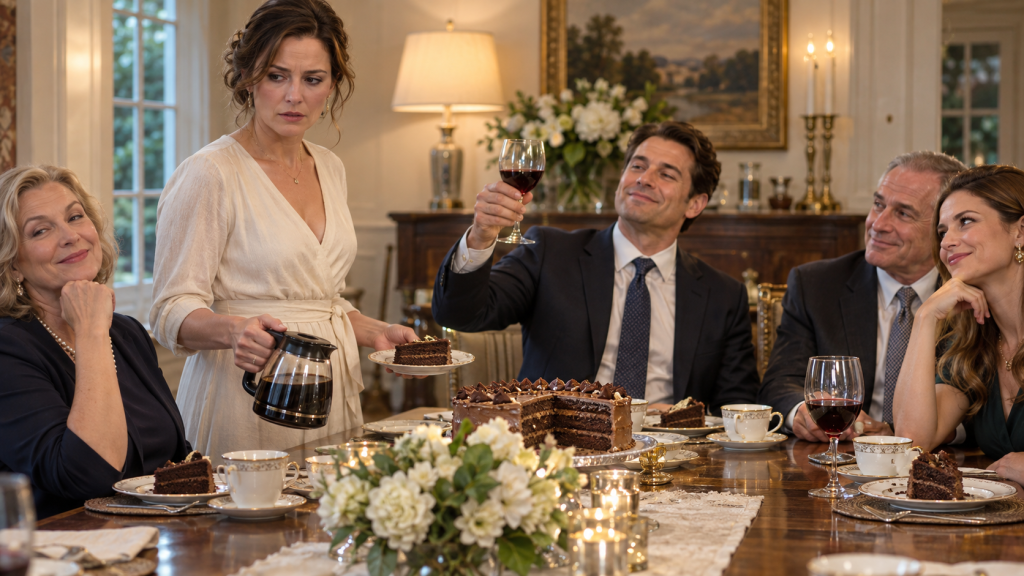
I thought about Sunday dinner all those decades earlier.
Lukas raising his glass.
Ingrid smiling.
Elisa laughing.
Me holding cake.
They thought I was powerless because they believed I couldn’t understand.
But language had never been the real source of power.
Choice was.
I understood them.
Then I chose not to react before I knew enough.
I chose to protect myself financially.
I chose not to empty accounts in anger.
I chose legal process over revenge.
I chose not to punish Sophia for lies Lukas told both of us.
I chose not to turn Noah into a symbol of betrayal.
I chose divorce even while loving my husband.
I chose to keep learning the language that had once been used to exclude me.
I chose another marriage.
Another kind of family.
Eventually, I chose forgiveness.
Not all at once.
Choice rarely arrives as one heroic moment.
Most lives change through small decisions repeated until they become a direction.
Call the lawyer.
Save the document.
Tell the truth.
Say no.
Move out.
Go to therapy.
Take the trip.
Accept the date.
Love again.
Forgive when ready.
Keep the boundary.
Those were my choices.
The family had believed my longing for motherhood made me weak.
It didn’t.
Pain made me vulnerable.
There is a difference.
Vulnerability means something can hurt you.
Weakness means you cannot survive being hurt.
I survived.
But survival itself was not the victory.
I dislike stories where women are praised merely for enduring terrible things.
Endurance is sometimes necessary.
It is not the highest goal.
Living was the victory.
Laughing again.
Trusting again.
Sleeping peacefully.
Teaching Anna German.
Holding Claire’s hand at Daniel’s funeral.
Receiving photographs from Noah.
Reading books beside the lake.
Eating dinner alone without feeling abandoned.
Those were victories.
Ordinary life.
That was what betrayal had nearly stolen.
And that was what I reclaimed.
Before I went to bed that night, I opened an old drawer.
Inside was the notebook from the coffee shop.
The one where I had written down every German phrase I remembered from Sunday dinner.
The pages had yellowed.
My handwriting looked young.
Angry.
Afraid.
At the bottom of one page, beneath Ingrid’s sentence about making me raise the baby, I had written:
Do not forget this.
I touched the words.
Then smiled.
I had not forgotten.
But I no longer needed the instruction.
Memory had changed.
For years, I remembered that dinner as the night my marriage ended.
Later, I understood the marriage had been ending quietly before then.
The dinner was simply the night I heard it clearly.
That distinction mattered.
Truth often arrives late.
That does not mean it created the problem.
It only illuminated what was already there.
I tore out no pages.
Burned nothing.
Dramatic destruction is overrated.
I closed the notebook and placed it back in the drawer.
The past did not need to disappear for me to be free of it.
It simply needed to remain where it belonged.
Behind me.
The next morning, Anna called.
“Grandma, emergency.”
“What?”
“My German oral exam.”
“That is not an emergency.”
“It is to me.”
“What do you need?”
“How do I say, ‘I understand everything’?”
I smiled.
“Ich verstehe alles.”
She repeated it badly.
I corrected her.
Again.
Better.
Then she asked:
“What does it literally mean?”
“I understand everything.”
“That’s kind of powerful.”
“Yes.”
I looked out at the lake.
“It can be.”
She practiced once more.
Ich verstehe alles.
I closed my eyes.
Once, those words would have carried anger.
Now they sounded almost peaceful.
Because understanding everything is impossible.
I never fully understood why Lukas risked our marriage.
He never fully understood why I could love him and still leave.
I never fully understood why my body did not give me the children I wanted.
I never fully understood why Daniel entered my life when he did.
Or why Claire came to love me.
Or why Noah, whose existence once shattered me, became someone whose Christmas cards I treasured.
We do not understand everything.
Maybe we are not supposed to.
Sometimes understanding enough is sufficient.
Enough to recognize betrayal.
Enough to protect yourself.
Enough to stop blaming the wrong person.
Enough to leave.
Enough to heal.
Enough to forgive.
Enough to know when forgiveness does not mean returning.
That was what I finally understood.
And if I could sit beside the younger Evelyn again—the woman standing ten feet from a dinner table with a cake knife in her hand while her husband announced another woman’s pregnancy in a language he thought she could not understand—I would not tell her to scream.
I would not tell her to throw the cake.
I would not tell her to expose everyone immediately.
I would walk over.
Take the serving plate from her trembling hands.
And whisper:
You heard them correctly.
You are not imagining this.
What they are saying is cruel.
What Lukas has done is not your failure.
You do not have to decide your whole life tonight.
Finish dinner if you need to.
Go home.
Sleep if you can.
Then get up tomorrow.
Write down what you know.
Protect yourself.
Ask questions.
Get help.
And when the truth becomes clear, do not let anyone use your longing for love, marriage, motherhood, or family as leverage against your dignity.
You are allowed to want a child desperately and still refuse this child as a solution.
You are allowed to love your husband and leave him.
You are allowed to understand his pain without volunteering to absorb its consequences.
You are allowed to forgive his family without sitting at their table again.
You are allowed to become someone whose life looks nothing like the one she planned.
And someday, Evelyn, you will hear German across a restaurant and your hands will not shake.
Someday you will laugh.
Someday you will love again.
Someday a young woman will call you Mom without anyone arranging it.
Someday the baby whose existence breaks your heart tonight will become a grown man who writes to thank you for never blaming him.
Someday you will understand that motherhood was never a prize they could dangle in front of you.
Someday you will stop asking why you weren’t enough.
Because you were never the missing piece.
Honesty was.
And someday, many years from now, the sentence that once made you feel trapped will become something entirely different.
Ich verstehe alles.
I understand everything.
Not everything about life.
Not everything about love.
But enough.
Enough to know that silence is not ignorance.
Enough to know that forgiveness is not surrender.
Enough to know that love without honesty becomes a room where one person is always translating.
Enough to know that no family gets to use your deepest wound as a leash.
And enough to know that sometimes the moment your old life breaks is also the moment you finally hear your own voice clearly.
That Sunday evening, everyone at the table had laughed because they thought I understood nothing.
They were wrong.
I understood every word.
It simply took me years to understand what mattered most.
I did not need to raise Lukas’s child to become a mother.
I did not need to save my marriage to prove I had loved my husband.
I did not need revenge to prove I had been wronged.
I did not need their regret to validate my pain.
And I did not need to forget any of it in order to be free.
I only needed the courage to stop serving everyone else the life they had chosen for me—
and finally choose my own.
THE END STORIES! THANK YOU FOR READING GOOD LUCK !❤️
Related Posts