For one terrible moment, I forgot how to breathe. Someone had signed a contract to sell my house. Not a stranger’s house. Not an investment property. The home where I’d raised three children, buried two beloved dogs beneath the maple tree, and spent thirty-eight Christmas mornings watching wrapping paper accumulate around the fireplace.
The home where Richard had kissed me goodbye before leaving for work on the morning of his fatal heart attack. My home. And somebody had apparently decided it no longer belonged to me. I stared at Thomas Brennan through the security monitor. “What did you just say?” His expression was grave.
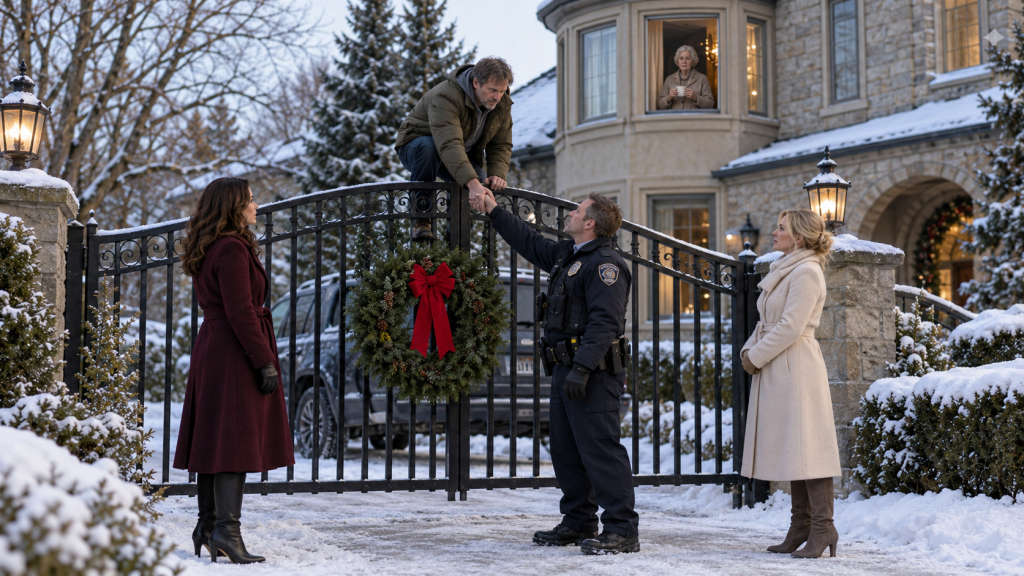
“There’s a purchase agreement bearing an unauthorized signature on your behalf. I received a copy from a title company this morning.” Behind him, my son Michael stopped arguing with the security officer. Jennifer’s hand flew to her mouth. Lisa looked at the ground. Their reactions told me more than anything they could have said. They knew.
At least some of them did.
And they had arrived two days before Christmas expecting me to welcome them into the very house they were apparently trying to sell.
“Thomas,” I said, “come inside. You and Dr. Park.”
My security officer, Owen Brooks, acknowledged the instruction.
He opened the pedestrian gate for them while keeping the vehicle gate closed.
Michael stepped forward.
“That’s our mother’s attorney!”
Owen blocked his path.
“Sir, you’re not authorized to enter.”
“I’m her son!”
“That doesn’t change her instructions.”
Michael looked directly into the camera.
“Mom, this is ridiculous!”
I held down the intercom button.
“No, Michael. What’s ridiculous is signing a contract to sell property that doesn’t belong to you.”
His face went white.
Jennifer turned toward him.
“You told me she agreed!”
I felt something cold settle in my chest.
Michael looked at her.
“Shut up, Jen.”
Lisa started crying.
“Please, can we just talk?”
I looked at my youngest daughter.
For years, Lisa had been the one who softened arguments.
She remembered birthdays.
She sent flowers.
But she also had a habit of making everyone else’s wrongdoing sound like a misunderstanding.
“Not today,” I told her.
“Mom—”
“You told me to stop calling. I respected that. Now I’m asking you to respect my decision.”
I released the intercom.
Then turned off the monitor.
For the first time in three months, I wasn’t waiting to see whether my children would choose me.
I had made a choice of my own.
Thomas entered the living room carrying his briefcase.
Dr. Helen Park followed him.
She was a composed woman in her late fifties with dark hair, thoughtful eyes, and a calmness that made the room feel less frightening.
We had met twice during the previous month.
I’d asked her to perform an independent cognitive and functional assessment after Thomas discovered that someone was trying to portray me as incapable of managing my affairs.
I didn’t need a doctor to tell me whether my children loved me.
But if they intended to challenge my decisions using claims about my mental capacity, I wanted an honest clinical evaluation rather than speculation.
“Maggie,” she said gently, “how are you feeling?”
I laughed bitterly.
“Like somebody’s trying to sell the roof over my head.”
She didn’t smile.
“That would frighten anyone.”
I sat down.
My hands had begun shaking.
Thomas placed a folder on the coffee table.
“Before I show you this, I want you to understand something. A purchase agreement signed by someone without authority does not automatically transfer ownership of your house.”
I swallowed.
“So the house is still mine?”
“Yes. The recorded ownership has not changed. No deed has been conveyed to a buyer. But the attempted transaction is serious, and we need to act quickly.”
I nodded.
“Show me.”
The contract listed my property at an address I’d memorized before any of my children were born.
The agreed purchase price was $765,000.
I stared.
My most recent valuation had placed the house near $900,000.
Thomas turned the page.
“Look at the signature block.”
There it was.
Michael Whitmore, attorney-in-fact for Margaret Whitmore.
Beneath it was a reference to an old power of attorney.
The same one I’d signed years earlier when Richard was ill.
The same one Thomas had helped me revoke after the bank discovered Michael trying to inquire about my accounts.
I felt my chest tighten.
“When was this signed?”
“Eleven days ago.”
I stared at him.
“After the revocation?”
“Yes.”
“Does Michael know that?”
“His bank received formal notice. Michael also received written notice through counsel.”
I looked back at the contract.
“Then why would he sign it?”
Thomas hesitated.
“That’s one of several questions we need answered.”
I turned another page.
There was a proposed closing date.
January 8.
Barely two weeks away.
And attached to the contract was a document describing my supposed intention to move into a senior living community.
I read the first paragraph.
Margaret Whitmore has expressed concern about her ability to maintain independent living and has authorized her family to assist with housing transitions.
My stomach turned.
“I never said this.”
Thomas nodded.
“I know.”
I continued reading.
It claimed I’d been increasingly forgetful.
That I’d repeatedly confused appointment dates.
That I’d made unsafe financial decisions.
It even mentioned the night I’d gone to the hospital with chest pain.
According to the document, the incident demonstrated my inability to distinguish serious medical symptoms from emotional distress.
I felt tears sting my eyes.
I’d been frightened I was having a heart attack.
I’d called an ambulance because I knew what ignoring chest pain could cost.
And my children had apparently decided that responsible choice was evidence I couldn’t care for myself.
Dr. Park studied the document.
“Who wrote this?”
Thomas pointed toward the bottom.
A name appeared beneath the final paragraph.
Jennifer Whitmore Collins.
My oldest daughter.
The little girl who used to hold my hand whenever thunderstorms frightened her.
The teenager whose college applications I’d proofread at the kitchen table.
The woman who couldn’t find ten minutes to call me after I’d been hospitalized.
She had written a statement suggesting her mother was incapable of living alone.
I stared at her signature.
Then whispered:
“She couldn’t come see me at the hospital, but she found time to write this.”
There was another name beneath Jennifer’s.
Lisa Whitmore Bennett.
My youngest daughter.
I closed my eyes.
All three.
Michael had signed the contract.
Jennifer had supplied a statement about my supposed decline.
Lisa had endorsed it.
It wasn’t just one son overstepping his authority.
It was my family, united around a decision I’d expressly refused.
Thomas leaned forward.
“Maggie, the buyer is a development company called Front Range Residential Partners. Their representative contacted a title company after receiving contradictory information about Michael’s authority.”
I looked up.
“So the buyer doesn’t necessarily know what they’re doing?”
“We don’t have evidence they knew the authority was invalid. The title company asked for current documentation and reached my office because of the revocation notice.”
“Thank God.”
Thomas nodded.
“The transaction has not closed.”
I gripped my hands together.
“What happens now?”
“We’ll send formal notice that Michael lacked authority to sign, require preservation of all transaction records, and pursue whatever protective or civil remedies are appropriate. If the documents were knowingly misrepresented, that may require investigation beyond the property dispute.”
I looked at him.
“And my children?”
His expression softened.
“That depends on what the evidence establishes.”
The doorbell rang.
I flinched.
Owen called from the gate.
“Mrs. Whitmore, your son is refusing to leave. He says he has a right to come inside because this is a family emergency.”
I looked at Thomas.
He nodded.
“You can tell him to leave.”
I pressed the intercom.
“Michael, the visit is over.”
He stared directly at the camera.
“Mom, you’re making a huge mistake.”
“Then it’s my mistake to make.”
His expression darkened.
“You don’t understand the paperwork.”
I looked at the contract.
“You signed a purchase agreement using an authority I’d revoked.”
His mouth opened.
Then closed.
I continued.
“And your sisters wrote a statement saying I can’t manage my own life.”
Jennifer looked away.
Lisa covered her face.
Michael slammed his palm against the gate.
“That’s because you clearly can’t!”
The sound made me jump.
Owen stepped forward.
“Sir, step away from the gate.”
Michael glared at him.
“This is my mother’s property!”
I stared at my son.
Then answered:
“Exactly.”
For a moment, nobody moved.
Then Michael said something I’ll never forget.
“You’re going to die in that house, Mom. What good is keeping it going to do you?”
I felt as though he’d slapped me.
I knew I was seventy-two.
I knew time didn’t stretch endlessly ahead of me.
There were mornings when my knees hurt.
Days when I missed Richard so fiercely that I couldn’t bear to listen to our favorite songs.
I understood mortality.
But hearing my son treat my death as an administrative inconvenience was different.
I pressed the intercom again.
“Michael, I don’t need you to tell me that I’m going to die someday.”
My voice shook.
“I needed you to remember that I’m alive now.”
Then I told Owen to ask them to leave and contact local authorities if anyone continued attempting to enter.
The cars remained outside for several minutes.
Michael argued with his sisters.
Jennifer paced beside her SUV.
Lisa stood near her sedan, crying into her hands.
I watched silently from the security monitor.
Then, one by one, the vehicles left.
The driveway became quiet.
And the house was mine again.
At least for the moment.
I turned toward Dr. Park.
“Do I look confused to you?”
She studied my face.
“Maggie, you’re frightened and upset. Those are understandable reactions.”
I swallowed.
“But am I losing my mind?”
She moved her chair closer.
“Your assessment did not identify a major cognitive impairment. You’re able to understand your decisions, explain the consequences, manage your daily activities, and express consistent preferences.”
My eyes filled.
She continued.
“That doesn’t mean you’ll never make a mistake or need help. None of us are immune to that. But your children cannot establish incapacity simply because they dislike your choices.”
I covered my mouth.
For months, I’d questioned whether I was being unfair.
Perhaps I called too often.
Perhaps I was too sensitive.
Perhaps my expectations were unreasonable.
Now I was discovering that my children had apparently turned my loneliness into a medical argument.
Thomas placed one final page on the table.
“Maggie, there’s another concern.”
I looked up.
“What now?”
“The contract includes instructions for the seller’s proceeds to be deposited into a new account.”
My stomach tightened.
“An account in my name?”
“An account titled as though Michael were managing funds for you.”
I stared.
“Does he control it?”
“Based on the documentation submitted, he intended to.”
I looked toward the empty driveway.
Then whispered:
“So they weren’t only planning to sell my home. They were planning to control the money afterward.”
Thomas didn’t answer immediately.
He didn’t need to.
The paperwork was lying between us.
And for the first time, I understood why all three of my children had suddenly decided Christmas at Mom’s house was important.
They hadn’t come to see their mother.
They’d come to see whether their plan was working.
That evening, after Thomas and Dr. Park left, I wandered from room to room.
The house had never felt so large.
Richard and I had bought it when Jennifer was six, Michael was four, and Lisa was barely walking.
We’d stretched our savings to make the down payment.
The kitchen had ugly yellow wallpaper.
The upstairs bathroom leaked.
The backyard was mostly dirt.
But Richard had stood in the empty living room, spread his arms, and said, “Maggie, listen.”
I’d frowned.
“To what?”
“Exactly. All this peace and quiet.”
I’d laughed.
“Give the kids twenty minutes.”
He’d been right.
Within half an hour, Michael had fallen down the stairs carrying a toy truck, Jennifer was crying because she’d lost her favorite doll, and Lisa had found a crayon and begun decorating the hallway.
It was the happiest chaos of my life.
Now the hallway had been repainted three times.
The stairs no longer creaked.
The children had houses of their own.
And somebody had signed an agreement promising strangers they could buy mine.
I stopped outside Richard’s study.
We’d left most of it unchanged after he died.
His desk remained beneath the window.
There were framed photographs from fishing trips, an old globe, and a wooden box containing the fountain pen I’d given him for our thirtieth anniversary.
I sat in his chair.
“I don’t know what happened to them, Richard,” I whispered.
A tear slipped down my cheek.
“I don’t know where we went wrong.”
I’d spent so many years making excuses for our children that blaming myself came as naturally as breathing.
Had I spoiled them?
Protected them too much?
Made their lives too comfortable?
Perhaps I had.
But whatever mistakes Richard and I had made, I couldn’t believe we’d raised them to see a mother’s home as money waiting to be collected.
My phone vibrated.
A message from Jennifer.
Mom, the kids are devastated. They thought they were spending Christmas with Grandma. I hope you’re happy.
I stared at it.
Then another appeared.
You embarrassed us in front of security. Michael was only trying to help you.
I placed the phone facedown.
For years, those messages would have worked.
I would have called immediately.
Apologized.
Invited everyone in.
Cooked three meals and pretended nothing had happened.
But that evening, I couldn’t get past the words on the contract.
Michael Whitmore, attorney-in-fact.
He hadn’t asked permission.
He’d simply decided he could still speak for me.
The next morning, I met Thomas at his office.
He’d already sent notices to the buyer, title company, and everyone whose involvement could affect the attempted closing.
The buyer’s attorney had acknowledged that Michael’s authority was disputed and confirmed that no closing would proceed while the matter was unresolved.
That was a relief.
But Thomas looked concerned.
“There’s something I want to show you.”
He handed me a financial worksheet recovered from the transaction materials.
Across the top were the words:
MARGARET WHITMORE — PROPERTY TRANSITION PLAN
Below them was a calculation of the sale proceeds.
Estimated sale price: $765,000.
Closing expenses.
A proposed amount for temporary senior housing.
An allowance for moving expenses.
Then a line that made my heart stop.
Family distribution reserve: $480,000.
I looked up.
“What does that mean?”
Thomas folded his hands.
“The accompanying notes suggest Michael intended to distribute part of the proceeds among himself and his sisters.”
I stared.
“While I’m alive?”
“Yes.”
I read the amount again.
Four hundred eighty thousand dollars.
The money that was supposed to come from selling my home.
The home I was still living in.
“Did they think I wouldn’t notice?” I whispered.
Thomas looked at me carefully.
“The notes suggest they expected the funds to be handled by Michael while you moved into managed housing.”
I shook my head.
“I never agreed to move.”
“I know.”
“And I never agreed to give them money.”
“I know that too.”
I stared at the worksheet.
Then something else caught my eye.
Beside Jennifer’s name was a handwritten figure.
$160,000.
The same amount appeared beside Michael’s and Lisa’s names.
Three equal distributions.
As though I had already died.
I began crying.
Thomas passed me a tissue.
“Maggie, the proposed distributions don’t give them a legal right to anything.”
I nodded.
But that wasn’t why I was crying.
The numbers were so neat.
So tidy.
Someone had sat down with a calculator and divided my life into three equal shares.
The Christmases.
The school shoes.
The emergency loans.
The nights I slept in hospital chairs.
All those years I’d believed I was building a family.
And here was a spreadsheet explaining what my disappearance might be worth.
I asked Thomas whether the contract itself was enforceable.
He explained that signing as attorney-in-fact after a properly communicated revocation created serious problems for Michael’s claimed authority. The surrounding evidence also raised questions about whether the buyer had been given accurate information.
He was careful not to promise that every legal issue would resolve overnight.
There could be disputes about reliance, representations, and damages.
But the title company had already stopped the proposed closing, and we had strong records supporting my position.
I took a breath.
“What about Michael’s old power of attorney?”
“The revocation remains effective. We’ve recorded and distributed the appropriate notices and are reviewing every institution where the document might have been used.”
“And if he tries again?”
“We’ll address any further attempt immediately. We’re also preparing the necessary filings to prevent anyone from treating that contract as an authorized sale.”
I nodded.
Then I asked:
“Thomas, can they have me declared incompetent just because I’m seventy-two?”
He shook his head.
“No. They could seek a conservatorship or other court intervention if they believed the legal requirements were met. But they would need evidence, and you’d have the right to respond. Disagreeing with your children is not incapacity.”
I exhaled.
That distinction mattered more than I could explain.
That afternoon, my neighbor Ruth Delgado came over carrying a casserole.
Ruth was seventy-five.
She’d lived next door for twenty years, and she had a way of entering a room that made every problem seem slightly more manageable.
She set the casserole on the counter.
“Chicken and rice.”
I smiled.
“You always make enough for twelve.”
“Then you’ll have leftovers.”
She looked at my face.
“Have you been crying?”
I hesitated.
Then nodded.
Ruth took off her coat.
“Put the kettle on.”
I told her everything.
The hospital.
The unanswered calls.
Michael telling me to stop bothering them.
The old power of attorney.
The changed gate code.
The attempted sale.
The worksheet dividing the proceeds among my children.
Ruth listened without interrupting.
When I finished, she stared into her tea.
Then said quietly:
“That’s a terrible thing they’ve done.”
I began crying again.
“I keep wondering whether I should have just let them in.”
Ruth looked at me.
“Maggie, you told them not to come.”
“I know.”
“And they came anyway.”
“Yes.”
“And one of them tried to climb your gate.”
I nodded.
She reached across the table.
“Then maybe the kindest thing you did was make the answer clear.”
I wiped my eyes.
“What about the grandchildren?”
Ruth’s expression softened.
“They’re not responsible for the decisions their parents made.”
“I know.”
“Then don’t let Michael decide that the only way you can love your grandchildren is by giving him your house.”
I stared at her.
Something in those words settled inside me.
For months, I’d been afraid that saying no to my children meant losing every other relationship connected to them.
But my grandchildren were people in their own right.
I could love them without allowing their parents to control me.
I didn’t yet know how.
But I could try.
Ruth glanced around the kitchen.
“Have you made Christmas plans?”
I laughed bitterly.
“Apparently, I’ve canceled the invasion.”
She smiled.
“Good. Now make some real plans.”
I looked at her.
“Such as?”
“Come to my house tomorrow night. My sister’s visiting, and my grandson is bringing his girlfriend. There’ll be too much food and somebody will complain about the music.”
I smiled through tears.
“That sounds nice.”
“It is.”
Then Ruth leaned closer.
“And Maggie?”
“Yes?”
“Bring your famous apple pie.”
I laughed.
For the first time in weeks, the laughter didn’t feel forced.
Christmas Eve arrived beneath a pale Colorado sky.
I woke early.
For nearly fifty years, I’d spent that morning preparing for everyone else.
Checking stockings.
Wrapping gifts.
Making casseroles.
Worrying whether the turkey would fit in the oven.
This year, there was no turkey.
No mountain of presents.
No frantic call from Michael asking whether I’d bought the batteries his children needed.
I made myself coffee.
Sat beside the window.
And watched snow settle gently over the garden.
I expected to feel relieved.
Instead, I felt lonely.
Painfully lonely.
I missed the noise.
The laughter.
The smell of cinnamon rolls.
I even missed the arguments about whose turn it was to wash the dishes.
Setting boundaries hadn’t made me stop loving my children.
It had simply made the absence of their love harder to ignore.
At noon, my phone rang.
Lisa.
I stared at her name.
Then answered.
“Hello?”
“Mom?”
Her voice was trembling.
“Yes, Lisa.”
There was a long pause.
Then she whispered:
“I’m sorry about yesterday.”
I looked at the snow.
“Which part?”
She began crying.
“The gate. The way Michael acted. Everything.”
I closed my eyes.
“Did you know about the sale contract?”
Silence.
“Lisa?”
“Yes.”
The answer hurt.
Even though I already knew.
“Did you read the statement you signed about my memory?”
Lisa sobbed.
“Jennifer wrote it.”
“That wasn’t my question.”
She swallowed.
“Yes.”
“Did you believe it?”
There was another long silence.
Then she whispered:
“Not really.”
I gripped the phone.
“Then why did you sign it?”
She began crying harder.
“Michael said if we didn’t act, you’d leave everything to strangers.”
I stared at the window.
“Strangers?”
“He said Thomas was manipulating you. That you’d been changing your will without telling us.”
I took a breath.
“So you decided I couldn’t possibly have made those choices myself.”
Lisa sobbed.
“I was scared.”
“Of what?”
“Of losing the family.”
The words made my chest ache.
“Lisa, what family were you protecting when you helped your brother sell my home?”
She had no answer.
For a long time, we both remained silent.
Then Lisa whispered:
“I signed because I didn’t want Jennifer and Michael turning against me.”
I looked down.
There it was.
Not love.
Not concern.
Fear.
She’d hurt me because she was afraid the others would exclude her.
I remembered Lisa at ten years old, following her older siblings around the backyard, desperate to be included in their games.
She’d always been afraid of disappointing them.
Apparently, some things had never changed.
But she was forty-seven now.
And adults were responsible for the choices they made.
“Lisa,” I said quietly, “I love you.”
She began crying.
“I love you too, Mom.”
“But I won’t pretend what you did was harmless.”
“I know.”
“You signed a statement that could have been used to take away my ability to manage my own life.”
Her voice broke.
“I’m sorry.”
“Then tell the truth.”
She went quiet.
“Give Thomas an accurate account of what happened. Don’t protect Michael from the consequences of his decisions.”
There was a long pause.
Then Lisa whispered:
“I will.”
I wanted to believe her.
But I had learned not to confuse words with evidence.
Before hanging up, Lisa asked:
“Can I bring Maya to see you sometime?”
Maya was my youngest granddaughter.
Eight years old.
She loved horses, strawberry ice cream, and drawing pictures of animals with eyelashes longer than their legs.
My throat tightened.
“I would like to see her.”
Lisa began crying.
“Really?”
“Yes. But we’ll arrange something calmly, on a day we’ve agreed to. No surprises. No discussions about my money.”
“I understand.”
I closed my eyes.
Then whispered:
“Merry Christmas, sweetheart.”
Lisa began sobbing.
“Merry Christmas, Mom.”
That evening, I carried my apple pie across the snowy sidewalk to Ruth’s house.
Her grandson opened the door.
Warm air spilled into the night.
Somebody was laughing in the kitchen.
A dog barked.
A television played an old Christmas movie.
Ruth appeared wearing a ridiculous sweater decorated with flashing lights.
“Maggie!” she called. “You’re late.”
I looked at the clock.
“By three minutes.”
“Unacceptable.”
I burst out laughing.
She hugged me.
And for the first time that Christmas, I felt welcome somewhere without having to earn it by giving something away.
Later, while everyone gathered around the dinner table, Ruth’s grandson raised his glass.
“To the people who made it here.”
Everyone smiled.
I looked around.
They weren’t my children.
They hadn’t grown up in my house.
They didn’t know all the stories that made Richard and me who we’d been.
But they were glad I was there.
And something inside me began to understand a truth I’d resisted for years.
Family can be the people you raise.
It can also be the people who choose to make room for you when your chair would otherwise be empty.
Three days after Christmas, Thomas called.
“Maggie, we have a response from the buyer’s attorney.”
I was sitting in Richard’s study, sorting through old photographs.
“Are they still trying to buy the house?”
“No. They have formally acknowledged the disputed authority and withdrawn from the proposed closing. The parties are addressing the expenses caused by the failed transaction.”
I exhaled.
“Thank goodness.”
“But there’s something else.”
I closed the photograph album.
“What?”
“The buyer provided the correspondence Michael sent during the negotiations.”
My stomach tightened.
“What did he say?”
Thomas paused.
“He repeatedly represented that you couldn’t participate in the sale because of cognitive decline.”
I stared at the wall.
“Even though he hadn’t had me evaluated?”
“Yes.”
I swallowed.
“Is that all?”
“No.”
Thomas’s tone changed.
“He told the buyer you had already moved into residential care.”
For a moment, I couldn’t speak.
I looked around Richard’s study.
My books.
My photographs.
The cup of tea beside me.
The winter sunlight falling across the rug.
I was sitting in the home I’d occupied for nearly four decades.
And my son had apparently told strangers I wasn’t living there anymore.
“He said I’d moved out?”
“Yes.”
“Where?”
“He identified a senior living facility called Pine Meadow Residence.”
I frowned.
“I’ve never been there.”
“We’ve confirmed you were not admitted there.”
I felt sick.
“Then why use its name?”
Thomas hesitated.
“Michael had requested admission information and placed a refundable reservation deposit through his own account. He apparently intended to present the housing arrangements as settled.”
I stared.
“So he chose where I would live before asking me.”
“Yes.”
“And then he told strangers I’d already gone.”
Thomas was quiet.
I looked toward Richard’s photograph.
For years, Michael had been a successful contractor.
He wore expensive watches.
Drove a beautiful truck.
Talked confidently about investment properties.
I’d assumed he was doing well.
But something about this plan felt desperate.
“Thomas, I want to know why he needed the money so quickly.”
The answer came through financial documents produced during the dispute.
Michael’s construction business had borrowed heavily to acquire land for a planned housing development outside Denver.
The project had encountered permitting delays and financing problems.
Several contractors remained unpaid.
A personally guaranteed loan was approaching a critical deadline.
Michael had been trying to find additional cash.
The worksheet dividing my home’s proceeds among the children hadn’t been his first idea.
It was part of a plan to obtain money that he thought could be treated as an early inheritance.
Thomas laid out the documents during our next meeting.
“Michael’s business appears to have significant financial pressure,” he explained.
I stared at the loan statements.
“Why didn’t he ask me for help?”
Thomas looked at me.
“Would you have given him the money?”
I thought about it.
Perhaps I would have considered a reasonable loan.
I’d helped him before.
Paid for college.
Helped him buy his first work truck.
Covered a mortgage payment when his first child was born.
But I wouldn’t have risked my home for a project I didn’t understand.
And Michael probably knew that.
“He wanted money I might have refused,” I whispered.
Thomas nodded.
“That is one possible motive supported by the circumstances.”
I looked down at the worksheet.
“But why involve Jennifer and Lisa?”
Thomas turned another page.
“Jennifer’s family has also been under financial strain. Her husband lost a substantial amount of money in a failed investment. Lisa appears to have been told that distributing the proceeds equally would prevent conflict between the siblings.”
I closed my eyes.
Jennifer’s designer bags.
Michael’s truck.
Lisa’s family vacations.
I’d looked at their photographs and assumed they were comfortable.
All the while, my children were apparently experiencing financial problems they didn’t want to discuss.
And rather than tell me, they’d begun planning to divide my money.
“Thomas,” I asked, “is there any evidence they intended to leave me enough to live on?”
He studied the documents.
“There is an allowance for housing and ongoing expenses, but I don’t see a complete long-term plan accounting for your needs.”
I felt my stomach tighten.
“Would it have been enough?”
“We can’t know from these papers. The amount appears to have been selected without a proper assessment of future housing costs, healthcare, inflation, or the possibility of needing substantial care later.”
I looked away.
They’d worried so much about what they’d inherit.
But apparently, nobody had calculated what their mother might need if she lived another twenty years.
That thought hurt more than I expected.
My children had been so eager to divide the future that they’d forgotten I might still have one.
Then Thomas said:
“There’s one more thing.”
I looked up.
He handed me an email Jennifer had sent to Michael.
If Mom gets upset, remind her that Dad always wanted the money kept in the family. She’ll eventually agree if we all present a united front.
I read it twice.
Richard.
They were using Richard.
My husband had worked his entire life to provide security for our family.
He’d saved carefully.
Avoided unnecessary debt.
Paid off our mortgage years before he died.
And he’d always encouraged our children to make lives of their own.
He’d never said their future required taking away mine.
I looked at Thomas.
“Can I speak at the next hearing?”
He nodded.
“You can provide relevant testimony when appropriate.”
I swallowed.
“I want the court to understand I’m not confused about my house.”
Thomas smiled gently.
“We’ll make sure your voice is heard.”
A week later, the civil proceedings brought us into a courtroom.
I wore a dark blue suit and the pearl earrings Richard had given me for our fortieth wedding anniversary.
My hands trembled as I entered.
Jennifer sat with her attorney.
Michael was beside a separate lawyer.
Lisa sat a little farther away.
None of them looked at me.
For one terrible second, I wanted to cross the room, hug them all, and say we could forget everything.
Then I remembered the purchase agreement.
The false statements.
The $480,000 family distribution reserve.
And I walked to my seat.
The hearing concerned the disputed property contract and associated protective relief.
Thomas presented the deed showing my ownership.
The signed revocation of Michael’s power of attorney.
Records demonstrating that notice had been delivered.
The purchase agreement Michael executed afterward.
And the correspondence suggesting he’d misrepresented my circumstances to the buyer.
The judge listened carefully.
Michael’s lawyer argued that his client believed he was acting in his mother’s best interests.
Thomas responded that an adult child’s belief that a parent should sell her house did not create legal authority to sign away that property.
Then the judge asked Michael a question.
“Mr. Whitmore, had your mother agreed to sell the house?”
Michael shifted in his chair.
“We’d discussed downsizing.”
I felt my chest tighten.
The judge looked at him.
“Did she agree to this sale?”
Michael hesitated.
“She was becoming difficult about financial matters.”
“That wasn’t my question.”
Silence.
“Did Margaret Whitmore authorize you to execute this purchase agreement?”
Michael swallowed.
“No, not directly.”
I closed my eyes.
There it was.
After months of messages, excuses, and accusations, my son had finally acknowledged the one thing I’d been saying all along.
I hadn’t agreed.
The judge considered the documentary evidence and the status of the proposed sale.
The buyer had withdrawn, and no conveyance had occurred.
The court entered appropriate orders restraining further attempts to act under the revoked authority and requiring preservation of transaction records while any remaining claims were resolved.
The validity of Michael’s conduct and potential remedies were left to the proper proceedings.
It wasn’t an instant resolution of every problem.
But the judge made the central point unmistakable.
My age did not make my home available for someone else to sell.
During the hearing, Thomas also addressed the statements suggesting I lacked decision-making capacity.
Dr. Park’s evaluation was available as part of the evidence.
She explained her professional findings and the limits of what a clinical assessment could establish.
The court understood that an evaluation was not a magical certificate of competence, nor could disagreement with family members establish incapacity.
There was no sufficient evidence presented to justify treating me as unable to make my own housing and financial decisions.
When the judge addressed the matter, I felt tears rise.
For months, my children had made me feel as though I needed permission to remain myself.
Now someone was finally saying what should have been obvious.
I was allowed to make decisions they disliked.
After the hearing, Jennifer approached me in the hallway.
“Mom.”
I stopped.
She looked exhausted.
There were dark circles beneath her eyes.
“Can we talk?”
Thomas stood nearby.
I nodded.
“For a few minutes.”
Jennifer swallowed.
“I didn’t think it would turn into all this.”
I looked at her.
“You signed a statement saying I was losing my memory.”
She began crying.
“I thought Michael knew what he was doing.”
“Did you ask me?”
She lowered her eyes.
“No.”
“Did you visit when I was in the hospital?”
Her face crumpled.
“No.”
“Then Jennifer, how would you know whether I could take care of myself?”
She covered her mouth.
“I was worried,” she whispered.
“About me?”
She hesitated.
Then began crying harder.
“About everything.”
I waited.
Her husband had lost money.
They were behind on expenses.
They’d borrowed against their home to cover obligations they thought would be temporary.
Then Michael had approached Jennifer with what he called a family restructuring plan.
He told her I was lonely, overwhelmed, and incapable of maintaining the house.
He said selling would give me a simpler life and provide each sibling with money they could use to stabilize their families.
Jennifer hadn’t verified any of it.
She’d simply signed.
“Mom, I thought if we could fix our finances, everything would settle down.”
I stared at her.
“So you tried to fix yours with mine.”
She began crying.
“Yes.”
I took a breath.
“Jennifer, you could have told me you were struggling.”
She shook her head.
“I didn’t want you to think I’d failed.”
My throat tightened.
“Oh, sweetheart.”
For a moment, I saw her at twelve years old, crying over a failed math test.
I’d held her and told her that one grade didn’t define her.
Now she was fifty-one, still afraid to tell her mother she was having trouble.
But instead of asking for help, she’d helped take away my choices.
I reached for her hand.
She looked surprised.
“I love you,” I whispered.
She began crying harder.
“But love doesn’t mean I can pretend you didn’t hurt me.”
“I know.”
“Then you need to take responsibility without expecting me to make the consequences disappear.”
She nodded.
“I will.”
I wanted to believe her.
But belief would have to be earned again.
Lisa approached a few minutes later.
She’d already provided Thomas with a written account explaining how Michael had circulated the statement and pressured the others to sign.
She’d acknowledged that she had no medical basis to claim I was cognitively impaired.
Now she stood in front of me with tears running down her cheeks.
“Mom, I told the truth.”
I nodded.
“I know.”
She swallowed.
“Does that mean you forgive me?”
I looked at her.
“Lisa, it means you’ve taken a step in the right direction.”
Her expression crumpled.
I continued.
“Forgiveness is something we may work toward. Trust is something we’ll have to rebuild.”
She nodded.
Then whispered:
“Can I hug you?”
I hesitated.
Then opened my arms.
She began sobbing against my shoulder.
I held her.
And I hated how much I’d missed holding my own daughter.
Michael didn’t approach me.
He walked past with his attorney.
For a moment, our eyes met.
I saw anger.
Embarrassment.
And something that might have been fear.
But no apology.
He looked away first.
I watched him disappear through the courthouse doors.
Then I turned toward Thomas.
“Is it wrong that I still want him to come home?”
Thomas’s expression softened.
“No, Maggie.”
I swallowed.
“He tried to sell my house.”
“Yes.”
“And I still want to know whether he’s eaten.”
Thomas handed me a tissue.
“That’s what makes this so painful.”
I began crying.
Because he was right.
Setting boundaries had not turned me into someone who stopped being a mother.
It had simply made me a mother who could say no.
Spring arrived slowly that year.
Snow lingered along the edges of the driveway long after the afternoons began growing warmer.
The maple tree outside Richard’s study remained bare until late April.
Then, almost overnight, little green leaves appeared.
I used to watch that tree with Richard every spring.
He’d say, “There you go, Maggie. The world decided to try again.”
For the first time since his death, I understood why he’d loved that phrase.
Trying again didn’t mean nothing bad had happened.
It meant something could still grow afterward.
The legal matters continued.
The attempted sale had stopped, but the consequences of Michael’s actions were not finished.
Investigators reviewed the documents, the revoked power of attorney, and the representations he’d made to the buyer and title company.
Michael eventually acknowledged through counsel that he had knowingly used the old document after receiving notice of its revocation.
He faced criminal charges relating to the attempted fraudulent transaction.
The case resulted in a negotiated resolution involving court supervision, financial obligations, and penalties determined by the court.
There was no missing fortune to recover because the house hadn’t actually been sold.
But there were legal expenses, transaction costs, and serious damage to relationships that no court order could simply erase.
Thomas pursued the appropriate financial remedies while I continued living in my house.
I didn’t attend every hearing.
I didn’t watch every development involving Michael’s business.
And I refused to turn my life into a permanent investigation of my children.
They were adults.
They had to answer for their own decisions.
For the first time, I was beginning to understand that I could love them without making their crises my full-time responsibility.
One afternoon, Thomas and I reviewed my estate plan again.
The changes I’d begun three months before Christmas were now fully documented.
My home had been transferred into my revocable living trust, with me retaining control and the right to live there, subject to the trust’s terms.
My investment accounts had updated arrangements.
The $250,000 life insurance policy had a beneficiary designation reflecting my current wishes.
I’d appointed independent professionals to assume financial responsibilities if I ever became unable to manage them, with safeguards and oversight.
And I’d prepared healthcare directives that explained my preferences.
Not because I expected something terrible to happen.
Because Richard had taught me that planning ahead was an act of care.
Thomas studied the final documents.
“Are you certain this is what you want?”
I smiled faintly.
“I’ve thought about it for months.”
He nodded.
“Then tell me what matters most.”
I looked toward the window.
“I want to remain independent for as long as I’m able.”
“Good.”
“I want decisions about my health and home made according to my wishes, with appropriate help when I need it.”
He made a note.
“And your estate?”
I took a breath.
“I want my grandchildren to have educational opportunities. I want their gifts protected from being controlled by their parents.”
Thomas nodded.
“We can structure those provisions.”
“And I want a substantial portion to support older people who don’t have family available when they’re frightened or sick.”
His expression softened.
I looked down.
“When I came home from the hospital in an Uber, I realized how many people must do that every day.”
My voice broke.
“Some have no family. Others have family who simply don’t show up.”
Thomas waited.
“I want to help those people get to appointments, receive practical assistance, and have someone check whether they got home safely.”
He smiled.
“That sounds like you, Maggie.”
We worked with an established community nonprofit to create a designated fund in Richard’s memory.
It would support transportation and practical assistance for older adults experiencing isolation.
The grandchildren’s provisions were administered separately under the trust.
The remaining estate arrangements reflected my considered wishes rather than a punishment invented in anger.
I wasn’t required to leave everything equally to three adult children simply because I’d given birth to them.
And I wasn’t required to leave them nothing just to prove I could be angry.
I could make thoughtful decisions.
Revisit them if circumstances genuinely changed.
And protect the people and causes that mattered to me.
When the documents were finished, Thomas closed his folder.
“Maggie, how do you feel?”
I thought about it.
Then answered:
“Like I finally stopped writing my own obituary before I’m dead.”
He laughed.
Then his eyes filled.
“I think Richard would appreciate that.”
In May, I began volunteering with the organization we’d chosen to support.
At first, I helped make phone calls.
Simple conversations.
Confirming that people knew when their appointments were scheduled.
Helping arrange rides through the organization’s approved transportation service.
Listening when somebody needed to talk.
One morning, I called a woman named Evelyn Harris.
She was eighty-one.
Recently widowed.
Her daughter lived across the country.
Her son had died several years earlier.
When I asked whether she needed transportation to an appointment, she became quiet.
Then said:
“Actually, I’d like somebody to call me afterward. Just to make sure I got home.”
My throat tightened.
“Of course.”
There was a pause.
Then she whispered:
“Thank you for asking.”
I sat at my desk for a long time after the call ended.
Four months earlier, I would have understood those words only as a volunteer.
Now I understood them as a woman who had once come home from a frightening hospital stay and waited for a phone call that never came.
Lisa began visiting again.
Not often.
Not without asking.
At first, we met at a little café halfway between our houses.
Then she began bringing Maya to the park.
My granddaughter would run toward me with her arms outstretched.
“Grandma!”
I would hug her so tightly that she’d giggle.
“Too tight!”
“Sorry, sweetheart.”
Then she’d ask whether we could get ice cream.
And for an hour, we would talk about horses, school, books, and whatever else interested her.
No conversations about my house.
No discussion of my bank accounts.
No suggestions that I should move somewhere more manageable.
Just time together.
One afternoon, Maya asked:
“Grandma, why don’t we come to your house anymore?”
My heart tightened.
I looked toward Lisa.
She appeared uncomfortable.
I took a breath.
“Because some grown-ups had a disagreement about important things, sweetheart.”
Maya frowned.
“Are you mad at Mommy?”
I considered the question.
Then answered gently.
“Your mommy and I are working through something. That’s between us.”
She looked down.
“Did I do something wrong?”
I pulled her close.
“Absolutely not.”
Her eyes widened.
“Really?”
“Really.”
I kissed her forehead.
“You never have to fix problems between adults to make them love you.”
Maya smiled.
Then asked whether she could have another scoop of ice cream.
I laughed.
Some conversations were easier than others.
Jennifer took longer.
For weeks after the hearing, she sent apologies that still contained explanations.
She was overwhelmed.
Her husband had made bad investments.
Michael had pressured her.
She hadn’t understood the paperwork.
All of those things might have been true.
But I needed her to acknowledge that she’d written a statement questioning my mental capacity without having any factual basis for doing so.
Eventually, she did.
She called one afternoon.
“Mom, I’ve been thinking about what you said.”
I waited.
“I didn’t ask whether you were okay after the hospital.”
My throat tightened.
“No.”
“I didn’t visit.”
“No.”
“And then I signed a statement saying you couldn’t take care of yourself.”
Her voice broke.
“I had no right to do that.”
I closed my eyes.
For a moment, I couldn’t speak.
Then whispered:
“Thank you for saying it.”
Jennifer began making changes in her own life.
She and her husband met with a financial counselor.
They sold one of their cars.
Reduced their expenses.
And worked on addressing their debts without treating my savings as their emergency reserve.
It wasn’t easy.
She called me crying more than once.
I listened.
Sometimes I offered encouragement.
But I didn’t write checks to make every uncomfortable consequence disappear.
I was learning that supporting someone wasn’t the same as rescuing them from every decision they’d made.
Michael was different.
For months, he barely contacted me.
When he did, his messages were angry.
He accused Thomas of manipulating me.
Claimed his sisters had turned against him.
Insisted he’d only been trying to protect the family’s future.
I didn’t respond to the accusations.
Then, near the end of summer, a letter arrived.
It was written in Michael’s handwriting.
I’d recognize those uneven capital letters anywhere.
He’d written them on the first Mother’s Day card he ever made for me.
Now they covered three pages.
Mom,
I’ve spent most of my life believing I was supposed to be the successful one.
Dad always worked hard, and I wanted to be like him.
Then my business started falling apart.
I borrowed money to keep it running. I told myself the next project would fix everything.
When that didn’t happen, I became desperate.
I stopped reading.
My eyes filled.
I knew you had money.
I knew your house was paid for.
I convinced myself it would all eventually come to us anyway.
That’s the ugliest thing I’ve ever written, but it’s true.
I stopped thinking of it as your home and started thinking of it as something I could use to solve my problems.
I covered my mouth.
When you revoked the power of attorney, I was furious.
Not because you were confused.
Because you were taking back control I thought I should still have.
I told Jennifer and Lisa that you needed us to make decisions for you.
I knew that wasn’t true.
I’m sorry, Mom.
I sat there crying.
Then I continued.
I don’t expect you to give me money.
I don’t expect you to fix the mess I made.
And I don’t expect you to trust me because I finally admitted the truth.
But I want you to know I understand why you locked the gate.
For years, you opened every door whenever I needed something.
I treated that kindness like a right.
I was wrong.
The final paragraph nearly broke me.
Dad used to say the house was where we could always come when life got hard.
I think I misunderstood him.
He didn’t mean we owned it.
He meant you would love us.
I hope someday I can come home again without asking you for anything except a chance to do better.
Love, Michael.
I placed the letter on the kitchen table.
Then I cried.
Not because it erased what he’d done.
It didn’t.
Not because I was ready to hand him another key.
I wasn’t.
But because, for the first time, my son seemed to understand the difference between being loved and being entitled.
I wrote back.
My letter was shorter.
Michael,
Thank you for telling me the truth.
I love you. That has never changed.
But love doesn’t erase the need for accountability.
Continue meeting your legal obligations. Keep working on your finances. And stop blaming other people for the choices you made.
If you want a relationship with me, we can begin slowly.
No money.
No property discussions.
No demands.
Just two people learning how to speak honestly again.
Love, Mom.
He didn’t answer immediately.
That was all right.
For once, I didn’t spend the afternoon watching my phone.
I went into the garden.
Pulled weeds.
Watered the roses.
And made myself lunch.
By autumn, my life had found a rhythm I hadn’t known I needed.
Ruth and I walked three mornings a week.
I volunteered twice a week.
I attended a book club at the library.
I finally arranged for someone to help with the heavier yard maintenance instead of insisting I had to do everything alone.
I kept regular appointments with my doctor.
And I developed a practical plan for transportation, emergencies, and future care with people I’d chosen.
I wasn’t pretending I would remain twenty-five forever.
I was acknowledging that getting older didn’t mean surrendering control of my life in advance.
That October, I turned seventy-three.
Ruth organized a little birthday dinner.
There were flowers, a homemade cake, and far too much food.
Lisa brought Maya.
Jennifer came with her teenage son Oliver.
Michael asked whether he might visit for a short while.
I thought about it carefully.
Then agreed.
He arrived carrying a small bouquet of yellow roses.
Richard’s favorite flowers for our garden.
Michael looked nervous.
“Happy birthday, Mom.”
I smiled faintly.
“Thank you.”
He glanced toward the driveway.
“The gate looks different.”
I nodded.
“I had the motor serviced.”
He almost smiled.
“Still the same code?”
I looked at him.
“No.”
Then, after a moment, I added:
“And I like it that way.”
He nodded.
“I understand.”
We didn’t have a perfect evening.
There were awkward silences.
Moments when Jennifer looked ready to cry.
Times when Michael seemed unsure where to sit.
But nobody asked about my will.
Nobody mentioned selling the house.
Nobody suggested I wasn’t capable of living there.
We ate cake.
Talked about the grandchildren.
And remembered Richard.
At one point, Michael found an old photograph of his father teaching him to ride a bicycle.
He stared at it for a long time.
Then whispered:
“I wish Dad were here.”
My throat tightened.
“So do I.”
Later, after everyone left, I sat beside the fireplace.
Richard’s photograph stood on the mantel.
I picked it up.
“Well,” I whispered, “that was something.”
In the picture, he was smiling.
That crooked smile I had loved for forty years.
I thought about all the years we’d spent raising our children.
The school concerts.
The scraped knees.
The Christmas mornings.
The birthdays.
The difficult conversations.
I’d once believed motherhood meant being needed forever.
Now I understood that a healthier kind of love might mean allowing my children to become responsible for their own lives.
And allowing myself to have one too.
The following Christmas, I sent invitations.
Not demands.
Not announcements.
Invitations.
I gave everyone the date, the time, and the simple expectations for the visit.
Nobody would be discussing my property.
Nobody would be pressuring me about my estate.
And anyone who couldn’t respect those boundaries was welcome to celebrate elsewhere.
Ruth was invited too.
So were a few friends from the volunteer program.
I wasn’t going to build another holiday around the fear that my children might not come.
I was going to have Christmas whether they came or not.
On December 23, shortly before two in the afternoon, my security system alerted me.
A vehicle at the gate.
I glanced at the screen.
Michael’s truck.
Then Jennifer’s SUV.
Then Lisa’s sedan.
For a moment, I was transported back to the previous year.
The old gate code.
Michael climbing the fence.
Jennifer demanding that I open the house.
Lisa crying.
Thomas arriving with news that someone had tried to sell my home.
I felt my heartbeat quicken.
Then my phone rang.
Michael.
I answered.
“Hello?”
“Hi, Mom.”
His voice was careful.
“We’re at the gate.”
“I can see that.”
He hesitated.
“Would you like us to come in?”
I smiled.
For years, he’d assumed the answer.
Now he was asking.
“Yes,” I said. “Come on in.”
I pressed the button.
The gate opened.
I watched the cars roll slowly up the driveway.
The grandchildren climbed out first.
Maya ran toward the front door.
Oliver followed carrying a bag of presents.
Jennifer had brought a casserole.
Lisa carried flowers.
Michael stepped out of his truck holding a small box.
When he reached the porch, he stopped.
“Mom?”
“Yes?”
He handed me the box.
Inside was a new wooden sign.
Richard’s old sign by the front walkway had become weathered over the years.
Michael had made a replacement.
The lettering was carved carefully.
THE WHITMORE HOME
Below it, in smaller words, he’d added:
MARGARET’S PLACE. VISITORS WELCOME BY INVITATION.
I stared at it.
Then began laughing through tears.
Michael smiled nervously.
“Too much?”
I shook my head.
“No.”
I touched the lettering.
“It is exactly right.”
That Christmas wasn’t perfect.
I don’t imagine any family gathering ever is.
There were spilled drinks.
Overcooked vegetables.
A disagreement about the football game.
And Maya accidentally knocked over a bowl of cranberry sauce.
But there was also laughter.
Real laughter.
The kind that comes when people stop performing happiness and begin making room for one another.
Nobody expected me to cook everything.
Nobody treated my house like a future inheritance.
And when I grew tired after dinner, Jennifer told me to sit down while everyone else cleaned the kitchen.
I watched them through the doorway.
My three children.
Working together.
Talking.
Washing dishes.
For the first time in a long while, they looked less like people waiting for me to disappear and more like the family I remembered.
It didn’t mean every wound had healed.
There were still boundaries.
Still difficult conversations ahead.
Still consequences that Michael had to face.
But it was a beginning.
That night, after everyone went home, Ruth stayed behind to help me put away the decorations.
She found me standing beside the front window.
“You all right?” she asked.
I nodded.
Then smiled.
“Yes.”
She looked toward the security gate.
“Funny how much that little gate changed things.”
I laughed softly.
“It wasn’t the gate.”
Ruth raised an eyebrow.
“No?”
I shook my head.
“It was finally understanding that I could decide when to open it.”
After she left, I walked into Richard’s study.
I sat in his chair and looked at the photograph on his desk.
“Richard,” I whispered, “I think I’m finally learning how to live without waiting for everyone else.”
My eyes filled.
“I miss you.”
The room remained quiet.
But for once, the silence didn’t feel like abandonment.
It felt like peace.
My children once told me to stop calling because they had their own lives.
For a long time, I heard those words as proof that mine no longer mattered.
I thought being a good mother meant waiting patiently until someone needed me.
I thought loving my children meant never disappointing them.
And I thought growing older meant slowly giving away pieces of my independence so the people I loved would remain close.
I was wrong.
My children had their own lives.
And so did I.
I had friends.
A home.
A garden.
A future.
People I could help.
Places I still wanted to visit.
Books I hadn’t read.
Birthdays I hoped to celebrate.
And a right to make my own decisions, even when they disappointed the people closest to me.
The house was still mine.
The savings were still under my control.
My estate plan reflected my wishes.
And the gate code had changed.
But the greatest change wasn’t something anyone could see from the driveway.
I’d stopped confusing being needed with being loved.
I’d stopped treating loneliness as a reason to surrender my dignity.
And I’d learned that saying no to my children didn’t mean I loved them less.
Sometimes it meant I finally loved myself enough to expect respect.
I turned off the light in Richard’s study and walked toward the kitchen.
There was leftover pie in the refrigerator.
A stack of Christmas cards on the counter.
And a message from Lisa asking whether I’d like to come to Maya’s school concert next month.
I smiled.
Then replied:
I’d love to.
I set down my phone.
Outside, snow was beginning to fall.
And as I stood in the warm kitchen of the home I’d almost lost, I realized something beautiful.
For the first time in years, I wasn’t waiting for someone to remember I existed.
I was busy living.
THE END STORIES! THANK YOU FOR READING GOOD LUCK !❤️
Related Posts



