“Dad, there’s something else you need to know.” Trey’s voice was so quiet that I almost didn’t hear him. For a moment, the room seemed to hold its breath. Vic stood near the doorway, his weathered hands clasped in front of him. Ben held the folder containing eleven months of financial records. Rebecca Shaw, the attorney I’d hired six weeks earlier, remained beside the kitchen island.
Candace was staring at my son. Her father, Stuart, had gone strangely still. And I stood beside the dining room table I’d built with Michael, my younger brother, almost twenty years earlier. The same table where my late wife, Eleanor, used to serve Thanksgiving dinner.
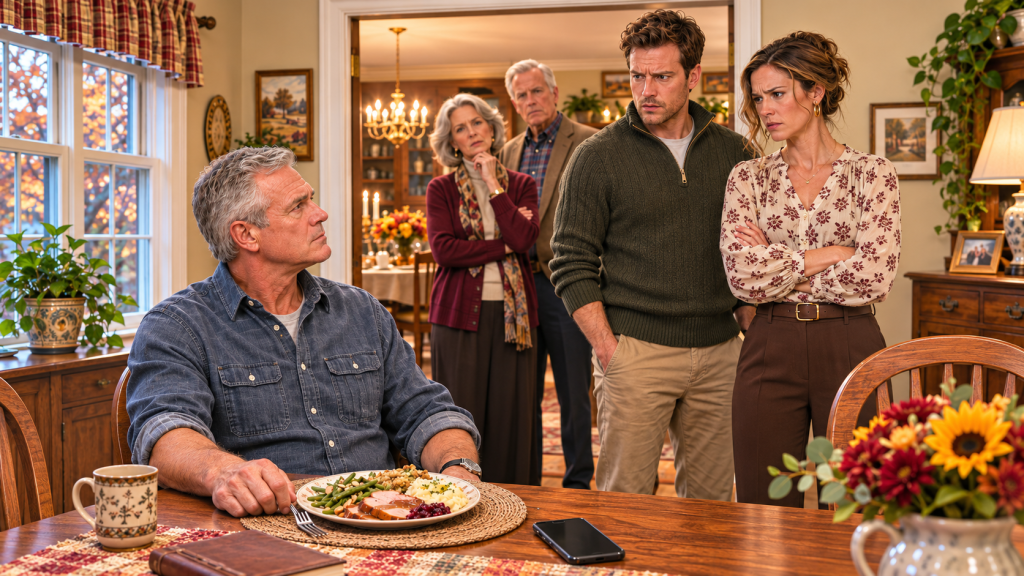
The same table where Trey had once sat swinging his little legs, too short to reach the floor. Now my thirty-five-year-old son looked at me as though he was about to confess something neither of us could survive hearing. “What is it, son?” I asked. Trey swallowed.
“Candace and her dad have been talking to someone about the house.”
My eyes moved toward Candace.
She immediately straightened.
“Trey, stop talking.”
He ignored her.
“Not just renovations.”
A terrible coldness spread through my chest.
“What about the house?”
Trey lowered his eyes.
“They wanted to use it as collateral.”
I stared at him.
“For what?”
He began crying.
“A business loan.”
I looked toward Stuart.
His expression hardened.
Then I asked the question that had been building inside me for eleven months.
“Whose business?”
Trey didn’t answer.
He didn’t have to.
Stuart suddenly stepped forward.
“Now hold on. Nobody was going to do anything without discussing it with you.”
I looked at him.
“Then why am I hearing about it on Thanksgiving?”
His mouth tightened.
Before he could answer, Candace snapped, “Because you make everything difficult!”
There it was.
Not embarrassment.
Not regret.
Anger that their plans had been interrupted.
I pulled out the chair Stuart had occupied at the head of my table.
Then I sat down.
“Everybody,” I said quietly, “take a seat.”
Nobody moved.
I looked directly at my son.
“Especially you, Trey.”
For thirty-two years, I’d worked to build Finch Outdoor Services from almost nothing.
I started with a used lawn mower, a battered pickup truck, and a handwritten list of twelve customers.
By the time Trey joined me full-time, we had seventeen employees, three maintenance crews, commercial landscaping contracts, and a reputation built on showing up when we promised.
I’d never been a wealthy man in the way Stuart understood wealth.
I didn’t own expensive watches.
I didn’t drive luxury vehicles.
Most days, I wore jeans, work boots, and the same old jacket Eleanor used to threaten to throw away.
But I owned my house.
My business was stable.
My employees received their paychecks.
And I had enough savings to know I wouldn’t have to choose between groceries and medication when I grew old.
I thought that was success.
Candace thought it was evidence that I wasn’t ambitious enough.
She often talked about expanding Finch into luxury property development.
Her father had spent years trying various business ventures, none of which seemed to last.
He had an answer for everything.
A contact.
An opportunity.
A promising investment.
Always one step away from the deal that would supposedly change everything.
And apparently, my son had begun believing him.
Trey sat slowly.
His hands were trembling.
Candace remained standing.
“Dad,” he whispered, “Stuart said he could get us into commercial land development.”
I listened.
“There was a property outside Maryville. Twenty-eight acres. He said a group of investors wanted to turn it into a residential subdivision.”
I looked at Stuart.
“Was there an actual purchase agreement?”
He bristled.
“Business doesn’t work on your little lawn-mowing schedule, Finch.”
I felt Vic stiffen beside me.
But I remained calm.
“Then explain how it works.”
Stuart opened his mouth.
Nothing came out.
Rebecca stepped forward.
“Mr. Whitcomb, if there are documents supporting this proposed transaction, they should be preserved and reviewed by the appropriate parties.”
Stuart looked away.
Trey rubbed his face.
“He said we needed to show financial strength.”
“How much?”
My son swallowed.
“Four hundred thousand dollars.”
My chest tightened.
“Four hundred thousand?”
He nodded.
I stared at him.
“And you planned to secure that money using my property?”
Trey began crying.
“I thought we’d make enough to pay you back.”
I shook my head.
“Son, you can’t pay somebody back for something they never agreed to lend you.”
Candace slammed her hand against the table.
“You’re acting as though we were trying to steal from you!”
I turned toward her.
“Then tell me exactly what you were trying to do.”
She folded her arms.
“We were trying to build a future.”
I looked around my dining room.
“At whose expense?”
She had no answer.
Then Trey revealed the part that almost brought me to my knees.
“Dad, they told me you were planning to retire next spring.”
I stared.
“I’ve talked about reducing my hours.”
He nodded.
“I know.”
“But I never said I was giving you the house.”
He looked down.
“And I never said you could use Finch Outdoor Services as security for another man’s venture.”
His eyes filled.
“I know that now.”
Candace laughed bitterly.
“Your father has been promising you the company for years.”
I looked at her.
“I’ve been preparing Trey to lead it.”
“Exactly.”
“Preparing isn’t the same as transferring ownership.”
She rolled her eyes.
“That’s just paperwork.”
Rebecca spoke quietly.
“Ownership and authorization are not merely paperwork.”
Candace turned away.
I leaned forward.
“Tell me something, Candace.”
She looked at me.
“When you sent me into the kitchen tonight, did you think I was too old to notice what was happening?”
Her face flushed.
“That had nothing to do with business.”
“No?”
I smiled sadly.
“You wanted your father at the head of my table.”
She looked away.
“You wanted Trey signing for my money.”
I paused.
“And apparently, you wanted my house used to fund your father’s investment.”
She said nothing.
I looked around at the table.
“Seems to me you’ve been rearranging quite a few things that don’t belong to you.”
My sister Nell appeared in the kitchen doorway.
She had arrived moments earlier through the back entrance, carrying a pumpkin pie and a worried expression.
I hadn’t asked her to come with Vic, Ben, and Rebecca.
But I’d texted her that afternoon.
You might want to stop by after seven.
She looked at the gathering.
Then at my untouched plate.
“Good grief, Henry.”
That was my name.
Henry Finch.
Sixty-three years old.
Widower.
Father.
Business owner.
And apparently, the only person at Thanksgiving who hadn’t been consulted about what was supposed to happen to his house.
Nell took one look at my face and set down the pie.
“What’s happened?”
I smiled tiredly.
“Pull up a chair.”
She sat beside me.
Then noticed Stuart standing near the dining room entrance.
Her eyes narrowed.
“Why is that man sitting in Eleanor’s chair?”
Stuart looked offended.
“Excuse me?”
Nell turned toward him.
“That chair belonged to my sister-in-law.”
Silence fell.
I hadn’t thought about that detail when Candace sent me into the kitchen.
But Nell was right.
Eleanor always sat beside me at Thanksgiving.
After she died, I left her chair empty for the first few holidays.
Then, gradually, family members began sitting there.
But I never stopped remembering whose place it had been.
Nell looked at Candace.
“Did you ask Henry whether he wanted you to move everyone around?”
Candace folded her arms.
“We were trying to make the seating comfortable.”
Nell glanced at the empty chairs.
“For whom?”
I almost laughed.
It was the first moment all evening that I felt something other than sorrow.
Rebecca suggested ending the discussion for the night.
She was right.
A holiday dinner was no place to conduct a detailed financial investigation.
The records required careful review.
The people involved needed the opportunity to provide explanations.
And I didn’t want my dining room turning into a courtroom.
I stood.
“Thanksgiving dinner is over.”
Candace stared.
“You can’t be serious.”
I looked at her.
“There’s plenty of food. You’re welcome to take a plate home.”
Her father scoffed.
“Unbelievable.”
I nodded.
“I’ve been thinking the same thing.”
Stuart grabbed his coat.
Connie followed him silently.
The remaining guests exchanged embarrassed glances.
One of Candace’s cousins approached me.
“Mr. Finch, I’m sorry. We didn’t know.”
I believed her.
Most of the people Candace brought weren’t responsible for what had happened.
They’d simply accepted an invitation.
I shook her hand.
“You don’t owe me an apology.”
She gave me a grateful look.
Then quietly left.
Soon only Trey, Candace, Nell, Vic, Ben, Rebecca, and I remained.
The house fell into an uncomfortable silence.
I looked toward the kitchen.
Then said, “Anybody still hungry?”
Nell stood.
“I am.”
Vic smiled faintly.
“Been smelling that dressing since I got out of the truck.”
For the first time that night, I laughed.
We carried the food back to the table.
I sat at the head.
Nell sat beside me.
Vic took another chair.
Ben joined us after putting the folders away.
Rebecca stayed long enough to ensure the evening ended calmly, then declined a full meal because she had family waiting at home.
I thanked her before she left.
Trey lingered near the doorway.
His eyes were red.
“Dad?”
I looked up.
“Yes?”
“Can I sit?”
My chest tightened.
For a moment, I wanted to tell him no.
To make him stand in the kitchen while the rest of us ate.
To let him experience one small piece of the humiliation I’d felt.
But then I looked at Eleanor’s chair.
And remembered how she used to settle arguments between us.
Henry, don’t confuse teaching someone a lesson with making them suffer.
I took a slow breath.
“There’s a chair, Trey.”
He sat.
Candace remained upstairs, gathering her belongings.
Nobody spoke for a while.
Then Nell passed me the dressing.
“Eleanor would have loved this.”
My eyes filled.
I took a bite.
And for the first time that Thanksgiving, my dinner tasted like home.
The next morning, the investigation began in earnest.
Ben arrived at the Finch yard before sunrise.
Vic had already gathered the crew supervisors.
I drove there at seven.
The November air was cold.
Our trucks stood in neat rows beneath the security lights.
A few employees were drinking coffee near the equipment shed.
When they saw me, they waved.
“Morning, Mr. Finch!”
I smiled.
“Morning, boys.”
For years, those greetings had been the soundtrack of my working life.
I knew almost every employee’s family.
Their children’s names.
Which ones needed flexible schedules.
Who was saving for a house.
Who was caring for an elderly parent.
Finch wasn’t just a company on paper.
It was seventeen households depending on us to operate responsibly.
And that was why I couldn’t simply ignore what Trey had done.
We gathered in the small office.
Ben laid out the records.
Nine questionable transactions.
Sixty-one thousand dollars.
Three payments to a consulting company registered to Stuart.
Two transfers connected to Trey’s personal spending.
One transaction associated with an online betting platform.
And several others that required explanation.
I stared at the spreadsheet.
Then looked at Vic.
“How long have you suspected?”
He sighed.
“Something wasn’t right for months.”
My chest tightened.
“Why didn’t you tell me?”
He looked ashamed.
“I thought Trey was making mistakes he’d correct.”
I nodded slowly.
“That’s what I thought too.”
Vic looked down.
Then whispered, “I’m sorry, Henry.”
I took a breath.
“Don’t apologize for trusting my son.”
He raised his eyes.
“But from now on, we verify.”
The hardest part wasn’t discovering that money had moved.
It was learning how many people had noticed warning signs and remained silent.
Our equipment manager, Luis Ramirez, remembered invoices for materials that never arrived.
Our office coordinator, Denise Walker, recalled being asked to code several payments as consulting expenses without supporting contracts.
And one crew supervisor remembered Stuart visiting the yard and discussing a subdivision project as though Finch had already agreed to participate.
I listened to every account.
I didn’t blame employees for decisions they hadn’t made.
Instead, I asked Ben to organize an independent review.
The goal wasn’t to produce the largest possible accusation.
It was to identify what had actually happened.
Which payments were authorized.
Which weren’t.
Whether any company assets had been misused.
And what obligations we might have to lenders, employees, or other parties.
That evening, I stood alone in the office.
The yard lights glowed through the windows.
I looked at a photograph of Trey as a teenager.
He was standing beside our old pickup truck, holding a rake and grinning.
I remembered his first summer working with me.
He complained about the heat.
Blistered his hands.
And told me he’d never work in landscaping when he grew up.
Then, years later, he joined the business full-time.
I thought he had finally discovered what I’d spent my life building.
Now I wondered whether I’d mistaken his presence for commitment.
Three days after Thanksgiving, Trey came to my office.
He looked exhausted.
“Dad?”
I gestured toward the chair.
“Sit down.”
He did.
For a while, neither of us spoke.
Then he whispered, “I need to tell you the whole thing.”
I folded my hands.
“I’m listening.”
He took a shaky breath.
“I started gambling about a year and a half ago.”
My chest tightened.
He looked down.
“At first, it was small.”
“Sports bets.”
“A few hundred dollars.”
“I won some money.”
He swallowed.
“Then I lost.”
I remained silent.
“I kept thinking I could win it back.”
His eyes filled.
“And when I couldn’t, I borrowed.”
I took a breath.
“From whom?”
“Credit cards.”
“Personal loans.”
He looked away.
“And then I used company money.”
I closed my eyes.
The admission hurt.
But I needed him to keep talking.
“How much?”
He swallowed.
“I don’t know exactly.”
I looked at him.
“Trey.”
His voice broke.
“I was afraid to add it all up.”
I nodded slowly.
“Then we’re going to add it up.”
Trey began crying.
“I thought I could fix it before you found out.”
My heart tightened.
“How?”
He wiped his eyes.
“Stuart said the development deal would make us rich.”
I looked at him.
“And you believed him.”
He nodded.
“He said if we put enough money into the property, the investors would come.”
I leaned back.
“Did you review the financial projections?”
He shook his head.
“Did you speak to a lender independently?”
“No.”
“Did you verify the property was actually available for development?”
His eyes filled.
“No.”
I stared at my son.
A man I’d trained to compare fertilizer costs down to the dollar.
A man who knew how to bid commercial contracts.
A man who’d spent years watching me refuse jobs that looked profitable on paper but couldn’t support their expenses.
And yet he’d apparently abandoned every lesson I’d taught him because someone promised a shortcut to wealth.
“Son,” I whispered, “why?”
He covered his face.
“Because I wanted to be bigger than you.”
The words struck harder than any insult Candace had thrown at me.
I stared.
Trey began sobbing.
“I wanted to prove I wasn’t just Henry Finch’s son.”
I looked down.
“I wanted to build something people would talk about.”
My throat tightened.
“And you thought my company wasn’t enough.”
He shook his head.
“No, Dad.”
Then he whispered, “I thought I wasn’t enough.”
For a long moment, neither of us spoke.
Then I remembered something Eleanor used to say.
Comparison can turn blessings into disappointments.
Trey had grown up watching me build a stable business.
But somewhere along the way, he’d decided that stability wasn’t impressive.
He wanted fast success.
Big projects.
Important people.
And the kind of lifestyle Candace’s father talked about over expensive dinners.
I understood the temptation.
I had been young once.
I remembered wanting to prove myself.
But understanding temptation wasn’t the same as excusing wrongdoing.
I leaned forward.
“Trey, I love you.”
His eyes filled.
“But you used company money that didn’t belong to you personally.”
He nodded.
“Yes.”
“You put your employees’ livelihoods at risk.”
He began crying.
“I know.”
“And you involved your mother’s memory in plans to take control of this house.”
He looked up.
His expression crumpled.
“Dad, I never wanted to take your home.”
I shook my head.
“Then you should have refused anyone who suggested using it without my permission.”
He lowered his eyes.
“I know.”
I took a breath.
“We’re going to let the review establish the full amount.”
He nodded.
“And you’ll need independent legal advice.”
His face tightened.
“Are you going to report me?”
I looked at him.
“I’m going to make sure the records are accurate and the appropriate obligations are met.”
My voice broke.
“I won’t lie to protect you, son.”
He began crying again.
The full accounting took several weeks.
When Ben and the independent reviewer finished, the picture was clearer.
The nine questioned transactions amounted to sixty-one thousand dollars.
But the records also revealed related charges, reimbursements, and offsets that needed to be reconciled.
Some money had gone to legitimate company expenses, though supporting paperwork was missing.
Other payments had been improperly directed toward personal obligations or Stuart’s consulting business.
The online betting transaction was connected to Trey’s personal account.
And several transfers involving Stuart’s company lacked any credible business purpose for Finch Outdoor Services.
The financial review identified a substantial amount requiring recovery or formal resolution.
It also revealed another problem.
Stuart had presented a proposed partnership document to Trey.
The document described a future arrangement in which Finch Outdoor Services would become part of a larger land-development venture.
The proposed terms gave Stuart’s company broad management authority while using Finch’s equipment, customer relationships, and credit standing.
I read the pages twice.
Then a third time.
My name appeared in the proposed agreement.
Below it was a space for my signature.
Blank.
Thank God.
But attached was an email from Stuart.
Henry will sign once Trey has everything arranged. Don’t involve him until we’re ready.
I sat very still.
Then whispered, “So that was the plan.”
Ben looked at me.
“What?”
I held up the paper.
“They weren’t waiting for me to retire.”
My voice hardened.
“They were planning to present me with a decision they’d already made.”
Rebecca reviewed the documents.
She was careful with her language.
The proposed partnership wasn’t a completed transfer.
The house hadn’t been pledged.
And my ownership interests had not legally changed merely because Stuart and Trey had discussed future arrangements.
But the communications supported my concerns about unauthorized plans.
They also raised serious questions about the payments that had already moved through Finch’s accounts.
We preserved the records.
Notified the relevant financial institutions and counterparties as appropriate.
And pursued the available remedies through the proper procedures.
Trey cooperated with the review.
Stuart was less cooperative.
He insisted the payments were consulting fees.
But he struggled to produce meaningful work product.
He threatened lawsuits.
Accused me of sabotaging a promising investment.
And told anyone who would listen that I was a bitter old man who couldn’t accept his son’s ambition.
I didn’t respond publicly.
I had spent thirty-two years building a reputation.
I wasn’t going to sacrifice it to win an argument at the county diner.
Then Clark Donovan called.
“Henry.”
“Morning, Clark.”
He sounded serious.
“I’ve got something you need to hear.”
I sat down.
“What is it?”
“Stuart approached me last week.”
My stomach tightened.
“About what?”
“He said Finch was restructuring and that Trey would soon control the company.”
I closed my eyes.
Clark continued.
“He suggested I move my properties into a new management package tied to the development venture.”
I stared at the wall.
“And what did you say?”
Clark chuckled without humor.
“I said I don’t sign contracts based on promises from people who don’t own the business.”
For the first time that morning, I smiled.
“Thank you.”
He grew serious.
“Henry, I don’t know what your family is going through.”
I listened.
“But I’ve worked with your crews for seventeen years.”
My throat tightened.
“They show up.”
“They do good work.”
“And when something goes wrong, somebody answers the phone.”
I nodded.
“That’s because of the company you built.”
My eyes filled.
Clark continued.
“I’m willing to renew, provided the operational controls are clear and the company remains stable.”
I closed my eyes.
“Vic will oversee day-to-day operations while the review continues.”
“Good.”
Then Clark added, “And Henry?”
“Yes?”
“Don’t let somebody else’s appetite ruin a business built on ordinary promises kept.”
I looked toward the yard.
“I’m trying not to.”
The contract renewal was finalized after the appropriate review.
Our crews kept working.
Payroll continued.
Customers were informed of the operational arrangements that affected them.
And Vic handled the day-to-day scheduling with a steadiness I’d come to trust over nearly three decades.
There were difficult weeks.
Questions from employees.
Rumors around town.
Concerns about the company’s future.
But we worked through them.
I held a staff meeting one Monday morning.
Seventeen employees gathered near the equipment shed.
I stood in front of them.
For a moment, I looked at their faces.
Luis.
Denise.
Vic.
Young workers who’d joined recently.
Older men who’d been with me through droughts, recessions, and storms.
I cleared my throat.
“I know there’ve been questions.”
The group became quiet.
“We’re reviewing certain financial matters.”
I paused.
“The review is being handled through the proper channels.”
I looked around.
“What I want you to know is that our customers will be served, your work will be respected, and payroll remains our priority.”
Several employees nodded.
Then I added, “I started this company because I believed honest work mattered.”
My voice thickened.
“I still believe that.”
Vic stood beside me.
“And so do we, Henry.”
For a moment, nobody spoke.
Then Luis began clapping.
The others joined.
I looked down.
Because I didn’t want them to see me cry.
Candace and Trey’s marriage began deteriorating almost immediately.
I didn’t ask for details.
I didn’t want to be drawn into their private arguments.
But Trey occasionally called.
At first, he blamed everyone.
Stuart had misled him.
Candace had pressured him.
The betting losses were bad luck.
I listened.
Then reminded him that his decisions were still his responsibility.
He didn’t always appreciate that.
One evening, he said, “Dad, you don’t understand what it was like.”
I took a breath.
“Then help me understand.”
He was quiet.
I continued.
“I know Stuart made promises.”
“I know Candace wanted a bigger life.”
“But I also know you authorized transfers you weren’t entitled to make for those purposes.”
He sighed.
“I’m trying.”
“I know.”
My voice softened.
“But trying begins with telling the truth, especially when it’s uncomfortable.”
He was silent for a long time.
Then whispered, “I think I’m starting to see that.”
Three months after Thanksgiving, Candace came to my house alone.
I was repairing a loose board on the deck.
She stood at the bottom of the steps wearing a dark coat.
“Henry?”
I looked up.
“Hello, Candace.”
She hesitated.
“Can we talk?”
I set down the screwdriver.
“Of course.”
We sat at the patio table.
She looked around the yard.
Then whispered, “I never realized how much work you put into this place.”
I smiled sadly.
“I’ve been working on it since 1992.”
She nodded.
“I know.”
For a moment, she stared at her hands.
Then said, “Trey and I have separated.”
My chest tightened.
“I’m sorry.”
She looked surprised.
“Are you?”
I nodded.
“Yes.”
She swallowed.
“I know you don’t like me.”
I took a breath.
“Candace, I don’t like the way you’ve treated me.”
Her eyes filled.
“That isn’t the same as wanting you to suffer.”
She looked down.
“I was awful that Thanksgiving.”
I nodded.
“Yes.”
She began crying.
“I knew you spent all day cooking.”
I remained silent.
“And I asked you to eat in the kitchen.”
Her voice broke.
“I told myself it wasn’t a big deal.”
I looked toward the house.
“Why?”
She hesitated.
“Because Dad wanted to feel important.”
My chest tightened.
“And I wanted him to like Trey.”
I stared at her.
She looked up.
“Stuart has always been hard to please.”
I listened.
“Growing up, nothing was enough.”
“Not grades.”
“Not achievements.”
“Not the people I dated.”
She wiped her eyes.
“When Trey said his father owned a business, Dad finally seemed impressed.”
I took a slow breath.
“And you wanted to keep him impressed.”
She nodded.
“Yes.”
For the first time, I saw Candace not as the woman who’d humiliated me at my own table, but as someone who’d spent years seeking approval from a man who made approval difficult to earn.
That didn’t excuse her actions.
But it helped me understand them.
I leaned forward.
“Candace, your father’s opinion doesn’t determine your worth.”
She began crying.
“I know that now.”
I nodded.
“And you don’t have to make someone else smaller to make him feel important.”
Her shoulders shook.
“I know.”
For a moment, we sat quietly.
Then she whispered, “I’m sorry, Henry.”
I looked at her.
“Thank you.”
She hesitated.
“Can you forgive me?”
I considered.
Forgiveness was complicated.
I could acknowledge her apology without pretending the past hadn’t happened.
I could wish her well without allowing her to take charge of my home again.
So I answered honestly.
“I don’t want to spend the rest of my life angry with you.”
Her eyes filled.
“But trust takes time.”
She nodded.
“I understand.”
We sat together for another few minutes.
Then she stood.
“Thank you for listening.”
I smiled gently.
“Take care of yourself, Candace.”
She walked toward her car.
And for the first time since Thanksgiving, I felt a little of the bitterness inside me loosen.
Stuart’s situation became more complicated.
His consulting company faced questions about the payments it had received.
The land-development proposal failed to attract the financing he claimed was nearly secured.
And the property outside Maryville was ultimately sold to another buyer.
The supposed opportunity that had encouraged Trey to risk so much never materialized.
There were negotiations over the disputed transfers.
Records were examined.
Explanations were requested.
And the company pursued recovery where appropriate.
Some funds were repaid through settlement arrangements.
Other amounts remained disputed for a time.
The final outcome required patience, expense, and careful documentation.
There was no instant courtroom spectacle.
No dramatic confession beneath a spotlight.
Just the slow work of establishing facts and resolving obligations.
And in the end, Stuart no longer had influence over Finch Outdoor Services.
That was what mattered most to me.
Trey faced more than financial consequences.
He had to confront his gambling.
At first, he insisted he could stop whenever he wanted.
Then he admitted he’d tried before.
He’d deleted apps.
Made promises.
Started again.
Eventually, he sought professional help.
He attended counseling.
Joined a support group.
And worked with qualified advisers to establish stronger safeguards around his personal finances.
I encouraged him.
But I didn’t manage the process.
That was important.
For years, whenever Trey had a problem, I’d stepped in.
A bad grade.
A broken truck.
A missed payment.
An argument with Candace.
I’d tried to fix everything.
Now I understood that my son needed to learn how to face difficulty without automatically reaching for me.
One evening, he called after a counseling appointment.
“Dad?”
“Hello, son.”
He sounded tired.
“We talked about why I started gambling.”
I listened.
“I thought it was about money.”
I nodded.
“And?”
He was quiet.
“It’s about feeling like I’m not enough.”
My chest tightened.
He continued.
“I wanted to be successful.”
“To impress Candace.”
“To impress Stuart.”
“To prove I could build something bigger than Finch.”
I took a breath.
“Son, there’s nothing wrong with ambition.”
He nodded.
“I know.”
“But ambition without honesty can destroy what you already have.”
He was silent.
Then whispered, “I learned that the hard way.”
Nearly six months after Thanksgiving, Trey asked to meet me at the yard.
I agreed.
He arrived wearing work boots and an old Finch jacket.
The sight startled me.
For years, I’d seen him in expensive shirts, talking about expansion plans and high-level opportunities.
Now he looked like the young man who used to ride beside me in the pickup.
We sat in the office.
He placed a folder on the desk.
“Dad, I made a repayment plan.”
I looked at him.
“With whom?”
“My attorney and financial counselor.”
I opened it.
There were figures.
Dates.
Proposed payments.
And an acknowledgment of his responsibility for amounts established through the review.
I studied the pages.
Then looked up.
“Can you actually afford this?”
He nodded.
“I’ve taken a job.”
My eyebrows rose.
“Where?”
He smiled nervously.
“A landscaping company in Oak Ridge.”
I stared.
He swallowed.
“I know.”
I shook my head.
“No, son.”
He looked confused.
“It’s honest work.”
My throat tightened.
“I was going to say I’m glad.”
His eyes filled.
He nodded.
“I’m starting at the bottom.”
I smiled faintly.
“There’s no shame in that.”
He looked down.
“I used to think there was.”
I leaned forward.
“Most people building something worthwhile start exactly there.”
Trey worked long days.
He loaded equipment.
Maintained properties.
Learned a different company’s systems.
And discovered what it felt like to be an employee whose livelihood depended on someone else’s decisions.
He called occasionally.
Sometimes to talk.
Sometimes to ask advice.
And sometimes just to say hello.
One evening, he called after a difficult day.
“Dad, I spent eight hours clearing storm debris.”
I laughed.
“Sounds familiar.”
He chuckled.
“My back hurts.”
“Also familiar.”
He was quiet for a moment.
Then said, “I think about the crews at Finch.”
I listened.
“I used to complain about payroll.”
He swallowed.
“I treated it like a problem that got in the way of bigger plans.”
My chest tightened.
He continued.
“Now I understand what it means when someone depends on that check.”
I smiled sadly.
“That was always the point, son.”
He nodded.
“I know.”
The following Thanksgiving, I woke at five in the morning.
Not because anyone expected me to cook for a crowd.
Because I wanted to.
I made the same dressing from my mother’s 1974 recipe.
Prepared sweet potatoes.
Macaroni and cheese.
Green bean casserole.
And a smaller ham.
Nell came over that afternoon.
She carried a pie.
“Henry Finch,” she announced, “I hope you haven’t invited twelve people without telling me.”
I laughed.
“Not this year.”
She smiled.
“Good.”
We set the table.
There were six chairs.
Nell.
Me.
Vic and his wife, Margaret.
Ben and his husband, Daniel.
People who had stood beside me during one of the hardest years of my life.
When the food was ready, Nell looked toward the empty chair beside me.
Eleanor’s old place.
She reached over and squeezed my hand.
“She’d be proud of you.”
My eyes filled.
“I hope so.”
Then the doorbell rang.
I looked up.
Nell smiled.
“Expecting someone?”
I shook my head.
“No.”
I walked to the door.
And found Trey standing on the porch.
He was holding a small covered dish.
His eyes looked tired.
“Dad?”
I stared.
“Hello, son.”
He swallowed.
“I know I wasn’t invited.”
I took a breath.
He held up the dish.
“I made sweet potatoes.”
I almost laughed.
“You made sweet potatoes?”
He smiled nervously.
“I found Grandma’s recipe.”
My throat tightened.
He looked down.
“I wasn’t planning to stay.”
“I just wanted to bring something.”
For a moment, I remembered the previous Thanksgiving.
Candace at the table.
Stuart in my chair.
Trey staring at his plate.
The humiliation.
The anger.
The financial revelations that followed.
Now my son stood at the door holding a homemade dish.
Not asking for money.
Not demanding control.
Not expecting me to step aside.
Just offering something.
I looked at him.
Then opened the door wider.
“There’s room.”
His eyes filled.
“Dad?”
I smiled.
“Come in.”
He began crying.
We sat together at the table.
Trey was quiet at first.
He looked around.
Then whispered, “This feels different.”
Nell smiled.
“That’s because nobody’s been ordered into the kitchen.”
I laughed.
Trey lowered his eyes.
“I’m sorry about that.”
Nell looked at him.
“Good.”
Then she passed him the gravy.
For a while, the conversation was simple.
Work.
Weather.
Neighbors.
Football.
The things families talk about when they’re not trying to hide something.
After dinner, Trey helped clear the table.
He carried plates into the kitchen.
Then stopped beside the sink.
“Dad?”
I looked up.
“Yes?”
“I’ve wanted to apologize properly.”
I turned toward him.
He swallowed.
“For last Thanksgiving.”
My chest tightened.
“I know you already said you’re sorry.”
He shook his head.
“Not enough.”
I waited.
He continued.
“You cooked for six hours.”
“You welcomed people into your home.”
“And I sat there while Candace told you to eat alone.”
His voice broke.
“I should have stood up.”
My eyes filled.
“I should have said something.”
He looked down.
“Instead, I acted like I didn’t see you.”
For a moment, neither of us spoke.
Then I whispered, “That was the part that hurt most.”
Trey began crying.
“I know.”
I shook my head.
“Son, I could have forgiven an awkward dinner.”
He nodded.
“I could have forgiven someone misunderstanding the seating.”
My voice trembled.
“But when you looked at your plate instead of looking at me…”
I stopped.
The memory was still painful.
Trey wiped his eyes.
“I was ashamed.”
I looked at him.
“Of what?”
“Of myself.”
He swallowed.
“I knew what Candace was doing.”
“I knew you’d worked all day.”
“And I knew Stuart was sitting in your chair.”
His voice cracked.
“But I wanted everyone to stay happy.”
I nodded slowly.
“So you let me be the one who was hurt.”
He closed his eyes.
“Yes.”
For a moment, I thought about all the times I’d kept quiet to avoid conflict.
All the times I’d let small disrespect pass.
The pantry.
The armchair.
The comments about retirement.
Maybe I’d taught Trey that silence was easier than standing up.
But I couldn’t keep repeating that mistake.
I placed a hand on his shoulder.
“Son, sometimes keeping the peace means someone else pays for it.”
He nodded.
“I know.”
Then he whispered, “I won’t make that mistake again.”
Our relationship began healing after that.
Not quickly.
Not perfectly.
There were still difficult discussions about the company.
The repayments.
The damage to trust.
And the decisions Trey had made.
But he was no longer demanding that I fix everything.
He was doing the work.
And that mattered.
Over the next two years, he continued counseling.
Remained employed.
Made payments under the agreement.
And rebuilt his finances.
He and Candace eventually divorced.
It was painful.
They had loved each other once.
But the financial pressure, dishonesty, and conflicting expectations had caused damage neither could repair.
I didn’t celebrate the divorce.
I wished them both the opportunity to build healthier lives.
Candace eventually moved to another city and found work outside her father’s business interests.
We exchanged a few polite messages over the years.
Nothing more.
That was enough.
Finch Outdoor Services continued operating under Vic’s leadership.
I remained involved.
But I reduced my hours gradually.
Not because Candace wanted me out.
Not because Stuart thought I was too old.
Because I chose to.
There is a profound difference between being pushed aside and deciding for yourself what the next chapter should look like.
I spent more mornings fishing.
More afternoons in the garden.
And more evenings on the back deck Eleanor and I built together.
I traveled with Nell to visit relatives in North Carolina.
Took a woodworking class.
And finally restored the old pickup truck I’d kept behind the barn.
It was the same truck I’d used when I started the business.
The paint was faded.
The engine needed work.
And the driver’s seat had a tear I remembered from the early years.
But restoring it brought me joy.
Every bolt.
Every repaired panel.
Every hour spent working with my hands.
It reminded me that I’d built a life through patience.
Not shortcuts.
And that the things worth having usually required more than a clever plan.
One afternoon, Trey came by while I was working on the truck.
He stood in the barn doorway.
“Dad?”
I looked up.
“Hey, son.”
He smiled.
“Need help?”
I laughed.
“Depends. You any good with carburetors?”
He grinned.
“Not as good as you.”
I handed him a wrench.
“Then today you’re learning.”
We worked for several hours.
Sometimes talking.
Sometimes quietly concentrating.
It felt like the old days.
The afternoons when Trey was a teenager and followed me around the yard asking questions.
At one point, he looked toward the truck.
“Dad, did you ever think Finch would become what it is?”
I smiled.
“No.”
He looked surprised.
“Really?”
I shook my head.
“I just wanted enough work to pay the bills.”
He laughed softly.
“That was it?”
“At first.”
I nodded toward the truck.
“Then one customer became two.”
“Two became ten.”
“And eventually, I realized people trusted me.”
Trey was quiet.
I continued.
“I didn’t build the business by promising everyone we’d get rich.”
“I built it by doing what I said I’d do.”
He looked down.
Then whispered, “I wish I’d understood that before.”
I put down the wrench.
“Son, understanding it now still matters.”
Three years after that terrible Thanksgiving, Vic told me he wanted to retire from daily operations.
We sat in the office.
He looked older.
His hair had turned almost completely gray.
“Henry,” he said, “I think it’s time.”
I smiled.
“You’ve earned it.”
He chuckled.
“Thirty-two years of this place.”
“Twenty-nine for you,” I corrected.
He laughed.
“Feels like fifty.”
I shook his hand.
Then pulled him into a hug.
“Thank you, old friend.”
His voice thickened.
“Couldn’t have done it without you.”
I stepped back.
“That’s what I was going to say.”
We discussed succession.
For the first time, I didn’t automatically think of Trey.
Not because I wanted to punish him.
But because I’d learned that family relationships and business governance needed to be considered separately.
We evaluated experienced managers.
Reviewed qualifications.
Considered internal candidates.
And eventually promoted Luis Ramirez to operations director.
Luis had spent fifteen years with Finch.
He knew the crews.
The customers.
The equipment.
And the importance of keeping promises.
He earned the role.
Trey congratulated him.
And that was one of the moments I knew my son was changing.
Because years earlier, he would have believed the job belonged to him.
Now he understood it had to be earned.
At sixty-eight, I made another decision.
I began preparing a formal succession plan for Finch Outdoor Services.
Not a secret agreement.
Not a promise whispered over Thanksgiving dinner.
A documented plan developed with qualified advisers.
It addressed management authority, ownership, financial controls, and what would happen if I became ill or died.
I also updated my estate documents.
That process was emotional.
For years, I’d avoided thinking about mortality.
After Eleanor died, I couldn’t bear to imagine what would happen when I was gone.
But the events surrounding Thanksgiving had shown me the danger of leaving important matters to assumptions.
I wanted clarity.
For Trey.
For the employees.
For the company.
And for myself.
I told my son about the process.
He listened carefully.
Then said something that surprised me.
“Dad, I don’t need you to give me Finch.”
I stared.
He continued.
“I know I used to think it was supposed to be mine.”
He looked down.
“But I have to build a life I can be proud of on my own.”
My eyes filled.
I nodded slowly.
“That’s a good place to start.”
Trey eventually earned a supervisory position at the company where he’d begun working after leaving Finch.
Not because of my influence.
Not because of his last name.
Because he showed up.
Learned.
Took responsibility.
And built trust.
One evening, he called.
“Dad!”
I smiled.
“What’s happened?”
“I got promoted.”
My chest warmed.
“Congratulations, son!”
He laughed.
“I couldn’t believe it.”
I asked him how he’d earned it.
He explained that he’d helped improve scheduling.
Reduced equipment downtime.
And developed a more reliable process for responding to customer complaints.
I listened with growing pride.
Those were the kinds of achievements I’d once hoped to see at Finch.
But now they were his.
Earned independently.
And perhaps because of that, they meant even more.
When he finished, I smiled.
“I’m proud of you.”
He was quiet.
Then whispered, “That means a lot.”
The next Thanksgiving, Trey arrived early.
He wore an old apron Eleanor had sewn years earlier.
Across the front were the words:
KISS THE COOK.
I laughed when I saw him.
“Where’d you find that?”
He grinned.
“In one of the kitchen drawers.”
I shook my head.
“Your mother used to wear that.”
He smiled.
“I remember.”
Then he picked up a knife.
“Where do you want me?”
I looked at the pile of vegetables.
“Start chopping.”
He nodded.
“Yes, sir.”
We spent the next several hours cooking together.
He peeled potatoes.
Made the green bean casserole.
And helped prepare the dressing from my mother’s recipe.
At one point, he tasted the gravy.
Then frowned.
“Needs salt.”
I laughed.
“Look at you.”
He grinned.
“Learning from the best.”
For a moment, I felt Eleanor’s absence so sharply that I had to look away.
She would have loved seeing us together.
Not as a father financing his son’s ambitions.
Not as a son trying to inherit what he hadn’t earned.
Just two men preparing a meal.
When the guests arrived, Trey greeted everyone at the door.
Nell came with a pie.
Luis and his wife brought rolls.
Ben and Daniel carried dessert.
Vic and Margaret arrived with a bottle of sparkling cider.
And at seven o’clock, we sat down.
There were enough chairs.
Nobody was sent into the kitchen.
Nobody was told they were in the way.
I looked around the table.
Then smiled.
“Before we eat, I’d like to say something.”
The room became quiet.
I cleared my throat.
“A few years ago, Thanksgiving became one of the hardest nights of my life.”
Trey lowered his eyes.
I continued.
“But it also taught me something important.”
I looked around.
“A family table isn’t valuable because it’s expensive.”
“It isn’t valuable because someone important sits at the head.”
“And it certainly isn’t valuable because one person paid for everything.”
I paused.
“It’s valuable because the people gathered around it treat one another with respect.”
Nell smiled through tears.
Vic nodded.
I looked toward Trey.
“And because everyone has a place.”
My son’s eyes filled.
I lifted my glass.
“To the people who help us remember what matters.”
Everyone raised their glasses.
And we ate.
After dinner, Trey and I stood in the kitchen washing dishes.
He rinsed.
I dried.
For a while, neither of us spoke.
Then he smiled.
“Dad?”
“Yes?”
“You know what I think about sometimes?”
I looked at him.
“What?”
“That night you walked into the kitchen.”
My chest tightened.
He continued.
“You smiled.”
I nodded.
“I remember.”
He looked down.
“And I thought that meant you were okay.”
I shook my head gently.
“No, son.”
He swallowed.
“I know that now.”
He was quiet.
Then whispered, “I think I finally understand what your smile meant.”
I looked at him.
“What?”
He took a breath.
“You were done begging people to respect you.”
My eyes filled.
I nodded.
“Yes.”
He put down a plate.
Then looked directly at me.
“Dad, I’m sorry it took me losing your trust to understand how much it mattered.”
I placed my hand on his shoulder.
“Trust can be rebuilt.”
He nodded.
“I know.”
“But it takes time.”
He smiled sadly.
“And work.”
I nodded.
“And work.”
When I turned seventy, Trey took me fishing.
Just the two of us.
We drove out before sunrise.
The sky was still dark when we reached the lake.
He carried the tackle box.
I brought coffee.
We sat side by side on the dock.
For a while, neither of us spoke.
Then the sun began rising.
Golden light spread across the water.
Trey looked toward the horizon.
“Dad?”
“Yes?”
“Do you ever regret making me leave Finch?”
I considered.
The question deserved an honest answer.
“I regret that things got bad enough for it to be necessary.”
He nodded.
“But I don’t regret protecting the business.”
He looked down.
I continued.
“Seventeen families depended on those paychecks.”
“I know.”
“And I couldn’t let personal feelings override that responsibility.”
He took a breath.
“I understand.”
We sat quietly.
Then he whispered, “I think losing that job saved me.”
I turned toward him.
He smiled sadly.
“If I’d stayed, I might’ve kept blaming everybody else.”
I listened.
“But starting over made me face what I’d done.”
My eyes filled.
He continued.
“And now I know I can build something without taking it from someone else.”
I smiled.
“That’s worth a great deal, son.”
He nodded.
“I know.”
We spent the morning fishing.
Caught very little.
Laughed a lot.
And talked more honestly than we had in years.
At one point, Trey asked whether I planned to sell Finch.
I smiled.
“Maybe someday.”
He nodded.
“Whatever you decide, Dad, I hope it’s what you want.”
I looked at him.
For a moment, I remembered Candace’s message.
Finch signs over by spring.
The arrogance of it.
The certainty.
The assumption that my life could be rearranged because someone younger wanted what I’d built.
Now my son was telling me the decision belonged to me.
My eyes filled.
“Thank you, Trey.”
He smiled.
“For what?”
“For finally seeing me.”
That was the real victory.
Not the recovered money.
Not the failed development deal.
Not Stuart losing his influence.
Not even Trey rebuilding his career.
It was the simple fact that my son had learned to see me as a person.
Not merely the man who owned a company.
Not a source of credit.
Not an obstacle to his ambitions.
His father.
A man who had worked hard.
Loved deeply.
Made mistakes.
And deserved dignity in his own home.
People sometimes ask whether I regret what happened that Thanksgiving.
I understand the question.
It was painful.
My family was embarrassed.
My son lost his authority within Finch.
Financial problems were exposed.
And relationships changed.
But the trouble had begun long before I walked into the kitchen.
The unexplained transfers.
The gambling.
The proposed partnership.
The plans involving my house.
The silence.
Those things already existed.
Thanksgiving simply became the moment I stopped pretending they were harmless.
I didn’t set out to destroy my son.
I wanted him to understand that love isn’t ownership.
That inheritance isn’t an entitlement.
And that being part of a family business carries responsibilities larger than personal ambition.
I also learned something about myself.
For years, I’d tolerated small disrespect because I thought speaking up would create conflict.
I let Candace reorganize my pantry.
Accepted comments about my furniture.
Ignored remarks about retirement.
And convinced myself that every concession was too small to matter.
But small concessions can become a pattern.
And patterns can become expectations.
By the time Candace asked me to eat alone in the kitchen, she wasn’t making a new demand.
She was simply taking another step down a path I’d allowed others to build.
That realization hurt.
But it also gave me the power to change.
I still live in the house outside Knoxville.
The deck I built with my own hands is still there.
The maple tree Eleanor planted still turns red every autumn.
The old pickup truck runs again.
And Finch Outdoor Services continues serving customers throughout the county.
Luis manages the crews.
Ben oversees the financial reporting.
We maintain stronger controls than we did before.
And I spend fewer hours in the office, by choice.
My life is quieter now.
But it is also fuller.
I fish.
Garden.
Read.
Visit friends.
And occasionally cook Thanksgiving dinner for people who genuinely want to share it with me.
Last November, Trey arrived at the house before sunrise.
He carried groceries.
A bag of potatoes.
Fresh herbs.
And a handwritten shopping list.
“Morning, Dad.”
I smiled.
“Morning, son.”
He stepped inside.
Then looked toward the dining room.
“Need me to set the table?”
I nodded.
“Sure.”
He walked over.
Paused beside the head chair.
Then looked back.
“Dad?”
“Yes?”
“Where do you want me to sit tonight?”
I smiled.
“Wherever you’re comfortable.”
He nodded.
Then pointed toward the chair beside mine.
“Mind if I sit there?”
My throat tightened.
I shook my head.
“Not at all.”
He smiled.
And continued setting the table.
I stood in the kitchen doorway watching him.
The same son who once stared at his plate while someone sent me away.
Now carefully placing a chair beside mine.
Not because he wanted control.
Not because he expected an inheritance.
But because he wanted to sit next to his father.
For a moment, I had to close my eyes.
Because sometimes the smallest gestures carry the greatest meaning.
That evening, when everyone arrived, the dining room filled with laughter.
Nell told stories.
Vic complained about his retirement golf game.
Luis talked about a new commercial contract.
And Trey helped carry the food.
When we sat down, he pulled out my chair.
I looked at him.
He smiled.
“Dad, sit.”
I laughed.
“Bossy as ever.”
He grinned.
“Only about dinner.”
I sat.
Then looked around the table.
There were plenty of chairs.
Plenty of food.
And something that had been missing for a long time.
Respect.
I thought about the man I’d been that first Thanksgiving.
Sixty-three years old.
Standing with a plate in his hand.
Listening to his daughter-in-law ask him to eat alone in the kitchen.
Looking toward his son and finding silence.
That man was hurt.
Humiliated.
And tired.
But he was also ready.
Not to punish everyone.
Not to prove he was powerful.
But to stop allowing other people to decide how much dignity he was permitted inside his own home.
I was proud of that man.
Because he had finally understood something he’d spent years teaching everyone else.
Honest work deserves respect.
Promises matter.
And the things we build with our own hands are worth protecting.
After dinner, I walked into the kitchen.
The same kitchen where I’d sat alone years earlier.
The same little table by the window.
The same swinging door.
I stood there for a moment.
Then Trey appeared.
“Dad?”
I turned.
“Yes?”
He smiled.
“Everyone’s waiting for dessert.”
I looked toward the dining room.
Laughter drifted through the doorway.
The table was full.
My chair was waiting.
And my son was standing beside me.
I smiled.
“Then let’s not keep them waiting.”
We walked back together.
I used to believe that being a good father meant giving my son everything I had.
My time.
My knowledge.
My opportunities.
My business.
Maybe even my house.
But I learned that the greatest gift I could give him wasn’t ownership of what I’d built.
It was the understanding that he had to build something worthy of his own name.
And the greatest gift I gave myself was finally recognizing that I didn’t have to surrender my place in the world to prove how much I loved him.
That Thanksgiving, I didn’t need to make a speech.
Didn’t need to produce another folder.
Didn’t need to call the bank.
Or summon an attorney.
I simply sat at my table.
In my home.
Beside my son.
And enjoyed the food I’d cooked.
Because the most powerful lesson had already been learned.
A father’s love is not a blank check.
A lifetime of work is not an inheritance someone can claim before it is given.
And respect should never be the price a parent must pay to remain welcome in their own home.
I had spent thirty-two years building a business and more than sixty years building a life.
Neither belonged to someone else simply because they wanted it.
And when I finally stopped accepting disrespect, I didn’t lose my family.
I gave us the chance to become one worth coming home to.
THE END STORIES! THANK YOU FOR READING GOOD LUCK !❤️
Related Posts