I stared at Mr. Okafor as though he had begun speaking a language I no longer understood. “Another account?” He nodded slowly, still holding the telephone. “Yes, Mrs. Lane.” My hands tightened around the arms of the chair. “Opened by whom?”
He listened to the person on the other end of the line, then said, “Please send the relevant information to our fraud department and preserve the records.” When he hung up, he sat across from me. For a moment, the office was completely silent. Then he folded his hands.
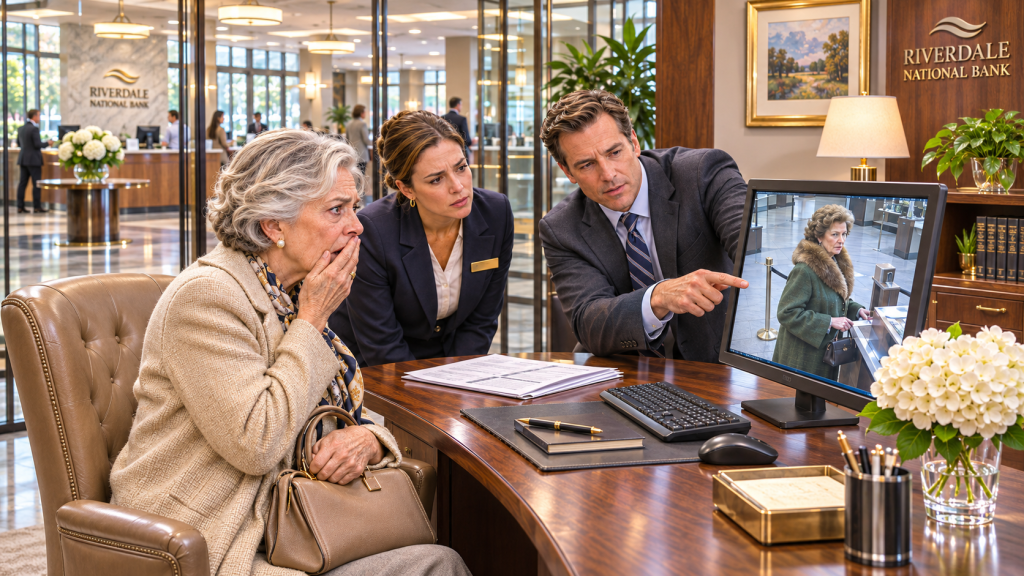
“Mrs. Lane, investigators have identified an account at another financial institution that appears to have been opened using your personal information.” I swallowed. “How much money is in it?” “We don’t have a confirmed balance yet.” I looked toward the frozen photograph on his monitor.
Diane.
My son-in-law’s mother.
Standing at a bank counter wearing the green coat my late husband had bought me for our fortieth wedding anniversary.
I could understand the missing money.
Not forgive it.
Not excuse it.
But understand what had happened.
Someone had used my identification, copied my appearance, and persuaded bank employees that she was me.
But another account?
That meant preparation.
Planning.
Perhaps months of it.
I looked at Mr. Okafor.
“Why would they need another account?”
He spoke carefully.
“We don’t know who opened it or why. That’s something the investigators will need to establish.”
I nodded.
Then whispered, “I want every account in my name examined.”
“We’ll help you document the problem and take the appropriate protective steps.”
I looked down at my hands.
They were wrinkled and covered with the small brown spots that had appeared as I grew older.
These hands had raised children.
Held my dying husband.
Worked in a school cafeteria for twenty-eight years.
Planted gardens.
Sewn birthday dresses.
And counted every dollar because I knew what it meant to have too little.
Now someone had decided those years of effort belonged to them.
I looked up.
“Mr. Okafor, I want to know how far this goes.”
He nodded.
“So do we.”
My name is Evelyn Lane.
I turned eighty that spring.
My husband, Walter, died seven years earlier.
We were married for fifty-three years.
Walter wasn’t a wealthy man.
He repaired commercial refrigeration systems, worked long hours, and believed a handshake should mean something.
I worked in the cafeteria at our local elementary school.
Between us, we raised two children, paid off a modest house, and saved enough to live without asking anyone for help.
Walter loved ordinary things.
Fresh coffee.
Baseball on the radio.
Tomato sandwiches in July.
And the sound of our grandchildren running through the house.
He was careful with money, but he wasn’t miserly.
He believed savings should buy peace of mind, not admiration.
When he died, his insurance benefit and the savings we’d built together became my financial foundation.
I guarded that money carefully.
Not because I wanted to leave behind an impressive inheritance.
Because I wanted to remain independent.
I wanted to pay my bills.
Buy birthday gifts.
Have the roof repaired when necessary.
And never become a financial burden on my children.
Sixty-one thousand dollars represented more than numbers on a statement.
It represented years of choices.
Vacations we postponed.
Cars we drove until the engines gave out.
Restaurant dinners we replaced with meals at our own table.
And a promise Walter and I had made to one another.
Whatever happens, one of us will always be able to stand on our own.
Now I was eighty years old, sitting in a bank office, discovering that people who called themselves family had treated that promise as an obstacle.
The police arrived later that afternoon.
Detective Marcus Reed introduced himself with a gentle handshake.
He had kind eyes and the measured manner of someone accustomed to hearing difficult stories.
A younger officer accompanied him to document the initial report.
Mr. Okafor explained the transaction history.
The withdrawals.
The identification records.
The security footage.
And my telephone conversation with Claire.
I told Detective Reed everything I knew.
Diane’s resemblance to me.
My missing coat.
Brian’s spare key.
The kitchen renovation.
And Claire’s admission that she’d known about the first withdrawal.
When I finished, Detective Reed closed his notebook.
“Mrs. Lane, I understand this is upsetting.”
I smiled faintly.
“Detective, I raised two children and worked in a school cafeteria. I’ve seen plenty of upsetting things.”
He returned the smile.
Then grew serious.
“We’ll investigate the suspected identity fraud and financial transactions. The evidence will determine what action is appropriate.”
I nodded.
“Good.”
He hesitated.
“Have you spoken to your son-in-law?”
“No.”
“Would you prefer to let us contact him?”
I looked toward the frozen security image.
“Yes.”
My voice was steady.
“I don’t trust myself to hear another explanation right now.”
Before I left the bank, Mr. Okafor helped coordinate the steps necessary to secure my finances.
The affected account was flagged for investigation.
I obtained written documentation of the disputed withdrawals.
I requested replacement identification and reviewed account access arrangements.
Additional verification measures were discussed.
The bank also began examining how the transactions had been approved.
Three large cash withdrawals by someone whose identity had apparently been misrepresented.
That raised questions.
Questions about identification procedures.
Questions about teller verification.
Questions about whether warning signs had been missed.
Mr. Okafor didn’t pretend the bank had handled everything perfectly.
He acknowledged that the matter required a formal internal review.
I appreciated that.
Because I didn’t need comforting promises.
I needed accountability.
When I stood to leave, Brittany came around the counter.
Her eyes were red.
“Mrs. Lane?”
I smiled gently.
“Yes, sweetheart?”
She swallowed.
“I’m so sorry.”
I took her hand.
“You noticed something wasn’t right today.”
She nodded.
“And you didn’t ignore it.”
Tears filled her eyes.
I squeezed her fingers.
“That’s important.”
Then I walked outside.
The afternoon sunlight was bright.
Cars passed along the street.
People hurried into shops carrying ordinary errands and ordinary worries.
For the first time in years, I felt uncertain about going home.
I drove slowly.
At every red light, I found myself glancing into the rearview mirror.
I knew it was irrational.
I wasn’t being followed.
But discovering that someone had worn my coat, carried my identification, and impersonated me had made the world feel unfamiliar.
When I reached my neighborhood, I parked in the driveway and stared at the house.
White siding.
Blue shutters.
A porch swing Walter built himself.
Rosebushes beside the steps.
The same home where Claire had learned to ride a bicycle.
Where her brother, Stephen, had broken his wrist trying to climb the maple tree.
Where we celebrated Christmas mornings and birthdays.
Where Walter spent his final months in the sunny bedroom overlooking the garden.
I loved that house.
But now I had to wonder who had entered it while I was away.
I unlocked the front door.
Then stopped.
The hallway smelled faintly of lavender.
Diane’s perfume.
A scent I recognized because she wore far too much of it at family gatherings.
I stood motionless.
Then slowly walked toward my bedroom.
My dresser drawers looked normal.
The jewelry box sat where I always kept it.
My husband’s photograph stood beside the lamp.
But when I opened the bottom drawer, the folder containing my old insurance documents was missing.
I stared at the empty space.
And felt a fresh wave of cold fear.
I called Detective Reed.
He advised me not to disturb anything further until the appropriate evidence procedures could be considered.
I stepped out of the bedroom.
Then called a licensed locksmith.
Brian’s spare key would no longer open my door once the locks were changed.
I also contacted my son Stephen.
He lived in North Carolina with his wife and two teenage children.
Stephen was fifty-two.
Quiet.
Practical.
Much like his father.
He’d never asked me for money.
Not once.
When I explained what had happened, he was silent for several seconds.
Then he whispered, “Mom, are you safe?”
The question nearly made me cry.
“Yes, sweetheart.”
“Are you alone?”
“Yes.”
“I’ll come.”
I took a breath.
“Stephen, you don’t have to drive all the way here.”
“Mom.”
His voice was firm.
“You spent fifty years showing up for us.”
I closed my eyes.
“Let me show up for you.”
Tears filled my eyes.
“All right.”
He exhaled.
“Lock the doors. I’ll call you when I leave.”
After we hung up, I sat beside Walter’s photograph.
Then whispered, “Our boy turned out all right.”
Claire called that evening.
I almost didn’t answer.
But I wanted to hear her voice.
Not because I expected a satisfying explanation.
Because she was my daughter.
And even after everything, some part of me still hoped she’d say something that made the day less terrible.
“Mom?”
Her voice trembled.
“Hello, Claire.”
She began crying.
“I’m so sorry.”
I looked toward the window.
“Have you spoken with Brian?”
She hesitated.
“Yes.”
“And Diane?”
Another pause.
“Yes.”
I took a breath.
“Then tell me what happened.”
Claire sobbed.
“Mom, Brian said the renovation costs got out of control.”
I closed my eyes.
“He said the contractor was threatening to stop work.”
“And that meant he could take money from my account?”
“No.”
Her voice broke.
“No, Mom.”
I remained quiet.
She continued.
“He told me he’d found a way to borrow against money you weren’t using.”
I stared.
“Borrow?”
“Yes.”
“Claire, borrowing requires the owner’s consent.”
She began crying harder.
“I know.”
I swallowed.
“Did you ever ask me?”
“No.”
“Did Brian?”
“No.”
“And Diane?”
Silence.
I looked down.
Then whispered, “So three adults decided they could take my money without asking.”
Claire sobbed.
“Yes.”
I closed my eyes.
For years, I’d told Claire she could come to me with anything.
When she was twelve and failed a math test.
When she was seventeen and crashed her first car.
When her marriage went through difficult periods.
When she struggled with anxiety after her second child was born.
I listened.
Helped.
Comforted.
Sometimes I gave advice.
Sometimes I simply held her hand.
But now she had known about a large withdrawal from my account and kept silent.
I could understand being frightened.
I could understand not knowing how to confront a spouse.
But I couldn’t understand how my daughter watched someone steal my identity and decided protecting their secret mattered more than protecting me.
“Claire,” I whispered, “you could have told me.”
She sobbed.
“I know.”
“I would have listened.”
“I know.”
I looked toward Walter’s photograph.
Then asked, “Did you know Diane was wearing my coat?”
Claire was quiet.
My stomach tightened.
“Claire?”
Finally, she whispered, “I saw her leave the house wearing it once.”
I stared.
“And you didn’t ask why?”
“She said she was borrowing it.”
I closed my eyes.
“That coat was a gift from your father.”
Claire began crying.
“I know.”
I took a slow breath.
“No, sweetheart.”
My voice trembled.
“I don’t think you do.”
The next morning, Stephen arrived.
He stepped out of his truck carrying an overnight bag.
He looked tired.
His hair had begun turning gray near the temples.
But when he saw me standing on the porch, his expression softened.
“Mom.”
I walked down the steps.
He hugged me.
For a moment, I felt like a much younger woman.
The mother who used to comfort him after nightmares.
Now I was the one leaning against her child.
He held me carefully.
“Are you okay?”
I shook my head.
“Not really.”
He kissed my forehead.
“That’s all right.”
I began crying.
And for the first time since the bank, I allowed myself to cry without trying to be strong.
We sat in the kitchen over coffee.
Stephen listened as I explained the withdrawals.
The security footage.
The new account.
The missing documents.
And Claire’s confession.
When I finished, he was silent.
Then he looked at me.
“Mom, I need to ask something.”
I nodded.
“Of course.”
“Have you ever given Brian or Diane permission to manage your accounts?”
“No.”
“Have you signed anything allowing Claire to access them?”
I thought carefully.
“Only an emergency contact form at the bank years ago. That wasn’t supposed to give her withdrawal authority.”
Stephen nodded.
“Okay.”
He took a breath.
“Then we need to make sure every institution understands the difference.”
I smiled sadly.
“You sound like your father.”
He looked toward Walter’s photograph.
“I’ll take that as a compliment.”
I reached for his hand.
“It was meant as one.”
That afternoon, Detective Reed called.
The second account had been opened using a combination of my personal information and questionable supporting documents.
The institution was preserving its records.
Investigators were working to determine who submitted the application and whether any funds had moved through it.
But there was something else.
“Mrs. Lane,” he said, “do you remember signing any documents at your daughter’s house last February?”
I frowned.
“February?”
“Yes.”
I thought back.
Claire had invited me over for dinner.
Brian was there.
Diane came later.
I remembered the evening because Claire’s youngest child, Oliver, had been sick.
She asked me to stay with him while she picked up medication.
Then Brian brought papers to the dining room table.
He said they were insurance renewal forms.
I remembered signing one document.
My stomach dropped.
“Detective.”
“Yes?”
“I signed something.”
He was quiet.
I continued.
“Brian told me it was related to the homeowners insurance policy.”
“Do you have a copy?”
“No.”
I felt sick.
“I trusted him.”
Detective Reed’s voice remained calm.
“We’ll need to examine what was presented and what you actually signed. Please don’t assume the document is valid for any purpose beyond what you knowingly agreed to.”
I nodded.
After we hung up, I looked at Stephen.
“I may have signed something without reading it.”
He took my hand.
“Then we’ll find out what it was.”
The paperwork review revealed a troubling pattern.
The document I remembered signing was indeed presented as an insurance-related form.
But the version later used in connection with the second account contained additional language that purported to authorize Brian to assist with certain financial transactions.
Whether that language had been present when I signed, and how the document had been altered or presented, became an important question.
The records required examination.
I disputed the authorization.
Investigators reviewed available copies, signatures, and submission histories.
And my attorney, Patricia Wells, helped me challenge any claim that I had knowingly granted broad financial authority to Brian.
Patricia was a patient woman with silver glasses and a habit of tapping her pen against her notebook when she was thinking.
At our first meeting, she looked at me.
“Mrs. Lane, I want to explain something clearly.”
I nodded.
“Your age does not make your decisions less valid.”
My eyes filled.
She continued.
“And it doesn’t mean other people can assume financial authority over you.”
I smiled faintly.
“Thank you.”
She leaned forward.
“Older adults are sometimes treated as though family members automatically know what’s best.”
I nodded.
“But legal authority has to be established properly.”
I took a breath.
“Then let’s establish what I did and didn’t authorize.”
Patricia smiled.
“Exactly.”
Over the following weeks, the investigation uncovered the purpose of the second account.
It had been used as part of an arrangement to move money between accounts while disguising the origin of certain funds.
The exact transaction history required careful review.
But the general picture was becoming clearer.
Brian had serious financial problems.
Far more serious than Claire initially admitted.
The kitchen renovation wasn’t the original cause.
It was the visible part of a much larger pattern.
Brian had invested in a commercial renovation project that failed.
He’d borrowed money.
Then borrowed more to cover earlier obligations.
He began relying on credit cards and short-term loans.
By the time Claire’s kitchen renovation started, their finances were already unstable.
Yet Brian continued spending.
He wanted their home to look successful.
Wanted neighbors to admire it.
Wanted Claire’s friends to believe they were doing well.
And when the bills became impossible to manage, he looked toward the one person he believed had money she wasn’t using.
Me.
His eighty-year-old mother-in-law.
The first time I heard the full amount of Brian’s debts, I almost dropped my teacup.
One hundred and eighty thousand dollars.
Not all of it tied to the disputed withdrawals.
Some was business debt.
Some personal.
Some connected to the renovation.
Some to earlier investments.
But the total was staggering.
I looked at Patricia.
“How could Claire not know?”
She hesitated.
“That’s something we shouldn’t assume without evidence.”
I nodded.
The truth was complicated.
Claire had known about some financial problems.
She’d known about the first withdrawal.
She’d remained silent when Diane wore my coat.
But she didn’t appear to have known the full extent of Brian’s debts.
She had trusted her husband.
Just as I once had.
That didn’t erase her responsibility.
But it helped explain how the situation had become so dangerous.
Diane’s role became increasingly clear.
She had a remarkable resemblance to me.
Similar height.
Similar gray hair.
Similar build.
At family events, people sometimes joked that we looked like sisters.
I laughed at those comparisons.
Diane laughed too.
Apparently, she remembered them.
When Brian needed someone to impersonate me, she was willing.
She wore my coat.
Used my identification.
And appeared at the bank with enough account information to convince employees she was the genuine customer.
The footage captured her entering and leaving.
Additional records helped establish the timing.
Investigators examined the transactions and the individuals involved.
The case eventually moved into formal criminal proceedings.
I provided statements.
Cooperated with requests for records.
And told the truth.
I didn’t ask for anyone to receive a particular sentence.
I didn’t pretend the legal process guaranteed a specific result.
But I refused to withdraw accurate information simply because the people involved were related to me.
Claire came to my house one afternoon while Stephen was still staying with me.
She stood on the porch carrying a small bag.
Her eyes were red.
“Mom?”
I opened the door.
“Hello, Claire.”
She looked toward Stephen.
He remained beside me.
“Can we talk?”
I hesitated.
Then stepped aside.
We sat in the living room.
Claire placed the bag on the coffee table.
Inside was my green coat.
My breath caught.
The wool was familiar.
The fur collar.
The buttons.
The tiny repair Walter had made near the left pocket after I caught it on a fence.
For a moment, I couldn’t speak.
Claire began crying.
“I found it in Diane’s closet.”
I reached for the coat.
Held it against my chest.
And closed my eyes.
I could almost hear Walter’s voice.
Green suits you, Evelyn.
He’d said that the day he bought it.
I remembered laughing.
Telling him it was too expensive.
He’d smiled.
Then I’ll be the extravagant one for once.
I pressed my face into the fabric.
And cried.
Claire watched silently.
Then whispered, “Mom, I’m sorry.”
I looked up.
“For what, Claire?”
She began crying harder.
“For not telling you.”
I waited.
“For letting Brian convince me it would all be fixed.”
She covered her face.
“For being afraid of what would happen to my marriage if I told the truth.”
My chest tightened.
I took a breath.
“Claire, I know you were frightened.”
She looked up.
“But you let me stay in danger because you were afraid of losing your comfort.”
She sobbed.
“I know.”
I swallowed.
“You watched your mother-in-law impersonate me.”
Claire lowered her eyes.
“You knew my identification had been used.”
She nodded.
“And you didn’t warn me.”
Her shoulders shook.
I looked down at my coat.
“Claire, that hurt more than the money.”
She whispered, “I know.”
I shook my head.
“No.”
My voice broke.
“You don’t know what it’s like to discover your own daughter saw danger coming toward you and chose not to speak.”
Claire began crying so hard she could barely breathe.
And for the first time, I didn’t rush to comfort her.
Stephen sat quietly.
He didn’t interrupt.
He didn’t criticize his sister.
He simply let me speak.
I looked at Claire.
“I love you.”
She raised her eyes.
“But I don’t trust you right now.”
Her face crumpled.
“I understand.”
I took a breath.
“Trust isn’t something you can demand because you’re my daughter.”
She nodded.
“And it isn’t something I can give back just because you’re crying.”
Her voice trembled.
“I know.”
I looked at her.
“I’m going to need time.”
She nodded.
“I’ll give you whatever time you need.”
Then she whispered, “Can you ever forgive me?”
I looked down at Walter’s coat.
For a long moment, I was quiet.
Finally, I answered.
“I hope so.”
Her eyes filled.
“But forgiveness and trust are different things.”
She nodded.
“I understand.”
I took her hand.
“And if you want us to rebuild, it has to begin with honesty.”
She squeezed my fingers.
“Okay, Mom.”
Claire’s marriage began unraveling.
Brian denied much of what had happened.
He claimed he intended to repay the money.
Insisted Diane had misunderstood his instructions.
And suggested that I had once given him verbal permission to help manage my finances.
The evidence had to be evaluated through the proper process.
But Claire had begun seeing things she hadn’t wanted to see before.
The hidden debts.
The false explanations.
The shifting stories.
The pressure to keep secrets.
Eventually, she separated from Brian.
She moved into a smaller house with her children.
Not because I ordered her to.
Not because I threatened to cut her off.
Because she recognized that her marriage had become financially and emotionally unsafe.
The separation was painful.
My grandchildren were frightened and confused.
Claire struggled.
She had to create a budget.
Find a home she could afford.
And explain changes without burdening her children with adult details.
I wanted to help.
But this time, I was careful.
I offered childcare when I was available.
Cooked meals occasionally.
Listened.
And encouraged her to seek qualified advice.
I did not hand over my savings to solve the problems.
That was new for both of us.
One afternoon, Claire called.
“Mom?”
“Yes?”
“I need to ask you something.”
My stomach tightened.
“What is it?”
She hesitated.
“Can you watch Oliver on Thursday? I have an appointment with my attorney.”
I smiled.
“Of course.”
She exhaled.
“Thank you.”
Then she added quickly, “If you’re busy, I can ask someone else.”
My heart softened.
“No, sweetheart. Thursday is fine.”
She was quiet.
Then whispered, “I’m trying to get better at asking instead of assuming.”
My eyes filled.
“I can see that.”
My grandson’s birthday came three months after the bank incident.
The very birthday for which I’d originally wanted to withdraw three hundred dollars.
His name was Noah.
He was turning twelve.
He loved astronomy.
Anything involving stars, planets, telescopes, or the possibility of life beyond Earth fascinated him.
I’d planned to give him money toward a telescope.
But after everything, I decided to do something different.
I took him to a small science museum.
We spent the afternoon looking at meteorites.
Watching a planetarium show.
And discussing whether humans might someday live on Mars.
Noah asked more questions than I could answer.
I laughed.
“Sweetheart, your grandmother worked in a school cafeteria. I don’t know everything about space.”
He grinned.
“That’s okay, Grandma.”
Then he took my hand.
“You know lots of other stuff.”
My throat tightened.
“Like what?”
He thought for a moment.
“How to make pancakes.”
I laughed.
“Very important.”
“And how to grow tomatoes.”
“Also important.”
He smiled.
“And how to make people feel better.”
My eyes filled.
I squeezed his hand.
“Thank you, sweetheart.”
Then he whispered, “Mom says you’ve been sad.”
I looked at him.
“Sometimes.”
He nodded.
“Are you getting better?”
I smiled gently.
“Yes.”
Then I added, “Especially today.”
The financial institutions continued reviewing the disputed accounts and transactions.
The process was frustrating.
There were forms.
Statements.
Deadlines.
Requests for additional documents.
And moments when I wished I could simply make the whole situation disappear.
But Patricia encouraged me to remain organized.
Stephen helped me create a system.
One folder for bank records.
One for police correspondence.
One for identity-related documents.
One for legal notices.
I labeled everything.
Recorded dates.
And kept copies.
For years, I’d believed I was old-fashioned because I preferred paper statements and handwritten notes.
Now those habits helped me reconstruct what had happened.
I also learned to use some new tools.
Stephen showed me how to review account alerts.
How to recognize suspicious messages.
And how to keep important records secure.
At eighty years old, I was still learning.
That surprised me.
In a good way.
The bank’s internal review eventually identified failures in how the large withdrawals had been verified.
The institution acknowledged that the circumstances warranted remediation under the applicable rules and its account agreements.
The disputed transactions were addressed through the bank’s investigation and resolution process.
I ultimately recovered the sixty-one thousand dollars taken from my account.
Not all at once.
Not without documentation.
But the funds were restored after the relevant review.
When Mr. Okafor called to tell me, I sat down.
“Mrs. Lane,” he said, “the confirmed restitution has been processed.”
I stared at the wall.
“All of it?”
“Yes, the sixty-one thousand dollars involved in the disputed withdrawals.”
My hands began shaking.
For a moment, I couldn’t speak.
Then I whispered, “Thank you.”
He paused.
“Mrs. Lane, I’m sorry you had to experience this.”
I closed my eyes.
“I appreciate that.”
After we hung up, I sat beside Walter’s photograph.
And cried.
Not because the money was everything.
But because it represented something we’d worked so hard to protect.
And for one terrible afternoon, I’d thought it was gone forever.
The proceedings involving Brian and Diane continued.
The investigators examined the impersonation, the movement of funds, and the disputed financial documents.
The evidence established serious misconduct connected to the unauthorized transactions.
The court process resulted in legal consequences and financial obligations for those found responsible.
I won’t pretend every detail was simple.
The new account involved additional questions.
Some documents were disputed.
And different individuals had different degrees of involvement.
But the central truth was no longer hidden.
Someone had used my identity.
Someone had taken money without my consent.
And the people involved had to answer for what they’d done.
I didn’t celebrate.
I felt relief.
And sadness.
Because every person involved had once sat at my dining room table.
Diane eventually sent a letter.
It arrived in a plain white envelope.
There was no return address.
Inside, her handwriting filled two pages.
She apologized for wearing my coat.
For using my identification.
For appearing at the bank as though she were me.
She wrote that Brian had convinced her the money would be replaced.
That she believed she was helping her son.
That she had been afraid his marriage would collapse if the debts were exposed.
I read the letter twice.
Then set it down.
For a long time, I stared at the window.
I understood a mother wanting to help her child.
I’d spent my life doing that.
But there was a difference between helping your child and harming someone else to protect them.
Diane had crossed that line.
I didn’t answer immediately.
Eventually, I sent a brief response through Patricia.
I acknowledged the apology.
I wished her the opportunity to take responsibility and change.
And I made clear that I did not want further personal contact.
That was enough.
I didn’t need revenge.
I needed boundaries.
Stephen stayed with me for almost two months.
He worked remotely while helping me handle appointments and practical matters.
At first, I protested.
“You have your own family.”
He smiled.
“I know.”
“Your wife needs you.”
“She told me to stay as long as you need.”
I shook my head.
“Your children have school.”
He laughed.
“Mom, they’re teenagers. They barely notice when I’m in the room.”
I smiled.
Then he became serious.
“Let me do this.”
My throat tightened.
I looked down.
“I don’t want to be a burden.”
He took my hand.
“Mom, accepting help isn’t the same as being a burden.”
I stared at him.
He continued.
“You’ve spent your whole life taking care of people.”
His voice softened.
“It’s okay to let someone take care of you sometimes.”
For a moment, I couldn’t speak.
Then I nodded.
“All right.”
One morning, Stephen found me sitting at the kitchen table staring at a stack of old photographs.
He poured himself coffee.
“What are you looking at?”
I smiled sadly.
“Your father.”
He sat beside me.
The photograph showed Walter standing beside our first house.
He was young.
Thin.
Wearing work boots and a faded blue shirt.
Stephen smiled.
“Dad looked about twelve.”
I laughed.
“He was twenty-six.”
Stephen studied the picture.
Then said, “I miss him.”
My eyes filled.
“So do I.”
We sat quietly.
Then I whispered, “He would have been furious about what happened.”
Stephen nodded.
“Probably.”
I looked at him.
“But I don’t think he’d want me spending the rest of my life angry.”
Stephen smiled gently.
“No.”
“He’d want you living.”
I closed my eyes.
The words settled somewhere deep inside me.
Because for months, I’d been focused on what people had taken.
My money.
My coat.
My sense of safety.
But I still had a life.
A home.
A garden.
Children and grandchildren.
Friends.
And years that might still hold happiness.
I didn’t want the people who’d hurt me to take those too.
That spring, I began working in the garden again.
Walter had planted the first rosebush forty years earlier.
Over time, we’d added more.
Red roses.
White roses.
Yellow roses.
And a beautiful pink variety that bloomed every June.
I spent mornings pruning.
Watering.
Pulling weeds.
And sitting on the porch when my knees needed a rest.
The work felt familiar.
Comforting.
There was something honest about gardening.
You couldn’t rush it.
Couldn’t demand flowers before the plant was ready.
You could only provide care and wait.
One afternoon, Claire arrived carrying gardening gloves.
She stood beside the gate.
“Mom?”
I looked up.
“Hello, sweetheart.”
She hesitated.
“Can I help?”
I considered.
Then nodded.
“Yes.”
She smiled.
And stepped into the garden.
We worked quietly.
Claire pulled weeds.
I trimmed roses.
Sometimes we talked about the weather.
The children.
Her work.
Small, ordinary things.
Then she stopped beside the rosebush Walter had planted.
“Mom?”
“Yes?”
“I’ve been thinking about something.”
I looked at her.
She swallowed.
“When Dad died, you never asked me for help with money.”
I smiled sadly.
“I didn’t need to.”
She nodded.
“But I think I got used to believing you were fine.”
I looked down.
She continued.
“Whenever I had a problem, you helped.”
“Whenever the kids needed something, you found a way.”
Her voice broke.
“And I stopped asking whether you needed anything.”
My chest tightened.
I took a breath.
“Claire, I didn’t need you to pay my bills.”
She nodded.
“I know.”
I looked at her.
“I needed you to care whether I was safe.”
She began crying.
“I know.”
For a moment, we stood among the roses.
Then she whispered, “I’m trying to become someone you can trust again.”
I nodded.
“I can see that.”
Trust returned slowly.
Not through dramatic promises.
Through small acts.
Claire began calling simply to ask how I was.
She visited without requesting money.
She helped with errands but asked before moving anything in my home.
She stopped treating my age as evidence that I couldn’t make my own decisions.
And she accepted that financial information was private unless I chose to share it.
One day, she asked whether I wanted help reviewing a medical bill.
I smiled.
“Thank you, but I’ve already handled it.”
She nodded.
“Okay, Mom.”
No argument.
No insistence.
No suggestion that I didn’t understand.
Just acceptance.
That simple response meant more than she knew.
The following Thanksgiving was different.
Stephen and his family came from North Carolina.
Claire brought Noah and Oliver.
I cooked.
Not because anyone expected me to.
Because I wanted to.
Turkey.
Mashed potatoes.
Green beans.
Sweet potatoes.
And Walter’s favorite cranberry sauce.
The house filled with laughter.
The grandchildren played board games.
Stephen carved the turkey.
Claire washed dishes.
And for the first time in months, my home felt like a place of warmth rather than suspicion.
Before dinner, Stephen raised his glass.
“To Mom.”
Everyone looked toward me.
I laughed.
“Oh, don’t start.”
He smiled.
“Too late.”
Then he continued.
“To the woman who taught us what strength looks like.”
My eyes filled.
“And who reminded us that getting older doesn’t mean becoming less worthy of respect.”
I looked down.
Claire began crying.
Stephen raised his glass.
“We love you, Mom.”
Everyone echoed him.
I smiled through tears.
“Love you too.”
After dinner, Claire helped me put away the leftovers.
We stood side by side in the kitchen.
For a while, neither of us spoke.
Then she whispered, “Mom?”
“Yes?”
“Do you remember the day you called me from the bank?”
My chest tightened.
“Yes.”
She lowered her eyes.
“I remember hearing your voice.”
I looked at her.
“You sounded so calm.”
I smiled sadly.
“I didn’t feel calm.”
She nodded.
“I know that now.”
She swallowed.
“When you said you were looking at Diane wearing your coat, I knew everything was falling apart.”
I remained quiet.
Claire continued.
“I was terrified.”
I looked down.
Then she whispered, “But I wasn’t thinking about how frightened you must have been.”
My eyes filled.
She turned toward me.
“I was thinking about Brian.”
I nodded slowly.
“Yes.”
Her voice broke.
“And I think that’s the part I regret most.”
I took a breath.
“Claire, recognizing that is important.”
She nodded.
“I know.”
I looked at her.
“But what matters now is how you live differently.”
She smiled through tears.
“I’m trying.”
Two years after the bank incident, I turned eighty-two.
My grandchildren organized a birthday party.
There were balloons.
A homemade cake.
Flowers from the garden.
And a ridiculous paper crown that Noah insisted I wear.
“Grandma, you’re the queen today!”
I laughed.
“At eighty-two, I suppose I’ve earned a crown.”
Everyone cheered.
Oliver brought me a handmade card.
Inside, he’d drawn a picture of me standing beside a telescope.
He wrote:
GRANDMA EVELYN, YOU ARE STRONGER THAN YOU THINK.
My eyes filled.
I hugged him.
“Thank you, sweetheart.”
He grinned.
Then whispered, “Mom says you’re the bravest person she knows.”
I looked toward Claire.
She was standing near the kitchen doorway.
Our eyes met.
For a moment, neither of us spoke.
Then she smiled.
And I smiled back.
Later that evening, after the guests left, I sat on the porch swing.
The sunset painted the sky orange.
The roses moved gently in the breeze.
Stephen sat beside me.
“Good birthday?”
I smiled.
“Very good.”
He nodded.
“I’m glad.”
We sat quietly.
Then he asked, “Mom, do you ever think about moving?”
I looked at him.
“Sometimes.”
He smiled.
“Really?”
I nodded.
“This house is a lot of work.”
He looked toward the garden.
“It is.”
I took a breath.
“But I don’t want to leave because someone thinks I’m too old to stay.”
Stephen nodded.
“Of course.”
I smiled.
“If I ever move, it’ll be because I choose to.”
He took my hand.
“That’s how it should be.”
I eventually made some practical changes.
I installed better exterior lighting.
Updated the locks.
Added security measures.
And organized my important documents with Patricia’s assistance.
I reviewed my estate arrangements.
Not because I expected to die soon.
But because I wanted my wishes clear.
Stephen and Claire were informed of the arrangements relevant to them.
Neither received automatic control over my finances.
Any assistance I might need in the future would follow the legal instructions I chose while capable of making those decisions.
I also learned to recognize warning signs.
Unexpected withdrawals.
Unfamiliar account activity.
Requests for identification.
Pressure to sign documents quickly.
And relatives who insisted that family trust should replace ordinary financial safeguards.
I wasn’t ashamed to ask questions.
At eighty-two, I’d earned the right to understand what happened to my money.
I began volunteering at the local senior center.
Once a month, I shared my experience during financial-safety workshops.
I didn’t pretend to be an expert.
I simply told people what happened.
A missing coat.
A daughter who remained silent.
A son-in-law who took advantage of trust.
A woman who resembled me standing at a bank counter.
And the teller who noticed something didn’t add up.
Sometimes the room became very quiet.
Then people began asking questions.
“What if my child gets angry when I say no?”
“What if I already signed something?”
“What if I don’t understand online banking?”
I always answered carefully.
“Ask a qualified professional.”
“Keep copies.”
“Don’t let anyone rush you.”
“And remember that being older doesn’t mean your money stops belonging to you.”
One afternoon, a woman named Margaret approached me afterward.
She was seventy-eight.
Her hands trembled.
“Mrs. Lane?”
I smiled.
“Yes?”
“My nephew wants me to add him to my account.”
I listened.
“He says it’ll make things easier.”
I nodded.
“Have you spoken to your bank or an independent adviser about what that would mean?”
She shook her head.
“No.”
I smiled gently.
“Then perhaps start there.”
Her eyes filled.
She whispered, “I’m afraid he’ll think I don’t trust him.”
I took her hand.
“Margaret, protecting yourself isn’t an insult to someone who truly wants what’s best for you.”
She began crying.
And I realized that what I’d survived might help someone else avoid a similar loss.
The most unexpected change came from Claire.
One afternoon, she called.
“Mom?”
“Yes?”
“I’ve been thinking about starting a small emergency fund.”
I smiled.
“That sounds sensible.”
She laughed nervously.
“I know it’s late.”
I shook my head.
“It’s never too late to begin.”
She was quiet.
Then whispered, “I think I spent years assuming someone would always rescue me.”
My chest tightened.
I listened.
“And when Brian got into trouble, I was so afraid of losing everything that I convinced myself taking your money temporarily wasn’t really hurting you.”
I closed my eyes.
She continued.
“But it was.”
I nodded.
“Yes.”
She took a breath.
“I don’t want to live like that anymore.”
My eyes filled.
“Then don’t.”
She laughed softly.
“That’s your advice?”
I smiled.
“Start small. Stay consistent. Ask for help when you need advice. And don’t borrow from someone without their permission.”
She laughed through tears.
“Fair enough.”
Three years after the bank incident, Claire invited me to dinner.
Not an elaborate meal.
Not a celebration.
Just dinner.
She had moved into a modest house.
The expensive kitchen from her old home was gone.
So were the high monthly payments.
The elaborate furniture.
And the need to look wealthier than she was.
Her new kitchen had white cabinets.
A small wooden table.
And a window overlooking a little garden.
When I arrived, she opened the door.
“Mom!”
I smiled.
“Hello, sweetheart.”
She hugged me.
No hesitation.
No hidden request.
Just a hug.
Noah came running.
“Grandma!”
Oliver followed.
I laughed.
“My goodness, you’ve both grown!”
We ate spaghetti.
Garlic bread.
And a salad.
Claire apologized because the garlic bread was slightly burned.
I laughed.
“Sweetheart, I’ve eaten worse.”
She smiled.
Then looked at me.
“Mom, thank you for coming.”
I took her hand.
“Thank you for inviting me.”
After dinner, Claire walked me to the car.
The evening air was cool.
Streetlights glowed along the sidewalk.
She stood beside me for a moment.
Then whispered, “Mom?”
“Yes?”
“Do you think Dad would be disappointed in me?”
My heart tightened.
I looked at her.
For a moment, I remembered Walter.
His gentle laugh.
His strong hands.
His quiet belief that people should do what they promised.
I took a breath.
“Claire, your father would have been deeply hurt by what happened.”
She nodded.
Tears filled her eyes.
“I know.”
I continued.
“But I also believe he’d want you to become better rather than spend the rest of your life hiding from your mistakes.”
She began crying.
I took her hand.
“That’s what responsibility is.”
She nodded.
“Not pretending the past didn’t happen.”
I smiled gently.
“But choosing to live differently because it did.”
She hugged me.
And for the first time in years, I felt the beginning of a relationship built on honesty instead of assumption.
People sometimes ask whether I ever forgave Claire.
I think about that carefully.
Because forgiveness isn’t a single moment.
It doesn’t arrive because someone cries.
Or apologizes.
Or promises never to repeat a mistake.
It grows through time.
Through changed behavior.
Through honesty when the truth is uncomfortable.
Through respect for boundaries.
And through the willingness to accept that trust may never return exactly as it was.
I love my daughter.
I always will.
But I no longer believe love requires me to ignore danger.
I can forgive her while keeping my financial information private.
I can welcome her into my home while controlling who has a key.
I can enjoy dinner with her without making myself responsible for her bills.
Those things aren’t contradictions.
They’re boundaries.
And I’ve learned that healthy relationships can survive them.
The last time I visited the bank, Brittany greeted me with a smile.
“Mrs. Lane!”
I laughed.
“Hello, sweetheart.”
She looked at the calendar.
“First Monday.”
I grinned.
“Just like always.”
Mr. Okafor stepped out of his office.
“Mrs. Lane, good to see you.”
I smiled.
“Good to see you too.”
He asked whether everything was going well.
I nodded.
“Yes.”
Then I added, “And I check my statements every week now.”
He smiled.
“That’s an excellent habit.”
I laughed.
“Took me eighty years to learn it.”
He shook his head.
“It’s never too late.”
We talked briefly.
Then I completed my transaction.
No confusion.
No unfamiliar withdrawals.
No stranger wearing my coat.
Just an ordinary visit to a bank I’d trusted for more than half a century.
When I stepped outside, I felt something I hadn’t felt on that terrible Thursday.
Peace.
I still wear the green coat.
Not every day.
Only when the weather is cold.
The wool is soft.
The collar is familiar.
And every time I button it, I remember Walter standing in our bedroom with the gift box.
Green suits you, Evelyn.
For a while, I thought I’d never wear it again.
The coat had become evidence.
A reminder of betrayal.
A symbol of how easily someone had stepped into my identity.
But one winter morning, I took it from the closet.
Brushed the sleeves.
Fastened the buttons.
And looked in the mirror.
There I was.
Eighty-three years old.
Gray hair.
Wrinkled hands.
A face that had lived through love, grief, motherhood, and hardship.
And I realized something.
Diane had worn my coat.
But she had never been me.
She could imitate my appearance.
Carry my identification.
Stand at my bank counter.
And attempt to take my money.
But she couldn’t take the life I’d lived.
The love I’d given.
The work I’d done.
Or the dignity I still possessed.
I walked outside that morning and stood beneath the porch roof.
The sky was pale.
The roses were bare for winter.
Walter’s porch swing moved gently in the wind.
I looked toward the garden.
Then smiled.
Because the coat belonged to me again.
Not merely as property.
As a reminder that the things people try to steal don’t have to remain defined by the theft.
Sometimes we can reclaim them.
I think often about the day I walked into the bank wanting three hundred dollars for my grandson’s birthday.
Such a small errand.
Such an ordinary afternoon.
I expected to withdraw money.
Perhaps chat with Brittany.
Then drive home and wrap a gift.
Instead, I discovered that sixty-one thousand dollars had been taken from my account.
That someone had impersonated me.
That my daughter knew more than she’d admitted.
And that the people I trusted had used my age and kindness as reasons to believe they could get away with it.
That day changed my life.
But it didn’t end it.
I learned that age doesn’t make a person helpless.
That kindness isn’t foolishness.
And that trusting your family doesn’t mean giving up the right to protect yourself.
I also learned that independence doesn’t require refusing every offer of help.
Stephen helped me.
Patricia guided me.
Mr. Okafor and the bank staff assisted with the investigation.
Detective Reed followed the evidence.
And Claire eventually began doing the difficult work of repairing what she could.
I wasn’t alone.
But I remained the person making decisions about my own life.
That distinction mattered.
One Sunday afternoon, I sat in my garden with Noah.
He was fifteen now.
Tall.
Curious.
Still fascinated by astronomy.
We were watching the sunlight move across the rosebushes.
He looked toward me.
“Grandma?”
“Yes, sweetheart?”
“Are you afraid of getting old?”
I smiled.
“Sometimes.”
He looked surprised.
“Really?”
I nodded.
“Growing older can bring challenges.”
He considered.
“Like what?”
I thought about the bank.
The hospital visits.
The loss of Walter.
The changes in my family.
Then I smiled gently.
“Sometimes people begin making assumptions about what you can and can’t do.”
He frowned.
“That’s not fair.”
I laughed softly.
“No.”
Then I added, “But getting older also gives you something wonderful.”
He looked up.
“What?”
“Perspective.”
He considered the word.
I smiled.
“You learn what matters.”
He nodded.
“Like money?”
I laughed.
“Money matters because it helps you live safely.”
Then I took his hand.
“But it’s not the most important thing.”
He looked toward the roses.
“What is?”
I smiled.
“Respect.”
He thought about that.
Then asked, “More than love?”
I took a breath.
“Love without respect can hurt people.”
His expression became thoughtful.
I continued.
“The best kind of love makes room for both.”
Noah sat quietly for a moment.
Then smiled.
“Grandma, I’m glad you’re my grandma.”
My eyes filled.
I squeezed his hand.
“And I’m glad you’re my grandson.”
He leaned against me.
For a while, we watched the garden.
Then he whispered, “Mom says you helped her become a better person.”
My heart tightened.
I looked at him.
“Did she?”
He nodded.
“She said you told the truth even when it was hard.”
Tears filled my eyes.
I looked toward the house.
Then whispered, “Sometimes that’s the only way things can begin to change.”
That evening, after Noah went home, I sat beside Walter’s photograph.
The house was quiet.
The lamp cast a warm circle of light across the room.
I looked at my husband’s face.
His familiar smile.
The gentle lines around his eyes.
The man who’d shared fifty-three years with me.
I thought about everything that had happened since his death.
The loneliness.
The loss.
The financial betrayal.
The fear.
The slow rebuilding.
Then I smiled.
“Walter,” I whispered, “you would not believe what I’ve been through.”
For a moment, I imagined his laughter.
Then I looked down at the bank statement resting on my desk.
The account was secure.
The disputed funds had been restored.
My documents were organized.
My home was peaceful.
And my family relationships were no longer built on the assumption that my money belonged to whoever needed it most.
I took a breath.
“We did all right.”
I know people might expect me to say I got revenge.
That Brian and Diane suffered.
That Claire learned her lesson.
That everyone who betrayed me paid dearly.
But revenge was never what I wanted.
I wanted my money protected.
My identity restored.
My home secured.
And the truth established.
The legal process addressed wrongdoing.
The financial institutions corrected what they were required to correct.
And the people involved had to face consequences.
That was enough.
I didn’t need to spend whatever years I had left consumed by bitterness.
I wanted to live.
To enjoy my grandchildren.
To garden.
To bake birthday cakes.
To wear my green coat.
And to remember Walter with love rather than fear.
The greatest lesson of all was something I wish I’d understood earlier.
Being eighty doesn’t make me less entitled to respect than someone who’s thirty.
Having savings doesn’t mean my relatives have permission to spend them.
And loving my children doesn’t mean I must sacrifice my safety to protect their mistakes.
I had spent a lifetime being careful.
A lifetime working.
Saving.
Giving.
And loving.
Those years belonged to me.
And so did the right to decide what happened next.
One bright Monday morning, I picked up my purse and walked toward the door.
My green coat hung beside the hallway mirror.
I slipped it on.
Fastened the buttons.
And checked my reflection.
Then I smiled.
Because the woman looking back at me wasn’t helpless.
She wasn’t foolish.
She wasn’t simply an old lady whose money could be taken without consequence.
She was Evelyn Lane.
A mother.
A grandmother.
A widow.
A woman who had worked hard, loved deeply, and survived more than most people knew.
I picked up my keys.
Then stepped outside.
The sun was shining.
The roses were beginning to bloom.
And the world was waiting.
I went to the bank that morning.
Not because something was wrong.
But because I wanted to make an ordinary withdrawal.
Three hundred dollars.
For a birthday gift.
When Brittany saw me, she smiled.
“Good morning, Mrs. Lane.”
I smiled back.
“Good morning, sweetheart.”
She glanced at the calendar.
“First Monday, right on schedule.”
I laughed.
“You know me.”
She nodded warmly.
“I do.”
For a moment, I looked at her.
Then smiled.
“And that’s a very good thing.”
I walked out of the bank with the money safely in my purse.
No stranger had touched my account.
No family member had made decisions for me.
No one had mistaken my kindness for permission.
I drove home slowly, enjoying the sunlight.
Then I stopped at a little bookstore and bought Noah a beautiful book about the night sky.
Inside the cover, I wrote:
For Noah,
May you always remember that the greatest treasures in life are not the things we take, but the trust we earn and the love we protect.
With all my love,
Grandma Evelyn.
I closed the book.
And smiled.
Because after everything, I finally understood:
They had stolen my money, but they hadn’t stolen my future.
They had worn my coat, but they hadn’t taken my identity.
And they had mistaken my age for weakness, never realizing that eighty years of living had taught me how to stand up for myself.
I didn’t need revenge to reclaim my life.
I needed the courage to protect it.
And I had found that courage.
At eighty years old.
Right when I needed it most.
THE END STORIES! THANK YOU FOR READING GOOD LUCK !❤️
Related Posts