➡️ PART 3 ➡️
For ten years, I had believed that Arthur Jensen was the one person who would never let me feel unwanted. He had loved the parts of me that my family overlooked. The quietness. The books. The way I preferred a Saturday morning at home to an expensive party filled with strangers.
Then he asked for a divorce, and my twin sister walked into our dining room wearing a red dress, announcing that she was going to marry him. For four months, I had tried to understand how love could disappear so completely. Now, sitting in David Allen’s office, I was beginning to realize that it might never have disappeared at all.
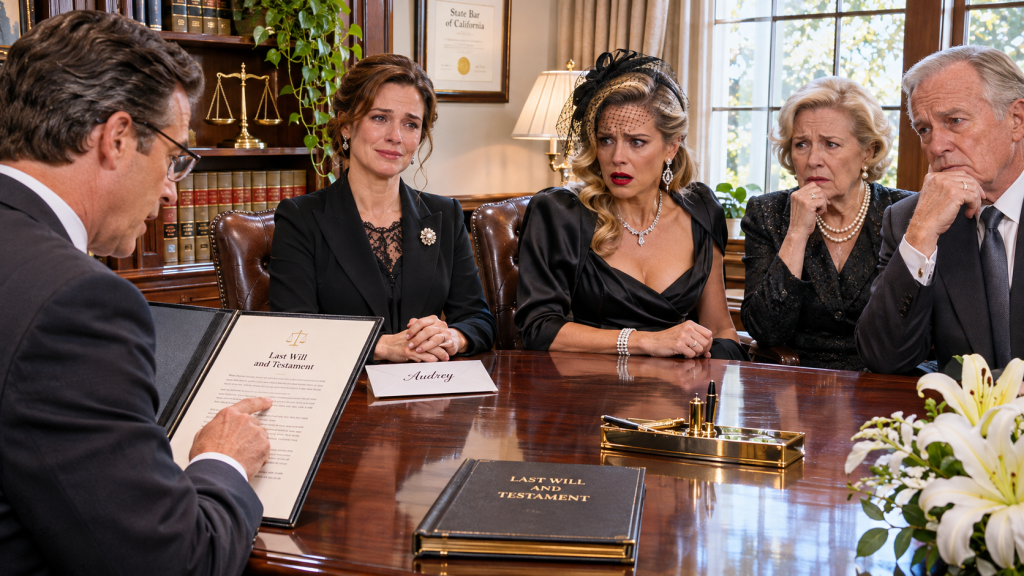
It had been buried beneath fear, dishonesty, and a terrible secret. Across the mahogany table, Beatrice stared at the email David had placed before us. Its final sentence seemed to burn through the silence. Don’t tell Audrey yet. If she knows how sick Arthur is, she’ll never sign the divorce papers. I had read those words aloud. But I still couldn’t believe them.
My mother pressed a hand against her mouth. My father looked toward Beatrice. And my sister, who had entered the attorney’s office smiling about a four-hundred-million-dollar fortune, suddenly seemed unable to meet anyone’s eyes. I looked directly at her. “Beatrice, did you know Arthur was sick?” She swallowed.
Then whispered, “It’s not what you think.”
I felt something inside me break.
Because I’d heard those words from her before.
And every time, the truth had been worse.
David adjusted his glasses.
“Before anyone makes accusations, I need to clarify something.”
He pointed toward the document.
“This email was recovered from correspondence Arthur preserved. We have the message records, but certain circumstances surrounding the exchange remain under review.”
Beatrice leaned forward.
“Exactly. You’re twisting everything.”
David remained calm.
“I’m not interpreting your intentions, Mrs. Jensen. I’m showing Audrey what Arthur instructed me to preserve.”
The sound of that name made my stomach tighten.
Mrs. Jensen.
For ten years, it had been mine.
Now my sister wore it as though it were a piece of jewelry she’d taken from my dresser.
I looked toward Beatrice.
“Who sent you the medical information?”
She stared at the table.
“Arthur told me himself.”
My heart stopped.
“He told you?”
She nodded reluctantly.
“When?”
Her fingers tightened around her purse.
“A few weeks before he asked you for the divorce.”
For several seconds, I couldn’t speak.
Arthur had been diagnosed.
He had confided in Beatrice.
And together, they had kept me outside the most frightening moment of his life.
I whispered, “I was his wife.”
Beatrice looked away.
“I know.”
“No,” I said, my voice trembling. “I don’t think you do.”
I remembered a Thursday evening shortly before the divorce.
Arthur had come home late.
His face was pale.
He barely touched dinner.
I’d asked whether he was feeling well.
He said he was tired.
I offered to make an appointment with our doctor.
He shook his head.
Then went upstairs.
That night, he lay beside me with his back turned.
I thought he didn’t want me anymore.
Now I wondered whether he’d been lying awake, terrified of a disease he didn’t know how to face.
I pressed my fingertips against my eyes.
“Why didn’t he tell me?”
David’s expression softened.
“He addressed part of that in his letter.”
I looked down at the pages.
Arthur’s familiar handwriting trembled in my hands.
Audrey, I thought leaving you would protect you from the months or years I might spend becoming someone you no longer recognized.
My eyes filled.
But I understand now that I wasn’t protecting you. I was protecting myself from letting you see me afraid.
I covered my mouth.
He had mistaken loneliness for mercy.
And he’d forced me to carry it without even knowing why.
My mother began crying.
“Oh, Audrey. How awful.”
I looked toward her.
For a moment, I wanted to believe she was finally grieving with me.
Then she turned toward Beatrice.
“Sweetheart, why didn’t you tell us?”
I almost laughed.
Not because anything was funny.
But because the pattern was so familiar.
Even now, my mother wanted to understand the daughter who’d kept the secret.
Not the daughter who’d lived inside it.
I folded Arthur’s letter carefully.
“Mom, could you please let me finish hearing what happened?”
She looked startled.
Then nodded.
My father cleared his throat.
“We’re all upset.”
I met his eyes.
“Yes, Dad.”
My voice remained quiet.
“But only one of us was married to Arthur for ten years and learned about his illness after he died.”
He lowered his gaze.
For once, he had nothing to say.
David opened the next folder.
“Arthur requested a review of the correspondence surrounding his divorce.”
I looked up.
“What correspondence?”
“Messages, financial communications, and certain documents exchanged before the proceedings.”
My stomach tightened.
For weeks before Arthur left, I’d received messages from an unfamiliar number.
They were cruel.
Personal.
Almost designed to strike the places where I was already weakest.
Arthur regrets wasting his life with you.
He wants a woman who understands success.
Stop embarrassing yourself by trying to keep him.
At first, I thought someone was playing a horrible joke.
Then came a message that appeared to be from Arthur himself.
I don’t love you anymore, Audrey. Please accept that.
I remembered staring at the words until my eyes burned.
When I confronted him, he didn’t deny wanting the divorce.
But he wouldn’t explain the messages either.
Now David placed a report in front of me.
“An investigator was able to connect the account used for several of those messages to contact information associated with Beatrice.”
I looked at my sister.
She went rigid.
“That proves nothing.”
David nodded.
“On its own, it doesn’t prove authorship. But the records are relevant.”
I stared at her.
“Did you send them?”
She said nothing.
“Beatrice?”
Finally, she whispered, “I wanted you to let him go.”
I felt the room tilt.
“You wanted me to let him go?”
Her eyes filled.
“Arthur was going through something terrible.”
I shook my head.
“Then why not tell me?”
She swallowed.
“Because you wouldn’t have left him.”
I stared at her.
“Of course I wouldn’t have.”
Tears rolled down my cheeks.
“He was my husband.”
Beatrice looked down.
I continued.
“I would have sat beside him in hospitals. Taken him to appointments. Held his hand when he was frightened.”
My voice broke.
“And you knew that.”
For a moment, she looked almost ashamed.
Then she whispered, “Yes.”
The admission was barely audible.
But it changed something inside me forever.
My sister hadn’t simply taken the husband I loved.
She had known exactly what kind of wife I would have been.
And she’d helped make certain I never got the chance.
David waited until I could breathe again.
Then he said, “Arthur ultimately made his own decisions. It’s important not to overlook that.”
I nodded.
He was right.
Beatrice had manipulated the situation.
But Arthur had agreed to the divorce.
He’d withheld the diagnosis.
He’d allowed me to believe the marriage meant nothing.
And then he’d married my sister.
Whatever fear he’d been carrying, those choices belonged to him.
I looked down at his letter.
You deserved the truth, Audrey. I denied it to you because I was too frightened to face what it would mean.
I closed my eyes.
Arthur had been wrong.
Terribly wrong.
But at least, in the words he’d left behind, he wasn’t asking me to pretend otherwise.
My father leaned forward.
“I think we’ve heard enough about the marriage.”
I looked up.
He gestured toward David.
“Let’s discuss what Arthur actually left.”
For a moment, I couldn’t believe him.
Then I looked toward my sister.
She was watching the attorney’s folder with renewed attention.
Even after everything, the fortune was still the thing they wanted to understand.
I took a slow breath.
“Dad, Arthur is dead.”
He frowned.
“I know that.”
“Then perhaps we could speak about him like a person instead of a bank account.”
The room went silent.
David quietly closed the medical folder.
Then said, “We can address the estate matters now, if Audrey is comfortable proceeding.”
I nodded.
“Yes.”
Not because I wanted the money.
But because I wanted the secrets to stop.
David explained that much of Arthur’s estimated wealth was held through family trusts and business entities.
The figure Beatrice had repeated so confidently—four hundred million dollars—was an estimate of combined holdings, not the balance of an account waiting to be transferred to the newest Mrs. Jensen.
Arthur had established the principal trust years before their marriage.
And its governing documents named me as a primary beneficiary.
I stared at David.
“Me?”
He nodded.
“Arthur confirmed those provisions after the divorce.”
My eyes filled.
“Why?”
David opened another page.
“He wrote that he wanted your financial security protected regardless of what happened between you.”
I looked down.
Arthur had given me most of our savings in the divorce.
He’d transferred the bungalow to me.
I’d assumed he was paying to make his departure easier.
Now I realized he’d been arranging a future he didn’t expect to share.
That knowledge didn’t erase the hurt.
But it changed the shape of it.
Beatrice slammed her purse onto the table.
“This is ridiculous.”
David looked toward her.
She continued.
“I married Arthur. I cared for him during his final days.”
I turned toward her.
“Six days.”
Her face reddened.
“What?”
“You were married to him for six days.”
She crossed her arms.
“That doesn’t make it less real.”
I studied her.
“No.”
I paused.
“But it doesn’t make my ten years imaginary either.”
For the first time, Beatrice looked away.
David explained that Beatrice could have rights involving Arthur’s personal estate and marital property, subject to the applicable legal documents and state law.
But the trust couldn’t simply be claimed because of the wedding.
My sister listened until he finished.
Then asked, “How much do I get?”
I looked toward the window.
A delivery truck was backing into the parking lot.
Somewhere outside, people were eating lunch, answering emails, and living entirely ordinary lives.
I envied them.
Then David opened another folder.
“There is also the matter of the disputed financial authorizations.”
Beatrice stiffened.
I looked toward him.
“What authorizations?”
“Shortly before the wedding, documents were submitted seeking to give Beatrice access to certain business and financial accounts.”
My heart tightened.
David continued.
“Arthur disputed at least one of the signatures.”
My father sat upright.
“Are you accusing my daughter of forgery?”
David shook his head.
“I’m explaining a documented dispute. The origin and authenticity of the signatures require appropriate examination.”
Beatrice’s hands began trembling.
I noticed.
So did my mother.
But neither spoke.
I looked toward David.
“Did Arthur know about those documents?”
“Yes.”
“And what did he do?”
“He instructed the relevant offices not to act on the disputed authority without further verification.”
I nodded slowly.
Then David added, “He also asked that the correspondence be preserved.”
I turned toward Beatrice.
She stared at the table.
For the first time, I began to understand why Arthur had written so many letters.
He’d been afraid of his illness.
Ashamed of his decisions.
And increasingly worried about the woman he’d chosen to marry.
But instead of confronting everything openly, he had left instructions.
Documents.
Notes.
Evidence.
As though paper could repair what silence had destroyed.
I looked toward his name on the folder.
“Arthur,” I whispered.
Then I closed my eyes.
I had loved a man who could make a room feel safe.
And he’d become a man too frightened to tell the truth inside his own home.
That was the part I couldn’t reconcile.
Not yet.
After the meeting, I stepped into the hallway.
My legs felt weak.
I found a bench near the elevator and sat down.
For several minutes, I simply breathed.
Then David approached.
“Audrey?”
I looked up.
“Are you all right?”
I gave a small, tired laugh.
“No.”
He sat beside me.
Neither of us spoke for a while.
Finally, I asked, “Did Arthur ever try to contact me after the divorce?”
David hesitated.
“Yes.”
My heart tightened.
“When?”
“He drafted several letters.”
I looked at him.
“Did he send them?”
David shook his head.
“No.”
I stared at the floor.
“Why?”
“He said he didn’t know how to explain what he’d done.”
Tears filled my eyes.
I whispered, “He could have started with the truth.”
David nodded.
“Yes.”
Then he said something unexpected.
“Arthur asked me to arrange a meeting with you shortly before his death.”
I looked up sharply.
“What?”
“He wanted to tell you about his diagnosis.”
My heart began pounding.
“When?”
“Just before the wedding.”
I swallowed.
“Then why didn’t it happen?”
David looked troubled.
“He postponed it.”
I stared at him.
“Arthur postponed it?”
“Yes.”
“Why?”
David hesitated.
“He said there were additional matters he needed to resolve first.”
My stomach tightened.
“What matters?”
David glanced toward the closed conference-room door.
Then answered quietly.
“The disputed financial documents were among them.”
I sat motionless.
Arthur had been preparing to explain himself.
But something kept delaying him.
And then he died.
I pressed my hands against my knees.
For the first time since the funeral, I felt something besides grief.
I felt afraid of what I might still discover.
That evening, I returned to the bungalow.
The oak trees moved gently in the wind.
The tomato plants needed water.
And Arthur’s crooked bookshelves stood exactly where he’d built them.
I’d spent the months after our divorce trying to remove every trace of him.
But I hadn’t been able to take down the shelves.
They leaned slightly to the left.
No matter how many times Arthur tried to straighten them, they always returned to that familiar angle.
He used to call them “architecturally independent.”
I laughed through tears at the memory.
Then sat at our kitchen table.
The same table where he had told me he wanted a divorce.
I opened his letter again.
Near the bottom, beneath the medical explanation, he’d written:
Audrey, if you can bear it, I want you to know what I did with the future we once imagined.
I frowned.
There was another page.
I hadn’t read it in the attorney’s office.
My hands trembled as I unfolded it.
We wanted children, Arthur had written.
For years, I watched you blame yourself whenever another test failed or another month passed.
I covered my mouth.
I remembered those years.
The doctor’s appointments.
The hopeful mornings.
The evenings when I sat on the bathroom floor crying because the answer was no again.
Arthur would kneel beside me.
Hold my hands.
And tell me we would find another way to build a happy life.
I continued reading.
You became a teacher because you believed every child deserved someone who noticed them.
Tears filled my eyes.
I loved that about you.
Then came a sentence that made me sit upright.
Three years ago, I began setting aside money for children who needed help continuing their education.
I stared at the page.
Arthur had never told me.
I continued.
The fund carries your name.
My heart tightened.
I called it the Audrey Jensen Children’s Opportunity Fund.
I placed the letter against my chest.
For several seconds, I couldn’t speak.
Arthur had built a charitable program in my name.
Not after the divorce.
Not after his diagnosis.
Three years earlier.
While we were still married.
While we were sitting on the couch reading books and laughing about the crooked shelves.
I continued reading.
I never told you because I wanted to surprise you when the first group of children completed their programs.
My eyes filled.
That day may come without me.
Then he wrote:
If you want to be involved, David can explain everything. If you don’t, the fund will continue without asking anything of you.
I pressed the page to my heart.
For the first time since Arthur’s death, I cried without feeling angry.
Not because the letters excused what he’d done.
But because this was something I recognized.
The Arthur who quietly bought school supplies for children whose parents couldn’t afford them.
The Arthur who believed nobody should miss a field trip because of money.
The Arthur I’d loved.
He was still there, somewhere beneath all the terrible choices.
And knowing that hurt almost as much as losing him.
The next morning, I called David.
He answered immediately.
“Audrey?”
“I read about the children’s fund.”
His voice softened.
“I thought you might.”
I swallowed.
“Is it real?”
“Yes.”
“Are children already receiving assistance?”
He paused.
“Twelve at present.”
I closed my eyes.
“Twelve?”
“Yes. The program supports educational expenses, tutoring, and other needs through approved partner organizations.”
My eyes filled.
I pictured twelve children.
Twelve different lives.
Families struggling to provide opportunities.
Children who might never know Arthur’s name but whose futures were changing because of him.
I whispered, “Can I help?”
David smiled through the telephone.
“Arthur hoped you would.”
We arranged a meeting for the following week.
David introduced me to the program director, Elaine Brooks.
She was a warm woman with silver-framed glasses and a calm voice.
She showed me the fund’s records.
The applications.
The eligibility criteria.
The safeguards protecting families’ privacy.
And the letters families had chosen to write.
I read one from a fourteen-year-old boy who wanted to study engineering.
Another from a girl whose tutoring had helped her catch up in reading.
Then Elaine handed me a drawing.
A little yellow schoolhouse.
A tree.
A smiling teacher standing beside six children.
Across the bottom, written in uneven handwriting, were the words:
Thank you for believing I could learn.
I covered my mouth.
And cried.
Elaine waited quietly.
Then said, “Arthur spoke about you often.”
I looked up.
“He did?”
She nodded.
“He said you understood children better than anyone he’d ever known.”
My throat tightened.
“He told me you could recognize when a student was frightened just by the way they entered a classroom.”
I smiled through tears.
“He exaggerated.”
Elaine smiled.
“Perhaps.”
Then she added gently, “But he seemed very proud of you.”
I looked down at the drawing.
For months, I’d believed Arthur was ashamed of our life together.
Now I was discovering he’d been celebrating parts of it in places I never knew existed.
The contradiction was almost unbearable.
How could someone love me enough to create something beautiful in my name, yet hurt me so deeply?
I didn’t know.
Perhaps some questions could never be answered neatly.
That evening, my mother called.
“Audrey, your father and I are worried about Beatrice.”
I closed my eyes.
Of course.
“She’s very upset about the estate.”
I stared toward the window.
“Mom, I’m grieving my husband.”
A pause.
Then she sighed.
“I know, dear.”
I swallowed.
“Do you?”
Silence.
I continued.
“Because every time you call, it’s about Beatrice.”
My voice broke.
“You ask whether she’s getting money. Whether she’s angry. Whether the lawyer is treating her fairly.”
I wiped my eyes.
“But you haven’t asked whether I’m sleeping.”
My mother was quiet.
“You haven’t asked whether I’ve eaten.”
My throat tightened.
“And you haven’t asked what it feels like to learn that my husband was dying while my own sister helped keep me from him.”
For several seconds, nobody spoke.
Then my mother began crying.
“Audrey, I’m sorry.”
I closed my eyes.
I had wanted those words for most of my life.
But hearing them now didn’t fix everything.
I took a breath.
“Thank you.”
Then I added, “I need some distance, Mom.”
She whispered, “I understand.”
I hoped she did.
Two days later, Beatrice appeared at my house.
No call.
No warning.
She stood on the porch wearing sunglasses and a cream-colored coat.
I opened the door but didn’t invite her inside.
“What do you want?”
She removed her glasses.
Her eyes were red.
“We need to talk.”
I studied her.
“About Arthur?”
She hesitated.
“About everything.”
I waited.
Then she whispered, “I didn’t think he was going to die so soon.”
My heart tightened.
“What?”
She swallowed.
“I knew he was sick.”
Tears filled her eyes.
“But he told me the doctors were treating it.”
I stared at her.
“So you thought he’d recover?”
She nodded.
“I thought we’d have years.”
For a moment, I almost felt sorry for her.
Then she added, “I thought things would finally work out for me.”
Something inside me went cold.
“Work out how?”
She looked away.
“The marriage. The business. The life.”
I took a breath.
“Beatrice, did you love Arthur?”
She stared at the porch boards.
For a long time, she said nothing.
Then whispered, “I wanted to.”
My throat tightened.
That wasn’t an answer.
And we both knew it.
I looked toward my sister.
“Did you send the messages pretending to be him?”
She began crying.
I waited.
Finally, she nodded.
“Yes.”
I closed my eyes.
The admission hurt even though I’d expected it.
“Why?”
Her voice broke.
“Because I knew you’d never agree to leave him otherwise.”
Tears rolled down my cheeks.
“And you wanted me gone.”
She nodded.
“Yes.”
For several seconds, I couldn’t speak.
Then I asked, “Did Arthur know what you did?”
Beatrice hesitated.
“Not at first.”
My stomach tightened.
“When did he find out?”
She looked toward the street.
“After the divorce was underway.”
I swallowed.
“And what did he say?”
Her voice became small.
“He was furious.”
I stared at her.
“He told me I’d crossed a line.”
For a moment, I pictured Arthur standing in front of Beatrice, finally understanding what she’d done.
Then she whispered, “But he didn’t tell you.”
My eyes filled.
“No.”
She looked up.
“He said it would only hurt you more.”
I shook my head.
“He was wrong.”
Beatrice nodded slowly.
“Yes.”
Then I asked about the financial authorization.
Her expression changed.
Immediately.
“What about it?”
I studied her.
“Arthur said he didn’t sign it.”
She crossed her arms.
“He was confused about some things.”
I felt my chest tighten.
“Was he?”
She looked away.
I continued.
“He had legal advisers. Doctors. People who knew what was happening.”
Beatrice’s voice sharpened.
“I was his wife.”
“For six days.”
She flinched.
I took a breath.
“Being married doesn’t give you permission to sign someone’s name.”
Her face reddened.
“I didn’t say I did!”
I nodded.
“Then let the proper review establish what happened.”
For several seconds, she stared at me.
Then whispered, “You really aren’t going to help me?”
I looked at her.
“Help you do what?”
She didn’t answer.
And once again, I understood that the only thing she truly wanted from me was rescue from the consequences of her own choices.
I stepped back.
“Beatrice, I won’t lie for you.”
Her eyes filled.
“I won’t interfere with the investigation.”
She began crying.
“And I won’t let you keep using our parents to pressure me.”
I swallowed.
“But I hope you tell the truth.”
She looked down.
For the first time in our lives, she didn’t argue.
She simply turned and walked away.
I watched until her car disappeared.
Then I closed the door.
And sank against it.
I cried for the sister I’d wanted.
The one I imagined might someday become my friend.
The one who might have sat beside me after Arthur died and held my hand.
Instead, she’d become another person I needed to protect myself from.
Several weeks passed.
The disputed authorization remained under review.
The trust administration continued.
And I began spending one afternoon each week working with Elaine at the children’s fund.
For the first time since the funeral, I started sleeping through the night.
Not every night.
But enough.
Then one Friday, David called.
His voice sounded unusually serious.
“Audrey, there’s something I need to discuss.”
My stomach tightened.
“What happened?”
“We’ve received additional information about the financial authorization.”
I sat down.
“From whom?”
“A former employee of Arthur’s financial office.”
I frowned.
“Who?”
“A woman named Lauren Pierce.”
I recognized the name.
She had worked for Arthur years earlier.
Then left suddenly.
I remembered asking him why.
He’d told me she found another opportunity.
David continued.
“Lauren says Beatrice approached her about obtaining access to certain accounts.”
My heart pounded.
“When?”
“Before the wedding.”
I closed my eyes.
Then he added something I hadn’t expected.
“Lauren also says Arthur was considering postponing the ceremony.”
I sat upright.
“What?”
David paused.
“Arthur had become concerned about the pressure Beatrice was placing on him to change financial arrangements.”
I stared toward the window.
“But he married her anyway.”
“Yes.”
My throat tightened.
“Why?”
David hesitated.
“We don’t know his full reasoning.”
Then he said something that made my blood turn cold.
“Audrey, Lauren says there was an argument between Arthur and Beatrice just days before the wedding.”
I swallowed.
“About the money?”
“Yes.”
“And?”
David took a breath.
“She claims Arthur told Beatrice he would not give her control of the trust.”
I closed my eyes.
Then he added:
“According to Lauren, Beatrice replied that if he wouldn’t give her what she’d been promised, she would make sure Audrey never received it either.”
For several seconds, I couldn’t speak.
I looked toward Arthur’s photograph.
The man who had loved me.
Hurt me.
And tried to make amends with letters he never had the courage to send.
Then I whispered, “David, what exactly did Beatrice do after he refused?”
There was a long silence.
Finally, he answered.
“That’s what we need to establish.”
I looked toward the folder of documents on my kitchen table.
For the first time, I understood that Arthur’s final instruction hadn’t simply been about leaving me his estate.
It had been about protecting something he feared someone else might try to destroy.
And the more I learned about my sister’s plans, the more frightened I became of what the final days of his life might reveal.