➡️ PART 3 ➡️
For thirty-six years, I had inspected buildings for a living. I’d climbed through attics where the summer heat felt like an oven. I’d walked across unfinished floors, checked foundations, examined support beams, and written reports explaining why a structure was either safe or dangerous. But nothing in my professional life had prepared me for discovering that the most serious threat to my independence might be coming from inside my own family.
I stood in my kitchen, staring at the word written across Friday on the calendar. TOUR. Beneath it was the name of an assisted-living facility. Oakridge Senior Living. My daughter-in-law’s handwriting was unmistakable. Neat. Slanted. Carefully spaced. The same handwriting she’d used on my birthday cards and the labels inside my pill organizer.
I looked toward Noah. My eight-year-old grandson was sitting beside his unfinished wooden bridge. His hands were folded tightly in his lap. “Buddy,” I asked gently, “did your parents tell you we were going somewhere Friday?” He nodded. “Where?” He looked toward the calendar. Then whispered, “The place with the old people.” My throat tightened. “Did they say I was moving there?”
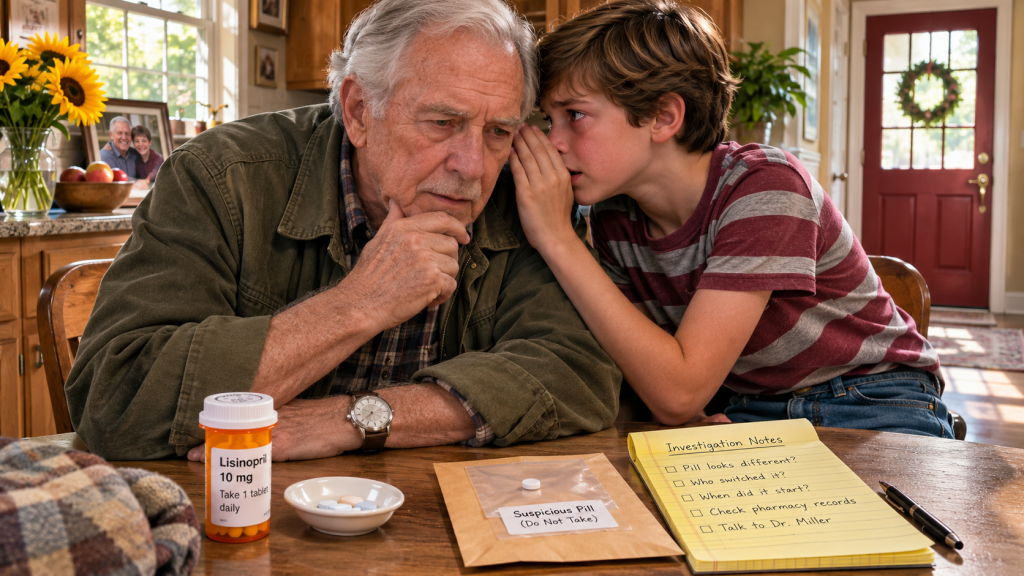
Noah lowered his eyes. Then gave one tap on the table. Yes. I sat down slowly. For several seconds, I couldn’t speak. My home was the house Marilyn and I had bought thirty-one years earlier. We’d raised Derek there. Planted a maple tree in the backyard. Replaced the kitchen cabinets ourselves. And spent countless evenings sitting on the porch while the neighborhood children rode bicycles beneath the streetlights.
Marilyn had died in that house.
Her favorite blue sweater still hung inside our bedroom closet.
I wasn’t ready to leave.
More importantly, I hadn’t agreed to leave.
I looked toward Noah.
“Did they say why?”
He hesitated.
Then whispered, “Mom said you forget things.”
My chest tightened.
I thought about the medical notes.
Family reports increased confusion.
Family concerned about missed medication.
And the cognitive assessment I’d never been told had been canceled.
I took a breath.
“Sometimes I do forget things, buddy.”
He looked up.
“Everybody does.”
For the first time that morning, he smiled.
A small smile.
But enough to make my eyes burn.
I didn’t call Derek.
I didn’t confront Melissa.
And I didn’t accuse anyone of anything.
Instead, I opened my notebook.
At the top of a fresh page, I wrote:
Things I know.
Then I listed the facts.
An unfamiliar tablet had been placed among my medication.
My current pharmacy list didn’t include it.
My physician had documented that family members reported increasing confusion.
A recommended assessment had not been completed.
And an assisted-living tour appeared on my calendar without my knowledge.
Beneath those observations, I wrote another heading.
Things I do not know.
Why Melissa had added the tablet.
Whether anyone had deliberately misrepresented my condition.
Who scheduled the tour.
And whether Derek understood what was happening.
I stared at the page.
For years, I had taught younger inspectors that suspicion wasn’t evidence.
You could notice a crack in a wall.
But you still had to determine whether the foundation was shifting.
I intended to follow my own advice.
That afternoon, I called Oakridge Senior Living.
A cheerful woman answered.
“Thank you for calling Oakridge. How can I help you?”
“My name is Kenneth Walker.”
I paused.
“I believe someone scheduled a tour for me this Friday.”
She asked me to hold.
When she returned, her voice had changed.
“Mr. Walker, I do see an appointment connected to your family.”
My stomach tightened.
“Who scheduled it?”
She hesitated.
“Your daughter-in-law contacted us.”
I closed my eyes.
“Did I authorize that?”
There was a pause.
“Not according to the information I can see.”
I swallowed.
“Has anyone applied for me to live there?”
She became careful.
“I can’t discuss all application details over the phone without verifying certain information.”
“I understand.”
Then I asked, “Can I visit independently and discuss the process?”
“Of course.”
I thanked her.
Before hanging up, she added something I wrote down immediately.
“Mr. Walker, your family indicated that you might need a higher level of supervision.”
I stared at the wall.
Higher supervision.
Another phrase someone had chosen for me.
The following morning, Noah and I visited Oakridge.
I told him we were going to look at a building.
He seemed relieved when I explained that nobody was moving that day.
We walked through a bright lobby filled with potted plants and comfortable chairs.
A piano stood beside a window.
An older gentleman was reading a newspaper.
Two women were discussing a crossword puzzle.
It looked pleasant.
And that troubled me in a different way.
There was nothing wrong with a person choosing to live somewhere like this.
Some people needed assistance.
Others wanted companionship.
But choice mattered.
I wasn’t frightened of assisted living.
I was frightened of being pushed into it without being heard.
A director named Helen Price greeted us.
“Mr. Walker?”
I shook her hand.
“Yes.”
She smiled.
“Your daughter-in-law mentioned you were experiencing some memory difficulties.”
I nodded.
“That’s what I came to discuss.”
We sat in her office.
Noah occupied himself with a coloring book.
I explained that I had recently visited my doctor and was arranging a proper assessment.
I also explained that I had not asked my family to arrange housing.
Helen listened carefully.
Then said, “Mr. Walker, we would need to evaluate whether our services were appropriate, and any admission would involve consent or the relevant lawful authority.”
I nodded.
“I understand.”
She looked thoughtful.
“Your family had asked about availability and costs.”
My stomach tightened.
“Costs?”
“Yes.”
“Did they discuss how it would be paid for?”
Helen hesitated.
Then answered cautiously.
“They indicated that your current property might eventually be sold.”
For several seconds, I couldn’t speak.
My house.
Marilyn’s house.
The place where our grandson had learned to ride his first bicycle.
I looked toward Noah.
He was coloring a tree bright green.
Then I turned back to Helen.
“Thank you for telling me.”
On the drive home, Noah stared out the window.
After a while, he whispered, “Grandpa?”
I almost swerved.
Not because he’d spoken.
But because he was beginning to speak without being asked.
“Yes, buddy?”
“Are you going away?”
My throat tightened.
“No.”
He looked toward me.
“Promise?”
I pulled into a quiet parking lot.
Then turned toward him.
“Noah, I can’t promise that life will never change.”
His eyes filled.
“But I can promise nobody gets to decide I’m leaving my home just because they want me to.”
He nodded slowly.
Then whispered, “Good.”
I reached across the console and squeezed his hand.
When we returned home, there was a message from the pharmacy.
The pharmacist had completed the identification review of the tablet I’d submitted.
She asked me to call.
My hands trembled as I dialed.
“Mr. Walker,” she said, “we identified the tablet by its markings and confirmed the result against our references.”
I sat down.
“What is it?”
She told me the medication’s name.
It was the same short-term sleep medication Dr. Carter had discontinued months earlier.
For several seconds, I couldn’t breathe.
“Are you certain?”
She explained that the tablet’s appearance and markings matched the product and strength in the records they reviewed.
She also confirmed that my pharmacy had not filled a current prescription for it.
I swallowed.
“Could there be another explanation for how it ended up in my pill organizer?”
“Possibly,” she said. “I can’t tell you who placed it there or why.”
I thanked her.
Then called Dr. Carter.
Dr. Carter listened carefully.
Her tone remained calm.
“Ken, the important thing is that you didn’t take an unidentified medication.”
I nodded.
“Could it have caused the confusion everyone keeps reporting?”
She paused.
“You previously experienced grogginess and cognitive side effects while taking it. If you were taking it again, that could be relevant.”
My stomach tightened.
“But it wouldn’t prove someone intended to harm me.”
“Correct.”
I appreciated her honesty.
Then she added, “We should review your medication use, document the concern, and complete the independent assessment that was recommended.”
I agreed.
She also advised me to keep my medications secured and to seek medical help promptly if I developed unexpected symptoms.
When I hung up, I stared at Marilyn’s photograph above the fireplace.
For two years, I’d been trying to adjust to life without her.
Now I was wondering whether some of the moments when I’d felt least like myself had a medical explanation I hadn’t known about.
That evening, Derek called.
“Dad, how’s everything?”
I glanced toward Noah.
He was building another bridge.
“Fine.”
“Taking your medicine?”
I took a breath.
“I’m following the medication plan Dr. Carter and I reviewed.”
There was silence.
Then Derek asked, “Why did you talk to Dr. Carter?”
I frowned.
“Because she’s my doctor.”
He sighed.
“Dad, Melissa has been handling all that.”
“I know.”
Another pause.
Then he said, “She’s trying to help.”
I looked toward the kitchen calendar.
“Derek, why is there an assisted-living tour scheduled for Friday?”
The line went silent.
I waited.
Then he said, “Who told you about that?”
I felt a cold ache in my chest.
Not What tour?
Not There must be a mistake.
Just:
Who told you?
“I saw it on my calendar.”
Derek sighed.
“Dad, it’s only a tour.”
“Then why wasn’t I invited to discuss it?”
He hesitated.
“We didn’t want to upset you.”
I closed my eyes.
“Derek, I’m more upset about finding out everyone has been making plans without me.”
His voice sharpened.
“Dad, you’ve been forgetting things.”
I nodded.
“Sometimes.”
“You missed lunch with Frank twice.”
“Once. The second time Frank was sick.”
Derek was quiet.
I continued.
“And I’ve agreed to an assessment.”
There was another pause.
Then he said something that made my heart sink.
“Melissa thinks you need more supervision.”
I swallowed.
“And what do you think?”
He didn’t answer.
For several seconds, I listened to my son’s breathing.
Then I asked quietly, “Derek, have you noticed me becoming confused yourself?”
He hesitated.
“Melissa tells me things.”
My chest tightened.
“What things?”
“Leaving appliances on.”
I frowned.
“I haven’t done that.”
“She said you left the stove on overnight.”
I sat perfectly still.
“Derek, when?”
He hesitated.
“A few weeks ago.”
I looked toward Noah.
The little boy had stopped moving his blocks.
His eyes were fixed on me.
I took a breath.
“Derek, I have an automatic stove shutoff system.”
There was silence.
“I had it installed after Marilyn died.”
My son didn’t answer.
“And you know that, because you helped me choose it.”
Finally, he whispered, “I forgot.”
I closed my eyes.
The irony hurt.
He’d forgotten a basic fact about my home while discussing whether I could safely live in it.
After the call, Noah approached me.
He carried his drawing notebook.
He opened it to a blank page.
Then drew a stove.
A small stick figure stood beside it.
Melissa.
Another figure sat in a chair.
Me.
Noah pointed toward the stove.
Then looked at me.
I waited.
Finally, he whispered, “Mom turned it on.”
My stomach tightened.
“When?”
He swallowed.
“The night Dad said you forgot.”
For several seconds, I couldn’t speak.
I didn’t want to turn an eight-year-old’s memory into an accusation.
But I couldn’t ignore it either.
I asked gently, “Did you see her turn it on?”
One tap.
Yes.
“Did you see me there?”
Two taps.
No.
I nodded.
“Thank you for telling me.”
Then I closed the notebook.
I wouldn’t press him further.
He had already carried far too much.
The next morning, I called Dr. Carter.
I explained what Noah had told me.
She listened carefully.
Then suggested that I speak with an appropriate child mental-health professional about Noah’s recent return to speech and the distress he seemed to be experiencing.
She also encouraged me to document the concerns without repeatedly questioning him.
I understood.
Noah wasn’t a witness I needed to interrogate.
He was my grandson.
A child who deserved to feel safe.
That afternoon, I contacted a child therapist recommended by his pediatrician’s office.
I explained only what I knew.
The long period of silence.
The sudden return of his voice.
And the troubling things he’d voluntarily told me.
The therapist arranged an initial consultation and explained that parental consent or another appropriate authorization would need to be addressed.
I thanked her.
Then sat at my kitchen table for a long time.
I had been so frightened of what Melissa might be doing to me that I almost overlooked the more important question.
What had Noah been living with?
That evening, while we ate grilled cheese sandwiches, I asked him something simple.
“Buddy, when did talking start feeling hard?”
Noah looked down.
I waited.
He took a small bite.
Then whispered, “After Grandma died.”
My throat tightened.
“I know you missed her.”
He nodded.
For a while, we ate quietly.
Then he looked toward Marilyn’s photograph.
“She listened.”
I smiled sadly.
“Yes, she did.”
Noah’s eyes filled.
“Even when people were mad.”
My stomach tightened.
I kept my voice gentle.
“Did people get mad when you tried to talk?”
He looked toward the hallway.
Then gave one tap.
Yes.
I swallowed.
“Was that frightening?”
He nodded.
I reached across the table.
“You don’t have to tell me everything today.”
His eyes filled.
“I know.”
I squeezed his hand.
“And you never have to earn my love by speaking.”
For the first time, he leaned across the table and hugged me without hesitation.
The following day, I met with an attorney named Evelyn Hart.
She specialized in elder law and estate planning.
I brought my medical records, the pharmacy documentation, my notebook, and the information about Oakridge.
Evelyn listened carefully.
Then asked whether Derek or Melissa held any legal authority over my finances.
“No.”
“Power of attorney?”
“No.”
“Access to your banking?”
“Not directly.”
She nodded.
“What about the house?”
I looked toward her.
“My name is on the deed.”
“Anyone else’s?”
“No.”
She smiled slightly.
“Then you have important protections. But we should review your records and make sure nothing has been submitted without your knowledge.”
I swallowed.
“Can my son force me into assisted living?”
“Not simply because he thinks it’s a good idea,” she said.
She explained that the relevant legal procedures and evidence mattered, and that an allegation of confusion did not automatically remove my rights.
I breathed easier.
Then Evelyn asked an unexpected question.
“Ken, have you recently changed your will?”
I frowned.
“No.”
“Any trusts?”
“No.”
“Beneficiary designations?”
I shook my head.
“Not that I know of.”
She looked thoughtful.
“Has anyone asked about your assets?”
I remembered Melissa’s questions after Marilyn died.
The value of the house.
My retirement savings.
Whether I planned to leave the property to Derek.
At the time, I’d considered them ordinary family conversations.
Now I wasn’t sure.
I took a breath.
“My house is paid off.”
Evelyn nodded.
“And?”
“I have a retirement account and some savings.”
She asked whether I’d mind sharing approximate values.
I told her.
Then watched her expression change slightly.
“Ken, we should conduct a thorough review.”
My stomach tightened.
“Why?”
“Because the housing discussions appear to involve your property, not just your care.”
Two days later, Evelyn discovered something important.
A real-estate agent had contacted the county office seeking general property information about my house.
That alone wasn’t unusual.
Property records were public.
But when we followed up, the agent told us Melissa had asked for a preliminary valuation.
I stared at Evelyn.
“A valuation?”
She nodded.
“She apparently said the family was considering selling the home after you moved.”
My chest tightened.
I looked down at my hands.
Thirty-one years.
The maple tree.
The porch.
Marilyn’s garden.
All reduced to a number someone else wanted to calculate.
I swallowed.
“How much?”
Evelyn checked the notes.
“The preliminary estimate was around six hundred and forty thousand dollars.”
I stared at the wall.
For years, I’d thought of the house as a place to live.
Apparently someone else had begun thinking of it as an asset to liquidate.
That Friday, the day of the supposed tour, I didn’t go to Oakridge.
Instead, I attended the independent cognitive assessment my physician had arranged.
I answered questions.
Completed memory exercises.
Discussed my medications.
And explained the difficulties I’d been experiencing since Marilyn’s death.
The clinician was thorough.
Patient.
And careful.
When the appointment ended, she told me the full interpretation would follow after review.
I appreciated that.
No dramatic declarations.
No instant conclusions.
Just a proper evaluation.
As I left, I thought about how different that felt from having people discuss my memory without including me.
I wasn’t afraid of an honest medical finding.
I was afraid of decisions based on stories nobody had checked.
That afternoon, Derek called again.
His voice sounded strained.
“Dad, why didn’t you go to the tour?”
I sat on the porch.
“Because I didn’t schedule it.”
He sighed.
“You’re making this harder than it needs to be.”
I looked toward the yard.
“Harder for whom?”
There was a pause.
Then he said, “Melissa spent weeks arranging things.”
I closed my eyes.
“Derek, arranging what?”
He hesitated.
“Your care.”
I swallowed.
“And the sale of my house?”
Silence.
Then he whispered, “Who told you about that?”
I stared toward the maple tree.
For the second time that week, my son had answered a serious question by asking who had revealed the information.
It hurt more than anger would have.
“Derek,” I said quietly, “I’m your father.”
He didn’t answer.
“I taught you to ride a bicycle in this driveway.”
My voice trembled.
“I helped you with homework at this kitchen table.”
I swallowed.
“And when you got married, I welcomed Melissa into our family.”
There was a long silence.
Then I asked:
“When did you decide I wasn’t supposed to know what was happening to my own life?”
Derek’s breathing changed.
Finally, he whispered, “Dad, it’s complicated.”
I shook my head.
“Then explain it.”
He didn’t.
Instead, he said, “We’ll talk when we get home.”
Then the call ended.
That night, Noah asked whether we could watch an old video of Marilyn.
I found one on my laptop.
It showed her standing beside the kitchen counter, teaching him how to make blueberry muffins.
He was five.
His cheeks were covered in flour.
Marilyn laughed every time he dropped a blueberry on the floor.
Noah watched quietly.
Then whispered, “I miss her.”
My throat tightened.
“Me too.”
He leaned against my shoulder.
For a long time, we watched.
Then he said something that made me pause.
“Grandma told Mom not to yell.”
I looked down.
“When?”
He kept watching the screen.
“Before she got sick.”
I swallowed.
“What happened?”
Noah was quiet.
Then whispered, “Mom got mad because I told Grandma something.”
My heart tightened.
“What did you tell Grandma?”
He looked toward me.
For a moment, his lips trembled.
Then he whispered:
“That Mom was taking things from your office.”
I sat perfectly still.
Noah looked frightened.
I kept my voice steady.
“What things?”
He shook his head.
Too much.
Too fast.
I nodded.
“It’s okay.”
He leaned against me.
We continued watching the video.
I didn’t ask another question.
But after Noah went to bed, I opened the door to my office.
It was a small room beside the garage.
The same room where I’d kept inspection reports, retirement statements, insurance documents, and old family photographs.
For years, Melissa had helped me organize paperwork there.
She’d insisted it would make things easier after Marilyn died.
I stood in the doorway.
Then looked toward the filing cabinet.
One drawer was slightly open.
I pulled it out.
Inside were folders labeled by year.
Property taxes.
Insurance.
Retirement.
Bank statements.
But the folder containing my original estate documents was missing.
My stomach tightened.
I searched carefully.
Nothing.
Then I noticed something else.
A fresh folder labeled:
WALKER FAMILY PROPERTY PLAN.
I had never created it.
Inside were photocopies of my house deed.
A preliminary property valuation.
Information about Oakridge Senior Living.
And several pages outlining a possible sale of the house.
My hands began trembling.
Then I reached the final document.
It was a draft agreement.
At the top were the words:
AUTHORIZATION TO ACT ON BEHALF OF KENNETH WALKER.
I stared at the page.
The proposed agent was my son.
Derek Walker.
The document included authority over certain financial and property matters if properly executed.
But it wasn’t signed.
I let out a breath.
Then I turned the page.
And found something that made my heart pound.
A typed letter addressed to an attorney I’d never met.
It described me as increasingly confused.
Unable to manage medications.
Frequently leaving appliances on.
And at risk of making poor financial decisions.
At the bottom were two names.
Derek Walker.
Melissa Walker.
I stared at the letter.
Then noticed the date.
It was written three weeks before their vacation.
I sat down slowly.
For months, I’d believed Melissa was simply helping with my medication.
Derek had insisted he was worried about me.
And I’d been grateful they cared enough to check in.
Now I had to consider a much more troubling possibility.
Someone had been building a record of my supposed decline while quietly arranging a future in which I would no longer control my home.
I didn’t yet know whether every claim was deliberately false.
I didn’t know what Derek truly believed.
And I didn’t know whether Melissa had acted out of fear, ambition, or something else entirely.
But I knew the plan had advanced much further than anyone had admitted.
The following morning, Evelyn reviewed the documents I’d found.
She studied them carefully.
Then asked one question.
“Ken, do you recognize the attorney named on this letter?”
I shook my head.
“No.”
She nodded.
“I’ll see whether this was actually sent and what, if anything, was done with it.”
I swallowed.
Then she turned to the last page.
Her expression changed.
“Ken, did you know there’s another document in this folder?”
I frowned.
“What?”
She held up a single sheet.
It was a photocopy of a form from my retirement account.
The document appeared to request a change in beneficiary information.
I stared at the name listed.
Derek Walker.
My son.
I swallowed.
“He’s already one of my beneficiaries.”
Evelyn nodded.
“But this form appears to request something more specific.”
My stomach tightened.
“What?”
She pointed toward a section near the bottom.
It concerned the removal of a contingent beneficiary.
I stared at the page.
The original name had been crossed out.
And replaced with another.
Melissa Walker.
For several seconds, I couldn’t speak.
Then I noticed the date.
It was from six months earlier.
And beneath it was a signature that looked disturbingly familiar.
Mine.
But I had no memory of signing it.
I looked toward Evelyn.
“Could this be a forgery?”
She answered carefully.
“We cannot conclude that from a photocopy. We need to obtain the original records and verify whether any changes were processed.”
I nodded.
My hands were shaking.
Then Evelyn pointed to another detail.
“There’s something else.”
I looked closer.
Beside the signature was a handwritten notation.
Witnessed by family representative.
The name underneath was partially obscured by a copy mark.
Evelyn adjusted the page.
Then read it aloud.
“Marilyn Walker.”
My heart stopped.
Marilyn.
My wife.
The woman who had died two years earlier.
The woman who had never been able to witness a document dated six months ago.
I stared at the paper.
For several seconds, I couldn’t breathe.
Then I whispered:
“Evelyn, my wife has been dead for two years.”
She looked toward me.
Her expression became grave.
“I know.”
I swallowed.
“Then how could her name be on this?”
Evelyn carefully placed the document inside a folder.
“Ken, this is something we need to investigate immediately.”
I stared toward the window.
Then my phone began ringing.
It was Derek.
I answered.
“Dad?”
His voice sounded frightened.
I closed my eyes.
“Yes?”
He swallowed.
“Melissa just told me something.”
My heart pounded.
“What?”
For several seconds, he couldn’t speak.
Then he whispered:
“Dad, I don’t think we can come home.”
I sat perfectly still.
“Why?”
He was breathing quickly.
Then came the words that made my blood run cold.
“Because Melissa says the police are looking for her.”