➡️ PART 3 ➡️
I didn’t shout at Leah.
I wanted to.
Goodness knows I wanted to.
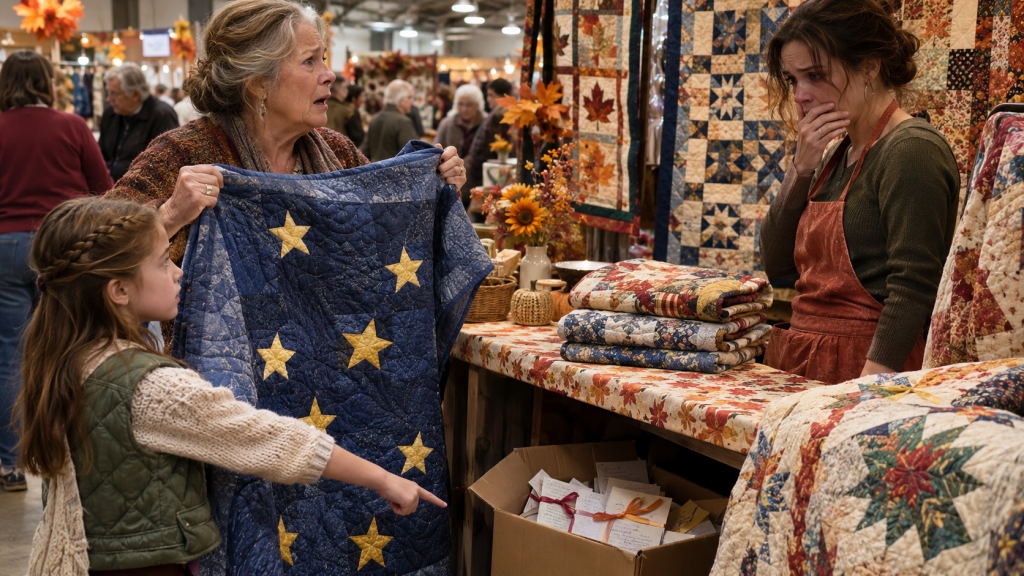
But there were children walking past the booth, people shopping for Christmas presents, and my grandchildren waiting for apple cider.
I wasn’t going to turn the county craft fair into a public argument.
Instead, I told her to close the shop’s sales for the afternoon and take down the photograph of me.
She looked frightened.
“Margaret, I can’t just shut everything down.”
“Then take the quilts off display. We’ll discuss the rest at home.”
She looked toward the woman helping her.
The woman was standing behind the counter, staring at both of us.
“Leah,” I said quietly, “those are my quilts.”
Finally, she nodded.
I asked Dolores to stay with Tessa and Caleb until Ben could collect them.
Then I drove home.
I barely remember the trip.
My hands kept tightening around the steering wheel.
At every traffic light, I thought about another quilt.
The red one with the little cream squares.
The green one I’d sewn during a week when my arthritis was so bad I could barely hold a spoon.
The children’s quilt with elephants and tiny blue clouds.
I remembered writing notes for strangers I’d never meet.
I remembered Tessa asking whether the children who received our blankets would sleep better.
I’d told her I hoped they would.
Now I wondered how many people had received them simply because they could afford to pay.
I parked in my driveway and went straight to my sewing room.
There were three finished quilts stacked beside the machine.
Leah was supposed to collect them the following Tuesday.
I looked at them for a long time.
Then I sat down and cried.
Not because somebody had made money.
If Leah had asked me whether we could sell a few quilts to help her family, I would’ve listened.
I might even have agreed to make some specifically for that purpose.
But she’d told me they were going to people who had lost their homes.
She’d let me spend my retirement savings on fabric.
She’d let my granddaughter believe she was helping frightened children.
And when I asked whether the families appreciated them, she’d invented stories to keep me sewing.
That was what I couldn’t understand.
How she’d sat across from me at Sunday dinner, smiling, knowing what she was doing.
My phone rang shortly after five.
It was Ben.
“Mom, what’s going on?”
I closed my eyes.
“Have you talked to Leah?”
“She called me crying. Said you found her booth and got upset about the quilts.”
I took a slow breath.
“Ben, did you know those quilts were supposed to be donations?”
There was silence.
“What?”
“I made fifty-two quilts for families who lost their homes. Your wife delivered nine. She’s been selling the rest.”
He didn’t speak.
“She has an online business using my picture and the work I’ve been giving her.”
“Mom, I thought she was buying quilts from local makers.”
“She told me she was taking them to a relief organization.”
He swore softly.
Then he apologized.
“I’m coming over.”
Twenty minutes later, Ben walked through my front door looking exhausted.
He’d lost weight since being laid off.
His beard was longer than usual.
He looked older than thirty-nine.
He sat at my kitchen table while I showed him the photographs I’d taken at the fair.
The price tags.
The online listings.
The picture of me on Leah’s website.
He stared at the screen.
“That’s the picture I took at Christmas.”
I nodded.
“She used it without asking.”
He rubbed his face.
“Mom, she told me the women making these were paid for their work.”
“Well, this one wasn’t.”
His eyes filled.
“I didn’t know.”
I believed him.
But I was angry with him too.
“Ben, you know how much sewing I do.”
He looked down.
“Yes.”
“Didn’t you ever wonder where all those quilts were going?”
He hesitated.
“Leah said you were helping with a community relief program. I thought that was separate from the shop.”
That made sense.
Not enough to make me feel better.
But enough that I understood how she’d kept the two stories apart.
Leah had described the same quilts differently depending on whom she was talking to.
To me, they were donations.
To Ben, they were products purchased from other makers.
To customers, they were handmade quilts helping people recover from house fires.
And to Leah, they were money.
Ben looked at the three quilts beside my sewing machine.
“Mom, I’m so sorry.”
I wiped my eyes.
“Did she tell you how much she’s made?”
He shook his head.
“I knew the shop brought in some extra money. I didn’t know the details.”
I sighed.
“Then you need to find out.”
That evening, after the children were asleep, Ben and Leah went through her business records.
He called me the following morning.
I didn’t answer immediately.
Part of me wanted to leave the phone ringing.
But eventually I picked up.
“Mom?”
“Yes.”
“She sold thirty-five quilts.”
“I know.”
“Gross sales were a little over nine thousand dollars.”
I sat down.
Nine thousand dollars.
More money than I’d spent on sewing supplies in several years.
Ben continued.
“After shipping costs, online fees, booth expenses, and other business costs, the amount left was much less.”
I listened.
“She used most of it toward our bills.”
I looked toward the sewing room.
“Did she keep records of what she spent?”
“Yes. We’re putting everything together.”
He hesitated.
“Mom, this started before I lost my job.”
“I know.”
He sounded ashamed.
“We had credit card problems. Then the minivan needed repairs. Leah sold a quilt, and I guess she realized people would buy more.”
I closed my eyes.
There wasn’t one terrible emergency that explained everything.
There had been a first lie.
Then another.
Then enough sales that telling the truth became uncomfortable.
And when Ben lost his job, the money became something she was afraid to give up.
I asked whether she’d ever donated proceeds from the sales to the relief program.
Ben was quiet.
“Not that I can find.”
I felt my heart sink.
“She told customers their purchases were supporting families who lost their homes.”
“I know.”
He took a breath.
“We need to correct that.”
I agreed.
Then I asked him something that had been bothering me since the fair.
“Ben, are the nine quilts she said she donated real?”
He sounded confused.
“What do you mean?”
“Did nine quilts actually reach families? Or was that another story?”
He was quiet.
“I don’t know.”
That was when I realized I couldn’t simply accept Leah’s explanation about the first nine.
Not anymore.
I needed to speak to the relief organization myself.
Two days later, I called the volunteer coordinator.
Her name was Mrs. Parker.
Leah had mentioned her several times.
I explained who I was and asked whether she’d received handmade quilts from my daughter-in-law.
Mrs. Parker remembered.
“Oh, yes. The beautiful ones with handwritten notes. We received several when the program first started working with Leah.”
My heart lifted a little.
“Do you remember how many?”
She checked her records.
“Nine.”
I closed my eyes.
For the first time in days, I felt some relief.
At least nine families had received the quilts as intended.
I asked whether the organization had any agreement with Leah’s business or received money from online sales.
Mrs. Parker sounded surprised.
“What business?”
I told her about the website.
There was a long silence.
Then she said, “Margaret, we haven’t received any donations connected with an online shop.”
I thanked her.
Before hanging up, she told me something that made me cry.
“Those first quilts meant a great deal to the families. One woman asked us to tell the maker she slept under hers the first night after moving into temporary housing.”
I put my hand over my mouth.
So at least one of Leah’s early stories had been true.
That made the rest of it hurt even more.
I could’ve spent two years doing something that genuinely helped people.
Instead, the project had quietly become somebody else’s business.
That afternoon, Leah came to my house.
Alone.
She looked terrible.
Her eyes were red, and she wasn’t wearing makeup.
She sat at my kitchen table, staring at her hands.
“I know you’re angry,” she whispered.
“I am.”
“I didn’t mean for it to go this far.”
I waited.
She began telling me how the first sale happened.
A woman had seen a photograph of one of my quilts and asked whether she could buy something similar.
Leah accepted the order.
She told herself she’d make a donation later.
Then another customer asked.
And another.
Soon she had more orders than quilts.
That’s when she started asking me whether I could make certain colors.
I remembered those requests.
Blue.
Cream.
Soft gray.
She’d told me families who’d lost their homes liked neutral colors because they went with whatever furniture people were able to replace.
I felt sick remembering how carefully I’d chosen the fabrics.
“Leah,” I said, “you didn’t just forget to tell me something.”
She looked up.
“You lied to me every month.”
Tears rolled down her cheeks.
“I know.”
“And you involved Tessa.”
She covered her face.
“She loved writing those cards.”
“I know she did.”
I pointed toward the sewing room.
“You let your own daughter believe she was making something for children who’d lost their homes. Then you removed her notes and sold the quilts.”
Leah started crying harder.
“I couldn’t throw the cards away.”
I looked at her.
“Why?”
She wiped her face.
“Because every time I read one, I felt awful.”
I didn’t know what to say.
After a while, she looked toward the hallway.
“Do you hate me?”
I thought about that.
I remembered her bringing me soup after Paul died.
I remembered how frightened she’d been when Caleb was born early.
I remembered the afternoon we’d sat together assembling Tessa’s first bicycle.
Those memories were real.
So was what she’d done.
“No,” I said. “But I don’t trust you.”
She nodded.
Then she whispered, “I don’t know how to fix this.”
I took a slow breath.
“Neither do I. But the first thing you need to do is stop hiding it.”
She looked up.
“From who?”
“From the people who bought the quilts. From the relief organization. From anyone you’ve told that this business was helping families after house fires.”
Her face went pale.
“That could ruin the shop.”
I stared at her.
“Leah, the shop was built on something that wasn’t true.”
She began crying again.
I wanted to comfort her.
Part of me still saw her as the young woman who’d married my son and brought two beautiful grandchildren into our family.
But I wasn’t going to make the truth disappear simply because hearing it hurt.
Then she asked whether I’d consider continuing to make quilts if she paid me properly.
I looked at her for a long moment.
And I realized she still didn’t understand what she’d taken from me.
It wasn’t just money.
It wasn’t just fabric.
It was the feeling I’d had every evening when I sat at that sewing machine, believing I was making something kind for somebody who needed it.
I told her I couldn’t answer that question.
Not now.
Not while I was still looking at the box of undelivered letters she’d brought back from the fair.
And not while I was wondering how I could ever explain to Tessa why those letters hadn’t reached the people we’d written them for.