➡️ PART 3 ➡️
For forty minutes, I had watched my seventy-one-year-old mother stand beneath the August sun while a deputy treated her like someone who didn’t deserve basic respect. I had been angry. Frightened. And ashamed of how powerless I felt. But standing beside County Road 6, watching Sheriff Daniel Mercer question his own deputy, I began to understand something that would change the way I saw my mother forever.
The woman I’d spent my life describing as a courthouse telephone operator had spent thirty-four years becoming someone the entire county trusted. And she had never once thought that made her more important than anybody else. The deputy stood beside his patrol truck, gripping his citation book. His nameplate read COLTON REESE.
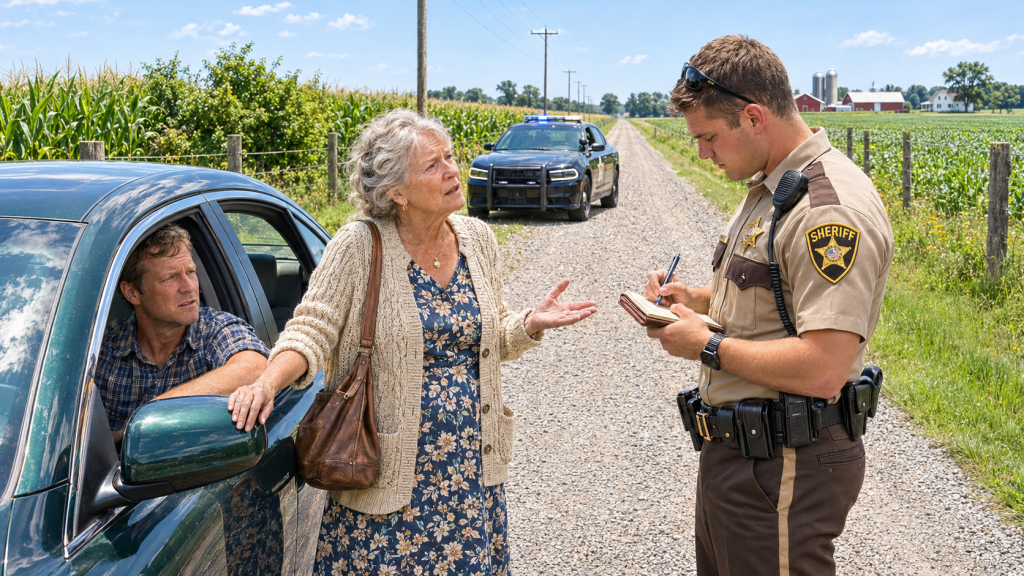
He couldn’t have been older than thirty. The sheriff looked directly at him. “Deputy Reese, dispatch has no record of this traffic stop.” Reese swallowed. “I was handling it.” Mercer’s expression hardened. “That wasn’t my question.” The August wind moved through the cornfields. Somewhere in the distance, a tractor rumbled.
My mother stood quietly beside me, her floral dress moving slightly in the breeze. She looked exhausted. But she was still listening. The sheriff repeated his question. “Why didn’t you notify dispatch?” Reese glanced toward my mother. Then toward me. “I didn’t think it was necessary.”
Sheriff Mercer stared at him.
“You detained an elderly driver beside an exposed highway for forty minutes, and you didn’t think notifying dispatch was necessary?”
Reese said nothing.
Then my mother spoke.
“Daniel, before we discuss anything else, may I please sit down?”
The sheriff’s expression changed immediately.
“Of course, Margaret.”
And for the first time that afternoon, someone opened a car door for my mother instead of ordering her where to stand.
I helped Mom into the sheriff’s air-conditioned vehicle.
Her cheeks were flushed.
Her hands trembled slightly.
I took a bottle of water from the emergency supply in the back seat and handed it to her.
“Mom, please drink.”
She smiled weakly.
“Don’t fuss, Jeffrey.”
I stared at her.
“Mom, you were standing in ninety-one-degree heat for forty minutes.”
She took a sip.
“I know, honey.”
My throat tightened.
“Why didn’t you tell him who you were?”
She looked toward the windshield.
For several seconds, she said nothing.
Then she whispered, “Because it shouldn’t have mattered.”
I swallowed.
She continued.
“If I had to tell him my name to receive ordinary courtesy, what happens to the people whose names he doesn’t recognize?”
I looked down.
That was my mother.
Even while exhausted and humiliated, she was thinking about the next person who might be treated the same way.
Sheriff Mercer approached the open door.
“Margaret, I’ve requested medical assistance.”
Mom shook her head gently.
“Daniel, I’m alright.”
He crouched beside the vehicle.
“You’re overheated. I’d rather have someone check.”
She sighed.
“Then I suppose you’ll have your way.”
He smiled faintly.
“Just this once.”
I watched them.
The familiarity between them surprised me.
I’d known Mercer since I was a teenager.
He’d been sheriff for almost twelve years.
But I’d never understood why he spoke to my mother as though she were an old teacher.
Then he looked toward me.
“Jeffrey, your mother helped train me when I was a rookie.”
I frowned.
“Train you?”
Mom gave him a warning look.
“Daniel.”
He chuckled softly.
“Margaret, your son deserves to know.”
I looked between them.
“What exactly did Mom do at the courthouse?”
The sheriff’s smile faded into something more serious.
“Your mother helped build the county’s emergency dispatch procedures.”
I stared at him.
“What?”
He nodded.
“She supervised overnight communications for years. Trained dispatchers. Coordinated emergency responses. Helped us modernize our records.”
My chest tightened.
I looked toward Mom.
She was studying the water bottle.
For thirty-four years, she’d told me she answered telephones.
And I’d never asked what those calls meant.
Mercer continued.
“During the flood of 1998, your mother stayed at the communications center for nearly thirty hours.”
I remembered that flood.
The river had overflowed.
Roads disappeared beneath muddy water.
Families evacuated their homes.
I was a teenager then.
Mom told me she was working overtime.
I assumed she was answering calls.
The sheriff looked toward her.
“She coordinated rescue crews when half the roads were underwater.”
Mom waved a hand.
“Daniel, there were plenty of people helping.”
He nodded.
“Yes.”
Then his voice softened.
“But you were the one keeping track of where everybody was.”
I looked toward my mother.
She’d come home after that flood with swollen feet and red eyes.
I remembered complaining because she’d missed my baseball game.
She apologized.
Then washed my uniform.
I swallowed hard.
For the first time, I wondered how many moments of her life I’d misunderstood.
The paramedics arrived shortly afterward.
They checked Mom’s blood pressure and temperature.
Fortunately, she hadn’t suffered a medical emergency.
But they advised her to rest, drink water, and avoid further exposure to the heat.
I stayed beside her.
Meanwhile, Sheriff Mercer moved toward Reese.
I couldn’t hear everything.
But I saw the sheriff hold out his hand.
Reese hesitated.
Then surrendered the citation book.
Mercer examined it.
His expression changed.
He turned several pages.
Then called another officer over.
The two men spoke quietly.
I watched Reese shift his weight.
He looked less confident now.
Less amused.
I remembered the way he’d lifted Mom’s temporary license toward the sunlight.
The mocking little laugh.
The refusal to let her sit.
And the careless way he’d dismissed a document issued by the courthouse.
My chest tightened.
Mom noticed me watching.
“Jeffrey.”
I turned.
“Yes?”
She touched my hand.
“Don’t let anger make you careless.”
I swallowed.
“Mom, he could’ve hurt you.”
She nodded.
“Then we need to make certain it doesn’t happen to somebody else.”
A few minutes later, Mercer returned.
“Margaret, I need to ask what happened from the beginning.”
She nodded.
“Of course.”
He took out a notebook.
Then looked at me.
“Jeffrey, I’d like your account too.”
I told him everything.
The deputy stopping us.
The temporary yellow license.
His remark about the public library.
His order for Mom to stand behind the car.
The forty minutes in the sun.
And the citation he’d begun preparing.
Mercer listened without interrupting.
Then turned toward Mom.
“Is that accurate?”
She nodded.
“Yes.”
He looked down.
“Did he explain why he stopped you?”
Mom considered the question.
“He said I was driving suspiciously slowly.”
I frowned.
“She was doing forty-eight in a fifty-five.”
Mercer made a note.
Mom continued.
“I asked whether I’d violated a traffic law. He didn’t answer directly.”
The sheriff looked thoughtful.
Then asked, “Did he ever tell you that you were free to leave?”
“No.”
Mercer nodded.
“Thank you.”
The second officer approached.
“Sheriff, can I speak with you?”
Mercer stepped aside.
They spoke near the patrol truck.
Then I saw the officer point toward something inside Reese’s citation book.
The sheriff frowned.
He returned to us a moment later.
“Margaret, there’s something I need to verify.”
Mom looked up.
“Go ahead.”
“Did Deputy Reese ask you for money?”
I stared at him.
“Money?”
Mom shook her head.
“No.”
“Did he mention any payment or fee?”
She considered the question.
“He said that if my license wasn’t valid, there could be a substantial penalty.”
Mercer nodded.
“Anything else?”
Mom hesitated.
Then said, “He told me some people prefer to settle problems without making a courthouse visit.”
My stomach tightened.
I looked toward her.
“Mom, you didn’t tell me that.”
She sighed.
“He said it quietly while you were still inside the car.”
Mercer’s expression changed.
“What exactly were his words?”
Mom repeated them carefully.
The sheriff wrote them down.
Then looked toward the other officer.
For the first time, I saw genuine concern in his face.
“Margaret,” Mercer said, “we’re going to preserve the records from this stop and review the deputy’s conduct.”
She nodded.
“That’s appropriate.”
I leaned forward.
“What did you find in his citation book?”
The sheriff paused.
“Jeffrey, I can’t discuss everything while we’re still gathering information.”
I swallowed.
“But there is a concern that requires further investigation.”
I looked toward Reese.
He was standing beside his truck with another officer.
His sunglasses were gone.
He looked frightened.
For a moment, I felt satisfaction.
Then Mom squeezed my hand.
“Remember,” she whispered, “we want the truth.”
The sheriff arranged transportation for us and made sure our car could be safely moved from the roadside.
Mom refused to leave until she knew what would happen to the lemon bars.
I almost laughed.
“Mom, the powdered sugar melted.”
She gave me a look.
“Jeffrey, your Aunt Louise is expecting those.”
I stared at her.
After everything she’d endured, she was worried about dessert.
That was how she’d always been.
A woman who could handle a crisis without forgetting the small promises she’d made.
The sheriff smiled.
“Margaret, I’ll personally make sure the lemon bars reach Louise.”
She nodded.
“Good.”
Then she added, “And Daniel, please don’t make a spectacle of this.”
He sighed.
“I’ll handle it properly.”
She looked directly at him.
“That’s all I ask.”
By the time we reached home, Mom was exhausted.
I helped her inside.
She sat in her favorite chair near the kitchen window.
I brought her another glass of water.
Then stood there, unsure what to say.
Finally, I asked, “Mom, why didn’t you ever tell me about your work?”
She looked surprised.
“I did.”
I frowned.
“You told me you answered telephone calls.”
She smiled gently.
“Well, I did.”
I sat across from her.
“Mom.”
She laughed softly.
“What?”
“You helped coordinate rescues.”
She shrugged.
“That was part of the job.”
“You trained the sheriff.”
“Daniel was a quick learner.”
I shook my head.
For years, I’d thought my mother had a simple job in the basement of the courthouse.
Now I realized she’d spent decades making decisions that could affect whether people lived or died.
And she’d never felt the need to impress anyone with it.
I looked toward her.
“Did you ever get scared?”
She considered the question.
“Sometimes.”
I swallowed.
“When?”
She looked through the window.
“Whenever somebody called and couldn’t tell us where they were.”
Her voice softened.
“You could hear how frightened they were.”
I nodded.
“And what did you do?”
She smiled sadly.
“Listened.”
For a moment, neither spoke.
Then she continued.
“People think emergency work is about speaking loudly and giving orders.”
She shook her head.
“Most of the time, it’s about listening carefully enough to understand what someone needs.”
My throat tightened.
“And today?”
She looked toward me.
“That young man wasn’t listening.”
The following morning, Sheriff Mercer called.
Mom was eating toast.
I answered.
“Jeffrey?”
“Yes, Sheriff.”
“How’s Margaret?”
“Much better.”
“Good.”
He hesitated.
“Could you both come to the station this afternoon? We’d like formal statements.”
My stomach tightened.
“Has something happened?”
“We’ve identified information that needs to be reviewed.”
I looked toward Mom.
She raised an eyebrow.
I swallowed.
“What information?”
Mercer paused.
“Some discrepancies involving Deputy Reese’s traffic enforcement records.”
I felt my chest tighten.
“Discrepancies?”
“Yes.”
Then he added something unexpected.
“Your mother’s stop may not have been an isolated incident.”
At the station, we met with an investigator named Lieutenant Karen Bell.
She was a middle-aged woman with short gray hair and a calm, professional manner.
Mom recognized her immediately.
“Karen?”
The lieutenant smiled.
“Hello, Margaret.”
They embraced.
I watched in surprise.
Another person who knew my mother.
Another person who greeted her with genuine affection.
Karen turned toward me.
“Jeffrey, your mother taught my first dispatch class.”
I smiled faintly.
“Apparently, she taught half the county.”
Mom rolled her eyes.
“Don’t encourage them.”
For a moment, everyone laughed.
Then Karen became serious.
“We need to discuss the stop.”
She explained that the department was reviewing Reese’s actions.
The lack of a dispatch notification.
The prolonged detention.
The circumstances surrounding the proposed citation.
And the comments Mom had reported.
Additional records had raised questions about previous stops.
Several involved older drivers.
Others involved motorists traveling through the county.
I leaned forward.
“Are you saying he did this to other people?”
Karen answered carefully.
“We’re investigating complaints and records that may involve similar concerns.”
Mom’s expression tightened.
“Did anyone report him?”
Karen nodded.
“There have been complaints.”
My stomach sank.
“Then why was he still working?”
Karen looked toward me.
“Some complaints lacked supporting evidence. Others were handled at different levels. We’re reviewing whether they were assessed appropriately.”
I swallowed.
I wanted to demand names.
Dates.
Explanations.
But Mom placed her hand over mine.
“Jeffrey.”
I looked toward her.
She whispered, “Let her finish.”
Karen opened a folder.
“Margaret, we also found several entries in the citation book that don’t match the department’s electronic records.”
Mom nodded slowly.
“What kind of entries?”
“Notes concerning motorists who were stopped but apparently never received formal citations.”
I frowned.
“Like us?”
“Potentially.”
Karen continued.
“Some entries contain amounts written beside names.”
My stomach tightened.
“Amounts?”
She nodded.
“We’re determining what those figures represent.”
I looked toward Mom.
Her face had become serious.
Then she asked, “Have you contacted the people listed?”
Karen nodded.
“We’ve begun the process.”
Mom leaned forward.
“Please make certain they feel safe speaking honestly.”
The lieutenant looked toward her.
“We will.”
Mom nodded.
“Some people won’t report mistreatment because they’re afraid nothing will happen.”
For a moment, Karen didn’t answer.
Then she whispered, “I know.”
That evening, Mom received a telephone call from a woman named Mrs. Agnes Carter.
Agnes was eighty-three.
She lived alone outside town.
Mom knew her from church.
I was sitting at the kitchen table when Mom answered.
“Hello, Agnes.”
A long pause.
Then Mom’s expression changed.
“Oh, honey.”
She listened.
I watched her grip the phone.
Finally, she said, “You did nothing wrong by being frightened.”
My chest tightened.
Mom continued.
“Would you feel comfortable telling someone what happened?”
Another pause.
Then she whispered, “I’ll go with you.”
When she hung up, I looked toward her.
“Mom?”
She sat quietly.
Then said, “Agnes was stopped on County Road 6 last month.”
My stomach tightened.
“By Reese?”
She nodded.
“And?”
Mom’s eyes filled.
“She says he told her there was a problem with her insurance and that she could avoid going to court if she paid a roadside administrative fee.”
I stared at her.
“Did she pay?”
Mom nodded slowly.
“Two hundred dollars.”
For several seconds, I couldn’t speak.
Two hundred dollars.
From an eighty-three-year-old widow living on a fixed income.
I felt anger rise through my chest.
“Mom, that’s terrible.”
She nodded.
“Yes.”
I stood.
“We need to tell the sheriff.”
“We will.”
My voice sharpened.
“He took advantage of her.”
Mom looked toward me.
“Jeffrey.”
I stopped.
She continued.
“Agnes is embarrassed.”
My throat tightened.
“Why?”
“Because she thinks she should’ve known better.”
Mom shook her head.
“That’s what happens when someone in authority makes another person feel small. They begin blaming themselves for trusting that authority.”
I sat down.
For the first time, I understood why Mom had asked Reese to radio her name.
Not because she wanted to frighten him.
But because she wanted someone else to hear what was happening.
The following morning, I drove Mom to Agnes’s house.
It was a small white bungalow surrounded by flower beds.
Agnes opened the door wearing a blue cardigan.
When she saw Mom, she began crying.
Margaret Whitcomb, the woman I’d spent thirty-four years describing as a courthouse telephone operator, stepped forward and wrapped her arms around her friend.
“It’s alright, Agnes.”
The older woman shook her head.
“I feel so foolish.”
Mom held her gently.
“You trusted someone wearing a badge.”
Agnes began crying harder.
“Exactly.”
Mom looked into her eyes.
“And that trust shouldn’t have been used against you.”
I swallowed.
For years, I’d admired people with impressive titles.
Executives.
Politicians.
Business owners.
Now I watched my mother comfort a frightened widow in a modest living room.
And I realized what real authority looked like.
It was the ability to make another person feel safe.
Agnes showed us a small envelope.
Inside was a handwritten receipt.
The amount was two hundred dollars.
The date matched the day she’d been stopped.
I examined it carefully.
There was no official department heading.
Only a signature.
C. Reese.
My stomach tightened.
“Agnes, would you be willing to show this to Lieutenant Bell?”
She nodded nervously.
“If Margaret comes.”
Mom smiled.
“Of course I will.”
Over the following days, investigators interviewed several motorists.
The department preserved relevant records.
And Reese was placed on administrative leave while the allegations were examined.
The sheriff publicly acknowledged that the department was reviewing serious concerns about traffic-stop procedures.
He didn’t announce conclusions before the investigation was complete.
But he promised an independent review.
Mom appreciated that.
“People deserve fairness,” she told me.
“Even when they’re accused of doing something wrong.”
I nodded.
That was my mother’s strength.
She didn’t confuse accountability with humiliation.
Then a local reporter called.
Her name was Emily Foster.
She wanted to interview Mom about the traffic stop.
Mom refused at first.
“I don’t want to be on television.”
I looked toward her.
“Mom, people should hear what happened.”
She shook her head.
“They don’t need to hear about me.”
I swallowed.
“Then what do they need to hear?”
She looked toward the window.
“That every person deserves to be treated with dignity.”
For a long moment, I considered her words.
Then she added, “If Emily wants to talk about better procedures, I’ll speak with her.”
I smiled.
“That sounds like you.”
The interview took place at our kitchen table.
Mom wore the same floral dress she’d worn during the stop.
She insisted on serving lemon bars.
Emily asked about the deputy.
Mom described what happened without exaggerating.
The heat.
The temporary license.
The mocking comment.
The prolonged wait.
Then Emily asked, “Mrs. Whitcomb, why did you ask him to announce your name over the radio?”
Mom folded her hands.
“Because I believed someone in dispatch might recognize me.”
Emily nodded.
“And what did you hope would happen?”
Mom paused.
“I hoped someone would ask whether I was alright.”
My throat tightened.
Then she continued.
“But I’d like the department to make sure that question is asked for everybody.”
The interview spread quickly.
People shared it online.
Former dispatchers wrote messages thanking Mom for training them.
Retired officers recalled nights she’d helped coordinate difficult emergencies.
Families described how her calm voice had guided them through frightening situations.
I sat beside her one evening, reading the messages.
“Mom, listen to this.”
She smiled.
“Jeffrey, you don’t need to read every one.”
I laughed softly.
“Apparently, you saved half the county.”
She shook her head.
“No.”
Her voice softened.
“I helped people who were trying to save one another.”
I looked toward her.
For the first time, I understood why she had never bragged.
She didn’t consider kindness a personal accomplishment.
She considered it a responsibility.
Then Sheriff Mercer called again.
His tone was unusually serious.
“Margaret, Jeffrey, we need to discuss something we’ve found.”
My stomach tightened.
“What?”
He hesitated.
“During the review, investigators obtained additional records connected to Deputy Reese’s previous assignments.”
Mom sat upright.
“Daniel?”
The sheriff continued.
“Some records suggest that complaints involving him may not have been properly documented or escalated.”
I stared at the phone.
“Who handled those complaints?”
Mercer paused.
“That’s what we’re examining.”
Then he added something that made my chest tighten.
“Margaret, there’s a name appearing repeatedly in the review.”
Mom frowned.
“What name?”
The sheriff hesitated.
“Captain Harold Vance.”
I looked toward Mom.
Her expression had changed completely.
For the first time since the roadside stop, she looked genuinely frightened.
“Harold?” she whispered.
Mercer was quiet.
Then said, “You know him?”
Mom closed her eyes.
“Daniel, Harold was my supervisor during my final years at dispatch.”
My stomach tightened.
“Mom?”
She didn’t answer.
Then the sheriff continued.
“We’ve found evidence that some complaints were routed through an older communications review process.”
Mom opened her eyes.
Her face had gone pale.
She whispered, “That process was discontinued years ago.”
Mercer’s voice lowered.
“Apparently, someone continued using it.”
I stared at her.
“What does that mean?”
Mom looked toward the window.
Then whispered something I’d never heard her say before.
“Jeffrey, I think this started long before Deputy Reese stopped us.”
The sheriff continued.
“Margaret, there’s something else.”
She gripped the telephone.
“What?”
“We found a report filed under your name shortly before you retired.”
Mom froze.
I looked toward her.
She whispered, “What report?”
Mercer took a breath.
“A complaint concerning improper handling of traffic-stop records.”
For several seconds, nobody spoke.
Then Mom closed her eyes.
“I remember.”
My stomach tightened.
“Mom, what happened?”
She shook her head slowly.
“I reported irregularities.”
I stared at her.
“And?”
Her voice trembled.
“I was told the matter had been resolved.”
The sheriff remained quiet.
Then he said:
“Margaret, according to the records we’ve recovered, your complaint was never formally investigated.”
I felt my blood run cold.
Mom lowered her head.
For thirty-four years, she’d trusted the systems she helped build.
Now she was discovering that someone might have used those very systems to hide misconduct.
Then Sheriff Mercer said something that made her grip the table.
“And Margaret, your complaint wasn’t the only document we found. There’s another report bearing your signature—but the date is six months after you retired.”
Mom stared at the phone.
Her voice was barely audible.
“Daniel, I never signed that.”


