PART 3 — THE WIFE WHO FINALLY READ EVERYTHING
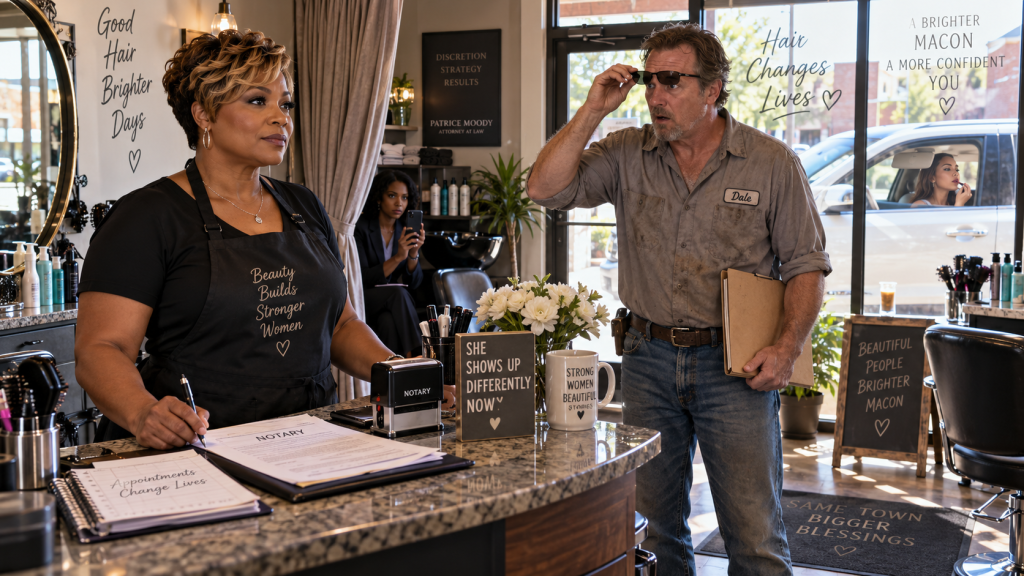
The fraud alert glowed between us.
Did you authorize a $247,000 commercial loan application submitted today in your name?
Dale stared at the screen.
Ashley stared at Dale.
Patrice stared at nobody.
She was already working.
Her phone remained in one hand, recording.
The folder sat open beneath the salon lights.
My forged signature appeared three times on the pages in front of us.
For twenty-six years, my husband had known exactly how to make me doubt myself.
That afternoon, for the first time, I watched him realize doubt was no longer available to him.
“Carol,” he said quietly.
I looked at him.
“Did you do this?”
He swallowed.
“It isn’t what it looks like.”
Behind him, Ashley actually laughed.
Not because anything was funny.
Because some lies are so exhausted they become insulting.
“What exactly does it look like, Dale?” she asked.
He turned.
“Stay out of this.”
Her face changed.
“You brought me here.”
“I said stay out of it.”
“You asked me to find a notary.”
“Ashley.”
“You told me your wife had already agreed.”
I felt something shift inside me when she said those words.
Not sympathy.
Not yet.
Recognition.
Dale had not built one lie.
He had built two separate realities and placed a woman inside each.
In mine, we were struggling.
In hers, he was preparing a glamorous new life.
In mine, I needed to clean dental offices on Saturdays because the roofing business was barely surviving.
In hers, he had a hidden boat account worth four hundred thousand dollars.
In mine, we postponed replacing the leaking back windows because “cash flow was tight.”
In hers, there was a condo.
A Lexus.
A ring.
And apparently a future financed partly by debt he planned to staple to my name.
Patrice reached toward the bank alert.
“Do not answer that from this phone yet.”
Dale looked at her.
“What?”
“She is preserving the message.”
“I’m her husband.”
Patrice smiled without warmth.
“I’m aware.”
Then she looked at me.
“Carol, I want you to take one photograph of the alert.”
I did.
“Now another with the time visible.”
I did.
“Good.”
Dale grabbed his sunglasses from the floor.
“This is ridiculous.”
Patrice stepped between him and the folder.
“No.”
Her voice was quiet.
“What would be ridiculous is trying to leave here with documents containing apparently forged signatures after bringing them to the person whose name appears on them.”
Dale’s face turned red.
“Apparently?”
Patrice raised one eyebrow.
“I like evidence more than adjectives.”
I almost loved her.
Dale looked at me.
Twenty-six years of marriage moved through his face.
The fights.
The vacations.
My father’s funeral.
His mother’s funeral.
The night our roof leaked into the hallway and we slept downstairs surrounded by buckets.
The year he started Mercer Commercial Roofing with one truck and three ladders.
Me answering phones from our kitchen.
Me learning payroll because we could not afford a bookkeeper.
Me bringing sandwiches to job sites.
Me sitting beside him when the first bank rejected his business loan.
All of it.
Then he said:
“Carol, tell her to give me my folder.”
My folder.
That almost did it.
I put both hands on the counter.
“No.”
The word was not loud.
It did not need to be.
Dale blinked.
“Excuse me?”
“No.”
Ashley looked at me.
Patrice did too.
I had said that word to my husband before.
About dinner.
Paint colors.
His cousin sleeping on our sofa.
I had never said it with nothing attached.
No apology.
No explanation.
No effort to make it easier for him.
Just no.
Dale stepped closer.
“You have no idea what you’re doing.”
For years, that sentence had worked on me.
Bank papers.
Tax forms.
Insurance renewals.
Business documents.
Dale handled the “complicated” things.
Carol, sign here.
Carol, initial this.
Carol, don’t worry about it.
You hate numbers.
Let me handle it.
I had believed him.
Not because I was stupid.
Because trust turns repetition into habit.
I looked at the forged signatures.
“You’re right.”
His face relaxed slightly.
Then I finished.
“I had no idea what I was doing for a long time.”
His relief disappeared.
“I do now.”
—
Ashley was the first to move.
She took two steps backward.
Then another.
Dale turned toward her.
“Where are you going?”
“Home.”
“To the condo?”
She stared at him.
“My condo?”
He said nothing.
Her face went white again.
“Oh my God.”
“Ashley.”
“You said it was mine.”
“I said we bought it for us.”
“You said my name would be on it after the divorce.”
“It will.”
She laughed again.
“You mean after you steal your wife’s house?”
Dale’s jaw tightened.
“Stop saying stupid things.”
I watched Ashley flinch.
That tone.
I knew it.
The tone he used when a woman had gotten too close to a truth he preferred to manage.
“You told me she was stupid,” Ashley whispered.
My body went cold.
Dale looked at me.
Ashley covered her mouth.
“I’m sorry.”
I did not know which part she meant.
Maybe all of it.
Patrice spoke.
“Ashley, before you leave, I suggest you preserve every message you have involving Dale, the condo, these documents, business accounts, or any representations about Carol’s property.”
Dale spun toward her.
“Do not tell her what to do.”
Patrice looked at him.
“I wasn’t.”
Then at Ashley.
“I was making a suggestion.”
Ashley’s eyes filled.
“What am I supposed to do?”
“Get your own lawyer.”
Dale scoffed.
“You don’t need a lawyer.”
All three of us looked at him.
His mouth closed.
That was almost satisfying.
Almost.
Ashley picked up her purse.
Then she looked at me.
For months, I had stood behind that chair while she told me about dates with my husband.
Hotel rooms.
Business trips that were not business trips.
The ring.
The boat.
The house he said he would eventually sell after divorcing his “clueless wife.”
I had imagined a hundred confrontations.
In most of them, I hated her.
Standing there now, I did.
And I didn’t.
She knew he was married.
That mattered.
She had helped him betray me.
That mattered too.
But the terror on her face belonged to someone discovering she had not been chosen.
She had been positioned.
“Carol.”
She swallowed.
“I didn’t know this part.”
I looked at her.
“Which part?”
She cried.
“The signatures.”
“The debt.”
“The house.”
I said nothing.
“I knew about you.”
That honesty hurt.
Good.
It should.
“I knew he was married.”
Her voice shook.
“He told me it had been over for years.”
A tear slid down her cheek.
“I chose to believe him.”
There it was.
Not innocence.
Not complete guilt.
Responsibility.
I respected that more than excuses.
Patrice handed Ashley a business card.
“Call someone before you speak to him again.”
Dale laughed bitterly.
“This is unbelievable.”
Ashley stared at him.
“No.”
Then:
“What’s unbelievable is I sat in your wife’s chair every Thursday and told her everything.”
For the first time that afternoon, I almost smiled.
Dale looked at me slowly.
“How long?”
I held his gaze.
“Since the first Thursday.”
His face changed.
Not anger.
Horror.
“You knew?”
“Yes.”
“How much?”
I thought of the back of my appointment book.
Dates.
Amounts.
Hotels.
Boat registration.
Company names.
His plans for the divorce.
Every twenty-dollar tip.
“Enough.”
He lunged toward my station.
Patrice moved immediately.
“Don’t.”
He stopped.
She looked at the salon owner, Marlene, who had been frozen behind the reception desk since Dale entered.
“Marlene, call the police.”
Dale’s face hardened.
“Oh, for God’s sake.”
Marlene already had the phone in her hand.
Dale turned toward me.
“You’re really doing this?”
I stared at him.
That question.
As if I had arranged the affair.
As if I had created forged documents.
As if the commercial loan application belonged to my imagination.
“No, Dale.”
My voice stayed calm.
“You did this.”
—
He left before the police arrived.
Patrice did not stop him.
She told me later that was deliberate.
“We had the documents.”
“We had the recording.”
“We had the alert.”
“And we had his reaction.”
Trying to physically keep him there would have created risk for no benefit.
That afternoon taught me something about power.
Real power is often much quieter than rage.
It knows what it needs.
Then lets the other person walk out carrying only their panic.
Ashley left separately.
Her white Lexus remained in the lot for nearly ten minutes before she finally drove away.
At 4:32, two officers came into the salon.
I gave a statement.
So did Patrice.
Marlene.
Ashley was later contacted separately.
The officers photographed the documents.
Patrice made sure the originals were handled carefully.
The bank’s fraud department called while they were still there.
I told them I had not applied for the loan.
I did not authorize Dale to apply for it.
I did not sign the documents.
I asked them to freeze anything associated with the application.
The woman on the line spoke in the calm voice people use when they know panic is expensive.
She walked me through what needed to happen.
By six o’clock, I had placed fraud alerts and credit freezes.
By seven, Patrice had arranged for a forensic accountant she trusted to meet us Monday.
By eight, my marriage still technically existed.
But almost everything I believed about it did not.
—
I did not go home that night.
Patrice would not let me.
Neither would Marlene.
I stayed with Marlene and her husband, Tony.
Their guest room had sunflower curtains and a mattress too soft for my back.
I lay awake until 3:00 in the morning anyway.
Dale called thirty-two times.
He sent texts.
At first angry.
You had no right to ambush me.
Then threatening.
You’re going to destroy the company over a misunderstanding.
Then pleading.
Carol, please. We can fix this.
Then romantic.
Twenty-six years has to mean something.
That one made me cry.
Because twenty-six years did mean something.
That was the problem.
People think betrayal makes every old memory fake.
It does not.
Some were real.
Dale holding my hand when my father died.
Real.
Dale driving through a thunderstorm because my car broke down on I-75.
Real.
Dancing in our kitchen when we were thirty.
Real.
The affair.
Also real.
The forged signatures.
Real.
The hidden money.
Real.
Humans are terrible because they force us to hold contradictory truths at the same time.
I loved the man I married.
The man I married was also capable of planning to leave me with debt he created while using marital money to finance another woman.
Both.
I cried into Marlene’s spare pillow until the fabric went cold beneath my face.
At 3:17, one final text arrived.
Come home and let me explain before lawyers turn this into something it isn’t.
I stared.
Then replied:
Do not contact me except through Patrice.
He responded immediately.
Carol.
I blocked him.
My hands shook afterward.
Twenty-six years.
One button.
Blocked.
Technology is brutally efficient about things the heart has not caught up to.
—
Monday morning, I learned how much my husband thought I would never find.
The forensic accountant’s name was Leonard Shaw.
He wore suspenders.
Actual suspenders.
I distrusted him for twelve minutes.
Then he found seventy-eight thousand dollars I did not know existed.
I decided suspenders were fine.
We sat around a conference table in Patrice’s office.
Appointment book.
Bank statements.
Tax returns.
Business records I could access.
Emails.
The forged documents.
Ashley’s name appeared in my notes over and over.
Leonard flipped through the appointment book.
“You wrote all this as she talked?”
“Yes.”
“Why?”
“I didn’t know what else to do.”
He nodded.
“Good instinct.”
No one had called my instincts good in a long time.
He pointed to one entry.
Boat account — Southern Coast Marine Holdings — approx. $400k.
“What exactly did Ashley say?”
“That Dale called it the boat account.”
“Cash?”
“She said money.”
“Business account?”
“I don’t know.”
He wrote something down.
Another entry.
Condo north side — through business.
Another.
Back taxes moved to Carol.
Another.
Equipment loans.
Leonard looked at Patrice.
“If half of this is accurate, we need full discovery fast.”
Patrice nodded.
“We’ll request temporary restraints on extraordinary asset transfers.”
I listened.
Words.
Discovery.
Restraints.
Subpoenas.
Tracing.
My life had become nouns I never expected to learn.
Then Leonard asked:
“Carol, how involved were you in the roofing company?”
“At the beginning?”
“Yes.”
“Very.”
“How very?”
“I answered the phone.”
“Scheduled estimates.”
“Did payroll.”
“Ordered materials sometimes.”
“Handled receivables when Dale was on sites.”
“For how long?”
“About seven years.”
“And after?”
“He hired office staff.”
“You still owned any interest?”
I hesitated.
“I thought so.”
Patrice looked at me.
“Thought?”
“Dale said we restructured years ago.”
Leonard and Patrice exchanged a glance.
I hated when professionals did that.
“What?”
Patrice spoke gently.
“Do you have the restructuring documents?”
“No.”
“Did you sign anything?”
I almost laughed.
“Apparently that question is complicated now.”
Leonard leaned back.
“We’ll find out.”
I looked down at my hands.
Salon hands.
Small cuts near the cuticles.
A faint bleach mark on one finger.
Hands that had shampooed strangers while my husband moved numbers around rooms I never entered.
I whispered:
“He told me the company was barely surviving.”
Leonard looked at the appointment book.
“Then we’ll test that statement.”
—
It took three weeks to learn the truth.
The company was not thriving wildly.
That would have almost been easier.
Dale had told one lie built on part of the truth.
Mercer Commercial Roofing had cash-flow problems.
It also had substantial assets.
Equipment.
Contracts.
Receivables.
Property interests.
And several side entities Dale had formed over the previous five years.
One owned the boat.
One held the condo Ashley believed would someday be hers.
One had received payments from the roofing company labeled as “equipment leasing.”
Another had been used for a parcel of land outside Warner Robins.
Money moved between them constantly.
Not all of it illegal.
Not all of it proper.
All of it hidden from me.
The so-called boat account was real.
Not exactly four hundred thousand dollars in cash.
A combination of cash, brokerage funds, and proceeds held through an entity.
Still worth enough that I had to leave Leonard’s office and sit in the bathroom for ten minutes.
Because during the same period, I had taken weekend cleaning work.
I cleaned toilets.
Scrubbed sinks.
Emptied tiny trash cans filled with dental bibs and floss packaging.
Forty-eight dollars a Saturday after taxes.
Not because I enjoyed it.
Because Dale sat at our kitchen table and told me:
“If we both sacrifice for another year, we’ll get through this.”
I believed him.
I postponed my mammogram because the new insurance deductible was high.
I stopped buying expensive shampoo even though I sold it to clients all day.
I wore the same winter coat for eleven years.
Meanwhile, the boat account existed.
The condo existed.
Ashley’s Lexus existed.
I sat in my car after Leonard showed me the records and screamed.
Not words.
Just sound.
Years of careful silence leaving my body with no grammar.
Then I went to work.
Because Mrs. Hollis had a 1:30 root touch-up and she had waited six weeks.
Life is insulting that way.
—
Ashley came back to the salon one month after the confrontation.
Not for her hair.
She stood near the door holding a padded envelope.
Marlene looked at me.
I nodded.
Ashley approached my station.
Her hair had grown out enough that the blond roots showed darker at the crown.
For months, I had covered them for her.
That detail felt absurdly intimate now.
“I called first.”
“I know.”
“Thank you for seeing me.”
I said nothing.
She placed the envelope down.
“Screenshots.”
My chest tightened.
“Of what?”
“Everything I still had.”
She looked ashamed.
“Texts.”
“Photos.”
“Bank-account pictures he sent.”
“The ring receipt.”
“Condo documents.”
“Messages about the divorce.”
I stared at her.
“Why?”
Her eyes filled.
“Because I was part of hurting you.”
Not:
Because Dale lied to me.
Not:
Because I’m scared.
Because I was part of hurting you.
That mattered.
She continued.
“I didn’t know about the fraud.”
“I know.”
“But I knew you existed.”
“Yes.”
“I called you lazy.”
My throat tightened.
“She told me?”
“You told me.”
Ashley covered her mouth.
Of course.
For months she had insulted me to my face while I held foils in her hair.
“I’m sorry.”
I looked at her.
“You should be.”
She nodded.
No defense.
Good.
“I believed what I wanted to believe.”
Her voice broke.
“He said you two hadn’t slept in the same room for years.”
Lie.
“He said you barely spoke.”
Lie.
“He said you refused to work.”
I almost laughed.
I was working two jobs.
Ashley cried.
“I liked the story because it made me feel less awful.”
There.
Truth.
Not innocence.
Self-deception.
“I’m not asking you to forgive me.”
“Good.”
She nodded.
“I just want you to have what I have.”
I touched the envelope.
“Have you spoken to Patrice?”
“Yes.”
“She told me to give everything through her too.”
“Then why bring this here?”
Ashley swallowed.
“Because I needed to look at you once without lying.”
That sentence softened something I did not want softened.
I let it.
Softness is not surrender.
“What happened with the condo?”
Her mouth twisted.
“It was never mine.”
Of course.
“The company owns it.”
“Yes.”
“He let me pay for furniture.”
I almost laughed.
Not kindly.
Ashley noticed.
“I know.”
“He was using both of us.”
“No.”
I shook my head.
“Not the same way.”
She looked at me.
“You knew he was married.”
“Yes.”
“You chose to help him betray me.”
“Yes.”
My voice stayed calm.
“Do not make us equal victims because that feels cleaner.”
Tears rolled down her face.
“I won’t.”
Good.
“But he lied to you too.”
“Yes.”
Both.
Again.
I was learning to let truths coexist without using one to erase another.
Ashley looked toward my chair.
“I suppose Thursdays are open now.”
I stared.
Then, unexpectedly, we both laughed.
One small, sad laugh.
“Yes.”
“They are.”
She turned to leave.
Then stopped.
“Carol?”
“Yes?”
“I never told him you knew.”
“I know.”
“He kept asking why you were so calm.”
I smiled.
“What did you say?”
“That maybe his wife wasn’t as stupid as he thought.”
I looked at her.
“Good answer.”
Then she left.
I never did her hair again.
We were not friends.
Forgiveness, years later, did not turn us into women who drank wine together and laughed about Dale.
Some relationships do not need resurrection.
But she told the truth when it mattered.
I gave her credit for that.
Nothing more.
Nothing less.
—
Dale did not handle discovery well.
People who hide things often interpret being asked for records as persecution.
His first attorney withdrew.
His second lasted longer.
The commercial-loan application triggered a bank investigation.
The forged signatures triggered another.
The quitclaim deed had not yet been recorded.
That saved me an enormous amount of immediate trouble.
It had been prepared for recording after notarization.
My house was still legally tied to both of us.
The entity owning Ashley’s condo became central.
So did the business liabilities.
The equipment loans I had supposedly agreed to guarantee were not valid merely because my name appeared on paperwork.
That did not mean everything vanished easily.
Nothing did.
But paper trails matter.
So do dates.
So do signatures.
So does a notary who says:
“No, she did not appear before me and sign this.”
Especially when the proposed notary was the person whose signature had been forged.
Dale had tried to be clever.
His cleverness aged badly.
—
Six months after that Friday, I sat across from him for mediation.
First time I had seen him in person since the salon.
He looked older.
Twenty pounds lighter.
No tan.
No expensive watch.
His company had lost contracts after the investigations became known.
Not destroyed.
Damaged.
Several lenders demanded additional documentation.
The tax issues were being reviewed.
The business continued, barely, under supervision from accountants and attorneys.
Ashley was gone.
The white Lexus had been returned.
The ring had gone back too, I later heard.
Dale looked at me across the table.
“Hi, Carol.”
I almost said hello.
Instead, I nodded.
Patrice sat beside me.
Dale’s attorney sat beside him.
Numbers covered the table.
House.
Retirement.
Business value.
Hidden accounts.
Debt allocation.
Property.
Tax exposure.
Twenty-six years turned into columns.
I thought that would feel insulting.
Instead, there was relief in it.
Numbers did not kiss me on the forehead and ask me to trust them.
They simply had to reconcile.
At one point, Dale asked to speak to me privately.
Patrice immediately said:
“No.”
I looked at her.
Then him.
“Five minutes.”
She hesitated.
“Door open.”
Dale and I moved to a smaller conference room.
The door remained open.
He sat.
I did not.
“What do you want?”
He looked at his hands.
“To apologize.”
I almost laughed.
“You had six months.”
“I didn’t know what to say.”
“Try the truth.”
He flinched.
Then:
“I got scared.”
Not enough.
“Of what?”
“Money.”
“Losing the business.”
“Getting older.”
His voice cracked.
“Being trapped.”
I stared.
“Trapped?”
“I know how that sounds.”
“Do you?”
He looked at me.
“I felt like everything I had built belonged to everyone else.”
The irony almost took my breath.
“You mean me?”
“You.”
“Employees.”
“Taxes.”
“Banks.”
He rubbed his forehead.
“I wanted something that was mine.”
I thought of the boat.
The condo.
Ashley.
The ring.
“And you decided the way to get it was to make everything bad mine.”
He closed his eyes.
“Yes.”
At least he did not argue.
“Why Ashley?”
He looked up.
I had not planned to ask.
Maybe I needed to.
“She thought I was impressive.”
That answer was so small it almost broke my heart.
“Did I not?”
“You knew me too well.”
There.
The pathetic center of so much destruction.
Ashley met the polished version.
Successful roofer.
Boat.
Condo.
Trips.
I knew the man who left wet socks by the bed.
The man who panicked over payroll.
The man whose first truck had to be pushed downhill to start.
Reality had made me less flattering than fantasy.
“You could have left me.”
“I know.”
“You could have asked for a divorce.”
“I know.”
“You could have told me you were unhappy.”
“I know.”
I felt tears.
“You did not have to forge my name.”
His face collapsed.
“I know.”
“You did not have to let me clean bathrooms on Saturdays.”
He began crying.
Good.
Not because I enjoyed it.
Because I needed him to hear the sentence in full.
“I skipped medical care because you told me we were broke.”
“I know.”
“My mammogram.”
He covered his face.
“I know.”
I stared.
“What?”
He looked up.
“I found the appointment reminder after you left.”
My blood went cold.
“You knew?”
“Not before.”
“After.”
He cried.
“I’m sorry.”
Something in me shut gently.
Not slammed.
Closed.
There are apologies that arrive after the place they needed to reach no longer exists.
I believed he was sorry.
I also knew I would never be his wife again.
That clarity was almost peaceful.
“Dale.”
He looked at me.
“I forgive enough of this not to spend the rest of my life hating you.”
His face changed.
Hope.
I stopped it.
“But I will never trust you with my name again.”
The hope disappeared.
“I understand.”
“Do you?”
“Yes.”
I nodded.
“Then go finish the divorce.”
—
The financial settlement took another eight months.
Not because I fought for revenge.
Because hidden money takes time to untangle.
Leonard traced transfers.
Patrice subpoenaed records.
Accountants valued the business.
Tax lawyers determined which liabilities belonged where and which purported guarantees could not stand.
The boat was sold.
I did not get the boat.
Thank God.
I get seasick.
The proceeds became part of the marital accounting.
The condo was sold later too.
The house remained mine after I refinanced and offset Dale’s share against other assets.
Part of his business interest went toward balancing what had been hidden.
Retirement accounts were divided.
The secret money stopped being secret.
That was enough.
I did not walk away fantastically wealthy.
Real divorces rarely end with a woman becoming a millionaire while violins play.
I walked away secure.
That mattered more.
My name was cleared from the fraudulent loan application.
The forged obligations were challenged and ultimately not treated as mine merely because Dale had placed my signature on them.
The tax issues tied to his business were separated through professionals as much as the law and records allowed.
There were costs.
Attorney fees.
Accounting fees.
Stress.
Sleep lost.
Years off my life, probably.
But there was one thing I refused to pay.
His future.
—
The criminal side moved separately.
I had little control over that.
That was good.
Dale eventually entered a plea involving fraud and forgery-related conduct.
He avoided a long prison sentence.
There were fines.
Probation.
Restitution and financial restrictions.
The details mattered less to me than I expected.
I did not attend every hearing.
I did not need to watch him lose.
I had spent too much of my marriage watching him.
Where he went.
What mood he was in.
Whether the business was okay.
Whether he needed dinner.
Whether he was disappointed.
Divorce gave me the luxury of looking elsewhere.
At myself.
That was unfamiliar.
—
My mammogram was normal.
I cried harder over that phone call than anything else.
The nurse probably thought I was terrified of cancer.
I was.
But mostly, I was crying because I had postponed taking care of my own body to save money for a marriage that already contained hundreds of thousands of dollars I was not allowed to know about.
After the appointment, I sat in my car.
Then I called Patrice.
Not Dale.
Not Ashley.
Patrice.
“It’s clear.”
She knew immediately.
“Good.”
I cried.
“Carol?”
“Yes?”
“Go buy yourself lunch.”
I laughed.
“With what?”
“Your money.”
That phrase.
My money.
I went somewhere nice.
Sat alone.
Ordered salmon.
And dessert.
I tipped twenty dollars.
That made me laugh.
Thursdays.
Ashley’s twenties.
For months, she had tipped me twenty dollars each appointment.
I had kept most of them in cash because I used tips for groceries.
After everything happened, I gathered every twenty I still had in the kitchen drawer.
Four hundred and sixty dollars.
I put the money in an envelope.
Wrote:
THURSDAYS
Then forgot about it for almost a year.
Eventually, I used it to pay for the first month of a small studio space.
Because something else had changed.
I stopped renting a chair.
—
Marlene announced she was retiring two years after my divorce.
The salon had been open almost thirty years.
She wanted to sell.
One evening, she locked the front door and sat in my chair.
“Buy me out.”
I laughed.
“I do hair.”
“So do I.”
“I don’t own salons.”
“Neither did I until I did.”
I stared.
“Marlene.”
“You already run half this place.”
“I do not.”
“You order color when I forget.”
True.
“You train the girls.”
True.
“You fix the booking software.”
True.
“You know which clients are going to cancel by the way they breathe on voicemail.”
Also true.
She smiled.
“You think ownership is something other people know how to do because Dale trained you to believe paperwork belongs to somebody else.”
That hurt.
Because it was true.
I looked around.
Six chairs.
Three shampoo stations.
The little nail room in back.
My notary certificate beside my mirror.
The place where my marriage ended.
Also the place where I had earned my own money for twenty years.
“I don’t have enough.”
“For all of it?”
“No.”
“Good.”
She shrugged.
“Because I’m not giving you all of it.”
We structured a gradual buy-in.
With a lawyer.
An accountant.
Documents I read myself.
Every page.
Every clause.
Sometimes twice.
Marlene complained.
“You’re worse than an attorney now.”
I smiled.
“Trauma.”
She laughed.
“Useful trauma.”
Three years later, I owned the salon.
We renamed it.
Not Carol’s.
I hated that.
Vine & Shears.
A little pretentious.
Clients loved it.
I kept my chair.
Same mirror.
Same notary certificate.
But I moved the certificate.
Not beside the mirror anymore.
Into my office.
Some symbols do not need to sit in the place where they almost became weapons.
—
I stopped cleaning the dental office.
That was one of the happiest Saturdays of my life.
I slept until eight.
Made coffee.
Sat on my porch.
Did absolutely nothing productive for forty minutes.
At first, I felt guilty.
Then angry that rest felt guilty.
Then tired of analyzing it.
So I took a nap.
Progress.
—
Ashley wrote me once a year after the divorce.
Not a long letter.
Email.
Subject:
I’m sorry.
I waited three days before opening it.
She told me she had moved to Atlanta.
Sold most of the furniture from the condo.
Changed jobs.
Started therapy.
Then she wrote:
I keep thinking about how you stood behind me every week while I talked about your husband. I cannot imagine how much restraint that took.
I stared.
Restraint.
Maybe.
Shock, mostly.
Then:
I’m not writing to ask forgiveness. I just wanted you to know I understand now that believing his marriage was “dead” did not make me innocent. I wanted the version of the story that let me have what I wanted without seeing you as real.
That was a hard sentence.
A good one.
She ended:
You were real. I’m sorry I acted like you weren’t.
I cried.
Then replied:
Thank you for saying that. I hope you build something honest from here.
No friendship.
No absolution ceremony.
Enough.
Years later, she sent one photograph.
Her wedding.
Different man.
Small ceremony.
No white Lexus.
She wrote:
He is single. I checked.
I laughed.
Then deleted the photo.
Some chapters do not need archiving.
—
Dale remarried eventually too.
Not Ashley.
Someone I never met.
I heard from a mutual acquaintance.
My reaction surprised me.
Nothing.
Not joy.
Not pain.
Nothing.
Indifference is quieter than revenge.
It arrives after you stop rehearsing old arguments.
He mailed me a letter when he learned I bought the salon.
Actual mail.
His handwriting.
I almost threw it away.
Then read.
Carol,
I heard about the salon. Congratulations. You always were better at business than I gave you credit for.
I laughed out loud.
That may have been the most insulting compliment of our marriage, even after it ended.
Then:
I am sorry I made you believe otherwise.
Better.
He wrote that he had closed Mercer Commercial Roofing after selling remaining contracts and equipment.
Started working as a project estimator for another company.
Less money.
Less control.
Perhaps healthier.
He said:
For years I thought being the one who handled the paperwork made me the one who built everything. I know now you built more of my life than I admitted.
I put the letter down.
Went back later.
The final paragraph read:
You were right that I wanted something that felt like mine. The truth is I already had too much that was ours, and I was too selfish to value it. I hope your life feels like yours now.
That line stayed.
I did not answer.
Not because I hated him.
Because some letters are complete without a response.
My life did feel like mine.
That was answer enough.
—
My house changed after the divorce.
At first, I preserved everything.
Same sofa.
Same dining table.
Same bedroom.
As though moving a lamp might disturb evidence.
Then one morning, I woke and hated the beige walls.
Dale loved beige.
“Neutral sells.”
We were not selling.
He just liked everything to look like a hotel.
I painted the kitchen green.
Not sage.
Not tasteful olive.
Green.
Marlene walked in and said:
“That is aggressive.”
“Good.”
I bought yellow curtains.
Ugly according to several people.
I loved them.
I moved our wedding portrait from the hallway.
Did not burn it.
Put it in a box.
Twenty-six years happened.
I do not need to pretend they didn’t.
But memory does not have to occupy premium wall space.
I replaced it with a photograph of my mother standing outside the salon years earlier.
She had been proud when I finished cosmetology school.
Dale had said hair was “something you can always fall back on.”
Funny.
The thing he considered fallback became the life that caught me.
—
For a while, I was ashamed that I had not known.
People assume betrayed spouses missed obvious signs.
Sometimes we did.
Sometimes the signs were designed to look ordinary.
Late meetings.
Business calls.
Separate accounts justified by tax structure.
A company vehicle.
A client dinner.
Twenty-six years creates enough routine to hide a second life inside.
I blamed myself.
For not reading documents.
For letting him handle taxes.
For signing things.
For believing “business is struggling.”
Patrice stopped me one afternoon.
“You need to separate trust from negligence.”
I frowned.
“I was negligent.”
“In some areas.”
She said it directly.
I appreciated that.
“You should have read what you signed.”
“Yes.”
“You should have understood more of your household finances.”
“Yes.”
She leaned forward.
“That does not make forgery your fault.”
I looked down.
“Two things can be true.”
I smiled weakly.
Everyone in my life had started saying that.
Maybe because I needed it.
I had to become financially literate in my own life without turning education into self-punishment.
That took time.
I took a small business course.
Then bookkeeping.
Then tax basics for salon owners.
Not because I planned to become an accountant.
Leonard’s suspenders were safe.
Because never again would someone kiss my cheek and say:
“Just sign.”
Now I read.
Not because everyone is a thief.
Because my name is valuable.
I learned that too late.
Still learned it.
—
One of the strangest moments came five years after the divorce.
A new client named Denise sat in my chair.
She was fifty-two.
Recently separated.
While I sectioned her hair, she said:
“My husband handled everything.”
I stopped.
Just for a second.
She noticed.
“What?”
“Nothing.”
She sighed.
“I don’t even know what bank our mortgage is through.”
I set down the comb.
Then looked at her in the mirror.
“Find out.”
She laughed nervously.
“I know.”
“No.”
My voice softened.
“Really.”
She looked at me.
“You don’t have to accuse him of anything.”
“You don’t have to panic.”
“But know your accounts.”
“Know what you owe.”
“Know what you own.”
“Read before you sign.”
Denise became quiet.
Then:
“Bad experience?”
I smiled.
“You could say that.”
I did not tell her the whole story.
Not then.
But six months later, she came in and said:
“I made a folder.”
I almost cried.
“What folder?”
“All the financial stuff.”
She smiled.
“My husband laughed.”
“What did you say?”
“Nothing.”
“I kept reading.”
Good.
Not every lesson has to come through disaster.
Sometimes another woman can simply whisper sooner.
—
Patrice and I became friends.
This was inevitable.
No one sees you sob over forensic accounting and escapes becoming family.
She still did not let me do her hair.
Unforgivable.
“You’re too emotionally involved.”
“It’s bangs.”
“Exactly.”
Every year on the anniversary of the salon confrontation, she texted:
READ BEFORE SIGNING DAY.
I sent back a scissors emoji.
One year, she mailed me a frame containing a photocopy of the first page Dale brought in.
Across it, in red letters:
NOPE.
I hung it in my office.
Not because I wanted clients to see.
For me.
Humor is one of the ways pain becomes history.
—
I dated eventually.
Very eventually.
The first man asked on our third date:
“What happened with your marriage?”
I told him:
“He lied.”
He asked:
“Cheating?”
“Yes.”
I waited.
Then:
“And financial fraud.”
He stared.
“That escalated.”
I laughed.
Did not see him again.
Not because of that.
He chewed ice.
Unacceptable.
The man I eventually loved was named Thomas.
A widower.
Electrician.
Terrible dancer.
Good listener.
On our fourth date, I told him the whole story.
Not every account number.
Enough.
When I finished, he said:
“That must have made trust hard.”
Not:
How did you not know?
Not:
Why didn’t you leave sooner?
That must have made trust hard.
I liked him immediately after that.
We never married.
By choice.
He kept his house.
I kept mine.
We traveled.
Cooked.
Argued about thermostat settings.
He never asked me to prove love through paperwork.
Once, before a trip, he handed me a hotel form.
“Need your signature.”
I looked at him.
He grinned.
“Read it first.”
I threw a pillow at him.
That is intimacy too.
Knowing where someone’s scars are and refusing to step on them carelessly.
—
The salon prospered.
Not spectacularly.
Steadily.
I added two chairs.
Then another stylist.
Set up retirement contributions for employees.
Paid for continuing education.
No fake luxury.
No hidden boat account.
We had one business checking account.
One savings account.
Books reconciled monthly.
Everybody knew who our accountant was.
Transparency became almost a personality disorder.
Marlene complained:
“You send too many reports.”
“You’re retired.”
“Still.”
“Delete them.”
“I like knowing.”
Exactly.
Knowing.
What a luxury.
—
I kept the original appointment book.
The one with Ashley’s confessions written in back.
Patrice told me to preserve it through the legal process.
After everything ended, she returned it.
For years, it sat in a safe.
Then one rainy afternoon, I opened it.
Appointments filled the front.
Mrs. Tanner.
Root color.
Mr. Lee.
Cut.
Ashley.
Thursday 2:00.
Again.
Again.
Again.
Then the notes.
Dale says condo through business.
Boat acct approx 400k.
Ring 2ct.
Divorce quick.
Move debts to Carol.
Forging sigs.
I touched the ink.
There I was.
Learning the truth one haircut at a time.
At the very end, I had written something after Dale left that Friday.
I did not remember doing it.
One sentence:
He looked scared when he realized I was listening.
I sat with that.
Listening.
That was what changed everything.
Not the trap.
Not Patrice behind the curtain.
Listening.
To Ashley.
To the bank alert.
To my own unease.
To the part of myself I had dismissed for years because Dale always had a smoother explanation.
People talk a lot about trusting your gut.
I think sometimes your gut is simply the part of you still keeping records while your heart is busy making excuses.
I closed the book.
Kept it.
Not forever as evidence.
As proof that I eventually listened.
—
My mother died when I was sixty-eight.
Peacefully.
She knew the whole story by then.
At first, I hid it from her because she had heart problems.
Old habit.
Protect everybody.
Then Patrice said:
“You understand you are allowed to tell people when your life is difficult?”
I hated her.
Then told Mom.
She listened.
When I finished, she said:
“I never liked him.”
I stared.
“You loved Dale.”
“I was polite.”
“Mama.”
“What?”
“You made him peach cobbler.”
“I make everybody peach cobbler.”
Fair.
Then she took my hand.
“Are you going to be all right?”
“Yes.”
She looked hard at me.
“Not the answer you give clients.”
I cried.
“Eventually.”
She nodded.
“That I believe.”
Years later, near the end, Mom asked:
“Did you ever find out what happened to the boat?”
“Sold.”
“Good.”
“She hated that boat.”
She had never even been on it.
Then:
“Did you get half?”
I laughed.
“Mama.”
“What?”
“I’m dying, not losing interest.”
I told her enough to satisfy her.
She smiled.
Then whispered:
“I’m glad you read the papers.”
My eyes filled.
“So am I.”
Those were among our last clear conversations.
—
Dale died before I did.
Heart attack at seventy-one.
His wife—his second wife—called me.
Her name was Joanne.
I had never met her.
She sounded kind.
“I thought you should know.”
“Thank you.”
“I found your name in his emergency folder.”
Of course he had an emergency folder now.
Life has jokes.
She hesitated.
“He kept an old photograph of you.”
My throat tightened.
“Which one?”
“You’re both young.”
“You’re wearing a blue dress.”
I knew it.
Our tenth anniversary.
Savannah.
Dale with more hair.
Me thinner.
Both laughing at something outside the frame.
“I can mail it if you want.”
I thought.
“No.”
“Are you sure?”
“Yes.”
Then:
“Keep it if you want.”
“Throw it away.”
“Whatever feels right.”
She was quiet.
“Did he hurt you?”
The question surprised me.
“Yes.”
“I’m sorry.”
“Did he hurt you?”
A long pause.
“Not like that.”
Good.
I meant it.
People assume you want the person who follows you to suffer enough to validate your past.
I did not.
I hoped Dale had learned.
Maybe he did.
Joanne said:
“He talked about you sometimes.”
“What did he say?”
“That you were the person who taught him consequences.”
I laughed softly.
“That sounds unpleasant.”
“He didn’t say it angrily.”
Good.
After we hung up, I sat on my porch.
Waited to feel something.
Grief came.
Small.
Unexpected.
Not for the marriage I wanted back.
For the man who once danced badly in our kitchen.
For the twenty-six years.
For the younger version of both of us before entitlement and fear and dishonesty grew roots.
I cried.
Then made tea.
Death does not require you to rewrite history kindly.
It also does not forbid tenderness.
Both.
Always both.
—
I am seventy-four now.
I still cut hair two days a week.
Everyone tells me to retire.
I tell everyone to mind their business.
Vine & Shears belongs mostly to two younger stylists now.
I kept a small percentage because apparently I enjoy receiving quarterly reports.
Leonard would be proud.
I still notarize things occasionally.
But I have rules.
The biggest one is obvious.
Person signing appears in front of me.
Valid identification.
No exceptions.
One young man once said:
“My wife already signed. She’s at work. Can’t you just stamp it?”
I looked at him.
“No.”
“It’s just a form.”
“No.”
“She knows.”
“Then bring her.”
He rolled his eyes.
I smiled.
Notary Carol is not flexible.
There are worse legacies.
—
Sometimes new stylists hear the story.
Not from me.
Marlene told everyone.
Of course.
The details mutate.
In one version, Patrice jumped out from behind the curtain and arrested Dale personally.
She did not.
In another, I cut Ashley’s hair off.
Absolutely not.
I was furious, not unprofessional.
In another, I took the boat.
Again, seasick.
The real story is less theatrical.
More frightening.
A woman trusted her husband.
He learned which forms she did not read.
Then he mistook trust for stupidity.
That mistake cost him almost everything he was trying to protect.
And it nearly cost me more.
—
People ask why I kept doing Ashley’s hair after I knew.
Why not confront her the first day?
The second?
Why listen for weeks?
I have asked myself too.
Part of the answer is Patrice would later need evidence.
But I had not called Patrice yet.
The deeper answer is shock.
When someone tells you your reality is false, the mind does not always run toward confrontation.
Sometimes it becomes very still.
I needed to understand the shape of the betrayal before I touched it.
Every Thursday, Ashley added another line.
Condo.
Boat.
Ring.
Divorce.
Debt.
Forged signatures.
I was not plotting revenge.
I was catching up with my own life.
There is no shame in needing time.
I wish someone had told me that.
—
I also understand now why Dale chose to bring the papers to my salon.
He truly did not know my work.
That was the insult beneath all the others.
Twenty-six years.
He knew I cut hair.
He did not know I was a notary.
He knew I worked Saturdays.
He did not know how much I earned cleaning.
He knew I left the house early.
He did not know which clients sat in my chair.
He knew the outline of my life.
Not the details.
Meanwhile, I knew exactly how he liked his coffee.
Which knee hurt before rain.
The password to his old hunting-club account.
The name of the teacher who embarrassed him in ninth grade.
His favorite pie.
His blood type.
Marriage can become dangerously unequal long before anyone cheats.
Sometimes one person keeps studying the other while the other stops looking.
Dale stopped looking at me.
That made deception easier.
It also led him directly into my salon with a folder under his arm.
There is poetry in carelessness.
Cruel poetry.
Still.
—
The twenty-dollar tips became a joke with Thomas.
Whenever we go somewhere and service is good, he nudges me.
“Thursday tip?”
“Don’t.”
He laughs.
I tip generously anyway.
Not because of Ashley.
Because service work is hard.
Still, every crisp twenty reminds me of something strange.
Ashley believed she was rewarding the woman making her beautiful for another woman’s husband.
She did not know she was quietly funding the wife’s groceries.
Later, those same twenties helped me pay for the first month of a business space that became mine.
Money is not moral.
It simply travels.
Meaning comes from what people do around it.
—
One morning, years after the divorce, I found my old second-job shoes in a box.
Black nonslip sneakers.
Bleach mark on one side.
I held them.
Then sat down.
Those shoes had carried me through dark dental offices while Dale moved money into hidden entities.
For a long time, seeing them made me feel foolish.
Then something changed.
I saw a woman trying to keep her household afloat.
She did not know she was being deceived.
She worked.
There is no shame in that.
The shame belonged elsewhere.
I threw the shoes away.
Not dramatically.
Trash bag.
Tuesday pickup.
That was enough.
—
I think people sometimes want betrayal stories to end with the betrayed person becoming harder.
Mine did not.
I became clearer.
There is a difference.
Hardness says:
Trust no one.
Clarity says:
Trust should have structure.
Hardness says:
Never help.
Clarity says:
Know what you are giving.
Hardness says:
Love makes fools.
Clarity says:
Love without information can become vulnerability.
I still trust.
Thomas has a key to my house.
He knows where my will is.
I know where his is.
We discuss money.
Boringly.
Openly.
Trust after betrayal does not mean returning to ignorance.
It means being known enough that transparency does not feel insulting.
—
I never regretted calling Patrice.
Not once.
I regretted waiting as long as I did to believe myself.
That is different.
The woman I was before Friday at four thought confrontation required certainty.
Absolute proof.
A confession.
A perfect case.
Life rarely gives that early.
Sometimes all you have is a comb slipping from your hand when a stranger says your husband’s name.
A story that does not fit.
A sentence that makes your stomach go cold.
You are allowed to pay attention before you can prove why.
That was one of the lessons I taught every young woman who later sat in my chair crying about a boyfriend, husband, boss, landlord, business partner.
“Pay attention.”
Not:
Assume the worst.
Not:
Run.
Pay attention.
There is wisdom between paranoia and denial.
Most of us learn it late.
—
I visited the old house last year.
Not because I live elsewhere.
I still own it.
But I had spent the winter with Thomas in Florida, and when I returned, I stood outside longer than usual.
Nineteen years before the salon confrontation, Dale and I carried boxes through that front door.
He lifted me over the threshold as a joke.
Nearly dropped me.
We laughed until we cried.
Later, he tried to sign my half of that house into a company tied to another woman’s condo.
That contrast once made the house feel contaminated.
It does not anymore.
I repainted.
Repaired.
Paid the mortgage off myself after the divorce.
Planted hydrangeas.
Dale’s choices are part of the house’s history.
Not its owner.
I stood on the porch and thought:
He tried to take this.
Then corrected myself.
No.
He tried to take my legal interest.
The home itself had already been becoming mine in ways paperwork could not measure.
The mornings alone.
The green kitchen.
The yellow curtains.
Mom’s photograph.
Thomas making bad coffee.
Friends laughing at the table.
A house becomes yours through living too.
Paper matters.
So does life.
I have both now.
—
There is one final thing I did with Dale’s original folder.
After every legal matter ended, Patrice asked whether I wanted the copies returned or destroyed.
I kept one set.
For years.
Then on my seventieth birthday, I brought them to the salon.
Marlene was visiting.
Patrice came too.
Thomas.
A few employees.
I placed the papers in a shredder.
Nothing dramatic.
No fire.
Fire is terrible around hairspray.
I fed them through page by page.
Equipment guarantee.
Gone.
Tax-transfer document.
Gone.
Quitclaim deed.
Gone.
The forged signature disappeared into strips.
Patrice raised a plastic cup of champagne.
“To reading.”
Everyone laughed.
I did too.
Then I stopped before shredding the first page of the fraudulent loan application.
My name sat at the top.
CAROL ANN MERCER.
I touched it.
For years, seeing my name on those papers made me feel invaded.
Now it looked different.
My name.
Still mine.
He used it.
He did not own it.
I fed the page into the shredder.
The machine whined.
Then silence.
Marlene said:
“That it?”
“Yes.”
“How do you feel?”
I thought.
“Hungry.”
We ordered barbecue.
Healing is rarely cinematic when it finally arrives.
Sometimes you shred evidence and then want coleslaw.
—
If I could return to that Thursday at 2:05, when Ashley held up the photograph of the ring, I would stand beside my younger self.
She was wearing a black apron.
Silver scissors.
Tired eyes.
I would tell her:
Breathe.
Do not cut her hair badly.
You are better than that.
Write everything down.
Call someone who knows what papers mean.
Freeze your credit.
Get your medical appointments.
Stop cleaning dental offices the minute you can afford to.
And when Dale tells you the business is complicated, learn the complication.
You do not have to become suspicious of everything.
Just stop outsourcing knowledge of your own life.
Then I would tell her something gentler.
You are going to blame yourself.
Don’t.
Not for trusting.
Learn from it.
But do not become ashamed of having loved somebody enough to believe him.
Trust is not stupidity.
Betraying trust is the wrong.
Not giving it.
You will be angry.
Let yourself.
You will mourn him while he is still alive.
Normal.
You will miss things that were real.
Normal too.
You will eventually forgive more than you expect.
That does not mean you take him back.
Forgiveness and access are separate.
Learn that early.
And one day, your salon will belong to you.
Your house will feel like yours.
Your money will have your name on it because you put it there.
You will sit in a green kitchen that Dale would have hated and laugh with a man who reminds you to read hotel forms before signing them.
You will be fine.
Not untouched.
Fine.
There is dignity in that.
—
Dale thought I never read anything.
He was partly right.
I did not read bank papers closely.
I did not read tax documents.
I did not read the small print of the life he was building behind mine.
But the deeper thing I had failed to read was myself.
The discomfort when he stopped talking about money.
The way he turned his phone over.
The sudden insistence that business was terrible even when trucks multiplied.
The Saturdays I resented but accepted.
The tiny voice asking why sacrifice always seemed to happen on my side of the table.
I kept editing that voice.
Trust him.
Marriage is hard.
Businesses fluctuate.
Do not be dramatic.
Ashley did not create that voice.
She interrupted it.
Week after week.
Thursday at two.
Same chair.
Same mirror.
Same twenty-dollar tip.
Every appointment, the truth became harder to edit.
Until finally, with foils in her hair, she told me my husband planned to forge my signature.
There are moments when denial simply runs out of room.
That was mine.
—
The scissors were in my hand when she said it.
People love that detail.
The symbolism.
Wife.
Mistress.
Scissors.
But the scissors were never the dangerous thing.
I used them for work.
Carefully.
Professionally.
I never cut Ashley.
Never threatened Dale.
Never destroyed documents.
The sharpest thing I used was attention.
Then information.
Then the law.
Then no.
People underestimate no because it has only two letters.
They should not.
No stopped the notarization.
No stopped the loan.
No stopped me from going home to hear another explanation before I had counsel.
No stopped twenty-six years from automatically becoming twenty-seven.
No did not destroy my marriage.
The choices that made no necessary did.
That distinction took me a long time to understand.
—
I still work Thursdays.
Two o’clock is usually Mrs. Franklin now.
Short gray bob.
Always wants half an inch off and then insists I took too much.
She tips ten dollars.
Perfectly reasonable.
Sometimes I see a white Lexus pull into the lot and my body remembers before my mind does.
Then someone else gets out.
Different woman.
Different life.
The nervous system is a historian.
Eventually, even it learns the story ended.
—
Last Thursday, Mrs. Franklin was under the dryer when a young stylist named Maya came into my office.
She is twenty-six.
Newly engaged.
Smart.
Funny.
Still learning not to apologize when clients are late.
She held a folder.
“Miss C?”
“Yes?”
“My fiancé wants me to sign something for a house.”
My body became very still.
“What kind of something?”
“I don’t know.”
I looked at her.
She laughed nervously.
“He said it’s standard.”
I pointed at the chair across from me.
“Sit.”
She did.
“Did you read it?”
“No.”
“Why not?”
“He handles this stuff.”
There it was.
Not evil.
Not fraud.
Maybe completely harmless.
Still.
I pushed the folder back toward her.
“Then take it home.”
“Read it.”
“If you don’t understand it, ask someone who does.”
She smiled.
“You think he’s trying something?”
“No.”
I shook my head.
“I think your name deserves your attention.”
Maya looked down at the folder.
Then nodded.
“Okay.”
She stood.
At the door, she turned.
“Miss C?”
“Yes?”
“Did something happen to you?”
I smiled.
“A long time ago.”
“Bad?”
“Yes.”
She waited.
“Did you get over it?”
I looked through the glass wall of my office.
Salon chairs.
Mirrors.
Clients.
My business.
My life.
Thomas had texted that morning asking what I wanted for dinner.
Not telling.
Asking.
On my desk sat a clean mammogram report from the previous month.
Beside it, quarterly financial statements I had already read.
Every page.
I looked back at Maya.
“Yes.”
Then I corrected myself.
“I got through it.”
She smiled.
“That sounds different.”
“It is.”
She left carrying the folder.
Not signed.
Just carried.
And I thought maybe that was the best thing that came from everything.
Not the settlement.
Not the house.
Not Dale’s consequences.
Not even the salon.
Maybe it was the fact that the story could travel forward as warning instead of wound.
One woman learning to read before somebody has to teach her through betrayal.
That felt useful.
—
At closing time, I swept hair from beneath my chair.
I have done that thousands of times.
Blond.
Brown.
Gray.
Red.
Pieces of people scattered across the floor after they ask for change.
Hair grows back.
Marriage doesn’t always.
Trust sometimes does, in new places.
I shut off the station light.
The mirror went dark.
For a second, I remembered Ashley’s reflection sitting there years earlier.
Beautiful.
Excited.
Holding up a ring.
Telling me my husband believed his wife knew nothing.
I could still hear her:
He says she never reads anything anyway.
I touched the counter.
Then smiled.
Dale was wrong.
I read everything now.
Contracts.
Accounts.
People.
Silences.
My own unease.
Especially my own unease.
And I learned one final thing.
Knowing what someone is planning does not make you powerful if you keep abandoning yourself to accommodate it.
Power came when I believed what I knew.
When I stopped asking whether the truth was convenient.
When I stopped waiting for Dale to explain my own life back to me.
I locked the salon.
Stepped outside.
Evening air warm over Vineville Avenue.
My car was parked beneath the streetlight.
Paid for.
In my name.
At home, a green kitchen waited.
So did a life no one had hidden inside a folder.
For twenty-six years, Dale handed me pens and told me where to sign.
In the end, the most important thing I ever did with my name was refuse to give it away.
THE END STORIES! THANK YOU FOR READING GOOD LUCK !❤️
Related Posts