PART 3 — THE LANGUAGE THEY THOUGHT I COULDN’T SPEAK
I stared at Julian’s message until the words stopped looking like language.
Feeling better, sweetheart? Mom wants us over again tonight. Sophie might stop by. It’s time we all talked about the future.
The future.
My husband had apparently been planning one for me without asking whether I wanted to live in it.
Across the coffee shop, a barista laughed.
A milk steamer hissed.
Someone dropped a spoon.
The world had the indecency to continue behaving normally.
Sophie was still on the phone.
“Claire?”
“I’m here.”
“I’m sorry.”
I closed my eyes.
“Stop.”
She went quiet.
“I don’t know what else to say.”
“Neither do I.”
That was the only honest thing I had.
I looked at the notebook in front of me.
Eleven business trips.
Five months pregnant.
Forty-eight thousand dollars.
A custody agreement naming me as caregiver to a child I had never agreed to raise.
And one family dinner where everyone believed I was too stupid to understand the jokes made over my cheesecake.
“Sophie.”
“Yes?”
“Do not sign anything.”
“I won’t.”
“Do not move the money.”
She hesitated.
“I was going to send it back.”
“Not yet.”
“Why?”
“Because I need to know exactly where it came from before anybody can accuse either of us of hiding it.”
Silence.
Then:
“Okay.”
“Screenshot everything.”
“The transfers.”
“The account.”
“Messages from Julian.”
“Every document he gave you.”
“I will.”
“And Sophie?”
“Yes?”
“Do not tell him we spoke.”
Her breath caught.
“You’re going to dinner tonight?”
“Yes.”
“That sounds like a terrible idea.”
“It probably is.”
“Then why?”
Because for ten years Julian had chosen the version of conversations I was allowed to hear.
Because his mother had smiled into my face while discussing my future in a language she believed kept me outside the room.
Because Julian thought he could present betrayal as a completed plan and count on my desperation for motherhood to make me grateful.
Because I needed to hear what they would say before they knew the wall was gone.
“I want him to explain himself.”
Sophie whispered:
“To you?”
“No.”
I looked at the German sentences in my notebook.
“To the woman he thinks doesn’t understand.”
—
I did not go home immediately.
That surprised me.
For ten years, whenever my marriage frightened me, my instinct had been to return to the marriage.
Talk.
Repair.
Explain.
Try harder.
That morning I went somewhere else.
The fertility clinic.
I sat in the parking lot for eleven minutes before walking in.
The building had changed almost nothing in six years.
Same pale stone exterior.
Same glass doors.
Same ridiculous sculpture in the lobby that was probably supposed to represent hope.
I had cried under that sculpture more times than I could count.
Hope after a failed cycle.
Hope before bloodwork.
Hope after bad numbers.
Hope before worse ones.
The receptionist recognized me.
“Claire.”
She smiled warmly.
Then saw my face.
“Is everything okay?”
“No.”
The word came easier now.
“I need to speak to billing.”
Twenty minutes later, I sat across from a woman named Teresa who had helped us arrange payment plans two years earlier.
I placed my identification on the desk.
Then my phone.
“I need to know whether there was a refund issued to me and Julian.”
She typed.
Her forehead tightened.
“Yes.”
My stomach dropped.
“How much?”
“Forty-eight thousand two hundred and sixteen dollars.”
Exactly.
“When?”
“Yesterday.”
“Why?”
Teresa looked at the screen again.
“Your remaining prepaid treatment balance was refunded after cancellation of future cycles.”
I stopped breathing.
“What cancellation?”
She looked up.
“You and Mr. Bennett discontinued the treatment package.”
“No.”
Teresa’s face changed.
“I didn’t.”
A silence opened between us.
She clicked several times.
“There is a cancellation request in the portal.”
“From whom?”
“It was submitted under your household account.”
“Whose login?”
“I can’t tell you that from this screen.”
“Which email received the confirmation?”
She read it.
Julian’s.
Not our shared email.
Not mine.
His personal account.
“When was the cancellation submitted?”
“Eight weeks ago.”
Eight weeks.
I had been injecting myself eight weeks ago.
I remembered standing shirtless in our bathroom while Julian prepared the needle.
“Left side tonight.”
he had said.
I had joked that my stomach was becoming a dartboard.
He kissed the bruise afterward.
Eight weeks ago, my husband had already canceled the future treatment package.
Eight weeks ago, he had still been sticking needles into me.
“What about the medications?”
I asked.
Teresa looked confused.
“You were finishing the current cycle then.”
“And after that?”
“The next cycle never began.”
I knew that.
Julian told me the clinic wanted us to wait because my hormone levels needed time to stabilize.
He told me there was a scheduling backlog.
He told me:
“Let’s give your body a break.”
My body.
As though protecting it.
All the while, he had already ended the plan.
“What reason was given for cancellation?”
Teresa hesitated.
“Family circumstances.”
I laughed.
I could not help it.
Family circumstances.
That was one way to describe impregnating your former girlfriend.
“Was my signature required?”
“For the treatment cancellation itself, both patients typically acknowledge electronically when there are joint financial arrangements.”
“Did I?”
She turned the monitor slightly away.
“I need our compliance office to review exactly what was submitted.”
Good.
Someone careful.
I respected careful now.
“What about embryos?”
The question terrified me.
Julian and I had two frozen embryos remaining.
My hands began shaking.
Teresa immediately said:
“No disposition request has been processed.”
I exhaled so hard my chest hurt.
“Nothing can happen with those without additional consent and verification.”
“Good.”
My voice broke.
“Good.”
Teresa handed me tissues.
I hated tissues.
Every fertility office should simply issue them at the door.
I asked:
“Where did the refund go?”
“To the original joint account used for payment.”
“So the clinic did not send it to Sophie Keller?”
“No.”
That mattered.
Julian had waited for the refund to hit our joint account.
Then moved it.
Separate decision.
Separate lie.
I asked for copies of every record I was entitled to receive.
Teresa explained the process.
I completed forms.
Signed my name.
My real name.
My real signature.
Before I left, Teresa said:
“Claire.”
I turned.
“I’m sorry.”
I nearly said:
For what?
Then understood.
Not responsibility.
Humanity.
“Thank you.”
Outside, I sat in my car and cried.
Not for Julian yet.
For the two embryos.
For six years.
For every needle.
For every negative test.
For every time he had held me and said:
“We’re still in this together.”
Apparently, together had an expiration date.
He simply had not told me when it passed.
—
My next call was to an attorney.
Not a divorce attorney at first.
A woman named Evelyn Ross who handled both family law and complex marital finances.
A coworker had used her during a brutal divorce and described her as:
“Polite until someone lies.”
Sounded useful.
Evelyn made room for me that afternoon.
I told her everything.
Not emotionally.
Facts first.
I had spent all morning learning that facts kept me upright.
Affair.
Pregnancy.
German dinner.
Custody document.
Transfers.
Fertility refund.
Clinic cancellation.
Evelyn did not interrupt until I finished.
Then she asked:
“Do you want to remain married?”
The question arrived too early.
I stared.
“I found out last night.”
“I know.”
“I don’t know.”
“That’s acceptable.”
She closed her notebook.
“But whether you divorce him or not, we should preserve financial records now.”
“What do you need?”
“Bank statements.”
“Clinic records.”
“Tax returns.”
“Retirement accounts.”
“Credit cards.”
“Any account to which either of you has access.”
I nodded.
Then:
“Can he legally take money from our joint account?”
“Joint ownership can complicate unauthorized-transfer claims.”
She spoke carefully.
“But hiding or dissipating marital funds can matter greatly in a divorce or accounting.”
Good.
No promises.
No courtroom fantasy.
“What about the forty-eight thousand?”
“If Sophie has not spent it and is willing to preserve it, that helps.”
“She said she would.”
“Good.”
“And the custody agreement?”
“Bring it.”
“I don’t have it.”
“Sophie does.”
Evelyn looked at me.
“You and Sophie are speaking?”
“Yes.”
“Do not turn her into your investigator.”
That irritated me.
“I’m not.”
“I’m telling you because hurt people sometimes do.”
Fair.
“She is pregnant.”
Evelyn continued.
“She needs independent counsel.”
“Protect yourself.”
“Let her protect herself.”
“Do not let Julian turn the two women he deceived into opposing legal teams in his personal drama.”
That sentence settled somewhere deep.
Good.
I had spent enough years allowing Julian to define who stood on which side.
I would not do it again.
—
At four-thirty, I met Sophie in person.
A quiet park.
Public.
She wore a long gray cardigan and looked younger than I remembered.
That bothered me.
I had pictured a villain.
Villains are easier when they look the part.
Sophie just looked tired.
Pregnant.
Scared.
She stopped ten feet away.
“Claire.”
“Sophie.”
Neither of us knew whether to hug.
Obviously not.
We sat on opposite ends of a bench.
For several seconds, we stared at ducks.
It was absurd.
My husband’s former girlfriend carrying his child sat beside me while a duck tried to eat a plastic straw.
Life refuses appropriate staging.
Sophie finally said:
“I brought everything.”
She handed me an envelope.
I did not take it.
“My lawyer says you should keep your originals.”
Her eyes widened.
“You already have a lawyer?”
“Yes.”
“Are you divorcing him?”
“I don’t know.”
She looked down.
“I would.”
That almost made me laugh.
“Helpful.”
“Sorry.”
A pause.
Then:
“I ended things with him this morning.”
I turned.
“He doesn’t know why?”
“I told him I was overwhelmed.”
“Did he believe you?”
“He believes anything when it makes him feel in control.”
Interesting.
“How long did you know him before me?”
“Three years.”
“We dated for eighteen months.”
“Why did you break up?”
Sophie’s mouth tightened.
“He cheated.”
I stared.
“With whom?”
“Not you.”
She shook her head.
“Someone from his office.”
My stomach sank.
“Did you know that when you started seeing him again?”
“Yes.”
There it was.
Not innocence.
I appreciated the honesty.
“Why?”
She looked at the lake.
“Because I wanted to believe ten years had changed him.”
Then:
“And because he told me you two were already over.”
I said nothing.
“I know how that sounds.”
“Do you?”
“Yes.”
Sophie’s eyes filled.
“I knew he was married.”
“He said you slept separately.”
“We didn’t.”
“He said you were only staying together because of finances and fertility treatment paperwork.”
“We weren’t.”
“He said you knew we had reconnected.”
“I didn’t.”
“He said you were relieved he had someone else because you felt guilty you couldn’t give him a child.”
That one hurt.
I looked away.
Sophie covered her mouth.
“I’m sorry.”
“Stop.”
“I know.”
“No.”
I turned toward her.
“Stop apologizing for sentences he said.”
She stared.
“You’re responsible for your choices.”
“He is responsible for his.”
“My husband lied to you.”
“You still chose to sleep with a married man.”
She winced.
“I know.”
“Good.”
Silence.
Then:
“That is the last time I’m going to say that.”
She looked at me.
“Why?”
“Because I’m not spending the rest of this pregnancy prosecuting you emotionally.”
Her eyes filled again.
“You don’t owe me kindness.”
“No.”
“I owe myself limits.”
That was new.
I liked it.
—
Sophie showed me the account.
Julian had sent money for three months.
$4,000.
$6,500.
$3,000.
Then yesterday:
$48,216.
Memo:
FERTILITY REFUND
She had asked what it meant.
Julian told her:
Money Claire and I won’t need anymore.
My chest went cold.
Won’t need.
As though our six-year effort had become inventory surplus.
“Did you spend any?”
“Some of the earlier transfers.”
“How much?”
“About twenty-eight hundred.”
“On?”
“Prenatal care.”
“Rent.”
“A crib deposit.”
Fair.
The forty-eight thousand remained untouched.
Sophie had already spoken to her own attorney after our call.
Good.
She would move it only according to written advice.
Then she handed me the custody document.
I read.
It was worse than I expected.
Not because it was legally sophisticated.
Because it was emotionally revealing.
A draft parenting and caregiving memorandum.
Not finalized.
Not notarized.
Probably something Julian cobbled together from online templates and an old legal form.
It said Sophie would remain biological mother.
Julian biological father.
After birth, the child would reside primarily with Julian for a temporary period based on Sophie’s recovery and employment situation.
Then:
Claire Bennett may serve as day-to-day caregiver during Julian Bennett’s travel or work obligations.
May.
What a generous word.
Further down:
Claire has expressed a longstanding desire to parent and is supportive of this arrangement.
I stopped reading.
Sophie whispered:
“I swear he told me you wrote part of it.”
I stared at the page.
Longstanding desire to parent.
There it was.
Six years of grief converted into presumed labor.
Julian did not simply think I would forgive the affair.
He thought my infertility made me useful.
Helga had said it plainly.
We’ll make her raise the baby.
I folded the document.
Very carefully.
“Did he ask you to give up custody?”
“No.”
Sophie’s voice tightened.
“He framed it as temporary.”
“While you recovered.”
“Yes.”
“Did that make sense to you?”
“At first.”
“Why?”
She looked ashamed.
“I don’t have much family.”
“My job doesn’t give paid maternity leave.”
“Julian said you worked mostly from home.”
“I don’t.”
“I work hybrid.”
Sophie nodded.
“He said you had been asking about adoption.”
I laughed.
Of course.
We had discussed adoption once.
Two years earlier.
Privately.
In bed.
I had cried because I was not ready.
Julian had held me.
Apparently even my uncertainty had become material for his sales pitch.
“What do you want?”
I asked Sophie.
She looked startled.
“With the baby?”
“Yes.”
Her hand went to her stomach.
“I want my daughter.”
Daughter.
A girl.
I did not know that.
Something inside me twisted.
Not jealousy exactly.
Grief finding a new room.
“You know the sex?”
“Yes.”
“Julian does too?”
“Yes.”
“His family?”
“Yes.”
Of course.
Everyone except Claire.
The family tradition.
“Name?”
Sophie hesitated.
“Not final.”
“Good.”
I stood.
“Tonight.”
She looked up.
“What?”
“Come to Helga’s.”
Her eyes widened.
“No.”
“Julian invited you.”
“He thinks I’m coming later.”
“Then come.”
“Claire, I don’t think—”
“You don’t have to.”
I meant it.
Then:
“But if you do, sit beside me.”
She stared.
Not him.
Me.
After a long silence, she nodded.
“Okay.”
—
I went home at six.
Julian was in the kitchen.
Cooking.
Of course.
Pasta.
Garlic.
Wine breathing on the counter.
Domesticity performing innocence.
He turned.
“Hey.”
Then frowned.
“You were gone all day.”
“I needed air.”
He came toward me.
I let him kiss my forehead.
That was harder than I expected.
Not because I wanted him.
Because my body still recognized him as safe before my mind could correct it.
Ten years does that.
“You okay?”
“I’m tired.”
“Maybe we should skip Mom’s.”
I almost admired the instinct.
Maybe Sophie had sounded uncertain.
Maybe Julian sensed movement.
“No.”
I smiled.
“You said it’s time to talk about the future.”
His expression changed for half a second.
Then recovered.
“Yes.”
He poured wine.
I did not drink.
“Good.”
—
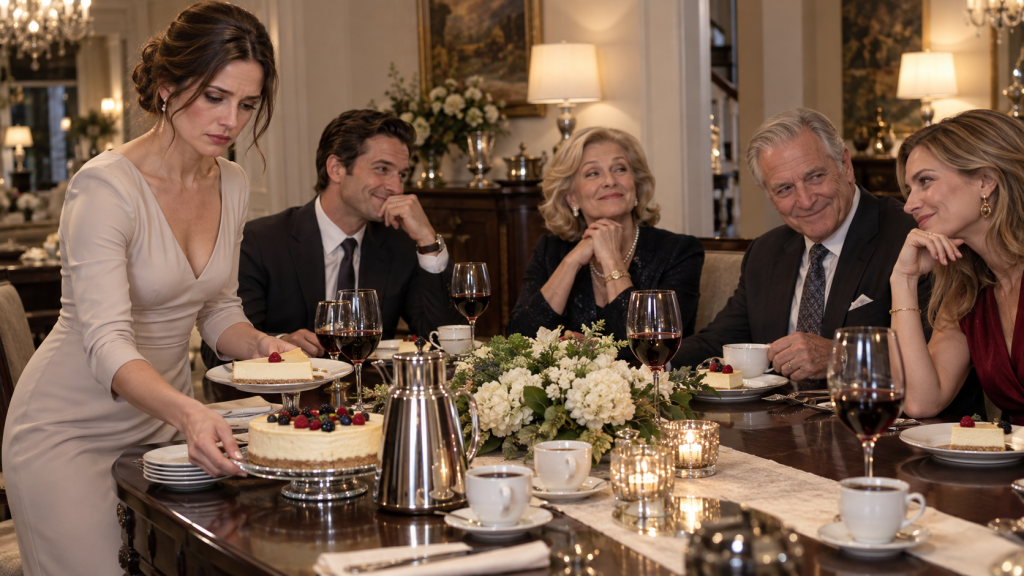
Helga’s dining room looked exactly as it had Sunday.
Dark mahogany table.
Cream candles.
Klaus at the head.
Marta beside him.
Helga wearing a blue blouse and the expression of a woman hosting an event she considered hers.
She hugged Julian.
Then me.
“Claire.”
Too warm.
I smiled.
“Helga.”
Marta barely looked up from her phone.
Klaus poured wine.
Julian sat beside me.
The choreography was familiar.
That helped.
Familiar rooms are easier to dismantle.
Dinner began in English.
Weather.
Marta’s job.
Klaus complaining about construction near their street.
Nothing.
Everything.
Then Helga switched to German.
Casually.
As always.
“Has Sophie decided whether she’s coming?”
Julian answered in German.
“She said maybe around eight.”
Marta smirked.
“Will Claire cry?”
Julian glanced at me.
I cut my chicken.
“I’m sure.”
Klaus shifted.
“Maybe this should not be done tonight.”
Helga dismissed him.
“It has already gone on too long.”
Then she looked at me.
Smiled.
In English:
“More wine, Claire?”
“No, thank you.”
Back to German.
“She looks pale.”
Marta said.
“Maybe she already suspects.”
Julian laughed softly.
“She suspects nothing.”
I put down my fork.
My hands were steady.
That surprised me.
Perhaps rage and preparation cancel tremors.
Helga said:
“We need to be gentle.”
Then, with the same calm certainty she had used Sunday:
“Once she understands there will finally be a baby in the house, she will accept it.”
Marta laughed.
“She may even thank Sophie.”
Something in me ended.
Not marriage.
That had ended earlier.
Hope.
The tiny, irrational hope that Sunday had been the worst version of them.
It wasn’t.
I lifted my water glass.
Then said in German:
“I wouldn’t count on gratitude.”
Silence.
Not ordinary silence.
Total.
Marta’s fork stopped halfway to her mouth.
Klaus stared at me.
Helga’s face emptied.
Julian turned so quickly his chair scraped the floor.
I looked at him.
In German.
“Would you like me to repeat it more slowly?”
No one moved.
For nearly five seconds, I enjoyed nothing.
Not revenge.
Not satisfaction.
Only the strange relief of finally standing in the room without translation.
Julian whispered:
“Claire.”
I switched to English.
“Nothing important?”
His face went white.
Marta looked at Helga.
Helga looked at me.
“You speak German?”
“Enough.”
“How long?”
“Long enough.”
Julian’s eyes narrowed.
“You were listening?”
I laughed.
The audacity.
“Yes.”
I said.
“In the room where I was sitting.”
Helga looked offended.
“You should have told us.”
There are sentences so absurd they arrive almost beautiful.
“I should have told you that I could understand the language you deliberately used to exclude me?”
No answer.
Marta stared at her plate.
Klaus rubbed a hand over his face.
Julian lowered his voice.
“We can talk about this at home.”
“No.”
His eyes sharpened.
“Claire.”
“You wanted to talk about the future.”
I looked around the table.
“Let’s.”
The doorbell rang.
Julian froze.
Helga looked toward the hall.
I stood.
“I’ll get it.”
Julian grabbed my wrist.
Not hard.
Enough.
“Who is that?”
I looked at his hand.
He released me.
Good.
I opened the door.
Sophie stood there.
Pregnant.
Pale.
Holding a folder.
When Julian saw her, the last of the color left his face.
“Why are you here?”
Sophie almost laughed.
“You invited me.”
Then she looked at me.
I stepped aside.
“Come in.”
She did.
And she sat beside me.
—
Helga recovered first.
She always did.
“Sophie, darling.”
Darling.
She moved as though to hug her.
Sophie stayed seated.
“No.”
Helga stopped.
Marta’s eyes widened.
Julian looked from Sophie to me.
“You two have spoken.”
I smiled.
“In English.”
His jaw tightened.
“How long?”
“Long enough.”
He stood.
“This is insane.”
“No.”
I said.
“Insane was assuming the two women you lied to would never compare sentences.”
Klaus whispered:
“Julian.”
He ignored his father.
“Claire, I was going to tell you tonight.”
I almost admired the sentence.
“Congratulations.”
“You found the courage five months after conception.”
Sophie looked down.
Julian pointed toward her.
“She knew our marriage was complicated.”
I turned to Sophie.
“Did you?”
She answered:
“I knew what he told me.”
Good.
Then I looked back at him.
“What did you tell me?”
Julian’s face hardened.
“That’s not fair.”
I laughed.
“For the first time tonight, something isn’t.”
Helga cut in.
“Claire, enough.”
I turned toward her.
“No.”
One word.
Her eyebrows lifted.
Interesting.
She had apparently never heard it from me either.
“You all spoke freely on Sunday because you believed I could not understand.”
I switched to German.
“So let us keep speaking freely.”
Helga’s face tightened.
“You are being dramatic.”
“Am I?”
In German, I repeated:
“‘Don’t worry. We’ll make her raise the baby.’”
Helga’s mouth opened.
I looked at Marta.
“‘Will Claire cry?’”
Marta looked away.
Then Julian.
“‘She suspects nothing.’”
His face changed.
Finally Klaus.
“You laughed.”
Klaus closed his eyes.
“I did.”
That honesty surprised me.
“I am ashamed of that.”
Helga snapped:
“Klaus.”
He looked at his wife.
“No.”
Interesting.
A second no in the room.
Maybe contagious.
—
I placed the custody document on the table.
Julian stared.
“Where did you get that?”
Sophie answered.
“You gave it to me.”
“That is private.”
I almost smiled.
“So was my fertility treatment.”
That landed.
Helga frowned.
“What are you talking about?”
I looked at Julian.
He knew.
Good.
I continued.
“Eight weeks ago, Julian canceled the remaining fertility package without telling me.”
Marta looked at him.
Klaus went still.
Helga’s face remained defensive.
“So?”
I stared.
“So?”
“You have been trying for years.”
Helga said.
“Perhaps he knew it was time to stop.”
My stomach turned.
“He knew it was time for my body to stop?”
“You were suffering.”
“Did I ask him to make that decision?”
Helga looked away.
I continued.
“The clinic issued a refund yesterday.”
I put a copy of the account printout on the table.
“Forty-eight thousand two hundred sixteen dollars.”
Marta’s eyes widened.
Klaus looked at Julian.
Julian said:
“It was our money.”
“Yes.”
I nodded.
“Ours.”
“Not yours.”
“Not Sophie’s.”
“Not your mother’s.”
Sophie spoke quietly.
“He transferred it to me.”
Helga looked shocked.
Good.
Apparently Julian had not disclosed every detail even to the committee.
“For the baby.”
Julian said.
“Exactly.”
I turned to him.
“You took money from the treatment you secretly ended with your wife and used it to fund the child you conceived with another woman.”
His face flushed.
“You’re twisting this.”
“No.”
I tapped the statement.
“Banking is helpful that way.”
Then I touched the custody document.
“And you told Sophie I had agreed to become your childcare.”
“I never said childcare.”
His voice rose.
“You wanted a child.”
There it was.
The room changed.
Even Helga stopped.
Julian had finally said the quiet part in English.
I looked at him.
For ten years, this was the man I had slept beside.
For six years, the man who had injected medication into my body.
Held my hand.
Counted days.
Cried, sometimes.
Maybe genuinely.
And underneath all of it, somewhere, he had reduced my longing to a vacancy that any baby could fill.
“You thought because I wanted to be a mother, I would take whatever arrangement you handed me.”
“That is not what I meant.”
“Yes.”
My voice broke for the first time.
“It is.”
He softened his tone.
“Claire.”
No.
Not the voice.
Not now.
“I was trying to find a way where nobody loses everything.”
I stared.
“Who is losing everything in your version?”
He opened his mouth.
Nothing.
I continued.
“You keep Sophie.”
“You keep your child.”
“You keep your parents’ approval.”
“You keep access to our money.”
“You keep your marriage long enough for me to provide stability.”
I touched the paper.
“And I get what?”
His face fell.
I answered for him.
“A baby that is not mine.”
Silence.
“Not adoption.”
“Not a child placed with me through consent.”
“Not a decision.”
“A baby you expect me to raise because you assume infertility has made me desperate enough to accept humiliation as motherhood.”
Sophie started crying.
Helga said:
“No one is humiliating you.”
I turned toward her.
“You laughed while discussing it.”
Helga’s mouth closed.
“Humiliation was the entertainment.”
—
Klaus stood.
He looked at Julian.
“Is the child yours?”
“Yes.”
“No doubt?”
Julian frowned.
“What kind of question—”
Sophie said:
“We did a prenatal paternity test.”
Everyone looked at her.
She swallowed.
“He insisted.”
Of course he did.
“Results confirmed he is the father.”
No twist.
No escape hatch.
The baby was real.
His.
And completely innocent.
I was grateful for that clarity.
Klaus sank back into his chair.
Marta whispered:
“Jesus.”
Helga turned toward Sophie.
“Why would you tell Claire about the money?”
Sophie stared.
That sentence told me exactly who Helga was worried about.
Not the betrayal.
The information.
Sophie’s expression hardened.
“Because it came from her account.”
“It came from Julian too.”
Helga snapped.
“And you think that makes it ethical?”
“Do not lecture me.”
Sophie almost laughed.
“I’m carrying your granddaughter.”
Helga went silent.
Then Sophie said:
“And I am not signing that agreement.”
Julian stood.
“Sophie.”
“No.”
Third no.
Beautiful word tonight.
“You told me Claire knew.”
“She didn’t.”
“You told me she wanted to help raise the baby.”
“She doesn’t.”
“You told me your marriage was over.”
Claire and I both looked at him.
Sophie corrected herself.
“You told me it was emotionally over.”
Julian said:
“It was.”
I spoke before I could stop myself.
“Three weeks ago, you took me to dinner for our tenth anniversary.”
He looked away.
“You told me you wanted to keep trying.”
Silence.
“You bought me a necklace.”
“Claire—”
“You came home and made love to me.”
Sophie closed her eyes.
Good.
Let the truth be ugly.
“Was that emotionally over?”
Julian sat.
Finally.
—
Marta began crying.
I almost ignored it.
Then she said:
“I’m sorry.”
Helga rolled her eyes.
“Marta, not now.”
Marta looked at her mother.
“No.”
Another.
She turned to me.
“I’m sorry.”
“For Sunday?”
“For years.”
That surprised me.
She wiped her face.
“I knew it was mean.”
Her voice shook.
“The German.”
“The jokes.”
“Everything.”
“Why?”
She looked at Helga.
Then Julian.
“Because it made me feel like I was on the inside.”
There it was.
Human.
Ugly.
Familiar.
I had learned German because I wanted to be inside too.
Different method.
Same hunger.
“I’m sorry.”
Marta repeated.
I nodded.
Not forgiveness.
Acknowledgment.
Enough for the moment.
Klaus spoke next.
“I should have stopped it.”
Helga snapped:
“Everyone is suddenly a saint?”
Klaus looked at her.
“No.”
“That is the point.”
He turned toward me.
“I knew Julian was seeing Sophie again.”
I swallowed.
“How long?”
“Three months.”
“Pregnancy?”
“Six weeks.”
“And Sunday?”
He closed his eyes.
“I laughed.”
“Yes.”
He nodded.
“I am ashamed.”
Good.
Shame should have somewhere to sit.
—
Helga stood abruptly.
“This is ridiculous.”
She looked at me.
“You want a child.”
“Yes.”
“You cannot have one easily.”
My body went still.
Sophie whispered:
“Helga.”
She ignored her.
“My son has a child coming.”
“And you would rather destroy the whole family than accept what life has given you?”
The room went silent.
That was the cruelest thing said that night.
Not because it was loud.
Because she believed it.
I stood too.
“What life has given me?”
My voice shook.
“Your son had an affair.”
“He lied to two women.”
“He canceled my fertility treatment behind my back.”
“He moved money without telling me.”
“He drafted a document assigning me childcare.”
“And you call that life giving me something?”
Helga’s expression did not change.
I stepped closer.
“No.”
“This child is not a consolation prize for my infertility.”
Sophie’s hand moved protectively over her stomach.
I looked at it.
Then at Helga.
“She is a baby.”
“She deserves a mother who wants her because she is hers.”
“A father who takes responsibility because he made her.”
“And a family that does not use her existence to punish another woman.”
Helga looked away.
I continued.
“I will not raise this child.”
Julian’s face changed.
Not shock.
Fear.
Because some part of his plan had depended on assuming I would.
“Claire, don’t make decisions tonight.”
I laughed.
“You made enough for both of us.”
Then:
“I am making one.”
He stared.
“I will not be part of your arrangement.”
That sentence was the beginning of my divorce.
Even before paperwork.
—
I left without dessert.
For once.
Sophie left too.
Separately.
Good.
Julian followed me to the driveway.
“Claire.”
I kept walking.
“Stop.”
I did.
Not because he ordered.
Because I wanted to look at him once without a table between us.
He stood under the porch light.
The man I had loved.
Maybe still loved.
Love is humiliating that way.
It does not always receive new information quickly.
“I never meant to hurt you.”
I laughed softly.
“That sentence is useless.”
“I was scared.”
“Of what?”
“Losing my chance to be a father.”
There it was.
At least honest.
“What about my chance to be a mother?”
His face tightened.
“I thought this could solve both.”
I closed my eyes.
He still did not understand.
“You thought a baby was the problem.”
He frowned.
“No.”
“Yes.”
“You thought the problem was that I wanted a child.”
“So if you supplied one, everything else became negotiable.”
“That isn’t fair.”
“Fair?”
My voice rose at last.
“You had eight months of an affair.”
“Five months of a pregnancy.”
“Eight weeks since canceling treatment.”
“Twenty-four hours since transferring forty-eight thousand dollars.”
“You had time to think.”
I wiped tears from my face.
“I got one day.”
He looked broken.
I hated that I cared.
Then he said:
“I love you.”
Of course.
I believed him.
That was worse.
“I know.”
His eyes widened.
Then:
“Love was not the missing ingredient.”
I got into my car.
Drove away.
—
I did not return home that night.
I stayed at a hotel.
The next morning, Evelyn filed what needed filing.
Not theatrically.
Correctly.
The joint accounts were monitored and handled according to legal advice.
I opened an individual account for my income.
Copied tax records.
Downloaded statements.
Preserved clinic communication.
Changed passwords.
I did not empty accounts.
I did not hide money.
I did not destroy property.
There is power in becoming extremely boring while someone else is panicking.
Julian called.
Texted.
Emailed.
Then sent flowers.
I left them at the hotel desk.
White lilies.
He knew I hated lilies.
That made me laugh.
Apparently betrayal affected memory too.
—
The financial review took months.
The forty-eight thousand was only the most visible transfer.
Evelyn brought in a forensic accountant named Sean Malik.
Kind man.
Terrible news.
Over three years, Julian had been moving smaller amounts.
Not constant.
Careful.
Insurance reimbursements from fertility procedures.
Clinic credits.
Duplicate reimbursements from our flexible spending account.
Refunds from canceled services.
He redirected some to an account I did not know existed.
Not millions.
Not a secret fortune.
About ninety-one thousand dollars total over three years.
Enough.
Enough to prove pattern.
Enough to prove he knew I would not scrutinize fertility bills because they hurt too much.
That was the part that nearly broke me.
He had hidden money inside the one category he knew I could not bear to study closely.
Every invoice carried memories of needles.
Ultrasounds.
Blood draws.
Bad news.
So I let Julian handle it.
He had used my pain as camouflage.
Sean slid a worksheet toward me.
I pushed it back.
“I need a minute.”
He nodded.
No rush.
I walked into the hallway.
Sat on a bench.
Called Sophie.
Not because we had become friends.
Because she knew part of the financial story.
She answered.
“Claire?”
“I found more.”
Silence.
“How much?”
“Ninety-one thousand over three years.”
“Oh God.”
“Did he send you money before the pregnancy?”
“No.”
“You’re sure?”
“Yes.”
Then:
“I can send statements.”
“I believe you.”
That surprised both of us.
She whispered:
“I’m sorry.”
This time I did not tell her to stop.
“Me too.”
Sometimes sorry does not assign blame.
Sometimes it simply names a ruined landscape.
—
Sophie returned the forty-eight thousand through attorneys.
Not to me directly.
Into an account where ownership could be sorted during divorce.
She did not return the money she had already spent from earlier transfers.
Her attorney argued those were gifts from Julian and she had reasonably relied on his statements.
I did not fight her over prenatal appointments and rent.
There are battles that cost more soul than money.
Julian eventually reimbursed a substantial portion of the diverted funds through the divorce settlement.
The numbers mattered.
But not as much as I once expected.
I thought seeing money returned would feel like justice.
It felt like arithmetic.
Necessary.
Cold.
The real losses were elsewhere.
—
Julian and I attended mediation nine months after the dinner.
He looked older.
So did I.
Marriage can age quickly once truth enters.
At one point, the mediator left us alone with attorneys nearby.
Julian stared at his hands.
“I canceled the treatment because I knew Sophie was pregnant.”
“I know.”
“I couldn’t keep pretending.”
“You did.”
“For two months.”
He winced.
“Yes.”
“Why keep giving me injections if you knew?”
His face broke.
That question had lived inside me for nine months.
I wanted the answer.
Even if it was terrible.
“I thought stopping immediately would make you suspicious.”
I stared.
There it was.
Not compassion.
Operational maintenance.
I began crying quietly.
He did too.
“I’m sorry.”
I looked at him.
“You watched me inject hormones into my body so your affair could remain convenient.”
He covered his face.
“I know.”
“No.”
“You know the sentence.”
“You do not know what it felt like.”
He looked up.
“You’re right.”
Good.
Finally.
Then:
“I told myself it was only one more cycle.”
I laughed through tears.
“You told yourself many things.”
“Yes.”
He swallowed.
“I told myself you would love the baby.”
My body went still.
“I know.”
“I thought…”
He stopped.
“Say it.”
He looked at me.
“I thought your desire to be a mother was stronger than your anger at me.”
There.
The equation.
The plan.
My infertility versus my dignity.
He gambled on desperation.
I wiped my face.
“You never understood why I wanted a child.”
His eyes filled.
“I wanted a family with you.”
Not a baby at any price.
Not motherhood as an empty job opening.
With you.
His face collapsed.
I think that was the moment he finally understood.
Too late.
Still.
Understood.
—
The divorce was finalized eleven months after the dinner.
Ten years of marriage reduced to signatures.
Property division.
Accounts.
Retirement.
Tax issues.
A settlement regarding diverted marital funds.
No screaming courthouse scene.
No reporters.
No applause.
I signed.
Julian signed.
That was it.
Outside, Evelyn asked:
“How do you feel?”
I thought.
“Hungry.”
She laughed.
“Good sign.”
We went for sandwiches.
I ate an entire one.
For six years, so much of my life had been scheduled around my body.
Fasting labs.
Medication timing.
Procedures.
Recovery.
Pregnancy tests.
That afternoon, I ate because I was hungry.
Small freedom.
Still freedom.
—
The embryos were harder.
Two frozen embryos.
Mine and Julian’s.
Created before the affair.
Not children.
Not nothing.
Not simple.
Our clinic documents required joint decisions for certain disposition options.
That process became one of the most emotionally brutal parts of the divorce.
For months, I could not discuss it without crying.
Julian initially wanted to preserve them indefinitely.
I asked why.
He said:
“They’re ours.”
That word.
Ours.
He had already built another family and still wanted possession of potential futures with me.
Eventually, through counseling and legal guidance, we reached a decision consistent with our prior agreements and clinic requirements.
I will not pretend it felt like closure.
Some choices are not satisfying.
Only necessary.
I grieved.
Privately.
Deeply.
Not because I knew what those embryos would have become.
Because they represented the last unopened door to the life Julian and I once planned honestly.
I let that door close.
Then I stopped standing in front of it.
—
Sophie gave birth to a daughter in February.
Her name was Emilia.
Julian told me through his attorney only because certain scheduling issues affected the final stage of our financial case.
I did not visit.
Did not send flowers.
Did not post anything.
The baby had nothing to do with my divorce except that her existence revealed the truth.
Weeks later, Sophie texted:
She’s healthy.
I stared at the message.
Then replied:
I’m glad.
That was all.
And I meant it.
I had spent months being afraid that seeing kindness toward the baby would somehow betray myself.
It did not.
Emilia had never promised me anything.
She had never laughed at me in German.
Never transferred money.
Never canceled a treatment.
She was simply a child born into adult mistakes.
I hoped they would not make her carry them.
—
Sophie and Julian did not marry.
That surprised Helga more than anyone.
Sophie moved into her own apartment before Emilia’s birth.
She retained primary residence of the baby initially while formal parenting arrangements were established.
Julian became financially responsible.
He visited.
He learned diapers.
Night feedings.
Pediatric appointments.
Real fatherhood.
Not the romanticized version he had imagined while drafting caregiving papers for me.
Months later, Sophie told me:
“He thought his mother would help constantly.”
I almost laughed.
“Does she?”
“Less than advertised.”
Of course.
Helga had wanted a grandchild.
Not necessarily 3:00 a.m. bottles.
Reality is excellent at clarifying enthusiasm.
—
Helga called me once after the divorce.
I almost did not answer.
Then did.
“Claire.”
Her voice was careful.
“Helga.”
“I wanted to say I’m sorry.”
I waited.
“For what?”
Silence.
A useful question.
“For what happened.”
“No.”
She paused.
“What?”
“Name it.”
Her breathing changed.
“I’m not doing this.”
“Then we have nothing to discuss.”
“Claire, please.”
I waited.
Finally:
“I’m sorry I spoke about you the way I did.”
“Which way?”
She sighed.
“The German.”
“The jokes.”
“The baby.”
Better.
“And?”
Another pause.
“I’m sorry I assumed you would raise Emilia.”
“Why did you?”
Helga became defensive again.
“Because you wanted children so badly.”
There it was.
Still.
Even apology could not fully uproot it.
I said:
“Wanting to become a mother never meant I agreed to become useful to everyone else’s choices.”
Silence.
Then:
“I know that now.”
Maybe.
Maybe not.
I no longer needed to verify.
She asked:
“Can we ever have a relationship again?”
I looked around my apartment.
My books.
My plants.
A German workbook on the table.
My life.
“No.”
I said.
Helga inhaled sharply.
“That is cruel.”
“No.”
“It is clear.”
Then I ended the call.
—
Marta was different.
She wrote me a letter in German.
I almost threw it away.
Then read.
Slowly.
Some sentences required a dictionary.
That felt strangely appropriate.
She apologized for years.
Not just Sunday.
The clothes.
Cooking.
My accent when I tried pronouncing German words before she knew I was learning seriously.
She admitted that making me the outsider had been a family habit.
A game.
Helga began it.
Julian encouraged it.
Marta joined because being inside felt good.
She wrote:
I did not understand that every laugh made the table smaller for you.
That line stayed with me.
Then:
I am ashamed that I needed you outside so I could feel inside.
I believed her.
I answered in German.
Briefly.
Thank you for telling the truth. I accept the apology. I am not ready for closeness.
She replied:
I understand.
And, unlike her mother, she did.
We exchanged birthday messages eventually.
Nothing more.
Sometimes reconciliation means the hostility ends.
Not that intimacy returns.
—
Klaus sent no letter for nearly a year.
Then a Christmas card.
Inside:
I laughed when I should have stopped my family. Silence would have been bad enough. Laughter was worse. I am sorry.
Short.
No defense.
I kept it.
Not because I forgave everything.
Because accountability that does not demand a reward is rare.
—
I continued German.
People found that strange.
“You don’t have to.”
a friend said.
As though the language belonged to Julian’s family.
It didn’t.
German had not betrayed me.
People had.
I returned to class.
At first, every phrase made my stomach tighten.
Then language became language again.
Grammar.
Poetry.
News articles.
Songs.
A woman named Ingrid taught our advanced class.
She was seventy-two and terrifying.
If anyone misused a case ending, she reacted as though we had insulted civilization.
I loved her.
One evening, she asked why I began learning.
The honest answer was:
“I wanted to understand my husband’s family.”
She smiled.
“And now?”
I thought.
“Now I want to understand myself when I speak it.”
Ingrid stared.
Then said:
“Your word order is still terrible.”
Perfect.
—
I traveled to Germany two years after the divorce.
Alone.
Munich first.
Then Heidelberg.
Then Berlin.
The first morning, I sat at a café and ordered breakfast in German.
The waiter understood without making me repeat myself.
I nearly cried into my coffee.
Not because of linguistic achievement.
Because nobody at the next table laughed.
Nobody translated me incorrectly.
Nobody used the language as a locked room.
I walked along the river in Heidelberg and thought:
I learned this language for them.
I kept it for me.
That felt like stealing something back without taking anything from anyone.
—
Fertility took longer to untangle.
Not medically.
Emotionally.
For years, every month had contained arithmetic.
Days.
Hormones.
Chances.
Percentage points.
After divorce, my body became quiet.
No alarms for injections.
No bloodwork.
No waiting room.
At first, silence felt like failure.
Then relief.
Then grief about the relief.
Therapy helped.
My therapist, Dr. Lane, asked me one day:
“If you never become a mother, what would that mean about you?”
I hated her immediately.
“Nothing.”
“Then why are you angry?”
“Because I want to be one.”
“Different question.”
I stared at the floor.
Eventually:
“I’m afraid everyone will think my life is incomplete.”
“Who is everyone?”
Helga.
Julian.
Maybe me.
I cried.
Then Dr. Lane said:
“A life can contain an unfulfilled longing without becoming an unfulfilled life.”
I wrote that down.
It took years to believe.
—
I considered adoption again.
Seriously.
Then stopped.
Not because I did not want children.
Because I realized I was trying to make a permanent decision while still proving something to ghosts.
Helga believed I was desperate enough to raise any baby.
I almost swung the other way and rejected motherhood entirely so no one could call me desperate.
That would have been another life built around them.
So I waited.
At forty-one, I still wanted a child.
At forty-two, I began exploring foster care.
Then paused.
At forty-three, I decided not to pursue it.
Not from fear.
Choice.
That surprised everyone.
Especially me.
My desire to mother had been real.
So was my desire for the life I had built afterward.
Neither canceled the other.
I became an aunt-like figure to my best friend’s daughters.
Mentored younger women at work.
Later volunteered with a literacy program.
None of those relationships were substitute children.
I refused that language too.
People do not become replacements simply because another role is empty.
That was one of Julian’s mistakes.
I would not repeat it.
—
Three years after the divorce, Sophie asked to meet.
I hesitated.
Then agreed.
Same park.
Different bench.
Emilia was with a babysitter.
Good.
I was not ready to meet her.
Sophie looked older.
Stronger.
She sat.
“I owe you something.”
“No.”
“Not money.”
I waited.
“The truth.”
I almost laughed.
That currency again.
She continued.
“I stayed with Julian longer than I told you after we spoke.”
I looked at her.
“How long?”
“Two weeks.”
I appreciated honesty.
“Why?”
“I was scared.”
“Pregnant.”
“Financially dependent.”
“And still in love with him.”
She nodded.
“I wanted the version he promised.”
“Family.”
“Support.”
“Someone excited about the baby.”
Then:
“I also resented you.”
That surprised me.
“Why?”
“You had ten years.”
“I had the house.”
“The history.”
“His family already knew you.”
“I thought I was the one waiting outside.”
I laughed softly.
“You were not.”
“I know.”
She looked at me.
“That’s the strange part.”
“He made both of us feel like the other woman had the secure position.”
Of course.
Divide the truth.
Sell different futures.
Keep everyone negotiating with the wrong person.
Sophie said:
“I’m sorry I entered your marriage.”
I nodded.
“Thank you.”
Not:
It’s okay.
It wasn’t.
Then I said:
“I’m sorry he used me as a lie to control you.”
Her eyes filled.
“Thank you.”
That was the closest we came to friendship.
We did not need more.
—
I met Emilia once.
Accidentally.
Years later.
A bookstore.
She was five.
Julian was with her.
I saw him first.
He saw me.
We both froze.
Then a little girl came around the shelf holding a picture book.
Dark curls.
Julian’s eyes.
“Daddy.”
The word struck gently.
Not painfully.
That surprised me.
Julian looked terrified.
As though I might shatter.
I didn’t.
“This is Claire.”
he said.
Emilia looked up.
“Hi.”
“Hi.”
She held up the book.
“It’s about a bear.”
“Excellent choice.”
She nodded solemnly.
Then ran toward the children’s section.
Julian stared at me.
“You okay?”
“Yes.”
I meant it.
He looked older.
More tired.
Parenthood perhaps.
Life.
“She’s wonderful.”
I said.
His face softened.
“Yes.”
Then:
“I’m sorry.”
I almost smiled.
“Still?”
“Probably forever.”
I thought about that.
“Don’t make your guilt a lifelong relationship with me.”
He looked startled.
“You don’t need my forgiveness every time you see me.”
His eyes filled.
“I hope you’re happy.”
“I am.”
That was enough.
We walked away in opposite directions.
No music.
No revenge.
No longing.
Just two people who once imagined grandchildren together meeting beside a shelf of picture books.
Life can be cruel.
It can also become ordinary again.
Ordinary is underrated.
—
Years passed.
I changed jobs.
Moved apartments.
Bought a small house with a garden I neglected enthusiastically.
I continued German.
I traveled.
I became the person people called when they needed help reading a contract because apparently betrayal turned me into a document enthusiast.
I kept cheesecake off the menu for almost four years.
Then one Christmas, Ingrid from German class invited everyone over.
She served cheesecake.
Of course.
I stared at it.
She noticed.
“You dislike?”
“No.”
“Then eat.”
German women of a certain age do not negotiate with trauma.
I ate.
It was excellent.
I laughed.
Another thing returned.
—
The most difficult part of healing was not trusting men again.
It was trusting myself.
For months, I replayed every dinner.
Every business trip.
Every late night.
Every German joke.
How did I miss it?
Why did I believe him?
Why did I need to study a language secretly to understand my own marriage?
Then Dr. Lane asked:
“What would trusting yourself have looked like before you knew?”
“I don’t know.”
“Exactly.”
I stared.
She continued:
“You are judging your past self with evidence she did not have.”
“But I had signs.”
“You had a husband.”
“That is usually considered a reason to trust.”
I cried.
She said:
“Being deceived is not the same as being foolish.”
That took longer to accept than the divorce.
Because anger at myself gave me the illusion that I could prevent betrayal forever.
If it was my stupidity, I could become smarter.
If it was my blindness, I could become more watchful.
The harder truth was:
Sometimes another person chooses to deceive you well.
You can become wiser afterward without making yourself responsible for their choice.
I stopped interrogating the woman I had been.
She had suffered enough.
—
I also stopped calling my German lessons secret.
That sounds small.
It wasn’t.
For two years, I had hidden them because I wanted to surprise Julian’s family someday.
At first, with something sweet.
I imagined ordering dinner in German during a trip.
Making Helga smile.
Finally belonging.
Later, I hid the lessons because I realized understanding them gave me access to truth.
Secrecy protected me.
After divorce, I stopped hiding.
Books on shelves.
Vocabulary cards on the fridge.
German radio while cooking.
Language in daylight.
The difference mattered.
—
On the fifth anniversary of that dinner, I cooked cheesecake.
My own.
I invited four friends.
No Julian.
No Helga.
No ghosts required.
After dessert, one friend asked why I had suddenly started laughing.
I had remembered Helga’s face when I answered in German.
For years, that memory carried rage.
Now it was almost funny.
Not because what happened was funny.
Because of the expression.
Absolute shock that the woman at the table had an interior life they had not accounted for.
That became symbolic to me.
People who underestimate you often confuse silence with absence.
I had not been absent.
I had been listening.
Then learning.
Then choosing.
—
I never forgot the forty-eight thousand dollars.
Not because of the money.
Because of the memo.
FERTILITY REFUND
Julian wrote it as though six years of our life could be summarized on a transfer line.
A refund.
As though hope could be reversed.
As though pain returned to sender.
It couldn’t.
What I got instead was different.
Clarity.
Costly.
Late.
Still useful.
—
If I could go back to Sunday night and stand behind the version of me carrying cheesecake to that table, I would not tell her to throw the cake.
Tempting.
I would whisper:
Keep walking.
Set down the plates.
Listen.
You are not weak because you do not explode.
You are collecting the truth.
Tomorrow, call the clinic.
Call the bank.
Call a lawyer.
Call Sophie.
Do not call yourself stupid.
And when Helga says they will make you raise the baby, remember:
No one can assign you motherhood as punishment, compensation, or labor.
Motherhood is not what remains after other people make choices.
Your body is not a family resource.
Your grief is not leverage.
Your longing is not consent.
You will learn that.
Slowly.
And when Julian tells you he loved you, believe that love may have existed.
Then ask whether it was enough to make his choices safe.
It wasn’t.
Love does not erase conduct.
No language can translate that into something prettier.
—
The last time I spoke to Helga was at Klaus’s funeral.
He died seven years after the divorce.
Heart attack.
Marta told me.
I went because Klaus had apologized without asking me to make him feel better.
That mattered.
Helga saw me across the church.
Older.
Smaller.
She walked over.
“Claire.”
“Helga.”
Her eyes filled.
“Klaus always regretted Sunday.”
“I know.”
“He spoke of you.”
I nodded.
Then she said:
“You look well.”
“Thank you.”
A pause.
Then, in German:
“You really did become fluent.”
I smiled.
In German:
“You gave me excellent motivation.”
For half a second, she looked offended.
Then she laughed.
Actually laughed.
Not at me.
At herself, perhaps.
“I deserved that.”
“Yes.”
She nodded.
Then:
“I was cruel to you.”
My chest tightened.
There it was.
No:
We misunderstood each other.
No:
I was protecting my son.
Cruel.
“Yes.”
“I thought giving you a baby would make what Julian did smaller.”
She looked down.
“I did not understand that I was treating your pain like a weakness to exploit.”
I stared.
That was the apology I had once wanted desperately.
Now I did not need it.
Strange.
“Thank you for saying it.”
She looked at me.
“Do you forgive me?”
I thought.
“Yes.”
Her eyes filled.
Then I added:
“But forgiveness is not a door back into my life.”
She nodded.
“I know.”
Maybe she finally did.
We hugged.
Briefly.
Then separated.
Appropriate.
—
Marta and I occasionally exchanged messages.
Sophie and I stopped speaking after Emilia turned two, except for one Christmas greeting every few years.
Julian remained part of my history.
Not my life.
Emilia grew.
I knew through the edges of other people.
School.
Dance.
Eventually middle school.
I never became Aunt Claire.
Never became Stepmother Claire.
Never became the woman they thought they could recruit into raising her.
Good.
She had a mother.
She had a father learning the consequences and responsibilities of being one.
She did not need me turned into a symbol.
Neither did I.
—
At fifty, I stood in Berlin again.
This time with two friends from language class.
We went to a small restaurant.
The menu was handwritten.
My friend Peter struggled.
He leaned over.
“What does that mean?”
I translated.
He smiled.
“You’re useful.”
The word hit me strangely.
Useful.
Once dangerous.
Now harmless.
Because he asked.
Because I could say no.
Because usefulness without coercion is simply generosity.
“Five euros.”
I said.
He laughed.
“Capitalist.”
“Divorced woman.”
He paid for dessert.
Cheesecake.
Of course.
I ate it.
—
Sometimes, people ask whether I regret learning German.
Never.
The language exposed my marriage.
But more importantly, it exposed something in me.
For years, I had been entering rooms hoping other people would decide I belonged.
Julian’s family.
Fertility clinics.
Marriage.
Motherhood.
I kept waiting for acceptance to arrive from outside.
Then one night, I answered in German.
Not perfectly.
Not elegantly.
Enough.
And the room changed because I no longer needed permission to understand what was happening to me.
That was the beginning.
Not divorce.
Not the money.
Language.
Understanding.
Naming.
Then choice.
—
I did not become a mother in the way I once imagined.
For years, saying that sentence felt like failure.
Now it is only biography.
I wanted a child.
Deeply.
I did not have one.
That mattered.
It still does.
Some grief does not need to be cured to stop controlling your life.
It can sit quietly at the edge of a beautiful existence.
Mine does.
There are days when I see a woman my age with adult children and feel the old ache.
Then it passes.
Not because the longing was false.
Because my life is larger than one unanswered longing.
I wish I had known that when Helga looked at me and thought any baby would make me grateful.
I wish Julian had known.
Mostly, I am glad I learned.
—
On my fifty-second birthday, Ingrid gave me a card.
Inside, in German:
Man versteht eine Sprache erst, wenn man darin seine eigene Wahrheit sagen kann.
I translated it slowly.
You only truly understand a language when you can speak your own truth in it.
I cried.
Ingrid frowned.
“Grammar wrong?”
“No.”
“Then why cry?”
“Long story.”
She waved her hand.
“All stories are long at your age.”
I laughed.
Fair.
—
That night, I went home and opened the old notebook from the coffee shop.
I still had it.
Page one.
German sentences from dinner.
How far along is she?
Almost five months.
What are you going to tell her?
Nothing yet.
She still thinks Sophie moved to Chicago.
Then:
Don’t worry. We’ll make her raise the baby.
Below that, in my handwriting:
Eleven business trips.
Dates.
Questions.
Forty-eight thousand.
I turned the page.
Blank.
For years, I thought that blank page represented everything I didn’t know.
Now it felt different.
Space.
I took a pen.
Wrote one sentence in German.
Then translated it beneath.
Ich habe verstanden. Dann habe ich gewählt.
I understood.
Then I chose.
That was the story.
Not that my husband cheated.
Not that his family laughed.
Not that Sophie got pregnant.
Not even that I understood German.
The story was that once I understood, I chose myself.
Not selfishly.
Not cruelly.
Finally.
—
Julian believed I could not understand German.
So he spoke freely.
His family did too.
They mistook language for a wall.
They mistook my silence for ignorance.
They mistook infertility for desperation.
They mistook kindness for compliance.
And, for a while, I had mistaken marriage for proof that I was safe.
We were all wrong about something.
The difference was what we did after the truth arrived.
Julian lost a wife.
Sophie stopped accepting the life he had described for her.
Marta apologized.
Klaus admitted shame.
Helga eventually learned that a grandchild could not repair what adults had broken.
And I learned the most expensive lesson of all:
Understanding people does not obligate you to stay with them.
Sometimes understanding is exactly why you leave.
—
I think occasionally about that cheesecake server in my hand.
How tightly I held it.
How close I came to dropping everything.
People love dramatic moments.
They imagine power looks like smashed plates.
Raised voices.
Doors slamming.
Sometimes it does.
Mine looked like this:
“Would anyone like coffee?”
A calm voice.
A notebook the next morning.
A clinic appointment.
A bank statement.
A lawyer.
A woman on the phone named Sophie.
Then, three nights later, one sentence spoken in German across a mahogany table.
“I wouldn’t count on gratitude.”
That was enough.
The room changed because I did.
—
I spent years wanting Julian’s family to let me inside.
In the end, I learned their language and walked out.
Not because I failed to belong.
Because I finally understood that belonging somewhere cruel is not belonging at all.
Now, when I speak German, I do not hear Helga.
I hear Ingrid correcting my grammar.
I hear waiters in Berlin.
Friends laughing.
Music.
My own voice.
That may be the best thing I reclaimed.
Not money.
Not pride.
Not even time.
My voice.
The one they assumed did not understand.
The one they joked around.
The one they planned over.
The one that eventually answered.
And once it did, nobody at that table ever mistook my silence for ignorance again.
THE END STORIES! THANK YOU FOR READING GOOD LUCK !❤️
Related Posts