➡️ PART 3 ENDING PART ➡️
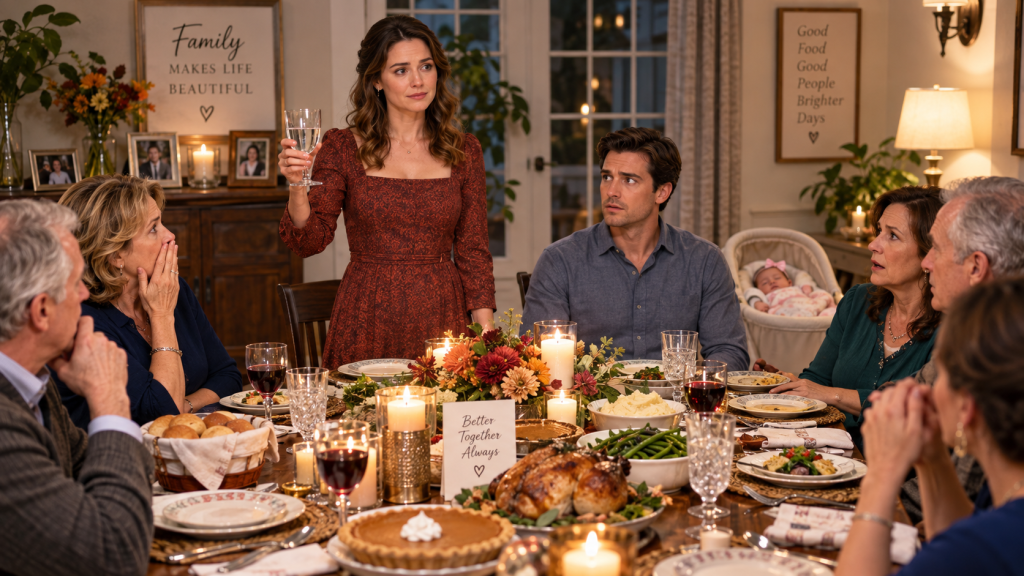
“Would you like to tell everyone why the woman you’ve been promising to marry is wearing your brother’s wedding ring around her neck?”
Nobody moved.
Julian stared at the photograph.
His mother, Patricia, had already dropped it onto the table, but the image lay faceup between the pumpkin pie and the half-empty wineglasses.
A woman with long dark hair stood beside Julian outside a downtown restaurant.
His hand rested against the small of her back.
Her face was turned toward him.
Around her neck hung a thin gold chain.
And from that chain hung a man’s wedding ring.
A ring I recognized because I had watched Julian’s older brother, Nathan, wear it for seven years.
My father was the first person to speak.
“What the hell is going on?”
Julian looked at me.
“Emily.”
“No.”
My voice was quiet.
“Don’t use my name to buy yourself time.”
His father, Robert, picked up the photograph.
He stared at it.
Then at Julian.
Then back at the photograph.
“Is that Caroline?”
Julian said nothing.
Patricia made a broken sound.
Nathan’s wife.
Caroline.
The woman Julian had just promised to marry after divorcing me was his brother’s wife.
Or, more accurately, his brother’s widow.
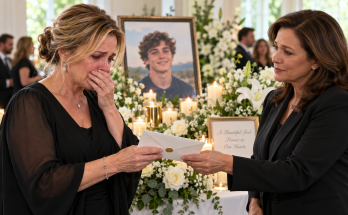
Nathan had died eighteen months earlier.
A sudden aneurysm.
Thirty-six years old.
Healthy one morning.
Gone before midnight.
The family had never recovered.
Especially Julian.
Or so I had believed.
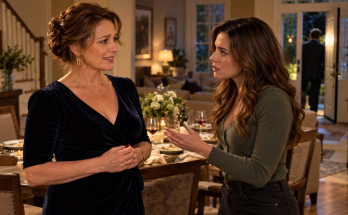
For months after Nathan died, Julian had spent hours helping Caroline.
Fixing things around her house.
Driving her to appointments.
Handling paperwork.
Sorting through Nathan’s belongings.
I encouraged him.
That was the part that hurt in a particularly cruel way.
I had encouraged my husband to spend time with the woman he eventually began sleeping with.
I had packed leftovers for him to take to her.
Bought Caroline a birthday present and asked Julian to deliver it because Maya had a fever.
Sat beside her at Christmas while she cried.
Held her hand.
Told her:
“You’re still family.”
And apparently she agreed.
Just not in the way I meant.
Patricia whispered:
“No.”
Julian finally looked at his mother.
“Mom—”
“No.”
Her voice rose.
“Tell me that isn’t Caroline.”
Julian rubbed both hands over his face.
Robert stood.
“Answer your mother.”
“Yes.”
One word.
That was all it took.
Patricia began crying.
“Oh, God.”
Julian looked around the table.
“This isn’t what any of you think.”
His sister, Melissa, laughed bitterly.
“You’re sleeping with your dead brother’s wife.”
“Widow.”
The second the word left Julian’s mouth, he seemed to realize how ugly it sounded.
Melissa stared at him.
“That’s your defense?”
“No.”
“Because if we’re correcting vocabulary while your marriage explodes, I’d like to leave.”
“Melissa, stop.”
“No, Julian. You stop.”
She pointed toward me.
“Your wife is sitting there with a four-month-old baby.”
Maya stirred in her seat.
Every adult immediately lowered their voice.
That tiny movement reminded us that the person who mattered most in the room had no idea her family was breaking around her.
I lifted Maya into my arms.
She settled against me.
Warm.
Heavy.
Safe.
Julian watched.
His expression collapsed.
“Emily, please.”
I kissed Maya’s hair.
“What?”
“I love her.”
I looked up.
“Caroline?”
He froze.
“I meant Maya.”
“Interesting that I had to ask.”
His eyes filled.
“I love both of you.”
I almost laughed.
“No.”
“Emily.”
“You may love Maya.”
I shifted our daughter higher against my chest.
“But don’t stand there and tell me you love me because you don’t like what it says about you if you don’t.”
“I do.”
“You told Caroline you hated me.”
“I was angry.”
“At what?”
He had no answer.
“At me asking whether you’d be home for dinner?”
Nothing.
“At me sending pictures of your daughter?”
Nothing.
“At me believing your late meetings were work because I trusted you?”
His eyes lowered.
“Which part made you angry, Julian?”
“I felt trapped.”
The words landed quietly.
I nodded.
There it was.
Finally.
Not the affair.
Underneath it.
The excuse he had been building inside himself.
“Trapped.”
He swallowed.
“Yes.”
“By me?”
“By everything.”
I looked around.
“Our marriage?”
He nodded.
“The baby?”
His eyes snapped up.
“I didn’t say that.”
“Then what?”
“I wasn’t ready for any of this.”
“Maya was planned.”
“I know.”
“You wanted a baby.”
“I thought I did.”
That sentence hurt more than Caroline.
I looked down at our daughter.
She had wrapped her tiny fingers around the collar of my blouse.
My father swore under his breath.
Julian immediately said:
“I love Maya.”
“Then don’t make her responsible for your regret.”
“I’m not.”
“You just said you felt trapped after becoming her father.”
“That’s not what I meant.”
“Then learn to say what you mean.”
Silence.
For six days, I had imagined this confrontation.
In some versions, I screamed.
In others, Julian begged.
Sometimes I threw his clothes onto the lawn.
Sometimes Caroline arrived and I humiliated them both.
But now that the moment had come, revenge felt strangely small.
I didn’t want Julian embarrassed.
I wanted the last six months of my life back.
I wanted to unknow what I knew.
I wanted to return to the afternoon before the phone call and believe my husband’s late meetings were real.
No speech could give me that.
So I stopped trying to win.
I simply wanted the truth.
“When did it start?”
Julian looked at his parents.
“Emily.”
“When?”
“Does everyone need to hear this?”
“You had no problem discussing how much you hated me with Caroline.”
His face reddened.
“Answer.”
He whispered:
“Three months ago.”
Maya was four months old.
I calculated automatically.
“One month after she was born?”
Julian closed his eyes.
“Yes.”
Patricia began crying harder.
I stared at my husband.
“One month.”
“It wasn’t planned.”
“That sentence must be very comforting to you.”
“Emily—”
“Did it begin before?”
“What?”
“Emotionally.”
Silence.
That was answer enough.
“How long?”
“I don’t know.”
“Try.”
He rubbed his face.
“After Nathan died, Caroline and I talked a lot.”
“I know.”
“You encouraged me to help her.”
I stared.
“Be very careful where you’re going with that sentence.”
“I’m not blaming you.”
“You just came dangerously close.”
He shook his head.
“No. I’m saying we were both grieving Nathan.”
“You were grieving your brother by falling in love with his wife?”
“Not at first.”
His voice cracked.
“At first we just talked.”
I looked at Patricia.
She had gone pale.
Nathan had been her firstborn.
Every sentence about his widow and brother must have felt like someone reopening his grave.
I turned back to Julian.
“Did Nathan know?”
“No.”
“Know what?”
“There was nothing to know while he was alive.”
“Are you sure?”
“Yes.”
For once, his answer came immediately.
I believed that part.
I didn’t know whether it made anything better.
Maybe slightly.
Maybe not.
Robert asked:
“Does Caroline know you’re here tonight?”
Julian looked down.
“Yes.”
“And she knew Emily was hosting your anniversary dinner?”
“Yes.”
Melissa whispered:
“Jesus.”
I suddenly remembered something.
The flowers.
Julian had brought grocery-store flowers home the evening I overheard him.
“Did you see Caroline after that phone call?”
He looked at me.
“Yes.”
“Before you came home?”
“Yes.”
“Did she know you forgot to hang up?”
“No.”
I nodded.
“Good.”
“Why does that matter?”
“Because I wanted to know whether the flowers were your idea or hers.”
He stared.
“They were mine.”
“Wonderful.”
I laughed once.
“You kissed another woman, told her you hated me, promised to divorce me, then stopped at a grocery store and bought me flowers.”
My voice broke.
“That’s almost impressive.”
“Emily.”
“No.”
I wiped my eyes.
“I’m finished.”
Julian stood.
“Don’t say that.”
“I already filed.”
“You said your attorney has papers.”
“Yes.”
“We can stop it.”
I looked at him.
“Why?”
“Because we’re married.”
“That is the thing we’re discussing ending.”
“Because we have Maya.”
“Maya needs parents who behave like adults. She does not need married parents who lie to each other.”
“I can fix this.”
“You cannot unfail to hang up.”
He flinched.
I hated how cruel the sentence sounded.
But it was true.
If Julian had ended that call properly, I would still be married to a man planning to leave me.
The only difference was that I would not know.
That thought frightened me.
How many times do we mistake ignorance for happiness?
Julian stepped closer.
I moved Maya against my other shoulder.
He stopped.
“Can I hold her?”
I looked at him.
Every part of me wanted to say no.
That was the injured wife speaking.
But Maya was not evidence.
Not leverage.
Not punishment.
He was her father.
I handed her to him.
Julian held our daughter.
And broke.
He pressed his face against her tiny head and sobbed.
Not elegant tears.
Not manipulation.
Something raw.
Maya stared at him with enormous eyes.
Then grabbed his nose.
A few people laughed through tears.
Julian kissed her fingers.
“I’m sorry.”
My chest hurt.
He whispered it again.
“I’m so sorry.”
I did not know whether he meant Maya, me, Nathan, his parents, or himself.
Maybe everyone.
After several minutes, he handed her back.
Then he sat.
His shoulders seemed smaller.
“There’s something else.”
I became still.
Of course there was.
There is always something else when someone begins telling the truth after months of lying.
“What?”
Julian looked at the photograph.
“Caroline doesn’t know I told you I would marry her.”
I stared.
“What?”
“I mean…”
He swallowed.
“She knows what I’ve said privately.”
“That sentence made no sense.”
Melissa leaned forward.
“Are you saying Caroline doesn’t actually want to marry you?”
Julian closed his eyes.
“I don’t know.”
I almost admired the disaster.
“So you told her you’d divorce me and marry her.”
“Yes.”
“But you don’t know whether she wants that.”
“Yes.”
“Does she know you’re planning a divorce?”
“I told her I was thinking about it.”
“Thinking?”
My voice rose.
“On the phone, you said, ‘I’ll divorce her.’”
“I was saying what she wanted to hear.”
Silence.
This revelation did not help him.
It made everything uglier.
“So you lied to her too.”
He looked miserable.
“Yes.”
I leaned back.
There was the man I had married.
Not a romantic hero torn between two women.
A frightened man who had created different versions of himself for different rooms.
At work, responsible executive.
At home, tired husband.
With Caroline, trapped lover.
With his parents, loyal son.
Every version told the audience what it needed to hear.
Eventually, he forgot there was supposed to be one Julian underneath them all.
My father said:
“You need help.”
Julian looked at him.
“I know.”
That was the first answer all night that sounded honest.
Then the doorbell rang.
Everyone froze.
I knew who it was.
Julian didn’t.
He looked at me.
“Who else did you invite?”
I shifted Maya in my arms.
“One more guest.”
His face went white.
“Emily.”
I walked toward the front door.
“Please tell me you didn’t.”
I opened it.
Caroline stood on the porch.
She was wearing a black coat.
No makeup.
Her face was pale.
And around her neck hung the gold chain.
Nathan’s wedding ring rested against her chest.
For a moment, neither of us spoke.
Then she whispered:
“Emily.”
I stepped aside.
“Come in.”
She looked past me.
Saw Julian.
Her expression changed.
Not lovingly.
Furiously.
Julian stood.
“Caroline.”
“Don’t.”
One word.
He stopped.
Caroline entered.
Patricia began crying again.
Caroline saw her.
“Oh, Patricia.”
“Why?”
That one word from Nathan’s mother broke the room.
Caroline covered her mouth.
“I’m sorry.”
Patricia shook her head.
“Why his brother?”
Caroline began sobbing.
“I don’t know.”
“You had the whole world.”
“I know.”
“Why him?”
“I was lonely.”
Patricia looked at Julian.
“So was he.”
Caroline wiped her face.
“We talked about Nathan.”
Her fingers touched the ring around her neck.
“Nobody else wanted to hear me talk about him every day.”
I understood that.
Grief makes people uncomfortable after the socially acceptable period ends.
After the casseroles stop.
After sympathy cards disappear.
The grieving person still wakes up inside the same absence.
Julian had understood Caroline’s grief because he carried his own version.
Two wounded people found recognition in each other.
That explained the beginning.
It did not excuse the ending.
Caroline looked at me.
“I knew he was married.”
“Yes.”
“I knew you had just had Maya.”
“Yes.”
“I don’t have an excuse.”
“No.”
“I’m sorry.”
I believed she was sorry.
I also hated her.
Both could be true.
She removed the chain from her neck.
Nathan’s ring slid into her palm.
“I started wearing this after he died.”
Patricia nodded through tears.
“I know.”
Caroline looked at Julian.
“He used to hold it when we talked.”
Julian looked down.
“At first, it felt like Nathan was still somehow between us.”
Her voice cracked.
“Then one night that changed.”
Nobody needed details.
Caroline turned to me.
“I should have stopped it.”
“Yes.”
“I didn’t.”
“No.”
“I told myself grief made us different.”
“It didn’t.”
“I know.”
She nodded.
Then her expression hardened.
“And I found something out this afternoon.”
Julian looked up.
“What?”
Caroline reached into her purse.
She pulled out her phone.
“Your husband told me he’d been sleeping in the guest room for months.”
I stared at Julian.
He went pale.
Caroline continued.
“He told me your marriage was basically over before Maya was born.”
I laughed.
I couldn’t help it.
The absurdity had become too much.
“Would you like to know where he slept last night?”
Caroline’s eyes filled.
I pointed upstairs.
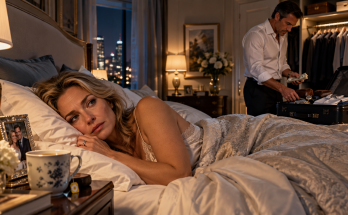
“In our bed.”
She closed her eyes.
Julian stood.
“I was going to tell you.”
“Which one of us?”
I asked.
Nobody spoke.
“Exactly.”
Caroline looked at him.
“You said Emily knew you were unhappy.”
I answered for him.
“I knew he worked late.”
Caroline’s face collapsed.
“He told me you barely spoke.”
“We spoke every day.”
“He said you didn’t want him touching you.”
I felt humiliated.
Then angry.
Then strangely calm.
“My doctor had not cleared me after childbirth.”
Caroline covered her mouth.
“Oh, God.”
Julian whispered:
“Stop.”
I looked at him.
“No.”
Caroline stared at him as though seeing him for the first time.
“You made her sound cold.”
Julian shook his head.
“I didn’t—”
“You told me she stopped caring about you after the baby.”
“I was confused.”
“No.”
Caroline stepped backward.
“You were dishonest.”
Julian’s eyes filled.
“Caroline.”
She removed Nathan’s ring from the chain.
Then walked toward Patricia.
She placed it in Patricia’s palm.
Patricia stared.
Caroline closed Patricia’s fingers around it.
“I think Nathan would want you to keep this for now.”
Patricia began sobbing.
Caroline hugged her.
It was painful to watch.
Because betrayal does not always happen between people who never loved one another.
Sometimes the person who hurts you is somebody who sat beside you at a funeral.
Somebody who knows your children.
Somebody who understands exactly what they are risking.
That is what makes betrayal betrayal.
Caroline released Patricia.
Then looked at me.
“I won’t contact Julian again.”
I believed her.
Not because she owed me obedience.
Because whatever fantasy had held them together had died in this room.
“You should decide that for yourself,” I said.
She nodded.
“I am.”
Then she looked at Maya.
Her face crumpled.
“She’s beautiful.”
I tightened my arms around my daughter.
“Thank you.”
Caroline left.
No screaming.
No thrown glasses.
Just a front door closing.
Sometimes endings are quieter than the lies that created them.
Julian stared at the door.
Then looked at me.
“Emily.”
I shook my head.
“There is nothing left to say tonight.”
He looked around at both families.
His humiliation was complete.
But I did not feel satisfied.
That surprised me.
For six days, I had imagined exposing him.
Now that I had, all I felt was grief.
I looked at our anniversary cake.
Two years.
The number was written in frosting.
Two years was not a lifetime.
But it had been the life I expected to continue.
Now it was ending beside pumpkin pie and a digital recorder.
I looked at our families.
“I’m sorry dinner ended this way.”
My mother stood.
“You have nothing to apologize for.”
“I invited everyone knowing what I was going to do.”
My father said:
“Good.”
“Dad.”
“What?”
Despite everything, I laughed.
The tension broke slightly.
Julian’s parents left first.
Patricia hugged me for a long time.
“I’m sorry.”
“You didn’t do this.”
“I raised him.”
“He’s thirty-four.”
She pulled back.
“You’re very generous.”
“No.”
I looked at Julian.
“I just don’t believe mothers should be sentenced for every choice their adult sons make.”
Patricia cried harder.
Then she kissed Maya and left.
Eventually, everyone was gone.
Except Julian.
He stood in the dining room surrounded by dirty dishes.
I put Maya in her bassinet.
Then returned.
Julian looked exhausted.
“Where am I supposed to go?”
I stared at him.
For a second, the old instinct appeared.
Solve it.
Take care of him.
Make sure he has somewhere to sleep.
Marriage trains certain reflexes deeply.
Then I remembered that he had managed to organize an affair without my assistance.
He could organize a hotel.
“I don’t know.”
“This is my house too.”
“Yes.”
He looked surprised.
I wasn’t going to invent legal authority I didn’t have.
“You can stay tonight if you want.”
Hope flashed across his face.
“In the guest room.”
It disappeared.
“Tomorrow, our attorneys can discuss temporary arrangements.”
“Emily.”
“What?”
“Do you really want this?”
I looked at him.
“No.”
He blinked.
I continued.
“I wanted my husband.”
Tears filled my eyes.
“I wanted the man I thought you were.”
He started crying.
“I don’t want a divorce.”
“That doesn’t mean I want this marriage.”
“Give me a chance.”
“You had thousands.”
He flinched.
“Every late meeting was a chance.”
I stepped closer.
“Every time I asked whether you were okay was a chance.”
Another step.
“Every picture of Maya I sent you was a chance.”
My voice broke.
“You complained about them to your mistress.”
“I’m sorry.”
“I know.”
“I was horrible.”
“Yes.”
“I don’t know why.”
“Then find out.”
He stared.
“Go to therapy.”
“I will.”
“Become a better father.”
“I will.”
“Learn why you needed two women believing two different versions of you.”
He nodded desperately.
“I will.”
“But don’t do those things to win me back.”
His face fell.
“Do them because Maya deserves a father who knows who he is when nobody is watching.”
He covered his face.
I went upstairs.
Locked the bedroom door.
Then cried into a towel so I wouldn’t wake the baby.
That was my anniversary.
The next morning, Julian left.
He took one suitcase.
For three weeks, we communicated mostly about Maya.
He began therapy.
I knew because he told me once.
I said:
“Good.”
Nothing more.
I filed for divorce formally.
He did not contest it.
That mattered.
He could have made everything uglier.
He didn’t.
Caroline kept her promise.
She disappeared from our lives.
Patricia eventually returned Nathan’s ring to her.
That surprised me.
“She was his wife,” Patricia told me months later.
“Whatever happened afterward doesn’t erase that.”
I admired her for it.
Forgiveness is strange.
It doesn’t always restore relationships.
Sometimes it simply returns things to their rightful owners.
My maternity leave ended.
I returned to work.
The first morning was terrible.
I stood outside daycare holding Maya and cried harder than she did.
The teacher smiled.
“She’ll be okay.”
“What about me?”
“No guarantees.”
I laughed.
Then went to work.
Life became practical.
Diapers.
Court documents.
Pumping schedules.
Daycare pickup.
Attorney calls.
Laundry.
Bills.
Sleep deprivation.
Heartbreak sounds dramatic until it has to coexist with ordinary responsibilities.
You can discover your husband has been sleeping with his brother’s widow and still need to buy dishwasher detergent.
There is something healing about that.
Life refuses to remain entirely inside tragedy.
Maya learned to sit.
Then crawl.
Then stand.
Julian never missed his scheduled time with her.
At first, I expected him to.
He didn’t.
He changed diapers.
Learned bottles.
Took pediatric appointments.
Stayed awake when she had an ear infection.
The first time he called me at two in the morning because Maya had a fever, I almost laughed.
“Welcome to parenting.”
“I deserve that.”
“Yes.”
He became better.
Not for me.
For her.
That was exactly what I had asked.
Our divorce became final eleven months after the anniversary dinner.
I wore navy blue to court.
Nothing symbolic.
It was clean.
Julian sat across the hallway.
When everything was finished, we walked outside together.
For a moment, we stood on the courthouse steps.
Two people who had once stood somewhere else promising forever.
“I’m sorry,” he said.
“I know.”
“Do you hate me?”
I thought.
“No.”
He looked surprised.
“I did.”
He nodded.
“Sometimes I probably still will.”
“Fair.”
“But hatred is heavy.”
I looked at him.
“I have Maya to carry.”
He cried.
I almost did.
Then he said:
“Thank you for not keeping her from me.”
“She’s not mine to use against you.”
“I know.”
“Be worthy of that.”
“I’m trying.”
We hugged.
Briefly.
Not romantically.
A goodbye to something.
Then we walked in different directions.
Years passed.
Julian never married Caroline.
They never resumed the relationship.
He dated eventually.
So did I.
My first date after divorce was disastrous.
The man spent twenty minutes explaining cryptocurrency to me without asking what I did for work.
I came home laughing.
My mother asked:
“How was it?”
“I’d rather remarry Julian.”
She looked horrified.
“That bad?”
“That bad.”
Eventually, dating became easier.
Not because I trusted automatically.
Because I stopped believing trust meant ignoring evidence.
I learned to ask questions without apologizing.
To listen to discomfort.
To recognize that being loving does not require being naive.
Maya grew into a loud, funny child who inherited Julian’s dimples and my inability to sit through bad movies quietly.
She knew her parents were divorced.
When she was six, she asked why.
I told her a child-sized truth.
“Your dad and I hurt each other, and we couldn’t stay married in a healthy way.”
“Did Daddy hurt you?”
“Yes.”
“Did you hurt Daddy?”
“Probably in different ways.”
That answer surprised even me.
Betrayal had been Julian’s.
But marriage is still two imperfect people.
I did not need to pretend I had been perfect to know I had not deserved what he did.
“Do you love him?”
Maya asked.
I thought.
“I love that he’s your dad.”
She frowned.
“That’s not what I asked.”
Six years old.
Merciless.
“I care about him.”
“Does he love you?”
“I think part of him always will.”
“Then why aren’t you married?”
“Because love isn’t always enough.”
She looked deeply offended by this information.
Disney had failed her.
I smiled.
“Trust matters too.”
“Oh.”
“And honesty.”
“Okay.”
“And being kind.”
She nodded.
Then asked for ice cream.
At eight, Maya started soccer.
Julian and I sat beside each other at games.
People occasionally assumed we were married.
We corrected them.
Sometimes afterward we drank coffee.
We became something I never expected.
Friends.
Not close friends.
But genuine ones.
The first time Julian told me he was seeing someone seriously, he looked terrified.
“Her name is Hannah.”
I stared.
“Okay.”
“You’re not mad?”
“Why would I be?”
“I don’t know.”
I smiled.
“Does she know you’re divorced?”
He laughed.
“Yes.”
“Does she know why?”
His smile faded.
“Yes.”
That mattered.
“All of it?”
“Yes.”
“Caroline?”
“Yes.”
“What did she say?”
“That if I ever cheat on her, she’ll sell my organs.”
I laughed so hard coffee came out my nose.
“I like Hannah.”
“You haven’t met her.”
“I already like her.”
Hannah eventually became part of Maya’s life.
That was difficult.
Not because she did anything wrong.
Because another woman brushing your daughter’s hair can awaken strange, primitive feelings.
I worked through them.
Hannah never tried to become Maya’s mother.
That helped.
When Julian eventually proposed to her, he called me first.
“Why are you calling me?”
“I don’t know.”
“Do you need permission?”
“No.”
“Then ask her before she changes her mind.”
He laughed.
Then became serious.
“I wanted to say thank you.”
“For what?”
“For making me face myself.”
I went quiet.
“You could have destroyed me that night.”
“I considered it.”
“I know.”
“But you didn’t.”
“I exposed you in front of both families.”
“That’s not what I mean.”
He swallowed.
“You didn’t make my worst choice my permanent identity.”
I looked out the window.
“That part was your job.”
“I know.”
He married Hannah.
I attended.
Maya was the flower girl.
At the reception, Julian danced with our daughter.
I watched from my table.
There was a time that image would have broken me.
Instead, I smiled.
Because Maya had a father who showed up.
Maybe he became that man too late for our marriage.
He became him in time for her childhood.
That mattered.
I remarried too.
His name was Daniel.
Not dramatic.
Not impossibly handsome.
Not rich.
Not mysterious.
He was an elementary-school librarian.
The first time he met Maya, she asked:
“Do you know every book?”
He said:
“Yes, but librarians sign a confidentiality agreement.”
She adored him immediately.
So did I.
Daniel was steady.
At first, steadiness frightened me because I had learned to confuse intensity with love.
He called when he said he would.
Came home when he said he would.
Left his phone on the kitchen counter.
Not as proof.
Just because that was where he put it.
One evening, months into dating, his phone rang while he was showering.
My entire body tensed.
The screen lit up.
Unknown number.
I hated myself for looking.
Daniel came downstairs.
“You okay?”
“Yes.”
He stared.
“No.”
I told him.
Not everything.
He knew about Julian.
But I told him how phones still made my stomach tighten.
He listened.
Then said:
“You can ask me anything.”
“I don’t want to become controlling.”
“Asking isn’t controlling.”
He sat beside me.
“Demanding access to every thought I have would be controlling.”
He smiled.
“Wanting reassurance because somebody trained your nervous system to associate secrecy with danger is human.”
I cried.
He held me.
That was when I knew I loved him.
Not because he promised never to hurt me.
Because he made room for the part of me that remembered being hurt.
We married when Maya was eleven.
Julian attended.
So did Hannah.
Life had become wonderfully strange.
At the reception, Julian approached Daniel.
I watched nervously.
They shook hands.
Julian said something.
Daniel laughed.
Later, I asked:
“What did he tell you?”
Daniel smiled.
“He said if I ever hurt you, your family owns a digital recorder.”
I laughed until I cried.
Years later, Maya learned the full story.
She was sixteen.
I did not tell her.
She found the recorder.
I had forgotten I still owned it.
It was inside a box of old documents.
“Mom?”
I knew immediately.
She held it.
“What is this?”
My stomach dropped.
I sat with her.
Told her.
Not every intimate detail.
Enough.
Her face changed.
“Dad said he hated you?”
“Yes.”
“He cheated?”
“Yes.”
“With Uncle Nathan’s wife?”
“Yes.”
Maya stood.
“I hate him.”
“No.”
“Mom!”
“You’re allowed to be angry.”
“He did that while I was a baby.”
“Yes.”
“You were taking care of me.”
“Yes.”
“And he—”
She started crying.
I hugged her.
“Listen to me.”
“No.”
“Yes.”
She pulled away.
“Your father did something terrible.”
“Then why are you defending him?”
“I’m not.”
I held her shoulders.
“Understanding that a person is more than his worst decision is not defending the decision.”
She cried.
“He’s a good dad.”
“Yes.”
“How?”
There it was.
The same question I had struggled with.
How can someone who does something terrible also contain goodness?
Because human beings are inconvenient.
Because character is not one photograph.
Because sometimes people fail spectacularly and then spend years becoming someone who would no longer make the same choice.
“Your father was a bad husband to me at the end.”
I wiped her tears.
“And he became a good father to you.”
“Both?”
“Both.”
She sat beside me.
“Did you forgive him?”
“Yes.”
“Why?”
“Because he changed.”
“What if he hadn’t?”
“I still might have forgiven him eventually.”
She frowned.
“But I would not have trusted him.”
That distinction mattered.
Forgiveness is something you can do alone.
Trust requires participation.
Maya called Julian the next day.
They talked for three hours.
I don’t know everything they said.
I didn’t ask.
That relationship belonged to them.
Later, Julian texted me:
Thank you.
I replied:
For what?
He wrote:
For telling her the truth without teaching her to hate me.
I stared at the message.
Then wrote:
Don’t thank me. Keep deserving it.
He replied:
I will.
And he did.
Nathan remained part of the family too.
That mattered.
For a while, the affair made his memory feel contaminated.
It shouldn’t have.
Nathan had done nothing.
We restored him to his rightful place in our stories.
Brother.
Son.
Uncle Maya never really knew.
Patricia kept his wedding ring.
Caroline never asked for it back after Patricia returned it.
Years later, Patricia gave it to Maya.
Not as jewelry.
As family history.
“This belonged to your uncle.”
Maya looked at me.
She knew the complicated history by then.
Patricia said:
“Remember him for his life, not for what other people did after he died.”
That was wise.
Maya kept the ring in a small box.
She never wore it.
Caroline rebuilt her life somewhere else.
I heard she eventually remarried.
I wished her well.
Truly.
Not because what she did stopped mattering.
Because I no longer needed her suffering to validate mine.
That freedom took years.
On Maya’s wedding day, Julian and I stood together outside the bridal room.
He looked older.
Gray hair.
Lines around his eyes.
“Can you believe this?”
“No.”
“She was four months old yesterday.”
“Pretty sure that’s not how time works.”
“You know what I mean.”
I did.
Maya walked out.
Beautiful.
Confident.
Her eyes filled when she saw us.
“Mom. Dad.”
We both cried.
“Stop,” she said. “You’ll make me cry.”
Julian laughed.
“You started it.”
She took one of his hands.
One of mine.
“Walk me?”
Together.
We did.
Not because we were married.
Because we were her parents.
At the end of the aisle, I let go.
So did Julian.
That was parenthood.
Holding.
Then letting go.
At the reception, Maya made a speech.
She thanked Daniel.
Hannah.
Her grandparents.
Then us.
“My parents taught me something unusual.”
I looked at Julian.
He looked nervous.
“They taught me that a family can survive the end of a marriage.”
My eyes filled.
“They also taught me that forgiveness doesn’t mean pretending nobody got hurt.”
Julian lowered his head.
Maya smiled at him.
“It means deciding that people are allowed to become better than who they were on their worst day.”
Julian cried.
So did I.
Then Maya looked at me.
“And my mom taught me never to underestimate a woman holding a digital recorder.”
The room exploded with laughter.
Even Julian.
Especially Julian.
I laughed until my cheeks hurt.
Daniel leaned over.
“Should I be worried?”
“Always.”
Years later, after Maya had children of her own, she called me one afternoon.
“Mom.”
“What?”
“How did you do this?”
“Do what?”
“Newborn.”
I laughed.
Her baby was six weeks old.
“I haven’t showered.”
“Normal.”
“I cried because we ran out of cereal.”
“Normal.”
“I think my husband is breathing too loudly.”
“Extremely normal.”
She laughed.
Then became quiet.
“Mom?”
“Yes?”
“I’m sorry.”
“For what?”
“For Dad.”
My chest tightened.
“You have nothing to apologize for.”
“I know.”
She began crying.
“But I understand now.”
“Understand what?”
“How vulnerable you must have been.”
I closed my eyes.
She continued.
“You were taking care of me while your body was still healing, and Dad was somewhere else telling another woman he hated you.”
I swallowed.
“Don’t carry that.”
“I’m not.”
She sniffed.
“I just wish I could go back and hug you.”
I smiled through tears.
“You did.”
“What?”
“You were four months old.”
I laughed softly.
“I held you every night.”
“You hugged me constantly.”
She cried harder.
“You were the reason I got through it.”
That was true.
Not because children should be responsible for saving their parents.
They shouldn’t.
But Maya gave my days structure when my heart had none.
Feed.
Change.
Rock.
Sleep.
Wake.
Repeat.
Sometimes healing begins as routine.
Years later, I found the silver gift box again.
The recorder was still inside.
Old.
Battery dead.
For a long time, I had kept it as evidence.
Then as a reminder.
Eventually, I realized I didn’t need either.
Julian had admitted what he did.
The divorce was decades behind us.
Maya knew.
I knew.
Nobody needed proving anymore.
Daniel found me holding it.
“What are you doing?”
“Thinking.”
“Dangerous.”
I smiled.
“Should I throw it away?”
He looked at the recorder.
“Do you want to?”
“I don’t know.”
He sat beside me.
“What does it mean to you?”
I thought.
For years, it meant betrayal.
Then survival.
Then boundaries.
Then truth.
Now?
“Nothing.”
Daniel smiled.
“Sounds like an answer.”
So I threw it away.
No ceremony.
No dramatic fire.
I dropped it into the trash.
Then took the trash outside.
The next morning, garbage collection came.
That was it.
Some things deserve ordinary endings.
The call that changed my life had lasted only minutes.
For years, I could remember every word.
“She’s driving me insane.”
“I just want her to leave me alone.”
“Of course I hate her.”
“I’ll divorce her.”
“Then I’ll marry you.”
Eventually, the sentences faded.
Not completely.
Scars rarely disappear.
But they stopped being the loudest words in my life.
Other sentences replaced them.
Maya’s first:
“Mommy.”
Daniel:
“I love you.”
Julian years later:
“I was wrong.”
My father:
“You have nothing to apologize for.”
Patricia:
“Remember Nathan for his life.”
Maya at her wedding:
“People are allowed to become better.”
Those words grew louder.
That is how healing happened.
Not by deleting the past.
By building a future with more words in it.
When I was seventy, Julian and I sat beside each other at our granddaughter’s birthday party.
Children ran everywhere.
Daniel was helping assemble some ridiculous toy.
Hannah was cutting cake.
Maya was arguing with her husband about candles.
Julian looked around.
“We did okay.”
I smiled.
“Maya did okay.”
“We didn’t ruin her.”
“Low bar.”
He laughed.
Then became serious.
“Emily.”
“Yes?”
“I don’t think I’ve said this in years.”
I waited.
“I’m sorry.”
I looked at him.
“You don’t have to keep apologizing.”
“I know.”
“Then why?”
“Because sometimes I remember the woman you were that night.”
His eyes filled.
“You were holding Maya while I stood there asking for another chance.”
I said nothing.
“I didn’t understand what I was asking.”
“What were you asking?”
“For you to carry the consequences so I wouldn’t have to.”
That was insightful.
He continued.
“I wanted forgiveness before I had changed anything.”
“Yes.”
“I thought being sorry meant I deserved restoration.”
“Yes.”
He smiled sadly.
“You were right not to give it to me.”
I touched his hand.
“I didn’t know whether I was right.”
“You looked like you did.”
“That’s because I was terrified.”
He laughed softly.
“I thought you were the strongest person in the room.”
“I went upstairs and cried into a towel.”
He stared.
“Really?”
“Yes.”
“Why a towel?”
“Didn’t want to wake Maya.”
His eyes filled.
“God.”
“Stop.”
“No.”
He shook his head.
“You were still protecting everyone.”
“Not you.”
“Fair.”
We laughed.
Then he said:
“I’m glad you divorced me.”
That surprised me.
“So am I, but that’s impolite.”
He smiled.
“I mean it.”
“I know.”
“If you’d taken me back immediately, I don’t think I would have changed.”
I considered that.
Maybe.
“I needed to lose something I couldn’t charm my way back into.”
I looked at him.
“That sounds expensive.”
“It was.”
“Good.”
He laughed.
Then we watched our granddaughter blow out candles.
There was peace between us.
Not romantic love.
Something perhaps rarer.
A shared history that had stopped demanding a verdict.
Julian had betrayed me.
That remained true.
I had exposed him.
True.
Our marriage ended.
True.
He became better.
True.
I became happier.
True.
We raised a wonderful daughter.
True.
Life did not need one sentence to cancel another.
When people heard the story, they often focused on the anniversary dinner.
The recorder.
The photograph.
Caroline arriving.
The humiliation.
They loved that part.
I understood why.
Revenge has a satisfying shape.
Someone hurts you.
You reveal the truth.
Everyone gasps.
Justice.
But that wasn’t the most important surprise I gave Julian.
The surprise wasn’t the recorder.
It wasn’t the divorce papers.
It wasn’t Caroline standing at the door.
The surprise was that I meant what I said afterward.
I left.
I stopped protecting him from the consequences of his choices.
I did not allow flowers, tears, promises, history, or a baby to pressure me into pretending trust still existed.
Then, years later, I gave him something else he probably never expected.
Forgiveness.
Not marriage.
Not access.
Not another chance as my husband.
Forgiveness.
There is power in knowing the difference.
If I could speak to the younger woman standing at that anniversary table, water glass trembling slightly in her hand, I would tell her:
You are about to discover that exposing betrayal is easier than healing from it.
You will have nights when you miss him.
You will wonder whether leaving was too harsh.
You will look at your sleeping baby and grieve the family photograph you thought she would grow up inside.
You will hate Caroline.
Then hate yourself for hating her.
Then eventually feel nothing when her name comes up.
You will learn to trust again.
Slowly.
You will meet a man who does not make you inspect his phone to feel safe.
You will watch your ex-husband become the father he should have been from the beginning.
You will learn that his improvement does not mean you made the wrong decision by leaving.
Sometimes someone becomes better because you stopped making it possible for them to remain the same.
Most importantly, you will understand that being betrayed is not the same thing as being foolish.
You trusted your husband because husbands are supposed to be trustworthy.
His misuse of your trust was his failure.
Not yours.
That lesson took me years.
I wish it hadn’t.
One evening, long after retirement, Daniel and I sat on our porch.
He asked:
“If Julian hadn’t forgotten to hang up, do you think you’d still be married to him?”
I thought for a long time.
“I don’t know.”
“Scary.”
“Yes.”
Maybe Julian would have eventually left.
Maybe Caroline would have.
Maybe guilt would have ended the affair.
Maybe I would have discovered another message.
Maybe years would have passed.
There was no answer.
Then Daniel asked:
“Are you glad he forgot?”
I looked toward the sunset.
“No.”
He waited.
“I wish there had been nothing for me to hear.”
That was the truth.
I would never call betrayal a blessing simply because I survived it.
Pain does not become good merely because something good eventually grows afterward.
I would have preferred honesty.
A faithful husband.
An intact marriage built on truth.
But those were not the choices I was given.
Given the reality that already existed?
“Yes.”
I looked at Daniel.
“I’m glad the truth reached me.”
He took my hand.
That distinction mattered.
I did not celebrate the wound.
I was grateful I stopped living without knowing it was there.
The last photograph in my old anniversary album was taken the morning before that dinner.
Julian holding Maya.
Me beside him.
All three smiling.
For years, I couldn’t look at it.
Eventually, I framed it.
People found that strange.
“Why keep it?”
Because it was real.
Not the marriage I believed we had.
But that moment.
I loved Maya.
Julian loved Maya.
For one second, the camera captured three people who belonged to the same chapter.
The chapter ended.
That didn’t make every page fake.
I learned not to burn entire histories because the ending hurt.
Some memories deserved to remain good.
Others deserved accurate names.
And some belonged in the trash with a dead digital recorder.
On our granddaughter’s tenth birthday, Maya took a family photograph.
“Everyone together!”
We crowded onto the patio.
Daniel beside me.
Julian beside Hannah.
Maya and her husband.
Children.
Grandchildren.
People who never would have been in the same photograph if I had forced my original marriage to survive at any cost.
“Smile!” Maya called.
We did.
The camera clicked.
I looked around.
This was family too.
Not the version I planned.
The version we built.
There is a difference between a broken family and a family whose shape changes.
I wish someone had told me that when I was holding a four-month-old baby and divorce papers.
I thought Maya would grow up inside the wreckage.
Instead, she grew up surrounded by adults who eventually learned to behave better than the circumstances that created us.
Not perfectly.
But enough.
And perhaps that is all any family can promise.
Not perfection.
Repair.
Truth.
Effort.
The courage to stop pretending.
The humility to apologize.
The wisdom to understand that sometimes love means staying.
Sometimes it means leaving.
And sometimes, years after leaving, it means sitting beside the person who hurt you at your granddaughter’s birthday party and discovering the wound no longer hurts when they laugh.
That was my ending.
Not Julian destroyed.
Not Caroline ruined.
Not me standing triumphantly above anyone.
Just peace.
A husband I trusted.
A daughter who knew she was loved.
An ex-husband who finally learned what honesty cost.
A life that became larger than the betrayal that once seemed big enough to swallow it.
And one old memory of a phone call that should have ended when Julian thought it did.
He forgot to hang up.
For a long time, I thought that was the mistake that destroyed our marriage.
It wasn’t.
The marriage was already being destroyed in rooms I could not see.
The open phone line simply turned on the light.
And once I saw the truth, I could no longer build my life in the dark.
So I didn’t.
I stood up.
I told the truth.
I walked away.
I healed.
And years later, when I looked back at the woman holding that phone with numb fingers while her newborn daughter slept beside her, I no longer saw a wife being abandoned.
I saw a woman being handed a terrible truth.
And, eventually, choosing herself.
Julian had promised Caroline that he would leave me.
In the end, he never got the chance.
I left him first.
But that wasn’t the victory.
The victory was that after I walked away, I did not spend the rest of my life looking backward to see whether he regretted losing me.
I kept walking.
And somewhere along the way, without even noticing the exact moment it happened, I stopped being the woman whose husband had betrayed her.
I became simply Emily again.
Mother.
Wife.
Grandmother.
Friend.
A woman with a whole life.
And the little surprise Julian never forgot was not that I exposed his secret in front of everyone he loved.
It was that when I told him I was finished—
I finally loved myself enough to mean it.
THE END STORIES! THANK YOU FOR READING GOOD LUCK !❤️
Related Posts