➡️ PART 3 ENDING PART➡️
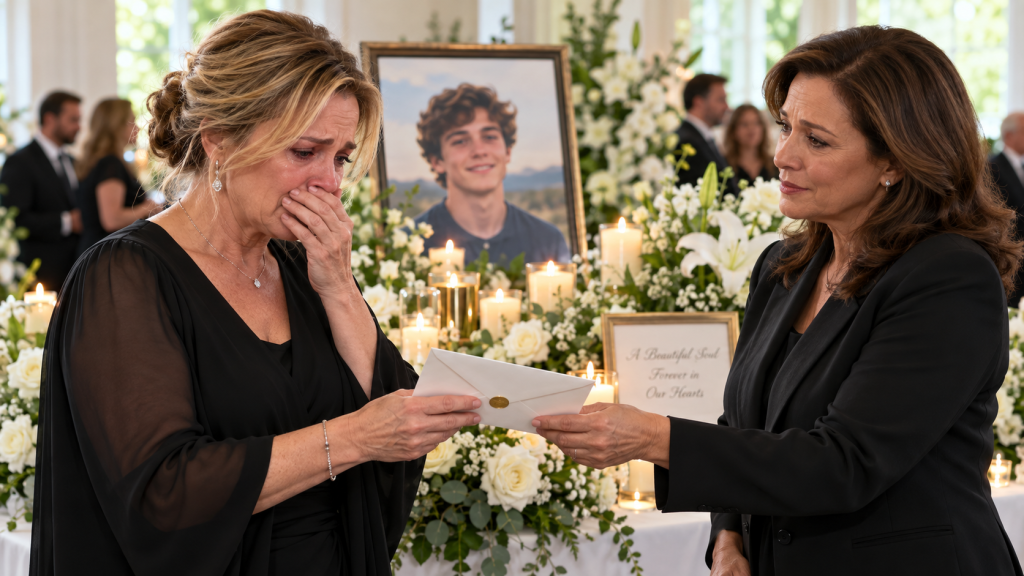
“There’s one more thing,” Emily’s mother whispered. “Caleb left something for Emily too—and she wants you there when she opens it.”
I stared at her through tears.
The envelope from my son was still trembling in my hands.
Around us, people moved quietly through the funeral home, speaking in low voices, touching my shoulder, telling me how sorry they were, telling me Caleb had been wonderful, kind, funny, brave.
Words floated around me without landing.
All I could hear was the sentence Caleb had written.
She is not my grave. She is a girl who still has a life to live.
And now this woman was telling me there was something else.
Something Caleb had prepared for the girl who carried his heart.
“What did he leave her?”
I asked.
She shook her head.
“I don’t know.”
That surprised me.
“You don’t?”
“No.”
Her eyes filled again.
“My name is Susan, by the way.”
I realized with shame that in all the shock, I had never even asked.
“Susan.”
I repeated.
She nodded.
“Caleb gave a sealed package to one of the transplant coordinators before he became too weak.”
“He asked that it go to Emily only if the transplant happened.”
My throat closed.
“He knew?”
“That it might be her?”
“Yes.”
Susan swallowed.
“The doctors were careful not to promise anything.”
“He understood that.”
“But apparently Caleb had asked whether, if everything lined up medically and legally, Emily could be considered.”
I looked down at my son’s handwriting.
Of course he had.
Quietly.
Without telling me.
Not because he did not trust me.
Because he knew I would have spent his final weeks clinging to the plan as if saving Emily could somehow make losing him less real.
Susan continued.
“Emily knows there’s something waiting.”
“She hasn’t opened it.”
“Why not?”
Susan’s face broke.
“Because she says she’s afraid.”
“Of what?”
“Of loving him more after he’s gone.”
That sentence went through me.
I looked away before I started crying again.
For a few seconds, neither of us spoke.
Then I asked:
“Where is she?”
“Still recovering.”
“She’s doing well.”
“But the surgery took a lot out of her.”
Of course it had.
A heart transplant was not a fairy tale.
Caleb had died.
Someone had carried his heart into another operating room.
Doctors had placed it inside an eighteen-year-old girl whose own heart could no longer keep her alive.
There were machines.
Incisions.
Medication.
Pain.
Fear.
Nothing about that belonged in a beautiful metaphor.
Yet grief kept trying to make one.
I whispered:
“Does she know I’m here?”
Susan nodded.
“She wanted to come.”
“The doctors said no.”
“Good.”
I surprised myself.
Susan looked at me.
I wiped my face.
“She should be in bed.”
“She should be healing.”
“She shouldn’t be at my son’s funeral because she thinks she owes me something.”
Susan’s eyes filled.
“That’s what Caleb wrote too.”
I stared.
“What?”
She reached into her purse.
Pulled out a folded paper.
“I’m sorry.”
“I probably shouldn’t have read this to you yet.”
“But the coordinator gave me a copy of one line from the instructions Caleb attached to Emily’s package.”
She unfolded it.
His handwriting again.
Messier than the letter in my hands.
He had been weaker by then.
Susan read:
If Emily feels guilty about not coming to anything for me, tell her I donated a heart, not a lifetime of apologies.
A sound came out of me.
Half laugh.
Half sob.
That was my boy.
Even dying, he had found a way to make a sentence sound like him.
Susan laughed too.
Then both of us stood in the corner of my son’s funeral and cried.
I did not meet Emily that week.
Or the next.
The transplant team encouraged patience.
Emily needed to recover.
I needed to grieve.
Nobody used those exact words as if grief had a treatment plan.
But that was the truth.
I went home after Caleb’s funeral to a house that had become unbearable.
His shoes were still by the back door.
One sneaker tipped sideways against the wall.
A cereal bowl sat in the dishwasher from the last morning he had eaten at home.
His jacket hung beside mine.
I walked into his room once.
Then walked out.
For three days, I slept on the couch because opening my bedroom door meant passing his.
People brought food.
So much food.
Lasagna.
Soup.
Chicken.
Bread.
A woman from church left a pie.
I stared at all of it like nourishment was an administrative problem someone else had assigned me.
I had spent nearly a year believing my job was to keep Caleb alive.
Appointments.
Medication schedules.
Insurance calls.
Specialists.
Research.
Second opinions.
Selling the car.
Selling jewelry.
Borrowing rides.
Learning words I had never wanted to know.
Then suddenly there was nothing left to manage.
No next appointment.
No next treatment.
No next question.
Only absence.
People talk about grief as pain.
It is.
But it is also unemployment.
The work of loving someone does not disappear when they die.
Your hands simply no longer know where to put it.
Susan called on the tenth day.
I almost did not answer.
Then I saw her name.
“Hello?”
“Hi.”
Her voice sounded cautious.
“How are you?”
I laughed bitterly.
She immediately said:
“Stupid question.”
“No.”
“Normal question.”
“I just don’t have a useful answer.”
“That’s fair.”
We sat in silence over the phone.
Then Susan said:
“Emily asked about you.”
My chest tightened.
“What did she ask?”
“If you were eating.”
I laughed.
Then cried.
“Caleb used to ask that.”
Susan was quiet.
Then:
“She wants to meet you.”
My hand tightened around the phone.
“When?”
“Not yet.”
I exhaled.
“Okay.”
“The transplant coordinator suggested waiting until she’s a little stronger.”
“Good.”
“But Emily asked if I could tell you something.”
I sat down.
“What?”
“She read Caleb’s letter.”
My heart stopped.
The other letter.
The one for her.
“She did?”
“Yes.”
“Was she alone?”
“No.”
“I was there.”
“She asked me to stay.”
“What did it say?”
Susan paused.
“That’s hers.”
The answer stung.
Immediately.
I hated that it did.
It was my son’s writing.
My son’s final words.
How could part of him belong to someone else now?
Then I remembered his letter.
She is not my grave.
I closed my eyes.
“You’re right.”
I whispered.
Susan’s voice softened.
“But there’s a part addressed to you.”
My eyes opened.
“What?”
“She wants to read that part with you when you meet.”
I swallowed hard.
“Okay.”
Then:
“Is she all right?”
Another pause.
“She’s alive.”
I understood.
That was not the same as all right.
“No rejection?”
“Not right now.”
“They’re watching everything closely.”
“She has to take a lot of medication.”
“She’s exhausted.”
“She cries.”
“Sometimes she wakes up and touches her chest because she can’t believe…”
Susan stopped.
Because she could not say it.
That her daughter’s chest rose and fell because my son’s heart was beating inside it.
I said nothing.
Then Susan whispered:
“I don’t know how to thank you.”
My body went cold.
“Don’t.”
She went silent.
“I’m sorry.”
“No.”
I pressed my fingers against my forehead.
“I’m sorry.”
“I know what you mean.”
“But please don’t thank me.”
“Caleb made the choice.”
“And I…”
My voice broke.
“I would give anything to have him back.”
Susan started crying.
“I know.”
“I know.”
“I’m sorry.”
We both stayed on the phone.
Two mothers with completely opposite miracles.
Her daughter had survived.
My son had died.
Neither fact cancelled the other.
That would take me years to understand.
I met Emily six weeks later.
The hospital arranged it in a quiet family room on a cardiology floor.
Susan arrived first.
Then me.
Then a nurse wheeled Emily in.
The first thing I noticed was how young she looked.
Not eighteen.
Fourteen.
Maybe twelve.
Illness does that sometimes.
It makes someone seem both much older and impossibly young at once.
Emily had dark hair cut to her shoulders.
A pale face.
A loose sweater.
She held a folded blanket against her stomach even though the room was warm.
When she saw me, she froze.
I did too.
Nobody moved.
Then Emily started crying.
Not delicately.
Her face crumpled completely.
“I’m sorry.”
Those were the first words she said to me.
My heart broke.
“No.”
I went to her.
Then stopped.
I did not know whether I was allowed to touch her.
She looked at me.
I opened my arms slightly.
She nodded.
Then I hugged her.
Carefully.
Terrified of hurting her incision.
Terrified of feeling anything beneath her chest.
Terrified I would become some desperate mother pressing my ear against a stranger.
Emily held me.
Her shoulders shook.
“I’m sorry.”
she repeated.
I whispered:
“You have nothing to apologize for.”
“But he—”
“No.”
I pulled back.
I held her face between my hands before realizing how intimate that was.
She did not pull away.
“Caleb wanted this.”
“Do not apologize for being alive.”
She cried harder.
So did I.
Susan stood near the door, one hand pressed over her mouth.
The nurse quietly left.
We sat.
Awkwardly.
There is no etiquette book for meeting the person carrying your child’s donated organ.
Emily looked at me.
Then down.
Then at me again.
Finally she whispered:
“Do I look like what you expected?”
I almost laughed.
“No.”
Her face fell.
“Because I didn’t expect anything.”
That made her smile faintly.
“I kept imagining you.”
she said.
“What did I look like?”
“Tall.”
I laughed.
“I am five-three.”
“I know.”
“I figured that out when you walked in.”
Good.
A little humor.
Air entering the room.
Emily looked at her hands.
“Caleb said you were funny.”
My chest tightened.
“He lied.”
“He said you say that too.”
I closed my eyes.
Of course.
Then she reached into the bag beside her wheelchair.
A white envelope.
Caleb’s handwriting across the front.
EMILY — OPEN WHEN YOU’RE READY TO BE MAD AT ME.
I laughed through tears.
“That sounds like him.”
Emily nodded.
“I was mad.”
“At what?”
“At everything.”
She looked at the envelope.
“At him.”
“At myself.”
“At my heart.”
Then she caught herself.
Her hand went to her chest.
“My old heart.”
She corrected.
“That sounds terrible.”
“No.”
I said.
“It sounds honest.”
Emily took a breath.
“My doctors had been telling us I was running out of time.”
“I knew I needed a transplant.”
“I also knew what that meant.”
“That someone else had to die.”
“People kept saying, ‘Don’t think about it like that.’”
Her voice hardened.
“But how else was I supposed to think about it?”
Susan looked down.
Emily continued.
“I prayed for a heart.”
“Then I hated myself for praying.”
I swallowed.
“Caleb knew.”
She nodded.
“He knew I felt guilty before he was even gone.”
“How?”
“I told him.”
“When?”
“Two months before he died.”
She smiled sadly.
“We were sitting in the hospital cafeteria.”
“He stole half my fries.”
“That sounds like him.”
“I told him I felt horrible whenever the transplant team called because part of me hoped they were calling to say there was a donor.”
“She stopped.”
“Caleb said…”
Emily’s mouth trembled.
“He said, ‘Somebody else’s tragedy doesn’t become your crime because it saves you.’”
My eyes filled.
That boy.
My boy.
Giving wisdom away as if he had years left to use it himself.
Emily continued.
“When he got worse, he stopped talking about himself.”
“I knew something was wrong.”
“He kept telling me he was tired.”
“I thought he meant treatment.”
“He never told me…”
Her voice broke.
“That he was dying?”
She nodded.
Anger rose inside me.
Not at her.
At Caleb.
Suddenly.
Unexpectedly.
My son.
Who had spent his last weeks deciding what everyone else was allowed to know.
I whispered:
“He didn’t tell me about you.”
Emily looked up.
“What?”
“Not once.”
Her face went pale.
“I thought you knew.”
“No.”
“He said…”
She stopped.
“What?”
“He said his mom had enough to carry.”
I laughed without humor.
“Of course he did.”
Emily looked frightened.
“Are you angry?”
“Yes.”
I answered.
Her eyes widened.
“At him.”
I said.
“Not you.”
That mattered.
“I loved that boy more than anything.”
“And apparently he spent his final months trying to protect every woman around him by keeping half his life secret.”
Emily smiled through tears.
“That sounds right.”
We both laughed.
It hurt.
It also helped.
Then Emily opened the letter.
“Can I read some of it?”
she asked.
I looked at her.
“It’s yours.”
“You decide.”
She nodded.
Then unfolded it.
Her hands trembled.
“Okay.”
She read:
“Emily,
If you are reading this, one of two impossible things happened. Either somebody broke the rules and gave you this early, in which case put it down and yell at them, or I died and somehow the doctors decided my heart could help you.”
Emily stopped.
Took a breath.
Then continued.
“I’m hoping for the second thing, which is a weird sentence to write when it contains the words ‘I died.’”
I laughed through tears.
Of course.
“First: don’t make my death prettier because of what happened afterward. Dying still sucks. Mom is still going to hate it. You’re still allowed to hate it. I’m allowed to have hated it too.”
My hand flew to my mouth.
He had hated it.
That sentence mattered more than I knew I needed.
Caleb had been so calm at the end.
So focused on me.
On donation.
On arrangements.
Part of me had begun torturing myself with the idea that maybe he had been ready to leave.
He had not.
He had simply been brave while not wanting to go.
Emily continued.
“Second: if my heart goes to you, it is your heart.”
She stopped crying entirely.
So did I.
The room changed.
“It is not mine on loan.”
“Not Mom’s.”
“Not a memorial you have to carry around carefully.”
“Yours.”
I looked at Emily’s chest.
Then away.
My son had known me better than I wanted.
Emily’s voice shook.
“You don’t have to like my music because I liked it.”
“You don’t have to eat Mom’s lasagna even though it is objectively better than your mother’s.”
Susan gasped.
“That little liar.”
We all laughed.
Emily wiped her eyes.
Then continued.
“You don’t have to date someone I would approve of, go to college because I wanted to, celebrate my birthday, visit my grave, or become the life I didn’t get.”
“You already have a life.”
“Go be unreasonable with it.”
I closed my eyes.
There was my son.
Nineteen years old.
Dying.
Writing freedom into another person’s future.
Emily’s voice became smaller.
“Third: I love you.”
She stopped.
The silence that followed was almost physical.
Susan turned away.
I pressed my fingers against my mouth.
Emily stared at the page.
Then read:
“I don’t know what kind of love because we were in a hospital and everything was upside down and we never even got to have one normal date.”
“But I know I wanted more time with you.”
“If there had been more time, I would have asked you to go somewhere with me where nobody knew our diagnosis.”
“A bad diner.”
“A terrible movie.”
“Anywhere ordinary.”
“I’m sorry we didn’t get ordinary.”
Emily sobbed.
I reached for her hand.
She held mine.
Then she continued.
“Last: my mom.”
My entire body went still.
Emily looked at me.
“Do you want me to stop?”
“No.”
My voice barely worked.
“Please.”
She read.
“My mom loves like it’s a full-time job.”
I laughed through tears.
“She will want to know whether you’re eating enough.”
“She will probably look at you and see me at first.”
“Please don’t hate her for that.”
My chest cracked open.
“But do not let her turn you into me.”
I stopped breathing.
Emily’s eyes filled.
“She’ll understand eventually.”
“I hope.”
“If she tries to make you responsible for keeping me alive, tell her I said she’s being impossible.”
I cried harder.
“She hates being called impossible.”
I laughed.
“He was right.”
Emily smiled.
Then the last lines:
“Mom, if you’re hearing this, I love you.”
“I know you think losing Dad already means losing me is some kind of cosmic punishment.”
“It isn’t.”
“Bad things are not always messages.”
“Sometimes they’re just bad.”
“You gave me nineteen years that felt like a whole life when I was inside them.”
“Don’t spend whatever years you have left standing at the end of mine.”
“Keep going.”
“Both of you.”
“Please.”
Emily lowered the letter.
Nobody spoke.
I wanted to be angry with him.
I was.
I wanted to grab him by the shoulders and demand why he thought he had the right to make dying sound so simple.
He had no idea what waking up without him felt like.
He had no idea what walking past his bedroom door did to me.
He had no idea how quiet a house could become.
Then another part of me understood.
He had known enough.
Enough to be afraid I would make grief my address.
Enough to leave directions out.
There was a small box too.
Emily opened it.
Inside was a cheap plastic bracelet.
Blue thread.
A little silver-colored charm shaped like a compass.
Emily laughed immediately.
“Oh my God.”
“What?”
“He won this.”
“Where?”
“Hospital gift shop.”
“What?”
She held it up.
“They had this ridiculous fundraising carnival in the children’s wing.”
“Caleb tried to win me a stuffed bear.”
“He missed every game.”
“That also sounds like him.”
“Finally he got enough tickets for this.”
She turned the compass charm.
“It doesn’t even point north.”
I laughed.
Caleb had given a dying girl a broken compass.
Perfect.
Emily found another note beneath it.
It doesn’t work. Neither do plans. Wear it anyway.
Susan laughed so hard she cried.
I did too.
For the first time since Caleb died, laughter did not feel like betrayal.
That surprised me.
Then came the moment I had both wanted and feared.
Emily looked at me.
“Do you want to hear it?”
My body went cold.
She did not have to explain.
The heart.
Caleb’s heart.
My son’s heart.
Beating inside her.
I stared at her chest.
Then at her face.
Emily touched the collar of her sweater.
“The coordinator said some donor families want to.”
“I can ask for a stethoscope.”
Susan watched me.
Nobody pushed.
I thought I would say yes immediately.
Instead, I started shaking.
“I don’t know.”
Emily nodded.
“That’s okay.”
“What if…”
I could not finish.
“What?”
“What if I hear him?”
The question sounded insane.
Emily understood anyway.
“You won’t.”
she whispered.
My eyes filled.
“I know.”
The heart was muscle.
A miraculous organ, yes.
But it did not contain Caleb’s voice.
His jokes.
His memories.
His habit of leaving wet towels on the bathroom floor.
The way he sang the wrong lyrics on purpose.
Those things were gone from the body.
Alive only in people who remembered.
Still, I was afraid.
Afraid that hearing the beat would make me believe he was trapped there.
Afraid I would never stop wanting to hear it.
I said:
“Not today.”
Emily squeezed my hand.
“Okay.”
No disappointment.
No obligation.
That was the first boundary between us.
I am glad I set it.
I am even more grateful she respected it.
We met again three months later.
Not at the hospital.
At a café.
Emily walked in on her own.
Slowly.
But walking.
She had gained weight.
Color had returned to her face.
Her hair was longer.
The broken compass bracelet circled her wrist.
I noticed immediately.
Then felt guilty for noticing.
She saw.
“I like it.”
she said.
“You don’t have to wear it.”
“I know.”
“Caleb specifically said—”
“I know.”
She smiled.
“I wear it because I like it.”
Good.
That was the answer I needed.
Susan came too.
The three of us ordered lunch.
Emily got fries.
I laughed.
“What?”
she asked.
“Nothing.”
“Caleb stole your fries.”
“He did.”
“I’m protecting mine.”
She pulled the basket closer.
I laughed harder.
Then stopped.
Because for half a second, when she rolled her eyes, something looked like him.
Not actually.
Not physically.
Just a gesture.
A coincidence.
My grief lunged toward it anyway.
Emily noticed my face.
“What?”
“Nothing.”
She watched me.
Then:
“You saw him.”
I looked down.
“I’m sorry.”
“Don’t be.”
She took a fry.
“But tell me when it happens.”
I looked up.
“Why?”
“Because I can tell anyway.”
Smart girl.
So I told her.
“You rolled your eyes like him.”
She smiled sadly.
“Maybe he taught me.”
“Maybe.”
Or maybe eighteen-year-olds around the world roll their eyes in exactly the same irritating way.
Not everything had to be mystical.
I learned that slowly.
That spring, Emily graduated from high school.
She invited me.
I almost said no.
Then yes.
Then no again.
Finally I went.
I sat with Susan.
When Emily’s name was called, she crossed the stage.
Carefully.
Strongly.
The crowd applauded.
I cried.
Not because Caleb should have been there instead.
That thought came.
Of course it did.
He should have been graduating college one day.
Getting married.
Building a life.
All the things I lost.
But Emily’s graduation was not evidence of his stolen future.
It was hers.
I stood.
Clapped.
Afterward, Emily found me in the crowd.
Cap crooked.
Smile enormous.
She hugged me.
“I did it.”
“You did.”
Then, without thinking, I said:
“He would be proud.”
Her smile faltered.
My stomach dropped.
Too much.
Too fast.
I touched her arm.
“Sorry.”
She looked at me.
“No.”
“I think he would too.”
Then she added:
“But I’m proud of me.”
My eyes filled.
“Yes.”
I smiled.
“You should be.”
That was the first time I understood the work Caleb had left me.
Not loving Emily less.
Loving her accurately.
The first time I heard Caleb’s heart was almost a year after the transplant.
Emily asked again.
We were at the hospital for her anniversary appointment.
I had joined her and Susan for lunch afterward.
The transplant coordinator happened to be there.
Emily looked at me.
“One year.”
I knew what she meant.
My stomach tightened.
Then I nodded.
“Yes.”
A stethoscope appeared.
Such a small thing.
Metal.
Rubber tubing.
Ordinary.
My hands shook so badly Emily reached to steady them.
Then stopped before touching me.
My choice.
I put the earpieces in.
The nurse showed me where to place the chest piece.
Emily adjusted her blouse carefully.
I pressed the stethoscope against her chest.
And heard it.
Lub-dub.
Lub-dub.
Lub-dub.
Strong.
Steady.
Alive.
My knees almost gave out.
I closed my eyes.
For one impossible second, I was pregnant again.
Caleb’s heartbeat on an ultrasound.
Fast.
Tiny.
A sound from inside me.
Then he was five.
Running through sprinklers.
Nine.
Feverish in my bed.
Thirteen.
Slamming a door.
Sixteen.
Learning to drive.
Nineteen.
Holding my hand in a hospital bed.
Mom, I want to do something useful.
The sound in the stethoscope continued.
Lub-dub.
Lub-dub.
I started sobbing.
Emily cried too.
Then something happened that I did not expect.
I opened my eyes.
And saw her.
Not Caleb.
Emily.
Tears on her face.
Scar beneath her blouse.
Her chest rising.
Her heart beating.
Yes.
His donated heart.
But hers now.
Exactly as he had written.
I removed the stethoscope.
Handed it back.
Then I put both hands around Emily’s face.
“Thank you.”
She froze.
“For what?”
“For letting me hear.”
Her eyes filled.
Then I added:
“You never have to let me again.”
She cried.
So did Susan.
That was the only time I ever asked.
Grief became less dramatic after that.
Not smaller.
Different.
I returned to work.
Bought a used car.
Nothing fancy.
I had sold mine during Caleb’s illness.
For months I took buses because buying another felt like admitting there would be no more specialists to pay.
Eventually, practical life won.
I found a blue sedan.
Caleb would have hated the color.
I bought it partly for that reason.
I cleaned his room slowly.
Not all at once.
Shoes first.
Then clothes.
I kept the jacket.
Donated most of the rest.
His phone remained in a drawer for two years before I could turn it off permanently.
There were messages with Emily.
I never read them.
I wanted to.
God, I wanted to.
But they were theirs.
Death did not make me entitled to every private piece of my son.
That lesson hurt.
It also kept me from turning memory into possession.
Emily went to college.
Not medicine.
Everyone assumed she would choose medicine after everything.
She chose architecture.
Caleb had hated drawing straight lines.
I loved that.
Her first semester was difficult.
Medication schedules.
Appointments.
Fatigue.
Fear of infection.
Normal college problems layered over abnormal ones.
Roommates.
Exams.
Homesickness.
A boy named Marcus who broke her heart and became my enemy despite never meeting me.
Emily laughed when I told her.
“Caleb said you would do that.”
“I have standards.”
“You don’t know him.”
“I know enough.”
She rolled her eyes.
There it was again.
I smiled.
But did not say it looked like Caleb.
Some similarities could remain private.
Then I made a mistake.
A big one.
It happened during Emily’s second year of college.
Susan called me late at night.
Emily had been admitted to the hospital.
Fever.
Abnormal labs.
Concern about rejection.
That word.
Rejection.
I dropped the phone.
Literally.
It hit the kitchen floor.
For eleven months, I had done so well learning that Emily was not Caleb.
Then one medical word destroyed all the progress.
I drove to the hospital before anyone asked me to.
Three hours.
I arrived at two in the morning.
Susan was in the waiting room.
She looked exhausted.
I rushed toward her.
“What happened?”
“They’re running tests.”
“What did the echo show?”
“I don’t know.”
“Biopsy?”
“Maybe.”
“Where is she?”
“Upstairs.”
“I need to see her.”
Susan touched my arm.
“She’s sleeping.”
“I don’t care.”
Susan’s face changed.
I heard myself too late.
I continued anyway.
“We can’t lose it.”
Silence.
Susan stared.
“What?”
“The heart.”
The moment the words left my mouth, I knew.
Too late.
Susan stepped back.
“Her.”
My face went cold.
“What?”
“We can’t lose her.”
she said.
“Not it.”
“Not the heart.”
“Emily.”
I covered my mouth.
“Oh God.”
Susan’s eyes filled.
“I know you didn’t mean it.”
“I did.”
I whispered.
“That’s worse.”
“No.”
“I did.”
My chest tightened.
“For one second, all I could think was Caleb.”
“I know.”
Susan looked tired.
Not angry.
That hurt more.
“I know.”
I started crying.
“I’m sorry.”
“She’s not my son.”
“No.”
“She’s not.”
“And the heart…”
I could barely say it.
“Belongs to her.”
Susan nodded.
“Yes.”
I sat down.
Then cried so hard a nurse brought water.
Emily found out.
Of course.
Susan did not hide it.
Good.
Secrets had already done enough harm.
When Emily woke, she asked to see me.
I almost refused.
Then realized refusing would only make my shame her responsibility.
I went in.
She looked pale.
IV in her arm.
Monitor beside her.
The sight nearly destroyed me.
I sat.
“I’m sorry.”
Emily watched me.
“I know.”
“No.”
“I need to say it right.”
She waited.
“When Susan called, I got scared.”
“I stopped seeing you.”
“I started seeing Caleb’s heart as something I could lose again.”
“I said ‘we can’t lose it.’”
Her face tightened.
“I know.”
“That was terrible.”
“Yes.”
I nodded.
No defending.
No:
But you understand.
No:
Grief made me.
Just yes.
“I’m sorry.”
Emily looked toward the window.
For a long time, she said nothing.
Then:
“Sometimes I feel like everybody is looking at my chest.”
My throat closed.
“Doctors.”
“People who know.”
“Donor people.”
“Even Mom sometimes.”
Susan was not there.
Emily continued.
“And sometimes I want to scream that I am not a box carrying something important.”
Tears filled my eyes.
“You’re not.”
“I know.”
“But when you said it…”
She swallowed.
“It made me feel like if this heart fails, I fail Caleb.”
“No.”
I reached toward her.
Stopped.
“You could never fail him that way.”
“What if my body rejects it?”
“That would be biology.”
“Not betrayal.”
She looked at me.
I remembered Caleb’s line.
Bad things are not always messages.
Sometimes they are just bad.
I said it.
Emily cried.
“So did I.”
Eventually, she held out her hand.
I took it.
Then she said:
“I need you to stop calling it Caleb’s heart.”
That hurt.
Deeply.
I did not let the hurt become her problem.
I nodded.
“Okay.”
“It was his.”
“Yes.”
“Now it’s mine.”
“Yes.”
“And I don’t want to feel guilty saying that.”
“You shouldn’t.”
She stared.
“Can you do that?”
I thought.
Then answered honestly.
“I can learn.”
That was enough.
The doctors treated Emily.
The problem was caught early.
Treatment worked.
She recovered.
But something changed between us.
Good change.
Necessary.
I stopped introducing her as “the girl who received my son’s heart.”
If people knew, fine.
If they did not, I said:
“This is Emily.”
That was all.
When she graduated college, I cried because Emily graduated.
When she got her first architecture job, I celebrated Emily.
When she fell in love with a man named Daniel, I disliked him for exactly fourteen minutes because he had a pierced ear.
Then I remembered I was becoming ridiculous.
Daniel turned out to be gentle, funny, and completely unafraid of medical schedules.
He did not treat Emily like glass.
I liked him for that.
Years passed.
Not many.
Enough.
Caleb’s photographs stopped surprising me when I walked through the house.
His birthday remained hard.
The anniversary of his death remained harder.
Emily sent a message every year at first.
Thinking of you.
Eventually I told her:
“You don’t have to message me today.”
She called.
“Do you not want me to?”
“That’s not what I said.”
“Then what?”
“I don’t want you marking your calendar because you think you owe me.”
Silence.
Then she said:
“I don’t.”
“I remember him.”
“Okay.”
So we kept it.
Choice.
Not obligation.
That difference saved us.
Susan and I became friends in a strange way.
Not best friends.
Something harder to name.
We understood an equation no one else could.
My worst day had been attached to her best news.
Her joy had come through my loss.
Neither of us caused that.
Still, the relationship required honesty.
Once, over coffee, she admitted:
“For the first year, I was afraid to complain about Emily around you.”
I stared.
“Why?”
“How could I say she was driving me crazy when…”
She stopped.
“When Caleb was dead?”
She nodded.
I laughed.
“Susan.”
“What?”
“I would have given anything to have Caleb alive enough to annoy me.”
“I know.”
“But that does not mean Emily stopped being annoying.”
Susan laughed so hard coffee nearly came out her nose.
Good.
After that, she complained freely.
Emily left dishes everywhere.
Forgot to call.
Dated badly.
Changed majors once before returning to architecture.
Life.
That was what Caleb had wanted for her.
Not sacred survival.
Life.
Messy.
Ungrateful.
Ordinary.
On what would have been Caleb’s twenty-fifth birthday, I went to his grave alone.
I brought no flowers.
He hated flowers.
I brought a cheeseburger.
Ridiculous.
I ate it sitting on a bench nearby.
Then read his letter again.
The one he had left me.
I had read it hundreds of times.
That day, one line felt different.
You gave me nineteen years that felt like a whole life when I was inside them.
For six years, I had read it as comfort.
That day, I heard gratitude.
Not for perfect motherhood.
I had not been perfect.
I yelled.
Worried too much.
Worked late.
Forgot permission slips.
Once left him at soccer practice for forty minutes because I wrote the wrong time on the refrigerator.
He survived my mistakes.
Until he did not survive his disease.
Those were different things.
I touched the stone.
“Emily’s doing well.”
I smiled.
“She’d kill me for reporting on her.”
Then:
“She says the heart is hers.”
Wind moved through the trees.
“I know.”
My eyes filled.
“It took me a while.”
I laughed.
“You knew it would.”
Then I whispered:
“I miss you.”
That truth had not become smaller.
It had simply learned to coexist with everything else.
Emily and Daniel got engaged when she was twenty-seven.
She called me before announcing it publicly.
“Can I ask you something?”
“Of course.”
“Will you come dress shopping?”
I cried immediately.
She laughed.
“I haven’t even told you when.”
“I don’t care.”
Then I stopped myself.
“Wait.”
“Do you want me there because you want me there?”
Emily groaned.
“Yes.”
“Not because of Caleb?”
“No.”
“Not because you think—”
“If you keep asking, I will uninvite you.”
I smiled.
“Good.”
That was exactly the answer Caleb would have wanted.
Dress shopping was chaos.
Susan cried at every gown.
I cried at two.
Emily hated anything with lace.
Daniel’s sister joined.
Nobody talked about hearts.
Nobody talked about donors.
We argued about sleeves.
Glorious.
Ordinary.
Before the wedding, Emily asked me another question.
A harder one.
“Would it hurt you if I didn’t mention Caleb?”
I looked at her.
We were sitting in my kitchen.
The same kitchen where I had spent countless nights after his death believing I would never feel normal again.
“During the ceremony?”
“Yes.”
She looked ashamed.
“I thought about putting something in the program.”
“Then I realized…”
She stopped.
“What?”
“This is my wedding.”
I smiled.
“Yes.”
Tears filled her eyes.
“Does that make me horrible?”
“No.”
I reached across the table.
“It makes you exactly what he told you to be.”
She started crying.
“I loved him.”
“I know.”
“I love Daniel.”
“I know.”
“It feels weird.”
“Because people teach us love has to erase what came before to be real.”
She looked at me.
“When did you get wise?”
“Trauma.”
I said.
“Very expensive.”
She laughed.
Then:
“I want one thing.”
“What?”
“The bracelet.”
The broken compass.
She had stopped wearing it years earlier.
Kept it in a box.
“I want it tied around my bouquet.”
I smiled.
“Because you want it?”
She glared.
“Do not start.”
I laughed.
“Okay.”
At the wedding, Emily walked down the aisle beside Susan.
Beautiful.
Alive.
Her bouquet held white flowers.
Around the stems, barely visible, a faded blue thread bracelet.
Daniel cried.
Emily laughed at him.
I cried at both.
During the ceremony, Caleb’s name was not spoken.
And somehow he was not absent.
Not because his heart was beating inside the bride.
I had learned not to make that the center.
He was present because love leaves language behind.
The way Emily refused guilt.
The way I had learned to let go.
The ridiculous broken compass.
The years that came after nineteen.
When Emily said her vows, she promised Daniel:
“I will not make fear make decisions for both of us.”
My breath caught.
Later I asked where that came from.
She smiled.
“Life.”
Good answer.
At the reception, Daniel found me near the cake.
“Can I tell you something?”
“Depends.”
He smiled nervously.
“I know about Caleb.”
“I assumed.”
“Emily told me everything.”
I waited.
He continued.
“I used to be intimidated by it.”
“What?”
“That there was someone before me who literally…”
He stopped.
I appreciated that.
“Whose donated heart keeps her alive?”
“Yes.”
I nodded.
“That’s a lot.”
“It is.”
He looked across the room at Emily.
“But then I realized I was thinking about it wrong.”
“How?”
“I was competing with a dead nineteen-year-old in a race nobody entered.”
I laughed.
“That will exhaust you.”
“Yes.”
He smiled.
“Caleb loved her.”
“I love her.”
“Those facts don’t fight.”
My throat tightened.
“You’re good for her.”
Daniel looked terrified.
“Please tell her that.”
“Absolutely not.”
He laughed.
Good.
Years later, Emily became a mother.
That was a complicated decision medically.
Her doctors were involved.
Specialists.
Planning.
Fear.
I stayed out of it unless invited.
Growth.
When her daughter was born, Emily sent me a photograph.
A tiny baby wrapped in pink.
I stared for a long time.
Then called.
“She’s beautiful.”
“I know.”
“Name?”
“Clara.”
Not Caleb.
I did not expect Caleb.
I had not realized some part of me wondered until I felt relieved.
Emily said:
“Middle name Rose.”
“Beautiful.”
Then:
“I want you to meet her.”
My throat tightened.
“Of course.”
When I held Clara, I did not think:
Caleb’s heart helped create this baby.
Not first.
I thought:
She has Emily’s nose.
That felt like victory.
Caleb’s heart carried Emily for many years.
Long enough for her to become something neither he nor I could have predicted.
Architect.
Wife.
Mother.
Terrible cook.
Excellent friend.
A woman who once called me at midnight because she had accidentally dyed a white blouse pink and apparently believed motherhood made me an expert in laundry.
Ordinary.
That word became sacred to me.
Not because her life was always easy.
There were hospitalizations.
Medication changes.
Scares.
Transplant medicine does not become irrelevant because the story wants a happy ending.
We learned to respect uncertainty without letting it own every day.
Emily learned that best.
I learned from her.
One summer, when I was sixty-eight, she came to visit alone.
We sat on my porch.
She brought the broken compass bracelet.
The thread was almost gone.
The little charm tarnished.
“I think this thing has finally died.”
I laughed.
“It never worked.”
“I know.”
She turned it in her fingers.
“Do you want it?”
I looked at her.
“No.”
She seemed surprised.
“Really?”
“It was yours.”
“It still is.”
She smiled.
Then:
“I’m going to put it in a memory box for Clara.”
“Good.”
She looked toward the yard.
“Can I ask you something?”
“Yes.”
“Do you still think of him when you see me?”
I thought carefully.
“Sometimes.”
She nodded.
“Less?”
“Yes.”
“Does that make you sad?”
I looked at her.
“No.”
And it was true.
At first, Emily had been almost unbearable to look at because every breath felt borrowed from Caleb.
Now she was Emily.
Caleb had become part of the story of how we met.
Not the definition of who she was.
I said:
“I think he would have liked that.”
She smiled.
“Me too.”
Then she leaned back.
“Good.”
We sat quietly.
No ghosts needed.
When I was younger, I thought losing my husband was the worst grief I would ever survive.
Then Caleb died.
I discovered grief does not respect rankings.
You do not become prepared because you have suffered before.
You simply recognize some of the furniture.
The sleepless nights.
The anger.
The impossible mornings.
The guilt when you laugh.
The first time you forget for ten seconds and then remember.
But Caleb’s death taught me something his father’s had not.
Love can continue without demanding possession.
That took me years.
I wanted every part of Caleb to remain mine.
His room.
His clothes.
His messages.
His heart.
Especially his heart.
Then my son, with better wisdom at nineteen than I had in middle age, wrote:
If my heart goes to you, it is your heart.
Not mine.
Not Mom’s.
Yours.
It took me a long time to understand what generosity that required.
Donation was not a way for me to keep part of Caleb physically close.
It was Caleb giving something away.
Completely.
That is what made it a gift.
People sometimes asked whether hearing his heart helped me heal.
I never knew how to answer.
It helped.
It hurt.
Both.
The heartbeat did not bring my son back.
It did not sound like him.
It did not contain a message.
It was a heartbeat.
Strong.
Steady.
Inside Emily.
The healing came later.
When I stopped needing it to be Caleb.
That difference changed everything.
Susan died before I did.
Cancer.
Fast.
Unfair.
Emily called me from the hospital.
This time, I went because she asked.
I sat beside her while her mother slept.
Emily was forty-two.
Older than Susan had been when Emily first got sick.
She held my hand.
“I can’t do this.”
I almost said:
Yes, you can.
I stopped.
I remembered how much I hated being told I could survive things I had never agreed to face.
So I said:
“I know.”
She cried.
After Susan died, Emily looked at me and whispered:
“Now I have two dead parents and one extra mother.”
I laughed through tears.
“Extra?”
“Bonus?”
“Worse.”
“Spare?”
“Absolutely not.”
We laughed.
Then cried again.
I did not replace Susan.
Could not.
Did not try.
I was simply still there.
That was enough.
Later, Emily gave me something Susan had kept all those years.
A copy of Caleb’s first letter to her.
Not the whole thing.
A single page Susan had photocopied with Emily’s permission.
The part about me.
My mom loves like it’s a full-time job.
I smiled.
Emily said:
“Susan kept that because she said it explained you perfectly.”
I touched the paper.
“Your mother was very wise.”
“She thought you were bossy.”
“She was also wrong sometimes.”
Emily laughed.
Then her face softened.
“I don’t know what I would have done without both of you.”
I shook my head.
“You would have lived.”
“I know.”
She smiled.
“That’s not the same as saying it wouldn’t have been harder.”
Fair.
I took the compliment.
Growth.
When I finally became old enough to think seriously about my own death, I updated my will.
Nothing dramatic.
House.
Savings.
A few personal things.
Caleb’s letters went to a small box marked:
FOR FAMILY — READ IF YOU WANT, NOT BECAUSE YOU HAVE TO.
The original letter Emily received remained hers.
Of course.
The copy of my letter stayed with me.
My used blue sedan had long since died.
The family gold I sold during Caleb’s illness was gone forever.
For years, I regretted selling it because treatment did not save him.
Then I stopped.
I had spent what I had trying to help my son.
There was no shame in that.
The fact that it failed did not make the love foolish.
That was another lesson grief took too long to teach me.
On Caleb’s fiftieth birthday—the age he never reached—I went to the cemetery with Emily.
She was forty-nine.
Gray beginning at her temples.
A scar still visible when her blouse shifted.
Daniel came too, but stayed by the car for a while to give us space.
Emily carried two coffees.
We sat near Caleb’s grave.
She said:
“This feels weird.”
“Everything about us is weird.”
“Fair.”
She looked at the stone.
“I’ve lived thirty years longer than he did.”
“Yes.”
“I used to feel guilty about every birthday.”
“I know.”
“I don’t anymore.”
“Good.”
Then she looked at me.
“Do you?”
“About what?”
“That he didn’t get these years.”
My eyes filled.
“Yes.”
Honesty.
“I always will.”
She nodded.
Then:
“But you don’t wish he hadn’t donated?”
I looked at her.
“No.”
The answer was immediate.
Then I clarified.
“I wish he had not died.”
“I wish none of it had happened.”
“I wish you had gotten some other miracle that did not require anyone’s death.”
“I wish diseases listened to mothers.”
Emily smiled sadly.
“But given what happened?”
I touched her hand.
“No.”
“I am glad he got to choose something.”
She cried.
“So am I.”
We sat.
Then Emily said:
“I have something for you.”
She reached into her bag.
Pulled out the broken compass bracelet.
Or what remained of it.
The blue thread had been replaced years earlier to preserve the charm.
“I thought Clara had this.”
“She did.”
“She gave it back to me.”
“Why?”
Emily smiled.
“Because she says it points nowhere.”
I laughed.
“Smart child.”
Then:
“What do you want me to do with it?”
“Nothing.”
Emily placed it in my palm.
“I thought maybe today it could come back to you.”
My first instinct was to refuse.
Caleb gave it to her.
It belonged to her.
Then I understood.
Emily was not returning a debt.
She was giving me something she no longer needed to hold.
Choice again.
I closed my fingers around it.
“Okay.”
She smiled.
I kept it.
Not as part of Caleb’s heart.
As part of his humor.
Much safer.
When I got home, I placed the compass beside his photograph.
The needle still pointed wrong.
I laughed.
Then read the tiny note I had saved a copy of:
It doesn’t work. Neither do plans. Wear it anyway.
Caleb’s whole life had become that sentence.
Nothing went to plan.
Not his health.
Not my motherhood.
Not Emily’s youth.
Not Susan’s future.
Not mine.
Yet life continued.
Not because plans eventually worked.
Because people adjusted when they did not.
I spent years believing Caleb’s final gift was his heart.
It was not.
That was Emily’s gift.
Her heart.
Her life.
Her future.
The final gift he left me was harder.
Permission.
Permission to stop treating grief as loyalty.
Permission to love someone connected to him without turning her into him.
Permission to admit I was angry.
Permission to laugh.
To buy another car.
To clean his room.
To stop listening for his footsteps.
To become a person whose identity was larger than “Caleb’s mother who lost him.”
I remained his mother.
Death did not revoke that.
But motherhood changed shape.
It stopped being appointments.
Meals.
Laundry.
Worry.
It became memory.
Story.
The occasional cheeseburger beside a grave.
And a promise I finally learned how to keep.
Don’t spend whatever years you have left standing at the end of mine.
I didn’t.
Not forever.
The last time I saw Emily before my own health began failing, she was standing in my kitchen arguing with Clara about whether twenty-two was too young to travel through Europe alone.
I listened from the table.
Emily said:
“You need a plan.”
Clara groaned.
“Mom.”
“A real plan.”
“Hotels.”
“Emergency contacts.”
“Insurance.”
“Your medications—”
“Mom!”
I started laughing.
Emily looked at me.
“What?”
“Nothing.”
“No.”
She narrowed her eyes.
“What?”
I pointed toward the old compass sitting on the shelf.
Emily followed my finger.
Then laughed.
“Oh, shut up.”
Clara looked confused.
I said:
“Your mother once owned a compass that pointed in the wrong direction.”
Clara stared.
“She still does.”
Emily said.
“She gave it to me.”
Clara rolled her eyes.
Three generations.
There it was.
Emily laughed.
Then told her daughter:
“Fine.”
“Go.”
“But call me.”
Clara hugged her.
“I will.”
I watched.
For one dangerous second, grief tried to whisper:
Caleb should have had this.
A child.
Arguments.
Gray hair.
A kitchen.
Maybe.
He should have had the chance.
That grief remained true.
But another truth stood in front of me.
Emily had this.
Not instead.
Also.
Life is not a balance sheet where one person’s future cancels another’s loss.
It is messier.
Kinder sometimes.
Crueler sometimes.
Mostly both.
After Clara left, Emily sat beside me.
“You okay?”
“Yes.”
“You made the face.”
“What face?”
“The Caleb face.”
I smiled.
“You still know it?”
“Always.”
Fair.
I looked at her.
“I thought he would disappear if I stopped looking for him everywhere.”
Emily’s eyes softened.
“Did he?”
“No.”
I looked toward the photograph.
“He became easier to find.”
“Where?”
I thought.
“Not in you.”
She nodded.
She understood.
“In me.”
I touched my chest.
“Memory.”
“Things he taught me.”
“Things I hated about him.”
Emily laughed.
“He was terrible at returning texts.”
“Yes.”
“And folding laundry.”
“Criminal.”
We smiled.
Then I said:
“I don’t need your heartbeat to remember him anymore.”
Emily started crying.
So did I.
“That’s good.”
she whispered.
“Yes.”
“It is.”
The night after Caleb died, I believed my life had ended.
Not metaphorically.
I truly believed there could be nothing on the other side worth wanting.
I had already lost my husband.
Then my son.
The two people around whom my world had once been built.
I thought surviving would be an empty technicality.
Breathing.
Bills.
Groceries.
Sleep.
Repeat.
I was wrong.
Not because grief disappeared.
Because life grew around it.
Susan.
Emily.
Work.
Friends.
A used blue car.
Graduations.
A wedding.
A baby.
Arguments.
Bad coffee.
Good laughter.
A broken compass.
Caleb did not give me those things.
That is important.
People sometimes romanticize death until the dead are credited with every beautiful thing afterward.
Caleb died.
That was terrible.
Emily lived.
That was hers.
I kept living.
That was mine.
But my son’s final words helped me understand I was allowed to.
For that, I will always be grateful.
There is a photograph on my dresser now.
Caleb at nineteen.
Skinny.
Too-long hair.
Smiling like he knew something.
Beside it, not touching, is a photograph of Emily and her family.
Daniel.
Clara.
Emily in the middle.
Older.
Laughing.
For years, I thought putting those photographs beside each other would mean one represented what the other lost.
Now they simply tell two stories that crossed once.
Deeply.
Permanently.
But did not become the same story.
Caleb’s story ended at nineteen.
I hate that sentence.
I accept it anyway.
Emily’s continued.
Mine continued too.
And that was what he asked.
Before my son died, he gave away his heart.
For a long time, I thought that meant some part of him had escaped death.
I know better now.
Caleb did not survive inside Emily.
Emily survived because of something Caleb gave.
Those are not the same thing.
And strangely, the second truth is more beautiful.
Because it does not require Emily to carry a dead boy forever.
It allows the gift to become completely hers.
It allows Caleb to be remembered for generosity without pretending generosity defeated death.
And it allows me to love my son for who he was, not for the organ he left behind.
If I could speak to the woman I was at the funeral, the woman clutching that envelope while Susan said her daughter had Caleb’s heart, I would not tell her everything would be all right.
I would have hated that.
I would tell her:
“You are going to be angry longer than you expect.”
“You will resent a girl who did nothing wrong for one terrible second, and then hate yourself for it.”
“You will hear your son’s heartbeat once and believe the room is splitting open.”
“You will make mistakes.”
“You will apologize.”
“You will learn boundaries from a nineteen-year-old letter.”
“You will laugh again.”
“You will feel guilty.”
“Then one day, you won’t.”
“You will love Emily.”
“Not because she carries Caleb’s heart.”
“Because she is Emily.”
“And that will be the moment you finally understand what Caleb gave away.”
Not himself.
A chance.
A chance for someone else to keep going.
That was all.
That was enormous.
Sometimes I still read the final line of his letter to me.
The paper is soft now from years of unfolding.
His handwriting slopes near the bottom.
He had been so tired.
Don’t spend whatever years you have left standing at the end of mine.
Underneath, almost squeezed into the margin, he added one more sentence I did not notice until months after the funeral.
Maybe because tears had blurred it.
Maybe because I was not ready.
It said:
Mom, loving me and living without me are not opposites.
That was my son’s last lesson.
The hardest one.
The truest.
So I kept loving him.
And eventually,
I kept living too.
THE END STORIES! THANK YOU FOR READING GOOD LUCK !❤️
Related Posts