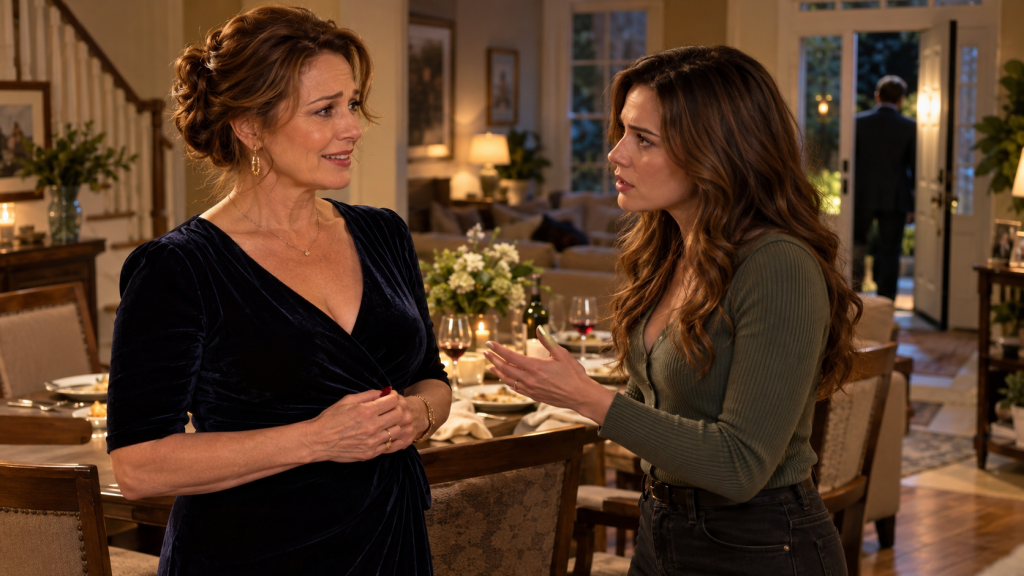
➡️ PART 3 ENDING PART➡️
“Ask your daughter why I was really at your house tonight.”
Mom read the message twice.
Then a third time.
Her hand began to tremble.
I could hear the refrigerator humming behind us, the faint tick of the wall clock, and the sound of a car passing outside on the wet street.
Everything in my mother’s kitchen looked exactly as it had an hour earlier.
The casserole dish still sat beside the sink.
Three wineglasses remained on the table.
Benedict’s napkin was folded carelessly beside the plate where he had eaten two helpings of my mother’s roast chicken and complimented her cooking.
Twenty minutes earlier, Mom had been glowing.
Now she looked as if someone had quietly removed the floor beneath her.
“What does that mean?”
she whispered.
I reached toward the phone, then stopped before touching it.
“Don’t answer yet.”
Mom looked at me.
“What does it mean?”
“I don’t know.”
“You recognized him.”
“Yes.”
“And he knew you might.”
“Yes.”
“Why?”
I took a breath.
“Three years ago, when our legal department was dealing with the situation involving that employee, Martin Cole wasn’t just some photograph buried in a file.”
Mom’s eyes stayed on me.
“He had contacted people through company events.”
“He had used a fake consulting business to make himself look legitimate.”
“One of our employees became involved with him personally.”
“She transferred almost forty thousand dollars to him over several months.”
Mom closed her eyes.
I continued carefully.
“When questions started, he disappeared.”
“The number stopped working.”
“The business address was fake.”
“By the time the police tried to locate him, he was gone.”
Mom looked down at Benedict’s message.
“But you never met him.”
“No.”
“Not face-to-face.”
“So why would he care whether you recognized him?”
That was the question.
The one I had been trying not to ask.
I sat across from her.
“Mom, how did you meet him?”
Her mouth tightened.
“You know.”
“I know you said online.”
She nodded.
“What app?”
She named it.
“How quickly did he ask about me?”
Her expression changed.
“What does that have to do with anything?”
“I don’t know yet.”
“Please.”
She stood.
Not angrily.
Restlessly.
“He knew I had a daughter.”
“Everyone I date knows I have a daughter.”
“Of course.”
I softened my voice.
“When did he learn where I work?”
Mom stopped.
I saw the memory arrive.
“A few weeks in.”
“How?”
“I told him.”
“What exactly did you tell him?”
She looked irritated now.
And embarrassed.
Both.
“I told him the company.”
“Why?”
“Because he asked what you did.”
“That is a normal question.”
“Yes.”
I nodded.
“Did he react?”
Mom looked toward the dark kitchen window.
“He said the name sounded familiar.”
My stomach tightened.
“What else?”
“I don’t remember.”
“Mom.”
“I said I don’t remember.”
Her voice rose.
Then she pressed her fingers against her forehead.
“I’m sorry.”
I waited.
She whispered:
“He asked whether you had always worked there.”
I felt cold.
“And?”
“I told him how long.”
“How long have you and Benedict been dating?”
“Five months.”
I started doing arithmetic in my head.
Mom saw.
“Stop.”
“What?”
“Looking at me like a case.”
That hurt.
Because she was right.
I had gone into problem-solving mode.
Files.
Timelines.
Questions.
She was sitting in the wreckage of a relationship.
I lowered my hands.
“I’m sorry.”
She sat again.
For several seconds neither of us spoke.
Then Mom’s phone began ringing.
BENEDICT.
She stared.
I said:
“You decide.”
She looked at me.
“What?”
“It’s your phone.”
“If you want to answer, answer.”
“If you don’t, don’t.”
Her eyes filled.
“You think I shouldn’t.”
“I think anything important should be saved.”
“That is not what I asked.”
I swallowed.
“No.”
“I don’t think you should speak to him alone right now.”
“Why?”
“Because he already knows you’ve been warned.”
“And because that last message sounds like he’s trying to turn me into the person you should distrust.”
The phone continued ringing.
Mom let it stop.
Immediately, it rang again.
She declined the call.
Then another message appeared.
Loretta, please answer me before she poisons this.
Mom made a small sound.
Not quite a sob.
I looked at the words.
“Don’t delete anything.”
She laughed bitterly.
“Of course.”
“What?”
“You sound exactly like work.”
I took the hit.
“I know.”
Then a new message arrived.
Your daughter knows exactly why her company came after me. Ask her what they did to my life.
Mom turned toward me.
“What did your company do?”
“Nothing to his life.”
“That is not an answer.”
“No.”
I breathed.
“We investigated because an employee reported that a man she was dating had persuaded her to transfer large amounts of money.”
“Corporate legal got involved because he had also been introduced to people through a company networking event and had represented himself as a consultant.”
“There were concerns he had used company names and contacts to appear legitimate.”
“Did you accuse him?”
“No.”
“Did you call the police?”
“Our legal department supported the employee when she made a report.”
“Were you involved?”
“I helped gather emails and photographs because I knew the employee and had access to event records.”
Mom stared at me.
“So he might know your name.”
“Yes.”
“How?”
“My name was on internal emails.”
“Possibly reports.”
“I don’t know what he ever saw.”
Her face changed.
I saw the answer arrive before she said it.
“He knew.”
“Mom—”
“He knew who you were before tonight.”
“I think that is possible.”
“No.”
She stood again.
“He asked three times when he could meet you.”
My stomach dropped.
“What?”
“He said it mattered to him.”
“I thought…”
Her voice broke.
“I thought he wanted my daughter to approve.”
I had no answer for that.
Mom walked toward the sink.
Put both hands on the counter.
“He asked whether you’d be here tonight.”
“Yesterday.”
“And this morning.”
“Did he suggest tonight?”
“Yes.”
I closed my eyes.
This dinner had not been spontaneous.
He had wanted me here.
Mom whispered:
“Why?”
I looked at the message.
Ask your daughter why I was really at your house tonight.
Then something else struck me.
“Mom.”
She turned.
“Has he asked you for money?”
Her expression froze.
There.
My heart sank.
“How much?”
“Don’t.”
“Mom.”
“You walk into my house, tell me the man I love is some criminal, and now you’re going to interrogate my bank account?”
“I am not interrogating you.”
“It sounds like it.”
“I’m scared.”
“So am I!”
Her voice cracked across the kitchen.
Silence followed.
Then she covered her face.
“I’m sorry.”
I stood.
“Don’t be.”
“I am not angry at you.”
“I know.”
“No.”
I moved closer but did not touch her.
“I am not angry at you.”
She lowered her hands.
Tears ran down her face.
“He didn’t ask exactly.”
“What did he ask?”
Mom looked ashamed.
That hurt more than anything.
“He has an investment.”
My stomach clenched.
“What kind?”
“A property deal.”
“Where?”
“Cape Cod.”
“He and a partner are buying a house to renovate.”
“How much did he ask you to put in?”
“He didn’t ask.”
I waited.
Mom looked down.
“He said he didn’t want me involved because it was risky.”
Of course.
The oldest trick in the world sometimes arrives dressed as restraint.
“Then?”
“I asked.”
“How much?”
“Sixty-five thousand.”
My heart pounded.
“Did you give it to him?”
“No.”
Air returned.
Not all of it.
“But…”
There was a but.
“There’s a bank appointment tomorrow.”
I closed my eyes.
“What time?”
“Nine-thirty.”
“For what?”
“I was going to move money from a CD.”
“How much?”
“Sixty-five.”
I sat down.
Mom started crying harder.
“I was going to surprise him.”
My throat tightened.
“Why?”
“He said the deal would close Friday.”
“He said he was embarrassed that his other investor pulled out.”
“He kept saying he would handle it.”
“I thought…”
She wiped her face.
“I thought after everything I’d been through, maybe it would feel good to be the person who could help someone for once because I wanted to.”
I said nothing.
She continued.
“He didn’t pressure me.”
“Not directly.”
“He told me not to.”
“That made me trust him more.”
I nodded slowly.
That was the point.
He had let her persuade herself.
Mom suddenly looked at me.
“Do you think he targeted me because of you?”
I hated the question.
Because I did not know.
And because any answer would hurt her.
“I think we need to find out.”
Her face hardened.
“No.”
“What?”
“I asked what you think.”
I looked at my mother.
The woman who had worked doubles.
Skipped vacations.
Put herself last so many times it became instinct.
The woman who, at fifty-three, finally allowed herself to believe someone was interested in her for no reason except that she was Loretta.
I could not protect her with a softer lie.
“Yes.”
I whispered.
“I think there’s a real possibility he knew who you were before the relationship became serious.”
Mom sat very still.
Then:
“So none of it was real.”
“I didn’t say that.”
“It doesn’t matter.”
“It matters to me.”
I crouched beside her.
“Mom.”
She looked at me.
“I don’t know what he felt.”
“I only know he lied about who he was.”
“And he knew enough about me to be worried I would recognize him.”
“That is what we know.”
She looked at the untouched place where Benedict had been sitting.
Then whispered:
“I told him things.”
I said nothing.
“About your father.”
“About raising you.”
“About how lonely I was after you moved out.”
Her face twisted.
“I told him I was afraid I’d waited too long to be loved.”
I took her hand.
“He listened.”
she said.
“He remembered everything.”
“My coffee.”
“My favorite flowers.”
“The song I liked in high school.”
“He sent me a message every morning.”
She started sobbing.
“How much of that was work for him?”
I had no answer.
So I gave her the truth.
“I don’t know.”
We did not call the police that night because I recognized a photograph.
Recognition is not a crime report.
Instead, I called the attorney who had handled the old matter for my company.
Her name was Dana Ruiz.
It was after ten, but I still had her number.
She answered on the fourth ring.
I apologized.
Then said:
“I think I found Martin Cole.”
She became fully awake.
“Where?”
“My mother’s house.”
“What?”
I explained.
Not every emotional detail.
Enough.
Dana asked:
“Is he there now?”
“No.”
“Do you know where he is?”
“No.”
“Do you have current messages from him?”
“Yes.”
“Save them.”
Of course.
“Did your mother send him money?”
“No.”
“Has she given him account access?”
Mom shook her head.
I repeated no.
“Identification?”
I looked at Mom.
She looked uncertain.
“What?”
I asked.
“Did he ever photograph your driver’s license?”
“No.”
Then:
“Maybe.”
My stomach dropped.
“When?”
“When we booked a trip.”
“What trip?”
“Savannah.”
“He said he needed my details for the hotel and rental car.”
Dana heard.
“Loretta, I want you to assume any identification he had access to may have been copied.”
Mom’s face went pale.
Dana continued.
“Tomorrow morning, contact your bank’s fraud department before the appointment.”
“Tell them there is a concern about attempted financial exploitation and identity information.”
“Do not move the sixty-five thousand.”
Mom nodded, even though Dana could not see.
“What about tonight?”
“Change banking passwords from a device he has never used.”
“Email too.”
“Turn on multi-factor authentication.”
“If he has a key, change the locks.”
Mom’s eyes widened.
“He has a key.”
Of course.
Dana heard that too.
“Then call a locksmith.”
“At this hour?”
“Yes.”
Mom almost laughed.
“This feels insane.”
Dana’s voice softened.
“I know.”
Then:
“But temporary inconvenience is cheaper than guessing.”
That sentence became our motto for the night.
The locksmith arrived at 11:40.
Mom apologized to him three times.
He did not care.
By midnight, Benedict’s key no longer worked.
I helped Mom change passwords.
We froze her credit.
Called the bank’s after-hours fraud line.
Cancelled the morning appointment.
The bank employee noted the concern and said someone from their fraud team would follow up.
Practical.
Boring.
Necessary.
At 12:18, Benedict texted again.
Please stop letting her control you.
Mom stared.
Then something in her face changed.
Small.
Important.
She said:
“He always says that.”
“What?”
“That you control me.”
My stomach tightened.
“When?”
“Not at first.”
“In the last month.”
“He would say I spent too much time worrying what you thought.”
“I assumed he was teasing.”
I sat.
“What else?”
Mom looked at the wall.
“He said you were overprotective.”
“Maybe I am.”
“No.”
She shook her head.
“He hadn’t met you.”
That was the point.
He had already built me into the obstacle.
She whispered:
“He said if we ever got serious, I’d have to learn to make decisions without asking my daughter.”
My chest hurt.
“Did you tell him about the bank appointment?”
“Yes.”
“Did he know the amount?”
“Yes.”
“Did he know which bank?”
Mom closed her eyes.
“Yes.”
The targeting no longer felt theoretical.
Then her phone rang again.
She stared.
This time, she said:
“I want to answer.”
I nodded.
“Okay.”
“On speaker?”
“If you want.”
She pressed accept.
“Benedict.”
His voice came immediately.
“Loretta.”
Warm.
Relieved.
The voice I had heard all through dinner.
“Thank God.”
Mom closed her eyes.
“I need you to explain something.”
“Of course.”
“Is your name Martin Cole?”
Silence.
Not long.
Long enough.
Then:
“That is complicated.”
My stomach turned.
Mom’s fingers tightened around the phone.
“It is a yes-or-no question.”
“I used that name professionally.”
I stared at Mom.
She stared back.
He continued quickly.
“There are things your daughter does not know.”
“She only saw one side.”
Mom’s voice shook.
“Is Benedict your real name?”
Another pause.
“I go by Benedict now.”
“That isn’t what I asked.”
He sighed.
“Loretta, can we not do this over the phone?”
“Is Benedict your legal name?”
“No.”
Mom’s eyes closed.
I wanted to grab the phone.
I did not.
Her choice.
“What is your legal name?”
Silence.
Then:
“Gabriel Mercer.”
I wrote it down.
Mom whispered:
“How many names have you used?”
“Please.”
“How many?”
“People reinvent themselves.”
“That is not an answer.”
His voice hardened slightly.
“Your daughter is turning this into something ugly.”
Mom flinched.
I said nothing.
He continued.
“She has hated me since the second she opened that door.”
Mom opened her eyes.
“No.”
“What?”
“She froze.”
“You saw it.”
“That was recognition.”
He went silent.
Mom continued.
“You knew she might recognize you before you came.”
“I knew there was a chance she had seen an old photograph.”
“Why didn’t you tell me?”
“Because I knew you would react exactly like this.”
There it was.
The logic of deception.
I lied because honesty would have changed your decision.
Mom’s face tightened.
“So why did you want to meet her?”
He did not answer.
“Benedict.”
“Gabriel.”
Whatever.
“Why?”
His voice lowered.
“I needed to know whether the past was going to interfere with us.”
My skin went cold.
There.
The dinner had been a test.
Mom understood too.
“You were checking whether she recognized you.”
“I was checking whether we had a future.”
“No.”
Mom’s voice changed.
“You were checking whether I was safe to keep lying to.”
He breathed out sharply.
“Loretta.”
“And the investment?”
Silence.
“What about it?”
“My daughter thinks you were going to take my money.”
“That is insulting.”
“Were you expecting me to go to the bank tomorrow?”
“I knew you had an appointment.”
“How?”
“You told me.”
“Did you expect me to invest the sixty-five thousand?”
“I told you not to.”
Mom laughed.
It was the saddest sound I had heard all night.
“You told me not to three times.”
“Yes.”
“And each time you told me how much the deal would make.”
Silence.
“You told me your partner had abandoned you.”
“You told me you might lose your deposit.”
“You told me you hated asking anyone for help.”
Then her voice broke.
“You did ask me.”
“Just without saying the words.”
He became defensive.
“You offered.”
“I did.”
“Exactly.”
“That doesn’t make it fraud.”
Interesting word.
He had used it before Mom did.
She heard it.
“So you know that’s what we’re talking about.”
“I know what your daughter has accused me of.”
“You haven’t spoken to her.”
Another silence.
Mom and I looked at each other.
He had just made a mistake.
She whispered:
“How do you know what she’s accusing you of?”
He recovered badly.
“Because of the old situation.”
“What old situation?”
“That woman from her company.”
“What was her name?”
He refused.
Mom asked again.
“What was her name?”
“Loretta, this is absurd.”
“What was her name?”
He snapped:
“She gave me that money.”
Mom went completely still.
He had not denied it.
He had defended it.
I wrote down every word.
He continued.
“She was an adult.”
“She made her own decisions.”
“Your daughter’s company turned it into some predatory story because they needed someone to blame when she embarrassed herself.”
My stomach turned.
Mom said:
“Did you love her?”
“What?”
“The woman who gave you forty thousand dollars.”
Silence.
Then:
“That has nothing to do with us.”
Mom closed her eyes.
“Yes.”
she whispered.
“It does.”
He softened his voice.
“Loretta, listen to me.”
“No.”
“Please.”
“No.”
Her hand stopped shaking.
I watched it happen.
Not because she stopped loving him in one second.
Because some piece of her finally moved from defending the relationship to defending herself.
“Do not come back to my house.”
He went quiet.
“Loretta.”
“Do not use your key.”
“The locks have been changed.”
His voice changed instantly.
“What?”
There.
Anger.
Real.
Not wounded romance.
Loss of access.
Mom heard it too.
“You changed the locks?”
“Yes.”
“That’s insane.”
“You told me not to let my daughter control me.”
“Now you changed your house because she told you to?”
Mom looked at me.
Then said the sentence I will remember for the rest of my life.
“No.”
“I changed them because you lied to me.”
Silence.
He tried again.
“You are making a terrible mistake.”
“Maybe.”
Mom’s eyes filled.
“But this one will be mine.”
Then she ended the call.
Mom collapsed after.
Not physically.
Emotionally.
She sat on the kitchen floor and sobbed.
I sat beside her.
No speeches.
No:
You did the right thing.
No:
You’ll find someone else.
The future is insulting when the present is still bleeding.
So I stayed.
After a while, she leaned her head against my shoulder.
“I loved him.”
“I know.”
“I still love him.”
“I know.”
“Does that make me an idiot?”
“No.”
She looked at me.
I chose my words carefully.
“Your feelings were based on the person he presented to you.”
“That doesn’t make the feelings fake.”
“He was fake.”
“Parts of what he told you were.”
“That is different.”
Mom cried harder.
“He said he loved me.”
“Maybe he liked things about you.”
“Maybe he felt something.”
“I don’t know.”
I swallowed.
“But whatever he felt, he was willing to build it on information you didn’t have.”
“That matters.”
Mom nodded.
Then:
“I almost gave him sixty-five thousand dollars.”
“Yes.”
“Oh God.”
She covered her face.
“I almost did it.”
“But you didn’t.”
“Because you came.”
“Yes.”
She looked at me.
“What if you hadn’t?”
I hated that question.
Because there was no useful answer.
So I said:
“You did invite me.”
She frowned.
“What?”
“You wanted me to meet him.”
“You brought me into the room.”
“Maybe some part of you wanted another set of eyes.”
Mom was quiet.
Then:
“I thought I was showing him off.”
“That too.”
We almost laughed.
Almost.
Dana called the next morning with news.
The old employee’s name was Marissa Caldwell.
I remembered.
She had transferred Martin Cole nearly forty thousand dollars from her personal accounts after an eight-month relationship.
Not a week.
Not a foolish weekend.
Eight months.
He had met her friends.
Attended her nephew’s birthday.
Brought soup when she had pneumonia.
Helped assemble furniture.
Then introduced an “opportunity.”
A bridge loan for a property transaction.
He repaid the first five thousand within two weeks.
That made the second transfer easier.
Then another.
When Marissa finally refused more, his phone disconnected within days.
“Same pattern,”
Dana said.
Mom sat beside me listening.
“How much was the property?”
I asked.
Dana named the amount.
Sixty thousand.
Mom went white.
Not exactly sixty-five.
Close enough to hurt.
Then Dana said:
“There’s more.”
I hated that phrase already.
“Martin Cole was not his legal identity.”
“We know that now.”
“What is?”
“Police never confirmed it in the original case.”
“Gabriel Mercer may or may not be real either.”
Mom laughed bitterly.
“Wonderful.”
Dana continued.
“Marissa is willing to speak with Loretta if Loretta wants.”
Mom looked at me.
I did not answer for her.
She thought.
Then nodded.
“Yes.”
Marissa called that afternoon.
Her voice was older than I remembered from work.
Tired.
Steady.
Mom answered first.
“Hello?”
“Loretta?”
“Yes.”
“I’m Marissa.”
Silence.
Then Mom whispered:
“I’m sorry.”
Marissa immediately said:
“For what?”
“I don’t know.”
That broke something in all of us.
Marissa said:
“You don’t owe me an apology.”
Then, after a pause:
“I’m sorry too.”
Mom looked confused.
“You don’t owe me one either.”
“I know.”
Marissa took a breath.
“I just remember what it felt like the day I realized.”
They talked for almost two hours.
I mostly listened.
The details were not identical.
That was what made them worse.
He had tailored himself.
For Marissa, he loved jazz because she loved jazz.
With Mom, he loved old Motown because she did.
Marissa’s mother had died young, so he talked about grief.
Mom had been abandoned by my father, so he talked about loyalty.
Marissa said:
“He never asked me for money.”
Mom closed her eyes.
“Neither did he.”
“Exactly.”
Marissa’s voice softened.
“He built the emergency.”
“Then he tried to refuse my help.”
“He made helping feel like my idea.”
Mom cried.
“That’s exactly what happened.”
Then Marissa said something that stayed with both of us.
“He studied what I was proud of.”
Mom looked toward me.
“What do you mean?”
“I was proud of being independent.”
“So when I offered money, he acted worried that accepting would compromise me.”
“That made me feel even safer.”
“He didn’t only study what hurt.”
“He studied what made me feel good about myself.”
I saw Mom absorb that.
Benedict had praised her generosity.
Her resilience.
Her ability to take care of herself.
Then positioned accepting her money as something he did reluctantly.
Not because Mom was weak.
Because she had strengths he knew how to use.
That distinction mattered.
Marissa continued.
“The worst part wasn’t the money.”
Mom whispered:
“What was?”
“The sentences.”
Silence.
“I kept remembering things he said.”
“Private things.”
“Things that felt like they belonged only to us.”
“Then when police found another woman who’d reported him under another name, she told me he had said some of the same things to her.”
Mom started crying.
“So it all felt stolen twice.”
I closed my eyes.
Mom understood exactly.
“I know.”
she whispered.
The bank caught something two days later.
An attempted password reset.
Mom had already changed everything.
The request came using identifying information Benedict—or whatever his name was—could plausibly have copied during the relationship.
It did not succeed.
But it gave the fraud team more reason to document everything.
Mom filed a police report.
Not because dating under a false name alone guaranteed a crime.
Because of the financial solicitation, identity concerns, messages, prior pattern, and attempted account access.
The old matter was reopened.
Investigators coordinated across jurisdictions.
Slowly.
No dramatic arrest that afternoon.
No police bursting through a restaurant while Mom watched.
Real investigations are mostly silence from people who cannot tell you what they are doing yet.
So we waited.
And secured things.
And lived.
Benedict did come back to the house once.
Three nights after the locks changed.
At 8:40 p.m.
Mom and I were watching television.
The doorbell camera alerted her phone.
There he was.
Standing beneath the porch light.
Flowers in his hand.
Of course.
Mom froze.
He rang.
Then knocked.
“Loretta.”
She stared at the screen.
He knocked again.
“I know you’re home.”
I reached for my phone.
Mom stopped me.
“Wait.”
“Mom.”
“Just wait.”
Benedict looked toward the camera.
His face was sad.
Beautifully sad.
Practiced or real.
Maybe both.
“Please.”
he said.
“I’m not asking to come inside.”
“I just want five minutes.”
Mom stood.
I stood with her.
She walked toward the door.
I whispered:
“Do not open it.”
She looked at me.
“I know.”
She spoke through the door.
“What do you want?”
His face changed when he heard her.
“Loretta.”
He stepped closer.
“I want to explain.”
“You’ve explained.”
“No.”
“Your daughter has shown you one version.”
Mom looked at me.
Then back at the door.
“My daughter didn’t create your names.”
Silence.
“She didn’t create Marissa.”
His face hardened.
“You spoke to her?”
There.
Not:
Who?
He knew exactly who.
Mom’s shoulders straightened.
“Yes.”
“You have no idea what that woman did.”
“She gave you money.”
“She was unstable.”
I saw Mom flinch.
Because that was the moment the final piece arrived.
The contempt.
When a woman stopped being useful, he rewrote her.
Maybe someday he would have described Loretta the same way.
Needy.
Unstable.
Lonely.
Mom pressed the intercom button.
“Leave.”
“Please.”
“Leave.”
His face changed.
Anger finally broke through.
“You’re throwing away something good because your daughter can’t let go of a case that wasn’t hers.”
Mom said:
“Maybe.”
Then:
“But if it was good, it would have survived your real name.”
He stared into the camera.
No answer.
Mom continued.
“Do not come back.”
He dropped the flowers on the porch.
Walked away.
We watched until his car disappeared.
Mom cried afterward.
Of course she did.
Strength does not cancel grief.
But she never opened the door.
Investigators eventually identified him.
His legal name was not Benedict.
Not Martin Cole.
Not Gabriel Mercer.
It was Stephen Adrian Bell.
Fifty-seven years old.
Twice divorced.
A trail of dissolved consulting businesses.
Multiple aliases used socially and commercially.
Not all illegal.
Some suspicious.
Some tied to disputes that never became criminal cases.
Once authorities connected current evidence to older complaints, more women came forward.
Not dozens.
Enough.
Different states.
Different names.
Similar stories.
Relationships.
Emergencies.
Investments.
Loans.
Repayment promises.
Disappearing acts.
One woman had lost ninety thousand dollars.
Another only eight thousand but said the emotional damage lasted longer than the debt.
There were also allegations involving unauthorized access to accounts and documents.
The case grew.
Then became quieter.
Lawyers.
Subpoenas.
Bank records.
Charges.
Mom struggled with one thing more than everything else.
Not the money she almost lost.
Not his real name.
Not even the other women.
She struggled with happiness.
For months, any memory that had made her smile became contaminated.
A weekend in Vermont.
The concert tickets he surprised her with.
The night he danced with her in her kitchen.
The handwritten note he left in her coat pocket.
She would remember something and immediately ask:
“Was that fake?”
At first, I tried to answer.
Then I learned not to.
One afternoon, she showed me a photograph.
Benedict—Stephen—standing beside her at a fall festival.
Mom was laughing.
Not politely.
Head thrown back.
Real joy.
She said:
“Was this fake?”
I looked at her.
“Your laugh wasn’t.”
She went quiet.
That became the answer.
His intention may have been dishonest.
Her happiness in the moment had belonged to her.
He did not get to retroactively own every good feeling simply because he lied.
That helped.
A little.
Mom stopped dating.
Immediately.
She deleted the app.
Then another.
Announced she was done.
“Forever?”
I asked.
“Yes.”
I made the mistake of arguing.
“You don’t have to decide forever right now.”
“I just did.”
“Mom—”
“No.”
Her voice hardened.
“I was fine before.”
“You were.”
“I can be fine again.”
“Yes.”
“So stop trying to turn this into some inspirational second-chance story.”
That shut me up.
Good.
She did not need a replacement romance to prove Benedict had failed.
For almost a year, she returned to herself.
Travel.
Gardening.
Book club.
A ceramics class she hated.
Volunteer work she loved.
She painted her bedroom.
Cut her hair.
Bought a red coat she would once have called impractical.
None of it was revenge.
It was life.
That mattered more.
I became overprotective.
Of course I did.
If Mom mentioned a new male neighbor, I asked his last name.
If someone helped her carry groceries, I wanted details.
Once she said she had coffee with a widower from her travel club.
I asked:
“What does he do?”
She stared.
“Drinks coffee.”
“Mom.”
“Stop.”
“I’m just asking.”
“No.”
She set down her mug.
“You are doing it again.”
“What?”
“Turning me into a case.”
I flinched.
She continued.
“I know what happened.”
“I know.”
“Do you?”
She looked at me.
“Because sometimes I think you learned the wrong lesson.”
I said nothing.
She continued.
“You think the lesson is that I need better supervision.”
“That isn’t what I think.”
“It is how you act.”
That hurt because it was true.
“I almost lost sixty-five thousand dollars.”
“Yes.”
“And I almost married your father.”
“That cost me more.”
I laughed despite myself.
Mom smiled.
Then became serious.
“I need to be careful.”
“Yes.”
“I need to verify things.”
“Yes.”
“I need to listen when something feels wrong.”
“Yes.”
“But I do not need my daughter deciding that any man who asks me to dinner is a pending felony.”
Fair.
I sat back.
“I’m scared.”
“I know.”
“I don’t want this to happen to you again.”
“I don’t either.”
She took my hand.
“But protection can become control if you don’t watch it.”
That sentence hit me harder than I wanted.
Because Benedict had tried to isolate her using exactly that word.
Control.
I never wanted love to become another way of taking her choices.
“I’m sorry.”
“I know.”
Then:
“Also his name is Samuel.”
I stared.
“What?”
“The widower.”
“Samuel Price.”
“Retired high-school principal.”
“His wife died four years ago.”
“He has two daughters.”
“He owns a small condo and an extremely ugly Honda.”
I narrowed my eyes.
“How do you know all that?”
Mom smiled.
“I checked.”
I laughed.
Good.
Her caution belonged to her now.
Not to me.
Stephen Bell was eventually charged in connection with multiple fraud-related offenses.
Mom testified before a grand jury.
Later, she gave evidence in the criminal proceedings.
She was not the central victim financially because her transfer never happened.
But her messages, his attempted access to her accounts, the use of aliases, and the pattern mattered.
Marissa testified too.
So did other women.
Stephen eventually entered a plea rather than take every count to trial.
There was a sentence.
Restitution orders for victims who had lost money.
No punishment could restore every loss.
The system did what it could with paper, statutes, evidence, and time.
Mom attended the sentencing.
I asked if she wanted me beside her.
She said yes.
Stephen looked at her once.
Only once.
She did not look away.
When victims were given an opportunity to speak, Mom stood.
I had helped her practice.
Then she threw away the draft the night before.
Typical.
She walked to the lectern.
“My name is Loretta.”
She paused.
“I say that because you knew my name.”
Stephen looked at her.
“You knew my favorite music.”
“My daughter’s job.”
“My fear of being alone.”
“My pride in raising her.”
“You knew I had spent years taking care of other people and that I was finally learning how to let someone take care of me.”
Her voice shook.
“And you used those things.”
The room was silent.
“I almost gave you sixty-five thousand dollars.”
“I did not.”
“I was fortunate.”
“Other women were not.”
She looked down.
Then back at him.
“For a long time, I was ashamed that I believed you.”
“I am not ashamed anymore.”
My eyes filled.
“You were practiced at lying.”
“I was sincere at loving.”
“There is a difference.”
Stephen lowered his eyes.
Mom continued.
“I do not know whether any part of what you felt for me was real.”
“That question used to keep me awake.”
“It does not anymore.”
“What matters is that when honesty might have cost you access to me, you chose deception.”
She took a breath.
“You did not make me foolish.”
“You made yourself untrustworthy.”
Then she sat down.
I cried.
Not because it was triumphant.
Because my mother had spent months separating his deception from her worth.
That speech was the moment I knew she finally had.
Marissa came to lunch with us afterward.
First time they met in person.
She and Mom hugged.
Then both pulled back awkwardly because intimacy built through shared harm is strange.
We ate soup.
Talked about everything except Stephen for almost forty minutes.
Children.
Work.
Shoes.
A restaurant Marissa liked.
Then Mom said:
“Do you ever date?”
Marissa laughed.
“Loretta.”
“What?”
“You met me three hours after sentencing and you’re already asking my romantic status.”
“I’m curious.”
Marissa smiled.
“Yes.”
“Sometimes.”
“Carefully.”
Mom nodded.
“Me too.”
I looked at her.
She ignored me.
Marissa asked:
“Samuel?”
My jaw dropped.
“You told Marissa?”
Mom looked innocent.
“We talk.”
Apparently I had lost control of the narrative completely.
Good.
Samuel did not become a grand love overnight.
That was partly why I trusted the situation more.
Not him.
The pace.
He and Mom had coffee.
Then lunch.
Then nothing for three weeks because he went to visit his daughter in Arizona.
He called when he said he would.
Did not love-bomb.
Did not tell Mom she was his destiny on date four.
Did not ask about her pension.
Did not need an emergency loan.
Low bar.
Still useful.
Four months in, Mom invited him for dinner.
I arrived early.
Of course.
Mom saw my face.
“Behave.”
“I am always pleasant.”
“You once asked a man for his date of birth before he finished an appetizer.”
“That was one time.”
“That was Samuel.”
Fair.
The doorbell rang.
Mom opened it.
Samuel stood there holding flowers.
Not red roses.
Sunflowers.
Mom loved sunflowers.
My heart tightened automatically.
Then I reminded myself:
Remembering a flower is not evidence of fraud.
Samuel smiled.
“Good evening.”
I had met him twice by then.
Nothing in my nervous system cared.
It wanted paperwork.
I ignored it.
Dinner was easy.
Too easy.
That made me suspicious.
Again:
Trauma is not a detective.
It is an alarm system that sometimes goes off because somebody burned toast.
After dessert, Samuel helped Mom carry plates to the kitchen.
Then stopped.
“Loretta, do you want help or am I invading your system?”
Mom smiled.
“Help.”
I noticed.
He asked.
Small.
Good.
When he left, Mom closed the door.
Turned toward me.
Here we were again.
Different man.
Same kitchen.
“Well?”
she asked.
I stared.
She raised an eyebrow.
“Say it.”
I smiled.
“Mom, before you let things go any further with him, there’s something you need to know.”
Her face dropped.
Completely.
“What?”
I held it for two seconds.
Cruel.
Then:
“He left his reading glasses on the table.”
Mom stared.
Then threw a dish towel at me.
I laughed so hard I had to sit down.
She started laughing too.
Then crying.
Then laughing again.
We hugged in the kitchen.
Not because Samuel had passed some test.
Because the sentence that once broke her heart no longer had to belong only to fear.
We had taken it back.
Mom dated Samuel for two years before they moved in together.
Not into her house.
Not into his.
They rented a small place near the coast for summers first.
A trial.
Mom’s idea.
Financially separate.
Clear expenses.
No rushed merging.
Not because Samuel was dangerous.
Because clarity is healthy even with good people.
Eventually, they married.
Mom was fifty-seven.
Small ceremony.
Twenty-four guests.
She wore blue.
Samuel cried.
I cried more.
At the reception, Mom pulled me aside.
“You’re staring at him.”
“I’m not.”
“You are.”
“I’m emotional.”
“You’re checking whether he looks guilty.”
I laughed.
“Occupational hazard.”
She squeezed my hand.
Then became serious.
“Thank you.”
“For what?”
“That night.”
I knew immediately.
“No.”
I shook my head.
“You invited me.”
“You listened.”
“Eventually.”
“You were allowed not to.”
Her eyes filled.
“I almost didn’t.”
“I know.”
She looked across the room at Samuel.
“You know what frightened me most afterward?”
“What?”
“That I would never trust myself again.”
My throat tightened.
She continued.
“I thought the lesson was that my judgment was broken.”
“It wasn’t.”
“No.”
She smiled.
“My judgment needed more information.”
“That’s different.”
Exactly.
Then:
“And I learned not to confuse speed with intimacy.”
I nodded.
Mom looked at me.
“Also, I checked Samuel’s property records.”
I laughed.
“Romantic.”
“Very.”
Samuel knew the whole story.
Eventually.
Not on date one.
Not as a confession.
Mom told him when she was ready.
His response was apparently:
“That sounds awful.”
Then he asked what she needed him to understand.
Not:
How can I prove I’m different?
Not:
You can trust me.
Just:
What do you need me to understand?
Mom told him:
“Don’t rush me.”
He did not.
Simple.
That was all.
I kept the old photograph of Martin Cole for years.
Not because I wanted it.
Because after the case, it stayed in a folder on my work computer.
One afternoon, long after Stephen was sentenced and Mom had married Samuel, I came across it.
Same face.
Different haircut.
Different name.
The man I recognized in my mother’s doorway.
For a moment, I was back there.
Hand on the doorknob.
His polite smile.
My mother calling from the kitchen:
“Is that Benedict?”
I could feel the cold in my body again.
Then I looked at the photograph more carefully.
It was just a face.
The power had been context.
Secrets.
Uncertainty.
What he knew that we did not.
That part was gone.
I archived the file according to company policy.
Closed the folder.
Went to lunch.
Healing is sometimes boring.
I recommend it.
Mom did lose something to Stephen.
I refuse to pretend otherwise.
Time.
Trust.
Memories she had to rebuild around.
A particular restaurant she never returned to.
One song she still skips.
Being caught before the bank transfer did not mean she escaped unharmed.
Money is only one currency.
But he did not get everything.
That mattered too.
He did not get sixty-five thousand dollars.
He did not get control of her accounts.
He did not isolate her from me.
He did not make her stop traveling.
He did not make her stop loving.
He did not turn caution into a cage.
Most importantly, he did not become the final authority on what those five months meant.
Mom decided that herself.
Years later, she said:
“I was happy.”
I looked at her.
“With him?”
“Yes.”
“For a while.”
“Does that bother you?”
She thought.
“Not anymore.”
Then:
“I wish the man had been real.”
“That’s all.”
She did not need to call every memory fake in order to condemn the deception.
That felt like freedom.
Sometimes people hear the story and ask why Mom did not recognize the warning signs.
I dislike that question.
Warning signs are obvious after you know what they warned you about.
Before that, many look like ordinary life.
Attention.
Interest.
Generosity.
Vulnerability.
A man embarrassed to ask for help.
A partner interested in your family.
A conversation about investments.
None of those things prove fraud.
Patterns matter.
Verification matters.
Pace matters.
And when somebody reacts to reasonable questions by trying to separate you from the people who ask them, that matters too.
Mom did not need to become suspicious of every kind gesture.
She needed permission to let kind gestures remain gestures until trust had enough time and truth underneath it to become something larger.
She learned.
So did I.
I learned that protecting somebody is not the same as making choices for them.
That lesson took longer.
When I first recognized Benedict, I wanted to grab my mother by the shoulders and say:
He is a criminal.
Never speak to him again.
Give me your phone.
Give me your accounts.
Let me handle it.
I would have called that love.
Maybe part of it was.
But if I had done that, I would have replaced one controlling person with another.
So I learned to say:
“Here is what I know.”
“Here is what I’m worried about.”
“You decide.”
It is much harder.
People you love can choose things you dislike.
They can answer the phone.
Meet the person.
Hear the explanation.
Forgive.
Leave.
Stay.
Take time.
Agency is frightening when the stakes are high.
Still necessary.
Mom had spent too much of her life putting herself last.
I did not want her second half to become a different kind of obedience.
Even to me.
On her sixtieth birthday, we returned to the restaurant where she and Stephen had their first date.
Her idea.
I thought it was strange.
Mom said:
“It has good tiramisu.”
Apparently trauma did not own dessert.
Samuel came too.
No weirdness.
No jealousy.
Adults are capable of more than one history.
After dinner, Mom raised her glass.
“To fifty-three.”
I smiled.
“What happened at fifty-three?”
She stared.
“Seriously?”
“Oh.”
Then she laughed.
“That was the year I made two excellent decisions.”
I raised an eyebrow.
“Dating Benedict?”
“No.”
“Dating again.”
She corrected.
“And what was the second?”
“Listening when you told me something I did not want to hear.”
My throat tightened.
Samuel raised his glass.
“I am grateful for both.”
Mom smiled.
Then:
“And one terrible decision.”
“What?”
“Ceramics.”
I laughed.
She had never improved.
Some things cannot be saved.
After cake, Mom handed me an envelope.
I stared.
“What is this?”
“Open it.”
Inside was a printed copy of the first photograph I had shown her years earlier.
Martin Cole.
Stephen Bell.
Whoever.
I looked up.
“Why do you have this?”
“Turn it over.”
On the back, Mom had written:
THE NIGHT I LEARNED THAT LOVE SHOULD SURVIVE QUESTIONS.
My eyes filled.
Below that:
AND THAT MY DAUGHTER IS ANNOYINGLY USEFUL.
I laughed.
“Mom.”
She smiled.
“I kept one piece.”
“Why?”
“Because I don’t want to remember him.”
“I want to remember me.”
I looked at her.
She continued.
“The woman I was that night thought being deceived meant she had failed.”
“She hadn’t.”
“She just didn’t have all the information.”
My throat tightened.
Mom tapped the picture.
“He had information I didn’t.”
“Then you gave me some.”
“I made a different decision.”
She shrugged.
“That’s life.”
I hugged her.
Samuel complained that birthdays had become too emotional.
We ignored him.
Stephen once told Mom that I would ruin her happiness because I could not stand seeing her choose someone other than me.
That may have been the cruelest lie he told.
Because for a while, after everything, Mom wondered whether my warning had been motivated by jealousy.
Only for a moment.
But manipulation does not need to last forever to hurt.
Years later, she apologized for doubting me.
I said:
“You were in love.”
She replied:
“That’s not a defense.”
“No.”
“But it’s context.”
She smiled.
“Listen to you.”
“What?”
“Sounding like a lawyer.”
“Don’t insult me.”
We laughed.
Then she said:
“I’m glad you didn’t need me to believe you instantly.”
That mattered.
Because trust goes both directions.
I had needed to give her facts strong enough to stand without demanding obedience.
The photograph.
The messages.
The pattern.
The bank appointment.
The old victim.
She made the choice.
That is why it held.
Mom and Samuel are still together.
She still travels.
Still overpacks.
Still checks the stove twice before leaving.
Still sends me photographs of every meal as though I am personally supervising her nutrition.
She is happy.
Not every day.
That would be suspicious.
Real happiness has bad moods.
Arguments.
Boring Tuesdays.
Bills.
Samuel snores.
Mom steals blankets.
They have an ongoing dispute about thermostat settings that may outlive the marriage.
Good.
Ordinary.
I trust ordinary more now.
The strangest thing is that, in a very ugly way, Stephen taught both of us something useful.
Not because harm should be thanked.
I do not believe that.
But because once something happens, you get to decide what knowledge you carry forward.
Mom learned that wanting love does not require suspending judgment.
I learned that protecting someone does not require taking over.
We both learned that shame is excellent camouflage for fraud because embarrassed people stop asking for help.
So we talk.
About money.
About relationships.
About strange messages.
About things that feel foolish.
Especially those.
And if one of us says:
“This seems off,”
the other does not answer:
“You’re overreacting.”
We ask:
“What are you seeing?”
That question has saved us more than once.
Usually from nothing dramatic.
A fake bank email.
A suspicious contractor.
A pharmacy billing error.
Life.
The habit matters even when the emergency does not.
I still remember opening Mom’s front door that first night.
Benedict smiling.
Polite.
Confident.
For one second I could not place the face.
Then memory caught up.
Photograph.
Old file.
Martin Cole.
And through dinner, I watched my mother laugh beside him.
That was the hardest part.
Knowing that truth would hurt the person I had wanted to see happy more than almost anyone in the world.
I considered staying quiet.
Only until morning.
Only until I checked.
Only until I was sure.
But silence would have given him another night of access to her decisions.
So I waited until he left.
Then I said:
“Mom, before you get any closer to him, there’s something you need to know.”
I thought I was about to destroy her happiness.
For months afterward, part of me believed I had.
Now I understand something better.
Truth did not destroy what was safe.
It revealed what wasn’t.
That distinction matters.
A relationship worthy of my mother could survive her daughter recognizing an old photograph.
It could survive questions about a name.
It could survive a bank appointment being postponed.
It could survive transparency.
His could not.
That was the answer.
Years later, at Mom and Samuel’s house, I once heard them arguing in the kitchen.
Nothing serious.
Something about a credit-card charge.
Old fear rose instantly.
I almost walked in.
Then I stopped in the hallway.
Mom said:
“I don’t recognize this.”
Samuel replied:
“Neither do I.”
“Then call the bank.”
“I will.”
“No, now.”
“Loretta, it’s nine-thirty.”
“Banks have phones.”
I smiled.
Samuel groaned.
Then called.
Ten minutes later, they discovered it was a restaurant charge listed under the parent company’s name.
Nothing.
Mom came out of the kitchen.
Saw me.
“What are you smiling at?”
“Nothing.”
She narrowed her eyes.
“You were listening.”
“I was passing.”
“Slowly.”
I hugged her.
She protested.
Then hugged me back.
That was when I realized fear had finally changed shape.
Once, a strange financial question in my mother’s kitchen meant a conman.
Now it meant a receipt.
That is healing too.
Not a life where nothing looks familiar.
A life where familiar things can become ordinary again.
At sixty-two, Mom asked me whether I still had the old messages from Stephen.
“No.”
I said.
“Really?”
“The legal case is over.”
“Everything that needed preserving was preserved officially.”
“My copies are gone.”
She nodded.
“I deleted mine last year.”
“How did that feel?”
“Terrible for five minutes.”
“And then?”
“Like I had stopped carrying a man who wasn’t in the room.”
I understood.
She looked at me.
“Do you ever think about what would have happened if you hadn’t come to dinner?”
“Sometimes.”
“Me too.”
We were quiet.
Then Mom said:
“I think I would have gone to the bank.”
My chest tightened.
“Probably.”
“I might have lost the money.”
“Maybe.”
“He might have disappeared.”
“Maybe.”
She looked toward the window.
“But that isn’t what happened.”
“No.”
She smiled.
“I’m trying to get better about not grieving disasters that didn’t occur.”
That was a good sentence.
I stole it.
Use it often.
The night Mom met Benedict, I believed my job was to save her.
It wasn’t.
My job was to tell her what I knew.
Her job was to decide what to do with it.
That sounds smaller.
It is actually much harder.
Love wants to grab the wheel when danger appears.
Respect sometimes means keeping your hands close enough to help without pretending the road belongs to you.
Mom made her own decision.
She cancelled the transfer.
Changed the locks.
Filed the report.
Answered the phone once because she needed to hear his explanation.
Then told him not to return.
Later she testified.
Later still, she dated again.
Every step was hers.
That is why Stephen ultimately failed at the thing he understood least.
He thought love was access.
To money.
To loneliness.
To information.
To decisions.
It isn’t.
Love can stand very close to another person and still leave their choices in their own hands.
My mother taught me that after I thought I was teaching her.
Typical.
When Mom turned sixty-five, Samuel gave her a bracelet engraved with a sentence.
She showed me immediately.
ASK ME ANYTHING.
I laughed.
“That is either romantic or extremely dangerous.”
Mom smiled.
“He knows.”
Samuel walked into the room.
“I regret the engraving already.”
Mom kissed him.
I looked away theatrically.
Then she showed me the inside.
A second line.
I’LL TELL YOU THE TRUTH.
My eyes filled.
Not because jewelry fixes anything.
Because after everything, Mom had chosen a man who understood what she valued now.
Not perfection.
Not charm.
Not constant intensity.
Truth sturdy enough to tolerate questions.
That was love she could build on.
And if I ever forget the lesson, I remember three messages.
Did she recognize me?
Don’t listen to your daughter.
Ask your daughter why I was really at your house tonight.
He wanted those words to split us.
Instead, they made us compare what we knew.
That was his mistake.
Manipulation grows best when people are isolated inside separate versions of reality.
Mom and I put ours on the same table.
Then we checked.
Photographs.
Names.
Bank appointments.
Past complaints.
Messages.
Facts.
He could argue with one woman’s memory.
He could not easily survive all the information once it was allowed into the same room.
So now, whenever something feels wrong, that is what we do.
We put it on the table.
No shame.
No assumptions.
No one gets punished for asking.
And every once in a while, Mom smiles at me and says:
“Before you let this go any further, there’s something you need to know.”
Usually it is about my car warranty.
Or an expired yogurt.
Or Samuel’s latest attempt at grilling.
She thinks she is hilarious.
She is.
Mostly.
Because the sentence belongs to us now.
Not to the night her happiness broke.
To everything that came after.
The truth.
The grief.
The anger.
The bank account that stayed hers.
The locks that changed.
The man who eventually faced consequences.
The woman who refused to let one liar convince her that love itself was the danger.
And the daughter who finally understood that protecting her mother did not mean keeping her from ever taking another risk.
It meant being there when she wanted another pair of eyes.
At fifty-three, my mother gave love another chance.
The first man did not deserve it.
That did not mean she had been wrong to try.
She simply learned that another chance at love should never require giving up the right to ask who, exactly, is standing on the other side of the door.
And when the right man eventually stood there, he never minded being asked.
THE END STORIES! THANK YOU FOR READING GOOD LUCK !❤️
Related Posts