➡️ PART 3 ENDING PART ➡️
The knock came again.
“Police! Open the door!”
Derek looked at me.
For the first time since I had walked into that house, there was no arrogance in his face.
No sneer.
No smug confidence.
Only fear.
It would have been easy to enjoy that.
A younger version of me might have.
The drill instructor in me knew exactly how to use fear. I had spent years teaching young Marines to function while exhausted, overwhelmed, and scared.
But this wasn’t boot camp.
Derek wasn’t a recruit.
Sarah wasn’t a problem I could solve by barking louder than the man who had frightened her.
So I stepped away from him.
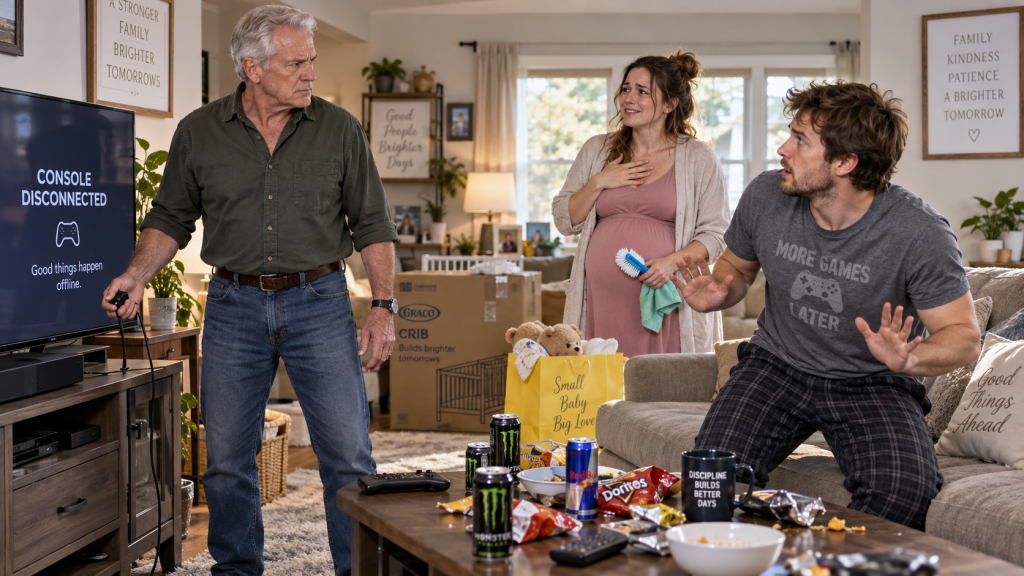
“Answer the door.”
Derek stared.
“You called them. You answer it.”
“No.”
I looked toward Sarah.
“This is your house too. And from this moment forward, nobody is going to make decisions for you because they’re louder.”
Sarah wiped her cheeks.
Then she walked to the door.
Her hand shook on the lock.
I stood behind her, close enough that she knew I was there, far enough that the choice remained hers.
She opened it.
Two officers stood outside.
A woman and a man.
The female officer immediately looked at Sarah’s swollen belly, then at her face.
“Ma’am, we received a call about a domestic disturbance.”
Sarah opened her mouth.
Nothing came out.
Derek suddenly found his voice.
“This is ridiculous. Her father attacked me.”
The officers looked toward me.
I raised my hands slightly.
“I’ll explain exactly what happened.”
“He assaulted me!”
Derek pointed.
“He came into my house, unplugged my property, then slammed me against the wall.”
The male officer looked at me.
“Sir?”
“He swung at me after I unplugged his game console. I stopped him and released him when he stopped resisting.”
“That’s not what happened!”
I nodded toward the hallway.
“Security camera.”
Derek’s face tightened.
The female officer turned to Sarah.
“Ma’am, would you come outside with me for a moment?”
Derek stepped forward.
“She doesn’t need—”
The officer looked at him.
“I was speaking to her.”
He stopped.
Sarah looked at me.
I nodded.
“Go ahead, sweetheart.”
She followed the officer onto the porch.
The male officer separated Derek and me.
That was exactly what should have happened.
No assumptions.
No theatrical justice.
Statements.
Evidence.
Procedure.
I respected that.
The officer asked me what happened.
I told him.
Every part.
Including unplugging the console.
Including Derek swinging.
Including restraining him.
I didn’t embellish.
Didn’t call him names.
Didn’t tell the officer I had been a Marine as though that gave me special authority.
It didn’t.
I was a citizen who had witnessed something deeply troubling and intervened when another man attacked me.
That was enough.
The officer reviewed the camera footage.
Then requested footage from earlier.
The camera had captured more than Derek’s swing.
It had captured Sarah struggling toward the floor.
Derek pointing at the scrub brush.
His voice.
“Miss one spot and you don’t eat.”
The officer’s expression changed.
Then he watched Chloe—
No.
There was no Chloe.
My mind was moving too fast.
Sarah.
My daughter.
My little girl.
Eight months pregnant.
Trying to lower herself onto her knees while her husband treated food as something she had to earn.
I turned away from the screen.
I couldn’t watch it twice.
The officer could.
That was his job.
Mine was standing beside Sarah when she came back through the door.
She had been crying.
The female officer spoke quietly to her.
“Do you have somewhere safe you can stay tonight?”
Sarah looked at me.
“Yes.”
That one word almost broke me.
Derek heard.
“This is insane.”
Sarah flinched.
The officer noticed.
“Sir, stay where you are.”
Derek threw up his hands.
“She’s my wife!”
Sarah’s face changed.
Not dramatically.
Something smaller.
But I saw it.
For years, perhaps, those words had been used as ownership.
She’s my wife.
As though marriage were a deed.
A receipt.
A title.
Sarah put one hand protectively over her belly.
Then said:
“Yes, Derek.”
Her voice trembled.
“I am your wife.”
He stared.
“And look what you’ve done with that privilege.”
Silence.
The female officer asked whether Sarah wanted medical attention.
“No.”
Then Sarah hesitated.
Actually—
“Yes.”
I turned.
She looked embarrassed.
“My stomach’s been tightening since this morning.”
Every bit of blood seemed to leave my body.
“How often?”
“I don’t know.”
“Sarah.”
“I thought it was normal.”
The officer immediately called for paramedics.
Derek rolled his eyes.
I saw it.
So did the male officer.
“She’s been complaining about everything lately.”
I stared at him.
Eight months pregnant.
Bruises.
Swollen ankles.
Contractions.
And he was annoyed.
Something hot rose inside me.
I forced it down.
That was perhaps the hardest thing I did that day.
Not pinning Derek against a wall.
Not confronting him.
Standing still.
Because anger can feel like action while accomplishing nothing.
Sarah needed calm.
So I gave her calm.
“Sit down, honey.”
She sat.
I knelt beside her.
“Look at me.”
Her eyes found mine.
“You’re okay.”
“Dad—”
“Breathe.”
“I’m scared.”
“I know.”
Another tightening came.
I saw it in her face.
She gripped my hand.
Hard.
“Okay.”
I breathed with her.
“In.”
She inhaled.
“Out.”
She exhaled.
Derek stood ten feet away.
For once, he was irrelevant.
The paramedics arrived.
They assessed Sarah and decided she needed evaluation.
I rode with her.
Derek tried to follow.
One of the officers stopped him.
“What?”
he demanded.
“That’s my wife!”
Sarah heard.
She looked at the paramedic.
Then at me.
“I don’t want him there.”
The words were quiet.
The officer nodded.
That was enough.
As the ambulance doors closed, Sarah started crying.
“Dad.”
“I’m here.”
“What if something happens to the baby?”
“We’re going to the hospital.”
“What if—”
“Sarah.”
I squeezed her hand.
“One problem at a time.”
She looked at me.
“Is that a Marine thing?”
“No.”
I smiled faintly.
“That’s a dad thing.”
She cried harder.
At the hospital, doctors determined Sarah was dehydrated and experiencing frequent contractions, but she was not yet in active labor.
They gave her fluids.
Monitored the baby.
Ordered rest.
Asked questions.
Important questions.
Did she feel safe at home?
Had anyone prevented her from eating?
Controlled money?
Threatened her?
Pushed her?
Grabbed her?
Restricted access to transportation?
Medical care?
Friends?
Family?
At first, Sarah answered softly.
Then more clearly.
Yes.
Yes.
Sometimes.
Yes.
Yes.
Yes.
The answers accumulated.
Each one felt like another failure on my part.
I sat in the corner.
My daughter had been disappearing in front of me, and I hadn’t seen it.
Or maybe I had seen pieces and accepted explanations because the alternative was too frightening.
She bumped into the pantry.
They’re having normal newlywed arguments.
Derek is immature.
Pregnancy is exhausting.
Sarah is emotional.
How many warning signs do families rename because the true name would require action?
Eventually, a social worker asked me to step outside.
I did.
Twenty minutes later, she invited me back.
Sarah was staring at the ceiling.
I sat beside her.
“Hey.”
“Hey.”
She didn’t look at me.
Then:
“Are you disappointed?”
I stared.
“In you?”
She nodded.
My heart broke.
“Sarah.”
“I let it happen.”
“No.”
“I stayed.”
“That’s not the same thing.”
“I made excuses.”
“You were trying to survive inside your marriage.”
“I should have left.”
“Maybe.”
She looked at me, surprised.
I wasn’t going to lie to her.
“Yes, I wish you’d left sooner.”
Tears rolled down her cheeks.
“But wishing you had escaped earlier is not the same as blaming you for what he did.”
She covered her face.
“I’m so stupid.”
“No.”
“Dad—”
“No.”
My voice sharpened automatically.
She flinched.
I immediately softened.
“Sorry.”
I pulled my chair closer.
“You are not stupid.”
“I believed him.”
“You loved your husband.”
“He said he was stressed.”
“I’m sure he was.”
“He said the baby was making everything harder.”
“Babies make things harder.”
“He said I was too sensitive.”
“Maybe sometimes you are.”
She looked at me.
I shrugged.
“So am I.”
That almost made her smile.
“None of those things gives him permission to control your food, money, body, or fear.”
Sarah began crying.
“I didn’t want you to hate him.”
I looked down.
That was painful.
“Why?”
“Because I knew what you’d do.”
“What?”
“You’d come charging in.”
I couldn’t argue.
“You’re Dad.”
She laughed weakly through tears.
“You’re the guy who once drove forty minutes because my landlord wouldn’t fix my heater.”
“It was January.”
“You threatened to sleep in the leasing office.”
“It worked.”
She smiled.
Then became serious.
“I thought if I told you about Derek, you’d take over.”
I leaned back.
That landed harder than I expected.
“I’m sorry.”
“You didn’t do anything.”
“Yes, I did.”
I thought carefully.
“I spent your whole childhood teaching you that if something went wrong, Dad would handle it.”
“That’s what dads do.”
“Sometimes.”
I shook my head.
“But maybe I didn’t teach you enough that you could handle things too.”
She looked at me.
“I wanted to protect you so badly that maybe I accidentally taught you protection always comes from somebody stronger.”
My throat tightened.
“It doesn’t.”
Sarah listened.
“You’re not leaving Derek because I ordered you to.”
“I know.”
“You’re not filing anything because I tell you.”
“I know.”
“You decide what happens next.”
She whispered:
“What if I make the wrong choice?”
“Then we’ll deal with it.”
“What if I go back?”
That question hurt.
I wanted to say:
You won’t.
I wanted to forbid it.
Instead:
“I’ll tell you the truth about what I see.”
She waited.
“I think going back without major change and professional intervention would be dangerous.”
Tears filled her eyes.
“But if you make a choice I hate, I will still answer the phone.”
“Even if—”
“Every time.”
She broke.
I held her.
“I don’t want to go back.”
The sentence disappeared against my shirt.
I closed my eyes.
“Okay.”
“I’m scared.”
“I know.”
“I don’t know how to do this.”
“You don’t have to know tonight.”
She pulled away.
“What do I do tonight?”
“Sleep.”
“Tomorrow?”
“We find out.”
That became our plan.
Not a grand strategy.
Tomorrow.
The following morning, Sarah came home with me.
Home.
Funny word.
My house had been hers once.
Then college.
Marriage.
Now suddenly the bedroom where she had slept as a teenager was hers again.
I had turned it into a storage room.
We spent two hours moving boxes.
Sarah sat on the bed directing me.
“You’re doing it wrong.”
“I’m moving boxes.”
“That one goes in the closet.”
“You’re very demanding for a refugee.”
She stared.
I immediately regretted the word.
“Sorry.”
Then she laughed.
A real laugh.
First one I’d heard in days.
“You’re terrible at emotional support.”
“Thirty years in the Marines. We had different customer-service standards.”
She smiled.
That evening, I assembled the crib.
The crib I had originally gone to her house to build.
I opened the instruction booklet.
Sarah watched from bed.
“You’re reading instructions?”
“No.”
“You are.”
“I’m inspecting enemy intelligence.”
“Dad.”
“Go to sleep.”
She did.
Halfway through assembling the crib, I found one rail backward.
I stared at it.
Then quietly corrected it before Sarah woke.
Some secrets are acceptable.
Derek called thirty-seven times.
Sarah didn’t answer.
He texted.
Apologies.
Promises.
Anger.
More apologies.
Then blame.
You embarrassed me.
Your father assaulted me.
You’re destroying our family.
I was joking.
You know I’d never hurt the baby.
You made me angry.
Come home.
I love you.
Please.
Please.
Please.
Then:
If you don’t come back tonight, don’t bother coming back at all.
Sarah showed me.
I read it.
Then handed the phone back.
“What do you think?”
she asked.
I wanted to say what I thought.
Instead:
“What do you think?”
She stared at the message.
Then deleted it.
“I think he finally offered me something useful.”
“What?”
“Permission not to come back.”
I smiled.
“Good.”
She contacted an attorney.
Not mine.
Hers.
That distinction mattered.
Her attorney helped her understand options involving separation, divorce, property, custody, and protective orders.
I drove her.
Sat in the waiting room.
Did not go inside.
That was harder than any obstacle course I had ever run.
When she came out, she looked exhausted.
“Well?”
I asked.
She held up one finger.
“Don’t interrogate.”
I raised both hands.
“Yes, ma’am.”
She smiled.
“Coffee?”
“Absolutely.”
Derek’s criminal situation developed separately.
The police and prosecutors reviewed the assault captured on camera and the broader evidence Sarah provided.
I gave my statement.
Then I stayed out of it.
That frustrated people who heard the story.
They wanted me to “teach him a lesson.”
I had already learned something important.
Consequences imposed by an angry father are temporary.
Consequences imposed by law, family boundaries, and a person’s own choices can last.
I wasn’t Derek’s drill instructor.
I wasn’t his judge.
I wasn’t his executioner.
I was Sarah’s father.
That job was enough.
Three weeks later, at 3:11 in the morning, Sarah woke me.
“Dad.”
I sat upright.
“What?”
“I think my water broke.”
Every ounce of Marine training vanished.
“What?”
She laughed despite herself.
“My water.”
“Right.”
I jumped out of bed.
“Hospital.”
“Yes.”
“Bag.”
“By the door.”
“Car.”
“Dad.”
“What?”
“Pants.”
I looked down.
Boxers.
Right.
Two minutes later, we were driving.
Safely.
Mostly.
Sarah groaned.
“Slow down.”
“You said contractions are five minutes apart!”
“We still need to arrive alive.”
“Good point.”
At the hospital, labor lasted fourteen hours.
Fourteen.
I had completed training exercises that felt shorter.
Sarah squeezed my hand so hard I briefly considered orthopedic evaluation.
At one point, she screamed:
“This is Derek’s fault!”
I nodded.
“Correct.”
A nurse laughed.
Hours later, my grandson arrived.
Eight pounds, two ounces.
Healthy.
Angry.
Loud.
Perfect.
Sarah held him against her chest.
The room became quiet.
“What are you naming him?”
I whispered.
She looked at me.
“Benjamin.”
“Ben.”
She nodded.
Then:
“Benjamin Frank.”
I stared.
“No.”
She smiled.
“Yes.”
“Absolutely not.”
“Too late.”
“You’re giving that child my name?”
“Middle name.”
“Still reckless.”
She cried.
So did I.
I held my grandson.
Tiny.
Warm.
His entire hand wrapped around one of my fingers.
I had held rifles.
Training manuals.
Promotion orders.
Retirement papers.
My daughter’s hand on her first day of kindergarten.
Nothing had ever felt as heavy with responsibility as that tiny grip.
“Hello, Ben.”
He yawned.
“I’m Pops.”
Sarah smiled.
“Don’t yell at him.”
“No promises.”
She laughed.
Then her face changed.
“Dad?”
“Yes?”
“Don’t let me go back.”
I looked at her.
“I can’t make that promise.”
Fear flashed.
I continued.
“But I can remind you who you are every time you forget.”
She cried.
“That’ll do.”
Derek requested to see the baby.
Sarah refused at first.
Then spoke with her attorney.
There were legal processes to follow.
Parental rights did not disappear merely because a marriage ended badly.
That reality was complicated.
Sarah hated it.
So did I.
But again, we followed the law.
Supervised contact was arranged while matters were evaluated.
Derek behaved well during those visits.
At first.
He arrived with gifts.
Apologies.
Flowers for Sarah.
She refused the flowers.
Then he began asking her to reconcile.
She said no.
Again.
Again.
Again.
Eventually, the charm cracked.
He accused her of keeping his son from him.
The supervisor documented it.
He sent angry messages.
Her attorney documented those.
He violated a communication boundary.
Documented.
I learned something from Sarah during those months.
Documentation is quieter than rage.
And often more powerful.
Every time Derek tried to pull her into an argument, she wrote it down instead.
Date.
Time.
Message.
Action.
She stopped trying to convince him.
That was freedom.
You do not have to persuade someone who mistreats you that they mistreated you.
Sometimes you simply need to stop giving them access to the argument.
The divorce took nearly a year.
Derek fought over everything.
Furniture.
Accounts.
The house.
Custody schedules.
A television.
Yes.
The television.
The one connected to the console I unplugged.
When Sarah told me, I laughed.
“What?”
“He wants the television.”
“Give it to him.”
“Dad!”
“What?”
“It’s a seventy-inch OLED.”
“Then sell it and divide the money.”
She smiled.
“Attorney said the same thing.”
“Smart woman.”
“You should’ve gone to law school.”
“I enjoy happiness.”
Eventually, a settlement was reached.
Sarah kept what mattered.
Safety.
Stability.
A workable parenting structure.
Derek received what the law allowed and required.
Not what my anger wanted.
That distinction remained important.
There was no cinematic moment where a judge slammed a gavel and declared me right about everything.
Real life is usually less tidy.
There were hearings.
Evaluations.
Paperwork.
Waiting.
Compromise.
Frustration.
But slowly, Derek stopped controlling Sarah’s daily life.
That was the victory.
Not his suffering.
Her freedom.
Sarah returned to work when Ben was five months old.
She had been a dental hygienist before pregnancy.
The first morning, she stood beside the front door holding her bag.
“I can’t.”
“Yes, you can.”
“He’s too little.”
“Yes.”
“What if he needs me?”
“He will.”
“That isn’t helping.”
I smiled.
“He’ll need you at five tonight too.”
She cried.
I took Ben.
“Go.”
She stared.
“Dad?”
“Yes?”
“Don’t teach him Marine chants.”
“Of course not.”
She narrowed her eyes.
“Frank.”
“Leave before you’re late.”
She left.
I looked at Ben.
He looked at me.
“Okay, recruit.”
He smiled.
“First lesson. Your mother is terrifying.”
He drooled.
“Correct answer.”
I became his childcare two days a week.
It was exhausting.
At sixty-something, crawling on the floor with a baby is less adorable than people advertise.
My knees filed formal complaints.
But I loved it.
Ben’s first word was:
“Ball.”
Sarah claimed it was “Mama.”
It was ball.
I remain objective.
His second might have been “Pops.”
Sarah disputes this too.
History will vindicate me.
When Ben was two, Sarah moved into a small townhouse.
The day she got the keys, she stood in the empty living room.
No furniture.
Boxes everywhere.
Ben running in circles.
She cried.
“What’s wrong?”
I asked.
“Nothing.”
“Then why are you crying?”
“Because it’s mine.”
I understood.
Not technically only hers.
Mortgage company had opinions.
But emotionally.
Hers.
She walked into the kitchen.
Opened every cabinet.
Then opened the pantry.
She stood there.
Silent.
I knew.
The locked pantry.
Food used as control.
She touched the new pantry door.
Then removed the lock mechanism entirely.
“Don’t need that.”
I said nothing.
She threw it in the trash.
That was one of the proudest moments of my life.
Not because she needed me.
Because she didn’t.
Sarah became stronger in ways I had never taught.
Not harder.
Stronger.
There is a difference.
Hardness resists feeling.
Strength survives it.
She went to counseling.
Built friendships she had neglected.
Reconnected with coworkers.
Started running again after her doctor cleared her.
Slowly.
Then farther.
She joined a weekend group for mothers.
At first, she hated it.
“Everyone talks about organic snacks.”
“Terrifying.”
“Dad.”
“What?”
“Be supportive.”
“I support conventional snacks.”
She laughed.
Then kept going.
One woman in that group became her closest friend.
Maria.
When Sarah later helped Maria recognize troubling behavior in her own relationship, I realized something.
Pain had not made my daughter smaller.
She had transformed it into perception.
She knew what fear looked like now.
She could recognize it in another woman’s silence.
But she never told Maria what to do.
That impressed me.
She said:
“I’ll believe you. I’ll help you find options. You decide.”
I heard her say it once.
Those were almost the words I had learned to say to Sarah.
Except now she said them better.
Years passed.
Derek remained part of Ben’s life under structured arrangements.
For a while, he improved.
Then slipped.
Then improved again.
Human beings are frustrating that way.
Sarah stopped measuring her peace by whether Derek changed.
That was perhaps her greatest breakthrough.
If he behaved responsibly, good.
If not, boundaries and legal agreements existed.
She no longer waited for his personality to become the key to her safety.
Ben grew.
At six, he asked:
“Why don’t Mommy and Daddy live together?”
Sarah answered:
“Because we weren’t healthy together.”
“Was Daddy mean?”
Sarah looked at me.
I looked away.
Her answer.
“Sometimes.”
“Are you mean?”
“Sometimes.”
Ben giggled.
“To me?”
“When you don’t brush your teeth.”
He laughed.
Then she became serious.
“But grown-ups are responsible for how they treat people, even when they’re angry.”
Ben nodded.
That was enough at six.
At nine, he asked harder questions.
At thirteen, harder still.
Sarah never lied.
She also never recruited him into hatred.
That took extraordinary discipline.
I once asked:
“How do you do it?”
“What?”
“Talk about Derek without telling Ben what you really think.”
She smiled.
“I tell him what happened without telling him what emotion he’s required to have about it.”
I stared.
“When did you become smarter than me?”
“Pregnancy.”
“Temporary condition.”
“Apparently not.”
She laughed.
Derek eventually remarried.
A woman named Kelly.
I worried.
Of course I worried.
Sarah did too.
But Kelly was an adult.
Sarah couldn’t manage that relationship.
Years later, Kelly contacted Sarah.
Not me.
Sarah.
She said Derek had begun showing some of the same controlling behavior.
Sarah helped her find resources.
I didn’t understand at first.
“Why help her?”
Sarah stared.
“Because I wish someone had helped me.”
“But she’s married to your ex-husband.”
“And?”
I had no answer.
Sarah smiled sadly.
“Dad, if I only care about abuse when the victim is someone I like, then I don’t actually care about abuse.”
That humbled me.
Kelly left Derek eventually.
I never knew every detail.
Didn’t need to.
Derek finally entered a long-term intervention program and therapy after that second marriage failed.
Did he change?
Some.
Enough?
That question wasn’t mine to answer.
By then, Ben was nearly grown and had his own relationship with his father.
Complicated.
Cautious.
Real.
I did not tell him whom to love.
That was a lesson I had learned late.
When Ben was seventeen, he joined the wrestling team.
I hated wrestling.
Not the sport.
The parents.
Every father in the bleachers suddenly believes he’s an Olympic coach.
One evening, Ben lost badly.
He came home furious.
“I’m quitting.”
“No.”
He stared.
“You can’t tell me no.”
“Correct.”
He waited.
“So?”
“So quit tomorrow.”
“What?”
“Never quit on the day you’re humiliated.”
He frowned.
“Why?”
“Because then you don’t know whether you’re choosing to leave or just running from the feeling.”
He sat.
That night, he didn’t quit.
Two weeks later, he decided wrestling wasn’t for him.
Then he quit.
I supported him.
Sarah later said:
“That was surprisingly healthy.”
“Thank you.”
“Who are you?”
“Very funny.”
Ben joined track instead.
Loved it.
At eighteen, he came to me with college brochures.
Then something else.
A Marine Corps brochure.
I stared at it.
“No.”
He laughed.
“You can’t tell me no.”
“Apparently everyone remembers that lesson except me.”
“Pops.”
I looked at him.
“Why?”
“Because of you.”
That frightened me.
“No.”
His smile disappeared.
“Why not?”
“Do not join the Marines to become me.”
“I’m not.”
“Don’t join because you think toughness is a family inheritance.”
“I don’t.”
“Don’t join because you want to prove something to your father.”
His face changed.
That one hit.
“I’m not.”
I studied him.
“Then why?”
“Because I want to serve.”
Simple.
His answer.
Not mine.
I sighed.
“Okay.”
“Okay?”
“If you choose it after understanding what you’re choosing, I’ll support you.”
He grinned.
“Really?”
“Yes.”
Then I pointed.
“But if some drill instructor tells you your grandfather was soft—”
“Pops.”
“—you give me their name.”
He laughed.
Ben enlisted after college instead.
He wanted a degree first.
Smart kid.
The day he left for training, Sarah cried.
I didn’t.
Until the car disappeared.
Then I went into the garage and cried where nobody could see me.
Sarah found me anyway.
“You know you’re allowed to cry indoors.”
“Bad ventilation.”
“Sure.”
She hugged me.
“Scared?”
“Yes.”
“Me too.”
“He’ll be okay.”
“I know.”
“You told me one problem at a time.”
“I hate when people quote me.”
She smiled.
When Ben graduated, I wore my old dress blues.
They barely fit.
That is all I will say about that.
Ben saw me.
His face lit up.
He crossed the parade deck afterward and hugged Sarah first.
Correct decision.
Then me.
“Pops.”
“Marine.”
I stepped back.
Looked at him.
Pride is dangerous when it becomes ownership.
So I didn’t tell him he had continued my legacy.
His life was his.
Instead:
“Well done.”
His eyes filled.
Coming from an old drill instructor, those two words carried enough.
Years later, Ben asked about the day I confronted Derek.
He had heard pieces.
Family stories become mythology if nobody corrects them.
According to one cousin, I had thrown Derek through a wall.
According to another, six police officers had arrived.
Neither happened.
So I told Ben the truth.
His father had been controlling Sarah.
I saw marks.
Derek ordered her to scrub the floor and threatened food.
I unplugged the console.
Derek swung.
I restrained him.
Police came.
Sarah left.
Ben listened.
Then asked:
“Did you really say ‘Boot camp begins now’?”
I groaned.
“Yes.”
He laughed.
“You actually said that?”
“I was angry.”
“That is the most Pops thing I’ve ever heard.”
“I regret the wording.”
“No, you don’t.”
“Fine.”
He laughed.
Then became serious.
“Did you want to hurt him?”
I thought.
“Yes.”
Ben stared.
“But you didn’t?”
“I stopped when the danger stopped.”
“Why?”
“Because strength isn’t how much damage you can do once you have control.”
I looked at him.
“It’s whether you can stop.”
He became quiet.
That lesson mattered more to me than any story about pinning a younger man against a wall.
Anyone can worship force.
Discipline is knowing when force has finished its legitimate purpose.
Ben nodded.
“Did Mom ever forgive him?”
“You’d have to ask her.”
“Did you?”
That question was harder.
“Eventually.”
“Why?”
“Because hating your father wasn’t helping your mother anymore.”
He stared.
“I thought you still hated him.”
“No.”
“You don’t like him.”
“Correct.”
Ben laughed.
“Different.”
“Very.”
“Would you have dinner with him?”
“No.”
“Christmas?”
“Absolutely not.”
He laughed harder.
Forgiveness does not require poor judgment.
I never became Derek’s friend.
Never needed to.
But I stopped imagining arguments with him.
Stopped wishing life would punish him.
Stopped measuring justice by his unhappiness.
Sarah was safe.
Ben was loved.
That was enough.
When Sarah was forty-three, she remarried.
His name was Michael.
Quiet man.
High school science teacher.
The first time I met him, he looked terrified.
“Mr. Vance.”
“Frank.”
“Yes, sir.”
“Frank.”
“Yes, sir.”
Sarah covered her face.
“Dad, stop frightening him.”
“I said nothing.”
“Your face said several things.”
Michael eventually relaxed.
He treated Sarah with something I had once underestimated because it looked too ordinary.
Respect.
He cooked.
She cleaned.
Sometimes reversed.
He asked before making major financial decisions.
She did too.
They argued.
Of course they argued.
But Sarah never flinched.
That was how I knew.
Not because Michael was perfect.
Because my daughter’s body did not prepare for danger when he became frustrated.
One Thanksgiving, Michael burned the turkey.
Badly.
Smoke alarm.
Windows open.
Everyone laughing.
Sarah stood in the kitchen teasing him.
Michael pointed a wooden spoon at her.
“You’re ordering pizza.”
“Gladly.”
They laughed.
I stood in the doorway.
For no logical reason, I remembered Derek pointing toward a scrub brush.
You want dinner? Earn it.
Two kitchens.
Two marriages.
The difference wasn’t who cooked.
It was whether love had room for dignity.
Michael noticed me.
“You okay, Frank?”
“Yes.”
“Why are you crying?”
“Smoke.”
Sarah looked at the open window.
“Sure, Dad.”
I went outside.
She followed.
“You’re thinking about him.”
I didn’t ask who.
“Yes.”
She leaned against me.
“I’m okay.”
“I know.”
“Really okay.”
“I know.”
“Then why are you sad?”
I looked at my daughter.
“Because sometimes you don’t realize how wrong something was until you finally see what normal looks like.”
Her eyes filled.
She hugged me.
“I love you.”
“I love you too.”
“Now come inside.”
“Pizza?”
“Michael is banned from poultry.”
“Good leadership.”
Years later, I became slower.
Age does that even to Marines.
My knees hurt.
My hearing wasn’t what it had been.
Sarah claimed I turned the television too loud.
I claimed modern actors mumbled.
We agreed to disagree.
She started helping me.
At first, I hated it.
Groceries appeared in my refrigerator.
Appointments appeared on my calendar.
A railing appeared beside my back steps without authorization.
“Sarah.”
“What?”
“What’s this?”
“A handrail.”
“I know what it is.”
“Then why ask?”
“I don’t need it.”
She stared at me.
“Use the handrail, Dad.”
“I spent twenty-four years—”
“In the Marines. Yes. The entire state knows.”
“I can handle stairs.”
“Great. Handle them while holding the rail.”
I muttered something.
“What?”
“Nothing.”
She smiled.
“Boot camp begins now, old man.”
I stared at her.
Then laughed so hard I had to sit down.
Karma.
At seventy-eight, I had a minor stroke.
Minor.
I hated the word.
Anything that makes your left hand stop obeying you is not minor when it’s your hand.
Rehabilitation.
Physical therapy.
Occupational therapy.
Humiliation.
I dropped cups.
Struggled with buttons.
Hated needing help.
One morning, I threw a therapy ball across the room.
“I’m done.”
Sarah picked it up.
“No.”
I stared.
“You don’t tell me no.”
She raised an eyebrow.
“Interesting.”
I recognized the trap.
She placed the ball back in my hand.
“One problem at a time.”
“Stop quoting me.”
“Squeeze.”
“I hate you.”
“Love you too.”
She stayed through therapy.
But she didn’t do the exercises for me.
That mattered.
“Help me.”
“No.”
“Sarah.”
“You can do it.”
“I can’t.”
“Yes.”
“That’s annoying.”
“I learned from the best.”
I regained most function.
The first time I buttoned my shirt without assistance, Sarah applauded.
I told her to stop.
She applauded louder.
Ben joined.
Michael recorded it.
I threatened everyone.
Family.
Years after that, Derek became ill.
Ben told me.
“Dad’s got liver disease.”
I nodded.
“How bad?”
“Bad.”
“You going to see him?”
“I don’t know.”
I looked at my grandson.
He was no longer young.
A husband.
Father.
Marine veteran.
His own man.
“Do you want to?”
“I don’t know.”
“Then don’t decide because you think you’re supposed to.”
He looked at me.
“Would you go?”
“Doesn’t matter.”
“Pops.”
“No.”
I shook my head.
“Don’t borrow my history to make your decision.”
He sat quietly.
Eventually, Ben went.
Several times.
Sarah went once.
Not to reconcile romantically.
Not to erase anything.
To close a door properly.
When she came home, she sat beside me.
“How was it?”
“Sad.”
“Did he apologize?”
“Yes.”
“Good apology?”
She thought.
“Better than the old ones.”
“What did he say?”
“That he spent years thinking being obeyed meant being respected.”
I nodded.
“That sounds accurate.”
“He said losing us forced him to realize people were afraid of him, not loyal to him.”
I waited.
“Did you forgive him?”
Sarah looked at me.
“I told him I forgave him years ago.”
“Did you?”
“Yes.”
“Why didn’t you tell me?”
She laughed.
“Because my forgiveness wasn’t a press release.”
Fair.
Then:
“He asked whether I ever loved him.”
“What did you say?”
“Yes.”
That surprised me.
Sarah saw it.
“I did, Dad.”
“I know.”
“No.”
She smiled sadly.
“I loved him. That’s why leaving hurt.”
I understood.
“He asked whether I regretted marrying him.”
“And?”
“I said I regret what he did, but I don’t regret Ben.”
She looked toward the photographs on my mantel.
“Life isn’t clean enough for simple answers.”
No.
It isn’t.
Derek died several months later.
I felt almost nothing at first.
Then, unexpectedly, grief.
Not for the man he became.
For what might have been.
For Sarah’s first marriage.
For Ben’s complicated childhood.
For a thirty-year-old man who could have learned earlier that domination wasn’t strength.
Waste is sad.
Even when the person caused much of it himself.
At Derek’s funeral, I stood in the back.
Sarah saw me.
“You came.”
“For Ben.”
She nodded.
Then:
“Only Ben?”
I looked toward the casket.
“No.”
Sarah took my hand.
That was enough.
I never told Derek goodbye.
Didn’t need to.
My life had stopped being about him decades earlier.
On my eighty-fifth birthday, the family gathered at Sarah and Michael’s house.
Ben brought his children.
Three of them.
Loud little criminals.
One climbed onto my lap.
“Great-Pops?”
“Yes?”
“Were you really a drill sergeant?”
“Drill instructor.”
“What’s that?”
“Someone who teaches Marines.”
“By yelling?”
“Sometimes.”
“Mom says yelling is rude.”
“Your mom is correct.”
The child looked disappointed.
“Did you yell at Grandpa Ben?”
“Never professionally.”
Ben shouted from the kitchen:
“Liar!”
Everyone laughed.
My great-granddaughter asked:
“Were you strong?”
I looked at my hands.
Wrinkled.
Veins visible.
One still slightly weaker after the stroke.
“Once.”
She squeezed my bicep.
“You’re squishy.”
The entire room exploded.
“Get this child away from me.”
Sarah laughed hardest.
Later that evening, after everyone left, Sarah sat beside me on the porch.
She was sixty now.
That was impossible.
In my mind, she was still eight.
Sixteen.
Twenty-five.
Eight months pregnant.
All of them.
“Dad?”
“Yeah?”
“Do you remember the teddy bear?”
“What teddy bear?”
“The yellow gift bag.”
I thought.
Then remembered.
The day everything changed.
“I never gave it to you.”
“You did.”
“When?”
“Hospital.”
I didn’t remember.
“I kept it.”
She pulled out her phone.
Found a photograph.
Ben as a newborn.
Beside him, a little brown teddy bear.
My eyes filled.
“I forgot.”
“I didn’t.”
We sat quietly.
Then Sarah said:
“You saved me that day.”
I shook my head.
“No.”
“Yes.”
“No, sweetheart.”
I turned toward her.
“I interrupted something.”
“You saved me.”
“You left.”
“Because you showed up.”
“That matters.”
I nodded.
“But don’t give me the part that belongs to you.”
She stared.
“You told the police the truth.”
“Yes.”
“You told the doctor.”
“Yes.”
“You hired the attorney.”
“Yes.”
“You stayed away.”
“Yes.”
“You built another life.”
Her eyes filled.
“You did that.”
She leaned her head against my shoulder.
“You taught me how.”
“Maybe.”
“And then you learned how to let me.”
I smiled.
“That part was harder.”
She laughed.
“I know.”
After a while, she asked:
“Do you regret saying it?”
“What?”
“Boot camp begins now.”
I groaned.
“Absolutely.”
“Liar.”
“Mostly.”
She laughed.
“You scared him half to death.”
“That was not the objective.”
“Sure.”
I became serious.
“You know what I regret?”
“What?”
“That I thought the answer was teaching Derek discipline.”
She listened.
“For about five minutes, I thought I could straighten him out.”
“Very Marine.”
“Very stupid.”
She smiled.
“What changed?”
“You.”
I looked at her.
“I realized the person who needed my attention wasn’t him.”
Sarah’s eyes filled.
“It was you.”
I continued.
“I could have spent years fighting Derek.”
I squeezed her hand.
“But then my life would’ve been about him too.”
She nodded.
“The best thing I ever did was stop trying to control the man who controlled you and start helping you regain control of yourself.”
Sarah cried.
So did I.
Age makes crying annoyingly easy.
A commercial can get me now.
I hate it.
When I was young, I believed toughness meant being the person nobody could knock down.
The Marines refined that belief.
Then fatherhood changed it.
Toughness is not never falling.
It is not pinning someone against a wall.
It is not having the loudest voice in the room.
Real strength can look embarrassingly gentle.
A pregnant woman saying:
“I don’t want to go back.”
A father answering:
“Okay.”
A mother removing a lock from a pantry.
A child learning that anger does not excuse cruelty.
A grown son visiting a dying father because he chooses to, not because guilt orders him.
A woman forgiving without returning.
An old Marine accepting a handrail.
Strength is not control.
I wish I had learned that distinction earlier.
Control says:
Do what I tell you because I am stronger.
Strength says:
I will stand beside you while you decide what happens to your life.
Derek had control for a while.
Sarah developed strength.
Control failed.
Strength remained.
One morning near the end of my life, I woke before sunrise.
I was living with Sarah and Michael by then.
My choice.
Mostly.
My doctors had opinions.
I shuffled into the kitchen.
Sarah was already awake.
Coffee.
“Couldn’t sleep?”
I asked.
“Could ask you the same.”
“I’m old.”
“So am I.”
“Not allowed.”
She smiled.
I sat.
For a while, neither of us spoke.
Then I noticed something near the pantry.
No lock.
Of course.
There had never been one in this house.
Still, I thought about that first pantry.
The bruises Sarah had tried to hide.
The floor.
The scrub brush.
Derek’s voice.
Miss one spot and you don’t eat.
I looked at the woman across from me.
Healthy.
Safe.
Gray beginning in her hair.
Laugh lines.
A life.
“You hungry?”
she asked.
“Yes.”
“What do you want?”
“Eggs.”
“Make them.”
I stared.
“You invited an elderly disabled Marine into your home and refuse breakfast?”
“You can cook eggs.”
“This is abuse.”
She laughed.
“Scrub the floor first.”
I stared.
She froze.
“Oh, Dad.”
Then I started laughing.
So did she.
We laughed until both of us cried.
Not because the old memory was funny.
Because it no longer owned the words.
We had survived long enough to take them back.
Sarah made the eggs.
I made toast.
Burned it.
She complained.
I told her Marine toast was supposed to be black.
She called me ridiculous.
It was an ordinary breakfast.
That was the miracle.
Not dramatic justice.
Ordinary life after fear.
Years earlier, I had entered her house believing I was going to assemble a crib.
Instead, I found my daughter trapped inside a life she was afraid to name.
I unplugged a video game.
Derek swung.
I stopped him.
People loved that part whenever the story was told.
The old Marine.
The abusive son-in-law.
The wall.
“Boot camp begins now.”
It sounded satisfying.
But that was not where Sarah’s rescue happened.
It happened afterward.
When she told the truth.
When she accepted medical help.
When she packed a bag.
When she said she didn’t want to go back.
When she called her own lawyer.
When she opened her own bank account.
When she removed the pantry lock.
When she went back to work.
When she raised Ben without teaching him that masculinity meant domination.
When she loved again without mistaking fear for respect.
Those were the battles that mattered.
And Sarah fought them.
Not me.
I was simply lucky enough to stand nearby.
If I could return to that Tuesday afternoon and speak to the angry retired Marine walking toward Derek’s console, I would tell him:
Unplug it.
Stop the attack if it comes.
Protect your daughter from immediate danger.
Then calm down.
Because the most important thing you will do today will not require your hands.
It will require your ears.
Listen when she finally speaks.
Believe her.
Do not shame her for staying.
Do not order her to leave.
Give her somewhere safe enough that she can hear her own voice again.
And when she uses it—
listen.
That is what I eventually learned.
I spent most of my adult life training Marines to stand when every part of them wanted to collapse.
But my daughter taught me the final lesson.
Sometimes courage isn’t standing.
Sometimes courage is walking out the door.
And sometimes love isn’t dragging someone to safety.
It is opening the door, standing beside it, and reminding them that they are free to walk through.
Sarah did.
And once she crossed that threshold, she never again needed anyone’s permission to eat, speak, spend, rest, laugh, work, love, or live.
Derek once believed fear made him powerful.
He was wrong.
Fear only made the house quiet.
Sarah’s freedom filled it with sound again.
Ben laughing.
Michael burning Thanksgiving dinner.
Grandchildren running through hallways.
Sarah teasing her stubborn old father.
Ordinary noise.
Beautiful noise.
Life.
That became Derek’s real consequence.
Not that an old Marine once pinned him against a wall.
Not the police.
Not the divorce.
Not losing the television he cared about too much.
His real consequence was that the family he tried to rule discovered it could flourish without being ruled at all.
And my reward was simpler.
I got to watch it happen.
I got to see my daughter become herself again.
I got to hold my grandson.
I got to grow old enough for Sarah to order me to use a handrail.
I got to discover that a father’s job does not end when his daughter stops needing rescue.
It simply changes.
Sometimes you protect.
Sometimes you advise.
Sometimes you shut up.
That last one took the most training.
On one of my final birthdays, Sarah gave me a framed photograph.
It showed three generations.
Me in the middle.
Sarah on one side.
Ben on the other.
Below it, she had engraved:
STRENGTH IS WHAT MAKES OTHER PEOPLE FEEL SAFE BESIDE YOU.
I read it twice.
Then looked at her.
“That’s not a Marine quote.”
“No.”
“Who said it?”
“I did.”
I smiled.
“Better than most Marine quotes.”
She kissed my cheek.
“Love you, Dad.”
“Love you too, sweetheart.”
I looked at the photograph again.
For most of my life, I had been proud of teaching people strength.
It took my daughter to teach me what strength was for.
Not domination.
Not intimidation.
Not making weaker people obey.
Strength is supposed to become shelter.
And that, more than any rank I ever wore, became the thing I was proudest to understand.
The afternoon I unplugged Derek’s game console, I stared him down and said:
“Boot camp begins now.”
I was wrong.
Derek’s training was never mine to give.
The real transformation began behind me, with an exhausted pregnant woman slowly rising from the floor.
My daughter.
Sarah.
She stood.
She packed her bag.
She told the truth.
She walked away.
And she never again mistook being afraid of a man for respecting him.
That was the lesson.
That was the victory.
And that was the day my daughter became stronger than the Marine who raised her.
THE END STORIES! THANK YOU FOR READING GOOD LUCK !❤️
Related Posts