➡️ PART 3 ENDING PART ➡️
“He followed me.”
Helen felt the little girl’s fingers close around hers.
Not gently.
Ellie gripped her as though Helen were the last solid thing in a room that had suddenly begun to tilt.
The police officer lowered himself until his eyes were level with hers.
“Ellie, who followed you?”
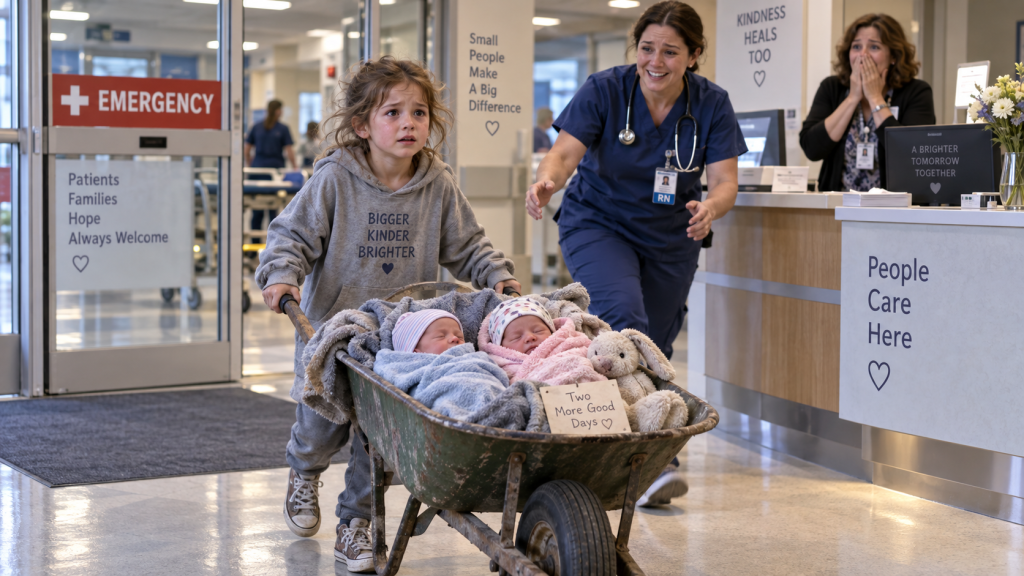
The six-year-old stared toward the hospital’s glass entrance.
People came and went beyond it.
A woman carrying flowers.
An elderly man leaning on a cane.
A nurse hurrying toward the parking lot.
Every moving shadow seemed to make Ellie smaller.
“My daddy.”
The officer kept his voice calm.
“What is your daddy’s name?”
Ellie pointed toward the wrinkled note.
The officer looked down.
DANIEL MERCER.
“Is Daniel your daddy?”
She nodded.
Helen rubbed Ellie’s back.
“Did you see him today?”
Ellie shook her head.
“Then how do you know he followed you?”
The child swallowed.
“Because I saw his truck.”
The officer’s expression changed.
“Where?”
“When I was pushing Noah and Nora.”
“On the road?”
Ellie nodded.
“It was far behind me.”
“What color?”
“Black.”
“What kind?”
Ellie looked confused.
“A daddy truck.”
Despite everything, Helen almost smiled.
The officer didn’t.
“Big?”
“Yes.”
“Pickup?”
Ellie nodded quickly.
“He has the scratch on the door.”
“Did the truck stop?”
“No.”
“Did you see who was driving?”
Ellie hesitated.
“I saw his hat.”
That wasn’t enough to establish who had been driving.
The officer knew it.
Helen knew it.
But it was enough to take seriously.
He stood and quietly spoke into his radio.
Within minutes, hospital security had been alerted.
Doors were watched.
Rachel’s room, once she arrived, would not be publicly identified.
The twins remained in pediatric care.
And Ellie stayed with Helen.
That part happened almost accidentally.
Helen had been the first adult Ellie trusted after pushing that wheelbarrow through the emergency room doors, so whenever somebody else asked her a question, she looked at Helen before answering.
“Can she come?”
Ellie asked when a nurse said they needed to examine her blistered hands.
Helen looked toward her supervisor.
Then back at Ellie.
“Yes.”
So Helen went.
The nurse washed the dirt from Ellie’s palms.
The child didn’t complain.
Not once.
That frightened Helen in a different way.
Children are supposed to complain when antiseptic stings.
They are supposed to squirm.
Cry.
Ask when they can go home.
Ellie simply watched.
“You can tell me if it hurts,” the nurse said.
“I’m okay.”
“You don’t have to be okay.”
Ellie frowned.
As though the sentence made no sense.
The nurse looked at Helen.
Helen understood.
For three days, being okay had been Ellie’s job.
Mommy wouldn’t wake.
The twins needed bottles.
Diapers needed changing.
The house was quiet.
One baby started becoming frighteningly quiet.
There had been no room for Ellie to be six.
Helen crouched beside her.
“Sweetheart.”
Ellie looked at her.
“You did your job.”
“What job?”
“Getting Noah and Nora here.”
Ellie glanced toward the treatment area.
Helen continued.
“You don’t have to be the grown-up anymore.”
Ellie’s mouth trembled.
Then she whispered:
“But who will be?”
Helen had to look away for a second.
“Us.”
That was the word that broke the child.
Not safe.
Not brave.
Not okay.
Us.
Ellie began sobbing.
Huge, exhausted sobs.
She leaned into Helen and cried as if all three days were finally coming out at once.
“I couldn’t wake her.”
“I know.”
“I tried water.”
“I know.”
“I shook her.”
“I know.”
“I said please.”
Helen held her tighter.
“I know.”
“I thought she was mad at me.”
“Oh, sweetheart.”
“I thought maybe I did something bad.”
“No.”
Helen pulled back and looked directly into Ellie’s eyes.
“Listen to me. Whatever happened to your mommy was not because you were bad.”
Ellie cried.
“I ate cereal in the living room.”
“That didn’t do it.”
“I spilled milk.”
“That didn’t do it.”
“I yelled at Noah.”
“That didn’t do it either.”
“I said I hated Nora because she wouldn’t stop crying.”
Helen’s heart broke.
“Do you hate Nora?”
Ellie shook her head violently.
“No.”
“Then you were tired and scared.”
Ellie covered her face.
“Mommy says words matter.”
“They do.”
Helen gently lowered the child’s hands.
“But one angry sentence from a frightened six-year-old does not make terrible things happen.”
Ellie stared at her.
“Really?”
“Really.”
For the first time, she seemed to believe an adult might be able to carry something for her.
Then the ambulance arrived.
Rachel was alive.
Barely.
The emergency team moved quickly.
She was severely dehydrated.
Her blood pressure was dangerously low.
There were signs that she had been unconscious for a prolonged period.
The overturned medication bottle from the bedroom came with her.
So did questions.
Had she taken the medication herself?
Had she taken too much accidentally?
Had someone given it to her?
Why was the window broken?
Why were there bruises around her wrist?
Why had her phone been found beneath the bed with an incomplete emergency call?
Nobody at the hospital pretended to know.
That mattered.
Suspicion is not proof.
So doctors treated Rachel.
Police investigated.
And everyone waited.
Ellie was allowed to see her mother only briefly.
Rachel lay beneath white blankets with monitors around her.
Ellie stopped at the doorway.
All the courage drained out of her.
“Mommy?”
No response.
Helen stood beside her.
“She still sleeping?”
“Yes.”
“Three days is too much.”
“I know.”
“Can doctors wake her?”
“They’re helping her.”
Ellie walked closer.
She reached for Rachel’s hand.
“Mommy.”
Nothing.
Ellie’s lower lip shook.
“I brought the babies.”
Helen began crying.
“I didn’t leave them.”
Rachel’s fingers didn’t move.
“I remembered the bottles.”
No response.
“I lost one sock.”
Helen covered her mouth.
“Sorry.”
Ellie leaned closer.
“You can wake up now.”
The machines answered.
Beep.
Beep.
Beep.
Ellie whispered:
“I found the hospital.”
Then she kissed her mother’s hand.
Helen had to turn away.
A detective arrived that afternoon.
Her name was Lena Ortiz.
She had twenty years of experience and the rare ability to make questions sound like invitations rather than traps.
She did not interrogate Ellie.
She talked to her.
Crayons on the table.
Apple juice.
Helen nearby.
“Tell me about your daddy.”
Ellie colored a sun purple.
“He doesn’t live with us.”
“Does he visit?”
“Sometimes.”
“When was the last time?”
Ellie thought.
“Before Mommy went to sleep.”
Detective Ortiz remained still.
“What happened?”
“They talked loud.”
“Were you in the room?”
“No.”
“Where were you?”
“Under my bed.”
Helen looked at Ortiz.
The detective’s expression barely changed.
“Why were you under the bed?”
“Mommy told me to take the babies.”
A pause.
“And go where?”
“My room.”
“Did she tell you why?”
“She said play quiet.”
“What did you hear?”
Ellie’s crayon stopped.
“Daddy was mad.”
“What did he say?”
“I don’t remember.”
“That’s okay.”
“He said the babies.”
“What about them?”
Ellie shook her head.
“I don’t know.”
Ortiz didn’t push.
“What happened next?”
“I heard something break.”
“The window?”
“I don’t know.”
“Then?”
“Mommy screamed.”
Helen’s stomach tightened.
Ellie whispered:
“Then it got quiet.”
“Did you see your daddy leave?”
“I waited.”
“How long?”
“Until it was dark.”
That could have been hours.
“When you came out, where was Mommy?”
“Bedroom.”
“Was Daddy there?”
“No.”
“What did you do?”
“I tried to wake Mommy.”
Ortiz leaned back.
“Did you call anybody?”
“Mommy’s phone was gone.”
It had not been gone.
It was beneath the bed.
Ellie simply couldn’t find it.
“What about another phone?”
“No.”
“Neighbors?”
“Far.”
The farmhouse sat nearly a mile from the nearest occupied property.
“And you stayed there?”
Ellie nodded.
“With Noah and Nora.”
“Yes.”
“What did they eat?”
“Milk.”
“What kind?”
“The powder.”
“Did you know how to make it?”
“Mommy showed me.”
“How?”
Ellie demonstrated with imaginary scoops.
Not perfectly.
But enough.
Enough to keep two newborns alive until she realized they needed more help than she could provide.
Detective Ortiz put her pen down.
“You were very brave.”
Ellie looked at her.
“Mommy says brave means scared but you do it.”
Ortiz smiled.
“Your mommy is right.”
“I was very scared.”
“I believe you.”
“Does that mean I was very brave?”
Ortiz’s eyes filled.
“Yes.”
She cleared her throat.
“I think it does.”
By evening, police had located Daniel Mercer’s truck.
It was parked outside a motel forty miles away.
Daniel was inside.
He was questioned.
He denied harming Rachel.
He admitted going to the farmhouse.
He admitted arguing with her.
He said he left while she was awake.
He denied following Ellie.
He claimed someone else had borrowed his truck later.
Detective Ortiz did not announce conclusions.
She gathered evidence.
The black pickup had a scratch on the passenger door exactly as Ellie described.
Security footage from a gas station placed the vehicle on a road several miles from the hospital that morning.
But the footage did not clearly show the driver.
More work.
More waiting.
Rachel remained unconscious overnight.
Then another day.
Ellie slept in a hospital family room under temporary protective arrangements while child welfare workers searched for relatives.
There weren’t many.
Rachel’s parents were dead.
Daniel’s family lived out of state.
Then somebody found a name in Rachel’s emergency contacts.
Margaret Hale.
“Aunt Maggie!”
Ellie shouted when told.
Margaret arrived six hours later.
She was Rachel’s older sister.
Forty-one.
School librarian.
She ran through the hospital doors and dropped to her knees when she saw Ellie.
“Oh, baby.”
Ellie launched herself into her arms.
“Aunt Maggie!”
Margaret sobbed.
“I’m sorry.”
“Why?”
“I should’ve called.”
“Mommy said you were busy.”
Margaret looked at Helen.
Something passed across her face.
Guilt.
“I wasn’t busy.”
Later, Margaret explained.
Rachel and Daniel had separated months earlier.
Daniel had become increasingly controlling after the twins were born.
Rachel had withdrawn from family.
Stopped returning calls.
Margaret assumed exhaustion.
Then Rachel sent a strange message:
Need space. Please don’t come by.
Margaret obeyed.
Now she hated herself for it.
Detective Ortiz asked:
“Did that message sound like Rachel?”
“No.”
“Why didn’t you follow up?”
Margaret cried.
“Because sometimes people tell you to leave them alone, and you think respecting them means doing exactly that.”
Ortiz nodded.
“Do you still have the message?”
“Yes.”
It became evidence.
Not proof.
Evidence.
The investigation slowly constructed a picture.
Daniel had financial problems.
Serious ones.
He had recently learned that Rachel intended to seek formal custody arrangements.
There had been disputes over whether Daniel was stable enough to care for the newborn twins alone.
He insisted he was.
Rachel disagreed.
The note—
DON’T LET HIM TAKE THE BABIES.
—suddenly had context.
Then the toxicology results came back.
Rachel had a dangerous level of a sedating prescription medication in her system.
The medication had been prescribed to Daniel months earlier after surgery.
Not Rachel.
That changed the investigation.
Detective Ortiz returned to the motel with other officers.
Daniel was arrested pending formal charges.
The case was nowhere near finished.
But he was no longer outside the hospital.
Helen told Ellie only what a six-year-old needed.
“Your daddy won’t be coming here tonight.”
Ellie’s shoulders dropped.
“Okay.”
That single word told Helen more than any interview could have.
Then, on the fifth morning after Ellie pushed the wheelbarrow into the hospital, Rachel opened her eyes.
A nurse noticed first.
“Rachel?”
Her eyelids fluttered.
“Rachel, can you hear me?”
Her lips moved.
No sound.
The nurse called the physician.
Rachel blinked.
Confusion.
Fear.
Then suddenly:
“Babies.”
The word was almost nothing.
The nurse leaned closer.
“Your babies are safe.”
Rachel tried to sit up.
“Ellie.”
“Your daughter is safe too.”
Rachel began crying.
The nurse pressed the call button.
“She’s here.”
Rachel’s lips trembled.
“My babies.”
“They’re safe.”
“Ellie?”
“Safe.”
Rachel closed her eyes.
Two tears rolled toward her ears.
When Ellie was brought in, Margaret held her hand.
Helen stood near the door.
Ellie stopped when she saw Rachel awake.
For once, she didn’t move.
Rachel lifted one weak hand.
“Baby.”
Ellie ran.
“Mommy!”
Margaret caught her before she climbed onto the bed.
“Careful.”
Ellie pressed herself against Rachel’s side.
“You woke up.”
Rachel sobbed.
“I woke up.”
“You slept too long.”
“I know.”
“Three days!”
“I’m sorry.”
“I brought Noah and Nora.”
Rachel stared at her.
“What?”
“I took them to the hospital.”
Rachel looked at Margaret.
Then Helen.
“What does she mean?”
Margaret began crying.
“Rachel…”
“What?”
“Ellie got them here.”
“How?”
Nobody wanted to say it.
Ellie did.
“The wheelbarrow.”
Rachel stared.
“What wheelbarrow?”
“The green one.”
Rachel’s face changed.
“No.”
Ellie nodded proudly.
“I put the towels in first so their heads didn’t bump.”
Rachel covered her mouth.
“No.”
“I pushed them.”
“How far?”
“I don’t know.”
Rachel looked at Margaret.
“How far?”
Margaret whispered:
“Almost seven miles.”
Rachel made a sound that Helen would remember for the rest of her life.
Not a scream.
Not quite.
The sound of a mother discovering that her six-year-old child had been forced to become brave in ways no child should ever need to be.
“No.”
Rachel reached for Ellie.
“No, no, no.”
“Mommy?”
“I’m sorry.”
Rachel held her.
“I’m so sorry.”
“Why?”
“You should never have had to do that.”
Ellie frowned.
“But Noah got quiet.”
“I know.”
“I had to.”
Rachel cried harder.
“You shouldn’t have had to.”
That distinction would take Ellie years to understand.
Being brave and being burdened are not the same thing.
A child can do something extraordinary.
Adults should still mourn that it became necessary.
Rachel kissed Ellie’s hair.
“Were you scared?”
“Yes.”
“Why did you go?”
Ellie looked confused by the question.
“Because they’re my babies.”
Rachel broke all over again.
“They’re my babies too.”
“I know.”
“I was supposed to take care of all of you.”
“You were sleeping.”
Rachel laughed through tears.
“Yes.”
Then Ellie whispered:
“I thought you died.”
Everything stopped.
Rachel pulled her closer.
“I’m here.”
“I thought you went with Grandma.”
“No.”
“Don’t sleep three days again.”
“I’ll try very hard not to.”
“Promise?”
Rachel hesitated.
Then answered carefully.
“I promise that if I’m ever sick, I will make sure there are grown-ups who know you need help.”
That was a promise she could actually keep.
Ellie nodded.
“Okay.”
Noah and Nora improved steadily.
The twins had suffered dehydration and inadequate feeding, but doctors were optimistic.
When Rachel was strong enough, the nurses arranged for all four of them to be together.
Rachel in a wheelchair.
Ellie beside her.
Noah and Nora in bassinets.
Margaret.
Helen.
Half the pediatric staff pretending they had legitimate reasons to pass through the hallway.
Rachel picked up Noah first.
Then Nora.
She cried over both.
Ellie stood beside her.
“See?”
she said.
“I kept both.”
Rachel looked at her daughter.
“Yes.”
Her voice broke.
“You kept both.”
A nurse turned away and wiped her eyes.
Then something unexpected happened.
Rachel held out one arm.
“Come here.”
Ellie climbed carefully into her lap beside Nora.
Rachel kissed all three children.
“I have all my babies.”
Helen left the room because she could no longer pretend she wasn’t crying.
The criminal case against Daniel took more than a year.
Real justice is slower than stories.
Evidence was examined.
Attorneys argued.
Rachel testified.
Medical experts testified.
Investigators reconstructed timelines.
Phone records showed repeated calls and messages between Rachel and Daniel before the incident.
Forensic analysis supported the conclusion that Rachel’s phone had been damaged during the confrontation.
Evidence from Daniel’s medication and statements became important.
He continued denying that he intended to kill Rachel.
Eventually, he entered a plea to serious charges arising from the assault, drugging, and endangerment rather than putting the family through a full trial on every allegation.
The court imposed a substantial prison sentence.
Rachel listened without celebrating.
Margaret expected relief.
Instead, Rachel cried.
“He was my husband once.”
Margaret held her.
“I know.”
“I loved him.”
“I know.”
“How can someone you loved become someone you’re afraid of?”
Margaret didn’t have an answer.
Neither did anyone else.
After sentencing, reporters approached Rachel.
The story of the six-year-old with the wheelbarrow had spread.
People called Ellie a hero.
A miracle child.
The bravest girl in the state.
Rachel refused almost every interview.
“She is six,” she told one reporter.
“She did something extraordinary because the adults around her failed to keep an ordinary world around her. Please don’t turn the worst three days of her life into entertainment.”
That sentence changed the way some people told the story.
Not everyone.
But enough.
Donations arrived.
Wheelbarrows arrived too.
Dozens.
People thought it was cute.
Rachel eventually asked the hospital to stop accepting them.
Ellie hated wheelbarrows now.
Nobody had considered that.
For months, the squeak of a metal wheel made her freeze.
She had nightmares.
In them, she was pushing Noah and Nora forever.
The hospital kept moving farther away.
Mommy wouldn’t wake.
Noah stopped crying.
Nora disappeared beneath the towels.
Ellie would wake screaming.
Rachel always came.
Sometimes Margaret.
Sometimes both.
“I’m here.”
Rachel would say.
“You’re home.”
“Babies?”
“Safe.”
“Both?”
“Both.”
Only then could Ellie sleep again.
Rachel entered therapy.
So did Ellie.
Not because either was broken.
Because terrible experiences leave weight behind, and sometimes people need help learning how to set it down.
The therapist gave Ellie a phrase.
“Grown-up problem.”
Whenever Ellie became frightened that she needed to solve something beyond her age, Rachel would ask:
“What kind of problem?”
Ellie would think.
“Grown-up problem.”
“And who handles those?”
“Grown-ups.”
“What’s your job?”
Ellie had several answers.
“School.”
“Playing.”
“Being six.”
“Being seven now.”
“Very important promotion.”
Eventually:
“Being a kid.”
That was the answer Rachel loved most.
The wheelbarrow remained at the farmhouse for a while.
Rachel couldn’t look at it.
Neither could Ellie.
Finally, Margaret asked:
“Want me to throw it away?”
Ellie shook her head.
“Why?”
“I don’t know.”
So they kept it behind the shed.
Years passed.
Noah and Nora grew into healthy children.
Noah remained loud.
Nora remained quieter.
Ellie found this deeply satisfying.
“I told everyone.”
At ten, she became annoyed whenever adults introduced her as “the wheelbarrow girl.”
“I have a name.”
Rachel supported her.
At twelve, Ellie joined the school orchestra.
Cello.
Margaret complained that nobody had warned her how large a cello was.
Rachel laughed.
“You drive an SUV.”
“Not emotionally large enough.”
Ellie rolled her eyes.
Normal.
Beautifully normal.
At thirteen, Ellie finally asked Rachel what had happened during those three days.
Not the child version.
The truth.
Rachel sat with her.
Margaret came too.
They told her.
Carefully.
Daniel had come to the house.
They argued.
He wanted access to the twins.
Rachel was frightened by his behavior.
She attempted to call for help.
During the confrontation, she was injured and drugged.
He left.
Ellie had been hiding with the babies.
“Did Dad know we were there?”
Ellie asked.
Rachel closed her eyes.
“He knew you were in the house.”
That hurt.
“Why didn’t he help us?”
“I can’t answer that for him.”
“Because he’s bad.”
Rachel resisted the easy answer.
“Your father did something very harmful.”
“He almost killed you.”
“Yes.”
“And left us.”
“Yes.”
“So he’s bad.”
Rachel took Ellie’s hand.
“You’re allowed to feel that way.”
“What do you feel?”
Rachel thought.
“I think your father made choices that were dangerous, selfish, and cruel.”
“Do you hate him?”
“No.”
Ellie stared.
“How?”
“Because I don’t want to spend the rest of my life in a relationship with him, even inside my own head.”
Ellie considered that.
“Do you forgive him?”
“Some days.”
“What does that mean?”
“It means forgiveness isn’t always a door you walk through once.”
Rachel smiled sadly.
“Sometimes it’s something you have to choose again when the anger comes back.”
“Will you ever let him come home?”
“No.”
Immediate.
Certain.
Ellie looked surprised.
“But you forgive him.”
“Forgiveness and access are different things.”
That lesson stayed with Ellie.
At sixteen, she wrote an essay about the wheelbarrow.
Not for publicity.
For school.
The teacher cried.
Ellie hated that.
But the essay won a statewide contest.
She titled it:
THE SEVEN MILES I SHOULD NEVER HAVE WALKED.
The opening sentence was:
People always call me brave before they ask whether I was scared.
Rachel read it at the kitchen table.
By the third paragraph, she couldn’t see through tears.
Ellie wrote about the handles hurting her hands.
Stopping beside the road because Noah was crying.
Checking Nora’s face over and over.
Being afraid of cars.
Being afraid to stop.
Being afraid the hospital wouldn’t be where she remembered.
She wrote:
I was six, so I didn’t know seven miles was too far. Sometimes not knowing something is impossible is the only reason you try it.
Then:
I am proud that I saved my brother and sister. I am also sad for the little girl who had to do it. Both feelings belong to me.
Rachel stopped reading.
“Ellie.”
“What?”
“Come here.”
“Mom, it’s just an essay.”
“Come here.”
Ellie groaned but hugged her.
Rachel whispered:
“I’m proud of both girls.”
“What girls?”
“The one who pushed.”
She kissed Ellie’s forehead.
“And the one who eventually learned she could stop.”
Ellie cried.
At eighteen, she visited Daniel in prison.
Rachel did not tell her to go.
Did not tell her not to.
“Are you sure?”
Rachel asked.
“No.”
“Good.”
Ellie frowned.
“Good?”
“People who are completely sure about complicated things scare me.”
That made Ellie laugh.
Margaret drove her.
Waited outside.
Daniel had aged.
Ellie barely recognized him.
For years, she had remembered the black truck more clearly than his face.
They sat across from each other.
He cried immediately.
“Ellie.”
She didn’t.
“Hi.”
“I’ve waited so long.”
“That was your choice.”
He flinched.
She had practiced that sentence.
“I’m sorry.”
“For what?”
“Everything.”
“That’s not an answer.”
Daniel looked down.
“For hurting your mother.”
Ellie waited.
“For leaving.”
She waited.
“For leaving you and the twins in that house.”
Her eyes filled.
There.
The thing.
“You knew.”
“Yes.”
“You knew we were there.”
“Yes.”
“Did you know Mom was unconscious?”
He hesitated.
“Yes.”
Ellie closed her eyes.
“Why?”
“I panicked.”
“You left three babies.”
“You were six.”
“I was six.”
“I know.”
“No.”
Ellie looked at him.
“You don’t get to use my age like it makes it better.”
Daniel cried.
“I’m sorry.”
“I pushed them seven miles.”
“I know.”
“People call me brave because of what you did.”
He covered his face.
“I know.”
“I hate that.”
“I know.”
“Stop saying you know.”
He lowered his hands.
Ellie took a breath.
“I came because I needed to see you.”
He waited.
“I needed to know whether you were a monster.”
His face crumpled.
“Am I?”
Ellie thought.
“No.”
Daniel looked shocked.
“Monsters are easier.”
She leaned forward.
“You’re a person.”
He cried harder.
“A person who knew better.”
Silence.
“A person who made choices.”
Daniel nodded.
“And that means I don’t have to spend my life being afraid that evil is some mysterious thing with a monster’s face.”
She stood.
“Sometimes it’s a person making one terrible choice after another.”
Daniel whispered:
“Can you forgive me?”
Ellie looked at him.
“Maybe someday.”
“Will you come back?”
“I don’t know.”
“Can I write?”
She thought.
“One letter.”
His face filled with hope.
“Then I’ll decide.”
That was all.
Ellie walked out.
Margaret was waiting.
“How was it?”
Ellie got into the car.
“Can we get fries?”
Margaret stared.
“That’s it?”
“I’m starving.”
Margaret laughed.
“Absolutely.”
They ate fries in the parking lot.
Ellie cried halfway through.
Margaret didn’t ask why.
Just passed ketchup.
Daniel wrote one letter.
It was twelve pages.
Ellie read it.
Then put it away.
She did not answer for eight months.
When she finally did, her letter was two pages.
She established boundaries.
No excuses.
No asking Rachel for forgiveness through Ellie.
No requests for money.
No pressure.
No rewriting history.
Daniel accepted them.
Over the years, they exchanged occasional letters.
Not father and daughter in the ordinary sense.
Not strangers.
Something complicated.
Real life is full of relationships without clean names.
Noah and Nora made their own decisions when they were old enough.
Nora wanted no contact.
Noah eventually wrote.
Rachel respected both.
That mattered.
Children from the same trauma are allowed different conclusions.
Ellie went to college.
Nursing.
Everyone assumed she chose it because of the hospital.
She insisted she had chosen it because she liked science and hated office chairs.
Both could be true.
Her first emergency department rotation nearly ended her career.
A wheelbarrow squeaked past an outdoor maintenance entrance.
Ellie froze.
Twenty years old.
Suddenly six.
Her instructor noticed.
“You okay?”
“No.”
Good answer.
She stepped outside.
Called Rachel.
“Mom.”
“What’s wrong?”
“I heard it.”
Rachel knew.
“The wheel?”
“Yes.”
“Where are you?”
“Hospital.”
“Are you safe?”
“Yes.”
“Babies?”
Ellie laughed through tears.
“Mom.”
“Had to check.”
“I’m safe.”
“Then breathe.”
Ellie did.
She went back inside.
That day mattered more than the day she pushed the wheelbarrow.
At six, she had no choice.
At twenty, she was afraid and chose to return.
Different courage.
She became an emergency nurse.
Helen attended her graduation.
Yes.
Helen.
The receptionist who had first looked up when the wheelbarrow squeaked through the doors.
She and Rachel had remained friends.
Ellie called her Aunt Helen eventually.
At graduation, Helen hugged her.
“Look at you.”
Ellie smiled.
“You told me I didn’t have to be the grown-up.”
“I remember.”
“You lied.”
Helen laughed.
“Temporarily.”
“Good save.”
Then Helen handed her a small box.
Inside was a key.
The old house key.
The one Ellie had worn on string.
The paramedic had returned it after the emergency.
Rachel had kept it all those years.
Ellie stared.
“I thought we lost this.”
“No.”
Helen smiled.
“Your mom asked me to keep it until today.”
“Why?”
Rachel stepped forward.
“Because for years you thought that key meant it was your job to keep the house together.”
Ellie’s eyes filled.
Rachel touched it.
“Now it’s just a key.”
Ellie cried.
She put it around her neck.
Not because she needed to protect anyone.
Because she had survived.
Years later, Ellie married.
A paramedic.
Everyone made jokes.
His name was Jonah.
He had heard the wheelbarrow story only after their fifth date.
He stared at her.
“That was you?”
Ellie groaned.
“Please don’t.”
“I remember reading about that.”
“Fantastic.”
“You were famous.”
“I was six.”
“Right.”
He became serious.
“Sorry.”
That was one reason she loved him.
He could correct himself without making her comfort him for being corrected.
They married beneath an enormous oak tree.
Rachel walked Ellie down the aisle.
Halfway, Ellie stopped.
“What?”
Rachel whispered.
Ellie kissed her cheek.
“You woke up.”
Rachel’s eyes filled.
“What?”
“That was all I wanted that day.”
Rachel began crying.
“Don’t do this before the photographs.”
Ellie laughed.
Then they kept walking.
Margaret sat in the front row.
Helen beside her.
Noah and Nora stood with the wedding party.
The family that had nearly disappeared inside one silent farmhouse was loud now.
Painfully loud.
Wonderfully loud.
Ellie eventually became a mother.
The first night home with her daughter, she did not sleep.
Not because the baby wouldn’t.
Because Ellie couldn’t.
Every time she closed her eyes, she saw Rachel on the floor.
Jonah found her at four in the morning sitting beside the crib.
“Hey.”
“I’m fine.”
“No, you’re not.”
She smiled faintly.
“Occupational hazard.”
“What is it?”
“If I sleep…”
She stopped.
Jonah waited.
“What?”
“Nothing.”
He sat beside her.
“Tell me.”
Ellie cried.
“If I sleep, something might happen.”
Jonah understood.
He took her hand.
“Then I’ll be awake.”
“You worked yesterday.”
“I’ll survive.”
“No.”
She shook her head.
“We can’t do that forever.”
“Correct.”
He smiled.
“So tonight I’ll stay awake.”
He kissed her forehead.
“Tomorrow we’ll call your therapist.”
Ellie laughed through tears.
“Very romantic.”
“I contain multitudes.”
She slept.
When she woke three hours later, Jonah was asleep sitting upright beside the crib.
The baby was fine.
The house was fine.
Everyone had survived sleep.
It sounds small.
For Ellie, it was enormous.
Rachel became Grandma.
An excellent one.
Overbearing.
Snack-heavy.
Completely incapable of respecting bedtime.
Ellie complained.
Rachel ignored her.
One afternoon, Rachel pushed her granddaughter around the yard in a red toy wheelbarrow.
Ellie stepped onto the porch.
Stopped.
Rachel saw her.
Immediately stopped too.
“Sorry.”
Ellie stared.
Her daughter was laughing.
“Again, Grandma!”
Rachel looked at Ellie.
“Want me to put it away?”
Ellie thought.
Twenty-five years.
The squeak.
The road.
The towels.
Nora’s quiet breathing.
Her blistered palms.
Then she looked at her daughter.
Safe.
Laughing.
“No.”
Rachel waited.
Ellie walked down.
“Move over.”
She took the handles.
The wheelbarrow squeaked.
Her body tightened.
Then released.
She pushed her daughter around the yard.
Once.
Twice.
Ten times.
The little girl screamed with laughter.
Ellie cried while laughing.
Rachel cried watching.
That evening, Ellie dragged the old green wheelbarrow out from behind the shed.
It was rusted.
One handle cracked.
The tire nearly flat.
Rachel stood beside her.
“Ready?”
Ellie nodded.
“What do you want to do with it?”
For years, people had suggested preserving it.
Museum.
Display.
Symbol.
Ellie hated all those ideas.
It had been a tool.
A desperate one.
She didn’t want the worst day of her childhood turned into a shrine.
“Fix it.”
Rachel blinked.
“What?”
“Fix the wheel.”
“Why?”
Ellie smiled.
“Garden.”
So they did.
Jonah replaced the tire.
Noah sanded the handles.
Nora painted over the rust.
Rachel planted flowers.
The following spring, Ellie used the wheelbarrow to carry soil.
Ordinary soil.
For tomatoes.
That was healing.
Not forgetting what an object had once carried.
Allowing it to carry something else.
Rachel lived into her seventies.
She never fully forgave herself for those three days.
Ellie knew.
One evening, they sat on the farmhouse porch.
Rachel had moved back years after the crime.
Not immediately.
Only after the place stopped feeling like a scene and became a home again.
She asked:
“Do you remember everything?”
“Not everything.”
“What do you remember most?”
Ellie thought.
“The handles.”
Rachel looked down.
“My hands hurt.”
Rachel’s eyes filled.
“I’m sorry.”
“Mom.”
“I know.”
“No.”
Ellie took her hand.
“Listen.”
Rachel did.
“You did not put those handles in my hands.”
Rachel began crying.
“I should’ve protected you.”
“Yes.”
The honesty surprised her.
“You should have.”
Ellie squeezed her fingers.
“But something was done to you too.”
Rachel stared.
“I can wish you’d been able to protect us without pretending you chose to be unconscious.”
Rachel sobbed.
“I hate that you had to be brave.”
“So do I.”
“Everyone calls it beautiful.”
“I know.”
“It wasn’t.”
“No.”
Ellie looked across the yard.
“It was terrible.”
Then she smiled faintly.
“And I was magnificent.”
Rachel laughed through tears.
“Yes.”
“You’re allowed to be proud of me.”
“I am.”
“Without being grateful it happened.”
Rachel nodded.
That was the balance they had spent a lifetime learning.
Pride without romanticizing trauma.
Forgiveness without erasing accountability.
Love without pretending fear had never existed.
Daniel was released from prison late in life.
He did not return to Rachel.
Did not ask.
That mattered.
He lived quietly.
Worked where he could.
Continued therapy.
Wrote to Ellie occasionally.
Before he died, he sent one final letter.
Ellie read it alone.
He wrote:
I used to tell myself that one terrible night destroyed my family.
That was another lie.
It wasn’t one night.
It was hundreds of smaller choices before that night.
Every time I frightened your mother and called it an argument.
Every time I treated control as love.
Every time I blamed fear, money, stress, or jealousy instead of changing.
The night you pushed that wheelbarrow was not the moment I became the man who could leave you there.
It was the moment everybody else finally saw him.
I am sorry you had to become brave because I refused to become better.
Ellie folded the letter.
She cried.
Then she called Rachel.
“Dad died.”
Silence.
“Oh.”
“You okay?”
Rachel thought.
“Yes.”
Then:
“No.”
Then:
“I don’t know.”
Ellie smiled sadly.
“Good answer.”
They mourned him.
Complicatedly.
Noah came.
Nora did not.
Both choices were respected.
Years later, Rachel died peacefully.
Ellie was beside her.
So were Noah and Nora.
Three children.
All grown.
Rachel’s breathing became slower.
Ellie held her hand.
Suddenly she was six again.
“Mommy?”
Rachel opened her eyes.
“I’m here.”
The same words.
Ellie began crying.
“You can sleep now.”
Rachel smiled faintly.
“You sure?”
“Yes.”
“No wheelbarrow?”
Ellie laughed through tears.
“No wheelbarrow.”
“Good.”
Rachel squeezed her fingers weakly.
“My brave girl.”
Ellie leaned close.
“No.”
Rachel looked confused.
“Your girl.”
Rachel’s eyes filled.
“Just your girl.”
She understood.
“My girl.”
“Yes.”
“I love you.”
“I love you too.”
Rachel closed her eyes.
This time, Ellie knew what death meant.
She knew doctors couldn’t wake her.
She knew there was no hospital at the end of a road that could change what was happening.
And because she knew, she didn’t have to push anything anywhere.
She simply sat beside her mother.
Held her hand.
And let her go.
Rachel died just before sunrise.
Peacefully.
No fear.
No violence.
No child alone in a house wondering why Mommy wouldn’t wake up.
After the funeral, Ellie returned to the farmhouse.
The old wheelbarrow stood beside the garden.
Full of flowers.
She rested one hand on the metal handle.
Noah came outside.
“You okay?”
“Yes.”
Nora followed.
“You sure?”
Ellie smiled.
“No.”
They stood together.
The twins.
The babies she had carried.
Except they weren’t babies.
Noah had gray beginning at his temples.
Nora had three children.
Time had done what time does.
It had taken the most impossible moment of Ellie’s childhood and placed decades around it.
Noah touched the wheelbarrow.
“Is this really it?”
“Yes.”
“You pushed both of us in this?”
“Yes.”
He laughed.
“You were tiny.”
“So were you.”
Nora cried.
“Why didn’t you leave us?”
Ellie stared at her.
“What?”
“You could’ve gone alone.”
“I was six.”
“I know.”
“You think six-year-old me was doing moral philosophy?”
Nora laughed through tears.
“Still.”
Ellie looked at them.
“I didn’t know there was another option.”
She smiled.
“You were mine.”
Noah hugged her.
Then Nora.
Three siblings beside a rusted green wheelbarrow.
Nobody watching.
No reporters.
No nurses.
No headlines.
Just family.
When Ellie was seventy-eight, the hospital where she had once arrived offered to name a pediatric family-support room after her.
At first, she refused.
Then she changed her mind.
On one condition.
No wheelbarrow display.
No photograph of frightened six-year-old Ellie.
No giant word HERO.
Instead, the plaque read:
THE ELLIE MERCER FAMILY ROOM
FOR CHILDREN WHO HAVE BEEN BRAVE LONG ENOUGH.
Ellie cried when she saw it.
Helen had been gone many years by then.
But Ellie could hear her voice.
You don’t have to be the grown-up anymore.
At the dedication, a reporter asked:
“What do you hope people remember about your story?”
Ellie thought for a long moment.
Then answered:
“That children can be extraordinary.”
The reporter smiled.
Ellie continued.
“But we should never build a world that depends on them being extraordinary to survive.”
The reporter lowered her microphone slightly.
Ellie looked toward the family room.
“A six-year-old pushing two newborn babies seven miles is not a story about how little children should be tougher.”
Her voice softened.
“It’s a story about how quickly adults need to notice when a child has been forced to carry something that belongs in adult hands.”
Behind her, Noah cried.
Nora cried.
Jonah squeezed Ellie’s shoulder.
Her children stood nearby.
Grandchildren.
Great-grandchildren.
An enormous family grown from three frightened children in a silent farmhouse.
That evening, Ellie returned home.
Jonah had died several years earlier.
The house was quieter now.
She made tea.
Sat by the window.
On a shelf nearby hung the old house key.
Still attached to a piece of string.
She had kept it.
Not as a symbol of responsibility.
As proof of distance traveled.
Seven miles by road.
A lifetime everywhere else.
She remembered the paramedic holding out his palm.
Can I borrow it so we can go help her?
And her own voice:
Bring Mommy too.
They had.
That was the miracle she preferred to remember.
Not that she had been brave enough to push.
That when she finally reached adults and handed over the key, they believed her.
They ran.
They went.
They brought Mommy too.
Sometimes rescue begins when someone finally believes a child’s sentence.
“My mommy has been sleeping for three days.”
Nobody laughed.
Nobody told her she was imagining things.
Nobody sent her home.
They listened.
And because they listened, Rachel lived long enough to become a grandmother.
Noah lived.
Nora lived.
Ellie lived.
Not merely survived.
Lived.
There is a difference.
Near the end of Ellie’s life, one of her great-granddaughters interviewed her for a school project.
“What was the bravest thing you ever did?”
The girl obviously expected the wheelbarrow.
Ellie smiled.
“Ask your next question.”
“Great-Grandma.”
“What?”
“Seven miles?”
“No.”
The child frowned.
“Then what?”
Ellie thought.
“Going back into an emergency room when I was twenty.”
“Why?”
“Because I was afraid.”
“But you weren’t afraid when you were six?”
“Oh, sweetheart.”
Ellie laughed.
“I was terrified.”
“Then why isn’t that the bravest?”
“Because at six, I didn’t think I had a choice.”
The girl listened.
“Later, I did.”
Ellie smiled.
“Sometimes choosing to return to something that frightens you is harder than running through fear when there’s nowhere else to go.”
The girl wrote that down.
Then asked:
“Did the babies know you saved them?”
Ellie smiled.
“They heard about it once or twice.”
From another room, Noah’s old voice shouted:
“Every Thanksgiving!”
Ellie laughed.
“Eavesdropper!”
Her great-granddaughter giggled.
“Would you do it again?”
That question made Ellie quiet.
She looked toward the window.
“No.”
The girl seemed surprised.
“Why?”
“Because if I could change that day, I’d make sure a grown-up arrived before six-year-old me ever touched those handles.”
She leaned forward.
“Courage is wonderful.”
Her eyes filled.
“But safety is better.”
The girl stopped writing.
Ellie smiled.
“Put that down.”
She did.
Courage is wonderful.
Safety is better.
That became the final line of the school project.
And perhaps it is the final line of Ellie’s story too.
Not the wheelbarrow.
Not the miles.
Not the headlines.
A little girl should never have needed to become a hero to keep two newborn babies alive.
But when the world failed around her, Ellie looked at Noah.
Then Nora.
Then at a mother who would not wake.
She found towels.
She found bottles.
She found the wheelbarrow.
She found the road.
And somehow, with blistered hands and worn-out sneakers, she found the hospital.
Years later, when people told Ellie she had saved her family, she always corrected them.
“I got us to help.”
Because that was how she remembered it.
She had not cured Noah.
She had not treated Nora.
She had not revived Rachel.
She had not arrested Daniel.
She had done the one thing a frightened six-year-old could do.
She kept moving until she found people who could carry what she could not.
And when she finally reached them, she took the little house key from around her neck, placed it in a paramedic’s hand, and gave away the responsibility she had been carrying alone.
“Bring Mommy too.”
They did.
Mommy came back.
The babies grew up.
And the little girl who once believed it was her job to keep everyone alive eventually learned the most beautiful lesson of all:
She was allowed to be carried too.
THE END STORIES! THANK YOU FOR READING GOOD LUCK !❤️
Related Posts