➡️ PART 3 ENDING PART ➡️
“And I’m not the woman you should be worried about.”
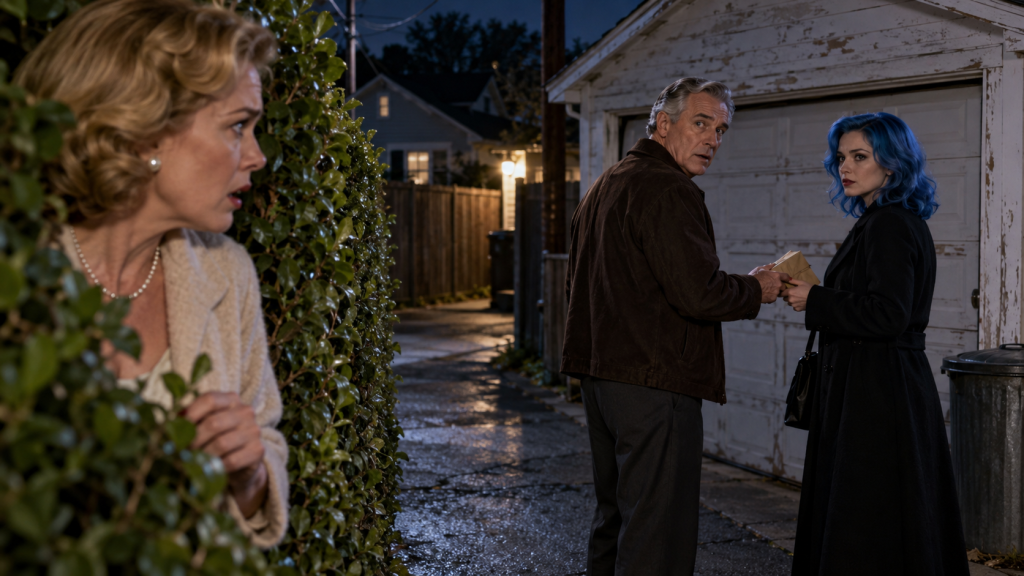
Claire’s words seemed to hang in the alley between us.
For a second, all I could hear was the distant hum of traffic and the faint rattle of somebody’s air conditioner.
Robert stood beneath the yellow security light with his shoulders slumped.
Claire still held the brown-paper package against her chest.
I looked from one of them to the other.
“Then who exactly should I be worried about?”
Neither answered.
That frightened me more than an answer would have.
“Robert?”
He rubbed both hands over his face.
“Diane, please.”
“No.”
My voice cracked.
“You have been disappearing every night with packages hidden inside garbage bags. You meet a woman I’ve never seen in an alley. She knows my name. She knows about Saturday. And apparently she knows something I don’t.”
I pointed at Claire.
“So no more ‘please.’ No more ‘not yet.’ Tell me what is happening.”
Robert looked at Claire.
She shook her head.
“Don’t look at me.”
she said.
“This is your marriage.”
Then she turned to me.
“I’m sorry.”
“For what?”
“For helping him keep this secret.”
My stomach tightened.
“What secret?”
Robert closed his eyes.
Then he said:
“Come with me.”
I laughed.
It sounded ugly.
“Absolutely not.”
“Diane—”
“You can explain right here.”
“I can’t.”
“Why?”
“Because what I need to show you isn’t here.”
I stared at him.
Claire stepped forward.
“He’s telling the truth.”
I looked at her.
“You understand that you are currently the least reassuring person available?”
To my surprise, she almost smiled.
“Fair.”
Then she looked at Robert.
“You’ve already ruined the surprise.”
Robert sighed.
“I know.”
“So stop protecting the surprise and protect your marriage.”
Something about the way she said it made me pause.
Not defensive.
Not possessive.
Not like a mistress caught with someone else’s husband.
She sounded irritated with him.
Almost protective of me.
I folded my arms.
“Where?”
Robert pointed farther down the alley.
“Three blocks.”
“At nine forty at night?”
“Yes.”
“What is three blocks away?”
He hesitated.
I raised my eyebrows.
“Robert.”
“A storage unit.”
Of all the answers I had imagined, that wasn’t one.
“You have a storage unit?”
“Yes.”
“Since when?”
“Six months.”
“Six months?”
“I can explain.”
“You keep saying that.”
“I know.”
Claire muttered:
“He does that.”
I looked at her.
Robert looked offended.
“Whose side are you on?”
“Apparently hers.”
Claire said.
“I told you this secrecy thing was stupid.”
I almost laughed.
Almost.
Instead, I said:
“Fine.”
Robert blinked.
“Fine?”
“Show me.”
We walked.
Robert beside me.
Claire several steps behind.
I did not hold his hand.
That mattered.
For twenty-nine years, Robert and I had walked almost everywhere touching somehow.
Hands.
Shoulders.
His palm against my back crossing streets.
Some tiny physical confirmation that we were together.
That night, there was space between us.
Only a few inches.
It felt enormous.
The storage facility sat behind a row of small businesses.
Robert entered a code.
The gate opened.
“You have your own code.”
I said.
“Yes.”
“How much are you paying for this?”
“Diane.”
“What?”
“Can we discuss the budget later?”
“If we remain married long enough to discuss the budget.”
He stopped walking.
I immediately regretted saying it.
Not because I didn’t mean it.
Because of his face.
Twenty-nine years suddenly appeared there.
Fear.
“Diane.”
he whispered.
“Just show me.”
We reached unit 114.
Robert took a key from his pocket.
His hand trembled.
Claire stood back.
“You should open it.”
she told him.
He did.
The metal door rattled upward.
A light came on.
And I forgot every accusation I had prepared.
Inside the storage unit was my life.
Not metaphorically.
Literally.
Boxes.
Photographs.
Furniture.
An old green bicycle.
A wooden rocking chair.
My father’s toolbox.
The yellow lamp from my childhood bedroom.
A sewing machine I hadn’t seen since my mother died.
And against the back wall stood something covered by a white sheet.
I stepped inside.
“What is this?”
Robert did not answer.
I touched the rocking chair.
My mother’s.
I recognized the scratch on the arm where our dog had chewed it when I was eleven.
“Where did you get this?”
“Your sister.”
“My sister?”
“Some of it.”
I turned.
Robert’s eyes were wet.
“Some came from your aunt’s basement. Some from boxes we already had. Some I tracked down.”
“Tracked down?”
I looked around.
There was an old wooden sign.
MILLER’S BOOKS & STATIONERY
My knees nearly gave way.
“No.”
I walked toward it.
“No way.”
My father had owned a tiny bookstore when I was a child.
It lasted twelve years.
Then a chain store opened nearby.
Business disappeared.
The shop closed.
My father never recovered emotionally.
He died eight years later.
I had not seen that sign in more than thirty-five years.
I touched the faded lettering.
“Where did you find this?”
Robert swallowed.
“Wisconsin.”
“What?”
“A man bought it at an estate auction years ago.”
“How did you even know—”
“I’ve been looking for four years.”
I turned around.
Four years.
Claire walked in quietly.
“Show her the rest.”
she said.
Robert nodded toward the covered object.
I pulled away the sheet.
Underneath was an old oak counter.
The counter from my father’s bookstore.
I knew because I had carved my initials beneath it when I was nine.
I dropped to my knees.
There.
D.M.
Crooked letters.
Still visible.
My hand flew to my mouth.
“Oh my God.”
Robert crouched beside me.
I touched the initials.
For a moment, I was not sixty-one years old.
I was nine.
My father was alive.
My mother was standing behind the register complaining about dust.
There were paperbacks stacked by the window.
There was a jar of peppermint candies near the till.
There was sunlight on the wooden floor.
And I was small enough to believe that places lasted forever.
I started crying.
Robert reached for me.
This time, I let him.
“What is all this?”
I whispered.
“Saturday.”
he said.
I pulled back.
“What happens Saturday?”
Robert looked at Claire.
She smiled.
Then held out the brown package.
“Open it.”
I took it.
Inside was a brass door handle.
Old.
Polished.
Familiar.
I stared.
“No.”
Robert was crying now.
“Yes.”
“Robert.”
“Saturday is the thirtieth anniversary of the day we met.”
I blinked.
Our wedding anniversary was still months away.
But he was right.
Thirty years earlier, on a Saturday in October, I had met Robert in a hardware store.
I was trying to fix a cabinet hinge.
He told me I was holding the wrong size screw.
I told him to mind his business.
He followed me to the register and asked me for coffee.
I said no.
Then changed my mind in the parking lot.
Saturday.
Thirty years.
“I thought you forgot.”
I whispered.
“I didn’t.”
“What are you doing?”
Robert stood.
“I’m rebuilding your father’s bookstore.”
The room disappeared.
“What?”
“Not as a business.”
he said quickly.
“Not exactly.”
I stared.
He continued.
“The old pharmacy building on Walnut Street.”
I knew it.
Empty for years.
“You bought it?”
“We bought it.”
“What?”
He winced.
“That part requires explanation.”
“Yes.”
“It does.”
I wiped my face.
“Robert.”
“We had talked about buying a small property after I retired.”
“That was supposed to be next year.”
“I know.”
“How much?”
“Diane.”
“How much?”
“Eighty-four thousand.”
My jaw dropped.
“You spent eighty-four thousand dollars without telling me?”
“No.”
he said quickly.
“I used my inheritance from Uncle George.”
I stopped.
Robert’s uncle had died two years earlier and left him money.
Robert had always insisted it was “our money.”
I had insisted it was his.
We had compromised by investing most of it in an account solely in his name while discussing what we might eventually do with it.
“You bought a building.”
“Yes.”
“Without telling me.”
“Yes.”
“Why?”
He looked around the storage unit.
“Because I wanted to give you something that couldn’t fit in a box.”
That should have been romantic.
Part of it was.
Another part made me furious.
“You lied to me for six months.”
His face fell.
“I know.”
“You disappeared.”
“Yes.”
“You hid financial decisions.”
“Yes.”
“You sneaked through alleys with garbage bags.”
“That part was only this week.”
I stared.
“Not helping.”
“Sorry.”
Claire covered a laugh with a cough.
I turned toward her.
“And who are you?”
Finally.
Claire put out her hand.
“Claire Donnelly.”
I did not take it immediately.
“What do you do?”
“Architectural restoration.”
I blinked.
She smiled.
“I restore old commercial interiors. Woodwork, fixtures, signage, hardware.”
I looked at the package.
“The door handle.”
“Yes.”
“And you’ve been helping Robert?”
“For about eight months.”
“Eight?”
Robert looked guilty.
“Technically.”
I closed my eyes.
“Robert.”
“I wanted it to be perfect.”
I opened my eyes.
“That sentence has caused more marital disasters than you realize.”
Claire nodded.
“I told him.”
“Thank you.”
“You’re welcome.”
Robert looked betrayed.
“Again, whose side?”
“Diane’s.”
she said.
“You pay invoices late.”
Despite myself, I laughed.
It escaped before I could stop it.
Robert smiled.
Then I pointed at him.
“Do not interpret that as forgiveness.”
“Wouldn’t dream of it.”
Good answer.
I walked deeper into the unit.
Boxes were labeled in Robert’s handwriting.
DIANE — CHILDHOOD BOOKS
MILLER SHOP PHOTOS
REGISTER PARTS
LIGHTING
SATURDAY
I touched one.
“What exactly are you building?”
Robert inhaled.
“Come see.”
“Now?”
“If you’re willing.”
I looked at the clock.
10:18.
I should have been home.
I should have been furious.
I was furious.
But underneath the anger, something else had started.
Fear.
Not fear of Robert.
Fear of hope.
Because my father’s bookstore was one of the tenderest places inside me.
Robert knew that.
He also knew I almost never talked about it.
After Dad died, I stopped.
Some memories are so precious that speaking them aloud feels like wearing them down.
“Okay.”
I said.
“Show me.”
Claire drove separately.
Robert and I took his car.
The silence lasted six blocks.
Then I said:
“You could have told me.”
“I know.”
“No, I don’t think you do.”
He gripped the steering wheel.
“I wanted to surprise you.”
“I thought you were having an affair.”
He flinched.
“I know.”
“No. You know now.”
I looked out the window.
“For three days, I wondered whether twenty-nine years had meant something different to you than it meant to me.”
He swallowed.
“I am sorry.”
“I watched you walk toward another woman in an alley.”
“I know.”
“She asked whether I knew.”
“I know.”
“You told her not yet.”
“I know.”
“Stop saying you know.”
“Sorry.”
We stopped at a red light.
Robert looked at me.
“I was stupid.”
“Yes.”
“I thought secrecy and deception were different if the intention was good.”
That made me look at him.
He continued.
“They aren’t.”
Not entirely true.
But close enough to matter.
“A surprise has an expiration date.”
he said.
“Saturday.”
“Yes.”
“A secret can damage things before you reveal it.”
“Yes.”
He nodded.
“I understand that now.”
The light changed.
We drove.
The old pharmacy building stood at the corner of Walnut and Ash.
I had passed it hundreds of times.
That night, lights glowed inside.
Robert unlocked the front door.
I stepped in.
Then stopped.
The smell hit me first.
Wood.
Fresh paint.
Dust.
Paper.
Memory.
The room was unfinished.
Tools everywhere.
Plastic sheeting.
Half-painted walls.
But I could already see it.
Bookshelves lined one side.
A long counter waited near the back.
Pendant lights hung from the ceiling.
The old bookstore sign rested against the wall, waiting to be mounted.
On another wall was a framed black-and-white photograph of my father standing outside Miller’s Books & Stationery in 1978.
I covered my mouth.
“Robert.”
He stood behind me.
“This was supposed to be finished Saturday.”
I walked farther inside.
There were books.
Hundreds.
Some old.
Some new.
A children’s corner.
Two armchairs.
A long communal table.
“What is this?”
I whispered.
Robert smiled.
“You’ve spent fifteen years saying our neighborhood needs somewhere kids can read after school.”
I looked at him.
“You said the library closes too early.”
“Yes.”
“You complained about kids doing homework at the laundromat because their parents work evenings.”
“Yes.”
“You said when you retired, maybe you’d volunteer.”
My eyes filled.
“So I thought…”
His voice broke.
“I thought maybe we could make somewhere.”
We.
Not buy me something.
Make somewhere.
“What is it called?”
I asked.
He pointed toward the wall.
A sign was covered with brown paper.
I tore it down.
MILLER HOUSE
Below it:
BOOKS • HOMEWORK • COFFEE • COMMUNITY
I started crying again.
“Coffee?”
I managed.
Robert smiled.
“I require coffee.”
“You hate books.”
“I tolerate them when coffee is present.”
Claire entered behind us.
“He also insisted on an absurdly expensive espresso machine.”
I looked at Robert.
“How expensive?”
He looked at Claire.
“Why would you say that?”
“Transparency.”
she replied.
I laughed again.
Then cried harder.
Robert approached.
“Diane.”
I let him hold me.
For a minute.
Maybe two.
Then I stepped away.
“This is beautiful.”
His eyes lit.
“But.”
The light dimmed.
“We are still having a serious conversation.”
“I know.”
“Tomorrow.”
“Absolutely.”
“No more secrets.”
“No more.”
“Financial or otherwise.”
“Yes.”
“And you are taking out the trash for the rest of your natural life.”
He stared.
“That’s unreasonable.”
“Divorce remains available.”
“I accept the trash.”
Claire laughed so hard she had to lean against the counter.
That should have been the ending.
It wasn’t.
Because life is rarely solved by one beautiful reveal.
The next morning, I woke angry.
That surprised Robert.
It surprised me too.
He was making coffee when I walked into the kitchen.
He smiled cautiously.
“Morning.”
“Morning.”
Then he saw my face.
“Oh.”
“Yes.”
“Still angry.”
“Yes.”
He poured coffee.
“Fair.”
I sat.
He sat opposite me.
For a while, neither spoke.
Then I asked:
“Why didn’t you trust me with this?”
He frowned.
“I did trust you.”
“No.”
I shook my head.
“You trusted that I would like the finished product.”
He became quiet.
“You didn’t trust me with the process.”
That landed.
I continued.
“You made a major financial decision.”
“With my inheritance.”
“I know.”
“You contacted my sister.”
“Yes.”
“My aunt.”
“Yes.”
“You spent four years searching for my father’s sign.”
“Yes.”
“You bought a building.”
“Yes.”
“You hired Claire.”
“Yes.”
“You planned a community space.”
“Yes.”
“You involved apparently everyone except me.”
His eyes lowered.
“When you say it like that—”
“How else should I say it?”
He rubbed his face.
“I wanted to give you something.”
“I understand.”
“And you are always the one who plans everything.”
I stopped.
There it was.
Something underneath.
“What does that mean?”
Robert hesitated.
“Diane, for twenty-nine years, you have been the organizer.”
“That isn’t news.”
“No.”
He looked at me.
“You plan vacations.”
“Because you forget.”
“You manage birthdays.”
“Because you forget.”
“You handle the bills.”
“Because you once paid the electric company twice and forgot the mortgage.”
“That happened once.”
“Three times.”
“Fine.”
He almost smiled.
Then became serious.
“You take care of everyone.”
I leaned back.
“So?”
“So I wanted to take care of something for you.”
My anger softened.
A little.
“You could have.”
“I know.”
“Without making me think you were having an affair.”
“Yes.”
He looked miserable.
“I genuinely did not anticipate that.”
“You met a blue-haired woman in an alley.”
“When you say it like that—”
“Robert.”
“Right.”
He sighed.
“I messed up.”
“Yes.”
“I am sorry.”
I believed him.
Still, there was something bothering me.
“Why the trash bags?”
His ears turned red.
I stared.
“Oh my God.”
“What?”
“You’re embarrassed.”
“No.”
“You are.”
He rubbed his neck.
“Claire’s workshop is behind the alley.”
“I know.”
“She restored some smaller pieces there.”
“Yes.”
“I needed to transport things without you seeing them.”
“So you put them in trash bags.”
“Yes.”
“Why at exactly 9:30?”
“You always start your crossword at nine.”
I stared.
“You planned around my crossword?”
“You become impossible to interrupt.”
“That’s insulting.”
“You once ignored a smoke alarm because you were finishing Sunday.”
“That was one time.”
“Twice.”
I tried not to smile.
Failed.
Robert saw.
He smiled too.
Then I pointed.
“Still angry.”
“Understood.”
I drank my coffee.
“Why Claire?”
“Her father knew your father.”
That surprised me.
“What?”
Robert nodded.
“That’s actually how I found the counter.”
Claire’s father, Patrick Donnelly, had worked as a carpenter.
He had helped Dad remodel the bookstore in the early eighties.
After the store closed, some fixtures were sold.
Patrick remembered where several had gone.
Years later, Claire inherited his workshop records.
Robert had found her through a preservation group.
“So she knew Dad?”
“She met him when she was little.”
“How little?”
“Five or six.”
I sat back.
Suddenly Claire was no longer simply the blue-haired woman in an alley.
She was a tiny thread connecting me to someone long gone.
“Why didn’t she say?”
“Because I made everyone promise.”
I glared.
Robert raised both hands.
“Again: stupid.”
“Correct.”
We talked for three hours.
About money.
The building.
His inheritance.
What Miller House would actually be.
Robert had done more homework than I expected.
The building would be owned through a small nonprofit foundation he had begun establishing with legal help.
No mortgage.
Renovation costs mostly covered from his inheritance, plus a modest grant Claire had helped him identify.
He had not used our retirement accounts.
He had not signed my name to anything.
He had not placed financial obligations on me.
I appreciated that.
But the emotional problem remained.
“I don’t want a building as an anniversary present.”
I said.
His face fell.
Then I continued.
“I want a decision.”
He frowned.
“What decision?”
“If Miller House is supposed to be part of my life, then I get to decide whether I want it.”
He nodded slowly.
“Yes.”
“Not because you’ve already spent money.”
“Yes.”
“Not because everyone worked hard.”
“Yes.”
“Not because Dad would have loved it.”
“Yes.”
“I get to say no.”
He swallowed.
“Yes.”
That mattered.
I looked at him.
“Then I want it.”
Robert cried.
Actually cried.
Ugly crying.
I laughed.
“Don’t make this dramatic.”
“You just said yes.”
“To a community reading room.”
“It feels like a proposal.”
“We already did that.”
“Twenty-nine years ago.”
“And you nearly dropped the ring in spaghetti.”
“It was romantic.”
“It was Olive Garden.”
“Same thing.”
I laughed.
There he was.
My husband.
Infuriating.
Ridiculous.
Mine.
Saturday came.
The surprise was ruined.
The opening wasn’t.
Robert wanted to cancel.
I refused.
“No.”
“But you know.”
“Other people don’t.”
“Are you sure?”
“Yes.”
“Do I still give the speech?”
“Depends.”
“On?”
“Is it terrible?”
He looked offended.
“I’ve been practicing for months.”
“Then definitely terrible.”
He gave the speech anyway.
Our children came.
Our daughter, Emily, flew in from Denver.
Our son, Michael, drove from Indianapolis with his wife and our two grandchildren.
Apparently they had all known.
I stood at the entrance of Miller House with my arms crossed.
“You.”
I pointed at Emily.
She smiled nervously.
“Happy anniversary?”
“You knew.”
“Dad threatened us.”
Robert protested.
“I did not threaten anyone.”
Michael laughed.
“You said Mom would murder us if we spoiled it.”
“That is an observation, not a threat.”
I hugged them anyway.
My sister came.
My aunt came.
Old neighbors.
Former coworkers.
People from the community.
Claire arrived wearing her blue hair in a braid and carrying the brass door handle.
“You kept it.”
I said.
“It belongs here.”
Together, we installed it on the office door.
The old bookstore counter stood near the back.
Dad’s sign hung above it.
The rocking chair sat in the children’s corner.
My mother’s sewing machine had been placed inside a glass display case along with photographs and a small card about our family.
I read the card.
Then changed it.
Robert watched.
“What did you change?”
“It said Dad founded Miller’s Books.”
“He did.”
“Mom kept the books.”
“So?”
“So without her, Dad would’ve been selling novels from a cardboard box.”
Robert smiled.
“You’re right.”
We changed the plaque.
FRANK AND HELEN MILLER
That felt better.
At two o’clock, Robert stood before everyone.
He hated public speaking.
I could see his hands shaking.
“Thirty years ago tomorrow…”
he began.
I raised my hand.
“Today.”
He looked at me.
“What?”
“We met thirty years ago today.”
His face went blank.
The room erupted in laughter.
I stared.
“You built an entire building around the wrong date?”
“I thought it was the nineteenth.”
“It was the eighteenth.”
Robert looked at Emily.
“You told me the nineteenth.”
Emily nearly collapsed laughing.
“I guessed!”
I covered my face.
Twenty-nine years.
Secret storage unit.
Historic restoration.
Months of planning.
And my husband had the date wrong.
It was perfect.
Robert waited until everyone stopped laughing.
Then said:
“This is why Diane usually organizes things.”
More laughter.
Then his voice changed.
He looked at me.
“I spent most of our marriage thinking Diane liked taking care of everything.”
I smiled faintly.
“She is very good at it.”
he continued.
“So good that I stopped asking whether being good at something meant she should always have to do it.”
My throat tightened.
“I thought she handled the bills because she liked organization. I thought she remembered birthdays because she had a good memory. I thought she planned holidays because she enjoyed planning.”
He paused.
“Maybe some of that is true.”
I nodded.
Some.
“But somewhere along the way, I let competence become obligation.”
The room became quiet.
“I let the person who could carry things become the person who always carried them.”
My eyes filled.
Robert looked down.
“I even let her take out the garbage for twenty-nine years.”
Everyone laughed.
I didn’t.
Because suddenly the trash meant something different.
Not the secret packages.
The ordinary bags.
Twenty-nine years of small things.
I had carried them because Robert hated doing it.
And because I could.
How many responsibilities in a marriage begin exactly that way?
One person does something well.
So they do it again.
Then again.
Eventually, nobody remembers it was ever a choice.
Robert continued.
“Four years ago, Diane mentioned her father’s bookstore.”
I remembered.
We had been driving home from a funeral.
I had said I wished there were still places like it.
That was all.
One sentence.
Robert remembered.
“She said her father believed every neighborhood needed a place where a kid could walk in without money and still be allowed to stay.”
I started crying.
Dad had said that.
All the time.
Books were for buyers.
The chairs were for everyone.
That was his rule.
Robert continued.
“So I started looking.”
He told the story.
The sign.
The counter.
Claire.
The building.
Then he looked at me.
“I wanted to surprise Diane because she has spent our entire marriage making ordinary life possible for everyone else.”
His voice broke.
“But I learned this week that a good intention doesn’t make secrecy harmless.”
He looked around.
“I scared my wife.”
Some people laughed softly.
Robert didn’t.
“She thought I was betraying her.”
The room became still.
“And that isn’t funny.”
He looked at me.
“I am sorry.”
Not private.
Not hidden behind the happy ending.
Public.
Simple.
“I wanted to give you a place built from your memories.”
he said.
“But I should have remembered that marriage isn’t a magic trick.”
I laughed through tears.
“That is correct.”
He smiled.
“So Miller House is not Diane’s anniversary present.”
I frowned.
“It isn’t?”
“No.”
He looked at me.
“It belongs to the neighborhood.”
Then he reached into his pocket.
“This is your anniversary present.”
He handed me a small box.
I opened it.
Inside was a key.
I looked at him.
“To what?”
“The back office.”
“I already have a key.”
“Different key.”
I narrowed my eyes.
“Robert.”
Emily started laughing.
“Dad, tell her.”
He sighed.
“A cabin.”
My jaw dropped.
“No.”
“Tiny.”
“No.”
“Very tiny.”
“Robert.”
“Michigan.”
“You bought another property?”
“Technically—”
I handed the box back.
The entire room exploded with laughter.
Robert took the key.
“Okay.”
he said.
“Bad timing.”
“Very.”
“Can we discuss later?”
“Yes.”
“Is that a no?”
“It is a threat.”
More laughter.
For the record, we kept the cabin.
After several conversations.
And after I made him show me every document.
Miller House opened the following Monday.
At first, almost nobody came.
That was humbling.
Robert had imagined children pouring through the doors.
Instead, our first afternoon brought one retired man who thought we were a used bookstore and a woman asking whether we repaired printers.
Robert looked devastated.
“Give it time.”
I told him.
“You sound like me.”
“Terrifying.”
The next week, six middle-school students came in after class.
They bought nothing.
Perfect.
They sat at the long table and did homework.
One fell asleep in the rocking chair.
Another asked whether the Wi-Fi was free.
“Yes.”
I said.
“For how long?”
“As long as we’re open.”
He looked suspicious.
“Why?”
I smiled.
“Because.”
That was enough.
Within six months, Miller House became what Robert had hoped.
Homework club.
Used books.
Coffee.
Tutoring.
Saturday reading groups.
A retired accountant volunteered to teach basic financial literacy.
Claire taught workshops on neighborhood architecture.
Robert learned to make espresso.
Badly.
I eventually banned him from the machine.
He became excellent at taking out the trash.
Every night.
Without fail.
At exactly 9:30, he would stand dramatically and announce:
“I have a secret meeting.”
I would throw a napkin at him.
Marriage survives many things through humor.
But humor only works after honesty.
Without honesty, jokes become camouflage.
That was another thing we learned.
A year after Miller House opened, Claire came to me privately.
“There is something I should tell you.”
My stomach tightened.
She saw my face.
“Not that kind of something.”
“Please never begin a sentence like that.”
“Fair.”
We sat in the children’s corner.
She told me that during the restoration, Robert had asked her whether she thought I would like the project.
“I told him I didn’t know you.”
she said.
“He kept describing you.”
I smiled.
“What did he say?”
“That you hated surprises.”
I stared.
Claire laughed.
“Yes.”
“He knew?”
“Apparently.”
“Then why—”
“He said this one was different.”
I covered my face.
“Of course.”
Claire continued.
“He said you loved old books but hated dust. That you always carried mints. That you cried at dog food commercials but not funerals.”
“That is private.”
“That you hated people singing happy birthday to you.”
“Correct.”
“That you still used your mother’s sewing scissors even though they barely cut.”
My eyes filled.
“And he said you had spent your whole life being practical.”
Claire’s voice softened.
“He wanted to give you something impractical.”
That broke me.
Because she was right.
Robert was right too.
I had spent my life being practical.
My father had been a dreamer.
The bookstore failed partly because he loved books more than spreadsheets.
After watching that happen, I became the opposite.
Budgets.
Lists.
Insurance.
Savings.
Retirement.
Practicality had protected me.
It had also become armor.
Miller House was impractical.
Beautifully so.
We never made much money.
Some years we lost a little.
We fundraised.
Applied for grants.
Accepted donated books.
Held ridiculous bake sales.
And for twenty-three years, children came through those doors.
That was enough.
Robert retired at sixty-five.
I retired two years later.
Retirement nearly destroyed us.
Not because of infidelity.
Because Robert was suddenly home.
Constantly.
There are aspects of a spouse’s personality that become charming only because employment removes them for eight hours a day.
Robert whistled.
All morning.
Badly.
He reorganized drawers.
Incorrectly.
He developed opinions about how I loaded the dishwasher after twenty-nine years of having none.
One morning I stared at him and said:
“Get a hobby.”
He replied:
“I have Miller House.”
“Go there.”
He did.
Marriage saved.
We traveled.
Not extravagantly.
The cabin in Michigan became our favorite place.
Yes, the secret cabin.
I eventually forgave him for that too.
It sat beside a small lake.
Two bedrooms.
Screened porch.
Terrible plumbing.
Robert loved fishing.
I hated fishing.
So he fished.
I read.
That is what compatibility looks like after forty years.
Not doing everything together.
Being able to be peacefully separate in the same place.
Our children grew older.
Our grandchildren grew.
Miller House grew too.
One afternoon, a seventeen-year-old girl named Tasha asked whether she could volunteer.
“Why?”
I asked.
She shrugged.
“I used to come here when Mom worked nights.”
I remembered her.
Tiny girl.
Braids.
Always hungry.
We kept granola bars behind the counter because of her.
“I did homework here.”
she said.
“I got into Northwestern.”
I cried.
She looked alarmed.
“Are you okay?”
“No.”
Robert appeared.
“What happened?”
“She got into Northwestern.”
He cried too.
Tasha stared at us.
“You guys are weird.”
“Yes.”
I said.
“Get used to it.”
Years later, Tasha became a lawyer.
She joined the Miller House board.
Eventually chaired it.
That mattered because Robert and I had always insisted the place could not depend forever on us.
If something good dies the moment its founder leaves, you built a monument.
Not an institution.
I had learned that from Dad’s bookstore.
He had built something beautiful.
But too much of it depended on him.
When he broke, the store broke.
Miller House needed to outlive us.
It did.
Claire married a woman named Jenna.
I attended their wedding.
At the reception, Claire introduced me to someone as:
“The woman who caught me meeting her husband in an alley.”
I stared at her.
“You need a better story.”
“It is my best story.”
Jenna laughed.
“I’ve heard it forty times.”
Robert said:
“I remain the victim of poor optics.”
I replied:
“You put packages in garbage bags.”
“I was protecting them from rain.”
“You met a blue-haired woman behind a garage.”
“Architect.”
“At night.”
“She works late.”
“Secretly.”
“Surprise.”
Claire raised her glass.
“To Diane not murdering us.”
We drank to that.
Robert and I celebrated our fortieth wedding anniversary at Miller House.
Then our forty-fifth.
At fifty, our children threw us a party.
Someone brought a trash can decorated with ribbons.
I considered disowning everyone.
Robert thought it was hilarious.
He stood beside it for photographs.
Then came the years when jokes became memories.
Robert began forgetting things.
Small at first.
Keys.
Appointments.
Words.
Once he drove to the grocery store and returned with no groceries because he had forgotten why he went.
We laughed.
Then it happened again.
And again.
At seventy-nine, Robert was diagnosed with early-stage Alzheimer’s disease.
There are moments when life becomes divided into before and after.
That was one.
The neurologist kept talking.
I stopped hearing.
Robert reached for my hand.
I held it.
In the parking lot, we sat in the car.
Neither spoke.
Finally Robert said:
“Well.”
I stared ahead.
“Don’t.”
“What?”
“Make a joke.”
“I wasn’t.”
“You were about to.”
He sighed.
“Yes.”
I started crying.
He did too.
“I am scared.”
I whispered.
“So am I.”
That mattered.
He did not say:
We’ll beat this.
He did not say:
Everything will be fine.
He did not make promises biology could not keep.
He simply said:
“So am I.”
We drove home.
At 9:30 that night, Robert stood.
“I’ll take the trash.”
I looked at him.
He smiled.
Some habits survive even when memory begins loosening.
I watched him tie the bag.
He walked outside.
Two minutes later, he returned.
No alley.
No secret package.
Just Robert.
For the next few years, we adjusted.
Lists.
Labels.
Medication boxes.
Calendars.
Our children helped.
Claire helped.
Tasha helped at Miller House.
Eventually Robert stopped driving.
That hurt him.
Then he stopped managing the espresso machine.
That helped everyone.
He still went to Miller House.
Children knew him as Mr. Robert.
Some did not know he had founded it.
I liked that.
One afternoon, I found him standing beneath Dad’s bookstore sign.
He looked confused.
“What is this?”
he asked.
My heart broke.
“You found it.”
“I did?”
“Yes.”
“Where?”
“Wisconsin.”
He stared at the sign.
“Why?”
“For me.”
He looked at me.
“Why?”
I almost couldn’t answer.
“Because you loved me.”
His face softened.
“Oh.”
Then he smiled.
“Good reason.”
I cried in the bathroom afterward.
There is a particular grief in being remembered less by someone you remember completely.
People call dementia “the long goodbye.”
I disliked that phrase.
It made it sound like the person was steadily leaving while everyone else remained still.
That wasn’t our experience.
Robert was still there.
Changed.
Fragmented.
Sometimes distant.
Sometimes astonishingly present.
I had to learn to meet him where he was instead of demanding he return to where I stood.
One morning he woke and called me “Mom.”
I cried after.
Another morning he looked at me and said:
“Diane, you look tired.”
I laughed.
“Accurate.”
He touched my cheek.
“You do too much.”
That nearly destroyed me.
Even as his memory faded, some old truth remained.
“You always carry everything.”
he whispered.
I held his hand.
“Not everything.”
“You should let people help.”
“I do.”
“Good.”
Then five minutes later he asked where we were.
Memory is cruel.
Love can be stubborn.
At eighty-three, Robert needed more care than I could safely provide alone.
I resisted.
Our daughter finally said:
“Mom, keeping Dad home at any cost is not the same as loving him.”
I hated her for saying it.
For approximately twelve minutes.
Then I knew she was right.
We found a memory-care residence ten minutes away.
I visited every day.
Not because I had to.
Because I wanted to.
Some days Robert knew me.
Some days he knew only that he liked me.
That became enough.
I would sit beside him.
He would smile.
“You’re pretty.”
“I’m your wife.”
“Lucky me.”
“Yes.”
I would show him photographs.
Children.
Grandchildren.
Miller House.
Sometimes recognition appeared.
Sometimes not.
Then one afternoon I brought an old photograph of the two of us standing outside Miller House on opening day.
Robert stared.
“That place.”
“Yes.”
“I know that place.”
“Yes.”
“Books.”
“Yes.”
He touched the photograph.
“Did you like it?”
I couldn’t breathe.
“Very much.”
He smiled.
“Good.”
Then:
“I made that?”
“Yes.”
“For you?”
“Partly.”
“Why?”
I leaned closer.
“Because I spent our entire marriage taking out the trash.”
He stared.
Then suddenly laughed.
Not polite laughter.
Robert’s laugh.
Deep.
Familiar.
Mine.
“You hated that.”
I froze.
“You remember?”
He looked at me.
For perhaps ten seconds, his eyes cleared.
“I hate trash.”
I laughed and cried.
“So you do remember.”
He smiled.
“Of course.”
Then it was gone.
But I had ten seconds.
Sometimes ten seconds is a lifetime.
Robert died at eighty-five.
Quietly.
I was beside him.
Emily on the other side.
Michael at the foot of the bed.
His breathing slowed.
Then stopped.
No dramatic final sentence.
No last revelation.
Just breath.
Then no breath.
I held his hand for a long time afterward.
I expected something inside me to break loudly.
Instead, grief entered quietly.
Like snow.
Covering everything.
At his funeral, Claire spoke.
She was gray-haired by then.
Blue gone.
She told the alley story.
Everyone laughed.
I did too.
Then she said:
“Robert taught me that beautiful things can begin with terrible plans.”
More laughter.
“But he also taught me something about restoration.”
Her voice softened.
“When you restore old wood, you don’t erase every scratch.”
She looked at me.
“You preserve enough of the marks to show that the object lived.”
I cried.
“That was Robert.”
she said.
“He wasn’t polished smooth. He was stubborn. Secretive when excited. Terrible with invoices. Worse with dates.”
People laughed.
“But he spent his life learning how to love people more carefully.”
That was true.
At the reception, Tasha approached me.
“We need to talk about Miller House.”
My stomach tightened.
“Is something wrong?”
“No.”
She handed me an envelope.
Inside were plans.
Expansion.
The building next door had become available.
“What is this?”
“Robert started talking to the owner three years ago.”
I stared.
“No.”
Tasha laughed.
“He did not buy it.”
“Thank God.”
“He learned.”
I laughed so hard I cried.
“He told us we weren’t allowed to do anything until you approved.”
I looked at the plans.
A larger children’s area.
Two tutoring rooms.
A small legal-aid office.
Community meeting space.
“He wanted this?”
“Yes.”
“Do we have money?”
“We have funding.”
“Do we have board approval?”
“Pending.”
“Do we have permits?”
“Working on it.”
I looked at Tasha.
“Good.”
She smiled.
“He trained you.”
“No.”
I said.
“You did.”
That touched me more than she knew.
We expanded.
The new wing opened two years after Robert died.
We named it:
THE ROBERT HAYES ROOM
I objected.
“He would hate that.”
Tasha said:
“He’s dead.”
“Tasha.”
“What? He can’t resign.”
I laughed.
The room became a homework and tutoring center.
On the wall, we placed a photograph of Robert holding a trash bag.
Emily had taken it as a joke on our fortieth anniversary.
Underneath, a small plaque read:
TAKE CARE OF THE SMALL THINGS. THEY BECOME A LIFE.
That was my idea.
Because that was what I learned.
Not from the grand gesture.
The grand gesture was wonderful.
The restored bookstore.
The sign.
The counter.
The building.
But marriage had never truly been built from grand gestures.
It was trash.
Coffee.
Bills.
Who called the plumber.
Who remembered prescriptions.
Who sat awake during fever.
Who apologized after being unfair.
Who noticed when the other person was tired.
Who learned to carry what they had once assumed belonged to someone else.
Small things.
Repeated.
Until they became a life.
At eighty-nine, I stopped volunteering regularly at Miller House.
My knees objected.
I still visited.
Children still filled the tables.
Most had no idea who I was.
Perfect.
One afternoon, a young employee stopped me near the counter.
“Ma’am, staff only behind here.”
I smiled.
“Sorry.”
Then moved.
Tasha saw from across the room and hurried over.
“Diane, you can go anywhere you want.”
“No.”
I said.
“She was right.”
The young employee looked horrified when Tasha explained who I was.
I reassured her.
“You did your job.”
“But this is your place.”
“No.”
I looked around.
“It isn’t.”
That was the success.
Miller House belonged to people who had never met Robert.
Children not yet born when he bought the building.
Volunteers who did not know my father.
A neighborhood that had absorbed the place into itself.
Dad would have loved that.
Robert too.
At ninety-one, I moved from our house.
That was harder than selling any building.
Fifty-seven years of marriage had left fingerprints everywhere.
Robert’s workshop.
The dent in the hallway from when Michael threw a baseball indoors.
Height marks.
Kitchen renovations.
A scorch mark from Thanksgiving 1996.
And the garbage bins.
Ridiculous.
I stood beside them and cried.
Emily found me.
“Mom?”
“I am crying over trash cans.”
She hugged me.
“Dad would be thrilled.”
“He’d say I finally appreciated his contribution.”
“He would.”
We laughed.
I moved into a smaller apartment.
Claire had died the year before.
Tasha visited.
My grandchildren visited.
Great-grandchildren appeared.
Life kept doing that.
Expanding after loss.
That felt rude at first.
Then merciful.
At ninety-three, my great-granddaughter Sophie interviewed me for a school project.
“Tell me how you met Great-Grandpa.”
“Hardware store.”
“Was it romantic?”
“No.”
“What did he say?”
“That I had the wrong screw.”
She laughed.
“Then what?”
“He asked me for coffee.”
“Did you say yes?”
“No.”
“Why?”
“He annoyed me.”
“Then how did you marry him?”
“I changed my mind in the parking lot.”
She wrote furiously.
“Why?”
I thought.
“He made me laugh.”
She looked up.
“That’s it?”
“At twenty-nine, that’s enough for coffee.”
She nodded seriously.
Then:
“Mom says he built you a library.”
“Community reading house.”
“Because he loved you?”
“Yes.”
“Was that the nicest thing he ever did?”
I thought for a long time.
“No.”
Sophie frowned.
“What was?”
I smiled.
“He learned.”
She waited.
“That sounds boring.”
“It is.”
“What did he learn?”
“How to notice what I carried.”
I said.
“How to apologize without turning the apology into an excuse. How to let me make decisions even when he wanted to surprise me. How to be cared for when he got sick.”
I touched her hand.
“Building something beautiful is easier than becoming easier to live with.”
Sophie wrote that down.
“That’s good.”
“I’m ninety-three. I have material.”
She laughed.
Before she left, she asked:
“Were you ever mad at him?”
“Constantly.”
“Even when you loved him?”
“Especially then.”
She looked confused.
So I explained.
“Love doesn’t remove irritation, disappointment, or anger.”
“What does it do?”
I thought of Robert.
The alley.
The storage unit.
Miller House.
The cabin.
The trash.
The Alzheimer’s.
Ten clear seconds.
“It gives you a reason to keep telling the truth.”
That became my answer.
Not stay no matter what.
Not forgive everything.
Not endure harm.
Just truth.
Healthy love needs truth because otherwise you are not loving the person.
You are loving a performance.
Robert’s secrecy had frightened me because for three nights I was forced to wonder whether our marriage was a performance.
It wasn’t.
But his good intention did not erase the fear.
Both things could be true.
That became important as I grew older.
People wanted the alley story to be simple.
Woman suspects affair.
Surprise!
Husband secretly rebuilding childhood bookstore.
Heartwarming.
Yes.
It was heartwarming.
It was also frightening.
And foolish.
And loving.
And complicated.
Real marriages usually are.
Robert did something beautiful badly.
Then listened when I told him the bad part mattered too.
That was why the story became beautiful in the end.
Not because his intentions automatically excused him.
Because he allowed my experience to change his behavior.
Years after his death, I found the brown wrapping paper.
I don’t know why I had kept it.
Probably accidentally.
It was folded inside a box with the brass handle’s original receipt.
Claire’s handwriting was on the corner:
SATURDAY — DO NOT LET DIANE SEE
I laughed.
Then cried.
Then laughed again.
I sat by the window holding that stupid paper.
So much of life becomes ridiculous once enough time passes.
The things that nearly destroy you become stories.
The things you barely notice become the things you miss most.
I did not miss the surprise.
I missed Robert asking where the scissors were while standing beside them.
I missed him stealing blankets.
I missed the way he sneezed three times.
Always three.
I missed hearing the back door at 9:30.
I missed the trash bag rustling.
I missed saying:
“Don’t forget recycling.”
I missed him answering:
“I know.”
Those were the sounds of marriage.
Ordinary.
Invisible.
Sacred only after they stop.
On my ninety-fifth birthday, Miller House held a celebration.
I objected.
Nobody cared.
Tasha was seventy by then.
Imagine that.
The teenager who once slept in my mother’s rocking chair had gray hair.
She stood beside me beneath Dad’s sign.
“We’ve had over eighty thousand student visits.”
she told me.
I stared.
“No.”
“Yes.”
“That’s impossible.”
“Numbers don’t care about your feelings.”
“You sound like me.”
“I learned from the worst.”
We smiled.
A little boy approached.
Maybe eight.
He held a book.
“Are you Mrs. Hayes?”
“Yes.”
“Did you make this place?”
I looked around.
“No.”
He frowned.
“Mr. Robert did?”
“Partly.”
“Who made it?”
I thought.
“Lots of people.”
He seemed dissatisfied.
Children like simple founders.
Single heroes.
History rarely gives them.
“My dad had a bookstore.”
I told him.
“Then my husband remembered it. Claire restored pieces. Neighbors donated. Volunteers worked. People gave money. Tasha kept it alive. Kids came.”
I smiled.
“Places are made by everyone who decides they’re worth keeping.”
He considered that.
Then held up his book.
“Can I take this home?”
“Ask the librarian.”
“Are you the librarian?”
“No.”
“What do you do?”
I smiled.
“Mostly interfere.”
He ran away.
Tasha laughed.
“Accurate.”
At the end of the event, everyone left.
I stayed.
Just for a little while.
The building was quiet.
Late sunlight came through the windows.
I walked slowly toward the old counter.
My initials were still underneath.
D.M.
Nine years old.
I touched them.
Then I touched the edge where Robert had once rested his hands during the opening.
So many people gone.
Dad.
Mom.
Robert.
Claire.
Yet here was the counter.
Wood survives differently.
It keeps marks.
I sat in Mom’s rocking chair.
Closed my eyes.
And remembered Thursday night.
The alley.
My shoe crushing the plastic bottle.
Robert saying my name.
The terror in his voice.
At the time, I believed I had discovered the moment my marriage was about to collapse.
Instead, I had discovered a door.
Not into a perfect marriage.
We never had one.
Into a deeper one.
Because afterward, we talked about things we had stopped talking about.
Labor.
Money.
Surprises.
Control.
Competence.
Fear.
Aging.
What we wanted retirement to mean.
What we owed our children.
What we owed ourselves.
All because my husband suddenly decided to take out the trash.
Life is ridiculous.
I smiled.
Then whispered:
“You could’ve just told me.”
In my memory, Robert answered:
“Would’ve ruined the surprise.”
I laughed.
“Idiot.”
No answer.
Only the building settling around me.
I was ninety-seven when I stopped going to Miller House.
My body had become smaller.
My world too.
That wasn’t entirely sad.
There is intimacy in a small world.
A favorite chair.
Morning light.
Tea.
Photographs.
Calls from children.
The sound of rain.
At that age, memory becomes its own geography.
I could travel without moving.
Hardware store.
Wedding.
First apartment.
Babies.
School mornings.
Funerals.
Alley.
Miller House.
Cabin.
Hospital.
Robert’s last room.
All of it nearby.
One afternoon, Emily brought me a small package wrapped in brown paper.
I stared at it.
“No.”
She laughed.
“What?”
“Absolutely not.”
“Mom.”
“I have trauma.”
“It is a book.”
“Open it.”
Inside was a photo album.
On the first page was Robert carrying a trash bag.
Of course.
Below it, Emily had written:
THE NIGHT DAD FINALLY TOOK OUT THE TRASH
I laughed until I coughed.
Then turned the pages.
Photos of construction.
Claire with blue hair.
The old sign.
The counter.
Opening day.
Children.
Anniversaries.
Robert aging.
Me aging.
Tasha.
Expansion.
Grandchildren.
Great-grandchildren.
On the final page was a photograph I had never seen.
Robert alone inside Miller House before opening day.
He was standing beneath Dad’s sign.
Looking up.
Not smiling for the camera.
Just looking.
On the back, Claire had written:
He stood there for ten minutes before he knew I was watching. Then he said, “I hope she feels like something came home.”
I pressed the photograph against my chest.
After all those years, Robert surprised me again.
That one I allowed.
I cried for a long time.
Not broken crying.
Grateful crying.
There is such a thing.
Eventually, I looked at Emily.
“He did.”
“What?”
“He hoped something came home.”
I touched the photograph.
“It did.”
My father.
My childhood.
A forgotten part of myself.
But also Robert.
Because through the years, Miller House became one of the places where I could still find him after memory took him and death took the rest.
Not literally.
I knew that.
I did not need ghosts to make love enduring.
People remain in habits.
Institutions.
Jokes.
Children.
Changed behavior.
Things they repaired.
Things they taught us to repair.
Robert remained every time a child walked into Miller House without money and nobody asked them to leave.
That was enough immortality for me.
Near the end of my life, Sophie asked whether I regretted following Robert that night.
“No.”
“What if you hadn’t?”
“I would’ve found out Saturday.”
“So it wouldn’t have mattered.”
I smiled.
“It mattered.”
“Why?”
“Because Saturday would have shown me what Robert built.”
I said.
“Thursday showed me something about our marriage.”
She waited.
“That good intentions can still frighten someone.”
I continued.
“That secrecy isn’t automatically romantic because the ending is pleasant. That you can be grateful and angry at the same time.”
Sophie nodded.
“And?”
“And your great-grandfather looked very suspicious carrying garbage through an alley.”
She laughed.
I did too.
Then she asked:
“Would you marry him again?”
I closed my eyes.
People love that question.
As though a lifetime can be reduced to yes or no.
“Yes.”
I said.
“With conditions.”
“What conditions?”
“He takes out the trash from day one.”
Sophie laughed.
Then I became serious.
“Yes.”
I repeated.
“I would.”
Not because every day was good.
Not because he never hurt me.
Not because love erased mistakes.
I would marry him again because when his mistakes became visible, he was capable of letting truth change him.
And because he changed me too.
I became less practical.
He became more responsible.
I learned to let people carry things.
He learned not to wait until I dropped them.
We met somewhere in the middle.
That is marriage at its best.
Not two perfect people fitting together.
Two unfinished people willing to keep revising how they love.
If I could return to the alley one final time, I would see myself behind the hedge.
Sixty-one.
Suspicious.
Terrified.
Watching Robert hand a brown-paper package to Claire.
I would want to tell myself:
You are wrong about the affair.
But you are not wrong to ask questions.
Follow him.
Demand answers.
Do not apologize for needing honesty.
Then, when you discover the beautiful thing he built, allow yourself to be moved.
But do not let beauty silence the part of you that was frightened.
Talk about both.
That conversation will matter more than the surprise.
And Diane—
pay attention to the trash.
Not because it hides packages.
Because one day the ordinary things will be what you miss.
The bag tied at 9:30.
The back door opening.
His shoes crossing the kitchen.
The complaint about recycling.
The cold air coming in when he returns.
You will not know these are precious while they are happening.
Nobody does.
That is the terrible bargain of ordinary life.
We recognize much of its beauty only after it becomes memory.
But perhaps knowing that can help us notice a little sooner.
Not perfectly.
Just sooner.
So if someone you love starts taking out the trash after twenty-nine years, yes, perhaps ask why.
But also notice that they are carrying something you used to carry.
Notice when a burden changes hands.
Notice when someone learns.
Notice the small things.
Because eventually, the grand gestures become photographs.
The buildings belong to other people.
The anniversaries blur.
The surprises become family jokes.
And what remains most vividly is often something almost insultingly ordinary.
A man standing beside an overflowing trash can.
A woman saying:
“Your turn.”
And the man she has loved for most of her life tying the bag, smiling, and answering:
“I’ve got it.”
For twenty-nine years, I had heard those words as a joke.
Then as a secret.
Eventually, I understood them as something larger.
Not a promise to carry everything.
Nobody can.
Just a willingness to carry his share.
And in the end, that was the gift Robert had been trying to give me all along.
Not the building.
Not the cabin.
Not my father’s counter.
Not even Miller House.
The gift was that after decades of letting me carry what I could, he finally learned to look at my hands and ask whether they were full.
Then he reached for something.
Even if, at first, it was only the trash.
THE END STORIES! THANK YOU FOR READING GOOD LUCK !❤️
Related Posts