➡️ PART 3 ENDING PART ➡️
“Who are you talking to?”
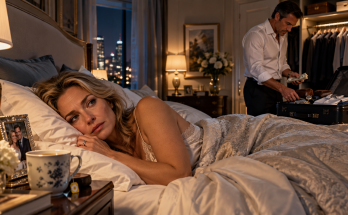
Robert stood in the bedroom doorway.
His face was white.
Not pale.
White.
The color of a man whose secret had just walked into the room before he had time to lock the door.
I held the phone against my ear.
The hospital employee was still speaking.
“Mrs. Bennett?”
I did not answer.
My eyes stayed on my husband.
For two weeks, I had watched Robert move through our house like a grieving father.
I had watched him sit on the edge of our bed with his face in his hands.
I had heard him crying in the shower.
I had felt his arms around me while I screamed for the daughter I believed was dead.
He had brought me medication.
He had closed the nursery door because he said seeing the crib hurt too much.
He had told relatives I wasn’t strong enough for visitors.
He had answered calls from the hospital.
He had handled paperwork.
He had kissed my forehead and whispered:
“We have to survive this for Willie.”
Now Willie stood beside me, trembling.
And Robert was not looking at his son with confusion.
He was looking at him with fear.
That was when I knew.
Not suspected.
Knew.
“Mom?”
Willie whispered.
I reached behind me without looking and found his hand.
His fingers wrapped around mine.
Robert noticed.
“What did Willie tell you?”
My heart stopped.
Not:
What happened?
Not:
Why are you upset?
Not:
What did the hospital say?
What did Willie tell you?
The question of a guilty man.
I lowered the phone.
“Everything.”
It was a lie.
I knew almost nothing.
But Robert didn’t know that.
His eyes closed.
Only for a second.
It was enough.
“Oh, God.”
he whispered.
Willie started crying.
“Daddy?”
Robert looked at him.
I had never seen shame arrive on a human face so quickly.
“Buddy…”
“Where’s my sister?”
Robert’s mouth opened.
No sound came.
Willie pulled his hand out of mine.
“Where is she?”
His little voice cracked so badly that something inside me tore open.
Robert stepped forward.
I raised my hand.
“Don’t.”
He stopped.
I spoke into the phone again.
“Are you still there?”
“Yes, Mrs. Bennett.”
“I need you to listen carefully.”
My voice sounded unlike mine.
“My husband told me our daughter died after delivery.”
Robert whispered:
“Please.”
I ignored him.
“My eight-year-old son says he saw my husband give money to my sister-in-law and saw her leave with a crying newborn.”
The hospital employee became silent.
Then:
“Mrs. Bennett, I need to transfer you to my supervisor.”
“No.”
I said.
“Do not transfer me.”
“I want your name.”
She gave it.
I wrote it on the back of an envelope with a shaking hand.
“I want you to preserve every record connected to my admission, surgery, delivery, my daughter’s birth, her transfer, discharge, and every person who accessed or changed those records.”
Robert moved.
I pointed at him.
“Stay there.”
He froze.
The woman on the phone said:
“Mrs. Bennett, I strongly recommend that you contact law enforcement.”
“I will.”
Robert’s face collapsed.
“Please don’t.”
I looked at him.
“Where is my daughter?”
He started crying.
That should have moved me.
Once, Robert’s tears could undo almost any anger I had.
That afternoon, they looked like water running down a locked door.
“Where is she?”
I repeated.
“With Caroline.”
The world became silent.
Not figuratively.
I stopped hearing the air conditioner.
The traffic outside.
The clock.
My own breathing.
There was only one sentence.
With Caroline.
Alive.
My daughter was alive.
My knees buckled.
I grabbed the dresser.
“Mom!”
Willie caught my arm.
An eight-year-old child trying to hold up his mother.
I sank onto the bed.
“Alive?”
I whispered.
Robert nodded.
“She’s alive.”
I covered my mouth.
A sound came out of me that I had never heard before.
It was not crying.
It was what happens when grief is forced to reverse direction too quickly.
For fourteen days, my body had been taught that my daughter was dead.
Every cell had learned it.
My breasts had filled with milk for a baby I was told would never drink it.
I had stood in the nursery holding that stuffed rabbit and apologized to an empty crib.
I had asked God to hold her because I could not.
I had dreamed about a face I had barely been allowed to see.
Now Robert was telling me she had been breathing somewhere the entire time.
Hungry.
Sleeping.
Crying.
Opening her eyes.
Being held by someone else.
I stood so quickly the room spun.
“Take me to her.”
Robert shook his head.
“You’re still recovering.”
I stared at him.
Of all the things he could have said.
Of all the stupid, monstrous things.
He chose concern.
I slapped him.
The sound cracked through the room.
Willie gasped.
I had never hit Robert before.
I would never be proud that I did.
But in that moment my hand moved before the rest of me arrived.
Robert touched his cheek.
He did not become angry.
“I deserved that.”
“No.”
I said.
My voice shook.
“You don’t get to decide what you deserve.”
I picked up my phone.
“Mom, who are you calling?”
Willie asked.
“The police.”
Robert stepped toward me.
“Please.”
“Stay back.”
“We can fix this.”
I stared at him.
“Fix?”
“She is safe.”
“Safe?”
My voice rose.
“You let me believe my child was dead.”
“I know.”
“You watched me mourn her.”
“I know.”
“You held me while I begged God to take care of her.”
He sobbed.
“I know.”
“And all that time you knew where she was?”
“Yes.”
That single word destroyed whatever remained of my marriage.
I called 911.
Robert sat down.
He did not run.
Perhaps he knew running would only make things worse.
Perhaps some part of him had been waiting for the lie to end.
The dispatcher asked whether anyone was in immediate danger.
I looked at Willie.
At Robert.
At the pale-yellow nursery across the hall.
“My newborn daughter may have been taken from the hospital without my consent.”
The words sounded impossible.
The dispatcher became very calm.
Very precise.
Address.
Names.
Hospital.
Date.
Description.
Possible location.
“Do you know where the baby is now?”
“With my husband’s sister, Caroline Bennett.”
“Address?”
I gave it.
Robert looked up.
“She isn’t there.”
I stopped.
“What?”
He covered his face.
“She left.”
My blood turned cold.
“Where?”
“I don’t know.”
I almost dropped the phone.
The dispatcher heard me.
“Ma’am?”
“My husband says the woman with my baby has left her home.”
“Do you know the vehicle?”
I looked at Robert.
“What does Caroline drive?”
“You know.”
“Say it.”
“Blue Honda Pilot.”
“Plate?”
He gave it.
I repeated it.
Then I asked:
“Where was she going?”
“I don’t know.”
“Robert.”
“I swear.”
“You have lied to me every day for two weeks.”
“I know.”
“Your oath is worthless.”
He cried.
The police arrived in eleven minutes.
It felt like eleven years.
Two officers came inside.
A third remained outside.
Then detectives.
Then more questions.
I told the story.
Willie told his.
An officer asked whether Willie could speak with someone separately.
I immediately felt protective.
“He’s eight.”
The detective nodded.
“I understand.”
“We want to minimize how many times he has to repeat this.”
That sentence mattered.
They did not interrogate him in front of Robert.
A child specialist was requested.
My mother came.
When she entered and saw police cars outside, she nearly collapsed.
“What happened?”
I could barely say it.
“The baby’s alive.”
Mom stared.
“What?”
“Our baby is alive.”
She grabbed my arms.
“What are you saying?”
“Robert gave her to Caroline.”
My mother’s face changed.
She looked at my husband.
Robert lowered his eyes.
Mom walked toward him.
For one terrifying second, I thought she might kill him.
Instead she stopped three feet away.
“You watched my daughter bury a baby who wasn’t dead?”
“There wasn’t a burial.”
Robert whispered.
Mom’s expression twisted.
“What?”
He looked at me.
“I told you the hospital recommended direct cremation because of complications.”
I remembered.
God.
I remembered.
I had been so weak.
So medicated.
So destroyed.
Robert told me he would handle it.
He brought me a small white urn four days after I came home.
It was in our bedroom.
I turned toward the dresser.
The urn.
My legs stopped working.
“What is in there?”
Robert did not answer.
“What is in that urn?”
“Nothing.”
My mother screamed.
I did not.
I walked to the dresser.
Picked it up.
For two weeks, I had kissed that urn goodnight.
I had whispered my daughter’s name to it.
Grace.
We had named her Grace before she was born.
Willie chose her middle name.
Grace Emily Bennett.
I had held an empty container and apologized to my living child for not saving her.
The urn slipped from my hands.
It struck the floor.
The lid came off.
Nothing.
Not ash.
Not paper.
Nothing.
Willie began sobbing.
Mom grabbed him.
I turned toward Robert.
The detective stepped between us.
Probably wise.
“Mrs. Bennett.”
he said.
“I need you to sit down.”
“I want my daughter.”
“I know.”
“No.”
I looked at him.
“You don’t.”
My voice broke.
“I gave birth to her.”
“My body is still bleeding.”
“My milk came in.”
“I wake up every night because I hear her crying even though she isn’t here.”
“I held an empty urn.”
“I want my daughter.”
His expression softened.
“We’re going to do everything we can.”
Everything.
It was the only answer anyone could give me.
I hated it.
Robert was taken to the station.
Not dramatically.
No screaming.
No fight.
He asked if he could speak to Willie first.
I said no.
For once, I did not worry whether that was cruel.
Willie had spent two weeks carrying a secret that belonged to adults.
He had watched his father lie.
He had filled a jar with lunch money because he believed enough coins could buy his sister back.
He did not owe Robert comfort.
Neither did I.
Before leaving, Robert looked at me.
“I never wanted to hurt you.”
I stared at him.
“Then what did you think this would do?”
He had no answer.
The door closed.
The search for Grace began.
Police contacted Caroline.
No answer.
Her phone was off.
Her vehicle had been captured on a traffic camera heading east that morning.
An alert went out.
Hospitals were contacted.
Airports.
State police.
I learned later that there are procedures and jurisdictions and words professionals use when a child may have been unlawfully removed.
At the time, all I understood was that my daughter was somewhere beyond my reach.
Again.
But now grief had been replaced by terror.
Terror is active.
Grief had pinned me to a bed.
Terror put shoes on my feet.
I wanted to search.
The detective told me to stay home.
I hated him for it.
Then loved him for saying:
“If she comes back here, somebody needs to be here.”
So I stayed.
Willie sat beside the window with his jar.
I found him counting the money.
“What are you doing?”
“Seeing how much.”
“For what?”
“In case they need it.”
I sat beside him.
“No.”
He looked at me.
“Sweetheart, listen carefully.”
I took his hands.
“You do not have to buy your sister back.”
“But Daddy—”
“What Daddy did was wrong.”
“You do not have to fix it.”
“I should’ve told you sooner.”
“No.”
“Mom—”
“No.”
I held his face.
“You are eight.”
His tears spilled.
“I was scared.”
“I know.”
“I thought Daddy would get mad.”
“I know.”
“He told Aunt Caroline nobody could know.”
I froze.
“When?”
“The hospital.”
“Did he see you?”
Willie nodded.
My heart broke again.
“He found me by the elevators.”
“What did he say?”
Willie’s breathing became shallow.
I pulled him into my arms.
“You don’t have to tell me right now.”
“He said the baby was going somewhere better.”
I closed my eyes.
“He said you were too sick and she needed somebody.”
“Then why did he tell me she died?”
“I don’t know.”
Willie cried into my chest.
“He said if I talked about what I saw, you might get sicker.”
There are betrayals committed against a spouse.
And there are betrayals committed against a child.
Robert had managed both.
“He made you think telling me could hurt me?”
Willie nodded.
I held him tighter.
“No.”
I whispered.
“Listen to me.”
“Nothing you told me caused this.”
“Nothing you saw caused this.”
“You did not make me sick.”
“You did not hurt Grace.”
“You did not hurt Daddy.”
“You told the truth.”
“And I am so proud of you.”
He sobbed harder.
“I just want her home.”
“So do I.”
At 5:14 that evening, the detective called.
They had located Caroline’s vehicle.
At a motel.
Forty-seven miles away.
My knees weakened.
“And Grace?”
“We believe an infant is with her.”
Believe.
Not know.
“Is she alive?”
“We believe so.”
“Is she okay?”
“We don’t know yet.”
I pressed my fist against my mouth.
“Please.”
“I know.”
Twenty-three minutes later, he called again.
I will remember those twenty-three minutes longer than some entire years of my life.
The phone rang.
I answered before the first ring ended.
“Mrs. Bennett?”
“Yes.”
“We have your daughter.”
I stopped breathing.
“She is alive.”
My mother screamed.
Willie jumped up.
“She’s alive?”
I dropped to my knees.
“Is she okay?”
“She appears stable.”
“She is being transported to the hospital for evaluation.”
“Can I go?”
“Yes.”
I do not remember getting into Mom’s car.
I remember Willie holding the stuffed rabbit.
He had run upstairs for it.
The same rabbit he chose before Grace was born.
He held it against his chest all the way to the hospital.
“She’s going to need him.”
he said.
“Him?”
“The rabbit.”
“His name is Mr. Pickles.”
I laughed.
For the first time in weeks.
A broken laugh.
A beautiful one.
At the hospital, they would not immediately let me see Grace.
Medical evaluation.
Evidence.
Questions.
Identification.
Procedure.
Every second felt obscene.
I wanted to scream:
I am her mother.
Then a pediatrician came through the doors.
“Mrs. Bennett?”
“Yes.”
“Your daughter is stable.”
I cried.
“Can I see her?”
“In a moment.”
“Is she hurt?”
“We don’t see signs of acute injury.”
“She is slightly under her expected weight, but not dangerously so.”
“She appears to have been fed and cared for.”
Fed and cared for.
Caroline had cared for her.
That complicated something I was not ready to have complicated.
“Can I hold her?”
“Yes.”
The nurse brought me into a small room.
And there she was.
Grace.
My daughter.
Alive.
Wrapped in a hospital blanket.
Tiny pink face.
Dark hair.
A little crease between her eyebrows.
I knew her.
That was the miracle.
I had barely seen her after delivery.
I had been bleeding.
Drugged.
Terrified.
But my body knew her.
My arms knew before my mind did.
I made a sound.
The nurse placed Grace against me.
Warm.
She was warm.
For two weeks I had imagined cold earth.
Ash.
Heaven.
Absence.
Instead she was warm.
Her cheek touched my chest.
She moved her mouth.
Then she cried.
That cry.
The crying bundle.
Willie had been right.
I started sobbing.
“Hello.”
I whispered.
“Oh, my baby.”
“Hello.”
I kissed her forehead.
“I’m sorry.”
Then stopped.
No.
I would not make my first words to my daughter an apology for something done to us.
“I love you.”
I whispered.
“I love you.”
“I love you.”
I said it until the words stopped being language and became breath.
Willie stood in the doorway.
He was afraid to enter.
I looked at him.
“Come here.”
His eyes widened.
“Is that her?”
“Yes.”
He approached slowly.
Grace cried again.
Willie burst into tears.
“That’s the sound.”
he whispered.
I knew what he meant.
The crying bundle.
He took Mr. Pickles and placed the rabbit beside her.
“I saved him for you.”
Grace’s tiny hand opened.
Willie put one finger inside.
She gripped it.
My son looked at me.
“She knows me.”
“Of course she does.”
He smiled through tears.
“I told you she wasn’t gone.”
I pulled him against me.
“You did.”
He had saved his sister with nothing but memory and courage.
Not money.
Not the jar.
Truth.
The police found Caroline in the motel bathroom.
She had been crying.
Grace was in a portable bassinet.
There were formula bottles.
Diapers.
Clothes.
A diaper bag.
A car seat.
Caroline had not harmed her physically.
But she had taken her.
That fact remained.
Later, the investigation reconstructed what happened.
The truth was worse than I expected.
And stranger.
Caroline had wanted a child for years.
Three miscarriages.
Two failed fertility treatments.
One disrupted adoption.
Her grief had become desperation.
Robert knew.
So did I.
I had sat beside her after her second miscarriage and held her while she said:
“Some women get babies without even trying.”
I remembered the bitterness.
I had understood it as pain.
Maybe it was.
Pain can explain a road without excusing where someone chooses to drive it.
Months before my delivery, Robert’s business had begun failing.
That was the first secret.
He had hidden debt from me.
Large debt.
Loans.
Credit cards.
Money owed to a business partner.
Caroline had money from a settlement and inheritance.
She offered to help him.
At first, loans.
Then more.
By the time Grace was born, Robert owed his sister nearly $70,000.
The envelope Willie saw contained paperwork and cash.
Not payment for my baby in the simple sense Willie understood.
The truth was more twisted.
Caroline agreed to forgive most of Robert’s debt and give him additional money if he helped her take Grace.
I read that sentence in an investigative summary months later and vomited.
My husband had not exactly sold our daughter.
But I could find no moral distinction that comforted me.
Robert later claimed he had never intended to go through with it.
He said Caroline had talked for months about how I was overwhelmed.
How another baby would make our finances impossible.
How my difficult pregnancy had nearly killed me.
How Willie needed his mother.
How Caroline could give Grace everything.
He said he rejected her repeatedly.
Until the delivery.
Until I hemorrhaged.
Until doctors rushed me away.
Until he believed I might die.
Then fear and debt and selfishness became a story he could live inside.
He told himself Grace would be safe with Caroline.
He told himself I might not survive.
He told himself if I did survive, losing the baby would be devastating but perhaps easier than another pregnancy complication.
He told himself Willie needed me more.
He told himself Caroline needed Grace.
He told himself he could solve everyone’s problems with one unforgivable act.
That is the frightening thing about terrible decisions.
People rarely make them while saying:
I am doing evil.
They build explanations.
One brick at a time.
Until they can no longer see what they have built.
A hospital employee helped.
That was the woman Willie saw near the elevators.
Not Caroline.
Willie had seen both women at different moments and, in his frightened memory, connected them.
Her name was Melissa Crane.
She worked in patient administration.
Caroline knew her through a support group.
Melissa altered access information and helped create confusion around transfer paperwork.
She did not have the power to erase an entire birth.
But she had enough access to delay questions, redirect calls, and help Robert control what information reached me while I was medicated and recovering.
That was why the hospital employee on the phone found restrictions.
That was why records did not align cleanly.
That was why Robert insisted on handling everything.
The scheme was not brilliant.
It did not need to be.
It only needed to survive long enough for me to believe the lie.
And grief made me easy to isolate.
That truth took years to say without shame.
I was not foolish.
I was postpartum.
Recovering from emergency surgery.
Anemic.
Medicated.
Traumatized.
And I trusted my husband.
Trust is not stupidity.
Betraying it is not proof the trusting person should have known better.
The hospital launched an investigation.
Attorneys became involved.
Police.
Prosecutors.
Social workers.
Doctors.
Therapists.
For months, our lives became rooms where strangers asked questions.
Grace remained with me.
That was the only fact I cared about.
Robert was not permitted to return home.
His contact with Willie became supervised while everything was investigated.
He wrote me letters.
I did not read them.
Then one day, Willie asked:
“Does Daddy love us?”
There is no manual for answering that question when the father in question helped take one child and manipulated the other into silence.
I could have said no.
It would have been simple.
Maybe satisfying.
Instead I said:
“I think Daddy loves you.”
Willie frowned.
“Then why did he do bad things?”
I looked at him.
“Because loving someone doesn’t automatically make every choice you make good.”
“Can bad people love?”
I thought.
“People are more complicated than good people and bad people.”
“Daddy made a terrible choice.”
“Many terrible choices.”
“He hurt us.”
“That is true even if he loves you.”
Willie stared at Grace sleeping beside us.
“Do I have to forgive him?”
“No.”
“Ever?”
“No.”
“Will you?”
“I don’t know.”
That answer seemed to comfort him more than certainty would have.
Grace grew.
That sounds ordinary.
It was miraculous.
At six weeks, she smiled.
At four months, she laughed when Willie sneezed.
At seven months, she crawled toward Mr. Pickles.
At ten months, she said something that sounded like “Will.”
Willie insisted it was his name.
I let him win.
At one year, we had a birthday party.
Small.
Family.
Yellow cake.
One candle.
Willie stood beside her high chair like a bodyguard.
I cried when everyone sang.
Not because I was sad.
Because birthdays are proof of time.
And there had been fourteen days when I believed Grace would never have any.
The legal cases moved slower than children grow.
Caroline eventually accepted responsibility as part of a plea agreement.
So did Melissa.
Robert did too.
The exact charges and consequences were complicated by what each person had done, what records showed, and the agreements reached.
I attended sentencing.
Not because I wanted vengeance.
Because I wanted to hear the truth spoken somewhere Robert could not edit it.
He stood before the court.
He looked smaller.
He said:
“I told myself I was saving my wife from something.”
My hands tightened.
“I told myself my sister would be a good mother.”
“I told myself my son was too young to understand.”
“I told myself debt had trapped me.”
He looked toward me.
“All of those were excuses.”
I started crying.
“I took away my wife’s right to know her daughter was alive.”
“I took away her right to hold her.”
“I made my son carry a secret no child should carry.”
“I helped my sister take a baby who was not hers.”
“And then I watched my wife grieve.”
His voice broke.
“There is no explanation that makes that smaller.”
That mattered.
Not enough to repair us.
Enough to tell me he had finally stopped lying to himself.
Afterward, he asked through his attorney if I would speak with him.
I said no.
A year later, I said yes.
We met in a supervised room.
Robert looked older.
I sat across from him.
For a long time, neither of us spoke.
Then he said:
“I’m sorry.”
I looked at him.
“Don’t say that yet.”
He stopped.
“I have questions.”
“Anything.”
“Did you think I was going to die?”
“Yes.”
“Did a doctor tell you that?”
“No.”
“So you decided.”
“Yes.”
“Did you believe Grace would be better with Caroline?”
He cried.
“At the time, I made myself believe it.”
“Why?”
“Because I owed her money.”
“Because I was terrified.”
“Because she had wanted a baby for so long.”
“Because I was weak.”
“Because if I admitted what I was doing was monstrous, I couldn’t do it.”
I nodded.
“Did you ever plan to tell me?”
His silence lasted too long.
“No.”
That answer hurt more than anything else he said.
“You were going to let me die believing she was dead?”
“No.”
“You just said—”
“I thought maybe years later.”
“Years?”
“I don’t know.”
He covered his face.
“I didn’t think beyond the next hour.”
“That is what I mean when I say I wasn’t thinking.”
“No.”
I said.
“You were thinking.”
He looked up.
“You were just thinking about the wrong people.”
That silenced him.
“You thought about Caroline.”
“You thought about your debt.”
“You thought about whether Willie needed me.”
“You thought about your fear.”
“You thought about how to make the records work.”
“You thought about what to tell me.”
“You thought enough to bring an empty urn into our bedroom.”
He sobbed.
“Do not ever tell me you weren’t thinking.”
“I’m sorry.”
“Now you can say it.”
He looked at me.
“I am sorry.”
“For what?”
He knew enough by then not to say everything.
“For making you mourn a living child.”
I nodded.
“For taking away your first two weeks with Grace.”
Another nod.
“For frightening Willie into silence.”
His voice broke.
“For teaching our son that telling the truth might hurt his mother.”
I wiped my eyes.
“For lying while you were physically vulnerable and trusting me to care for you.”
“For the urn.”
He could barely speak.
“For Caroline.”
“For money.”
“For choosing my fear over your rights.”
“For destroying our marriage.”
I looked at him.
“Yes.”
He cried.
“Do you hate me?”
“Sometimes.”
“Do you still love me?”
That was harder.
“Yes.”
His face crumpled.
“But that changes nothing.”
He nodded.
“I know.”
“I wish it did.”
“No.”
I shook my head.
“You wish love erased consequences.”
“That’s different.”
He looked at me.
“You always were smarter than me.”
“Don’t.”
“What?”
“Turn me into the wise one so you can be the foolish one.”
I leaned forward.
“You weren’t stupid.”
“You made choices.”
“Own them.”
He nodded slowly.
“I made choices.”
“Yes.”
“And I destroyed us.”
“You ended our marriage.”
I corrected.
“You did not destroy my life.”
That distinction mattered to me.
Robert closed his eyes.
“Can you ever forgive me?”
“I don’t know.”
I stood.
“But I’m going to stop organizing my life around whether I do.”
That was the beginning of my recovery.
Not forgiveness.
Freedom from making forgiveness the assignment.
I divorced Robert.
There was no dramatic courtroom victory.
No applause.
Just signatures.
Property.
Custody arrangements.
Therapy recommendations.
Legal restrictions.
A marriage reduced to paper.
I cried afterward.
People thought I would feel relieved.
I did.
But relief and grief can live in the same body.
I had loved Robert.
We had built years before the betrayal.
Willie existed because of that love.
So did Grace.
I refused to rewrite every memory into poison.
Our wedding had been real.
The camping trips had been real.
The night Willie was born and Robert cried against my shoulder had been real.
The Christmas mornings.
The laughter.
The stupid arguments over thermostat settings.
Real.
Then he did something unforgivable enough to end the marriage.
Also real.
Human beings are difficult because truths do not always cancel one another.
Willie needed years of therapy.
So did I.
At first, he checked Grace’s crib several times every night.
He hid money again.
Not for buying her back.
“For emergencies.”
His therapist helped him understand that children do not need to finance safety.
We bought him a small savings box anyway.
Not because fear should control him.
Because learning healthy control over money helped replace the terrible meaning he had attached to it.
He saved for a bicycle.
When he finally bought it, he cried.
“Why are you crying?”
I asked.
“Because I used money and nobody disappeared.”
That sentence nearly broke me.
I hugged him.
Grace grew up knowing the truth gradually.
Not all at once.
Never as a dramatic revelation.
When she was five, she knew Aunt Caroline had taken care of her for two weeks when she was a baby and had done so in a way that was not allowed.
At eight, she understood her father had helped.
At twelve, she knew more.
At sixteen, she asked to read the records.
I hesitated.
Then agreed.
Truth belonged to her too.
She sat at the dining table for three hours.
When she finished, she closed the folder.
“Was Caroline nice to me?”
The question surprised me.
“Yes.”
“From what doctors and police found, she fed you, changed you, held you, and kept you physically safe.”
Grace cried.
“Am I supposed to hate her?”
“No.”
“Do you?”
I thought.
“I hated what she did.”
“For a long time, I hated her.”
“And now?”
“I mostly feel sad.”
“For her?”
“For all of us.”
Grace looked at the folder.
“She really wanted a baby.”
“Yes.”
“So much she took one.”
“Yes.”
“That isn’t love.”
I looked at my daughter.
“No.”
I said.
“Wanting someone is not the same as loving them.”
She nodded.
“Love has to care what happens to the other person.”
I smiled sadly.
“Yes.”
“You figured that out younger than many adults.”
Grace asked to see Caroline when she was eighteen.
I did not like it.
But eighteen meant something.
My daughter was no longer the bundle someone could carry away.
She could decide.
We arranged the meeting carefully.
Public place.
Therapist aware.
Willie offered to come.
Grace said no.
“This is mine.”
He respected that.
Afterward, she came home and sat beside me.
“Well?”
I asked.
“She cried.”
“I imagine.”
“She said she thought about me every birthday.”
I waited.
“She said she loved me.”
“How did that feel?”
Grace looked toward the window.
“Complicated.”
“That’s allowed.”
“She apologized.”
“Did you accept?”
“I said I heard her.”
I smiled.
“That sounds wise.”
“I learned from you.”
“No.”
I shook my head.
“You learned from surviving us.”
Grace leaned against me.
“She asked if I could ever call her Aunt Caroline.”
“And?”
“I said maybe someday.”
“Good.”
“You’re not mad?”
“No.”
I kissed her hair.
“Your relationship with what happened belongs to you.”
That was something Robert had stolen from me.
Choice.
I would not steal it from Grace in the name of protecting her.
Willie grew into a remarkable young man.
Not because trauma magically creates strength.
I hate that idea.
Pain is not a gift.
What people build after pain can be beautiful, but that does not make the pain necessary.
Willie became compassionate because he worked at it.
Because therapists helped.
Because teachers noticed him.
Because Grandma showed up.
Because I apologized when my own fear made me overprotective.
Because he learned that vigilance and love were not the same thing.
At twenty-two, he studied social work.
At twenty-six, he began working with children who had witnessed domestic conflict, family separation, and other frightening events.
The first time I visited his office, I saw a glass jar on his shelf.
Coins inside.
I froze.
He noticed.
“Mom.”
“What is that?”
He smiled.
“Emergency snack fund.”
I stared.
“For kids who come here hungry.”
My eyes filled.
“Willie.”
“I know.”
He walked over and touched the jar.
“I wanted the jar to mean something different.”
I hugged him.
That is healing.
Not forgetting the object.
Giving it another meaning.
Grace became a nurse.
Of course she did.
Life has a sense of symmetry I sometimes find almost rude.
She chose neonatal intensive care.
The first time she told me, I said:
“Are you sure?”
She laughed.
“Mom, I’m not made of glass.”
“I know.”
“You’re thinking about the hospital.”
“Yes.”
“So am I.”
She took my hand.
“That’s partly why.”
Grace became the nurse who sat beside frightened mothers and explained every tube.
Every monitor.
Every medication.
Every transfer.
She never said:
“Don’t worry.”
She said:
“Here is what we know.”
She believed information was a form of care.
I knew exactly where she learned that.
Robert’s relationship with the children developed slowly.
Supervised first.
Then structured.
Willie refused contact for several years.
I supported him.
Grace was younger and approached the relationship differently.
I supported her too.
People sometimes expected me to force consistency.
“If Grace sees him, Willie should.”
No.
Children are not a committee.
Pain does not require unanimous voting.
At thirty, Willie finally met Robert alone.
He told me afterward.
I tried not to interrogate him.
I failed.
“How was it?”
“Fine.”
“What did he say?”
“Mom.”
“Sorry.”
Five minutes later:
“Did you eat?”
Willie laughed.
“Yes.”
“What?”
“Sandwiches.”
“What kind?”
“Mom.”
“All right.”
He eventually told me.
Robert apologized.
Willie asked one question.
“Why did you tell me Mom could get sick if I told?”
Robert cried.
He said:
“Because I was afraid of the truth.”
Willie answered:
“You made me afraid of it too.”
Robert never forgot that sentence.
Years later, he told Willie it was the hardest thing anyone had ever said to him.
Good.
Some sentences should be heavy.
Not as punishment.
As responsibility.
Robert rebuilt his life after consequences.
Slowly.
He worked.
Paid debts.
Went to therapy.
He never remarried.
Not because he was waiting for me.
I made sure to ask once.
He laughed sadly.
“No.”
“I don’t trust myself enough yet.”
“That sounds like therapy.”
“It is.”
Eventually he did trust himself.
He became involved in a program teaching financial accountability and decision-making to men leaving incarceration.
He never used our family story publicly without permission.
That mattered.
He asked Willie.
He asked Grace.
He asked me.
I said:
“You may tell what you did.”
“Not what we felt.”
He understood.
At sixty-eight, Robert was diagnosed with cancer.
By then, decades had passed.
Willie had children.
Grace had children.
I had gray hair and knees that predicted rain more accurately than television.
Robert called me.
“Can we talk?”
“Yes.”
We met in a park.
He looked thinner.
“You know?”
he asked.
“Grace told me.”
“She asked permission.”
“I know.”
He smiled.
“She’s something.”
“Yes.”
“So is Willie.”
“Yes.”
He looked at me.
“I don’t want anything.”
“Good opening.”
He laughed.
Then coughed.
“I’ve spent years wondering whether you forgave me.”
I sighed.
“Robert.”
“I know.”
“You said you wouldn’t organize your life around it.”
“I remember.”
“Then why ask?”
“Because I may not have much time.”
I looked at the man I had once married.
Age had softened him.
Not absolved.
Softened.
“I forgave you years ago.”
His eyes filled.
“Really?”
“Yes.”
He covered his face.
“But listen carefully.”
He lowered his hands.
“Forgiveness did not mean what you wanted it to mean.”
He nodded.
“It did not mean it became acceptable.”
“It did not mean I trusted you as a husband again.”
“It did not mean the marriage should have survived.”
“It did not mean Caroline deserved Grace.”
“It did not mean Willie should forget.”
“It meant I stopped needing you to suffer in order for me to heal.”
Robert cried.
“That is enough.”
he whispered.
“Yes.”
“It was enough for me too.”
He looked at the pond.
“I loved you.”
“I know.”
“I know that sounds impossible after what I did.”
“No.”
I shook my head.
“That’s what made it hurt.”
He looked at me.
“I wish I could go back.”
“So do I.”
His eyes widened.
“Really?”
“Yes.”
“I would go back and stop you.”
I smiled faintly.
“I wouldn’t go back to stay married to you.”
He laughed through tears.
“Fair.”
We sat there for an hour.
Talking.
Not as husband and wife.
Not enemies.
Two old people who had once built a family, nearly destroyed it, and somehow lived long enough to see that family become larger than their worst year.
Robert died eighteen months later.
Willie and Grace were with him.
I visited the day before.
He was weak.
“Do you remember the yellow nursery?”
he asked.
“Yes.”
“I painted the ceiling wrong.”
“You got paint in your hair.”
“You laughed for twenty minutes.”
“You looked ridiculous.”
He smiled.
“I was happy.”
“So was I.”
His eyes filled.
“Was any of it real?”
That question broke my heart.
“Yes.”
I said.
“The good was real.”
“So was the terrible.”
“One does not erase the other.”
He nodded.
“Thank you.”
“For what?”
“For not making me a monster to the kids.”
I thought carefully.
“I told them what you did.”
“I know.”
“That was enough.”
He smiled.
“Fair.”
Before I left, he whispered:
“I’m sorry about the urn.”
Decades had passed.
Still, my chest tightened.
“I know.”
“That was the cruelest part.”
“One of them.”
“I thought it would stop you asking questions.”
“I know.”
“I hate who I was.”
I touched his hand.
“Don’t.”
He looked at me.
“Hate wastes the years you spent becoming someone else.”
He cried.
“So what should I do?”
“You’re dying, Robert.”
I smiled sadly.
“You can probably stop working on yourself now.”
He laughed.
A weak laugh.
The last one I ever heard.
At his funeral, Willie spoke.
Grace did not.
She said she had already said goodbye.
Both choices were right.
Willie stood before family and friends.
“My father did something terrible when I was eight.”
The room became still.
“He spent the rest of his life refusing to call it anything else.”
I cried.
“That did not undo it.”
“It did not return my sister’s first two weeks to my mother.”
“It did not return my childhood innocence.”
“But accountability mattered.”
“My father taught me two lessons.”
“The first was accidental.”
“He taught me how much damage a lie can do when adults ask children to carry it.”
“The second was intentional.”
“He taught me that being guilty of something terrible does not excuse you from spending the rest of your life trying to become better.”
Then Willie looked at Grace.
“My sister is here because she was stronger than the secret surrounding her.”
Grace shook her head through tears.
Later she told him:
“I was two weeks old.”
He said:
“Still counts.”
Life moved.
As it does.
Willie married a teacher named Hannah.
They had two sons.
Grace married another nurse, Daniel.
They had one daughter.
They named her Hope.
I protested.
“Grace and Hope?”
Grace laughed.
“We’re committed to a theme.”
When Hope was eight, she found Mr. Pickles in a storage box.
The rabbit was old.
One eye slightly crooked.
Fur worn thin.
“Whose is this?”
she asked.
Grace looked at me.
I looked at Willie.
Willie smiled.
“Long story.”
Hope hugged the rabbit.
“Can I have him?”
Willie thought.
Then nodded.
“Yeah.”
“He’s good at finding little sisters.”
We all went quiet.
Hope had no idea why.
One day she would.
Not yet.
Children deserve truth.
They also deserve timing.
At seventy-nine, I developed heart problems.
Nothing dramatic.
Age making itself known.
I moved into a smaller house near Grace.
Willie protested that I should live near him.
Grace said:
“She likes me better.”
Willie said:
“She literally named me first.”
They argued like children.
I sat between them laughing.
There had been a time I thought our family would never laugh normally again.
That was grief’s greatest lie.
It tells you the present feeling is permanent.
It isn’t.
Nothing is.
Not joy.
Not pain.
Not terror.
Not even guilt.
What can become permanent is what we build around those things.
Willie built compassion.
Grace built care.
I built boundaries.
Robert eventually built accountability.
Caroline built something too.
Her story did not end at the motel.
She served her sentence.
Received treatment.
Spent years in therapy.
She never had children.
That fact once made me feel relieved.
Then guilty for feeling relieved.
Eventually, I stopped judging the feeling.
Caroline sent Grace birthday cards every year.
She never demanded a response.
At twenty-five, Grace began responding.
At thirty, she invited Caroline to coffee.
At thirty-five, she invited her to Hope’s birthday.
I struggled with that.
I admit it.
When I saw Caroline holding my granddaughter, my body remembered.
Not logically.
Physically.
My hands shook.
Grace noticed.
“Mom?”
“I’m okay.”
“You don’t have to be.”
“I know.”
Caroline saw too.
She immediately handed Hope back.
Then walked toward me.
“I’m sorry.”
I sighed.
“We have said this.”
“I know.”
She looked older.
Small.
“I won’t hold her again if it hurts you.”
I looked at Grace.
At Hope.
At Caroline.
“No.”
I said.
“You don’t get to make me responsible for your relationship with them.”
She blinked.
“If Grace trusts you with her daughter, that’s Grace’s decision.”
“What happened to me is mine.”
“What happens next belongs to them too.”
Caroline cried.
“Thank you.”
“Don’t thank me.”
“I’m not giving you permission.”
“I’m giving up control.”
That distinction mattered.
At eighty-four, I wrote the entire story down.
Not for publication.
For my grandchildren.
I called it:
THE CRYING BUNDLE.
Willie hated the title.
“Sounds like horror.”
“It was.”
“Mom.”
“Fine.”
Grace loved it.
Of course she did.
She had inherited my dark humor.
I wrote everything.
Not only Robert’s betrayal.
My weakness after surgery.
The milk leaking through my nightgown while I thought my daughter was dead.
The empty urn.
Willie’s jar.
The phone call.
The hospital.
The first time I held Grace again.
Therapy.
Court.
Anger.
Divorce.
Forgiveness.
I wanted future generations to know something important.
Families sometimes hide terrible things because they believe truth will destroy the family.
Usually the hiding does more damage.
Truth did not destroy us.
Truth hurt us.
There is a difference.
A surgeon hurts when removing something dangerous.
Physical therapy hurts when teaching a damaged limb to move.
Grief hurts when love has nowhere familiar to go.
Some pain is destruction.
Some pain is the cost of no longer pretending.
When Hope turned sixteen, she read the story.
She came to my house afterward.
“Grandma?”
“Yes?”
“Mom was stolen?”
I winced.
“That’s a blunt word.”
“Is it wrong?”
“No.”
She sat beside me.
“And Grandpa helped?”
“Yes.”
“But we visited him when I was little.”
“Yes.”
“Why?”
“Because your mother chose to have a relationship with him.”
“Were you mad?”
“Sometimes.”
She looked stunned.
“You let her anyway?”
“Grace was an adult.”
“I didn’t own her choices.”
Hope thought.
“Did you forgive Grandpa?”
“Yes.”
“Would you have married him again?”
“Absolutely not.”
She laughed.
Then covered her mouth.
“Sorry.”
“No.”
I smiled.
“That’s the correct response.”
She became serious.
“So forgiveness doesn’t mean taking somebody back.”
“No.”
“Then what does it mean?”
“For me?”
“Yes.”
I looked out the window.
“It meant his worst choice no longer got to decide how I felt every morning.”
Hope nodded slowly.
“I like that.”
“Good.”
“It’s mine.”
She smiled.
“Can I steal it?”
“Apparently our family has a history.”
She stared.
Then we both started laughing.
Dark humor.
Sometimes survival grows strange flowers.
At eighty-eight, Willie gave me the old glass jar.
The original one.
I stared at it.
“You kept this?”
“Of course.”
Inside were no coins.
Instead there were folded pieces of paper.
“What are these?”
“Open one.”
I did.
Age 9 — First full night without checking Grace’s crib.
Another.
Age 12 — Told therapist I was angry at Dad.
Another.
Age 16 — Stopped blaming myself.
Another.
Age 22 — Chose social work.
Another.
Age 30 — Met Dad alone.
Another.
Age 41 — Told my son the truth about being scared sometimes.
My eyes blurred.
“Willie.”
He sat beside me.
“I used to think money could fix it.”
“I know.”
“So I started putting other things in there.”
“What?”
“Proof.”
“Of what?”
“That we kept going.”
I held the jar against my chest.
There are gifts too large for thank-you.
I kissed his cheek.
He was sixty by then.
Still my little boy.
At ninety-one, my health declined quickly.
Grace became my nurse in every way except officially.
I told her she was bossy.
She told me it was hereditary.
Willie visited almost every day.
Hope brought Mr. Pickles.
The rabbit looked older than I felt.
One evening, all three sat with me.
Willie.
Grace.
Hope.
The jar sat on the bedside table.
So did the rabbit.
Two objects.
One had once represented a child’s belief that he needed money to rescue his sister.
The other had waited in an empty nursery for a baby everyone said was dead.
Now both sat beside an old woman surrounded by the family that survived.
I looked at Willie.
“Do you remember what you said?”
“When?”
“You were eight.”
His eyes filled.
“Yes.”
“Mom, she’s not gone.”
Grace took his hand.
Willie nodded.
“I remember.”
“You saved her.”
He shook his head.
“Police saved her.”
“Doctors helped.”
“You believed me.”
“No.”
I reached for his hand.
“You told me.”
“That came first.”
Grace cried.
Willie looked at his sister.
“I was so scared.”
“I know.”
“I thought I needed more money.”
Grace smiled through tears.
“You were eight.”
“I had thirty-seven dollars.”
“Rich.”
He laughed.
“Basically.”
Then Grace looked at me.
“Mom, were you ever happy again after that?”
The question surprised me.
I looked at my children.
“Yes.”
“When?”
I thought.
Not when Grace came home.
That was relief.
Not when the divorce ended.
That was release.
Not when Robert apologized.
That was recognition.
Happiness returned quietly.
“I don’t know exactly.”
I said.
“That’s the beautiful part.”
They waited.
“One day, I realized an entire afternoon had passed and I hadn’t thought about the hospital.”
“Then I felt guilty.”
“Later, a whole day passed.”
“Then two.”
“Then the memory became something I carried instead of somewhere I lived.”
Grace wiped her eyes.
“That took years.”
“Yes.”
“Was it worth it?”
“What?”
“Forgiving everybody.”
I smiled.
“I didn’t forgive everybody for them.”
“I did it because my heart was getting crowded.”
Willie laughed softly.
“That sounds like something you’d put on a pillow.”
“Then don’t repeat it.”
“I absolutely will.”
We laughed.
My last weeks were gentle.
I had no dramatic reconciliation left to perform.
No secret documents.
No final confession.
Life had already done its work.
Caroline visited once.
She stood in the doorway.
“Can I come in?”
“Yes.”
She sat.
We looked at each other.
Two old women.
Once connected by a baby one of us gave birth to and the other tried to claim.
“What do you think would have happened if Willie hadn’t seen us?”
she asked.
I had wondered that for decades.
“I don’t know.”
“I think about it every day.”
“Stop.”
She looked surprised.
“You don’t owe me daily suffering.”
Tears filled her eyes.
“I took your baby.”
“Yes.”
“How do I stop being sorry?”
“You don’t have to stop being sorry.”
I said.
“You have to stop making sorrow the only good thing you’re capable of.”
She cried.
“You sound like Robert.”
“No.”
I smiled.
“Robert eventually sounded like me.”
She laughed.
That was our last conversation.
I died at ninety-two.
Grace held one hand.
Willie held the other.
Hope sat at the foot of the bed with Mr. Pickles.
The last thing I remember clearly was Willie saying:
“Mom?”
“Yes?”
“You can rest.”
I looked at him.
For one strange second, he was eight again.
Small.
Terrified.
Trying to save everyone.
I squeezed his hand.
“You too.”
I whispered.
That was important.
He had spent enough of his life watching doors.
Checking cribs.
Saving coins.
Telling truth.
He was allowed to rest too.
After my funeral, Willie and Grace went through my things.
They found THE CRYING BUNDLE manuscript.
They found Robert’s old letters, still unopened.
I had never needed to read them.
They found the empty urn.
Yes.
I had kept it.
Grace stared at it.
“Why?”
Willie asked.
Grace looked at him.
“Mom kept everything.”
“No.”
Willie shook his head.
“She threw things away all the time.”
He picked up the urn.
“I think she kept this because it changed meaning.”
He was right.
Once, it represented death.
Then deception.
Eventually, it became proof of something else.
An empty object can only hold the meaning we give it.
I had spent two weeks believing it contained my daughter.
It never did.
Grace had been alive elsewhere.
Years later, I understood that grief had worked similarly.
I thought betrayal contained the rest of my life.
It didn’t.
Life was elsewhere too.
Waiting.
Willie placed the urn beside the jar.
Grace placed Mr. Pickles between them.
Then she laughed.
“This is the strangest family memorial ever.”
Willie smiled.
“Mom would love it.”
They donated most of my belongings.
Kept a few.
Grace kept the manuscript.
Willie kept the jar.
Hope kept Mr. Pickles.
The empty urn went into a box.
Years later, Grace took it out.
She was seventy.
Willie seventy-eight.
They were sorting family belongings after moving Grace into a smaller home.
She held the urn.
“What do we do with this?”
Willie looked at it.
Then shrugged.
“Throw it away.”
Grace stared.
“Really?”
“Yeah.”
“Mom kept it for seventy years.”
“Mom kept it because she needed it.”
He smiled.
“We don’t.”
Grace thought about that.
Then carried it to the trash.
No ceremony.
No speech.
Just release.
That was fitting.
The jar remained.
So did Mr. Pickles.
Some objects deserve to stay.
Some deserve to finish their work.
The manuscript eventually passed to Hope.
She read it to her daughter when the girl was old enough.
At the end, her daughter asked:
“So Uncle Willie saved Grandma Grace?”
Hope smiled.
“He helped.”
“Because he saw the truth?”
“Yes.”
“And told?”
“Yes.”
The little girl considered this.
“Even though he was scared?”
“Especially because he was scared.”
That was the part worth carrying forward.
Not the crime.
Not Robert.
Not Caroline.
Not even me.
An eight-year-old boy saw something he did not understand.
The adults around him had more power.
More money.
More words.
One of them told him silence would protect his mother.
For two weeks, he believed that.
Then his love for his sister became larger than his fear.
He showed me a jar.
He asked a question.
He told the truth.
That truth brought Grace home.
It brought police to our door.
It ended my marriage.
It exposed crimes.
It sent people into courtrooms.
It put us in therapy.
It changed every year that followed.
Truth did not make our lives easy.
It made them real again.
And real was something we could rebuild.
That was the lesson I wanted my grandchildren to remember.
Not that fathers are dangerous.
Not that hospitals cannot be trusted.
Not that family betrayal waits behind every door.
Fear is a poor inheritance.
I wanted them to inherit something better.
Ask.
Speak.
Check.
Listen to children.
Do not force them to carry adult secrets.
Do not confuse forgiveness with permission.
Do not confuse wanting someone with loving them.
Do not confuse guilt with accountability.
Do not confuse pain with destiny.
And when someone tells you something impossible, do not dismiss it simply because believing it would make your life more complicated.
Sometimes an eight-year-old with thirty-seven dollars in a jar knows more about what happened than every adult in the room.
For years, people called Willie brave.
He never liked it.
He said:
“I wasn’t brave.”
“I was terrified.”
But that is the mistake people make about courage.
They imagine courage feels powerful.
Often it feels like a child crying beside a dresser.
It feels like a trembling voice.
It feels like:
“Mom, she’s not gone.”
It feels like telling the truth without knowing whether anyone will believe you.
And sometimes that is enough to bring someone home.
My daughter was not gone.
My son was not broken.
My life was not over.
Even Robert, though he lost the right to be my husband, was not forever frozen as the worst man he had once been.
Caroline was not entitled to Grace because she suffered.
But she was still capable of becoming more than the woman who took her.
None of us escaped unchanged.
That was never possible.
We became people with scars.
And scars are not evidence that nothing happened.
They are evidence that healing happened after it did.
The pale-yellow nursery remained yellow for years.
I never repainted it.
When Grace was little, she asked why.
“Because your brother chose it.”
Willie corrected me.
“We chose it.”
He was right.
One afternoon, when Grace was six, she drew three figures on the wall in crayon.
Me.
Willie.
Herself.
I pretended to be angry.
“Grace!”
She pointed proudly.
“Family.”
I looked at the crooked figures.
Willie had giant arms.
Grace had yellow hair even though hers was brown.
I had a purple dress.
There was no Robert.
I felt a small ache.
Then Grace took the crayon again.
She drew a fourth figure far to the side.
“Who’s that?”
I asked.
“Daddy.”
I swallowed.
“Why is he over there?”
“Because he doesn’t live here.”
Children.
So literal.
So merciful.
She had not erased him.
She had simply drawn the distance accurately.
Years later, when we finally repainted that room, I cut out the piece of drywall with the drawing.
Willie thought I was ridiculous.
I kept it anyway.
It hung in my smaller house until I died.
Four figures.
Not arranged the way I once imagined our family.
Still a family.
Changed.
Separated.
Alive.
That is how I remember us.
Not in the hospital.
Not beside the empty urn.
Not in court.
On a pale-yellow wall.
A little girl’s crayon telling the truth without hatred.
A mother.
A brother.
A sister.
A father standing farther away.
Nobody erased.
Nobody pretending the distance wasn’t there.
And if I could return to that afternoon when Willie stood before me with tears in his eyes and coins in a jar, I would kneel beside him.
I would take his little face in my hands.
And before he ever had to whisper the words that changed everything, I would tell him:
You never have to buy back someone you love.
You never have to protect adults from the truth.
You never have to carry a secret because someone older tells you fear is love.
Your voice matters even when it shakes.
Especially then.
Then I would listen.
Because my son had been trying to tell me something larger than where his sister was.
He was telling me that reality still existed beneath the lies.
Grace was alive.
The truth was alive.
And somewhere beneath my grief, so was I.
That was what we eventually recovered.
Not the life we had before.
That life was gone.
Something else grew in its place.
A life where Willie could sleep without checking doors.
A life where Grace could know her history without being owned by it.
A life where I could remember Robert without wanting him back.
A life where forgiveness did not require forgetting.
A life where accountability did not require hatred.
A life where an empty urn could eventually be thrown away.
A life where a jar once filled with desperate coins could become a jar filled with proof that we kept going.
And we did.
We kept going.
Through courtrooms.
Through therapy.
Through birthdays.
Through anger.
Through questions.
Through forgiveness.
Through marriages.
Through grandchildren.
Through sickness.
Through old age.
Through death.
We kept going until the worst thing that ever happened to our family became only one chapter in a much longer story.
A terrible chapter.
An unforgettable one.
But not the ending.
The ending belonged to us.
And it began with an eight-year-old boy who loved his little sister enough to be afraid—
and speak anyway.
THE END STORIES! THANK YOU FOR READING GOOD LUCK !❤️
Related Posts