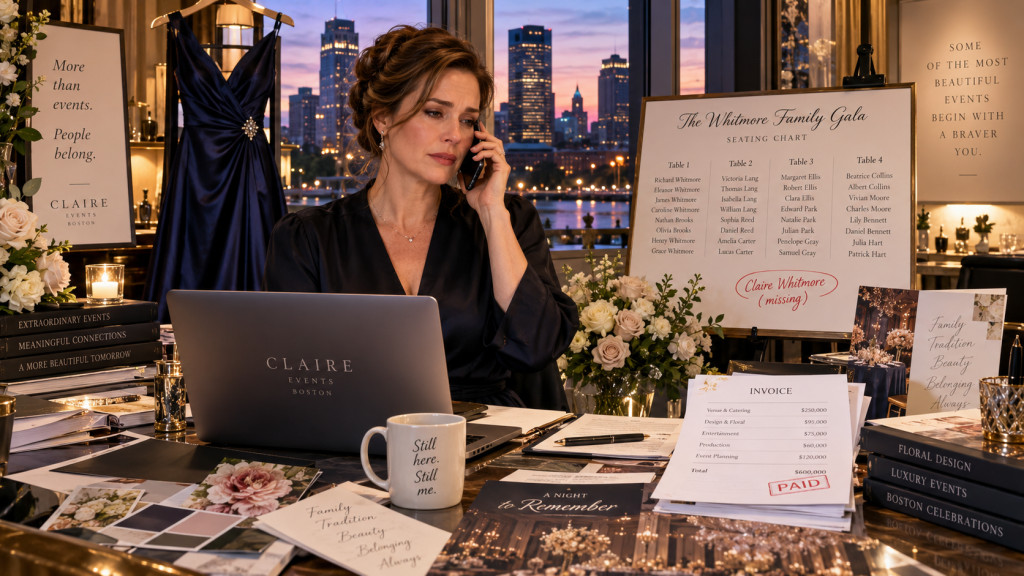
➡️ PART 3 ENDING PART ➡️
The second contract was forty-three pages long.
I read the first page twice.
Then a third time.
My hands began to shake.
CLIENT: BENNETT EVENTS LLC
My company.
AUTHORIZED REPRESENTATIVE: CLAIRE BENNETT
My name.
TOTAL COMMITMENT: $487,500
Not my money.
Not my signature.
Not my contract.
Yet there it was.
Someone had signed my name beneath an agreement committing my company to nearly half a million dollars.
I scrolled upward.
The ballroom manager had written:
Claire, given tonight’s cancellation request, I thought you should also review the attached agreement your father submitted last month. We had assumed you approved it. Please call me immediately.
I stared at the screen.
My father had submitted it.
Dad was still on the phone.
“Claire.”
His voice had changed.
The anger was gone.
Now he sounded careful.
That frightened me more.
“Don’t do anything until we talk.”
I looked at the contract.
“What is the Bennett Legacy Summit?”
Silence.
“Claire.”
“What is it?”
“It’s a business event.”
“For whom?”
“The family.”
“What family?”
“Don’t be dramatic.”
I laughed.
Not because anything was funny.
Because after years of hearing those words, something about them had finally become absurd.
“Dad, someone signed my name to a contract worth four hundred eighty-seven thousand five hundred dollars.”
“We were going to tell you.”
“When?”
“After the gala.”
I closed my eyes.
Of course.
After.
After the flowers.
After the wine.
After the wagyu.
After the ballroom.
After I had once again paid for a celebration where there was no chair for me.
“Who signed my name?”
Dad sighed.
“It’s complicated.”
“No.”
My voice became strangely calm.
“It is actually the simplest question anyone has asked me all day.”
“Who signed my name?”
Mom was shouting in the background.
Dad covered the receiver.
I heard muffled arguing.
Then he returned.
“Lauren handled some paperwork.”
There it was.
My sister.
The one whose useful professional contacts apparently deserved seats more than I did.
I whispered:
“Lauren forged my signature?”
“Do not use that word.”
“What word would you prefer?”
“She had authority.”
“No, she didn’t.”
“You’ve handled family events for years.”
“That does not give Lauren authority to sign contracts for my company.”
“She thought—”
“I don’t care what she thought.”
Dad’s voice hardened.
“Watch your tone.”
And there it was again.
The old reflex.
I was thirty-nine years old.
I employed fourteen full-time people.
My company had coordinated events for universities, hospitals, technology firms, charities, and families who trusted me with some of the most important days of their lives.
But one sentence from my father and suddenly I was sixteen again, standing in the kitchen while he explained that disagreement was disrespect.
Except this time something inside me refused to shrink.
“My tone is the least expensive problem you have tonight.”
Then I hung up.
My phone rang immediately.
Dad.
Mom.
Lauren.
Dad.
Lauren.
Mom.
I turned it facedown.
Then I called my attorney.
Her name was Rachel Kim.
Rachel had represented Bennett Events for six years.
She had negotiated leases, reviewed employment agreements, and once spent four hours arguing with an insurance company because a hotel sprinkler destroyed $32,000 worth of floral installations.
She answered on the second ring.
“Claire?”
“I need help.”
Her voice changed instantly.
“What happened?”
“Someone forged my signature.”
Pause.
“On what?”
“One contract for thirty-eight thousand.”
“Okay.”
“And another for four hundred eighty-seven thousand five hundred.”
Longer pause.
“Claire.”
“Yes.”
“Do not speak to your family again tonight.”
That sentence landed harder than I expected.
My family.
Not the vendor.
Not the client.
My family.
“Send me everything.”
I forwarded the contracts.
Screenshots.
Emails.
The seating chart.
Invoices.
Then Rachel asked:
“Who had access to your company letterhead?”
I felt cold.
“My mother.”
“Why?”
I closed my eyes.
“Because I emailed her templates when she was helping with a charity luncheon two years ago.”
“Digital signature?”
“No.”
“Accounting portal?”
“No.”
“Company email?”
“No.”
“Vendor contacts?”
“Some.”
“Has anyone ever signed on your behalf with permission?”
“My operations director.”
“Anyone in your family?”
“No.”
“Claire, I need you to listen carefully.”
I sat down.
“I’m listening.”
“Do not delete anything.”
“I won’t.”
“Do not threaten anyone.”
“Okay.”
“Do not accuse anyone publicly.”
“Okay.”
“Do not post on social media.”
“I wasn’t going to.”
“Good.”
“And don’t pay another family invoice.”
That one hurt.
Not because I wanted to pay.
Because hearing an outsider say it made the last five years suddenly visible.
“How much have you paid for them?”
Rachel asked.
I looked toward the spreadsheet open on my second monitor.
I had never totaled it.
Why hadn’t I?
Because each request arrived separately.
Four thousand here.
Seven there.
A deposit.
A caterer.
A photographer.
A graduation party.
An anniversary.
A fundraiser.
A holiday dinner.
A “temporary” advance.
Each amount felt survivable.
Together?
“I don’t know.”
“Find out.”
So I did.
I stayed at the office until after midnight.
My staff had gone home.
Boston glowed beyond the windows.
I opened five years of company accounts.
Personal accounts.
Credit cards.
Transfers.
Invoices.
I created a spreadsheet.
BENNETT FAMILY — UNREIMBURSED.
The first year:
$18,400.
Second:
$31,250.
Third:
$42,870.
Fourth:
$56,110.
Current year, including the gala:
$91,640.
I stared at the total.
$240,270.
More than a quarter of a million dollars after miscellaneous fees and smaller transfers were added.
I checked again.
Then again.
I had given my family more than the down payment on my first house.
More than I had put into my own retirement during the same period.
More than I had spent building my company during its first three years.
And every time I hesitated, Mom had said:
“You’re the successful one.”
Dad:
“Family takes care of family.”
Lauren:
“You can write it off.”
My brothers:
“Claire’s got it.”
My youngest sister once joked at Christmas:
“Don’t worry. Claire is basically our family credit card.”
Everyone laughed.
Including me.
That memory hurt the most.
Sometimes people tell you exactly what role they have assigned you.
You laugh because the alternative is admitting you heard them.
At 12:43 a.m., I found something worse.
A reimbursement.
Not to me.
Three years earlier, my parents had hosted Dad’s sixtieth birthday at a private club.
I paid $27,600.
Mom promised repayment from a family investment account.
I never received it.
But there, buried in an old email chain, was a payment confirmation.
The family investment partnership had reimbursed the event.
$27,600.
The payment went to Lauren.
I stared.
Then searched.
Another.
A holiday event I funded.
Reimbursed to Mom.
Another.
Dad’s business dinner.
Reimbursed to an account I didn’t recognize.
My family had not merely failed to reimburse me.
On several occasions, they had been reimbursed after I paid.
I called Rachel.
It was nearly one in the morning.
She answered.
“Tell me you found something.”
“I found reimbursements.”
“To whom?”
“Everyone except me.”
Silence.
“How much?”
“I don’t know yet.”
“Keep going.”
By three in the morning, I had identified $83,400.
Rachel finally said:
“Go home.”
“I can’t.”
“Claire.”
“If I stop, I’ll think.”
“You need to think.”
“No.”
My voice broke.
“I really don’t.”
Rachel softened.
“Go home anyway.”
I did.
The gala was scheduled for seven that evening.
At 6:12 a.m., Mom started calling.
At 6:30, Dad.
At 6:42, Lauren sent:
We need to handle this privately.
I laughed when I read it.
People who hurt you publicly are often deeply committed to resolving consequences privately.
I did not respond.
At eight, Antonio called.
“Your mother is trying to reinstate the catering.”
“She can’t.”
“I know.”
“She offered her credit card.”
“And?”
“It declined.”
I closed my eyes.
Of course it did.
“What about the food?”
“We’ve redirected what we can.”
He explained that ingredients already purchased would be used for other contracted events, staff would be reassigned, and the cancellation terms would determine what remained payable.
“I’m sorry.”
I said.
“For what?”
“Putting you in this position.”
“Claire.”
His voice became gentle.
“You have given my company almost half a million dollars in legitimate business over six years.”
“One canceled gala will not destroy our relationship.”
I nearly cried.
It is embarrassing how shocking ordinary professional respect can feel after people close to you have trained you to expect exploitation.
The florist called next.
Then lighting.
Musicians.
Wine distributor.
Rental company.
Some deposits were nonrefundable.
Fine.
I would deal with those.
What mattered was stopping new charges.
At nine thirty, Rachel arrived at my office.
She carried coffee and the expression of a woman prepared to ruin someone’s morning legally.
“Show me.”
We spent four hours reviewing everything.
The half-million-dollar contract was not for one event.
It was a three-year agreement.
The Bennett Legacy Summit was supposed to become an annual business conference hosted at the same luxury hotel.
My father planned to use it to attract investors for a new real-estate fund.
My company was listed as event producer and financial guarantor.
I had never heard of the fund.
Rachel stared at the document.
“They were using your company’s credit.”
“Yes.”
“Without telling you.”
“Yes.”
“Do you understand what could have happened if this had gone forward?”
“I think so.”
“No.”
She turned the paper toward me.
“If their investment event failed to generate revenue, your company could have been liable for venue minimums, production obligations, cancellation penalties, and related vendor commitments.”
I felt sick.
“How much?”
“Potentially more than the face value.”
My mouth went dry.
My parents had not merely expected me to pay for dinner.
They had quietly positioned the business I spent eleven years building beneath their next gamble.
“Why?”
I whispered.
Rachel looked at me.
“Because they believed you’d cover it.”
That sentence stayed with me.
Not because they hated me.
Not because they wanted to destroy me.
Perhaps that would have been easier.
They did it because experience had taught them something.
Claire covers it.
Claire fixes it.
Claire doesn’t embarrass the family.
Claire says yes.
Claire pays.
Claire absorbs.
Claire saves.
I had trained them too.
That realization hurt.
Not because their choices were my fault.
They weren’t.
But because boundaries I never enforced had become invitations they eventually stopped recognizing as invitations.
By noon, Rachel sent formal notices disputing the forged agreements.
The venue suspended both contracts pending investigation.
My company’s bank instituted additional verification.
Our insurer was notified.
Vendor accounts received written instructions identifying authorized signatories.
My operations director changed passwords.
Then Rachel asked:
“Do you want to file a police report?”
I stared at her.
There it was.
The line between family drama and something else.
“Do I have to decide today?”
“No.”
“Then not today.”
She nodded.
“Fair.”
At 1:17 p.m., Lauren arrived.
My receptionist called upstairs.
“Your sister is here.”
“Did she make an appointment?”
“No.”
“Then I’m unavailable.”
Lauren pushed past reception anyway.
She entered my office without knocking.
Rachel stood.
Lauren stopped.
“Oh.”
I folded my hands.
“Hello, Lauren.”
She looked furious.
“You brought a lawyer into this?”
Rachel smiled politely.
“I came voluntarily.”
“This is a family issue.”
Rachel replied:
“Not when a corporate signature is disputed.”
Lauren looked at me.
“You’re seriously doing this?”
“Sit.”
“I don’t need to sit.”
“Then stand.”
Her eyes narrowed.
“You canceled Mom and Dad’s gala.”
“My company canceled services my company was paying for.”
“You humiliated them.”
“They removed me from the guest list of an event I financed.”
“That was Mom.”
“You posted the seating chart.”
Lauren looked away.
“I didn’t know she hadn’t invited you.”
“You saw eighty-eight names.”
“I didn’t count.”
“I did.”
“Claire, this is ridiculous.”
Rachel glanced at me.
I could see her silently reminding me not to argue emotionally.
I asked:
“Did you sign my name?”
Lauren froze.
There.
The whole room changed.
“What?”
“On the Legacy Summit agreement.”
“I was told you approved it.”
“That isn’t what I asked.”
She crossed her arms.
“Dad said it was fine.”
“Did you sign my name?”
“Claire—”
“Yes or no?”
Her eyes filled.
“Yes.”
My stomach dropped even though I already knew.
Rachel immediately said:
“Lauren, I advise you to obtain independent counsel before continuing this conversation.”
Lauren stared at her.
“Oh my God.”
Then at me.
“You’re going to prosecute me?”
“I haven’t decided anything.”
“I’m your sister.”
“And I’m apparently your signature.”
She flinched.
Good.
“I thought you knew.”
“Why would you sign if you thought I knew?”
“Dad was in a rush.”
“Why not call me?”
“He said you were busy.”
“I’m always busy.”
“I know.”
“Yet when you need money, everyone finds my number.”
She started crying.
I felt nothing at first.
Then guilt.
Then anger at the guilt.
I had spent my whole life believing another person’s tears meant I had become cruel.
Rachel said nothing.
Smart woman.
Lauren whispered:
“I didn’t think it was a big deal.”
“Four hundred eighty-seven thousand dollars.”
“I didn’t read the whole contract.”
I laughed.
“You forged my signature on something you didn’t read?”
“Stop saying forged.”
“What would you call it?”
“I signed for you.”
“Without permission.”
“Yes.”
“That is what forged means.”
She sat down.
Her face disappeared into her hands.
“Dad said everyone was going to benefit.”
“How?”
“The investment fund.”
“Did you invest?”
She hesitated.
“Yes.”
“How much?”
“Fifty thousand.”
I stared.
“Where did you get fifty thousand dollars?”
She looked up.
“Dad advanced it.”
“From where?”
“I don’t know.”
Rachel and I exchanged a glance.
That answer mattered.
The family investment account became the next problem.
By the following week, an independent accountant was reviewing it.
Not because I controlled the account.
I didn’t.
Because Lauren, frightened by what she had signed, hired her own lawyer.
Her lawyer told her to stop trusting Dad’s explanations.
Blake—my brother, not to be confused with any other family story—asked questions.
Then my sister Natalie.
Then Peter.
Then Rebecca.
Then Matthew.
Six siblings.
For years, Dad had kept us financially connected while making sure none of us saw the full picture.
Lauren received “investment advances.”
Peter’s mortgage down payment came from a “family loan.”
Natalie’s children’s school tuition had been paid from a partnership distribution.
Matthew’s business received capital.
Rebecca’s divorce attorney had been paid.
Each sibling believed Dad was helping privately.
Each was told not to discuss money because “it creates jealousy.”
Meanwhile, I received no direct support.
I received requests.
Why?
Because I was the one Dad believed did not need help.
That had once made me proud.
Then it became a punishment.
Successful children are often handed a peculiar sentence:
You can handle it.
Sometimes that means:
Therefore, we don’t have to care what it costs you.
The accountant discovered Dad’s investment fund was struggling.
Badly.
Several properties had underperformed.
Loans were coming due.
The gala was not simply a family celebration.
It was networking.
The Legacy Summit was intended to attract fresh money.
And Bennett Events—with strong revenue, good credit, and a respected reputation—would make the entire operation look more stable than it was.
My company name was not incidental.
It was credibility.
My credibility.
My father had been borrowing it without asking.
When I confronted him, he did not deny it.
We met at Rachel’s office.
Mom came.
Dad came.
Lauren came with her attorney.
I brought nothing except a notebook.
Dad looked exhausted.
Mom looked furious.
She began before anyone sat down.
“Are you happy now?”
I looked at her.
“No.”
“You’ve destroyed everything.”
“No.”
“The gala was a disaster.”
“I wasn’t there.”
“Exactly!”
I almost smiled at the irony.
Dad said:
“Enough.”
Mom turned.
“No, not enough. She canceled the food. Do you know what people said?”
I looked at her.
“What did they eat?”
Her mouth opened.
I genuinely wanted to know.
After spending $75,000, I was curious how my absence had tasted.
Lauren whispered:
“Pizza.”
I blinked.
“What?”
“Dad ordered pizza.”
I laughed.
I tried not to.
I failed.
Eighty-eight elegantly dressed guests.
A ballroom.
Custom florals partly removed.
No professional lighting.
No musicians.
And thirty-two pizzas.
Mom slammed her hand against the table.
“This is funny to you?”
“No.”
I wiped my eyes.
“Okay, a little.”
“You humiliated us.”
I became serious.
“Mom, you called me and asked for another six thousand dollars while telling me there was no chair for me.”
“That was logistics.”
“There were twelve empty seats.”
“We had to account for—”
“Twelve.”
She stopped.
“I checked the fire-code capacity.”
I continued.
“I checked the final venue diagram.”
“Twelve empty seats.”
“You didn’t run out of room.”
“You excluded me.”
Mom looked away.
Dad said:
“It was a mistake.”
“No.”
I looked at him.
“It was a decision.”
That distinction mattered.
A mistake is putting the wrong name card at table seven.
A decision is reviewing a list of eighty-eight people and leaving off the daughter paying for dinner.
Dad rubbed his forehead.
“Claire, we can argue about the gala forever.”
“I don’t intend to.”
“Good.”
“I’m done paying for family events.”
Mom laughed bitterly.
“Here we go.”
I ignored her.
“No advances.”
“No deposits.”
“No company resources.”
“No vendor discounts.”
“No staff.”
“No credit.”
“If you want Bennett Events to plan something, you receive a normal proposal and pay the normal rate.”
“You would charge your own family?”
Mom asked.
“Yes.”
She looked genuinely shocked.
That told me everything.
Dad leaned forward.
“What do you want?”
“Truth.”
“About?”
“The contract.”
He sighed.
“I needed your company’s backing.”
“You needed my permission.”
“I knew you’d say no.”
There.
Rachel stopped writing.
I stared at him.
“Say that again.”
Dad looked irritated.
“I knew you would be cautious.”
“No.”
“You said you knew I would say no.”
“Claire.”
“Which means you understood I did not consent.”
Silence.
Lauren’s attorney looked at Dad.
Mom whispered:
“Thomas.”
Dad realized too late what he had admitted.
I felt strangely calm.
“Why didn’t you ask?”
“Because you don’t understand the investment.”
“I understand the word no.”
“This could have made all of us wealthy.”
“All of us?”
“Yes.”
“Was I receiving equity?”
Dad stopped.
“Was Bennett Events receiving ownership in the fund?”
“No.”
“Was I receiving a management fee?”
“We would’ve arranged—”
“Was there a written fee?”
“No.”
“So my company was taking liability while your fund took the upside.”
He became angry.
“Family doesn’t nickel-and-dime family.”
I stared at him.
“Apparently family only half-million-dollars family.”
Even Lauren laughed.
Dad glared at her.
For the first time, she did not shrink.
Mom said:
“You’ve always been obsessed with money.”
That one almost took me back.
Almost.
I looked at her.
“I paid two hundred forty thousand dollars in family expenses over five years.”
Her face changed.
“What?”
I placed the spreadsheet on the table.
“Two hundred forty thousand two hundred seventy dollars.”
Dad stared.
“That can’t be right.”
“It is.”
Mom flipped pages.
“Some of these were gifts.”
“Which?”
“Christmas.”
“Which Christmas?”
She stopped.
“Exactly.”
I pointed.
“Here are the reimbursements I was promised.”
Then another page.
“And here are reimbursements from the family partnership that were paid to other people after I covered the original costs.”
Lauren stared.
Mom whispered:
“Thomas.”
Dad said nothing.
I looked at him.
“Did you know?”
He looked tired.
“Some.”
“How many?”
“I don’t remember.”
“Did you ever intend to repay me?”
“Eventually.”
“When?”
“Claire—”
“When?”
He couldn’t answer.
That was my answer.
I sat back.
Something inside me went quiet.
For years, I thought the pain came from the money.
It didn’t.
I could earn more money.
I had.
The pain came from realizing that every promise of reimbursement had been a tool.
Just enough hope to keep me saying yes.
Dad said:
“I can make this right.”
“How?”
“We’ll restructure.”
“No.”
“I can give you equity.”
“No.”
“Claire.”
“No.”
He stared at me.
I smiled sadly.
“You really hate that word.”
Nobody spoke.
“I don’t want equity in your fund.”
“I don’t want control of the family partnership.”
“I don’t want the gala money back today.”
“I want my company removed from every document I did not authorize.”
“That can be done.”
Rachel said.
“I want written confirmation that neither of you nor any sibling has authority to sign for Bennett Events.”
“Done.”
“I want all family vendor accounts separated from mine.”
“Done.”
“And the forged contract?”
Dad looked at Lauren.
She looked terrified.
I had thought about this for days.
Lauren had done something serious.
But context mattered.
She had believed Dad’s authority extended further than it did.
She had still chosen not to call me.
Both were true.
I looked at her.
“You are going to provide a sworn statement explaining exactly how my signature got there.”
She nodded.
“You are going to cooperate with the venue and insurer.”
“Yes.”
“You will never sign my name again.”
“Never.”
“And if I discover another document?”
Her face went white.
“You do whatever you need to.”
I nodded.
I did not pursue criminal charges against Lauren.
That was my choice.
Not an obligation.
Rachel made sure the disputed agreements were rescinded and my company suffered no contractual liability beyond certain gala cancellation costs I had legitimately authorized.
The Legacy Summit never happened.
Dad’s investment fund eventually collapsed.
Not overnight.
Over eighteen months.
Properties were sold.
Loans renegotiated.
Some investors lost money.
Not everything.
Enough.
Dad sold the house where we grew up.
Mom called me crying.
“This is your childhood home.”
“No.”
I said gently.
“It was.”
“Don’t you care?”
“Yes.”
“But caring doesn’t mean buying it.”
That was what she wanted.
She never asked directly.
She didn’t need to.
Old Claire would have heard the unspoken request.
New Claire heard it too.
She simply did not obey.
The house sold to a family with three young children.
Months later, I drove past.
A bicycle lay in the driveway.
Chalk drawings covered the sidewalk.
I cried.
Then kept driving.
Mom and Dad moved into a condo.
Smaller.
Still beautiful.
They survived.
That surprised them.
People who have been financially rescued for years sometimes mistake inconvenience for catastrophe.
The six of us siblings changed too.
Lauren apologized properly.
Not:
“I’m sorry you were hurt.”
Not:
“I’m sorry Dad put me in that position.”
She said:
“I signed your name because Dad told me it would be easier than asking you.”
“I knew you might say no.”
“I decided getting the contract done mattered more than your right to say it.”
“I was wrong.”
That apology I could work with.
I did not trust her immediately.
Trust is not a light switch.
We started small.
Lunch.
Birthday texts.
No money.
The first time she asked me to plan something afterward was her tenth wedding anniversary.
She called.
“I need an event planner.”
I waited.
She continued.
“A professional one.”
“Budget?”
“Twelve thousand.”
“My minimum for that scope is fifteen.”
She groaned.
“Family discount?”
“No.”
“Worth trying.”
I laughed.
She hired me.
Paid the deposit.
On time.
Paid the final invoice.
On time.
At the anniversary dinner, she seated me beside her.
Not near catering.
Beside her.
At one point she tapped her glass.
“I want to thank my sister Claire.”
I stiffened.
Public gratitude had historically been followed by private invoices.
Lauren smiled.
“For attending as my sister.”
That was all.
I cried in the bathroom.
My brothers apologized differently.
Peter sent a check.
I returned it.
He called.
“Why?”
“You don’t owe me the gala money.”
“But I benefited.”
“Yes.”
“I want to contribute.”
“Then take Mom to dinner occasionally.”
He laughed.
“That’s more expensive.”
“Probably.”
Matthew struggled.
He believed I had overreacted.
We didn’t speak for two years.
That hurt.
Then his own business partner signed a loan guarantee without fully explaining it.
Suddenly consent in financial matters became less abstract.
He called.
“I owe you an apology.”
“Yes.”
“You could make this easier.”
“No.”
He laughed.
“Okay.”
Then apologized.
Rebecca admitted she had known for years that Mom treated me differently.
“Why didn’t you say anything?”
“I liked not being the one she leaned on.”
That was brutally honest.
I respected it.
Natalie cried.
She had assumed I enjoyed being the capable one.
I told her:
“I did.”
That surprised her.
“For a while.”
Being needed can feel like love.
Especially to the eldest daughter.
Especially when praise comes attached.
Claire can handle it.
Claire always comes through.
Ask Claire.
It felt good until I realized nobody asked whether Claire was tired.
My youngest brother, Evan, had been twenty-two when the pattern became worst.
He apologized for jokes.
Especially “family credit card.”
“I thought you thought it was funny.”
“I laughed.”
“I know.”
“I didn’t want everyone to know it hurt.”
He nodded.
“I’m sorry.”
That was enough.
My relationship with Mom took longest.
Because she did not understand what she had done.
Not for years.
To her, I had always been the strong child.
Lauren was sensitive.
Rebecca anxious.
Matthew impulsive.
Peter overextended.
Natalie overwhelmed.
Evan young.
And Claire?
Claire was fine.
Claire worked.
Claire solved.
Claire paid.
One afternoon, three years after the gala, we sat in her condo.
She asked:
“Why didn’t you tell me you were struggling?”
I almost laughed.
“I did.”
“When?”
“Every time I said something was expensive.”
“That isn’t struggling.”
“Every time I asked when you’d reimburse me.”
“I thought you were being organized.”
“Every time I said I was exhausted.”
“You always say you’re tired.”
I stared at her.
“Mom.”
She stopped.
I saw it arrive.
Not full understanding.
The beginning.
“You really felt used.”
I shook my head.
“No.”
“I was used.”
She flinched.
“That sounds ugly.”
“It was ugly.”
“I loved you.”
“I know.”
“Then how can you say we used you?”
“Because love doesn’t prevent exploitation.”
She began crying.
I continued gently.
“You loved what I did for everyone.”
“You were proud of me.”
“You bragged about my company.”
“You told people I was successful.”
“And because I was successful, you decided taking from me hurt less.”
Mom looked down.
“I didn’t think of it that way.”
“I know.”
That was the problem.
She had not thought.
I had been so reliable that my limits became invisible.
Mom eventually apologized.
It took another year.
She wrote it.
Maybe because speaking still made her defensive.
Claire,
I made your competence into an excuse not to care for you.
I stopped reading.
That sentence.
That was it.
She continued:
When your siblings needed something, I asked how we could help them. When you needed something, I reminded you how capable you were. I thought I was complimenting you. Sometimes I was abandoning you politely.
I cried.
The gala was cruel. There was room. I knew there was room.
My hand shook.
There.
Finally.
I left you off because Lauren said several potential investors might be uncomfortable if it looked like the event was being run by your company rather than by the family foundation. I wanted the family to look independently wealthy. I told myself you would understand because you were working anyway.
I had to stop again.
So that was it.
Image.
They wanted the illusion that they could afford the party.
My presence might reveal who actually paid.
I asked you to finance the appearance of our success and then excluded you because your presence risked revealing that the success was partly yours.
I cried harder.
Not because it was new.
Because she finally said it.
There is no explanation that makes that acceptable. I am sorry.
I kept the letter.
I did not frame it.
Some apologies are not trophies.
They are bridges.
We crossed slowly.
Dad was different.
Pride lived deeper in him.
His fund’s collapse aged him.
For years, he spoke as though I had caused it by refusing the Legacy Summit.
Then one evening, five years after the gala, he asked me to dinner.
Just us.
I nearly declined.
Then went.
He chose an ordinary Italian restaurant.
No private club.
No investors.
No agenda I could see.
We ate.
Finally he said:
“I was angry with you.”
“I know.”
“I thought if you had backed the Summit, the fund might have survived.”
“Maybe.”
He looked surprised.
“You admit that?”
“Yes.”
“Then—”
“Dad.”
I put down my fork.
“A bad thing might have succeeded if I had allowed you to use me.”
“That doesn’t make the use acceptable.”
He became quiet.
I continued.
“Maybe the fund would’ve survived.”
“Maybe investors would’ve come.”
“Maybe everybody would’ve made money.”
“None of that changes the fact that you decided my right to consent was less important than your plan.”
Dad looked at the table.
“I thought family assets were family assets.”
“My company was not a family asset.”
“I know that now.”
“Do you?”
“Yes.”
He sighed.
“I built my identity around providing.”
I waited.
“When things started failing, I couldn’t stand anyone knowing.”
“So you used my success to hide your failure.”
He nodded.
“Yes.”
That was the first honest thing he had said about it.
“Why leave me off the gala list?”
He closed his eyes.
“Your mother told you?”
“Yes.”
He nodded.
“I agreed.”
“Why?”
“Because investors knew your company.”
“And?”
“If you were seated prominently, they might realize you were underwriting the evening.”
“You were ashamed.”
“Yes.”
“Of me?”
“No.”
His answer came instantly.
“Of needing you.”
That hurt differently.
Dad continued.
“I spent my whole life telling people I built everything myself.”
“Then my daughter became more financially stable than I was.”
“I was proud.”
“And humiliated.”
I sat quietly.
“You could have told me.”
“I didn’t know how.”
“So you made me invisible.”
“Yes.”
He cried.
My father rarely cried.
I did not rush to comfort him.
He needed to sit with it.
Finally he said:
“I’m sorry.”
I believed he meant it.
Forgiveness came slowly.
Not as restored access to my bank account.
Never again.
It came as dinners.
Phone calls.
Boundaries.
He once asked whether I could help pay for a cruise for their fortieth anniversary.
I stared at him.
He stared back.
Then burst out laughing.
“Too soon?”
“Forever too soon.”
“Fair.”
He paid for his own cruise.
They had a wonderful time.
I received too many photographs.
Progress.
Bennett Events grew.
Ironically, the scandal helped me professionally—not because I publicized it.
I didn’t.
But setting stronger financial controls improved the company.
We created formal authorization policies.
No family exceptions.
No verbal approvals above specified limits.
Dual verification for major contracts.
Rachel gave a training session titled:
YOUR SIGNATURE IS NOT A FAMILY HEIRLOOM.
I loved it.
My employees did too.
I promoted my operations director, Jasmine, to partner.
She had worked beside me for eight years.
The first thing she asked:
“Are you sure?”
“Yes.”
“Your family okay with that?”
I laughed so hard I nearly fell out of my chair.
“My family doesn’t get a vote.”
“Just checking.”
At forty-five, I bought a townhouse.
Not enormous.
Mine.
I hosted Thanksgiving.
Twenty-two people.
Mom called two weeks beforehand.
“Do you need help?”
The old answer rose automatically.
No.
I’ve got it.
Instead I said:
“Yes.”
Silence.
Then:
“With what?”
“Dessert.”
“I can do dessert.”
“Great.”
She brought four pies.
One burned.
We ate it anyway.
Dad washed dishes.
Lauren set the table.
Peter brought wine.
Natalie arrived late.
Matthew argued about football.
Rebecca’s children spilled cranberry sauce.
Evan fell asleep on my couch.
Nobody asked me for money.
It was one of the happiest holidays of my life.
Not because everyone had changed perfectly.
Because I was finally present at my own table.
Years later, my company planned a major charity gala at the same hotel where the Bennett Family Gala had imploded.
I almost declined the contract.
Then decided a ballroom did not own my memories.
The event raised $3.2 million for pediatric cancer research.
Nine hundred guests.
The ballroom glittered.
After the final check, Jasmine found me near the stage.
“You’re done.”
“I need to check—”
“No.”
“Dessert service—”
“Handled.”
“Lighting strike—”
“Tomorrow.”
“The donor—”
“Claire.”
She pointed toward table twelve.
There was a place card.
CLAIRE BENNETT
I laughed.
“What?”
“You are attending.”
“I’m working.”
“You own the company.”
“Exactly.”
“Sit down.”
I looked at the chair.
For a moment, I was back five years earlier.
Navy silk gown.
Eighty-eight names.
No Claire.
Then Jasmine said:
“There’s room.”
I cried.
Right there.
In the ballroom.
Jasmine panicked.
“Was that wrong?”
“No.”
I hugged her.
“It was perfect.”
I sat.
Dinner was probably excellent.
I barely tasted it.
I was too busy understanding something.
A seat is such a small thing.
Four legs.
Fabric.
A place card.
A few feet of table.
But sometimes a seat means:
We expected you.
We counted you.
You are not here merely to serve.
You belong at the table.
I had spent half my life earning chairs for other people.
It took me far too long to insist on one for myself.
I never married.
People always ask that when hearing my story.
As though a woman needs a romantic ending to prove she eventually became valued.
I dated.
Loved twice.
One relationship lasted seven years.
His name was Daniel.
Good man.
We simply wanted different futures.
We remained friends.
I did not need a husband to complete the lesson.
My life was full.
Friends.
Employees who became family.
Siblings.
Nieces.
Nephews.
Travel.
Work I loved.
A house where nobody could remove my name from the guest list.
At fifty-two, I sold a majority stake in Bennett Events to Jasmine and three senior employees.
Not because I was tired of it.
Because I wanted the company to survive beyond me.
I retained a minority interest and advisory role.
Dad asked:
“How much?”
I smiled.
“None of your business.”
He laughed.
“Had to try.”
The sale made me wealthy.
Actually wealthy.
Not family-definition wealthy, where everyone assumes you can pay for things.
Financially secure.
The first purchase I made was absurd.
A dining table.
Twelve seats.
Solid walnut.
Custom built.
When it arrived, Mom came over.
She ran her hand across it.
“Beautiful.”
“Yes.”
“Twelve chairs?”
“Yes.”
“Why twelve?”
I smiled.
“Room.”
She understood.
Her eyes filled.
“Claire.”
I hugged her.
“It’s okay.”
“No.”
She pulled back.
“Don’t make it smaller because I feel bad.”
That surprised me.
She had learned.
She touched one chair.
“There was room.”
“Yes.”
“There was always room.”
“Yes.”
She cried.
“So I’m sorry.”
“I know.”
Dad died first.
Seventy-nine.
Stroke.
Unexpected.
At the hospital, all seven children came.
Six siblings.
Me.
Mom sat beside his bed.
For a while, nobody spoke.
Then Evan said:
“This is the first family event Claire didn’t organize.”
I laughed.
So did Dad, weakly.
His final day was quiet.
He asked me to stay after the others went for coffee.
“Claire.”
“Yes?”
“Did I ruin it?”
“What?”
“Our family.”
I thought carefully.
“No.”
“Did I come close?”
“Yes.”
He smiled faintly.
“Fair.”
Then:
“You know what I regret?”
“What?”
“The contract?”
“That too.”
“The money?”
“Yes.”
“The gala?”
He looked at me.
“The chair.”
My eyes filled.
“Really?”
“Yes.”
“Why?”
“Because everything else was complicated.”
“Investments.”
“Fear.”
“Pride.”
“Money.”
“The chair wasn’t complicated.”
He cried.
“We had room.”
I took his hand.
“Yes.”
“I knew.”
“Yes.”
“And I let you believe for even one night that your own family had counted everyone except you.”
I could not speak.
Dad whispered:
“I’m sorry.”
I squeezed his hand.
“I know.”
He died the following morning.
I forgave him.
Not because death demanded it.
Because over the years he had stopped asking forgiveness to erase consequences and started allowing it to exist alongside them.
Mom lived another fourteen years.
She became softer.
Not weak.
Softer.
There is a difference.
At eighty-six, she moved into assisted living.
The first week, she complained that the dining room kept assigning seats.
“I don’t like my table.”
“Why?”
“Harold talks about his gallbladder.”
“Maybe it’s fascinating.”
“It is not.”
I laughed.
Then she became serious.
“Claire?”
“Yes?”
“Will you have dinner with me?”
“Of course.”
She smiled.
“Good.”
Then:
“I saved you a seat.”
Three words.
I cried in the elevator.
At ninety, Mom developed dementia.
Memory became uneven.
Some days she knew me.
Some days she thought I was thirty.
Once she asked:
“How’s your little event company?”
“Pretty good.”
“Are they paying you enough?”
I laughed.
“I own it.”
She looked impressed.
“Smart girl.”
Then she whispered:
“Don’t lend money to relatives.”
I laughed until I cried.
Apparently some lessons survive everything.
On one of her final lucid afternoons, we sat near a window.
She looked at me.
“I was hard on you.”
“Yes.”
“You always tell the truth now.”
“I try.”
“I thought because you were strong, you didn’t need protecting.”
I held her hand.
“Strong people still get tired.”
“I know.”
She nodded.
“I wish I’d known sooner.”
“So do I.”
She cried.
Then:
“Were you lonely?”
That question reached somewhere deep.
“At the gala?”
“In the family.”
I looked out the window.
“Sometimes.”
Mom squeezed my fingers.
“I’m sorry.”
“I know.”
She died at ninety-two.
All seven of us were there.
At her memorial, Lauren arranged the reception.
Not me.
She refused to let me touch anything.
“Sit.”
“I can help.”
“No.”
“I know the caterer.”
“Claire.”
“Fine.”
I sat.
My place card was at the center table.
Of course it was.
After our parents were gone, the siblings remained.
That sounds obvious.
It isn’t.
Parents often function as the center of a family wheel.
When they die, siblings discover whether they actually know one another without the hub.
We decided to try.
Annual dinner.
Rotating host.
No gala.
Absolutely no gala.
The first year was Lauren.
Second Peter.
Third me.
Evan created one rule:
“No one may use the phrase family discount.”
We toasted to it.
Over time, the story of the disastrous gala became funny.
Not immediately.
Years later.
That’s how you know some wounds have healed enough to become stories.
Peter would say:
“Remember Dad ordering thirty-two pizzas?”
Lauren:
“It was thirty-four.”
Mom had apparently demanded gluten-free.
We laughed.
Then someone always looked at me.
“Too soon?”
Eventually, I would say:
“No.”
And mean it.
At seventy, I retired fully.
Jasmine’s daughter ran Bennett Events by then.
Imagine that.
The company survived me.
Thrived without me.
Exactly as it should.
They invited me to the thirtieth-anniversary celebration.
I arrived.
Checked the seating chart out of habit.
Jasmine caught me.
“You’re unbelievable.”
“Professional reflex.”
She pointed.
Table one.
My name.
I smiled.
“Just checking.”
“There will always be a seat for you here.”
I hugged her.
“Thank you.”
Then corrected her.
“But if there isn’t, that’s okay too.”
She looked confused.
I smiled.
“I know how to leave now.”
That was the final lesson.
Belonging does not mean forcing every table to seat you.
Sometimes the table is wrong.
Sometimes the invitation never comes.
Sometimes people deliberately exclude you.
Your worth does not depend on convincing them to pull up a chair.
You can build another table.
You can leave.
You can eat somewhere else.
You can invite people who understand that your presence matters more than what you can provide.
At seventy-six, I wrote a book.
Not a memoir exactly.
A business book about boundaries in family-owned and founder-led companies.
The chapter people quoted most was titled:
THERE IS ALWAYS ROOM FOR THE PERSON PAYING FOR THE BALLROOM.
Rachel loved that.
She was retired by then.
She called me.
“You finally used it.”
“Used what?”
“Spite.”
“I prefer wisdom.”
“Spite with footnotes.”
Fair.
The book did well.
I spoke to young entrepreneurs.
Especially women.
Especially eldest daughters.
I told them:
“Generosity without boundaries eventually becomes an expectation.”
“An expectation repeated long enough can become entitlement.”
“And entitlement rarely announces itself as entitlement.”
“It usually sounds like this:”
But you always do it.
That sentence silenced rooms.
Because people knew.
I never told anyone to stop helping family.
That would have been equally foolish.
I helped mine later.
When I wanted to.
Mom’s medical expenses.
Evan after a fire damaged his house.
Lauren when her husband became ill.
But I learned a sentence that changed everything:
Is this a gift, a loan, or a business transaction?
We named it before money moved.
If gift:
Gift.
No resentment.
If loan:
Written terms.
If business:
Contract.
If I couldn’t afford to lose it:
No.
Simple.
Not always easy.
But simple.
I lived to ninety-four.
The walnut dining table moved with me three times.
Twelve chairs.
Always twelve.
Not because twelve meant anything.
Because I liked room.
My nieces scratched it.
Nephews spilled wine.
Grandchildren of siblings did homework there.
Rachel once fell asleep at it during Thanksgiving.
Jasmine signed a major company buyout at it.
Lauren celebrated her seventieth birthday around it.
Afterward, she stayed late.
Everyone else had gone.
We sat with tea.
“Do you ever think about the seating chart?”
she asked.
“Yes.”
“Still?”
“Sometimes.”
“I’m sorry.”
“I know.”
“I was such an idiot.”
“You were.”
She laughed.
“You’ve become mean in old age.”
“I’ve become efficient.”
She looked at the table.
“I wish I had put your name on it.”
I smiled.
“Lauren.”
“What?”
“If you had, none of this might have happened.”
She stared.
“Are you saying I did you a favor?”
“Absolutely not.”
We laughed.
Then I became serious.
“But sometimes a cruel moment reveals a truth you’ve been avoiding.”
She nodded.
“What truth?”
“That I had mistaken usefulness for belonging.”
Lauren’s eyes filled.
I continued.
“I thought if I kept saving everyone, nobody could question my place.”
“But then you did everything and still didn’t get a chair.”
“Exactly.”
She reached across the table.
“You always had a place.”
“No.”
I said gently.
Her face fell.
“I should have.”
“There is a difference.”
She nodded.
“Yes.”
There was.
I loved my family.
But love does not require lying about what happened.
For years, my place had been conditional.
Pay.
Organize.
Fix.
Rescue.
Be easy.
Need nothing.
Then belong.
After the gala, I stopped accepting the conditions.
And strangely, some relationships became better.
Others disappeared.
Both outcomes were useful.
At ninety-one, I gave the walnut table to my grandniece Sophie.
She had just bought her first home.
“Why me?”
she asked.
“Because you host.”
She smiled.
“Is this the famous table?”
“Unfortunately.”
She counted.
“Twelve chairs.”
“Yes.”
She looked at me.
“There’s always room?”
I shook my head.
“No.”
She seemed surprised.
I touched the table.
“That’s not the lesson.”
“What is?”
“Don’t count chairs.”
“Count how people treat you.”
She smiled.
Then hugged me.
At ninety-four, my health declined quickly.
Nothing dramatic.
Heart.
Age.
Time.
My siblings had thinned around me.
Some gone.
Some still calling.
Lauren was ninety-one.
Still bossy.
She visited my final week.
We sat by the window.
She held my hand.
“Do you remember the gala?”
I laughed weakly.
“How could I forget?”
“I still hate that seating chart.”
“So do I.”
She smiled.
“Antonio’s pizza would’ve been better.”
“Antonio didn’t make the pizza.”
“I know.”
Pause.
“Claire?”
“Yes?”
“Were you proud of yourself?”
“For canceling?”
“For finally saying no.”
I thought.
“No.”
She looked surprised.
“I was heartbroken.”
Her eyes filled.
“People remember the phone calls.”
“The cancellations.”
“Mom screaming.”
“Dad panicking.”
“They make it sound triumphant.”
“It wasn’t.”
I looked at her.
“I sat in my office at three in the morning adding up five years of being used by people I loved.”
“There was nothing triumphant about that.”
“Then what was it?”
“Necessary.”
She nodded.
Sometimes necessary is enough.
Before she left, Lauren kissed my forehead.
“There will be a seat for you wherever we’re going.”
I smiled.
“You don’t know that.”
“I’ll fight management.”
“That’s my sister.”
I died three days later.
Peacefully.
My family held the memorial at a small garden venue.
Not the hotel.
Thank God.
Sophie organized it.
Jasmine helped.
Rachel’s son attended on her behalf; Rachel had died two years earlier.
Antonio’s daughter catered.
Full circle without trying too hard.
There were photographs.
Flowers.
Music.
Nothing extravagant.
At the reception, there was one empty chair at the family table.
My name card rested in front of it.
CLAIRE BENNETT
Lauren had insisted.
When Sophie saw it, she smiled.
Then removed the chair.
Lauren protested.
“What are you doing?”
Sophie said:
“Aunt Claire wouldn’t want us turning a chair into a shrine.”
Lauren stared.
Then laughed.
“You’re right.”
Sophie placed my photograph on a side table instead.
Then everyone moved closer.
Someone pulled another chair in for a late-arriving cousin.
There was room.
Not because anyone had been excluded.
Because people made room.
Later, Sophie read the letter I had left.
To my family,
Please do not remember me as the woman who canceled a gala.
It was one party.
One terrible, ridiculous party with far too much wagyu and, apparently, thirty-four emergency pizzas.
Laughter filled the room.
Remember what came after.
Remember that Lauren learned to ask permission.
Lauren cried.
Remember that Peter learned help does not always mean money.
Remember that Matthew learned consent applies to business even when surnames match.
Remember Rebecca learned honesty is kinder than comfortable silence.
Remember Natalie learned strong people need care too.
Remember Evan finally retired the phrase family credit card.
More laughter.
Remember Mom learned there had always been room.
Silence.
Remember Dad learned the chair was the simplest mistake because there had been no financial crisis forcing it, no investor pressure, no complicated contract. He simply chose not to include me. And later, he chose to tell the truth about that.
I loved him for the second choice without pretending the first one did not hurt.
If you remember me, remember this:
Do not earn belonging by becoming indispensable.
The room became still.
People who love you should notice you before they need something.
Help generously when you want to.
Give freely when you can.
But do not confuse being useful with being loved.
They can exist together.
They are not the same thing.
And if someone tells you there is no room for you at a table you built, paid for, decorated, and spent years holding together—do not spend the rest of your life begging them to move a chair.
Go build a table where nobody has to earn a seat by emptying themselves.
Love, Claire.
There was one final line.
Sophie smiled before reading it.
P.S. Please pay the caterer.
Antonio’s daughter laughed hardest.
The letter was framed eventually.
Not the seating chart.
I had destroyed that years earlier.
Some people thought I should have kept it as evidence of how far I had come.
I disagreed.
I did not need to preserve every insult to prove I survived it.
The walnut table remained.
Years later, children who had never met me ate pancakes around it.
Teenagers argued over homework.
Couples announced pregnancies.
Someone signed divorce papers there.
Someone else accepted a college scholarship.
People cried.
Laughed.
Spilled things.
Added chairs.
Removed chairs.
Nobody knew exactly which seat had once been mine.
That was perfect.
Because the story was never really about a chair.
It was about what the missing chair revealed.
For five years, I believed my family needed me because they valued me.
Then one photograph showed me eighty-eight names and taught me something painful.
They had made room for my money.
My labor.
My contacts.
My company.
My competence.
My ability to rescue them.
They had simply forgotten to make room for me.
So I stopped paying.
The flowers disappeared.
The caterer canceled.
The musicians stayed home.
The illusion collapsed.
And beneath it, I found something worth far more than the seventy-five thousand dollars I had spent.
A boundary.
At first, everyone hated it.
Then some learned to respect it.
Eventually, so did I.
That was the part people often miss when they tell stories about standing up to family.
Saying no once is dramatic.
Believing you are allowed to keep saying it is the real work.
I did that work.
For years.
Until no stopped sounding like betrayal.
Until help became a choice instead of an assignment.
Until family invitations no longer arrived disguised as invoices.
Until I could sit at a table without wondering what I was expected to pay for afterward.
And until I finally understood something the seating chart had tried to tell me in the cruelest possible way:
My name did not need to appear on someone else’s list to prove I belonged somewhere.
I could choose my own table.
I could choose who sat beside me.
I could make room for myself.
That was what I finally did.
And there was always room.
THE END STORIES! THANK YOU FOR READING GOOD LUCK !❤️
Related Posts