➡️ PART 3 ENDING PART ➡️
Julian stared at the folder as though it contained a language he had forgotten how to read.
“What do you mean, the resort expenses are the smallest problem?”
The attorney did not answer immediately.
His name was Samuel Roth.
He had worked with my father for twenty-three years, and in all the time I had known him, Samuel had possessed a remarkable talent for making silence feel more dangerous than shouting.
He adjusted his glasses.
“Mr. Vale, I suggest you attend the board meeting.”
“I asked you a question.”
“And I suggested you attend the board meeting.”
Julian looked toward Maya.
She would later tell me that was the moment she finally understood something about him.
Until then, Julian had still believed the world would rearrange itself if he became angry enough.
“Maya.”
She did not move.
“Get Evelyn on the phone.”
“No.”
His eyes narrowed.
“What did you say?”
“I said no.”
“You work for me.”
Maya swallowed.
“Not anymore.”
He stared at her.
She removed her employee badge and placed it on his desk.
“I resigned this morning.”
“Why?”
Her face crumpled.
“Because I spent six days watching you ignore your pregnant wife while I knew exactly where you were.”
Julian looked away.
Maya continued.
“I kept telling myself I was only your assistant.”
“That your marriage wasn’t my business.”
“That I needed my job.”
“Then Evelyn almost died.”
Her voice broke.
“And Daniel did.”
Julian flinched at his son’s name.
Maya wiped her eyes.
“So no.”
“I don’t work for you anymore.”
Julian turned toward Chloe.
She had been standing beside her suitcase without speaking.
For the first time, apparently, she looked less like his glamorous escape and more like another person caught inside the wreckage he had created.
“Call Evelyn.”
Chloe shook her head.
“Don’t involve me.”
Julian laughed in disbelief.
“You are involved.”
“Not in this.”
“You were in Napa with me.”
“And you told me your marriage was finished.”
Maya stared at her.
Chloe’s face reddened.
Julian said:
“It was.”
Samuel finally spoke.
“Then the divorce papers should present no difficulty.”
Julian looked as if Samuel had slapped him.
“My wife just lost our child.”
Samuel’s expression changed.
Barely.
But enough.
“Your wife nearly lost her life.”
Julian opened his mouth.
Samuel continued.
“And during the medical emergency, you were unreachable because you had instructed your staff not to interrupt you.”
“I didn’t know.”
“No.”
Samuel said.
“You chose not to know.”
That sentence followed Julian for years.
At eleven o’clock, he entered the Vale Meridian boardroom.
I was not there.
That surprised him.
He had expected me to sit at the far end of the table in black clothes, hollow-eyed and furious, waiting to watch him fall.
But I was still recovering.
My body was still producing milk for a baby who was no longer alive.
I was still waking every few hours because my body had memorized a child my arms would never hold.
I was not going to drag myself into a boardroom to perform strength for Julian.
Samuel attended as my representative.
So did the trust’s independent counsel.
The board had eleven voting directors.
Julian had spent years assuming he controlled them.
He controlled fewer than he thought.
Samuel placed my proxy revocation on the table.
Then the trust documents.
Then the financial report.
The first irregularity involved Napa.
Corporate aircraft.
Resort suite.
Meals.
Spa charges.
Wine.
A private vineyard excursion.
Luxury car rental.
All billed to Vale Meridian under “investor development.”
No investors had attended.
Only Julian.
And Chloe.
Approximately $46,000.
Embarrassing.
Improper.
Potentially reimbursable.
But survivable.
Then Samuel opened the second section.
For eighteen months, the communications department had paid consulting fees to three outside firms.
One was legitimate.
Two were not.
One shared a mailing address with Chloe’s brother.
The other had been incorporated by a college friend of Julian’s.
Together, they had received $611,000.
The work product supporting those payments was thin.
In some cases, nonexistent.
Julian stared at the figures.
“What is this?”
The chief financial officer answered.
“That is what we’re asking you.”
“I approved communications vendors.”
“Yes.”
“Chloe selected them.”
Every eye turned toward her.
Chloe went pale.
“You told me to.”
Julian snapped:
“Be careful.”
She stared at him.
That was the beginning of the end of their romance.
Not Daniel’s death.
Not my divorce.
Money.
Fear.
Self-preservation.
The board asked questions.
Chloe answered some.
Julian interrupted.
Samuel stopped him.
The audit continued.
One vendor had paid a “strategy fee” to a private company controlled by Chloe.
Another had covered travel unrelated to corporate business.
There were gifts.
Jewelry.
Hotel stays.
Tickets.
A lease deposit on an apartment in San Francisco.
The accounting trail did not establish that Julian had personally stolen $611,000.
It did establish enough undisclosed conflicts, questionable approvals, inaccurate business descriptions, and control failures to make the board’s next step inevitable.
Julian was placed on administrative leave pending an independent investigation.
He laughed when they told him.
Actually laughed.
“You cannot suspend me.”
The board chair looked at him.
“We just did.”
“My name is on the building.”
Samuel said quietly:
“Your wife’s father’s name is on the building.”
That one hurt.
Julian stood.
“You think Evelyn can run this company?”
Nobody answered.
Because the question was irrelevant.
I had never claimed I wanted to be CEO.
That was another thing Julian never understood.
Control and leadership are not the same desire.
I wanted the company protected.
I wanted my father’s work protected.
And I wanted the authority that belonged to my trust returned to me.
Nothing more.
Nothing less.
Julian left the boardroom at 2:17 p.m.
Security disabled his executive access.
He stood in the lobby where he had spent years walking past employees without learning their names.
Maya was waiting near the doors.
Not for him.
For her final paperwork.
Julian approached her.
“Where is Evelyn?”
“I don’t know.”
“Don’t lie.”
“I know where she was discharged to.”
“Where?”
“I won’t tell you.”
His jaw tightened.
“She is my wife.”
Maya looked at him.
“Read the papers.”
Then she walked away.
I had gone to my mother’s house.
Not the mansion where I grew up.
She had sold that after Dad died.
She lived in a quiet home outside Boston with hydrangeas along the front walk and a kitchen that always smelled faintly of cinnamon.
My childhood bedroom did not exist there.
That helped.
I did not need to become a child.
I needed somewhere I was allowed to fall apart.
Mom gave me that.
For the first week, she slept in the room beside mine.
Not with me.
Not hovering.
Just close.
The first night, I woke at 3:14 a.m.
My gown was wet.
Milk.
I stared at it.
Then screamed.
There are pains people can prepare you for.
Nobody had prepared me for that.
My body had received the message that Daniel was born.
It had not received the message that he died.
My mother came running.
I was sitting on the bathroom floor.
“I can’t do this.”
She knelt beside me.
“Yes, you can.”
I shook my head violently.
“No.”
Then Mom corrected herself.
“No.”
She wrapped a towel around my shoulders.
“You’re right.”
“You don’t have to do this.”
“We’ll get help.”
That was better.
The next morning, my doctor explained my options.
Medication.
Cold compresses.
Supportive clothing.
Pain management.
Warning signs.
Practical things.
Grief is full of humiliating practical things.
Forms.
Medication schedules.
Funeral arrangements.
Medical bills.
Flowers you never wanted.
People asking whether they can bring lasagna.
I hated lasagna for almost two years afterward.
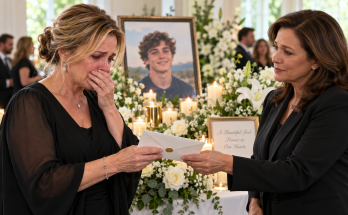
We buried Daniel on a Thursday.
Julian attended.
I did not invite him.
I did not forbid him.
He was Daniel’s father.
Whatever he had done to me, that fact remained.
The service was private.
Twenty-three people.
A tiny white coffin.
I had not known coffins came that small.
That knowledge changed me.
Julian arrived alone.
No Chloe.
No executives.
No photographers.
He looked destroyed.
Part of me wanted satisfaction.
I found none.
He approached before the service.
“Evelyn.”
I stepped backward.
He stopped.
Good.
At least he understood that much.
“I’m sorry.”
I looked at him.
“For which part?”
His face crumpled.
“All of it.”
“That isn’t an answer.”
“I should’ve answered.”
“Yes.”
“I should’ve come home.”
“Yes.”
“I didn’t know it was that serious.”
My grief became anger so quickly it frightened me.
“I wrote SOMETHING IS WRONG. PLEASE CALL ME.”
“I know.”
“You answered, CAN THIS WAIT?”
He closed his eyes.
“I know.”
“So don’t tell me you didn’t know.”
“I didn’t know Daniel was going to die.”
“Neither did I.”
My voice broke.
“That was why I called.”
Julian began crying.
I had seen him cry twice in six years.
Once when his father died.
Once when my father offered him the CEO position.
This was different.
Ugly.
Helpless.
He whispered:
“If I had known—”
I stopped him.
“No.”
He looked at me.
“You don’t get to build your defense around information you refused to receive.”
He stared.
“I called because I needed my husband.”
“You decided I was an interruption.”
I pointed toward the chapel.
“Our son died while you were protecting six days with your mistress from the inconvenience of my phone calls.”
Julian covered his face.
I wanted to hurt him.
I admit that.
I wanted one sentence sharp enough to make him feel what I felt.
Then I looked at Daniel’s coffin.
And suddenly I was tired.
So tired.
“This is his funeral.”
I whispered.
“Not our divorce.”
“Sit wherever you want.”
“But leave me alone.”
Julian did.
During the service, he sat in the last row.
I sat in front between Mom and Maya.
Maya had asked permission to attend.
I said yes.
She cried through the entire service.
Afterward, she approached me.
“I’m sorry.”
I hugged her.
She stiffened in surprise.
“You tried.”
“Not enough.”
“No.”
I said.
“Not enough.”
She cried harder.
“But you tried.”
Both were true.
Maya eventually became one of my closest friends.
Not immediately.
Trust needed time.
But grief creates strange bridges.
She had been one of the last people to know Daniel was alive inside me.
She had also been standing near the hospital door when I woke without him.
That connected us.
The divorce became ugly.
Not because I wanted it to.
Because Julian refused to believe I meant it.
He delayed.
Contested.
Requested mediation.
Sent letters.
Flowers.
Jewelry.
I returned everything except the letters.
I gave those to my attorney.
At one point, Julian arrived at Mom’s house.
She did not let him inside.
He stood on the porch for forty minutes.
I watched from an upstairs window.
Then stopped watching.
He left a box.
Inside was Daniel’s nursery mobile.
I threw up.
Mom called my lawyer.
Julian received a formal instruction that all communication go through counsel.
He obeyed after that.
The independent corporate investigation lasted five months.
Its conclusions were complicated.
Real life often is.
Chloe had directed company money toward vendors where she had undisclosed personal relationships.
Some work had been performed.
Some invoices were inflated.
Some services could not be adequately substantiated.
Julian had approved expenditures without proper review.
He had also used company resources for personal travel and concealed the personal nature of several expenses.
There was no neat discovery that Julian had secretly stolen millions and buried them offshore.
The truth was less cinematic and, in some ways, more damning.
He had become careless because he believed normal rules no longer applied to him.
That is how entitlement often works.
Not:
I am committing wrongdoing.
But:
Surely this rule was meant for someone else.
The board terminated Julian for cause.
Chloe was terminated too.
Certain disputed funds were repaid through settlements.
Regulators and tax professionals handled matters within their respective authority.
I did not direct criminal punishment.
I did not need to.
I wanted governance restored.
The board hired an interim CEO.
Then conducted a national search.
Everyone expected me to install someone loyal to me.
I did not.
The final candidate was Dr. Adrian Cole, an executive I had met twice.
He had no personal loyalty to me.
Excellent.
At his final interview, he asked:
“What role do you intend to play?”
I said:
“Trustee.”
“Not chair?”
“No.”
“Not executive?”
“No.”
“Then what do you want from me?”
“Do your job well enough that I don’t have to learn your children’s birthdays.”
He laughed.
We hired him.
He ran Vale Meridian for twelve years.
Better than Julian had.
That hurt Julian more than losing the title.
My divorce became final fourteen months after Daniel died.
I wore gray.
Not black.
My attorney Samuel attended with me.
Mom waited outside.
The judge asked routine questions.
Did I understand the agreement?
Yes.
Had I entered voluntarily?
Yes.
Was reconciliation possible?
I looked at Julian.
He looked at me.
For one second, I saw the man I had married.
Twenty-nine.
Ambitious.
Funny.
Terrified before proposing.
The man who once slept on a hospital chair when I had appendicitis.
The man who danced barefoot with me in our kitchen.
The man who cried when I showed him the positive pregnancy test.
Those things had happened too.
People wanted me to make Julian entirely monstrous after the divorce.
I couldn’t.
Because if every good memory became fake, then I would have to believe my own life had been fake.
It hadn’t.
Love can be real and still become unsafe.
A person can once care for you and later fail you terribly.
Past tenderness does not create a lifetime exemption from consequences.
The judge repeated:
“Mrs. Vale?”
I returned to the room.
“Is reconciliation possible?”
“No.”
Julian closed his eyes.
The judge signed.
That was it.
Six years ended with a pen.
Outside, Julian approached.
My attorney moved closer.
I lifted a hand.
It was fine.
Julian stopped several feet away.
“Evelyn.”
“Yes?”
“Was there ever a chance?”
“After Daniel?”
He nodded.
“No.”
His face tightened.
“Because he died?”
I looked at him.
“No.”
That surprised him.
“Daniel’s death was not something I could use as a verdict against you.”
“Doctors never told me that answering your phone would definitely have saved him.”
That mattered.
I refused to lie just because the lie would punish Julian.
My placental abruption had been catastrophic.
Even if Julian had answered immediately, Daniel might still have died.
I might still have hemorrhaged.
Medical tragedy does not become murder simply because someone behaved cruelly around it.
Julian stared at me.
“Then why?”
“Because when I believed something was wrong, I reached for you.”
“And you taught me I could not trust you to reach back.”
He cried.
I continued.
“That was enough.”
He nodded.
“I understand.”
“I hope you do someday.”
Then I left.
For two years, I barely lived outside grief.
I functioned.
That is different.
I attended board meetings.
Read reports.
Exercised.
Ate.
Slept badly.
Went to therapy.
Visited Daniel’s grave every Sunday.
Sometimes I spoke.
Sometimes I sat.
On his first birthday, I brought nothing.
No balloons.
No flowers.
I sat in the grass and said:
“You should be one.”
Then cried until it rained.
Mom found me there.
She did not say:
“He’s in a better place.”
She knew better.
She sat beside me.
After a while she said:
“I would have liked to see what his hair looked like.”
That destroyed me.
“Me too.”
We cried together.
Grief changed over time.
Not smaller exactly.
Less sharp.
At first, Daniel’s absence was the only thing I could see.
Eventually, the rest of the world returned around it.
Trees.
Coffee.
Music.
Work.
Friends.
Then one day I laughed at something Maya said and immediately felt guilty.
My therapist asked:
“What did laughing take away from Daniel?”
“Nothing.”
“Then why must loving him require suffering every minute?”
I hated that question.
Then needed it.
I began living again.
Julian disappeared from public life for a while.
He sold the apartment.
Moved to a smaller place.
His relationship with Chloe ended during the investigation.
I knew almost nothing else.
Then, three years after our divorce, he wrote.
Not to my home.
Through Samuel.
Samuel called.
“Do you want it?”
“No.”
“Okay.”
“Wait.”
Silence.
“Is it legal?”
“No.”
“Manipulative?”
“I haven’t read it.”
“Send it.”
The letter arrived sealed.
I waited four days.
Then opened it.
Evelyn,
I have written versions of this letter that asked for forgiveness. I destroyed them because I realized forgiveness is another thing I have no right to ask you to provide for me.
I kept reading.
I spent a long time telling myself Daniel’s death was a tragedy that happened while I was away. That sentence allowed me to avoid the sentence that mattered: when you told me something was wrong, I decided whatever you needed was less important than what I wanted.
I stopped.
Breathed.
Continued.
I cannot know whether being there would have changed the medical outcome. I do know it would have changed one thing. You would not have faced it believing your husband had chosen not to answer.
Tears came.
I am sorry for the affair.
I am sorry for the money.
I am sorry for turning authority into entitlement.
I am sorry I treated your trust as proof that I deserved more trust.
And I am sorry I made our son’s death part of the moment you finally had to protect yourself from me.
Then:
I visit Daniel sometimes.
I froze.
If you want me to stop, tell Samuel and I will. I go on Thursdays because I know you used to go Sundays and I never wanted you to find me there.
I cried.
I tell him about the things I should have told him if he had lived. Mostly that his mother loved him before either of us knew his face.
I closed the letter.
For an hour.
Then finished.
I do not expect an answer.
Julian
I did not answer.
But I did not ask him to stop visiting.
That was my first act of forgiveness.
Not reunion.
Not absolution.
Simply making room for the fact that Daniel belonged to him too.
Years passed.
Vale Meridian changed.
Under Adrian, we separated the chair and CEO roles permanently.
Strengthened audit controls.
Added independent directors.
Created stricter conflict-of-interest policies.
Not because Julian alone had broken the system.
Because a system that depends entirely on one person’s virtue is a weak system.
I learned that from my marriage too.
Trust matters.
So do boundaries.
At thirty-eight, I founded the Daniel Vale Maternal Emergency Initiative.
I almost did not use his name.
It felt private.
Then I decided privacy and silence were different.
The initiative funded research, emergency obstetric response programs, patient advocacy, and communication systems designed to help pregnant patients recognize and respond to urgent warning signs.
We never claimed Julian’s presence would have saved Daniel.
That would have been medically irresponsible.
The initiative focused on what evidence could support:
Rapid recognition.
Rapid transport.
Emergency care.
Blood availability.
Patient education.
Support after pregnancy loss.
The last part mattered most to me.
Hospitals were often excellent at saving bodies and uncertain what to do with mothers leaving without babies.
We funded bereavement training.
Memory boxes.
Counseling.
Follow-up calls.
Lactation support after loss.
Practical things.
The things nobody wants to know exist until they need them.
At the opening of our first dedicated center, I stood at a podium.
Behind me was no giant photograph of Daniel.
I never wanted him turned into branding.
There was simply a small blue line beneath the foundation name.
The same shade as the blanket in my hospital bag.
I said:
“This organization exists because medical emergencies deserve urgent responses and because grief deserves care after the emergency ends.”
I paused.
“We cannot promise every family the outcome they want.”
“We can promise that no mother should be treated as though the death of her baby is something she must quietly recover from before everyone becomes uncomfortable.”
Afterward, a woman approached me.
She had lost a daughter fourteen years earlier.
“No one said her name after the funeral.”
she whispered.
“What was her name?”
“Grace.”
So I said:
“Tell me about Grace.”
She cried.
For twenty minutes, she told me.
That became part of my work.
Not saving people.
Making room.
At forty, I met Nathan.
Not at a gala.
Not through business.
At a grocery store.
I dropped oranges.
He helped pick them up.
Very romantic.
He was a high-school history teacher.
Divorced.
One daughter.
Terrible at choosing avocados.
We dated slowly.
Painfully slowly, according to Maya.
After six months, Nathan asked:
“Are you waiting for me to do something terrible?”
I wanted to deny it.
Instead:
“Yes.”
He nodded.
“Anything specific?”
“No.”
“That sounds exhausting.”
“It is.”
“Anything I can do?”
“Be consistent.”
He smiled.
“That I can try.”
And he did.
Nathan did not heal me.
I dislike that phrase.
I was not an injury waiting for a man to close.
But he participated in a life where trust could grow again.
That was different.
When he proposed three years later, I said:
“I need time.”
He answered:
“Okay.”
Not:
Why?
Not:
Don’t you trust me?
Not:
After everything I’ve done?
Just:
Okay.
I said yes six weeks later.
Before our wedding, I told him:
“Daniel will always be my son.”
Nathan looked confused.
“Of course.”
“I need you to understand that.”
“I do.”
“I may visit his grave on his birthday.”
“Okay.”
“I may cry.”
“Evelyn.”
He took my hands.
“I am not competing with a dead baby.”
I cried.
He held me.
Then asked:
“Do you want his name included somehow?”
We placed one small blue flower in my bouquet.
No announcement.
No performance.
Just him.
I became stepmother to Nathan’s daughter, Emma.
She was twelve.
Smart.
Suspicious.
Correctly so.
Her parents’ divorce had been rough.
I did not ask her to love me.
I did not ask her to call me Mom.
I showed up.
Homework.
Soccer.
Driving lessons.
College applications.
When she was sixteen, she called me after a party because she had been drinking and was afraid to call Nathan.
I picked her up.
In the car, she said:
“Are you going to tell Dad?”
“Yes.”
She groaned.
“But I’m going to tell him you’re safe first.”
“Then we’ll deal with the rest tomorrow.”
She looked at me.
“I knew you’d come.”
That sentence meant more to me than she knew.
I knew you’d come.
I had once called someone who did not.
Years later, Emma learned the full story.
She hugged me.
Then whispered:
“I’m sorry.”
“For what?”
“Daniel.”
Even after decades, hearing his name spoken gently could break me.
“Thank you.”
Nathan and I tried to have a child.
Once.
I became pregnant at forty-four.
I was terrified.
Every cramp.
Every spot.
Every quiet hour.
I called my obstetrician so often I apologized.
She said:
“Don’t.”
“You’ve experienced catastrophic loss.”
“We would rather hear from you.”
At eleven weeks, there was no heartbeat.
Miscarriage.
Different from Daniel.
Still grief.
Nathan cried with me.
We did not try again.
Not because fear won.
Because we decided our family was already a family.
Emma.
Us.
Daniel.
The child we lost at eleven weeks.
Love does not require a census to prove itself.
Julian never remarried.
I know because eventually we spoke again.
Not until I was forty-seven.
Fourteen years after Daniel died.
The Daniel Vale Initiative held an anniversary dinner.
Julian donated anonymously every year.
I knew.
Samuel knew.
Nobody else.
That year, Samuel said:
“Julian asked whether he may attend.”
My heart raced.
“Why now?”
“He says because Daniel would have been fourteen.”
I closed my eyes.
Fourteen.
A boy.
Almost a young man.
I tried to imagine him.
Couldn’t.
That was one of grief’s cruelties.
I knew Daniel as a newborn who never breathed.
I had no memories of him becoming.
“Does he expect to speak?”
“No.”
“Meet me?”
“No.”
“Then yes.”
Julian sat at table twenty-seven.
Not near me.
He looked older.
Gray at the temples.
Thinner.
When I spoke, I saw him.
For one second, I lost my place.
Then continued.
After dinner, he approached.
Nathan stood beside me.
Julian looked at him.
Then me.
“Hello, Evelyn.”
“Hello, Julian.”
Nathan extended his hand.
“Nathan.”
Julian shook it.
“Julian.”
No drama.
No territorial nonsense.
Just two men.
Julian looked at me.
“The center is extraordinary.”
“Thank you.”
“I saw the lactation program.”
My throat tightened.
He remembered.
“Yes.”
He looked down.
“I didn’t know.”
“Most people don’t.”
Silence.
Then:
“I’m glad you built something.”
I replied:
“I wish I hadn’t needed to.”
His eyes filled.
“Me too.”
He left.
That was our first conversation in fourteen years.
It lasted less than two minutes.
It mattered.
Afterward, Nathan asked:
“Okay?”
“Yes.”
“Want to leave?”
“No.”
That answer surprised me.
I stayed.
I danced.
Not because seeing Julian no longer hurt.
Because hurt was no longer in charge.
Mom lived to eighty-eight.
She loved Nathan.
She adored Emma.
She never stopped talking about Daniel.
Not obsessively.
Naturally.
On Christmas she would sometimes say:
“Daniel would be forty-two now.”
Nobody corrected her.
Nobody changed the subject.
Before Mom died, she gave me the clear hospital bag.
I stared.
“I thought I lost this.”
“I kept it.”
Inside was the blue blanket.
Daniel’s.
My hands shook.
“Why didn’t you tell me?”
“I didn’t know when you were ready.”
“What if I never was?”
“Then I would have kept it.”
I pressed the blanket to my face.
It no longer smelled like hospital.
Only fabric.
Time had taken even that.
I cried.
Mom said:
“You don’t have to keep it.”
“I know.”
“Want me to take it back?”
“No.”
I held it.
For the first time in decades, I could.
Mom smiled.
“Okay.”
After she died, I placed the blanket in a cedar box.
Not displayed.
Not hidden.
Mine.
Julian and I developed a strange relationship in old age.
Not friendship exactly.
Not estrangement.
Every year on Daniel’s birthday, one of us sent the other a message.
Usually:
Thinking of him today.
Nothing more.
At sixty-two, Julian asked whether I wanted to visit Daniel’s grave together.
I hesitated.
Then said yes.
We met on a cold Thursday.
Julian brought no flowers.
Neither did I.
We stood beside the stone.
DANIEL THOMAS VALE
BELOVED SON
Dates separated by one day.
Julian whispered:
“I used to think if I punished myself long enough, eventually it would count as something useful.”
I looked at him.
“Did it?”
“No.”
“What did?”
“Changing.”
He put his hands in his coat pockets.
“I spent years volunteering at a bereavement support foundation.”
“I know.”
He looked surprised.
“Samuel told me.”
“Of course he did.”
I smiled.
“He’s eighty-six and still incapable of retiring.”
Julian laughed.
Then became serious.
“I tell fathers something.”
“What?”
“That grief does not excuse making the mother carry yours too.”
I looked at him.
He continued.
“I wasn’t there to carry anything.”
“So I spent years wanting to make my guilt your responsibility.”
“The letters.”
“The delays.”
“The flowers.”
“I thought if you forgave me, I could live with myself.”
He shook his head.
“That was selfish too.”
I said nothing.
Julian looked at Daniel’s name.
“I’m sorry.”
“I know.”
“Do you forgive me?”
The question finally came.
Nearly thirty years late.
I thought carefully.
“Yes.”
Julian closed his eyes.
“But.”
He looked at me.
“Forgiveness does not mean I think what happened was acceptable.”
“I know.”
“It does not mean I would choose differently.”
“I know.”
“It does not mean we should have stayed married.”
“I know.”
I breathed.
“It means I don’t need you to suffer anymore for me to know I deserved better.”
Julian cried.
So did I.
We stood there together.
Parents.
Nothing more.
Nothing less.
Nathan died when I was seventy-four.
Aneurysm.
Sudden.
One morning he was complaining about coffee.
That afternoon he was gone.
I hated the universe for repeating abrupt loss.
But grief at seventy-four was different from grief at thirty-one.
Not easier.
Different.
With Nathan, I had decades.
Photographs.
Arguments.
Vacations.
His terrible avocados.
His reading glasses in every room.
I could miss what had existed.
With Daniel, I had mourned what never got the chance to exist.
Both griefs were real.
Their shapes were different.
Emma moved closer.
She called every morning.
Too early.
Like her father.
One day she asked:
“Do you regret marrying Dad?”
“What kind of question is that?”
“A philosophical one.”
“No.”
“Do you regret marrying Julian?”
I paused.
“No.”
She looked surprised.
“Really?”
“If I erase Julian, I erase Daniel.”
“You wouldn’t.”
“Not literally.”
I looked at her.
“And I don’t want to spend my life wishing I had been wise enough to avoid every pain.”
“I wasn’t.”
“I loved someone.”
“He failed me.”
“I left.”
“Then life continued.”
“That is enough.”
Julian died at seventy-eight.
Cancer.
Before he died, he asked to see me.
I went.
Emma drove.
At the hospice, Julian looked impossibly small.
The man who once filled boardrooms with confidence now needed help lifting a glass.
“Evelyn.”
“Hi.”
“You came.”
“Yes.”
I sat.
For a while, neither of us spoke.
Then he said:
“I keep thinking about 144 hours.”
I closed my eyes.
“Julian.”
“I know.”
He swallowed.
“I wasted years counting them.”
“Don’t.”
He looked at me.
“Why?”
“Because your life was longer than your worst six days.”
He cried.
“I don’t deserve you saying that.”
“This isn’t about deserving.”
I touched his hand.
“You did something terrible.”
“Several things.”
“Yes.”
He smiled weakly.
“Thank you.”
“But you spent decades trying to become someone who would not do them again.”
“That matters.”
He looked toward the window.
“Do you think Daniel knows?”
“I don’t know.”
“Do you think he hates me?”
“No.”
“How can you know?”
“Because he never knew enough to hate anyone.”
Julian cried.
That was the cruel truth.
Daniel had no anger.
No forgiveness.
No opinion of either of us.
He had been our son for one silent day.
The rest belonged to us.
Julian whispered:
“Will you tell him I’m sorry?”
“If you see him first, you tell him.”
He laughed.
Then winced.
“Fair.”
Before I left, he said:
“Evelyn.”
“Yes?”
“You were right to leave me.”
I looked at him.
“I know.”
He smiled.
“Still terrifying.”
“Goodbye, Julian.”
“Goodbye.”
He died that night.
Emma asked whether I wanted to attend the funeral.
I did.
I sat near the back.
Just as Julian had at Daniel’s.
His life after me was represented by people I barely knew.
Colleagues from later jobs.
Men from grief-support groups.
Young executives he mentored.
Volunteers.
One man spoke about Julian calling him every night after his daughter died.
Another said Julian convinced him to enter therapy rather than destroy his marriage with rage.
I cried.
Not because that erased anything.
Because people can become useful after being harmful.
That does not mean the harmed person was required to wait.
That distinction became one of the most important truths of my life.
Julian changed.
I was still right to leave.
Both.
Always both.
At eighty-one, I stepped down as trustee of the Vale family trust.
Emma became successor trustee.
Not because she was biologically related to my father.
She wasn’t.
The trust documents allowed me to appoint a qualified successor.
Emma had spent twenty years in nonprofit finance.
She was better prepared than anyone.
Some distant relatives objected.
I smiled.
“Read the documents.”
Samuel would have been proud.
He had died years earlier at ninety-one.
His obituary called him a distinguished corporate attorney.
I remembered him as the man who stood outside Julian’s office holding a folder and said:
The resort expenses are the smallest problem we found.
He deserved poetry.
He got corporate law.
Probably appropriate.
Vale Meridian eventually merged with another healthcare company.
My father’s name disappeared from the building.
I thought that would hurt.
It didn’t.
Buildings are not legacies.
What survives inside people matters more.
The Daniel Vale Initiative remained independent.
By my eighty-fifth birthday, it had helped fund maternal emergency programs in forty-three hospitals and pregnancy-loss support services in more than a hundred.
Numbers.
Useful.
But I remembered individuals.
Grace’s mother.
A father named Marcus who called us after his wife lost twins.
A woman named Lena who said the first person from our program was the only one who asked whether she wanted to talk about her baby rather than telling her to “try again.”
Her baby’s name was June.
I remembered.
Names mattered.
At eighty-eight, I visited Daniel’s grave less often.
My knees disliked cemeteries.
Emma took me on his birthday.
She brought a folding chair.
“Humiliating.”
“You’re eighty-eight.”
“Rude.”
We sat.
Daniel would have been fifty-seven.
Impossible.
I looked at the stone.
“I don’t know who you’d be.”
Emma sat quietly.
“I used to imagine.”
“Doctor.”
“Musician.”
“Terrible student.”
“Great student.”
“Married.”
“Single.”
“Children.”
“No children.”
I smiled.
“Eventually I realized every version was me trying to turn grief into biography.”
Emma squeezed my hand.
“So who is he now?”
“My son.”
“That’s enough?”
“Yes.”
Finally.
Yes.
At ninety-two, my health declined.
Heart.
Kidneys.
Age.
Nothing dramatic.
I moved into Emma’s home.
Her children visited.
Their children too.
I had become a grandmother without ever giving birth to a living child.
Life does not always honor categories.
Love finds technicalities boring.
One afternoon, my great-granddaughter asked why there was a tiny blue blanket in my cedar box.
Emma looked at me.
My choice.
I said:
“It belonged to my son.”
The girl frowned.
“I thought Aunt Emma was your daughter.”
“She is.”
“Then who was your son?”
“Daniel.”
“Where is he?”
“He died when he was born.”
Children accept truth better than adults sometimes.
“Oh.”
Then:
“Was he cute?”
I laughed.
“I thought so.”
“Can I see a picture?”
I had one.
A hospital photograph.
For decades I showed almost nobody.
I showed her.
She studied it.
“He’s really tiny.”
“Yes.”
“Can I say hi?”
My throat closed.
“Yes.”
She looked at the photograph.
“Hi, Daniel.”
Then ran away because someone had cookies.
I cried for twenty minutes.
Emma found me.
“Too much?”
“No.”
I smiled.
“Exactly enough.”
My final birthday was ninety-four.
Maya came.
Yes.
Maya.
Ninety-one.
Still dramatic.
Still wearing lipstick brighter than any reasonable person.
She had married twice.
Outlived both.
She sat beside me.
“Do you remember when you asked me for your laptop?”
I laughed.
“You looked terrified.”
“I was.”
“I thought you were going to email Julian.”
“I did too.”
“Then you revoked his proxy.”
She shook her head.
“I remember thinking: This woman is bleeding, grieving, medicated, and still terrifying.”
“I was numb.”
“I know.”
We became quiet.
Then Maya said:
“I’m still sorry.”
“Maya.”
“I know.”
“Ninety-one years old and still trying to apologize?”
“I have stamina.”
I took her hand.
“You told me where he was.”
“Eventually.”
“You tried to call him.”
“Yes.”
“You came to the hospital.”
“Yes.”
“You stayed.”
She cried.
“Thank you.”
I smiled.
“Take the win.”
She laughed.
Maya died six months before me.
At her funeral, her daughter gave me Maya’s old employee badge from Vale Meridian.
“She kept it.”
I stared.
“Why?”
“She said it reminded her of the day she stopped being afraid of powerful men.”
I laughed.
That sounded like Maya.
I kept it beside Daniel’s blanket.
My final week was peaceful.
Emma slept nearby.
One evening she asked:
“Are you afraid?”
“Yes.”
“Of dying?”
“A little.”
“What else?”
I looked toward the window.
“Seeing everyone again and discovering the afterlife requires awkward conversations.”
She laughed.
“Julian?”
“Imagine.”
“What would you say?”
“I already said everything.”
“Nathan?”
“I’d complain he left first.”
“Your parents?”
“Mom owes me a lasagna-free eternity.”
Emma laughed.
“And Daniel?”
That silenced me.
For sixty-three years, I had imagined that possibility.
Not religious certainty.
Just hope.
“What would you say to him?”
I cried.
“Nothing.”
“Nothing?”
“I think I’d hold him.”
Emma cried too.
“That sounds right.”
On my last night, she brought the cedar box.
“Want it?”
“Yes.”
Inside:
Blue blanket.
Daniel’s photograph.
Mom’s letter.
Maya’s badge.
Nathan’s wedding ring.
A life reduced to objects.
And yet not reduced at all.
I touched the blanket.
“Emma?”
“Yes?”
“Promise me something.”
“Anything.”
“Don’t make my story about Julian.”
She looked surprised.
“Okay.”
“People like simple stories.”
“Bad husband.”
“Abandoned wife.”
“Powerful woman destroys him.”
“That isn’t my life.”
“What is?”
I thought.
“A woman lost her son.”
“She left a marriage.”
“She protected her father’s company.”
“She grieved.”
“She loved again.”
“She became a stepmother.”
“She built something useful.”
“She forgave eventually.”
“She got old.”
I smiled.
“That’s the story.”
Emma squeezed my hand.
“I promise.”
I closed my eyes.
Then opened them.
“And don’t say Daniel died because Julian didn’t answer.”
“I won’t.”
“We don’t know that.”
“I know.”
“Cruelty doesn’t need exaggeration to be cruel.”
Emma nodded.
That mattered to me.
Truth had carried me too far to abandon it at the end.
I died the next morning.
Emma was holding my hand.
The blue blanket rested beside me.
At my memorial, she kept her promise.
She did not tell a revenge story.
She told mine.
She spoke about my father founding Vale Meridian.
About my mother.
Daniel.
Julian.
Nathan.
Maya.
The initiative.
Then she read a letter I had left.
To anyone who remembers the worst six days of my marriage better than the ninety-four years of my life:
People laughed softly.
I understand.
One hundred forty-four hours makes a dramatic number.
It sounds precise enough to explain everything.
It does not.
Those hours did not kill my son.
A catastrophic medical emergency took Daniel from me.
Those hours did reveal something else.
When I reached for the person who had promised to stand beside me, he chose not to reach back.
That truth ended my marriage.
But please understand: leaving Julian did not heal me.
Punishing him did not heal me.
Removing him from Vale Meridian did not heal me.
Divorce did not heal me.
Time alone did not heal me either.
Healing was smaller.
My mother sitting beside me while my body grieved a baby it could no longer feed.
Maya showing up after she wished she had acted sooner.
A therapist asking whether laughter really betrayed my son.
Nathan saying okay when I needed time.
Emma calling me family before I understood I had become hers.
Women telling me the names of babies nobody else wanted to mention.
Julian eventually learning that remorse is not a request another person must fulfill.
And me learning that forgiveness does not require reopening a door I was right to close.
Emma stopped to wipe her eyes.
Then continued.
If someone fails you in your worst hour, you are allowed to reconsider the place they hold in your life.
You do not need a courtroom verdict on whether they are a terrible human being.
You do not need to prove they never loved you.
You do not need to turn every good memory into a lie.
Sometimes the truth is more difficult:
They loved you.
And they still failed you.
You loved them.
And you still had to leave.
Both can be true.
The room was silent.
If they change afterward, good.
Let them change.
Their growth does not create a debt requiring your return.
A second chance can be beautiful when freely given.
It is never owed.
Julian became a better man.
I became able to forgive him.
We still never belonged together again.
There was peace in finally understanding that.
Emma’s voice broke.
As for my son:
His name was Daniel Thomas Vale.
He existed.
He was wanted.
He was loved.
His life was unimaginably brief, but I will not measure its meaning by duration.
For decades, people described me as a woman who lost a baby.
Eventually I changed the sentence.
I was Daniel’s mother.
Death did not revoke that.
Nothing could.
Several people were crying openly.
Do not remember the empty bassinet first.
Remember the blue blanket.
Remember that I chose his name months before he arrived.
Remember that I used to play music against my stomach because he kicked during piano pieces.
Remember that his grandmother loved him.
His father loved him imperfectly and carried regret for the rest of his life.
And I loved him without ever hearing him cry.
That is enough to make him part of our family forever.
Emma took a breath.
One final thing.
Never mistake access for love.
Marriage does not entitle someone to your loyalty regardless of how they treat it.
A title does not make someone a leader.
A surname does not make someone the owner of a legacy.
A second chance is not the admission price for proving you have forgiven.
And grief is not a room you must remain inside to prove the person you lost mattered.
Open the door.
Carry them with you.
Live.
That is what I finally learned to do.
Love, Evelyn.
Emma folded the letter.
The Daniel Vale Maternal Emergency Initiative continued after my death.
Vale Meridian no longer carried my family’s name after another merger.
That was fine.
Names disappear from buildings.
They survive in other places.
On a scholarship.
On a medical training program.
On a blue line beneath a bereavement-center sign.
In stories.
In families.
In the mouth of a little girl looking at an old photograph and saying:
“Hi, Daniel.”
Years later, my great-granddaughter became a physician.
Obstetrics.
Nobody pressured her.
She chose it.
On her first day as an attending, she carried a copy of my letter in her bag.
Not the whole thing.
One sentence:
Cruelty doesn’t need exaggeration to be cruel.
She said it reminded her to tell families the truth.
Not false hope.
Not unnecessary despair.
Truth.
With compassion.
One night, a pregnant woman arrived bleeding.
The team moved quickly.
The outcome was good.
Mother survived.
Baby survived.
Afterward, the woman’s husband stood shaking in the hallway.
My great-granddaughter put a hand on his shoulder.
“Go to her.”
He did.
No dramatic speech.
No lesson.
No mention of me.
That was perfect.
Because a legacy is most beautiful when it stops needing your name attached to it.
And somewhere, in a cedar box passed carefully through the family, a tiny blue blanket remained folded.
Not as evidence of betrayal.
Not as a symbol of revenge.
As proof of love.
That was what survived the 144 hours.
Not Julian’s affair.
Not his lost office.
Not the board meeting.
Not the divorce papers.
Daniel.
Me.
The life I built afterward.
For years, people thought my story began when my husband finally remembered his pregnant wife.
They were wrong.
My story began when I stopped waiting to be remembered.
I chose myself.
Then I chose grief.
Then healing.
Then work.
Then love.
Then family.
Then forgiveness.
Then, eventually, peace.
Julian lost his marriage during those six days.
He lost his position soon afterward.
But I did not spend the rest of my life counting what he lost.
I learned to count what remained.
My mother’s hand.
Maya’s friendship.
Nathan’s patience.
Emma’s love.
Daniel’s name.
My own life.
And in the end, that life was much larger than 144 hours.
It was larger than betrayal.
Larger than grief.
Larger even than forgiveness.
It was mine.
And I lived it.
THE END STORIES! THANK YOU FOR READING GOOD LUCK !❤️
Related Posts