➡️ PART 3 ENDING PART ➡️
For several seconds, nobody moved.
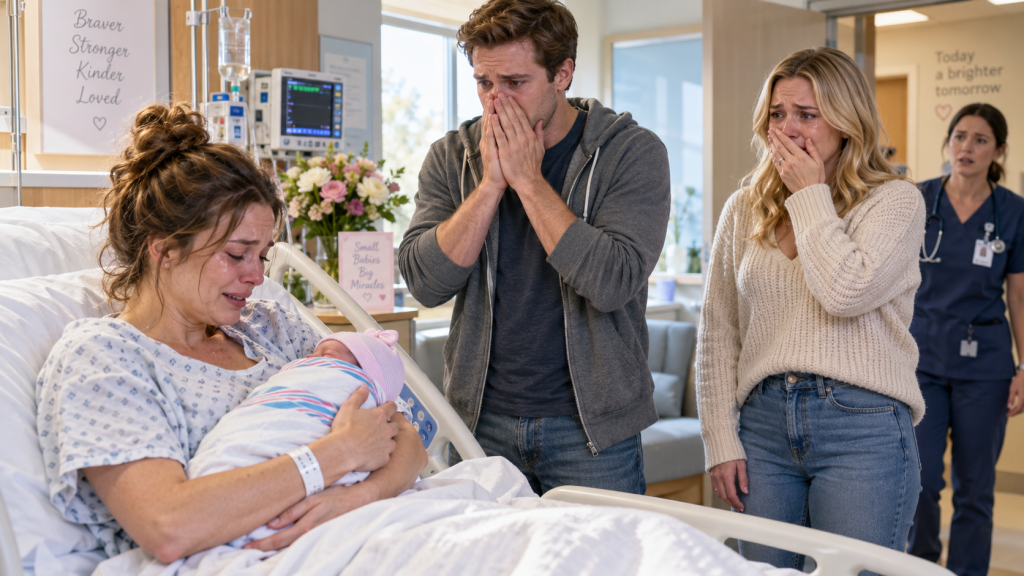
The baby slept against my chest as though the world around her had not just cracked open.
Her tiny cheek rested against the hospital blanket.
One fist was curled beneath her chin.
She had no idea that three adults were staring at her as if someone had suddenly erased her name.
Emily was the first to speak.
“What do you mean she didn’t come from our embryo?”
The hospital administrator, Dr. Raymond Cole, closed the door behind him.
Beside him stood Dr. Marcus Hale, the fertility specialist who had supervised part of Jason and Emily’s treatment.
Dr. Hale looked sick.
Not worried.
Not professionally concerned.
Sick.
Emily noticed too.
She stood so abruptly that the chair scraped backward.
“No.”
Her voice shook.
“No, don’t stand there looking at me like that.”
Dr. Hale swallowed.
“Emily—”
“Don’t call me Emily.”
Jason moved beside her.
“What happened?”
Dr. Cole answered.
“We don’t know everything yet.”
Jason laughed once.
It was a terrible sound.
“Then tell us what you do know.”
Dr. Cole looked toward me.
Then toward the baby.
“During the transfer cycle, two cryogenic storage cases were being prepared on the same morning.”
My arms tightened around the child.
“Cases belonging to whom?”
I asked.
“We are still confirming that.”
“That isn’t an answer.”
“No.”
Dr. Cole said quietly.
“It isn’t.”
Emily stepped forward.
“You put somebody else’s embryo inside her?”
Dr. Hale closed his eyes.
“We believe that may have happened.”
Emily slapped both hands over her mouth.
Jason went completely still.
I looked down at the baby.
Somebody else’s embryo.
The words felt obscene.
She wasn’t an embryo anymore.
She was warm.
Breathing.
Alive.
She had ten fingers.
Ten tiny toes.
A soft patch of dark hair.
She had cried the second she entered the world.
She had kicked beneath my ribs for months.
She hiccupped every evening around nine.
She became still whenever my son sang to my stomach.
She was not an administrative error.
She was a child.
“What do you mean may?”
Jason demanded.
Dr. Cole took a breath.
“The transfer documentation says the embryo transferred into your sister was the embryo created from your sperm and Emily’s egg.”
“Then why are you saying it wasn’t?”
“Because an internal identifier attached to the transfer record does not match the cryostorage identifier assigned to your embryos.”
Silence.
Emily stared at him.
“You knew?”
“No.”
“When?”
“Approximately forty minutes ago.”
“How?”
Dr. Cole glanced toward the baby.
“The unusual birthmark prompted questions about family medical history.”
Jason’s face changed.
“That mark doesn’t prove anything.”
“No.”
Dr. Cole agreed.
“It does not.”
That mattered.
Finally, someone was speaking carefully.
“A birthmark alone cannot establish biological parentage.”
“Then why are you here?”
“Because when Dr. Hale contacted the clinic to verify the embryo record, staff discovered the identifier discrepancy.”
Jason turned toward Dr. Hale.
“You called them because of a birthmark?”
“Yes.”
“Why?”
Dr. Hale looked at Jason.
“Because of what you told me.”
“My mother’s genetic records?”
“Yes.”
Jason’s hands curled into fists.
“Those records aren’t even about the baby.”
“I understand.”
“Do you?”
Jason shouted.
“Because five minutes ago I thought this child was mine.”
Emily spun toward him.
“She is yours.”
Jason looked at her.
The pain on his face was almost unbearable.
“Emily—”
“No.”
She pointed toward the baby.
“We spent six years trying to have her.”
“I know.”
“I gave myself injections.”
“I know.”
“I had surgeries.”
“I know.”
“I lost two pregnancies.”
His face crumpled.
“I know.”
“I picked her name.”
Emily’s voice broke.
“I painted her room.”
“I talked to her every night through your sister’s stomach.”
“And now you stand there saying you can’t take her because somebody in a laboratory may have made a mistake?”
Jason covered his face.
“I don’t know what I’m saying.”
“Then stop saying things you’ll make her live with someday.”
The room went silent.
Emily’s words hit all of us.
Especially Jason.
He looked toward the baby.
Shame spread across his face.
“I’m sorry.”
He whispered.
I did not know whether he was speaking to Emily.
To me.
Or to the child.
Maybe all three.
Dr. Cole said:
“We need to perform genetic testing.”
Emily looked at him.
“On whom?”
“With consent, the baby, Jason, Emily, and possibly the gestational carrier.”
“The gestational carrier has a name.”
I said.
He looked at me.
“You’re right.”
“I’m sorry, Claire.”
That was my name.
Claire Bennett.
Thirty-four years old.
Mother of a six-year-old boy.
Twin sister of a man who had just discovered that perhaps we were not twins in the way we had always believed.
And apparently the woman who had spent nine months carrying a baby whose biological parents might be complete strangers.
“What happens until then?”
I asked.
Dr. Cole hesitated.
That frightened me.
“Legally, the situation may be complicated.”
Emily went pale.
“No.”
“We need counsel involved.”
“No.”
She stepped toward me.
“She comes home with us.”
Dr. Cole spoke carefully.
“I cannot make that determination.”
“She is our daughter.”
“We understand that’s how—”
“Don’t.”
Emily’s voice became almost frighteningly calm.
“Do not say that’s how we feel.”
She pointed toward the crib.
“We have spent nine months preparing for that child.”
“Claire spent nine months carrying that child because we asked her to.”
“That little girl did not commit an error.”
“If someone mislabeled a container, that does not turn her into luggage you can redirect to another address.”
Nobody spoke.
Emily’s entire body trembled.
“She has a name.”
I looked at her.
We had discussed names for months.
They had chosen one during the seventh month.
“Tell them.”
I whispered.
Emily looked at the baby.
“Lily.”
Her voice cracked.
“Her name is Lily Grace Bennett.”
Jason started crying.
Not quietly.
His shoulders folded.
He sank into the chair and covered his face.
Emily stared at him.
For a moment, anger remained.
Then love overtook it.
She knelt beside him.
Jason whispered:
“I ruined it.”
“No.”
“I looked at her and rejected her.”
“You panicked.”
“I said I wouldn’t take her.”
“Yes.”
“What kind of father does that?”
Emily held his face.
“One who has about five minutes to make sure those aren’t the last words he ever gives his daughter.”
Jason looked toward me.
Toward Lily.
He stood.
Slowly.
“Can I hold her?”
I did not answer immediately.
He noticed.
That hurt him.
Good.
Not because I wanted revenge.
Because words should have weight.
He came closer.
“I’m sorry, Claire.”
“I know.”
“I panicked.”
“I know.”
“I saw the mark.”
“What does it mean?”
Jason looked toward Dr. Hale.
Then at me.
“I found Mom’s medical file after we cleaned out the storage unit.”
“What file?”
“From when we were babies.”
My stomach tightened.
“We were born in 1990.”
“I know.”
“Why would she have genetic testing?”
Jason swallowed.
“She had it done when we were seventeen.”
“Why?”
“She suspected something.”
“What?”
“That we weren’t biological twins.”
I stared at him.
“That makes no sense.”
“We have the same birthday.”
“I know.”
“We were born six minutes apart.”
“I know.”
“We look alike.”
“Not as much as we think.”
I laughed.
“Jason.”
“Claire, listen.”
He wiped his face.
“Mom had testing done privately.”
“I found the report.”
“It says we share a mother.”
“But not a father.”
The room disappeared.
Not literally.
But that is how shock works.
Objects remain.
Walls remain.
People continue breathing.
Yet your mind steps somewhere else because reality has become too large to process all at once.
I stared at my twin brother.
My other half.
The boy who had shared my birthday cake.
My childhood bedroom wall.
My first day of school.
My mother’s funeral.
Every family photograph.
“You’re saying we’re half siblings.”
“Yes.”
“No.”
“I have the report.”
“No.”
“Claire—”
“Who is my father?”
Jason looked away.
My stomach dropped.
“You know?”
“I think so.”
“Who?”
“Mom left a note with the report.”
“Who?”
His eyes filled.
“Thomas Reed.”
The name meant nothing.
“Who is that?”
“Our father’s brother.”
I stared.
“What?”
Jason’s voice broke.
“The man we thought was our father—Daniel Bennett—was my biological father.”
“And Thomas Reed was apparently yours.”
My skin went cold.
“Apparently?”
“I haven’t verified it.”
“Then don’t tell me it’s true.”
“You’re right.”
Jason nodded quickly.
“You’re right.”
I looked down at Lily.
The crescent birthmark.
“What does that have to do with her?”
Jason swallowed.
“Thomas had that mark.”
“How do you know?”
“There was a photograph with Mom’s note.”
“Same place?”
“Same shape.”
“Similar.”
“Jason, birthmarks aren’t fingerprints.”
“I know that now.”
“But when I saw Lily’s…”
His voice collapsed.
“I thought…”
“What?”
He looked ashamed.
“I thought somehow the embryo was yours.”
I stared.
“Mine?”
“That doesn’t even make sense.”
“I know.”
“You thought I secretly used my own egg?”
“No.”
“Then what?”
“I don’t know!”
He shouted.
Then immediately lowered his voice.
“I don’t know.”
“I saw the mark.”
“I thought of Mom’s secret.”
“I thought about the clinic.”
“I thought about everything that could’ve gone wrong.”
“And I panicked.”
Emily stood.
“You didn’t just panic.”
She said.
“You rejected her.”
Jason closed his eyes.
“Yes.”
“That matters.”
“I know.”
“But what you do next matters too.”
He looked at Lily.
Then at me.
“Please.”
I carefully lifted the baby.
Placed her in his arms.
Jason held her as though she were made of light.
His face broke.
“I’m sorry.”
he whispered.
Lily yawned.
That was all.
She did not understand betrayal.
Genetics.
Embryos.
Family secrets.
She understood warmth.
Milk.
Voices.
Arms.
Jason kissed her forehead.
“I’m so sorry.”
Emily wrapped her arms around both of them.
I turned away.
Because suddenly I was crying too hard to watch.
The genetic testing took three days.
The longest three days of our lives.
The hospital arranged temporary accommodation while lawyers, administrators, and doctors argued about words that felt grotesquely inadequate.
Intended parents.
Genetic parents.
Gestational carrier.
Embryo ownership.
Custody.
Transfer error.
Adverse reproductive event.
Every phrase sounded clinical.
Lily did not.
She cried at two in the morning.
She hated being swaddled too tightly.
She slept best against Emily’s chest.
She sneezed in sets of three.
Jason learned how to change diapers while simultaneously apologizing to a person who could not understand him.
I pumped milk.
Emily fed Lily.
Sometimes I did.
Sometimes Jason.
There was something almost sacred about those nights.
Four exhausted adults if you counted my son, Noah, who visited during the day and considered the entire hospital situation inconvenient because nobody had brought his dinosaur pajamas.
Noah adored Lily.
He leaned over her crib.
“She’s tiny.”
“Yes.”
“Was I that tiny?”
“No.”
“You said I was.”
“You were enormous.”
He looked offended.
“Rude.”
Then he noticed the mark.
“What’s that?”
Every adult in the room froze.
I forced myself to breathe.
“A birthmark.”
“Cool.”
He looked at his own arm.
“Why don’t I have one?”
“Because people are different.”
“Okay.”
Then he asked for crackers.
Children can rescue adults from drama simply by refusing to understand why it deserves so much oxygen.
On the third afternoon, Dr. Cole entered with two genetic counselors.
I knew before he spoke.
Not the result.
Only that our lives were about to change again.
Emily held Lily.
Jason stood beside her.
I sat near the window.
Dr. Cole closed the door.
“The results are conclusive.”
My mouth went dry.
“Lily is not genetically related to Jason.”
Emily squeezed her eyes shut.
Jason swayed.
Dr. Cole continued.
“She is not genetically related to Emily.”
Emily made a sound I never want to hear again.
Not a scream.
Something quieter.
Like grief trying not to wake a sleeping baby.
Jason caught her.
I stared at the floor.
Then Dr. Cole said:
“She is also not genetically related to Claire.”
I looked up.
The birthmark.
Meaningless.
Or coincidence.
Perhaps one day genetics would explain it.
Perhaps not.
Jason had nearly shattered his family over a mark that had become a mirror for his own fear.
“Whose child is she?”
Emily whispered.
Dr. Cole took a breath.
“We believe we have identified the genetic parents.”
Believe.
I hated that word now.
“Who?”
Jason asked.
“A couple named Rachel and Mark Sullivan.”
Emily held Lily tighter.
“Where are they?”
“Two states away.”
“Do they know?”
Dr. Cole hesitated.
“Yes.”
Emily went white.
“When did you tell them?”
“This morning.”
“And?”
Dr. Cole looked devastated.
“They believed their embryo transfer had failed eighteen months ago.”
My hand flew to my mouth.
No.
No.
Somewhere, another woman had mourned Lily before Lily was even born.
A child she believed had never begun.
A pregnancy that supposedly failed.
A nursery perhaps never painted.
A name perhaps never chosen.
Emily whispered:
“Do they want her?”
Dr. Cole did not answer.
Jason stepped forward.
“Do they want our daughter?”
“They have retained counsel.”
That was answer enough.
Emily collapsed into the chair.
She held Lily against her chest.
“No.”
Jason knelt beside her.
“No one is taking her tonight.”
he said.
I looked at Dr. Cole.
“Where is Jason and Emily’s embryo?”
The room changed.
He had hoped we would not ask yet.
“Where is it?”
I repeated.
Dr. Cole looked at Dr. Hale.
Then back at us.
“We are investigating.”
Jason stood.
“No.”
“Jason—”
“You lost their embryo too?”
“We do not yet know.”
“You implanted somebody else’s child into my sister.”
“You told us it was ours.”
“We spent nine months waiting for her.”
“And now you can’t tell me where the embryo we created is?”
Dr. Cole’s voice lowered.
“No.”
Jason slammed his palm against the wall.
Lily startled.
He immediately froze.
Her face wrinkled.
Then she began crying.
Jason’s anger disappeared.
He went to her.
“Sorry.”
He whispered.
“Daddy’s sorry.”
The word daddy hung in the room.
Nobody corrected him.
The Sullivans arrived the next day.
Rachel was thirty-eight.
Mark forty-one.
They looked terrified.
Not evil.
That disappointed the ugliest part of me.
A villain would have been easier.
Rachel entered the conference room holding a folder.
When she saw Lily through the glass partition with Emily, she stopped walking.
Her knees almost gave out.
Mark caught her.
“Oh my God.”
she whispered.
I knew immediately.
She loved Lily.
Not because she knew her.
Because grief had spent eighteen months telling her this child did not exist.
Now there she was.
Rachel pressed both hands against her mouth.
Mark cried.
Jason stood across the room.
I watched him watch them.
This was not a custody dispute yet.
It was four parents staring at one baby.
Two had created her.
Two had waited for her.
One woman had carried her.
And nobody had done anything wrong.
That was the cruelty.
The clinic had made the error.
Everyone else had simply loved in the direction they were told.
Rachel sat.
Emily entered holding Lily.
The room became unbearable.
Rachel whispered:
“Is that…”
Emily’s arms tightened.
“Yes.”
Rachel cried.
“Can I see her?”
Emily froze.
Jason touched her shoulder.
Emily looked at him.
Then at Rachel.
Slowly, she approached.
She did not hand Lily over.
Not yet.
Rachel looked down.
“She has Mark’s ears.”
Mark laughed through tears.
“Poor kid.”
For one second, everybody laughed.
Then Rachel asked:
“What did you name her?”
Emily looked at Lily.
“Lily.”
Rachel’s face crumpled.
“We were going to name our daughter Rose.”
Silence.
Two flower names.
Two mothers.
One child.
Rachel reached one finger toward Lily’s hand.
She stopped before touching her.
“May I?”
Emily nodded.
Lily curled her tiny fingers around Rachel’s.
Rachel sobbed.
Emily started crying too.
I turned away.
There are moments too private even when you are standing inside them.
Lawyers spent weeks preparing for war.
The parents did something different.
They talked.
Not because everything was easy.
It wasn’t.
Rachel wanted her biological daughter.
Emily wanted the daughter she had prepared to raise.
Mark believed genetics mattered.
Jason believed nine months of intention mattered.
Then Jason admitted that genetics had mattered enough to make him reject Lily for five terrible minutes.
That humbled him.
The Sullivans had no interest in punishing him.
They understood panic.
They had spent eighteen months living inside their own.
Court proceedings began.
Experts testified.
Documents surfaced.
And the clinic’s mistake became clearer.
It had not been a mysterious biological impossibility.
It had been a chain of ordinary failures.
A mislabeled secondary container.
A skipped verification step.
A software migration that separated one identifier from another.
A staff member who noticed an inconsistency and assumed someone else had corrected it.
No single dramatic villain.
Just several safeguards failing in sequence.
That frightened me more.
Because disasters do not always require monsters.
Sometimes they require ordinary people becoming comfortable with one small shortcut after another.
The clinic suspended procedures.
An external investigation began.
Families from previous cycles were contacted.
Independent audits followed.
And then we received another phone call.
Jason and Emily’s embryo had been located.
Frozen.
Still stored.
Never transferred.
Emily sat down when she heard.
“So our baby…”
Jason looked at her.
“Our embryo.”
She corrected herself.
“Our embryo is still there.”
“Yes.”
The relief was complicated.
Lily slept upstairs in their rented apartment.
The embryo that was supposed to become their child remained microscopic and frozen.
Neither canceled the other.
Emily cried all night.
Months passed.
The custody question remained.
The media learned about the case.
Suddenly strangers had opinions.
Some said biology should decide everything.
Others said intended parenthood should.
Some called me the mother.
Some called Emily the mother.
Some called Rachel the real mother.
I hated that word most.
Real.
As if love requires one person to become counterfeit.
We stopped reading comments.
The court appointed independent representation focused solely on Lily’s interests.
That mattered.
Because adults can become so consumed by what has been done to them that they accidentally treat a child as the remedy.
Lily was not compensation.
Not evidence.
Not property.
Not a prize awarded to whoever suffered most.
She was a baby who would one day become a girl capable of asking:
What happened to me?
Why did everyone fight?
Who wanted me?
The answer needed to be:
Everyone.
Eventually, mediation began.
I attended one session.
Only one.
Rachel asked me:
“What do you want?”
I stared at her.
“For Lily?”
“Yes.”
I looked at Emily.
Jason.
Mark.
Then Rachel.
“I want her to grow up without believing her existence ruined five adults.”
Nobody spoke.
“I want her to know the mistake happened before she had anything to do with it.”
“I want her to know she was never the mistake.”
Emily started crying.
Rachel did too.
“And I want every adult in this room to stop asking what would be fair to us.”
I said.
“Because there is no fair.”
“You lost a pregnancy you didn’t know continued.”
I looked at Rachel.
“You prepared for a daughter you were told was yours.”
I looked at Emily.
“Jason nearly destroyed himself over a family secret.”
“Mark has a biological child he didn’t know existed.”
“And I carried a baby believing I was doing one thing when my body was actually doing another.”
I looked at Lily’s photograph on the table.
“There is no version where everybody gets back what they were supposed to have.”
“So build the version that hurts her least.”
That became the foundation.
The eventual arrangement was unusual.
Complicated.
Imperfect.
But Lily remained primarily with Jason and Emily, the parents who had prepared for and cared for her from birth, while Rachel and Mark became permanent, legally recognized figures in her life through an agreement structured with professional and judicial oversight.
I will not pretend everyone celebrated immediately.
Rachel grieved.
Deeply.
She had to learn how to love a daughter she had created without being the mother who tucked her into bed every night.
Emily struggled with jealousy.
Every time Lily looked like Rachel, fear returned.
Jason became overprotective.
Mark sometimes wondered whether agreeing had been cowardice.
There were arguments.
Therapy.
Revisions.
Boundaries.
More therapy.
But adults can survive discomfort.
Children should not be asked to absorb it for us.
When Lily was two, she called Rachel “Rae.”
When she was three, she called Mark “Papa Mark.”
Jason remained Daddy.
Emily remained Mommy.
I was Aunt Claire.
Biology had not assigned those names.
Life had.
When Lily was four, she asked why she had two families.
Emily answered:
“Because something happened before you were born that made your story unusual.”
“Bad?”
Lily asked.
Emily thought.
“The mistake was bad.”
“You weren’t.”
That became the sentence.
Again and again.
The mistake was bad.
You weren’t.
At five, Lily asked whether I was her mother because she had lived in my stomach.
“No.”
“Why?”
“Because bodies can help families in different ways.”
“Did I kick you?”
“Constantly.”
“Sorry.”
“You’re forgiven.”
At six, she asked why Rachel looked like her.
That conversation went deeper.
At eight, she understood embryos.
At eleven, she read an age-appropriate timeline we had prepared with counselors.
At thirteen, she became furious.
Not confused.
Furious.
That was her right.
She screamed at all of us.
“You all knew and I didn’t!”
Emily cried.
Jason tried explaining.
Lily shouted:
“Stop explaining!”
And to his credit, he stopped.
She stayed with Rachel and Mark for two weeks.
Not as punishment.
Because she wanted distance.
Emily nearly fell apart.
I reminded her:
“You spent years saying Lily should have every part of her story.”
“Yes.”
“This is what that looks like when she doesn’t react in the way we prefer.”
That hurt.
Truth often does.
Lily returned.
Not because everything was fixed.
Because adolescence is hungry and Emily made better pancakes.
At sixteen, Lily asked Jason about the day she was born.
She knew there was something everyone softened.
“What did you say?”
Jason looked at me.
I said nothing.
His truth.
His responsibility.
He looked at Lily.
“I said I couldn’t take you.”
Her face changed.
Emily began crying.
Jason continued.
“I saw your birthmark.”
“I had just discovered a secret about Aunt Claire and me.”
“I panicked.”
“I thought something impossible had happened.”
“And for a few minutes, I let fear become more important than you.”
Lily stared.
“Did you not want me?”
“I wanted you for years.”
“Then why?”
“Because wanting someone doesn’t automatically make you wise enough to handle fear.”
She crossed her arms.
“That sounds like therapy.”
“I’ve had a lot.”
Despite herself, Lily smiled.
Then:
“Did you mean it?”
Jason cried.
“For those few seconds?”
“Yes.”
“I did.”
Everyone went silent.
He did not rescue himself with a lie.
“But I was wrong.”
he said.
“And I have regretted those words every day.”
Lily’s eyes filled.
“Do you think I have to forgive you?”
“No.”
That answer surprised her.
“You don’t?”
“No.”
“You don’t owe me forgiveness because I raised you.”
“You don’t owe me comfort because I’m sorry.”
“I hope my life after those words tells you more about me than those words do.”
“But you get to decide.”
Lily cried.
Then she walked away.
She did not hug him.
Not that day.
Three months later, Jason was repairing the fence when Lily walked outside.
I watched from the kitchen.
She stood beside him.
Said something.
He put down the hammer.
She hugged him.
Jason collapsed around her.
I turned away.
Some moments still deserve privacy.
Meanwhile, the other family secret waited.
Mine.
Thomas Reed.
The man Mom’s note claimed was my biological father.
After Lily’s birth, I had almost forgotten.
Then one evening Jason arrived at my house carrying the old file.
“We should test.”
he said.
I stared at it.
“Do you want to?”
“No.”
“Neither do I.”
We tested anyway.
Mom’s report had been accurate.
Jason and I shared a mother.
Different fathers.
Thomas Reed had died twelve years earlier.
I never met him.
But he had a daughter.
My half sister.
Anna.
When I contacted her, she thought I was running a scam.
Reasonable.
Then testing confirmed it.
We met.
She had my hands.
That bothered me for days.
I had spent my entire life believing my hands came from Mom.
Family identity is full of tiny assumptions nobody thinks to question.
Anna told me about Thomas.
He was funny.
Unreliable when young.
Sober later.
Worked as an electrician.
Loved fishing.
Hated tomatoes.
Had no idea I existed.
At least, Anna believed he didn’t.
Mom’s note suggested their relationship had been brief during a separation from Daniel.
Daniel and Mom reconciled before we were born.
He knew there was uncertainty about my paternity.
He chose to raise both babies as his.
That changed everything.
Jason’s biological father was also the father who raised me.
Daniel Bennett.
The man whose brother had biologically fathered me.
I sat with that for months.
Then I realized something.
Daniel had known.
And stayed.
He changed my diapers.
Taught me to ride a bicycle.
Sat beside my hospital bed when I broke my arm.
Called me “Bug.”
Died when Jason and I were nineteen.
DNA did not retroactively remove him.
Thomas gave me biology.
Daniel gave me fatherhood.
I could honor both truths without forcing them to compete.
Jason struggled more.
“I’m more his daughter biologically than you are.”
he said one night.
I stared.
“That sentence is disgusting.”
“I know.”
“Then why say it?”
“Because some ugly part of me thought it.”
I appreciated the honesty.
“What else does the ugly part think?”
“That maybe Dad loved you more because he was proving something.”
That hurt.
“Did he?”
“No.”
“How do you know?”
Jason smiled sadly.
“Because Dad loved everybody like he was being timed.”
I laughed.
True.
Daniel Bennett loved loudly.
Bad jokes.
Huge hugs.
Burned pancakes.
He would have hated every second of our genetic crisis.
Then demanded everyone eat.
Jason and I remained twins.
Not genetically identical.
Not full siblings.
Twins.
We shared a womb.
A birthday.
A childhood.
A mother.
A father in every way that mattered to our upbringing.
Six minutes.
Thousands of memories.
No laboratory result could make us strangers.
Years later, Jason said:
“I used to think family was a fact.”
“What do you think now?”
“A verb.”
I rolled my eyes.
“You’ve been in therapy too long.”
“Probably.”
But he was right.
Family was something people did.
Again.
Again.
Again.
Jason and Emily waited four years before deciding what to do with their remaining embryo.
There was no easy choice.
Emily wanted another child.
She also feared another pregnancy journey.
I was not volunteering again.
Nobody asked.
That mattered.
Eventually, they used a different clinic after extensive independent review.
Emily carried the pregnancy herself.
At forty-one, she gave birth to a boy.
Samuel Daniel Bennett.
Jason cried so hard during delivery that the nurse asked whether he needed medical attention.
Lily was twelve.
She held her baby brother.
Looked at him suspiciously.
“He looks like Dad.”
Emily laughed.
“He does.”
Lily glanced at Jason.
“Check his back.”
The entire room froze.
Then Lily grinned.
Jason stared.
“You are evil.”
“I learned from Aunt Claire.”
“Absolutely not.”
Everyone laughed.
Even Jason.
Especially Jason.
The birthmark that once nearly broke us eventually became a family joke.
Not because that morning stopped mattering.
Because painful memories are allowed to become lighter when the people involved have done the work.
Lily grew.
She became fascinated by biology.
Of course.
At eighteen, she studied genetics.
At twenty-two, bioethics.
At twenty-seven, she completed a doctorate focused on assisted reproduction, consent, and identity.
She never worked for the clinic that caused the error.
It had closed years earlier after lawsuits, regulatory findings, and financial collapse.
Several professionals faced disciplinary consequences.
Policies changed.
Verification standards became stricter.
Our families participated in advocacy, but carefully.
We did not turn Lily into a mascot.
Her story belonged to her.
When journalists called, the answer was always:
“Ask Lily when she is old enough to decide.”
When she became old enough, she decided.
At thirty, she gave one interview.
One.
She sat beneath studio lights.
Calm.
Brilliant.
The interviewer asked:
“Who do you consider your real parents?”
Lily smiled.
“I consider that question badly designed.”
I laughed so loudly watching from home that Noah called from the next room.
Lily continued:
“Jason and Emily raised me.”
“Rachel and Mark are my genetic parents and have loved me throughout my life.”
“Claire carried me.”
“All of those relationships are real.”
“They are simply different.”
The interviewer asked:
“Wasn’t that confusing?”
“Sometimes.”
“Was it damaging?”
Lily thought.
“The clinic’s mistake caused harm.”
“The adults telling me the truth gradually and refusing to make me choose between them reduced that harm.”
Then:
“What would you say to families facing similar situations?”
Lily paused.
“I would tell adults not to make children responsible for repairing adult injustice.”
That line traveled everywhere.
I wrote it down.
Not because I needed to remember.
Because I was proud.
Noah grew too.
My son had been six when Lily was born.
He became a teacher.
Married a woman named Jasmine.
Had two daughters.
He remained close to Lily.
When anyone called their family confusing, Noah said:
“Only if you’re bad at calendars.”
Rachel and Mark had another child through IVF years later.
A son named Oliver.
Lily adored him.
She called him her brother.
Samuel was also her brother.
Again, no competition.
At Rachel’s sixtieth birthday, both families gathered.
Jason grilled.
Mark criticized his technique.
Emily and Rachel argued over salad dressing.
Lily sat beside me.
“Look at them.”
she said.
“What?”
“All this because someone mislabeled a container.”
I shook my head.
“No.”
She looked at me.
“All this happened after someone mislabeled a container.”
“There’s a difference.”
She smiled.
“Still correcting language?”
“Until I die.”
“Why the distinction?”
“Because the mistake didn’t create the love.”
“We did.”
Lily looked around.
Jason laughing.
Emily carrying a cake.
Rachel chasing Oliver’s children away from candles.
Mark pretending not to steal frosting.
Samuel arguing with Noah about football.
Anna, my half sister, talking with Jasmine.
A family no genealogist would enjoy diagramming.
Lily leaned her head against my shoulder.
“I like that.”
“So do I.”
Jason died before me.
Seventy-eight.
Cancer.
It was slow enough for goodbyes.
Too fast for acceptance.
Twins are not supposed to leave one at a time.
That is childish.
Of course they do.
But some part of me had always imagined we would somehow trick death too.
Six minutes apart entering.
Maybe six minutes apart leaving.
Life does not honor symmetry.
During his final week, I sat beside him.
He looked terrible.
I told him.
“Thanks.”
“Twin honesty.”
“Half-sibling honesty.”
I glared.
He laughed weakly.
“Too soon?”
“Fifty years too soon.”
Then he became quiet.
“Claire?”
“Yes?”
“Do you remember Lily’s birth?”
“Unfortunately.”
“I still hear myself saying it.”
“I know.”
“‘I can’t take her.’”
“Yes.”
He looked toward the window.
“That was the worst sentence I ever said.”
“Probably.”
“You could lie.”
“Not now.”
He smiled.
“Do you think she forgave me?”
“Ask her.”
“I have.”
“What did she say?”
“That forgiveness isn’t a certificate she hands out.”
I laughed.
“That sounds like her.”
“She said she loves me.”
“She does.”
“Is that enough?”
I looked at my brother.
“Yes.”
Then I corrected myself.
“It has to be.”
He nodded.
“I spent years trying to make up for five minutes.”
“I know.”
“That was stupid.”
“A little.”
“I should’ve just been her dad.”
“You were.”
He cried.
“I was scared.”
“I know.”
“I saw that mark and thought the universe was telling me something.”
I held his hand.
“It was a birthmark, Jason.”
“I know.”
“Turns out the universe has terrible handwriting.”
He laughed.
Then coughed.
When he settled, he whispered:
“Thank you.”
“For what?”
“Carrying her.”
I looked at him.
“You’re welcome.”
“I don’t think I ever said it properly.”
“You did.”
“Not enough.”
“Jason.”
He looked at me.
“She was never a gift from me to you.”
He frowned.
“What?”
“I used to describe the surrogacy that way.”
“A gift.”
“But Lily wasn’t mine to give.”
“I carried her.”
“I helped bring her here.”
“But she was always herself.”
Jason’s eyes filled.
“That’s annoyingly wise.”
“I’m older.”
“Six minutes.”
“Still older.”
He squeezed my hand.
“Love you, Claire.”
“Love you too.”
Jason died two days later.
Lily sat on one side.
Emily on the other.
I stood at the foot of the bed.
His final conscious words were to Lily.
“I took you home.”
She bent over him.
“Yes, Dad.”
“You did.”
At his funeral, Lily spoke.
She told the truth.
Not every detail.
But enough.
“My father met me badly.”
The room went still.
“Five minutes after I was born, fear got the better of him.”
“He said something he regretted for the rest of his life.”
“But I do not measure my father by the worst five minutes of his eighty years.”
She paused.
“Nor do I erase those minutes.”
“Both would be dishonest.”
She looked toward his photograph.
“He taught me that apology is not saying ‘that wasn’t who I am.’”
“Apology is saying ‘that was me, and I am responsible for becoming someone who behaves differently.’”
Emily cried.
So did I.
Lily continued.
“My father never asked me to pretend his rejection did not happen.”
“He answered my questions.”
“He accepted my anger.”
“He went to therapy.”
“He showed up.”
“Again.”
“And again.”
“And again.”
“That is how he became my father.”
Not genetics.
Not paperwork.
Not the nursery.
Not intention.
Showing up.
Again.
And again.
And again.
Emily lived another eleven years.
Rachel and Mark both outlived her.
The four-parent arrangement gradually became ordinary enough that nobody thought to explain it at family dinners.
When Emily died, Rachel sat beside Lily in the front row.
Not taking Emily’s place.
There was no empty position to fill.
She sat because Lily needed her.
At eighty-six, I moved into a small cottage near Noah.
By then my hands shook.
My knees complained.
My memory remained annoyingly good.
Lily visited every Sunday.
One afternoon she brought a photograph.
Her newborn picture.
The first one.
Emily holding her.
Jason beside the bed.
Me in the background.
All of us exhausted.
“You hate that photo.”
I said.
“I used to.”
“Why bring it?”
She turned it over.
On the back, someone had written:
LILY GRACE — 7 LBS 2 OZ — OUR MIRACLE.
Emily’s handwriting.
Lily smiled.
“She wrote that before the testing.”
“Yes.”
“Before she knew.”
“Yes.”
“She already thought I was hers.”
I looked at her.
“She loved you before she knew anything except that you existed.”
Lily’s eyes filled.
Then she showed me another photograph.
Rachel holding Lily for the first time.
Taken weeks later.
Rachel’s face destroyed by joy and grief.
“Two mothers.”
Lily said.
“Yes.”
“Was that hard for them?”
“Extremely.”
“Did they ever hate each other?”
I considered.
“For approximately three hours every Thanksgiving.”
Lily laughed.
Then became serious.
“Aunt Claire?”
“Yes?”
“Did you ever feel like my mother?”
I thought carefully.
“No.”
She looked surprised.
“Never?”
“I felt responsible for you.”
“Protective.”
“Connected.”
“I loved you before you were born.”
“But I never wanted to replace Emily or Rachel.”
“Carrying you made me part of your story.”
“It didn’t automatically tell me what role I should have afterward.”
Lily nodded.
“Thank you.”
“For what?”
“For never using the pregnancy to claim me.”
I squeezed her hand.
“You were never property.”
She leaned against me.
“No.”
“I was apparently a paperwork disaster.”
“An expensive one.”
“Rude.”
We laughed.
At eighty-eight, I developed heart disease.
Nothing dramatic.
Just age collecting its debts.
Noah wanted me to move into his house.
I refused.
Then fell in the bathroom.
He did not say I told you so.
That was how I knew I had raised him well.
I moved in.
My granddaughters decorated the room.
Far too many pillows.
Lily brought flowers.
Crescent-shaped flowers did not exist, thankfully.
One evening, Noah found me looking at an old photograph of Jason and me at eight.
Matching bicycles.
Missing teeth.
Same terrible haircut.
“You miss him?”
“Every day.”
“You were technically half siblings.”
I glared.
Noah grinned.
“Uncle Jason would’ve said it.”
“He would.”
“Do you feel less like twins now that you know?”
“No.”
“Why?”
I looked at the photograph.
“Because facts can change what you understand without changing what you lived.”
Noah sat beside me.
“That sounds important.”
“It is.”
“DNA told us something true.”
“It told us Jason and I had different biological fathers.”
“It did not tell us whether he held my hand on the first day of kindergarten.”
“It did not tell us who slept on my bedroom floor when my first boyfriend dumped me.”
“It did not tell us who sat beside me at Dad’s funeral.”
“It didn’t tell us who called every year at 6:02 in the morning on our birthday because he was born at 6:08 and insisted those six minutes belonged exclusively to me.”
Noah smiled.
“So science isn’t everything?”
“Don’t tell Lily I said that.”
Too late.
She was standing in the doorway.
“I heard you.”
“Your hearing is rude.”
She entered.
“Science would agree.”
At ninety-one, I knew I was nearing the end.
Not immediately.
But soon enough to begin giving things away.
Noah received Dad’s watch.
Anna received Mom’s letters.
Lily received something she did not expect.
The photograph of Thomas Reed.
My biological father.
The man with the crescent birthmark.
She stared.
“Why me?”
“Because that photograph almost ruined your first day.”
She laughed softly.
Then looked at his back.
The mark was visible above his swimming trunks.
“Looks like mine.”
“Yes.”
“Do you think we’re related somehow?”
“No evidence.”
“But maybe?”
“Maybe.”
“Do you want to know?”
“No.”
That surprised her.
“Why?”
“Because not every mystery needs to become an investigation.”
Coming from our family, that was practically revolutionary.
“What if we tested?”
“You can after I’m dead if you want.”
“Would that bother you?”
“I’ll be extremely difficult to offend.”
She smiled.
Then put the photograph down.
“I don’t need to.”
“Why not?”
“Because the mark already did enough.”
She touched her lower back.
“For years I hated it.”
“I know.”
“Then I thought it made me special.”
“I know.”
“Now it’s just skin.”
I smiled.
“That sounds healthy.”
“Disappointingly.”
On my ninety-second birthday, the whole family gathered.
Rachel was there.
Mark had died the year before.
Samuel came with his wife and children.
Noah.
Jasmine.
My granddaughters.
Anna’s family.
Daniel and Matthew had become family friends through years of strange holiday overlap.
Someone tried to explain our relationships to a new boyfriend.
He gave up.
Smart man.
Lily brought a cake.
On top, in pink frosting:
FAMILY: SOME ASSEMBLY REQUIRED
I laughed until I cried.
That evening, after everyone left, Lily stayed.
She sat beside me.
“Aunt Claire?”
“Yes?”
“I’ve been asked to write a book.”
“Terrible idea.”
“I knew you’d say that.”
“Are you going to?”
“Maybe.”
“What would it be about?”
“Identity.”
“Family.”
“Assisted reproduction.”
“Ethics.”
“The case.”
“Our family.”
I nodded.
“What are you afraid of?”
She looked surprised.
“How did you know?”
“Ninety-two.”
“Basically witchcraft.”
She smiled.
“I’m afraid I’ll hurt people.”
“You will.”
“Helpful.”
“If you tell a complicated story honestly, someone will dislike how they appear.”
“What do I do?”
“Don’t write to punish.”
“Don’t write to protect reputations either.”
“Write what you can support.”
“Admit what you don’t know.”
“Give people their humanity.”
“Especially when you’re angry.”
Lily became quiet.
“What should I say about Dad?”
“The truth.”
“That he rejected me?”
“Yes.”
“That he loved me?”
“Yes.”
“That both are true?”
“Yes.”
She nodded.
“What about you?”
“Make me taller.”
She laughed.
“Seriously.”
“I am serious.”
“Aunt Claire.”
I looked at her.
“Tell them I agreed to carry a baby because I loved my brother.”
“Tell them I thought I understood what that meant.”
“Tell them I learned that bringing a child into the world does not give adults ownership over the child’s story.”
“Tell them we made mistakes.”
“Tell them we tried to repair them.”
“And tell them you were loved.”
Her eyes filled.
“By who?”
I smiled.
“That’s going to be a long chapter.”
She hugged me.
The following winter, pneumonia put me in the hospital.
Life has an irritating sense of symmetry.
I had spent enough time in hospitals.
I complained.
Noah told me nobody cared.
Again, good parenting.
Lily came every day.
One night, rain struck the window.
I woke and found her asleep in the chair.
For a moment, I saw the newborn.
Tiny.
Warm.
Sleeping against my chest while adults argued about whose she was.
Then she opened her eyes.
“You’re staring.”
“I carried you.”
“I’ve heard.”
“You kicked.”
“Allegedly.”
“Constantly.”
“Defamation.”
I smiled.
“Lily.”
“Yes?”
“Come here.”
She moved closer.
I touched her cheek.
“You know you weren’t the mistake.”
Her eyes filled immediately.
We had said it a thousand times.
Perhaps some truths deserve repetition.
“I know.”
“Say it.”
“The clinic made a mistake.”
“And?”
“I wasn’t the mistake.”
“Again.”
She laughed through tears.
“I wasn’t the mistake.”
“Good.”
She held my hand.
“Aunt Claire?”
“Yes?”
“Were you scared when Dad said he wouldn’t take me?”
I looked toward the rain.
“Yes.”
“What were you scared of?”
“That everyone would leave.”
Her face changed.
“Did you think you’d have to raise me?”
“For a few minutes.”
“Would you have?”
I looked at her.
“Yes.”
She cried.
“But I’m glad I didn’t have to.”
She laughed through tears.
“Wow.”
“You had parents.”
“Too many, arguably.”
“Definitely.”
She squeezed my hand.
“Thank you for keeping me safe until everyone figured themselves out.”
“That I can accept.”
We sat quietly.
Then Lily asked:
“What do you think family is now?”
I smiled.
Jason’s answer returned.
A verb.
But after ninety-two years, I had my own.
“Family is the people who keep learning how to love you without turning you into something they own.”
Lily went still.
“That’s going in the book.”
“Royalties.”
“Absolutely not.”
“Ungrateful child.”
“Niece.”
“Paperwork disaster.”
She laughed.
I died four days later.
Not alone.
Noah held one hand.
Lily held the other.
Jasmine stood behind them.
Samuel was on his way but did not arrive in time.
That was okay.
Love is not measured by whether traffic cooperates.
At my funeral, Lily gave the final speech.
She was fifty-eight by then.
Silver beginning at her temples.
The crescent birthmark still on her back.
She stood before photographs of my life.
Me and Jason as children.
My son.
The pregnancy.
Lily as a baby.
Our enormous impossible family.
She began:
“My Aunt Claire once carried me because she believed she was giving her twin brother and his wife the child they had prayed for.”
She paused.
“Then I was born.”
Soft laughter.
“And everything became complicated.”
She told them about Jason.
Not cruelly.
“He saw a birthmark.”
“He was already carrying a secret about his own family.”
“Fear collided with confusion.”
“And for several minutes, he forgot the most important thing in the room was not genetics.”
“It was a newborn child.”
She looked toward his photograph.
“My father spent the rest of his life remembering.”
Then she spoke about Emily.
“My mother loved me before she knew whose DNA I carried.”
She spoke about Rachel.
“My genetic mother loved me before she knew I had survived.”
She spoke about Mark.
“My biological father learned to love me without demanding that love give him ownership.”
Then she spoke about me.
“And Claire carried me without turning pregnancy into possession.”
Her voice trembled.
“She used to say she was just the person who got me safely from one side of birth to the other.”
Lily smiled.
“She was more than that.”
“But she was wise enough not to decide for me what more had to mean.”
Then she unfolded a letter.
Mine.
Dear Lily, Noah, Samuel, and everyone unfortunate enough to be related to us,
Laughter.
Our family spent too many years frightened by the question: Who belongs to whom?
I think we were asking the wrong question.
People do not belong to people.
The room became quiet.
Children are not rewards for infertility.
They are not proof of marriage.
They are not genetic property.
They are not compensation for suffering.
They are not extensions of their parents’ unfinished dreams.
They are people.
Our job is not to own them.
Our job is to care for them until they can increasingly choose their own lives.
Lily stopped.
Then continued.
Jason learned that lesson painfully.
On the day Lily was born, he saw something he did not understand and let fear speak before love had time to think.
He said, “I can’t take her.”
Those words mattered.
We should not pretend otherwise.
But they were not the final sentence of his life.
That matters too.
A photograph of Jason holding toddler Lily appeared on the memorial screen.
Be careful about reducing a human being to one terrible moment.
Also be careful about using their better moments to erase the terrible one.
Hold the whole truth.
Jason rejected Lily for minutes.
Then he spent decades being her father.
Both belong in the story.
Emily’s photograph appeared next.
Emily taught me that motherhood can begin before certainty.
She did not know Lily’s DNA.
She knew the sound of her heartbeat.
She knew which blanket she had chosen.
She knew the nursery waiting at home.
She knew love.
Then Rachel.
Rachel taught me another kind of motherhood.
She mourned a pregnancy she had been told failed, only to discover her biological daughter alive in another woman’s arms.
There is no simple language for that pain.
So do not simplify it.
She was allowed to grieve what she lost while loving what remained possible.
Then Mark.
Mark taught me that fatherhood can sometimes mean refusing to turn biology into a weapon.
Then me.
And I learned that carrying a child does not automatically answer who you are to that child afterward.
Pregnancy gave me a relationship with Lily.
Love shaped it.
Time named it.
She called me Aunt Claire.
I was proud of that name.
Lily wiped her eyes.
Then there was the birthmark.
A few people smiled.
That tiny crescent caused an absurd amount of trouble.
Laughter moved through the room.
We treated it like evidence before we understood that coincidence can look meaningful when fear desperately wants a pattern.
Remember that beyond birthmarks.
Human beings are pattern-making creatures.
We see signs.
We build stories.
Sometimes the story is correct.
Sometimes it is fear wearing the clothes of certainty.
Ask questions before you punish someone for an answer you invented.
The room became still again.
The mark also uncovered the truth about Jason and me.
We were twins.
We shared a mother.
We did not share a biological father.
For about a year, that fact felt enormous.
Then it became information.
DNA explained where some things came from.
It did not rewrite our childhood.
Science can tell you who contributed chromosomes.
It cannot tell you who sat beside you when your mother died.
Both kinds of truth matter.
Then came the part I had written specifically for Lily.
Lily, if you are reading this, you are probably correcting my grammar. Stop it. I am dead and therefore outrank editors.
She laughed through tears.
You spent years asking which family was really yours.
All of them were.
Not equally.
Not identically.
But genuinely.
You never needed to divide yourself into percentages.
You did not owe Rachel half your heart because she contributed half your DNA.
You did not owe Emily more love because she raised you.
You did not owe me gratitude because I carried you.
You did not owe Jason forgiveness because he regretted what he said.
Love freely.
Set boundaries freely.
Ask questions.
Change your mind.
Your life is not a courtroom where every relationship must prove superior standing.
Lily’s voice broke.
She waited.
Then continued.
And never call yourself the clinic’s mistake.
The mistake was a mislabeled container.
The mistake was a skipped safeguard.
The mistake was a system that allowed several failures to pass unnoticed.
You were what happened afterward.
You were a person.
You still are.
Never confuse the circumstances of your arrival with the value of your existence.
People were crying openly now.
That applies to more than Lily.
Some of you were unplanned.
Some were born during terrible marriages.
Some arrived when your parents had no money.
Some were conceived after loss.
Some were adopted.
Some were raised by grandparents.
Some found family later.
Some left families that hurt them.
The conditions surrounding your beginning do not establish the limits of your worth.
Then:
Our family could have become a tragedy.
For a while, I thought it had.
But tragedy was not avoided because everything worked out perfectly.
It didn’t.
Rachel lost years of ordinary motherhood with Lily.
Emily lived with fear that biology might one day take her daughter away.
Jason carried shame.
Mark carried grief.
I carried questions about my own father.
Lily carried a story she never requested.
No ending refunds those losses.
A happy ending is not a magical transaction where pain is returned for store credit.
A few people laughed softly.
Sometimes a happy ending is simply this:
The pain did not get the final decision.
Lily stopped.
That was the sentence.
The pain did not get the final decision.
She continued.
We chose honesty.
We chose therapy.
We chose awkward holidays.
We chose boundaries.
We chose not to make Lily select one mother and erase another.
We chose not to pretend Jason’s first reaction had never happened.
We chose not to let that reaction become his entire identity.
We chose to let biology matter without allowing it to become ownership.
We chose, imperfectly and repeatedly, to show up.
Then my final paragraph.
When Lily was born, I held her while everyone around me panicked over the mark on her back.
I remember looking down at her and thinking she seemed impossibly calm for someone who had just detonated an entire family.
Laughter.
She wasn’t worried about genetics.
She wasn’t worried about legal parentage.
She wasn’t worried about embryos, contracts, or secrets from thirty years earlier.
She was hungry.
That was it.
She needed warmth.
Milk.
A clean diaper.
Someone to hold her.
Perhaps adults would be wiser if, before turning every crisis into a battle over what someone means to us, we first asked what the person in front of us actually needs.
That newborn needed care.
So we cared for her.
Then she needed truth.
So eventually we told it.
Then she needed room to be angry.
So we tried to give it.
Then she needed freedom to define her own family.
So we stepped back.
Love changes jobs as people grow.
Good love learns the new job.
Lily folded the page.
She looked toward my photograph.
Then finished from memory.
“Aunt Claire’s final sentence was this.”
Her voice steadied.
“Family is not proven by who can claim you.”
She paused.
“It is revealed by who can love you without needing to own you.”
The room remained silent.
Years later, Lily published her book.
She called it The Mistake Wasn’t Me.
On the first page was a photograph.
Not the dramatic hospital photograph.
Not the birthmark.
Not the clinic.
It was a simple picture taken when Lily was seven.
Jason stood behind a barbecue.
Emily was laughing.
Rachel held a bowl of salad.
Mark was arguing with Noah.
I was sitting on the porch.
Lily stood in the middle, missing two front teeth, holding a melting popsicle.
Nobody looked important.
Nobody looked tragic.
Nobody looked confused about who belonged where.
They simply looked like family.
Underneath the photograph, Lily wrote:
This is not the family biology planned.
It is not the family the clinic planned either.
It is the family we built after both plans failed.
She dedicated the book to all four parents.
And, annoyingly, to me.
The final line came from something Jason once told me late at night, years after the hospital.
He had been looking through photographs of Lily growing up.
First birthday.
Kindergarten.
Graduation.
Wedding.
Grandchildren.
A whole life following five terrible minutes.
He said:
“I thought family was a fact.”
I asked:
“What is it now?”
Jason smiled.
“A verb.”
For once, my brother had gotten something exactly right.
Because in the end, none of us were saved by DNA.
We were not saved by contracts.
We were not saved by pretending mistakes had never happened.
We were saved, slowly, by what we kept choosing to do after them.
To tell the truth.
To apologize.
To listen.
To stay.
To give space.
To come back.
To stop competing.
To let children grow.
To let relationships change.
To forgive when forgiveness became freeing.
To accept when forgiveness was not yet available.
To love without ownership.
Again.
Again.
And again.
That was family.
Not something written once in blood.
Something written every day in behavior.
And the little girl whose birthmark once made an entire room believe everything had gone wrong grew into a woman who taught all of us something far more important:
How she arrived was complicated.
Who loved her was complicated.
Her family was complicated.
But she never was.
She was simply Lily.
And from the first breath she took in my arms, before any test result, before any lawyer, before anyone understood whose DNA she carried, she had already been exactly what every child deserves to be.
Not claimed.
Not owed.
Not explained.
Just loved.
THE END STORIES! THANK YOU FOR READING GOOD LUCK !❤️
Related Posts