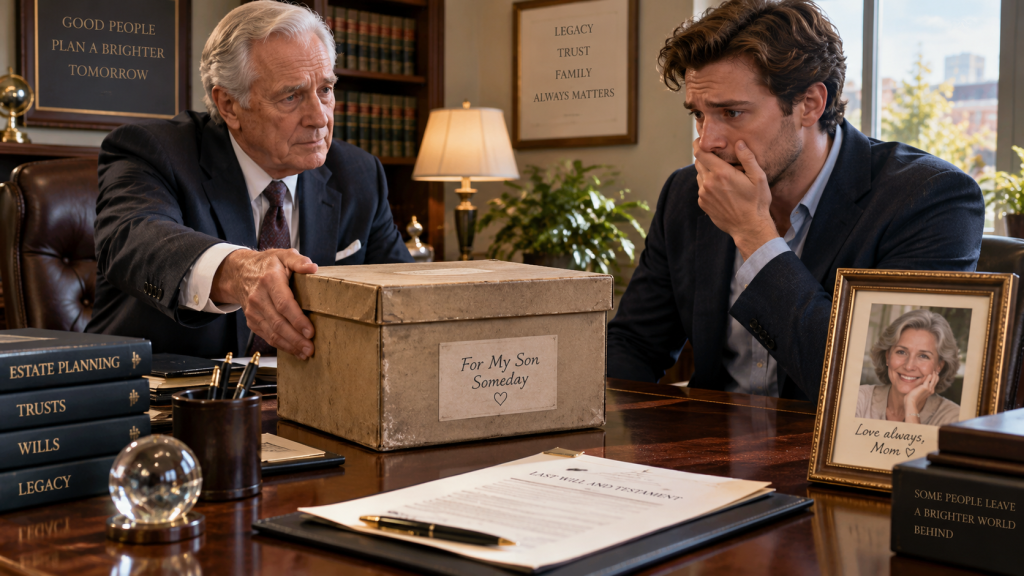
➡️ PART 3 ENDING PART ➡️
My dear husband, if you are reading this, the house was never mine to leave you. But what I truly owned may still change your life.
I read that sentence three times.
The first time, I felt confused.
The second time, cheated.
The third time, ashamed that cheated had been the first emotion strong enough to survive the confusion.
Across the desk, Ayla’s lawyer, Mr. Whitaker, said nothing.
He was an older man with silver hair and the infuriating patience of someone who already knew how every chapter ended.
I looked down at the letter again.
Ayla’s handwriting leaned slightly to the right.
I knew that handwriting.
It had labeled leftovers in our refrigerator.
It had written birthday cards to my father.
It had left ridiculous notes in my coat pocket.
Buy milk. And something sweet. Life is short.
Once, after we argued about whether she was physically capable of trimming roses from her wheelchair, she left a note on my pillow:
You married an old woman, not a decorative pillow. Stop hovering.
I had laughed then.
Now I couldn’t breathe.
“What does she mean the house wasn’t hers?”
Mr. Whitaker folded his hands.
“Keep reading.”
I hated that answer.
But I obeyed.
You are probably angry.
I stopped.
Of course she knew.
Good. Anger is often more honest than manners. Be angry for a moment. Then ask yourself what, precisely, you believe has been taken from you.
My face burned.
Something you earned?
Something I promised?
Something that belonged to you?
I lowered the letter.
Mr. Whitaker looked toward the window.
He was giving me privacy without pretending I was alone.
I continued.
I never promised you this house. You assumed it would become yours because I was older than you and because death seemed, to you, like the natural final clause of our marriage contract.
I closed my eyes.
She had known.
Not suspected.
Known.
I kept reading.
Do not misunderstand me. I knew why you first came back after carrying my groceries.
My stomach twisted.
The first afternoon, you were kind.
The second time, you were curious.
By the fourth, you had noticed the house.
By the sixth, you had begun asking questions that sounded casual but were not.
Did I have children?
Did I have siblings?
Had my husband left me comfortable?
Was maintaining such a large property difficult alone?
I remembered every question.
I had thought I was subtle.
Apparently greed always believes it is more elegant than it looks from across the room.
I was seventy-six, not seven.
Despite myself, a broken laugh escaped me.
That sounded exactly like Ayla.
Mr. Whitaker glanced at me.
I wiped my eyes.
The letter continued.
Loneliness does not make a person stupid.
That sentence hurt.
Because I had behaved as though it did.
But here is the part you may find difficult to believe: I kept opening the door.
At first, because I was curious about you.
Then because I liked you.
Eventually because I loved you.
My vision blurred.
I stopped reading.
The office became impossibly quiet.
“You knew?”
I asked Mr. Whitaker.
“Knew what?”
“That I…”
I couldn’t finish.
“That you initially pursued Mrs. Vale partly because you believed she was wealthy?”
“Yes.”
“He knew?”
“She told me.”
“When?”
“Before your engagement.”
I stared at him.
“And you let her marry me?”
Mr. Whitaker’s eyebrows rose.
“Mrs. Vale was my client, not my child.”
“You didn’t warn her?”
“I did.”
“What did she say?”
For the first time, he smiled.
“She told me to mind my own damn business.”
I laughed.
Then cried harder.
Yes.
That was Ayla.
“What was the trap?”
I asked.
Mr. Whitaker looked at the letter.
“You haven’t reached it yet.”
I continued.
You are probably wondering whether I married you to punish you.
No.
Punishment is a terrible foundation for marriage, and I was too old to waste three years conducting an experiment in revenge.
I married you because somewhere between your dishonest beginning and our honest evenings, something changed.
My hands tightened around the paper.
The difficulty, my darling, is that I never knew exactly how much.
That one hurt differently.
Perhaps neither did you.
I stared at those words.
She was right.
That was the ugliest part.
If someone had asked me on our wedding day whether I loved Ayla, I would have said yes.
And I would not have been entirely lying.
But if someone had told me then that she had no money, no house, no inheritance—
would I still have married her?
I did not know.
That uncertainty was worse than a confession.
A confession ends somewhere.
Uncertainty keeps asking.
I read on.
So I arranged matters in a way that would force you, after my death, to meet the man you were when we met and decide whether he was still the man you had become.
My throat tightened.
That is the trap.
Not the house.
Not the will.
You.
I lowered the letter.
Mr. Whitaker reached toward a pitcher.
“Water?”
I nodded.
My hand shook when I took the glass.
“Who owns the house?”
I asked.
“The Vale Foundation.”
“What foundation?”
“A charitable trust established by Ayla’s late husband.”
I stared.
“She told me he left the house to her.”
“She had a lifetime right to occupy it.”
“So she couldn’t leave it to me.”
“Correct.”
“Did she have money?”
Mr. Whitaker paused.
“Yes.”
My heart betrayed me.
Even after everything I had just read, some primitive greedy part of me awakened.
“How much?”
He studied my face.
I hated him for noticing.
Then I hated myself for giving him something to notice.
“Keep reading.”
I almost threw the letter at him.
Instead, I laughed bitterly.
“She really planned this.”
“Very carefully.”
I looked down.
Now we arrive at the question I know has been scratching at you since the moment Harold pushed this box across his desk.
Harold.
Mr. Whitaker.
I glanced at him.
He shrugged.
“She enjoyed dramatic timing.”
Of course she did.
I continued.
Did I leave you money?
There it was.
My pulse accelerated.
Yes.
I stopped breathing.
Then:
And no.
I actually looked at the ceiling.
“Ayla.”
I whispered.
Mr. Whitaker smiled.
“Keep going.”
There are two inheritances waiting for you.
You may choose only one.
I stared at the sentence.
“What?”
Mr. Whitaker reached into his desk.
He removed two envelopes.
One white.
One blue.
He placed them side by side.
My heart began pounding.
“What are those?”
“The choice.”
I looked back at the letter.
Harold has two envelopes.
The white envelope contains a direct cash inheritance.
It is substantial enough to solve the immediate problems that first brought you to my door.
My father’s medical bills flashed through my mind.
The mortgage on my parents’ house.
The credit cards.
The months of juggling payments.
My own debt.
Everything.
If you choose the white envelope, Harold will transfer the inheritance to you after the required legal process. There are no tricks attached to that money. No hidden debts. No morality test. It will be yours.
My breathing quickened.
Then I read the next paragraph.
The blue envelope contains no immediate inheritance for you.
I frowned.
Instead, it contains the documents for something I spent the final year of my life building. If you choose it, the direct cash inheritance disappears into that project permanently. You will receive a salary only if you choose to work there, and that salary will be ordinary.
I looked at Mr. Whitaker.
“What project?”
“Keep reading.”
I wanted to scream.
But I kept reading.
Before you decide, you need to understand why I created the choice.
It is not to determine whether you are a good person.
Good people sometimes need money.
Desperate people are not immoral merely because desperation makes money important.
That sentence loosened something in my chest.
Your father was sick.
Your mother was frightened.
You were drowning financially.
I knew all of that before you told me.
I looked toward the folder with my father’s name.
I also knew something you did not.
I stopped.
Your father and I had met before.
The photograph.
I picked it up again.
My father looked young.
Thirty-something.
Ayla perhaps in her late forties.
And there I was.
A baby.
“What was she to my father?”
I asked.
Mr. Whitaker pointed to the letter.
I almost laughed.
“Do you ever answer questions?”
“When permitted.”
I read.
Your father, Michael, worked for my husband and me for six years.
My mouth opened.
My father had never told me.
Not as an executive. Not as a business partner. He maintained equipment at one of our textile warehouses.
That sounded like Dad.
Before his stroke, he could repair almost anything.
One winter, there was an electrical fire. Your father smelled smoke before the alarm system activated. He helped evacuate fourteen people, including me.
I stared at the photograph.
My father had saved her?
He did not carry me dramatically through flames, so please do not improve the story when you tell it. He pulled an alarm, opened a blocked side exit, and refused to leave until he knew the storage floor was empty. Ordinary courage is impressive enough without decoration.
I laughed through tears.
Again, pure Ayla.
Several months later, your mother brought you to the company picnic. I held you for approximately eleven seconds before you vomited on my blouse.
I covered my mouth.
A laugh escaped.
Mr. Whitaker smiled.
“She remembered that part fondly.”
“Of course she did.”
Your father left the company when we sold that division. We lost contact. Years passed. My husband died. Your family became one of those old memories that appears occasionally without invitation.
Then:
When I saw you outside the grocery store, I did not recognize you immediately.
That surprised me.
But you gave me your name while carrying my bags.
Your surname made me curious.
Your eyes made me suspicious.
When you mentioned your father’s stroke on our third visit, I knew.
My throat tightened.
She had known from almost the beginning.
I asked Harold to confirm it.
I looked at Mr. Whitaker.
“You investigated me?”
“Public records and information your father voluntarily provided after Mrs. Vale contacted him.”
“What?”
My chair scraped backward.
“She contacted my father?”
“Yes.”
“When?”
“About six weeks after you met.”
I stared.
“My father knew I was seeing her?”
“Not initially.”
“What did she say to him?”
Mr. Whitaker hesitated.
Then:
“She asked whether he remembered Ayla Vale.”
“And?”
“He did.”
“Did he know who I was helping?”
“Eventually.”
“Why didn’t he tell me?”
Mr. Whitaker nodded toward the box.
There was another envelope.
My father’s handwriting was on it.
My chest tightened.
Dad was alive.
But after his stroke, writing had become difficult.
The letters looked uneven.
I opened it.
Son,
I had to stop immediately.
My father’s handwriting alone broke me.
I continued.
Ayla asked me not to tell you that I knew her. I didn’t like keeping it from you, but she told me she wanted to know why you kept going back.
I closed my eyes.
I asked her whether you were bothering her. She laughed and said, “Not yet.”
That was Ayla.
Then she told me you had been kind to her.
I was proud.
The word proud hurt.
Later, she told me she believed you had noticed her money.
I could barely breathe.
I was ashamed.
There it was.
The opposite word.
Proud.
Ashamed.
Separated by a few lines.
I wanted to confront you. Ayla told me not to. She said if kindness only survives while nobody questions its motive, then perhaps it deserves the chance to become something better before we kill it with accusation.
I wiped my face.
She paid some of my rehabilitation bills. I tried to refuse. She reminded me about the warehouse fire and said she had been waiting thirty years to repay a debt I never considered a debt.
My hands shook.
The money you thought you needed from her was already helping us before you married her.
That sentence hollowed me out.
I had married Ayla partly because I believed someday her wealth might rescue my family.
Meanwhile, she had already been helping my father without telling me.
Not to buy me.
Not to manipulate me.
Because he had once helped her.
I continued.
I don’t know what was in your heart when you married her.
I’m your father. I want to believe the best.
But don’t lie to yourself because you think honesty will disappoint me.
Then:
If you used her, admit it.
If you loved her, admit that too.
People can carry ugly and beautiful motives at the same time.
What matters now is which one you keep feeding.
I lowered the letter.
For several minutes, neither Mr. Whitaker nor I spoke.
Finally, I asked:
“Did Ayla know he wrote this?”
“Yes.”
“Did she read it?”
“No.”
That surprised me.
“She could have.”
“She refused.”
“Why?”
“He addressed it to you.”
Simple.
A boundary.
Even from the woman who had arranged half the secrets in the room.
I returned to Ayla’s letter.
Now you understand the first half.
The second half concerns me.
My chest tightened.
You did begin with money.
I began with loneliness.
That stopped me.
Do not make the mistake of believing only your motives were selfish.
I stared.
I knew you were twenty-nine.
I knew I was seventy-six.
I knew that when you touched my hand in restaurants, strangers assumed one of us was foolish and the other predatory.
Sometimes I enjoyed making them uncomfortable.
I laughed.
She absolutely had.
But I also knew I was lonely enough to accept ambiguity because your company made my days brighter.
Was that entirely noble?
No.
I had money. You needed money.
You had youth, time, strength, and attention. I wanted companionship.
Neither of us arrived empty-handed.
I swallowed.
The question is whether we remained a transaction.
My eyes blurred.
Memories came.
Not the house.
Not the bank accounts.
Ayla asleep during old movies.
Ayla demanding I learn chess and then accusing me of letting her win.
Ayla in the hospital after pneumonia, gripping my hand because she hated sleeping alone there.
Ayla laughing so hard at my burnt anniversary dinner that she had to use her inhaler.
Ayla asking me one night:
“If I had been poor, would you have noticed me?”
I had kissed her forehead.
“Of course.”
She had smiled.
But I remembered something now.
She had not said she believed me.
There were moments when I knew you loved me.
I stopped breathing.
Not because you said it.
Because greed is not patient with inconvenience.
I read that again.
When I fell in the bathroom, you slept in a chair beside me for three nights even after the nurse said I was fine.
When I became incontinent, you cleaned me without making me feel humiliated.
My face crumpled.
That period had been hard.
Ayla had hated needing help.
One night she apologized while I changed the bedding.
I had become angry.
Not at her.
At the apology.
“You took care of me when I had food poisoning.”
I reminded her.
She laughed weakly.
“For twelve hours.”
“So?”
“This is different.”
“No.”
I had kissed her temple.
“This is Tuesday.”
I remembered her staring at me afterward.
Now I understood why.
When my hands became too weak to button my blouse, you learned which clothes were easiest for me without announcing that you had noticed.
When I forgot your birthday during the worst week of my illness, you told me birthdays were an annual scam invented by cake companies.
I laughed and cried simultaneously.
When the doctor told us my condition was worsening, you did not ask Harold about my will.
I looked at the lawyer.
He nodded.
I hadn’t.
Not once.
I had thought about it.
God, yes.
But I had not asked.
And during my final month, when I was no longer charming, funny, elegant, or easy to care for, you stayed.
My tears fell onto the paper.
That does not erase why you first came.
But beginnings are not always verdicts.
I covered my face.
For almost three years, I had believed I was deceiving Ayla.
Now I understood the more frightening truth.
She had seen me far more clearly than I had seen myself.
She knew the greed.
She also knew when it stopped being the only thing in the room.
So here is your choice.
I looked at the envelopes.
White.
Blue.
The white envelope contains $1.8 million.
My breath disappeared.
I looked at Mr. Whitaker.
He nodded once.
One point eight million dollars.
More money than I had ever imagined holding.
Enough to pay every debt.
Buy my parents a home.
Secure my future.
Change everything.
Take it if you need it.
Ayla wrote.
I mean that.
Do not refuse because you think choosing poverty will prove you loved me. That would be vanity wearing a halo.
I laughed weakly.
She knew me too well.
The blue envelope transfers that $1.8 million into the Ayla and Elias Vale Homecoming Fund.
I frowned.
The fund will purchase and renovate small accessible homes for elderly and disabled adults who are at risk of losing independent housing after medical crises.
My chest tightened.
Ayla had spent her last years in a wheelchair.
She hated how often people assumed disability meant she belonged in an institution.
If you choose the blue envelope, you may become the fund’s first program director, provided the independent board hires you after an ordinary interview.
I stared.
The salary is $58,000.
I laughed through tears.
Of course she had included the exact number.
You will not own the fund.
You will not control its assets.
You will not inherit the houses.
You will have a job, if you earn it.
Then:
The white envelope gives you wealth.
The blue envelope gives you work.
Neither choice proves whether you loved me.
That part is already between us.
I stopped.
That sentence saved me from turning the decision into theater.
Choose based on the life you want after I am gone.
Then, beneath it:
But before choosing, go home.
Sleep.
See your father.
Do not decide in this office while Harold stares at you like an undertaker judging a pie contest.
I looked up.
Mr. Whitaker sighed.
“She rewrote that sentence three times and somehow that was the version she preferred.”
I laughed so hard I cried harder.
He pushed both envelopes back into his desk.
“You have thirty days.”
“Thirty?”
“Mrs. Vale believed decisions made under artificial urgency reveal panic, not character.”
I folded the letter carefully.
“What happens if I choose neither?”
“The entire amount goes to the fund.”
“Of course.”
Mr. Whitaker stood.
I remained seated.
Then I asked the question I had been avoiding.
“Did she know she was dying when she set this up?”
“Yes.”
“How long?”
“Longer than she told you.”
I looked up sharply.
“What?”
“She received the more serious prognosis approximately seven months before her death.”
“She told me three.”
“Yes.”
Anger returned.
“She lied to me.”
“She withheld information.”
“That’s a lawyer’s way of saying lied.”
Mr. Whitaker considered that.
“Yes.”
I stood.
“Why?”
“She explains that too.”
Another letter.
Of course.
He handed me a smaller envelope.
I almost laughed.
“How many dead people are going to talk to me today?”
“Hopefully only two.”
I opened it.
You may be furious that I knew earlier.
You should be.
I was wrong.
That stopped me.
No justification first.
I told myself I was protecting our final months from becoming a countdown.
In truth, I was protecting myself from watching you begin to grieve while I was still alive.
My anger softened without disappearing.
You deserved the truth sooner.
I am sorry.
Then:
If there is an afterlife and you arrive still angry, you may lecture me there. I will pretend to listen.
I laughed.
Then cried all over again.
I left the office carrying the cardboard box.
No check.
No deed.
No fortune.
Just paper.
Photographs.
Letters.
And a choice worth $1.8 million.
My father was sitting beside the window when I arrived at my parents’ house.
His stroke had left his right side weaker.
His speech came slowly.
But his mind remained sharp.
He saw the box.
Then my face.
“Ayla?”
he asked.
I nodded.
“You knew.”
Dad closed his eyes.
“Yes.”
I wanted to be angry.
Instead, I sat beside him.
“Why didn’t you tell me?”
He took time forming the words.
“She… asked.”
“You chose her over me?”
Dad shook his head.
“No.”
He struggled.
“Chose… chance.”
“What chance?”
He looked at me.
“For you… to choose.”
I understood.
If Dad had confronted me early—
told me Ayla knew exactly who I was—
I would have changed my behavior because I had been exposed.
Instead, Ayla wanted to know what I would become when I believed nobody could see inside me.
That was terrifying.
Dad pointed toward the box.
“Money?”
I laughed bitterly.
“You knew about that too?”
“No.”
So I told him.
The white envelope.
The blue.
One point eight million dollars.
The fund.
The job.
Dad listened.
When I finished, he asked:
“What… want?”
“I don’t know.”
He frowned.
“Not what… Ayla want.”
“I know.”
“What you want?”
“I want you taken care of.”
Dad shook his head immediately.
“Already am.”
“You have bills.”
“Ayla… paid much.”
“Not everything.”
“We manage.”
“I could pay off the house.”
He looked around.
The house was modest.
Thirty years old.
Mortgage nearly finished.
“We manage.”
“I could make Mom’s life easier.”
From the kitchen, my mother shouted:
“Stop using me as an excuse to take dead women’s money!”
I stared.
Dad started laughing.
Mom entered.
She had apparently been listening.
“You knew too?”
“About Ayla knowing you? Yes.”
“Am I the only idiot in this family?”
“Frequently.”
“Mom.”
She sat opposite me.
“Your father told me after you got engaged.”
“And you said nothing?”
“What was I supposed to say?”
“Maybe, ‘Son, your elderly fiancée knows you’re partly interested in her money’?”
Mom shrugged.
“You would’ve denied it.”
I opened my mouth.
Closed it.
She was right.
“I don’t know what to choose.”
Mom leaned forward.
“Then don’t choose today.”
“What would you do?”
“Doesn’t matter.”
“It matters to me.”
“No.”
She shook her head.
“If I tell you to take the money and you regret it, you’ll blame me.”
“If I tell you to choose the charity and you’re miserable, you’ll secretly blame me while pretending you’re noble.”
“So be an adult.”
I stared at her.
“Very comforting.”
“I raised you. Comfort was never guaranteed.”
Dad laughed again.
I stayed for dinner.
Afterward, I drove back to Ayla’s house.
Technically, it belonged to the foundation.
I had ninety days to vacate.
For the first time, I looked at the building without imagining ownership.
The marble entryway.
The staircase.
The garden.
The library.
All those years, I had mentally placed my name over everything.
My house someday.
My dining room.
My property.
Now it looked different.
Not smaller.
Just not mine.
I went into our bedroom.
Her pillow remained where I had left it.
I sat on her side of the bed.
For three years, she had slept there.
Complained there.
Read there.
Held my hand there.
Died in a hospital, but lived here.
I whispered:
“Did I love you?”
The room did not answer.
Dead people become frustratingly quiet after leaving so many letters.
I lay down.
I remembered our second anniversary.
Ayla had asked:
“If I lost everything tomorrow, what would you do?”
I had laughed.
“Probably panic.”
She laughed too.
Then:
“And after that?”
“Get a job.”
“You already have a job.”
“Get a better one.”
“What about me?”
I kissed her.
“Keep you.”
She had become very still.
I had forgotten that conversation.
Now it returned.
Keep you.
Not:
Keep the house.
Not:
Keep the money.
Keep you.
Maybe somewhere along the way, I had answered the question without realizing it.
That did not absolve my beginning.
But Ayla had been right.
Beginnings were not always verdicts.
For twenty-seven days, I changed my mind daily.
White.
Blue.
White.
Blue.
One morning I calculated investment returns on $1.8 million.
That afternoon I researched accessible housing shortages.
One evening I decided taking the money was what Ayla genuinely wanted me to feel free to do.
The next morning I accused myself of rationalizing greed.
Then I remembered her sentence:
Choosing poverty will not prove you loved me.
So I stopped asking which choice made me look better.
That helped.
I asked different questions.
What life did I want?
If I took the money, what would I do?
Pay debts.
Help my parents.
Buy a home.
Invest.
Travel.
Maybe start a business.
All reasonable.
If I chose the fund?
Work.
Probably frustrating work.
Budgets.
Contractors.
Accessibility regulations.
Board meetings.
People in crisis.
Ayla’s name appearing on paperwork for years.
Neither future was morally pure.
One was easier.
The other felt strangely familiar.
On day twenty-nine, I went to the grocery store where I had first met her.
I stood near the entrance.
People came and went.
Shopping carts rattled.
A child screamed because someone refused to buy cereal.
An elderly man struggled with a bag of potatoes.
I almost laughed.
Then I helped him.
Not because he might own a mansion.
Because potatoes are heavy.
He thanked me.
Walked away.
Nothing happened.
No inheritance.
No romance.
No test.
Just a small useful act.
I stood there smiling like an idiot.
The next morning, I went to Mr. Whitaker’s office.
He placed both envelopes on the desk.
“Have you decided?”
“Yes.”
“Would you like me to explain the consequences again?”
“No.”
I looked at the white envelope.
One point eight million.
Then the blue.
I reached forward.
And stopped.
Mr. Whitaker watched.
“What would Ayla think if I chose white?”
He leaned back.
“You’re asking the wrong person.”
“You knew her forty years.”
“Thirty-eight.”
“What would she think?”
He sighed.
“She would think you made your choice.”
“That’s it?”
“Yes.”
“She wouldn’t be disappointed?”
“Mrs. Vale specifically instructed me not to manipulate your decision by pretending I knew her preferred outcome.”
I smiled.
“She really covered everything.”
“Annoyingly.”
I touched the white envelope.
Then pushed it toward him.
“Blue.”
Mr. Whitaker did not smile.
That mattered.
He did not congratulate me.
He simply asked:
“Are you certain?”
“Yes.”
“Once executed, the decision is irrevocable.”
“I know.”
“You will not receive the $1.8 million.”
“I know.”
“You are not guaranteed employment.”
“I know.”
He nodded.
Then opened the blue envelope.
Inside were incorporation documents.
Property plans.
A board roster.
And one final letter.
Of course.
I opened it.
Well.
That was the first word.
I laughed.
If Harold has given you this letter, you chose the fund.
Before your chest swells with virtue, remember that you once researched the resale value of my dining-room chandelier while I was sitting six feet away.
I nearly dropped the letter.
Mr. Whitaker burst out laughing.
“You knew about that?”
“She told me.”
“Oh my God.”
I remembered.
I had searched the chandelier manufacturer.
Ayla had been reading.
I thought she hadn’t noticed.
You were never subtle, darling.
I laughed until tears came.
Then:
Thank you.
Two words.
Nothing elaborate.
Not for proving you loved me.
You already did that while cleaning soup from my nightgown at three in the morning.
Thank you for deciding that money can do more than end one person’s fear.
I swallowed.
Now earn the job.
I stared.
“That woman.”
Mr. Whitaker smiled.
“The interview is Tuesday.”
I did not automatically become director.
In fact, the board rejected me for director.
That was humbling.
They offered me a lower position instead.
Program coordinator.
Forty-six thousand dollars.
I stared at the offer.
Mr. Whitaker said:
“You can decline.”
I almost did.
Then I heard Ayla.
Before your chest swells with virtue…
I accepted.
The work was harder than I expected.
Our first property was a four-unit building being renovated for wheelchair accessibility.
I knew nothing about construction permits.
I knew nothing about grant reporting.
I knew nothing about housing policy.
I learned.
Slowly.
Humiliatingly.
Ayla had spent years navigating a world that treated accessibility like an optional kindness rather than basic design.
Doorways too narrow.
Bathrooms impossible to use.
Steps where ramps could have been.
Counters too high.
I began noticing barriers everywhere.
Once you learn where the world excludes people, it becomes difficult to stop seeing it.
Our first resident was an eighty-two-year-old woman named Dorothy.
She had lost her apartment after a hospitalization and had been living with a niece whose second-floor bathroom she could barely reach.
When we gave Dorothy the keys, she cried.
I cried too.
She looked at me suspiciously.
“Why are you crying?”
“Long story.”
“You people are strange.”
“You sound like my wife.”
“Your wife?”
“She’s dead.”
Dorothy paused.
“Then she sounds sensible.”
I laughed.
Ayla would have adored her.
The fund grew.
Slowly.
The $1.8 million did not magically solve housing.
Money disappears astonishingly fast when roofs, plumbing, accessibility renovations, insurance, and property taxes become involved.
So we raised more.
Applied for grants.
Partnered with hospitals.
Built relationships with rehabilitation centers.
Created transitional housing.
Five homes became twelve.
Twelve became twenty-eight.
By my sixth year, the board promoted me to director.
This time, I had earned it.
I kept the salary ordinary.
Not because Ayla demanded it.
Because the fund needed money more than I needed luxury.
But I did eventually buy my own home.
Small.
Two bedrooms.
No marble.
No chandelier worth researching.
My father visited.
He walked slowly with a cane.
Looked around.
“Yours?”
“Yes.”
He smiled.
“Good.”
I made coffee.
We sat outside.
“Ayla would’ve liked this.”
Dad nodded.
“You miss her?”
“Every day.”
“Still?”
I looked at him.
“That’s a strange question.”
He struggled for words.
“Thought… maybe because beginning…”
I understood.
“Because I started for money?”
He nodded.
I looked toward the yard.
“Dad, that’s the thing nobody tells you.”
“What?”
“You can begin loving someone badly and still end up loving them well.”
He smiled.
“Maybe.”
I shook my head.
“No. I know.”
Dad died two years later.
Another stroke.
This one larger.
At the hospital, I sat beside him.
He could barely speak.
I held his hand.
He whispered:
“Proud.”
I cried.
“Again?”
He smiled faintly.
“Again.”
Those were among his last clear words.
After his funeral, I found an envelope in his desk.
My name.
Inside:
Son,
Ayla once asked me whether I thought you loved her.
I told her I didn’t know.
She said, “Neither does he yet.”
I laughed through tears.
Later, after you had been married about a year, she called me.
She said, “Michael, I think your idiot son actually loves me.”
I laughed louder.
I asked how she knew.
She said, “He has stopped looking at the house when he thinks I’m not watching.”
I stopped.
My eyes filled.
I thought you should know.
That letter gave me something Ayla’s trap never had.
A date.
A moment.
Somewhere around our first year of marriage, she had noticed the change.
So had I, perhaps.
I just hadn’t named it.
Years continued.
The fund became the Vale Home Project after people complained that the original name was too long.
I objected.
Lost.
Boards are ruthless.
We served hundreds of people over the decades.
Not thousands.
Hundreds.
I learned to respect honest numbers.
One safe apartment mattered to the person sleeping there.
One ramp mattered to the person who could finally enter their own front door.
One accessible shower mattered at seven in the morning.
Impact did not need inflated language.
At forty-seven, I met a woman named Leah.
For months, I refused to date her.
Partly because I was busy.
Mostly because loving someone new felt like betraying Ayla.
Leah eventually said:
“Your dead wife sounds exhausting.”
I stared.
Nobody spoke about Ayla like that.
“What?”
“She left you a moral scavenger hunt from beyond the grave.”
I laughed before I could stop myself.
Leah smiled.
“There.”
“What?”
“You’re allowed to laugh.”
We married four years later.
Before proposing, I took her to Ayla’s grave.
That felt strange.
I stood there.
“I’m getting married.”
Wind moved through the grass.
No supernatural sign.
No bird landed dramatically.
No sunlight formed Ayla’s face.
Good.
Ayla would have mocked that.
I said:
“She knows about you.”
Then:
“She thinks your letters were manipulative.”
I imagined Ayla saying:
I like her already.
Leah never competed with a dead woman.
That was one reason I loved her.
She understood that love was not a room with one chair.
I could miss Ayla without diminishing Leah.
I could love Leah without revising what Ayla had been.
Different chapters.
Different people.
Real in different ways.
When I was fifty-five, Mr. Whitaker retired.
At his retirement dinner, he handed me a small envelope.
I groaned.
“No.”
He laughed.
“What?”
“No more envelopes.”
“This one’s from me.”
“Worse.”
Inside was a photocopy of a note Ayla had written him shortly before she died.
Harold,
If he chooses the money, give it to him without making that undertaker face.
I laughed.
If he chooses the fund, do not congratulate him. He is dangerously susceptible to believing his own mythology.
I laughed harder.
Either way, tell him I loved him.
Then:
And Harold?
He did love me.
I know.
I stopped laughing.
The restaurant blurred.
Mr. Whitaker looked down.
“She was certain at the end.”
I cried.
“Why didn’t you show me this before?”
“She asked me not to.”
“Why?”
“She didn’t want it influencing your choice.”
Of course.
“Why now?”
“Because enough years have passed that I think the choice belongs to history.”
I folded the note.
“She was impossible.”
“Yes.”
“You loved her too.”
Mr. Whitaker smiled.
“As a friend.”
“I know.”
“She was impossible there too.”
Leah squeezed my hand.
That note went into the cardboard box.
I had kept it.
The original box.
Edges softened.
Tape yellowing.
Over the years, I added things.
Ayla’s letters.
Dad’s letters.
The photograph of Ayla holding baby me.
Our wedding picture.
The program from the first Vale Home opening.
Dorothy’s thank-you card, which mostly complained about the kitchen cabinets.
Mr. Whitaker’s note.
My father’s rehabilitation bracelet.
A grocery receipt from the store where Ayla and I met.
Not the original.
I wasn’t that sentimental.
Just one from years later.
The box became less about inheritance.
More about evidence.
Evidence that a life can change direction without pretending the road behind it never existed.
At sixty-two, a journalist interviewed me about the Vale Home Project.
She knew the unusual story.
She asked:
“Do you consider Ayla’s plan a test of your character?”
“No.”
“Why not?”
“Because character isn’t revealed by one multiple-choice question.”
She smiled.
“What was it, then?”
“A choice.”
“Didn’t choosing the charity prove you’d changed?”
“No.”
She looked disappointed.
Journalists love clean arcs.
I continued.
“It proved I chose the charity that day.”
“What proved you changed?”
I thought.
“The next thirty years.”
She stopped writing for a moment.
That answer eventually became the headline.
I hated it.
Ayla would have enjoyed that.
The journalist asked:
“Do you regret not taking the money?”
I answered truthfully.
“Sometimes.”
She looked surprised.
“When?”
“When my roof needed replacing.”
She laughed.
“When Leah got sick and medical bills were high.”
“When I watched investments rise and calculated what $1.8 million could have become.”
“When I was tired.”
“When fundraising failed.”
“When people we tried to help died before housing became available.”
“Regret isn’t always proof you chose wrong.”
“Sometimes it is simply awareness of the road you didn’t take.”
“Would you choose differently now?”
“No.”
That was also true.
Leah died when I was seventy-one.
Ovarian cancer.
Afterward, I retired.
The board gave me a plaque.
I hated it.
They also named a small community room after me.
I hated that more.
I told them to rename it after Dorothy.
They did.
Dorothy would have complained.
Perfect.
In retirement, I volunteered twice a week.
Less responsibility.
More conversations.
I became the lonely old person.
That irony was not lost on me.
One afternoon, I was leaving a grocery store when a young man offered to carry my bags.
I nearly burst out laughing.
He looked worried.
“Did I say something?”
“No.”
“Are you okay?”
“Better than you can imagine.”
I let him carry one bag.
Only one.
We walked toward my car.
He asked:
“Do you live around here?”
I looked at him suspiciously.
He had no idea why.
“Yes.”
“Big family?”
I laughed harder.
He probably thought I was insane.
“Something like that.”
At the car, I gave him twenty dollars.
He refused.
“Take it.”
“No.”
“Then you’ve already passed.”
“Passed what?”
“Nothing.”
I laughed.
“Forget it.”
He walked away quickly.
Probably wisely.
That evening, I opened the cardboard box.
I was seventy-six.
The same age Ayla had been when I met her.
That realization sat strangely inside me.
At twenty-nine, seventy-six had seemed ancient.
Now it felt like Tuesday.
I took out her first letter.
The paper had yellowed slightly.
My dear husband…
I read everything again.
Then I noticed something I had overlooked for forty-seven years.
At the bottom of the page, beneath her signature, written very lightly in pencil:
P.S. If you are still handsome at seventy-six, I expect an apology for all the jokes you made about my age.
I laughed until I cried.
“Fine.”
I said to the empty room.
“I’m sorry.”
At seventy-eight, I developed heart problems.
Nothing immediately fatal.
Just enough to make time visible.
I updated my will.
No traps.
Absolutely no traps.
Leah’s niece received my house.
My remaining savings went partly to family and partly to the Vale Home Project.
The cardboard box went to the project archive with instructions that private letters remain sealed for twenty-five years after my death unless my family chose otherwise.
Then I changed my mind.
The box was too personal.
I gave it to my niece instead.
“What’s this?”
she asked.
“A warning.”
“About what?”
“Old women.”
She stared.
I smiled.
“Sit down.”
So I told her everything.
Not the polished public version.
The ugly beginning.
“I married Ayla partly because I wanted her money.”
My niece stared.
“You?”
“Yes.”
“You always tell everyone how much you loved her.”
“I did.”
“Both are true?”
“Yes.”
She looked uncomfortable.
Good.
Truth should occasionally make the furniture less comfortable.
“Did she know?”
“Almost immediately.”
“And still married you?”
“Yes.”
“Why?”
“Because Ayla was either very wise or completely insane.”
“Which?”
“Depends on the day.”
Then I told her about the choice.
The $1.8 million.
The fund.
My niece asked:
“Were you tempted?”
“Extremely.”
“How close were you to taking it?”
I thought.
“Some mornings, ninety-nine percent.”
“Why didn’t you?”
I looked at the box.
“Because eventually I realized I had spent years imagining inheritance as something that would remove work from my life.”
“Ayla offered me something that gave me work instead.”
“And that was better?”
“Not always.”
She laughed.
“But it became meaningful.”
My niece touched the photograph of young Ayla holding baby me.
“Do you think she planned your whole life?”
“No.”
I answered immediately.
“She created one fork in the road.”
“I walked after that.”
That distinction mattered.
I refused to turn Ayla into a supernatural architect of everything good that happened.
She made choices.
I made choices.
Other people helped.
Chance interfered.
Life accumulated.
Nobody authors another human being completely.
At eighty-one, I moved into one of the accessible apartments our organization had built.
I paid rent.
The board tried to waive it.
I threatened to haunt them.
They charged me.
A young program coordinator named Sofia helped me move.
She was twenty-eight.
Almost my age when I met Ayla.
She carried a box into my apartment.
“What’s in this?”
“Books.”
“It weighs as much as a refrigerator.”
“Character building.”
“You’re terrible.”
“So I’ve been told.”
She reminded me of myself.
Not because she was greedy.
Because she was restless.
Always planning the next stage of life as though the current one were merely a waiting room.
One afternoon she asked:
“Do you think money makes people bad?”
“No.”
“Really?”
“Money is extremely useful.”
She laughed.
“You gave away almost two million dollars.”
“No.”
I corrected her.
“I redirected money that had never been mine yet.”
“Same difference.”
“Not remotely.”
She rolled her eyes.
I liked her.
I said:
“The dangerous thing wasn’t wanting money.”
“What was?”
“Believing another person’s death was my financial plan.”
She stopped smiling.
“That sounds awful.”
“It was.”
“Did Ayla forgive you?”
“I don’t know whether she thought forgiveness was necessary.”
“What do you mean?”
“She saw me.”
“Completely?”
“As much as one person can.”
“And stayed?”
“Yes.”
Sofia became quiet.
“That sounds terrifying.”
“It was.”
“Romantic?”
“Sometimes.”
She laughed.
At eighty-three, my health worsened.
I spent more time in bed.
Sofia brought groceries occasionally.
One afternoon, she arrived with too many bags.
I looked at them.
Then at her.
“You know how this story started, right?”
“Yes.”
“So you’re either very kind or playing a dangerous long game.”
She laughed.
“Your estate is going to charity.”
“Smart woman.”
She put groceries away.
Then asked:
“Do you regret the way you met her?”
I thought.
“I regret my motive.”
“Not meeting her.”
“No.”
“Would she have loved you if you’d approached honestly?”
“I don’t know.”
“What would honest have looked like?”
I smiled.
“Hello, elderly stranger. I notice your home suggests significant net worth, and my father has medical debt. Would you care to begin an emotionally complicated relationship?”
Sofia laughed so hard she nearly dropped the milk.
When she stopped, I said:
“Maybe honesty doesn’t always mean announcing every ugly thought the instant it appears.”
“What does it mean?”
“Eventually being willing to face it.”
That became important near the end.
I did not want to die pretending I had become a saint.
I hadn’t.
I still liked money.
I still sometimes envied people with easier retirements.
I still occasionally imagined the white envelope.
Not because I wished I had chosen it.
Because alternate lives remain interesting.
The difference was that money no longer looked like rescue.
People had rescued me more often.
Work had.
Love had.
Being useful had.
Being forgiven without being lied to had.
At eighty-five, I knew I was dying.
Heart failure.
Months, perhaps.
No dramatic cure.
No secret treatment.
I called my niece.
Called Sofia.
Called the current director of the Vale Home Project.
Then I asked them to take me somewhere.
The grocery store.
They thought medication had affected my judgment.
“Why?”
my niece asked.
“Because old people are allowed to be sentimental.”
They took me.
I sat in my wheelchair near the entrance.
Same store.
Renovated twice.
Different sign.
Different carts.
Same automatic doors.
People moved around me.
Nobody knew.
That was comforting.
A young father pushed a stroller.
An older woman argued with a cashier about coupons.
A teenager carried too many bags.
Life continued with complete indifference to symbolism.
I loved that.
My niece crouched beside me.
“This is where you met?”
“Yes.”
“Exactly here?”
“Close enough.”
“What did she say?”
“She said she could manage.”
“And could she?”
“Probably.”
“Then why did she let you help?”
I smiled.
“Maybe she was curious.”
“About you?”
“About what would happen next.”
Sofia asked:
“And was it worth it?”
I looked at the doors.
Ayla at seventy-six.
Me at twenty-nine.
The mansion.
The lies.
The laughter.
Her illness.
The cardboard box.
White envelope.
Blue envelope.
Dorothy.
Dad.
Leah.
Hundreds of homes.
Decades.
Was it worth it?
Dangerous question.
Worth can make suffering sound necessary.
So I answered carefully.
“I wouldn’t call everything that happened necessary.”
“But I’m grateful for what we built from it.”
My niece squeezed my shoulder.
That evening, I wrote my final letter.
Not a trap.
A letter.
It was read at my memorial six weeks later.
It began:
If you’re waiting for a surprise inheritance, please lower your expectations. I learned from an expert, but I declined to continue the family tradition of emotionally manipulative estate planning.
People laughed.
Good.
Then:
My name was Daniel Mercer, and when I was twenty-nine years old, I met a seventy-six-year-old woman named Ayla Vale outside a grocery store.
I helped with her bags.
I saw her house.
And I began imagining what her death might someday give me.
The room became still.
That is an ugly sentence.
It is also true.
Please do not improve me after death by deleting the parts that make you uncomfortable.
Ayla never did.
Then:
I needed money.
My father had suffered a stroke.
My family was frightened.
Desperation explains some of my thinking.
It does not turn calculation into kindness.
I pursued Ayla partly because I believed she could eventually make my life easier.
She knew.
That was the first surprise.
Then:
The second surprise was that I fell in love with her.
Not cleanly.
Not instantly.
Not in a way that erased my beginning.
Human motives do not line up politely and take turns.
Greed can stand beside tenderness.
Fear can stand beside generosity.
Selfishness can exist beside devotion.
The work of becoming better is not pretending the uglier motive never existed.
It is deciding which motive gets fed.
Then:
Ayla fed the better parts of me without pretending the worse parts were imaginary.
That is one of the greatest gifts anyone ever gave me.
She saw me without idealizing me.
And because she saw me, change became possible.
Then I told them about the envelopes.
One contained $1.8 million.
One contained work.
I chose work.
Please do not applaud.
Ayla specifically warned against that.
Laughter.
I spent decades being asked whether choosing the fund proved I had become a good man.
No.
One choice cannot certify a life.
The choice mattered.
What came after mattered more.
Character is less like a verdict and more like maintenance.
Neglect it long enough and things begin leaking.
Then:
I do not believe money is evil.
Money paid my father’s rehabilitation bills.
Money built accessible homes.
Money paid nurses, contractors, social workers, electricians, taxes, groceries, and rent.
Money is a tool.
The moral question is rarely whether money matters.
Of course it matters.
The question is what we ask it to mean.
Then:
At twenty-nine, I thought money meant safety.
Later, I learned safety can disappear even in a mansion.
I thought inheritance meant freedom.
Later, I learned work can sometimes create a freedom consumption cannot.
I thought owning a beautiful house would make me successful.
Eventually I became proudest of homes whose keys belonged to someone else.
Then came Ayla.
Ayla, if there is somewhere you can hear this, you were infuriating.
You were controlling.
You were funny.
You were occasionally manipulative.
You were braver than I understood.
You should have told me about your prognosis sooner.
I remain annoyed.
People laughed softly.
But you loved me without lying about who I had been.
You did not say my greed was secretly noble.
You did not tell me desperation excused everything.
You did something harder.
You left room for me to become more than my worst motive.
Then:
We are often told that people never change.
Sometimes they don’t.
Sometimes they do.
But change is not a speech.
It is repetition.
It is behavior practiced until the new choice becomes more familiar than the old one.
It is what you do after nobody is watching.
Especially then.
Then:
My father once wrote: “People can carry ugly and beautiful motives at the same time. What matters is which one you keep feeding.”
He was right.
I fed greed for a while.
Ayla fed curiosity.
Then affection.
Then love.
Later, the fund fed purpose.
Leah fed joy.
My family fed belonging.
My colleagues fed patience.
Dorothy fed complaints about cabinetry.
Laughter.
All of them became part of me.
Then:
If you have done something you are ashamed of, do not confuse accountability with permanent identity.
Say what you did.
Do not soften it.
Repair what can be repaired.
Accept what cannot.
Then behave differently long enough that the difference becomes a life.
My niece had to stop reading for a moment.
Sofia continued.
And if someone you love has failed, you are not required to forgive them.
You are not required to remain.
But if you freely choose to leave room for change, understand that change must be demonstrated, not merely promised.
Then:
Ayla’s real trap was never the cardboard box.
For decades I told the story that way because it sounded good.
The real trap was simpler.
She made it impossible for me to keep believing the flattering story I had told about myself.
Once I knew she had seen my motives from the beginning, I had nowhere left to hide from myself.
That was painful.
It was also useful.
Then:
The house was never mine.
That sentence devastated me at twenty-nine.
Now I think it may have been the most freeing sentence she left.
The house was never mine.
Ayla was never mine.
Her money was never mine.
Other people are not possessions waiting to become inheritances.
Love does not grant ownership.
Marriage does not turn another person’s life into an asset.
What we are given is time.
Attention.
Trust.
Opportunity.
And those things must be treated differently because none can be stored forever.
The final page was short.
I once married a lonely old woman partly because I wanted her money.
She knew.
Then something inconvenient happened.
I loved her.
She died.
And instead of leaving me a fortune, she left me a question:
Who are you going to be now that nobody is left to impress?
It took me fifty-six years to finish answering.
My answer is not written here.
It is in the homes.
In the people.
In the work.
In the mistakes I stopped repeating.
In the people I learned to love without calculating what their absence might give me.
That is the only inheritance I know how to leave.
Then came my final line:
Ayla, wherever you are, you were right about one thing.
I walked straight into your trap.
Thank God I never found my way back out.
After the memorial, my niece took the cardboard box home.
Years later, she donated copies of selected letters to the Vale Home Project archive.
The original photograph remained with the family.
Ayla.
My father.
Baby me.
Three lives crossing long before any of us understood where the lines would meet again.
The Vale Home Project continued without me.
That mattered.
Good work should not collapse because one person dies.
New directors arrived.
New residents moved in.
Buildings needed repairs.
Budgets remained annoying.
Wheelchair ramps were installed.
Keys changed hands.
Lives continued.
And in the lobby of the original four-unit building, there was a small photograph of Ayla.
Not the elegant portrait from her younger years.
I had chosen one from our marriage.
She was seventy-nine.
Silver hair untidy.
Laughing.
One hand lifted as if telling the photographer to stop.
Beneath it was a plaque.
Not about me.
Not about inheritance.
Not about the $1.8 million.
Just one sentence from her first letter:
BEGINNINGS ARE NOT ALWAYS VERDICTS.
People passed it every day.
Some noticed.
Most didn’t.
That was fine.
Because somewhere, an elderly woman could wheel herself through a doorway wide enough for her chair.
Somewhere, a man recovering from a stroke could leave rehabilitation without losing the possibility of living independently.
Somewhere, a frightened family had one less impossible decision.
And somewhere beyond all the complicated things people believe about love, money, motives, guilt, forgiveness, and second chances, a twenty-nine-year-old man was still walking beside a seventy-six-year-old woman, carrying grocery bags and believing he understood exactly what he wanted.
He didn’t.
Not yet.
He thought he was walking toward a mansion.
He thought he was walking toward money.
He thought he was walking toward an easier life.
Instead, without realizing it, he was walking toward the most difficult inheritance Ayla could possibly have left him.
A life in which he would eventually have to become someone worthy of the love he had first approached for all the wrong reasons.
And perhaps that was why, after all those years, I no longer remembered our first walk with shame alone.
I remembered Ayla looking sideways at me.
Sharp-eyed.
Amused.
Already suspicious.
Already curious.
Already several moves ahead.
“You don’t have to carry all of those,” she had told me.
“I know.”
I had smiled.
“I don’t mind.”
At twenty-nine, I thought I was talking about grocery bags.
I wasn’t.
Neither of us knew exactly how much we would eventually carry for one another.
Her loneliness.
My desperation.
Her illness.
My greed.
My father’s past.
Our imperfect marriage.
Her death.
My guilt.
Her strange final gift.
A cardboard box.
Two envelopes.
And the long, difficult privilege of becoming different.
The mansion was never mine.
The fortune was never mine.
Ayla was never mine to possess.
But the years we loved each other?
Those were ours.
And in the end, they were worth more than anything I had once hoped to inherit.
THE END STORIES! THANK YOU FOR READING GOOD LUCK !❤️
Related Posts