➡️ PART 3 ENDING PART ➡️
“My first wife.”
For a moment, I thought I had misunderstood him.
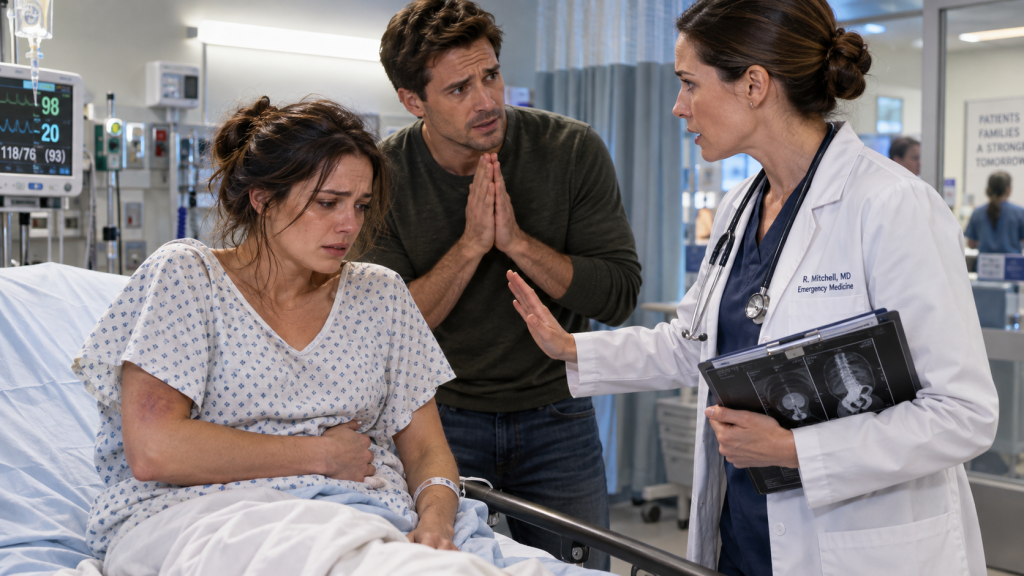
The hospital room seemed to shrink around those three words.
Rain tapped against the window.
A machine somewhere behind me kept beeping at the same patient rhythm.
Dr. Mercer stood beside the monitor, one hand still resting near the images of my fractured ribs.
Two police officers had stopped just outside the door.
And my husband stood in front of me with tears in his eyes, telling me that his mother had done this before.
“To your first wife?”
My voice sounded distant.
Graham nodded.
I stared at him.
“You told me Claire left you.”
“She did.”
“You said she had an affair.”
His face collapsed.
“She didn’t.”
Something inside me became very still.
Pain had been roaring through my body for hours, but suddenly the fractures were not the thing hurting most.
“You lied to me.”
“Yes.”
“For six years?”
“Yes.”
Dr. Mercer quietly stepped toward the door.
“I’ll give you a moment.”
“No.”
I said it immediately.
He stopped.
“Please stay.”
I did not want privacy anymore.
Privacy had protected the wrong people long enough.
Dr. Mercer remained.
One of the officers entered.
She introduced herself as Officer Elena Ruiz.
I barely heard the rest.
My eyes stayed on Graham.
“What did Judith do to Claire?”
He wiped his face.
“Nora—”
“What did your mother do to your first wife?”
“She hurt her.”
“How?”
He looked down.
I laughed once.
It came out broken.
“You can say it.”
He closed his eyes.
“She shoved her.”
“Down stairs?”
“Once.”
Once.
The word was so obscene in its smallness.
“Once?”
“There were other things.”
“What things?”
“She slapped her.”
My stomach turned.
“Grabbed her.”
I stared.
“Threw things.”
My hands went cold.
“She pushed Claire into a kitchen counter when Claire was pregnant.”
The room disappeared.
“What?”
Graham began crying.
“She lost the baby.”
I stopped breathing.
Officer Ruiz moved closer.
“Mr. Bennett, I need you to be careful about what you’re saying.”
He looked at her.
“I don’t care anymore.”
But I cared.
Because this was my life he had brought me into.
My marriage.
My body.
My broken ribs.
My years of confusion.
“What do you mean she lost the baby?”
I whispered.
Graham sat down.
“Claire was eleven weeks pregnant.”
His voice trembled.
“Mom came over uninvited.”
“They argued.”
“About what?”
“Me.”
Of course.
Always Graham.
Always Judith’s son at the center of every room, while the women around him paid the physical price of keeping him comfortable.
“Claire wanted boundaries.”
he said.
“She didn’t want Mom coming over without calling.”
“She didn’t want her criticizing everything.”
“The food.”
“The house.”
“The pregnancy.”
“She said Mom was making her anxious.”
I stared.
“What happened?”
“Mom came over one morning.”
“Claire asked her to leave.”
“They argued.”
“Mom shoved her.”
“She fell backward into the edge of the counter.”
My eyes filled.
“She started bleeding that night.”
“No.”
I whispered.
Graham covered his face.
“She miscarried two days later.”
“Did doctors say the fall caused it?”
“They couldn’t say for certain.”
That distinction mattered.
Even in rage, truth mattered.
“But Claire believed it did?”
“Yes.”
“And Judith?”
“She said Claire had been dramatic.”
I felt sick.
“What did you do?”
Graham looked at me.
That was when I knew.
Before he answered, I knew.
“I asked Claire not to report Mom.”
My eyes closed.
There it was.
The same sentence.
Different wife.
Different injury.
Same husband.
“Let’s keep it in the family.”
I whispered.
Graham began sobbing.
“Yes.”
I looked at Officer Ruiz.
Then at Dr. Mercer.
Then back at the man I had married.
“How many times did you say that to her?”
“I don’t know.”
“How many?”
“I don’t know!”
His voice broke.
Officer Ruiz stepped between us slightly.
“Sir, lower your voice.”
Graham immediately lowered it.
Interesting.
He could control himself when consequences entered the room.
I had learned something about his mother that night.
Now I was learning something about him too.
“Why did Claire leave?”
I asked.
“Because of Mom.”
“No.”
I shook my head.
“She left because of you.”
Graham stared.
“You weren’t the one hitting her.”
“No.”
“You were just the one making sure the person hitting her never faced consequences.”
His face crumpled.
“Nora—”
“Don’t.”
He stopped.
“Did Claire go to the police?”
“No.”
“Why?”
“Because I begged her not to.”
My chest hurt.
Not metaphorically.
Actually.
Every breath caught against fractured ribs.
But anger kept pulling air into me.
“She left you instead.”
“Yes.”
“And you told everyone she cheated.”
His silence answered.
“Why?”
“Mom told people.”
“And you corrected them?”
No answer.
“Graham.”
“No.”
I turned my face away.
There are moments when a marriage does not end with a slammed door or a signed paper.
It ends inside the body.
Quietly.
A thread breaks.
Something you had been holding together stops asking to be held.
My marriage ended in that hospital bed.
The divorce came later.
Officer Ruiz asked Graham to step outside.
This time he obeyed.
Before leaving, he looked at me.
“I love you.”
I stared at him.
“You loved being forgiven before you had to change.”
He flinched.
Then left.
The door closed.
And I cried.
Not delicately.
Not beautifully.
I cried until my ribs hurt so badly Dr. Mercer had to help me breathe slowly.
“I feel stupid.”
I whispered.
Officer Ruiz shook her head.
“Don’t decide tonight what this says about you.”
“But I knew she hated me.”
“That isn’t the same as knowing she’d push you down stairs.”
“She’d hurt me before.”
Dr. Mercer looked toward the X-rays.
“Yes.”
I stared at the old healed fractures.
My body had kept records my mind had been pressured to misfile.
Last Christmas.
Judith had shoved me against the pantry door.
Graham said:
“She gets physical when she’s overwhelmed.”
At Easter, Judith grabbed my arm hard enough to leave finger-shaped bruises.
Graham said:
“She doesn’t know her own strength.”
At a family barbecue, she had bumped me into the porch railing during an argument.
Except it had not been a bump.
I knew that now.
Maybe I had known it then.
I had simply been taught that acknowledging it would create a larger problem than enduring it.
That is how dangerous families protect themselves.
They do not always deny that something happened.
Sometimes they admit everything except its proper name.
A shove becomes tension.
A threat becomes emotion.
Control becomes concern.
Violence becomes family conflict.
And silence becomes loyalty.
Officer Ruiz pulled a chair closer.
“I need to ask whether you’d like to make a formal statement.”
“Yes.”
The answer surprised even me.
No hesitation.
“Yes.”
So I did.
I told her everything.
The stairs.
Judith’s words.
The hand against my back.
The fall.
The earlier incidents.
The pressure to stay silent.
Graham speaking for me at triage.
His confession about Claire.
Officer Ruiz wrote.
Then she asked:
“Would you be willing to let us photograph your injuries?”
“Yes.”
A hospital forensic nurse came.
Her name was Maya.
She explained every step before touching me.
That mattered more than I expected.
“May I move the gown?”
“Yes.”
“May I photograph your shoulder?”
“Yes.”
“May I document the bruising on your arm?”
“Yes.”
Permission.
Again and again.
Such a small word.
Such a different world.
After years of people deciding what counted as harm, being asked what happened and whether someone could touch me felt almost revolutionary.
At three in the morning, Graham was allowed back briefly because I asked for him.
He stood near the door.
I had one question.
“Where is Claire?”
He froze.
“I don’t know.”
“You expect me to believe that?”
“We haven’t spoken in years.”
“Do you know where she lives?”
“No.”
“Her full name?”
“Claire Elizabeth Bennett. She went back to her maiden name after the divorce.”
“What was it?”
“Holloway.”
I repeated it.
“Claire Holloway.”
“Yes.”
“Did she ever try to tell anyone what happened?”
Graham looked ashamed.
“Yes.”
“Who?”
“My family.”
I laughed bitterly.
“That went well.”
“No.”
“Did anyone believe her?”
“My aunt Rebecca did.”
“What happened?”
“Mom stopped speaking to her.”
Of course.
“Anyone else?”
“My cousin Daniel.”
“And?”
“He said Claire should go to the police.”
“What did you do?”
“I told him to stay out of my marriage.”
I stared at Graham.
“You weren’t protecting your mother.”
He looked at me.
“You were protecting yourself from having to choose against her.”
Tears filled his eyes.
“Yes.”
There it was.
The first honest sentence he had given me without being cornered.
I nodded toward the door.
“Go.”
“Nora—”
“Go.”
He went.
The next morning, Judith was arrested.
I learned about it from Officer Ruiz.
She had apparently spent half the night calling relatives.
By sunrise, a family story already existed.
I had slipped.
I was confused because of pain medication.
The doctor had misunderstood.
The police were overreacting.
Graham and I were having marital problems.
I wanted money.
I wanted revenge.
Judith had barely touched me.
Then she had never touched me.
Then she had tried to catch me.
Then I had threatened her first.
Truth was singular.
Lies arrived in a crowd.
But this time, there were witnesses.
Graham’s uncle had seen Judith follow me to the stairs.
His cousin had heard her argument with me.
One aunt had seen Judith’s arm extend.
Nobody had seen the exact moment clearly enough to describe the push perfectly.
But several had heard my body hitting the stairs.
And then there was the medical evidence.
The pressure mark across my back.
The injury pattern.
The old fractures.
My immediate disclosure at triage.
Graham’s admission about Claire.
For once, the family could not clean the scene before anyone outside saw it.
I stayed in the hospital four days.
The pelvic fracture did not require surgery, but walking was agony.
My ribs made coughing feel like punishment.
Graham visited once.
I refused to see him.
He sent flowers.
I asked the nurse to give them to someone else.
He sent a letter.
I did not open it.
On my third day, Officer Ruiz came with another detective.
Detective Samuel Lee.
He sat beside the bed.
“We found Claire Holloway.”
My heart stopped.
“She’s alive?”
He looked surprised.
“Yes.”
I had not realized until then that part of me had feared otherwise.
“Is she okay?”
He considered the question.
“She has agreed to speak with us.”
“Does she know about me?”
“Yes.”
“What did she say?”
Detective Lee looked at his notes.
“She said, ‘Tell Nora I believe her.’”
I cried.
Four words from a woman I had never met.
I believe her.
I had spent years inside a family that could turn bruises into misunderstandings.
And a stranger believed me immediately because she had once stood where I stood.
“Can I talk to her?”
“Not yet.”
“Why?”
“We don’t want to interfere with statements.”
I nodded.
“Later?”
“If she agrees.”
She did.
Two weeks after I left the hospital, Claire called.
I was staying with my sister, Emily.
I could walk with crutches by then.
My ribs still hurt.
My marriage was effectively over.
Judith was out on bond with a no-contact order.
Graham had moved into his mother’s house.
Of course he had.
My phone rang.
Unknown number.
I answered.
“Hello?”
A woman breathed on the other end.
“Nora?”
“Yes.”
“This is Claire.”
Neither of us spoke.
Then I began crying.
So did she.
“I’m sorry.”
I said.
Claire immediately answered:
“No.”
“I didn’t know.”
“I know.”
“He told me you cheated.”
A bitter laugh.
“I know.”
“I believed him.”
“Why wouldn’t you?”
“I feel horrible.”
“Nora.”
Her voice became firm.
“You are not responsible for a lie someone told you before you had any reason to doubt him.”
I closed my eyes.
“Did Judith really push you when you were pregnant?”
Silence.
“Yes.”
My stomach twisted.
“Did the fall cause the miscarriage?”
“The doctors couldn’t prove that.”
Her voice trembled.
“I need to be careful with that.”
I respected her for it.
“I was already having some spotting.”
“The fall may have contributed.”
“It may not have.”
“But Judith pushed me.”
“That part I know.”
“And Graham begged you not to report it.”
“Yes.”
“Why did you listen?”
Claire was quiet for a long time.
Then:
“For the same reasons you probably listened.”
I understood.
Love.
Hope.
Fear.
Embarrassment.
Confusion.
The belief that one more chance might produce the family everyone kept promising existed beneath the violence.
Claire continued.
“Graham was good at making consequences sound cruel.”
That sentence struck me.
“What do you mean?”
“If I wanted to call police, he’d say, ‘Do you really want to ruin my mother’s life?’”
“If I wanted to stop visiting, he’d say, ‘Do you want to destroy my family?’”
“If I wanted boundaries, he’d ask why I hated her.”
“If I wanted him to defend me, he’d cry and say he was caught between two women he loved.”
She paused.
“Somehow, the person being hurt always became responsible for everybody else’s suffering.”
I whispered:
“Yes.”
Claire exhaled.
“The day I left, Judith threw a ceramic bowl at me.”
“What?”
“It missed.”
“It shattered against the wall.”
“Graham stood there.”
“He said, ‘Can everyone please calm down?’”
Her voice broke.
“And something inside me just…”
“Stopped?”
“Yes.”
I knew exactly.
“I packed that night.”
“Did he try to stop you?”
“He begged.”
“Did he apologize?”
“For hours.”
“Did he promise things?”
“Everything.”
“What made you leave anyway?”
Claire became quiet.
Then she said:
“I realized his promises always began after the danger and ended before the next one.”
I wrote that sentence down later.
I kept it for years.
We spoke for almost two hours.
Before hanging up, Claire said:
“I need you to know something.”
“What?”
“Graham isn’t like Judith.”
I waited.
“He never hit me.”
“I know.”
“But don’t let that sentence become too generous.”
I swallowed.
“He knew.”
“Yes.”
“He minimized.”
“Yes.”
“He lied.”
“Yes.”
“He protected her.”
“Yes.”
“And when I left, he helped destroy my reputation so he wouldn’t have to admit why.”
I closed my eyes.
Claire said:
“Sometimes the person holding the door open for violence never throws a punch.”
That sentence ended whatever tiny fragment of marriage remained inside me.
I filed for divorce the following week.
Graham came to my sister’s house after being told not to.
Emily saw him through the window.
She called the police before opening the door.
He left.
Later he texted:
I just want five minutes.
I blocked him.
Then:
Mom needs help.
Blocked on email.
Then:
She is seventy-one. Prison could kill her.
Another address.
Blocked.
Then:
Please don’t punish me for something she did.
That one almost broke me.
Because it revealed he still did not understand.
I wasn’t punishing him.
I was leaving him.
Those are not the same thing.
Consequences often feel like punishment to people accustomed to access.
Graham had spent years believing marriage meant I would remain available while he decided whether my safety was important enough to inconvenience his mother.
Now access had ended.
He called Emily.
She hung up.
He called my workplace.
My manager documented it.
He sent his uncle to speak with me.
His uncle refused.
Instead, he called me directly and apologized.
“I should have said something years ago.”
he told me.
“What did you know?”
“That Judith had a temper.”
I almost laughed.
“A temper.”
He went silent.
“That’s what we called it.”
“I know.”
“I saw her grab Claire once.”
“And?”
“I told myself married people have problems.”
“She wasn’t married to Judith.”
Silence.
“No.”
He whispered.
“She wasn’t.”
That became another truth of the case.
Judith had not operated alone.
Not exactly.
She had operated inside a family system built to absorb evidence.
People looked away.
Changed vocabulary.
Avoided conflict.
Protected holidays.
Protected reputation.
Protected Grandma.
Protected Graham.
Protected themselves from uncomfortable decisions.
Everyone had a reason.
My body carried the result.
Judith’s criminal case took almost a year.
There were delays.
Motions.
Interviews.
Arguments over admissibility.
Claire agreed to testify regarding prior conduct where legally relevant, though not every detail could be used exactly as we imagined.
That taught me another lesson.
Court is not storytelling.
It does not exist to let every hurt receive a dramatic scene.
Evidence has rules.
Charges have elements.
Memory has limitations.
Truth and provability overlap, but they are not identical.
Judith eventually accepted a plea agreement involving the assault against me.
She did not confess to everything Claire alleged.
She did not suddenly become remorseful.
At sentencing, she said:
“I never intended for Nora to be seriously injured.”
I sat beside Emily.
Claire sat behind me.
Graham sat with his mother.
That hurt less than I expected.
By then, it made sense.
Judith continued:
“We had an argument.”
The prosecutor corrected the record through the established facts.
I had not fallen during an argument.
I had been pushed.
When it was my turn to speak, I stood slowly.
My ribs had healed.
My pelvis had healed.
My body looked normal again.
That was strange.
People imagine injury remains visible until justice arrives.
Usually it doesn’t.
Skin moves on faster than memory.
I faced the judge.
Then Judith.
“I spent years believing the most important question was whether you meant to hurt me.”
Judith looked at me.
“I don’t ask that anymore.”
“The important fact is that you did hurt me.”
“You grabbed me.”
“You shoved me.”
“You frightened me.”
“And every time someone protected you from consequences, you learned that my pain cost less than your comfort.”
Graham looked down.
I continued.
“The night you pushed me down those stairs, my husband asked me to keep it in the family.”
“My answer now is this: violence does not become private simply because the person committing it shares your last name.”
The courtroom was silent.
“A family should not be a place where harm becomes harder to name.”
“It should be the first place where harm matters.”
I looked at Graham.
“And loyalty is not asking the injured person to carry the consequence so everyone else can continue dinner.”
My voice broke.
I let it.
I did not need to sound invulnerable.
“I survived.”
“But survival does not make what happened smaller.”
Then I sat.
Judith received a custodial sentence followed by supervision and conditions restricting contact.
It was not the dramatic lifetime punishment some relatives wanted and others feared.
It was a legal consequence for what could be proved.
I learned to respect that distinction.
Graham filed a response in our divorce asking for counseling.
I refused.
He asked for mediation about reconciliation.
There was nothing to mediate.
We divided property.
Sold the house.
Separated accounts.
Signed papers.
The final hearing lasted twenty-three minutes.
Six years of marriage ended in less time than some family dinners.
Outside the courthouse, Graham followed me.
“Nora.”
I stopped.
Not because I owed him anything.
Because I wanted to hear whether he had finally learned a different sentence.
He looked older.
His mother had been incarcerated for several months.
His family was divided.
Claire’s story was no longer secret.
My story wasn’t either.
“I’m sorry.”
he said.
I waited.
“I know that isn’t enough.”
Still I waited.
“I kept thinking my job was to prevent everyone from falling apart.”
He swallowed.
“But all I did was decide you and Claire were the people allowed to break.”
That was new.
My eyes filled.
He continued.
“I didn’t push you.”
“I know.”
“For months, I kept saying that to myself.”
“I know.”
“As though that made me innocent.”
I said nothing.
“I wasn’t.”
There it was.
Not a request.
Not yet.
“I lied at the hospital.”
“Yes.”
“I lied about Claire.”
“Yes.”
“I pressured both of you.”
“Yes.”
“I made Mom’s violence something you were supposed to manage.”
“Yes.”
Tears ran down his face.
“I don’t know how to live with that.”
I looked at the man I had once loved.
“You learn.”
“How?”
“Without asking the women you hurt to teach you.”
He nodded.
That was the last conversation we had for seven years.
I did not hate Graham.
That surprised people.
Some wanted hatred because hatred made the story cleaner.
But hatred requires energy.
I had spent enough energy on that family.
I wanted distance.
Distance was quieter.
Claire and I became friends.
Not immediately.
Trauma does not automatically create friendship.
At first we were simply two women connected by the same terrible family.
Then we discovered ordinary things.
She hated olives.
I loved them.
She was an architect.
I worked in library administration.
She ran five miles every morning, which I considered evidence of questionable judgment.
I loved baking.
She could burn water.
One afternoon, almost two years after the trial, Claire came to my apartment.
We made dinner.
She looked around.
“This is peaceful.”
I smiled.
“Yes.”
“Do you ever miss him?”
The question surprised me.
“Yes.”
She nodded.
“Me too.”
“You miss Graham?”
“Sometimes.”
I stared.
Claire laughed sadly.
“He wasn’t terrible every day.”
That sentence was important.
People who have never lived inside harmful relationships sometimes imagine the harm must be constant.
If it were constant, leaving might be easier.
There were birthdays.
Jokes.
Sunday mornings.
Movies.
Illnesses cared for.
Hands held.
Promises.
Good memories do not prove the bad ones false.
Bad memories do not always erase the good.
The danger lies in using good days as payment against violence.
“I miss who I thought he could become.”
I said.
Claire nodded.
“I miss who I was when I still believed he would.”
We sat quietly.
Then she said:
“I used to hate you.”
I looked at her.
“What?”
“When I heard he’d remarried.”
“Why?”
“I thought maybe he’d become better for you.”
My heart broke.
“Oh, Claire.”
“I wondered what you had that I didn’t.”
“Nothing.”
“I know that now.”
She wiped her eyes.
“When police called me about you, I felt horrible.”
“Why?”
“Because part of me felt relieved.”
I understood.
“Relieved it wasn’t only you.”
“Yes.”
“That doesn’t make you bad.”
“I know.”
Then I admitted something ugly too.
“When Graham told me you existed, part of me was relieved.”
Claire looked at me.
“Because?”
“Because suddenly I had proof I wasn’t imagining the pattern.”
She reached across the table.
We held hands.
Healing is not always beautiful.
Sometimes it is two women admitting that another person’s pain made their own reality easier to believe.
And forgiving each other for being human.
At thirty-eight, I bought a small house.
One story.
No basement.
People joked about that.
I didn’t.
For years, stairs made my body tense.
Even after my fractures healed, my muscles remembered.
My therapist, Dr. Lena Morris, called it a trauma response.
I called it annoying.
We worked on it.
Slowly.
The first time I walked down a long staircase without gripping the railing until my knuckles whitened, I texted Claire.
Twenty-two steps. No panic.
She replied:
Show-off.
Then:
Proud of you.
I cried in a parking lot.
I dated eventually.
The first man became irritated when I asked him not to surprise me from behind.
There was no second date.
The second told me I talked about boundaries too much.
Also no second date.
The third, Daniel, listened.
Not perfectly.
But sincerely.
On our fourth date, I told him about Judith.
Not everything.
Enough.
He asked:
“What helps you feel safe?”
Nobody had ever asked me that so directly.
I said:
“No yelling during arguments.”
“Okay.”
“No blocking doorways.”
“Okay.”
“If I say I need space, don’t follow me from room to room.”
“Okay.”
“And if your mother pushes me down stairs, I’m calling the police.”
He stared.
Then realized I was half joking.
“Fair.”
I laughed.
That laugh was the first time I understood I could tell the story without always bleeding from it.
Daniel and I married four years later.
Claire stood beside me.
Emily cried through the entire ceremony.
Dr. Mercer did not attend because inviting an emergency physician from the worst night of my life to my wedding would have been strange.
But I wrote him a letter.
I thanked him.
Not for saving my life.
My injuries were serious but not likely fatal.
I thanked him for refusing the family’s vocabulary.
You were the first person that night who heard “she pushed me” and did not translate it into something easier.
He wrote back.
One paragraph.
You deserved to be believed without having to be injured badly enough to earn belief. I’m glad you’re well.
I kept that letter.
Years passed.
My life became beautifully unremarkable.
That phrase became sacred to me.
Beautifully unremarkable.
Coffee in the morning.
Work.
Groceries.
Arguments that ended without fear.
Bills.
Laundry.
Daniel leaving cabinet doors open despite apparently having been raised among wolves.
Birthdays.
Vacations.
Flu.
Laughter.
Ordinary life.
Nobody shoved me.
Nobody told me to hide bruises.
Nobody asked me to keep violence private.
For a while, safety felt boring.
Then I realized boredom had been unfairly maligned.
Boredom can be magnificent when your nervous system spent years waiting for the next explosion.
At forty-six, I received a letter from Graham.
He asked through an attorney first whether I was willing to receive it.
That mattered.
I said yes.
The letter was twelve pages.
I almost didn’t read it.
Then I did.
He had spent years in therapy.
He had joined a group focused on family systems and enabling behavior.
He had stopped contact with Judith after her release when she refused to acknowledge what she had done.
That surprised me.
He wrote:
For most of my life, I thought being a good son meant absorbing my mother’s consequences before they reached her.
When I married Claire, I expected her to help me.
When she refused, I called her difficult.
When I married you, I promised myself things would be different.
But I never changed the structure.
I simply hoped Mom would behave better.
Then:
When she hurt you, I asked you to save me from having to become the son I should have become years earlier—the son capable of saying no.
I read that sentence several times.
I told myself I was trapped between my wife and my mother.
That was dishonest.
You were trapped.
Claire was trapped.
I was uncomfortable.
That one made me cry.
Because yes.
He had mistaken discomfort for victimhood.
I am sorry for lying about Claire.
I am sorry for telling people she cheated.
I have corrected that lie with every family member I could reach.
I wrote Claire directly through her attorney and asked whether she wanted a written statement she could keep. She said yes.
I called Claire.
“Did he?”
“Yes.”
“How did you feel?”
“Angry.”
“Anything else?”
“Relieved.”
“Anything else?”
“Sad.”
“Anything else?”
“Hungry. I was reading it during lunch.”
I laughed.
She always saved me from turning every emotion into a ceremony.
I finished Graham’s letter.
He did not ask me back.
Did not ask forgiveness.
Did not ask friendship.
The final paragraph said:
I hope your life is peaceful.
I know now that peace is not the same as keeping everyone quiet.
I wish I had understood that before asking two women to suffer silently so I could keep calling my family close.
I wrote one response.
Thank you for taking responsibility. I wish you well. Please continue respecting the distance between us.
He did.
Years later, Claire told me he remarried.
I felt nothing dramatic.
No jealousy.
No anger.
Just a small hope.
I hoped he had changed enough that the woman he married would never learn our version of him through her own injuries.
Judith lived into her eighties.
She never apologized to me.
Not really.
Once she sent a letter beginning:
I am sorry things got so out of hand.
I stopped reading.
Things had not gotten out of hand.
Her hands had done something.
Language mattered.
I returned the letter unopened beyond that first line.
When she died, Graham’s cousin told me.
I did not attend the funeral.
Claire didn’t either.
We met for lunch that day.
Neither of us celebrated.
Neither cried.
Claire stirred her tea.
“Do you forgive her?”
I thought for a long time.
“No.”
Claire nodded.
“Me neither.”
“Does that bother you?”
“Not anymore.”
We talked about something else.
That was freedom too.
Not every wound requires a forgiveness ceremony.
Sometimes healing is the ability to stop organizing your life around the person who caused it.
At fifty-two, I became director of the city library system.
At the reception, Daniel gave a speech.
Too long.
Emily gave another.
Much too long.
Claire stood at the back holding a sign she’d made on printer paper:
PLEASE STOP PROMOTING HER. SHE’S BECOMING UNBEARABLE.
I laughed so hard I nearly ruined my makeup.
Afterward, a young librarian named Sophie approached me.
She had once overheard part of my story at a domestic-violence awareness event where I had spoken.
“My sister’s boyfriend scares me.”
she said.
My smile disappeared.
“Does he hurt her?”
“She says no.”
“But?”
“He throws things.”
“Breaks doors.”
“Checks her phone.”
“Once he grabbed her wrist.”
“She says it isn’t abuse because he hasn’t hit her.”
I felt the old staircase beneath my feet.
“What do you want to do?”
“I want to make her leave.”
I understood.
“But she won’t.”
“Probably not because you order her to.”
Sophie looked desperate.
“Then what do I do?”
“Stay connected if you safely can.”
“Tell her what you see without humiliating her.”
“Help her make plans.”
“Ask what she needs.”
“Don’t make your love another place where she loses control.”
Sophie began crying.
“What if something happens?”
“That fear is real.”
I took her hand.
“But if she has been living with someone controlling her, the answer isn’t to become another person controlling her for a better reason.”
That lesson had taken me years.
Protection should widen someone’s choices.
Not shrink them.
I began speaking occasionally to nurses, librarians, social workers, and community groups.
Not as an expert.
As a survivor.
I always told them the same part first.
“The most important sentence I said that night was simple: ‘She pushed me.’”
Then:
“The most important thing the doctor did was believe the sentence as spoken.”
I talked about euphemisms.
Temper.
Family matter.
Misunderstanding.
Stress.
Accident.
Difficult personality.
Marriage problems.
Words that can sometimes describe reality.
And sometimes hide it.
I told them:
“If someone says, ‘He hit me,’ do not immediately ask what argument came first.”
“If someone says, ‘She pushed me,’ do not turn the conversation into whether the person who pushed them was upset.”
“Context can matter later.”
“Safety comes first.”
I talked about Graham too.
Because enabling deserves language.
“Someone does not have to throw the punch to participate in a system that keeps the punching safe from consequences.”
But I was careful.
I did not flatten him either.
He eventually changed.
That did not erase what he had done.
His later growth belonged to him.
My safety did not depend on rewarding it.
Daniel and I grew old.
That sentence still astonishes me.
Grew old.
Such an ordinary miracle.
His hair disappeared.
Mine turned silver.
His knees became unreliable.
My left hip complained in cold weather where the old fracture had healed.
Every winter, Daniel accused me of predicting rain with my pelvis.
I told him it was the least dignified superpower imaginable.
At seventy-three, he developed cancer.
We had twenty-eight years together by then.
Treatment bought us four more.
Four difficult, beautiful years.
He died at seventy-seven.
At home.
No violence.
No secrets.
No terror.
Just grief.
Before he died, he asked:
“Did I make you feel safe?”
I cried.
“Yes.”
He smiled.
“Good.”
Then I corrected myself.
“No.”
His eyes opened.
“That’s not quite right.”
“What?”
“You didn’t make me safe.”
He frowned.
I took his hand.
“You respected the safety I built.”
Tears filled his eyes.
“I like that better.”
“So do I.”
He died three days later.
Grief nearly flattened me.
But grief and fear are different.
That was another thing I learned.
Grief hurts because something loved existed.
Fear hurts because something dangerous may.
I could miss Daniel without checking doors.
I could cry without waiting for someone to call me dramatic.
I could fall apart without being punished for making another person uncomfortable.
Even grief was safer.
At eighty-one, Claire and I took a trip together.
Two old women who had once been married to the same man.
Life has a sense of humor.
We went to Italy.
Claire still ran, though slower.
I still believed running voluntarily was suspicious.
At a hotel in Florence, we were given a room on the third floor.
The elevator broke.
Claire looked at the staircase.
Then at me.
“Want another hotel?”
I looked upward.
Forty-three steps.
Once, I would have said yes.
Instead:
“Race you.”
Claire stared.
“Your hip is eighty-one years old.”
“So is the rest of me.”
“You’ll lose.”
“Probably.”
We climbed.
Slowly.
Laughing.
Halfway up, I stopped.
Not because of panic.
Because I was winded.
That difference nearly made me cry.
Claire noticed.
“You okay?”
I touched the railing.
“Yes.”
Then I looked down.
For decades, stairs had belonged to Judith.
Basement stairs.
Wood striking ribs.
Concrete rushing upward.
A hand between my shoulders.
But standing there in Florence, I realized I had climbed thousands of staircases since.
Hospitals.
Courthouses.
Libraries.
Homes.
Museums.
Hotels.
Train stations.
Stairs belonged to architecture.
Not to her.
“I’m okay.”
I repeated.
And I was.
Claire reached the top before me.
She raised both arms.
“Victory!”
“You’re insufferable.”
“I know.”
That photograph became one of my favorites.
Claire at the top of the stairs.
Me halfway behind her.
Both laughing.
No symbolism required.
But symbolism arrived anyway.
Claire died when we were eighty-nine.
Stroke.
Quick.
I sat beside her daughter at the funeral.
Yes.
Her daughter.
Claire remarried after Graham.
Had one child at forty.
A girl named Ava.
For years, Claire had believed losing that first pregnancy meant motherhood had been stolen permanently.
Life surprised her.
Ava knew our story.
Not every detail.
Enough.
After the funeral, she hugged me.
“Mom said you gave her something nobody else could.”
“What?”
“Proof she wasn’t crazy.”
I cried.
“No.”
I whispered.
“She gave that to me.”
Maybe we had given it to each other.
I lived alone afterward.
Happily, mostly.
My body slowed.
My world became smaller.
But not empty.
At ninety-one, I moved into assisted living.
The first day, a nurse asked about old injuries while reviewing my history.
“Pelvic fracture in your thirties?”
“Yes.”
“Fall?”
I looked at her.
For one second, I could hear Graham.
Family dinner accident.
I smiled.
“No.”
The nurse looked up.
“My mother-in-law pushed me down a staircase.”
Her expression changed.
“I’m sorry.”
“Thank you.”
No shame.
No lowering my voice.
No euphemism.
Just truth.
It had taken sixty years to become that simple.
At ninety-three, I wrote a letter for Ava.
Claire’s daughter.
For Emily’s grandchildren.
For the younger people in our family.
For anyone who might someday inherit the old instinct to protect appearances.
I wrote:
There is something I want our family to stop passing down.
Not violence.
That is obvious.
I want us to stop passing down the belief that keeping a family together is automatically more virtuous than telling the truth about what happens inside it.
Then:
A family is not preserved when one person is sacrificed to protect another person’s reputation.
That is not preservation.
It is concealment.
I told them about Judith.
About Graham.
About Claire.
About Dr. Mercer.
When I arrived at the hospital, I thought my biggest problem was pain.
Three fractured ribs.
A pelvic fracture.
Bruising.
Old injuries.
I was wrong.
My biggest problem was that I had spent years allowing other people to rename what was happening to me.
Then:
The X-rays showed healed fractures.
But the most important thing they showed me was that the body can preserve evidence long after a family has agreed to forget.
I wrote about Graham.
Carefully.
My first husband did not push me down the stairs.
His mother did.
Facts matter.
But another fact matters too: he repeatedly asked the people she hurt to protect her from consequences.
That choice harmed us.
Years later, he acknowledged it and changed.
His change mattered.
It did not obligate me to return.
Then:
Remember this: another person’s improvement does not create a debt you must repay with access.
I underlined that.
You may be glad someone changed and still keep the door closed.
Then:
Claire taught me that survival can create strange emotions.
Relief.
Anger.
Jealousy.
Guilt.
Grief for good memories.
Do not shame yourself for complicated feelings.
Feelings are not contracts.
They do not force action.
Then:
Dr. Mercer taught me something without ever intending to.
He heard my sentence exactly as I said it.
“She pushed me.”
He did not soften it because the person who pushed me was elderly.
He did not make it smaller because she was family.
He did not ask whether I had upset her first.
He responded to the injury in front of him.
Then:
Sometimes helping someone begins with refusing to translate their pain into language that makes everyone else more comfortable.
I wrote about Daniel.
My second husband never rescued me.
That is one reason I loved him.
He did not treat my history as evidence that I was fragile.
He respected boundaries without acting wounded by them.
He understood that safety is not a gift one adult bestows upon another.
It is something people build together by refusing to make fear part of the price of love.
Then:
Please do not tell this story as though the best thing that happened to me was meeting a better man.
I smiled while writing that.
The best thing that happened was that I became able to hear myself.
Daniel was wonderful.
But I was already becoming free before he arrived.
Then:
People may ask why I stayed with Graham as long as I did.
Ask a better question.
Ask what made the truth difficult to act on.
Love.
Hope.
Financial ties.
Family pressure.
Embarrassment.
Confusion.
Repeated apologies.
Good days between bad ones.
The gradual normalization of behavior I would once have recognized immediately.
Those are not excuses.
They are context.
Then:
Ask what helped me leave.
A nurse who waited for my answer.
A doctor who named the injury.
Police who documented.
A sister who gave me somewhere to sleep.
Claire, who said, “I believe you.”
A therapist who taught my nervous system that stairs were stairs again.
Friends who stayed.
Work that reminded me I was useful.
Time.
Then I wrote:
Healing was not one brave decision.
It was thousands of ordinary ones.
Going to therapy.
Blocking a number.
Signing a lease.
Walking downstairs.
Going on a date.
Saying no.
Saying yes.
Buying groceries.
Sleeping through the night.
Laughing.
Missing someone without returning to them.
Allowing peace to become boring.
The final page took me longest.
I began it three times.
Eventually, I wrote:
The night Judith pushed me, I thought I was falling down a staircase.
I did not understand that something else was falling with me.
The story my marriage had been built around.
The story that Judith was merely difficult.
The story that Graham was neutral.
The story that silence kept families safe.
The story that love meant absorbing harm gracefully enough that nobody else had to feel uncomfortable.
All of it broke on those stairs.
Then:
For a long time, I wished the fall had never happened.
I still do.
Do not turn trauma into a gift merely because a meaningful life came afterward.
That mattered.
I did not need to be pushed down stairs in order to deserve freedom.
Claire did not need to lose a pregnancy in order to deserve belief.
Pain does not become good because survivors later build something beautiful.
The beauty belongs to the survivor.
Not to the pain.
I paused.
Then wrote the sentence I wanted them to remember:
Flowers growing through ruins do not mean the building needed to burn.
I continued.
We built after harm.
That is different.
Then:
If someone hurts you, you are allowed to name it.
If the person is family, you are still allowed.
If they are old, sick, frightened, traumatized, respected, wealthy, beloved, religious, lonely, or sorry, you are still allowed.
Context may explain behavior.
It does not erase your right to safety.
Then:
And if you are ever the Graham in someone else’s story—if you are standing beside harm, minimizing it because confronting the person responsible would cost you something—please understand that neutrality is not what you think it is.
Ask who is paying for your peace.
If the answer is the injured person, then it is not peace.
I signed the letter.
Nora.
Then added:
P.S. Always take the elevator when available. I have made enough symbolic progress for this family.
Ava laughed so hard when she read that after my death that she had to stop.
Yes.
After my death.
I lived to ninety-six.
Long enough that the night in the emergency room became one night among tens of thousands.
That mattered.
For years, I had feared it would become the title of my life.
It didn’t.
It became a chapter.
A terrible one.
Important.
Permanent.
But not the title.
My life also contained Daniel.
Claire.
Emily.
Libraries.
Italy.
Burnt cakes.
Promotions.
Retirement.
Books stacked beside my bed.
A garden I was terrible at maintaining.
A cat named Mercer, which I named after the doctor as a joke and then deeply regretted when the cat developed a habit of biting nurses.
There were weddings.
Funerals.
Arguments.
Apologies.
Trips.
Quiet mornings.
There was grief.
There was love.
There was ordinary life.
So much ordinary life.
After my funeral, Ava kept the letter.
Years later, she became a social worker.
Not because of Claire.
Not because of me.
She simply liked the work.
I would have been annoyed if anyone tried to make her career into a poetic consequence of our trauma.
She trained young staff.
One afternoon, a new social worker asked:
“How do you know when a family situation is serious?”
Ava thought.
Then remembered something Claire had taught her.
Something I had learned too late.
She answered:
“Listen to the verbs.”
The young woman frowned.
“What?”
“If someone says, ‘We had a disagreement,’ ask what happened.”
“If they say, ‘He got upset,’ ask what he did.”
“If they say, ‘She has a temper,’ ask what that looks like.”
“If they say, ‘Things got out of hand,’ ask whose hands.”
The young social worker wrote that down.
Ava continued:
“Families sometimes hide violence inside vague language.”
“Make the sentence concrete.”
Years after that, Ava had a daughter.
Then a grandson.
One Sunday, several generations gathered for dinner.
There was too much food.
Someone burned the rolls.
A child spilled juice.
Two cousins argued about politics and were told to change the subject.
Nothing dramatic.
After dinner, Ava’s grandson carried a casserole dish toward the kitchen.
There were basement stairs nearby.
He stopped.
“Where does this go?”
Ava pointed.
“Refrigerator upstairs.”
He put it away.
Nobody noticed the moment.
Why would they?
It was ordinary.
That was the beauty.
No one in that house needed to know that decades earlier another casserole dish had shattered on concrete while a woman lay at the bottom of a staircase wondering whether her own husband would tell the truth.
No one needed the comparison.
Safety does not always announce itself.
Sometimes safety is simply the absence of a story.
A family dinner ends.
Plates are washed.
People go home.
Nobody is injured.
Nobody begs anyone to lie.
Nobody needs a doctor to say the obvious.
And somewhere, if there is any part of us that remains after death, I like to imagine Claire and Daniel and I would understand what that ordinary evening meant.
Not victory.
Not revenge.
Not proof that suffering happened for a reason.
Something quieter.
The pattern stopped.
That was enough.
The last thing I want remembered is not Judith’s hand against my back.
Not Graham whispering:
“Let’s keep it in the family.”
Not even Dr. Mercer looking at my X-rays.
I want the answer remembered.
The answer I eventually learned to give.
If violence happens inside a family, truth belongs there too.
If someone is hurt, their safety matters more than the family’s appearance.
If love asks you to become silent so another person can avoid consequences, that is not the kind of love you are required to preserve.
And if your body, your memory, or your frightened voice tells you something happened, you do not need permission from the person who hurt you—or from the people who love them—to call it by its name.
That night, my X-rays revealed old fractures.
But what changed my life was not merely what the doctor saw in my bones.
It was what he refused to look away from.
For years, everyone around Judith had been asking the wrong question:
How do we keep this in the family?
The answer should have been obvious from the beginning.
You don’t.
You keep love in the family.
You keep kindness there.
You keep birthdays, recipes, terrible jokes, photographs, traditions, forgiveness when freely given, and people who make mistakes but genuinely repair them.
But violence?
Violence does not earn privacy because it shares your blood.
And silence is not an heirloom worth passing down.
So we stopped.
Claire stopped.
I stopped.
Eventually Graham stopped.
And generations later, when people in our family spoke about harm, they used plain words.
No protecting the dinner.
No protecting the holiday.
No protecting the surname.
No pretending that broken bones were less broken because the person responsible sat at the same table.
That became our real family tradition.
Not silence.
Truth.
And after everything, truth turned out to be the only thing strong enough to keep what was worth saving.
THE END STORIES! THANK YOU FOR READING GOOD LUCK !❤️
Related Posts