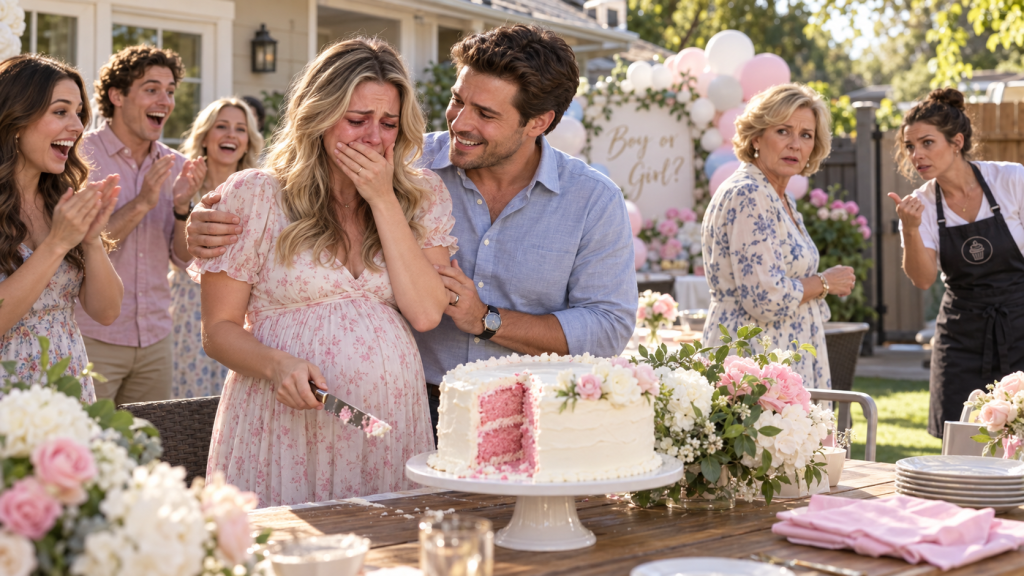
➡️ PART 3 ENDING PART➡️
For one second, nobody moved.
The woman stood just inside Lauren’s backyard gate with both hands hanging stiffly at her sides.
Mark’s face had gone so pale that even his lips seemed to lose their color.
Lauren was still standing beside the cake.
One hand rested protectively over her stomach.
The other held the white envelope.
Around us, the party had gone silent in pieces.
First the people closest to the table.
Then Lauren’s aunt.
Then Mark’s brother.
Then the children stopped laughing because adults had stopped pretending nothing was wrong.
Lauren stared at the woman.
“Your husband?”
The woman swallowed.
“Yes.”
Mark stepped forward.
“Claire, don’t.”
So that was her name.
Claire.
She looked at him.
Something passed between them.
History.
Regret.
Fear.
Whatever it was, Lauren saw it too.
Her gaze dropped to the photograph still trembling in her hand.
Mark kissing Claire.
Then she looked back at her husband.
“You know her.”
Mark rubbed one hand over his mouth.
“Lauren, I can explain.”
I had heard that sentence before.
Not from Mark.
From people whose explanations had arrived several lies too late.
Lauren’s voice became very quiet.
“Do you know her?”
“Yes.”
“How?”
Claire answered.
“We met six weeks ago.”
Mark turned sharply.
“Claire.”
“No.”
She looked at him.
“I already did what you asked once.”
Her voice shook.
“I’m not doing it again.”
Lauren’s breathing changed.
I knew that sound.
I had heard it in hospital waiting rooms during her miscarriages.
It was the sound she made when terror became physical.
I went to her.
“Sit down.”
“I’m fine.”
“You’re not.”
“I’m fine, Mom.”
She wasn’t.
But Lauren had spent four years becoming an expert at saying she was fine while doctors spoke around her.
Fine after the first loss.
Fine after the second.
Fine after injections.
Fine after procedures.
Fine after another negative test.
Fine while baby announcements appeared online every month from women who had started trying years after she had.
Fine had become armor.
I pulled out the nearest chair.
“Please.”
This time she sat.
Mark moved toward her.
Lauren raised one hand.
“Don’t touch me.”
He stopped immediately.
That hurt him.
Good.
Maybe pain would make him honest.
Claire remained near the gate.
I pointed toward an empty chair.
“You come here too.”
She hesitated.
“I don’t think—”
“If you walked into my daughter’s home to tell her that your husband fathered her child, you do not get to say half of it and disappear.”
Claire came closer.
Mark whispered, “This is not the way to do this.”
Lauren turned toward him.
“The gender reveal cake is fake.”
He said nothing.
“You secretly had my baby tested.”
Nothing.
“You paid a bakery to lie.”
Silence.
“You kissed another woman.”
His eyes closed.
“And now she is standing in my backyard telling me her husband is my baby’s father.”
Lauren leaned forward.
Her voice cracked.
“What exactly would have been the right way, Mark?”
He had no answer.
Claire sat down across from her.
People around us began looking at one another.
My sister moved toward me.
“Should we go?”
I looked at Lauren.
She nodded once.
I stood.
“Everybody, please give us some privacy.”
Nobody argued.
They gathered purses.
Children.
Paper plates.
One of Mark’s cousins quietly turned off the music.
Someone took the balloons down because they kept bumping against the patio roof with cheerful little taps that suddenly felt obscene.
Pink balloons.
Everywhere.
Within ten minutes, the backyard that had been full of celebration became almost empty.
Lauren’s best friend, Hannah, stayed.
So did I.
Mark.
Claire.
The baker.
That was all.
The cake remained on the table.
Pink filling exposed.
A lie in buttercream.
Lauren looked at the baker.
“What was in the real envelope?”
The baker hesitated.
“Blue.”
Lauren laughed.
One short sound.
No joy in it.
“I knew.”
Mark looked at her.
“What?”
Lauren’s eyes moved toward him.
“I knew it was a boy.”
The color drained from his face even further.
“How?”
“My patient portal.”
“You said you weren’t looking.”
“I wasn’t.”
She wiped one cheek.
“The lab posted the chromosome result under the wrong tab. I opened it thinking it was the iron panel.”
She looked at the cake.
“I saw XY.”
Nobody spoke.
“I closed it immediately. I didn’t tell you because I knew how excited you were about the surprise.”
Mark sat down.
Lauren laughed again.
“You were trying to surprise me with something I already knew.”
She looked at the pink cake.
“And then I cut into this.”
Now her tears came harder.
“I thought maybe I had misunderstood the report.”
I crouched beside her.
She gripped my hand.
“Then I saw the baker watching me.”
Mark whispered, “Lauren.”
She did not look at him.
“Why did you need everyone to think it was a girl?”
He leaned forward.
“Because I needed time.”
“For what?”
“I had just learned—”
“Six weeks ago.”
Claire’s voice sliced through his.
Mark glared.
She continued.
“He knew six weeks ago.”
Lauren stared at him.
“Six weeks?”
Mark looked at the ground.
Six weeks.
I started counting backward.
Six weeks earlier, Mark had taken Lauren to the coast for their anniversary.
Six weeks earlier, he had posted a picture of them standing together by the water.
His caption:
After everything, we finally get our happy ending.
I remembered commenting with three red hearts.
Now I wanted to smash his phone with my bare hands.
Lauren asked, “How?”
Mark looked toward Claire.
Then at me.
Finally at his wife.
“The fertility clinic contacted me.”
Lauren froze.
“What?”
Mark spoke slowly.
“They said they needed to repeat some paperwork from our cycle.”
“What paperwork?”
“They were doing an internal audit.”
Lauren’s fingers tightened around mine.
“What kind of audit?”
Claire answered.
“A sample-labeling audit.”
Lauren turned toward her.
Claire’s eyes filled.
“My husband and I used the same clinic.”
Mark said, “Claire.”
“No.”
She looked at Lauren.
“You deserve the whole thing.”
Then she told us.
Her husband’s name was Daniel Radley.
He and Claire had been patients at North Valley Reproductive Center during the same month Lauren and Mark underwent their successful treatment cycle.
Claire and Daniel had been trying to conceive too.
Their cycle failed.
They had eventually stopped treatment.
“Three months ago,” Claire said, “the clinic called Daniel.”
Lauren’s face was blank.
“They told him there had been an irregularity with one of the stored samples used during several procedures that week.”
“What does that mean?”
Claire swallowed.
“They were afraid his sample may have been mislabeled.”
Lauren’s hand flew to her stomach.
The baker covered her mouth.
I felt suddenly cold despite the summer heat.
Claire continued.
“They asked him to come in for additional testing.”
“Did he?”
“Yes.”
“And?”
“They said they were investigating whether his sample had been used for another patient.”
Lauren stared.
“No.”
Claire nodded miserably.
“Daniel wanted to tell every couple involved immediately.”
“Then why didn’t he?”
“Because the clinic wouldn’t give names.”
Lauren turned toward Mark.
“But they gave you his?”
“No.”
Mark’s voice was barely audible.
“I found him.”
“How?”
“I pushed the clinic.”
“Pushed how?”
“I threatened legal action.”
Claire said, “And then he found me online.”
Mark looked at her furiously.
“You contacted me first.”
“After the clinic told Daniel another family might be involved.”
Lauren held up both hands.
“Stop.”
Both went quiet.
She closed her eyes.
“I need one person at a time.”
Her breathing had become shallow again.
Hannah brought her water.
Lauren did not drink it.
She looked at Mark.
“Why did you have a paternity test?”
He rubbed both palms against his pants.
“When the clinic contacted me, they said they could not confirm anything yet.”
“So?”
“I wanted to know.”
“How did you get my blood?”
He looked down.
Lauren’s expression changed.
Then mine did too.
Three weeks earlier, Lauren had called me complaining that the clinic had ordered an unexpected repeat blood draw.
She had been annoyed because she had to drive across town before work.
I remembered.
She had said Mark told her it was a routine genetic recheck.
“Mark.”
Lauren’s voice was almost a whisper.
“What was that blood test?”
He did not answer.
She stood so quickly the chair scraped backward.
“What was that blood test?”
“I told the nurse—”
“You told me my doctor needed it.”
“I thought if I explained—”
“You lied to get my blood?”
“It was a legitimate draw.”
“For a paternity test I didn’t consent to.”
“I was scared.”
Lauren stared at him.
She put both hands over her stomach.
I watched something inside her change.
Fear remained.
But now there was fury underneath it.
“You used my body to answer your question.”
Mark stood.
“I needed to know if the baby was mine.”
“Then you should have told me what the clinic said.”
“I didn’t want to scare you.”
“So instead you lied to me.”
“You had already lost two pregnancies.”
Lauren went very still.
Mark realized immediately he had said the wrong thing.
“Lauren, I didn’t mean—”
She stepped backward.
“You used my miscarriages as a reason not to tell me the truth?”
“No.”
“That is exactly what you just said.”
“I was trying to protect the pregnancy.”
“From what?”
“Stress.”
Lauren laughed through tears.
“So you thought finding out at my gender reveal would be less stressful?”
“I never planned for you to find out today.”
There it was.
The worst sentence yet.
Lauren stared at him.
“When?”
“What?”
“When were you planning to tell me?”
Mark opened his mouth.
Closed it.
Claire looked away.
Lauren’s voice rose.
“After the baby was born?”
“No.”
“After the nursery was finished?”
“No.”
“After you signed the birth certificate?”
“I don’t know!”
Silence.
He shouted it.
Then immediately looked ashamed.
“I didn’t know.”
Lauren sat down again.
That answer hurt her more than any prepared explanation could have.
Because it was honest.
There had been no plan.
Only concealment.
One day becoming the next until the truth somehow became someone else’s problem.
I looked at Claire.
“Where does the photograph come into this?”
Claire’s face crumpled.
Mark looked at her.
“Don’t.”
Lauren lifted her head.
“Yes.”
Claire wiped her cheeks.
“Mark and I met because of the clinic situation.”
“You already said that.”
“We kept talking.”
“How often?”
“A lot.”
Mark stood.
“It was not an affair.”
Claire closed her eyes.
Lauren looked at the photograph.
“What do you call kissing?”
“One time,” Mark said.
Claire opened her eyes.
“Twice.”
Mark stared at her.
Lauren whispered, “Of course.”
Claire’s voice shook.
“The first time was after Daniel and I had a terrible fight.”
Lauren looked at her.
“About my baby?”
“Yes.”
Daniel had wanted the clinic investigated publicly.
He wanted lawyers.
Records.
Every affected patient notified.
Claire was terrified.
She had spent years trying to build a family with Daniel.
Now the possibility existed that his biological child was growing inside another woman.
A woman he had never met.
“I was jealous of you,” Claire said.
Lauren’s face tightened.
“You didn’t even know me.”
“I know.”
“You were jealous of me because your husband’s sperm might have been used without his permission?”
“I know how horrible that sounds.”
“It sounds insane.”
“Yes.”
Claire lowered her head.
“I looked at your social media.”
Mark turned toward her.
“You told me you hadn’t.”
“I lied.”
That word floated over the table like smoke.
Everyone had lied.
Different sizes.
Different reasons.
Same result.
Claire continued.
“I saw your pregnancy announcement. Your nursery pictures. You and Mark.”
She looked at Lauren.
“You looked happy.”
Lauren’s eyes narrowed.
“That offended you?”
“No.”
Claire began crying.
“It destroyed me.”
She covered her face.
“I kept thinking, what if that was Daniel’s child? What if the thing I wanted most was happening to someone else because of a mistake?”
Lauren’s anger flickered.
Not gone.
Complicated.
Claire looked toward Mark.
“Mark was angry too.”
Lauren turned.
“About me?”
“No.”
Mark sat again.
“About the clinic.”
Claire continued.
“We started talking because no one else understood how strange it felt.”
Mark said, “Nothing happened for weeks.”
Lauren looked at the photograph.
“Then something did.”
“Yes.”
Mark swallowed.
“We kissed.”
“Twice.”
He nodded.
“Twice.”
“Did you sleep with her?”
“No.”
Claire said, “No.”
For the first time, they answered together.
I believed them.
It did not make the betrayal small.
Lauren looked at Claire.
“Why were you at the bakery with him this morning?”
Claire stared at the table.
“Because I agreed to help.”
“Help with what?”
“Changing the cake.”
Lauren laughed softly.
“Why?”
Mark answered.
“I thought if the cake was pink, we could get through today.”
Lauren stared.
“Why pink?”
“Because you always said you pictured a daughter.”
“That is your explanation?”
“I thought you’d be happy.”
“I knew it was a boy.”
“I didn’t know that.”
“So you were going to make me believe the doctor was wrong?”
“Just until we figured out what to do.”
Lauren leaned back.
I could almost see every year of their marriage passing behind her eyes.
Every time Mark had called himself practical.
Every time he had said he handled stressful things so she didn’t have to.
Every time she had mistaken his control for care.
“What did you think would happen at my next appointment?”
He did not answer.
“When the doctor said ‘your son’?”
“I would have told you before then.”
“When?”
“I don’t know.”
Lauren closed her eyes.
Again.
No plan.
Only delay.
Claire reached into her purse.
She pulled out another envelope.
“This is why I came back.”
She placed it on the table.
Mark stood.
“What is that?”
Claire ignored him.
“The clinic sent Daniel this yesterday.”
Lauren looked at it but did not touch it.
“What is it?”
“A formal notice.”
“Of what?”
Claire breathed in.
“They confirmed the sample error.”
The backyard seemed to shrink.
Lauren opened the envelope.
Her hands shook so violently that Hannah helped unfold the letter.
I watched Lauren read.
First paragraph.
Second.
Then she stopped.
Her face went empty.
“What does it say?” I asked.
She handed it to me.
I read.
The language was clinical.
Cold.
North Valley Reproductive Center had completed a preliminary internal investigation regarding a specimen-identification error.
A stored sample associated with Daniel Radley had been used during a procedure designated for another patient.
The affected cycle date matched Lauren’s.
Further genetic confirmation had been recommended.
The clinic expressed “deep regret.”
Deep regret.
Two words for a mistake capable of rearranging half a dozen lives.
I looked up.
Claire whispered, “Daniel is the biological father.”
Lauren’s eyes filled again.
“This is not because I cheated.”
“No.”
Claire shook her head.
“You did nothing wrong.”
Mark stared at the ground.
Something about his posture made me furious.
“You let her believe for six weeks that you suspected she might have cheated.”
Lauren looked sharply at him.
“Did you?”
Mark shook his head.
“No.”
“Did you ever wonder?”
“At first.”
Lauren’s mouth opened.
He rushed on.
“Only before the clinic explained the sample problem.”
“How long?”
“A few hours.”
“Did you ask me?”
“No.”
“Did you look at my phone?”
Silence.
“Mark.”
“Yes.”
Lauren stood.
He looked sick.
“You went through my phone?”
“I was scared.”
“Stop saying that.”
Her voice cracked across the yard.
“Everyone was scared. Claire was scared. You were scared. I am terrified right now.”
She pressed a hand to her chest.
“And somehow I’m the only person who keeps getting told fear doesn’t excuse lying.”
Mark looked away.
She stared at him for a long moment.
Then at Claire.
“Where is Daniel?”
Claire’s eyes filled.
“At home.”
“Does he know you’re here?”
“No.”
“Does he know about you and Mark?”
Claire began to cry harder.
“No.”
Lauren laughed softly.
“So he’s the last person being lied to.”
Claire closed her eyes.
“Yes.”
Lauren handed the clinic letter back.
“Call him.”
Claire stared.
“What?”
“Call your husband.”
“Lauren—”
“Call him.”
Mark stepped forward.
“This is getting out of control.”
Lauren turned on him.
“It has been out of my control for six weeks.”
He stopped.
She looked at Claire.
“If Daniel is the biological father of my child, he deserves to know what is happening.”
Claire’s hands shook.
“I wanted to tell him.”
“Then do it.”
She pulled out her phone.
The call lasted twenty-three minutes.
I know because I watched the clock on the patio wall.
The first two minutes were confusion.
Then silence.
Then Daniel’s voice became loud enough that I could hear it from where I sat.
Not the words.
The pain.
Claire moved away toward the fence.
She cried.
Apologized.
Cried again.
Eventually she said:
“Yes.”
Then:
“I understand.”
Then:
“I’m sorry.”
The call ended.
Claire stood with the phone against her chest.
Lauren asked, “Is he coming?”
Claire nodded.
“He wants to.”
Lauren looked at me.
I wanted to tell her no.
Enough.
You have endured enough for one day.
But this was her decision.
“Do you want him here?”
She thought for a moment.
“Yes.”
Daniel arrived forty minutes later.
During those forty minutes, nobody ate cake.
Nobody touched the champagne.
The baker packed her things quietly, then asked Lauren if she wanted her to leave.
Lauren surprised me.
“No.”
The baker looked confused.
“You’re part of the reason I know.”
Her eyes filled.
“I’m sorry.”
“You didn’t create this.”
“No.”
The baker swallowed.
“I should never have agreed to change the result.”
Lauren looked at her.
“Why did you?”
“Five hundred dollars.”
The honesty was almost refreshing.
The baker looked ashamed.
“I told myself it was just frosting. That it wasn’t medical information. That people change reveal colors for jokes all the time.”
“And then?”
“I watched you cut the cake.”
She looked down.
“You looked terrified.”
That was why she called me over.
Not because she had suddenly become virtuous.
Because the lie acquired a face.
Sometimes wrongdoing becomes real only after we see who has to carry it.
At 4:18, the gate opened.
Daniel Radley walked in.
He was taller than Mark.
Dark hair.
Glasses.
Maybe forty.
He looked exhausted.
Claire stood.
He looked at her.
Then at Mark.
Then at Lauren.
His eyes dropped immediately to her stomach.
He looked away as if he had committed an offense just by noticing.
“Lauren?”
She nodded.
“I’m Daniel.”
“I know.”
He sat across from her.
For a long moment, nobody spoke.
Then Daniel said the one thing no one else had managed to say cleanly all afternoon.
“I am so sorry this happened to you.”
Lauren’s face broke.
Because he had not said:
This happened to us.
He had not claimed anything.
He had not made the baby his.
He had simply recognized that Lauren’s body and life had been invaded by decisions she never consented to.
She began crying.
Daniel looked as if he wanted to help but had no idea how.
Good.
He kept his hands to himself.
After a minute, Lauren wiped her eyes.
“Did you know?”
“Not until the clinic called me.”
“When?”
“Three months ago.”
“Three months?”
Claire looked down.
Daniel continued.
“They told me there was a possible discrepancy, not that they knew whose cycle was affected.”
“And you didn’t know it was me?”
“No.”
“Did Mark contact you?”
“No.”
Daniel looked at Mark.
“Apparently he contacted my wife.”
Claire flinched.
Mark said, “Daniel—”
“Don’t.”
One word.
Quiet.
Sharp.
Mark stopped.
Daniel looked back at Lauren.
“I found out your name yesterday.”
“How?”
“The clinic’s formal notice included enough dates that my attorney was able to push for disclosure.”
“You already have an attorney?”
“Yes.”
“Why?”
He gave a humorless laugh.
“Because somebody may have used my genetic material to create a child without my knowledge.”
Lauren’s hand moved across her stomach.
Daniel immediately added, “That is not your fault.”
“I know.”
But she said it like she was still trying to believe it.
Daniel leaned forward.
“I need you to understand something.”
Lauren looked at him.
“I am not here to take your baby.”
The words hit the whole table.
Mark closed his eyes.
Claire began crying again.
Lauren stared.
Daniel continued.
“I don’t know what the law says yet. I don’t know what the clinic forms say. I don’t know what being the genetic father means in this situation.”
He swallowed.
“But you carried this pregnancy. You went through treatment. You did everything believing you and your husband were creating your child.”
Lauren’s eyes filled.
“I am not going to walk into your life today and start calling him mine.”
Him.
The first time anyone had said it correctly.
A boy.
Lauren looked at the pink cake.
Then laughed through her tears.
“My son.”
Daniel nodded.
“Your son.”
Mark flinched.
Lauren noticed.
So did I.
The phrase was not meant to exclude him.
But guilt hears exclusion everywhere.
Daniel looked toward Claire.
“What I did not know until twenty minutes ago is that my wife has been meeting Mark privately.”
Claire whispered, “Daniel.”
He held up one hand.
“Not now.”
Then he looked at Mark.
“And apparently kissing him.”
Mark stared at the table.
Lauren asked Daniel, “Do you want to know why?”
“No.”
Claire looked devastated.
Daniel continued.
“Not today.”
That answer impressed me.
There are truths you need immediately.
And truths you can refuse until you are strong enough to carry them.
By six o’clock, the backyard had become a negotiation table.
Not about custody.
Not about marriage.
About the next twenty-four hours.
Lauren needed to call her obstetrician.
She needed an independent attorney.
The clinic’s attorney was not her attorney.
Mark needed somewhere else to sleep.
Claire and Daniel needed to leave separately.
The baker gave Lauren copies of the footage.
I photographed every document.
Hannah collected the fake cake envelope and real clinic notice in a plastic folder.
For once, nobody called Lauren dramatic.
Nobody told her to calm down.
No one told her to think about the baby as if she were not already thinking about him with every breath.
When Mark finally asked, “Can I stay tonight?” Lauren looked at him for a long time.
“No.”
His face collapsed.
“Please.”
“No.”
“Where am I supposed to go?”
I almost laughed.
The audacity of the question.
Lauren did not.
“Your brother. A hotel. Claire’s house if everyone wants to make this story even worse.”
Claire flinched.
Daniel closed his eyes.
Mark whispered, “That’s cruel.”
Lauren looked at him.
“Today you paid strangers to lie to me about my own pregnancy.”
He lowered his eyes.
“You will survive a hotel.”
He left at 6:42.
I watched from the window.
The man who had carried Lauren across the threshold on their wedding night put one suitcase into the trunk of his car and drove away.
My daughter did not follow him.
The minute his car disappeared, she folded.
Not physically.
Emotionally.
She sat at the kitchen table.
Put her head in her arms.
And made a sound I had heard only twice before.
After the miscarriages.
I sat beside her.
Hannah left quietly.
The baker was already gone.
Daniel and Claire had left separately.
Lauren and I were alone.
Almost.
There was the baby.
Her son.
Moving beneath her heart while the adults around him dismantled every assumption that had existed that morning.
“I can’t do this,” Lauren whispered.
“Yes, you can.”
“I hate when people say that.”
“Then you don’t have to do everything tonight.”
She lifted her face.
“What am I supposed to do tomorrow?”
“We start with breakfast.”
She laughed.
Then cried harder.
“What if the clinic ruined everything?”
I touched her hair.
“They changed things.”
“That’s the same.”
“No.”
She looked at me.
“You still wanted this baby yesterday.”
“I still want him.”
“Good.”
Her hand moved to her stomach.
“I love him.”
“I know.”
“I loved him before I knew any of this.”
“That matters.”
“Does it?”
“Yes.”
She looked desperate.
“What if Daniel wants him later?”
“We get a lawyer.”
“What if Mark tries to take him?”
“We get a lawyer.”
“What if the clinic says I signed something?”
“We get a lawyer.”
“What if—”
“Lauren.”
She stopped.
“You do not have to solve his eighteenth birthday tonight.”
Her face crumpled again.
“Just breakfast?”
“Breakfast.”
She leaned against me.
“Can you stay?”
“I’m not going anywhere.”
That night, I slept on Lauren’s couch.
At 1:12 in the morning, she came downstairs.
She had changed into pajamas.
No makeup.
Eyes swollen.
“Mom.”
I sat up.
“What?”
“I felt him kick.”
I smiled.
“Good.”
She sat beside me.
Then took my hand and placed it against the side of her stomach.
We waited.
Nothing.
Lauren laughed weakly.
“He always does that.”
Then:
A small movement.
So gentle I almost wondered if I imagined it.
Lauren looked at me.
“There.”
I nodded.
For five seconds, the clinic disappeared.
Mark disappeared.
Claire.
Daniel.
The cake.
The report.
There was only my daughter and her son moving under my palm.
Lauren whispered, “He’s real.”
“Yes.”
“I know that sounds stupid.”
“It doesn’t.”
“Everything else feels fake.”
I understood.
The cake had been fake.
The envelope.
Mark’s calm.
The blood test.
The anniversary trip.
But the child was real.
That became the first solid thing we built around.
The next morning, Lauren called her obstetrician before eating breakfast.
Dr. Mehta asked her to come in immediately.
I drove.
During the ultrasound, Lauren gripped my hand.
The technician knew enough not to make cheerful small talk.
Then the heartbeat filled the room.
Fast.
Steady.
Alive.
Lauren cried.
Dr. Mehta came in afterward.
She confirmed what Lauren already knew.
A boy.
Healthy growth.
No immediate concerns.
Then Lauren handed her the clinic letter.
Dr. Mehta read it twice.
Her expression changed.
“This is outside my specialty legally,” she said. “But medically, nothing about genetic paternity changes your prenatal care right now.”
Lauren nodded.
“I need to hear you say something.”
“What?”
“He’s my baby.”
Dr. Mehta did not hesitate.
“You are his mother.”
Lauren began crying.
Again.
So did I.
That sentence became a rope she held for months.
You are his mother.
The attorney’s office came next.
Her name was Rachel Stein.
Family law and assisted-reproduction law.
She spoke carefully.
Not dramatically.
I appreciated that.
She explained that biological parentage and legal parentage were not always the same, particularly when assisted reproduction and clinic consent forms were involved.
She needed every document.
Every consent form.
Every medical record.
Every communication from North Valley.
Every message between Mark and Claire if relevant.
The law, she told us, would depend on facts we did not yet have and statutes I had never heard of.
Lauren asked the question she had been afraid to say aloud.
“Can Daniel take my son?”
Rachel shook her head.
“No one walks into court tomorrow and takes this baby from you based on one letter.”
Lauren closed her eyes.
Rachel continued.
“But I will not promise you a final outcome before I see the records.”
Good.
Truth again.
Not comfort disguised as certainty.
A second attorney specialized in medical negligence.
He opened a separate file against the fertility clinic.
By Wednesday, the clinic stopped calling Lauren directly.
Everything went through counsel.
By Friday, North Valley had hired another outside firm.
The language became even colder.
Incident.
Deviation.
Specimen handling failure.
Affected cycle.
Patient impact.
I hated every phrase.
Lauren called it “words people use when they don’t want to say they changed who fathered a child.”
Mark called every day.
Lauren did not answer for four days.
On the fifth, she agreed to meet him with me present.
He arrived at the house carrying flowers.
Lauren looked at them.
“No.”
He stopped.
“What?”
“Take those back to the car.”
His face fell.
“They’re just flowers.”
“No.”
He left them outside.
Then sat across from us.
Lauren had written questions.
Twelve.
She read the first.
“When did you first know the baby probably wasn’t biologically yours?”
Mark swallowed.
“The day the paternity result came.”
“Date.”
He gave it.
“Who knew next?”
“Claire.”
“Why?”
“Because I was already talking to her about the clinic issue.”
“Did Daniel know you were talking?”
“No.”
“Did you tell anyone else?”
“My brother.”
Lauren looked up.
I did too.
Mark closed his eyes.
“Kevin knew?”
“Yes.”
“How much?”
“That the clinic made a mistake and the baby might not be mine.”
Lauren’s face went white.
“Was Kevin at the party?”
“Yes.”
I remembered him.
Standing near the grill.
Holding a beer.
Watching Lauren cut the cake.
He had known.
Maybe not everything.
Enough.
Lauren wrote something beside question two.
Then continued.
“Why did you not tell me?”
Mark took a long breath.
“Because I was terrified you’d lose the baby.”
Lauren stared.
He continued.
“The first miscarriage happened after that fight we had.”
Her face changed.
I knew the fight.
They had argued the night before she began bleeding.
Lauren had blamed herself for years even though doctors told her miscarriages were almost never caused by one argument.
Mark apparently carried his own superstition.
“I thought stress could cause it.”
Lauren whispered, “You thought telling me the truth might kill my baby.”
“Yes.”
“And lying would protect him.”
“Yes.”
She looked down.
“Did any doctor tell you that?”
“No.”
“Therapist?”
“No.”
“Anyone?”
“No.”
“So you made a medical decision for me based on fear.”
His eyes filled.
“Yes.”
She marked another note.
“Why change the cake?”
He rubbed his hands.
“I knew the real envelope said boy because Claire got the bakery to tell us before.”
The baker had not told us that part.
Lauren’s expression hardened.
“You knew.”
“Yes.”
“And you picked pink because I wanted a girl?”
“Yes.”
“Why not just cancel the reveal?”
Mark looked ashamed.
“Too many people were coming.”
Lauren almost laughed.
“That’s your answer?”
“I kept thinking I could get through one more day.”
One more day.
That became a theme.
People can build enormous lies one ordinary day at a time.
Lauren read question six.
“Did you love Claire?”
“No.”
Claire had already told Daniel the same thing.
“Did you want to leave me for her?”
“No.”
“Why kiss her?”
Mark looked miserable.
“Because I was angry.”
“At me?”
“At everything.”
“That is not an answer.”
He stared at his hands.
“I felt like my life had been stolen.”
Lauren went completely still.
Mark realized too late.
“Lauren, I don’t mean—”
“No.”
She held up one hand.
“You felt like your life had been stolen.”
He looked sick.
“Yes.”
She nodded slowly.
“So you kissed another man’s wife.”
“Yes.”
“And lied to your pregnant wife.”
“Yes.”
“And decided what medical information she could handle.”
His voice broke.
“Yes.”
She looked at me.
Then back at him.
“I need you to understand something.”
Mark raised his eyes.
“The clinic violated both of us.”
He nodded.
“But after that, you violated me again.”
Tears ran down his cheeks.
“You took the thing they did and made it an excuse to control what I knew about my own body.”
He started crying harder.
“I know.”
“No.”
Her voice remained calm.
“I don’t think you did know.”
She closed the notebook.
“Now you do.”
Mark asked whether they could go to counseling.
Lauren said yes.
Not because she promised reconciliation.
Because she needed to understand whether anything worth saving remained.
They went twice.
After the second session, Lauren came home, removed her wedding ring, and placed it inside the jewelry box her grandmother had given her.
“What happened?” I asked.
She sat beside me.
“The counselor asked Mark what he would do differently if the same thing happened again.”
I waited.
“He said he would tell me sooner.”
“That sounds reasonable.”
Lauren shook her head.
“I asked how much sooner.”
My heart sank.
“He said after the paternity test.”
I understood.
“He still thinks the decision to investigate without you was acceptable.”
“Yes.”
She began crying.
“He still thinks there was a point where I did not deserve to know.”
That was the end.
Not legally.
Not yet.
But inside Lauren.
Something closed.
She filed for separation the next week.
Mark moved into an apartment.
No dramatic screaming.
No smashed photographs.
He took clothes.
Books.
His coffee machine.
He left the nursery untouched.
Before leaving, he stood in the doorway.
Yellow walls.
A wooden crib.
A mobile shaped like clouds.
He began crying.
“I thought I’d put him to sleep here.”
Lauren stood behind him.
“So did I.”
“Can I still be part of his life?”
She closed her eyes.
“I don’t know.”
That was the truth.
Mark nodded.
For once, he accepted not knowing.
Daniel and Claire separated too.
Their marriage had cracks long before the clinic.
The kiss with Mark split them open.
Daniel moved into a small rental.
Claire entered therapy.
She wrote Lauren an apology letter.
Three pages.
Lauren read it once.
Then put it away.
She did not forgive Claire immediately.
Nobody should be rushed toward forgiveness simply because someone else is sorry.
Daniel requested one meeting with Lauren.
With attorneys aware.
Public place.
I went.
He brought no gifts.
No ultrasound frame.
No list of demands.
He sat across from her at a café.
“I want to ask what you want.”
Lauren looked surprised.
“Nobody asks me that first.”
“I’m learning.”
She smiled faintly.
“I want to have my son.”
“Yes.”
“I want the birth to belong to me.”
“Yes.”
“I don’t want a courtroom hanging over my hospital bed.”
“I don’t either.”
“I don’t want you signing anything at the hospital until our lawyers agree what it means.”
“Okay.”
“I don’t want you calling yourself his father publicly yet.”
Daniel swallowed.
“Okay.”
“I don’t know what relationship I want you to have.”
“I understand.”
“No, I don’t think you do.”
Lauren’s voice softened.
“You are biologically connected to the person I love most in the world, and I barely know you.”
Daniel’s eyes filled.
“I think about that every day.”
She looked down at her coffee.
“What do you want?”
He took a long time to answer.
“I want him to know the truth.”
Lauren nodded.
“I agree.”
“I want him to know my medical history.”
“Yes.”
“I want him to know he did not come from an affair.”
“Yes.”
“I want him to know nobody involved wanted this to happen.”
Lauren’s eyes filled.
“Yes.”
“And someday, if you’re comfortable, I want him to know me.”
There it was.
Not custody.
Not possession.
Know me.
Lauren pressed a napkin to her eyes.
“I think I can promise eventually.”
Daniel nodded.
“That’s enough.”
Attorneys handled the rest.
Slowly.
Consent forms.
Clinic records.
State statutes.
Questions about intended parenthood.
Genetic parenthood.
Marital presumptions.
Medical negligence.
Privacy.
There were no easy answers, so the lawyers built agreements around the ones everyone could accept.
Lauren would remain the child’s unquestioned mother.
Mark’s legal position was complicated by the fertility consents he had signed as Lauren’s spouse and intended parent.
Daniel’s genetic paternity was confirmed independently.
Rather than force a bitter trial during a high-risk pregnancy, the adults—through counsel—reached an interim agreement that preserved everyone’s claims while keeping the immediate focus on Lauren’s health and the baby’s birth.
It was not television.
Nobody slammed a gavel and solved a family.
It was paperwork.
Meetings.
Lawyers.
Compromises.
The truth moving slowly through institutions.
North Valley eventually admitted the sample-handling error.
Not publicly at first.
Then regulatory investigators became involved.
Other patients were notified.
An outside review began.
Lauren learned she was not the only patient whose records needed rechecking.
That almost broke her again.
“How many babies?”
Nobody knew.
The clinic closed temporarily.
Then permanently months later.
Civil cases followed.
I will not pretend every consequence felt satisfying.
Money could not put the correct sample into a procedure that had already happened.
A settlement could pay for therapy.
Legal fees.
Future care.
It could not make the past unhappen.
Lauren understood that before anyone else.
“I don’t want money for him,” she said once.
Her attorney answered gently.
“It isn’t for him. It is compensation for harm done to you.”
She stared at the settlement proposal.
“Harm that gave me him.”
That was the impossible paradox.
The worst medical error of her life had created the person she already loved more than herself.
How do you sue over a mistake when you would never wish away the child who resulted from it?
Eventually Lauren accepted that two truths could exist.
She could love her son completely.
And still hold the clinic accountable for taking away her right to consent.
Love did not erase the violation.
The violation did not contaminate the love.
That distinction saved her.
Pregnancy moved forward.
Seven months.
Then eight.
Lauren grew rounder.
Slower.
Her son kicked constantly.
She named him privately before telling anyone.
Evan.
When I asked why, she smiled.
“Because it means young warrior.”
I laughed.
“Does it?”
“I read it online.”
“So possibly.”
“Mom.”
“Fine.”
Evan.
Once she had a name, everything changed again.
The baby stopped being “the child.”
“The affected pregnancy.”
“The biological issue.”
He became Evan.
Evan hated when Lauren lay on her left side.
Evan kicked during thunderstorms.
Evan responded to music.
Evan apparently disliked orange juice and loved pancakes.
Every adult began becoming smaller beside his existence.
Mark asked permission to attend one ultrasound.
Lauren said yes.
He sat in the corner.
Did not touch her.
Did not ask to take pictures.
When Evan’s face appeared in profile on the screen, Mark cried.
Afterward, in the parking lot, he said:
“I love him.”
Lauren looked at him.
“I know.”
“Is that wrong?”
“No.”
“I don’t know what I am to him.”
“Neither do I.”
Mark nodded.
For once, neither tried to force an answer.
Claire did not see Lauren again during the pregnancy.
She sent one letter to Daniel asking him to give Lauren whenever Lauren was ready.
Lauren waited two months before opening it.
Claire wrote:
I was angry at the wrong woman.
That line made Lauren cry.
Claire admitted she had turned Lauren into a symbol.
A stranger carrying what Claire believed should have been hers.
She had forgotten Lauren was a real woman who had suffered her own losses.
She admitted the kiss with Mark had been partly revenge against Daniel for wanting contact with the baby and partly a desperate attempt to feel chosen.
She did not excuse herself.
She did not ask to become part of Evan’s life.
She ended with:
I hope one day the story of how he was conceived becomes smaller than the story of how deeply he was wanted once he existed.
Lauren folded the letter.
“She doesn’t write badly.”
“That is your response?”
“I’m not ready to forgive her.”
“You don’t have to.”
“But I don’t hate her anymore.”
“That is something.”
Lauren placed the letter in the nursery drawer.
Nine days before her due date, her water broke at 2:31 in the morning.
She called me first.
“Mom.”
I was awake before she finished the word.
“Hospital?”
“Yes.”
“Mark?”
“No.”
“Daniel?”
“No.”
“Who?”
“You.”
So I drove.
Lauren labored for eighteen hours.
I will not romanticize it.
It was exhausting.
Painful.
Messy.
At hour fourteen, Lauren cursed every man who had ever participated in human reproduction.
The nurse agreed.
At hour sixteen, she cried that she could not do it.
I told her she already was.
At 8:52 that evening, Evan arrived.
Seven pounds, four ounces.
Dark hair.
Red face.
Furious lungs.
Perfect.
The nurse placed him against Lauren’s chest.
Everything disappeared.
All the documents.
All the DNA.
All the betrayals.
All the arguments about fatherhood.
For one sacred minute, none of it existed.
Lauren looked down at her son.
“Hi.”
One word.
She touched his cheek with one finger.
He stopped crying.
Then she cried enough for both of them.
“My baby.”
Yes.
Her baby.
I stood beside the bed sobbing shamelessly.
The nurse laughed.
“Grandma?”
I nodded.
“First?”
“Yes.”
“Congratulations.”
I had never heard a more beautiful word.
Lauren had instructed the hospital carefully.
No visitors until she approved them.
Mark waited.
Daniel waited.
Neither pushed.
Mark came the following afternoon.
He stood outside the room until Lauren said, “Come in.”
He washed his hands.
Approached slowly.
When he saw Evan, his face collapsed.
“Oh.”
That was all.
Lauren looked at him.
“Do you want to hold him?”
Mark stared.
“Can I?”
“Yes.”
She handed Evan over.
Mark held him like something holy.
Maybe that was the moment I forgave part of him.
Not everything.
Part.
Because love appeared on his face before he knew what role he would be allowed to keep.
He whispered:
“Hey, little man.”
Evan yawned.
Mark laughed through tears.
For ten minutes, no one spoke about biology.
Then Mark handed him back.
“Thank you.”
Lauren nodded.
He kissed her forehead instinctively.
Then immediately stepped back.
“Sorry.”
She looked at him.
“It’s okay.”
He left twenty minutes later.
Daniel came the next day.
He brought nothing.
Again.
I liked that about him.
He stood at the foot of Lauren’s bed.
Looked at Evan.
His eyes filled.
He did not move closer.
Lauren said, “You can come over.”
He did.
He looked down.
There was no dramatic recognition.
Newborns look like old men and potatoes.
But Daniel smiled.
“He has my ears.”
Lauren laughed.
“Those ears are unfortunate.”
Daniel laughed too.
Then cried.
“Can I hold him?”
Lauren hesitated only a second.
“Yes.”
Daniel sat.
Lauren handed him Evan.
He looked terrified.
“Support his head.”
“I know.”
“You look like you don’t.”
“I’m nervous.”
“Good.”
He laughed.
Then he held his biological son.
And something happened that surprised all of us.
Lauren relaxed.
Not because she loved Daniel.
She barely knew him.
Because he was gentle.
Because he did not act entitled.
Because he understood that genetic connection gave him responsibility before it gave him privilege.
Evan opened his eyes.
Daniel whispered, “Hi.”
Lauren looked away.
I saw tears.
Later, after Daniel left, she said:
“That hurt.”
“I know.”
“But not badly.”
I waited.
“It hurt because it was beautiful.”
Those are some of the hardest things.
Beautiful things you never wanted to need.
Lauren brought Evan home three days later.
The pink decorations from the reveal were gone.
Hannah had removed them.
In their place, the nursery waited.
Yellow walls.
Cloud mobile.
No color announcement.
No public performance.
Just a crib.
A rocking chair.
Stacks of diapers.
Life.
The first months were hard for ordinary reasons.
No sleep.
Reflux.
Laundry.
A baby who considered 4:00 a.m. an excellent time for philosophical conversation.
That ordinariness healed Lauren.
For months, pregnancy had been paperwork and DNA and arguments.
Motherhood returned it to feeding schedules and tiny socks.
Evan did not care who mishandled which specimen.
He cared whether someone picked him up.
Lauren did.
Every time.
Mark visited under the interim legal agreement.
At first twice a week.
Then more.
He learned bottles.
Diapers.
How to bounce Evan without waking him completely.
He never called himself Dad unless Lauren approved.
That took time.
Daniel visited less often.
Once every two weeks.
He and Lauren built a cautious friendship around Evan.
Medical history.
Family photographs.
Stories.
Daniel’s father had heart disease.
His grandmother had diabetes.
He had been allergic to penicillin as a child.
Lauren wrote everything down.
At four months, Evan laughed for the first time while Daniel was making a ridiculous noise.
Daniel looked stricken.
“What?”
Lauren smiled.
“You got the first laugh.”
“I did?”
“Yes.”
He began crying.
Lauren laughed.
“You are all emotionally exhausting.”
I agreed.
Claire saw Evan for the first time when he was six months old.
Not because anyone owed her that.
Because Lauren chose it.
They met in a park.
Claire stood ten feet away.
She began crying immediately.
Lauren held Evan.
Claire did not ask to touch him.
That mattered.
“I’m sorry,” she said.
Lauren nodded.
“I know.”
“I don’t expect—”
“I know.”
Claire looked at Evan.
“He’s beautiful.”
“He is.”
There was silence.
Then Lauren did something I did not expect.
She held Evan out.
Claire froze.
“You don’t have to.”
“I know.”
“Are you sure?”
“No.”
Lauren gave a tiny laugh.
“But hold him.”
Claire took Evan.
Her hands trembled.
Evan grabbed her necklace.
Claire laughed through tears.
Then she handed him back quickly.
“Thank you.”
Lauren nodded.
That was all.
No friendship.
No dramatic reconciliation.
But hatred lost another room.
The legal questions resolved gradually over Evan’s first year.
The agreement ultimately recognized the complexity rather than pretending one simple label could undo what happened.
Lauren remained Evan’s mother.
Mark, as the intended parent who had entered treatment with Lauren and had acted as parent from birth, retained a legal parental role under the agreement reached through counsel.
Daniel’s genetic parentage was formally documented, with a structured relationship and contact arrangement that all parties agreed served Evan’s long-term interests.
The details belonged to lawyers and judges.
What mattered inside the family was simpler.
No one would lie to Evan.
Ever.
That became the one rule nobody questioned.
No fake story.
No “we’ll tell him when he’s older” used as an excuse to wait forever.
Child specialists helped Lauren build age-appropriate language.
When Evan was three, the story was:
“Mommy needed doctors to help make you. The doctors made a mistake with the ingredients. Mark was there when Mommy tried to have a baby, and Daniel gave one of the ingredients without knowing it went to Mommy.”
At three, Evan accepted this more easily than he accepted bedtime.
At six, he asked more questions.
At nine, more.
Truth grew with him.
It never arrived as an explosion.
Lauren made sure of that.
Mark and Lauren divorced when Evan was eighteen months old.
Quietly.
They had tried.
Counseling.
Co-parenting sessions.
Long conversations.
Mark changed in real ways.
He became more honest.
Stopped making decisions “for” people.
He apologized without explaining.
But Lauren could not rebuild a marriage on top of the moment he had taken her medical information away from her.
One evening, after signing the final papers, she sat at my kitchen table.
“Do you think I gave up too soon?”
“No.”
“Too late?”
“No.”
“You don’t know that.”
“No.”
She smiled sadly.
“Helpful.”
I took her hand.
“You are trying to turn a decision into a math problem.”
She looked at me.
“There is no correct number of months that proves you tried enough.”
She began crying.
“I still love him.”
“I know.”
“That feels stupid.”
“It isn’t.”
“I don’t want to be married to him.”
“That is allowed.”
Love and marriage separated in her mind that year.
She learned they were related but not identical.
You can love someone and know living beside them requires too much forgetting.
Mark remained in Evan’s life.
That surprised some people.
Not Lauren.
“He loved him before he knew how this would end,” she said.
She never used Evan as punishment.
Mark never used parenthood as leverage.
That was part of his repair.
He moved twenty minutes away.
He dated no one for two years.
When he eventually began seeing someone, he told Lauren before Evan met her.
Not because she had the right to control him.
Because transparency had become the cost of rebuilding trust in a new form.
“Her name is Melissa,” he said.
Lauren laughed.
“What?”
“Nothing.”
“What?”
“Just promise me she’s not married to someone involved in reproductive medicine.”
Mark covered his face.
He deserved that.
Daniel and Claire divorced too.
Not because of Evan alone.
Not because of Mark alone.
Sometimes a crisis does not destroy a marriage.
It reveals one that had been breaking quietly for years.
They remained civil.
Claire eventually remarried.
She had no children.
For a while, I thought that was unbearably sad.
Then she told Lauren she was okay.
“Not every life becomes the one you planned,” she said. “That doesn’t mean it becomes empty.”
Lauren understood that better than anyone.
Daniel never married again during Evan’s childhood.
He dated.
Worked.
Traveled.
He became more naturally part of Evan’s life as the years passed.
Not a replacement father.
Not a secret father.
Daniel.
At four, Evan called him “Dad Daniel.”
Mark became “Dad Mark.”
Nobody planned that.
Evan invented it.
Adults spend thousands of dollars on lawyers defining relationships children solve with two extra syllables.
At five, Evan asked why he had two dads.
Lauren answered:
“Because your story is unusual.”
“Am I weird?”
“No.”
“Are Dad Mark and Dad Daniel weird?”
“Yes.”
He laughed.
I nearly fell off my chair.
At seven, Evan found the gender-reveal photographs.
Lauren had kept some.
Not the fake cake.
Just family pictures from before everything collapsed.
He pointed at the pink balloons.
“Why is everything pink?”
Lauren looked at me.
I waited.
Her decision.
“Because somebody made a mistake.”
Evan laughed.
“I’m not a girl.”
“No.”
“Did they think I was?”
“For about six minutes.”
“Why?”
Lauren took a breath.
“Because Dad Mark changed the cake.”
Evan frowned.
“Why?”
That was the first time the story became more complicated.
Lauren explained a little.
Not betrayal.
Not kisses.
Not every adult failure.
Just:
“Dad Mark learned something scary and made a bad choice because he was afraid.”
Evan thought.
“Did he say sorry?”
“Yes.”
“Did you forgive him?”
Lauren looked at her son for a long moment.
“Some things, yes.”
“That’s confusing.”
“Very.”
Evan nodded.
Then asked for ice cream.
Children are merciful that way.
They let enormous truths exist beside dessert.
Years passed.
The clinic settlement paid for Evan’s education trust, Lauren’s therapy, legal expenses, and long-term medical counseling related to the disclosure.
Lauren never became rich.
She became stable.
More importantly, she became impossible to silence.
When reproductive patient groups asked whether she would speak publicly, she said no the first three times.
Then another clinic scandal appeared in the news.
Different state.
Different patients.
Same cold language about specimen-handling irregularities.
Lauren changed her mind.
She spoke at a patient-safety conference.
I sat in the front row.
She stood behind a podium.
Forty-two years old.
Confident.
Her son nine years old at home with Mark.
She began:
“I was once given a pink cake when I was carrying a boy.”
People laughed gently.
Then she told them why.
Not every private detail.
Not Claire’s pain.
Not Mark’s kiss.
Those belonged to real people.
She talked about consent.
Medical transparency.
The damage caused when institutions and families decide a pregnant woman is too fragile for truth.
She said:
“Protection without consent can become another kind of harm.”
I wrote that sentence down.
Afterward, three women waited to speak to her.
One had experienced an embryo-labeling scare.
Another had discovered donor information years after birth.
A third simply hugged Lauren.
On the drive home, Lauren said:
“I used to wish none of it happened.”
I looked at her.
“And now?”
She stared through the windshield.
“I still wish the clinic never made the mistake.”
I nodded.
“But then Evan wouldn’t exist.”
There was no answer.
She smiled sadly.
“I stopped trying to solve that.”
Good.
Some paradoxes are not meant to be solved.
They are meant to be carried honestly.
At twelve, Evan asked for the whole story.
Not child language.
Not ingredients.
Not “bad choices.”
Everything.
Lauren called Mark.
Daniel.
Even Claire.
Not because Claire had to participate.
Because Lauren wanted no hidden version waiting elsewhere.
They met without Evan first.
Five adults at a table.
Lauren.
Mark.
Daniel.
Claire.
Me.
We decided what facts belonged to him.
All of them eventually.
But not every intimate detail needed to become a child’s burden.
The kiss mattered because it explained part of the rupture.
The bakery manipulation mattered because it showed how far fear had taken Mark.
The clinic error mattered most.
The prenatal test.
The lies.
The legal process.
At twelve, Evan sat in Lauren’s living room.
Mark on one side.
Daniel on the other.
He listened.
For almost an hour.
When Mark admitted he had changed the cake, Evan stared at him.
“You made everyone think I was a girl?”
Mark nodded.
“Yes.”
“That’s kind of insane.”
“Yes.”
“Why pink?”
“Your mom wanted a daughter.”
Evan looked at Lauren.
“You wanted a girl?”
Lauren smiled.
“I wanted you.”
“No, before.”
She laughed.
“Yes. I pictured a girl.”
He looked offended.
“I’m better.”
“Obviously.”
The room relaxed.
Then Mark told him about the paternity test.
About lying to Lauren.
His voice shook.
Evan became serious.
“You took Mom’s blood?”
Mark nodded.
“I arranged for a test without telling her what it was really for.”
“That’s bad.”
“Yes.”
“Did you know it was bad?”
“I convinced myself it was necessary.”
Evan thought for a long time.
“Is that worse?”
Mark’s face changed.
“What?”
“Knowing something is wrong but telling yourself it’s necessary.”
Nobody spoke.
Twelve-year-olds sometimes ask cleaner moral questions than adults.
Mark answered honestly.
“Yes.”
Evan looked at Lauren.
“Is that why you divorced?”
“Partly.”
“Because you couldn’t trust him?”
“Yes.”
Evan looked back at Mark.
“Do you lie now?”
Mark smiled sadly.
“Sometimes probably. Small things. But not like that.”
Lauren added, “Your dad worked very hard to change.”
Evan nodded.
Then he asked Daniel:
“Did you want me?”
Daniel’s face broke.
“After I knew you existed?”
“Yes.”
“Very much.”
“Before?”
Daniel shook his head.
“I didn’t know you were possible.”
Evan absorbed that.
Then looked at Claire.
“Did you hate my mom?”
Claire began crying.
“For a while, I was angry at her because I was hurting.”
“But she didn’t do anything.”
“I know.”
“Did you know then?”
“Part of me did.”
Evan frowned.
“Adults are weird.”
We all laughed.
Then he looked around the room.
“So nobody planned me like this.”
Lauren moved closer.
“No.”
Evan’s face fell.
She took his hand.
“But everybody had to decide what to do once you were here.”
He looked at her.
“And?”
She smiled.
“I chose you every day.”
Mark said, “Me too.”
Daniel nodded.
“Me too.”
Claire whispered, “And eventually I chose not to make my pain your problem.”
Evan looked at me.
“What did you do?”
I smiled.
“I lifted a cake.”
He laughed.
That became family legend.
Not because the cake mattered most.
Because it was where the lie stopped.
When Evan graduated high school, the entire strange family attended.
Lauren.
Mark and Melissa.
Daniel.
Claire and her second husband.
Me.
People asked how everyone knew one another.
We stopped explaining after a while.
Evan walked across the stage.
Tall.
Dark hair.
Daniel’s ears.
Lauren’s smile.
Mark’s habit of rubbing the back of his neck when nervous, learned rather than inherited.
That was something I loved.
DNA had shaped his face.
Life had shaped everything else.
After the ceremony, Evan hugged Mark first.
Then Daniel.
Then Lauren.
When he reached me, he whispered:
“Thanks for lifting the cake, Grandma.”
I laughed.
“You know that story has become exaggerated.”
“No way.”
“You all act like I uncovered a government conspiracy.”
“You kind of did.”
“It was frosting.”
He hugged me harder.
“Still.”
Still.
At his graduation dinner, someone ordered cake.
White frosting.
Nobody planned it.
When the waiter cut it open, the inside was chocolate.
Evan pointed.
“Thank God.”
Lauren nearly spit out her wine.
Even Mark laughed.
Time can turn some wounds into jokes without making the wound unimportant.
That is different from forgetting.
Lauren never forgot.
Neither did Mark.
That was partly why they became good co-parents.
He did not ask her to erase the past to prove forgiveness.
She did not weaponize it forever to prove pain.
They learned to let history be history.
Claire apologized one final time when Evan turned eighteen.
Lauren stopped her.
“You do not have to keep apologizing.”
Claire looked surprised.
“Really?”
“Yes.”
“Are you forgiving me?”
Lauren thought.
“I think I already did.”
Claire cried.
Lauren did not.
Sometimes forgiveness is so complete it no longer feels dramatic.
Daniel walked Evan through his full family medical history before college.
Heart disease.
High cholesterol.
One uncle with colon cancer.
A grandmother with depression.
Genetics became practical rather than existential.
That was another victory.
For years, Daniel’s DNA had symbolized the mistake.
Eventually it became useful information.
A fact.
Not a verdict.
Mark attended Evan’s college move-in.
So did Daniel.
They argued over how to assemble a desk.
Lauren stood in the doorway laughing.
“You both realize neither of you is genetically or spiritually qualified to build furniture.”
Evan shouted from the hallway:
“Grandpa would have figured it out!”
He meant my husband.
The man who had died before any of this began.
Family expanded beyond biology without anyone pretending biology was meaningless.
That balance took years.
At nineteen, Evan asked Lauren the question she had always feared.
“If the clinic hadn’t made the mistake, would you rather have the baby you were supposed to have?”
Lauren called me afterward.
She was crying so hard I could barely understand her.
“What did you say?”
“The truth.”
“What truth?”
“I told him I grieve the choice that was taken from me.”
My heart tightened.
“And?”
“And there is no universe where I know him and wish for someone else.”
I closed my eyes.
“That was the right answer.”
“I hope.”
“It was.”
Evan had cried.
Then hugged her.
He said:
“I think I understand.”
Maybe he did.
Maybe none of us fully did.
Years later, Mark married Melissa.
Lauren attended the wedding.
Not front row.
Not family table.
She came because Evan wanted both parents there.
During the reception, Mark asked Lauren for one dance.
She hesitated.
Then said yes.
I watched.
No romance.
No secret longing.
Just two people who had once planned a life together and had somehow built a different kind of family out of the wreckage.
At the end of the song, Mark said something.
Lauren laughed.
Later I asked.
“What did he say?”
She smiled.
“He said, ‘I still owe you a real gender reveal.’”
I stared at her.
“That man has courage.”
“I told him if he ever buys me a cake again, I’ll throw it at him.”
Good.
Daniel eventually remarried too.
A pediatric physical therapist named Ana.
Before proposing, he told her everything.
Not because he expected the past to disqualify him.
Because secrecy had already caused enough damage in their family.
Ana met Evan.
Asked thoughtful questions.
Never tried to become something she was not.
Lauren liked her.
Claire liked her too, eventually.
That surprised everyone.
Life became almost boring.
Thank God.
Evan went to college.
Lauren changed jobs.
Mark developed high blood pressure.
Daniel learned to cook.
Claire adopted two elderly dogs and became one of those people who sent Christmas cards signed with paw prints.
Hannah still brought up the gender reveal whenever she drank two glasses of wine.
The bakery closed years later because the owner retired.
Before closing, the baker sent Lauren one final card.
Inside she wrote:
I have never accepted money to change a reveal result again. You taught me that a “small” lie is only small to the person who does not have to live inside it.
Lauren kept that card.
She kept the real clinic notice too.
Not because she wanted to stay angry.
Because records matter.
Truth matters.
And there had been a day when too many people decided she did not need either.
When Evan turned twenty-one, we returned to Lauren’s backyard for his birthday.
Same yard.
Different table.
No reveal.
No secrets.
The tree near the fence had grown taller.
The patio stones had been replaced.
Lauren had painted the kitchen.
The house no longer looked like the place where everything collapsed.
That afternoon, Evan asked for a group photo.
“All parents.”
Everyone groaned.
He insisted.
Lauren stood in the center.
Mark beside her.
Melissa beside Mark.
Daniel on Lauren’s other side.
Ana beside Daniel.
Claire joined after Evan waved her over.
Then me.
Hannah took the picture.
“Everybody say ‘paternity test!’”
Lauren shouted, “Hannah!”
We laughed at exactly the wrong moment.
The photograph is still my favorite.
Nobody looks composed.
Mark’s eyes are closed.
Daniel is laughing.
Claire is pointing at Hannah.
Lauren has one hand over her face.
Evan is in front of us all, grinning.
A child created through a mistake standing inside a family built through choices.
That is the part I wish people understood.
Mistakes can begin stories.
They do not get to own the ending.
Years after the gender reveal, Lauren and I sat in the backyard alone.
She had turned fifty.
I had grown slower.
Evan was finishing graduate school.
The old story came up because the bakery space had become a coffee shop.
Lauren smiled.
“Do you remember lifting that cake?”
“Yes.”
“I thought you were going to drop it.”
“So did I.”
We laughed.
Then she became quiet.
“I used to think that was the worst day of my life.”
“Wasn’t it?”
She thought.
“No.”
“What was?”
“The miscarriages.”
I nodded.
“Then why does the cake day feel bigger?”
“Because the miscarriages were loss.”
She looked across the yard.
“That day was betrayal.”
I understood.
Loss hurts because something disappears.
Betrayal hurts because something remains but becomes unfamiliar.
The husband remained.
The pregnancy remained.
The house.
The people.
Everything was still there.
But none of it meant what it had meant that morning.
“That day changed me,” she said.
“How?”
“I stopped believing love means letting people decide what I can handle.”
I smiled.
“That sounds familiar.”
“You told me that.”
“Did I?”
“About six hundred times.”
“Then I was right.”
She laughed.
“Yes.”
Then she said something I wrote down later because I did not want to forget it.
“The truth can break your heart once. A lie makes you break it every day until you find the truth.”
That was Lauren.
Not bitter.
Not naïve.
Clear.
Mark never became the villain people expected when they heard the story.
That bothered some people.
They wanted a simple ending.
He lied.
He cheated emotionally.
He manipulated.
Therefore, bad man forever.
Life rarely stays that tidy.
Mark had done terrible things.
Then he faced them.
He paid consequences.
Lost his marriage.
Spent years rebuilding trust with Lauren.
Told Evan the truth.
Changed patterns.
He became better.
Not entitled to forgiveness.
Not erased by wrongdoing.
Simply accountable.
Claire did too.
Daniel had his own work.
He had to learn not to let biological connection become entitlement.
Lauren once told him:
“Your DNA does not make you the center of his story.”
He never forgot.
And Lauren?
Lauren had to learn the hardest thing.
That being wronged did not mean she had to organize the rest of her life around the injury.
For years, people introduced her quietly as “the woman from the fertility clinic case.”
She hated it.
Eventually, she stopped answering to that identity.
She was Lauren.
Mother.
Manager.
Terrible gardener.
Excellent cook.
Woman who cried at dog food commercials.
Woman who carried a son.
Woman who divorced.
Woman who forgave some things.
Woman who refused to forgive others until she was ready.
Woman who laughed loudly again.
Evan’s story mattered.
But it was not the only thing about her.
That may have been her greatest victory.
On my seventy-ninth birthday, Evan gave me a cake.
White frosting.
I stared at it suspiciously.
He grinned.
“Cut it.”
“No.”
“Grandma.”
“I have trauma.”
Everyone laughed.
I finally took the knife.
Lauren stood beside me.
Mark across the table.
Daniel filming.
Claire had sent flowers.
I cut.
The inside was rainbow.
Evan shouted:
“Surprise!”
I looked at Lauren.
She was crying.
Happy tears.
Real ones.
No fear behind them.
I remembered her standing in the backyard decades earlier.
Knife in hand.
Pink cake.
Face white.
“I know,” she had whispered.
Two words.
At the time, I thought she meant she knew she was having a daughter.
Later I learned she meant something else.
She knew the cake was wrong.
She knew reality had been altered.
She knew, before she had proof, that somebody had stepped inside her story and changed a fact without permission.
That was what scared her.
Not pink.
Not blue.
Loss of reality.
Years later, she told me:
“The worst part was looking at everyone cheering and wondering whether I was the only sane person in the yard.”
That sentence stayed with me.
Because deception often feels exactly like that.
Everybody else claps.
You stand holding the evidence that something is wrong.
And for one terrible moment, you wonder whether you should smile too.
Lauren did not smile.
The baker noticed.
I noticed the baker.
Then I lifted the cake.
Small actions.
That is how truth sometimes enters.
Not through bravery that feels heroic.
Through discomfort someone decides not to ignore.
The baker could have left.
I could have told myself the reveal was none of my business.
Claire could have kept protecting the arrangement.
Daniel could have treated biology like ownership.
Lauren could have pretended the marriage was salvageable because a baby was coming.
Mark could have spent the rest of his life insisting he lied out of love.
Instead, eventually, each person had to choose truth.
Not at the same time.
Not gracefully.
But enough.
When Evan was twenty-five, he became engaged.
Her name was Sophie.
The night he proposed, he called Lauren first.
Then Mark.
Then Daniel.
Then me.
“I’m fourth?”
“You didn’t answer.”
“I was in the shower.”
“Excuses.”
He brought Sophie home for dinner the next month.
At dessert, she said:
“Evan told me the cake story.”
Lauren groaned.
“All of it?”
Sophie looked at Evan.
“There’s more?”
We laughed for ten minutes.
Then Sophie asked Lauren something unexpectedly serious.
“Was it hard telling him the truth when he was little?”
Lauren nodded.
“Yes.”
“Did you ever want to wait?”
“All the time.”
“Why didn’t you?”
Lauren looked at Evan.
“Because secrets grow in the dark.”
He smiled.
“And because I had already lived through what happened when adults decided the truth was too dangerous for me.”
Sophie reached for Evan’s hand.
That was how another generation learned.
Not through scandal.
Through a rule.
Tell the truth early enough that it can grow with the person.
When Evan married Sophie, both Mark and Daniel walked in the family procession.
No one argued over who counted as father.
Evan had decided years earlier.
Both.
Differently.
Mark gave the toast.
Daniel cried during it.
Mark said:
“I spent years thinking fatherhood was something biology could take away from me.”
He paused.
“Then I spent years watching Daniel prove biology does not guarantee a role either.”
Everyone laughed.
Daniel raised his glass.
Mark continued.
“Evan taught me fatherhood is a verb.”
The room went quiet.
“You show up. You tell the truth. You apologize. You show up again.”
Lauren wiped her eyes.
“So, son, if you ever become a father, remember this.”
Mark smiled.
“You do not need to control someone’s life to protect them.”
Lauren looked down.
He had not warned her he would say that.
He looked at her.
“I learned that too late for our marriage.”
Her eyes filled.
“But not too late for our family.”
Lauren raised her glass.
That was forgiveness.
Not reunion.
Not erasure.
Recognition.
At the end of the night, Evan danced with Lauren.
Then with Mark.
Then Daniel.
Then me.
I lasted forty seconds.
My knees were eighty.
Evan whispered:
“Best grandma ever.”
“Because I lifted a cake?”
“Among other things.”
I smiled.
“Good.”
Because eventually I wanted the cake to become one chapter too.
Not my entire role.
Just like Lauren.
Just like everyone.
Years later, I would sometimes think about that first pink slice.
A room full of people cheering for a daughter who did not exist.
They were not stupid.
They were not cruel.
They had been given false information.
That is what lies do.
They recruit innocent people.
Everyone at that party became part of the performance without knowing.
They clapped.
Hugged.
Congratulated.
Took photographs.
The lie became louder because good people believed it.
Truth began quietly.
A baker’s hand motion.
Come here.
A phone screen.
A cake board lifted.
An envelope.
That is why I stopped believing truth always announces itself dramatically.
Sometimes truth whispers while the lie has balloons.
Evan once asked Lauren whether she wished she had smashed the cake into Mark’s face.
She laughed.
“Absolutely.”
“Why didn’t you?”
“I was pregnant.”
“So?”
“I wanted the cake later.”
He stared.
“You ate it?”
Lauren looked guilty.
“Your grandmother and I ate some at midnight.”
I nodded.
“We scraped out the pink part.”
“You did not.”
“We absolutely did.”
“Why?”
Lauren smiled.
“Because after everything, I was still hungry.”
That may be my favorite detail.
After betrayal.
After fear.
After the impossible truth.
My daughter still needed dinner.
Life continued.
Not poetically.
Physically.
You drink water.
You sleep badly.
You wake.
You hire a lawyer.
You feed a baby.
You change diapers.
You go to work.
You eventually laugh.
Healing is often embarrassingly ordinary.
That is why people miss it.
They expect a moment when the music rises and you become whole.
There is no moment.
There are mornings.
Hundreds.
Then thousands.
One day you realize you have gone three weeks without thinking about the thing that once occupied every waking hour.
Then someone cuts cake and you remember.
But you do not fall apart.
That is healing too.
Lauren did not get the simple pregnancy story she deserved.
Mark did not get the uncomplicated fatherhood he expected.
Daniel did not get control over where his genetic material went.
Claire did not get the child she had imagined.
Evan did not get a family tree that fit easily on school worksheets.
But none of them remained trapped in the worst moment.
That was the ending.
Not perfect justice.
Not perfect forgiveness.
Movement.
Truth.
Choice.
When Lauren became a grandmother herself, Evan called from the hospital.
“It’s a girl.”
Lauren laughed.
“Are you sure?”
“Mom.”
“Did you personally verify?”
“Mom!”
Sophie shouted from the background:
“Tell her there is no cake!”
Lauren laughed so hard she cried.
Then she called me.
By then, I was very old.
Her voice shook.
“Mom.”
“Yes?”
“I’m a grandmother.”
“I know.”
“It’s a girl.”
I smiled.
“A real one?”
She groaned.
Apparently the joke survives generations.
They named the baby Grace.
When Lauren first held her, she cried.
Not from fear.
Not confusion.
Joy.
Clean joy.
She looked at Evan.
Then at Sophie.
Then down at Grace.
Years earlier, one wrong result had turned celebration into terror.
Now the family had learned not to worship surprises.
They worshipped truth.
Nobody cared whether the balloons matched.
Nobody cared whether the nursery was pink or blue.
There was a baby.
Wanted.
Known.
Loved.
That was enough.
The old photograph from the first reveal still exists.
Lauren standing beside Mark.
Knife in hand.
White cake.
Before the slice.
Before the truth.
Everyone smiling.
People sometimes look at old photographs and say:
“You looked so happy.”
Lauren always answers:
“I was.”
That is important.
She was happy before the truth.
The happiness was real.
So was the betrayal.
One does not cancel the other.
Human lives are not court exhibits where every memory becomes invalid after new evidence appears.
She had loved Mark.
Really.
He had loved her.
Imperfectly.
He had betrayed her.
Truly.
She had forgiven him partly.
Honestly.
Evan had two fathers.
Differently.
Daniel’s DNA did not erase Mark’s years.
Mark’s years did not erase Daniel’s genetics.
Lauren’s motherhood was never threatened by either.
Love became additive once ownership stopped being the question.
That was what the adults had to learn.
The baby was never a prize.
Not evidence.
Not compensation.
Not a mistake.
He was a person.
The second everyone centered Evan instead of their injury, the story became survivable.
I think about the baker sometimes.
A woman who made one bad decision for five hundred dollars.
Then made one good decision because she saw my daughter’s face.
People are rarely entirely one thing.
That does not erase responsibility.
It leaves room for change.
I think about Claire too.
Jealous of a pregnant stranger.
Kissing that stranger’s husband.
Then returning to expose the deception she had helped create.
Wrong.
Then brave.
Both.
Daniel.
Angry.
Terrified.
But careful enough not to turn genetic truth into possession.
Mark.
A husband who convinced himself lying was protection.
Then spent years learning love without permission is not protection.
Lauren.
My daughter.
The woman everyone thought was fragile because pregnancy had cost her so much.
She turned out to be the strongest person among them.
Not because she never cried.
She cried constantly that year.
Strength has very little to do with tears.
She was strong because she kept choosing reality after reality hurt her.
That is harder than optimism.
Eventually, the blue folder the baker used to hold the footage ended up in Lauren’s closet.
Inside:
The clinic letter.
The paternity report.
The fake bakery envelope.
The real result.
Legal papers.
Claire’s apology letter.
A photograph of newborn Evan.
And later, his graduation picture.
Lauren once asked whether she should throw the folder away.
I said:
“Do you need it?”
“No.”
“Does keeping it hurt?”
“No.”
“Then keep it until you don’t want it.”
At sixty, she finally emptied it.
She shredded the legal duplicates.
Recycled old correspondence.
Kept Evan’s photos.
Kept Claire’s letter.
Then she took the fake pink envelope outside.
She lit it in a metal bowl.
I watched.
The paper curled.
The false result disappeared.
Lauren smiled.
“That feels dramatic.”
“You deserve one dramatic thing.”
She laughed.
The actual doctor’s result went into Evan’s baby book.
Male fetus.
Truth.
Simple.
No frosting required.
Before throwing away the blue folder, Lauren found the photograph of Mark kissing Claire.
She stared at it for a long time.
Then tore it in half.
Not angrily.
Almost absentmindedly.
She dropped it into the trash.
“Nothing?”
I asked.
“What?”
“No big feeling?”
She thought.
“No.”
That was when I knew the story no longer owned her.
Indifference can be more complete than forgiveness.
She washed her hands.
Made coffee.
Asked what I wanted for lunch.
Ordinary.
Again.
The last time we talked about the gender reveal, Lauren asked me:
“What would you have done if the baker never stopped you?”
I hated that question.
“I don’t know.”
“She would have left.”
“Yes.”
“Claire might not have come back.”
“Maybe.”
“Mark would have kept lying.”
“For some time.”
She nodded.
“I think about that.”
“So do I.”
“What if I had gone to my next appointment and the doctor said boy?”
“You would have known somebody changed the cake.”
“And then?”
“You would have asked.”
“What if Mark lied again?”
“You would have kept asking.”
Lauren smiled faintly.
“You sound very sure.”
“I’m your mother. I’m contractually required to believe you eventually figure things out.”
She laughed.
Then became serious.
“I’m glad you looked at my face.”
“What?”
“At the party.”
I remembered.
Everyone cheering.
Mark hugging her.
Lauren staring at the cake.
“I almost thought you were disappointed it was a girl.”
She shook her head.
“I was scared I was losing my mind.”
“You weren’t.”
“I know.”
She took my hand.
“You showed me I wasn’t.”
That was what I had done.
Not uncovered the entire truth.
Not solved the clinic error.
Not saved the marriage.
I looked at her face and believed something was wrong.
Sometimes that is the first gift we can give another person.
Belief.
Before proof.
Not belief in an accusation.
Belief in their discomfort.
Enough to ask.
Enough to look closer.
Enough not to tell them to smile while everyone else is celebrating.
There is a photograph from Evan’s twenty-first birthday that sits on my mantel now.
Lauren.
Evan.
Mark.
Daniel.
Everyone laughing.
No cake visible.
I like that.
The family survived without needing a dessert to explain itself.
And if you ask me what happened after I lifted that cake board, I could tell you about lawyers.
DNA.
Divorce.
Regulators.
Settlements.
Therapy.
Custody agreements.
Birth certificates.
But those were only mechanisms.
The real story was simpler.
A woman learned that the people closest to her had decided she could not be trusted with the truth.
Then she built the rest of her life around people who trusted her enough to give it back.
She learned that motherhood did not require genetic simplicity.
That fatherhood could exist in more than one form.
That forgiveness does not demand reunion.
That love can survive the end of a marriage and become something different.
That a child can begin in error without becoming an error.
Most of all, she learned that being protected and being controlled are not the same thing.
Protection stands beside you while you face reality.
Control hides reality and calls the hiding love.
Lauren never confused them again.
Neither did I.
The pink cake lasted three days in the refrigerator.
On the third morning, Lauren threw it away.
Not ceremonially.
It had gone stale.
She looked into the trash.
“Waste of good frosting.”
I laughed.
Then she touched her stomach.
Evan kicked.
Lauren smiled.
“Blue,” she whispered.
Not because blue mattered.
Because truth did.
Then she closed the lid.
And we went on with our day.
Years later, whenever anyone asked Evan whether he had seen the photographs of his gender reveal, he always answered:
“Yeah. Apparently I was a girl for six minutes.”
Then he laughed.
Because the lie that once threatened to destroy his mother had become small enough for her son to joke about.
That is the ending I choose.
Not Mark’s deception.
Not Claire’s confession.
Not Daniel’s DNA.
Not even the clinic’s mistake.
I choose a grown man laughing about the pink cake while his mother laughs beside him.
Because truth had been told early enough.
Love had been chosen often enough.
And the secret had never been allowed to grow bigger than the child.
Lauren once wanted a perfect reveal.
She never got one.
What she got instead was a life where nothing important had to be revealed by cutting something open.
Questions could be asked.
Answers could be given.
Fear could be spoken.
Love could survive honesty.
And nobody had to smile at a lie just because the frosting was pretty.
That was better.
Much better.
THE END STORIES! THANK YOU FOR READING GOOD LUCK !❤️
Related Posts