➡️ PART 3 ENDING PART➡️
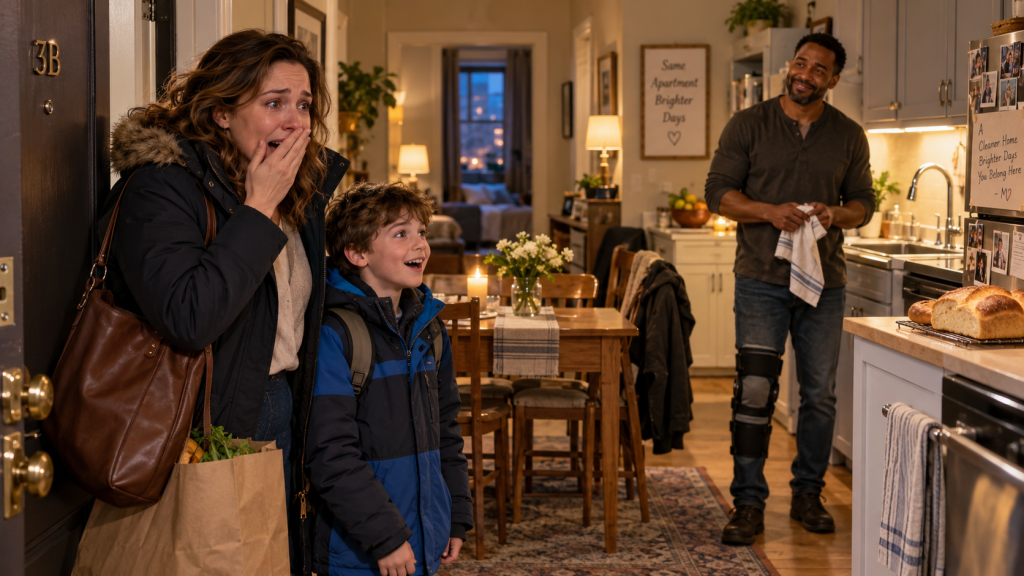
For a few seconds, I just stood there with my hand still wrapped around the doorknob.
Liam slipped past me.
“Whoa.”
That was the only word he managed.
The apartment looked like ours.
But better.
Not expensive.
Not magically renovated.
Just cared for.
The faucet that had dripped every night for eight months was silent.
The cabinet door above the sink no longer hung at an angle.
The warped front door closed without me having to slam my shoulder into it.
The loose baseboard beneath the living-room window had been secured.
The torn curtain had been stitched.
Even the small wooden chair Liam used at the kitchen table had stopped wobbling.
And the smell.
Warm bread.
Real bread.
Not the supermarket kind in a plastic bag.
The kind that filled a room and made a place feel safer than it probably was.
Marcus stood by the oven with my old dish towel wrapped around one hand.
His duffel bag sat neatly packed beside the couch.
The knee brace was still strapped to his leg.
He looked as startled to see me as I was to see him.
“I can explain.”
I stared at him.
“You’re still here.”
“Yes.”
“That was not the agreement.”
“I know.”
My voice sharpened.
“You told me you’d leave.”
“I know.”
Liam turned around.
“Mom, look at the door!”
“I see the door.”
“It closes!”
“I see that too.”
Marcus set the loaf on the stove.
“Chloe.”
I looked at him.
“You need to leave.”
The happiness vanished from Liam’s face.
Marcus nodded immediately.
“Okay.”
No argument.
No wounded expression.
No speech about gratitude.
He reached for the duffel bag.
That should have made me feel better.
Instead, guilt rose fast.
I hated it.
Having boundaries does not mean you stop feeling guilty when someone respects them.
Marcus slung the bag over one shoulder.
Then he pointed toward the kitchen table.
“There are receipts there.”
I looked.
Beside the three twenties was a folded note and two hardware-store receipts.
“What is the money?”
“Not yours.”
“I know it isn’t mine.”
He almost smiled.
“Mrs. Alvarez from 3C saw me carrying the old faucet parts downstairs.”
I knew Mrs. Alvarez.
Seventy-two.
Widowed.
Complained about everything but would still leave soup outside your door if she heard you were sick.
“She asked if I knew radiators.”
I stared at him.
“Do you?”
“Yes.”
“So?”
“So I bled hers.”
“You what?”
“Got the trapped air out.”
“Oh.”
“She gave me forty bucks.”
“That’s too much.”
“I told her.”
“And?”
“She told me if I gave it back she’d break my other leg.”
That sounded like Mrs. Alvarez.
Liam laughed.
Marcus pointed at the remaining money.
“Mr. Henderson across the hall paid me twenty to rehang his bathroom door.”
I looked toward our front door.
“And you used some of that to buy parts for my apartment?”
“Sixteen eighty-four.”
He tapped the receipt.
“Washer. Strike plate screws. Two cabinet hinges. Wood filler.”
I stared at him.
“You spent money you earned fixing my things?”
“You gave me dinner.”
“That was spaghetti.”
“Still dinner.”
“You slept on my couch.”
“That too.”
“Marcus.”
His expression changed.
Not defensive.
Almost embarrassed.
“I needed to do something.”
The sentence was quiet.
Liam wandered toward the sink and turned the faucet on.
Then off.
Then on again.
He seemed fascinated by silence.
I looked back at Marcus.
“You could have left.”
“Yes.”
“Why didn’t you?”
He hesitated.
Then pointed at the front door.
“I tried.”
I frowned.
“What?”
“I woke up around seven.”
He shifted his weight carefully off the bad leg.
“I packed everything.”
“I went to leave.”
“And the deadbolt jammed.”
I glanced toward the door.
“It does that.”
“I know.”
“I took the strike plate off.”
He stopped.
Something in his expression changed.
“What?”
“The screws were barely an inch long.”
“So?”
“So anybody who hit that door hard enough could’ve popped the frame.”
A chill ran through me.
Marcus continued.
“The wood behind the plate was split.”
I looked at the door differently.
All those nights.
Liam asleep down the hall.
Me throwing my shoulder into the frame just to lock it.
“How bad?”
“Bad enough I couldn’t leave it.”
I folded my arms.
“So you fixed the lock.”
“Yes.”
“And then the faucet.”
“That thing was driving me insane.”
Despite myself, I almost laughed.
“And then the cabinet.”
“It was one screw.”
“The curtain?”
He looked guilty.
“That was boredom.”
Liam shouted from the table:
“You fixed my chair!”
Marcus looked at him.
“That was self-defense. It squeaked every time you moved.”
Liam grinned.
My anger weakened.
Not disappeared.
We still had an agreement.
One night.
He had stayed in my home all day without permission.
He must have seen the conflict on my face because he said:
“You have every right to be mad.”
That stopped me.
People usually argue hardest when they know you have a right to be angry.
Marcus did the opposite.
“I should have left once the door was safe.”
“Yes.”
“I got carried away.”
“Yes.”
“I’m sorry.”
I looked at his duffel.
“Where were you planning to go?”
He shrugged.
“Shelter again.”
“Did you call?”
“Yeah.”
“And?”
“Full tonight.”
Liam turned around.
His face changed.
“Then where will you sleep?”
“Buddy.”
“I’m asking him.”
Marcus smiled slightly.
“I’ll figure something out.”
“That means outside.”
“Liam.”
My son looked at me.
“He fixed our door.”
“That doesn’t mean—”
“He fixed everything.”
“I know.”
“He made bread.”
“I can see that.”
“And you’re making him go outside?”
There are parenting moments when your child asks a question with no respect for adult complexity.
This was one.
I put down my purse.
“Marcus.”
“Yeah?”
“Sit.”
He hesitated.
“Sit down.”
He lowered himself carefully into a chair.
I sat across from him.
Liam climbed onto his newly repaired chair.
I looked at Marcus.
“Start with this.”
I tapped the table.
“How does a homeless man with a knee brace know how to repair half an apartment?”
Marcus stared at his hands.
For a long moment, he said nothing.
Then:
“I was a maintenance supervisor.”
I blinked.
“For what?”
“Apartment buildings.”
Of course.
“What happened?”
He rubbed his thumb over a scar near his wrist.
“Work accident.”
“The knee.”
“Yes.”
“How?”
“Loading dock.”
His mouth tightened.
“A steel access panel came loose.”
“How heavy?”
“Enough.”
“That is not an answer.”
“About four hundred pounds.”
My stomach turned.
“It hit you?”
“Caught my leg against a curb.”
Liam’s eyes widened.
“Did your bone break?”
“Several places.”
I gave Liam a look.
He immediately pretended he was intensely interested in the bread.
Marcus continued.
“I had surgery twice.”
“When?”
“Eleven months ago.”
“And you lost your job?”
“Not right away.”
He stared toward the window.
“The company kept me on modified duty.”
“For how long?”
“Three months.”
“Then?”
“Workers’ comp started fighting about what portion of my pain was from the accident and what was supposedly preexisting.”
I knew enough from the nursing home to understand how ugly those cases could become.
“You had a lawyer?”
“Eventually.”
“What about housing?”
“I was living in one of the properties I worked for.”
My chest tightened.
“Employee unit?”
“Discounted.”
“So losing the job meant—”
“Losing the apartment.”
Liam whispered:
“That’s not fair.”
Marcus looked at him.
“No.”
Then:
“But fair and legal are not always the same thing.”
I did not like how familiar that sounded.
“How long have you been outside?”
“Off and on, five months.”
“Off and on?”
“Shelters. Cheap motel if I get day work. A friend’s place twice.”
“What friend?”
He smiled sadly.
“The kind who has three kids and one bedroom.”
I nodded.
He continued.
“I tried staying there.”
“Couldn’t.”
“Wouldn’t.”
“There’s a difference.”
He looked at me.
“So is there between kindness and obligation.”
That sentence landed.
I had spent the previous twenty-four hours wondering whether inviting him in once somehow made me responsible for everything after.
Apparently he understood the danger too.
“What about family?”
I asked.
His face closed.
Liam noticed.
So did I.
“You don’t have to answer.”
Marcus shook his head.
“No, it’s fine.”
He stared at the table.
“My parents are dead.”
“Siblings?”
“Sister in Arizona.”
“Does she know?”
“No.”
“Why?”
He looked almost offended.
“Because she has two kids and a husband who got laid off last spring.”
“So?”
“So I’m not showing up at her door like one more emergency.”
I thought of myself.
Three weeks behind on rent.
Gas bill unopened.
Still telling my mother I was “fine.”
Pride is strange.
It can look noble while it slowly corners you.
“What about your settlement?”
“Still fighting.”
“How do you eat?”
“Day labor when my knee lets me.”
“You work with that brace?”
“Sometimes.”
“What does your doctor say?”
“Doctors say a lot of things when they aren’t paying rent.”
I did not answer.
I heard versions of that sentence from residents’ families every week.
Medical advice assumes stability people often do not have.
Rest.
Elevate.
Keep wounds clean.
Attend follow-ups.
Take medication with food.
All reasonable.
All much harder when life has stopped providing a bed.
Liam looked at Marcus.
“Did you make the bread?”
“Yes.”
“How?”
“With flour.”
Liam rolled his eyes.
“I know.”
Marcus smiled.
“There was yeast in the cabinet.”
I looked toward the cabinet.
“Expired.”
“Still alive.”
“Like you.”
He laughed.
A real laugh.
Then stopped when he realized I had said it.
I looked at the loaf.
“Why bread?”
“My mom baked when she was nervous.”
“And you were nervous?”
“I was in a stranger’s apartment after breaking the rule about leaving.”
“Fair.”
Liam reached for the loaf.
“Can we eat it?”
I stared at my son.
Then at Marcus.
Then at the clock.
Six-twenty.
Cold outside.
Bitter enough that the windows had a thin line of frost near the sill.
I sighed.
“One more night.”
Marcus looked up immediately.
“No.”
I frowned.
“What?”
“You said one night.”
“I am changing it.”
“Because Liam is looking at you like that.”
Liam tried to look innocent.
Failed.
Marcus shook his head.
“I don’t want you making a decision because your kid makes you feel guilty.”
That irritated me.
“Do not tell me why I’m making decisions.”
He held up both hands.
“Fair.”
“I’m offering one more night.”
He watched me.
“Then tomorrow?”
“We figure out tomorrow tomorrow.”
He hesitated.
Then:
“Okay.”
Liam cheered.
I pointed at him.
“Do not make this a victory.”
He stopped cheering.
Mostly.
That night, we ate bread with scrambled eggs and the last of the spaghetti.
Marcus sliced the loaf thick.
Liam declared it better than store bread.
Marcus said Liam’s standards were alarmingly low.
I laughed.
It was the first evening in months that our apartment did not sound tired.
That is the only way I can describe it.
No dripping faucet.
No door slamming.
No me calculating bills under my breath while pretending I was not.
For one night, the place sounded like people.
After Liam went to bed, I sat at the table with Marcus.
He had taken off the brace.
The knee underneath was swollen.
Badly.
“You need ice.”
“I’m fine.”
“That is nursing-home language for ‘I do not want to be inconvenient.’”
He looked at me.
“Occupational hazard?”
“Yes.”
I wrapped frozen peas in a towel.
He laughed.
“Dinner tomorrow?”
“Those peas are six months old. This is their highest purpose.”
He put them over his knee.
For a while, neither of us spoke.
Then Marcus said:
“You’re behind on rent.”
My entire body stiffened.
“How do you know?”
He immediately looked toward the counter.
“The notice was under the hardware-store flyer.”
I stared.
“You read my mail?”
“No.”
“It was face up.”
I looked away.
Humiliation burns differently from fear.
“I wasn’t snooping.”
“I know.”
Silence.
Then he said:
“You don’t owe me an explanation.”
“Good.”
Another silence.
“I get paid Friday.”
I said it too sharply.
Marcus nodded.
“Okay.”
“I’m not getting evicted.”
“Okay.”
“The manager knows.”
“Okay.”
“Stop saying okay.”
He almost smiled.
“Would you prefer an argument?”
“No.”
I rubbed my forehead.
“I hate people knowing.”
“I know.”
“How?”
He looked around the apartment.
“Because you hid your gas bill under three grocery coupons.”
I stared.
He shrugged.
“I notice things.”
“You really do.”
“That used to be my job.”
I thought about his duffel.
One bag.
Entire life.
“How did it get this bad?”
He did not answer quickly.
Then:
“Same way most bad things do.”
I waited.
“Not all at once.”
That sentence stayed with me.
He missed two paychecks.
Then rent.
Sold tools.
Used savings for surgery deductibles.
A settlement was always “coming.”
A decision was always “next month.”
Then the company terminated his housing arrangement.
He stayed in a motel until the money was gone.
Then the car was repossessed.
Then he learned how quickly a mailing address becomes necessary for everything.
Benefits.
Applications.
Banking.
Doctors.
Job interviews.
Every system wanted proof that he already had what he was trying to recover.
Stability.
I told him about my own mess.
Not everything.
Enough.
Liam’s father had left two years earlier.
Not vanished.
Just left.
Sent child support irregularly.
Called when it was convenient.
Moved to Indiana with a woman he had met online.
I had not fought.
Not because I was peaceful.
Because lawyers cost money.
The nursing home paid enough to survive if nothing went wrong.
Something always went wrong.
Tire.
Dental bill.
School shoes.
Winter gas.
Life had a thousand twenty-dollar emergencies and apparently they had unionized.
Marcus listened.
No advice.
That was rare.
When I finished, he said:
“You’re doing okay.”
I laughed bitterly.
“My rent is three weeks late.”
“Yes.”
“You’re sleeping on my couch because I invited a stranger home in front of my nine-year-old.”
“Yes.”
“My son’s shoes are separating from the soles.”
“I noticed.”
“Of course you did.”
He smiled faintly.
“You’re still doing okay.”
“How?”
“Kid feels safe enough to ask why somebody is sleeping outside.”
I went quiet.
“That’s not nothing.”
No.
It wasn’t.
The next morning, I woke to coffee.
Marcus had already packed.
Again.
“You leaving?”
“I’m going to the shelter intake office.”
I frowned.
“You said full.”
“Overnight beds.”
“Day caseworkers are different.”
“You have a caseworker?”
“Sort of.”
“Sort of?”
“Her name is Denise. She threatens me with paperwork.”
“Sounds terrifying.”
“She is.”
Liam came out rubbing his eyes.
“You’re leaving?”
“For the day.”
“Coming back?”
Marcus looked at me.
I nodded.
“For dinner.”
Liam accepted that.
Then Marcus said:
“I’m going to stop by a maintenance company too.”
“What company?”
“Lakeview Residential.”
I knew the name.
They managed buildings all over the North Side.
“They hiring?”
“Always.”
“With your leg?”
“Maybe inspection work.”
I thought.
“You need a clean shirt.”
He looked down at the faded hoodie.
“This is clean.”
“You need a shirt that says ‘hire me,’ not ‘I slept behind a grocery store.’”
He almost smiled.
I dug through the hall closet.
Found a button-down that belonged to my ex.
Blue.
Still in a dry-cleaning bag because apparently I had held on to a shirt for two years out of spiteful organizational confusion.
Marcus stared.
“No.”
“Take it.”
“I’m not wearing your ex-husband’s shirt.”
“Why?”
“I have standards.”
Liam laughed so hard milk came out his nose.
I threw the shirt at Marcus.
“Wear it.”
He did.
It fit.
Mostly.
He left at eight.
I went to work.
At ten-thirty, my supervisor called me into her office.
Her name was Elaine Parker.
Sixty.
No patience for drama unless she was the one creating it.
I assumed I was being written up for leaving early twice that month.
Instead she handed me an envelope.
“Employee hardship fund.”
I stared.
“What?”
“You applied in October.”
I had forgotten.
A small fund supported nursing-home employees facing emergencies.
My application had been waitlisted.
“How much?”
“Eight hundred.”
My eyes filled immediately.
Elaine looked uncomfortable.
“Do not cry in my office.”
I laughed.
“I’m three weeks behind on rent.”
“I know.”
“How?”
“Payroll garnishment request from your landlord.”
I froze.
“What?”
She frowned.
“Not legal garnishment. Sorry. Wrong word.”
She waved her hand.
“He called HR asking to verify employment because you gave him a payment arrangement.”
Right.
That.
My stomach settled.
Barely.
“Eight hundred?”
“Yes.”
I cried anyway.
Elaine pushed tissues toward me without looking.
“Use the blue box. Those are cheaper.”
That woman.
The money would not solve everything.
It would stop the immediate fall.
Sometimes rescue is not a staircase to a new life.
Sometimes it is one hand stopping you from sliding another foot.
That evening, Marcus did not come back at six.
Or seven.
Liam kept looking toward the door.
At seven-thirty, I began feeling stupid.
Of course he was not coming back.
He did not owe us.
At eight-fifteen, there was a knock.
Three.
Evenly spaced.
I knew somehow.
I opened the door.
Marcus stood there.
Blue shirt wrinkled.
Face exhausted.
Holding a paper bag.
Liam ran down the hallway.
“You came back!”
Marcus smiled.
“I said dinner.”
I looked at the bag.
“What’s that?”
“Chicken.”
“From where?”
“Lakeview bought lunch.”
My heart jumped.
“Interview?”
He nodded.
“How?”
“Badly.”
“Marcus.”
He smiled.
“They want me back tomorrow.”
“For what?”
“Second interview.”
Liam cheered.
Marcus’s eyes filled.
He blinked quickly.
Then held out the paper bag.
“I saved half the sandwich.”
I looked inside.
One wrapped chicken sandwich.
Apple.
Bag of chips.
He had carried lunch across Chicago because he knew we were stretching groceries.
I wanted to hug him.
I did not.
Not yet.
“Come in.”
Over the next week, our lives became a strange temporary arrangement built almost entirely from boundaries written aloud.
Marcus slept on the couch.
Not indefinitely.
We said two weeks.
He contributed what he could.
Not money at first.
Repairs.
Cooking.
School pickup only if I explicitly asked.
Never entering my bedroom.
Never borrowing my car.
No alcohol in the apartment.
Not because he drank.
Because I needed rules.
Rules helped kindness feel safer.
He respected every one.
That made extending them easier.
Lakeview hired him.
Not full maintenance.
Building systems coordinator.
Temporary contract.
Mostly inspections, work orders, vendor scheduling, and training younger technicians.
Less lifting.
More knowledge.
The hiring manager, Mr. Patel, had worked with Marcus years earlier.
That was the part Marcus had not told me.
“You knew him?”
“Barely.”
“He remembered you.”
“Apparently.”
“What did he say?”
“That I used to fix everybody else’s mistakes.”
I smiled.
“Accurate.”
Marcus looked embarrassed.
“He asked why I left the industry.”
“And?”
“I told him.”
“Everything?”
“Enough.”
Lakeview required an address.
Marcus froze on the form.
That night, he asked:
“Can I use yours?”
The question changed the room.
Not because I distrusted him.
Because addresses create invisible roots.
Mail.
Employment.
Benefits.
Bank statements.
Proof of residence.
I thought carefully.
“For thirty days.”
He nodded immediately.
“Thirty.”
“If you get stable housing sooner, you change it.”
“Yes.”
“No packages without telling me.”
“Yes.”
“Nothing financial tied to my name.”
“Obviously.”
“I needed to say it.”
“You should.”
Liam listened from the table.
Later he asked:
“Why do you make so many rules with Marcus?”
I said:
“Because rules help people know what kindness does and does not mean.”
He frowned.
“That sounds boring.”
“It is.”
“Can’t you just trust him?”
“I do.”
“Then why rules?”
I thought.
“Trust isn’t pretending nothing could go wrong.”
He waited.
“Trust is knowing what everyone agreed to do.”
He nodded slowly.
Then asked if he could have cookies.
Deep thinker.
Two weeks passed.
Marcus got his first paycheck.
It was not enormous.
It looked enormous to him.
He stared at the deposit on his phone like somebody had handed him back his name.
That night, he put three hundred dollars on the table.
I pushed it back.
“No.”
“Rent.”
“You’re sleeping on a couch.”
“It’s still housing.”
“You bought groceries twice.”
“Not enough.”
“I’m not taking three hundred.”
“Chloe.”
“No.”
He looked at me.
“Do not make me charity.”
That stopped me.
I heard his meaning immediately.
He needed to contribute.
Not because help required repayment.
Because dignity sometimes requires participation.
I sat.
“Fine.”
He waited.
“One hundred.”
“Two.”
“One-fifty.”
“One-seventy-five.”
“You bargain like a landlord.”
“Occupational memory.”
“One-fifty.”
He held out his hand.
I shook it.
Liam watched.
“Can I have some?”
“No,” we both said.
He sighed.
“Worth a try.”
Marcus gave me one hundred fifty dollars.
I used it toward the gas bill.
Then felt strange.
Not guilty.
Connected.
Help had moved in both directions now.
That mattered.
At the end of thirty days, Marcus had saved almost eighteen hundred dollars.
Enough for a room.
Not an apartment.
A room in a shared house owned by one of Lakeview’s retired maintenance techs.
Six hundred fifty a month.
Utilities included.
Near a bus line.
No credit check beyond proof of employment.
Marcus showed me the listing.
“It’s ugly.”
I looked.
Brown carpet.
Wood paneling.
Tiny window.
“It’s magnificent.”
He smiled.
“Shared bathroom.”
“You survived my bathroom.”
“Barely.”
“When do you move?”
His smile disappeared slightly.
“Saturday.”
I hated the sadness that came with relief.
Liam hated it openly.
“No.”
Marcus looked at him.
“Buddy.”
“You can live here.”
“No.”
“Mom likes you.”
I nearly choked.
“Liam.”
“She does.”
Marcus looked at me.
I looked at the ceiling.
Children should be prohibited from observing adults.
He continued:
“You still have to finish my volcano.”
Marcus smiled.
“I thought that was your school project.”
“You said you’d help make the lava realistic.”
“Realistic does not mean exploding in your classroom.”
“I know.”
“Good.”
Liam crossed his arms.
“You’re still coming.”
Marcus looked at me.
I nodded.
“If he wants.”
“I want.”
“Then yes.”
Saturday arrived too fast.
Marcus folded the blanket.
Washed the sheets.
Cleaned the couch cushions.
He had very little to pack.
That was the saddest part.
One duffel.
Two new work shirts.
A lunch container.
Medication.
A used tablet Lakeview had issued him.
Liam gave him something wrapped in notebook paper.
Marcus opened it.
A drawing.
Three stick figures.
Me.
Liam.
Marcus.
Our apartment.
Above Marcus’s head, Liam had drawn a speech bubble:
I CAN FIX THAT.
Marcus laughed.
Then cried.
He looked horrified by the crying.
Liam hugged him.
“Don’t lose it.”
“I won’t.”
Marcus looked at me.
“Thank you.”
I shook my head.
“Don’t.”
“What?”
“Don’t make me the person who saved you.”
He went still.
“You did.”
“No.”
I thought about what Mrs. Ostrander—wrong story, ignore. Need no reference. Let’s continue fresh.
“You already knew how to fix buildings.”
“You went to the shelter office.”
“You went to the interview.”
“You wore the terrible blue shirt.”
“It was terrible.”
“You did all that.”
He looked at me.
“You opened the door.”
That silenced me.
Sometimes that is enough.
Not saving.
Opening.
“I did.”
He smiled.
“And Liam started it.”
“Obviously.”
Liam looked proud.
Marcus moved out.
The apartment felt enormous for two days.
Then normal.
He came back Sunday.
Volcano.
Tuesday.
Dinner.
Saturday.
He took Liam to the hardware store—with my permission—to buy paint for a model bridge.
Our relationship with him became something I did not know how to name.
Friend.
Family friend.
Neighbor without the neighboring.
The person I called when the toilet made a sound that suggested demonic possession.
The person Liam called when his bike chain broke.
The person who remembered I worked double shifts on Thursdays and sometimes left soup in my fridge.
Not because he owed me.
Because people develop habits around one another.
Three months after moving out, Marcus’s workers’ compensation case settled.
Not millions.
Not movie money.
Enough to pay medical debt.
Replace some lost wages.
Put a deposit on a studio apartment.
Buy a used car.
He called me from the attorney’s office.
“I’m holding a check.”
“How much?”
“None of your business.”
“Good.”
He laughed.
Then:
“I’m scared.”
“Why?”
“Because every dollar already has a job.”
“Welcome to money.”
“No.”
He went quiet.
“I’m scared I’ll lose it again.”
That was honest.
Trauma around poverty does not disappear when a check arrives.
Sometimes money creates a new terror.
The possibility of falling twice.
“What are you going to do?”
“Pay debt.”
“Good.”
“Emergency fund.”
“Good.”
“Apartment.”
“Good.”
“Buy Liam shoes.”
“No.”
He laughed.
“I’m serious.”
“So am I.”
“He needs them.”
“I know.”
“You’ve been taping the sole.”
I hated him sometimes.
“That’s my job.”
“Can I buy him one pair?”
“No.”
“Birthday?”
“His birthday is seven months away.”
“Early birthday?”
“No.”
“Christmas?”
“Three months ago.”
I sighed.
“Fine.”
He was silent.
“One pair.”
“Thank you.”
“You’re impossible.”
“So are you.”
He bought Liam sneakers.
Not expensive.
Blue.
Liam wore them out in six months.
That made Marcus happier than the settlement.
I paid my rent current by spring.
Not because a rich stranger rescued me.
No mysterious inheritance.
No lottery.
The hardship fund helped.
Extra shifts helped.
Marcus’s small rent contribution had helped.
My ex finally had child-support wages formally withheld after I stopped trying to keep things “civil” and filed the paperwork.
That helped most.
I had spent two years treating legal enforcement like aggression.
Marcus, ironically, was the one who said:
“You keep talking like asking somebody to do what they’re already supposed to do is cruelty.”
I hated that sentence.
Filed the next day.
The first regular child-support payment arrived automatically.
I stared at it.
Then cried.
Not because of the amount.
Because I had finally stopped financing someone else’s irresponsibility with my exhaustion.
Liam got new clothes.
We filled the refrigerator.
I opened the gas bill when it arrived.
Small miracle.
Marcus’s knee improved slowly.
He still wore the brace for long shifts.
Physical therapy twice a week.
Lakeview eventually hired him permanently.
Then promoted him.
By the second year, he was training maintenance staff in six properties.
He developed a checklist for safety inspections after a tenant door nearly failed during a domestic incident.
Long screws in strike plates became his obsession.
Every door.
Every property.
Three-inch screws.
“Because a lock is only as strong as what’s holding it.”
He said it so often people teased him.
I understood why.
Our front door had changed something in him too.
Two years after that freezing grocery-store night, Marcus stood in our kitchen holding a clipboard.
I groaned.
“No.”
“What?”
“You’re inspecting my apartment again.”
“I’m not.”
“You’re staring at the ceiling.”
“Your bathroom exhaust fan sounds wrong.”
“Get out.”
Liam, now eleven, shouted from his room:
“Mom, let him fix it!”
“Traitor.”
Marcus smiled.
“Dinner first?”
“Yes.”
By then, his hair had grown longer.
He looked healthier.
Still thin.
Still carrying traces of those months outside.
People think recovery has an obvious finish line.
It does not.
He hoarded granola bars.
Always kept two coats in his car.
Never let the gas tank fall below half.
Could not sleep well during extreme cold.
The first winter after he got housing, he drove past shelters at night.
Not volunteering.
Checking.
He admitted that later.
“I needed to know they were still there.”
“Why?”
“In case everything disappeared again.”
I understood.
My own version was money.
Even after I had six thousand dollars in savings, I still checked the balance three times a day.
Security becomes obsessive when you once watched it evaporate.
We worked on it.
Separately.
Together.
Not therapy together.
We were not a couple.
At least not then.
That changed in the least romantic way possible.
I got the flu.
Bad.
Liam was twelve.
I woke at two in the morning with a fever over 103.
Called the nursing-home supervisor.
Then passed out on the bathroom floor.
Liam found me.
He called Marcus.
Not 911.
Marcus.
He arrived in twelve minutes.
Took one look at me.
Called 911.
I remember waking in the ER.
Marcus asleep in a chair.
Liam wrapped in Marcus’s coat.
The image hit me strangely.
Years earlier, I had let a man sleep on my couch.
Now my son trusted him enough to call when I could not stand.
I recovered.
Nothing dramatic.
Severe flu.
Dehydration.
But for two days, Marcus took care of Liam.
With my permission.
School.
Food.
Laundry.
Not because he was “paying me back.”
There was no ledger.
That was the moment I realized the relationship had stopped being about the grocery store entirely.
He was simply ours.
Not possession.
Belonging.
A few months later, he asked me to dinner.
Without Liam.
That had never happened.
I stared at him.
“Why?”
He looked nervous.
“Because normal adults sometimes eat dinner.”
“We eat dinner all the time.”
“With a twelve-year-old discussing Minecraft?”
“Educational.”
“Chloe.”
I knew.
I had known for a while.
Apparently denial is easier when schedules are busy.
“Are you asking me on a date?”
“Yes.”
I looked at him.
“No.”
His face fell.
Then I smiled.
“Ask again when you don’t look like you’re about to vomit.”
He stared.
“You’re terrible.”
“I’m tired.”
He laughed.
Then:
“Chloe, will you go out with me?”
“Yes.”
Our first date was horrible.
The restaurant lost our reservation.
Marcus wore shoes that hurt his knee.
I spent half the evening talking about Liam because I had forgotten how to talk about myself.
Marcus spilled water.
Then we both started laughing.
“You realize we were better at spaghetti when you were homeless.”
He nearly choked.
“Do not say that in public.”
“Why?”
“The couple beside us just heard.”
They had.
The woman looked horrified.
I waved.
We left before dessert.
Bought donuts at a gas station.
Sat in his car.
Best part of the night.
Dating Marcus scared me more than inviting him to sleep on the couch had.
That sounds ridiculous.
It was true.
Kindness for one night had rules.
Romance opens doors with fewer visible hinges.
I worried Liam would attach too much.
I worried Marcus would feel obligated.
I worried I would turn gratitude into love because that made a prettier story.
So we went slowly.
Very.
Painfully.
Marcus kept his apartment.
I kept mine.
No keys exchanged for a year.
Liam knew.
Pretended to be disgusted.
Was secretly delighted.
At thirteen, he said:
“If you guys get married, do I have to call him Dad?”
Marcus answered before I could.
“No.”
Liam looked surprised.
“Why not?”
“Because you already have a father.”
Liam’s face changed.
His biological father had become consistent only after wage enforcement and a court schedule.
Better.
Not close.
Complicated.
Marcus continued.
“You can call me Marcus.”
“What if I want to call you Dad?”
Marcus stopped breathing.
I did too.
Liam shrugged.
“I’m asking.”
Marcus’s eyes filled.
“If you ever want to, that’s your choice.”
“Okay.”
He walked away.
Children enjoy detonating emotional bombs and leaving.
He did not call Marcus Dad that year.
Or the next.
He called him Marcus.
Then M.
Then, once accidentally at fifteen:
“Dad, can you—”
Everyone froze.
Liam froze too.
Marcus looked down at his hands.
Liam said:
“I didn’t mean—”
Marcus looked up.
“You can take it back.”
Liam stared.
“Do I have to?”
“No.”
“Then I’m not.”
That was it.
No music.
No speech.
Dad.
Not replacing anyone.
Adding relationship to language.
Marcus cried in the garage afterward.
He denied this.
Liam has video.
Cruel child.
We married when Liam was sixteen.
Small courthouse ceremony.
Not because money was tight anymore.
Because after years of chaos, quiet felt luxurious.
Liam stood beside us.
My mother came.
Marcus’s sister flew from Arizona.
Yes.
He had finally told her everything.
Not when he was homeless.
Later.
When he was stable.
He expected anger.
Got it.
She cried for an hour.
Then yelled at him for another.
“You could’ve called.”
“I know.”
“You slept outside.”
“I know.”
“You idiot.”
“I know.”
She forgave him.
Eventually.
At our wedding, she whispered to me:
“Thank you for helping him.”
I said:
“He helped us too.”
She nodded.
“I know.”
Good.
No savior story.
That mattered.
Marcus kept working for Lakeview.
Then, at forty-eight, he started his own small maintenance consulting business.
Not repairs exactly.
Inspections.
Training.
Accessibility modifications.
He had become interested in helping older tenants and disabled tenants after his injury.
“You notice different things after your body stops doing what buildings assume bodies can do.”
He told me that once.
Stairs.
Heavy doors.
Bad railings.
Narrow bathrooms.
Broken elevators.
Things I had seen at the nursing home too.
We started collaborating informally.
I would complain about a resident’s apartment situation.
He would explain what modifications existed.
Eventually, our conversations became a community workshop at the library.
Then a nonprofit partnership.
Then something larger.
Not huge.
Not famous.
Useful.
We called it Safe Door Project.
Marcus hated the name.
I loved it.
We helped low-income older adults, injured workers, and families get basic home safety repairs.
Grab bars.
Locks.
Ramps.
Leaking faucets.
Window latches.
Smoke detectors.
Sometimes one repair keeps an apartment livable.
People underestimate small maintenance until the absence of it becomes crisis.
We raised funds.
Partnered with trade schools.
Young apprentices volunteered under supervision.
Marcus trained them obsessively.
“Do not fix what you don’t understand.”
Sound familiar.
He said it constantly.
One winter, we returned to the grocery store where we met.
Not intentionally.
We needed milk.
Again.
Apparently milk organizes my life.
A man sat near the brick wall.
Older than Marcus had been.
No brace.
Thin coat.
Liam, now seventeen, saw him first.
He stopped.
For one second, I was back eight years.
Same cold.
Same question waiting.
Liam looked at me.
Then Marcus.
“What do we do?”
That mattered.
Not:
Can we bring him home?
Liam had learned complexity.
Marcus walked over.
“Hey.”
The man looked up.
“I’m not asking.”
Marcus smiled softly.
“I know.”
My chest tightened.
Same words.
He asked:
“You know the overnight warming center on Clark?”
The man nodded.
“Full.”
Marcus took out his phone.
Called someone.
There was another center with mats.
Not beds.
Space.
Twenty minutes away.
We drove the man there.
Bought him dinner.
Did not bring him home.
Liam did not protest.
In the car afterward, he said:
“That feels less nice.”
I looked at him.
“Does it?”
“A little.”
Marcus said:
“Helping isn’t always doing the biggest thing you can imagine.”
Liam waited.
“It’s doing something useful without making promises you can’t safely keep.”
I looked at him.
Marcus smiled.
“You taught me that.”
“No.”
He shook his head.
“Life taught us.”
That was fair.
At eighteen, Liam wrote his college essay about Marcus.
I did not know until he showed me.
The title:
The Man on Our Couch.
I groaned.
“Subtle.”
He rolled his eyes.
His essay did not say:
My mother saved a homeless man.
Thank God.
It said:
When I was nine, I thought helping someone meant taking away their whole problem. I learned that adults cannot always do that. Sometimes helping means giving somebody one safe night, one meal, one address, one ride, or one reason not to feel invisible.
I cried.
He hated that.
Then I reached the final paragraph.
Marcus fixed our broken front door the morning after we met. For years I thought that was the important part of the story. Now I think the important part is that my mother opened it first.
I had to stop reading.
Liam looked embarrassed.
“You okay?”
“No.”
“Good?”
“Yes.”
Marcus came home halfway through my breakdown.
“What happened?”
I handed him the essay.
He read it.
Then disappeared into the bathroom.
He claimed allergies.
Our family apparently shared a genetic tendency toward fake allergies despite not sharing genetics.
Liam went to college.
Civil engineering.
Of course.
He had spent childhood around broken things and adults who believed structures mattered.
He specialized later in affordable housing design.
When he graduated, Marcus gave him the original hardware-store receipt from that first day.
He had kept it.
$16.84.
Washer.
Screws.
Hinges.
Wood filler.
Liam stared.
“You kept this?”
Marcus shrugged.
“First job after unemployment.”
“That was my apartment.”
“Work is work.”
Liam framed it.
I thought that was ridiculous.
Then cried.
Of course.
Years passed.
The Safe Door Project expanded.
Not enormous.
Chicago-sized.
We helped several hundred households a year.
One winter, a local reporter wrote a story about Marcus.
Headline:
FORMERLY HOMELESS MAINTENANCE WORKER NOW HELPS KEEP OTHERS HOUSED.
Marcus hated it.
“I have a name.”
“You’re in the headline photo.”
“Still.”
The article told the grocery-store story.
Too neatly.
Of course.
Media likes arcs.
Homeless.
Couch.
Job.
Marriage.
Nonprofit.
Done.
Marcus read it and frowned.
“What?”
“It makes it sound like being homeless ended when I got a room.”
I understood.
“What would you change?”
He thought.
“That’s when housing instability ended.”
“And homelessness?”
He looked at me.
“That stayed in my head for years.”
We contacted the reporter.
To her credit, she added that context to the online version.
Recovery is not a before-and-after photo.
People carry scarcity.
Shame.
Hypervigilance.
Fear.
All of it.
I did too.
Even after our combined income became comfortable, I saved grocery bags.
All of them.
Under the sink.
Too many.
Marcus finally opened the cabinet one day and a hundred plastic bags attacked him.
“What is this?”
“Useful.”
“This is pathology.”
“Do not diagnose me.”
He held up twenty bags.
“Why?”
“Trash.”
“We own trash bags.”
“Wasteful.”
He stared.
“You have twelve thousand dollars in emergency savings.”
I stared back.
“And now I also have free bags.”
We compromised.
Thirty bags.
Marriage is mostly negotiated weirdness.
Marcus’s knee eventually required replacement surgery.
The irony was not lost on him.
He delayed it.
Of course.
I threatened him.
Of course.
At sixty, he finally did it.
Post-op, he was unbearable.
“I can do it myself.”
“No.”
“I know my body.”
“No.”
“I have installed hospital grab bars.”
“You are currently wearing non-slip socks with smiley faces.”
He glared.
I laughed.
Liam flew in for the weekend.
Watched Marcus struggle to stand.
Then said:
“Remember when Mom found you outside?”
Marcus groaned.
“We are not doing nostalgia while I’m on pain meds.”
Liam smiled.
“Full circle.”
“I will disinherit you.”
“You don’t have enough money.”
“Rude.”
He recovered.
Slowly.
Better.
Walking without brace for the first time in decades made him emotional.
The old black brace remained in our garage.
I asked why.
He said:
“I don’t know.”
Years later, he donated it to a rehabilitation program that taught injured workers how to navigate adaptive equipment.
Nothing needed to become sacred.
Not the brace.
Not the couch.
Not even the story.
The couch lasted twelve more years.
Unreasonably long.
We finally replaced it when one spring poked through the cushion and nearly injured Liam’s girlfriend.
Marcus objected.
“This couch changed my life.”
“It is trying to end hers.”
We bought a new one.
Before the delivery truck came, Marcus sat on the old couch alone.
I found him.
“You okay?”
He touched the armrest.
“First bed I had indoors after eleven nights outside.”
My throat tightened.
“Keep it?”
He shook his head.
“No.”
Then:
“Take a picture.”
So I did.
One photograph.
Then the junk company hauled it away.
No shrine.
Memory without clutter.
That became another lesson.
Liam married at thirty-one.
A woman named Sophie.
Public-school teacher.
Sharp.
Warm.
Unimpressed by his engineering vocabulary.
Perfect.
At their wedding, Liam gave a toast.
Most grooms thank people.
Liam told stories.
Unfortunately.
He talked about the grocery store.
The couch.
The faucet.
Then:
“My mom once let a stranger sleep in our apartment for one night.”
People laughed.
Marcus covered his face.
Liam continued.
“She was right to be cautious.”
Good.
“She locked her bedroom door.”
More laughter.
“She set rules.”
I smiled.
“And Marcus was right to leave when she asked.”
He looked at Marcus.
“Except she asked him to stay another night.”
Marcus nodded.
“Big mistake.”
Laughter.
Liam continued.
“I grew up thinking kindness was a feeling.”
The room quieted.
“Then I learned kindness is often logistics.”
A meal.
A ride.
A lock.
A phone call.
A form.
An address.
A rule.
A boundary.
A second chance.
His eyes filled.
“My parents taught me you can help someone without owning their outcome.”
That line mattered.
He raised his glass.
“To open doors.”
Marcus cried.
I did too.
Sophie said:
“This family cries too much.”
Correct.
When our first grandchild was born, Marcus became ridiculous.
Her name was Nora.
He built her a wooden bookshelf before she could sit.
Then a toy workbench.
Then a dollhouse with actual working cabinet hinges.
I said:
“She’s six months old.”
“She’ll grow.”
He taught her how to use a screwdriver at four.
Supervised.
Very supervised.
At five, she asked him:
“Were you really homeless?”
Children skip delicacy.
Marcus looked at Liam.
Liam shrugged.
“Family history.”
Marcus sat beside Nora.
“Yes.”
“Why?”
He thought.
“I got hurt.”
“And then?”
“I lost my job.”
“And then?”
“I lost my apartment.”
She frowned.
“Why didn’t you buy another one?”
Everyone smiled sadly.
“Because apartments cost money.”
“Didn’t you have money?”
“Not enough.”
She thought.
“Then Grandma gave you one?”
I opened my mouth.
Marcus shook his head.
“No.”
He pointed at me.
“Grandma gave me a couch for one night.”
Nora looked confused.
“That fixed it?”
“No.”
He smiled.
“It helped me be warm long enough to take the next step.”
She nodded.
Then asked:
“Did you fix the couch?”
“No.”
“That’s weird.”
Conversation over.
I loved that answer.
Warm long enough to take the next step.
That was exactly what happened.
I did not fix Marcus.
Marcus did not fix me.
We gave each other enough stability at different times to keep moving.
That is more realistic.
And, in some ways, more beautiful.
My nursing-home career lasted thirty-two years.
I became a unit coordinator.
Then assistant director of nursing.
I nearly declined the promotion because I did not have a bachelor’s degree.
Elaine—still terrifying then—told me:
“You have been doing half this job for free. Take the title.”
I did.
Marcus celebrated by repairing absolutely nothing.
At my request.
We ordered dinner.
When I retired, the staff gave me a plaque.
I hated it.
Marcus hung it anyway.
Below it, he mounted the original faucet washer from our apartment.
I stared.
“You kept that?”
“Yes.”
“You’re worse than me with grocery bags.”
He smiled.
The tiny rubber washer sat in a shadow box.
Under it he had printed:
IT WAS DRIVING ME INSANE.
I laughed for ten minutes.
That was marriage.
Taking your hardest history and sometimes letting it become funny.
Not because it stopped mattering.
Because pain had lost exclusive rights to the memory.
At seventy, Marcus started slowing down.
Not illness.
Age.
His body had been through more than mine.
The repaired knee ached.
Shoulder problems from years of maintenance work.
Hands stiff.
He stopped consulting full time.
Still volunteered.
Mostly training.
One afternoon, he came home with a young man named Isaiah.
Twenty-four.
Quiet.
Carrying a backpack.
I looked at Marcus.
He looked guilty.
Absolutely guilty.
“Why is there a person?”
Isaiah looked terrified.
Marcus said:
“He needs a shower.”
I stared.
“And?”
“And maybe dinner.”
I folded my arms.
“Marcus.”
“I know.”
“You brought a stranger into our house?”
He looked at the floor.
I stared at him.
Then burst out laughing.
“You unbelievable hypocrite.”
He laughed too.
Isaiah looked between us.
“I can leave.”
“No.”
I waved him in.
“But.”
Both men looked at me.
“One night.”
Marcus smiled.
“Of course.”
I pointed at him.
“Do not.”
Isaiah had been sleeping in his car.
Safe Door Project was helping him secure transitional housing after aging out of a bad roommate situation and losing work.
No grand destiny.
He showered.
Ate.
Slept in our guest room.
Left the next morning.
Marcus did not fix anything because everything was already fixed.
That seemed to bother him.
Two months later, Isaiah sent a holiday card.
New job.
Shared apartment.
Doing okay.
I put it on the refrigerator.
Marcus stood beside me.
“See?”
“What?”
“One night.”
I smiled.
“One night.”
We never turned our house into an informal shelter.
That was important.
We were not equipped.
Not trained.
Not always safe.
Kindness without boundaries can become dangerous for everyone involved.
Instead, we supported professionals.
Funded motel vouchers.
Shelter beds.
Case management.
Home repairs.
The original decision I made outside the grocery store was a risk.
I am not going to pretend otherwise because the story ended well.
It could have gone badly.
Marcus himself always said that.
At community talks, someone inevitably asked:
“Do you recommend bringing strangers home?”
Marcus answered:
“No.”
People looked shocked.
Then he would add:
“I recommend not looking away.”
There are many ways to help.
Call a warming center.
Buy food.
Offer transportation if safe.
Support shelters.
Ask what someone actually needs.
Involve professionals.
My choice worked out.
That does not make it a universal instruction.
Liam appreciated that nuance.
He once said:
“Mom, you realize your entire moral philosophy is ‘be kind but lock your bedroom door.’”
I laughed.
“That’s not terrible.”
Marcus said:
“Put it on a shirt.”
We did not.
Thank God.
Then came the winter that Marcus got sick.
Not sudden.
At first, shortness of breath.
Then fatigue.
He blamed age.
Then the knee.
Then Chicago weather.
Finally, because I had been a nurse for most of my life and was done tolerating male nonsense, I scheduled the appointment myself.
Heart failure.
Manageable.
Then less manageable.
Years.
Medication.
Diet.
Appointments.
Good days.
Hard ones.
The man who once refused to be charity struggled deeply with receiving care.
One night I was helping him with compression socks.
He looked furious.
“I hate this.”
“I know.”
“I hate you doing this.”
“I know.”
“I used to carry refrigerators.”
“Poorly, apparently.”
He glared.
I smiled.
Then he started crying.
“I don’t want to become work.”
My hands stopped.
There it was.
The old fear.
Not homelessness.
Burden.
Obligation.
I sat beside him.
“You are work.”
He looked wounded.
I continued.
“So am I.”
He stared.
“Love is work sometimes.”
I took his hand.
“That is not the same as being unwanted.”
He cried.
I did too.
“You gave me a couch.”
“One night.”
“You’re going to hold that over me forever?”
“Apparently.”
He laughed through tears.
Then let me finish the socks.
Marcus lived six more years.
Good years.
Not perfect.
We traveled once.
To Arizona.
Visited his sister.
He stood in the desert and complained there were not enough buildings to inspect.
We went home.
He preferred Chicago.
Of course.
The winter he died was unusually mild.
That felt wrong.
Marcus belonged to cold weather in my mind.
Maybe because that was how I found him.
He entered hospice in our home.
His choice.
Liam came.
Sophie.
Nora.
Isaiah, now running a maintenance crew.
Former Lakeview coworkers.
Safe Door volunteers.
People.
So many people.
Marcus had once believed showing up at his sister’s home would make him one more emergency.
By the end, his life had become a place people wanted to show up.
That mattered.
One evening, it was just us.
Snow started outside.
Finally.
Small flakes.
Marcus watched through the window.
“Cold?”
“No.”
“You sure?”
“Chloe.”
“What?”
“I’m under three blankets.”
“Professional habit.”
He smiled.
Then:
“Remember that grocery store?”
“Yes.”
“You looked terrified.”
“I was.”
“I thought you were crazy.”
“I was.”
“I almost said no.”
“To what?”
“Coming home.”
I looked at him.
“Why?”
“Pride.”
Of course.
“I thought if I accepted, then I’d be somebody who needed that.”
“You did need it.”
“I know.”
He looked toward the window.
“Took me years to understand needing help wasn’t an identity.”
My throat tightened.
“What was?”
“Being cold.”
He smiled slightly.
“One night.”
I held his hand.
He continued.
“You know what I remember most?”
“What?”
“Liam asking where I was going to sleep.”
I smiled.
“He was relentless.”
“He looked at you like you were personally responsible for winter.”
“That sounds like him.”
Marcus breathed slowly.
“He made me feel visible.”
I swallowed.
“Kids do that.”
“Sometimes.”
He looked at me.
“Adults get good at not seeing.”
That was true.
We sat.
Then he whispered:
“Thank you for opening the door.”
I started crying.
“You fixed it.”
He laughed weakly.
“Team effort.”
Marcus died two days later.
Quietly.
Holding my hand.
Liam on the other side.
No cinematic last sentence.
No perfectly timed snow.
He breathed.
Then did not.
That was all.
I was seventy-four.
Widowed.
Again, in a way.
But different from being abandoned.
Loss hurts differently when love was allowed to finish honestly.
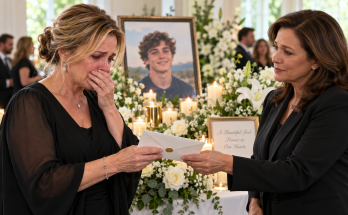
The funeral was full.
Too full.
Maintenance workers.
Tenants.
Nurses.
Family.
People from shelters.
Trade students.
A woman from Lakeview brought a bag of three-inch screws and placed them beside the guest book.
I laughed through tears.
Liam gave the eulogy.
He did not tell the grocery-store story first.
He started with the faucet.
“Marcus noticed what leaked.”
People smiled.
“Not only faucets.”
“He noticed systems.”
“Doors.”
“People.”
“Things everyone else had gotten used to being broken.”
My throat tightened.
Liam continued.
“He did not believe broken meant worthless.”
I cried.
“That applied to apartments.”
“Work.”
“Bodies.”
“Families.”
“And himself.”
Then Liam looked at me.
“My mother gave him one night on a couch.”
He smiled.
“He gave us the rest of his life.”
I covered my face.
Afterward, Nora placed something in the casket.
The old drawing Liam had made at nine.
Three stick figures.
Our apartment.
Speech bubble:
I CAN FIX THAT.
Marcus had kept it all those years.
Liam found it in his desk.
Perfect.
The Safe Door Project continued.
I stayed involved less.
Liam joined the board.
Isaiah became training director.
We created the Marcus Reed Emergency Repair Fund.
He would have hated the name.
Good.
It covered simple repairs that threatened housing stability.
Broken locks.
Heat failures.
Water leaks.
Accessibility hazards.
Things that seem small until they become the reason someone cannot stay home.
The first grant paid for a woman’s front door.
Of course.
Three-inch screws.
Of course.
I kept one thing from Marcus’s desk.
Not the drawing.
That went with him.
Not the hardware receipt.
Liam had it.
A note.
Folded.
Old.
The one he had left on my kitchen table that first day.
I had forgotten.
He had not.
The note said:
Chloe—
I know you said one night. I’m sorry I stayed longer this morning.
The door wasn’t safe. I fixed the lock, faucet, cabinet, chair, and curtain. Parts receipts are here.
Mrs. Alvarez paid me $40. Henderson paid $20. The money on the table is what’s left after parts. It belongs to the house because the house gave me work today.
Bread is in the oven.
Thank you.
Marcus
At the bottom, in different ink, apparently added years later:
P.S. Still think the curtain was ugly.
I laughed until I cried.
Then framed the note.
Yes.
I became that person.
Age gives you permission.
My apartment from those days is gone now.
The building was renovated.
Then converted.
Then sold.
Chicago changes.
Everything does.
But sometimes I drive past the grocery store.
The brick wall remains.
Different sign.
New automatic doors.
No Marcus.
No little nine-year-old Liam.
No exhausted thirty-something version of me balancing grocery bags and calculating whether milk would last until payday.
I stand there sometimes.
Not often.
Memory should not become a job.
The night I met Marcus, I thought the decision was whether to let a homeless stranger sleep on our couch.
That was the visible decision.
The deeper one was whether poverty had made me too frightened to remain generous.
I was struggling.
That mattered.
I had a child.
That mattered more.
Safety mattered.
Boundaries mattered.
My caution was not cruelty.
His homelessness was not character.
Both truths fit.
That became the lesson.
The morning after Marcus stayed, I thought I would come home to discover whether trusting him had been a mistake.
Instead, I discovered that trust is not really one dramatic bet.
It is a series of small observations.
He respected the locked bedroom.
He left my documents alone.
He fixed the door.
He told the truth when staying longer violated the agreement.
He accepted boundaries.
He found work.
He contributed.
I listened.
Adjusted.
Said yes sometimes.
No other times.
That is how relationship formed.
Not because I was a good woman who rescued a homeless man.
I hate that version.
It makes him passive.
Makes me heroic.
Neither was true.
Marcus had skills before I met him.
Pride.
History.
Fear.
A bad knee.
A bad run of circumstances.
A brain that understood buildings.
Hands that could repair what neglect had loosened.
He did not need someone to turn him into a valuable person.
He already was one.
He needed warmth.
Time.
An address.
A chance for other people to see what was already there.
And I?
I needed things too.
A safe lock.
Help.
Regular child support.
Permission to stop pretending struggle was nobility.
Someone who saw my overdue notice and did not use it to make me feel small.
Someone who eventually loved me without treating love like debt.
We were not savior and saved.
We were two adults standing near different edges.
For a while, we kept each other from falling.
Liam did the bravest thing.
He looked.
That sounds small.
It isn’t.
The world teaches people to look away from discomfort quickly.
Do not stare.
Keep walking.
Not your problem.
Sometimes those rules protect dignity.
Sometimes they protect us from feeling responsible.
Liam stared because he was nine.
He had not yet learned the sophisticated adult skill of pretending not to see suffering.
“Where is he gonna sleep?”
One question.
That was all.
I did not have a good answer.
So I made one for one night.
One.
That is what I want people to remember.
You do not have to solve someone’s life to matter in it.
Sometimes one safe night matters.
One meal.
One phone call.
One repaired lock.
One completed form.
One ride.
One introduction.
One address for thirty days.
One person saying:
I see that this is happening to you.
And sometimes the person you help will disappear from your life the next morning.
That does not make the help wasted.
Sometimes they stay.
Sometimes they help you back.
Sometimes they become family.
You cannot know at the door.
Kindness is not an investment where you are guaranteed a return.
If that is what you need, call it something else.
I helped Marcus because Liam was cold just looking at him.
Marcus repaired my apartment because broken things bothered him and he wanted to contribute.
Neither of us knew what came after.
That uncertainty is part of what made it real.
Near the end of my own life, Nora asked me to tell the grocery-store story again.
She had heard it a hundred times.
I said:
“You know it.”
“I want your version.”
So I told her.
The cold.
The brace.
The couch.
The spaghetti.
The dripping faucet.
The fear at work.
The key turning.
The smell of bread.
Marcus by the oven.
The repaired door.
Nora smiled.
“What were you thinking when you opened it?”
I thought.
“I thought I had made a terrible mistake.”
“And then?”
“I realized I had made a complicated decision.”
She laughed.
“That’s less dramatic.”
“Most true things are.”
She looked toward the framed note.
“Do you think Grandpa Marcus would’ve made it without you?”
I knew the expected answer.
No.
You saved him.
I did not give it.
“Probably.”
She looked surprised.
“What?”
“He was stubborn.”
“He knew how to work.”
“He had Denise.”
“He found Lakeview.”
“He might have found another opening.”
“Then did you matter?”
I smiled.
“Yes.”
“How?”
“I made that particular week less cold.”
She stared.
“That’s all?”
“No.”
I touched her hand.
“That is a lot.”
Her eyes filled.
Mine too.
We spend too much time wanting to be the turning point in other people’s stories.
Sometimes it is enough to be a warm room in the middle.
Marcus became that for me too.
Again and again.
When money was tight.
When Liam was difficult.
When I was sick.
When I retired and did not know who I was without work.
When Daniel—no, wrong story. There was no Daniel in this one. Ignore. Need not mention. Good.
When life became quieter.
Marcus knew how to make ordinary rooms feel occupied.
Bread.
Tools.
Bad jokes.
Radio too loud.
His shoes always near the door.
That was love.
Not rescue.
Presence.
If I could return to that first night, I would still lock my bedroom door.
People laugh when I say that.
I mean it.
Good heart.
Good boundaries.
Both.
I would still hide my documents.
Still tell him one night.
Still make the rule clear.
But I would not feel guilty for protecting Liam and myself while being kind.
Safety and compassion are not enemies.
That may be the most important thing I learned.
And the next evening, when I opened the door and saw Marcus still standing there, I would probably still be angry.
He broke the agreement.
He knew it.
But I would also notice the faucet.
The chair.
The hinges.
The bread.
The receipts.
The money he had earned.
I would understand a little sooner what it took me years to learn.
Some people walk into your life looking like another problem.
Then quietly reveal they know how to repair things you had stopped believing could be fixed.
Not everything.
No one fixes everything.
Marcus could not repair the years he spent homeless.
Could not undo my financial struggle.
Could not make Liam’s biological father into a different man.
Could not promise our lives would stay stable.
What he did was smaller.
And bigger.
He fixed what was in front of him.
A faucet.
A door.
A chair.
A meal.
A relationship.
Then, one day at a time, we did the same.
That is why I still remember the exact sound of my key turning that evening.
I expected danger.
Instead, the door opened smoothly for the first time in months.
The apartment smelled like bread.
My son ran inside.
And a man who had spent the night on my broken couch looked at me with embarrassment and said:
“I know I promised one night.”
He was right.
It was supposed to be one night.
It became a lifetime.
THE END STORIES! THANK YOU FOR READING GOOD LUCK !❤️
Related Posts