➡️ PART 3 ENDING PART➡️
“That doesn’t determine who has rights to the property—”
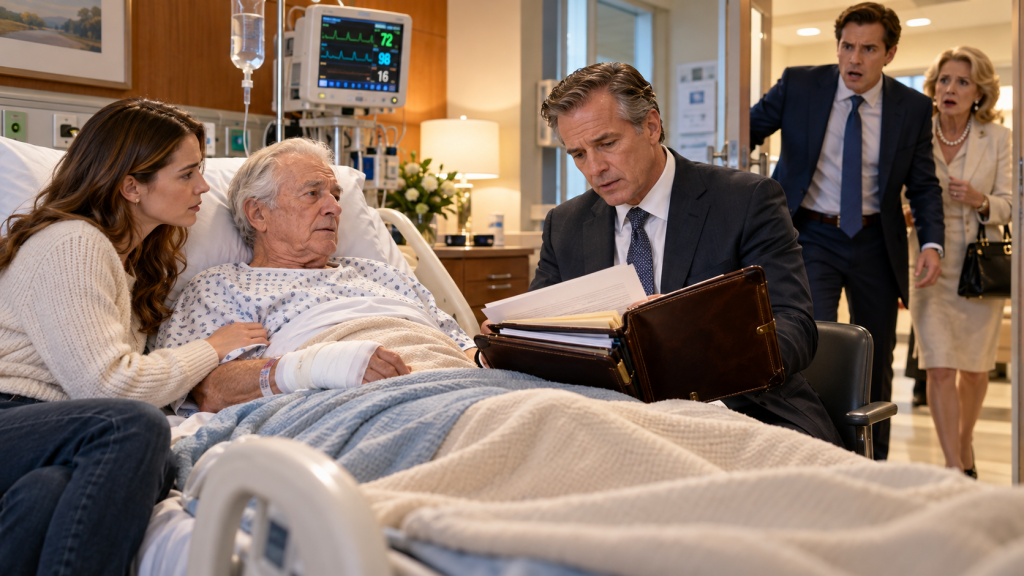
Larry opened the old leather folder before Richard could finish.
The sound of the metal rings separating was small.
Almost polite.
But Richard stopped talking.
Larry removed a yellowed copy of the financial agreement Caroline and I had signed five years earlier and placed it carefully on the hospital tray beside the plastic cup of water I still hadn’t touched.
“I think,” Larry said, “we should begin with the document your mother signed.”
Richard’s jaw tightened.
Caroline stood at the foot of my bed, one hand still wrapped around her purse.
For the first time since she and Richard rushed into the room, neither one looked angry.
They looked uncertain.
That was new.
Richard pointed toward the trust documents.
“Dad was preparing for surgery. He was under stress. Whatever he signed can be challenged.”
Melissa stiffened beside me.
Larry did not.
“I’m sure you can find someone willing to file something.”
Richard blinked.
“That isn’t an answer.”
“It’s the only honest one.”
Larry adjusted his glasses.
“Anyone can file a lawsuit. Winning is another matter.”
Caroline stepped closer.
“Larry, surely you understand that Boris was frightened.”
“I understand exactly what condition Boris was in.”
“He needed an urgent medical procedure.”
“Yes.”
“He was emotional.”
“Yes.”
“And Melissa had just given him money.”
Melissa’s face changed.
I felt her hand pull slightly away from mine.
Before she could speak, I did.
“Leave her out of this.”
Caroline looked at me.
“I’m not accusing her of anything.”
“You are standing in my hospital room five minutes after learning she controls valuable land, and your first argument is that she gave me money before I signed the trust.”
Caroline’s lips parted.
“That’s not what I meant.”
“It’s exactly what you meant.”
Richard stepped in.
“Dad, nobody is saying Melissa manipulated you.”
Larry looked at him.
“You did approximately thirty seconds ago.”
Richard ignored him.
He turned toward his sister.
“Mel, you don’t actually want this.”
Melissa stared at him.
“What?”
“You don’t want to be in the middle of Dad’s property dispute.”
“There wasn’t a dispute until you walked in.”
“That land was part of this family for ten years.”
I almost laughed.
Ten years.
For most of those ten years, the sixty acres had been described as my failure.
My mistake.
My useless dirt.
The reason we lost money.
The reason Caroline needed “protection.”
The reason Richard told people his father had once been in business but “didn’t understand risk.”
Now it was family property.
Amazing what fifteen million dollars can do to vocabulary.
Larry slid the old agreement toward Richard.
“Read paragraph seventeen.”
Richard did not move.
“I know what it says.”
“Then we can save time.”
Larry tapped the page.
“Five years ago, your mother and father executed a marital property partition and liability agreement.”
Caroline’s eyes narrowed.
“I remember.”
“Good.”
“You had independent counsel.”
“Yes.”
“You signed voluntarily.”
“Yes.”
“You received the house as separate property.”
Caroline said nothing.
“Your retirement assets were confirmed as separate property.”
Still nothing.
“Certain savings accounts were allocated to you.”
“Yes.”
“And Boris accepted full responsibility for the Rosenberg parcel, all carrying costs, all taxes, all existing environmental exposure, all financing tied to it, and any future liabilities arising from ownership.”
Richard interrupted.
“That was because the land was toxic.”
“Adjacent land had an environmental problem.”
Larry corrected him.
“The exact status of Boris’s parcel was more complicated.”
“You know what I mean.”
“I prefer knowing what documents mean.”
I almost smiled.
Larry turned the page.
“Now the sentence you were referring to, Richard.”
Richard’s face tightened.
Larry read:
“‘Any and all future appreciation, recovery in market value, condemnation proceeds, mineral value, development proceeds, sale proceeds, settlement payments, and other economic benefit associated with the Rosenberg parcel shall remain the sole and separate property of Boris Antonov, just as all liabilities, carrying costs, assessments, remediation exposure, and economic loss shall remain solely his.’”
Silence.
Caroline looked toward me.
Richard looked toward the window.
Melissa looked confused.
I remembered that sentence.
Not every word.
The argument around it.
Richard sitting at our kitchen table five years earlier with a laptop.
Caroline beside him.
Me across from them.
The land had already destroyed the small freight-storage business I had tried to build after leaving plant management.
A neighboring industrial site had leaked contaminants into groundwater.
My financing disappeared almost overnight.
Our potential tenant backed out.
County officials restricted certain development until the environmental review was completed.
The land itself was not condemned.
But it might as well have been.
Banks treated it like poison.
Buyers vanished.
Taxes remained.
Richard was thirty-three then.
Already successful.
Sharp suit.
Sharper opinions.
He had said:
“Mom cannot spend retirement carrying Dad’s property risk.”
I had been sitting six feet away.
Dad’s property risk.
As if I were a business unit being written off.
Caroline had not objected.
She had said:
“He’s right, Boris.”
I had been ashamed.
The business failed on my watch.
The land had been my decision.
So I agreed.
Caroline received financial separation from the downside.
I accepted the land.
The taxes.
The uncertainty.
The embarrassment.
And now Richard was staring at the same sentence because it had remembered something he had not.
Upside travels with downside.
Larry removed another sheet.
“This may refresh your memory further.”
Richard looked at him.
“What is that?”
“An email.”
My son’s face changed.
I had not known about it.
Larry turned the page toward him.
At the top was Richard’s email address.
Five years old.
Sent to Larry while the agreement was being drafted.
Larry, please make this airtight. Mom should not be exposed if Dad’s land gets hit with remediation costs later. If future liabilities are Dad’s problem, then any future value can be Dad’s benefit. That seems fair and should keep things clean.
I stared at the sentence.
If future liabilities are Dad’s problem, then any future value can be Dad’s benefit.
Richard read his own words.
Once.
Then again.
Melissa whispered:
“Wow.”
Caroline slowly sat in the visitor chair.
Richard looked furious.
Not at Larry.
At himself.
“You kept that?”
Larry closed the folder slightly.
“I keep correspondence regarding property agreements.”
“That was five years ago.”
“Paper ages better than convenience.”
I liked that.
Richard turned toward me.
“Dad, I was trying to protect Mom.”
“I know.”
“You were in a financial mess.”
“I know.”
“The land looked like it could become a permanent liability.”
“I know.”
“So don’t sit there acting like I did something malicious.”
“I’m not.”
My voice was still weak from the procedure.
That made everyone lean in.
“I agreed with you.”
Richard stopped.
“I thought it was fair.”
I looked at Caroline.
“You wanted your retirement protected.”
She swallowed.
“Yes.”
“You wanted the house protected.”
“Yes.”
“You did not want a contaminated property problem following you into old age.”
She looked down.
“No.”
“I understood.”
I looked back at Richard.
“You called it smart protection.”
He said nothing.
“It was.”
I meant that.
That seemed to bother him more.
Because I was not rewriting history.
I had not secretly hated the agreement.
I had been ashamed, yes.
But I had signed willingly.
The land was my mistake.
So I accepted the consequences.
“All I’m asking now,” I said, “is that the same agreement remain smart after the numbers change.”
Caroline’s eyes filled.
“Boris.”
“No.”
I shook my head carefully.
“You don’t get to protect yourself from the loss and then call the gain a family asset.”
Her face tightened.
“We were married through all of it.”
“Yes.”
“We are married now.”
“Yes.”
“And I stood by you when the business collapsed.”
I looked at her.
Did she believe that?
Maybe she did.
People remember themselves kindly.
“You separated our finances.”
“Because Richard said—”
“I know why.”
My voice softened.
“I’m not blaming you.”
That surprised her.
“I accepted it.”
“I signed too.”
“But that agreement has to mean the same thing today that it meant when nobody wanted the land.”
Melissa looked down at the bus schedule lying on the bedside table.
Richard noticed.
His anger returned.
“This is all because of three thousand dollars.”
I stared at him.
There it was.
Finally.
The sentence he had wanted to say from the moment he entered.
“You’re punishing me because I wouldn’t give you $3,200.”
Melissa turned sharply.
“Richard.”
“No, let him answer.”
He stepped closer.
“You called me while I was closing the biggest transaction of my career.”
“You asked for money.”
“I said I couldn’t help.”
“And suddenly I’m cut out of fifteen million dollars?”
I looked at him for a long time.
Then:
“Do you know what your problem is?”
His mouth tightened.
“You think this is about the $3,200.”
“It obviously is.”
“No.”
“It’s about what the $3,200 showed me.”
He laughed.
“What does that even mean?”
“I did not ask you for twelve million.”
“I did not ask you for a house.”
“I did not ask you to support me.”
“I asked for $3,200 toward a medical procedure.”
“You had it.”
His expression changed.
“Dad, that deal wasn’t twelve million in my checking account.”
“I know.”
That stopped him.
Of course I knew.
I was not stupid.
A twelve-million-dollar deal did not mean twelve million personally deposited into his wallet that afternoon.
I continued.
“But you had $3,200.”
Silence.
Richard looked away.
Melissa watched him.
I said:
“You had more than enough.”
His jaw tightened.
“Yes.”
“Thank you.”
“But that is not the point.”
“It is exactly the point.”
“No.”
I looked at him.
“The point is that you made a decision.”
“I asked you because I was short.”
“You said no.”
“You had the right to say no.”
Richard looked surprised.
Even Caroline looked at me.
“I mean that.”
I continued.
“You are an adult.”
“Your money is yours.”
“You did not owe me $3,200 simply because you are my son.”
He relaxed slightly.
Too soon.
“But once you said no, I had to update my understanding of who I could rely on if something happened to me.”
His face changed again.
“That’s not the same as punishing you.”
“That is planning based on new information.”
Melissa’s eyes filled.
Richard scoffed.
“So Melissa buys your loyalty for two thousand dollars?”
My daughter stood.
“Don’t.”
Her voice was small.
But sharp enough that Richard stopped.
She reached into her purse.
Pulled out the white envelope.
The same envelope she had given me at the kitchen table.
She put it on my blanket.
“I don’t want the land.”
I looked at her.
“Melissa.”
“No.”
Tears rolled down her face.
“I did not give you money because I wanted this.”
“I know.”
“I sold my car because you needed the procedure.”
“I know.”
“I did not know anything about fifteen million dollars.”
Larry said quietly:
“That is correct.”
Richard looked at him.
“How do you know?”
“Because Boris instructed me not to contact Melissa before execution.”
My daughter turned toward me.
“What?”
I nodded.
Larry continued.
“The trust was prepared and signed before Melissa knew the land restrictions had been lifted.”
Richard stared.
“She didn’t know?”
“No.”
“She was not in the room.”
“No.”
“She did not ask for it.”
“No.”
“She did not participate in drafting.”
“No.”
Larry almost sounded bored.
It was wonderful.
“I advised Boris privately.”
“The notary spoke with him privately.”
“We documented his instructions.”
“His physician had not administered sedation.”
“The procedure occurred later.”
“He understood the property, the offer, the trust, and the consequences of making the trust irrevocable.”
Larry closed the folder.
“If you were thinking of alleging undue influence, Richard, you will need a different story.”
Richard’s face flushed.
“I didn’t say that.”
“You were about to.”
He was.
We all knew it.
Melissa picked up the trust document.
Her hands trembled.
“Dad, why would you do this without asking me?”
“Because if I asked, you would have said no.”
“I’m saying no now.”
“You can’t.”
She stared.
“What?”
Larry answered.
“The trust is irrevocable.”
Her eyes widened.
“That sounds terrifying.”
“It can be.”
Larry looked at me.
“Which is why I spent most of a night trying to talk your father into sleeping before signing it.”
I almost smiled.
Melissa sat.
“What does it actually mean?”
Good question.
Larry pulled out a clean copy.
“The land is now owned by the Rosenberg Family Stewardship Trust.”
She stared.
“Family?”
“Yes.”
“I thought Dad gave me the property.”
“No.”
He looked at Richard.
“Your brother has been using that language.”
Then Larry looked back at Melissa.
“You are trustee.”
“What does that mean?”
“You control administration of the trust subject to its terms.”
“The trust owns the property.”
“You decide whether to accept, reject, or renegotiate the Cornerstone offer.”
“You manage the sale proceeds if the property is sold.”
“You do not simply have fifteen million dollars in your personal checking account.”
Melissa exhaled.
“Thank God.”
Richard laughed bitterly.
“That’s temporary.”
Larry ignored him.
“Boris is the primary lifetime beneficiary.”
My daughter looked at me.
“What?”
“The trust is required to provide for his medical care, housing, support, and reasonable quality of life.”
Her eyes filled.
“He can receive income and permitted distributions.”
“After his death, the remaining trust assets are distributed according to the terms he chose.”
Richard went still.
Caroline did too.
Melissa whispered:
“To who?”
I looked at her.
Not Larry.
Me.
“Mostly you.”
She closed her eyes.
“Dad.”
“Listen first.”
She opened them.
“Seventy percent of the remaining trust after my death goes to you.”
Richard laughed once.
No humor.
“There it is.”
“Fifteen percent funds scholarships for public-school teachers in Fort Bend County.”
Melissa stared.
“And the remaining fifteen percent goes into a family medical fund.”
Richard stopped laughing.
I continued.
“For you.”
“For Richard.”
“For any grandchildren I may have.”
“For major medical expenses.”
No luxury distributions.
No business investments.
Medical.
Richard looked at me.
“You left me fifteen percent?”
“No.”
I shook my head.
“I created a fund that can help either of you with serious medical costs.”
His expression changed.
I could see the irony reach him.
Good.
Not because I planned a clever punishment.
Because after staring at a $3,200 medical shortfall, I understood exactly what I wanted some portion of the money to do.
Nobody in my family should ever be forced to sell a car for a necessary procedure if this land could prevent it.
Melissa began crying.
“What if I don’t want seventy percent?”
“Then when the time comes, you can make decisions with your own inheritance.”
“I don’t want to be rewarded because Richard said no.”
“You aren’t.”
She looked at me.
“Then why me?”
The room went quiet.
I thought carefully.
“Because you came over with dinner before you knew I needed money.”
Tears rolled down her face.
“You noticed my coffee was untouched.”
“You asked what was wrong.”
“You gave me almost everything you had before you knew there was anything coming back.”
I touched the bus schedule.
“And then you sold your car.”
“That was crazy.”
“Yes.”
I almost smiled.
“Do not do that again.”
She laughed through tears.
Then I became serious.
“But when I was deciding who should have authority if I became weak, confused, or unable to manage my affairs, I asked myself one question.”
Melissa waited.
“Who had shown me that my needs mattered before my assets did?”
Nobody spoke.
Richard looked toward the floor.
Caroline began crying.
Melissa shook her head.
“Dad, that’s too much.”
“Probably.”
“You should have named a bank.”
Larry cleared his throat.
“I recommended an institutional co-trustee.”
Melissa looked at him.
“And?”
He glanced at me.
“Your father used language I will not repeat in a hospital.”
I smiled.
“I don’t trust people who charge one percent to say no.”
Larry sighed.
“That was the polite version.”
Melissa almost smiled.
Then:
“I want a co-trustee.”
Richard looked at her.
“What?”
She wiped her face.
“If I’m responsible for that much money, I want someone professional involved.”
Larry’s eyebrows lifted.
I watched my daughter.
The first decision she made after learning she controlled a potential fifteen-million-dollar asset was to ask for less unchecked power.
That was exactly why I had chosen her.
Larry said:
“The trust allows you to appoint an independent fiduciary as co-trustee for investment and tax administration.”
“Then I want that.”
Richard stared.
“You’re just accepting this?”
She turned toward him.
“What do you want me to do?”
“Refuse.”
“How?”
“I don’t know.”
“Then stop telling me what Dad should do with property you were happy to call a liability five years ago.”
Richard’s face hardened.
“I was protecting Mom.”
“And who were you protecting four days ago?”
Silence.
The question stayed there.
Richard looked at me.
Then at Melissa.
Then toward the door.
Caroline said:
“Richard.”
He turned.
“Not now.”
He walked out.
The hospital door closed harder than necessary.
Caroline remained.
For several seconds she said nothing.
Then:
“You planned to divorce me too?”
I looked at her.
“No.”
Her shoulders relaxed.
Again, too soon.
“I did not sign divorce papers.”
“But you transferred the land.”
“Yes.”
“Without telling your wife.”
“You transferred your finances away from me five years ago.”
“That’s different.”
“Why?”
She opened her mouth.
Closed it.
Melissa looked uncomfortable.
“I can go.”
“No.”
I said.
Caroline looked at her.
“Please do.”
“Caroline.”
My voice stopped her.
“She stays.”
My wife stared at me.
“This is between us.”
“It became between all of us when you came into my hospital room with Richard and demanded property paperwork before asking whether the procedure went well.”
Her face crumpled.
I regretted the cruelty of the sentence.
Not the truth.
Caroline looked at the monitor beside my bed.
Then at the bandage beneath my gown.
“How did it go?”
Too late.
But I answered.
“Fine.”
She cried.
“I’m sorry.”
“I know.”
“No.”
She stepped closer.
“I mean it.”
“I should have come.”
“Yes.”
“I thought Melissa was with you.”
“She was.”
“You weren’t alone.”
“That is not the same as having my wife here.”
Caroline covered her mouth.
Melissa stood.
This time I let her.
“I’m going to get coffee.”
She left.
Larry gathered the papers.
“I’ll give you both a few minutes.”
Then he paused at the door.
“Boris.”
“Yes?”
“Do not sign anything.”
I laughed.
Caroline did not.
Larry left.
For the first time since my procedure, I was alone with my wife.
She sat beside the bed.
Four decades of marriage? User doesn’t specify length. Richard wealthy adult, Melissa 26. Could be 30 years. I will say thirty-one years maybe. Need not be too exact maybe “decades”. Let’s avoid.
Caroline stared at her hands.
“I didn’t know the land restrictions had been lifted.”
“I know.”
“I didn’t know about the offer.”
“I know.”
“Would you have told me?”
I thought.
“Yes.”
“When?”
“After the procedure.”
She flinched.
“Why after?”
“Because I wanted to see what happened before money changed the room.”
She looked at me.
“You tested us.”
“No.”
I shook my head.
“That would mean I knew the result when I called Richard.”
“I didn’t.”
“I received the certified letter after Melissa left.”
“That night?”
“Yes.”
“So when you asked Richard for money—”
“I did not know.”
Caroline went still.
That mattered.
Because it removed the version she wanted.
The one where I secretly possessed fifteen million dollars and asked our son for $3,200 as some morality experiment.
No.
When I called Richard, I was a warehouse worker with a medical bill and a piece of land everybody believed was dead.
When Melissa sold her car, she believed the same.
Only afterward did the envelope arrive.
Chance had made the timing cruelly clear.
Caroline whispered:
“I thought you knew.”
“No.”
“Richard said maybe you were testing him.”
“He is trying to make his answer less ugly.”
She closed her eyes.
I regretted that sentence too.
Still true.
Then she said:
“What about me?”
I looked at her.
“What do you mean?”
“Was I part of the test?”
“No.”
“You asked me to talk to Richard.”
“Yes.”
“And I said no.”
“Yes.”
“Then you changed the property.”
“Caroline.”
I breathed slowly.
“The land changed.”
“My understanding changed with it.”
“I did not create fifteen million dollars because I was angry.”
“I received a letter.”
“I called Larry.”
“He reminded me of the agreement we signed.”
“And I decided I did not want the next medical emergency decided by people who had already shown me where I stood.”
She cried quietly.
“That includes me.”
“Yes.”
I hated saying it.
Sometimes the sentence you need is not satisfying.
Only sad.
Caroline stared out the window.
“I was scared.”
“Of what?”
“Money.”
I almost laughed.
“We have always been scared of money.”
“No.”
She shook her head.
“After your business collapsed.”
“I was terrified.”
“Every bill.”
“Every tax notice.”
“Every call from a lender.”
“I thought we were going to lose everything.”
Her voice broke.
“When Richard suggested separating finances, it felt like oxygen.”
I knew that.
Maybe not fully.
But enough.
She continued.
“And then you started working at the warehouse.”
“You looked tired all the time.”
“I thought if I let you pull from my retirement too, we would both end up with nothing.”
“You were right to protect yourself.”
She looked surprised.
“I mean it.”
I said.
“You had spent decades saving that money.”
“The house mattered.”
“I agreed.”
Tears kept coming.
“Then why does this feel like punishment?”
“Because the side of the agreement that protects me is finally worth something.”
She looked down.
That was it.
We sat quietly.
Then she said:
“When you showed me the hospital estimate, I thought…”
She stopped.
“What?”
“I thought there would always be another bill.”
My chest tightened.
She continued.
“Three thousand today.”
“Ten thousand next month.”
“Medication.”
“Follow-ups.”
“I was afraid if I started giving money, there would be no end.”
The honesty hurt.
Not because it was monstrous.
Because I understood it.
Fear makes people ration tenderness.
I said:
“You could have told me that.”
“I was ashamed.”
“So you told me to ask Melissa.”
She started crying harder.
“I knew she had nothing.”
“Yes.”
“That was wrong.”
“Yes.”
“I’m sorry.”
I believed her.
Believing an apology is not the same as reversing what it revealed.
“Caroline.”
She looked at me.
“I don’t know if I want to go home with you.”
Her face went completely still.
“What?”
“I’m not deciding today.”
“You just had surgery.”
“I know.”
“You’re emotional.”
I almost smiled.
“So is everyone who discovers his family relationship is conditional.”
“That’s not fair.”
“No.”
I sighed.
“Maybe it isn’t.”
“But I need time.”
She reached for my hand.
I let her.
Thirty years of habit are not erased by a property filing.
She whispered:
“Do you still love me?”
“Yes.”
Immediate.
Because that was true too.
Love was not the question.
Trust was.
Partnership was.
Who comes when things are inconvenient.
Who protects themselves.
Who notices.
Who asks.
Caroline lowered her head.
“I love you.”
“I know.”
We sat that way until Melissa came back.
The next two weeks were strange.
I recovered at Melissa’s apartment.
Not because I was trying to punish Caroline.
Because the doctor wanted someone nearby at night for the first few days, and when Caroline offered, my body tightened before my mind answered.
That told me enough.
Melissa slept on her sofa so I could use the bed.
I hated that.
She ignored me.
Every morning, she took the city bus to school.
The first time I watched her walk toward the stop in the rain, something inside me burned.
“Take a rideshare.”
I told her.
“No.”
“Why?”
“Because rideshares cost money.”
“You sold a car worth almost nine thousand dollars.”
“Seven thousand four hundred.”
“You sold your car for me.”
“You needed the deposit.”
“That does not make it sane.”
She smiled.
“Now you sound like me.”
I called Larry.
“I want to buy Melissa a car.”
“No.”
I stared at the phone.
“What?”
“You just placed the land in a trust she controls.”
“So?”
“So if you start moving money and assets to her immediately, Richard’s attorney will describe it as a transaction chain tied to undue influence.”
I hated lawyers again.
“It’s my money.”
“Then use money that is clearly separate and documented.”
“I have six thousand in savings.”
“Do you need it for recovery?”
“Some.”
“Then wait.”
I looked out the window at the empty parking spot where her Civic used to be.
“I hate waiting.”
“That is why law has deadlines.”
I hung up on him.
Three days later, Richard’s attorney sent the first letter.
Not a lawsuit.
A demand.
Preserve records.
Do not close the Cornerstone sale.
Provide trust documents.
Provide medical records related to competency.
Provide communications between me, Melissa, and Larry.
Richard wanted to challenge.
Melissa read the letter at her kitchen table.
Her face went pale.
“I knew it.”
“What?”
“I knew I should have refused.”
“You cannot refuse being named trustee by pretending the trust disappears.”
“I can resign.”
“Yes.”
“Maybe I should.”
“No.”
“Dad.”
I looked at her.
“Do not resign because your brother is louder.”
She stared.
“What if this ruins us?”
“Then we were already too fragile.”
Her eyes filled.
“I don’t want fifteen million dollars between me and Richard.”
“It isn’t.”
“It already is.”
She was right.
I hated that.
Larry arrived that evening with another attorney.
A trust litigator named Sandra Hale.
Short gray hair.
No patience.
She reviewed everything.
Then asked me questions.
Not comforting ones.
“Did Melissa know of the offer before you signed?”
“No.”
“Did you discuss changing your estate plan after she gave you money?”
“No.”
“Did you sign because she gave you money?”
I thought.
“Partly.”
Sandra’s eyes sharpened.
Larry looked worried.
I continued.
“Not because I was paying her back.”
“I signed because what she did changed my judgment about who could manage my affairs if I became incapable.”
Sandra nodded.
“Better.”
“I’m not trying to sound better.”
“Good.”
“Truth is easier to defend.”
She asked whether I had taken medication.
Whether I understood irrevocability.
Whether Larry explained that I could instead use a revocable trust.
“Yes.”
“Why did you reject revocable?”
“Because I did not want Richard or Caroline pressuring me to undo it after they learned about the offer.”
Sandra looked at Larry.
“He said that contemporaneously?”
Larry opened his notes.
“Almost those words.”
Good.
“Why Melissa as trustee instead of yourself?”
“Because if the procedure went badly, I did not know what capacity I would have afterward.”
“Why not Caroline?”
Silence.
Then:
“Because when I needed help arranging the procedure, she told me to ask our daughter.”
Sandra made no expression.
“Why not Richard?”
“You know.”
“I need you to say it.”
“Because he refused to help me with $3,200 he could afford.”
“Did he owe you the money?”
“No.”
“Then why does that matter?”
“Because trustees make discretionary decisions about another person’s needs.”
I looked at Melissa.
“I needed someone whose first instinct was not to protect her own pile.”
Melissa cried.
Sandra wrote something.
Then she looked at my daughter.
“Did your father promise you any money before execution?”
“No.”
“Did you know about the offer?”
“No.”
“Did you know the restrictions had been lifted?”
“No.”
“Did you ask for control?”
“No.”
“Did you know he was meeting Larry?”
“No.”
“Did you know he was changing ownership?”
“No.”
“When did you first learn?”
“In the hospital.”
“Who told you?”
“Larry.”
“Did you immediately accept?”
Melissa almost laughed.
“No.”
“What did you do?”
“Tried to refuse.”
Sandra wrote again.
“Good.”
Melissa looked annoyed.
“This is not good.”
“It is legally useful.”
“I mean emotionally.”
Sandra finally softened.
“That is not my department.”
I liked her.
Richard filed suit six days later.
Not just against me.
Against Melissa as trustee.
He alleged lack of capacity.
Undue influence.
Improper transfer of marital property.
Breach of family agreement.
The last claim was vague enough to make Sandra snort.
Caroline did not join.
That mattered.
Richard came to Melissa’s school.
That did not.
He waited in the parking lot after dismissal.
I found out because she called me crying.
“What happened?”
“He wants me to resign.”
My blood pressure probably violated medical instructions.
“Did he threaten you?”
“No.”
“What did he say?”
“That Dad is using me to punish him.”
I closed my eyes.
“He said if I stay trustee, whatever happens between us is my fault.”
There it was.
Oldest family trick.
Make the quiet person responsible for the loud person’s reaction.
“What did you say?”
“I told him he needed to leave.”
“Good.”
“He said I always loved being the good child.”
That one hurt her.
I could hear it.
“Melissa.”
“I have to go.”
“No.”
“I’m fine.”
“Don’t lie.”
Silence.
Then she cried.
“I don’t want to be the good child.”
“You aren’t.”
“I don’t want you loving me because I sold my car.”
“I don’t.”
“What if I hadn’t?”
“I would still love you.”
“Would I still control the trust?”
I hesitated.
She heard it.
“Exactly.”
I sighed.
“No.”
That hurt.
But I would not lie.
“Probably not.”
She cried quietly.
Then:
“So it is because of the money.”
“No.”
“It is because of what the money showed.”
“Dad, that sounds like the same thing.”
“It isn’t.”
I searched for the right words.
“If you had given me fifty dollars and sat with me at the hospital, I would have learned something.”
“If Richard had said, ‘Dad, I can’t give you $3,200, but I’ll call the billing office, I’ll come tomorrow, I’ll help you figure something out,’ I would have learned something different about him.”
Silence.
“I did not choose you because you paid more.”
“I chose you because you moved toward the problem.”
She breathed.
Then:
“I still hate this.”
“So do I.”
That helped more than pretending the trust was a gift wrapped in justice.
It was responsibility.
Heavy.
Complicated.
And I had placed it on her without asking.
I apologized for that later.
Not for choosing her.
For not understanding the burden of being chosen.
The court moved quickly because the property sale had deadlines.
Cornerstone agreed to pause.
For thirty days.
Then sixty.
Their lawyer wanted title certainty.
Of course.
The preliminary hearing happened in Fort Bend County.
I wore the same navy jacket I had worn to Richard’s college graduation.
It barely buttoned.
Melissa sat beside Sandra.
Richard sat across the aisle with his lawyer.
Caroline sat in the back row.
Alone.
That hurt in a different way.
Richard’s lawyer argued that the trust was created under emotional distress immediately before a medical procedure.
True.
He argued that Melissa had provided a substantial financial benefit immediately beforehand.
True.
He argued that I had historically relied on family for financial decisions after the business collapse.
Partly true.
Then Sandra began.
She did not give a speech.
She produced chronology.
The restrictions were lifted.
Certified letter dated Monday.
Melissa gave me money before I opened it.
Cornerstone offer arrived in same envelope.
I called Larry after Melissa left.
Melissa was not present.
Trust drafted independently.
Medical clearance.
Notary.
Recorded deed.
Old marital partition agreement.
Richard’s email.
His own sentence:
If future liabilities are Dad’s problem, then any future value can be Dad’s benefit.
The judge read it twice.
Richard stared straight ahead.
Then Larry testified.
Then the notary.
Then me.
Richard’s attorney asked:
“Mr. Antonov, were you angry with your son when you created the trust?”
“Yes.”
Good start.
“Very angry?”
“Yes.”
“Because he refused to give you $3,200?”
“Partly.”
“So this was retaliation.”
“No.”
“What else would you call transferring a fifteen-million-dollar asset days after your son refuses you money?”
“Planning.”
He almost smiled.
“For what?”
“For the possibility that I would come out of surgery unable to manage my affairs.”
“You could have named your wife.”
“Yes.”
“You did not.”
“No.”
“You could have named your son.”
“Yes.”
“You did not.”
“No.”
“You named the child who had just given you almost all her savings.”
“Yes.”
He turned toward the judge.
Then back.
“Does that not sound like a reward?”
“No.”
“Why not?”
“Because I did not give her fifteen million dollars.”
“You gave her control.”
“Yes.”
“Why?”
“Because control is what I was choosing.”
He paused.
I continued.
“I needed a person who would decide whether I needed care without first calculating what my care cost her future.”
The courtroom went quiet.
Richard looked down.
His lawyer recovered.
“You are referring again to the $3,200.”
“Yes.”
“Your son had no legal obligation to pay your medical bills.”
“I agree.”
The lawyer stopped.
“You agree?”
“Yes.”
“He owed you nothing?”
“Legally?”
“No.”
“Then why punish him?”
“I didn’t.”
I looked at Richard.
“I believed him.”
That sentence landed harder than I intended.
His lawyer frowned.
“What does that mean?”
“When my son told me he could not help, I accepted his answer.”
“I made future plans that did not rely on his help.”
“That is not punishment.”
“That is listening.”
Nobody moved.
Then the lawyer asked about Caroline.
“Your wife declined to finance the procedure.”
“She told me to ask Melissa.”
“Did that influence your decision not to appoint her trustee?”
“Yes.”
“So again, emotion.”
“Yes.”
I said it calmly.
“Trust decisions involve judgment.”
“Judgment is informed by experience.”
“If the law required families to make estate decisions without emotion, nobody would ever write a will.”
Even Sandra looked at me.
Maybe too clever.
But true.
The judge did not rule that day.
Three days later, we received the order.
Richard had not met the burden required to block trust administration.
The court found substantial evidence that I understood the transfer.
The old marital agreement made Caroline’s property claim unlikely.
Most importantly, the judge noted Melissa had not participated in the trust’s creation and did not know of the asset appreciation before execution.
The injunction was denied except for one temporary condition:
Any sale proceeds had to remain in trust pending further proceedings.
Fine.
That was always the plan.
Cornerstone returned.
Their offer was still fifteen million.
Melissa surprised everyone at the next meeting.
Including me.
She walked into Larry’s office with a yellow pad full of questions.
Not emotional questions.
Practical.
Environmental indemnities.
Tax treatment.
Closing costs.
Developer contingency periods.
Escrow.
Access rights.
Whether any part of the land should be retained.
Richard had spent years telling people Melissa was “just a teacher.”
Teachers are dangerous when you hand them homework.
She had read every document.
Twice.
The Cornerstone representative, Mark Delaney, spoke directly to me at first.
Melissa stopped him.
“I’m trustee.”
He blinked.
Then nodded.
“You are.”
“Then answer me.”
I almost smiled.
She asked:
“Why is the offer fifteen million?”
Mark explained.
The new interchange had changed projected traffic.
Nearby residential development.
Water and sewer expansion.
Demand for a private golf community.
Location.
Access.
Future appreciation.
Melissa said:
“If you think it is worth fifteen million today, what do you think it is worth after entitlements?”
Mark smiled.
Good question.
Negotiations began.
My daughter, who had ridden the bus to that meeting, did not accept the first offer.
Or the second.
Cornerstone moved to $16.2 million.
Then $16.8.
Larry looked pleased.
Melissa did not.
She commissioned an independent appraisal.
Paid from trust administrative funds.
The appraisal came back between $17.1 and $18 million depending on entitlement assumptions.
She returned to Cornerstone.
Final price:
$17.4 million.
I stared at her after the meeting.
“You just made two point four million dollars by asking questions.”
She looked horrified.
“I did not make anything.”
“You know what I mean.”
“No.”
She pointed at me.
“This is exactly how people get weird around money.”
Fair.
Then she surprised me again.
“I want the trust to keep five acres.”
“Why?”
She unfolded the map.
“Your original warehouse site is on the western edge.”
The concrete pad.
The little metal office.
Mostly gone now.
My failed business.
My shame.
Cornerstone did not need that portion.
Melissa wanted to keep it.
I stared.
“Why?”
“Because you paid taxes on this land for ten years when everyone told you it was useless.”
Tears filled her eyes.
“I don’t want the entire history turned into houses and golf carts.”
My throat closed.
I looked at Larry.
He pretended to read.
Coward.
We revised the sale.
Fifty-five acres.
Cornerstone paid $16.6 million.
The trust kept five acres around the old warehouse pad and a stand of pecan trees near the back.
It was less money.
Still more than I could comprehend.
Richard called the night before closing.
I answered.
First time in weeks.
“Dad.”
“Richard.”
“Melissa is selling tomorrow.”
“Yes.”
“For sixteen-six.”
“Yes.”
He was quiet.
Then:
“You’re really doing this.”
“Yes.”
“You could stop it.”
“No.”
“You can ask her.”
“I won’t.”
“Why?”
“Because I gave her authority.”
“You’re still the beneficiary.”
“Yes.”
“That means you can tell her what to do.”
“No.”
“That is exactly why I created a trust.”
Silence.
He exhaled.
“Do you hate me?”
The question surprised me.
“No.”
“You act like you do.”
“No.”
“I’m angry.”
“I’m disappointed.”
“I don’t trust you with certain things.”
“That is different from hate.”
He was quiet.
Then:
“I couldn’t believe you asked me for money that night.”
I frowned.
“Why?”
“Because you never ask.”
That was true.
I had paid his college tuition.
Helped him move.
Loaned him money when he started his first business.
Never asked for repayment on most of it.
Richard continued.
“When you called, I thought…”
He stopped.
“What?”
“That it was going to start.”
My stomach tightened.
“What was going to start?”
“You needing things.”
There.
He said it so quietly I almost missed it.
“I’ve seen friends with parents who didn’t plan.”
“Medical bills.”
“Mortgage help.”
“Monthly money.”
“I thought if I gave you the first $3,200, then next it would be ten.”
“Then fifty.”
I listened.
Not because I agreed.
Because I finally understood his fear.
He had looked at my failed business and warehouse job and decided I was one illness away from becoming his financial responsibility.
Perhaps Caroline’s fear had become his.
Perhaps his success made everyone around him ask.
Perhaps he had built walls before anyone reached the gate.
“I understand.”
I said.
He sounded surprised.
“You do?”
“Yes.”
“I do not agree with what you did.”
“But I understand being afraid of an open-ended obligation.”
He exhaled.
“Then why—”
“Because you didn’t ask.”
“What?”
“You did not say, ‘Dad, I’m scared this is more than $3,200.’”
“You did not say, ‘Can I pay the hospital directly?’”
“You did not ask whether I had a plan for follow-up costs.”
“You did not offer time.”
“You did not offer to call the billing office.”
“You did not even ask what the procedure was.”
Silence.
“You said, ‘I can’t help you, Dad.’”
His breathing changed.
I continued.
“And the next message you sent was asking whether I had worked out the payment issue.”
“I did ask.”
“You asked about the payment.”
“Not me.”
That landed.
He was quiet a long time.
Then:
“I thought you were okay.”
“Based on what?”
No answer.
That was the problem.
Families often mistake silence for evidence.
“I’m sorry.”
he said.
I closed my eyes.
Not because everything was fixed.
Because it was the first apology that had no property attached.
“Thank you.”
He whispered:
“Does that change anything?”
“No.”
Painful.
Necessary.
“Not tonight.”
He let out a broken laugh.
“Of course.”
“Richard.”
“Yes?”
“I did not build this trust to make you apologize.”
“I know.”
“Do you?”
“I’m starting to.”
We ended the call.
The land sale closed the next afternoon.
Melissa signed as trustee.
Her hand shook.
Before the final signature, she looked at me.
“Last chance.”
“For what?”
“To tell me not to.”
I smiled.
“That would defeat the entire point.”
“I hate you.”
“No, you don’t.”
“I hate paperwork.”
“That I believe.”
She signed.
$16.6 million did not appear in cash.
No cinematic wire notification with confetti.
Escrow.
Closing statements.
Taxes reserved.
Fees.
Existing property expenses.
Then the net proceeds transferred into the trust’s custody.
Melissa had already appointed a professional co-trustee for investment administration.
A trust company named Red Oak Fiduciary.
She kept discretionary authority over my care and certain major decisions.
The professionals handled portfolio construction.
Again, her first instinct was to build guardrails around herself.
Richard would not understand that until later.
The day after closing, I asked Melissa to drive me somewhere.
She looked at me.
“With what car?”
Right.
Habit.
We took a rideshare to a Honda dealership.
She realized where we were.
“No.”
“Yes.”
“No.”
“You sold your Civic.”
“I am not accepting a car.”
“You need transportation.”
“I have a bus pass.”
“You teach ten miles from your apartment.”
“The bus works.”
“It takes ninety minutes.”
She crossed her arms.
“Dad.”
I looked at her.
“This is not payment.”
“It feels like payment.”
“Then call it restoration.”
“No.”
“We argued in the parking lot for thirteen minutes.”
A salesman came out twice.
Went back inside both times.
Smart man.
Finally I said:
“Melissa.”
“What?”
“If the land had stayed worthless, I would still want to replace the car you sold because of me.”
“That’s different.”
“No.”
“That is exactly what makes it not a reward.”
She stared.
I continued.
“You sacrificed an asset because I had a medical need.”
“I am medically stable now.”
“I can afford to replace what you sacrificed.”
“I want to.”
She cried.
“I don’t want you measuring my love in things.”
“I’m not.”
“Then why are we here?”
“Because love does not require you to stay on a bus forever to prove it was pure.”
That got her.
She laughed through tears.
We bought a used Civic.
Three years old.
Certified.
Nothing extravagant.
When the salesman tried to sell an extended warranty, Melissa interrogated him for twenty minutes.
My daughter had changed.
Or maybe money simply gave her permission to ask questions louder.
I wrote the check from my personal distribution account, not trust principal allocated to her.
Larry approved.
Of course.
I sent him a photograph of the car.
He replied:
You overpaid by $600.
I blocked him for two hours.
The lawsuit did not disappear after closing.
Richard continued the trust challenge.
For a while.
Then discovery began.
That changed everything.
His attorneys received my medical records from the signing date.
Clear orientation.
No sedation yet.
Larry’s contemporaneous notes.
Notary affidavit.
The Cornerstone letter proving Melissa did not know.
The certified-mail timestamp.
Melissa’s bank withdrawal.
The dealership receipt showing her car sale before she knew any offer existed.
And, most painfully for Richard, his own messages.
Caroline had given Sandra permission to produce one family text thread.
Five years earlier.
The day the financial partition agreement was signed.
Richard:
Now Dad’s land mess can’t touch you. Whatever happens with that property is his issue going forward.
Caroline:
I hate thinking of it that way.
Richard:
It’s not personal. It’s smart. Upside/downside stay together.
My son had written the entire case against himself years before the money existed.
After mediation, his lawyer asked to speak privately with him.
Two hours later, Richard offered to dismiss his challenge.
No money.
No settlement share.
Each side bore its own legal expenses.
Melissa accepted.
I agreed.
At the dismissal hearing, Richard did not look at me.
Outside the courthouse, he finally did.
“I lost.”
I shook my head.
“No.”
He frowned.
“The case is dismissed.”
“You stopped fighting.”
“That is not the same thing.”
He looked tired.
“Do you always have to make everything a lesson now?”
“Only after medical procedures.”
He laughed despite himself.
Good.
Then:
“Do you really mean it?”
“What?”
“That medical fund.”
“Yes.”
“Even for me?”
“Yes.”
“After this?”
“Yes.”
His eyes filled.
“Why?”
“Because I learned something too.”
“What?”
“I do not want to become the kind of father who uses money to decide who deserves care.”
He looked away.
That sentence changed him.
Not immediately.
People rarely transform on courthouse steps.
But something entered.
Caroline and I separated.
Quietly.
Not because of the land.
Everyone assumed that.
They were wrong.
The land simply removed the financial fear that had kept us from asking whether our marriage still worked.
Caroline stayed in the house.
Exactly as the five-year agreement intended.
Her retirement remained hers.
I did not challenge either.
She asked once:
“If we divorce, will people think I stayed until the land became valuable?”
I said:
“People will think whatever makes dinner interesting.”
She laughed.
Then cried.
We attended counseling for four months.
Some sessions were angry.
Most were sad.
We discovered we had spent the five years after my business failure living beside each other rather than with each other.
I was ashamed of losing money.
So I stopped sharing.
She was terrified of losing security.
So she protected.
Richard took her side.
Melissa tried to stay neutral.
Small resentments calcified.
I worked extra shifts.
Caroline built routines without me.
Then my medical problem arrived.
Crisis does not always create distance.
Sometimes it reveals the distance already there.
One evening, our counselor asked:
“If the land had remained worthless, would you still want to stay married?”
That was the question.
Caroline cried before answering.
“I don’t know.”
Neither did I.
There was our truth.
We divorced respectfully the following year.
No property war.
No hidden accounts.
No punishment.
She kept what the old agreement had allocated.
I kept my separate property interests, including my beneficial interest in the trust.
We split a few ordinary things.
Furniture.
Photographs.
Holiday decorations.
Thirty-two years? Let’s avoid exact.
A life becomes strange when divided by boxes.
On our final day in court, Caroline touched my hand.
“I am sorry I didn’t come to the hospital.”
I looked at her.
“I know.”
“That is the thing I regret most.”
Not the land.
Not millions.
Good.
“I should have been there.”
“Yes.”
She cried.
“I loved you.”
“I know.”
“I still do.”
“I know.”
Love again.
Not enough.
Still real.
We hugged in the hallway.
Then went to separate cars.
No villain.
No victory.
Just an ending.
That disappointed people who wanted me to throw her out with nothing.
But Caroline had not forged papers.
She had not stolen.
She had made choices out of fear that hurt me.
So had I, over the years.
Divorce was consequence enough.
Melissa remained trustee.
She also remained a fourth-grade teacher.
That confused everyone.
“You’re going to keep teaching?”
Richard asked her once.
“Yes.”
“But you’ll inherit millions.”
“Eventually.”
“You could stop now.”
“I like my students.”
He stared as if she had spoken another language.
A year after the sale, she moved into a slightly nicer apartment.
Not luxury.
Two bedrooms.
Closer to school.
She paid market rent.
She paid off her student loans only after I practically ordered her to request a permitted early distribution? Wait trust remainder not current beneficiary, can’t distribute to her. Better she uses a gift from me? Could do annual gift. We can say I used my personal distributions to give both children equal gifts later? Hmm. Maybe not.
She paid her loans herself, slowly.
I respected that.
The trust was not her checking account.
That boundary mattered.
My own life changed more.
I stopped working six days a week at the warehouse.
At first, I planned to quit immediately.
Then I panicked.
Work had been my identity after the business failed.
I reduced to three days.
Then two.
My supervisor, Calvin, stared at me.
“You win the lottery?”
“Something like that.”
“Can I borrow twenty?”
“No.”
Good training.
Six months later, I retired.
On my last shift, the warehouse crew bought a grocery-store cake.
Blue frosting.
GOOD LUCK BORIS
My name spelled correctly.
A miracle.
Calvin gave me a cheap pocketknife.
I still have it.
Money did not make those years meaningless.
I had been embarrassed by warehouse work at first.
At fifty-eight, lifting boxes beneath fluorescent lights after once owning a business.
I thought everyone could see failure on me.
They couldn’t.
They saw a man at work.
That lesson cost ten years.
Worth something.
I used trust distributions carefully.
Paid medical bills.
Built an emergency reserve.
Bought health coverage with less fear.
Replaced the roof on a small townhouse I purchased after the divorce.
Not mansion.
No gate.
No private garage like Richard’s building.
I liked being able to fix something when it broke without checking three accounts first.
That was wealth enough.
The five acres we kept became important.
At first, it was simply leftover land.
The old warehouse pad.
A pecan grove.
Part of the drainage pond.
Melissa asked what I wanted to do with it.
“Nothing.”
She hated that answer.
“Nothing is still management.”
Teachers.
Always assignments.
We visited one Saturday.
The old office foundation was cracked.
Weeds pushed through concrete.
I stood where my desk used to be.
Ten years earlier, I had sat inside that metal office watching financing disappear one lender at a time.
I remembered calling Caroline.
We lost the tenant.
Her silence.
Then:
What does that mean?
Everything.
At the time, I thought that was where my life broke.
Standing there years later, I realized it was just one place where it changed.
Melissa picked up a rusted bolt.
“Was your office here?”
“Yes.”
“Where?”
I pointed.
She tried to imagine walls.
“What was the company called?”
“Antonov Distribution Services.”
“Creative.”
“Your brother helped with the name.”
She laughed.
Then:
“Do you miss it?”
I thought.
“No.”
That surprised me.
“I miss who I thought I would become.”
She looked at me.
“What does that mean?”
“I thought owning a business would prove I had done something important.”
“Then it failed.”
“So I thought I had become less important.”
Melissa stared.
“Dad.”
“I know.”
“Now.”
She took my hand.
“What do you want this land to be?”
I looked toward the highway interchange.
Cornerstone construction had started beyond the fence.
Earthmovers.
Survey stakes.
Future houses.
A golf course.
Millions made visible.
Then back at the old warehouse pad.
“Something useful.”
We spent a year deciding.
Eventually, the trust leased three of the five acres for a small vocational training center operated by a community nonprofit.
Warehousing.
Forklift certification.
Commercial driving support.
Basic logistics.
Skills for adults changing careers.
The remaining two acres stayed open around the pecan trees.
We called the program Second Route.
Melissa chose the name.
I pretended not to like it.
I loved it.
The trust charged a token lease.
Ten dollars a year.
Richard found out.
“You kept land worth millions and leased it for ten dollars?”
“Yes.”
He stared at me.
“You’re insane.”
“Probably.”
Then he toured the center.
That changed him too.
A fifty-two-year-old man named Reggie showed him a forklift certification he earned after being laid off from an oil-field job.
A single mother named Tanya completed commercial-driver training.
People started new lives on ground my family had once called useless.
Richard stood outside afterward.
“I thought you were doing this to make a point.”
“I am.”
“What point?”
“That land can be worth something without being sold.”
He rolled his eyes.
Then smiled.
Our relationship took longer to repair than the lawsuit took to end.
For almost a year, we spoke only about practical things.
Birthdays.
Medical updates.
Caroline.
Melissa.
No money.
Then Richard called one Sunday.
“Want lunch?”
I almost asked why.
Didn’t.
“Yes.”
We met at a barbecue place near Sugar Land.
He drove the Audi.
I teased him.
He ignored me.
We ate for twenty minutes before he said:
“I was wrong.”
I looked up.
“About?”
He laughed.
“Pick one.”
Good.
Then his face grew serious.
“About you asking for help.”
I waited.
“I told myself I was setting a boundary.”
“That’s what my therapist called it.”
“You have a therapist?”
“Rich people outsource emotions.”
I laughed.
He smiled.
Then:
“She asked me whether I had ever actually told you my boundary.”
I waited.
“I hadn’t.”
“No.”
“I just said no and hung up.”
“Yes.”
“She asked what I was afraid would happen if I helped.”
I knew.
Still let him say it.
“That you would start depending on me.”
He stared at his plate.
“I was so afraid of becoming responsible for you that I forgot I already had a relationship with you.”
That sentence mattered.
“I didn’t owe you the money.”
“No.”
“But I owed you more humanity than I gave you.”
I swallowed.
“Yes.”
He nodded.
“I’m sorry.”
“Thank you.”
Then he said:
“And I’m sorry for the lawsuit.”
I almost smiled.
“That one cost more than $3,200.”
He laughed.
“Much more.”
“Your mother always said you learned lessons expensively.”
“Still does.”
We ate.
Then:
“Did Melissa tell you I paid her back?”
I frowned.
“Paid her back for what?”
He looked uncomfortable.
“The car.”
“What?”
“A few months ago.”
My body went still.
“What did you do?”
“I transferred her seven thousand four hundred.”
“Why?”
“She sold the Civic.”
“For me.”
“I know.”
“That was not your debt.”
“No.”
He looked at me.
“But I was part of why she had to do it.”
I started to object.
Then stopped.
It was not about accounting.
Melissa had given.
Richard had refused.
Now he wanted to participate in repair.
“Did she accept it?”
“Eventually.”
“Did she yell?”
“Thirty minutes.”
“That sounds right.”
He smiled.
“Then she donated two thousand of it to the teacher supply fund at her school.”
Of course she did.
I laughed.
That was Melissa.
Richard stared at me.
“You really chose the right trustee.”
I looked at him.
“That may be the most expensive compliment you ever gave your sister.”
“Probably.”
He became part of my life again.
Not as before.
Better in some ways.
Less automatic.
More deliberate.
He started visiting without business calls glued to his hand.
Once, during dinner, his phone rang three times.
He turned it off.
I noticed.
Said nothing.
He noticed me noticing.
“Don’t make it weird.”
Too late.
Years passed.
The $12 million deal that had seemed enormous the night I called him became one transaction among many.
Richard did well.
Very well.
But something in his definition of success softened.
He created a policy at his company allowing employees emergency medical advances without interest.
He never told me.
Melissa did.
I called him.
“Was that because of me?”
“No.”
Liar.
I let him keep the dignity.
Caroline and I found a different relationship after divorce.
Not friendship immediately.
We needed distance.
Then, slowly, family events made us civil.
Melissa’s school award.
Richard’s fortieth birthday.
A cousin’s wedding.
We learned to stand beside each other without reopening old arguments.
One afternoon, she called me.
“I have a biopsy next week.”
My stomach tightened.
“What kind?”
“Breast.”
I went silent.
Then:
“Do you need someone to go?”
She cried.
“Yes.”
I went.
Not because we were married.
Because thirty-plus years do not disappear because paperwork changes.
Richard came too.
Melissa.
All of us.
The biopsy was benign.
Afterward, Caroline sat in the parking lot crying.
“You came.”
I looked at her.
“You asked.”
Her eyes closed.
She knew what that meant.
Years earlier, I had needed her.
She had not come.
Now she asked.
I came.
Not to prove superiority.
Because I did not want her frightened alone.
Forgiveness, I discovered, is sometimes doing differently when history gives you the same scene from the other side.
Not always.
You are allowed to walk away.
But I wanted to go.
So I did.
The family medical fund remained untouched for several years.
Then Richard’s oldest daughter—my granddaughter Sophia—developed a serious autoimmune condition in college.
Insurance covered most.
Not all.
Specialist travel.
Treatment.
Time off.
Costs multiplied.
Richard could afford them.
He did not need the fund.
Still, I watched him sit beside Sophia’s hospital bed.
Sleep in a chair.
Cancel meetings.
Bring food.
Ask nurses questions.
No steakhouse deal mattered.
One night, I visited.
He looked exhausted.
I handed him coffee.
He whispered:
“I get it now.”
I knew what he meant.
No speech.
The medical fund later helped one of Melissa’s children? She doesn’t have kids established. Maybe not.
Instead it eventually funded care for a future grandchild. Could mention Richard’s Sophia. But he could afford. Maybe he declined the trust fund, saying save it for someone who can’t. Good growth.
Larry died? Maybe later. Or retires. Need close old folder motif. Larry remains friend.
Five years after sale, Larry invited all three of us to his office.
Me.
Richard.
Melissa.
Caroline declined.
He had found something in his archives.
The old property file.
Original environmental notices.
Bank denials.
Tax receipts.
Every year I paid.
At the bottom was a letter I had forgotten.
From Richard.
Ten years earlier.
Right after the business collapse.
He had written me an email.
Dad, you need to accept that land may never recover. Stop pouring money into it. Walk away if you can.
Richard read it.
Winced.
“I was supportive.”
“You were practical.”
Then another line:
Melissa thinks you should keep it because ‘maybe something changes.’ She doesn’t understand sunk cost.
Melissa stared at him.
“You said that?”
“You were twenty-one.”
“I had optimism.”
“You had student loans.”
We laughed.
Then Larry pulled out one more document.
The original tax receipt from the year I almost stopped paying.
I remembered.
I had stood at the county counter with $4,800 due and less than $6,000 in savings.
Almost let the parcel go delinquent.
Caroline had been furious.
Richard called it throwing good money after bad.
Melissa had driven over with groceries.
Not money.
Just groceries.
Then sat at my table while I wrote the tax check.
She had forgotten.
I had too.
Larry said:
“You know what the funny part is?”
“What?”
“If Boris had let the property go to tax sale that year, none of this happens.”
We stared.
$4,800.
The smallest hinge.
Life is full of them.
Richard laughed weakly.
“So Dad made sixteen million because he ignored me.”
“Story of my life.”
We all laughed.
Then Larry became serious.
“Do not turn it into mythology.”
“What?”
“The land could have remained worthless.”
“He was not secretly a genius.”
I nodded.
Good lawyer.
“It was risk.”
“Luck.”
“Timing.”
“And persistence.”
“Do not teach your children that holding every bad investment long enough creates a miracle.”
Richard said:
“Thank you.”
Melissa laughed.
Larry closed the old folder.
“What does matter is ownership.”
He looked at all of us.
“Boris carried the downside after the family agreement.”
“So when upside came, it was his.”
“Not because the universe rewards good fathers.”
“Because documents mattered.”
He pointed at Richard.
“You of all people should appreciate that now.”
Richard groaned.
We left.
The old folder came with me.
I kept it in my office.
Not the bank statement.
Not the development contract.
The folder.
Evidence of years when the land was worth almost nothing.
Restrictions.
Taxes.
Failure.
Because I never wanted the fifteen million to rewrite the decade before it.
Wealth has a way of making history look inevitable.
It wasn’t.
The highway interchange could have been built somewhere else.
Restrictions could have lasted longer.
Cornerstone could have chosen another property.
Melissa could have kept her car.
Richard could have said yes.
Caroline could have come to the hospital.
Any change would have created a different story.
The meaning did not come from fate.
It came from choices made without knowing the outcome.
That was why Melissa’s $2,000 remained more important to me than $16.6 million.
She gave it when she believed it was leaving forever.
No return.
No inheritance.
No development offer.
That is the purest information money can provide.
What do you do when you do not expect it back?
Melissa eventually married.
A music teacher named Aaron.
Good man.
Terrible at home repairs.
I liked him.
Before the wedding, he asked to meet me.
I thought he wanted permission.
He didn’t.
Good start.
He said:
“I know Melissa controls your trust.”
I stared.
“She told you?”
“Yes.”
“And?”
“I want a prenuptial agreement.”
I laughed.
He looked alarmed.
“No, that’s good.”
“Why?”
“Because you said it before the wedding.”
He smiled.
The agreement kept trust interests separate.
Protected him too.
Clear.
Fair.
No shame.
Melissa had learned.
So had I.
At their wedding, Richard gave a toast.
I became nervous.
Family history with speeches.
He raised his glass.
Looked at his sister.
“Melissa has always been the person in our family who shows up first and calculates later.”
She covered her face.
He continued.
“For a long time, I thought that made her less sophisticated than me.”
People laughed.
“I was wrong.”
He looked at me.
Very briefly.
“I learned that the expensive way.”
More laughter.
Then:
“Generosity without judgment can be reckless.”
“But judgment without generosity can become cowardice.”
The room went quiet.
He looked at Melissa.
“You taught me the difference.”
She cried.
So did I.
Aaron whispered:
“Is everyone in this family emotional?”
“Yes.”
“Run.”
Too late.
The trust grew.
Investment returns.
Sale proceeds.
Conservative portfolio.
The five-acre training center remained.
Scholarship fund began after my seventy-fifth birthday instead of waiting for my death.
I amended what I legally could? Trust irrevocable, but perhaps terms already allowed early charitable distributions at trustee discretion. Good. Melissa as trustee and co-trustee could fund teacher scholarships. Let’s frame as trust terms allowed it.
Under the trust terms, Melissa could begin the education grants during my lifetime if my medical reserve remained fully funded.
She did.
Of course.
The first year, five public-school teachers received grants for classroom materials and graduate courses.
Melissa tried to stay anonymous.
Impossible.
One recipient taught at her own school.
“Ms. Antonov, did your dad really sell land for millions?”
Kids have no discretion.
Melissa said:
“My dad got lucky.”
Then called me.
“You’re ruining my workplace.”
“Excellent.”
I visited the school once.
A fourth-grader asked if I was rich.
I said:
“I have enough.”
He frowned.
“That means yes.”
Smart kid.
I told them the land story in a safer version.
No family betrayal.
Just persistence.
One girl asked:
“Why did your daughter give you all her money?”
I looked at Melissa.
She looked horrified.
Kids again.
I answered:
“Because she loved me.”
The girl shrugged.
“Okay.”
To children, obvious things stay obvious.
Adults are the ones who complicate them.
Caroline eventually sold the old house.
Moved into a condo near her sister.
Before moving, she called.
“I found something of yours.”
A box.
My failed business records.
An old framed photograph of the sixty acres when we first bought it.
No highway.
No development.
Just grass.
Me standing beside a FOR SALE sign somebody had left from the prior owner.
Forty-eight years old.
Hopeful.
Caroline handed me the picture.
“I hated that land.”
I smiled.
“I know.”
“I hated what it did to us.”
I looked at the photograph.
“It didn’t do anything.”
She stared.
“We did things.”
“Banks did things.”
“Regulators did things.”
“Bad luck happened.”
“The dirt just sat there.”
She laughed.
Then cried.
“I’m glad it worked out for you.”
That sentence mattered.
No claim.
No bitterness.
“Thank you.”
She hugged me.
We had become something like friends.
Not close.
But kind.
That was enough.
At eighty, I revisited the trust documents with Melissa and the corporate co-trustee.
Not because I could revoke them.
I could not.
But succession planning mattered.
If Melissa died or became incapable, who next?
Richard sat in the room.
He had not been named successor originally.
My choice.
Years earlier, I would have kept it that way.
Now?
People change.
That was part of the story too.
I looked at him.
“Would you serve?”
He stared.
“As trustee?”
“Successor co-trustee.”
He looked at Melissa.
She smiled slightly.
Then Richard said:
“No.”
I frowned.
“Why?”
“Because I know exactly what I did when I thought I deserved control.”
Silence.
He continued.
“I’ll serve on the family medical committee.”
“I’ll help with the training center.”
“But money that large?”
He shook his head.
“I don’t need to prove anything anymore.”
I looked at my son.
That was the moment I knew the hospital room no longer defined him.
He had learned something more valuable than eligibility.
Restraint.
Melissa nominated Sophia, Richard’s daughter, as a future family co-trustee after appropriate age and professional experience.
Richard smiled.
Good.
The trust became less about rewarding one child and more about building a structure stronger than any one personality.
Exactly what I should have understood earlier.
Before the land.
Before failure.
Before illness.
But wisdom often arrives after tuition is paid.
My medical condition remained manageable.
The procedure that triggered everything worked.
Follow-ups.
Medication.
Lifestyle changes.
No miracle.
I became healthier because for once I had the luxury to obey doctors without calculating whether missing a shift would hurt the mortgage.
That fact stayed with me.
Money does not buy health.
But lack of money can certainly make health harder to protect.
That was why I never mocked the original $3,200.
After millions entered the story, people treated it as tiny.
It had not been tiny when I needed it.
A number is only small when you have it.
At eighty-two, I had another procedure.
Not urgent.
Still frightening.
Richard drove me.
Melissa met us there.
Caroline came too.
Four chairs around one bed.
I laughed.
“What?”
Melissa asked.
“Nothing.”
Then:
“Last time I couldn’t fill one chair.”
Everyone went quiet.
Richard looked down.
“Dad.”
I reached for his hand.
“I’m not punishing you.”
“I know.”
“I’m noticing.”
He squeezed my fingers.
“We’re here.”
“Yes.”
They were.
That was enough.
After the procedure, Richard stayed until I woke.
When I opened my eyes, he was sitting beside the bed reading something on his phone.
He noticed me.
Put it down immediately.
“How do you feel?”
I smiled.
“Expensive.”
He laughed.
Then his eyes filled.
“I’m sorry.”
“For what?”
“You know.”
I did.
I also knew apologies can outlive their usefulness.
“You came.”
I said.
He nodded.
That was the new fact.
We did not need to keep living inside the old one.
Years later, after my health began declining more seriously, Melissa asked whether I regretted making the trust irrevocable.
We were sitting on the five acres beneath one of the pecan trees.
The vocational building stood nearby.
Students practicing forklift operations in the yard.
Beeping machines.
Laughter.
Life.
“Sometimes.”
she looked surprised.
“Really?”
“Yes.”
“Why?”
“Because irrevocable means even when I became less angry, I could not rewrite everything.”
She was quiet.
“Would you have given Richard more?”
“Maybe.”
She looked worried.
I smiled.
“Relax.”
“I don’t mean half.”
She laughed.
Then:
“Do you regret choosing me?”
“No.”
Immediate.
“Not once.”
She looked away.
I continued.
“But I learned something.”
“What?”
“Permanent decisions made during pain should have enough structure to survive your emotions changing.”
She frowned.
“Isn’t that what Larry did?”
“Yes.”
“He put in the medical fund.”
“Scholarship.”
“Lifetime support.”
“Professional co-trustee option.”
I smiled.
“That’s why he charged so much.”
We laughed.
The trust was better than my first impulse would have been.
If I had drafted it alone that night, angry after Richard’s refusal, maybe I would have left everything to Melissa.
Cut Richard out.
Punishment in legal language.
Larry had slowed me down.
Asked:
“What do you want this money to do after the anger is gone?”
That question saved all of us.
I had almost forgotten.
Melissa whispered:
“What did you answer?”
“Keep me from being afraid of medical bills.”
“Protect whoever shows up.”
“Help teachers.”
“Make sure nobody in the family has to sell a car for surgery.”
She smiled.
“That sounds like you.”
“It sounded like the person I wanted to become.”
Important difference.
By then, Richard had long stopped asking about inheritance.
His own wealth had grown.
But more importantly, inheritance had stopped being proof of love.
That had taken years.
One Thanksgiving, Sophia asked him a question at dinner.
“Dad, is it true Grandpa left Aunt Melissa most of the trust?”
Everyone froze.
Family stories eventually reach children.
Richard looked at me.
Then Melissa.
Then Sophia.
“Yes.”
“Were you mad?”
He laughed.
“Very.”
“Why?”
“Because I thought money told me how much Grandpa loved me.”
Sophia frowned.
“Does it?”
“No.”
Richard glanced at me.
“Took me too long to learn that.”
She thought.
Then:
“Why did Aunt Melissa get more?”
He smiled.
“Because your aunt sold her car.”
Melissa threw a napkin at him.
“Stop.”
Everyone laughed.
Then Richard became serious.
“Because Grandpa trusted her with a responsibility.”
“That’s different from loving her more.”
Sophia nodded.
Done.
Children can understand in thirty seconds what adults litigate for a year.
At eighty-five, I stopped driving.
Richard took my keys.
The irony was not lost on either of us.
“You sure?”
he asked.
“No.”
“Then why give them up?”
“Because I ran over the same trash can twice.”
“Fair.”
He drove me home.
At the curb, I looked at his Audi—newer model now, of course.
“You still spend too much on cars.”
“You still judge things you can afford.”
“Parenting.”
He laughed.
Then helped me inside.
On my desk sat the old leather folder.
Larry had retired years earlier.
Before he retired, he gave it to me.
Original agreement.
Richard’s email.
Trust drafts.
Property notices.
The hospital estimate.
I had asked him to include that.
$3,200 circled twice.
Next to it, I kept Melissa’s old bus schedule.
Not the $16.6 million closing statement.
That was stored elsewhere.
The estimate and bus schedule told the story better.
One evening, Richard found them.
He picked up the hospital paper.
“You kept this?”
“Yes.”
“Why?”
I looked at the circled amount.
“To remember scale.”
“What does that mean?”
“At the time, this was enormous.”
“Now the trust earns more than that in a day.”
“Exactly.”
I looked at him.
“I never want money to make me disrespect the amount that once frightened me.”
Richard sat.
Then picked up the bus schedule.
“She rode this for months.”
“Not months.”
“Weeks.”
“Still.”
He stared.
“I’ve thought about that car a thousand times.”
“I know.”
Then he whispered:
“I had spent $4,800 on a wine membership that year.”
I looked at him.
“What?”
He laughed bitterly.
“Nothing.”
“No.”
“Say it.”
He swallowed.
“The month you asked me for $3,200, I renewed a private wine-club membership for forty-eight hundred.”
I leaned back.
He had never told me.
“Why tell me now?”
“Because I used to say I couldn’t help.”
He looked at the estimate.
“The truth is I didn’t want to.”
That sentence had taken almost thirty years? No, maybe years. Let’s just say “years”.
“I know.”
He looked at me.
“How?”
“Because ‘can’t’ and ‘won’t’ feel different when you’re asking.”
His eyes filled.
“I’m sorry.”
I touched his shoulder.
“So am I.”
“For what?”
“That you had to become a better man through one of the worst moments between us.”
He cried.
I did too.
Then we put the paper back.
No need to burn it.
History does not become healthier because evidence disappears.
At ninety? Maybe too old. Let’s keep end in advanced age but not specify too much. We can have final transfer of trust stewardship while father alive. Need strong ending with bus schedule maybe framed.
Melissa eventually became a principal.
Then retired from education.
She never became lavish.
She bought books without checking prices.
That was her luxury.
Richard joked that she had inherited financial caution from me.
She reminded him she had once sold her car.
Fair.
The teacher scholarship program grew.
Dozens of teachers.
Some used grants for graduate degrees.
Some for classroom technology.
One bought science equipment her district would not fund.
The family medical fund finally paid its first major claim when Sophia’s daughter needed surgery years later.
Richard was ready to pay everything himself.
Melissa, as trustee, called him.
“This is what the fund is for.”
“I can afford it.”
“That’s not the test.”
He laughed.
“Dad would say that.”
I was sitting nearby.
“I am saying it.”
He rolled his eyes.
The trust covered what insurance did not.
Not because Richard was poor.
Because Harold? wrong story. Boris. Need self-reference.
Because I had designed it so serious medical care would not depend on pride.
Richard accepted.
Afterward, he made a matching donation to the scholarship fund.
No one asked.
Good.
Near the end of my life, I asked Melissa to take me to the original five acres one more time.
The training center had expanded.
A plaque near the entrance read:
SECOND ROUTE TRAINING CENTER
Founded on land that got a second chance.
Melissa hated the second line.
I loved it.
We walked slowly toward the old concrete pad.
Some of it remained intentionally.
A bench had been built there.
Richard met us.
Caroline too.
Four people.
Again.
We sat beneath the pecan trees.
Cars moved along the interchange in the distance.
Where there had once been abandoned frontage and development restrictions, there were now neighborhoods.
Streetlights.
Shops.
A golf course I still thought looked expensive to maintain.
Richard pointed.
“You could have demanded a lifetime membership.”
“I hate golf.”
“Could have sold it.”
“I already sold enough.”
Melissa laughed.
Caroline looked at me.
“You kept the right five acres.”
That mattered.
For years, she had hated the land.
Now she could see what remained.
I asked Richard:
“Do you remember what you said when I bought this place?”
He groaned.
“No.”
“You said I was crazy.”
“I was probably right at the time.”
“Melissa?”
She smiled.
“I said it had pretty trees.”
Of course.
Caroline said:
“I said we couldn’t afford it.”
Also correct.
We all laughed.
Then the laughter faded.
I looked at my children.
“I need you to hear something.”
Melissa’s eyes immediately filled.
“Dad.”
“I’m not dying today.”
Richard said:
“That is exactly what dying people say.”
“Let me talk.”
They did.
“I did not give Melissa control because I loved her more.”
Richard looked down.
“I know.”
“I’m saying it anyway.”
I looked at Melissa.
“And you did not earn it by giving me two thousand dollars.”
She nodded.
“I know.”
“I chose you because in a moment when I was scared, you showed me something about how you make decisions.”
“You showed up.”
“You gave too much, honestly.”
She laughed through tears.
“You sold a perfectly repairable Civic.”
“It was not perfectly repairable.”
“Debatable.”
Then I looked at Richard.
“And you showed me something too.”
His face tightened.
“I know.”
“No.”
“Listen.”
“You showed me what fear looks like when it puts on a suit and calls itself prudence.”
He stared.
“That is not an insult.”
“I understand it now.”
“You were afraid I would become an obligation.”
“You protected your future.”
“I did the same thing after you said no.”
He nodded.
“I know.”
“But what matters is what came afterward.”
I looked at him.
“You changed.”
His eyes filled.
“I almost lost you first.”
“Yes.”
“Unfortunately.”
He laughed.
Then cried.
I looked at Caroline.
“And you protected yourself when my business failed.”
“I spent years thinking that meant you stopped loving me.”
“It didn’t.”
“It meant you were scared.”
Her face crumpled.
“I’m sorry.”
“I know.”
Then Melissa:
“And you.”
She laughed nervously.
“What?”
“You taught me something I did not want to learn.”
“What?”
“That generosity needs structure.”
She smiled.
“That sounds like Larry.”
“It cost him a fortune to teach me.”
We sat quietly.
Then Richard reached into his pocket.
Pulled out a folded piece of paper.
I frowned.
“What is that?”
He handed it to me.
A copy of the original hospital estimate.
The $3,200 circle.
Underneath, in his handwriting:
Paid forward: $3,200 deposited annually to county emergency medical assistance fund.
I looked at him.
“How long?”
“Five years.”
My throat closed.
“Why didn’t you tell me?”
He shrugged.
“Wasn’t for you.”
That was the right answer.
I cried anyway.
Melissa leaned against me.
Caroline took my other hand.
Richard stared at the trees.
Family.
Not perfect.
Not restored to what it had been.
Something more honest.
That was enough.
The $16.6 million did not make my son kind.
Losing a lawsuit did not make him wise.
Receiving control did not make Melissa good.
Money amplified choices.
Then time tested whether those choices were real.
That was the lesson.
I had once thought wealth revealed character.
Not exactly.
Scarcity reveals some things.
Abundance reveals others.
But neither freezes a person forever.
Richard failed me.
Then he changed.
Melissa showed up.
Then she learned not to destroy herself proving love.
Caroline protected herself.
Then learned protection without presence can become loneliness.
And I?
I made an irrevocable decision while hurt.
Then spent the rest of my life making sure the structure became larger than the hurt that created it.
That may have been my hardest work.
Not the warehouse.
Not the failed business.
Not paying ten years of taxes on unwanted land.
Letting the meaning change without pretending the history did.
When people later told the story, they always loved the dramatic part.
Wealthy son refuses $3,200.
Teacher daughter sells car.
Worthless land becomes worth millions.
Father transfers everything.
Son rushes into hospital.
Old lawyer opens folder.
That is a good story.
Clean.
Satisfying.
But the real ending took decades.
The real ending was Richard learning to sit in a hospital chair.
Melissa learning she could help without emptying herself.
Caroline and me forgiving without pretending our marriage should continue.
A failed property becoming a training center.
A medical fund paying bills.
Teachers receiving grants.
My son quietly sending $3,200 every year to strangers who would never know why.
Those were the parts I cared about.
The land was never revenge.
It became infrastructure for the kind of family I wished we had been when I first unfolded that medical estimate.
One where need could be spoken without shame.
One where saying no required honesty.
One where saying yes did not require self-destruction.
One where money was a tool.
Not a score.
Not proof.
Not love.
On the last birthday I spent at home before moving into assisted living, Melissa brought me a small frame.
Inside was the old city bus schedule.
The one she had tucked into her purse after selling the Civic.
I stared.
“You kept this?”
“No.”
“You did.”
She smiled.
“I stole it from your hospital folder.”
“Thief.”
“Trustee.”
“Worse.”
We laughed.
Beneath the schedule, she had placed one line:
Cars can be replaced. You can’t.
My eyes filled.
“You said that.”
“I know.”
“That was manipulative.”
“It worked.”
I looked at the frame for a long time.
Then Richard arrived.
He saw it.
Stopped.
His face changed.
“I hate that bus schedule.”
Melissa smiled.
“I know.”
He sat beside me.
Then handed me another envelope.
I opened it.
Inside was not money.
A receipt.
County emergency medical assistance fund.
$3,200.
Again.
I looked at him.
“You don’t have to keep doing this.”
“Yes, I do.”
“No.”
I shook my head.
“You choose to.”
He smiled.
“Fine.”
That distinction.
After all those years, he understood.
Can’t.
Won’t.
Have to.
Choose to.
Words matter.
I placed the receipt beside the bus schedule.
One child’s first instinct had been to give.
The other had learned later.
I loved them both.
Not equally in every moment.
Parents who claim that may be lying.
But completely.
That is different.
When I finally updated my will—not the trust, which remained irrevocable, but my personal estate—I left Richard my old warehouse pocketknife and the leather property folder.
He complained.
“Melissa gets seventy percent of millions and I get a rusty knife?”
I smiled.
“You also get my watches.”
“I don’t want your watches.”
“Then sell them.”
“What about the folder?”
“Read it.”
“I already have.”
“Read it again.”
He understood.
Melissa received my father’s old desk and the framed bus schedule.
The trust would take care of the rest.
Caroline received an old photograph from our first apartment.
Both of us sitting on milk crates.
No house.
No retirement.
No property agreement.
No land.
We looked terrified and happy.
She cried when I told her.
“Why that?”
“Because we were good once.”
She nodded.
“Yes.”
We were.
Endings should not be allowed to steal beginnings.
That was another thing money could not decide.
The last time Richard and Melissa visited me together, Richard brought steak.
Melissa brought soup.
They argued over which I was allowed to eat.
I ate both.
My doctor would have objected.
Too late.
After dinner, Richard looked around my room.
“You really don’t have much stuff.”
“I spent years worrying about having too little.”
“Turns out old age solves that.”
Melissa said:
“That’s morbid.”
“Accurate.”
They laughed.
Then Richard became quiet.
“Dad.”
“Yes?”
“If you could go back to that phone call…”
I knew.
The steakhouse.
The $3,200.
“What would you say differently?”
I thought.
“Nothing.”
He looked surprised.
“You wouldn’t tell me about the land?”
“I didn’t know about the offer yet.”
“Oh.”
Right.
Even after all these years, people forgot that.
Timing had become myth.
I continued.
“I would still ask.”
“Why?”
“Because I needed help.”
“That was true.”
He nodded.
“And if I said no again?”
I looked at him.
“I would listen again.”
His eyes filled.
No anger.
That is what the story became.
Listen to what people show you.
Not to condemn them forever.
To plan honestly.
Then leave room for them to show you something new.
Richard reached for my hand.
Melissa took the other.
Same arrangement as the hospital room years earlier.
Except this time nobody was demanding paperwork.
No property notice glowing on a phone.
No old folder opened like a weapon.
Just my children.
There.
I looked at Melissa.
“You still got that Civic?”
She laughed.
“Dad, that car died six years ago.”
“Wasteful.”
Richard said:
“It had two hundred thousand miles.”
“Still.”
Then he looked at me.
“Do you remember telling me the land wasn’t punishment?”
“Yes.”
“I didn’t believe you.”
“I know.”
“I do now.”
I waited.
He continued.
“Punishment would have been wanting me to stay the person I was that night.”
My throat tightened.
That was better than anything I could have taught him.
“You let me come back.”
I shook my head.
“You came back.”
Important.
He smiled.
Melissa cried.
“I hate both of you.”
We laughed.
That was our family.
Messy.
Expensive.
Still here.
After they left, I looked at the framed bus schedule on my table.
Beside it sat one of Richard’s medical-fund receipts.
$3,200.
Same number.
Different meaning.
Once, it represented a wall.
A hospital deposit I could not cross.
Then Melissa turned it into sacrifice.
Richard turned it into regret.
Years later, he turned it into help for strangers.
Numbers do not carry morality by themselves.
People give them meaning.
Fifteen million dollars sounded like the big number in our story.
Then sixteen point six.
Investment growth pushed it higher.
But the number that changed my family was still $3,200.
Because it was small enough to expose us.
Too small for excuses.
Too large for me at the time.
Affordable to my son.
Devastating to my daughter’s savings.
Simple enough that everyone had to choose.
That is why I kept the original estimate.
Not to shame Richard.
To remind myself that wealth is relative.
There was a day when $3,200 stood between me and medical care.
Later, there were days when the trust earned more than that between breakfast and lunch.
I never wanted the later man to forget the earlier one.
The man sitting at a kitchen island beside an overdue utility bill.
The man ashamed to call his wealthy son.
The man who pushed his daughter’s envelope back because he knew what two thousand dollars meant to a schoolteacher.
The man who opened a certified letter after she left and saw fifteen million dollars on a page.
I wish I could tell that man one thing.
Not:
You’re rich.
Not:
Richard will regret it.
Not:
The land finally paid off.
I would tell him:
Pay attention to who walks toward you before they know what you can give them.
Then, just as important:
Do not freeze them in that moment forever.
Melissa gave.
Richard refused.
Caroline stepped away.
Those were facts.
But life kept going.
Melissa learned boundaries.
Richard learned generosity.
Caroline learned presence.
I learned that an irrevocable document can protect property, but no document should make your heart irrevocable too.
Harshness is not strength.
Neither is surrender.
Wisdom is knowing what must stay fixed and what should still be allowed to change.
The trust stayed fixed.
The relationships did not.
That is why, near the end, I was grateful Larry had opened that old folder in my hospital room.
Richard had walked in demanding:
Undo what you did.
Larry showed him why I could not.
For years, I thought that was the power of the scene.
The trap.
The clause Richard had written.
The irrevocable trust.
The son suddenly powerless.
Now I think the important part came afterward.
Because the document could not be undone.
So all of us had to change around the truth instead.
Sometimes you cannot restore the old arrangement.
You build a better relationship on new ground.
That is what we did.
The sixty acres were gone except for five.
The marriage ended.
The Civic disappeared.
The warehouse job ended.
The hospital bill was paid.
The $12 million deal became old news.
But the family remained.
Different.
More honest.
Less automatic.
Better.
On my last visit to the five-acre training center, I asked Richard to drive slowly past the entrance.
A new class was outside.
Men and women wearing safety vests.
Learning equipment checks.
One instructor raised a hand as we passed.
Richard waved.
Melissa sat in the back seat beside Caroline.
All four of us.
Strange.
I asked him to stop near the pecan trees.
He did.
We got out.
I needed a cane by then.
Richard tried to take my elbow.
I swatted him away.
“Still stubborn.”
Caroline said.
“Still divorced.”
I answered.
She laughed.
We sat on the old concrete edge where my warehouse office once stood.
Richard looked toward the training center.
“You know, if that environmental problem never happened, you probably would’ve built the distribution park.”
“Maybe.”
“And the land never would’ve sold for this.”
“Probably.”
“So the thing that ruined you made you rich.”
I shook my head.
“No.”
He frowned.
“It kind of did.”
“No.”
I looked around.
“The thing that ruined my plan forced me to live a different life.”
“The highway made the land valuable.”
“The sale made the trust wealthy.”
“Melissa made one choice.”
“You made another.”
“Do not turn pain into destiny just because the ending looks good.”
He stared.
Then smiled.
“Larry?”
“No.”
“Me.”
“Finally.”
Melissa laughed.
We stayed until sunset.
At one point, Caroline whispered:
“Boris.”
“Yes?”
“Are you happy?”
I thought.
Not a simple question.
I had lost a business.
Nearly lost health.
Lost a marriage.
Fought my son.
Watched my daughter sell a car because I needed medical care.
Become wealthy late enough to understand what money cannot repair automatically.
Was I happy?
“Yes.”
I said.
Not because everything worked out.
Because I no longer needed everything to have been worth it in order to accept that it happened.
That was peace.
When we left, Richard helped me into the car.
This time I let him.
On the drive home, Melissa fell asleep in the back.
Caroline watched the highway.
Richard kept both hands on the wheel.
I looked at my son.
The man who once said:
I can’t help you, Dad.
Then spent years proving he could.
I looked at my daughter.
The woman who once had two thousand dollars and gave me nearly all of it.
Then spent years learning she did not have to impoverish herself to be loving.
I looked at Caroline.
The woman who protected her retirement and lost her marriage.
Then still showed up for my later procedures.
People are more than the worst decision they make when frightened.
Thank God.
When I reached home, Richard carried my bag inside.
Melissa woke and complained he had parked crooked.
Caroline found my medication on the counter and reminded me to take it.
Ordinary.
No fifteen million dollars in the room.
No lawyers.
No property maps.
No trust agreements.
Just people.
That was the richest I ever felt.
Before Richard left, he paused at the door.
“Dad?”
“Yes?”
“I’m glad you didn’t undo it.”
I smiled.
“The trust?”
“Yes.”
“Why?”
He looked toward Melissa.
Then back at me.
“Because if you had changed it just because I panicked, I would have learned nothing.”
I nodded.
Then he added:
“But I’m more glad you didn’t decide I could never change.”
That one stayed with me.
After he left, I sat at my desk.
Opened the leather folder.
At the front was the old agreement.
Paragraph seventeen.
Richard’s wording.
Future liabilities mine.
Future value mine.
Behind it, the trust.
Melissa’s name.
Behind that, Cornerstone’s offer.
Then the hospital estimate.
$3,200.
And finally the folded bus schedule.
I put everything back.
Closed the folder.
It had once stopped Richard in the middle of a sentence.
Years later, it no longer felt like a weapon.
It felt like a record.
Of fear.
Of choices.
Of consequences.
Of second chances.
I placed it in the drawer.
Turned off the lamp.
And went to bed.
The next morning, Melissa called before seven.
“Dad, did you take your medication?”
“Yes.”
“Are you lying?”
“Goodbye, Melissa.”
Then Richard texted:
Lunch Sunday? My treat. No business talk.
I smiled.
Typed:
Only if Melissa comes.
Three dots appeared.
Then:
Fine. But I’m not paying for her.
A second later, Melissa texted the family group:
I saw that.
I laughed alone in my kitchen.
Years earlier, I had believed the hospital procedure might mark the end of something.
Instead it became the beginning of the most honest part of our family life.
Not because the land became valuable.
Because for one moment, before any of us knew that it had, each person revealed what they were afraid to lose.
Richard feared his future.
Caroline feared security.
Melissa feared losing me.
And I feared becoming a burden.
The money did not create those fears.
It exposed them.
Then time gave us the chance to decide whether fear would remain in charge.
That was the choice that mattered.
The land was worth millions.
My son’s deal was worth millions.
The trust became worth millions.
But the thing I remember most clearly is still my daughter sitting across from me at the kitchen island with a worn canvas purse.
She opened it.
Took out a white envelope.
Two thousand dollars.
Nearly everything she had.
I pushed it back.
She pushed it toward me again.
And said:
“Dad, I need you more than I need the money.”
At the time, I thought she was talking about two thousand dollars.
She wasn’t.
She was telling me what money was for.
Not status.
Not protection from every uncertainty.
Not proof of who mattered most.
It was a tool.
Something you use when a person matters more.
Richard eventually learned that.
Caroline learned it in her own way.
So did I.
And that is why the document I signed that morning was never really about giving fifteen million dollars to the child who helped me.
It was about giving responsibility to the person who had already shown me she understood the difference between having something and holding it too tightly.
Years later, Melissa told me:
“You know I would’ve helped even if the land stayed worthless.”
I smiled.
“I know.”
Then she said:
“Would you still have loved Richard if he never apologized?”
That took longer.
“Yes.”
“Would you have trusted him?”
“No.”
She nodded.
There it was again.
Love and trust.
Related.
Not identical.
The most expensive lesson our family ever learned.
When I died—no, I won’t tell the story from beyond my own life.
That would be too dramatic even for me.
So I will end where I can still speak for myself.
I am sitting near a window.
The old hospital estimate is framed beside Melissa’s bus schedule.
Richard’s annual $3,200 medical-assistance receipt sits beneath them.
Outside, morning traffic is moving toward the interchange that changed everything.
Somewhere beyond it, families live on fifty-five acres that once nearly bankrupted me.
Five acres remain.
People learn trades there.
Teachers receive scholarships because of the trust.
My future medical bills are covered.
So are the serious medical needs of people I love.
Melissa still calls too early.
Richard still spends too much on cars.
Caroline still tells me when I need a haircut.
And Larry, retired and intolerable, still calls once a year to ask whether I have signed anything without reading it.
I tell him:
“Every page.”
He says:
“Good.”
That is enough.
Four days after I asked my wealthy son for $3,200, he rushed into my hospital room demanding that I undo what I had done.
At the time, he believed the worst thing that had happened was that he had lost a claim to valuable property.
He was wrong.
The worst thing was that somewhere along the way, we had become a family that knew what everything cost and had forgotten how to ask what someone needed.
The land did not save us.
The trust did not save us.
The money certainly did not.
What saved us, eventually, was that the truth became too expensive to keep avoiding.
Richard had to admit he could have helped and chose not to.
Caroline had to admit fear had turned partnership into financial distance.
Melissa had to learn love did not require giving until she had nothing left.
And I had to learn that protecting myself did not require keeping people forever trapped inside the moment they disappointed me.
That was the real inheritance.
Not sixteen million dollars.
Not sixty acres.
Not a trust.
A family that finally learned to show up before asking what was in it for them.
And whenever I look at that old bus schedule, I remember exactly where it began.
With a daughter who had almost nothing.
A father who thought he had run out of options.
And one quiet sentence spoken across a kitchen table:
“We’ll figure out the rest together.”
In the end, she was right.
We did.
THE END STORIES! THANK YOU FOR READING GOOD LUCK !❤️
Related Posts